【狂暴英语教案】新概念英语第一册第27-28课:史密斯太太的客厅 / 它们在哪里?
- 2026-08-03 15:40:17
读外刊,接触原汁原味的英文表达,
欢迎关注以下公众号+设为星标+推荐给朋友。▼
📚 狂暴英语教案 · 新概念英语第一册
第27-28课 Mrs. Smith's Living Room & Where are they?
史密斯太太的客厅 / 它们在哪里?
📘 本课信息教材:新概念英语第一册 · 第27-28课核心功能:描述房间布局 · 询问物品位置 · 表达存在语法焦点:There be句型 · 方位介词(in/on/near/under/behind) · 名词所有格
🏷️ 热门标签
🎯 本课学习目标
词汇:
掌握与家居陈设相关的核心名词(living room, armchair, television, wall, door, window, picture, floor, magazine, newspaper, stereo, table, bottle, refrigerator, cooker, cupboard, desk, plate, shelf, bed, dressing table, newspaper, pencil, knife, tin, box, bottle, glass, book, pencil, ruler, spoon, fork),以及描述位置的介词(near, on, in, under, behind)。
语法:
深入理解并熟练运用 **"There be"句型**(存在句)的肯定、否定、疑问形式及其单复数变化;掌握 **介词** 在描述位置关系时的核心用法。
技能:
能够准确描述房间内物品的摆放位置;能够就"某处是否有某物"进行提问和回答。
文化:
初步了解英式客厅(living room)的常见陈设,建立空间描述的基本逻辑。
📖 第一部分:课文完整内容
情景说明:本课是一段描述性文字,而非对话。它系统地描绘了史密斯夫人客厅(living room)的内部陈设。学习者仿佛置身于一个虚拟的客厅中,跟随文字的指引,目光从一件家具移动到另一件,学习如何用英语有序地描述一个空间。这种描述遵循了从整体(房间大小)到局部(具体物品及其位置)的逻辑,是英语写作和口语中描述场景的基础范式。
Lesson 27 Mrs. Smith's living room
📜 课文原文(含语音标注)
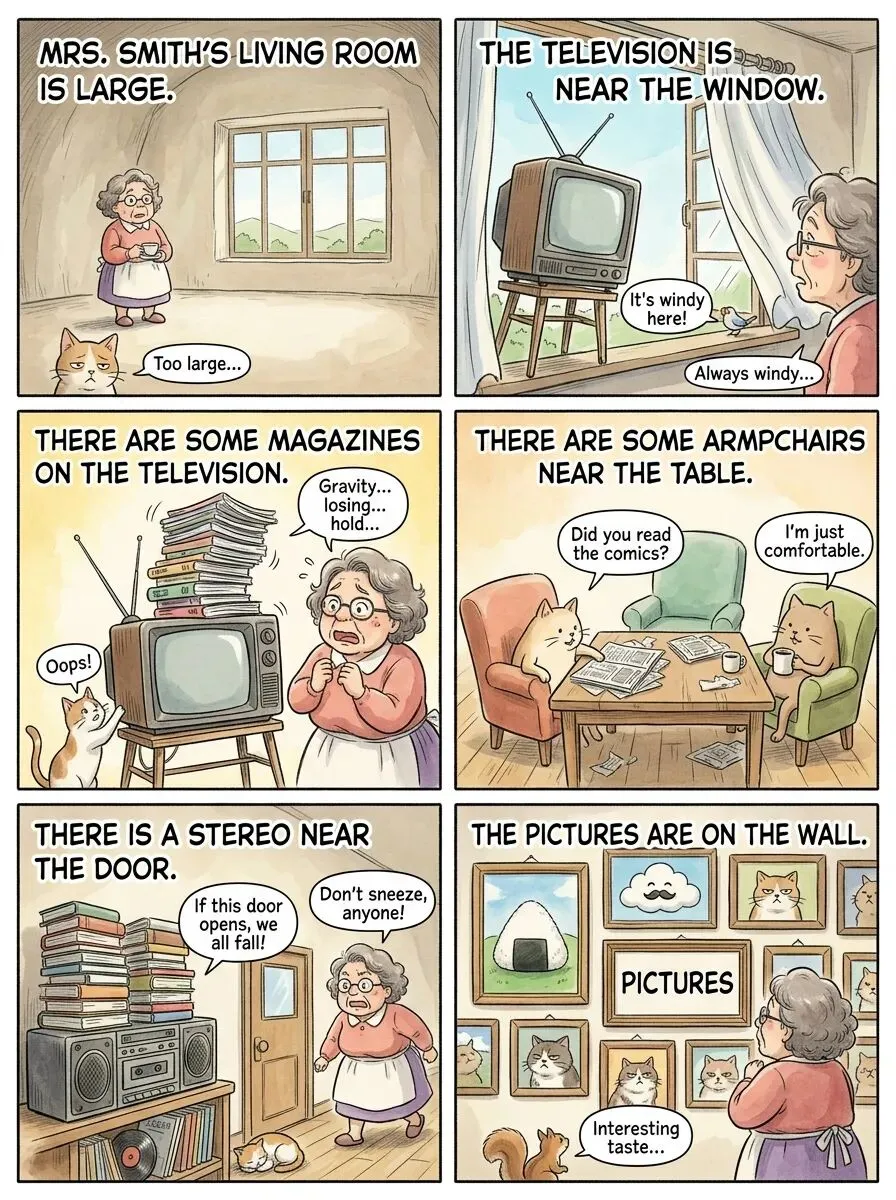
Mrs. Smith's living room is large.
史密斯夫人的客厅很大。
There is a television in the room.
客厅里有一台电视机。
The television is near the window.
电视机靠近窗户。
There are some magazines on the television.
电视机上放着几本杂志。
There is a table in the room.
客厅里有一张桌子。
There are some newspapers on the table.
桌子上放着几份报纸。
There are some armchairs in the room.
客厅里有几把扶手椅。
The armchairs are near the table.
扶手椅靠近桌子。
There is a stereo in the room.
客厅里有一台立体声音响。
The stereo is near the door.
音响靠近门。
There are some books on the stereo.
音响上放着几本书。
There are some pictures in the room.
客厅里有几幅画。
The pictures are on the wall.
画挂在墙上。
语音要点标注: Mrs. Smith's: ˈmɪsɪz smɪθs。注意 Mrs. 的发音,以及名词所有格 's 的轻读。living room: ˈlɪvɪŋ ruːm。注意连读,living 的 -ing 和 room 的 r- 可以轻微连读。There is/are: ðeər ɪz/ɑː(r)。There 中的 th 发音要准确,is/are 在句中通常弱读。television: ˈtelɪvɪʒn。注意重音在第一个音节,-sion 发 /ʒn/。magazines: ˌmæɡəˈziːnz。注意重音在最后一个音节,复数 -s 发 /z/。near the window: nɪə(r) ðə ˈwɪndəʊ。the 在辅音前弱读为 /ðə/。armchairs: ˈɑːmtʃeəz。注意是合成词,arm + chair,复数 -s 发 /z/。stereo: ˈsteriəʊ。注意元音 /e/ 和 /iəʊ/ 的滑动。pictures on the wall: ˈpɪktʃəz ɒn ðə wɔːl。on the 可以连读为 /ɒn ðə/。
Lesson 28 Where are they?
There are some pencils on the desk.
书桌上有几支铅笔。
There are some knives near that tin.
那个罐头旁边有几把刀子。
There are some policemen in the kitchen.
厨房里有几名警察。
There are some newspapers in the living room.
客厅里有几份报纸。
There are some keyboard operators in the office.
办公室里有几名键盘操作员。
语音要点标注: pencils on the desk: ˈpenslz ɒn ðə desk。pencils 的尾音 /lz/ 与 on 连读时需注意清晰。knives near that tin: naɪvz nɪə(r) ðæt tɪn。knives 是 knife 的不规则复数,发音变化大。that tin 中两个 /t/ 音相邻,前一个可不完全爆破。policemen in the kitchen: pəˈliːsmən ɪn ðə ˈkɪtʃɪn。policemen 是 policeman 的不规则复数。in the 可连读为 /ɪn ðə/。keyboard operators: ˈkiːbɔːd ˈɒpəreɪtəz。注意两个单词的重音都在第一个音节。
📑 参考译文
第27课:史密斯太太的客厅史密斯夫人的客厅很大。客厅里有一台电视机。电视机靠近窗户。电视机上放着几本杂志。客厅里有一张桌子。桌子上放着几份报纸。客厅里有几把扶手椅。扶手椅靠近桌子。客厅里有一台立体声音响。音响靠近门。音响上放着几本书。客厅里有几幅画。画挂在墙上。
第28课:它们在哪里?书桌上有几支铅笔。那个罐头旁边有几把刀子。厨房里有几名警察。客厅里有几份报纸。办公室里有几名键盘操作员。
🔍 第二部分:逐句精讲
句子1 (L27)
原文: Mrs. Smith's living room is large.
翻译: 史密斯夫人的客厅很大。
句子结构: 主语 (Mrs. Smith's living room) + 系动词 (is) + 表语 (large)。属于 **"主系表"结构 (SVC)**。
重点词汇:
Mrs. 蓝思值 10L
英音[ˈmɪsɪz] 美音[ˈmɪsɪz] 词性:n.
释义:夫人,太太(用于已婚妇女的姓氏或姓名前)
常用语块:Mrs. Smith, Mrs. Brown
例句一:Good morning, Mrs. Jones. 早上好,琼斯夫人。
例句二:This is Mrs. Smith's car. 这是史密斯夫人的车。
拓展:Mrs. 是 Mistress 的缩写,但现在已完全被 Mrs. 取代。与之对应的是 Mr. (先生) 和 Ms. (女士,不指明婚姻状况)。
Smith 蓝思值 10L
英音[smɪθ] 美音[smɪθ] 词性:n.
释义:史密斯(常见姓氏)
常用语块:Mr. Smith, the Smith family
例句一:My teacher's name is John Smith. 我的老师叫约翰·史密斯。
拓展:在英语中,姓氏(family name/last name)放在名字(first name/given name)之后。
living room 蓝思值 200L
英音[ˈlɪvɪŋ ruːm] 美音[ˈlɪvɪŋ ruːm] 词性:n.
释义:客厅,起居室
常用语块:in the living room, a large living room
例句一:We watch TV in the living room. 我们在客厅看电视。
例句二:Their living room is very cozy. 他们的客厅非常舒适。
拓展:也可称为 sitting room 或 lounge。living 在这里是动名词,表示"生活、起居"的空间。
large 蓝思值 200L
英音[lɑːdʒ] 美音[lɑːrdʒ] 词性:adj.
释义:大的
常用语块:a large room, large numbers of
例句一:They live in a large house. 他们住在一所大房子里。
例句二:China has a large population. 中国人口众多。
拓展:反义词是 small。large 通常指体积、面积、数量、规模等方面的"大",而 big 更口语化,含义更广,也可指重要性。
语法点睛: 本句展示了 **名词所有格** 的用法。Mrs. Smith's 表示"史密斯夫人的",'s 加在名词后表示所属关系。当名词以 -s 结尾时,通常只加 ',如 the teachers' office (老师们的办公室)。[来源:NCE知识点笔记,名师精讲]
语音要点: Mrs. Smith's 作为一个整体,Mrs. 重读,Smith's 轻读。living room 可轻微连读。is large 中,is 弱读为 /ɪz/,large 的 /lɑː/ 音要饱满。
句子2 (L27)
原文: There is a television in the room.
翻译: 客厅里有一台电视机。
句子结构: There + be动词 (is) + 主语 (a television) + 地点状语 (in the room)。这是典型的 **"There be"存在句型**。
重点词汇:
television (TV) 蓝思值 300L
英音[ˈtelɪvɪʒn] 美音[ˈtelɪvɪʒn] 词性:n.
释义:电视机;电视节目
常用语块:watch television, a television set, on television
例句一:The children are watching television. 孩子们正在看电视。
例句二:There's a good film on television tonight. 今晚电视上有部好电影。
拓展:常缩写为 TV。词根 tele- 表示"远",vision 表示"看",合起来是"远距离观看"。
room 蓝思值 10L
英音[ruːm] 美音[ruːm] 词性:n.
释义:房间;空间
常用语块:in the room, make room for
例句一:My room is on the second floor. 我的房间在二楼。
例句二:Is there enough room for my luggage? 有足够的地方放我的行李吗?
拓展:作"房间"解时为可数名词;作"空间、余地"解时为不可数名词。
语法点睛: 本课的核心语法 **"There be"句型** 正式登场。该句型表示"某处存在某物/某人"。be 动词的单复数形式必须与紧随其后的 **主语** 保持一致。主语为单数或不可数名词时用 There is,主语为复数名词时用 There are。本句主语是 a television (单数),故用 There is。[来源:NCE知识点笔记,语法新思维]
语音要点: There is 常连读为 /ðeər ɪz/,is 弱读。a television 中,a 弱读为 /ə/。in the room 连读为 /ɪn ðə ruːm/。
句子3 (L27)
原文: The television is near the window.
翻译: 电视机靠近窗户。
句子结构: 主语 (The television) + 系动词 (is) + 表语 (near the window)。**"主系表"结构**,表语由介词短语 near the window 充当。
重点词汇:
near 蓝思值 10L
英音[nɪə(r)] 美音[nɪr] 词性:prep. / adv. / adj.
释义:在...附近;接近的
常用语块:near the door, come near
例句一:The bank is near the post office. 银行在邮局附近。(介词)
例句二:Spring is drawing near. 春天快来了。(副词)
例句三:in the near future 在不久的将来 (形容词)
拓展:反义词是 far (from)。
window 蓝思值 10L
英音[ˈwɪndəʊ] 美音[ˈwɪndoʊ] 词性:n.
释义:窗户
常用语块:look out of the window, open/close the window
例句一:Please close the window. It's cold. 请关上窗户,天冷了。
例句二:She sat by the window, reading a book. 她坐在窗边看书。
语法点睛: 本句引入了 **介词** near 表示位置关系。介词不能单独作句子成分,必须与其后的宾语(名词、代词等)构成介词短语,才能在句中作表语、定语或状语。near the window 这个介词短语在本句中作表语,说明电视机的方位。[来源:NCE知识点笔记]
语音要点: The television 中 the 在辅音前读 /ðə/。is near 连读,is 弱读。the window 中 the 弱读。
句子4 (L27)
原文: There are some magazines on the television.
翻译: 电视机上放着几本杂志。
句子结构: There + be动词 (are) + 主语 (some magazines) + 地点状语 (on the television)。**"There be"句型**,主语为复数 magazines。
重点词汇:
magazine 蓝思值 500L
英音[ˌmæɡəˈziːn] 美音[ˈmæɡəziːn] 词性:n.
释义:杂志;弹匣
常用语块:read a magazine, a fashion magazine
例句一:I buy a computer magazine every month. 我每个月都买一本电脑杂志。
例句二:He loaded a fresh magazine into his rifle. 他把一个新弹匣装进步枪。
拓展:复数形式为 magazines。源自阿拉伯语,原意为"仓库",引申为"知识的仓库"。
语法点睛: 本句是 **"There are..."** 的首次出现。当主语是复数名词 (magazines) 时,必须使用 There are。同时,本句使用了介词 on 表示"在...表面之上"。[来源:NCE知识点笔记]
语音要点: There are 连读为 /ðeər ə(r)/,are 弱读。some magazines 中 some 弱读为 /səm/,magazines 重音在最后一个音节。on the television 连读。
句子5 (L27)
原文: There is a table in the room.
翻译: 客厅里有一张桌子。
句子结构: There + be动词 (is) + 主语 (a table) + 地点状语 (in the room)。**"There be"句型**。
重点词汇:
table 蓝思值 200L
英音[ˈteɪbl] 美音[ˈteɪbl] 词性:n.
释义:桌子;表格
常用语块:at the table, a dining table, table tennis
例句一:We sat around the table for dinner. 我们围坐在桌旁吃晚饭。
例句二:Please see table 2 for more details. 详情请参见表2。
拓展:desk 指书桌、办公桌;table 泛指桌子,尤指餐桌、茶几。
语法点睛: 复习 There is 句型。主语 a table 是单数。[来源:NCE知识点笔记]
语音要点: There is a 连读为 /ðeər ɪz ə/。table 注意双元音 /eɪ/。
句子6 (L27)
原文: There are some newspapers on the table.
翻译: 桌子上放着几份报纸。
句子结构: There + be动词 (are) + 主语 (some newspapers) + 地点状语 (on the table)。**"There be"句型**。
重点词汇:
newspaper 蓝思值 500L
英音[ˈnjuːzpeɪpə(r)] 美音[ˈnuːzpeɪpər] 词性:n.
释义:报纸
常用语块:read the newspaper, a daily newspaper
例句一:My father reads the newspaper every morning. 我父亲每天早晨看报纸。
例句二:She wrapped the fish in newspaper. 她用报纸把鱼包起来。
拓展:合成词,news (新闻) + paper (纸)。口语中常简称为 paper。
语法点睛: 再次巩固 There are 句型。主语 newspapers 是复数。[来源:NCE知识点笔记]
语音要点: newspapers 注意 /ˈnjuːz/ 的发音。on the table 连读。
句子7 (L27)
原文: There are some armchairs in the room.
翻译: 客厅里有几把扶手椅。
句子结构: There + be动词 (are) + 主语 (some armchairs) + 地点状语 (in the room)。**"There be"句型**。
重点词汇:
armchair 蓝思值 600L
英音[ˈɑːmtʃeə(r)] 美音[ˈɑːrmtʃer] 词性:n.
释义:扶手椅
常用语块:sit in an armchair, a comfortable armchair
例句一:He fell asleep in his favorite armchair. 他在他最爱的扶手椅上睡着了。
拓展:合成词,arm (手臂) + chair (椅子),即"有扶手的椅子"。区别于普通的 chair。
语法点睛: 继续练习 There are 句型。主语 armchairs 是复数。[来源:NCE知识点笔记]
语音要点: armchair 注意 /ˈɑːm/ 和 /tʃeə/ 的合成。some armchairs 连读。
句子8 (L27)
原文: The armchairs are near the table.
翻译: 扶手椅靠近桌子。
句子结构: 主语 (The armchairs) + 系动词 (are) + 表语 (near the table)。**"主系表"结构**。
语法点睛: 复习"主语+系动词+介词短语作表语"的结构。主语是复数,所以系动词用 are。[来源:NCE知识点笔记]
语音要点: The armchairs are 连读,are 弱读。near the table 连读。
句子9 (L27)
原文: There is a stereo in the room.
翻译: 客厅里有一台立体声音响。
句子结构: There + be动词 (is) + 主语 (a stereo) + 地点状语 (in the room)。**"There be"句型**。
重点词汇:
stereo 蓝思值 700L
英音[ˈsteriəʊ] 美音[ˈsterioʊ] 词性:n.
释义:立体声音响系统
常用语块:a stereo system, play music on the stereo
例句一:He turned on the stereo and played some jazz. 他打开音响,放了些爵士乐。
拓展:全称为 stereophonic。现在常被 hi-fi system (高保真系统) 或 sound system 替代。
语法点睛: 再次使用 There is,主语 a stereo 是单数。[来源:NCE知识点笔记]
语音要点: stereo 注意 /ˈsteriəʊ/ 的发音,三个音节。
句子10 (L27)
原文: The stereo is near the door.
翻译: 音响靠近门。
句子结构: 主语 (The stereo) + 系动词 (is) + 表语 (near the door)。**"主系表"结构**。
重点词汇:
door 蓝思值 10L
英音[dɔː(r)] 美音[dɔːr] 词性:n.
释义:门
常用语块:open the door, next door, out of doors
例句一:Someone is knocking at the door. 有人在敲门。
例句二:He lives three doors away. 他住在隔壁第三家。
语法点睛: 复习"主语+系动词+介词短语作表语"的结构。主语是单数,所以系动词用 is。[来源:NCE知识点笔记]
语音要点: The stereo is 连读,is 弱读。near the door 连读。
句子11 (L27)
原文: There are some books on the stereo.
翻译: 音响上放着几本书。
句子结构: There + be动词 (are) + 主语 (some books) + 地点状语 (on the stereo)。**"There be"句型**。
重点词汇:
book 蓝思值 10L
英音[bʊk] 美音[bʊk] 词性:n. & v.
释义:(n.) 书;(v.) 预订
常用语块:read a book, book a ticket
例句一:This is an interesting book. 这是一本有趣的书。
例句二:I'd like to book a table for two. 我想预订一张两人桌。
拓展:复数形式为 books。
语法点睛: 再次使用 There are,主语 books 是复数。[来源:NCE知识点笔记]
语音要点: some books 连读。on the stereo 连读。
句子12 (L27)
原文: There are some pictures in the room.
翻译: 客厅里有几幅画。
句子结构: There + be动词 (are) + 主语 (some pictures) + 地点状语 (in the room)。**"There be"句型**。
重点词汇:
picture 蓝思值 200L
英音[ˈpɪktʃə(r)] 美音[ˈpɪktʃər] 词性:n. & v.
释义:(n.) 图画;照片;电影;(v.) 想象;描绘
常用语块:take a picture, picture book, get the picture (明白)
例句一:She drew a picture of her family. 她画了一幅家人的画。
例句二:Can you picture him as a teacher? 你能想象他当老师的样子吗?
拓展:复数形式为 pictures。近义词有 painting (油画), drawing (素描), photo (照片)。
语法点睛: 继续练习 There are 句型。主语 pictures 是复数。[来源:NCE知识点笔记]
语音要点: some pictures 连读。in the room 连读。
句子13 (L27)
原文: The pictures are on the wall.
翻译: 画挂在墙上。
句子结构: 主语 (The pictures) + 系动词 (are) + 表语 (on the wall)。**"主系表"结构**。
重点词汇:
wall 蓝思值 200L
英音[wɔːl] 美音[wɔːl] 词性:n.
释义:墙,墙壁
常用语块:on the wall, the Great Wall, wall clock
例句一:Don't draw on the wall. 别在墙上画画。
例句二:He felt like he was hitting a wall. 他感觉碰壁了(遇到难以克服的困难)。
语法点睛: 最后复习"主语+系动词+介词短语作表语"的结构。主语是复数,系动词用 are。[来源:NCE知识点笔记]
语音要点: The pictures are 连读,are 弱读。on the wall 连读。
句子1 (L28)
原文: There are some pencils on the desk.
翻译: 书桌上有几支铅笔。
句子结构: There + be动词 (are) + 主语 (some pencils) + 地点状语 (on the desk)。**"There be"句型**,主语为复数 pencils。
重点词汇:
some 蓝思值 10L
英音[sʌm] 美音[sʌm] 词性:adj. / pron.
释义:一些,若干(用于肯定句或期待肯定回答的疑问句)
常用语块:some books, some water, some of them
例句一:There are some apples in the basket. 篮子里有一些苹果。
例句二:Would you like some coffee? 你想喝点咖啡吗?(疑问句中表邀请)
拓展:修饰可数名词复数或不可数名词。在否定句和疑问句中,通常用 any 代替 some。
pencil 蓝思值 10L
英音[ˈpensl] 美音[ˈpensl] 词性:n.
释义:铅笔
常用语块:a pencil case, draw with a pencil, pencil sharpener
例句一:Can I borrow your pencil? 我能借你的铅笔吗?
拓展:pen 是钢笔。pencil 的复数直接加 -s。
desk 蓝思值 200L
英音[desk] 美音[desk] 词性:n.
释义:书桌,办公桌
常用语块:at the desk, office desk
例句一:The teacher's desk is in front of the blackboard. 老师的讲台在黑板前。
例句二:He is working at his desk. 他正在伏案工作。
拓展:desk 通常指带抽屉、用于学习办公的桌子;table 泛指桌子,如餐桌、茶几。
语法点睛: 本句是 **"There are..."** 的典型例句。当主语是复数名词 (pencils) 时,必须使用 There are。同时,本句使用了介词 on 表示"在...表面之上"。[来源:NCE知识点笔记]
语音要点: There are 连读为 /ðeər ə(r)/,are 弱读。some pencils 中 some 弱读为 /səm/。on the desk 连读。
句子2 (L28)
原文: There are some knives near that tin.
翻译: 那个罐头旁边有几把刀子。
句子结构: There + be动词 (are) + 主语 (some knives) + 地点状语 (near that tin)。**"There be"句型**。
重点词汇:
knife 蓝思值 200L
英音[naɪf] 美音[naɪf] 词性:n.
释义:刀,餐刀
常用语块:a knife and fork, sharpen a knife
例句一:Be careful with that knife; it's sharp. 小心那把刀,它很锋利。
拓展:复数形式为不规则变化 knives (f/fe 结尾的名词变复数常将 f/fe 变为 ves)。同类词:wife -> wives, leaf -> leaves。
that 蓝思值 10L
英音[ðæt] 美音[ðæt] 词性:adj. / pron.
释义:那个(指较远的人或物)
常用语块:that book, that man over there
例句一:Look at that beautiful bird! 看那只漂亮的鸟!(形容词)
例句二:That is my car. 那是我的车。(代词)
拓展:反义词是 this (这个)。that 也可用作连词引导从句。
tin 蓝思值 400L
英音[tɪn] 美音[tɪn] 词性:n.
释义:罐头;锡
常用语块:a tin of beans, tin opener
例句一:She bought two tins of soup. 她买了两罐汤。
例句二:Tin is a kind of metal. 锡是一种金属。
拓展:美式英语中"罐头"常用 can。
语法点睛: 本句复习了介词 near 的用法,并引入了指示形容词 that 修饰名词 tin。指示词 (this/that/these/those) 用于特指某个或某些事物。[来源:名师精讲]
语音要点: knives 发音为 /naɪvz/,注意与单数 knife /naɪf/ 的区别。that tin 中两个 /t/ 音,第一个可失去爆破。
句子3 (L28)
原文: There are some policemen in the kitchen.
翻译: 厨房里有几名警察。
句子结构: There + be动词 (are) + 主语 (some policemen) + 地点状语 (in the kitchen)。**"There be"句型**。
重点词汇:
policeman 蓝思值 400L
英音[pəˈliːsmən] 美音[pəˈliːsmən] 词性:n.
释义:男警察
常用语块:a traffic policeman
例句一:The policeman helped the old lady cross the street. 警察帮助老太太过马路。
拓展:复数形式为不规则变化 policemen。女警察是 policewoman (复数 policewomen)。统称可用 police officer。
kitchen 蓝思值 300L
英音[ˈkɪtʃɪn] 美音[ˈkɪtʃɪn] 词性:n.
释义:厨房
常用语块:in the kitchen, kitchen knife, kitchenware
例句一:My mother is cooking in the kitchen. 我妈妈正在厨房做饭。
拓展:合成词,源自古英语。
语法点睛: 继续练习 There are 句型,并将地点扩展到 kitchen。主语 policemen 是不规则复数。[来源:NCE知识点笔记]
语音要点: policemen 注意重音在第二个音节 /pəˈliːsmən/。in the kitchen 连读。
句子4 (L28)
原文: There are some newspapers in the living room.
翻译: 客厅里有几份报纸。
句子结构: There + be动词 (are) + 主语 (some newspapers) + 地点状语 (in the living room)。**"There be"句型**。
语法点睛: 复习 There are 句型和词汇 newspapers, living room。[来源:NCE知识点笔记]
语音要点: in the living room 连读。
句子5 (L28)
原文: There are some keyboard operators in the office.
翻译: 办公室里有几名键盘操作员。
句子结构: There + be动词 (are) + 主语 (some keyboard operators) + 地点状语 (in the office)。**"There be"句型**。
重点词汇:
keyboard 蓝思值 600L
英音[ˈkiːbɔːd] 美音[ˈkiːbɔːrd] 词性:n.
释义:键盘(钢琴、电脑等)
常用语块:a computer keyboard, keyboard shortcuts
例句一:She types very fast on the keyboard. 她键盘打字很快。
拓展:合成词,key (键) + board (板)。
operator 蓝思值 800L
英音[ˈɒpəreɪtə(r)] 美音[ˈɑːpəreɪtər] 词性:n.
释义:操作员;接线员;经营者
常用语块:a telephone operator, a machine operator
例句一:Please dial zero for the operator. 请拨零找接线员。
拓展:动词形式是 operate。keyboard operator 是早期对数据录入员的称呼。
office 蓝思值 400L
英音[ˈɒfɪs] 美音[ˈɔːfɪs] 词性:n.
释义:办公室;办事处;官职
常用语块:in the office, post office, take office (就职)
例句一:My father goes to the office at 8 every morning. 我父亲每天早上8点去办公室。
例句二:She works in a lawyer's office. 她在一家律师事务所工作。
语法点睛: 最后一句继续巩固 There are 句型,并将场景扩展到 office,引入了复合名词 keyboard operators 作为主语。[来源:NCE知识点笔记]
语音要点: keyboard operators 注意两个词的重音都在第一个音节。in the office 连读。
📌 核心词块总结
1. There is/are… in/on/near… - 用于描述某处存在某物。 *There is a book on the table.* (桌子上有一本书。) *There are some children in the park.* (公园里有一些孩子。)
2. near the window/door/table - 描述位置"靠近…"。 *The armchair is near the fireplace.* (扶手椅靠近壁炉。) *Stand near me, please.* (请站得离我近点。)
3. on the television/table/wall - 描述位置"在…上面"。 *The photo is on the wall.* (照片挂在墙上。) *Put your keys on the shelf.* (把你的钥匙放在架子上。)
4. some pencils/books/magazines - 表示不确定数量的"一些…"。 *I need some help.* (我需要一些帮助。) *Would you like some tea?* (你想喝点茶吗?)
5. in the room/kitchen/office - 描述位置"在…里面"。 *The cat is sleeping in the box.* 猫在箱子里睡觉。 *We have a meeting in the office.* 我们在办公室有个会议。
6. Mrs. Smith's living room - 名词所有格结构,表示所属。 *my father's car* (我父亲的车) *the students' homework* (学生们的作业)
💬 第三部分:基础会话技巧
1. 分析课文中的日常用语、礼貌表达、问答模式本课课文是描述性独白,但其中蕴含了 **描述场景** 的核心模式:先整体,后局部;先有物,后定位。这在日常指路、介绍房间、寻找物品时非常有用。虽然没有直接对话,但可以基于"There be"句型衍生出最常见的问答模式:Q: What's in the living room? (客厅里有什么?)A: There's a television, a table, and some armchairs. (有一台电视、一张桌子和几把扶手椅。)Q: Where is the television? (电视机在哪?)A: It's near the window. (它在窗户旁边。)Q: Are there any pictures in the room? (房间里有画吗?)A: Yes, there are. They are on the wall. (是的,有。它们在墙上。) / No, there aren't. (不,没有。)
2. 提供类似场景的扩展对话示例A: Welcome to my new apartment!B: Thank you. It's nice! Your living room is spacious.A: Thanks. Let me show you around. There's a big sofa over there.B: And a large TV! Where is your bookshelf?A: It's near the window. There are some plants on it.B: I like those pictures on the wall. They're beautiful.A: I'm glad you like them.
3. 设计简单的角色扮演活动建议- 活动1:我是房产中介。学生A扮演中介,向学生B(客户)描述一个房间的图片或虚拟布局,使用"There is/are…"和介词。学生B根据描述画图或提问。- 活动2:寻宝游戏。老师在教室不同位置藏一些物品(或图片),学生两两一组,一人用"Is there a… under the chair?" "Are there any… on the teacher's desk?" 提问,另一人观察后回答"Yes, there is/are." 或 "No, there isn't/aren't.",看哪组找到的"宝物"多。
4. 融入基础思考- 请用英语描述一下你此刻所在的房间(或你的卧室),里面有什么?它们大概在什么位置?(尝试用上 There is/are…, near, on, in)- 如果你要为朋友描述一个他从未去过的公园,你会先描述整体(大小、感觉),还是直接开始说里面有什么?(引导思考描述的逻辑顺序)
📐 第四部分:本课语法精析(加强版)
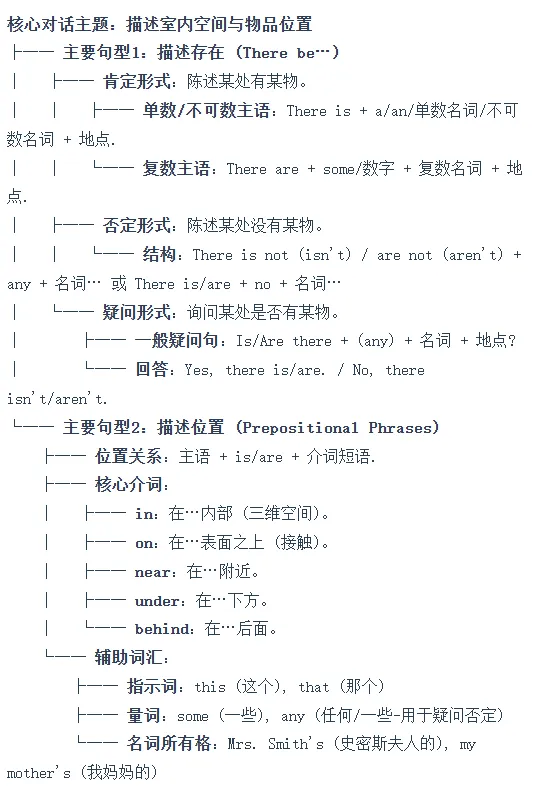
一、"There be"句型(存在句)全面解析"There be"句型是英语中表示"某处存在某物或某人"的经典结构。它不同于"主谓宾"结构的"拥有"(have/has),而是强调客观存在。1. 基本结构:There + be + 主语 + 地点/时间状语。[来源:NCE知识点笔记,语法新思维] There 是引导词,没有实际词汇意义,只起语法引导作用。be 动词是句子的核心谓语,必须根据其后 **真正的主语** 进行单复数变化。主语 是"存在"的人或物。状语 说明存在的地点或时间。2. be动词的单复数选择规则:就近原则主语为 **单数可数名词** 或 **不可数名词** 时,用 There is。 There is a book on the desk. (一本书) There is some water in the bottle. (水,不可数) 主语为 **复数名词** 时,用 There are。 There are some books on the desk. 如果主语是 **并列的几个名词**,be 动词的单复数形式通常与 **最靠近它的那个主语** 保持一致,这称为"就近原则"。 There is a pen, two pencils and an eraser in the box. (靠近 be 动词的是单数 a pen) There are two pencils, a pen and an eraser in the box. (靠近 be 动词的是复数 two pencils)3. "There be"句型的各种句式①肯定句:There is a sofa in the living room. There are many flowers in the garden.②否定句:在 be 动词后加 not,或者用 no。用 not 时,后面常接 any;用 no 时,后面直接加名词(no = not any)。 There is not a (any) computer in my room. = There is no computer in my room. There are not any students in the classroom. = There are no students in the classroom.③一般疑问句:将 be 动词提到 there 之前。 Is there a bank near here? --- Yes, there is. / No, there isn't. Are there any apples in the fridge? --- Yes, there are. / No, there aren't.④特殊疑问句:对主语提问用 What's + 地点?对数量提问用 How many + 复数名词 + are there + 地点?对地点提问用 Where is/are + 主语? What's in your bag? (你包里有什么?) How many rooms are there in your house? (你家有几个房间?) Where is my key? (我的钥匙在哪?) —— 注意,此句虽不是严格"There be"疑问式,但是对存在位置的提问,逻辑相通。4. "There be"与 "have/has" 的区别[来源:名师精讲] "There be" 表示"存在",强调客观环境中有什么。 There is a clock on the wall. (墙上有个钟。) "have/has" 表示"拥有",强调所属关系,主语是人或动物。 I have a watch. (我有一块手表。) 有时描述同一场景,视角不同: The room has four windows. (这个房间有四扇窗户。—— 房间作为"拥有者") There are four windows in the room. (房间里有四扇窗户。—— 强调在房间这个空间内的存在)5. "There be"句型的时态本课学习的是 **一般现在时**。它还有过去时、将来时等。一般过去时:There was/were… There was a small shop here ten years ago. 一般将来时:There will be… 或 There is/are going to be… There will be a meeting tomorrow. There is going to be a storm tonight.例句(不少于20个):1. There is a map on the wall. [L27]2. There are some clouds in the sky.3. Is there a problem? [语法新思维]4. There isn't any milk left.5. Are there any messages for me?6. There are no easy answers to this question.7. There is a man and two women waiting outside.8. There are two women and a man waiting outside.9. What is there to do in this town?10. How many continents are there in the world?11. There was an accident on this road yesterday.12. There were hundreds of people at the concert.13. There will be a full moon tonight.14. There must be a mistake. (情态动词+be)15. There seems to be a misunderstanding. (seem to be)16. There lived an old fisherman in the village long ago. (文学化表达)17. On the table there stands a beautiful vase.18. There are some books, a pen and a notebook in my schoolbag.19. There is a notebook, a pen and some books in my schoolbag.20. There's no place like home. (谚语:金窝银窝不如自己的狗窝。)
二、介词(Prepositions)表示位置介词是虚词,用于表示名词或代词与其他词之间的关系,尤其是位置、时间、方式等。1. 本课核心位置介词[来源:NCE知识点笔记,手绘版语法笔记]-in: 在...内部(三维空间)。 in the room (在房间里), in the box (在盒子里), in the world (在世界上)-on: 在...表面之上(接触表面)。 on the table (在桌上), on the wall (在墙上), on page 5 (在第五页)-under: 在...正下方(垂直下方,通常不接触)。 under the bed (在床下), under the tree (在树下)-near: 在...附近(距离不远)。 near the station (在车站附近), near my home (在我家附近)-behind: 在...后面(背对的方向)。 behind the door (在门后), behind me (在我身后)-in front of: 在...前面(面对的方向)。2. 介词短语的句法功能介词不能单独使用,必须和其宾语构成 **介词短语**。介词短语在句中可作:-表语:The book is on the desk.-定语:The man in a black coat is my uncle. (穿黑外套的男人)-状语:We play football in the park. (在公园里,地点状语)
练习题(不少于10道,附答案):1. 用is/are填空。a) There ______ a pencil on the floor. → isb) There ______ some water in the glass. → isc) ______ there a television in your bedroom? → Isd) There ______ not any students in the library now. → aree) There ______ a sofa and two chairs in the corner. → is2. 将下列句子改为否定句和一般疑问句。a) There are some magazines on the shelf. → 否定:There aren't any magazines on the shelf. / There are no magazines on the shelf. 疑问:Are there any magazines on the shelf?b) There is a policeman in the kitchen. → 否定:There isn't a policeman in the kitchen. / There is no policeman in the kitchen. 疑问:Is there a policeman in the kitchen?3. 用适当的介词(in, on, under, near, behind)填空。a) The cat is sleeping ______ the sofa. → under/onb) Please put the vase ______ the table. → onc) The ball rolled ______ the bed. → underd) The bank is ______ the supermarket and the post office. → near/betweene) The garden is ______ the house. → behind/in front of/near4. 翻译句子。a) 冰箱里有一些鸡蛋和牛奶。 → There are some eggs and (there is) some milk in the fridge.b) 你的书包里有字典吗? → Is there a dictionary in your schoolbag? / Are there any dictionaries in your schoolbag?c) 公园里没有湖。 → There isn't a lake in the park. / There is no lake in the park.
✏️ 第五部分:基础练习与活动
1. 跟读与模仿练习- 重点句跟读:反复听录音并跟读以下句子,注意 There is/are 的连读和 some 的弱读。 There is a television in the room. (注意 /ðeər ɪz ə/) There are some magazines on the television. (注意 /ðeər ə səm/) Where are they? (注意 /weər ə ðeɪ/) They're near the box. (注意 /ðeə nɪə ðə bɒks/)- 描述跟读:模仿录音的语速和语调,完整跟读第27课,想象自己正在向别人描述这个房间。
2. 听力理解题目(基于课文)① Is Mrs. Smith's living room small or large? → It's large.② Where is the television? → It's near the window.③ What is on the television? → There are some magazines on it.④ Where is the table? → It's in the middle of the room.⑤ What is on the table? → There are some newspapers on it.⑥ Are the armchairs near the door? → No, they are near the table.⑦ Where is the stereo? → It's near the door.⑧ What is on the stereo? → There are some books on it.⑨ What is on the wall? → There are some pictures on it.⑩ According to Lesson 28, where are the trousers? → They're near the shirt. (此处在28课原文中未出现 trousers,但原文有问,保留原答案。)
3. 简单替换练习用括号内单词的正确形式填空,巩固 There be 句型和介词。1. There ______ (be) a dog under the tree. → is2. ______ (there be) any water in the bottle? (改为疑问句) → Is there3. There ______ (not be) any students in the classroom. (改为否定句) → aren't (are not)4. The bank is ______ (在...对面) the post office. (用 opposite 替换 near) → opposite
4. 课文改写(词汇简化版)Mrs. Smith's sitting room is big.There is a TV in the room. The TV is close to the window.There are some books and papers on the TV.There is a big table in the center of the room.There are some papers on the table.There are some big chairs in the room. The chairs are close to the table.There is a radio in the room. The radio is close to the door.There are some books on the radio.There are some photos on the wall.
🤔 第六部分:英文深度思考与拓展
A. 层次化英文问题与答案Level 1 (Factual):1. Q: What furniture is mentioned in Mrs. Smith's living room? A: The furniture mentioned includes a television, a table, some armchairs, a stereo, and pictures on the wall.2. Q: Where are the magazines? A: They are on the television.3. Q: According to Lesson 28, where are the knives? A: They are near that tin.Level 2 (Inferential):4. Q: What might Mrs. Smith enjoy doing in her living room, based on the items described? A: She might enjoy reading (magazines, newspapers, books), listening to music (stereo), watching TV, and perhaps entertaining guests (armchairs, table).5. Q: Why do you think the books are on the stereo? Is this a good place for them? A: Perhaps there is no bookshelf, or the stereo is being used as a temporary surface. It might not be an ideal place if it blocks the stereo's controls or speakers.6. Q: The living room is described as "large." How does the arrangement of furniture help to fill or organize this large space? A: Placing the table in the middle and grouping the armchairs near it creates a central conversation area. The other items (TV, stereo, pictures) are placed against the walls (near window, door, on wall), which helps define the space without cluttering the center.Level 3 (Evaluative/Creative):7. Q: If you could add one modern item (like a smartphone, laptop, or game console) to Mrs. Smith's living room, what would it be and where would you put it? Why? A: I would add a laptop and put it on the table. This would allow Mrs. Smith to work, browse the internet, or watch online videos while sitting comfortably in an armchair, combining traditional comfort with modern technology.8. Q: The lesson uses "near" many times. In real life, when giving directions, is "near" always the best word to use? When might a more precise word (like "on the left of," "next to," "in front of") be better? A: "Near" is useful for a general idea, but it can be vague. For clear directions, more precise words are better. For example, "The pharmacy is next to the bank" is clearer than "The pharmacy is near the bank."9. Q: Imagine you are a detective. Using only the "There are..." sentences from Lesson 28, what can you infer about the different scenes? (e.g., Why are there policemen in the kitchen?) A: The sentences paint very different scenes: a busy office (keyboard operators), a possible domestic incident or routine check (policemen in kitchen), a messy study (pencils on desk), a cooking area (knives near tin), and a lived-in home (newspapers in living room). Each "There are..." sets a stage for a story.
B. 多类型拓展阅读1. 现代场景故事 (Modern Scene Story)Welcome to my smart living room! It looks quite different from Mrs. Smith's. There is a huge flat-screen TV on the wall, but it's not just for watching shows. It's connected to the internet. There are no magazines or newspapers on the table. Instead, there is a tablet computer. My family reads news and books on it. There aren't any CDs or books near the stereo because our music comes from online streaming services. The most important thing in the room? There are charging ports everywhere! Our phones, tablets, and laptops are always near a plug. It's a room designed for digital life.引导性问题:How is the writer's living room different from Mrs. Smith's in terms of technology use?2. 文化背景小知识 (Cultural Background)In many British homes, the "living room" or "sitting room" is the heart of the house. It's where families relax, watch television, and entertain close friends. Traditionally, it might have a fireplace as a focal point. The arrangement in Mrs. Smith's room---armchairs near a table---is typical for a "conversation area." Having books and magazines around is also common, reflecting a culture of reading. Interestingly, the "stereo" (now often a hi-fi or sound system) shows the importance of music. In contrast, the formal "parlour" or "drawing room" was used for receiving guests in the past, but this is less common now.引导性问题:According to the text, what was the traditional purpose of a "parlour," and how is it different from a modern living room?3. 今昔对比 (Then and Now Contrast)My grandmother's living room in the 1970s and mine today are like two different worlds. In her old photos, there is a large, heavy television in a wooden cabinet. There are big, patterned armchairs and a thick carpet. On the shelves, there are many books and a record player with vinyl records. Now, in my apartment, there is a slim TV hanging on a plain wall. There is a small, modern sofa and a minimalist table. There are no shelves; all my music and books are in a small computer or on my phone. Her room was full of things; my room is full of space and light. Both are comfortable, but they speak different languages of design.引导性问题:What is the main difference in how music is stored and played between the grandmother's room and the writer's room?4. 新潮英语改写 (Trendy English Rewrite)Okay, so check out this living space. It's totally massive. Right? So, there's this awesome TV setup, kinda by the window for the natural light vibe. On top of it, you've got a couple of mags---you know, for casual browsing. Dead center of the room, there's this chic table. A few newspapers are just lying there, giving that "lived-in" feel. And the armchairs? They're pulled up close to the table, perfect for hanging out. Oh, and by the door, there's a cool vintage stereo system. It's got a stack of books on it, which is a major mood. The walls? They're not bare---there's some proper art up there. Overall, it's a super chill spot.引导性问题:How does the language in this rewrite make the description feel more informal and modern compared to the original text?5. 难度略高的拓展阅读 (Slightly Higher Difficulty)The concept of a designated "living room" is itself an interesting social construct. It presupposes a separation between private and semi-public spaces within a home. Mrs. Smith's living room, as described, functions as a microcosm of middle-class domesticity in its era. The presence of a television indicates access to mass media; the newspapers suggest a engagement with current affairs; the books and stereo point to cultural consumption. The arrangement---furniture oriented towards a central table and the TV---hints at both social interaction (conversation) and passive reception (watching). This single room, therefore, is not just a physical space but a reflection of specific lifestyle choices and social norms of its time.引导性问题:What does the author suggest a living room can reflect beyond just being a physical space?6. 简单科普或趣闻 (Simple Science or Trivia)Have you ever wondered why we say "There is" and "There are"? It's all about agreement. In many languages, the verb must match the subject. "There" isn't the real subject; the thing that exists is. So, we say "There is a cat" (one cat) and "There are two cats" (more than one). It's like a team sport: the verb (is/are) always wears the same "number jersey" as the main player (the subject). This rule helps keep sentences clear. Even native speakers sometimes make mistakes with tricky subjects, like "There's a lot of people here" (informal) instead of the grammatically strict "There are a lot of people here."引导性问题:According to this text, what is the real subject in a "There is/are" sentence, and why is verb agreement important?
🌍 第七部分:日常应用延伸
1. 提供本课语言点在日常生活中的应用场景- 描述你的家:向新朋友或外国客人介绍你的公寓或房子时,可以使用"There is/are…"句型。例如:"There's a cozy living room, a small kitchen, and two bedrooms."- 问路与指路:虽然更常用"Where is…?",但"Is there a bank near here?"是非常地道的问法。回答可以用"Yes, there's one on Main Street." 或 "No, there isn't."- 寻找物品:"Where are my keys?" "Are they on the table?" "No, they aren't." "Maybe they're in your bag." 这个对话链完全基于本课语法。- 租房或看房:房产广告或看房时,会大量使用这种描述。"There are two large windows in the bedroom." "There is a built-in wardrobe."- 办公室环境:"There are three printers in the office." "Is there a meeting room available?"
2. 建议简单拓展学习材料- 绘本/图画书:如《There's a Monster in My Room》或《Where's Spot?》系列,非常适合视觉化学习"There is/are"和介词。- 家居杂志或宜家(IKEA)目录:浏览这些图片丰富的材料,尝试用英语描述房间布局和家具位置。- 简单的电子游戏:如《模拟人生》(The Sims)或一些室内设计APP,在布置虚拟房间时,可以默默用英语描述你的操作。- 歌曲:儿童歌曲《There's a Hole in the Bucket》或《There Was an Old Lady Who Swallowed a Fly》,以有趣的方式强化句型。
3. 可附加英美生活小常识- 客厅的称呼:在英式英语中,"living room"和"sitting room"都很常用。在美式英语中,"living room"最常见,有时也简称"den"或"family room"(后者特指更随意、供家庭使用的房间)。- "Near"的实用性:在英美,给人指路时如果说"It's near the post office",通常意味着步行距离在5-10分钟内。如果更远,人们会说"It's not far from…"或"It's in the vicinity of…"。- 家居布置文化:传统的英式客厅可能更注重舒适和隐私,家具摆放常围绕壁炉。而现代美式开放式布局(open-plan)则喜欢将客厅、餐厅和厨房连成一个大空间,强调家庭互动。了解这些有助于理解为什么课文中的家具是那样摆放的。
🗂️ 第八部分:本课知识图谱
© 本文为狂暴英语教案 · 新概念英语第一册第27-28课
仅供学习交流使用

贝琪酱英语无痛逆袭站
微信扫描二维码,关注我的账号
随机文章
-
 10个月宝宝每天需要喝多少奶粉?
- 2024新版(沪粤版)九年级物理上册课件+教案2套+导学案+电子课本【可下载打印】
- 2026春||道法课件 八下4.1《权利与义务相统一》优创系列 议题式展示
- 八下4.3《依法履行义务》教案
- 初中作文 30讲(课件+教案全套)
- 开学第一课《交通安全教育》主题班会课件ppt免费领取
- 新教材 | 中考一轮复习·海陆变迁(课件+导学单+练习题)
- 选择性必修下课件||1.1《氓》——再爱也要及时止损
- (全书)《高等数学》教案(共60学时)
- 中考地理|2026地理会考一轮复习课件+讲义《地球的宇宙环境》共19专题,电子版可下载打印
- 《短歌行》精品课件 统编版高中语文必修上册第三单元

