读外刊,接触原汁原味的英文表达,
欢迎关注以下公众号+设为星标+推荐给朋友。▼
📚 狂暴英语教案 · 新概念英语第二册
第40课 Food and talk
食物与交谈
📘 本课信息教材:新概念英语第二册 · 第40课核心功能:社交尴尬 · 幽默叙事 · 人物描写语法焦点:间接引语(时态后移) · 第二类条件句 · 将来进行时
🎯 本课学习目标
词汇目标:
掌握约15个核心词汇及短语,重点理解并运用描述社交场合、人物性格与对话的词汇,如 dinner party, tight-lipped, despair, globe 等。学习与“谈话”、“食物”主题相关的词块。
语法目标:
深入掌握间接引语(Reported Speech)中时态、人称和指示词的转换规则。巩固情态动词 must 表示推测的用法。理解并运用 as soon as 引导的时间状语从句。
技能目标(段落写作):
学习如何通过细节描写(如人物动作、对话、心理活动)来构建一个完整的叙事段落,描述一次社交经历。掌握从“场景设定”到“事件发展”再到“结果与感受”的叙事逻辑。
文化目标:
了解西方正式社交场合(如晚宴)的基本礼仪、座位安排以及谈话艺术,理解“small talk”(寒暄)在社交中的重要性及可能遇到的尴尬情境。
📖 第一部分:课文完整内容
课文原文
📜 课文原文
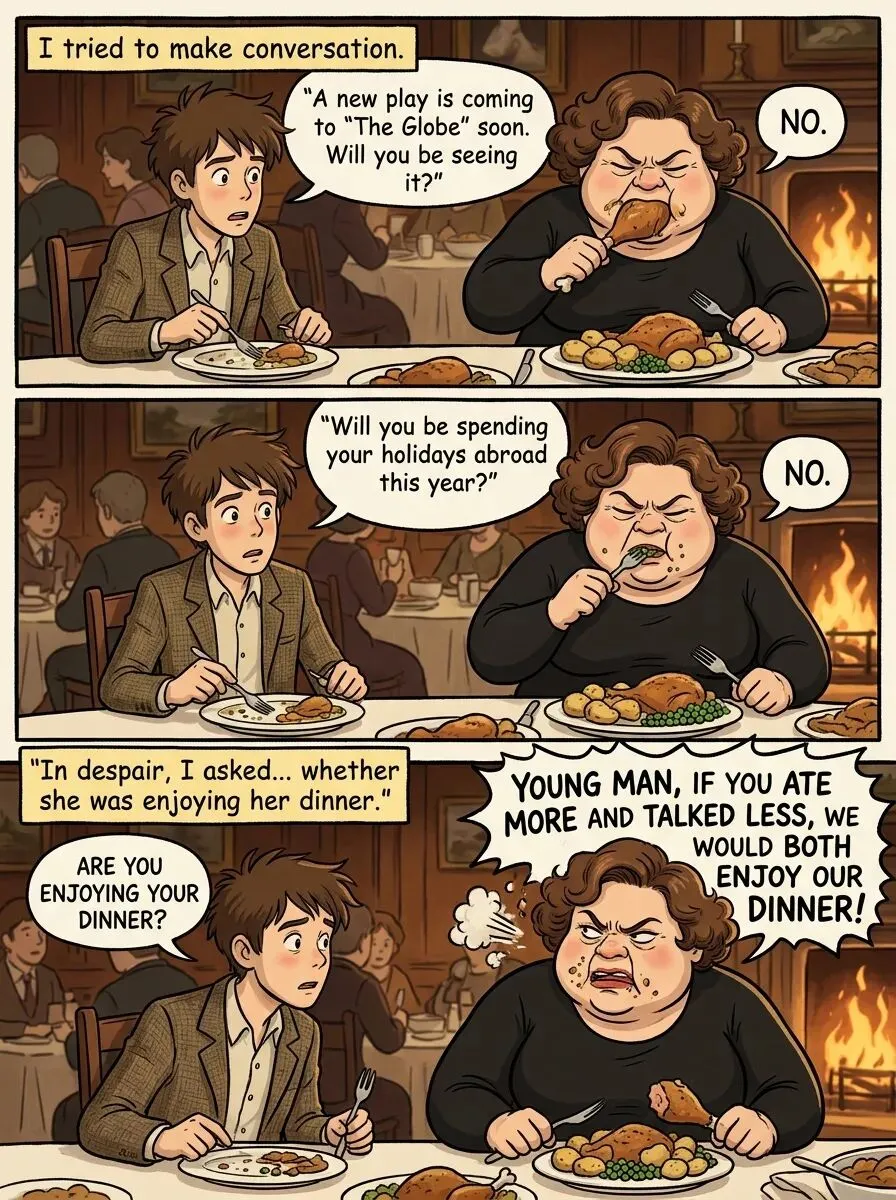
Last week at a dinner party, the hostess asked me to sit next to Mrs. Rumbold. Mrs. Rumbold was a large, unsmiling lady in a tight black dress. She did not even look up when I took my seat beside her. Her eyes were fixed on her plate and in a short time, she was busy eating. I tried to make conversation.'A new play is coming to "The Globe" soon,' I said. 'Will you be seeing it?''No,' she answered.'Will you be spending your holidays abroad this year?' I asked.'No,' she answered.'Will you be staying in England?' I asked.'No,' she answered.In despair, I asked her whether she was enjoying her dinner.'Young man,' she answered, 'if you ate more and talked less, we would both enjoy our dinner!'
背景简介:本课课文选自《新概念英语》第二册,是一篇幽默的叙事短文。它描绘了在一次正式晚宴上,“我”被安排坐在一位沉默寡言的女士旁边,并试图展开对话却屡屡碰壁的尴尬经历。故事通过简洁的对话和生动的细节,刻画了人物性格,反映了社交场合中可能出现的沟通困境,最后以女士一句犀利的回应达到幽默高潮。作者L.G.亚历山大擅长通过日常生活场景来呈现语言点和文化差异。
参考译文:上星期我去参加一次晚宴,女主人安排我坐在兰伯尔德夫人的身旁。兰伯尔德夫人是一位身材高大、表情严肃的女人,穿一件紧身的黑衣服。当我在她身旁坐下的时候,她甚至连头都没有抬一下。她的眼睛盯着自己的盘子,不一会儿就忙着吃起来了。我试图找个话题和她聊聊。“一出新剧要来‘环球剧场’上演了,”我说,“您去看吗?”“不,”她回答。“您今年去国外度假吗?”我又问。“不,”她回答。“您就呆在英国吗?”我问。“不,”她回答。失望之中我问她饭是否吃得满意。“年轻人,”她回答说,“如果你多吃点,少说点,我们两个都会吃得好的!”
🔍 第二部分:逐句精讲与词块总结
句子1
原文: Last week at a dinner party, the hostess asked me to sit next to Mrs. Rumbold.
翻译: 上星期在一次晚宴上,女主人让我坐在兰伯尔德夫人旁边。
句子结构: 这是一个简单句。主干为 the hostess asked me to sit next to Mrs. Rumbold。Last week at a dinner party 为时间状语和地点状语。
重点词汇:
dinner party 蓝思值 600L
英音[ˈdɪnə ˈpɑːti] 美音[ˈdɪnər ˈpɑːrti] 词性:名词短语
释义:晚宴;宴会
常用语块:at a dinner party (在晚宴上);host/hostess a dinner party (举办晚宴)
短语搭配:a formal dinner party (正式晚宴);a dinner party invitation (晚宴请柬)
例句一:They are having a dinner party to celebrate their anniversary. 他们正在举办晚宴庆祝周年纪念。
例句二:I met several interesting people at the dinner party last night. 我在昨晚的晚宴上遇到了几个有趣的人。
拓展:dinner 指一天中的主餐,通常在晚上,因此 dinner party 多指晚间举行的正式或半正式社交聚会。区别于 lunch party (午宴) 或 cocktail party (鸡尾酒会)。
hostess 蓝思值 700L
英音[ˈhəʊstəs] 美音[ˈhoʊstəs] 词性:名词
释义:女主人;(餐馆、飞机等的)女服务员
常用语块:the hostess asked... (女主要求...)
短语搭配:air hostess (空姐,现多用 flight attendant);a charming hostess (迷人的女主人)
例句一:Our hostess made sure everyone had enough to eat and drink. 我们的女主人确保每个人都有足够的食物和饮料。
例句二:She is an excellent hostess who always makes her guests feel welcome. 她是一位出色的女主人,总是让客人感到宾至如归。
拓展:对应词为 host (男主人)。派生词:host v. 主办,主持 (如 host a meeting)。
ask sb. to do sth. 蓝思值 400L
词性:动词短语
释义:要求/请某人做某事
常用语块:核心搭配即为本身。
短语搭配:politely ask sb. to do sth. (礼貌地请某人做某事)
例句一:The teacher asked the students to be quiet. 老师要求学生们安静。
例句二:He asked me to help him with his luggage. 他请我帮他拿行李。
拓展:注意与 ask sb. for sth. (向某人要某物) 的区别。ask 后接宾语再加不定式是常见结构,表示发出指令或请求。
语法点睛: 本句包含一个“动词+宾语+带to的不定式”结构 (asked me to sit)。这是英语中常见的使役或请求结构。类似的动词还有 tell, want, advise, expect, order, allow 等。例如:She told him to wait. He wants me to go with him. [NCE知识点笔记]
句子2
原文: Mrs. Rumbold was a large, unsmiling lady in a tight black dress.
翻译: 兰伯尔德夫人是一位身材高大、表情严肃的女人,穿一件紧身的黑衣服。
句子结构: 简单句,主系表结构。Mrs. Rumbold 是主语,was 是系动词,a large, unsmiling lady 是表语,in a tight black dress 是介词短语作后置定语,修饰 lady。
重点词汇:
unsmiling 蓝思值 900L
英音[ʌnˈsmaɪlɪŋ] 美音[ʌnˈsmaɪlɪŋ] 词性:形容词
释义:不笑的;严肃的
常用语块:an unsmiling face/expression (严肃的面孔/表情)
短语搭配:unsmiling and aloof (严肃而冷漠的)
例句一:The guard at the gate was unsmiling and checked our IDs carefully. 门口的警卫表情严肃,仔细检查了我们的身份证。
例句二:He is often unsmiling in public, but very warm with friends. 他在公共场合通常不苟言笑,但对朋友却很热情。
拓展:由否定前缀 un- 加动词 smile 的现在分词 smiling 构成,意为“不微笑的”。同义词:serious, stern, grim。反义词:smiling, cheerful。
tight 蓝思值 650L
英音[taɪt] 美音[taɪt] 词性:形容词
释义:紧的;牢固的;严格的
常用语块:a tight dress/schedule/budget (紧身的衣服/紧张的日程/紧张的预算)
短语搭配:tight security (严密安保);in a tight corner (处于困境);tight-lipped (守口如瓶的,本课后续出现)
例句一:These shoes are too tight; they hurt my feet. 这双鞋太紧了,挤得我脚疼。
例句二:We have a tight deadline to meet. 我们要赶一个很紧的截止日期。
拓展:副词形式为 tightly。反义词:loose (宽松的)。注意:在非正式口语中,tight 可直接作副词,如 hold tight (抓紧),但正式写作中通常用 tightly。
语法点睛: 多个形容词修饰名词时的顺序问题。本句中 large (大小) 和 unsmiling (表情/观点) 共同修饰 lady。英语中形容词顺序通常遵循:观点形容词 (opinion) + 尺寸大小 (size) + 形状 (shape) + 条件 (condition) + 年龄 (age) + 颜色 (color) + 图案 (pattern) + 来源 (origin) + 材料 (material) + 用途 (purpose) + 名词。例如:a beautiful large round old brown Chinese wooden dining table。本课是相对简单的组合。[名师精讲]
句子3
原文: She did not even look up when I took my seat beside her.
翻译: 当我在她身旁坐下的时候,她甚至连头都没有抬一下。
句子结构: 复合句。主句是 She did not even look up,when I took my seat beside her 是时间状语从句。
重点词汇:
look up 蓝思值 500L
英音[lʊk ʌp] 美音[lʊk ʌp] 词性:动词短语
释义:抬头看;查阅;好转
常用语块:look up from sth. (从...上抬起头);look up a word (查单词)
短语搭配:look up to sb. (尊敬某人);look sb. up (拜访某人)
例句一:He was so absorbed in his book that he didn't look up when I entered. 他读书太入神了,我进来时他头都没抬。
例句二:If you don't know the meaning, look it up in the dictionary. 如果你不知道意思,就查字典。
拓展:本课取字面意思“向上看”。look up 作为“查阅”解时,宾语常为 word, number, information等。
take one's seat 蓝思值 700L
英音[teɪk wʌnz siːt] 美音[teɪk wʌnz siːt] 词性:动词短语
释义:就座;坐下
常用语块:核心搭配即为本身。
短语搭配:please take your seats (请就座,正式用语)
例句一:The audience took their seats before the concert began. 观众们在音乐会开始前就座。
例句二:After being introduced, he took his seat at the table. 被介绍后,他在桌旁坐下。
拓展:比 sit down 更正式。seat 在此是名词。be seated 是更正式的表达,意为“请坐”,如 Ladies and gentlemen, please be seated.
语法点睛: when 引导的时间状语从句。主句动作 (did not look up) 和从句动作 (took my seat) 同时发生。when 可以表示“当......时”,强调时间点。注意从句中使用了一般过去时 (took),与主句时态一致。[NCE知识点笔记]
句子4
原文: Her eyes were fixed on her plate and in a short time, she was busy eating.
翻译: 她的眼睛盯着自己的盘子,不一会儿就忙着吃起来了。
句子结构: 并列句。由连词 and 连接两个分句:1) Her eyes were fixed on her plate;2) in a short time, she was busy eating。
重点词汇:
be fixed on 蓝思值 750L
英音[biː fɪkst ɒn] 美音[biː fɪkst ɑːn] 词性:动词短语
释义:固定在......上;凝视;专注于
常用语块:eyes are fixed on... (目光固定在...上)
短语搭配:fix one's attention/eyes/mind on sth. (将注意力/目光/心思集中在某物上)
例句一:The cat's eyes were fixed on the moving mouse. 猫的眼睛紧盯着移动的老鼠。
例句二:All his hopes are fixed on winning the scholarship. 他所有的希望都寄托在赢得奖学金上。
拓展:fix 本义为“固定”,be fixed on 是被动形式,表示状态。主动形式为 fix sth. on...。
be busy doing sth. 蓝思值 450L
英音[biː ˈbɪzi ˈduːɪŋ ˈsʌmθɪŋ] 美音[biː ˈbɪzi ˈduːɪŋ ˈsʌmθɪŋ] 词性:动词短语
释义:忙于做某事
常用语块:核心搭配即为本身。
短语搭配:be busy with sth. (忙于某事,后接名词)
例句一:She is busy preparing for her exams. 她正忙于准备考试。
例句二:The workers were busy building the new road. 工人们正忙着修建新路。
拓展:这是 busy 的常用结构之一。doing 是现在分词,表示正在进行的动作。不能误用为 be busy to do sth.。
语法点睛: 被动语态 (were fixed) 表示状态。be busy + doing 结构。注意 busy 后接动词时,必须用 -ing 形式 (动名词)。[NCE知识点笔记]
句子5
原文: I tried to make conversation.
翻译: 我试图找个话题和她聊聊。
句子结构: 简单句。I 是主语,tried 是谓语,to make conversation 是不定式短语作宾语。
重点词汇:
make conversation 蓝思值 700L
英音[meɪk ˌkɒnvəˈseɪʃn] 美音[meɪk ˌkɑːnvərˈseɪʃn] 词性:动词短语
释义:交谈;攀谈;没话找话(尤指与不熟的人)
常用语块:核心搭配即为本身。
短语搭配:make polite conversation (进行礼貌性的交谈);struggle to make conversation (费力地找话题)
例句一:At the party, I didn't know anyone, so I just tried to make conversation with the person next to me. 在聚会上我谁也不认识,所以就试着和旁边的人聊天。
例句二:He's not very good at making conversation with strangers. 他不擅长和陌生人交谈。
拓展:强调为了打破沉默或出于礼貌而主动发起的谈话,有时带有一点“勉强”或“刻意”的意味。区别于自然的 have a conversation。
语法点睛: try to do sth. 表示“努力、试图做某事”,强调尝试的过程。try doing sth. 表示“尝试做某事(看看效果如何)”。例如:I tried to open the window. (我努力试图打开窗。可能没成功)。I tried opening the window. (我试着打开了窗。看看是否能让房间凉快些)。[名师精讲]
句子6
原文: 'A new play is coming to "The Globe" soon,' I said.
翻译: “一出新剧要来‘环球剧场’上演了,”我说。
句子结构: 直接引语 + 主句。直接引语部分是一个简单句:A new play (主语) is coming (谓语) to “The Globe” (状语) soon (状语)。
重点词汇:
The Globe 蓝思值 950L
英音[ðə ɡləʊb] 美音[ðə ɡloʊb] 词性:专有名词
释义:环球剧场(伦敦著名的莎士比亚剧场)
常用语块:come to The Globe (在环球剧场上演)
短语搭配:Shakespeare's Globe (莎士比亚环球剧场)
例句一:We went to see “Hamlet” at the Globe Theatre last summer. 去年夏天我们去环球剧场看了《哈姆雷特》。
例句二:The Globe is a reconstruction of the Elizabethan playhouse. 环球剧场是伊丽莎白时期剧场的重建。
拓展:文化背景知识。原环球剧场建于1599年,莎士比亚许多剧作在此首演。1613年毁于火灾,后重建。现在的环球剧场是1997年重建的,位于伦敦泰晤士河南岸。
语法点睛: 现在进行时 (is coming) 表示近期计划或安排好的将来动作。这种用法常用于表示“来”、“去”、“离开”、“到达”等移动动词,如 go, come, leave, start, arrive 等。例如:He is leaving for Paris tomorrow. The train is arriving in five minutes. [NCE知识点笔记]
句子7 & 8 & 9 & 10 (对话部分)
原文: 'Will you be seeing it?' ... 'No,' she answered. 'Will you be spending your holidays abroad this year?' ... 'No,' she answered. 'Will you be staying in England?' ... 'No,' she answered.
翻译: “您去看吗?”......“不,”她回答。“您今年去国外度假吗?”......“不,”她回答。“您就呆在英国吗?”......“不,”她回答。
句子结构: 一系列直接引语构成的对话。问句都是将来进行时 (Will you be doing...?) 的一般疑问句。
重点词汇:
will be doing (将来进行时结构) 蓝思值 800L
词性:动词时态结构
释义:将来进行时,表示在将来某一时间点或时间段正在进行的动作。
常用语块:Will you be doing...? (你将会在做...吗?)
短语搭配:this time tomorrow, I will be flying to New York. (明天这个时候,我将在飞往纽约的途中。)
例句一:Will you be using the computer this evening? 今晚你会用电脑吗?
例句二:Don't call me at 8 p.m.; I'll be having dinner with my family. 晚上八点别给我打电话;我那时正在和家人吃晚饭。
拓展:将来进行时除了表示将来某个时间正在进行的动作外,还可用于礼貌地询问别人的计划,比单纯用 will do 更委婉、更不确定,给对方留有空间。这正是本课中“我”使用的策略,试图开启话题。
abroad 蓝思值 550L
英音[əˈbrɔːd] 美音[əˈbrɔːd] 词性:副词
释义:在国外;到国外
常用语块:go/travel/live abroad (出国/去国外旅行/住在国外)
短语搭配:at home and abroad (国内外);study abroad program (留学项目)
例句一:She has worked abroad for many years. 她在国外工作了很多年。
例句二:More and more students choose to study abroad. 越来越多的学生选择出国留学。
拓展:abroad 是副词,前面不能加介词。不能说 go to abroad,只能说 go abroad。名词形式需要其他词,如 foreign countries。
语法点睛: 将来进行时 (Will you be seeing...?) 的疑问句形式。这里用来询问对方未来的计划或安排,语气比 Will you see it? 更随意、更礼貌。同时,这一连串的“Will you be doing...?” 和简短生硬的“No”回答形成了鲜明的节奏对比,凸显了对话的尴尬和单方面努力。[语法新思维]
句子11
原文: In despair, I asked her whether she was enjoying her dinner.
翻译: 失望之中我问她饭是否吃得满意。
句子结构: 复合句。主句是 I asked her,whether she was enjoying her dinner 是宾语从句,作 asked 的直接宾语。In despair 是介词短语作状语。
重点词汇:
in despair 蓝思值 850L
英音[ɪn dɪˈspeə(r)] 美音[ɪn dɪˈsper] 词性:介词短语
释义:绝望地;在绝望中
常用语块:核心搭配即为本身。
短语搭配:cry/sink in despair (绝望地哭泣/陷入绝望)
例句一:After failing the exam for the third time, he gave up in despair. 第三次考试失败后,他绝望地放弃了。
例句二:She looked around in despair for someone to help. 她绝望地环顾四周,寻找能帮忙的人。
拓展:despair 是不可数名词。动词形式为 despair (of),如 He despaired of ever finding a job. (他对找到工作已不抱希望。)
whether 蓝思值 600L
英音[ˈweðə(r)] 美音[ˈweðər] 词性:连词
释义:是否
常用语块:ask/wonder/know whether... (询问/想知道/知道是否...)
短语搭配:whether... or not (是否;无论是否)
例句一:I'm not sure whether I can come tomorrow. 我不确定明天是否能来。
例句二:The question is whether the plan is feasible. 问题在于这个计划是否可行。
拓展:引导名词性从句(宾语从句、主语从句、表语从句等)时,whether 和 if 常可互换,但 whether 更正式,且可以引导主语从句、表语从句,或与 or not 连用,或用在介词后。if 通常只引导宾语从句。
语法点睛: 间接引语(宾语从句)的用法。本句中,asked 后的宾语从句由 whether 引导,表示“是否”。从句的时态 (was enjoying) 与主句动词 (asked) 的过去时态保持一致,这是间接引语时态后移的规则之一。同时,这也是一个“动词+间接宾语+直接宾语”的结构 (asked her whether...),her 是间接宾语,whether 从句是直接宾语。[NCE知识点笔记]
句子12
原文: 'Young man,' she answered, 'if you ate more and talked less, we would both enjoy our dinner!'
翻译: “年轻人,”她回答说,“如果你多吃点,少说点,我们两个都会吃得好的!”
句子结构: 直接引语中包含一个 if 引导的条件状语从句。引语的主干是 we would both enjoy our dinner。if you ate more and talked less 是条件从句。
重点词汇:
would enjoy 蓝思值 650L
词性:情态动词would + 动词原形
释义:会享受(用于虚拟语气或委婉表达)
常用语块:在虚拟条件句中构成主句谓语。
短语搭配:would do sth. if... (如果...就会做某事)
例句一:I would travel the world if I had enough money. 如果我有足够的钱,我会环游世界。
例句二:It would be nice if you could join us. 如果你能加入我们就好了。
拓展:本句中 would enjoy 用于非真实条件句(第二类条件句),表示与现在事实相反的假设。从句用一般过去时 (ate, talked),主句用 would + 动词原形。
语法点睛:第二类条件句(非真实条件句)。结构:If + 主语 + 动词过去式 (be动词用were) ..., 主语 + would/should/could/might + 动词原形 ...。这种句型表示与现在事实相反的假设,或实现可能性不大的将来假设。本课中,女士用此句型提出一个假设性建议,实则委婉而尖锐地批评“我”话太多。它并非完全不可能,但表达了她的强烈愿望和对当前状况(“我”说太多)的不满。例如:If I were you, I would accept the offer. (如果我是你,我会接受这个提议。)[名师精讲][语法新思维]
📌 核心词块总结
1. at a dinner party: Being present at a formal evening social gathering. E.g., I first met him at a dinner party last year.
2. ask sb. to do sth.: To request or instruct someone to perform an action. E.g., Can I ask you to close the window?
3. take one's seat: To sit down in one's assigned or chosen place, especially in a formal setting. E.g., Guests are requested to take their seats by 7 p.m.
4. be busy doing sth.: To be actively occupied with a particular activity. E.g., She was busy writing her report all morning.
5. make conversation: To talk to someone, especially someone you do not know well, in order to be polite. E.g., He found it hard to make conversation with her parents.
6. Will you be doing...?: A polite way to inquire about someone's future plans, using the future continuous tense. E.g., Will you be attending the meeting tomorrow?
7. in despair: Feeling or showing the complete loss of hope. E.g., He threw the book down in despair.
8. If you did..., you/would...: The structure of the second conditional, used to talk about hypothetical or unlikely situations in the present or future. E.g., If you practiced more, your English would improve faster.
✍️ 第三部分:语篇分析与段落写作技巧
1. 语篇分析①识别宏观结构 (Identify the macrostructure):本文是一个完整的微型叙事(mini-narrative)。结构清晰:背景设定(Sentence 1-2: 时间、地点、人物介绍) →冲突发展(Sentence 3-5: 对方的冷漠与“我”的尝试) →核心冲突/上升动作(Sentence 6-11: 一连串失败的对话尝试,尴尬升级) →高潮与结局(Sentence 12: 对方给出犀利回应,幽默收尾)。这是一个典型的“设定-冲突-解决”叙事弧。②列举衔接手段 (List cohesive devices):*时间衔接:Last week, when I took my seat, in a short time, soon.*逻辑衔接:and (并列), even (强调), In despair (因果/总结)。*指代衔接:she, her, I, me, it (指代play), we 等代词贯穿全文,指代清晰。*词汇复现:围绕“dinner”和“talk/conversation”展开,如 dinner party, plate, eating, dinner; make conversation, said, asked, answered, talked。③分析作者态度 (Analyze the author's attitude): 作者通过细节描写传达出人物的态度和叙事的幽默基调。对Mrs. Rumbold的描写 (large, unsmiling, did not even look up, eyes were fixed, busy eating, 简短生硬的 No) 生动刻画了她的冷漠、不善交际甚至有些粗鲁。对“我”的描写 (tried to make conversation, In despair) 则表现了我的礼貌、努力以及最终的无奈。最后一句Mrs. Rumbold的回应,虽然尖锐,但以其出人意料和直白产生了幽默效果。作者的整体态度是略带自嘲的,描绘了一个常见的社交窘境。
2. 写作技巧①提炼写作逻辑:本课展示了如何写一个关于“尴尬社交经历”的段落。逻辑链条为:引入场景(何时何地遇见谁) →描述对方(外貌、举止,建立第一印象) →叙述互动(你的主动行为,对方的反应,形成对比和冲突) →推向高潮(互动失败,你的感受或对方的最终反应) →结果/感想(事情如何结束,你学到了什么或有何感想)。这种逻辑适用于许多个人经历叙述。②提供段落写作范例:Topic: An Unsuccessful Attempt at Small TalkLast month, I found myself sitting next to a complete stranger on a long-haul flight. He was a middle-aged man with headphones on, staring intently at his laptop screen. After an hour of silence, I decided to break the ice. “Is this your first time visiting London?” I asked with a friendly smile. He briefly glanced at me, muttered “No,” and immediately looked back at his screen. Undeterred, I tried again. “The weather there can be quite unpredictable, don't you think?” This time, he simply gave a slight shrug without saying a word. Feeling a bit awkward, I finally asked if he was working on something important. He sighed, closed his laptop, and said, “I was, until now.” I took the hint, smiled apologetically, and spent the rest of the flight in quiet contemplation, learning that not everyone is in the mood for a chat, and that's perfectly okay.结构分析:第一句设定场景(航班,陌生人)。第二句描述对方(外貌,动作)。第三句转折,写“我”的主动(决定打破沉默)。第四、五、六句是第一次互动尝试及失败反应。第七、八句是第二次尝试及更冷淡的反应。第九、十句是第三次尝试及对方明确的拒绝(高潮)。最后一句是结果和感想(“我”的反思)。③布置小练笔并提供例文:小练笔:请模仿课文结构,写一个约120词的段落,描述一次你试图与一个沉默或不善交际的人沟通的经历(例如:新同学、安静的邻居、严肃的面试官等)。需包含场景、人物描写、你的主动行动、对方的反应以及最终结果或你的感受。例文:During my first week at the new university, I noticed a classmate who always sat alone in the corner of the library. His name was Leo, and he seemed completely absorbed in his physics textbooks. One afternoon, gathering my courage, I walked over and asked if the seat opposite him was taken. He shook his head without looking up. I sat down and, after a few minutes, commented on the difficult assignment we had been given. He merely nodded, his eyes still fixed on a complex equation. I then asked which professor he recommended for the advanced course. This time, he looked at me, his expression unreadable. “Professor Blake,” he said quietly, “but only if you're serious.” Then he went back to his work. I felt both dismissed and curiously respected. Leo wasn't unfriendly, just intensely focused. Our interaction, though brief, taught me to appreciate different styles of communication.语言点映射:* seemed completely absorbed in (对应课文 was busy eating, 表示专注)* without looking up (对应课文 did not even look up)* merely nodded (对应课文简短回答 No)* his eyes still fixed on (对应课文 Her eyes were fixed on)* his expression unreadable (对应课文 unsmiling lady)* said quietly (对应冷淡的对话风格)* 最后一句的感想(对应从经历中学习)。
📐 第四部分:本课语法精析(加强版)
本课语法重点聚焦于间接引语(Reported Speech)和第二类条件句(The Second Conditional)。以下讲解将综合知识库中多份资料的核心内容。
1. 间接引语(Reported Speech)详解 [NCE知识点笔记][名师精讲][语法新思维]间接引语用于转述他人的话,不用引号,通常以 that (可省略), whether/if, what, when 等词引导的从句形式出现。(1) 时态变化规则(时态后移):当主句引述动词(如 said, told, asked, wondered)为过去时态时,从句时态通常要向后推移一个时态。- 直接引语:“Ienjoythe dinner.” (一般现在时)间接引语:He said (that) heenjoyedthe dinner. (一般过去时)- 直接引语:“Iam enjoyingthe dinner.” (现在进行时)间接引语:He said (that) hewas enjoyingthe dinner. (过去进行时)(本课例句:I asked her whether she was enjoying her dinner.)- 直接引语:“Ihave finished.” (现在完成时)间接引语:He said (that) hehad finished. (过去完成时)- 直接引语:“Iwill goabroad.” (一般将来时)间接引语:He said (that) hewould goabroad. (过去将来时)- 直接引语:“Ican help.” (情态动词现在式)间接引语:He said (that) hecould help. (情态动词过去式)(2) 人称、指示词和时间状语的变化:- I, me, my, mine → he/she, him/her, his/her, his/hers- we, us, our, ours → they, them, their, theirs- you, your, yours → I/me/my/mine 或 he/she/him/her等- this, these → that, those- here → there- now → then, at that time- today → that day- yesterday → the day before, the previous day- tomorrow → the next/following day- last week → the week before- next year → the following year例句:“I likethisbookhere.” → He said he likedthatbookthere.例句:“I saw heryesterday.” → He said he had seen herthe day before.(3) 疑问句的间接引语:-一般疑问句:用 whether 或 if 引导,语序变为陈述句语序。“Are you tired?” → He askedif/whether I was tired.-特殊疑问句:用原疑问词引导,语序变为陈述句语序。“Where do you live?” → He askedwhere I lived.(本课例句:I asked her whether she was enjoying her dinner.)这是一个由一般疑问句转述而来的间接引语。(4) 与第一册相关语法点的对比分析:第一册主要接触直接引语,即原封不动地用引号引出某人说的话,如 He says, “I am busy.” 重点在于学习引号的使用和简单的转述动词 (say, ask)。第二册本课开始系统引入间接引语,这是一个重要的升级。学生需要理解两者之间的转换关系,掌握时态、人称、语序等复杂的综合变化规则,这是从简单引用到复杂转述的关键一步。
2. 第二类条件句(The Second Conditional)[名师精讲][语法新思维](1) 结构与功能:结构:If + 主语 + 动词过去式 (be动词通常用were) ..., 主语 + would/should/could/might + 动词原形 ...功能:表示与现在事实相反的假设,或实现可能性很小的将来假设。它描述的是一个非真实或想象的情景。(本课核心例句:If you ate more and talked less, we would both enjoy our dinner!)女士说这句话时,事实是“你正在说很多话,吃得少”,所以她假设了一个相反的情况。这个假设在说话时刻并非现实,因此用了第二类条件句。(2) 例句详解(不少于25个例句):1. If Iwereyou, Iwould acceptthat job offer. (事实:我不是你。)2. If hehadmore time, hewould travelaround the world. (事实:他现在没有更多时间。)3. If itdidn't rainso much here, the citywould bea nicer place to live. (事实:这里经常下雨。)4. If Iknewher phone number, Iwould callher. (事实:我不知道她的号码。)5. Theywould buya house if theycould affordit. (事实:他们买不起。)6. Whatwouldyoudoif youwonthe lottery? (假设一个可能性极小的将来事件。)7. If youpracticedthe piano every day, youwould playmuch better. (事实:你没有每天练习。)8. If dogscould talk, lifewould bemuch more interesting. (与现在事实相反的幻想。)9. Shewouldn't beso stressed if shemanagedher time better. (事实:她时间管理不好。)10. If welivedcloser to the coast, wecould goto the beach every weekend. (事实:我们住得离海岸不近。)11. If the internetwent downglobally, the worldwould bein chaos. (一个想象的极端情况。)12. Iwould helpyou with your homework if Iweren'tso busy myself. (事实:我很忙。)13. If this computerwerefaster, Iwould finishthe work sooner. (事实:电脑不快。)14. If youatemore vegetables, youmight feelhealthier. (建议,但暗示对方现在吃得不多。)15. If Ihada magic wand, Iwould solveall the world's problems. (纯粹的幻想。)16. Hewould bea great teacher if heweremore patient. (事实:他不够耐心。)17. If youdidn't spendso much on coffee, youcould savea lot of money. (事实:你咖啡花销大。)18. If the weatherwerenicer today, wewould havea picnic. (事实:今天天气不好。)19. If shespokeEnglish fluently, shecould geta better job. (事实:她英语不流利。)20. Whatwouldhappen if everyonerecycledtheir waste? (假设一个理想但未普及的情况。)21. If Iunderstoodthis formula, Iwould explainit to you. (事实:我不理解。)22. If youlistenedmore carefully, youwouldn't makeso many mistakes. (事实:你听得不仔细。)23. If theyinvestedin renewable energy, the countrywould beless dependent on oil. (事实:他们没有投资。)24. If this roomwerebigger, wecould invitemore people to the party. (事实:房间小。)25. If youaskedher politely, shemight agreeto help. (委婉的建议,暗示一种可能性。)(3) 与第一类条件句(真实条件句)的对比:第一类条件句:If + 主语 + 动词现在式 ..., 主语 + will/can/may + 动词原形 ... 表示基于现在情况的、很可能实现的将来条件。- If itrainstomorrow, Iwill stayat home. (明天可能会下雨,这是真实可能。)第二类条件句:If + 主语 + 动词过去式 ..., 主语 + would/could/might + 动词原形 ... 表示与现在事实相反或实现可能性很小的假设。- If itrainedevery day, Iwould bevery depressed. (事实是并非天天下雨,这是非真实假设。)对比两者,关键在于判断条件是“真实可能”还是“非真实/想象”。
3. 语法练习题(不少于12道)一、间接引语练习:将下列直接引语改为间接引语。1. John said, “I am reading an interesting book.”2. Mary asked Tom, “Do you like classical music?”3. The teacher said to us, “You must finish this exercise by tomorrow.”4. He said, “I will call you later tonight.”5. She asked me, “Where did you buy this dress?”6. “I have never been to Paris,” he told me.7. My father said, “I can't find my glasses.”8. They asked, “When is the next train leaving?”9. “Don't touch that wire!” the electrician warned us.10. “I might be late for the meeting,” she said.二、条件句练习:用动词的正确形式填空(区分第一类或第二类条件句)。11. If I ______ (see) him tomorrow, I ______ (give) him your message. (很可能见到)12. If I ______ (be) a bird, I ______ (fly) to you. (不可能实现)答案解析:1. John said (that) hewas readingan interesting book. (现在进行时→过去进行时)2. Mary asked Tomif/whether he likedclassical music. (一般疑问句,时态后移)3. The teacher told us (that) wehad to finishthat exercise by the next day. (must 可变为 had to,时间状语变化)4. He said (that) hewould callme later that night. (一般将来时→过去将来时,时间状语变化)5. She asked mewhere I had boughtthat dress. (特殊疑问句,时态后移,指示词变化)6. He told me (that) hehad never beento Paris. (现在完成时→过去完成时)7. My father said (that) hecouldn't findhis glasses. (can't → couldn't)8. They askedwhen the next train was leaving. (特殊疑问句,时态后移)9. The electrician warned usnot to touchthat wire. (祈使句转间接引语,用不定式)10. She said (that) shemight belate for the meeting. (might 情态动词过去式本身可不变)11.see; will give(第一类条件句,真实可能)12.were; would fly (第二类条件句,与现在事实相反,be动词用were)
🎧 第五部分:听力与阅读策略训练
1. 听力技巧本课课文录音语速适中,语调生动,能很好地体现人物的情绪。训练步骤如下:①预测关键词 (Predict key words):听录音前,看标题“Food and talk”,预测话题可能围绕“宴会”、“饮食”、“对话”、“尴尬”展开。关键词可能包括:dinner party, hostess, sit next to, conversation, asked, answered, enjoy 等。②抓主旨大意 (Grasp the main idea):第一遍听,不看课文,回答整体问题:What is the story mainly about? (e.g., It's about a man's awkward attempt to make conversation with a silent lady at a dinner party.)③笔记方法 (Note-taking method):第二遍听,尝试记下关键信息点,可采用列表形式:*Setting:Last week, dinner party.*People:Narrator (I), Hostess, Mrs. Rumbold (large, unsmiling, tight black dress).*Action:Sat next to her. She didn't look up, fixed eyes on plate, busy eating.*Conversation attempts:- Topic 1: New play at The Globe? → Answer: No.- Topic 2: Holidays abroad? → Answer: No.- Topic 3: Stay in England? → Answer: No.*Result: Narrator in despair, asked if she enjoyed dinner. Her final reply: “If you ate more and talked less, we would both enjoy our dinner!”
2. 阅读理解策略①扫读 (Scanning):快速阅读课文,找出以下具体信息,不超过30秒:a) What was Mrs. Rumbold wearing?b) How many questions did the narrator ask Mrs. Rumbold?c) What was the last question he asked?②略读 (Skimming):用1分钟快速浏览全文,总结段落大意:The narrator describes an awkward encounter with a silent woman at a social event.③推断词义 (Inferring word meaning):根据上下文推断划线词的含义。* “She was a large,unsmilinglady.” (从 large 和后续她的行为可推断 unsmiling 意为“不笑的、严肃的”。)* “Indespair, I asked her...” (从前面连续三个“No”的回答和“我”的努力落空,可推断 despair 意为“绝望、失望”。)* “...if you ate more and talked less, we would bothenjoy our dinner!” (从整个语境和 would 的使用,可推断 enjoy 在此意为“享受、吃得愉快”,是一种假设的更好结果。)
📝 第六部分:习题讲解
(基于《官方教材之新概念英语练习详解 第2册.pdf》及学生用书)本课课后练习通常包括:摘要写作 (Summary writing)、关键句型 (Key structures)、难点 (Special difficulties)、多项选择 (Multiple choice questions)等。
1. 摘要写作 (Summary writing)题目要点: 用不超过80个词概括课文,要点包括:被安排坐在Rumbold夫人旁边,她的外貌和举止,“我”试图聊天并问了四个问题,她简短的回答,以及她最后的建议。解题思路: 抓住叙事主线,省略细节描写(如衣服颜色、剧场的名字),用简洁的语言串联起因、经过、结果。使用间接引语转述对话。参考摘要: At a dinner party, the hostess asked the writer to sit next to Mrs. Rumbold, a large, unsmiling lady. She ignored him and started eating. He tried to make conversation by asking about a new play, her holiday plans, and whether she was staying in England. She answered 'No' to each question. In despair, he asked if she was enjoying her dinner. She replied that if he ate more and talked less, they would both enjoy it. (79 words)
2. 关键句型 (Key structures) -- 间接引语与条件句练习练习会聚焦于将课文中直接引语部分改为间接引语,以及练习第二类条件句的构成。例如: 将 “Will you be seeing the new play?” he asked. 改为间接引语。答案: He asked if/whether she would be seeing the new play.解析: 一般疑问句改为 if/whether 引导的宾语从句,人称从 you 变为 she,时态从 will be seeing 变为 would be seeing,语序变为陈述句语序。
3. 难点 (Special difficulties) -- 词汇辨析可能涉及 ask 与 ask for 的区别,whether 与 if 的用法,say 与 tell 的用法等。例如: 用 say 或 tell 填空:He didn't _____ me what happened. He _____ nothing.答案: tell; said解析: tell 通常需要接一个间接宾语 (tell sb. sth.),而 say 侧重说话内容,常用 say sth. to sb. 或直接接引语。
4. 多项选择题讲解以教材中可能出现的题目为例:The writer asked Mrs. Rumbold about her holidays because he wanted to _____.a) take a holiday himselfb) go abroadc) make conversationd) find out about her plans答案: c) make conversation.解析: 根据上下文,“我”问问题是为了打破沉默、进行交谈 (make conversation),而非真正关心她的假期计划。这是理解人物动机的题。
🤔 第七部分:英文深度思考与拓展(强化版)
A. 层次化英文问题与答案① Level 1 (Factual): 事实性问题1. Q: Where did the story take place?A: The story took place at a dinner party.2. Q: Who asked the narrator to sit next to Mrs. Rumbold?A: The hostess of the dinner party asked him to sit next to Mrs. Rumbold.3. Q: What did the narrator ask Mrs. Rumbold about first?A: He first asked her if she would be seeing a new play coming to “The Globe”.4. Q: How did Mrs. Rumbold answer most of the narrator's questions?A: She answered most of his questions with a simple and blunt “No”.5. Q: What was Mrs. Rumbold's final piece of advice to the narrator?A: Her final advice was that if he ate more and talked less, they would both enjoy their dinner.② Level 2 (Inferential): 推理性问题1. Q: Why do you think Mrs. Rumbold did not look up when the narrator sat down?A: It can be inferred that Mrs. Rumbold was either extremely focused on her food, deliberately ignoring the narrator to avoid conversation, or simply had poor social manners and lacked interest in interacting with a stranger.2. Q: What does the narrator's choice of conversation topics reveal about his strategy?A: His choice of topics (theatre, travel, local plans) reveals that he was trying to use common, neutral, and potentially interesting subjects to engage a stranger in polite “small talk,” which is a standard social strategy in Western cultures.3. Q: How might the narrator have felt after Mrs. Rumbold's final remark, and why?A: He likely felt embarrassed, rebuffed, and perhaps a bit amused at the irony of the situation. He tried so hard to be sociable, only to be told that his attempts were the very thing spoiling the meal. There might also be a feeling of frustration at the failed interaction.4. Q: Is Mrs. Rumbold's behavior considered polite in a typical Western dinner party setting? Why or why not?A: Generally, no. While one is not obliged to be deeply engaging, basic politeness at a dinner party includes acknowledging the person seated next to you, making minimal eye contact, and responding to direct questions with more than a monosyllabic answer to avoid creating an awkward atmosphere. Her behavior would be seen as rude or very antisocial.5. Q: What does the repeated use of “No” without any elaboration achieve in the story?A: It creates a strong rhythmic pattern that emphasizes the one-sidedness of the conversation, builds up the narrator's frustration and desperation, and heightens the comic effect by making Mrs. Rumbold's character exceptionally and consistently uncommunicative.③ Level 3 (Evaluative): 评价性问题1. Q: Who do you think was more at fault for the awkward situation, the narrator or Mrs. Rumbold? Justify your opinion.A: This is subjective. One could argue Mrs. Rumbold was more at fault for her outright refusal to participate in basic social reciprocity, making any attempt at conversation doomed. Alternatively, one could argue the narrator was at fault for persisting with questions after clear signals of disinterest, failing to read the room and respect her desire for silence. A balanced view might be that the hostess shares some blame for seating two seemingly incompatible people together.2. Q: Could the narrator have handled the situation better? If so, how?A: Possibly. After one or two brief, unanswered attempts, he could have taken the hint and simply enjoyed his meal in silence, perhaps with a polite smile. Alternatively, he could have made a single observational comment about the food itself (a safe topic at a dinner) and then stopped if unreciprocated. Persisting with multiple questions might have escalated the awkwardness.3. Q: What does this story teach us about cross-cultural or interpersonal communication?A: It highlights that communication is a two-way street requiring effort from both parties. It also touches on the concept of “small talk” as a social lubricant that isn't universally valued or practiced in the same way. The story reminds us that people have different communication styles and comfort levels, and misalignment can lead to humorous or uncomfortable situations.4. Q: Imagine you are Mrs. Rumbold. Write a brief inner monologue explaining your thoughts and feelings during this encounter.A: (Example) “Finally, a quiet moment to enjoy this excellent roast. Oh no, the hostess is seating someone next to me. A young man. Please don't talk to me. I'm tired, I just want to eat. He's talking. About a play? No. Holidays? No. England? No. Can't he see I'm eating? Now he's asking if I'm enjoying the dinner! The irony. The dinner is fine, but his constant chatter is ruining it. That's it. 'Young man, if you ate more and talked less, we would both enjoy our dinner!' Maybe now I can have some peace.”5. Q: Is the ending of the story truly humorous, or is it more sarcastic and critical? Discuss the tone.A: The ending is humorous in a dry, British style. The humor arises from the unexpected bluntness of Mrs. Rumbold's response after her passive silence, and the perfect logic of it within the context of a dinner party. It's sarcastic from her perspective, but the overall narrative tone set by the author is light-hearted and observational, inviting the reader to laugh at a relatable social faux pas rather than condemning either character severely.
B. 多类型拓展阅读1. 时事新闻拓展 (Current News Extension)Title: The Art of Small Talk in the Digital AgeIn an era dominated by smartphones and social media, the traditional skill of “small talk” is facing a crisis. A recent survey by a social research institute found that over 60% of young adults feel anxious about initiating conversations with strangers at events like dinner parties or networking functions. Many prefer to bury themselves in their phones, creating a modern version of Mrs. Rumbold's plate-fixing behavior. However, psychologists argue that these brief, superficial exchanges are crucial for building social bonds, reducing loneliness, and even advancing careers. They are the gateway to deeper connections. Experts suggest starting with low-stakes observations about the shared environment, like the food or the venue, rather than personal questions. The key, they say, is to be genuinely curious and a good listener—something the narrator in our lesson tried, but perhaps with the wrong partner.语言点映射:initiating conversations (发起对话), superficial exchanges (浅层交流), gateway to (通往...的途径), low-stakes (低风险的), genuinely curious (真正好奇的)。2. 文化背景解析 (Cultural Background Analysis)Title: British Dinner Party Etiquette vs. The “Rumbold” ApproachThe British dinner party is a classic social institution with unspoken rules. Conversation is considered an essential part of the meal, not just a side activity. One is expected to engage with both neighbors, alternating attention throughout courses. Topics should be light, avoiding politics, religion, money, or deeply personal matters—exactly the “safe” zones the narrator chose. The hostess's role is to facilitate mingling. Mrs. Rumbold, therefore, commits several faux pas: ignoring her seatmate, giving monosyllabic answers, and failing to reciprocate conversational effort. Her final remark, while humorous to readers, is a severe breach of politeness in reality. It directly criticizes another guest's behavior, which is taboo. The story works because it exaggerates a known social type—the reluctant or grumpy guest—within a familiar setting, allowing Britons (and others) to laugh at a shared understanding of whatshouldhappen versus what sometimesdoes.语言点映射:social institution (社会习俗), unspoken rules (潜规则), alternating attention (交替关注), faux pas (失礼行为), breach of politeness (违反礼仪), taboo (禁忌)。3. 今昔对比分析 (Then-and-Now Comparison)Title: From Globe Theatre to Global Streaming: Changing Topics of Small TalkThe narrator's first topic, a play at the Globe Theatre, anchors the story in a specific cultural context. In the mid-20th century when the book was written, theatre, along with books, radio programs, and local events, were common small-talk fodder. Today, the landscape has transformed. A modern “narrator” might ask: “Have you seen the latest series on [Streaming Service]?” or “Did you catch that viral video?” or “What do you think about this new app?” The digital world provides endless, universally accessible conversation starters. However, the core challenge remains the same: gauging the other person's interest. A modern Mrs. Rumbold might still answer “No” if she doesn't stream that service, doesn't follow trends, or simply prefers not to discuss screen-based entertainment. The mediums change, but the dance of finding common ground—or hitting a wall—is timeless.语言点映射:anchors the story (将故事定位于), cultural context (文化背景), small-talk fodder (闲聊的素材), gauging interest (揣测兴趣), finding common ground (找到共同点)。4. 新潮英语改写 (Modern English Rewrite)Title: Food and DMs (Direct Messages)Last weekend at this rooftop dinner thing, the host was like, “Hey, take the seat next to Maya.” Maya was this influencer-looking person, totally glued to her phone. Didn't even glance up when I sat down. I was like, okay, let's try. “So, that new Marvel drop on Disney+ is pretty crazy, right?” I said. She typed something, mumbled “Nah.” Scrolled. “Planning any lit trips for the summer?” I tried again. “Nope.” She didn't look away from the screen. “Just chillin' in the city then?” “Uh-uh.” I was getting major awkward vibes. Finally, I just went for it. “Is the food good at least?” She finally put her phone down, looked at me, and deadpanned, “Bro, if you focused on your avocado toast as much as your convo, we'd both have a better feed.” Mic drop. Back to the phone.语言点映射:将传统词汇替换为现代俚语/网络用语:dinner thing (晚宴), glued to her phone (粘在手机上), lit trips (很棒的旅行), chillin' (闲着), awkward vibes (尴尬的氛围), deadpanned (面无表情地说), avocado toast (牛油果吐司,现代流行食物), feed (社交媒体的动态)。5. 难度略高的拓展阅读 (Slightly Higher Difficulty Extension)Title: On the Sociological Function of Phatic CommunicationThe unfortunate exchange between the narrator and Mrs. Rumbold serves as a perfect case study of failed “phatic communication.” Coined by anthropologist Bronisław Malinowski, this term refers to speech whose primary function is not to convey information or ideas, but to establish, maintain, or manage social relationships. Phrases like “How are you?”, comments on the weather, or inquiries about holiday plans are often phatic. They are social rituals. The narrator diligently employs phatic tokens to fulfill his perceived social obligation. Mrs. Rumbold, however, refuses to participate in this ritual. She treats each question as a genuine request for factual information, answering literally and minimally, thereby breaking the social contract. Her final statement is ironic because it criticizes him for engaging in the very ritual that makes communal dining a socially cohesive activity rather than merely a biological function. Her stance is intensely individualistic, rejecting the communal aspect of the dinner party.语言点映射: case study (案例研究), coined by (由...创造), convey information (传递信息), social rituals (社交仪式), phatic tokens (寒暄性话语), social contract (社会契约), communal (集体的), individualistic (个人主义的)。
🌍 第八部分:日常应用与文化拓展
1. 介绍相关文化背景知识- 西式晚宴座位礼仪: 在正式晚宴中,座位安排 (seating arrangement) 是女主人 (hostess) 的重要职责。通常会精心安排,让客人能与不同的人交流。男女客人通常交替就座。被安排坐在某人旁边,意味着你至少有义务在最初进行一些礼貌性的交谈。- Small Talk (寒暄/闲聊): 这是英语社交文化中极其重要的一部分。它指非正式的、轻松的对话,目的不在于深入讨论,而在于打破沉默、营造友好氛围、发现共同兴趣。安全话题包括:天气、当前场合(如“这房子真漂亮”)、无害的时事、娱乐(电影、书籍、体育)、旅行计划等。应避免收入、政治、宗教、年龄等私人或敏感话题。- The Globe Theatre: 作为文化地标,提及它暗示叙述者试图找一个有文化品位的、中产阶级的标准话题。了解一些本国的文化场所(如中国的国家大剧院、上海话剧艺术中心)可以作为类似情境下的谈资。
2. 推荐拓展学习资源- 书籍: 《新概念英语美文欣赏 第2册》中可能包含更多关于社交、文化的短文。《新概念英语口语宝典 第2册》可以提供更多情景对话和实用句型。- 影视: 观看一些描绘西方社交场合的影视剧片段,如《唐顿庄园》(Downton Abbey) 中的宴会场景,或电影《国王的演讲》(The King's Speech) 中的社交窘境,可以直观感受其礼仪和对话风格。- 实践: 尝试在英语角或语言交换中,模拟“dinner party small talk”场景。使用本课学到的 Will you be doing...?, Have you seen...?, What do you think of...? 等句型发起对话。
💡 第九部分:引导性思考
1. 除了直接提问,还有哪些更巧妙的方式可以在社交场合开启与陌生人的对话?除了直接提问,社交场合中还有哪些更巧妙的方式可以开启与陌生人的对话?2. If you were the hostess and later heard about this awkward incident, what, if anything, should you do or say to either guest? 如果你是女主人,后来听说了这件尴尬事,你应该对其中一位客人做些什么或说些什么吗?3. Does the value of “small talk” differ significantly between Eastern and Western cultures? How might a similar situation unfold in a typical Chinese banquet setting? “寒暄”的价值在东西方文化中有显著差异吗?类似的情景在一个典型的中式宴会上会如何展开?
🗂️ 第十部分:本课知识图谱(结构化逻辑图)
核心事件: 叙述者在晚宴上遭遇尴尬的对话失败。
├─ 主要支撑点 1: 场景与人物设定│ ├─ 关键细节 1.1: 时间地点:上周晚宴。│ ├─ 关键细节 1.2: 人物引入:女主人安排座位。│ └─ 关键细节 1.3: 人物描写:Mrs. Rumbold -- 外貌 (large, unsmiling)、衣着 (tight black dress)、举止 (did not look up, eyes fixed, busy eating)。
├─ 主要支撑点 2: 单向互动尝试│ ├─ 关键细节 2.1: 叙述者动机:试图开启对话 (make conversation)。│ ├─ 关键细节 2.2: 对话内容:三个“将来进行时”疑问句(关于戏剧、国外度假、留在英国)。│ └─ 关键细节 2.3: 对方反应:连续三个生硬的“No”回答。
├─ 主要支撑点 3: 冲突高潮与结局│ ├─ 关键细节 3.1: 叙述者状态:陷入绝望 (in despair)。│ ├─ 关键细节 3.2: 最终尝试:询问对方是否享受晚餐(转为间接引语转述)。│ └─ 关键细节 3.3: 对方反击:使用第二类条件句给出尖锐建议 (If you ate more and talked less...)。
└─ 主要支撑点 4: 语言与技巧映射├─ 关键细节 4.1: 核心语法:间接引语 (asked her whether...)、第二类条件句 (If... ate..., ...would enjoy...)。├─ 关键细节 4.2: 叙事技巧:细节描写塑造人物、对话推进情节、反差制造幽默。└─ 关键细节 4.3: 文化映射:西方晚宴社交礼仪与小谈话 (small talk) 的期望与冲突。
© 本文为狂暴英语教案 · 新概念英语第二册第40课
排版设计 · 仅供学习交流使用

贝琪酱英语无痛逆袭站
微信扫描二维码,关注我的账号
 10个月宝宝每天需要喝多少奶粉?

