📚 狂暴英语教案 · 新概念英语第二册
第53课 Hot snake
触电的蛇
📘 本课信息
教材:新概念英语第二册 · 第53课
核心功能:叙述森林火灾调查与意外发现 · 科学探索叙事
语法焦点:过去进行时 vs 一般过去时 · 过去完成时 · 被动语态 · 定语从句
🎯 本课学习目标
词汇:
掌握本课核心词汇如hot, snake, cause, examine, accidentally, solution, solve等及其相关搭配和用法。重点区分cause与reason,examine与check的细微差别,以及solve的常见搭配。
语法:
系统掌握"过去进行时"与"一般过去时"的用法和区别,深入理解二者在语境中的正确选择。同时复习并深化对"现在完成时"与"一般过去时"的对比理解。
技能(段落写作):
学习如何按照时间顺序和因果逻辑来构建一个故事,掌握使用明确的时间连接词和因果关系词增强文章连贯性的技巧。
文化:
了解森林火灾(forest fire)的成因和预防措施,以及蛇类等野生动物在生态系统中的角色,培养环保意识和科学探索精神。
📖 第一部分:课文完整内容
Lesson 53 Hot snake
📜 课文原文(含难词标注)
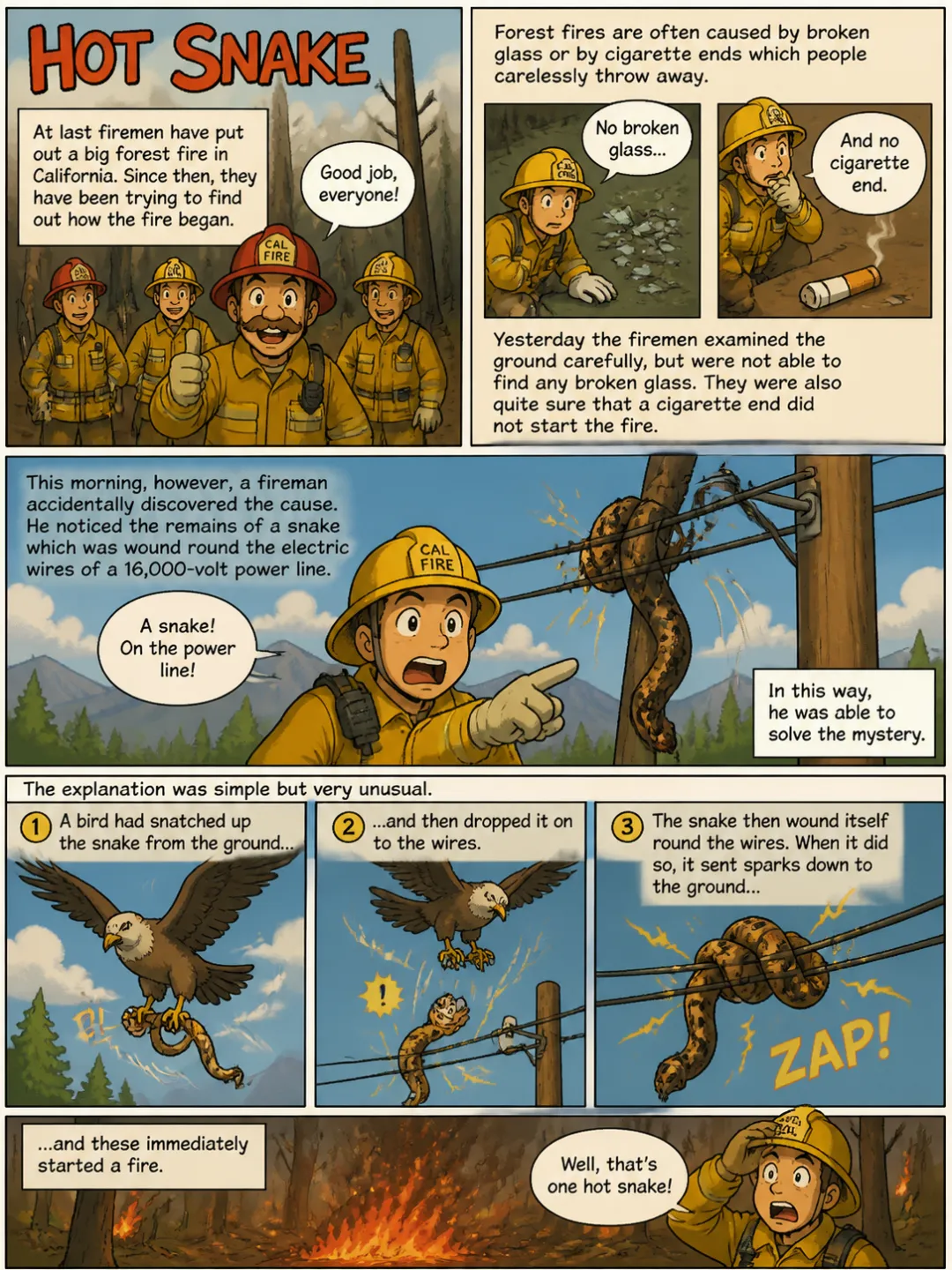
At last firemen have put out a big forest fire in California. Since then, they have been trying to find out how the fire began. Forest fires are often caused by broken glass or by cigarette ends which people carelessly throw away. Yesterday the firemen examined the ground carefully, but were not able to find any broken glass. They were also quite sure that a cigarette end did not start the fire. This morning, however, a fireman accidentally discovered the cause. He noticed the remains of a snake which was wound round the electric wires of a 16,000-volt power line. In this way, he was able to solve the mystery. The explanation is simple but very unusual. A bird had snatched up the snake from the ground and then dropped it on to the wires. The snake then wound itself round the wires. When it did so, it sent sparks down to the ground and this immediately started a fire.
语音标注: put out 连读 /pʊt aʊt/;find out 连读 /faɪnd aʊt/;cigarette ends 中 ends 发音 /endz/;examined the ground 连读 /ɪɡˈzæmɪnd ðə ɡraʊnd/;accidentally discovered 连读 /ˌæksɪˈdentəli dɪˈskʌvəd/;noticed the remains 连读 /ˈnəʊtɪst ðə rɪˈmeɪnz/;wound round 连读 /waʊnd raʊnd/;snatched up 连读 /snætʃt ʌp/。
背景简介:本课选自《新概念英语》第二册第53课,课文标题为"Hot snake"(触电的蛇)。故事讲述消防员在扑灭一场森林大火后,调查起火原因。他们排除了常见的起火原因(碎玻璃和烟头),最终一名消防员偶然发现了一条缠绕在高压电线上的蛇的残骸,从而揭示了火灾的真相:一只鸟将蛇叼起后掉落在电线上,蛇缠绕电线导致短路产生火花,从而引发了火灾。作者L.G.Alexander一如既往地以一个看似简单的事件入手,层层递进地揭示一个出人意料的、充满科学探索趣味的原因,体现了"小事见大"的写作魅力。
参考译文:
消防队员们终于扑灭了加利福尼亚的一场森林大火。从那时起,他们一直试图找出起火的原因。森林火灾常常是由碎玻璃或人们随意乱扔的烟头引起的。昨天,消防队员们仔细检查了地面,但未能找到任何碎玻璃。他们还十分肯定烟头也不可能引起火灾。然而,今天上午,一名消防队员偶然发现了起火的原因。他注意到一条蛇的残骸缠绕在一根16,000伏高压电线上。就这样,他解开了奥秘。解释很简单,却很不寻常。一只鸟从地上抓起蛇,把它扔到了电线上。于是,蛇就缠绕起电线来。当它这样做时,火花掉落到了地上,立刻引起了一场火灾。
🔍 第二部分:逐句精讲与词块总结
句子1
原文: At last firemen have put out a big forest fire in California.
翻译: 消防队员们终于扑灭了加利福尼亚的一场森林大火。
句子结构: 简单句。主语firemen,谓语have put out,宾语a big forest fire,地点状语in California。
重点词汇:
put out 蓝思值 520L
英音/pʊt aʊt/ 美音/pʊt aʊt/ 词性:短语动词
释义:扑灭;熄灭
常用语块:put out a fire; put out a cigarette
短语搭配:put out the light(关灯); put out(伸出;出版;困扰)
例句一:The firefighters worked hard to put out the forest fire. 消防员努力扑灭了森林大火。
例句二:Please put out your cigarette before entering the building. 进入大楼前请熄灭你的香烟。
拓展:put out是一个及物短语动词,宾语可以放在put和out之间(如put the fire out),也可以放在out之后(如put out the fire)。它的反义词是light(点燃)或start(引起,如火灾)。
fire 蓝思值 200L
英音/ˈfaɪə(r)/ 美音/ˈfaɪər/ 词性:n.
释义:火;火灾;失火
常用语块:forest fire; on fire; catch fire; set fire to
短语搭配:fire alarm(火灾报警器); fire station(消防站)
例句一:Don't play with matches, or you might start a fire. 不要玩火柴,否则可能引起火灾。
例句二:The house was on fire and people were running out. 房子着火了,人们正在往外跑。
拓展:fire作为名词,可以是不可数名词(表示"火"这种物质),也可以是可数名词(表示"火灾")。fire也可以作动词,意为"解雇"、"开火"。
语法点睛:本句使用了现在完成时have put out。At last(终于)表明动作在持续一段时间后最终完成了,强调"扑灭"这个动作的结果。现在完成时用来表达一个刚发生或已完成的动作,对现在有影响。在这里,大火被扑灭了,所以消防员们现在可以调查起火原因了。[NCE知识点笔记]
语音要点: put out 连读 /pʊt aʊt/;big forest fire 连读 /bɪɡ ˈfɒrɪst ˈfaɪə/。
句子2
原文: Since then, they have been trying to find out how the fire began.
翻译: 从那时起,他们一直试图找出起火的原因。
句子结构: 复合句。主句是they have been trying to find out。how the fire began是一个由how引导的宾语从句,作find out的宾语。
重点词汇:
since then 蓝思值 470L
英音/sɪns ðen/ 美音/sɪns ðen/ 词性:短语副词/介词短语
释义:从那时起
常用语块:since then; ever since then
短语搭配:since that time(从那以后)
例句一:He left in 2010 and since then I have never heard from him. 他2010年离开了,从那以后我再也没有他的消息。
例句二:Since then, the company has grown rapidly. 从那时起,这家公司发展迅速。
拓展:since then通常与现在完成时或现在完成进行时连用,表示从过去某个时间点开始一直持续到现在的动作或状态。
find out 蓝思值 530L
英音/faɪnd aʊt/ 美音/faɪnd aʊt/ 词性:短语动词
释义:查明;弄清楚;发现(真相)
常用语块:find out the truth; find out the cause; find out how...
短语搭配:find out about(了解关于……的情况)
例句一:We need to find out what happened. 我们需要查明发生了什么。
例句二:I will find out the answer for you tomorrow. 我明天会为你找到答案。
拓展:find out强调通过调查、研究或询问来"发现"原本未知的信息或真相,与discover意思相近,但discover更常用于发现新事物或新知识。find(找到)更强调"寻找并看到"的结果。
语法点睛:本句使用了现在完成进行时have been trying,强调"试图找出"这个动作从then(大火被扑灭)开始一直持续到现在,而且可能还在继续。Since then是典型的用于现在完成时或现在完成进行时的时间状语。find out后接how引导的宾语从句,这是常见的表达方式。[名师精讲]
语音要点: Since then 连读 /sɪns ðen/;trying to find out 连读 /ˈtraɪɪŋ tə faɪnd aʊt/。
句子3
原文: Forest fires are often caused by broken glass or by cigarette ends which people carelessly throw away.
翻译: 森林火灾常常是由碎玻璃或人们随意乱扔的烟头引起的。
句子结构: 主从复合句。主句是Forest fires are often caused by broken glass or by cigarette ends。which people carelessly throw away是一个由which引导的定语从句,修饰先行词cigarette ends。
重点词汇:
cause 蓝思值 380L
英音/kɔːz/ 美音/kɔːz/ 词性:v.
释义:引起;导致
常用语块:cause an accident; cause trouble; cause a fire
短语搭配:cause damage to(对……造成损害)
例句一:Smoking can cause many diseases. 吸烟会引起许多疾病。
例句二:The heavy rain caused the river to rise. 大雨导致河水上涨。
拓展:cause是及物动词,后面直接跟宾语。其名词形式也是cause,意为"原因;事业"。注意区分cause(导致)与reason(理由)。
broken 蓝思值 450L
英音/ˈbrəʊkən/ 美音/ˈbroʊkən/ 词性:adj.
释义:破碎的;坏的;断掉的
常用语块:broken glass; broken leg; broken promise
短语搭配:broken English(不流利的英语)
例句一:Be careful of the broken glass on the floor. 小心地板上的碎玻璃。
例句二:He has a broken heart after the breakup. 分手后他心碎了。
拓展:broken是动词break(打破)的过去分词,常作形容词使用,表示"被打破的"状态。
carelessly 蓝思值 590L
英音/ˈkeələsli/ 美音/ˈkerləsli/ 词性:adv.
释义:粗心地;不小心地
常用语块:throw away carelessly; drive carelessly
短语搭配:careless mistake(粗心的错误)
例句一:He carelessly left his keys in the car. 他粗心地把钥匙落在了车里。
例句二:Don't carelessly drop litter on the ground. 不要随便把垃圾丢在地上。
拓展:carelessly是形容词careless(粗心的)的副词形式,其反义词是carefully(小心地)。careless的名词形式是carelessness(粗心)。
throw away 蓝思值 500L
英音/θrəʊ əˈweɪ/ 美音/θroʊ əˈweɪ/ 词性:短语动词
释义:扔掉;丢弃
常用语块:throw away garbage; throw away a chance
短语搭配:throw it away(把它扔掉)
例句一:Don't throw away that paper; we can recycle it. 别扔掉那张纸,我们可以回收它。
例句二:This is a great opportunity; don't throw it away. 这是个好机会,不要浪费掉。
拓展:throw away强调"丢弃"的动作,宾语可以是具体物品,也可以是抽象事物(如机会、时间等)。
语法点睛:1. 被动语态:are...caused by是一般现在时的被动语态,表示"火灾是由……引起的"。此处用被动语态是因为火灾是"被引起"的,动作的执行者(原因)是broken glass和cigarette ends。[NCE知识点笔记] 2. 定语从句:which people carelessly throw away是一个定语从句,修饰cigarette ends。关系代词which指代cigarette ends,在从句中作throw away的宾语。
语音要点: are often caused by 连读 /ɑːr ˈɒfən kɔːzd baɪ/;cigarette ends which 连读 /ˌsɪɡəˈret endz wɪtʃ/。
句子4
原文: Yesterday the firemen examined the ground carefully, but were not able to find any broken glass.
翻译: 昨天,消防队员们仔细检查了地面,但未能找到任何碎玻璃。
句子结构: 并列句。由but连接两个并列分句。第一个分句是Yesterday the firemen examined the ground carefully,第二个分句是were not able to find any broken glass(省略了主语they)。
重点词汇:
examine 蓝思值 700L
英音/ɪɡˈzæmɪn/ 美音/ɪɡˈzæmɪn/ 词性:v.
释义:检查;审查;考核
常用语块:examine carefully; examine the evidence; examine a patient
短语搭配:examine into(调查)
例句一:The doctor examined the patient carefully. 医生仔细检查了病人。
例句二:We need to examine all the possibilities. 我们需要考虑所有可能性。
拓展:examine侧重于仔细查看以找出问题或了解情况。其名词形式是examination(检查;考试)。
able 蓝思值 350L
英音/ˈeɪbl/ 美音/ˈeɪbl/ 词性:adj.
释义:能够;有能力的
常用语块:be able to do sth.
短语搭配:able-bodied(体格健全的)
例句一:I am able to finish the work on time. 我能够按时完成工作。
例句二:She is a very able student. 她是一位非常有能力的学生。
拓展:be able to表示"能够",可以用于各种时态。can也表示"能够",但只有现在时和过去时形式(could),而be able to可以用于将来时(will be able to)和完成时(have been able to)。
语法点睛:were not able to find是be able to的过去式否定形式。can的过去式could也可以表示"能够",但was/were able to更强调在特定情况下"成功做到了某事",而could则只表示"有能力做"。这里were not able to find强调"未能找到"这个结果。[语法新思维]
语音要点: examined the ground 连读 /ɪɡˈzæmɪnd ðə ɡraʊnd/;were not able to 连读 /wɜːr nɒt ˈeɪbl tə/。
句子5
原文: They were also quite sure that a cigarette end did not start the fire.
翻译: 他们还十分肯定烟头也不可能引起火灾。
句子结构: 复合句。主句是They were also quite sure。that a cigarette end did not start the fire是一个由that引导的宾语从句,作sure的宾语。
重点词汇:
sure 蓝思值 280L
英音/ʃɔː(r)/ 美音/ʃʊr/ 词性:adj.
释义:确信的;有把握的;肯定的
常用语块:be sure of; be sure about; be sure to do
短语搭配:for sure(肯定地); make sure(确保)
例句一:I am sure that he will come. 我确信他会来。
例句二:Are you sure about that? 你对此有把握吗?
拓展:sure后接that从句,表示"确信……"。be sure to do表示"一定要做某事"或"肯定会做某事"。
语法点睛:were sure是"系动词+形容词"结构,后跟that引导的宾语从句。did not start是一般过去时的否定形式,用于否定"烟头"引起火灾的可能性。[名师精讲]
语音要点: were also quite sure 连读 /wɜːr ˈɔːlsəʊ kwaɪt ʃɔːr/;did not start 连读 /dɪd nɒt stɑːt/。
句子6
原文: This morning, however, a fireman accidentally discovered the cause.
翻译: 然而,今天上午,一名消防队员偶然发现了起火的原因。
句子结构: 简单句。主语a fireman,谓语discovered,宾语the cause,时间状语This morning,插入语however,方式状语accidentally。
重点词汇:
however 蓝思值 450L
英音/haʊˈevə(r)/ 美音/haʊˈevər/ 词性:adv.
释义:然而;不过;无论如何
常用语块:however; but however
短语搭配:however hard(无论如何努力)
例句一:He is very rich. However, he is not happy. 他非常富有,然而,他并不快乐。
例句二:However hard he tried, he couldn't succeed. 无论他多么努力,他都不能成功。
拓展:however是表示转折的副词,语气比but更强,且更正式。but是连词,连接两个并列分句;however则通常放在句首或句中,用逗号隔开。
accidentally 蓝思值 800L
英音/ˌæksɪˈdentəli/ 美音/ˌæksɪˈdentəli/ 词性:adv.
释义:意外地;偶然地
常用语块:accidentally discover; accidentally break
短语搭配:by accident(偶然地)
例句一:I accidentally met an old friend in the street. 我在街上偶然遇到了一位老朋友。
例句二:He accidentally knocked over the cup. 他意外地打翻了杯子。
拓展:accidentally是形容词accidental(偶然的;意外的)的副词形式,强调事件发生是"意料之外的"。
cause 蓝思值 380L
英音/kɔːz/ 美音/kɔːz/ 词性:n.
释义:原因;起因
常用语块:the cause of the fire; the cause of the accident
短语搭配:root cause(根本原因)
例句一:What is the cause of the problem? 问题的原因是什么?
例句二:The police are investigating the cause of the explosion. 警方正在调查爆炸的原因。
拓展:此句中的cause是名词,意为"原因",与上文句子3中的动词cause作对比学习。名词cause后接of结构,表示"……的原因"。
语法点睛:本句使用了一般过去时discovered,描述一个在过去(this morning)发生的、已经完成的动作。however在这里表示转折,连接上文"消防员排除了常见原因"和下文"他们偶然发现了真正原因",使叙事逻辑更清晰。
语音要点: This morning, however, 连读 /ðɪs ˈmɔːnɪŋ haʊˈevə/;accidentally discovered 连读 /ˌæksɪˈdentəli dɪˈskʌvəd/。
句子7
原文: He noticed the remains of a snake which was wound round the electric wires of a 16,000-volt power line.
翻译: 他注意到一条蛇的残骸缠绕在一根16,000伏高压电线上。
句子结构: 复合句。主句是He noticed the remains of a snake。which was wound round the electric wires of a 16,000-volt power line是一个由which引导的定语从句,修饰先行词snake。
重点词汇:
remains 蓝思值 550L
英音/rɪˈmeɪnz/ 美音/rɪˈmeɪnz/ 词性:n. (复数)
释义:剩余物;残骸;遗迹
常用语块:the remains of a snake; the remains of a meal
短语搭配:human remains(人类遗骸)
例句一:A few apples remained on the tree. 树上还剩几个苹果。
例句二:He remained calm during the crisis. 他在危机中保持冷静。
拓展:remains常以复数形式出现,意为"剩余物;残骸;遗迹",如the remains of an ancient city(古城遗迹)。remaining作形容词,意为"剩下的"。
wind 蓝思值 490L
英音/waɪnd/ 美音/waɪnd/ 词性:v.
释义:缠绕;蜿蜒;上发条
常用语块:wind round/around; wind up; wind one's way
短语搭配:wind down(放松;逐渐减少)
例句一:She wound the scarf round her neck. 她把围巾绕在脖子上。
例句二:The road winds through the mountains. 这条路蜿蜒穿过群山。
拓展:wind的过去式和过去分词是wound(不是winded)。注意与名词wind(风,不同发音)区分。
power 蓝思值 300L
英音/ˈpaʊə(r)/ 美音/ˈpaʊər/ 词性:n.
释义:电力;力量;权力
常用语块:power line; electric power; power cut; power station
短语搭配:come into power(掌权); in one's power(在某人能力范围内)
例句一:The storm knocked down many power lines. 暴风雨摧毁了许多电线。
例句二:He has the power to make decisions. 他有权力做决定。
拓展:power line指"输电线"、"电力线"。volt(伏特)是电压单位,16,000-volt是复合形容词,修饰power line。
语法点睛:本句包含一个由which引导的定语从句,修饰snake。was wound是wind的被动语态过去式,表示蛇"被缠绕"在电线上。electric wires of a 16,000-volt power line是一个复杂的介词短语结构,说明了具体的缠绕位置。[NCE知识点笔记]
语音要点: noticed the remains 连读 /ˈnəʊtɪst ðə rɪˈmeɪnz/;was wound round 连读 /wɒz waʊnd raʊnd/。
句子8
原文: In this way, he was able to solve the mystery.
翻译: 就这样,他解开了奥秘。
句子结构: 简单句。主语he,谓语was able to solve,宾语the mystery,方式状语In this way。
重点词汇:
in this way 蓝思值 520L
词性:短语副词
释义:以这种方式;就这样
常用语块:in this way; in that way; in the same way
短语搭配:in a way(在某种程度上)
例句一:In this way, he finally solved the problem. 就这样,他终于解决了问题。
例句二:You must do it in this way. 你必须这样做。
拓展:in this way表示方式、方法,相当于like this。
solve 蓝思值 520L
英音/sɒlv/ 美音/sɑːlv/ 词性:v.
释义:解决;解答
常用语块:solve a problem; solve a mystery; solve a puzzle
短语搭配:solve the equation(解方程式)
例句一:We must try our best to solve this problem. 我们必须尽力解决这个问题。
例句二:Sherlock Holmes solved many mysteries. 夏洛克·福尔摩斯破解了许多谜团。
拓展:solve的名词形式是solution(解决方法)。solve a mystery是固定搭配,意为"解开谜团"。
mystery 蓝思值 670L
英音/ˈmɪstri/ 美音/ˈmɪstri/ 词性:n.
释义:神秘;谜;难以理解的事物
常用语块:solve a mystery; a mystery story
短语搭配:it's a mystery to me(对我来说是个谜)
例句一:The cause of the fire remained a mystery for a long time. 火灾的原因很长时间内都是一个谜。
例句二:He is a man of mystery. 他是个神秘人物。
拓展:mystery的形容词是mysterious(神秘的)。
语法点睛:was able to solve是be able to的过去式,强调"成功做到了"某事。这里指消防员成功解开了火灾的谜团。[语法新思维]
语音要点: In this way 连读 /ɪn ðɪs weɪ/;was able to solve 连读 /wɒz ˈeɪbl tə sɒlv/。
句子9
原文: The explanation is simple but very unusual.
翻译: 解释很简单,却很不寻常。
句子结构: 简单句。主语The explanation,系动词is,表语simple but very unusual。
重点词汇:
explanation 蓝思值 600L
英音/ˌekspləˈneɪʃn/ 美音/ˌekspləˈneɪʃn/ 词性:n.
释义:解释;说明
常用语块:give an explanation; a simple explanation
短语搭配:by way of explanation(作为解释)
例句一:I need an explanation for your behavior. 我需要你对你的行为做出解释。
例句二:The teacher gave a clear explanation of the grammar rule. 老师对这个语法规则做了清晰的解释。
拓展:explanation是动词explain(解释)的名词形式,注意拼写变化。
unusual 蓝思值 630L
英音/ʌnˈjuːʒuəl/ 美音/ʌnˈjuːʒuəl/ 词性:adj.
释义:不寻常的;与众不同的
常用语块:unusual event; unusual situation; unusual weather
短语搭配:nothing unusual(没什么不寻常的)
例句一:It is unusual to see snow in June. 六月下雪很不寻常。
例句二:He has an unusual talent for music. 他有非凡的音乐天赋。
拓展:unusual由否定前缀un-加usual(通常的)构成,意为"不寻常的"。反义词是common(普通的)或usual。
语法点睛:本句是一个简单的"主系表"结构,使用一般现在时陈述一个客观事实。but连接两个并列的表语simple和unusual,形成对比,突出"简单"与"不寻常"这对矛盾概念,从而引出下文的具体解释。[名师精讲]
语音要点: The explanation is simple 连读 /ði ˌekspləˈneɪʃn ɪz ˈsɪmpl/;but very unusual 连读 /bʌt ˈveri ʌnˈjuːʒuəl/。
句子10
原文: A bird had snatched up the snake from the ground and then dropped it on to the wires.
翻译: 一只鸟从地上抓起蛇,把它扔到了电线上。
句子结构: 简单句。主语A bird,谓语是由and连接的两个并列动作:had snatched up和dropped。the snake和it是宾语。
重点词汇:
snatch 蓝思值 600L
英音/snætʃ/ 美音/snætʃ/ 词性:v.
释义:抓取;夺走;迅速抓住
常用语块:snatch up; snatch from; snatch away
短语搭配:snatch a victory(险胜); snatch a nap(抓紧时间打个盹)
例句一:The eagle snatched up the rabbit in its claws. 老鹰用爪子抓起了兔子。
例句二:He snatched the letter from my hand. 他从我手里夺走了信。
拓展:snatch强调"突然、迅速地"抓取、抢夺。snatch up意为"猛地抓起"。
drop 蓝思值 280L
英音/drɒp/ 美音/drɑːp/ 词性:v.
释义:使掉落;丢下;放下
常用语块:drop sth. on/onto; drop in; drop off
短语搭配:drop by(顺便拜访)
例句一:Be careful not to drop the glass. 小心别把玻璃杯掉了。
例句二:He dropped the book on the floor. 他把书掉在了地上。
拓展:drop强调从高处"落下"或"放下"的动作。drop sb. a line意为"给某人写信"。
语法点睛:本句包含了两个重要的动词时态。had snatched up是过去完成时(had + 过去分词),表示这个动作发生在另一个过去动作(dropped)之前。dropped是一般过去时。过去完成时在这里用来"说明因果关系":鸟先把蛇抓起来,然后再把它扔下去。时间上的先后顺序通过过去完成时清楚地表达出来。[语法新思维]
语音要点: had snatched up 连读 /hæd snætʃt ʌp/;dropped it on to 连读 /drɒpt ɪt ɒn tə/。
句子11
原文: The snake then wound itself round the wires.
翻译: 于是,蛇就缠绕起电线来。
句子结构: 简单句。主语The snake,谓语wound(wind的过去式),宾语itself,状语round the wires。
重点词汇:
wound 蓝思值 490L
英音/waʊnd/ 美音/waʊnd/ 词性:v. (wind的过去式)
释义:缠绕;蜿蜒
常用语块:wound itself round; wound its way
短语搭配:wound up(结束)
例句一:The vine wound itself around the tree. 藤蔓缠绕在树上。
例句二:The snake wound its body round the stick. 蛇把身体缠在棍子上。
拓展:wound作为动词wind的过去式,与名词wound(伤口,读作/wuːnd/)发音和拼写相同但意义不同,注意上下文区分。
语法点睛:本句使用了一般过去时wound,描述这个动作是紧接着上个动作发生的。wound itself round the wires是一个"动词 + 反身代词 + 介词短语"的结构,表示蛇"把自己缠绕在电线上"。这种用法非常生动形象。[NCE知识点笔记]
语音要点: then wound itself 连读 /ðen waʊnd ɪtˈself/;round the wires 连读 /raʊnd ðə ˈwaɪəz/。
句子12
原文: When it did so, it sent sparks down to the ground and this immediately started a fire.
翻译: 当它这样做时,火花掉落到了地上,立刻引起了一场火灾。
句子结构: 并列复合句。When it did so是一个由when引导的时间状语从句。主句由and连接两个并列分句:it sent sparks down to the ground and this immediately started a fire.
重点词汇:
spark 蓝思值 630L
英音/spɑːk/ 美音/spɑːrk/ 词性:n.或v.
释义:n. 火花;火星 v. 发出火花;引发
常用语块:send sparks; strike a spark; spark off(引发)
短语搭配:a spark of hope(一丝希望)
例句一:A single spark can start a devastating wildfire. 一颗火星就能引发毁灭性的野火。
例句二:The incident sparked a huge protest. 这起事件引发了一场大规模的抗议。
拓展:spark作名词时是可数名词。作动词时,spark意为"引发",后常接off。
send 蓝思值 280L
英音/send/ 美音/send/ 词性:v.
释义:发送;派遣;使……移动
常用语块:send a message; send someone; send down(使落下)
短语搭配:send for(派人去请); send off(寄出;送别)
例句一:Please send this letter to him. 请把这封信寄给他。
例句二:The explosion sent pieces of glass flying everywhere. 爆炸使玻璃碎片四处飞溅。
拓展:send down在本句中意为"使……向下移动",即"把火花弹落/发送到地上"。
immediately 蓝思值 540L
英音/ɪˈmiːdiətli/ 美音/ɪˈmiːdiətli/ 词性:adv.
释义:立即;马上
常用语块:immediately after; immediately before
短语搭配:respond immediately(立即回应)
例句一:He immediately recognized his mistake. 他立刻意识到了自己的错误。
例句二:Please come immediately; there is an emergency. 请马上来,有紧急情况。
拓展:immediately是形容词immediate(立即的)的副词形式,强调动作发生得迅速且没有延迟。
语法点睛:本句包含了When引导的时间状语从句,表示前后动作的紧密衔接。主句由and连接两个并列的动作,这两个动作几乎是同时发生的。sent sparks down to the ground描述了物理现象(蛇缠绕电线导致短路,产生火花),this immediately started a fire描述了结果。逻辑链条完整清晰。[名师精讲]
语音要点: When it did so 连读 /wen ɪt dɪd səʊ/;sent sparks down 连读 /sent spɑːks daʊn/;immediately started a fire 连读 /ɪˈmiːdiətli ˈstɑːtɪd ə ˈfaɪə/。
📌 核心词块总结
1. put out(扑灭): To stop something from burning or shining.
例句:The firemen put out the fire in less than an hour.
2. find out(查明,弄清楚): To discover or get information about something.
例句:We must find out who broke the window.
3. throw away(扔掉): To get rid of something you no longer want or need.
例句:Don't throw away those old books; we can donate them.
4. be able to do(能够做): To have the ability, means, or opportunity to do something.
例句:After studying hard, he was able to pass the exam.
5. in this way(以这种方式): By using this method or in this manner.
例句:In this way, the scientist was able to make a new discovery.
6. snatch up(猛地抓起): To take or grab something quickly and suddenly.
例句:The cat snatched up the fish from the kitchen counter.
7. be wound round(缠绕着): Having turned or twisted something several times around something else.
例句:The rope was wound round the tree trunk.
8. start a fire(引起火灾): To cause something to begin burning.
例句:A lightning strike can start a fire in a dry forest.
✍️ 第三部分:语篇分析与段落写作技巧
1. 语篇分析
① 识别宏观结构:本课短文是典型的问题-分析-解决(Problem-Analysis-Solution)的结构。
问题:一场森林大火被扑灭,但起火原因未知('how the fire began')。
分析:消防员排查常见原因:'broken glass'和'cigarette ends'。他们仔细检查,但均被排除。这是对问题的初步分析和否定。
解决:消防员偶然发现蛇的残骸,并由此推理出事件的前因后果。这个解决方案出人意料('unusual'),但逻辑清晰。
② 列举衔接手段:
时间连接:'At last', 'Since then', 'Yesterday', 'This morning', 'then', 'When it did so'.
逻辑连接:'however'(转折,引出意外发现), 'In this way'(方式,引出解决方案)。
指代:'they'(指消防员), 'he'(指发现蛇的消防员), 'it'(指蛇), 'this'(指火花落地这件事)。
词汇衔接:'fire', 'firemen', 'cause', 'forest fire', 'discovered', 'explanation'等核心词汇多次出现,形成了紧密的语义关联。
③ 分析作者态度:作者以客观、冷静的笔调叙述了一个科学探索的过程。作者没有直接抒发情感,而是通过事实的陈述和逻辑的推导,自然地引导读者得出"蛇在电线上缠绕导致火灾"这一结论。作者对火灾原因的探究过程充满好奇,最后用"simple but very unusual"总结,既肯定了推理的简洁性,又强调了事件的罕见性,使读者在获得知识的同时也感受到一丝意外和趣味。
2. 写作技巧
① 提炼写作逻辑:本课的写作逻辑是通过"设置悬念 → 排除常规 → 意外发现 → 推理解释"的结构来讲述一个故事。
设置悬念:开头直接提出核心问题(火灾是怎么开始的)。
排除常规:消防员有条不紊地排除了最常见的两种原因(碎玻璃、烟头)。这增加了悬念的紧张感。
意外发现:转折词'however'引出意外的发现(蛇的残骸)。
推理解释:作者用过去完成时和一般过去时清晰地还原了事件的时间顺序和因果链条:鸟叼蛇 → 蛇缠电线 → 火花落地 → 引发火灾。最后用'simple but unusual'进行总结。
建议:在写作叙事性文章时,可以运用这种"排除法 + 关键线索揭示"的结构来增加故事的趣味性和吸引力。"问题 → 常规方法无效 → 偶然发现关键线索 → 真相大白"是一个很有效的故事框架。
② 提供段落写作范例:
题目:Write a short passage describing how someone solved a puzzle or a problem.
例文:
Last week, my friend lost his smartwatch. At first, we thought he might have left it in the gym. He checked there, but was not able to find it. He was also quite sure he hadn't dropped it at the cafe. This morning, however, his little daughter accidentally found the cause of the mystery. She noticed the watch under the sofa, which was covered by a cushion. In this way, the mystery was solved. The explanation was simple but very unusual. The little girl had snatched up the watch from the table and then dropped it on the floor. It then slid under the sofa!
③ 分析其结构特点:
结构特点:完美遵循了问题-排除-意外发现-解决的写作逻辑。'lost his smartwatch'是问题。'left it in the gym'和'dropped it at the cafe'是被排除的常规猜测。'accidentally found'是意外的转折。'under the sofa'是最终发现。
语言点映射:
'At first, we thought...' → 映射课文'Forest fires are often caused by...'(提出常规原因)
'was not able to find' → 映射课文'were not able to find any broken glass'
'was also quite sure that' → 映射课文'They were also quite sure that a cigarette end did not start the fire'
'This morning, however, ... accidentally found' → 映射课文'This morning, however, a fireman accidentally discovered the cause'
'In this way, the mystery was solved' → 映射课文'In this way, he was able to solve the mystery'
'The explanation was simple but very unusual' → 映射课文'The explanation is simple but very unusual'
'had snatched up... dropped it' → 映射课文'had snatched up the snake from the ground and then dropped it on to the wires'
④ 布置小练笔并提供例文:
小练笔:Write a short paragraph (about 100 words) describing a small mystery or puzzle you solved. Try to use the structure: "problem → ruling out usual causes → accidental discovery → explanation". Use some of the key vocabulary from Lesson 53 (e.g., 'not able to find', 'quite sure that...did not', 'this morning/evening, however', 'accidentally discovered', 'in this way', 'the explanation is simple but unusual').
例文:
The Broken Vase Mystery
Last Saturday, my mother found her favorite vase broken. I thought our cat had knocked it over. I examined the table carefully, but was not able to find any cat hair. I was also quite sure that the wind from the open window didn't do it. This morning, however, my brother accidentally discovered the cause. He noticed the remains of a small rubber ball near the vase, which was lying under the sofa. In this way, the mystery was solved. The explanation was simple but very unusual. My little sister had snatched up the ball and thrown it at the vase. It hit the vase and immediately broke it!
📐 第四部分:本课语法精析(加强版)
1. 一般过去时与过去进行时的深度对比
在本课的叙述中,主要使用的是一般过去时(put out, examined, were, discovered, noticed, wound, dropped, sent, started)和过去完成时(had snatched)。虽然没有出现典型的过去进行时句子,但我们可以以此为契机,深入理解过去进行时的用法,并将其与一般过去时进行对比。过去进行时描述在过去的某个时间点或时间段正在进行的动作,它强调动作的"持续性"和"进行状态"。而一般过去时则描述一个完成了的、过去发生的动作。
比较维度:
一般过去时:
① 动作的完成:动作通常已经完成。
② 时间焦点:关注事件的"发生"和"结束"。
③ 语境应用:叙述故事中的主要事件(what happened)。
④ 典型搭配:yesterday, last week, ago.
过去进行时:
① 动作的完成:动作在过去的某个时间点尚未完成,仍在进行。
② 时间焦点:关注事件的"过程"和"状态"。
③ 语境应用:描绘故事发生的背景(what was happening when...)。
④ 典型搭配:at 8 pm last night, all day yesterday, when/while + 持续动作
例句对比:
I read a book last night.(一般过去时:我读完了整本书。)
I was reading a book at 8 pm last night.(过去进行时:昨晚8点,我正在读书,不一定读完。)
He watched TV all evening.(一般过去时:他看电视了一整晚,强调动作的完成。)
He was watching TV all evening.(过去进行时:他整个晚上都在看电视,强调动作的持续过程。)
2. 过去完成时的深度解析
本课中had snatched up是过去完成时,它用来表示"过去的过去"发生的动作。我们用一个时间轴来分析:
过去时间点1(鸟叼蛇) → 过去时间点2(蛇掉在电线上) → 过去时间点3(消防员发现残骸)
动作1(had snatched up)发生在动作2(dropped)之前,因此在叙述动作2时,需要用过去完成时来描述动作1。动作2(dropped),wound,sent,started)和动作3(消防员noticed)都是发生在过去的不同动作,对于它们之间,我们可以用一般过去时来描述。
例句:
He had finished his homework before his mother came home.(妈妈回家之前,他已经完成了作业。)
She had never seen such a beautiful sunset before she moved to the island.(在她搬到岛上之前,她从未见过这么美的日落。)
The thief had already left when the police arrived.(警察到达时,小偷已经跑了。)
3. 并列句与复合句在本课的应用
并列句:Yesterday the firemen examined the ground carefully,butwere not able to find any broken glass.(but表示转折)
并列句:When it did so, it sent sparks down to the groundandthis immediately started a fire.(and表示顺承)
复合句(定语从句):...cigarette endswhichpeople carelessly throw away.(which引导定语从句)
复合句(定语从句):...the remains of a snakewhichwas wound round the electric wires...(which引导定语从句)
复合句(宾语从句):They were also quite surethata cigarette end did not start the fire.(that引导宾语从句)
复合句(时间状语从句):Whenit did so, it sent sparks down to the ground...(When引导时间状语从句)
复合句(宾语从句):...they have been trying to find outhow the fire began.(how引导宾语从句)
4. 与第一册相关语法点进行对比分析
在《新概念英语》第一册中,我们主要学习了一般现在时、现在进行时、一般过去时和一般将来时。本课(第53课)在第二册中进一步深化了时态的学习。
对比第一册(基础)层次:
- 时态种类:主要学习一般过去时的基本用法(I played basketball yesterday.)。第二册(深化-第53课)深化过去时态的学习:一般过去时vs.过去进行时,以及引入过去完成时。
- 核心区分:第一册区分一般现在时与一般过去时(I play / I played)。第二册区分一般过去时、过去进行时和过去完成时(played / was playing / had played)。
- 典型例句:第一册:I saw the movie.(我看了那部电影。)第二册:I had seen the movie before she arrived.(在她到达之前,我已经看过了那部电影。had seen)vs. I was seeing the movie when she arrived.(她到达时,我正在看电影。was seeing)
- 学习意义:建立"时"的概念,区分不同时间点的动作。建立"时"和"态"的深层理解,学会在一个时间框架内区分不同动作的先后顺序和持续状态。
5. 练习题(不少于12道,附详细解析)
一、用括号内动词的适当形式填空(一般过去时、过去进行时或过去完成时)。
1. I (read) a book when the phone (ring).
2. She (finish) her homework before she (go) to bed.
3. He (watch) TV at 9 o'clock last night.
4. The firemen (put out) the fire and then (begin) their investigation.
5. I (never see) such a beautiful sunset until I (visit) the island.
6. While I (walk) in the park, I (meet) an old friend.
二、选择最佳答案。
7. The fire by a bird dropping a snake onto the wire.
A. caused B. was caused C. has caused
8. The firemen the ground, but they didn't find anything.
A. examined B. have examined C. were examining
9. When my mother came home, I my homework.
A. finished B. had finished C. was finishing
10. The fireman accidentally the cause while checking the wires.
A. was discovering B. discovered C. had discovered
三、改错。
11. When the phone rang, I cooked dinner.
12. She had went to the supermarket before I arrived.
四、翻译句子。
13. 当我到达车站时,火车已经开走了。
14. 消防队员正在仔细检查地面。
详细解析:
1.答案:was reading / rang
解析:"我在看书"是正在进行的动作,用过去进行时(was reading);"电话响了"是一个突然发生的、短促的动作,用一般过去时(rang)。[NCE知识点笔记]
2.答案:had finished / went
解析:"完成作业"发生在"上床睡觉"之前,是"过去的过去",所以用过去完成时(had finished);"上床睡觉"是过去的动作,用一般过去时(went)。[语法新思维]
3.答案:was watching
解析:at 9 o'clock last night是一个具体的过去时间点,描述在那个时间点"正在看"电视,用过去进行时(was watching)。[名师精讲]
4.答案:put out / began
解析:put out(扑灭)和began(开始)是两个先后发生的过去动作,都用一般过去时。then表明了顺序。
5.答案:had never seen / visited
解析:had never seen(从未见过)的状态在visited(访问)之前持续存在,所以had never seen用过去完成时,visited用一般过去时。
6.答案:was walking / met
解析:"散步"是正在进行的背景动作,用过去进行时(was walking);"遇见朋友"是发生在这个背景下的短暂动作,用一般过去时(met)。[同步语法强化]
7.答案:B. was caused
解析:火灾是"被"引起的,需要用被动语态。整句话描述的是过去的事情,所以用一般过去时的被动语态was caused by。
8.答案:A. examined
解析:句中的时间状语(didn't find)和逻辑关系表明,这是一个已经完成的过去动作,用一般过去时examined即可。were examining(过去进行时)强调"正在进行",不符合句子含义。
9.答案:B. had finished
解析:"完成作业"发生在"妈妈回家"之前,是"过去的过去",用过去完成时。
10.答案:B. discovered
解析:while从句中的was checking是过去进行时,表示背景;主句的动作discovered(发现)是发生在这个背景下的短暂动作,用一般过去时。
11.改正:When the phone rang, I was cooking dinner.
解析:"做饭"是一个持续的动作,电话铃响起时,这个动作正在进行,所以应该用过去进行时was cooking。
12.改正:She had gone to the supermarket before I arrived.
解析:had gone的过去分词是gone,不是went。过去完成时的构成是had + 过去分词。
13.翻译:The train had already left when I arrived at the station.
14.翻译:The firemen were examining the ground carefully.
🎧 第五部分:听力与阅读策略训练
1. 听力技巧
结合课文录音:本课录音语速适中,叙述逻辑清晰,包含多种时态,是训练听力策略的好素材。建议按照[新概念英语讲师用书新版2.pdf]的建议,分步进行听力训练。
① 预测关键词:在播放录音前,先看课文问题:"How did the fire start?"(火灾是如何开始的?)根据问题,我们可以预测录音中会出现关于fire, snake, cause, electric wires, bird等关键词。带着"到底是什么引起的"这个疑问去听,能迅速锁定答案。
② 抓主旨大意:第一遍听录音,集中精力抓住故事的轮廓:一个关于火灾调查的故事。核心事件是:扑灭火灾 → 调查原因 → 排除常规原因 → 发现蛇的残骸 → 推理出火灾原因。听完后尝试用一句话概括:A fireman discovered a snake on a wire and figured out it caused a forest fire.
③ 笔记方法:听第二遍时,可以简记关键信息点。
事件:a forest fire in California put out.
调查:find out cause; examined ground; no glass; no cigarette.
发现:fireman discovered snake; wound round power line.
解决/原因:bird snatched snake → dropped on wire → snake wound itself → sparks → fire.
听力理解题示例:
1. Why did the firemen examine the ground yesterday?
A. To look for witnesses. B. To search for broken glass or cigarette ends. C. To measure the size of the fire.
2. What did a fireman accidentally discover this morning?
A. A broken piece of glass. B. A cigarette end. C. A snake's remains on a power line.
3. How had the snake ended up on the electric wires?
A. It climbed up the pole itself. B. A bird dropped it there. C. The wind blew it.
4. What did the snake do when it got on the wires?
A. It stayed still. B. It tried to get down. C. It wound itself round the wires.
5. According to the passage, what was the immediate cause of the fire?
A. The broken glass. B. The spark from the wire. C. The careless person.
答案解析:
1. B(原文:Yesterday the firemen examined the ground carefully, but were not able to find any broken glass. 以及 They were also quite sure that a cigarette end did not start the fire.)
2. C(原文:This morning, however, a fireman accidentally discovered the cause. He noticed the remains of a snake which was wound round the electric wires...)
3. B(原文:A bird had snatched up the snake from the ground and then dropped it on to the wires.)
4. C(原文:The snake then wound itself round the wires.)
5. B(原文:When it did so, it sent sparks down to the ground and this immediately started a fire.)
2. 阅读理解策略
① 扫读:为了快速找到特定信息,可以运用扫读策略。
题目:找出消防员排除了哪些常见的火灾原因。
方法:快速扫读与"原因"相关的词。在原文中,找到broken glass和cigarette ends,以及它们的否定句(not able to find; did not start)。
题目:火灾的具体原因是什么?
方法:扫读关键词如cause, explanation, because。定位到句子He noticed the remains of a snake...以及最后一整段。
② 略读:为了快速理解故事脉络,可以略读文章,主要关注每句话的开头或关键词。
方法:
第一句:At last... put out a forest fire(扑灭了火灾)
第二句:Since then, trying to find out how...(正在找原因)
中间几句:examined, not able to find, were quite sure...did not start(排除原因)
转折句:This morning, however... discovered the cause(找到原因)
最后几句:snake, bird, sparks, started a fire(解释原因)
通过略读,我们迅速抓住了故事的"破案"逻辑:先发现结果(火灾),再排除常规,最后找到真凶。
③ 推断词义:根据上下文猜测生词的意思。
题目:根据上下文,wound(句子7中)是什么意思?
上下文线索:句子提到the remains of a snake which was wound round the electric wires.
推理:蛇的残骸在电线上,而且它是"绕着"电线的。结合日常知识,蛇会缠绕物体。因此,wound(wind的过去式)意思是"缠绕"。[official textbook 学生用书.pdf]
题目:根据上下文,remains(句子7中)是什么意思?
上下文线索:He noticed the remains of a snake... 后面提到wound round the electric wires,并且这个故事是关于"过去"发生的(had snatched up... then dropped)。
推理:蛇已经被烧死或电死,所以remains指的是"残骸"、"尸体"或"残余物"。
📝 第六部分:习题讲解
1. 针对教材中的书面练习进行详细讲解
本课的课后书面练习通常涵盖关键句型(Key Structures)和难点(Special Difficulties)两部分。
关键句型练习:过去时态的复习与综合运用
练习示例:根据课文内容,用适当的过去时态填空。
1. Firemen (put out) a big forest fire in California.
答案:put out
解析:描述一个已完成的过去事件,用一般过去时。
2. Since then, they (try) to find out how the fire began.
答案:have been trying(现在完成进行时,从过去某个时间点持续到现在)
解析:Since then是现在完成时/现在完成进行时的标志。have been trying强调持续性和未完成性。
3. Yesterday, the firemen (examine) the ground.
答案:examined
解析:Yesterday是具体过去时间,用一般过去时。
4. A bird (snatch) up the snake before dropping it.
答案:had snatched
解析:snatch up(抓起)发生在dropping(掉落)之前,是"过去的过去",用过去完成时。
5. When the snake (wind) itself round the wires, it (send) sparks down.
答案:wound / sent
解析:两个动作先后发生在过去,都用一般过去时。
难点练习:易混淆短语动词:put out, find out, throw away
本课的"难点"练习重点练习了这些短语动词的用法。
put out(扑灭):put out a fire(扑灭火)= extinguish a fire
find out(查明):find out the truth(查明真相); find out how(查明如何)
throw away(扔掉):throw away the garbage(扔掉垃圾); throw away an opportunity(浪费机会)
练习题:用put out, find out, throw away的适当形式填空。
1. Please don't ______ that old photograph. It's a memory.
答案:throw away
2. The teacher asked us to ______ the answer to the question.
答案:find out
3. The firemen ______ the fire in half an hour.
答案:put out
4. I need to ______ who broke my phone.
答案:find out
5. Make sure you ______ all your rubbish in the bin.
答案:throw away
多项选择题
题目1:How long have the firemen been trying to find out the cause of the fire?
A. Since yesterday. B. Since this morning. C. Since the fire was put out. D. Since last week.
答案:C
解题思路:原文Since then, they have been trying to find out...,其中then指代the fire was put out.
题目2:What did the firemen examine yesterday but failed to find?
A. A snake's body. B. A bird's nest. C. Broken glass or cigarette ends. D. The electric wires.
答案:C
解题思路:原文Yesterday the firemen examined the ground carefully, but were not able to find any broken glass... 以及They were also quite sure that a cigarette end did not start the fire.
题目3:What does "the snake then wound itself round the wires" mean?
A. The snake bit the wires. B. The snake twisted itself around the wires. C. The snake jumped onto the wires. D. The snake was killed by the wires.
答案:B
解题思路:wound是wind的过去式,意为"缠绕",所以wound itself round the wires意思是"将自己缠绕在电线上"。
题目4:What is the most surprising thing about the cause of the fire?
A. It was caused by a broken glass. B. It was caused by a cigarette end. C. It was caused by a bird and a snake. D. It was caused by lightning.
答案:C
解题思路:这是一个推断题。作者在解释了所有原因后总结道The explanation is simple but very unusual. 这个出人意料之处在于,火灾不是由常见的"人为疏忽"引起的,而是由一个"鸟类捕食蛇"的偶然事件引发的。
🤔 第七部分:英文深度思考与拓展(强化版)
A. 层次化英文问题与答案
Level 1 (Factual): 事实性问题
1. Q: What did the firemen want to find out after they put out the forest fire? A: They wanted to find out how the fire began.
2. Q: What things often cause forest fires, according to the passage? A: Forest fires are often caused by broken glass or by cigarette ends which people carelessly throw away.
3. Q: What did a fireman accidentally discover this morning? A: The fireman accidentally discovered the remains of a snake which was wound round the electric wires of a power line.
Level 2 (Inferential): 推理性问题
4. Q: Why did the firemen examine the ground carefully but fail to find any broken glass? A: They failed to find any broken glass because the real cause of the fire was not broken glass. The fire was caused by the snake and the bird, which left no glass or cigarette end evidence on the ground.
5. Q: Why did the firemen become "quite sure that a cigarette end did not start the fire"? A: They became quite sure because their careful examination of the ground found no evidence of a cigarette end. They had ruled out this common cause.
6. Q: The passage says the explanation was "simple but very unusual." What makes it "unusual"? A: It is unusual because forest fires are normally caused by human carelessness or natural phenomena directly like lightning, not by such a chain of events involving a bird, a snake, and a power line. It is a very rare and unexpected cause.
Level 3 (Evaluative): 评价性问题
7. Q: Do you think the firemen's initial investigation (looking for broken glass and cigarette ends) was a waste of time? Why or why not? A: No, their initial investigation was not a waste of time. It was a necessary and logical first step in any fire investigation, as these are the most common causes. By ruling them out, the firemen could then focus on other, more unusual possibilities, which is how they eventually solved the mystery. Good detective work often involves a process of elimination.
8. Q: This story is about how a natural event (a bird hunting a snake) unintentionally caused a disaster. What does this tell us about the relationship between nature and human infrastructure like power lines? A: This story shows that human infrastructure can interact with nature in unpredictable and sometimes dangerous ways. A power line, which we build for human convenience, can become an unexpected tool for a natural disaster when an animal interacts with it. It highlights the need for engineers and planners to consider how wildlife might interact with power lines to prevent such accidents and to ensure that our infrastructure is safe and resilient.
9. Q: The fireman who found the remains of the snake is described as discovering it "accidentally." Do you think this was just pure luck, or did his careful observation and investigation play a role? Explain. A: While the discovery seems "accidental" at first, it was likely the result of a combination of careful observation and systematic investigation. After ruling out common causes, the firemen were probably looking at the whole area more broadly. The fireman noticed the remains because he was actively looking for clues. In this way, it was not pure luck; rather, it was a form of "prepared mind" - he was looking for the unusual, and he found it.
10. Q: If you were the leader of this fire investigation, what would you have done differently after failing to find common causes? A: (Answers vary.) I would have broadened the search area and considered less common causes. I might have looked at the power lines and other infrastructure more closely, as the fireman did. I would have asked the birdwatchers if they had seen anything unusual.
11. Q: The story uses the phrase "In this way, he was able to solve the mystery." Do you think the mystery is completely solved, or could there be more questions? Think about the bird. A: From the firemen's perspective, the reason why the fire started is completely solved. We know that a bird dropped a snake onto the wire, causing a spark. However, for a wildlife biologist, the mystery might raise more questions. For instance, what type of bird was it? Why did it drop the snake (perhaps it was startled)? What type of snake was it? Was it common in that area? Solving one mystery often opens up new, more specialized questions.
B. 多类型拓展阅读
类型1:时事新闻拓展
Title: Power Lines and Wildlife: A Growing Problem in California
In recent years, California has faced some of its most devastating wildfires in history. While human carelessness (like campfires or power tool sparks) is a major cause, a significant number have been started by power lines interacting with the environment. In 2018, a faulty power line started the Camp Fire, which burned over 150,000 acres. Our lesson's story, though fictional, perfectly illustrates this real-world problem. A single spark from a power line interaction with a tree, an animal, or just from being old, can quickly rage into a catastrophic fire. This has led to new safety regulations and huge investments from power companies to inspect and upgrade their equipment, especially around high-risk areas like forests. The 'snake on a wire' scenario is not just a strange story; it is a real-life risk that power companies now take very seriously.
引导性问题:How does the real-life problem of power-line-caused fires in California compare with the story in our lesson? Why is this a serious issue today?
语言点映射:forest fire(森林火灾), cause(原因), spark(火花), start a fire(引发火灾), voltage(电压)。[NCE知识点笔记]
类型2:文化背景解析
Title: The Role of Fire in Ecosystems
In Western cultures, fire is often seen as a destructive force, something to be fought and controlled, as shown in our story. But many natural fire ecologists have a different view. For thousands of years, natural fires, often caused by lightning, played a vital role in many ecosystems, especially in places like California and Australia. These natural fires could clear out dead undergrowth, return nutrients to the soil, and even help some plants germinate. Our lesson's story is about a forest fire that was destructive. However, it is important to understand this cultural and ecological context: fire is a natural part of many landscapes. The challenge is to manage the risk of destructive fires (like the one caused by the snake) while recognizing the historical role of beneficial fire in shaping the natural environment.
引导性问题:How does the view of fire as only a destructive force differ from the ecological perspective presented here? Do you think our attitude toward forest fires should change?
语言点映射:forest fire(森林火灾), cause(起因)。课文将火灾视为问题,本拓展挑战这一传统观念。[手绘版新概念语法笔记]
类型3:今昔对比分析
Title: Firefighting Then and Now
Our story, written in the 1960s, shows a firefighter doing a hands-on investigation: examining the ground with his eyes and hands. Today, the science of fire investigation, or "fire forensics," has changed dramatically. In modern fire departments in the United States, investigators use advanced technology. They use drones to examine large areas from the air, which can quickly spot the potential source of a fire. They also use chemical sensors to detect tiny traces of accelerants like gasoline, which might indicate arson. They take digital photographs and create detailed 3D models of the fire scene. The fireman in our story would probably still start by looking at the ground, but he would also have the benefit of these high-tech tools to help him confirm his findings and make the investigation process much faster and more accurate.
引导性问题:How has the job of a fire investigator changed from the 1960s (when our story was written) to today? What are the advantages of modern technology?
语言点映射:examine the ground carefully(仔细检查地面), accidentally discover(偶然发现)。现代技术使这些动作变得更系统化和数据化。[语法新思维]
类型4:新潮英语改写
Title: Mystery of the Hot Snake Solved by Fire Crew
So, after a huge wildfire in Cali, the fire crew finally got the blaze under control. Since then, they have been trying to crack the case of how it all began. The usual suspects—broken bottles and carelessly flicked cigarette butts—often cause these kinds of fires. Yesterday, the crew scoured the site, checking every inch for a glass shard, but came up with nothing. They were also pretty sure a cigarette butt hadn't sparked the inferno. Then this morning, one of the firemen totally stumbled upon the answer. He spotted what was left of a snake all wrapped around an electric wire on a massive 16,000-volt power line. That's how he cracked the mystery. The reason is kinda simple but wild. A bird had snatched the snake and then dropped it onto the wire. The snake, not happy about it, coiled itself around the wire. And when it did, BOOM, sparks flew down to the ground, which instantly started a huge fire.
语言点映射:
crack the case → solve the mystery
blaze / inferno → fire
scoured the site → examined the ground carefully
came up with nothing → were not able to find
pretty sure → quite sure
kinda simple but wild → simple but very unusual
说明:这是对原文的口语化、现代版改写,用词更时尚,适合与年轻人交流。[会说话的新概念英语单词.pdf]
类型5:难度略高的拓展阅读
Title: The Principle of Electrical Short Circuit and Arcing
The central accident in the story is a classic example of an electrical short circuit. When the snake's body, which is a conductor of electricity, connected two wires of the power line, or just the wire and a grounded object, it created an unintended path for the electric current. This is called a short circuit. The current quickly created an arc of electricity passing through the snake's body. An electrical arc is a luminous discharge of light and heat, like a mini thunderstorm, and the heat is incredible. That massive heat instantly vaporized part of the snake, and ignited the air and surrounding material. The intense heat from the arc then set fire to the dry grass on the ground, starting the wildfire. Therefore, the snake itself didn't trigger a chemical fire by rubbing something; it became the physical bridge for a massive electrical discharge of energy.
引导性问题:What is the scientific reason why the snake getting on the wire caused a spark? Explain the term "short circuit" using the story.
语言点映射:electric wires(电线), power line(电线), spark(火花)。这篇拓展阅读从物理学角度解释了"火花"产生的原因。[新概念英语语法一学就会全4册.pdf]
类型6:真实故事或人物传记
Title: The Firefighter Who Became a Detective: John Orr
Many firefighters are not just brave individuals who put out fires; they are also detectives who investigate their causes. A famous real-life example is John Orr, a firefighter and fire investigator in California. Unlike the "accidental" discovery in our story, Orr became famous for developing a system to track fire patterns. He correctly identified a series of arson fires by noticing a unique signature left behind. Later, shockingly, he was convicted of being an arsonist himself! This real-life story shows that the business of fire investigation can be very complex and sometimes strange. Our story ends with a simple, accidental solution. Real life can have much more complicated and disturbing explanations for how and why a fire started, as seen in the case of John Orr. This adds a layer of complexity to the seemingly simple "mystery" in our lesson.
引导性问题:How does the real-life story of firefighter John Orr show that fire investigations can be more complex than the one in our lesson? What can we learn from this comparison?
语言点映射:fireman(消防员), discover the cause(发现原因), solve the mystery(解开奥秘)。拓展阅读中,消防员本身是(嫌疑人),扩展了对"调查"这一概念的深度。[新概念英语美文欣赏第2册.pdf]
🌍 第八部分:日常应用与文化拓展
1. 介绍相关文化背景知识
"A hot snake"这个标题巧妙利用了双关语。表面上看不可能是"一条滚烫的蛇",但结合故事,蛇因触电变得"带电、滚烫"。英式幽默中这种用语的巧思很常见。此外,西方人对森林火灾(特别是加州和澳洲的山火)有较强意识。防火最核心的做法是"预防",即不随意丢弃烟头和玻璃,但本课揭示了一个完全不可控的自然偶然事件。故事中消防员的科学探究精神(从排查到假设再到验证)体现了西方科学文化中重视"证据链"的理性态度。日常应用中,可以沿用好习惯:看到地上烟头帮忙熄灭,不随意扔破碎瓶子,这是社会公德的一部分。但更重要的是培养好奇心:不要轻易下结论,学会像消防员一样,一步步排查、推理,可能你会发现事情并非表面那么简单。
2. 推荐拓展学习资源
书籍:《福尔摩斯探案集》。本课的结构很像一个侦探故事,福尔摩斯善于从微小线索推断全局。
纪录片:《BBC: 世界的脉搏》中关于"电和自然"的章节,展示动物如何与人类电网互动。
电影:《逃出熔岩镇》(Pompeii,但内容方向尚可)。了解火山喷发时产生的"电火花"和导电现象。
名言:引用《新概念英语名人名言诵典.pdf》中爱因斯坦的名言"Insanity is doing the same thing over and over again and expecting different results."(疯狂就是一遍又一遍地做同一件事,却期待不同的结果)。消防员没有不停找到常规推测无果后就放弃,而是换了一个角度找,最后成功,这正说明了不要陷入思维定势。
💡 第九部分:引导性思考
English:
The story's fire was caused by a completely accidental series of events, not human carelessness. Do you think people feel less or more responsible for preventing such accidents? Why does this story say about the unpredictability of nature?
中文:
故事中的火是由一系列完全偶然的事件引起的,而不是人为疏忽。你认为人们对预防此类事故感到更有责任感还是更少?这个故事又说明了自然规律的不可预测性是什么?
English:
In the story, the firemen were not able to find any broken glass. However, they were "quite sure" it wasn't a cigarette end. Why was a "negative fact" (the absence of evidence) so important in solving the mystery? How does this relate to the meaning of "thinking like a detective"?
中文:
在故事中,消防员没有找到任何碎玻璃。但他们"非常肯定"那不是烟头引发的火。为什么一个"未发生的事实"在探索谜团过程中如此重要?这和"像侦探一样思考"有何关联?
English:
The phrase "the explanation is simple but very unusual." Do you think the explanation in our life is often "simple" or "complex"? Which type of story is often more powerful and memorable? Use examples to explain.
中文:
文中说"解释很简单,但很不寻常。"你认为生活中的解释通常是"简单"的还是"复杂"的?哪一类故事往往更有力量,更让人记忆深刻?请举例说明。
🗂️ 第十部分:本课知识图谱(结构化逻辑图)
核心事件:一次森林大火被扑灭,其起因在初期调查中被误判,后经一个偶然事件被彻底澄清。
├─ 主要支撑点一:火灾的爆发与初期调查
│ ├─ 关键细节1:火灾事件:加州发生一场严重的森林大火。
│ │ 逻辑关系:这是整个故事的起点。
│ ├─ 关键细节2:初期任务:大火扑灭后,展开起因调查。
│ │ 逻辑关系:引出故事的核心悬念。
│ ├─ 关键细节3:常规方向:将假设锚定在"人为疏忽"(碎玻璃、丢弃的烟蒂)上。
│ │ 逻辑关系:这是调查的初始方向。
│ └─ 关键细节4:调查受阻:细致的地面调查未能发现任何碎玻璃或烟蒂。
│ 逻辑关系:这是怀疑和常规认知的初期。初期的失败为后续反转做了情节铺垫。
├─ 主要支撑点二:关键证据的发现
│ ├─ 关键细节1:转折点出现:第二天,一名消防员无意发现了一条蛇的残骸。
│ │ 逻辑关系:这是整个故事的转折点。
│ ├─ 关键细节2:物证关联:蛇的残骸缠绕在一个高压电线上(a 16,000-volt power line)。
│ │ 逻辑关系:将蛇与火灾联系起来。
│ └─ 关键细节3:思维突破:这条蛇成为谜团的破解物证。
│ 逻辑关系:偶然发现给死胡同带来了生机,将案件从"人为"转向"自然与偶然"。
└─ 主要支撑点三:推理出最终结论
├─ 关键细节1:起因推断:Bird抓到蛇 → 掉落电线上。
│ 逻辑关系:这是因果链的起点。
├─ 关键细节2:物理作用:蛇自己在电线上缠绕(wound itself)。
│ 逻辑关系:这是导致短路的关键步骤。
└─ 关键细节3:结果确认:造成电线短路,飞溅出火花,点燃了地面的草木,引发火灾。
逻辑关系:完成了因果链,将所有已知信息串连成逻辑严密的解释,水落石出,完美呼应开头(大火终于被解释)。
© 本文为狂暴英语教案 · 新概念英语第二册第53课
排版设计 · 仅供学习交流使用

贝琪酱英语无痛逆袭站
微信扫描二维码,关注我的账号
 10个月宝宝每天需要喝多少奶粉?

