雅思写作真题|巴黎圣母院一场火,全世界捐了数亿欧元:老房子到底凭什么
- 2026-11-22 19:34:32
哈喽刷题搭子们👋
摘要:一道雅思题说「修老房子花太多钱」。可有些建筑一烧,全世界都心疼,它们凭什么?
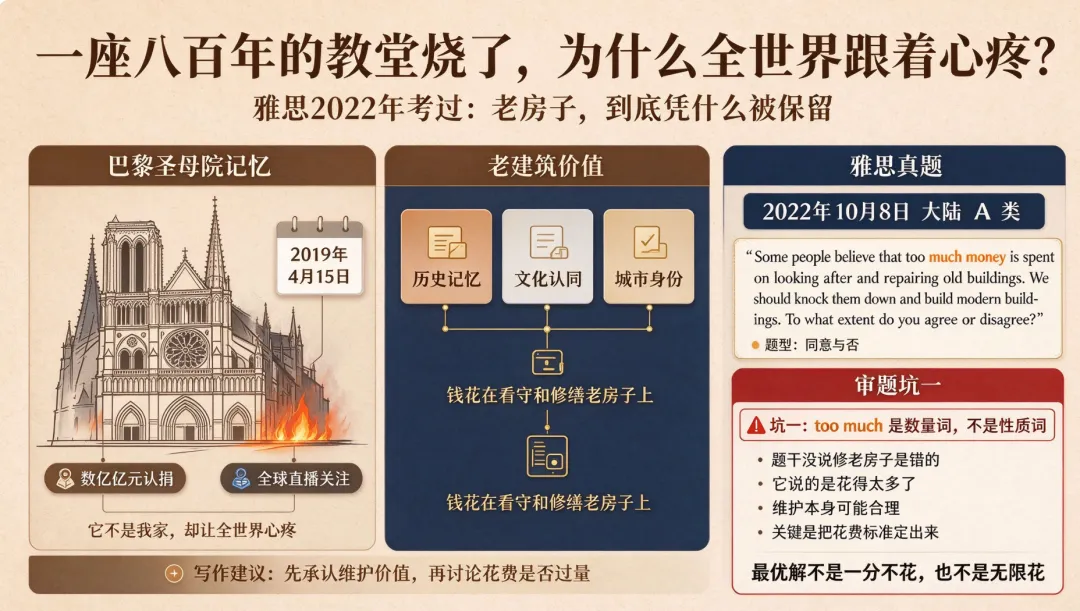
2019 年 4 月 15 日傍晚,巴黎圣母院的塔尖在火里倒了下来。
那几小时,全球都在直播。几天之内,来自法国富豪家族与国际各方的认捐,累积到数亿欧元的量级。
我当时也在看,看完只有一个问题:一座八百年的教堂烧了,为什么全世界跟着心疼?
它又不是我家。
这个问题,和雅思 2022 年 10 月 8 日那道题,是同一件事的两面。题干写得特别直接:钱花在看守和修缮老房子上太多了,我们该把它们拆了盖新的。
今天我不给口号,只回答一个问题:这些老房子,到底凭什么。
这题,雅思真考过
2022年10月8日 大陆 A 类(题库原件逐字核对,台账查过,此前没写过)
Some people believe that too much money is spent on looking after and repairing old buildings. We should knock them down and build modern buildings. To what extent do you agree or disagree?
题型:同意与否
三个审题坑,先排掉
坑一:too much 是数量词,不是性质词
题干没说「修老房子是错的」,它说的是「花得太多了」。它承认维护本身合理,只是嫌贵。所以最优解不是「一分不花」也不是「无限花」,而是把标准定出来。
坑二:modern buildings 不等于「更好的建筑」
题干把「新」和「好」偷偷划了等号。这个等号要当场验:新的更抗震、更省能——成立;但新的也更贵、更耗碳、且不产生任何记忆。
坑三:这道题的战场在「价值」,不在「情怀」
最容易失分的写法,是通篇写「老房子有历史、有故事」。情怀是结论,不是论证。 你要说清它是哪一种价值,能换回什么。
我的答案:不同意。这笔钱不但该花,而且有些国家只能花这一笔。
第一层:它是一份没写下来的历史
老建筑的价值,不在它好看,在它是祖先留下的实物证据。
文字会篡改,照片可以摆拍,只有一堵被磨出凹槽的石阶不会说谎。它记得每一代人的重量。
这就是 historical value(历史价值)——它不是讲述历史,它自己就是历史。
而这份证据,撑起的是一件更大的事:我们是同一个地方的人。
一个人知道自己住的地方三百年前就在这儿,和住在十年前才填平的地块上,感受完全不同。前者有「我属于这里」的踏实,后者只有「我住在这里」的事实。
学名叫 sense of belonging(归属感)。它再往前一步,就是对共同体、对这个国家的认同。
所以你去看,几乎所有国家带孩子认识祖国,都是带他去看古城、看老桥、看博物馆——
因为爱国这件事,很难靠说理教会,但可以被一个地方唤起。
第二层:它是「真的」,真的那份假不了
现在很多城市都造了「仿古街」:青砖、木门、红灯笼,一模一样。可游客到了,看一眼就走,拍两张照就完了。
为什么?因为它不 authentic(不真实)。
authenticity 的核心不是「旧」,是「它确实在这里发生过事」。 仿古街能复制样式,复制不了时间。
而这不是虚的,它直接换成钱。
你去欧洲,一张门票、一晚酒店、一顿饭,贵在哪儿?贵在你走出门,抬头就是一座中世纪的哥特式教堂,而它已经在那里站了六百年,谁也造不出第二个。
这就是完整的商业链条:authentic value(真实价值)→ a place of interest(景点)→ tourism industry(旅游产业)。
而这一条对某些国家是生存级的:中国有长江、有黄山、有九寨沟,这些自然资源可以直接换成旅游收入;而西班牙、意大利这样的国家面积小、没有大川大河,它们能卖的只有两样——历史和阳光。
不修,等于把自己的矿封了。
第三层:象征——为什么一座教堂烧了,全世界都心疼
这才是巴黎圣母院那场火真正的答案。
它不只是一栋房子。它是巴黎的象征,是一个国家向世界展示自己的那张脸,是无数人心里「巴黎」这个词的图像。
象征价值(symbolic value)有个特点:它属于所有人,包括从没去过的人。
所以火一烧,捐钱的不只是法国人。人们捐的不是一座教堂,是自己心里那个还没塌的东西。
这也解释了为什么法国宁可花天价也要修复,而且要坚持用传统工艺、按原样恢复——因为它要修的不是建筑,是那个象征。修歪了,象征就死了。
但是:这笔钱真的是负担
必须承认,账是真的。
最直接的证据是「一元古堡」「一元房」:政府或私人以 1 欧元的象征价出让废弃老宅,条件是买家必须在期限内完成翻新(多地报道为 3 年内)。
注意这个机制的本质:1 欧元不是价格,是转让义务。 真正贵的从来不是那栋房子,是后面几十年的维修。
更麻烦的是,一旦建筑被登记为受保护对象,业主就不能拆、不能随意改、也不能放着不管——这是法律强加的正向义务,不管就是违法。
所以欧洲才有那么多「卖不掉的城堡」和「继承下来却养不起的老宅」。
反驳:不是不花,是换个花法
这是我在这一题上最想给的观点。
问题从来不是「修不修」,而是「修到什么程度、由谁来付」。
一条被反复验证的路径:保留外部、改造内部(facade retention + adaptive reuse)。
外立面、结构、装饰一概不动,把内部的水电、隔音、动线全部更新,改造成酒店、书店、美术馆、公寓。建筑的象征价值被完整保住,而它开始自己挣钱。
欧洲有大量这种案例:老市政厅改成精品酒店,老火车站改成博物馆,老厂房改成办公空间。 它们既没有变成废墟,也没有变成财政黑洞——它们变成了资产。
这一招的高明之处在于:它把「维护成本」变成了「运营收入」,把一次性的财政支出,变成了可持续的商业循环。
这也是这道题唯一站得住的答案:不是砸钱,也不是拆掉,是让它自己养活自己。
范文(385 词)
The argument that too much is spent on maintaining old buildings, and that they should therefore be replaced, treats the question as a simple matter of cost. I disagree with it, because the expenditure buys three things nothing else supplies, and because the real problem is not whether to spend but how.
One compelling argument is that old buildings are physical evidence rather than illustration. This is because a worn stone step records generations of use in a way no text can, and a population living beside structures older than its own institutions acquires a sense of belonging that a new district cannot generate. That attachment is not decoration: it is the ground on which civic and national identity stands, and it explains why states introduce children to old towns rather than merely telling them about the past.
The second argument concerns authenticity, and it converts directly into income. A reconstructed old street reproduces the style but not the fact that events occurred there, and visitors detect the difference immediately; because authenticity cannot be manufactured, it commands a premium, which is why tourism in southern Europe is expensive and why countries with little land and no great rivers treat their old towns as a resource rather than an ornament. The third is symbolic: a cathedral is the face a nation shows the world, and its value belongs even to those who have never visited, which is why a fire in one is mourned far beyond its borders.
Nevertheless, the original claim has a real basis. The one-euro house schemes reveal the mechanism precisely: the price is symbolic because the obligation, which is decades of repair, is the actual cost, and where a building is listed its owner may not demolish, alter or neglect it. However, this is less likely to justify demolition, since the solution is not to stop spending but to spend differently: retaining facades while renewing interiors converts a cost centre into a hotel, a museum or a workspace that pays for its own upkeep.
In conclusion, I disagree that old buildings should be knocked down, mainly because they carry evidence, identity and symbolism that cannot be recreated, as well as because their authenticity is itself an economic asset. The sensible question is not whether to preserve, but how to make preservation pay.
🕊 白鸟老师小课堂
三个词,一条链:它是真的 → 真的不能复制 → 所以它能溢价。
① authenticity —— 真实性,它确实在这里发生过事,不是照着样子重建的。
大白话:仿古街能复制样子,复制不了那六百年。
② symbolic value —— 象征价值,它代表的东西比它本身更重要。
大白话:烧掉的不是一座教堂,是很多人心里那个「巴黎」。
③ adaptive reuse —— 适应性再利用,壳留着,里面全换。
大白话:外立面不动,内部重新装修,让它自己挣钱。
✍️ 造例
A reconstruction can copy the style but not the ==authenticity==, and what a cathedral carries is ==symbolic value== that belongs even to those who never go. ==Adaptive reuse== is what lets such a building pay for its own upkeep without losing either.
中文翻译:重建能复制样式,但复制不了真实性;而一座大教堂承载的象征价值,连从没去过的人也拥有一份。适应性再利用让这样的建筑自己养活自己,而且两样都不丢。
高分搭配:physical evidence rather than illustration(是物证,不是插图)/command a premium(能卖出溢价)/convert a cost centre into an asset(把成本项变成资产)
🔗 延伸一组(文化/城市类通用,考试直接搬)
facade retention 保留立面 → cultural capital 文化资本 → tourism receipts 旅游收入
==Facade retention== is the cheapest form of respect: the street keeps its face while the interior becomes a hotel. What looks like heritage policy is in fact ==cultural capital== being converted into ==tourism receipts==.
中文:保留立面是最便宜的尊重方式:街道保住了面孔,内部变成了酒店。看似是遗产政策,实际上是把文化资本兑换成了旅游收入。
最后一句,说点不客气的
你可能会说:那不是把老房子变成商场了吗?
是。但它至少还站着。
拆掉,你得到一块地;改造,你得到一栋还能用的历史。这两者的差别,不在一时,在五十年后你还有什么能指给孩子看。
而真正的失败不是「改」,是「拆完之后又建了个假的」。 那才是两头都丢:钱花了两遍,真的没了,假的也卖不上价。
三问,你挑一个回我
1. 你去过的「古镇」里,有几个是真的?你能分辨吗?
2. 巴黎圣母院那场火,你当时心疼了吗?心疼的是什么?
3. 如果把你家附近一栋老楼改成酒店,外部不动,你支持吗?
回在评论区,我挑几个明天拆。
身份分流:纸笔考生,把 Body2「真实性不可复制、所以能溢价」这一段背下来,文化类和旅游类通用;机考考生,重点记 authenticity / symbolic value / adaptive reuse 三词搭配;口语 part 3 问 old buildings or tourism,直接搬这条链。
通用模板(背走就能用):
Old buildings supply authenticity that cannot be manufactured, and a cathedral carries symbolic value that belongs even to those who never go. The answer to the cost is not demolition but adaptive reuse — keeping the face, renewing the interior, letting the asset pay for itself.
雅思写作范文系列已经更了很久了,全是机考和纸笔的实考真题,一道没编;每道都逐字核过题库,先拆审题坑再动笔。关键词“范文”,合集直接发你。
关注不迷路。 你的搭子下次还在。
—— 下期预告:今天还有一条我盯了很久——博物馆里全是外地游客,本地人一次没去过。这道题雅思也考过,问得比老房子更扎心:为什么我们对自己家门口的东西,反而最不感兴趣。
Grace 在努力 ♡

