读外刊,接触原汁原味的英文表达,
欢迎关注以下公众号+设为星标+推荐给朋友。▼
📚 狂暴英语教案 · 新概念英语第一册
第43-44课 Hurry up! & Are there any...? / Is there any...?
快点! / 有......吗?
📘 本课信息教材:新概念英语第一册 · 第43-44课核心功能:厨房场景 · 请求与能力 · 询问物品存在与位置 · 催促表达语法焦点:情态动词 can · There be 句型 (any/some) · 方位介词 behind/in front of · 不可数名词
🎯 本课学习目标
词汇:
掌握与厨房物品、食物及方位相关的核心名词(teapot, kettle, cupboard, teapot, teacup)和动词(make, boil, hurry up);理解“寻找某物”及“提供帮助”的相关短语。
语法:
掌握情态动词 can 表示“能力”和“可能性”的用法;熟练掌握 there is/are 句型与 any 在疑问句和否定句中的运用;巩固不可数名词与量词搭配(如 a loaf of bread)。
技能(日常对话):
能够在厨房或类似生活场景中,就物品的位置、存在与否进行有效问答;学会使用 Can you...? 礼貌地请求帮助或询问能力;掌握 Hurry up! 等催促用语。
文化:
初步了解英式茶饮文化中茶具的称呼;体会英语中催促语气的直接性与情境适用性。
📖 第一部分:课文完整内容
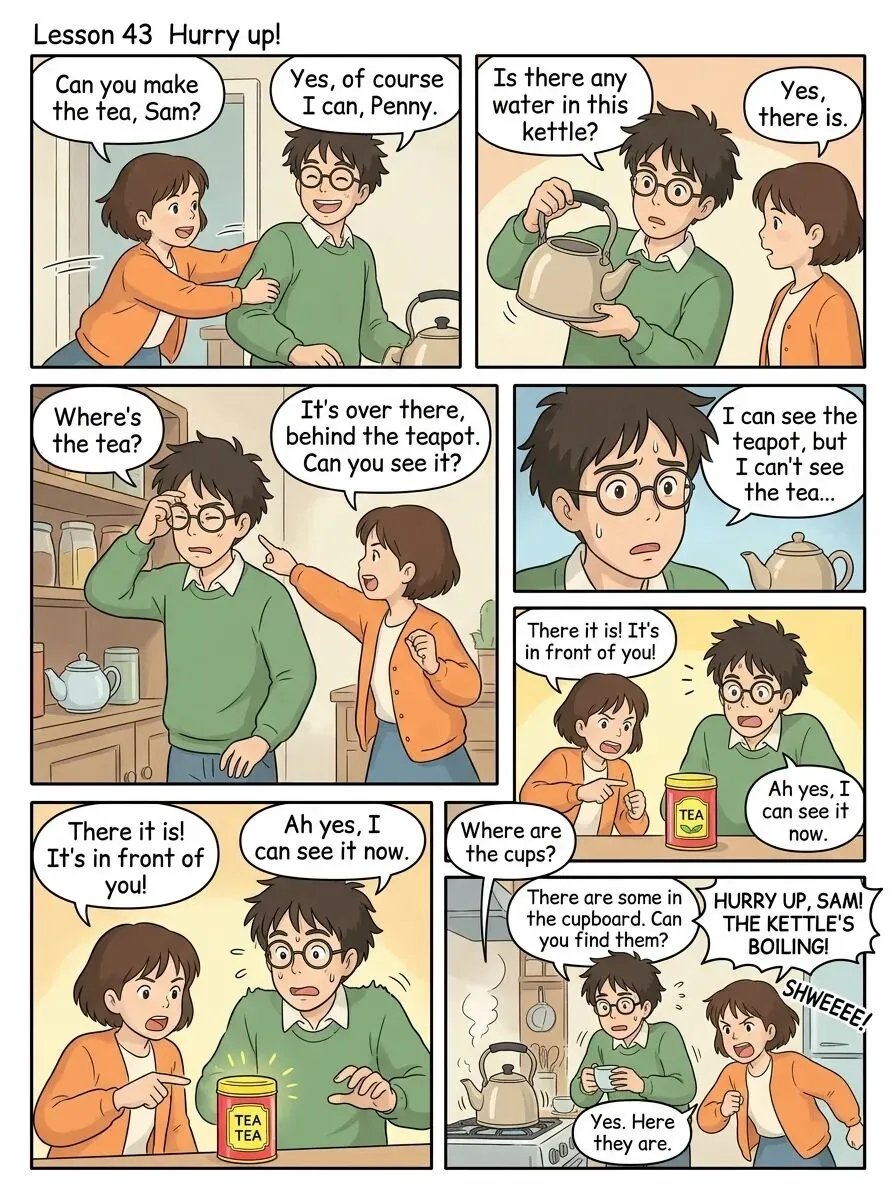
情景说明:场景发生在家庭的厨房或与厨房相连的餐区。彭妮(Penny)和萨姆(Sam)正在准备喝茶。对话围绕“泡茶”这个任务展开,涉及寻找必要的物品:水壶(kettle)、茶叶(tea)、茶壶(teapot)和茶杯(teacups)。彭妮在指引,萨姆在寻找,最后彭妮催促萨姆,因为水烧开了。
Lesson 43 Hurry up!
📜 课文原文(含语音标注)
PENNY: Can you make the tea, Sam?
彭妮:你会沏茶吗,萨姆?
SAM: Yes, of course I can, Penny.
萨姆:会的,我当然会,彭妮。
SAM: Is there any water in this kettle?
萨姆:这水壶里有水吗?
PENNY: Yes, there is.
彭妮:有的。
SAM: Where's the tea?
萨姆:茶叶在哪儿?
PENNY: It's over there, behind the teapot.
彭妮:就在那儿,茶壶后面。
PENNY: Can you see it?
彭妮:你能看见吗?
SAM: I can see the teapot, but I can't see the tea.
萨姆:茶壶我能看见,但茶叶我看不见。
PENNY: There it is! It's in front of you!
彭妮:就在那儿!就在你前面!
SAM: Ah yes, I can see it now.
萨姆:噢,是的,我现在看到了。
SAM: Where are the teacups?
萨姆:茶杯在哪儿?
PENNY: There are some in the cupboard.
彭妮:碗橱里有几个。
PENNY: Can you find them?
彭妮:你能找到它们吗?
SAM: Yes. Here they are.
萨姆:能。它们在这儿。
PENNY: Hurry up, Sam! The kettle's boiling!
彭妮:快点,萨姆!水开了!
语音标注: Can you 连读 /kən ju/;Is there 连读 /ˈɪz ðə/;Where's 发音 /weəz/;behind 重音第二音节;cupboard 中 p 不发音;Hurry up 连读 /ˈhʌri ʌp/。
情景说明:第44课是对第43课 there be 句型和 any/some 用法的集中操练,通过问答形式巩固对物品存在与否及位置的表达。
Lesson 44 Are there any...? Is there any...?
📜 课文原文(句型练习)
Are there any books on the table?No, there aren't any books on the table.There are some magazines.Where are they?They're on the television.
桌子上有书吗?不,桌子上没有书。有几本杂志。它们在哪儿?在电视机上。
Is there any chocolate on the shelf?No, there isn't any chocolate on the shelf.There's some coffee.Where is it?It's behind the teapot.
架子上有巧克力吗?不,架子上没有巧克力。有一些咖啡。它在哪儿?在茶壶后面。
🔍 第二部分:逐句精讲与词块总结
句子1
原文: Can you make the tea, Sam?
翻译: 你会沏茶吗,萨姆?
句子结构: 情态动词疑问句。Can(情态动词) + you(主语)+ make(谓语动词原形)+ the tea(宾语)+ Sam(呼语)。
重点词汇:
make (蓝思值 10L)英音 /meɪk/ 美音 /meɪk/词性:vt.释义:做,制作;准备(饭菜、饮料等)常用语块:make the tea/coffee 沏茶/冲咖啡例句一:My father makes breakfast every Sunday. 我爸爸每个周日做早餐。例句二:The good news made her very happy. 这个好消息让她非常开心。拓展:make 含义极广,本课指“准备、沏泡”。区别于 do(做某事,常接抽象或泛指任务),make 更强调“制造出”一个具体的东西或结果。
tea (蓝思值 10L)英音 /tiː/ 美音 /tiː/词性:n.释义:茶;茶叶;茶点常用语块:make the tea 沏茶;green/black tea 绿茶/红茶;a cup of tea 一杯茶例句一:Would you like a cup of tea? 你想喝杯茶吗?例句二:Afternoon tea is a British tradition. 下午茶是英国的传统。拓展:在英语文化中,tea 可指茶叶、茶饮,也指傍晚的一顿简餐(特别是英式下午茶)。the tea 此处特指“要喝的茶”。
语法点睛: 情态动词 can 用于询问能力。结构:Can + 主语 + 动词原形 + ...? 肯定回答:Yes, 主语 + can. 否定回答:No, 主语 + can't/cannot. 本句是请求对方做某事的委婉开场,比直接的祈使句 Make the tea. 更礼貌。
语音要点: Can you 常发生连读为 [kæn juː] 或更口语化的 [kən jə]。句尾呼语 Sam 用升调,表示呼唤和期待回答。
句子2
原文: Yes, of course I can, Penny.
翻译: 会的,我当然会,彭妮。
句子结构: 简单句。Yes(感叹词)+ of course(状语)+ I(主语)+ can(情态动词)+ Penny(呼语)。
重点词汇:
of course (蓝思值 20L)英音 /əv ˈkɔːs/ 美音 /əv ˈkɔːrs/词性:adv. phrase释义:当然,自然常用语块:用于肯定回答,加强语气。例句一:- Can I borrow your pen? - Of course. ——我能借你的笔吗?——当然可以。例句二:Of course, you should ask for help if you need it. 当然,如果你需要就应该寻求帮助。拓展:of course 语气肯定,有时会显得有点理所当然。更客气的说法可以用 certainly 或 sure。
语法点睛: 对 Can you...? 问句的肯定回答。完整形式是 Yes, I can make the tea. 口语中常省略动词部分,直接用 Yes, I can.。of course 插入其中,表示毫无疑问。
语音要点: of course 连读为 [əvˈkɔːs]。I can 连读,can 重读以强调能力。句末呼语 Penny 用降调。
句子3
原文: Is there any water in this kettle?
翻译: 这水壶里有水吗?
句子结构: There be 句型的一般疑问句。Is(be动词)+ there + any(限定词)+ water(主语)+ in this kettle(地点状语)?
重点词汇:
any (蓝思值 10L)英音 /ˈeni/ 美音 /ˈeni/词性:det., pron.释义:(用于疑问句或否定句)一些,任何;任何的常用语块:any water/milk/books 任何水/牛奶/书;not... any 没有......例句一:Is there any sugar left? 还有糖吗?例句二:I don't have any brothers or sisters. 我没有任何兄弟姐妹。拓展:any 常用于疑问句和否定句中,修饰可数名词复数或不可数名词。在肯定句中,表示“任何”的含义,如 Any student can answer this. 任何学生都能回答。
water (蓝思值 10L)英音 /ˈwɔːtə(r)/ 美音 /ˈwɔːtər/词性:n.释义:水常用语块:a glass of water 一杯水;hot/cold water 热水/冷水;under water 在水下例句一:All living things need water. 所有生物都需要水。例句二:The water in this lake is very clear. 这个湖里的水非常清澈。拓展:不可数名词。表示数量时需用量词,如 a cup of water, some water。
kettle (蓝思值 400L)英音 /ˈketl/ 美音 /ˈketl/词性:n.释义:(烧水用的)水壶常用语块:an electric kettle 电水壶;a whistling kettle 会鸣笛的水壶;put the kettle on 把水壶坐上(烧水)例句一:The kettle is boiling. 水壶里的水开了。例句二:She filled the kettle with fresh water. 她把水壶灌满了新鲜的水。拓展:特指烧开水的壶。区别于 pot(锅,罐)和 teapot(茶壶)。
语法点睛: There be 句型疑问式:将 be 动词 is/are 提前。主语是不可数名词 water,故用 is。any 用于疑问句中,表示“是否有一些”。
语音要点: Is there 连读为 [ˈɪz ðə]。any 弱读为 [əni]。this kettle 中,this 的尾辅音 [s] 与 kettle 的开头辅音 [k] 略有停顿,但属于同一意群。
句子4
原文: Yes, there is.
翻译: 有的。
句子结构: There be 句型的简短肯定回答。Yes + there + is。
语法点睛: 对 Is there...? 的肯定回答。完整回答是 Yes, there is (some water in this kettle). 口语中省略括号内部分。否定回答为 No, there isn't。
语音要点: there is 连读为 [ðər ˈɪz]。is 重读,表示肯定存在。
句子5
原文: Where's the tea?
翻译: 茶叶在哪儿?
句子结构: 特殊疑问句。Where(疑问副词)+ is(be动词,缩写为 's)+ the tea(主语)?
语法点睛: Where is...? 询问单数物品的位置。回答用 It's + 地点状语。 本课中 tea 作为物质名词(茶叶),常视为单数。
语音要点: Where's 发音为 [weəz]。句末用升调,表示疑问。
句子6
原文: It's over there, behind the teapot.
翻译: 就在那儿,茶壶后面。
句子结构: 主系表结构。It(主语)+ 's(系动词 is)+ over there(表语1)+ behind the teapot(表语2/地点状语)。
重点词汇:
behind (蓝思值 50L)英音 /bɪˈhaɪnd/ 美音 /bɪˈhaɪnd/词性:prep., adv.释义:在......后面;在后面常用语块:behind the door 在门后;fall behind 落后;leave behind 留下,忘带例句一:The sun disappeared behind the clouds. 太阳消失在云层后面。例句二:He's hiding behind the tree. 他正躲在树后面。拓展:反义词是 in front of。既可表空间位置,也可引申为“落后于”。
teapot (蓝思值 500L)英音 /ˈtiːpɒt/ 美音 /ˈtiːpɑːt/词性:n.释义:茶壶常用语块:a china teapot 瓷茶壶;pour from the teapot 从茶壶里倒茶例句一:She collects antique teapots. 她收藏古董茶壶。例句二:The teapot is still warm. 茶壶还是温的。拓展:复合词 tea + pot。特指泡茶和倒茶的壶,区别于烧水的 kettle。
语法点睛: 介词短语 behind the teapot 作地点状语,说明 it(茶叶)的具体位置。over there 是表示较远距离的副词短语。
语音要点: It's over there 中,over there 作为一个意群,语调平缓。逗号后有短暂停顿,behind the teapot 补充说明,语调略降。
句子7
原文: Can you see it?
翻译: 你能看见它吗?
句子结构: 情态动词疑问句。Can(情态动词)+ you(主语)+ see(谓语动词原形)+ it(宾语)?
重点词汇:
see (蓝思值 10L)英音 /siː/ 美音 /siː/词性:vt.释义:看见;看出,明白;会见常用语块:see a film 看电影;see you later 回头见;I see. 我明白了。例句一:I can see a bird in the tree. 我能看见树上有只鸟。例句二:Let me see what I can do. 让我看看我能做些什么。拓展:see 强调“看”的结果,即“看见”。区别于 look (at) 强调“看”的动作,watch 强调“观看”动态过程。
语法点睛: 情态动词 can 在此表示“能力”(视觉能力)或“可能性”(在视野内找到的可能性)。
语音要点: Can you 连读。see it 连读为 [ˈsiː jɪt]。
句子8
原文: I can see the teapot, but I can't see the tea.
翻译: 茶壶我能看见,但茶叶我看不见。
句子结构: 并列句。I(主语1)+ can see(谓语1)+ the teapot(宾语1)+ , but(并列连词)+ I(主语2)+ can't see(谓语2)+ the tea(宾语2)。
重点词汇:
can't (蓝思值 10L)英音 /kɑːnt/ 美音 /kænt/词性:modal v. contraction释义:cannot 的缩写,不能,不会常用语块:表示没有能力或不可能。例句一:I can't swim. 我不会游泳。例句二:You can't be serious! 你不会是认真的吧!拓展:cannot 是正式写法,can't 是口语和一般书写中的缩写。否定回答 No, I can't.
语法点睛: but 连接两个并列分句,表示转折关系。前一分句肯定,后一分句否定,形成对比。can't 是 cannot 的缩写,表示否定能力。
语音要点: can't 中的元音 [ɑː] 或 [æ] 需清晰发出,与 can 区别。but 弱读为 [bət]。两个分句语调先升后降,转折处 but 语调略提。
句子9
原文: There it is! It's in front of you!
翻译: 就在那儿!就在你前面!
句子结构: 句1:倒装句。There(副词)+ it(主语)+ is(系动词)! 句2:主系表结构。It(主语)+ 's(系动词 is)+ in front of you(表语/地点状语)!
重点词汇:
in front of (蓝思值 50L)英音 /ɪn ˈfrʌnt əv/ 美音 /ɪn ˈfrʌnt əv/词性:prep. phrase释义:在......前面常用语块:in front of the house 在房子前面;sit in front of me 坐在我前面例句一:There's a car parked in front of the gate. 有辆车停在大门前。例句二:Don't say that in front of the children. 别在孩子面前说那个。拓展:指在外部的前面。区别于 in the front of(在......内部的前部),如 He sits in the front of the bus. 他坐在公交车的前部(车厢内)。
语法点睛: There it is! 是表示“找到了”、“它在那儿”的常用感叹句,是 It is there. 的倒装强调形式。in front of 是介词短语,作地点状语。
语音要点: There it is! 语调高亢,充满惊喜或指示意味,is 重读。It's in front of you! 中 front 和 you 重读,语气可能带点无奈或强调。
句子10
原文: Ah yes, I can see it now.
翻译: 噢,是的,我现在看到了。
句子结构: 简单句。Ah yes(感叹词)+ , + I(主语)+ can see(谓语)+ it(宾语)+ now(时间状语)。
重点词汇:
now (蓝思值 10L)英音 /naʊ/ 美音 /naʊ/词性:adv.释义:现在,此刻;马上常用语块:right now 立刻;from now on 从现在起;now and then 偶尔例句一:I'm busy now. Can I call you back? 我现在正忙。能给你回电吗?例句二:Start the engine now. 现在启动引擎。拓展:表示当前时间点。在对话中也可用于转换话题或语气,如 Now, let's move on to the next point. 好了,我们接下来谈下一点。
语法点睛: 时间状语 now 放在句末,修饰整个句子,表示“在说话的这个时刻”。
语音要点: Ah yes 发音舒缓,表示恍然大悟。I can see it now 中 now 重读,强调“此刻”看见了。
句子11
原文: Where are the teacups?
翻译: 茶杯在哪儿?
句子结构: 特殊疑问句。Where(疑问副词)+ are(be动词)+ the teacups(主语)?
重点词汇:
teacup (蓝思值 450L)英音 /ˈtiːkʌp/ 美音 /ˈtiːkʌp/词性:n.释义:茶杯常用语块:a set of teacups 一套茶杯;a crack in the teacup 茶杯上的裂缝例句一:She handed me a delicate teacup. 她递给我一个精致的茶杯。例句二:The teacup is filled with hot tea. 茶杯里斟满了热茶。拓展:复合词 tea + cup。注意复数形式直接在词尾加 s。
语法点睛: Where are...? 询问复数物品的位置。回答用 They are + 地点状语。
语音要点: Where are 可连读为 [ˈweər ə]。teacups 尾音 [ps] 需清晰。
句子12
原文: There are some in the cupboard.
翻译: 碗橱里有几个。
句子结构: There be 句型。There + are(be动词)+ some(主语)+ in the cupboard(地点状语)。
重点词汇:
some (蓝思值 10L)英音 /sʌm/ 美音 /sʌm/词性:det., pron.释义:一些,若干常用语块:some books/water 一些书/水;some of them 他们中的一些例句一:Would you like some coffee? 你想喝点咖啡吗?例句二:Some people like rainy days. 有些人喜欢下雨天。拓展:some 常用于肯定句,修饰可数名词复数或不可数名词。在表示建议或请求的疑问句中,为了得到肯定回答,也会用 some,如 Would you like some tea?(期待对方说“要”)。
cupboard (蓝思值 400L)英音 /ˈkʌbəd/ 美音 /ˈkʌbərd/词性:n.释义:碗橱,橱柜常用语块:a kitchen cupboard 厨房碗柜;cupboard love 有所图的爱(比喻)例句一:The plates are in the cupboard. 盘子在碗橱里。例句二:He built a new cupboard for the bathroom. 他为浴室做了一个新柜子。拓展:注意发音,p 不发音。英式英语常用,美式英语可能更常用 cabinet。
语法点睛: There are 后接复数主语 some(指代 some teacups)。some 在此是不定代词,代替前面提到的复数名词,避免重复。
语音要点: There are 连读为 [ðər ə]。some 弱读为 [səm]。in the cupboard 中 the 弱读为 [ðə],cupboard 的发音是重点。
句子13
原文: Can you find them?
翻译: 你能找到它们吗?
句子结构: 情态动词疑问句。Can(情态动词)+ you(主语)+ find(谓语动词原形)+ them(宾语)?
重点词汇:
find (蓝思值 50L)英音 /faɪnd/ 美音 /faɪnd/词性:vt.释义:找到,发现;发觉常用语块:find a job 找到工作;find out 查明,弄清楚;find it difficult 觉得困难例句一:I can't find my keys. 我找不到我的钥匙了。例句二:Did you find the answer to the question? 你找到问题的答案了吗?拓展:find 强调寻找后的结果“找到”。look for 强调寻找的过程“寻找”。
语法点睛: them 是 they 的宾格,指代前文提到的 teacups。Can you find them? 是 Can you see them? 的进一步请求,要求对方不仅看到,还要“找到并可能取出”。
语音要点: find them 连读为 [ˈfaɪn ðəm]。
句子14
原文: Yes. Here they are.
翻译: 能。它们在这儿。
句子结构: 倒装句。Here(副词)+ they(主语)+ are(系动词)。
语法点睛: Here they are. 是表示“给你”、“它们在这儿”的常用句,是 They are here. 的倒装形式,用于递东西或指出物品位置时。单数用 Here it is.
语音要点: Here they are. 语调平稳或略降,表示陈述。are 可重读。
句子15
原文: Hurry up, Sam! The kettle's boiling!
翻译: 快点,萨姆!水开了!
句子结构: 句1:祈使句。Hurry up(谓语动词短语)+ , + Sam(呼语)! 句2:主谓结构。The kettle(主语)+ 's boiling(谓语,现在进行时)!
重点词汇:
hurry up (蓝思值 100L)英音 /ˈhʌri ʌp/ 美音 /ˈhɜːri ʌp/词性:v. phrase释义:赶快,快点常用语块:用于催促他人加快速度。例句一:Hurry up, or we'll be late! 快点,不然我们要迟到了!例句二:Can you hurry up with that report? 你能快点完成那份报告吗?拓展:hurry 本身是动词“匆忙”,hurry up 是固定短语。反义是 slow down。
boil (蓝思值 300L)英音 /bɔɪl/ 美音 /bɔɪl/词性:v.释义:(使)沸腾,烧开;用开水煮常用语块:boiling water 沸水;boil an egg 煮鸡蛋;boil over 沸溢例句一:Water boils at 100 degrees Celsius. 水在100摄氏度沸腾。例句二:The soup is boiling on the stove. 汤在炉子上沸腾着。拓展:现在分词 boiling 可作形容词,意为“沸腾的,极热的”。The kettle's boiling 是“水壶里的水正在沸腾”的简略说法。
语法点睛: Hurry up 是省略主语 you 的祈使句,表示命令或催促。The kettle's boiling 是现在进行时,表示说话时正在发生的动作(水正在沸腾),用来解释催促的原因。
语音要点: Hurry up 语调急促上扬,带有紧迫感。The kettle's boiling 中 boiling 重读,强调状态。
📌 核心词块总结 (Key Lexical Chunks)
make the tea — 沏茶 (e.g., Can you make the tea while I set the table?)
Is there any...? — 有……吗? (用于不可数或单数) (e.g., Is there any milk in the fridge?)
behind the teapot — 在茶壶后面 (e.g., The sugar is behind the teapot, next to the cups.)
Can you see/find...? — 你能看见/找到……吗? (e.g., Can you find the remote control? It should be on the sofa.)
in front of you — 在你前面 (e.g., Your passport is right in front of you on the desk!)
Hurry up! — 快点! (e.g., Hurry up! The bus is about to leave.)
There are some... — 有一些…… (肯定,复数) (e.g., There are some apples in the basket.)
Here they are. — 它们在这儿。 (e.g., Here are the books you asked for.)
💬 第三部分:基础会话技巧
1. 日常用语与礼貌表达- 请求与提议:Can you make the tea? 是请求帮助的委婉方式,比直接命令更礼貌。回答时用 Yes, of course I can. 表示欣然同意并强调能力。- 询问存在与位置:Is there any...? / Where is/are...? 是寻找物品的标准问法。回答时先确认存在 (Yes, there is/are.),再指明位置 (It's/They're...)。- 提供指引与确认:Can you see it? / Can you find them? 是在给出位置信息后,确认对方是否接收到信息的跟进提问,体现了对话的互动性。- 催促用语:Hurry up! 是直接但常用的催促语,通常用于熟人之间或紧急情况。可单独使用,也可后接催促原因 (The kettle's boiling!)。
2. 扩展对话示例(客厅寻找电视遥控器)A: Can you turn on the TV, please?B: Sure. Where's the remote control?A: Is it on the coffee table?B: No, there isn't any remote on the table.A: Maybe it's behind the cushion on the sofa.B: I can see the cushion, but I can't see the remote.A: There it is! It's under the newspaper!B: Ah, I can see it now. Here it is.A: Hurry up! The show is starting!
3. 角色扮演活动建议- 活动1:厨房寻宝。一人扮演“指引者”,拥有一张画有厨房物品位置的图(但不给同伴看);另一人扮演“寻找者”,根据指引者的口头描述(使用 Is there any...?, Where is...?, It's behind/in front of... 等),在空白图上画出物品位置或找到实物道具。- 活动2:快速反应。老师或一名学生快速说出一个物品和方位短语(如 a cup behind the book),其他学生需用 There is a cup behind the book. 或 Is there a cup behind the book? 来复述或提问,训练反应和句型熟练度。
4. 基础思考问题- 如果你是 Sam,Penny说 "It's in front of you!" 但你还没看到,除了说 "I can't see it.",还可以怎么回应?(例如:Where exactly? In front of me where?)- 除了 Hurry up!,在请别人加快速度时,还可以怎么说才显得更礼貌?(例如:Could you please be a bit quicker? We're running out of time.)
📐 第四部分:本课语法精析(加强版)
1. 情态动词 Can (表示能力与可能性) [NCE知识点笔记, 名师精讲, 语法新思维]基本用法:Can 是一个情态动词,无人称和数的变化,后接动词原形。在本课主要表示两种含义:- 能力:表示主语具有做某事的能力或技能。· Can you make the tea? (询问对方是否有沏茶的技能)· I can speak English. (我具备说英语的能力)· Birds can fly. (鸟有飞行的能力)- 可能性:表示根据现有情况判断的可能性,常译为“能、可以”。· I can see the teapot. (在视野范围内,我能看到茶壶/茶壶是可见的。)· Can you find them? (在碗橱里,你有可能找到它们吗?)· We can go to the park tomorrow if it's sunny. (如果晴天,我们明天可以去公园。)句型结构:- 肯定句:主语 + can + 动词原形 + ... (Sam can make the tea.)- 否定句:主语 + cannot (can't) + 动词原形 + ... (I can't see the tea.)- 一般疑问句:Can + 主语 + 动词原形 + ...? (Can you see it?) 回答:Yes, 主语 + can. / No, 主语 + can't.- 特殊疑问句:疑问词 + can + 主语 + 动词原形 + ...? (What can you do?)与其他情态动词的初步对比 [语法新思维]:- Can (能力/可能性) vs May (许可/可能性):May 表示“可以”,常用于请求或给予许可,语气更正式。Can 在口语中常代替 may 请求许可。- Can (能力) vs Be able to:Be able to 也能表示能力,有时可互换。但 can 只有现在时和过去时 (could),而 be able to 有更多时态形式,如将来时 will be able to,完成时 have been able to。例句扩充:1. My little sistercanread now. (能力)2.Canyou help me with this heavy box? (可能性/请求)3. Sorry, Ican'thear you. The line is bad. (可能性-否定)4. Youcanuse my pen if you need one. (许可-口语化)5.Cananimals think? (能力-泛指)6. Ican'tbelieve it's already Monday! (可能性-表示惊讶)7. How many languagescanyou speak? (能力-特殊疑问)8. Wecansee the mountains from our window. (可能性)9. He said hecan'tcome to the meeting. (能力/可能性-否定)10.Can I have a glass of water, please? (请求许可-口语)
2. There be 句型 (存在句) 与 Any/Some 的运用 [NCE知识点笔记, 手绘版语法笔记, 同步语法强化]There be 句型核心:表示“某处有某物”,强调存在而非所属。There 是引导词,无实际意义。动词 be 的单复数由紧随其后的主语决定。- 单数主语:There is (There's) a book on the desk.- 复数主语:There are some books on the desk.- 不可数名词主语:There is some water in the bottle. (本课 Is there any water...?)Any 和 Some 的用法辨析 [名师精讲]:- Some:用于肯定句,表示“一些”,修饰可数名词复数或不可数名词。· There aresometeacups in the cupboard. (本课,肯定句,复数)· There issomecoffee behind the teapot. (第44课,肯定句,不可数)· I needsomehelp. (肯定句,不可数)- Any:用于疑问句和否定句,表示“一些,任何”。· Is thereanywater in this kettle? (本课,疑问句,不可数)· Are thereanybooks on the table? (第44课,疑问句,复数)· There aren'tanybooks on the table. (第44课,否定句,复数)· There isn'tanychocolate on the shelf. (第44课,否定句,不可数)- 特例:在表示建议、请求或期望得到肯定回答的疑问句中,用 some。· Would you likesometea? (建议/邀请)· Can I havesomewater, please? (请求)There be 句型的疑问与否定形式:- 一般疑问句:将 be 动词提前。· Is there a pen in your bag? Yes, there is. / No, there isn't.· Are there any students in the classroom? Yes, there are. / No, there aren't.- 否定句:在 be 动词后加 not,或用 no。用 not any 更常见。· There is not (isn't) any milk. = There is no milk.· There are not (aren't) any chairs. = There are no chairs.与 Have 的区别 [手绘版语法笔记]:There be 表示“存在”,have 表示“拥有”。主语不同。- There is a book on the table. (书存在于桌上)- I have a book. (我拥有一本书)- The table has four legs. (桌子拥有四条腿——属于其一部分)例句扩充:1.There isa strange noise outside. (单数)2.Are thereany messages for me? (疑问,复数)3.There isn't anysugar in my coffee. (否定,不可数)4.There are somebeautiful flowers in the garden. (肯定,复数)5.Is therea bank near here? (疑问,单数)6.There are noclouds in the sky today. (否定,复数,用no)7.There's someimportant news on TV. (肯定,不可数,缩写)8. Whyaren't there anywindows in this room? (否定疑问,复数)9.There isa little boy and two girls waiting for you. (主语为并列结构,遵循“就近原则”,离 be 动词近的 a boy 是单数,所以用 is)10. Look!There's your bus! (倒装感叹句,单数)
3. 介词:Behind 与 In front of [NCE知识点笔记, 课堂笔记]Behind:在......后面(指外部后方)。- The cat is hidingbehindthe sofa.- Please don't talkbehindother people's backs. (引申义:在背后)In front of:在......前面(指外部前方)。- There's a car parkedin front ofour house.- She stoodin front ofthe mirror.重要区别:In front of (外部) vs In the front of (内部前部)。- He satin front ofthe bus. (他坐在公交车的前方,可能在车站的长椅上。)- He satin the front ofthe bus. (他坐在公交车内的前部座位。)方位介词小结 (复习与拓展):on (在......上,表面接触), in (在......里,内部), under (在......下), near (在......附近), next to (紧挨着), between (在两者之间), over (正上方), above (上方,不一定垂直)。例句扩充:1. The keys arebehindthe clock on the wall.2. Wait for mein front ofthe cinema entrance.3. The teacher's desk isin the front ofthe classroom.4. There's a gardenbehindthe building.5. Don't put your feetin front of the heater.
4. 不可数名词与量词 [教材解析, 全单词表]本课出现的不可数名词:water, tea, chocolate, coffee。不可数名词没有复数形式,不能直接与 a/an 或数词连用。表示数量时,需要借助量词。- a kettle of water (一壶水)- a cup of tea (一杯茶)- a bar of chocolate (一块巧克力)- a pot of coffee (一壶咖啡)- a loaf of bread (一条面包) -- 第44课拓展- a piece of cheese (一片奶酪) -- 第44课拓展在 there be 句型和疑问句中,不可数名词前用 some (肯定) 或 any (疑问/否定)。
练习题 (不少于10道)A. 用 can 或 can't 填空。1. I _______ play the piano, but my brother _______.2. _______ you pass me the salt, please?3. It's too dark. I _______ see anything.4. Fish _______ live without water.5. We _______ go to the beach tomorrow because it will rain.B. 用 some 或 any 填空。6. There are _______ apples in the basket.7. Is there _______ milk left in the fridge?8. I don't have _______ money with me.9. Would you like _______ cake?10. There isn't _______ sugar in this tea.C. 用 there is/are 的正确形式填空。11. _______ a letter for you on the table.12. _______ any problems with your computer?13. Look! _______ some birds in that tree.14. _______ no time to waste.15. How many students _______ in the library?D. 翻译句子。16. 你能看见黑板上的字吗?17. 冰箱里有一些鸡蛋吗?18. 茶杯不在茶壶后面。它们在碗橱里。19. 快点!电影要开始了。20. 我不会游泳,但我弟弟会。练习答案A: 1. can, can't 2. Can 3. can't 4. can't 5. can'tB: 6. some 7. any 8. any 9. some 10. anyC: 11. There is 12. Are there 13. There are 14. There is 15. are thereD: 16. Can you see the words on the blackboard? 17. Are there any eggs in the fridge? 18. The teacups are not behind the teapot. They are in the cupboard. 19. Hurry up! The film is about to start. 20. I can't swim, but my brother can.
✏️ 第五部分:基础练习与活动
1. 跟读练习: 播放课文录音,学生逐句跟读。重点模仿 Can you...? 的连读、there is/are 的连读、以及 behind, teapot, cupboard 的发音。教师可对 can 和 can't 的发音进行对比训练。
2. 角色扮演:- 活动A:两人一组,分角色朗读并表演课文对话。- 活动B:创设新场景(如在书房找书、在卧室找衣服),使用本课核心句型 (Can you find...?, Is there any...?, It's behind...) 编一段简短对话并表演。
3. 简单替换练习:- 句型:Is there any [不可数名词] in/on the [地点]?替换词:milk/bread/coffee/sugar/butter + fridge/cupboard/on the table/on the shelf- 句型:Are there any [可数名词复数] in/on the [地点]?替换词:books/plates/forks/eggs/apples + bag/kitchen/box/basket- 句型:Can you see/find the [名词]? It's in front of/behind the [名词].替换词:cat/dog/remote/phone + sofa/TV/chair/door
4. 听力理解(听一段简短对话,回答问题)对话内容:Tom: Mum, I'm hungry. Are there any biscuits?Mum: Look in the tin in the cupboard.Tom: I can see the tin, but I can't see any biscuits inside.Mum: They're not in the tin? Are there any on the kitchen table?Tom: No, there aren't any on the table.Mum: Oh, I remember! They're behind the cereal box on the top shelf.Tom: Ah, yes! I can see them now. There are some! Can I have one?Mum: Hurry up and take one. Dinner will be ready soon.问题:① What is Tom looking for?② Where does Mum first suggest looking?③ Can Tom find them there?④ Where are the biscuits finally?⑤ What does Mum say at the end?参考答案:① He is looking for biscuits.② She suggests looking in the tin in the cupboard.③ No, he can't. He can see the tin but not the biscuits inside.④ They are behind the cereal box on the top shelf.⑤ She says "Hurry up and take one. Dinner will be ready soon."
5. 课文简化改写版(供基础更薄弱者参考)Penny: Sam, make tea?Sam: Yes.Sam: Water in kettle?Penny: Yes.Sam: Tea where?Penny: There. Behind teapot.Penny: See it?Sam: See teapot. No see tea.Penny: There! In front of you!Sam: Oh, see now.Sam: Teacups where?Penny: Some in cupboard.Penny: Find them?Sam: Yes. Here.Penny: Quick, Sam! Water hot!
🤔 第六部分:英文深度思考与拓展
A. 层次化英文问题与答案Level 1 (Factual):1. What does Penny ask Sam to do at the beginning? → Penny asks Sam to make the tea.2. Where is the tea located? → The tea is behind the teapot.3. What is the reason Penny gives for hurrying up at the end? → The kettle is boiling.Level 2 (Inferential):4. Why does Sam ask, "Is there any water in this kettle?" before making tea? → He needs to check if the kettle has water in it because you need water to boil for making tea.5. How do you think Penny feels when she says, "There it is! It's in front of you!"? → She probably feels a little impatient or frustrated because Sam cannot see something that is right in front of him.6. Based on the dialogue, what kind of relationship do Penny and Sam likely have? → They likely have a casual, familiar relationship, such as family members, roommates, or good friends, because they are preparing tea together and Penny speaks to Sam directly ("Hurry up!").Level 3 (Evaluative/Creative):7. If you were Sam, what would you say or do differently after not seeing the tea at first? → If I were Sam, I might say, "Could you point to it more precisely?" or I might move a little to get a better view.8. Besides a kettle boiling, what are some other common situations in a house where someone might say "Hurry up!"? → Other situations could be: when someone is late for school/work, when food is getting cold on the table, when a bus/train is about to leave, or when a movie is starting.9. Do you think it's important to be able to give clear directions about where things are? Why or why not? → Yes, I think it is very important. Clear directions save time, prevent frustration, and are essential for teamwork, whether at home, at work, or in emergencies.
B. 多类型拓展阅读1. 现代场景故事 (Modern Scenario)Leo was gaming online with his friend when his mom called from the kitchen. "Leo! Can you make some popcorn?" "Sure, Mom!" he replied, pausing his game. He went to the kitchen. "Is there any oil?" he asked. "Yes, in the bottle behind the microwave," Mom said. Leo saw the microwave but not the oil. "I can see the microwave, but I can't see the oil bottle!" "There it is! In front of the coffee maker!" Mom said. "Ah, got it!" Leo found the popcorn kernels in the cupboard. "Hurry up, Leo! The movie is starting in five minutes!" Mom called from the living room. "Almost done!" Leo said, turning on the stove.Question: What are Leo and his mom about to do?→ They are about to watch a movie and eat popcorn.2. 文化背景小知识 (Cultural Background)The "teapot" in this lesson is a central part of British tea culture. A traditional British teapot is usually made of china or ceramic and is used to brew loose-leaf tea. The process involves warming the teapot first, adding tea leaves, and then pouring boiling water from a kettle over them. It steeps for a few minutes before being served. The "teacup" is often part of a matching set with a saucer. In many British homes, making a "proper pot of tea" is a daily ritual. The phrase "put the kettle on" is synonymous with offering a cup of tea and a chat.Question: What is the first step in making tea with a traditional British teapot?→ Warming the teapot.3. 今昔对比 (Then and Now)Penny and Sam's scene might look a bit different in a modern smart kitchen. Sam might ask, "Hey, smart speaker, is the kettle full?" and a voice would answer, "The kettle is 80% full." Penny might not need to give directions because Sam could use his phone to locate a smart tag attached to the tea tin. The kettle itself might send a notification to Sam's phone saying, "Water boiled!" instead of whistling. However, the human interaction——"Can you make the tea?" "Hurry up!"——would probably remain the same. Some people still prefer the old-fashioned way, enjoying the sound of a whistling kettle and the search for things in cupboards.Question: According to the text, what is one thing that might NOT change in a modern kitchen compared to the past?→ The human interaction (asking to make tea, hurrying someone).4. 新潮英语改写 (Trendy Rewrite)Yo Sam, you good to brew some tea?Yeah, for sure, Penny.Aight, the kettle got water in it?Yep.Bet. Where's the tea at?Over there, lowkey behind the teapot.You see it?I see the pot, but the tea's ghosting me.Bruh, it's literally in your face! Right there!Oh snap, my bad. I see it now.What about the cups?They're chillin' in the cabinet.Can you grab them?Got 'em. Here.Speed up, Sam! The kettle's gonna blow!Question: What does "ghosting me" mean in this context?→ It means the tea is hiding/disappearing from Sam's sight, like ignoring him.5. 难度略高的拓展阅读 (Slightly Higher Difficulty)The simple dialogue about making tea subtly demonstrates several principles of effective communication and spatial reasoning. First, Penny's initial request is a closed question ("Can you...?") requiring a yes/no answer, which efficiently establishes Sam's willingness. The subsequent questions ("Is there any...?", "Where's...?") are open-ended, seeking specific information. Sam's statement, "I can see the teapot, but I can't see the tea," is a precise report of his visual perception, highlighting the difference between an object (teapot) and its contents (tea) or a smaller object near it. Penny's corrective instruction, "It's in front of you!" relies on a shared frame of reference (Sam's viewpoint). Finally, "Hurry up!" is an imperative whose urgency is justified by the observable state change: "The kettle's boiling." This entire exchange is a microcosm of collaborative task completion.Question: What does the author say Sam's statement about seeing the teapot but not the tea highlights?→ It highlights the difference between an object (teapot) and its contents or a smaller object near it.6. 简单科普或趣闻 (Simple Popular Science or Anecdote)The English words man and woman have fascinating histories that explain their irregular plurals men and women. They come from Old English. Man originally meant "human being" or "person," not specifically a male. The word for a male person was wer (as in "werewolf" — man-wolf), and for a female person was wif (which became "wife"). Over centuries, man gradually took on the meaning of an adult male human. The plural men also evolved from an old plural form. Woman comes from wif + man, meaning "female human." Its plural, women, underwent a special sound change in Middle English where the i in wif shifted, and the spelling stabilized as o, but the pronunciation became /ˈwɪmɪn/. Many common, everyday words in English have irregular plurals because they are very old and their forms were set before spelling rules were standardized. Other examples are foot/feet, tooth/teeth, mouse/mice, and child/children. So, every time you say "women," you're using a word shaped by over a thousand years of language history!Question: What is the original meaning of the word "man," and how did it change? → Man originally meant "human being" or "person," not specifically a male. Over centuries, it changed to mean an adult male human.
🌍 第七部分:日常应用延伸
1. 生活应用场景:- 厨房帮手:家人做饭时,可以询问 Can you pass me the oil? It's behind the salt. 或 Is there any garlic in the fridge?- 寻找个人物品:I can't find my phone. Can you see it? Is it under the pillow? Are there any keys on the desk?- 办公室协作:Can you make copies of this report? The stapler is in front of the printer. Hurry up with that email, the meeting starts soon.- 购物:Excuse me, is there any milk of this brand? (询问店员)
2. 拓展学习材料建议:- 视频:搜索"How to make British tea"或"Kitchen vocabulary in English"的短视频,直观学习相关词汇和文化。- 歌曲:儿童英文歌曲《Can You...?》或《Put On Your Shoes》(其中常有 Hurry up!),旋律简单,帮助记忆句型。- 绘本/读物:适合初级的图解词典或情景绘本,如《First Thousand Words in English》或《Richard Scarry's Best Word Book Ever》,重点查看家居和厨房场景。
3. 英美生活小常识:- 关于茶:在英国,如果被问到 Would you like a cup of tea?,通常指红茶加牛奶。回答 Yes, please. 后,对方可能会问 How do you take it? (你喝什么样的?),意思是问加多少奶和糖。- 关于催促:Hurry up! 虽然常用,但在非常正式的场合或对陌生人/长辈使用可能显得粗鲁。更礼貌的说法是 I'm afraid we need to hurry. 或 Could we please speed up a bit?- 关于寻找物品:常说 It's right under your nose! (就在你鼻子底下!) 来表达东西明明很近却找不到的无奈,类似于课文中的 It's in front of you!
🗂️ 第八部分:本课知识图谱
核心对话主题:厨房协作 & 物品寻找├── 主要句型1:请求与能力 (Can you make the tea? / Can you see it?)├── 主要句型2:存在与位置 (Is there any water? / Where's the tea? / It's behind the teapot. / There are some in the cupboard.)├── 主要句型3:催促 (Hurry up! The kettle's boiling.)└── 关键词汇:make, tea, kettle, water, teapot, teacup, cupboard, behind, in front of, hurry up, boil, some, any, can, can't.
© 本文为狂暴英语教案 · 新概念英语第一册第43-44课
排版设计 · 仅供学习交流使用
贝琪酱英语无痛逆袭站
微信扫描二维码,关注我的账号