读外刊,接触原汁原味的英文表达,
欢迎关注以下公众号+设为星标+推荐给朋友。▼
📚 狂暴英语教案 · 新概念英语第一册
第45-46课 The boss's letter & Can you...?
老板的信 / 你能……吗?
📘 本课信息教材:新概念英语第一册 · 第45-46课核心功能:办公室请求 · 询问能力 · 礼貌应答 · 解释困难语法焦点:情态动词 can (能力/请求) · 现在进行时与 can 的转换 · 动词现在分词规则
🎯 本课学习目标
词汇:
掌握约20个核心词汇,包括名词(如boss, minute, ask)、动词(如type, make, come, shine, give)以及形容词(如next, able)。重点理解并运用动词的现在分词形式。
语法:
核心掌握情态动词 can 表示“能力”的用法(肯定、否定、疑问形式及其回答)。熟练掌握 现在进行时 (be + V-ing) 与 can 表示能力之间的句型转换。巩固动词现在分词的规则变化。
技能(日常对话):
能够用“Can you...?”礼貌地询问他人能力或提出请求,并能用“I can...”或“I can't...”进行回答。能在办公室、家庭等场景下进行关于当前活动与个人能力的简单对话。
文化:
初步了解英语中礼貌请求的表达方式,理解“can”在询问能力与请求时的语用功能差异。
📖 第一部分:课文完整内容
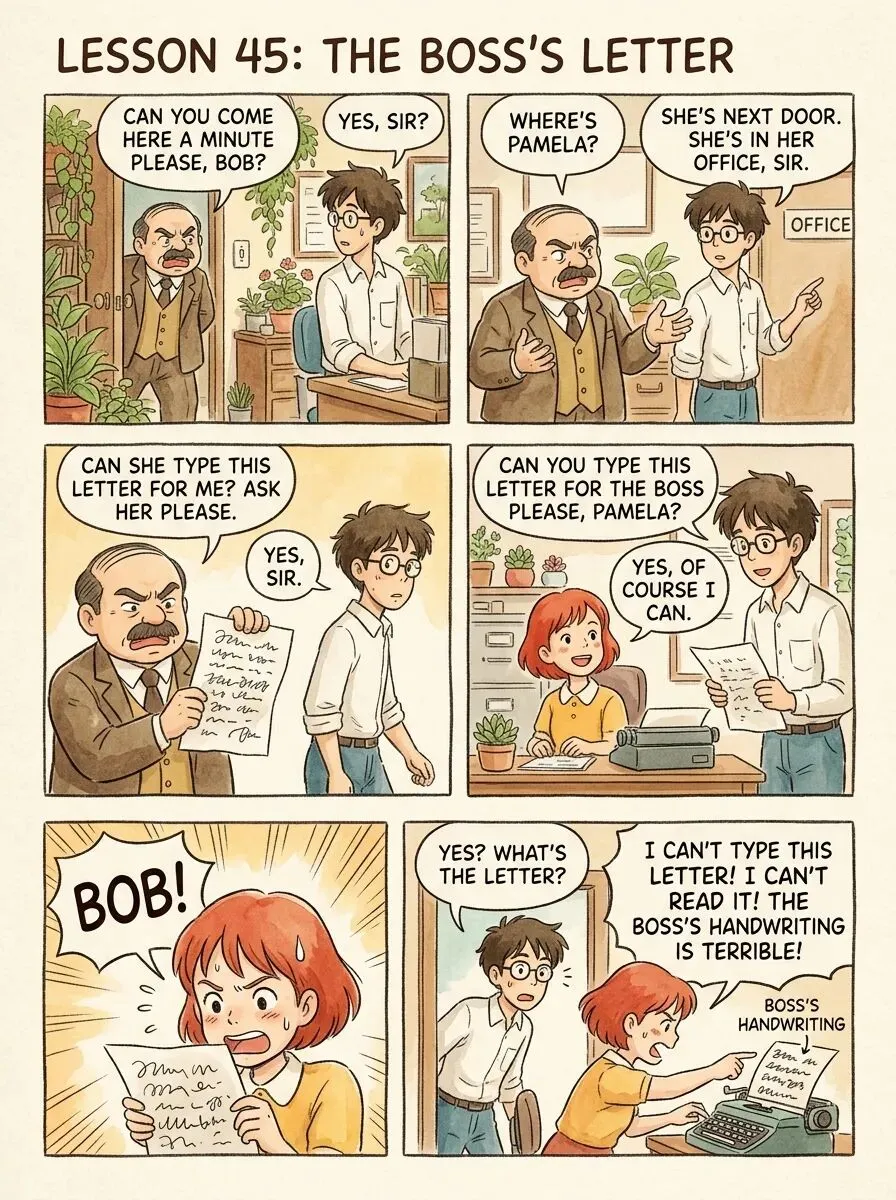
情景说明:本课对话发生在一个典型的办公室环境中。老板(The boss)首先呼叫员工鲍勃(Bob),询问另一位员工帕梅拉(Pamela)在哪里,并想让帕梅拉为他打一封信。鲍勃找到帕梅拉并转达了老板的请求。帕梅拉起初自信地答应,但当她拿到信时,却发现因为老板的字迹太潦草(terrible handwriting)而无法阅读,因此无法完成打字任务。这个场景生动地展示了职场中上级对下级的请求、同事间的任务转达,以及工作中可能遇到的意外困难,语言简单但非常实用。
Lesson 45 The boss's letter
📜 课文原文(含语音标注)
THE BOSS: Can you come here a minute please, Bob? /kən juː kʌm hɪə ə ˈmɪnɪt pliːz bɒb/
BOB: Yes, sir? /jes sɜː/
THE BOSS: Where's Pamela? /weəz ˈpæmələ/
BOB: She's next door. She's in her office, sir. /ʃiːz nekst dɔː. ʃiːz ɪn hɜːr ˈɒfɪs sɜː/
THE BOSS: Can she type this letter for me? Ask her please. /kən ʃiː taɪp ðɪs ˈletə fə miː. ɑːsk hɜː pliːz/
BOB: Yes, sir. /jes sɜː/
BOB: Can you type this letter for the boss please, Pamela? /kən juː taɪp ðɪs ˈletə fə ðə bɒs pliːz ˈpæmələ/
PAMELA: Yes, of course I can. /jes əv kɔːs aɪ kæn/
BOB: Here you are. /hɪə juː ɑː/
PAMELA: Thank you, Bob. /θæŋk juː bɒb/
PAMELA: Bob! /bɒb/
BOB: Yes? What's the matter? /jes. wɒts ðə ˈmætə/
PAMELA: I can't type this letter. /aɪ kɑːnt taɪp ðɪs ˈletə/
PAMELA: I can't read it! The boss's handwriting is terrible! /aɪ kɑːnt riːd ɪt. ðə bɒsɪz ˈhændraɪtɪŋ ɪz ˈterəbl/
情景说明:第46课是一个纯粹的语法与句型训练课,它通过将第45课引入的“can”与之前学过的现在进行时进行对比和转换,来巩固“can”表示能力的用法。练习围绕一系列描述正在进行的动作的句子,将其转换为表示具备做该动作能力的句子。场景可以想象为对一个人当前动作的观察(如“他正在拿书”)进而推断或询问其一般能力(如“他能拿书”)。这种训练旨在帮助学习者内化“can”的语法功能,并将其从具体的、正在发生的场景中抽象出来,形成关于“能力”的通用表达。
Lesson 46 Can you...?
📜 课文原文(句型练习)
(本课主要为句型练习,无连续对话课文。核心句型为现在进行时与 can 表示能力的转换。)
Examples:He is taking his book. → He can take his book.She is putting on her coat. → She can put on her coat.
参考译文:第45课 老板的信老板:鲍勃,请你来一下好吗?鲍勃:什么事,先生?老板:帕梅拉在哪儿?鲍勃:她在隔壁,在她的办公室里,先生。老板:她能为我打一下这封信吗?请问一下她。鲍勃:好的,先生。鲍勃:帕梅拉,请你为老板打一下这封信好吗?帕梅拉:好的,当然可以。鲍勃:给你。帕梅拉:谢谢你,鲍勃。帕梅拉:鲍勃!鲍勃:怎么了?什么事?帕梅拉:我打不了这封信。帕梅拉:我看不懂!老板的书写太糟糕了!第46课 你能……吗?(例句)他正在拿他的书。 → 他能拿他的书。她正在穿上她的外套。 → 她能穿上她的外套。
🔍 第二部分:逐句精讲与词块总结
句子1
原文: Can you come here a minute please, Bob?
翻译: 鲍勃,请你来一下好吗?
句子结构: 情态动词疑问句。Can(情态动词) + you(主语) + come(动词原形) + here(地点状语) + a minute(时间状语) + please(礼貌用语) + Bob(呼语)。
重点词汇:
can (蓝思值 10L)英音 [kæn] 美音 [kæn]词性:modal v. (情态动词)释义:能,会(表示能力);可以(表示许可)常用语块:can do sth., can't (cannot) do sth., Can you...?例句一:I can swim. 我会游泳。例句二:Can I open the window? 我可以开窗吗?拓展:情态动词,后接动词原形,无人称和数变化。否定式为 cannot (口语常缩略为 can't /kɑːnt/)。疑问句将 can 提至句首。
minute (蓝思值 60L)英音 [ˈmɪnɪt] 美音 [ˈmɪnɪt]词性:n.释义:分钟;片刻,一会儿常用语块:a minute, wait a minute, in a minute例句一:The bus will leave in five minutes. 公交车五分钟后开。例句二:Can you wait a minute, please? 你能稍等一下吗?拓展:短语“a minute”在口语中常不指精确的一分钟,而是表示“很短的时间”、“一下”。注意与形容词 minute /maɪˈnjuːt/(微小的)区分。
语法点睛: 本句是情态动词 can 引导的一般疑问句,用于礼貌地提出请求或询问对方是否能够做某事。can 用于表示“能力”或“可能性”,在疑问句中常用来请求许可或询问能力。结构为:Can + 主语 + 动词原形 + 其他?回答用:Yes, ... can. / No, ... can't.
语音要点: “Can you” 在快速口语中常连读为 /kənjuː/ 或 /kənjə/。“a minute” 中不定冠词 “a” /ə/ 弱读。“please” 语调可平或略降,使请求听起来更礼貌。
句子2
原文: Yes, sir?
翻译: 什么事,先生?
句子结构: 简单句(省略句)。Yes(应答词) + sir(呼语,带疑问语调)。
重点词汇:
sir (蓝思值 50L)英音 [sɜː(r)] 美音 [sɝ]词性:n.释义:先生(对男性的尊称,尤用于称呼上级、长辈或顾客)常用语块:Yes, sir. No, sir. Dear Sir (书信开头)例句一:Thank you, sir. 谢谢您,先生。例句二:May I help you, sir? 先生,需要帮忙吗?拓展:用于正式或礼貌场合。注意与“Mr.”区别:“Mr.”+姓(如 Mr. Smith),而“sir”单独使用,不加姓。
语法点睛: 这是一个通过语调(升调)来表达疑问的省略句。完整的句子可能是“Yes, sir, what can I do for you?” 或 “Yes, sir, what is it?”。在日常口语中,这种简略回答非常普遍,依赖于语境和语调来传达完整意义。
语音要点: “sir” 一词用明显的升调(↗),表示疑问和等待进一步指示。
句子3
原文: Where's Pamela?
翻译: 帕梅拉在哪儿?
句子结构: 特殊疑问句。Where(疑问副词) + 's (is 的缩略) + Pamela(主语)?
重点词汇:
where (蓝思值 BR L)英音 [weə(r)] 美音 [wer]词性:adv.释义:在哪里;到哪里常用语块:Where is/are...? Where do/does...? Where from?例句一:Where is my key? 我的钥匙在哪儿?例句二:Where are you going? 你要去哪儿?拓展:用于对地点提问。其引导的疑问句语序为:Where + be动词/助动词 + 主语 + ...?
语法点睛: 复习由 where 引导的特殊疑问句,询问地点。where 是疑问副词,用来对地点状语提问。本句是“Where + is + 主语?”的典型结构,回答需给出具体地点。
语音要点: “Where's” 连读为 /weəz/。句子语调通常为降调,表示一个完整的疑问。
句子4
原文: She's next door. She's in her office, sir.
翻译: 她在隔壁。她在她的办公室里,先生。
句子结构: 两个主系表结构的陈述句。1) She(主语) + 's (is 的缩略,系动词) + next door(表语)。2) She(主语) + 's (is 的缩略,系动词) + in her office(介词短语作表语) + sir(呼语)。
重点词汇:
next door (蓝思值 80L)英音 [nekst dɔː(r)] 美音 [nekst dɔr]词性:adv./adj.释义:在隔壁;隔壁的常用语块:live next door, the people next door, next-door neighbour例句一:My best friend lives next door. 我最好的朋友住在隔壁。例句二:Can you hear the noise from next door? 你能听到隔壁的噪音吗?拓展:可作状语(如本句),也可作定语(如 a next-door shop)。是一个固定短语。
office (蓝思值 120L)英音 [ˈɒfɪs] 美音 [ˈɑːfɪs]词性:n.释义:办公室;办事处;职务常用语块:in the office, go to the office, office worker, post office例句一:My father works in a big office. 我父亲在一家大办公室工作。例句二:She has an office on the third floor. 她的办公室在三楼。拓展:派生词:officer(官员),official(官方的;官员)。
语法点睛: 本句复习介词短语作表语的用法。“next door”和“in her office”都用于说明主语“She”的位置状态。同时,也巩固了所有格形容词“her”的用法。
语音要点: “next door” 连读。“She's in her office” 中,“in her”可连读为 /ɪn hɜːr/ 或 /ɪnər/(非正式)。句末的 “sir” 用平调,表示陈述完毕。
句子5
原文: Can she type this letter for me? Ask her please.
翻译: 她能为我打一下这封信吗?请问一下她。
句子结构: 两个祈使句。1) 疑问句形式:Can(情态动词) + she(主语) + type(动词原形) + this letter(宾语) + for me(目的状语)? 2) 祈使句:Ask(动词原形) + her(宾语) + please(礼貌用语)。
重点词汇:
type (蓝思值 100L)英音 [taɪp] 美音 [taɪp]词性:v. & n.释义:v. 打字;n. 类型,种类常用语块:type a letter, type quickly, a type of, blood type例句一:I need to type this report by 5 pm. 我需要在下午5点前打完这份报告。例句二:What type of music do you like? 你喜欢什么类型的音乐?拓展:名词“类型”更常用。其现在分词为“typing”,过去式/过去分词为“typed”。
ask (蓝思值 80L)英音 [ɑːsk] 美音 [æsk]词性:v.释义:问,询问;请求,要求常用语块:ask a question, ask for help, ask sb. to do sth., ask sb. for sth.例句一:Don't be afraid to ask if you don't understand. 不懂就问,别害怕。例句二:He asked me to close the door. 他让我关上门。拓展:注意搭配:ask sb. sth. (问某人某事);ask sb. for sth. (向某人要某物);ask sb. to do sth. (要求某人做某事)。
语法点睛: 第一句再次使用 can 引导的一般疑问句,但主语是第三人称单数“she”。第二句是祈使句,以动词原形“Ask”开头,用于发出指令或提出请求。祈使句省略主语 you,直接以动词原形开头,使语气直接。
语音要点: “type this” 中 /p/ 和 /ð/ 两个辅音相邻,发音需清晰。“Ask her” 中,如果快速连读,/k/ 和 /h/ 可能发生不完全爆破,听起来像 /ˈɑːs(k) hɜː/。“please” 用降调,使请求听起来更肯定。
句子6
原文: Can you type this letter for the boss please, Pamela?
翻译: 帕梅拉,请你为老板打一下这封信好吗?
句子结构: 情态动词疑问句。Can(情态动词) + you(主语) + type(动词原形) + this letter(宾语) + for the boss(目的状语) + please(礼貌用语) + Pamela(呼语)。
重点词汇:
boss (蓝思值 90L)英音 [bɒs] 美音 [bɔːs]词性:n.释义:老板,上司常用语块:the boss, my boss, boss sb. around (对...发号施令)例句一:I need to talk to my boss about the project. 我需要和我的老板谈谈这个项目。例句二:She's the boss of a small company. 她是一家小公司的老板。拓展:可作动词(非正式),意为“对...发号施令”。其所有格形式“boss's”在本课后续出现。
语法点睛: 此句与句子1结构完全相同,是“Can you... please?”请求句型的再次应用,只是动作(type this letter)和对象(for the boss)发生了变化。这展示了该句型的灵活性和实用性。
语音要点: 与句子1类似,“Can you” 连读。“for the boss” 中 “for the” 常弱读为 /fə ðə/。呼语“Pamela”前有停顿,用平调。
句子7
原文: Yes, of course I can.
翻译: 好的,当然可以。
句子结构: 陈述句(肯定回答)。Yes(应答词) + of course(插入语/状语) + I(主语) + can(情态动词)。
重点词汇:
of course (蓝思值 70L)英音 [əv ˈkɔːs] 美音 [əv ˈkɔːrs]词性:adv. phrase释义:当然,自然常用语块:用于肯定回答,表示非常愿意或认为某事显而易见。例句一:- Can you help me? - Of course! ——你能帮我吗?——当然!例句二:Of course, you must finish your homework first. 当然,你必须先完成作业。拓展:口语中常用。注意,在回答可能让对方觉得其问题愚蠢时,用“Of course”可能显得不礼貌,用“Sure”或“Certainly”更中性。
语法点睛: 这是对“Can you...?”疑问句的肯定回答。结构为:Yes, (+ 修饰语) + 主语 + can. “of course” 是加强肯定语气的副词短语,表明毫不犹豫。
语音要点: “of course” 连读为 /əvˈkɔːs/。“I can” 中,“can” 通常重读,以强调能力。
句子8
原文: Here you are.
翻译: 给你。
句子结构: 倒装句(副词 here 前置)。Here(副词) + you(主语) + are(系动词)。
重点词汇:
here (蓝思值 BR L)英音 [hɪə(r)] 美音 [hɪr]词性:adv.释义:这里,在这儿常用语块:here you are, come here, over here, here and there例句一:Please sit here. 请坐这儿。例句二:Here is your coffee. 你的咖啡在这儿。拓展:“Here you are.” 是递给对方东西时的常用语。类似表达还有“There you go.”。
语法点睛: 这是一个倒装句。当副词 here, there 位于句首,且主语是名词时,句子完全倒装(Here comes the bus.)。但当主语是人称代词时,则用部分倒装,即“Here/There + 代词 + 动词”,如本句“Here you are.”和“There she is.”。
语音要点: 语调通常为平调或略降,表示动作的完成。
句子9
原文: Bob! ... Yes? What's the matter?
翻译: 鲍勃!......怎么了?什么事?
句子结构: 1) 呼语:Bob。 2) 应答与疑问:Yes(应答词,升调) + What's the matter?(固定疑问句型)。
重点词汇:
matter (蓝思值 130L)英音 [ˈmætə(r)] 美音 [ˈmætər]词性:n. & v.释义:n. 事情,问题;物质 v. 要紧,有关系常用语块:What's the matter? no matter, as a matter of fact, It doesn't matter.例句一:What's the matter with your car? 你的车出什么问题了?例句二:It doesn't matter if you're late. 你迟到也没关系。拓展:在“What's the matter?”中,matter意为“麻烦事,问题”。这是询问对方为何看起来有困扰的常用句型。
语法点睛: “What's the matter?” 是一个固定句型,用于询问出了什么问题或有什么不对劲。其结构可视为“What(主语) + is(系动词) + the matter(表语)?” 。
语音要点: “Bob!” 用降调或急促的升调,表示呼唤。“Yes?” 用高升调,表示疑问和回应。“What's the matter?” 整体用升调,表示关切地询问。
句子10
原文: I can't type this letter. I can't read it! The boss's handwriting is terrible!
翻译: 我打不了这封信。我看不懂!老板的书写太糟糕了!
句子结构: 三个陈述句。1) I(主语) + can't (cannot 的缩略,情态动词否定) + type(动词原形) + this letter(宾语)。2) I(主语) + can't + read(动词原形) + it(宾语)。3) The boss's handwriting(主语) + is(系动词) + terrible(表语)。
重点词汇:
handwriting (蓝思值 180L)英音 [ˈhændraɪtɪŋ] 美音 [ˈhændraɪtɪŋ]词性:n.释义:笔迹,书法常用语块:neat handwriting, terrible handwriting, in one's own handwriting例句一:Your handwriting is very beautiful. 你的字很漂亮。例句二:The note was in his own handwriting. 便条是他亲笔写的。拓展:合成词,由 hand(手) + writing(书写)构成。类似合成词:handbag(手提包),handmade(手工的)。
terrible (蓝思值 150L)英音 [ˈterəbl] 美音 [ˈterəbl]词性:adj.释义:可怕的;很糟的,极差的常用语块:a terrible accident, terrible weather, feel terrible, taste terrible例句一:I had a terrible headache yesterday. 我昨天头疼得厉害。例句二:The food in that restaurant is terrible. 那家餐馆的食物糟透了。拓展:口语中常用来强调“非常糟糕”。副词形式为 terribly(非常,极度)。
语法点睛: 这两句展示了 can 的否定形式 can't (cannot) 的用法,表示“不能,不会”。同时,第三句是名词所有格('s)的运用:“the boss's handwriting” 意为“老板的笔迹”。单数名词和不以-s结尾的复数名词,其所有格形式通常在词尾加's。
语音要点: “can't” 发音为 /kɑːnt/,元音与 can /kæn/ 不同,需清晰区分以表达否定意义。“terrible” 重音在第一音节 /ˈterəbl/,发音饱满以表达强烈的负面评价。
📌 核心词块总结
Can you... (please)? - Used to politely ask someone if they are able to do something or to make a request. 例句: Can you help me with this box, please?
a minute - A short period of time; a moment. (Often used in requests) 例句: Wait a minute, I need to get my coat.
next door - In or at the adjacent house, room, or building. 例句: The noise is coming from the people next door.
type a letter - To use a typewriter or keyboard to write a formal message. 例句: In the past, secretaries had to type letters quickly and accurately.
What's the matter? - A fixed expression used to ask what is wrong or what the problem is. 例句: You look sad. What's the matter?
I can't read it. - A statement expressing the inability to understand written text. 例句: The doctor's prescription is messy; I can't read it.
💬 第三部分:基础会话技巧
1. 分析课文中的日常用语、礼貌表达、问答模式- 礼貌请求: 本课核心句型是“Can you... please?”。这是英语中最基本、最常用的礼貌请求句式之一,比直接的祈使句(如“Type this letter.”)要客气得多。“please”的位置灵活,可置于句末或动词之后(Can you please type...?)。- 应答与转述: 老板对Bob说“Ask her please.”,这是一个直接的祈使指令。Bob对Pamela则转述为礼貌的请求句“Can you type... please, Pamela?”,体现了同事间较为平等的交流方式。- 能力询问与回答: “Can she type...?” 询问第三人称的能力。“Yes, of course I can.” 是热情、肯定的回答。“I can't type/read it.” 是直接说明能力受限的原因。- 呼唤与回应: “Bob!” 直接呼唤名字。“Yes?” 用升调快速回应,表示“什么事?我在听”。- 问题询问: “What's the matter?” 用于发现对方有困难时主动关切地询问。
2. 提供类似场景的扩展对话示例场景: 在家中,孩子请父亲帮忙。Child: Dad, can you come here a minute, please?Dad: Yes? What is it?Child: Can you help me with my homework? I can't understand this math problem.Dad: Let me see... Oh, this is tricky. But of course I can help you. Here, look at this step first.Child: Thank you, Dad!
3. 设计简单的角色扮演活动建议-活动1:办公室任务请求角色:Manager (经理), Employee A (员工A), Employee B (员工B)。道具:一张写着潦草字迹的“便条”(可故意写乱)。情景:Manager请Employee A去找Employee B,让B根据便条内容发一封邮件。A找到B转达请求。B拿到便条后发现字迹难辨,无法完成任务,向A说明情况。语言点:练习“Can you... please?”, “Where's...?”, “Can she/he...?”, “I can't read it.”。-活动2:家庭互助角色:Parent, Teenager, Younger sibling。情景:Younger sibling的玩具车坏了,去请Teenager帮忙修理。Teenager看了一下说不会修,于是Younger sibling去请Parent。Parent过来检查后说可以修。语言点: 练习“Can you fix this for me, please?”, “I can't fix it.”, “Can Dad/Mom fix it?”, “Yes, I think I can.”。
4. 融入基础思考:设计1-2个简单的代入式问题① 如果你是Bob,老板让你去请Pamela做事,你会像课文里那样说“Can you type this letter for the boss please, Pamela?”,还是会说“The boss wants you to type this letter.”?你觉得哪种方式更好?为什么?(引导思考:前者是礼貌的请求,体现了对同事的尊重和团队合作精神;后者是直接的命令转达,可能显得生硬。在大多数工作场合,礼貌的请求更能促进和谐的同事关系。)② 当Pamela说“I can't type this letter”时,她立刻解释了原因(“I can't read it!”)。如果你遇到无法完成别人请求的情况,你认为直接说“I can't”然后解释原因,还是先说“I'm sorry”更好?(引导思考:先说“I'm sorry”表示歉意,再解释原因,通常更显礼貌和体贴。例如:“I'm sorry, but I can't type this letter because I can't read the handwriting.”)
📐 第四部分:本课语法精析(加强版)
一、情态动词 Can 的基本用法1.含义:Can 主要表示两种含义:-能力 (Ability):表示主语有知识、技能或体力去做某事。这是本课的重点。例句: I can speak English. (我会说英语。)例句: She can swim very fast. (她能游得很快。)-许可 (Permission):表示被允许做某事。常用于口语中请求或给予许可。例句: Can I use your phone? (我可以用一下你的电话吗?)例句: You can go home now. (你现在可以回家了。)2.形式:Can 是情态动词,具有以下特点:-无人称和数变化:无论主语是第几人称,单数还是复数,都用 can。例句: I can, You can, He/She/It can, We can, They can.-后接动词原形:Can 后面必须跟动词的原形(不带 to 的不定式)。例句: He can play the piano. (√)例句: He can to play the piano. (×)-否定形式:Cannot (正式) / Can't (口语缩略)。注意 cannot 是一个词。例句: I cannot/can't drive a car.-疑问形式:将 can 提到主语前面。例句: Can you help me?-回答:肯定:Yes, 主语 + can. 否定:No, 主语 + can't.例句: - Can dogs fly? - No, they can't.3.本课重点:Can 表示“能力”的疑问句与回答课文中的“Can you come here?”、“Can she type this letter?”、“Can you type this letter?”都是在询问对方是否“有能力”或“方便”做某事,属于询问能力的范畴,同时也是一种礼貌的请求方式。回答直接对应其能力:“Yes, of course I can.” 或 “I can't type this letter.”
二、现在进行时 (be + V-ing) 与 Can 表示能力的句型转换第46课的核心练习就是这两种句型的转换。这旨在帮助学习者区分“正在进行的动作”和“一般性的能力”。1.现在进行时:表示说话时正在发生或进行的动作。-结构:主语 + am/is/are + 动词的现在分词 (V-ing)。-功能:描述当前场景、临时状态。例句: He is taking his book. (他正在拿他的书。)——描述此刻观察到的动作。2.Can 表示能力:表示主语具备的某种一般性、常态化的技能或可能性。-结构:主语 + can + 动词原形。-功能:描述一种能力或可能性。例句: He can take his book. (他能拿他的书。)——描述他具备“拿书”这个能力。3.转换逻辑与对比分析:转换练习并非意味着两个句子意思完全等同,而是训练从“观察具体动作”联想到“主体具备相应能力”。-从进行时到能力:如果你看到“他正在拿书”,你自然可以推断“他能拿书”。(除非是特殊情境,如他正非常吃力地拿)。-对比:· She is putting on her coat. 她(此刻)正在穿外套。(可能因为冷,临时动作)· She can put on her coat. 她会自己穿外套。(描述一个能力,特别是对孩子而言,表示自理能力)-并非所有进行时都能直接转换为能力句:如果进行时描述的是一个一次性、偶然或正在学习中的动作,转换后可能不成立或意义改变。例句: He is eating a strange insect. (他正在吃一只奇怪的虫子。) → He can eat strange insects. (他能吃奇怪的虫子。) 后者暗示他有吃虫子的能力或习惯,而前者可能只是描述一个惊悚的瞬间。
三、动词现在分词的规则变化复习第46课的书面练习中大量涉及动词现在分词的构成,这是现在进行时的基础。规则总结如下:1.一般情况:动词后直接加 -ing。例句: cook → cooking, do → doing, sleep → sleeping2.以不发音的字母 e 结尾:去 e,加 -ing。这是本课练习A的重点。例句: type → typing, make → making, come → coming注意: 练习中的 shine → shining, give → giving 也遵循此规则。3.以重读闭音节结尾,且末尾只有一个辅音字母:双写该辅音字母,再加 -ing。例句: run → running, swim → swimming, sit → sitting注意: 本课练习中的 put → putting 也需双写 t。4.以 ie 结尾:变 ie 为 y,再加 -ing。例句: lie → lying, die → dying
四、练习题(不少于10道)1. 将下列句子改为用 can 表示能力的句子。a) She is making a cake.b) They are playing football.c) You are using the computer.答案:a) She can make a cake. b) They can play football. c) You can use the computer.2. 用 can 或 can't 填空。a) I ______ swim, but my brother ______.b) ______ you speak French? No, I ______.c) The baby ______ walk yet. She is only 10 months old.答案:a) can, can't b) Can, can't c) can't3. 根据括号内提示,用 can 的适当形式完成句子。a) (请求/能力) ______ you open the window, please? It's hot.b) (能力) My grandmother is 80, but she ______ read without glasses.c) (否定能力) I'm sorry, I ______ hear you. The music is too loud.答案:a) Can b) can c) can't4. 将下列现在进行时句子改为一般疑问句,并用 can 来询问能力。a) He is driving a bus. → ______ he ______ a bus?b) They are cooking dinner. → ______ they ______ dinner?答案:a) Can, drive b) Can, cook5. 写出下列动词的现在分词形式。a) take ______ b) write ______ c) sit ______ d) give ______ e) run ______答案:a) taking b) writing c) sitting d) giving e) running6. 模仿例句,进行对话练习。Example: type this letter / yes → - Can you type this letter? - Yes, I can.a) fix my bike / no → ________________________b) speak Chinese / yes → ________________________答案:a) - Can you fix my bike? - No, I can't. b) - Can you speak Chinese? - Yes, I can.7. 翻译句子。a) 你能帮我一下吗?b) 小猫不会游泳。c) 她会弹钢琴吗?会的。答案:a) Can you help me (a minute), please? b) The kitten can't swim. c) Can she play the piano? Yes, she can.8. 找出句中错误并改正。a) He can cooks very well.b) Can I to go now?c) She no can see the blackboard.答案:a) cooks → cook b) to go → go c) no can → cannot / can't9. 根据第45课课文内容回答。a) Can Pamela type the letter at first? ________b) Why can't she type it finally? ________答案:a) Yes, she can. / Yes, of course she can. b) Because she can't read it. The boss's handwriting is terrible.10. 情景造句:你的朋友想借你的自行车,但你今天要用。请用 can't 礼貌地拒绝并说明原因。答案示例: I'm sorry, but you can't borrow my bike today. I need to use it myself.
✏️ 第五部分:基础练习与活动
1. 跟读练习 (Shadowing)- 方法: 播放课文录音(可从官方教材配套资源获取)。第一遍静听。第二遍开始,延迟半秒到一秒,模仿录音的语音、语调、连读和节奏进行跟读。重点练习:· “Can you” 的连读 /kənjuː/。· “a minute” 中 /ə/ 的弱读。· “can't” /kɑːnt/ 与 “can” /kæn/ 的对比发音。· “What's the matter?” 的升调。- 目标: 培养语感,纠正发音,提高口语流利度。
2. 角色扮演 (Role-play)-活动:“班级任务角”-准备:教师准备几张“任务卡”,上面写有简单任务,如:draw a cat on the board, sing an English song, count from 1 to 20, spell the word “beautiful”。-流程:1. 学生A扮演“课代表”,学生B扮演“老师”。2. “老师”抽一张任务卡,对“课代表”说:“Can you ask [学生C的名字] to [任务卡内容], please?”3. “课代表”找到学生C,说:“Can you [任务卡内容] please, [C的名字]? The teacher asks.”4. 学生C回答:“Yes, of course I can.” 或 “I'm sorry, I can't. I don't know how to [相关动词].”5. 如果C回答“can”,则需当场表演任务;如果“can't”,则“课代表”需回报“老师”。-目的: 在真实互动中运用“Can you... please?”进行请求转达和回答。
3. 简单替换练习 (Substitution Drill)- 句型: Can you ______, please?- 替换词库: pass me the salt, close the door, turn on the light, lend me your pen, say that again, wait for me- 练习方式: 教师说提示词,学生快速组成完整请求句。然后学生两两互练。
4. 听力理解题目(假设基于一段类似课文的简短办公室对话音频)对话内容(供教师参考):M: Sarah, can you come here, please?S: Yes, Mr. Brown?M: Where's Tom? Can he send this email for me?S: He's in the meeting room. I can ask him.M: Thank you.(Later...)S: Tom, can you send this email for Mr. Brown, please?T: Oh, I'm sorry, Sarah. I can't. My computer isn't working.问题:① What does Mr. Brown want Sarah to do first? (A: Come to him.)② Who does Mr. Brown want to send the email? (A: Tom.)③ Where is Tom? (A: In the meeting room.)④ Can Tom send the email? Why or why not? (A: No, he can't. Because his computer isn't working.)答案: ① Come to him. / To come here. ② Tom. ③ In the meeting room. ④ No, he can't. Because his computer isn't working.
5. 课文改写版本(词汇更简单)The Manager's NoteManager: Anna, please come here.Anna: Yes?Manager: Where is Ben?Anna: He is in the next room.Manager: Can he write this note on the computer? Please ask him.Anna: Okay.Anna: Ben, can you write this note on the computer for the manager, please?Ben: Yes, I can.Anna: Here it is.Ben: Thank you... Anna!Anna: Yes? What's wrong?Ben: I can't write it. I can't see the words! The manager's writing is very bad!(改写说明:用 manager 替代 boss, write on the computer 替代 type this letter, note 替代 letter, very bad 替代 terrible,使词汇更基础。)
🤔 第六部分:英文深度思考与拓展(强化版)
A. 层次化英文问题与答案Level 1 (Factual): 事实性问题1. What does the boss ask Bob to do at the beginning of the conversation?Answer: The boss asks Bob to come to him for a minute.2. Where is Pamela when Bob is looking for her?Answer: She is next door, in her office.3. What is the specific task that the boss wants Pamela to do?Answer: He wants Pamela to type a letter for him.4. How does Pamela respond when Bob first asks her to type the letter?Answer: She says, "Yes, of course I can."5. What is the reason Pamela gives for being unable to type the letter?Answer: She says she can't read it because the boss's handwriting is terrible.Level 2 (Inferential): 推理性问题6. Why do you think the boss says "Can she type this letter for me?" instead of directly telling Pamela?Answer: Probably because Bob is closer or available at that moment, and it's a common way to delegate tasks through another person in an office. It also shows the boss is asking about Pamela's availability/ability, not just ordering.7. How might Bob feel when Pamela calls him back after saying she can type the letter?Answer: He might feel surprised or concerned, wondering what the problem is, because she had just confidently agreed.8. What does Pamela's final statement ("The boss's handwriting is terrible!") tell us about her frustration?Answer: It tells us that her inability to complete the task is not due to a lack of typing skill, but because of an external, unavoidable obstacle (the poor handwriting). Her exclamation mark shows strong emotion.9. If you were Bob, what would you do after hearing Pamela's problem?Answer: I would probably go back to the boss and explain the situation politely, e.g., "Sir, Pamela can't type the letter because she's having trouble reading the handwriting. Is it possible for you to clarify it or dictate it?"10. Is the boss's request reasonable? Why or why not?Answer: The request itself is reasonable (asking an employee to type a letter). However, if his handwriting is consistently terrible, it might be considered unreasonable because it creates a barrier for others to do their jobs.Level 3 (Evaluative/Creative): 评价/创造性问题11. In today's world, is typing a letter by hand (from handwritten text) still a common office task? What has changed?Answer: It is much less common today. Most documents are created directly on computers or digital devices. Handwritten drafts are rarer. Now, tasks might involve "formatting a document," "editing an email," or "transcribing a voice memo" instead of deciphering handwriting.12. "Can you...?" can be used to ask about ability or to make a polite request. In the lesson, which use is more prominent? Give an example from your life where you used "Can you...?" for each purpose.Answer: In the lesson, it's used more as a polite request ("Can you come here?", "Can you type this letter?"), though it implies the ability to do so. For ability: "Can you solve this math puzzle?" For polite request: "Can you pass me the water, please?"13. Imagine Pamela decides to solve the problem herself. What are two different ways she could try to complete the task despite the terrible handwriting?Answer: 1) She could try to guess the words from the context or ask a colleague if they recognize any words. 2) She could use technology, like taking a photo of the letter and using a handwriting recognition app on her phone (a modern solution).14. How important is good handwriting in the digital age? Should schools still focus on teaching it?Answer: While digital communication dominates, good handwriting is still important for personal notes, signatures, exams where writing is required, and it can reflect care and clarity. Schools should still teach it, but perhaps with a balanced focus alongside keyboarding skills.15. Create a short, humorous ending to the story. What does Bob say or do after Pamela complains about the handwriting?Answer: Bob looks at the letter and says, "Oh no! You're right. It looks like my doctor's prescription! Maybe we should ask him to send a voice message next time!"
B. 多类型拓展阅读1. 现代场景故事 (Modern Scenario)The Unreadable Email RequestMs. Chen, the project manager, pinged David on the office chat: "Can you handle the client's feedback doc?" David replied, "Sure!" and opened the attached file. His smile faded. The client had scanned their handwritten notes, and the image was blurry. Some words were smudged coffee stains. David typed back: "I can't process this file. The scan is too poor to read." Ms. Chen answered: "No problem. I'll call them for a quick clarification call instead. Thanks for checking." Technology changed the tool from a typewriter to a computer, but the problem of unclear communication remained the same!引导性问题:What is the modern equivalent of "terrible handwriting" in this story?2. 文化背景小知识 (Cultural Background)The Changing Role of the SecretaryIn the mid-20th century, when "The boss's letter" was written, the role of a secretary or typist was crucial. Bosses often dictated letters or wrote drafts by hand, and secretaries needed excellent typing speed, accuracy, and sometimes the skill to decipher difficult handwriting. Today, that role has evolved into administrative assistants or executive assistants. Their tasks now include email management, digital calendar coordination, preparing PowerPoint presentations, and using various software, not just typing. The ability to type quickly is still valuable, but it's one of many digital skills.引导性问题:According to the text, what was one important skill for secretaries in the past that is less critical now?3. 今昔对比 (Then and Now)From Typewriters to Voice TypingPamela had a typewriter on her desk. If she made a mistake, she needed correction fluid or had to start the page again. The "boss's letter" was a physical piece of paper. Today, "typing a letter" often means composing an email or a digital document. If the boss's instructions are unclear, you might receive a messy email draft. But now, you have spell check, grammar suggestions, and can easily edit. More interestingly, if the boss's spoken words are unclear, you can use voice-typing software to transcribe a meeting, which sometimes creates funny errors -- a new kind of "can't read it!" problem.引导性问题:What are two advantages of digital "typing" compared to using a typewriter?4. 新潮英语改写 (Trendy English Rewrite)OMG, I Can't Even Read This!Boss: "Bob, my dude, got a sec?"Bob: "Sup?"Boss: "Where's Pam?"Bob: "She's, like, right next door. In her cubicle."Boss: "Cool. Can she, like, type up this note for me? DM her, pls."Bob: "Got it."(Bob slides into Pam's DMs)Bob: "Hey Pam! Boss needs you to type this up. No biggie."Pam: "K, I'm on it."(Pam looks at the note)Pam: "Bob!!! WTH is this?!"Bob: "??"Pam: "I can't do this! His handwriting is a total mess! It's giving me a headache fr."引导性问题:How does the slang "WTH" and "fr" change the tone of Pam's complaint compared to the original?5. 难度略高的拓展阅读 (Slightly Higher Difficulty)The Power of "Can" vs. "Could"In the lesson, we see "Can you...?" used for direct requests. In more formal or polite situations, English speakers often use "Could you...?" instead. "Could" is the past tense of "can," but here it functions as a softer, more tentative modal verb. For example, "Could you possibly type this letter for me?" sounds more polite and less demanding than "Can you type this letter for me?" Similarly, to express past ability, we use "could" (e.g., "I could run fast when I was young.") or "was/were able to." Understanding these subtle differences helps in navigating social situations appropriately, from casual offices to formal meetings.引导性问题:When might you choose to use "Could you...?" over "Can you...?"
🌍 第七部分:日常应用延伸
1. 提供本课语言点在日常生活中的应用场景- 家庭: “Can you set the table, please?” (请求帮忙) / “I can't find my phone.” (陈述 inability) / “Can your little brother tie his shoes yet?” (询问能力)- 学校: “Can I borrow a pencil?” (请求许可) / “Sorry, I can't answer that question.” (承认不会) / “Can you explain this again, teacher?” (礼貌请求)- 公共场所: “Can you tell me where the library is?” (问路) / “You can't park here.” (表示禁止) / “Can we have the bill, please?” (在餐厅结账)
2. 建议简单拓展学习材料- 歌曲: “Can You Feel the Love Tonight?” (Elton John) ——感受“can”在歌词中的运用。- 儿童绘本: “Can I Play Too?” by Mo Willems ——简单重复的“Can I...?”句型,适合初学者。- 视频片段: 搜索YouTube上关于“office English”或“polite requests”的短剧,观察“Can you...?”在真实对话中的使用。- 应用/网站: 使用词汇学习App(如Quizlet)创建本课“can/can't”和动词词组的闪卡进行记忆。
3. 可附加英美生活小常识- “Of course”的使用注意: 在英式英语中,用“Of course”回答“Can you...?”或“Could you...?”的请求是非常友好和乐意的。但在回答像“Is this the way to...?”(这是去...的路吗?)这类事实性问题时,用“Of course”可能暗示问题太简单,有点不礼貌,用“Yes, it is.”更合适。- 手写体: 英美国家的人手写体差异很大,有印刷体、圆体、花体等。像课文中的“terrible handwriting”是常见玩笑。正式文件(如表格、考试)通常要求用清晰的大写印刷体(Block Capitals)书写。- 礼貌层级: 请求的礼貌程度从低到高可以是:Do this. → Please do this. → Can you do this? → Could you do this? → Could you possibly do this? 根据与对方的熟悉程度和场合选择。
🗂️ 第八部分:本课知识图谱(结构化逻辑图)
核心对话主题:办公室任务请求与执行障碍├──主要句型1:礼貌请求/询问能力 (Can you...?)│ ├──应用场景1:上级对下级直接请求│ │ └──关键词汇:come here, a minute, please│ ├──应用场景2:询问第三人称能力 (Can she...?)│ │ └──关键词汇:type, letter, for me│ └──应用场景3:同事间转达请求 (Can you... for the boss?)│ └──关键词汇:for the boss, ask her├──主要句型2:能力陈述 (I can / can't...)│ ├──肯定能力回答 (Yes, of course I can.)│ │ └──关键词汇:of course│ └──否定能力陈述与解释 (I can't... because... )│ ├──关键词汇:can't, read│ └──原因描述:handwriting, terrible├──辅助句型1:位置询问与回答 (Where's...? She's...)│ ├──疑问:Where's...?│ └──回答:next door, in (one's) office└──辅助句型2:问题关切询问 (What's the matter?)└──关键词汇: matter
© 本文为狂暴英语教案 · 新概念英语第一册第45-46课
仅供学习交流使用

贝琪酱英语无痛逆袭站
微信扫描二维码,关注我的账号