【狂暴英语教案】新概念英语第二册第34课:速战速决 / 失而复得的自行车
- 2026-07-15 04:05:14
读外刊,接触原汁原味的英文表达,
欢迎关注以下公众号+设为星标+推荐给朋友。▼
📚 狂暴英语教案 · 新概念英语第二册
第34课 Quick work
速战速决 / 失而复得的自行车
📘 本课信息
教材:新概念英语第二册 · 第34课
核心功能:叙事 · 时间跨度对比 · 幽默反讽
语法焦点:现在完成时 vs 一般过去时 · 被动语态(多种时态)· 过去完成时 · a great many 的用法
🏷️ 热门标签
🎯 本课学习目标
词汇目标:
掌握本课核心词汇,如 worry, local, station, most surprising, a great many 等,理解其在叙述性语境中的具体用法,并能够运用相关短语进行表达。
语法目标:
1. 深入理解并准确运用现在完成时(has been worried, has just received)与一般过去时(was stolen, found it)在叙述过去事件时的区别与联系。这是本课最核心的语法点。
2. 掌握被动语态(was stolen twenty years ago)在客观陈述事件时的应用。
3. 复习介词 at 在 call at the station 中的用法,以及 a great many 修饰可数名词的用法。
技能目标:
能够清晰、有条理地叙述一个过去发生的事件,并融入时间顺序和因果逻辑。重点训练根据时间线索(如 twenty years ago, then)组织段落的能力。
文化目标:
初步了解西方(特别是英国)基层警察局(local police station)在处理市民事务(如报失、找回失物)中的角色,以及相关文书工作的流程。
📖 第一部分:课文完整内容
背景简介:本课是一个带有幽默色彩的叙事短文。故事围绕丹·罗宾逊的一辆自行车展开,通过时间跨度的巨大反差(二十年前被盗,五日前在远方被发现)制造出“quick work”这一反讽效果。课文巧妙地交织了现在完成时、一般过去时和被动语态,是学习英语时态混合使用和叙事技巧的经典范例。
📜 课文原文(含语音标注)
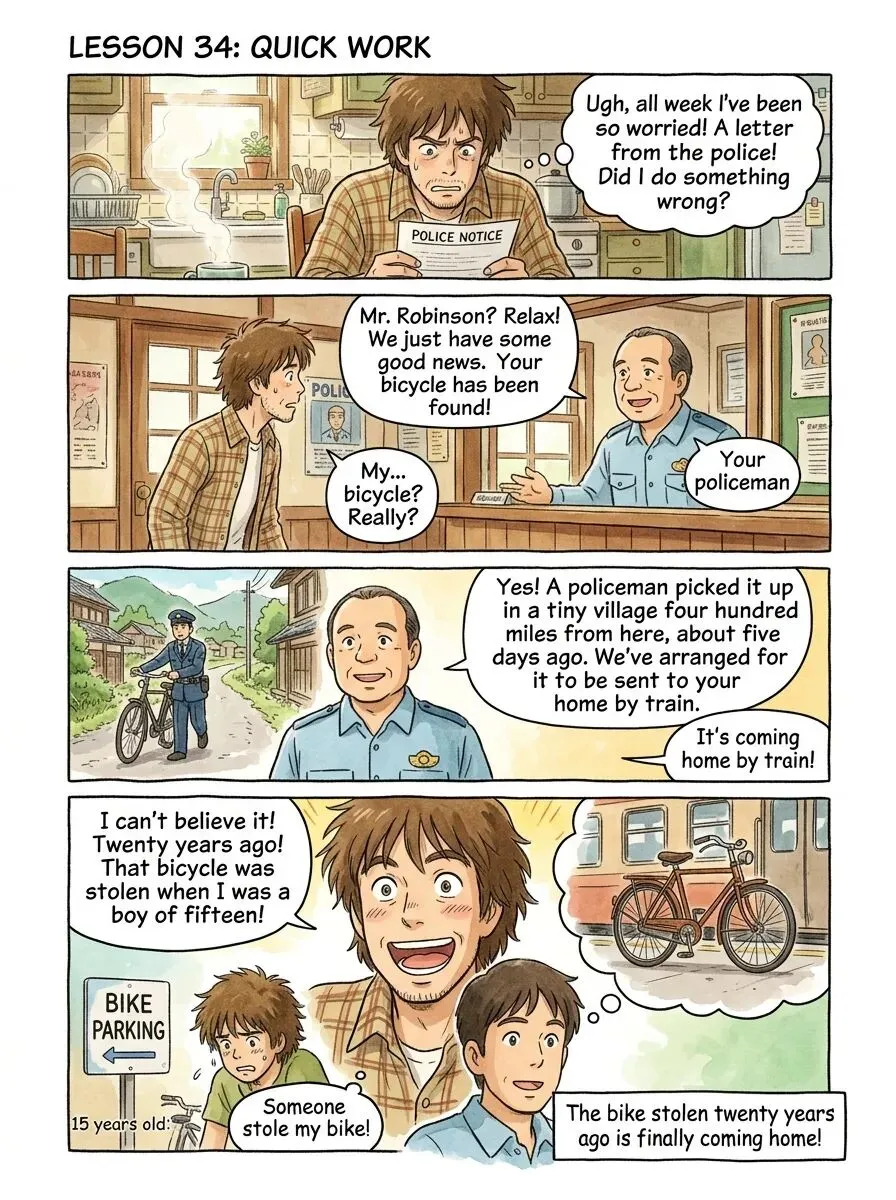
Dan Robinson has been worried all week.
丹·罗宾逊整整一个星期都焦虑不安。
Last Tuesday he received a letter from the local police.
上星期二他收到当地警察局的一封信。
In the letter he was asked to call at the station.
信中要他到警察局去一趟。
Dan wondered why he was wanted by the police, but he went to the station yesterday and now he is not worried any more.
丹很奇怪警察为什么找他,但昨天他还是去了警察局,现在他不再担心了。
At the station, he was told by a smiling policeman that his bicycle had been found.
在警察局里,一位面带笑容的警察告诉他,他的自行车找到了。
Five days ago, the policeman told him, the bicycle was picked up in a small village four hundred miles away.
那位警察对他说,那辆自行车是5天前在400英里外的一个小村里发现的。
It is now being sent to his home by train.
现在正用火车给他运回家来。
Dan was most surprised when he heard the news.
丹听到这个消息后,惊奇万分。
He was amused too, because he never expected the bicycle to be found.
他又感到非常好笑,因为他从未指望那辆自行车还能找到。
It was stolen twenty years ago when Dan was a boy of fifteen!
这是20年前丹还是个15岁的孩子时被人偷走的!
语音标注: has been worried 连读;received a letter 中 ed 与 a 连读;was asked 中 s 与 a 连读;call at 连读;was wanted 连读;had been found 中 d 与 b 不完全爆破;was picked up 连读;is being sent 中 s 与 b 连读;was most surprised 中 t 与 m 不完全爆破。
🌐 参考译文
丹·罗宾逊整整一个星期都焦虑不安。上星期二他收到当地警察局的一封信。信中要他到警察局去一趟。丹很奇怪警察为什么找他,但昨天他还是去了警察局,现在他不再担心了。在警察局里,一位面带笑容的警察告诉他,他的自行车找到了。那位警察对他说,那辆自行车是5天前在400英里外的一个小村里发现的,现在正用火车给他运回家来。丹听到这个消息后,惊奇万分,但又感到非常好笑,因为他从未指望那辆自行车还能找到。这是20年前丹还是个15岁的孩子时被人偷走的!
🔍 第二部分:逐句精讲与词块总结
句子1
原文: Dan Robinson has been worried all week.
翻译: 丹·罗宾逊整整一个星期都焦虑不安。
句子结构: 简单句。主语(Dan Robinson)+ 谓语(现在完成时 has been)+ 表语(worried)+ 时间状语(all week)。
重点词汇:
worried (蓝思值 600L)
英音 [ˈwʌrid] 美音 [ˈwɜːrid]
词性:形容词
释义:担心的,焦虑的
常用语块:be worried about sth./sb. 为某事/某人担心
短语搭配:a worried look/expression 担忧的神色
例句一:She's very worried about her exams. 她非常担心她的考试。
例句二:There's no need to look so worried. 没必要看起来这么焦虑。
拓展:动词原形 worry。Worry 作动词时,常用 worry about。Worried 是形容词,描述状态。同义词:anxious, concerned。
语法点睛: 本句使用了现在完成时(has been)。现在完成时有两个核心用法:1) 表示过去发生的动作对现在造成的影响或结果;2) 表示从过去某一时间开始,持续到现在的动作或状态。这里属于第二种用法,强调“担心”这种状态从上周某个时间点开始,一直持续了整整一周,并且可能刚刚结束或仍在继续。这与本课标题“Quick work”形成一种潜在的对比或铺垫:他担心了一周,但问题解决得却很快(自行车找到了)。
语音要点: has been worried 连读;all week 中 l 与 w 连接自然。
句子2
原文: Last Tuesday he received a letter from the local police.
翻译: 上星期二他收到当地警察局的一封信。
句子结构: 简单句。主语(he)+ 谓语(一般过去时 received)+ 宾语(a letter)+ 状语(from the local police)。
重点词汇:
local (蓝思值 700L)
英音 [ˈləʊkl] 美音 [ˈloʊkl]
词性:形容词
释义:地方的,当地的,本地的
常用语块:local police 当地警察;local news 本地新闻
短语搭配:local government 地方政府;local time 当地时间
例句一:We get our vegetables from the local market. 我们从本地市场买蔬菜。
例句二:The problem is of local rather than national importance. 这个问题的重要性是地方性的,而非全国性的。
拓展:名词形式 locality(所在地)。反义词:national(全国的),international(国际的)。
police (蓝思值 400L)
英音 [pəˈliːs] 美音 [pəˈliːs]
词性:名词(集合名词,常与复数动词连用)
释义:警察部门,警方
常用语块:the local police 当地警方;call the police 报警
短语搭配:police station 警察局;police officer 警官
例句一:The police are investigating the robbery. 警方正在调查这起抢劫案。
例句二:You should report the accident to the police. 你应该向警方报告这起事故。
拓展:注意 police 是集合名词,指警察队伍,谓语用复数。单个警察是 a policeman(男)或 a policewoman(女)。
语法点睛: 本句使用一般过去时(received),因为动作“收到信”发生在过去一个明确的时间点“上星期二”(Last Tuesday)。在叙述一连串过去事件时,通常用一般过去时来勾勒时间线。这里标志着具体事件的开始。
语音要点: received a letter 中 ed 与 a 连读;from the local police 中 from 与 the 连读。
句子3
原文: In the letter he was asked to call at the station.
翻译: 信中要他到警察局去一趟。
句子结构: 简单句(被动语态)。状语(In the letter)+ 主语(he)+ 谓语(被动语态 was asked)+ 主语补足语(to call at the station)。
重点词汇:
call at (蓝思值 650L)
英音 [kɔːl æt] 美音 [kɔːl æt]
词性:动词短语
释义:(短暂)访问(某地);(车、船等)停靠
常用语块:call at a place 造访某地
短语搭配:The ship calls at several ports. 这艘船停靠好几个港口。
例句一:I called at the office on my way home. 我回家路上顺便去了趟办公室。
例句二:This train calls at every station. 这趟火车每站都停。
拓展:辨析 call on(拜访某人),call at(拜访某地)。Call 单独使用有“打电话”、“呼喊”之意。
station (蓝思值 500L)
英音 [ˈsteɪʃn] 美音 [ˈsteɪʃn]
词性:名词
释义:站,所,局;车站
常用语块:police station 警察局;railway station 火车站
短语搭配:power station 发电站;gas station 加油站(美)
例句一:The suspect was taken to the police station for questioning. 嫌疑人被带到警察局问话。
例句二:I'll meet you at the bus station. 我在汽车站接你。
拓展:来自拉丁语 statio,意为“站立的位置”。动词 station 意为“安置,派驻”。
语法点睛: 本句使用了被动语态(was asked)。被动语态常用于强调动作的承受者(he),或者动作的执行者不重要或不明(这里执行者是“信”或“写信的警方”)。结构为 be + 过去分词。后面接不定式 to call 作主语补足语,说明被要求的具体内容。这种“be asked/told/ordered to do”结构非常常见。
语音要点: was asked 连读;call at 连读。
句子4
原文: Dan wondered why he was wanted by the police, but he went to the station yesterday and now he is not worried any more.
翻译: 丹很奇怪警察为什么找他,但昨天他还是去了警察局,现在他不再担心了。
句子结构: 并列复合句。由连词 but 和 and 连接三个分句。
分句1: Dan wondered + 宾语从句(why he was wanted by the police)
分句2: he went to the station yesterday (简单句)
分句3: now he is not worried any more (简单句)
重点词汇:
wonder (蓝思值 700L)
英音 [ˈwʌndə(r)] 美音 [ˈwʌndər]
词性:动词
释义:想知道;感到惊奇
常用语块:wonder why/what/how/whether... 想知道为什么/什么/如何/是否......
短语搭配:no wonder (that)... 难怪......
例句一:I wonder what she's doing now. 我想知道她现在在做什么。
例句二:He wondered if he had made the right decision. 他怀疑自己是否做了正确的决定。
拓展:也作名词,意为“奇迹,奇观”,如 the seven wonders of the world(世界七大奇迹)。
want (蓝思值 300L) (此处为特殊用法)
英音 [wɒnt] 美音 [wɑːnt]
词性:动词
释义:(此处)通缉,寻找(某人)
常用语块:be wanted by the police 被警方通缉/寻找
短语搭配:wanted poster 通缉令
例句一:He is wanted for questioning in connection with the theft. 他因与盗窃案有关而被警方找去问话。
例句二:You're wanted on the phone. 有你的电话。(引申义:有人找你)
拓展:want 最常见的意思是“想要”。在此语境下是法律或官方用语,意为“需要(某人)到场”,带有强制性。
any more (蓝思值 550L)
英音 [ˈeni mɔː(r)] 美音 [ˈeni mɔːr]
词性:副词短语
释义:(不)再,(不)还
常用语块:not... any more 不再......
短语搭配:常用于否定句或疑问句句末。
例句一:She doesn't live here any more. 她不再住在这里了。
例句二:Do you need any more help? 你还需要帮助吗?
拓展:同义表达 no more, no longer。Any more 通常用于句末;no longer 用于实义动词前或 be 动词后。
语法点睛: 本句包含一个宾语从句(why he was wanted by the police),由疑问词 why 引导,作动词 wondered 的宾语。从句本身又是一个被动语态(was wanted)。整句通过 but 和 and 展现了丹的心理活动(疑惑)、行动(前往)和状态变化(不再担心),是叙事中推进情节和描写心理的典型句式。
语音要点: was wanted by 连读;not worried any more 中 t 与 w 轻微连读。
句子5
原文: At the station, he was told by a smiling policeman that his bicycle had been found.
翻译: 在警察局里,一位面带笑容的警察告诉他,他的自行车找到了。
句子结构: 主句(被动语态)+ 宾语从句。状语(At the station)+ 主句主语(he)+ 主句谓语(被动语态 was told)+ 动作执行者(by a smiling policeman)+ 宾语从句(that his bicycle had been found)。
重点词汇:
smiling (蓝思值 500L)
英音 [ˈsmaɪlɪŋ] 美音 [ˈsmaɪlɪŋ]
词性:形容词(现在分词作定语)
释义:微笑的,带着笑容的
常用语块:a smiling face 笑脸
短语搭配:现在分词 smiling 修饰名词,表示主动和正在进行的状态。
例句一:She gave me a smiling welcome. 她微笑着欢迎我。
例句二:The smiling child ran towards her mother. 那个微笑着的孩子朝妈妈跑去。
拓展:动词 smile。Smiling 是现在分词,具有形容词性,描述名词的特征或状态。
语法点睛: 本句主句再次使用被动语态(was told),并带出了动作执行者 by a smiling policeman。宾语从句 that his bicycle had been found 中使用了过去完成时的被动语态(had been found)。过去完成时表示“过去的过去”,即“自行车被找到”这个动作发生在“警察告诉他”这个过去动作之前。这是叙述复杂时间顺序的关键时态。
语音要点: was told by 连读;had been found 中 d 与 b 不完全爆破。
句子6
原文: Five days ago, the policeman told him, the bicycle was picked up in a small village four hundred miles away.
翻译: 那位警察对他说,那辆自行车是5天前在400英里外的一个小村里发现的。
句子结构: 主句 + 插入语 + 宾语(从句内容)。插入语(the policeman told him)将宾语内容分隔开。宾语内容本身是一个简单句:主语(the bicycle)+ 谓语(被动语态 was picked up)+ 时间状语(Five days ago)+ 地点状语(in a small village four hundred miles away)。
重点词汇:
pick up (蓝思值 600L)
英音 [pɪk ʌp] 美音 [pɪk ʌp]
词性:动词短语
释义:(此处)发现,找到(尤指偶然地);捡起;接(人);学会
常用语块:pick up sth. 捡起某物;发现某物
短语搭配:pick up a language 学会一门语言;pick up the phone 接电话
例句一:The police picked up the stolen car in a back street. 警察在一条偏僻的街上发现了那辆被盗的汽车。
例句二:Can you pick up some milk on your way home? 你回家路上能买点牛奶吗?
拓展:这是一个多义短语,含义丰富,需根据上下文判断。
away (蓝思值 400L)
英音 [əˈweɪ] 美音 [əˈweɪ]
词性:副词
释义:离,远离
常用语块:...miles/kilometers away 在......英里/公里外
短语搭配:far away 遥远;go away 走开
例句一:The airport is about ten miles away from the city centre. 机场离市中心大约十英里。
例句二:He lives two blocks away. 他住在两个街区外。
拓展:常与表示距离的词连用,作后置定语或状语。
语法点睛: 本句的语序是叙事中为了生动而采用的“直接引语”的变体,将说话者(the policeman)和说话动词(told him)作为插入语放在句子中间,使叙述更灵活。核心信息“自行车被发现”使用一般过去时的被动语态(was picked up),因为这是一个发生在过去(五天前)的单一、已完成的事件。
语音要点: was picked up 连读;four hundred miles away 中 d 与 m 不完全爆破。
句子7
原文: It is now being sent to his home by train.
翻译: 现在正用火车给他运回家来。
句子结构: 简单句(现在进行时被动语态)。主语(It)+ 谓语(is being sent)+ 间接宾语(to his home)+ 方式状语(by train)。
语法点睛: 本句使用了现在进行时的被动语态(is being sent)。结构是 am/is/are + being + 过去分词。它强调一个被动的动作(被运送)在说话的当下(now)正在进行。这是被动语态中一个稍复杂的时态形式,生动地描绘了自行车“正在路上”的状态,让整个找回失物的过程显得非常即时和具体。
语音要点: is being sent 中 s 与 b 连读;by train 中 y 与 t 连读。
句子8
原文: Dan was most surprised when he heard the news.
翻译: 丹听到这个消息后,惊奇万分。
句子结构: 主句 + 时间状语从句。主句(Dan was most surprised)+ 从句(when he heard the news)。
重点词汇:
most (蓝思值 500L) (此处为副词)
英音 [məʊst] 美音 [moʊst]
词性:副词
释义:非常,极其(用于加强语气,相当于 very)
常用语块:most + 形容词(如 surprised, interesting)表示“非常”
短语搭配:a most interesting book 一本非常有趣的书
例句一:It was a most beautiful sunset. 那是一次非常美丽的日落。
例句二:She was most grateful for your help. 她对你的帮助非常感谢。
拓展:注意与形容词最高级前的 the most 区分。这里 most 前没有 the,且修饰形容词原级,表示程度高。
surprised (蓝思值 550L)
英音 [səˈpraɪzd] 美音 [sərˈpraɪzd]
词性:形容词
释义:惊奇的,惊讶的
常用语块:be surprised at/by sth. 对某事感到惊讶
短语搭配:a surprised look 惊讶的表情
例句一:I was surprised at how quickly he agreed. 我对他这么快就同意了感到惊讶。
例句二:She looked surprised when she saw me. 她看到我时显得很惊讶。
拓展:动词 surprise。Surprised 是过去分词转化来的形容词,描述人的感受。Surprising 是现在分词转化来的形容词,描述事物特性,如 a surprising result(一个令人惊讶的结果)。
语法点睛: most 在这里是副词,修饰形容词 surprised,意为“非常”,而不是最高级。When 引导的时间状语从句,使用一般过去时(heard),表明主句的动作(感到惊讶)与从句的动作(听到消息)几乎同时发生,或者从句动作是主句动作的触发点。
语音要点: was most surprised 中 t 与 m 不完全爆破;when he heard 连读。
句子9
原文: He was amused too, because he never expected the bicycle to be found.
翻译: 他又感到非常好笑,因为他从未指望那辆自行车还能找到。
句子结构: 主句 + 原因状语从句。主句(He was amused too)+ 从句(because he never expected the bicycle to be found)。
重点词汇:
amused (蓝思值 700L)
英音 [əˈmjuːzd] 美音 [əˈmjuːzd]
词性:形容词
释义:被逗乐的,觉得好笑的
常用语块:be amused at/by sth. 对某事感到好笑
短语搭配:an amused smile 觉得好笑的笑容
例句一:We were all amused by his funny stories. 我们都被他有趣的故事逗乐了。
例句二:She had an amused expression on her face. 她脸上带着觉得好笑的表情。
拓展:动词 amuse(使发笑)。Amused 描述人的情绪;amusing 描述事物特性,如 an amusing film(一部有趣的电影)。
expect (蓝思值 650L)
英音 [ɪkˈspekt] 美音 [ɪkˈspekt]
词性:动词
释义:预料,预期,指望
常用语块:expect to do sth. 期望做某事;expect sb. to do sth. 期望某人做某事
短语搭配:as expected 正如所料
例句一:I expect to be back by ten o'clock. 我预计十点前回来。
例句二:We didn't expect him to stay so long. 我们没指望他待这么久。
拓展:名词 expectation。常用结构 expect sth./expect that.../expect to do/expect sb. to do。
语法点睛: Because 引导原因状语从句,解释主句“感到好笑”的原因。从句中,动词 expected 后接复合宾语 the bicycle to be found,其中 the bicycle 是宾语,to be found 是不定式的被动形式作宾语补足语。Never 这个否定词加强了“出乎意料”的程度,与 amused(觉得有趣)的情感相呼应,体现了故事的幽默内核。
语音要点: was amused too 连读;because he 中因为弱读;expected the bicycle to be found 中 ed 与 th 轻微连读。
句子10
原文: It was stolen twenty years ago when Dan was a boy of fifteen!
翻译: 这是20年前丹还是个15岁的孩子时被人偷走的!
句子结构: 主句 + 定语从句。主句(It was stolen twenty years ago)+ 从句(when Dan was a boy of fifteen,when 引导的定语从句修饰 twenty years ago)。
重点词汇:
steal (蓝思值 600L) (过去分词 stolen)
英音 [stiːl] 美音 [stiːl]
词性:动词
释义:偷,窃取
常用语块:steal sth. from sb./somewhere 从某人/某处偷某物
短语搭配:过去式 stole,过去分词 stolen。
例句一:My wallet was stolen on the bus. 我的钱包在公交车上被偷了。
例句二:He was caught stealing money from the till. 他从收银机偷钱时被抓住了。
拓展:名词 theft(盗窃行为)。Steal 强调偷偷摸摸的行为;rob(抢劫)强调使用暴力或威胁。
语法点睛: 本句主句使用一般过去时的被动语态(was stolen),陈述一个发生在二十年前的单一事件。When 在这里引导的是定语从句,修饰表示时间的先行词 twenty years ago,相当于 at which time。这个从句揭示了时间跨度的巨大,是制造故事幽默感和“quick work”反讽效果的关键一笔,将过去(被盗的少年时代)和现在(找回的中年)戏剧性地连接起来。
语音要点: was stolen 连读;twenty years ago 中 ty 与 years 连读;when Dan was a boy 中 n 与 d 连读。
📌 核心词块总结
be worried about:为......担心。 (Dan has been worried. 隐含了他担心某事的状态)
call at (a place):造访(某地)。 (He was asked to call at the station.)
be wanted by:被......寻找/通缉。 (He wondered why he was wanted by the police.)
not... any more:不再......。 (He is not worried any more.)
pick up:(偶然)发现,捡到。 (The bicycle was picked up in a village.)
be surprised at/by:对......感到惊讶。 (Dan was most surprised when he heard the news.)
be amused at/by:对......感到好笑。 (He was amused too.)
expect (sb./sth.) to do:期望(某人/某事)做......。 (He never expected the bicycle to be found.)
✍️ 第三部分:语篇分析与段落写作技巧
1. 语篇分析
①识别宏观结构:本文是一个经典的叙事结构。遵循“背景-问题-发展-解决-反应”的线索。
-背景与问题(Para. 1, Sent. 1-3):丹焦虑一周,收到警方来信要求他去警局,他感到疑惑。
-发展与解决(Para. 1, Sent. 4 & Para. 2):丹前往警局,得知自行车在远方被找到,正在运回。
-反应与高潮(Para. 3):丹感到惊讶和好笑,并揭示关键信息——自行车是二十年前他少年时被盗的。最后一句是全文的“包袱”和幽默核心。
②列举衔接手段:
-时间衔接:all week, Last Tuesday, yesterday, now, Five days ago, twenty years ago。这些时间副词和短语清晰地勾勒出事件的时间线,特别是过去与现在的巨大跨度。
-逻辑衔接:but(转折,表示疑惑但仍前往),and(顺承,连接动作和状态变化),because(因果,解释感到好笑的原因)。
-指代衔接:大量使用代词 he, him, his, it 来指代 Dan 和 the bicycle,避免重复,使行文流畅。
-词汇复现:worried(开头)→ not worried any more(中间);bicycle 作为核心物件贯穿全文。
③分析作者态度:作者采用客观、略带幽默的叙事口吻。通过细节如“a smiling policeman”营造轻松氛围,用“most surprised”和“amused”刻画丹的复杂反应,最后用感叹句“when Dan was a boy of fifteen!”来突出时间跨度的荒谬感,引导读者会心一笑,而非严肃评论。标题“Quick work”本身就是一种反讽(irony),因为找回一辆二十年前被盗的车绝非“快速的工作”,从而产生幽默效果。
2. 写作技巧
①提炼写作逻辑:本课展示了如何叙述一个带有意外结局的过去事件。写作逻辑是:从当前状态写起,引出事件,按时间顺序叙述过程,最后揭示一个令人意外的背景信息来制造亮点或幽默。关键在于控制信息的释放节奏,将最具冲击力的事实(二十年前)放在最后。
②提供段落写作范例
主题:A Lost Key Found (一把丢失的钥匙)
I had been annoyed for days about my missing car key. Last Monday, I received a call from the community security office. They asked me to come over. I was puzzled but went there after work. A friendly guard told me that my key had been found. Two days ago, he said, it was discovered in the elevator of our building. It was now kept in their lost-and-found box. I was very relieved and also couldn't help laughing when I heard this. I had given up all hope of finding it. It was lost three months ago during a hectic move!
③布置小练笔并提供例文
小练笔:请模仿课文结构,写一篇约120词的短文,叙述一件你或你认识的人丢失已久后又意外找回的物品。需包含:丢失后的心情、收到找回消息的经过、得知找回时的反应、以及丢失的具体时间(这个时间要足够久以制造意外感)。
例文:
My grandfather had long forgotten about his old stamp album. Last month, my father got an email from a distant cousin. In the email, he was asked if our family still wanted the album. My father was curious and replied immediately. The cousin explained that while cleaning their attic, they found the album tucked inside a dusty trunk. They were planning to send it back to us by post. My grandfather was utterly astonished and deeply moved when my father told him. He chuckled, saying he never imagined seeing it again. The album was left behind at his childhood home when his family moved cities---over fifty years ago!
分析其结构特点:
- 背景:祖父已遗忘(对应“担心”)。
- 引子:父亲收到邮件(对应“收到信”)。
- 发展:询问、解释、计划归还(对应“去警局”、“被告知”)。
- 反应:惊讶、感动、好笑(对应“surprised”, “amused”)。
- 高潮:揭示时间是五十多年前(对应“二十年前”)。
标注语言点映射:
- had long forgotten (过去完成时,对应 had been worried)
- was asked if... (被动语态+宾语从句,对应 was asked to call)
- was utterly astonished (most surprised 的同义表达)
- never imagined... again (never expected... to be found 的同义表达)
- over fifty years ago (twenty years ago 的结构)
📐 第四部分:本课语法精析(加强版)
1. 现在完成时 (Present Perfect Tense) vs. 一般过去时 (Simple Past Tense)
这是本课最核心的语法对比,也是中国学习者最容易混淆的难点之一。
-概念对比:
·一般过去时:只关心动作发生在过去的某个特定时间点或时间段,与现在没有直接联系。句子中常有明确表示过去的时间状语,如 yesterday, last week, in 1990, ten minutes ago。
·现在完成时:有两个基本用法。用法一:表示过去发生的动作对现在造成的影响或结果,强调“现在怎么样”。用法二:表示从过去某一时刻开始,持续到现在的动作或状态,常与 for, since, all week, recently 等表示一段时间的状语连用。
-本课实例分析:
· Dan Robinson has been worried all week. (现在完成时 - 用法二) → 强调“担心”这种状态从上周某个时间开始,一直持续到说话的时刻(可能刚结束)。all week 是典型的时间段状语。
· Last Tuesday he received a letter... (一般过去时) → 动作“收到信”发生在过去一个明确的时间点 Last Tuesday。我们只关心这个动作本身在过去发生了。
· ...his bicycle had been found. (过去完成时) → 这是“过去的过去”。“找到自行车”发生在“警察告诉他”这个过去动作之前。
-更多例句辨析:
1. Ilostmy key yesterday. (一般过去时,昨天丢的,只陈述事实)
2. Ihave lostmy key. I can't get into the house now. (现在完成时,丢了钥匙导致现在进不了门,强调对现在的影响)
3. Shelivedin London for five years. (一般过去时,她曾在伦敦住过5年,现在不住了)
4. Shehas livedin London for five years. (现在完成时,她在伦敦住了5年,现在仍住在那里)
5.Didyouseethe film 'Titanic'? (一般过去时,询问过去是否看过这部电影)
6.Haveyouseenthe film 'Titanic'? (现在完成时,询问你是否看过,隐含“如果你看过,我们可以聊聊它”)
7. Hewrotethree books last year. (一般过去时,去年写了三本,去年的事)
8. Hehas writtenthree books. (现在完成时,他已经写了三本书,强调成就或现状)
9. The trainleftten minutes ago. (一般过去时,十分钟前开的,现在车已不在)
10. The trainhasjustleft. (现在完成时,车刚走,强调现在的结果是“你赶不上了”)
11. Wehaven't finishedour homework yet. (现在完成时,作业还没完成,现在状态是“没做完”)
12. Wedidn't finishour homework last night. (一般过去时,昨晚没做完,只陈述昨晚的事实)
-与第一册的对比分析:在第一册中,现在完成时初步引入,主要与 just, already, yet 等副词连用,强调刚刚完成的动作对现在的影响(如 I have just had breakfast.)。第二册本课则深化了现在完成时的第二个用法——表示持续状态(has been worried),并开始与一般过去时在同一个叙事中混合使用,时态运用更加复杂和精细。
2. 被动语态 (The Passive Voice) 的多种时态形式
本课集中出现了被动语态在几种不同时态下的应用,是复习和巩固的绝佳材料。
-结构回顾:被动语态基本结构为 be + 过去分词。be 动词随人称、数和时态变化。
-本课实例与时态分析:
1.一般现在时被动:Heiswanted by the police. (虽然描述当前状态,但 wanted 是特殊用法,结构上是 am/is/are + p.p.)
2.一般过去时被动:
· hewasasked to call...
· ...hewastold...
· the bicyclewaspicked up...
· Itwasstolen twenty years ago.
· 分析:was/were + p.p. 用于描述过去发生的被动动作。
3.现在进行时被动:Itisnowbeingsent to his home...
· 分析:am/is/are + being + p.p.。强调一个被动的动作在此时此刻正在进行。这是本课的一个新亮点。
4.过去完成时被动:...his bicyclehad beenfound.
· 分析:had been + p.p.。表示在过去的某个时间点之前就已经被完成的被动动作。
-被动语态的使用场景:
· 不知道或不必指出动作执行者:My bike was stolen. (不知道谁偷的)
· 强调动作承受者:The new library will be opened next month. (强调图书馆)
· 出于礼貌或委婉:You are requested to be quiet. (比 Please be quiet. 更正式)
· 用于客观、科学的描述:The experiment was conducted carefully.
-被动语态练习 (不少于12道)
A. 用所给动词的正确时态和语态填空。
1. The letter ______ (deliver) this morning.
2. A new bridge ______ (build) across the river at the moment.
3. By the time we arrived, all the food ______ (eat).
4. English ______ (speak) in many countries around the world.
5. I couldn't use my office because it ______ (clean).
6. The children ______ (give) some presents by their grandparents last Christmas.
7. Your application ______ (consider) right now. We'll inform you soon.
8. This song ______ (write) by a famous musician in the 1970s.
9.(映射课文)Dan ______ (tell) the good news by a policeman.
10.(映射课文)The lost bicycle ______ (find) in a remote village.
11.(映射课文)The book I needed ______ (borrow) by someone else already.
12.(映射课文)When we got to the station, we were told that the train ______ (delay).
B. 将下列主动句改为被动句。
13. Someone stole my necklace last night.
14. They are repairing the road in front of my house.
15. The company will announce the results tomorrow.
16. Had they finished the preparations before the guests arrived?
C. 选择正确的选项。
17. Great changes ______ in my hometown since 2010.
A. have taken place B. have been taken place C. were taken place
18. The work ______ by the time you come back.
A. will be done B. will have been done C. is being done
19. --- Why don't we go to the new restaurant?
--- Because all the tables ______.
A. have reserved B. reserved C. have been reserved
答案解析:
A部分:1. was delivered 2. is being built 3. had been eaten 4. is spoken 5. was being cleaned 6. were given 7. is being considered 8. was written 9. was told 10. was found 11. has been borrowed 12. had been delayed
B部分:13. My necklace was stolen last night. 14. The road in front of my house is being repaired. 15. The results will be announced tomorrow (by the company). 16. Had the preparations been finished before the guests arrived?
C部分:17. A (take place 是不及物动词短语,没有被动语态) 18. B (by the time 引导将来时间,主句用将来完成时) 19. C (桌子被预定,用现在完成时被动,强调现在的结果)
3. "a great many" 与数量表达
- 讲解:a great many 意为“许多,大量”,后接可数名词复数,相当于 a large number of。它比 many 语气更强。
· 例句:A great many people attended the concert. 许多人参加了音乐会。
· 类似结构:a good many (很多),a large number of, a huge amount of (后接不可数名词),a lot of/lots of (可接可数或不可数)。
🎧 第五部分:听力与阅读策略训练
1. 听力技巧
① 预测关键词:在听录音前,根据标题“Quick work”和第一句“Dan Robinson has been worried all week.”,预测故事可能涉及:一个人(Dan)、一种情绪(worried)、一件事(需要快速解决的工作/问题)。可以预测关键词:police, letter, bicycle, found, stolen。
② 抓主旨大意:第一遍听,回答:What is the story mainly about? (A. Dan's new job. B. Dan finding a lost bicycle. C. The police finding Dan's old bicycle.) 答案:C。
③ 笔记方法:听第二遍时,尝试用时间线做笔记:
· Now: Dan not worried any more.
· Yesterday: Went to station.
· Last Tuesday: Received a letter.
· Five days ago: Bicycle picked up (400 miles away).
· Twenty years ago: Bicycle stolen (Dan was 15).
这种方法有助于理清复杂的时间顺序。
2. 阅读理解策略
①扫读 (Scanning):快速阅读课文,找出下列具体信息:
· How did Dan feel at the beginning? (worried)
· Who asked Dan to go to the station? (the local police)
· How far away was the bicycle found? (four hundred miles)
· How is the bicycle being returned? (by train)
· How old was Dan when the bicycle was stolen? (fifteen)
②略读 (Skimming):快速浏览全文,总结段落大意:
· Paragraph 1: Dan was worried about a police letter but went to the station.
· Paragraph 2: At the station, a policeman told him his lost bicycle was found and is on its way back.
· Paragraph 3: Dan's reaction and the surprising fact that the bicycle was stolen 20 years ago.
③推断词义 (Inferring Meaning):
· “He was amused too, because he never expected the bicycle to be found.” 从 never expected 可以推断出 amused 在这里不是简单的“开心”,而是带有“觉得事情荒谬、好笑”的意味。
· “It was stolen twenty years ago when Dan was a boy of fifteen!” 从整篇文章轻松的语气和最后感叹号,可以推断作者和丹都觉得这件事结局出人意料且带有幽默色彩,而不是一件严肃的犯罪案件。
📝 第六部分:习题讲解
关键句型 (Key Structures) 练习
- 练习重点:现在完成时与一般过去时的对比运用。
- 例题:He has been there for six months. (强调从过去持续到现在,可能还在那) / He went there six months ago. (只陈述六个月前去的这个过去动作)
- 解题思路:判断句子是想强调与现在的联系(影响或状态持续),还是仅仅陈述过去的事实。有时间状语的,看状语是表示时间段(for six months)还是时间点(six months ago)。
难点 (Special Difficulties) 练习
- 练习重点:call at vs. call on; a great many 的用法。
- call at vs. call on:call at + 地点:I called at the bank on my way to work. / call on + 人:We called on our friends last weekend.
- a great many:后直接加可数名词复数,不加 of。例如:a great many books。 (a great many of the books 这种结构也存在,但意思侧重“这些书中的许多”,the 不能省略)。
多项选择题 (Multiple Choice Questions)
- 第1题:考察对文章整体内容的理解,尤其是最后一句的意外信息。
- 第5题:考察 a great many 的用法,需记住后接复数名词。
- 第7、8、9题:考察时态,特别是现在完成时和一般过去在上下文中的正确选择。
- 第11题:考察短语动词 pick up 在上下文中的含义(发现,捡到)。
- 详细解析应参考官方教材练习详解,引导学生理解每个选项对错的原因,而不仅仅是记住正确答案。
🤔 第七部分:英文深度思考与拓展(强化版)
A. 层次化英文问题与答案
Level 1 (Factual): 事实性问题
1. How did Dan Robinson feel at the beginning of the week? → He had been worried all week.
2. What did Dan receive last Tuesday? → He received a letter from the local police.
3. Where was Dan's bicycle found? → It was picked up in a small village four hundred miles away.
4. How is the bicycle being returned to Dan? → It is now being sent to his home by train.
5. How old was Dan when his bicycle was stolen? → He was a boy of fifteen.
Level 2 (Inferential): 推理性问题
1. Why do you think Dan was worried after receiving the police letter? → He probably wondered why the police wanted him. People often feel nervous or anxious when contacted by the police, fearing they might be in some kind of trouble.
2. What does the phrase “a smiling policeman” suggest about the situation? → It suggests that the news the policeman was about to deliver was good or pleasant, not serious or threatening. The smile helps to put Dan at ease.
3. Why was Dan both surprised and amused when he heard the news? → He was surprised because finding a bicycle lost for twenty years is highly unexpected. He was amused because the situation was ironic and funny—after so long, he had given up hope, yet it was found.
4. Is the title “Quick work” meant to be taken literally? Why or why not? → No, it is not meant literally. It is ironic. The “work” of finding the bicycle actually took twenty years, which is the opposite of quick. The title humorously highlights the unexpected and delayed resolution.
Level 3 (Evaluative): 评价性问题
1. Do you think the local police did a good job in this case? Explain your view. → While they eventually found and returned the bicycle, one could argue the job was not efficient, as it took twenty years. However, given the vast distance (400 miles) and the time elapsed, locating it at all is remarkable. Their communication (the letter) and final action (returning it by train) were professional and courteous.
2. What does this story tell us about holding onto hope or giving up on lost things? → The story playfully challenges the idea of giving up hope. Dan had “never expected” to find the bicycle, representing giving up. Yet, life sometimes delivers surprising reunions. It suggests that while it's practical to move on from lost items, completely closing the door on possibility might lead us to miss unexpected, joyful resolutions.
3. How does the author use time to create humor in this story? → The author uses a stark contrast in time scales to create humor. The recent, efficient-sounding actions (“five days ago”, “now being sent”) are juxtaposed with the absurdly long time frame of the loss (“twenty years ago”). The punchline relies entirely on this exaggerated time gap, making the “quick work” of the present moment hilariously insignificant compared to the decades of loss.
4. Could this story be seen as a metaphor for something in life? If so, what? → Yes, it could be a metaphor for reconciliation, solving old problems, or the unexpected return of something valuable from the past (like a memory, a relationship, or a forgotten skill). Just as Dan's childhood bicycle unexpectedly returned, sometimes issues or treasures from our personal history resurface in adulthood, allowing for closure or renewed appreciation.
B. 多类型拓展阅读
1. 时事新闻拓展 (News Extension)
Title: Modern Tech Solves a 30-Year-Old Mystery
Last month, a family in Cornwall, England, received an unexpected email. Attached was a clear photo of a silver locket. The sender, a museum curator in Oslo, Norway, explained that the locket had been found during a digital cataloging project. Using enhanced imaging and online ancestry databases, they deciphered the faded inscription inside: a name and a date from 1992. The locket had been lost by a teenage tourist during a school trip to Norway three decades ago. It is now being returned via international courier. “It's like getting a piece of my childhood back,” said the now 45-year-old owner, amazed at how technology bridged time and distance.
语言点映射:received an unexpected email (对应 received a letter); explained that (宾语从句); had been lost (过去完成时被动); is now being returned (现在进行时被动); amazed at (对应 surprised).
2. 文化背景解析 (Cultural Background)
Title: The British “Bobby” and Local Police Stations
The term “bobby” for a British policeman comes from Sir Robert Peel, who founded the Metropolitan Police in 1829. British police are generally known for being unarmed and community-focused. A “local police station” is the cornerstone of this system. Unlike the dramatic crime-fighting portrayed in films, much of their work involves community service: taking reports for lost property (like Dan's bicycle), giving directions, or dealing with minor disturbances. The “smiling policeman” in our lesson reflects this approachable, service-oriented image. Filing a report for stolen property, even decades ago, creates a record that can sometimes lead to unexpected recoveries, as technology and luck intersect.
语言点映射:are known for (被动语态); involves (动词第三人称单数); taking reports for (动名词短语作宾语); portrayed (过去分词作定语).
3. 今昔对比分析 (Then-and-Now Analysis)
Title: Finding Lost Items: 20th Century vs. 21st Century
When Dan's bicycle was stolen twenty years ago (from the story's perspective, likely in the 1970s or 80s), finding it was a matter of luck and manual police work. Today, the process is vastly different. Bicycles can be registered with microchips or GPS tags. Security cameras are ubiquitous. Online marketplaces where stolen goods might be sold are monitored. Social media allows for instant sharing of loss reports across communities. While some items still vanish forever, the digital footprint of our possessions makes recovery quicker and more likely. Dan's story remains charming precisely because it belongs to a slower, analog era where such a recovery felt like a minor miracle.
语言点映射:was stolen (一般过去时被动); is vastly different (一般现在时,联系动词); are monitored (一般现在时被动); makes recovery quicker (动词第三人称单数,make sb./sth. + adj.结构); belongs to (动词第三人称单数).
4. 新潮英语改写 (Trendy Rewrite)
Title: OMG, You Won't Believe What the Police Just Found!
So, my guy Dan was low-key stressed all week. Then, bam! A letter from the cops. He's like, “What did I do?” Turns out, it was the best thing ever. He goes to the station, and this chill policeman with a smile is like, “We found your bike, bro.” Get this—it was picked up like 400 miles away! They're shipping it back to him RN. The kicker? Dan hadn't seen that bike since he was FIFTEEN. It was stolen, like, two decades ago! He was shook but also kinda laughing. Talk about a plot twist! #LostAndFound #Throwback
语言点映射:用现代网络俚语 (low-key, bam, chill, RN, shook, kinda, #) 重新诠释课文核心信息 (stressed, letter, police station, found, 400 miles away, stolen twenty years ago, amused).
5. 难度略高的拓展阅读 (Higher-Difficulty Extension)
Title: The Psychology of “Lost and Found” Narratives
Stories of long-lost items being returned, like Dan's bicycle, resonate deeply because they tap into fundamental human themes: hope, memory, and the passage of time. Psychologically, they represent a victory over entropy—the natural tendency of things to disorder and disappear. The recovered object becomes a tangible link between our past and present selves, often triggering a flood of nostalgic memories. Moreover, such stories restore a sense of justice and order in a seemingly random world. The bystander or authority figure (the policeman, the museum curator) who facilitates the return acts as an agent of serendipity, reminding us that kindness and diligence can sometimes weave unexpected connections across years and miles. The emotional response—surprise followed by amusement or joy—is a complex mix of cognitive dissonance (how can this be?) and heartfelt appreciation.
语言点映射:being returned (动名词被动式); tap into (短语动词); represent (动词); triggering (现在分词作状语); restore (动词); facilitates (动词第三人称单数); reminding (现在分词作状语); is a complex mix (主系表结构).
🌐 第八部分:日常应用与文化拓展
A. 文化背景知识深挖
1. 英国警察体系:课文中的“local police”通常指郡警察(County Police)或市警察。他们负责辖区内的治安、交通和社区事务。报警电话是999或112。与一些国家不同,大多数英国街头巡警(“bobbies”)不配枪,旨在维持亲民形象。
2. 失物招领 (Lost Property):在英国,丢失物品通常可向当地警察局报失。大的交通枢纽(如火车站、机场)也设有失物招领处(Lost Property Office)。对于价值较低的物品,保管时间有限;贵重物品则会尽力联系失主。像课文这样跨辖区发现失物,警方会通过内部系统查询报案记录。
3. 幽默感 (Sense of Humour):英国人以“干幽默”(dry humour)或“冷幽默”(deadpan humour)著称。课文标题“Quick work”和整个故事的讲述方式——用平淡的语气陈述一件极其巧合和缓慢的事——正是这种幽默的体现。它依赖于 understatement(轻描淡写)和 irony(反讽)。
B. 拓展学习资源推荐
- 语法深化:《新概念英语语法新思维 第2册.pdf》查找讲解“现在完成时与一般过去时对比”以及“被动语态各种时态”的周次;《新概念英语名师精讲笔记 第2册.pdf》直接阅读第34课的“语法精析”;《NCE知识点笔记Book II.pdf》查阅第34课的语法笔记表格。
- 词汇与表达:《会说话的新概念英语单词.pdf》查找本课生词;《新概念英语习语惯用语大全.pdf》查找与 call at, pick up, a great many 相关的习语。
- 综合技能与写作:《新概念英语口语宝典 第2册.pdf》寻找与“讲述个人经历”、“描述情绪变化”相关的主题;《新概念英语写作全攻略 (王惠宁编著).pdf》参考“叙事顺序”和“设置意外结尾”的写作技巧;《钻研《新概念英语》啃课文第2册.pdf》阅读其对第34课的分析。
- 文化与兴趣:《新概念英语美文欣赏 第2册.pdf》提升语感;《新概念英语名人名言诵典.pdf》寻找关于“耐心”、“惊喜”或“时间”的名言。
C. 引导性思考
1. 效率与温情:课文中的警方花了二十年才找到一辆自行车,从“效率”角度看似乎很低。但在现实生活中,这种“低效率”的背后可能体现了怎样的系统韧性或人文关怀?我们是否应该用纯粹的效率来衡量所有公共服务(如警察、图书馆、失物招领)的价值?
2. 数字时代的“失去”与“找回”:在智能手机、云端备份和GPS追踪普及的今天,像课文这样“物理意义上彻底丢失多年又奇迹般找回”的体验是更常见了,还是更罕见了?数字工具是消灭了这种“失而复得”的浪漫,还是以新的形式(比如找回旧硬盘里的照片)创造了它?
3. 幽默的共情基础:为什么读者会觉得丹的故事好笑?这种幽默感是否需要建立在共同的文化认知上(比如认为警察来信通常是坏事,或者二十年前丢的东西不可能找到)?如果一个来自完全不同文化背景的人读这个故事,他/她还能体会到同样的幽默吗?
🗂️ 第九部分:本课知识图谱(结构化逻辑图)
核心事件:丹·罗宾逊二十年前被盗的自行车被警方找到并归还,令他惊讶又好笑。
├─1. 当前状态与引子(现在-最近过去)
│ ├─ 1.1 丹的持续状态:焦虑了一整周(has been worried all week)。
│ ├─ 1.2 触发事件:上周二收到当地警方的来信(received a letter)。
│ ├─ 1.3 信中要求:被要求去一趟警察局(was asked to call at the station)。
│ └─ 1.4 丹的反应与行动:感到疑惑(wondered why),但昨天还是去了(went to the station),现在不再担心(not worried any more)。
├─2. 在警局的对话(过去-更近的过去)
│ ├─ 2.1 消息告知:一位面带笑容的警察告诉他(was told by a smiling policeman)。
│ ├─ 2.2 核心信息:他的自行车找到了(his bicycle had been found)。
│ ├─ 2.3 发现细节:五天前在400英里外的小村被发现(was picked up... five days ago)。
│ └─ 2.4 归还方式:现在正用火车运回他家(is now being sent... by train)。
├─3. 丹的情感反应与真相揭示(过去-遥远的过去)
│ ├─ 3.1 直接反应:听到消息后非常惊讶(was most surprised)。
│ ├─ 3.2 深层感受:也觉得好笑(was amused),因为他从未指望能找到(never expected... to be found)。
│ └─ 3.3 真相高潮:自行车是二十年前被盗的(was stolen twenty years ago),当时丹才十五岁(a boy of fifteen)。
└─4. 核心语言与语法支撑(构建叙事的工具)
├─ 4.1 时态交响:现在完成时(has been worried)表持续状态;一般过去时(received, went, was told, was picked up, was stolen)叙述具体事件;过去完成时(had been found)表示“过去的过去”;现在进行时被动(is being sent)描述当前正在进行的被动动作。
├─ 4.2 被动语态网络:was asked, was told, was picked up, is being sent, was stolen, had been found。多用于客观陈述动作承受者(丹、自行车)的经历。
├─ 4.3 关键短语与搭配:call at, be wanted by, not... any more, pick up, most surprised, be amused at, expect... to do, a boy of fifteen。
└─ 4.4 逻辑与时间衔接:but, and, because 连接句子;last Tuesday, yesterday, now, five days ago, twenty years ago, when 清晰构建时间框架。
© 本文为狂暴英语教案 · 新概念英语第二册第34课
仅供学习交流使用

贝琪酱英语无痛逆袭站
微信扫描二维码,关注我的账号
随机文章
-
 10个月宝宝每天需要喝多少奶粉?
- 学风建设 | 海洋学院“好教案”“好笔记”“好作业”“好实验报告”投稿征集
- 临川区“才乡杯”一等奖课件:对比美式民主和中国人民当家作主,学习“人民当家作主”
- ��龙虾教案3免费领 + AI 实训营重磅预告
- 2026届高考语文二轮复习早读课件
- ��蔬香满园 幼儿班本课件PPT
- 28套古风通用汇报总结教学课件
- 风湿性疾病延续性护理(文末附课件获取方式)
- 作文专题02 半命题作文的审题补题课件 中考语文二轮专题:作文常考题型分类突破(全国通用)
- 清华大学:电力市场概论全套课件(445页)
- 哇偶!终于!一年级科学趣味课件来啦!小鳄鱼课件真的太好玩了!拿走!【吴老师交互】

