【狂暴英语教案】新概念英语第一册第63-64课:谢谢你,医生.不要...!你不应该...!
- 2026-07-09 18:58:54
读外刊,接触原汁原味的英文表达,
欢迎关注以下公众号+设为星标+推荐给朋友。▼
📚 狂暴英语教案 · 新概念英语第一册
第63-64课 Thank you, doctor. Don't...! You mustn't...!
谢谢你,医生。不要...!你不应该...!
📘 本课信息教材:新概念英语第一册 · 第63-64课核心功能:医患对话·表达感谢·下达禁令语法焦点:情态动词must/mustn't·祈使句Don't...·一般现在时三单疑问
🏷️ 热门标签
🎯 本课学习目标
1. 词汇:
掌握与身体健康、医嘱、禁止行为相关的核心词汇,如 better, certainly, get up, yet, rich, food, remain, play, match, talk, library, drive so fast, lean out of, break 等。所有重点词汇将附带蓝思值评估。
2. 语法:
深入理解并运用情态动词 must 的两种核心功能——表示“必须”的肯定形式 (must + V) 与表示“禁止、不许”的否定形式 (mustn't + V)。巩固一般现在时第三人称单数的陈述句与疑问句形式。
3. 技能(日常对话):
能够模拟医患对话,表达感谢、询问病情、传达医嘱;能够在日常生活中使用 Don't...! 和 You mustn't...! 发出明确的禁止指令。
4. 文化:
了解英语中表达感谢与回应感谢的多样方式;理解在公共场合或特定情境下,英语中表达规则与禁令的直接性。
📖 第一部分:课文完整内容
课文原文(含语音标注)
Lesson 63 Thank you, doctor.
📜 课文原文
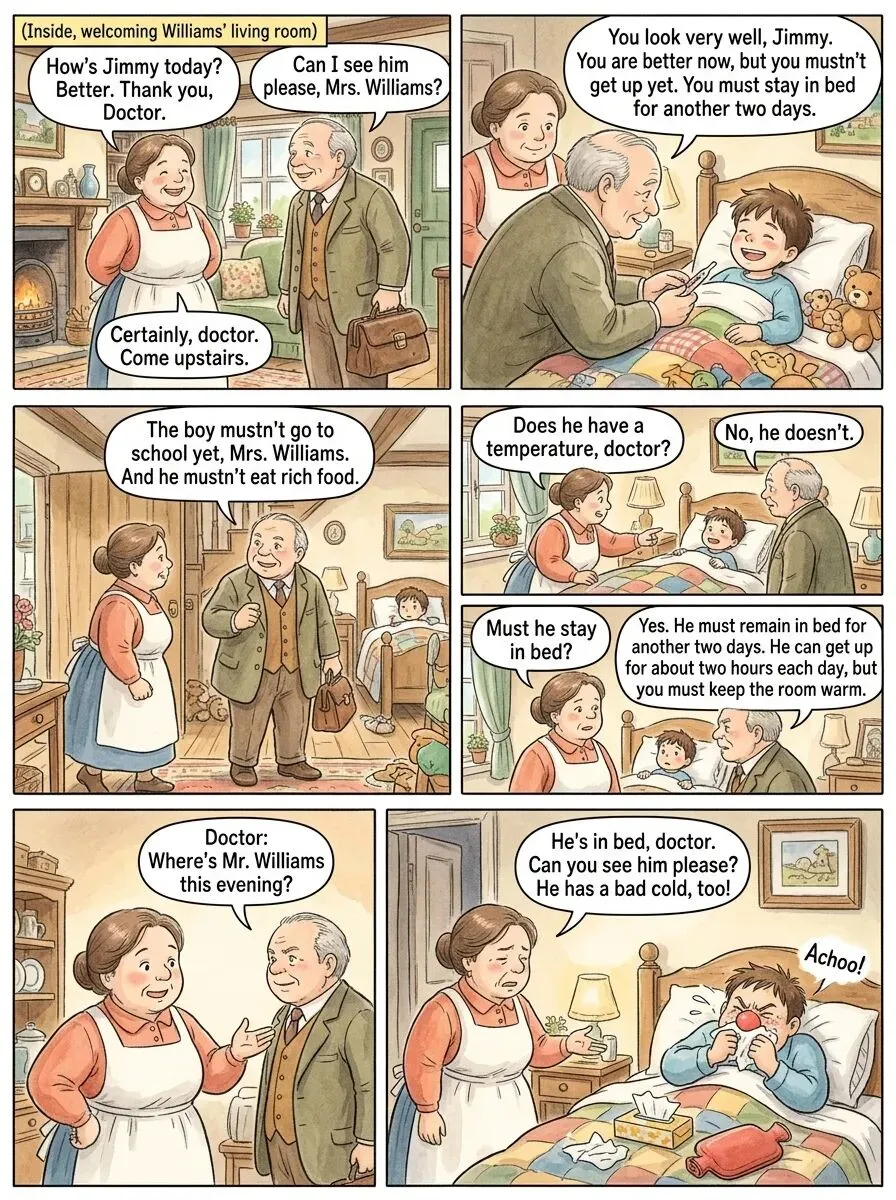
DOCTOR: How's Jimmy today?
MRS. WILLIAMS: He's better. Thank you, doctor.
DOCTOR: Can I see him please, Mrs. Williams?
MRS. WILLIAMS: Certainly, doctor. Come upstairs.
(In the bedroom)
DOCTOR: You look very well, Jimmy. You are better now, but you mustn't get up yet. You must stay in bed for another two days.
DOCTOR: The boy mustn't go to school yet, Mrs. Williams. And he mustn't eat rich food.
MRS. WILLIAMS: Does he have a temperature, doctor?
DOCTOR: No, he doesn't.
MRS. WILLIAMS: Must he stay in bed?
DOCTOR: Yes, he must. He must remain in bed for another two days. He can get up for about two hours each day, but you must keep the room warm.
DOCTOR: Where's Mr. Williams this evening?
MRS. WILLIAMS: He's in bed, doctor. Can you see him please? He has a bad cold, too!
Lesson 64 Don't...! You mustn't...!
📜 课文原文
- Don't take any aspirins!
- You mustn't take any aspirins!
- Don't call the doctor!
- You mustn't call the doctor!
- Don't talk so loud!
- You mustn't talk so loud!
- Don't type so fast!
- You mustn't type so fast!
- Don't play so loudly!
- You mustn't play so loudly!
- Don't drive so quickly!
- You mustn't drive so quickly!
- Don't lean out of the window!
- You mustn't lean out of the window!
- Don't break that vase!
- You mustn't break that vase!
情景说明:第63课的情景发生在威廉姆斯太太家中。医生前来复诊生病的小男孩吉米。对话始于客厅的寒暄,随后医生上楼进入吉米的卧室进行检查。这是一个典型的家庭随访场景,涉及病情汇报、医生检查、下达医嘱以及家属询问细节。氛围是礼貌、关切且专业的。第64课并非连贯对话,而是一系列针对不当行为的禁止指令配对展示。它模拟了多种日常生活场景,如图书馆(别大声说话)、办公室(别打字太快)、道路(别开这么快)、家里(别玩这么吵、别探身窗外、别打碎花瓶)以及可能出现的医疗建议场景(别吃阿司匹林、别叫医生)。这些句子展示了如何用两种方式表达强烈的禁止。
参考译文:第63课 谢谢你,医生。医生:吉米今天怎么样了?威廉姆斯夫人:他好些了。谢谢你,医生。医生:威廉姆斯夫人,我可以看看他吗?威廉姆斯夫人:当然可以,医生。请上楼。(在卧室里)医生:你看上去很好,吉米。你现在好些了,但还不应该起床。你必须再卧床两天。医生:这孩子还不能去上学,威廉姆斯夫人。而且他不可以吃油腻的食物。威廉姆斯夫人:他还发烧吗,医生?医生:不,他不发烧了。威廉姆斯夫人:他必须卧床吗?医生:是的,必须卧床。他必须再卧床两天。每天他可以起来大约两个小时,但你必须保持房间温暖。医生:威廉姆斯先生今晚在哪儿?威廉姆斯夫人:他也卧床呢,医生。请您去看看他好吗?他也得了重感冒!第64课 不要...!你不应该...!- 不要吃阿司匹林!- 你不应该吃阿司匹林!- 不要叫医生!- 你不应该叫医生!- 别这么大声说话!- 你不应该这么大声说话!- 别打字这么快!- 你不应该打字这么快!- 别玩得这么吵!- 你不应该玩得这么吵!- 别开这么快!- 你不应该开这么快!- 别探身窗外!- 你不应该探身窗外!- 别打碎那个花瓶!- 你不应该打碎那个花瓶!
🔍 第二部分:逐句精讲与词块总结
句子1
原文: How's Jimmy today?
翻译: 吉米今天怎么样了?
句子结构: 特殊疑问句。How's (How is 的缩写) 作系动词,Jimmy 作主语,today 作时间状语。属于“主语+系动词+表语”的变体疑问形式。
重点词汇:
How's 蓝思值 200L
英音[haʊz] 美音[haʊz] 词性:疑问副词 (How) + 系动词 (is) 的缩写
释义:(用于询问健康状况或情绪)怎么样
常用语块:How's it going? (情况如何?);How's everything? (一切都好吗?);How's your family? (你家人好吗?)
例句一:How's your new job? 你的新工作怎么样?
例句二:How's the weather in London? 伦敦天气如何?
拓展:How 引导的问候非常常见且非正式。回答可以是 Fine, thanks. 或具体描述如 He's better.。注意与 What's wrong with...? (...怎么了?) 的区别,后者通常用于已知有问题时询问具体原因。
语法点睛: 本句是使用 How 引导的、询问某人状态的特殊疑问句的一般现在时形式。How 在这里相当于一个表语性质的疑问词,询问主语的状态或性质。[NCE知识点笔记]
语音要点: How's 发音时,ow 发 [aʊ] 音,与后面的 s [z] 连读。语调通常为降调,表示一个完整的疑问。
句子2
原文: He's better. Thank you, doctor.
翻译: 他好些了。谢谢你,医生。
句子结构: 第一句:He's (He is 的缩写) 作系动词,better 作表语。第二句:Thank 作谓语动词,you 作宾语,doctor 作呼语。
重点词汇:
better 蓝思值 300L
英音[ˈbetə(r)] 美音[ˈbetər] 词性:形容词 (well 的比较级) / 副词 (well 的比较级)
释义:(健康状况)好转的,好些的
常用语块:feel better (感觉好些了);get better (变得更好/康复);much better (好多了)
例句一:I hope you get better soon. 我希望你早日康复。
例句二:This medicine will make you feel better. 这药会让你感觉好些。
拓展:better 是 good (形容词) 和 well (副词/形容词) 的比较级。在表示健康时,通常用 well 的原级和 better 的比较级。例如:He is well. (他身体好。) He is better (than yesterday). (他比昨天好些了。)
Thank you 蓝思值 100L
英音[θæŋk juː] 美音[θæŋk juː] 词性:动词短语 (Thank) + 代词 (you)
释义:谢谢你
常用语块:Thank you very much. (非常感谢你。);Thank you for your help. (谢谢你的帮助。)
例句一:Thank you for coming. 谢谢你的到来。
例句二:I just want to say thank you. 我只想说声谢谢。
拓展:这是英语中最基本的礼貌用语之一。回应方式多样,如 You're welcome. (不客气),My pleasure. (我的荣幸),Not at all. (没关系),Don't mention it. (别提了/不用谢)。
语法点睛: He's better. 是一个典型的主系表结构,使用了形容词比较级 better 作表语,表示与之前状态(可能是不好)的对比。Thank you 是祈使句的礼貌形式,省略了主语 I。[NCE知识点笔记]
语音要点: He's better 中,He's 的 s 发 [z] 音,与 better 的 [b] 略有停顿。Thank you 常连读为 [θæŋk juː],有时甚至弱读为 [θæŋkjə]。
句子3
原文: Can I see him please, Mrs. Williams?
翻译: 威廉姆斯夫人,我可以看看他吗?
句子结构: 一般疑问句。Can 作情态动词,I 作主语,see 作谓语动词,him 作宾语,please 作插入语表示礼貌,Mrs. Williams 作呼语。
重点词汇:
Can I...? 蓝思值 200L
英音[kæn aɪ] 美音[kæn aɪ] 词性:情态动词 (Can) + 主语 (I)
释义:我可以...吗?(请求许可)
常用语块:Can I help you? (我能帮你吗?);Can I have a look? (我能看一下吗?);Can I use your phone? (我可以用下你的电话吗?)
例句一:Can I ask you a question? 我可以问你一个问题吗?
例句二:Can I borrow your pen? 我能借你的钢笔吗?
拓展:这是请求许可最常用的句型之一,比 May I...? 更口语化和常用。肯定回答:Yes, you can. 或 Certainly.;否定回答:I'm afraid you can't. 或 No, you can't.
see 蓝思值 200L
英音[siː] 美音[siː] 词性:动词
释义:看望,探望;看见
常用语块:see a doctor (看医生);see you later (回头见);see the point (明白要点)
例句一:I went to see my grandmother last weekend. 我上周末去看望了我的祖母。
例句二:Can you see the bird in the tree? 你能看见树上的鸟吗?
拓展:see 强调视觉的结果“看到”,而 look (at) 强调看的动作“朝...看”,watch 强调专注地“观看”动态过程(如电视、比赛)。
语法点睛: 本句是 Can 引导的一般疑问句,用于礼貌地请求做某事。please 可以放在句末(如本句)或句中(Can I please see him?),使请求更委婉。[NCE知识点笔记]
语音要点: Can I 常连读为 [kæ naɪ]。see him 连读为 [siː hɪm],h 轻微发音。句末用升调。
句子4
原文: Certainly, doctor. Come upstairs.
翻译: 当然可以,医生。请上楼。
句子结构: 第一句:Certainly 作状语,doctor 作呼语。第二句:祈使句,省略主语 you,Come 作谓语动词,upstairs 作地点状语。
重点词汇:
Certainly 蓝思值 400L
英音[ˈsɜːtnli] 美音[ˈsɜːrtnli] 词性:副词
释义:当然,没问题(表示同意或许可)
常用语块:用于肯定回答请求或问题。
例句一:---Could you pass the salt? ---Certainly. ---你能递一下盐吗?---当然。
例句二:She certainly knows how to make people laugh. 她当然知道怎么逗人笑。
拓展:Certainly 是比较正式和礼貌的肯定答复,同义词有 Of course (更随意),Sure (美式,非常口语化)。Yes 是最简单的肯定,但不如 Certainly 热情。
Come upstairs 蓝思值 350L
英音[kʌm ˌʌpˈsteəz] 美音[kʌm ˌʌpˈsterz] 词性:动词短语 (Come) + 副词 (upstairs)
释义:上来,上楼
常用语块:go upstairs (上楼去);live upstairs (住在楼上)
例句一:Your room is ready. Come upstairs and see it. 你的房间准备好了。上楼来看看吧。
例句二:He came upstairs to say goodnight. 他上楼来道晚安。
拓展:upstairs 是副词,前面不加介词。反义词是 downstairs (下楼/在楼下)。Come up 也可以表示“上来”,但不特指楼梯。
语法点睛: Certainly 是副词单独成句,用于简短有力的肯定回答。Come upstairs. 是祈使句的肯定形式,用于发出邀请或指令。[NCE知识点笔记]
语音要点: Certainly 重音在第一音节 [ˈsɜːt]。Come upstairs 中,Come 的 [m] 与 upstairs 的 [ʌ] 稍有停顿,upstairs 重音在第二音节 [ˈsteəz]。
句子5
原文: You look very well, Jimmy.
翻译: 你看上去很好,吉米。
句子结构: 陈述句。You 作主语,look 作系动词,very well 作表语(very 是副词修饰形容词 well),Jimmy 作呼语。
重点词汇:
look 蓝思值 200L
英音[lʊk] 美音[lʊk] 词性:系动词 / 动词
释义:(作为系动词)看上去,看起来
常用语块:look happy/sad/tired (看起来高兴/悲伤/疲倦);look like (看起来像)
例句一:You look great in that dress. 你穿那条裙子看起来很棒。
例句二:It looks like rain. 看起来要下雨了。
拓展:作为系动词,look 后接形容词作表语,描述主语的外观或给人的印象。区别于行为动词 look at (看)。
well 蓝思值 300L
英音[wel] 美音[wel] 词性:形容词 / 副词
释义:(身体)健康的;好地
常用语块:feel well (感觉身体好);get well soon (祝早日康复);do well (做得好)
例句一:I don't feel very well today. 我今天感觉不太舒服。
例句二:She speaks English very well. 她英语说得很好。
拓展:表示“身体健康”时,well 是形容词,通常只作表语(如 I am well.)。其比较级和最高级是 better, best。作为副词时,修饰动词。
语法点睛: 本句是主系表结构,look 作为系动词,连接主语 You 和表语 well。very 是程度副词,修饰形容词 well,加强“好”的程度。[NCE知识点笔记]
语音要点: look very 中,k 和 v 都是爆破音,前者失去爆破,略作停顿。well 发音清晰,[w] 音明显。
句子6
原文: You are better now, but you mustn't get up yet.
翻译: 你现在好些了,但还不应该起床。
句子结构: 并列复合句。由连词 but 连接两个分句。第一分句:You 作主语,are 作系动词,better 作表语,now 作时间状语。第二分句:you 作主语,mustn't (must not 的缩写) 作情态动词否定式,get up 作谓语动词短语,yet 作状语。
重点词汇:
mustn't 蓝思值 400L
英音[ˈmʌsnt] 美音[ˈmʌsnt] 词性:情态动词 (must) 的否定缩写形式
释义:不准许,禁止,不应该(表示强烈的否定义务或禁止)
常用语块:You mustn't be late. (你绝不能迟到。);You mustn't tell anyone. (你绝对不能告诉任何人。)
例句一:You mustn't play with fire. It's dangerous. 你绝不能玩火。这很危险。
例句二:Visitors mustn't feed the animals. 游客禁止喂食动物。
拓展:mustn't 表示“禁止做某事”,语气非常强烈。它与 don't have to (不必) 含义完全不同。must 的否定回答通常用 needn't 或 don't have to,而不是 mustn't。
get up 蓝思值 250L
英音[ɡet ʌp] 美音[ɡet ʌp] 词性:动词短语
释义:起床;起身
常用语块:get up early/late (早起/晚起);get up from the chair (从椅子上站起来)
例句一:I usually get up at seven o'clock. 我通常七点起床。
例句二:He got up to answer the phone. 他起身去接电话。
拓展:get up 是“起床”最地道的说法。get 是一个极其灵活的动词,与不同副词/介词搭配含义丰富,如 get on (上车/进展),get off (下车),get over (克服)。
yet 蓝思值 450L
英音[jet] 美音[jet] 词性:副词
释义:(用于否定句和疑问句)还,尚(表示到说话时为止预期的动作或状态尚未发生)
常用语块:not yet (还没有);用于句末。
例句一:Has the mail come yet? 邮件来了吗?
例句二:I haven't finished my homework yet. 我还没做完作业。
拓展:yet 通常用于否定句和疑问句,置于句末或助动词后。在肯定句中表示“还”通常用 still。yet 也可作连词,意为“然而”,但本课是其副词用法。
语法点睛: 本课核心语法点之一:情态动词 must 的否定形式 mustn't,表示“禁止、不允许”。yet 用于否定句句末,表示“到目前为止还不...”,常与现在完成时连用,但本课与一般现在时连用,强调当前状态下的禁令。[NCE知识点笔记]
语音要点: mustn't 发音时,t 不发音,读作 [ˈmʌsnt]。get up 连读为 [ɡe tʌp],中间有轻微连读。yet 发音短促。
句子7
原文: You must stay in bed for another two days.
翻译: 你必须再卧床两天。
句子结构: 陈述句。You 作主语,must 作情态动词,stay 作谓语动词,in bed 作地点状语,for another two days 作时间状语(for 引导持续时间)。
重点词汇:
must 蓝思值 300L
英音[mʌst] 美音[mʌst] 词性:情态动词
释义:必须,应该(表示必要性、义务或强烈的建议)
常用语块:must do something (必须做某事);must be (一定是,表示推测)
例句一:We must protect the environment. 我们必须保护环境。
例句二:You look tired. You must get some rest. 你看起来很累。你必须休息一下。
拓展:must 表示说话人主观认为“必须”,语气强烈。否定形式 mustn't 表示“禁止”。表示“不必”要用 needn't 或 don't have to。
stay in bed 蓝思值 350L
英音[steɪ ɪn bed] 美音[steɪ ɪn bed] 词性:动词短语
释义:卧床,待在床上
常用语块:常用于生病或休息时。
例句一:The doctor told me to stay in bed and drink plenty of water. 医生告诉我卧床休息并多喝水。
例句二:On rainy Sundays, I like to stay in bed and read. 在下雨的周日,我喜欢待在床上看书。
拓展:stay 表示“保持某种状态或位置”。in bed 是固定搭配,指“在床上(休息)”,注意没有冠词。
for another two days 蓝思值 500L
英音[fɔːr əˈnʌðə tuː deɪz] 美音[fɔːr əˈnʌðər tuː deɪz] 词性:介词短语作时间状语
释义:再两天,另外两天
常用语块:for another hour/week/month (再一小时/一周/一个月)
例句一:Can you lend me the book for another week? 这本书你能再借我一周吗?
例句二:They decided to stay in Paris for another three days. 他们决定在巴黎再多呆三天。
拓展:for 后接一段时间,表示动作或状态的持续时间。another 后接复数名词时,意思是“再...,又...”,表示在原有基础上增加。
语法点睛: 本课另一核心语法点:情态动词 must 的肯定形式,表示“必须”,带有医嘱的强制性。for + 时间段 表示动作 (stay) 持续的时长。[NCE知识点笔记]
语音要点: must stay 中,t 和 s 相邻,t 失去爆破。for another 连读为 [fɔːr əˈnʌðə]。two days 中,two 的 [uː] 音拉长,与 days 的 [deɪz] 分开读。
句子8
原文: The boy mustn't go to school yet, Mrs. Williams.
翻译: 这孩子还不能去上学,威廉姆斯夫人。
句子结构: 陈述句。The boy 作主语,mustn't 作情态动词否定式,go to school 作谓语动词短语,yet 作状语,Mrs. Williams 作呼语。
重点词汇:
go to school 蓝思值 200L
英音[ɡəʊ tə skuːl] 美音[ɡoʊ tə skuːl] 词性:动词短语
释义:去上学
常用语块:go to work (去上班);go to hospital (去医院看病);go to bed (上床睡觉)
例句一:My children go to school by bus. 我的孩子们乘公交车上学。
例句二:It's time to go to school. 该去上学了。
拓展:这些短语中,school, work, hospital, bed 等表示抽象的活动或目的,前面通常不加冠词。比较:go to the school 可能指去学校这个地方(不一定是上学)。
语法点睛: 再次使用 mustn't... yet 结构,强调在康复期间,“上学”这个行为是被禁止的。主语变为第三人称单数 The boy,但情态动词 must 无人称和数变化。[NCE知识点笔记]
语音要点: go to school 中,go to 连读为 [ɡəʊ tə] 或 [ɡoʊ də](美音中 t 可能浊化为 d)。yet 置于句末,语调平稳。
句子9
原文: And he mustn't eat rich food.
翻译: 而且他不可以吃油腻的食物。
句子结构: 简单陈述句。And 是连词,he 作主语,mustn't 作情态动词否定式,eat 作谓语动词,rich food 作宾语。
重点词汇:
rich 蓝思值 450L
英音[rɪtʃ] 美音[rɪtʃ] 词性:形容词
释义:(食物)油腻的,丰盛的;富有的
常用语块:rich food (油腻食物);rich in (富含...的);a rich man (富人)
例句一:Avoid rich food before going to bed. 睡前避免吃油腻的食物。
例句二:The soil here is rich in minerals. 这里的土壤富含矿物质。
拓展:rich 形容食物时,指含有大量脂肪、奶油、糖等,口感厚重,不易消化。反义词可以是 light (清淡的) 或 plain (清淡朴素的)。
food 蓝思值 200L
英音[fuːd] 美音[fuːd] 词性:名词(不可数,但指种类时可数)
释义:食物,食品
常用语块:fast food (快餐);healthy food (健康食品);food and drink (饮食)
例句一:We need to buy some food for the party. 我们需要为聚会买些食物。
例句二:Italian food is my favorite. 意大利菜是我的最爱。
拓展:food 通常作不可数名词,如 some food。表示不同种类的食物时可用复数,如 different foods。常见搭配:junk food (垃圾食品),organic food (有机食品)。
语法点睛: 继续使用 mustn't 列出另一项禁令。rich 作为形容词修饰不可数名词 food。[NCE知识点笔记]
语音要点: eat rich 中,t 和 r 相邻,t 的发音很轻。rich food 两个词都重读,强调这是需要避免的东西。
句子10
原文: Does he have a temperature, doctor?
翻译: 他还发烧吗,医生?
句子结构: 一般疑问句。Does 是助动词(第三人称单数),he 作主语,have 作谓语动词,a temperature 作宾语,doctor 作呼语。
重点词汇:
have a temperature 蓝思值 400L
英音[hæv ə ˈtemprətʃə(r)] 美音[hæv ə ˈtemprətʃər] 词性:动词短语
释义:发烧
常用语块:run a temperature (发烧);have a high temperature (发高烧)
例句一:The baby has a temperature. We should call the doctor. 宝宝发烧了。我们应该叫医生。
例句二:If you have a temperature, you should stay home. 如果你发烧了,就应该待在家里。
拓展:这是“发烧”的常用表达之一。更口语化的说法是 have a fever。take one's temperature 意思是“量体温”。
语法点睛: 一般现在时第三人称单数 (he) 的一般疑问句构成:Does + 主语 + 动词原形 (have)...?。have 在这里是实义动词“患有”,不是助动词。[NCE知识点笔记]
语音要点: Does he 连读为 [dʌz iː] 或 [dəzi]。have a 连读为 [hæv ə]。temperature 重音在第一音节 [ˈtemprə]。
句子11
原文: No, he doesn't.
翻译: 不,他不发烧了。
句子结构: 简短回答。No 作否定副词,he doesn't (he does not 的缩写) 作主谓结构,省略了宾语 have a temperature。
重点词汇: (本句为简短回答,无新重点词汇,但巩固 doesn't 的用法)
语法点睛: 对一般疑问句的否定回答:No, 主语 + 助动词否定式 (doesn't/don't...).。这是英语问答的标准格式。[NCE知识点笔记]
语音要点: doesn't 发音为 [ˈdʌznt],t 轻微发音或不发音。回答简短有力,用降调。
句子12
原文: Must he stay in bed?
翻译: 他必须卧床吗?
句子结构: 一般疑问句。Must 作情态动词,he 作主语,stay in bed 作谓语动词短语。
重点词汇: (本句重点在于 must 引导的疑问句,词汇已学)
语法点睛: 情态动词 must 引导的一般疑问句:Must + 主语 + 动词原形...?。用于询问是否“必须”做某事。肯定回答:Yes, 主语 + must.;否定回答:No, 主语 + needn't. (不必)。[NCE知识点笔记]
语音要点: 句末用升调。Must he 连读为 [mʌst iː] 或 [mʌsti]。
句子13
原文: Yes, he must. He must remain in bed for another two days.
翻译: 是的,必须卧床。他必须再卧床两天。
句子结构: 第一句:简短肯定回答。第二句:陈述句,He 作主语,must 作情态动词,remain 作谓语动词,in bed 作表语(remain 是系动词),for another two days 作时间状语。
重点词汇:
remain 蓝思值 600L
英音[rɪˈmeɪn] 美音[rɪˈmeɪn] 词性:系动词 / 动词
释义:保持,仍然是;停留
常用语块:remain silent (保持沉默);remain calm (保持冷静);remain in one's memory (留在记忆中)
例句一:Please remain seated until the plane comes to a complete stop. 请在飞机完全停稳前保持坐在座位上。
例句二:Many problems remain to be solved. 许多问题仍有待解决。
拓展:remain 作为系动词,后接形容词、名词、介词短语等作表语,表示持续某种状态,比 stay 更正式。remain in bed 与 stay in bed 意思相近,但 remain 侧重状态的延续。
语法点睛: 对 Must...? 问句的肯定回答。remain 在此作系动词,in bed 是介词短语作表语,描述主语的状态。remain 比 stay 语气更正式,常用于书面或正式场合。[NCE知识点笔记]
语音要点: Yes, he must. 中 must 重读,强调必要性。remain in 连读为 [rɪˈmeɪ nɪn]。
句子14
原文: He can get up for about two hours each day, but you must keep the room warm.
翻译: 每天他可以起来大约两个小时,但你必须保持房间温暖。
句子结构: 并列复合句。but 连接两个分句。第一分句:He 作主语,can 作情态动词,get up 作谓语,for about two hours 和 each day 作时间状语。第二分句:you 作主语,must 作情态动词,keep 作谓语动词,the room 作宾语,warm 作宾语补足语。
重点词汇:
can 蓝思值 200L
英音[kæn] 美音[kæn] 词性:情态动词
释义:可以,能够(表示许可或能力)
常用语块:can do something (能做某事);can I...? (我可以...吗?)
例句一:You can go out and play after you finish your homework. 你做完作业后可以出去玩。
例句二:She can speak three languages. 她会说三种语言。
拓展:此处 can 表示医生给予的许可(允许起床)。与 must (必须) 和 mustn't (禁止) 形成对比,构成了“禁止-必须-允许”的义务层级。
keep 蓝思值 400L
英音[kiːp] 美音[kiːp] 词性:动词
释义:使保持(某种状态)
常用语块:keep quiet (保持安静);keep a diary (记日记);keep in touch (保持联系)
例句一:Keep the door closed, please. 请让门关着。
例句二:This coat will keep you warm. 这件外套会让你暖和。
拓展:keep + 宾语 + 形容词/介词短语/现在分词 是常见结构,表示“使宾语处于...状态”。此处 keep the room warm 是“使房间保持温暖”。
warm 蓝思值 300L
英音[wɔːm] 美音[wɔːrm] 词性:形容词
释义:温暖的;暖和的
常用语块:keep warm (保暖);warm welcome (热烈欢迎);warm-hearted (热心的)
例句一:Come sit by the fire and get warm. 过来坐在火边暖和一下。
例句二:The weather is getting warmer. 天气越来越暖和了。
拓展:warm 既可以形容温度,也可以形容感情(热情的)。反义词是 cool (凉爽的) 或 cold (寒冷的)。
语法点睛: can 在此表示许可,与 mustn't get up 形成部分解除禁令的关系。keep + 宾语 + 形容词 是使役结构,warm 作宾语 the room 的补足语,说明被保持的状态。[NCE知识点笔记]
语音要点: can get up 中,n 和 g 属于不同单词,略有停顿。keep the 连读为 [kiːp ðə]。room warm 中,m 和 w 都是唇音,过渡自然。
句子15
原文: Where's Mr. Williams this evening?
翻译: 威廉姆斯先生今晚在哪儿?
句子结构: 特殊疑问句。Where's (Where is 的缩写) 作系动词,Mr. Williams 作主语,this evening 作时间状语。
重点词汇:
Where's 蓝思值 200L
英音[weəz] 美音[werz] 词性:疑问副词 (Where) + 系动词 (is) 的缩写
释义:(询问地点)...在哪儿?
常用语块:Where are you? (你在哪儿?);Where is it? (它在哪儿?)
例句一:Where's the nearest post office? 最近的邮局在哪儿?
例句二:I don't know where he is. 我不知道他在哪儿。
拓展:Where 引导的特殊疑问句,用来询问位置或地点。回答通常用介词短语(如 in bed)或副词(如 here, there)。
this evening 蓝思值 250L
英音[ðɪs ˈiːvnɪŋ] 美音[ðɪs ˈiːvnɪŋ] 词性:名词短语作时间状语
释义:今天晚上
常用语块:this morning/afternoon/night (今天早上/下午/晚上)
例句一:I'll call you this evening. 我今晚给你打电话。
例句二:What are you doing this evening? 你今天晚上做什么?
拓展:this 与 morning, afternoon 等连用,表示“今天”的某个时段,前面不加介词。
语法点睛: Where is...? 句型询问某人或某物的位置。this evening 是具体的时间状语,放在句末。[NCE知识点笔记]
语音要点: Where's 发音为 [weəz],r 在英音中不卷舌,在美音中卷舌。this evening 连读为 [ðɪ ˈsiːvnɪŋ],s 和 e 连读。
句子16
原文: He's in bed, doctor. Can you see him please? He has a bad cold, too!
翻译: 他也卧床呢,医生。请您去看看他好吗?他也得了重感冒!
句子结构: 三个句子。第一句:He's (He is 的缩写) 作系动词,in bed 作表语。第二句:Can 作情态动词,you 作主语,see 作谓语动词,him 作宾语,please 作插入语。第三句:He 作主语,has 作谓语动词,a bad cold 作宾语,too 作状语。
重点词汇:
too 蓝思值 300L
英音[tuː] 美音[tuː] 词性:副词
释义:也(用于肯定句句末)
常用语块:Me too. (我也是。);用于句末,前面常有逗号。
例句一:I like pizza, and my brother does too. 我喜欢披萨,我弟弟也喜欢。
例句二:She's coming, and her friend is coming too. 她要来,她的朋友也要来。
拓展:too 用于肯定句句末,表示“也”。also 用于句中(实义动词前,be动词/助动词后)。either 用于否定句句末,表示“也(不)”。
语法点睛: He's in bed. 是主系表结构,in bed 介词短语作表语。Can you see him please? 是 Can you...? 句型用于请求对方做某事。too 放在句末,用逗号隔开更正式,口语中常直接连接。[NCE知识点笔记]
语音要点: He's in bed 连读为 [hiːz ɪn bed]。Can you 连读为 [kæn juː] 或 [kə njə]。too 发音拉长,表示强调,带有惊讶或无奈的语气。
第64课句子精讲(合并)
第64课的核心是展示 Don't...! 和 You mustn't...! 这对同义结构,用于表达禁止。我们将分组解析关键词汇和搭配。
分组1:Don't take any aspirins! / You mustn't take any aspirins!
take any aspirins 蓝思值 400L
释义:服用任何阿司匹林。take medicine 是“服药”的固定搭配。any 用于否定句,表示“任何”。
aspirin蓝思值 500L 英音[ˈæsprɪn] 美音[ˈæsprɪn] 词性:名词。释义:阿司匹林(药物名)。通常作不可数名词,但指药片时可数。
分组2:Don't call the doctor! / You mustn't call the doctor!
call the doctor 蓝思值 300L
释义:叫医生,给医生打电话。call 在此意为“召唤”或“打电话给”。
分组3:Don't talk so loud! / You mustn't talk so loud!
talk so loud 蓝思值 350L
释义:这么大声说话。so 是副词,修饰形容词 loud,表示程度。loud 是形容词,这里作副词用(口语中常见),更正式的副词是 loudly。
loud蓝思值 400L 英音[laʊd] 美音[laʊd] 词性:形容词/副词。释义:大声的,喧闹的。
分组4:Don't type so fast! / You mustn't type so fast!
type so fast 蓝思值 450L
释义:打字这么快。type 动词,打字。fast 副词,快速地。
分组5:Don't play so loudly! / You mustn't play so loudly!
play so loudly 蓝思值 400L
释义:玩得/演奏得这么吵。play 可指玩耍或演奏乐器。loudly 副词,大声地,吵闹地。
分组6:Don't drive so quickly! / You mustn't drive so quickly!
drive so quickly 蓝思值 450L
释义:开车这么快。drive 驾驶。quickly 副词,迅速地。同义表达 drive so fast,fast 更强调速度本身,quickly 强调动作迅速。
分组7:Don't lean out of the window! / You mustn't lean out of the window!
lean out of the window 蓝思值 550L
释义:探身到窗外。lean 倾斜,倚靠。out of 从...向外。
lean蓝思值 600L 英音[liːn] 美音[liːn] 词性:动词。释义:倾斜;依靠。
分组8:Don't break that vase! / You mustn't break that vase!
break that vase 蓝思值 450L
释义:打碎那个花瓶。that 指示代词,那个。vase 花瓶。
break蓝思值 400L 英音[breɪk] 美音[breɪk] 词性:动词。释义:打破,打碎。
第64课语法点睛: 本课核心语法是表达禁止的两种方式:1. 祈使句否定式:Don't + 动词原形 (+ 其他)! 这是一种直接的命令或警告,语气强硬,常用于即时制止。例如:Don't touch! (别碰!) 2. 陈述句形式:You mustn't + 动词原形 (+ 其他)! 这也表示禁止,但通过陈述一个规则或义务来表达,有时可能显得稍微正式一点,或者强调这是规定。两者在大多数日常情境下可以互换,但 Don't...! 更口语化、更直接。[NCE知识点笔记]
第64课语音要点: Don't 和 mustn't 都要重读,以示强调。句末用降调或感叹语调,传达命令或警告的语气。so 后面的形容词或副词 (loud, fast, quickly等) 也要重读。
📌 核心词块总结
1. Thank you, doctor. (谢谢你,医生。) - Explanation: The standard polite response to a doctor's inquiry or help. - Example: After the check-up, the patient said, “Thank you, doctor.”
2. must/mustn't + verb (必须/禁止做某事) - Explanation: Express strong necessity (must) or prohibition (mustn't). - Example (must): You must finish your homework before watching TV. - Example (mustn't): You mustn't swim right after eating.
3. have a temperature (发烧) - Explanation: To be feverish; to have a body temperature higher than normal. - Example: If you have a temperature, it's best to stay home and rest.
4. stay/remain in bed (卧床) - Explanation: To rest by lying in bed, especially when ill. - Example: The flu was bad, so I had to stay in bed for two days.
5. Don't...! / You mustn't...! (不要...!) - Explanation: Used to give a strong command or warning not to do something. - Example: Don't run in the hallway! / You mustn't run in the hallway!
6. keep + something + adjective (使某物保持某种状态) - Explanation: To cause something to remain in a particular condition. - Example: Please keep the door closed.
💬 第三部分:基础会话技巧
1. 分析课文中的日常用语、礼貌表达、问答模式- 问候与关心: 医生以 How's Jimmy today? 开场,这是询问病人情况的专业而关心的方式。家属回答 He's better. Thank you, doctor. 既汇报了病情,也表达了感谢,体现了良好的医患互动。- 请求许可: Can I see him please, Mrs. Williams? 是进入私人空间(卧室)前的礼貌请求。Certainly. 是热情肯定的答复。- 传达信息与指令: 医生使用了一系列 must 和 mustn't 来下达明确的、不容置疑的医嘱,如 you mustn't get up yet, You must stay in bed..., he mustn't eat rich food。这是专业权威的体现。- 家属询问: 家属使用 Does he have a temperature...? 和 Must he stay in bed? 来询问具体细节,显示了关切和希望遵循医嘱的态度。- 提出进一步请求: 在对话末尾,威廉姆斯夫人顺势提出 Can you see him please?,请求医生也为丈夫看病,这是一种自然的、基于信任的请求。
2. 提供类似场景的扩展对话示例(At a dentist's clinic)Dentist: Good morning, Ms. Chen. How's your tooth?Ms. Chen: It's much better. Thank you, doctor. The pain is almost gone.Dentist: Good. Can I check it please?Ms. Chen: Of course.Dentist: Everything looks fine. But youmustn'teat anything too hard or too cold for the next week.Ms. Chen: Okay. Do I need to come back?Dentist: No, youdon't have tocome back if there's no more pain. Justkeepit clean.Ms. Chen: Thank you very much.Dentist: You're welcome.
3. 设计简单的角色扮演活动建议-活动:“小小医生”-准备:准备一些简单的道具(玩具听诊器、体温计模型、一张床/椅子)。-角色:学生A扮演医生,学生B扮演病人(或病人的家长)。-任务:医生需要对“病人”进行复诊。对话必须包含以下要素:1. 医生问候并询问病情。2. 病人/家长汇报病情并感谢医生。3. 医生进行检查(可以说“Let me check...”)。4. 医生给出至少两条使用 must 的医嘱和一条使用 mustn't 的禁令。5. 病人/家长提出一个关于病情的问题(用 Does...? 或 Must...?)。6. 医生回答并结束问诊。-扩展: 可以引入第三个角色,扮演另一个生病的家庭成员,请求医生也为他/她看病。
4. 融入基础思考:设计1-2个简单的代入式问题- 问题1: 如果你是吉米,听到医生说你“必须”再卧床两天,但“可以”每天起来两小时,你心里会觉得这个医嘱是严格还是宽松?为什么?- 问题2: 在图书馆里,你看到有人大声说话。你觉得对他说“Don't talk loud!”和“You mustn't talk loud!”,哪一种听起来更像图书馆管理员说的?哪一种更像你作为另一个读者说的?
📐 第四部分:本课语法精析(加强版)
本课语法焦点高度集中于 情态动词 must 及其否定形式 mustn't 的用法,并与祈使句否定式 Don't...! 进行对比。同时,也涉及一般现在时第三人称单数的疑问句 (Does he have...?) 和情态动词疑问句 (Must he...?)。
1. 情态动词 must 表示“必须” (Necessity and Obligation)-来源 [NCE知识点笔记]、[名师精讲]、[语法新思维]:must 是情态动词,用于表达说话人认为有必要或有义务去做某事。这种“必须”通常源于主观判断、道德责任、规章制度或紧迫情况。它没有人称和数的变化,后接动词原形。-表意功能:在医患对话中,must 传达了医嘱的强制性和专业性,表明为了健康恢复,某些行动是绝对必要的。-例句(不少于10个):1. Youmusttake this medicine three times a day. (你必须一天吃三次这个药。)[医嘱]2. Studentsmustwear uniforms at school. (学生在校必须穿校服。)[校规]3. Imustfinish this report by tomorrow. (我必须在明天之前完成这份报告。)[个人责任]4. Wemustprotect endangered animals. (我们必须保护濒危动物。)[道德责任]5. Youmustbe quiet in the library. (在图书馆你必须保持安静。)[场所规定]6. Hemustcall his parents as soon as he arrives. (他一到就必须给父母打电话。)[要求]7. Driversmuststop at a red light. (司机遇到红灯必须停车。)[交通法规]8. You look pale. Youmustsit down and have some water. (你脸色苍白。你必须坐下喝点水。)[关切与建议]9. To pass the exam, youmuststudy harder. (要想通过考试,你必须更努力学习。)[条件性必要]10. Before operating the machine, youmust read the safety instructions. (操作机器前,你必须阅读安全说明。)[安全规程]
2. 情态动词 must 的否定式 mustn't 表示“禁止” (Prohibition)-来源 [NCE知识点笔记]、[名师精讲]、[语法新思维]:mustn't (/ˈmʌsnt/) 是 must not 的缩写形式,表示“不准许”、“禁止”做某事。语气非常强烈,常用于规则、警告或严肃的告诫。-表意功能:在课文中,mustn't 用于明确列出康复期间禁止的行为(起床、上学、吃油腻食物),划定了行为的红线。-与 don't have to 的对比分析:这是关键区别!mustn't 表示“不可以做”(禁止)。don't have to 表示“不必做”(没有义务)。例如:- Youmustn'tsmoke here. (禁止吸烟。)- Youdon't have tosmoke if you don't want to. (你不想抽就不必抽。)- 医生:Youmustn'tgo to work today. (你今天不准去上班。)- 医生:Youdon't have tocome back next week. (你下周不必再来复诊。)-例句(不少于10个):1. Youmustn'ttell lies. (你不应该说谎。)2. Childrenmustn'tplay with matches. (儿童不准玩火柴。)3. Youmustn'tuse your phone during the flight. (飞行期间禁止使用手机。)4. Visitorsmustn'tfeed the zoo animals. (游客禁止投喂动物园的动物。)5. Youmustn'tbe late for the meeting. (你开会绝不能迟到。)6. Hemustn'tknow about the surprise party. (绝不能让他知道惊喜派对的事。)7. Youmustn'tcross the road when the light is red. (红灯时禁止过马路。)8. Patientsmustn'teat or drink before the operation. (手术前病人禁止饮食。)9. Youmustn'tleave your luggage unattended. (请不要让行李无人看管。)10. In this game, youmustn't let the ball touch the ground. (在这个游戏里,你不可以让球落地。)
3. 祈使句否定式 Don't...! 也表示“禁止”-来源 [NCE知识点笔记]、[语法新思维]:祈使句的否定形式是在动词原形前加 Don't (Do not)。它用于发出直接的命令、指示或警告,要求对方不要做某事。语气通常比 You mustn't... 更直接、更口语化,常用于即时制止。-与 You mustn't... 的对比分析:两者都表示禁止,常可互换,但细微差别在于:- Don't...! 更像一个即时、具体的指令。Don't touch that! (别碰那个!)- You mustn't... 更像在陈述一条普遍的规则或强调后果。You mustn't touch ancient artifacts. (你不可以触摸古代文物。)- 在课堂上,老师可能喊:Don't talk! (别说话了!)。而在学生守则里会写:Students mustn't talk during exams. (考试期间学生禁止交谈。)-例句:1.Don'tforget to lock the door. (别忘了锁门。)2.Don'tworry. Everything will be fine. (别担心。一切都会好的。)3.Don'tbe afraid to ask questions. (不要害怕提问。)4.Don'topen the window; it's raining outside. (别开窗,外面在下雨。)5.Don't make so much noise. The baby is sleeping. (别这么吵,宝宝在睡觉。)
4. 情态动词 must 的一般疑问句 Must...? 及其回答- 来源 [NCE知识点笔记]: 将 must 提到句首构成一般疑问句,询问是否有必要做某事。- 回答方式:- 肯定回答:Yes, 主语 + must.- 否定回答:No, 主语 + needn't. (或 don't/doesn't have to)。特别注意: 不能用 mustn't 来回答 Must...? 的问句,因为 mustn't 是“禁止”,而回答“不必”应该用 needn't。- 例句:- Q: Must I finish this today? (我必须今天完成这个吗?)- A: Yes, you must. (是的,你必须。)- A: No, you needn't. / No, you don't have to. (不,你不必。)
5. 一般现在时第三人称单数的一般疑问句 (Does...?)- 来源 [NCE知识点笔记]: 当主语是第三人称单数 (he, she, it, a name) 时,用助动词 does 构成一般疑问句,谓语动词恢复原形。- 结构:Does + 主语 (三单) + 动词原形 + ...?- 课文例句: Does he have a temperature?- 更多例句:1. Does she live in London? (她住在伦敦吗?)2. Does it rain a lot in summer here? (这里夏天雨多吗?)3. Does your father work in a bank? (你父亲在银行工作吗?)
练习题(不少于10道)1. 根据句意,用 must 或 mustn't 填空。a. You ___________ cross the street when the light is red.b. To be healthy, you ___________ eat more vegetables.c. It's a secret. You ___________ tell anyone.d. We ___________ hurry, or we'll miss the train.e. Students ___________ listen to the teacher carefully in class.答案:a. mustn't b. must c. mustn't d. must e. must2. 选择正确的答句。Q: Must I wash all the dishes now?A: ( ) a. No, you mustn't. b. No, you needn't. c. Yes, you needn't.答案:b3. 将下列句子改成否定祈使句 (Don't...)。a. Open the box.b. Be late.c. Talk in the library.答案:a. Don't open the box. b. Don't be late. c. Don't talk in the library.4. 用 does 或 doesn't 完成一般疑问句及其回答。a. ___________ he like coffee? No, he ___________.b. ___________ she have a cat? Yes, she ___________.答案:a. Does, doesn't b. Does, does5. 翻译句子。a. 你不可以在这里拍照。b. 他必须每天练习钢琴吗?c. 别吵!答案:a. You mustn't take photos here. / Don't take photos here.b. Must he practice piano every day?c. Don't make noise! / Don't be noisy!6. 改正句中的错误。a. You must to see a doctor.b. He mustn't eats ice cream.c. Does she lives in Paris?答案:a. You must see a doctor. (must后接动词原形)b. He mustn't eat ice cream. (mustn't后接动词原形)c. Does she live in Paris? (Does后接动词原形)7. 根据情景写句子。情景:在游泳池边,有一个标志。a. (禁止跳水) _____________________________________________.b. (禁止奔跑) _____________________________________________.答案:a. You mustn't dive. / Don't dive.b. You mustn't run. / Don't run.8. 将 You mustn't... 转换成 Don't...。a. You mustn't touch the wet paint.b. You mustn't be rude to your elders.答案:a. Don't touch the wet paint.b. Don't be rude to your elders.9. 回答 Must...? 问句。Q: Must we book the tickets in advance? (提前)A: (肯定) ________________________________________________.A: (否定) ________________________________________________.答案:肯定:Yes, we must. 否定:No, we needn't. / No, we don't have to.10. 用 must, mustn't, don't have to 填空。a. You ___________ wear a tie to work, but you can if you want. (公司规定可选)b. You ___________ smoke near the gas station. It's dangerous.c. I ___________ send this email today. Tomorrow is fine.答案: a. don't have to b. mustn't c. don't have to
✏️ 第五部分:基础练习与活动
1. 跟读练习:- 目标: 模仿课文录音的语音语调,特别是情态动词 must/mustn't 的重读和句末语调。- 方法: 播放第63课和第64课录音。学生先整体听一遍,然后逐句跟读。重点练习:- You mustn't get up yet. (降调,mustn't 重读)- Does he have a temperature? (升调)- Don't talk so loud! (降调或感叹调,Don't 和 loud 重读)- 扩展: 尝试用不同的语气(严厉的、关心的、警告的)来读 You mustn't... 和 Don't... 的句子。
2. 角色扮演:- 活动名称: “规则制定者”- 情景: 你是新来的宿舍长/图书馆管理员/公园管理员。- 任务: 为你的管辖区域制定3条规则,并使用 You must... 和 You mustn't... (或 Don't...) 的句式写在海报上。然后向全班(或你的搭档)介绍这些规则。- 示例: (For a library) 1. You must keep quiet. 2. You mustn't eat or drink. 3. You must return books on time.
3. 简单替换练习:- 用括号里给出的词替换划线部分,并保持句子语法正确。- You must stay in bed. (she) → She must stay in bed.- He mustn't eat rich food. (we) → We mustn't eat rich food.- Does he have a temperature? (your sister) → Does your sister have a temperature?- Don't drive so quickly. (type/ fast) → Don't type so fast.- You mustn't lean out of the window. (they) → They mustn't lean out of the window.
4. 听力理解题目:(假设有一段基于课文情景的简短对话)录音脚本(可由教师朗读):Doctor: Good afternoon, Mrs. Brown. How's Tim feeling?Mrs. Brown: He's better, thank you, doctor.Doctor: Good. Can I see him?Mrs. Brown: Certainly. He's in his room.(In the room)Doctor: Hello, Tim. You look well. But you mustn't go back to school tomorrow. You must rest at home for one more day.Tim: Okay, doctor. Can I watch TV?Doctor: Yes, you can. But don't watch for too long. You must get plenty of sleep.问题:1. Who is ill? (Tim.)2. Is Tim feeling better or worse? (Better.)3. What mustn't Tim do? (He mustn't go back to school tomorrow.)4. What must Tim do? (He must rest at home for one more day and get plenty of sleep.)5. What can Tim do? (He can watch TV.)
5. 课文改写版本(词汇更简单):Lesson 63 (Simplified)Doctor: How is Jimmy today?Mother: He is better. Thank you.Doctor: Can I see him?Mother: Yes. Come with me.(In the bedroom)Doctor: You look good, Jimmy. But do not get up now. Stay in bed for two more days.Doctor: He cannot go to school. And do not give him heavy food.Mother: Is he hot? (代替 have a temperature)Doctor: No.Mother: Does he need to stay in bed?Doctor: Yes. Stay in bed for two more days. He can get up for two hours each day. But keep the room hot. (代替 warm)Doctor: Where is Mr. Williams?Mother: He is in bed too. Can you see him? He is also very sick.
🤔 第六部分:英文深度思考与拓展(强化版)
A. 层次化英文问题与答案① Level 1 (Factual): 事实性问题1. Q: How is Jimmy feeling today according to his mother?A: He is better.2. Q: What does the doctor say Jimmy must not do yet?A: The doctor says Jimmy mustn't get up yet, mustn't go to school yet, and mustn't eat rich food.3. Q: For how many more days must Jimmy remain in bed?A: He must remain in bed for another two days.4. Q: Is Mr. Williams well or ill in the evening?A: He is ill. He is in bed and has a bad cold too.② Level 2 (Inferential): 推理性问题1. Q: Why do you think the doctor asks to see Jimmy even after hearing he is “better”?A: The doctor likely wants to examine Jimmy personally to confirm his improvement, check for any remaining symptoms, and give specific, tailored advice based on what he sees. “Better” is subjective; a professional assessment is needed.2. Q: From the dialogue, what can we infer about Mrs. Williams' attitude towards the doctor?A: We can infer that she respects and trusts the doctor. She thanks him, agrees immediately to let him see Jimmy (“Certainly”), follows up with relevant questions about temperature and bed rest, and confidently asks him to see her husband as well.3. Q: Why might the doctor specifically warn against “rich food” for someone recovering from a cold?A: Rich food (greasy, fatty, or heavy food) can be harder to digest. When someone is ill, their digestive system might be weaker. Eating such food could cause discomfort, indigestion, or slow down the recovery process. Lighter, plainer food is easier on the body.4. Q: In Lesson 64, both “Don't...” and “You mustn't...” are used. In which situations might a speaker choose one form over the other?A: A speaker might choose “Don't...!” for immediate, direct, and sometimes urgent commands (e.g., “Don't touch that stove!”). “You mustn't...!” might be used when stating a rule, explaining a consequence, or in slightly more formal contexts (e.g., a parent explaining, “You mustn't talk to strangers.”).③ Level 3 (Evaluative/Creative): 评价/创造性问题1. Q: Imagine you are Jimmy. The doctor says you can get up for two hours a day. How would you plan those two hours? What quiet activities would you choose?A: If I were Jimmy, I would probably split the two hours. I might spend one hour sitting in a comfortable chair by the window, reading a book or listening to quiet music. The other hour I might use to have a proper meal at the table with my family or to do some very gentle stretching to avoid feeling too stiff.2. Q: Do you think rules using “must” and “mustn't” are always the best way to teach children about safety and behavior? Can you think of an alternative approach?A: While “must” and “mustn't” are clear and necessary for immediate danger (e.g., “You mustn't run into the street”), they aren't always the best for teaching. An alternative is explanation and reasoning. Instead of just “You mustn't hit,” saying “Hitting hurts people's feelings and bodies. Let's use words to solve problems” helps children understand the *why*, which fosters internal motivation to behave well.3. Q: The lesson ends humorously with Mr. Williams also being ill. Create a short, funny follow-up scene (2-3 lines) showing the doctor's reaction to seeing a second patient in the same house.A: DOCTOR: (Entering Mr. Williams' room) Good heavens! It seems there's an epidemic in the Williams household!MR. WILLIAMS: (Sniffling) Tell me about it, Doctor. At least now my son and I can complain about our colds together!
B. 多类型拓展阅读1. 现代场景故事 (Modern Scenario Story)Leo felt awful. His head throbbed, and his throat was sandpaper. He video-called Dr. Chen. “You definitely have the flu that's going around,” said Dr. Chen through the screen. “Youmustlog off from work completely for today. No checking emails! Youmustn'ttry to be a hero.” She prescribed rest, fluids, and paracetamol. “But I have a deadline!” Leo croaked. “Your health is the priority,” Dr. Chen said firmly. “Youmustlisten to your body. It's giving you a clear signal to stop.” Leo reluctantly closed his laptop. Maybe a day of true rest, enforced by a digital doctor's order, was exactly what he needed.引导性问题:What are the similarities and differences between this virtual doctor's visit and the home visit in the main课文?2. 文化背景小知识 (Cultural Background)In many Western countries, the phrase “doctor's orders” carries significant weight. It's not just advice; it's seen as a professional instruction necessary for recovery. This stems from a deep-seated respect for expert knowledge. You'll often hear people say, “I'd love to join, but it's against doctor's orders,” to politely decline an activity. Furthermore, while “bed rest” was once very strict, modern medical guidance often emphasizes “active rest” -- meaning you should avoid strenuous activity but don't necessarily have to stay in bed all day. Moving a little can sometimes aid circulation and recovery, much like Jimmy being allowed up for two hours.引导性问题:Why do you think society places such importance on following “doctor's orders”?3. 今昔对比 (Then and Now Comparison)A century ago, a doctor's visit for a cold like Jimmy's might have been very different. Medicines were limited; aspirin, mentioned in Lesson 64, was a breakthrough. Doctors relied heavily on rest, fresh air, and simple remedies. The instruction “keep the room warm” was crucial because homes were often drafty. Today, we have decongestants, antiviral drugs (for the flu), and advanced diagnostics. However, the core advice remains surprisingly similar: rest, hydrate, and avoid spreading germs. The big change is in prevention: we now have flu shots and a greater understanding of vitamins (like Vitamin C) and hygiene to avoid getting sick in the first place.引导性问题:What aspect of treating a common illness do you think has changed the most since the time reflected in the textbook?4. 新潮英语改写 (Trendy English Rewrite)Scene:Group ChatAlex:@Mom J's still burning up. 🤒Mom:Thx for the update. Doc's here.Doc:Hey Jimmy! Looking better than your avatar did yesterday 😉. But seriously, no getting out of that bed yet. #BedRestModeONJimmy:Ugh. For real? 🥺Doc:For real. School is a hard pass for this week. And junk food is a total no-go. ✋Mom:Any fever?Doc:Nope, temp's chill. 👍 But he's gotta stay put. He can game or stream for a bit each day, but keep the room cozy.Alex:BTW, Dad's down with it too. 😅Doc:OMG. This house is a germ fest! Be right there.引导性问题:How does using modern communication tools (texts, emojis) change the tone of the conversation compared to the original face-to-face dialogue?5. 难度略高的拓展阅读 (Slightly Higher Difficulty)Adherence to medical advice, or “compliance,” is a major challenge in healthcare. A doctor might say, “Youmusttake this antibiotic course fully,” but a patient may stop when they feel better. This can lead to antibiotic resistance. Similarly, “Youmustn'tlift heavy objects” after surgery is often ignored, risking injury. Factors like complex instructions, cost, side effects, or simply forgetting affect compliance. Modern solutions include smart pill bottles that send reminders, simplified drug regimens, and doctors spending more time explaining thereasonsbehind the “must” and “mustn't.” Understanding that these rules exist for long-term benefit, not just as arbitrary orders, improves patient cooperation and outcomes.引导性问题:What are some reasons, besides simply being stubborn, why a patient might not follow a doctor's “must” or “mustn't” instruction?
🌍 第七部分:日常应用延伸
1. 本课语言点在日常生活中的应用场景-遵医嘱与自我护理:从医院或诊所回来后,你可以清晰地转达或记住医嘱。例如:“The doctor said Imusttake this medicine after meals.” 或 “Imustn'tdo any exercise for a week.” 为自己设定恢复计划时,也可以自我告诫:“Imustdrink eight glasses of water today.”-制定与维护规则:无论是在家(照顾孩子或宠物)、在工作场所,还是参与公共活动,本课的句型都非常实用。例如,家庭规则:“Youmustfinish homework before screen time.” / “Don'tleave toys on the stairs!” 公共场所:“Passengersmustn'tstand beyond the yellow line.” (地铁)-表达强烈建议或警告:在关心朋友或家人时,可以用 must 表达强烈建议。例如:“You look exhausted. Youmustgo to bed early tonight.” 对于危险行为,立即用 Don't! 制止:看到朋友准备用湿手插插座,大喊:“Don'ttouch that!”-礼貌请求与确认义务:在协作项目中,可以询问:“Mustwe submit the report by Friday?” 或者澄清责任:“Does shehave to attend the meeting?” (用 have to 替代 must 询问客观必要性)。
2. 建议简单拓展学习材料- 语法深度挖掘: 强烈建议学习《新概念英语语法新思维 第1册.pdf》中关于“情态动词”的章节,它提供了系统的量化学习计划和海量例句。同时,完成《新概念英语同步语法强化 第1册.pdf》中与 must 和 have to 相关的练习,巩固区别。- 词汇与口语场景扩展: 使用《会说话的新概念英语单词.pdf》,找到与健康 (fever, cough, prescription)、规则 (allow, forbid, rule) 相关的单词,聆听并模仿其地道对话MP3,将这些词用在 must/mustn't 句式中。- 阅读与写作应用: 阅读《新概念英语美文欣赏 第1册.pdf》中关于习惯、纪律或健康主题的文章,观察如何自然地表达“必须”和“禁止”的概念。利用《新概念英语写作全攻略 (王惠宁编著).pdf》中的句型练习,尝试写一则“图书馆公约”或“宿舍守则”,交替使用 Don't... 和 You must(n't)... 句式。- 综合知识图谱: 参考《NCE知识点笔记Book I.pdf》对本课的总结,并利用《新概念英语pro 第1册.pdf》的词根索引,拓展学习 med- (医学), struct- (建造,与 instruct 指令相关), hibit- (持有,与 prohibit 禁止相关) 等词根,深化词汇理解。
3. 可附加英美生活小常识- “Must” vs. “Have to”: 在英式英语中,must 常表示说话人主观认为的“必须”,而 have to 更多表示客观规则或外界强加的“必须”。但在美式英语中,have to 在口语中使用频率更高。对于否定,mustn't (禁止) 和 don't have to (不必) 的区别至关重要,切勿混淆。- 就医与药品: 在英美,许多药品需要医生的“处方”(prescription)才能购买,这就是一种强制的“must”。非处方药 (over-the-counter medicine) 如阿司匹林则可自行购买。药剂师 (pharmacist/chemist) 是重要的医疗资源,可以就轻微症状和小伤提供专业建议。- 公共场合的禁令标识: 公共标志常用简洁的 No + V-ing 或 No + N 结构,如 No Smoking, No Parking, No Entry。这与 You mustn't smoke/park/enter. 同义,但更醒目。Don't Walk (禁行) 是常见的交通信号。- 表达“必须”的强弱层次: 英语中表达“必须”的语气从弱到强可以有:should (应该) → ought to (应当) → had better (最好) → need to (需要) → must/have to (必须)。了解这个层次有助于你在不同场合选择恰当的语气。
🗂️ 第八部分:本课知识图谱(结构化逻辑图)
本课双课核心逻辑链条围绕 “康复期的评估、指令与约束” 以及 “日常禁令的两种表达模式” 展开。
- 核心对话主题:医患复诊与康复管理-阶段一:现状评估与问候-关键句型1:询问康复进度- How's + [患者] + today?-功能词汇:How's (How is), today-关键句型2:汇报积极进展- [患者] + is + better.-功能词汇:better (well的比较级)-关键句型3:礼貌请求进行检查- Can I see + [患者] + please?-功能词汇:Can I...?, see, please-阶段二:专业检查与强制指令-关键句型4:下达禁止令 (康复期)- [患者] + mustn't + [动词原形] + yet.-例句:You mustn't get up yet. / The boy mustn't go to school yet.-功能词汇:mustn't, get up, go to school, yet-关键句型5:下达必要令 (康复期)- [患者] + must + [动词原形] + [持续时间].-例句:You must stay in bed for another two days.-功能词汇:must, stay in bed, for, another-关键句型6:补充具体禁令- [患者] + mustn't + [动词原形] + [宾语].-例句:He mustn't eat rich food.-功能词汇:eat, rich food-阶段三:家属询问与医嘱细化-关键句型7:询问具体症状 (一般现在时三单疑问)- Does + [患者] + have + [症状]?-例句:Does he have a temperature?-功能词汇:Does...have...?, a temperature-关键句型8:确认义务的必要性 (情态动词疑问)- Must + [患者] + [动词原形]...?-例句:Must he stay in bed?-功能词汇:Must...?-关键句型9:给予有限许可- [患者] + can + [动词原形] + [限定条件].-例句:He can get up for about two hours each day.-功能词汇:can, for about, each day-关键句型10:施加伴随条件 (使役结构)- You must keep + [物] + [形容词].-例句:You must keep the room warm.-功能词汇:keep, warm-核心语法主题:禁令的两种表达式-表达式A:直接祈使禁令-结构:Don't + [动词原形] (+ 修饰成分)!-语境:即时、直接的命令、警告或提醒。-例句链:- Don't take any aspirins!- Don't talk so loud!- Don't lean out of the window!-表达式B:规则陈述禁令-结构:You mustn't + [动词原形] (+ 修饰成分)!-语境:陈述规则、强调后果、稍显正式的规定。-例句链 (与A一一对应):- You mustn't take any aspirins!- You mustn't talk so loud!- You mustn't lean out of the window!-共同功能词汇池: take, aspirin, call, talk, loud/loudly, type, fast, play, drive, quickly/fast, lean out of, break, vase
🔖 相关热门标签
© 本文为狂暴英语教案 · 新概念英语第一册第63-64课
排版设计 · 仅供学习交流使用
贝琪酱英语无痛逆袭站
微信扫描二维码,关注我的账号