【狂暴英语教案】新概念英语第二册第47课:嗜酒的鬼魂
- 2026-07-02 04:37:15
读外刊,接触原汁原味的英文表达,
欢迎关注以下公众号+设为星标+推荐给朋友。▼
📚 狂暴英语教案 · 新概念英语第二册
第47课 A thirsty ghost
嗜酒的鬼魂
📘 本课信息
教材:新概念英语第二册 · 第47课
核心功能:讲述鬼故事 · 推测与悬念 · 情态动词+have done
语法焦点:情态动词+have done · 过去完成时被动语态 · 感官动词+宾补
🏷️ 热门标签
🎯 本课学习目标
词汇维度:
掌握与鬼怪、饮酒、旧物、感觉相关的词汇,如 thirsty, ghost, haunt, block, furniture, whisky, shake, accept, suggest, upset, stranger 等,并能灵活运用相关语块。
语法维度:
系统学习和巩固"情态动词 + have done"结构,重点辨析 must have done, can't have done, may/might have done, should have done, needn't have done 的用法和意义。
技能维度:
能够运用关键词或短语(Key phrases)复述故事;能分析故事中的因果关系,并将其运用到段落写作中,使文章逻辑连贯;能根据上下文线索(如情态动词的推测功能)推断故事背后的隐含信息。
文化维度:
了解西方文化中关于"鬼魂"(ghost)和"闹鬼"(haunted house)的民间传说与常见叙事模式,并思考其背后的文化心理。
📖 第一部分:课文完整内容
Lesson 47 A thirsty ghost
📜 课文原文
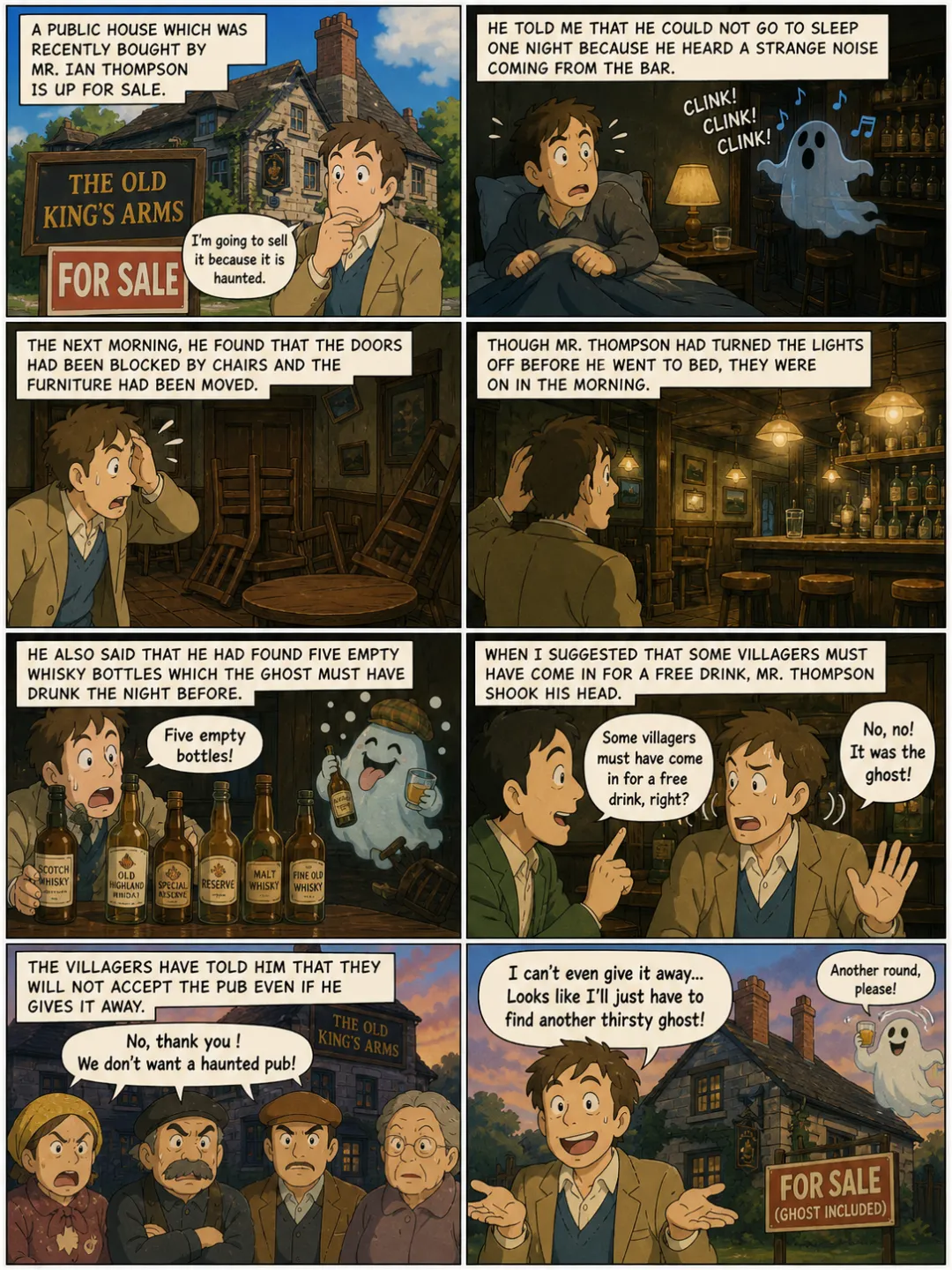
A public house which was recently bought by Mr. Ian Thompson is up for sale. Mr. Thompson is going to sell it because it is haunted. He told me that he could not go to sleep one night because he heard a strange noise coming from the bar. The next morning, he found that the doors had been blocked by chairs and the furniture had been moved. Though Mr. Thompson had turned the lights off before he went to bed, they were on in the morning. He also said that he had found five empty whisky bottles which the ghost must have drunk the night before. When I suggested that some villagers must have come in for a free drink, Mr. Thompson shook his head. The villagers have told him that they will not accept the pub even if he gives it away.
背景简介
《新概念英语》第二册的课文多以短小精悍的故事为主,旨在通过有趣的情节帮助学生掌握句型和语法。本课讲述了一个关于"闹鬼"的小故事,带有轻微的悬疑和幽默色彩。这种"鬼故事"是西方文化中非常普遍的叙事主题,常用来探讨人们对未知事物的恐惧和心理暗示。课文中的主人公Mr. Ian Thompson坚信自己的酒馆闹鬼,并以此作为出售的理由,而"我"则提出了一个更符合常理的猜测,但遭到了拒绝。这种"真实与想象"之间的张力,是本课的趣味所在。
参考译文
伊恩·汤普森先生最近买下的一家酒店现在要出售。汤普森先生打算卖掉它,因为据说它闹鬼。他告诉我,有一天夜里他无法入睡,因为他听到酒吧间里传来一阵奇怪的声音。第二天早上,他发现酒吧间的门被椅子堵上了,家具也被挪动过。虽然汤普森先生上床前已经把灯关了,但早晨灯却亮着。他还说他发现了5只空的威士忌酒瓶子,一定是鬼魂头天晚上喝的。当我暗示说一定是村里有些人进来白喝了一通时,汤普森先生摇了摇头。村民们告诉他,即使他把这酒店白送人,他们也不要。
🔍 第二部分:逐句精讲与词块总结
句子1
1. 原文: A public house which was recently bought by Mr. Ian Thompson is up for sale.
2. 翻译: 伊恩·汤普森先生最近买下的一家酒店现在要出售。
3. 句子结构: 这是一个复合句。主句是"A public house ... is up for sale"。主语"A public house"被一个由"which"引导的定语从句"which was recently bought by Mr. Ian Thompson"修饰。定语从句中使用了一般过去时的被动语态"was bought by",说明酒店是"被"汤普森先生买下的。
4. 重点词汇:
public house 蓝思值 830 L
英音[ˈpʌblɪk haʊs] 美音[ˈpʌblɪk haʊs] 词性:名词短语
释义:酒馆;酒店(英式英语,通常简称为pub)
常用语块:a local public house (当地的酒馆)
短语搭配:go to the public house (去酒馆)
例句一:I often meet my friends at the public house down the street. 我经常在街那头的酒馆里见朋友。
例句二:The public house serves traditional British food. 这家酒馆供应传统的英国食物。
拓展:在现代英式英语中,更常用"pub"来代替"public house"。这个词源自拉丁语"publicus",意为"公共的",表明这是一种为公众提供酒水和食物的场所。
up for sale 蓝思值 840 L
英音[ʌp fɔː seɪl] 美音[ʌp fɔːr seɪl] 词性:介词短语
释义:供出售;待售
常用语块:be put up for sale (被拿出来出售)
短语搭配:come up for sale (上市出售)
例句一:Their house is up for sale because they are moving abroad. 他们的房子待售,因为他们要移居国外。
例句二:The painting was put up for sale at an auction. 这幅画被拿出来在拍卖会上出售。
拓展:"up for"在这里表示"为了......的目的",是固定搭配。注意不要与"on sale"(打折销售)混淆。
5. 语法点睛: 本句包含一个由"which"引导的定语从句。在《NCE知识点笔记Book II.pdf》的第28课内容中明确指出,"关系代词在从句中作宾语时,通常省略"。但在本句中,关系代词"which"在从句中作主语,所以不能省略 [NCE知识点笔记]。这是定语从句中关系代词使用的基本原则。此外,注意定语从句中的被动语态"was ... bought by"与主句的系表结构"is up for sale"在时态上的区别:从句描述过去发生的动作,主句描述现在存在的状态。
句子2
1. 原文: Mr. Thompson is going to sell it because it is haunted.
2. 翻译: 汤普森先生打算卖掉它,因为据说它闹鬼。
3. 句子结构: 这是一个包含原因状语从句的复合句。主句"Mr. Thompson is going to sell it",从句"because it is haunted"说明出售的原因。主句中"is going to"表示计划或打算做某事。
4. 重点词汇:
haunted 蓝思值 850 L
英音[ˈhɔːntɪd] 美音[ˈhɔːntɪd] 词性:形容词
释义:闹鬼的;鬼魂出没的
常用语块:a haunted house (鬼屋;闹鬼的房子)
短语搭配:be haunted by (被......纠缠/困扰)
例句一:The old castle is said to be haunted. 据说那座古老的城堡闹鬼。
例句二:She is haunted by memories of the accident. 她被那次事故的记忆所困扰。
拓展:该词来自于动词"haunt",意为"(鬼魂)经常出没于"或"(不快之事)萦绕心头"。形容词化的"haunted"常用于描述地点,是恐怖故事中的高频词。
5. 语法点睛: [名师精讲]指出,"be going to"常用于表示已经计划好或决定要做某事,比"will"更具计划性。本句中,Mr. Thompson的出售决定是基于"it is haunted"这个原因。此外,"because"引导原因状语从句,语气强烈,直接说明因果关系。
句子3
1. 原文: He told me that he could not go to sleep one night because he heard a strange noise coming from the bar.
2. 翻译: 他告诉我,有一天夜里他无法入睡,因为他听到酒吧间里传来一阵奇怪的声音。
3. 句子结构: 这是一个多重复合句。主句是"He told me",后接一个由"that"引导的宾语从句"that he could not go to sleep one night..."。在这个宾语从句中,又包含一个由"because"引导的原因状语从句"because he heard a strange noise coming from the bar"。从句中"coming from the bar"是现在分词短语作宾语补足语,修饰"noise",相当于"which came from the bar"。
4. 重点词汇:
strange noise 蓝思值 770 L
英音[streɪndʒ nɔɪz] 美音[streɪndʒ nɔɪz] 词性:名词短语
释义:奇怪的声音
常用语块:hear a strange noise (听到奇怪的声音)
短语搭配:a strange noise coming from... (从......传来的奇怪声音)
例句一:I heard a strange noise coming from the attic. 我听到阁楼传来奇怪的声音。
例句二:The strange noise kept me awake all night. 那奇怪的声音让我整晚都没睡着。
5. 语法点睛: [名师精讲]中详细讲解了"感官动词(see, hear, watch, feel等)+ 宾语 + 现在分词"的结构。现在分词作宾补,表示动作正在进行,强调动作的"过程"。因此,"he heard a strange noise coming from the bar"强调他听到的时候,那个"奇怪的声音"正在持续发出。这与"hear a noise come"(听到声音发出,强调动作完成)有细微差别 [NCE知识点笔记]。
句子4
1. 原文: The next morning, he found that the doors had been blocked by chairs and the furniture had been moved.
2. 翻译: 第二天早上,他发现酒吧间的门被椅子堵上了,家具也被挪动过。
3. 句子结构: 这是一个复合句。主句是"he found",后接一个由"that"引导的宾语从句。该宾语从句由两个并列句"the doors had been blocked by chairs"和"the furniture had been moved"构成,由"and"连接。两个分句都使用了过去完成时的被动语态(had been + 过去分词)。
4. 重点词汇:
block 蓝思值 660 L
英音[blɒk] 美音[blɑːk] 词性:动词
释义:堵住;阻碍
常用语块:block the door (堵住门)
短语搭配:block one's way (挡住某人的路); block out (挡住;遮住)
例句一:A fallen tree blocked the road. 一棵倒下的树挡住了路。
例句二:My view was blocked by a tall man in front. 我的视线被前面一个高个子男人挡住了。
拓展:名词形式也是"block",意为"街区"、"积木"或"障碍物"。形容词"blocked"意为"被堵塞的"。
furniture 蓝思值 810 L
英音[ˈfɜːnɪtʃə(r)] 美音[ˈfɜːrnɪtʃər] 词性:名词(不可数)
释义:家具
常用语块:a piece of furniture (一件家具)
短语搭配:move the furniture (搬动家具)
例句一:We have bought some new furniture for the living room. 我们为客厅买了一些新家具。
例句二:The furniture in the hotel room was very old. 酒店房间里的家具很旧了。
拓展:这是英语中常见的不可数名词,不能说"a furniture",只能说"a piece of furniture"。类似的名词还有"information"(信息)、"advice"(建议)等。
5. 语法点睛: [NCE知识点笔记]指出,过去完成时"had done"表示"过去的过去"。在本句中,"发现"(found)是过去发生的动作,而"堵住门"和"搬动家具"发生在"发现"之前,所以使用过去完成时。同时,这些动作又是被动完成的(门被堵,家具被移),所以使用过去完成时的被动语态"had been blocked/moved"。这完美地表现了事件发生的先后顺序和被动关系。
句子5
1. 原文: Though Mr. Thompson had turned the lights off before he went to bed, they were on in the morning.
2. 翻译: 虽然汤普森先生上床前已经把灯关了,但早晨灯却亮着。
3. 句子结构: 这是一个包含让步状语从句的复合句。从句由"Though"引导,表示"虽然......但是......"。从句中又包含一个"before"引导的时间状语从句。主句"they were on in the morning"与从句"Though Mr. Thompson had turned the lights off"形成转折。
4. 重点词汇:
turn off 蓝思值 640 L
英音[tɜːn ɒf] 美音[tɜːrn ɔːf] 词性:动词短语
释义:关掉(灯、电器等)
常用语块:turn off the light (关灯)
短语搭配:turn off the TV (关电视);turn off the tap (关水龙头)
例句一:Don't forget to turn off the lights when you leave. 你离开时别忘了关灯。
例句二:He turned off the engine and got out of the car. 他关掉引擎,下了车。
拓展:反义词是"turn on"(打开)。名词形式是"turn-off"。注意,当宾语是代词时,必须放在中间,如"turn it off"。
5. 语法点睛: [名师精讲]中提到,"Though"引导让步状语从句,表示"尽管",使主从句之间形成强烈的对比。这里,Mr. Thompson "had turned the lights off"和"they were on"构成矛盾,为"闹鬼"提供了"证据"。注意让步状语从句不能与"but"同时使用,但可以与"yet"或"still"连用,例如"Though... yet they were on in the morning."
句子6
1. 原文: He also said that he had found five empty whisky bottles which the ghost must have drunk the night before.
2. 翻译: 他还说他发现了5只空的威士忌酒瓶子,一定是鬼魂头天晚上喝的。
3. 句子结构: 这是一个多重复合句。主句是"He also said",后接一个"that"引导的宾语从句"that he had found five empty whisky bottles"。在宾语从句中,又包含一个由"which"引导的定语从句"which the ghost must have drunk the night before",修饰先行词"five empty whisky bottles"。"must have drunk"是本句的语法核心。
4. 重点词汇:
whisky 蓝思值 910 L
英音[ˈwɪski] 美音[ˈwɪski] 词性:名词
释义:威士忌酒
常用语块:a bottle of whisky (一瓶威士忌)
短语搭配:drink whisky (喝威士忌)
例句一:He ordered a glass of Scotch whisky. 他要了一杯苏格兰威士忌。
例句二:Whisky is a popular alcoholic drink. 威士忌是一种很受欢迎的酒精饮料。
拓展:注意拼写区别。苏格兰、加拿大和日本产的通常拼写为"whisky",而美国和爱尔兰产的通常拼写为"whiskey"。
must have drunk 蓝思值 920 L
释义:一定是喝掉了
拓展:这是"情态动词 + have done"结构,表示对过去情况的肯定推测。
5. 语法点睛: 本课的绝对核心语法点——"情态动词 + have done"结构。这里的"must have done"表示对过去发生的事情的肯定推测,语气非常肯定,其依据是前面所述的"证据"(发现空瓶子)。[语法新思维]中系统讲解了此结构:must have done 表示"过去一定是......了"。
句子7
1. 原文: When I suggested that some villagers must have come in for a free drink, Mr. Thompson shook his head.
2. 翻译: 当我暗示说一定是村里有些人进来白喝了一通时,汤普森先生摇了摇头。
3. 句子结构: 这是一个包含时间状语从句的复合句。从句由"When"引导,其中"suggested"后接一个由"that"引导的宾语从句"some villagers must have come in for a free drink"。主句"Mr. Thompson shook his head"是核心反应。作者提出了一个合乎逻辑的不同推测。
4. 重点词汇:
suggest 蓝思值 730 L
英音[səˈdʒest] 美音[səˈdʒest] 词性:动词
释义:建议;暗示;表明
常用语块:suggest that... (暗示......;建议......)
短语搭配:suggest doing sth. (建议做某事)
例句一:His pale face suggests that he is ill. 他苍白的脸色表明他生病了。
例句二:I suggest we go to the cinema tonight. 我建议我们今晚去看电影。
拓展:当"suggest"意为"建议"时,其后的从句常用虚拟语气(should + 动词原形);当意为"暗示;表明"时,从句用陈述语气。本课中"suggest"意为"暗示",故从句使用一般过去时的推测结构"must have come in"。
shake one's head 蓝思值 780 L
英音[ʃeɪk wʌnz hed] 美音[ʃeɪk wʌnz hed] 词性:动词短语(固定搭配)
释义:摇头(表示否定、不赞同或拒绝)
常用语块:shake one's head in disbelief (难以置信地摇头)
短语搭配:shake one's head at / over sth. (对......摇头)
例句一:When asked if he agreed, he shook his head. 当被问及是否同意时,他摇了摇头。
例句二:She shook her head in disappointment. 她失望地摇了摇头。
拓展:注意与"nod one's head"(点头)对应。
5. 语法点睛: 作者使用了相同的 must have done 结构,提出了与Mr. Thompson完全不同的推测。这说明"情态动词 + have done"不仅用于陈述事实,也用于表达个人基于不同证据或逻辑的推断。Mr. Thompson的"摇头"暗示了他不接受这个更合逻辑的解释,坚持认为是"鬼魂"所为,增强了故事的戏剧性。
句子8
1. 原文: The villagers have told him that they will not accept the pub even if he gives it away.
2. 翻译: 村民们告诉他,即使他把这酒店白送人,他们也不要。
3. 句子结构: 这是一个复合句。主句是"The villagers have told him",后接一个由"that"引导的宾语从句"they will not accept the pub even if he gives it away"。宾语从句中又包含一个由"even if"引导的让步状语从句"even if he gives it away",强调了村民们绝对不会接受的态度。
4. 重点词汇:
accept 蓝思值 640 L
英音[əkˈsept] 美音[əkˈsept] 词性:动词
释义:接受;承认
常用语块:accept an offer (接受提议)
短语搭配:accept responsibility (承担责任);accept the fact (接受事实)
例句一:She accepted his invitation to the party. 她接受了他参加派对的邀请。
例句二:It may take some time for him to accept the situation. 他可能需要一些时间来接受这个局面。
拓展:辨析 accept 与 receive。receive 指"收到"这个动作,不强调接受者的意愿;accept 指"愿意接受",涉及主观意愿。例如:"I received his invitation but did not accept it." (我收到了他的邀请,但没有接受。)
give away 蓝思值 800 L
英音[ɡɪv əˈweɪ] 美音[ɡɪv əˈweɪ] 词性:动词短语
释义:赠送;白给;捐赠
常用语块:give away sth. for free (免费赠送某物)
短语搭配:give away a secret (泄露秘密)
例句一:I'm going to give away my old books to the library. 我打算把我的旧书送给图书馆。
例句二:They gave away all their money to charity. 他们把所有钱都捐给了慈善机构。
拓展:本课中"give it away"表示"免费赠与"。当宾语是代词时,必须放在中间(give it away)。名词形式是"giveaway"。
5. 语法点睛: [NCE知识点笔记]中关于"一般将来时"的用法指出,在时间或条件状语从句中,要用一般现在时表示将来。虽然"even if"引导的是让步状语从句,但其规则与条件状语从句类似,从句中用"he gives it away"表示将来,主句中用"will not accept"。此外,主句的现在完成时"have told"强调这个告知行为对现在造成了影响(即村民们现在的态度已定)。
📌 核心词块总结 (Key Lexical Chunks)
1. up for sale: available to be bought. Example: The old car is up for sale.
2. be haunted: (of a building or place) believed to be visited by a ghost. Example: The castle is said to be haunted.
3. a strange noise coming from: a sound that is unusual or unfamiliar, originating from a particular place. Example: I heard a strange noise coming from the basement.
4. must have done: used to say that you think something is very likely true or had a specific cause in the past. Example: The ground is wet. It must have rained last night.
5. shake one's head: to move one's head from side to side, usually to indicate disagreement or disapproval. Example: When I asked if he was ready, he just shook his head.
6. even if: used to emphasize that something will happen despite any obstacles. Example: I'll finish the project even if it takes all night.
7. give away: to give something to someone without asking for payment. Example: The store was giving away free samples of cake.
8. go to sleep: to start sleeping; to fall asleep. Example: It was so hot that I couldn't go to sleep.
✍️ 第三部分:语篇分析与段落写作技巧
1. 语篇分析
①Identify the macrostructure (识别宏观结构):本课是一篇典型的"故事类"记叙文。其宏观结构可以概括为:背景介绍 (Situation) → 问题出现 (Problem) → 作者质疑 (Complication) → 结局 (Resolution)。课文第一句交代背景(酒馆被买下并要出售),第二句点明问题(闹鬼),接着详细描述"证据"来渲染问题。最后,作者的合理推测与主人公的固执相信形成对比,并以村民的拒绝作为幽默的结局。这种结构清晰,环环相扣。
②List cohesive devices (列举衔接手段):作者运用了以下衔接手段使故事连贯。
*逻辑连接词:because, though, when, even if.
*时间链接:The next morning, one night.
*代词指代:it (指代 the public house), he (指代 Mr. Thompson), they (指代 the lights / villagers).
*重复与同义替换:public house, the pub, it 形成词汇链。
*并列结构:the doors had been blocked ... and the furniture had been moved.
③Analyze the author's attitude (分析作者态度):作者在写作中保持了一种客观叙述的口吻。通过转述"He told me that...", "He also said that...", 作者没有直接评价Mr. Thompson的观点。但通过"When I suggested..."提出一个更合理的解释,暗示了作者对事件持怀疑或理性的态度,从而增加了故事的幽默和讽刺意味。
2. 写作技巧
①提炼写作逻辑:本课展示了一种有效的"悬疑与反转"写作逻辑。其模式是:
*陈述无法解释的现象(引发悬念):...the doors had been blocked... the furniture had been moved... lights were on... five empty whisky bottles...
*提供两个或多个竞争性解释:A: the ghost must have drunk them. B: some villagers must have come in.
*结尾的选择(幽默点):主人公选择相信超自然解释,而村民们的行为(拒绝接受)则侧面强化了这个超自然解释的影响力,形成了闭环。
②提供段落写作范例:
*题目: Write a short story about a strange event in your neighbourhood.
*范文:
A small café which was recently closed by its owner is up for rent. The owner wants to rent it out because he cannot find a buyer. He told my neighbour that he found the cash register open every morning, even though he had locked it before he left for the night. The money inside did not disappear, but the receipts were always torn into pieces. He also said that he had smelled freshly brewed coffee when he opened the door, though he had cleaned everything the night before. When my friend suggested that some teenagers must have sneaked in for fun, the owner just shrugged his shoulders. The neighbours have told him that they will not rent the café even if the rent is free.
*结构特点分析:
*模仿句式:A small café which was recently closed... is up for rent. (模仿第一句句式)
*悬疑逻辑:通过描述锁好的收银机被打开、收据被撕碎、闻到了咖啡味等细节,与课文中的"灯被打开"、"酒被喝掉"异曲同工。
*对比解释:故事中提供了"鬼魂作祟"(隐含)和"青少年恶作剧"两种解释,模仿了课文的"鬼魂"与"村民"的对比。
*语言点映射:
* up for rent → 映射 up for sale
* had locked... before he left → 映射 had turned the lights off before he went to bed
* must have sneaked in → 映射 must have come in
* even if the rent is free → 映射 even if he gives it away
③布置小练笔并提供例文:
*小练笔: 请模仿本课课文,写一个与"闹鬼"无关,但类似逻辑的短故事(如:丢失钥匙,以为被偷,后来发现是自己忘在办公室)。字数不限。
*例文 (以丢失钥匙为例):
A small black key which was recently given to me by my office manager is now missing. I have to report it because it is the only one. I told my colleague that I couldn't find it anywhere the previous night. I had put it in my bag, but it was gone when I got home. I also said that I had searched every corner of my office and my house and asked everyone. When my colleague suggested that I must have left the key in the office, I shook my head. I have gone back to the office and looked again, but it is just not there. It is a mystery.
*分析:
* 故事模仿了"发现问题 → 提供解释 → 反驳 → 悬疑"的结构。
* 使用了 must have left 来提出推测。
* 结尾 It is a mystery. 与课文闹鬼的悬疑氛围相似。
📐 第四部分:本课语法精析(加强版)
语法点:情态动词 + have done
本课的核心语法是"情态动词 + have done"结构,用于对过去发生的事情进行推测或表达本应做某事而未做等含义。此语法点在《NCE知识点笔记Book II.pdf》的第47课有详细总结 [NCE知识点笔记],同时在《新概念英语名师精讲笔记 第2册.pdf》 [名师精讲] 和《新概念英语语法新思维 第2册.pdf》 [语法新思维] 中也有深入讲解。以下是结合这些资料的系统讲解。
一、用法详解与对比
1. must have done:表示对过去事情的肯定推测,语气非常强烈,意为"一定......了"。仅用于肯定句。
- 来源: [语法新思维] 和 [NCE知识点笔记]
- 例句1: The ground is very wet. It must have rained last night. (地面很湿,昨晚一定下过雨了。) [名师精讲]
- 例句2: He must have drunk the whisky because the bottles are empty. (他一定喝了威士忌,因为瓶子空了。)
- 例句3: She looks very happy. She must have passed the exam. (她看起来很高兴,一定是通过考试了。)
- 例句4: I didn't hear the phone. I must have been asleep. (我没听到电话声,我当时一定是睡着了。)
- 例句5: You must have left your umbrella on the bus. (你一定是把伞落在公交车上了。)
2. can't / couldn't have done:表示对过去事情的否定推测,语气强烈,意为"不可能......了"。
- 来源: [语法新思维]
- 例句6: He can't have drunk all the wine, because he is not a big drinker. (他不可能喝了所有的酒,因为他酒量不大。)
- 例句7: I saw her at the theatre last night. She couldn't have been at home. (我昨晚在剧院看见她了,她不可能在家。)
- 例句8: This is impossible. He cannot have finished the work in such a short time. (这不可能,他不可能在这么短的时间内完成工作。)
3. may / might have done:表示对过去事情的不太肯定的推测,意为"可能......了"。might 比 may 语气更弱,可能性更低。
- 来源: [语法新思维]
- 例句9: He may haveread the book, but I'm not sure. (他可能读过这本书,但我不确定。)
- 例句10: They might havemissed the train, which is why they are late. (他们可能错过了火车,所以才迟到的。)
- 例句11: She may not havereceived our message. (她可能没收到我们的信息。)
- 例句12: It might have been a ghost, or just a dream. (那可能是个鬼,也可能只是个梦。)
4. could have done:除了表示推测外,还可以表示"过去本能够做某事而(通常)没有做",带有惋惜或责备的意味。
- 来源: [语法新思维]
- 例句13: You could have told me the truth earlier! (你本该早点告诉我真相的!)
- 例句14: I could have helped you, but you didn't ask. (我本可以帮你的,但你没开口。)
- 例句15: It was a dangerous situation. He could have been killed. (那是个危险的局面,他差点就没命了。)
5. should / ought to have done:表示"过去本应该做某事而(实际上)没有做",带有责备、后悔或失望的含义。ought to 语气更强。
- 来源: [语法新思维] [NCE知识点笔记]
- 例句16: You should have told me about the problem earlier. (你本应该早点告诉我这个问题。)
- 例句17: He ought to have finished the report by now. (他现在本应该已经完成报告了。)
- 例句18: The kids should not have watched that horror movie. It's too scary for them. (孩子们本不该看那部恐怖电影的,对他们来说太吓人了。)
- 例句19: She should have seen a doctor about her cough. (她本应该去看医生治咳嗽。)
6. needn't have done:表示"过去本没有必要做某事,但(实际上)却做了"。
- 来源: [语法新思维] [NCE知识点笔记]
- 例句20: I needn't have taken an umbrella, because the weather was fine. (我本没必要带雨伞,因为天气很好。)
- 例句21: You needn't have cooked so much food; there are only two of us. (你本没必要做这么多饭,我们只有两个人。)
- 例句22: We needn't have hurried; the train was late. (我们本没必要赶那么急,火车晚点了。)
二、与第一册相关语法点的对比分析
在第一册中,我们学习了情态动词 can, may, must 的基本用法,主要是表示对现在或将来状态或动作的能力、许可、禁止和推测。
- 第一册(现在/未来推测):
* He must be the new manager. (他一定是新经理。) ------ 对现在的肯定推测。
* She can't be at home. (她不可能在家。) ------ 对现在的否定推测。
* He may be in his office. (他可能在办公室。) ------ 对现在的可能性推测。
- 第二册(本课,过去推测):
* The ghost must have drunk the whisky. (鬼魂一定喝了威士忌。) ------ 对过去的肯定推测。
* He can't have drunk all the wine. (他不可能喝了所有的酒。) ------ 对过去的否定推测。
* Some villagers may have come in. (有些村民可能进来过。) ------ 对过去的可能性推测。
对比结论:从第一册到现在推测的 must / can't / may + be / do 结构,升级为第二册对过去推测的 must / can't / may + have done 结构。核心区别在于"推测时间"的不同,前者是 "现在",后者是 "过去"。掌握了 have done 这一"过去"的标志,就能将知识从第一册自然过渡到第二册。
三、练习题 (12题)
选择正确的选项填空。
1. The lights in his room were on all night. He _______ been working very hard.
A. must have B. can't have C. should have D. might have
2. I _______ you earlier, but I didn't have your phone number.
A. should call B. should have called C. must have called D. can have called
3. You walked all the way here? You _______ the bus!
A. can't have missed B. could have taken C. should have missed D. mustn't have taken
4. She looks very tired. She _______ very well last night.
A. must not sleep B. can't sleep C. couldn't have slept D. shouldn't sleep
5. The soup is a bit salty. I _______ put too much salt in it.
A. must have B. couldn't have C. may have D. should have
6. I _______ the work on time, but I was sick for a week.
A. could have finished B. must have finished C. can have finished D. might have finished
7. You _______ a taxi. I would have picked you up from the airport.
A. needn't have taken B. mustn't have taken C. shouldn't take D. might not take
8. He came here on foot, but he _______ by bus. Traffic is terrible today.
A. must have come B. should have come C. might have come D. could have come
9. The window is broken. It _______ Peter. He was playing football nearby.
A. can't be B. can't have been C. must be D. must have been
10. She _______ the exam easily, but she didn't prepare carefully.
A. might have passed B. must have passed C. could have passed D. should pass
11. You _______ the secret to your friend. I told you not to!
A. shouldn't have told B. mustn't tell C. needn't have told D. couldn't have told
12. The children seem tired. They _______ a lot of fun at the park.
A. must have B. can have C. should have D. would have
练习题答案解析
1. A. must have。句意:他房间的灯亮了一整夜,他一定一直在努力工作。灯亮是证据,推导出"努力"这个结果,语气肯定。
2. B. should have called。句意:我本应该早点给你打电话,但我没有你的号码。should have done 表示"本应该做而没做",符合语境。
3. B. could have taken。句意:你一路走到这儿?你本可以坐公交车的!could have done 表示"本能够做而没做",带有惋惜。
4. C. couldn't have slept。句意:她看起来很累,昨晚不可能睡得很好。couldn't have done 是对过去情况的否定推测,表示"不可能......"。
5. C. may have。句意:汤有点咸,我可能放了太多盐。may have done 表示可能性不大的推测,语气不确定。
6. A. could have finished。句意:我本可以按时完成工作的,但我病了一个星期。could have done 表示"本能够做而没做"。
7. A. needn't have taken。句意:你本没必要打车的,我本可以去机场接你。needn't have done 表示"本没必要做而做了"。
8. C. might have come。句意:他走路来的,但他可能本可以坐公交来的。今天交通很堵。这里 might have done 语气较弱,表示一种可能性推测。但更合适的解释是,could have come 表示"本能够",但在"交通堵塞"的背景下,他"可能"是坐公交来的,故C更佳。如果题目改为"...but if he had, he would be late", 则选 should have come。这里 might have come 是推测。
9. B. can't have been。句意:窗户破了,不可能是Peter打破的,他刚才在附近踢球。对过去的行为进行否定推测,用 can't/couldn't have been。虽然 can't be 也可以表示对现在的推测,但"打破窗户"是过去动作,所以最恰当的是 can't have been。
10. C. could have passed。句意:她本可以轻松通过考试的,但她没认真准备。could have passed 表示"本能够"通过,但事实是没通过。
11. A. shouldn't have told。句意:你本不应该把秘密告诉朋友,我告诉过你别说的!shouldn't have done 表示"本不应该做而做了",带有责备意味。
12. A. must have。句意:孩子们看起来很累,他们在公园一定玩得很开心。对过去的情况进行有依据的推测,用 must have done。
🎧 第五部分:听力与阅读策略训练
1. 听力技巧
① 预测关键词 (Predicting Key Words):在听录音前,根据课文标题"A thirsty ghost"进行预测预测可能听到的词汇,如 ghost, drink, pub, whisky, bottle, night, noise, scared 等。这能帮助我们更快地进入听力情境,并抓取关键信息。
练习:听第一遍录音,写下你听到的至少5个与预测相关的词汇。
② 抓主旨大意 (Gist Listening):听第二遍录音,尝试用一句话概括故事的核心内容。关注故事的起因(为什么卖酒馆)、经过(发生了哪些怪事)、结果(酒馆的未来)。
问题:What is the main reason for Mr. Thompson selling the pub?
答案:Because he believes it is haunted.
③ 笔记方法 (Note-taking):听第三遍录音,用关键词和箭头记录事件的发展顺序。例如:
Mr. Thompson -> bought a pub
↓
pub is haunted
↓
could not sleep -> heard a noise
↓
next morning -> doors blocked, furniture moved, lights on
↓
found five empty bottles -> ghost must have drunk
↓
author suggested -> villagers came in
↓
Mr. T shook head
↓
villagers -> will not accept even if free
2. 阅读理解策略
① 扫读 (Scanning):快速扫读文章,找出下列细节信息。
- 酒馆是谁买的?(Mr. Ian Thompson)
- 汤普森先生为什么无法入睡?(Because he heard a strange noise coming from the bar.)
- 他第二天早上发现了几个空瓶子?(five empty whisky bottles)
② 略读 (Skimming):快速阅读全文,理解文章结构。本课采用了什么结构?(问题-解决式,但问题并未真正解决,而是留白。或者是"背景-事件-争论/反馈"式。)
③ 推断词义 (Inferring meaning from context):根据上下文推断下列划线单词或短语的意思。
- "A public house which was recently bought by Mr. Ian Thompson is up for sale."
- 猜词策略:后文说"Mr. Thompson is going to sell it",因此 "up for sale" 应该与"出售"有关。
- "When I suggested that some villagers must have come in for a free drink..."
- 猜词策略:作者认为村民们是来白喝的,"free"在这里是"免费的"意思,因此 "a free drink" 就是"免费的一杯酒"。
- "The villagers have told him that they will not accept the pub even if he gives it away."
- 猜词策略:"even if"表示让步,强调就算条件很诱人(白送),村民也不接受。因此 "gives it away" 应是"免费赠送"的意思。
📝 第六部分:习题讲解
关键句型练习 (Key Structures)
- 练习 A: 完成句子,要求使用 must have been' 或 can't have been' 等结构。本课的关键句型是"情态动词 + have done"。练习旨在巩固这个结构。
- 讲解思路:
1. The ground is very wet. It _______ (rain) last night.
- 答案: must have rained
- 解题思路: 地面湿是下雨的"结果",说明过去一定发生过"下雨"这件事,肯定推测用 must have done。
2. He is not at home. He _______ (go) out.
- 答案: must have gone
- 解题思路: 不在家说明他出门了,根据迹象进行的肯定推测。
3. The children are very quiet. They _______ (be) asleep.
- 答案: must be (或 must have been)
- 解题思路: 现在很安静,是对现在状态的推测,用 must be。如果强调他们之前一直在吵闹,现在终于安静了,可以推测他们"刚睡着了",用 must have fallen asleep。根据教材,此处倾向于对现在状态的推测,但也可对比过去完成时的用法进行引申。
4. She looks tired. She _______ (sleep) very well last night.
- 答案: can't have slept
- 解题思路: 看起来累说明昨晚没睡好,是否定推测,用 can't have slept.
5. He answered all the questions correctly. He _______ (prepare) very well.
- 答案: must have prepared
- 解题思路: 全答对了,是因为"准备得很好",是肯定推测。
- 练习 B: 改写句子。
- 讲解思路: 这类练习通常要求将包含 must / can't / may 等情态动词的句子,改写为更具体的时态形式,或者反之。主要目的是让学生将情态动词结构与不同时态结合。
- 练习 C: 选择题。
- 讲解思路: 此练习测试学生对课文细节的理解和对应结构的掌握。主要题型是单项选择。
难点练习 (Special Difficulties)
本课的难点可能在于对 accept 和 receive 的辨析,以及一些动词短语的用法,如 shook one's head, give away, turn off, come in for 等。
- accept vs. recieve:如上所述,receive 是客观"收到",accept 是主观"接受"。
- 例句:I received an invitation, but I did not accept it (because I am busy). 我收到了一份邀请,但我没有接受(因为我很忙)。
- come in for:意为"遭到;得到(批评、指责等)"或者"进来为了......目的"。本课中"come in for a free drink"意为"进来(目的是)白喝一顿"。注意 for 在这里表示目的。
- turn off 和 give away:这两个动词短语的用法。注意当宾语是代词(it, them)时,必须放在短语中间:turn it off, give it away。
多项选择题
教师应带领学生完成教材后附的多项选择题,重点讲解阅读理解题和词汇结构题,并分析选择每个答案的原因。
🤔 第七部分:英文深度思考与拓展(强化版)
A. 层次化英文问题与答案
Level 1: Factual Questions (事实性问题)
1. Question: Who is the owner of the haunted public house?
Answer: The owner of the haunted public house is Mr. Ian Thompson.
2. Question: What strange things did Mr. Thompson find the next morning?
Answer: He found that the doors had been blocked, the furniture had been moved, the lights were on, and there were five empty whisky bottles.
3. Question: According to Mr. Thompson, who drank the whisky?
Answer: According to Mr. Thompson, the ghost must have drunk the whisky.
Level 2: Inferential Questions (推理性问题)
4. Question: Why did the author suggest that some villagers must have come in for a free drink?
Answer: Because it is a more logical explanation. Villagers could have sneaked in, drunk the whisky, and rearranged the room to make it look like a ghost did it.
5. Question: Why did Mr. Thompson shake his head when the author gave his explanation?
Answer: Because Mr. Thompson is convinced that the pub is haunted. He refuses to believe the rational explanation, which shows his mind is made up about the ghost.
6. Question: How do the villagers' feelings about the pub confirm Mr. Thompson's belief?
Answer: The villagers' refusal to accept the pub, even if it is free, suggests that they too believe the pub is haunted. This external validation reinforces Mr. Thompson's own conviction about the ghost.
Level 3: Evaluative Questions (评价性问题)
7. Question: Do you think the pub is truly haunted, or is there another explanation for the events? Justify your opinion.
Answer: I think there is probably a logical explanation. It could be a prank played by some villagers who want the pub sold, or it could be Mr. Thompson himself who is forgetful due to stress or a bad dream which he mistook for reality. The author's suggestion of villagers wanting a free drink is also plausible. To truly believe in ghosts requires evidence that cannot be explained by natural means.
8. Question: What does Mr. Thompson's reaction tell us about human psychology when faced with the unknown?
Answer: It tells us that humans are often resistant to logical explanations when they are already emotionally invested in a certain belief. Mr. Thompson believes in the ghost so strongly that any counter evidence is dismissed. This "confirmation bias" makes people focus on information that supports their pre-existing ideas and ignore everything else.
9. Question: If you were a villager, would you accept the pub if Mr. Thompson gave it away? Why or why not?
Answer: I would not accept it. Even if I did not believe in the ghost, the reputation of a "haunted house" would make it very difficult to run a successful business. No one would want to work there, and customers would be scared away. The economic value of the pub would be negative because of the social stigma attached to it.
10. Question: How could the pub owner turn this situation to his advantage instead of selling it cheaply?
Answer: He could turn it into a business opportunity by marketing the pub as a "haunted" tourist attraction. "Ghost tours" of the pub, special "spooky" events on Halloween, and selling "ghost-themed" drinks could attract curious customers who want to experience the thrill of a supposedly haunted location. He could charge an entrance fee and make more money than selling the pub.
11. Question: Is it fair for Mr. Thompson to sell the pub without telling potential buyers it is haunted? Discuss the ethical implications.
Answer: This is a complex ethical issue. From a legal standpoint, "haunted" is not a recognized property defect like faulty wiring or a leaking roof. However, from an ethical standpoint, withholding information that he knows will affect the property's value and use could be considered dishonest. Most people would agree that a seller has a moral, if not legal, duty to disclose such a significant psychological and practical deterrent to a potential buyer.
12. Question: Think of a similar story from your own culture about a "haunted" place. How does it compare to this British story?
Answer: In many Chinese cultures, there are stories of "haunted" old houses or temples, often involving ghosts or spirits with unfinished business. Like the British story, the focus is often on strange sounds, moving objects, and an unbearable atmosphere. However, in some Chinese tales, the ghost's motivation is more explicitly defined -- it might be seeking revenge, looking for a lost item, or trying to deliver a message. The British story here is more ambiguous, with the ghost's only apparent activity being to drink whisky, which adds a layer of surreal humor. Both use the concept to explain the unexplainable and to highlight the power of suggestion and fear.
B. 多类型拓展阅读
类型 1: 时事新闻拓展
Title: A Real-Life "Haunted" Pub in London?
London's oldest pub, "The Prospect of Whitby", claims to be haunted by the ghost of a smuggler. For centuries, the pub has reported inexplicable events: chairs rearranging themselves, glasses falling off shelves, and a chilling cold spot in the corner. The pub's landlord, eager to preserve its historic and spooky charm, has even offered a cash prize to anyone who can prove the ghost is fake. This modern news story mirrors our lesson perfectly. It shows that the belief in haunted pubs isn't just in textbooks, but is a living part of British culture, often intertwined with tourism and local history. The landlord's challenge also reflects the same skepticism (or perhaps clever marketing) that the author of our lesson showed by proposing a rational explanation.
- 引导性问题: What does the landlord's offer of a cash prize suggest about his attitude towards the ghost?
- 语言点映射: is up for sale → The pub claimed to be haunted. must have drunk → The ghost must have caused these events. even if he gives it away → He offered a cash prize to prove the ghost is fake.
类型 2: 文化背景解析
Title: The Ghost in British Folklore
In British folklore, ghosts, or "spectres", often appear for a specific reason. They might be a soul with unfinished business, a victim of a tragic event, or even a prankster who enjoys causing trouble. The "thirsty ghost" in our lesson fits the latter category. He isn't scary but merely annoying or mischievous. This contrasts with "poltergeists" which are more violent, throwing objects and causing loud noises. The British love a good ghost story. Ghost tours are commonplace in historic cities like York and Edinburgh where haunted pubs and buildings are major attractions. These stories are often passed down through generations, becoming an intrinsic part of the building's identity. Our lesson's story, by being relatively tame and humorous, fits this broader tradition of charmingly scary British folklore.
- 引导性问题: Why do you think there are so many ghost stories connected to old British pubs?
- 语言点映射: the pub ... is haunted (The pub is associated with the folklore of ghosts). must have drunk (This structure helps express the folklore's conclusions).
类型 3: 今昔对比分析
Title: Belief in Ghosts: Then vs. Now
A hundred years ago, belief in ghosts was much more widespread. Many unusual events, like creaking floorboards or flickering lights, were blamed on spirits. Scientific explanations were less accessible. Today, we have many rational answers: central heating pipes knocking, electrical faults causing lights to flicker, or even sleep paralysis causing hallucinations. Yet, belief in ghosts persists. Surveys show that around 30-40% of people in Western countries still believe in ghosts. This shows that while science has explained many things, the human desire for mystery and the unknown remains strong. Our lesson, written in 1967, captures a moment when this belief system was starting to be questioned by the more rational author, but was still deeply held by the characters like Mr. Thompson.
- 引导性问题: How does the author's suggestion reflect the modern, scientific way of thinking?
- 语言点映射: is haunted (A past belief) must have come in (A modern, plausible inference).
类型 4: 新潮英语改写
Title: The Eerie Night Shift (现代场景改写)
A small convenience store just opened by Mr. Chen is already losing customers. Mr. Chen wants to close it down because it gives him the creeps. He told his friend that he couldn't focus on his work one night because the self-checkout machine kept beeping for no reason. The next morning, the security camera footage showed the doors unlocking themselves at 3 AM. Though Mr. Chen had locked up properly before he left, the store alarms were off in the morning. He also said that he had found three empty soda cans that some ghost must have guzzled. When I joked that some teenagers must have snuck in for a late-night party, Mr. Chen just sighed. His colleagues have told him that they wouldn't take over the night shift even with a bonus.
- 语言点映射: is up for sale → is losing customers (change of context). must have drunk → must have guzzled (informal language). shook his head → sighed (a similar gesture of refusal). even if he gives it away → even with a bonus (modern reward).
类型 5: 难度略高的拓展阅读
Title: The Psychology of the Supernatural Narrative
The narrative of an infallible belief in the supernatural, as depicted in our lesson, is a powerful tool in storytelling. The story operates on two levels: the literal, where a pub is haunted; and the psychological, where Mr. Thompson's resolute belief becomes a self-fulfilling prophecy. Cognitive dissonance occurs when an individual holds two or more contradictory beliefs. Mr. Thompson resolves the dissonance between the rational explanation (villagers) and his supernatural conclusion by simply rejecting the evidence. This psychological mechanism underscores why supernatural narratives are so compelling: they bypass logic and appeal to our primal fears. The villagers' collective refusal to accept the pub even for free reinforces Thompson's reality, creating a social consensus around the paranormal. This story is not about ghosts, but about the human condition and our persistent need to find meaning in chaos, even if that meaning is a thirsty, mischievous spirit.
- 引导性问题: How does the concept of "cognitive dissonance" explain Mr. Thompson's behavior?
- 语言点映射: is up for sale (state of transition). must have drunk (conclusive reasoning). will not accept (a collective, determined stance).
类型 6: 真实故事或人物传记
Title: The Haunted Hotel of Lizzie Borden
One of America's most famous ghost stories centers on the Lizzie Borden house, now an inn and museum. In 1892, Lizzie Borden was tried for the murder of her father and stepmother with an axe. She was acquitted, but the mystery endures. The house is said to be haunted by the victims. Guests report hearing footsteps, seeing phantom figures, and smelling cigar smoke. What's fascinating is that many guests want to experience the paranormal. They pay hundreds of dollars to sleep in the "murder rooms." This is a real-world version of the villagers' and Mr. Thompson's psychology: the belief in the haunting makes the place both feared and commercially valuable. Unlike the pub in our lesson which is being sold, this house is a successful business because of its haunted reputation.
- 引导性问题: What is the main difference in how the "haunted" status affects the commercial value of the pub in our lesson and the Lizzie Borden house?
- 语言点映射: is up for sale (commercial decision). the ghost must have drunk (logical conclusion). will not accept (market rejection/fear).
🌍 第八部分:日常应用与文化拓展
1. 相关文化背景知识介绍
- 英国的Pub文化:Public house(简称 pub)是英国社会的一个核心。它不仅是喝酒的地方,更是社区交流的中心。许多pub都有数百年的历史,是当地的地标。因此,一个"闹鬼的pub"在文化上更具冲击力,因为它是一个人们本应感到安全和社交的场所,却变成了让人恐惧的地方。
- "鬼魂"的经济价值:在西方国家,"闹鬼"有时不是坏事。如同第六部分所述,很多历史建筑、城堡、旅馆利用其"闹鬼"的传说作为旅游卖点,开展"夜间鬼魂之旅"(ghost tour)等商业活动。这与课文中村民避之不及的态度形成鲜明对比,反映了人们对"灵异现象"又爱又怕的矛盾心理。
- "Thirsty ghost"的幽默:课文的标题"A thirsty ghost"本身具有幽默色彩。传统观念中,鬼魂是虚无飘渺、令人恐惧的,但这个鬼魂却和凡人一样会口渴、要喝酒,这种拟人化的处理削弱了恐怖感,增加了故事的可信度和趣味性。这类似于中国故事中"好酒贪杯"的鬼怪形象。
2. 推荐拓展学习资源
- 经典电影:《人鬼情未了》(Ghost, 1990)——虽然主要讲爱情,但涉及了强烈的灵魂、鬼魂和通灵元素,与本课的"鬼魂"主题相关。
- 纪录片:BBC出品的关于"Haunted Britain"的纪录片系列,真实探讨了英国各地的闹鬼传说,可以拓宽文化视野。
- 书籍:著名作家Susan Hill的哥特小说《黑衣女人》(The Woman in Black),可以感受更深度的恐怖叙事风格。
- 在线资源:网站"Atlas Obscura"专门收录全球各地的诡异、神秘的地点和故事,可以查找你们当地的"都市传说"。
💡 第九部分:引导性思考
1. English: In the story, the author presents a rational explanation (villagers sneaking in for free drinks) while Mr. Thompson believes in a supernatural one. What factors in real life might make a person choose to believe in a ghost story rather than a logical explanation? (在故事中,作者提出了一个合理的解释(村民溜进来白喝),而汤普森先生相信超自然的解释。在现实生活中,哪些因素可能会让人选择相信鬼怪故事,而不是逻辑解释?)
2. English: Imagine you are Mr. Thompson. Write a short diary entry in English for the morning you found the blocked doors and the empty bottles. What would you be thinking and feeling? (想象你是汤普森先生。以你发现被堵的门和空酒瓶的那个早晨为背景,用英语写一篇简短的日记。你当时在想什么,感觉如何?)
3. English: The story ends with the villagers refusing to accept the pub. However, a clever businessman might see an opportunity. How could you use the "haunted" reputation to make the pub profitable? (故事以村民们拒绝接受这家酒馆告终。然而,一个精明的商人可能会看到商机。你会如何利用"闹鬼"的名声来让这家酒馆盈利?)
🗂️ 第十部分:本课知识图谱(结构化逻辑图)
核心事件:伊恩·汤普森先生决定出售一栋据称闹鬼的酒馆
├─ 主要支撑点一:酒馆的现状与出售原因
│ ├─ 关键细节 1: 酒馆是被汤普森先生"最近买下的"。
│ ├─ 关键细节 2: 酒馆现在"待售"。
│ └─ 关键细节 3: 出售的核心原因是"它闹鬼"。
├─ 主要支撑点二:汤普森先生声称的"闹鬼"证据
│ ├─ 关键细节 1. 听觉证据:
│ │ ├─ 汤普森先生一夜无法入睡。
│ │ └─ 原因:从酒吧间传来"奇怪的声音"。
│ └─ 关键细节 2. 视觉与物证(第二天早上发现):
│ ├─ 门被椅子堵住。
│ ├─ 家具被挪动。
│ ├─ 前一晚关掉的灯是亮着的。
│ ├─ 发现5个空的威士忌酒瓶。
│ └─ 关键细节 3. 汤普森先生的推论:
│ ├─ 基于空瓶子这一物证,他使用 must have drunk 结构进行肯定推测。
│ └─ 结论:鬼魂在前一晚喝掉了这些酒。
├─ 主要支撑点三:作者("我")的理性挑战与故事的幽默结局
│ ├─ 关键细节 1. 作者的推论:
│ │ ├─ 使用"suggested"和"must have come in"结构,提出一个完全不同的、更合理的推测。
│ │ └─ 结论:并非鬼魂,而是"村里有些人"为了"白喝一顿"而闯了进来。
│ ├─ 关键细节 2. 汤普森先生的反应:
│ │ ├─ "摇了摇了头"——坚决否定作者的理性解释。
│ │ └─ 这说明他个人坚信超自然的解释,不接受逻辑分析。
│ └─ 关键细节 3. 故事的幽默结局:
│ ├─ 村民们明确表态:"即使他把这酒店白送人,他们也不要。"
│ └─ 这个外部反馈强化了酒馆"闹鬼"的既定"事实",形成了一个无法被理性打破的闭环,从而产生幽默和讽刺的效果。
© 本文为狂暴英语教案 · 新概念英语第二册第47课
排版设计 · 仅供学习交流使用
贝琪酱英语无痛逆袭站
微信扫描二维码,关注我的账号