读外刊,接触原汁原味的英文表达,
欢迎关注以下公众号+设为星标+推荐给朋友。▼
📚 狂暴英语教案 · 新概念英语第一册
第73-74课 The Way to King Street & What Did They Do?
去国王街的路 / 他们做了什么?
📘 本课信息
教材:新概念英语第一册 · 第73-74课
核心功能:问路与指路 · 描述过去活动 · 礼貌请求
语法焦点:一般过去时(不规则动词) · 副词修饰动词 · 否定与疑问句
🎯 本课学习目标
词汇:
掌握与问路、指路相关的核心动词(如 lose, tell, understand, smile, cut)和地点名词(如 way, London, phrasebook, pocket);学习不规则动词的过去式(went, lost, told, understood, cut)。
语法:
系统学习并掌握不规则动词的一般过去时(Irregular Past Simple),特别是本课出现的核心动词;巩固一般过去时的疑问句(Did...?)和否定句(did not/didn't)结构;理解并初步运用副词修饰动词的用法。
技能(日常对话):
能够听懂并使用基本的问路与指路表达;能在迷路情境下进行简单求助与回应;掌握"Can you tell me the way to...?"这一核心问路句型。
文化:
了解在英语国家问路时的基本礼仪;初步感知伦敦作为城市的文化意象;体会通过肢体语言(如微笑)辅助沟通的作用。
📖 第一部分:课文完整内容
第73课 课文原文(含语音标注)
📜 课文原文(含语音标注)
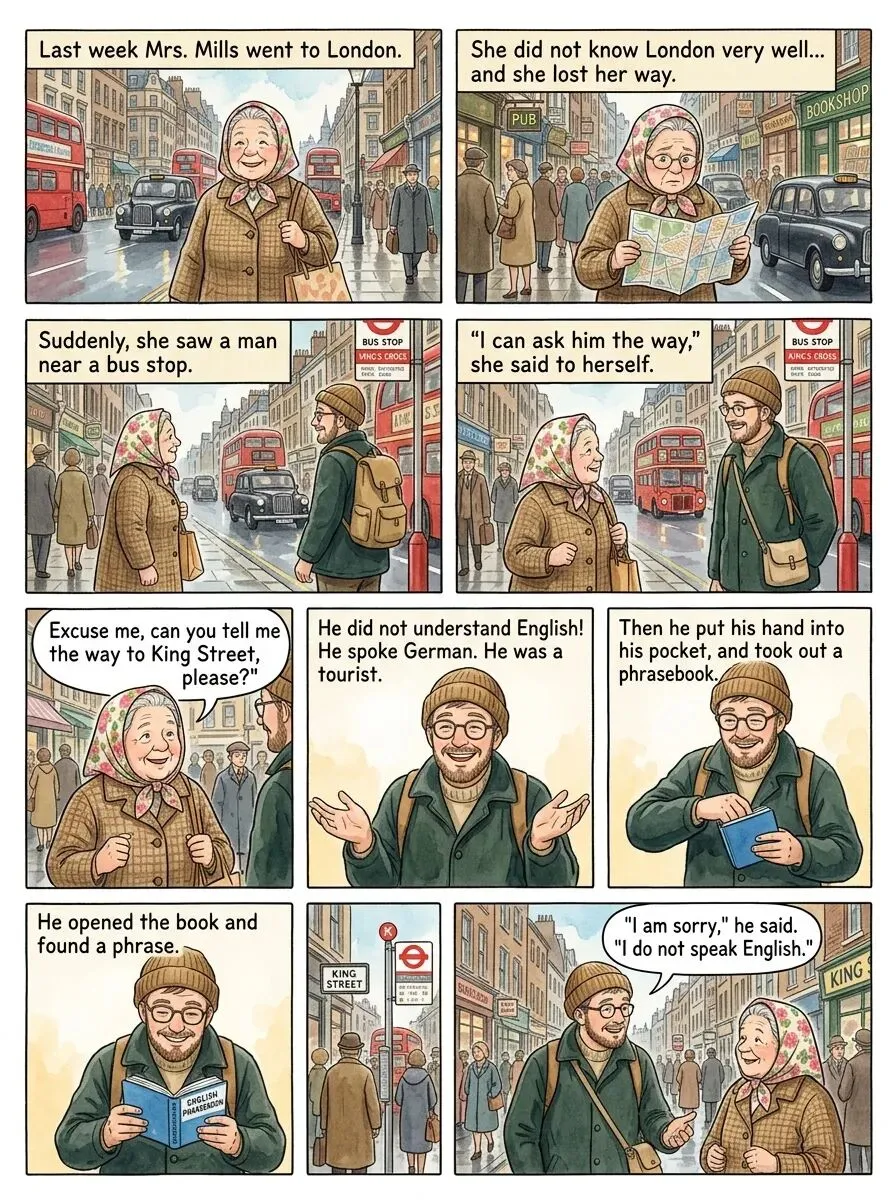
Narrator: Last week, Mrs. Mills went to London.
(连读:went_to)
She does not know London very well, and she lost her way.
(失去爆破:los(t) her;连读:lost_her)
Suddenly, she saw a man near a bus stop.
(弱读:a /ə/)
'I can ask him the way,' she said to herself.
(连读:ask_him;him_the)
'Excuse me,' she said. 'Can you tell me the way to King Street, please?'
(语调:礼貌的升调在'Excuse me',核心问句用降调;连读:tell_me, way_to)
The man smiled pleasantly.
(注意:smiled /smaɪld/,-ed发/d/音)
He did not understand English!
(强调否定:did_NOT;句末降调)
He spoke German.
He was a tourist.
Then he put his hand into his pocket, and took out a phrasebook.
(连读:put_his, into_his, took_out_a)
He opened the book and found a phrase.
(失去爆破:opene(d) the)
He read the phrase slowly.
'I am sorry,' he said. 'I do not speak English.'
第74课 课文原文(含语音标注)
📜 课文原文(含语音标注)
Narrator: What did they do?
(特殊疑问句,用降调)
Look at Picture A.
The bus went to London Airport yesterday.
(连读:went_to)
Look at Picture B.
The greengrocer sold a cabbage to a customer last week.
Look at Picture C.
The typist typed some letters the day before yesterday.
Look at Picture D.
They walked to the station yesterday morning.
Look at Picture E.
They washed the dishes after lunch yesterday.
Look at Picture F.
They painted the room last month.
Look at Picture G.
She waited for a bus yesterday afternoon.
Look at Picture H.
They worked in the garden last weekend.
情景说明
第73课是一个简短的叙事场景。米尔斯夫人(Mrs. Mills)上周去了伦敦。由于对伦敦不熟悉,她在途中迷路了(lost her way)。在一个公交车站附近,她看到一位男士,于是决定向他问路。她使用了非常礼貌的问路句式"Excuse me, can you tell me the way to...?"。然而,剧情出现了幽默的转折:这位男士虽然报以友好的微笑,但他并不懂英语。他实际上是一位德国游客。他从口袋里掏出一本常用语手册,慢慢地查找,最终用英语说出了"我很抱歉,我不会说英语。"这句话。这个场景生动地展现了跨国旅行中可能遇到的语言障碍,以及人们试图通过工具(短语手册)进行沟通的努力。
第74课则是一个纯粹的语法练习和词汇巩固场景。它通过八幅图片(A-H)直观地展示了不同人物在过去不同时间点所做的动作。这些图片涵盖了日常生活、工作、出行等多个方面,旨在让学习者通过看图说话的方式,反复练习和巩固规则动词与不规则动词的一般过去时肯定句表述。时间状语(yesterday, last week, the day before yesterday等)的复现也加强了学生对过去时间概念的表达。
参考译文
第73课
旁白:上周,米尔斯夫人去了伦敦。
她对伦敦不太熟悉,结果迷了路。
突然,她在公共汽车站附近看到一个男人。
"我可以向他问路,"她心想。
"对不起,"她说。"您能告诉我去国王街的路吗?"
这个男人友好地笑了笑。
他不懂英语!
他说德语。
他是个旅游者。
然后他把手伸进口袋,掏出了一本常用语手册。
他翻开书找到了一条短语。
他慢慢地读着短语。
"很抱歉,"他说。"我不会讲英语。"
第74课
旁白:他们做了什么?
看图片A。
昨天,公共汽车开往伦敦机场。
看图片B。
上周,蔬菜水果商卖给顾客一棵卷心菜。
看图片C。
前天,打字员打了一些信件。
看图片D。
昨天早上,他们步行去了车站。
看图片E。
昨天午饭后,他们洗了盘子。
看图片F。
上个月,他们粉刷了房间。
看图片G。
昨天下午,她等了一辆公共汽车。
看图片H。
上周末,他们在花园里干活了。
🔍 第二部分:逐句精讲与词块总结
句子1
1. 原文: Last week, Mrs. Mills went to London.
2. 翻译: 上周,米尔斯夫人去了伦敦。
3. 句子结构: 主语 (Mrs. Mills) + 谓语动词 (went) + 宾语 (to London)。这是一个"主语+谓语+宾语"的SV结构,其中"to London"是介词短语作地点状语。时间状语"Last week"置于句首。
4. 重点词汇:
week 蓝思值 10L
英音[wiːk] 美音[wiːk] 词性:n. (名词)
释义:周,星期
常用语块:last week (上周), next week (下周), this week (本周), once a week (每周一次)
例句一:I saw him last week. 我上周见过他。
例句二:We have a test next week. 我们下周有个测验。
拓展:来源于古英语 wice。相关词汇:weekday (工作日), weekend (周末), weekly (每周的)。
went 蓝思值 20L
英音[went] 美音[went] 词性:v. (动词,go的过去式)
释义:去,走
常用语块:went to (去了某地), went home (回家), went away (离开)
例句一:She went to the supermarket yesterday. 她昨天去了超市。
例句二:They went home early. 他们早早回家了。
拓展:go是不规则动词,过去式went,过去分词gone。记忆口诀:go-went-gone。注意区分:He has gone to London. (他已去了伦敦,现在不在。) He went to London last week. (他上周去了伦敦,动作发生在过去。)
London 蓝思值 140L
英音[ˈlʌndən] 美音[ˈlʌndən] 词性:n. (名词,专有名词)
释义:伦敦(英国首都)
常用语块:go to London (去伦敦), in London (在伦敦), London Bridge (伦敦桥)
例句一:London is a bustling city. 伦敦是一座繁华的城市。
例句二:He lives in central London. 他住在伦敦市中心。
拓展:文化小知识:伦敦有许多著名地标,如Big Ben (大本钟), Tower of London (伦敦塔), Buckingham Palace (白金汉宫)。在问路语境中,它是一个典型的目的地。
5. 语法点睛: 本句的核心语法点是不规则动词的一般过去时。动词"go"的过去式是不规则的"went",用于表示过去某个时间发生的动作(last week)。[NCE知识点笔记] 指出,一般过去时通常与表示过去的时间状语连用,如yesterday, last night, in 1990等。本句正是用"last week"明确了动作发生的时间。
6. 语音要点: "went to"会发生连读,/t/ 和 /t/ 相遇,通常前一个 /t/ 失去爆破或不完全爆破,听起来像是"wen(to)"。句首"Last week"中,"Last"的尾音 /t/ 与"week"的开头 /w/ 相邻,发音清晰。
句子2
1. 原文: She does not know London very well, and she lost her way.
2. 翻译: 她对伦敦不太熟悉,结果迷了路。
3. 句子结构: 这是一个由连词"and"连接的并列复合句。第一个分句:主语 (She) + 谓语 (does not know) + 宾语 (London) + 程度状语 (very well)。第二个分句:主语 (she) + 谓语 (lost) + 宾语 (her way)。
4. 重点词汇:
know 蓝思值 30L
英音[nəʊ] 美音[noʊ] 词性:v. (动词)
释义:知道;了解;认识
常用语块:know about (了解), know how to (知道如何做), know someone (认识某人)
例句一:Do you know his name? 你知道他的名字吗?
例句二:I know how to swim. 我知道怎么游泳。
拓展:不规则动词,过去式knew,过去分词known。注意与"no"的发音区别。
lost 蓝思值 50L
英音[lɒst] 美音[lɔːst] 词性:v. (动词,lose的过去式);adj. (形容词)
释义:v. 丢失;迷失;输掉;adj. 迷路的;丢失的
常用语块:lost one's way (迷路), lost and found (失物招领), get lost (迷路)
例句一:I lost my keys yesterday. 我昨天把钥匙丢了。
例句二:The little boy looked lost. 这个小男孩看起来迷路了。
拓展:lose是不规则动词:lose-lost-lost。其名词形式为loss (损失)。"lose one's way"是固定搭配,意为"迷路"。
way 蓝思值 80L
英音[weɪ] 美音[weɪ] 词性:n. (名词)
释义:路,道路;方法,方式
常用语块:the way to (去...的路), on the way (在路上), in this way (用这种方法)
例句一:Can you show me the way to the post office? 你能告诉我去邮局的路吗?
例句二:He has a strange way of talking. 他说话的方式很奇怪。
拓展:本课取其"道路"的本义。在问路句型中是核心词汇。
5. 语法点睛: 本句前半部分"She does not know..."使用的是一般现在时,表示她目前(或通常)对伦敦的了解状态。后半部分"she lost her way"则切换为一般过去时,描述上周发生的具体事件。这种时态的转换清晰地划分了背景信息和故事主线。[NCE知识点笔记] 强调,一般现在时描述常态、习惯或事实,而一般过去时描述过去某一时刻完成的动作。
6. 语音要点: "does not"在口语中常缩写为"doesn't" /ˈdʌz.ənt/。原句读作 /ʃiː dʌz nɒt/,其中"not"弱读。"lost her way"中,"lost"的尾音 /t/ 与"her"的开头 /h/ 相邻,/t/ 轻微失去爆破,"her"弱读为 /ə/。
句子3
1. 原文: Suddenly, she saw a man near a bus stop.
2. 翻译: 突然,她在公共汽车站附近看到一个男人。
3. 句子结构: 状语 (Suddenly) + 主语 (she) + 谓语动词 (saw) + 宾语 (a man) + 地点状语 (near a bus stop)。这是一个"主语+谓语+宾语"的SVO结构。
4. 重点词汇:
suddenly 蓝思值 190L
英音[ˈsʌdənli] 美音[ˈsʌdənli] 词性:adv. (副词)
释义:突然地
常用语块:all of a sudden (突然)
例句一:Suddenly, it started to rain. 突然,天开始下雨了。
例句二:The phone rang suddenly. 电话突然响了。
拓展:形容词形式是sudden (突然的)。副词通常修饰整个句子或动词,表示动作发生的突然性。
saw 蓝思值 20L
英音[sɔː] 美音[sɔː] 词性:v. (动词,see的过去式)
释义:看见
常用语块:saw someone do/doing sth. (看见某人做某事)
例句一:I saw a bird in the tree. 我看见树上有一只鸟。
例句二:He saw her crossing the street. 他看见她正在过马路。
拓展:see是不规则动词:see-saw-seen。注意与"sea"(海洋)同音异义。
bus stop 蓝思值 120L
英音[ˈbʌs stɒp] 美音[ˈbʌs stɑːp] 词性:n. (名词短语)
释义:公共汽车站
常用语块:at the bus stop (在公交车站), wait for a bus at the bus stop (在公交车站等车)
例句一:I'll meet you at the bus stop. 我在公交车站等你。
例句二:There is a shelter at the bus stop. 公交车站有个候车亭。
拓展:合成名词。类似的还有:train station (火车站), taxi rank (出租车候客点)。
5. 语法点睛: 本句继续使用一般过去时(saw),叙述故事的进展。副词"Suddenly"置于句首,起到强调和转换场景的作用,使叙述更具画面感和节奏感。[NCE知识点笔记] 提到,副词的位置比较灵活,可置于句首、句中或句末,用以修饰动词、形容词或其他副词,表示时间、地点、方式、程度等。
6. 语音要点: "Suddenly"重音在第一个音节 /ˈsʌdənli/。"saw a man"会发生连读 /sɔː ə mæn/。"bus stop"两个单词都是重读,但"stop"的重音更强。
句子4
1. 原文: 'I can ask him the way,' she said to herself.
2. 翻译: "我可以向他问路,"她心想。
3. 句子结构: 直接引语部分:主语 (I) + 情态动词谓语 (can ask) + 间接宾语 (him) + 直接宾语 (the way)。主句部分:主语 (she) + 谓语 (said) + 状语 (to herself)。这是一个"主语+谓语+间接宾语+直接宾语"的SVOO结构嵌套"主语+谓语+状语"的SVA结构。
4. 重点词汇:
ask 蓝思值 60L
英音[ɑːsk] 美音[æsk] 词性:v. (动词)
释义:问;请求;邀请
常用语块:ask someone a question (问某人一个问题), ask for help (寻求帮助), ask someone to do sth. (请某人做某事)
例句一:May I ask you a question? 我能问你一个问题吗?
例句二:He asked for a glass of water. 他要了一杯水。
拓展:规则动词,过去式asked。注意发音,英音和美音元音不同。
herself 蓝思值 220L
英音[hɜːˈself] 美音[hərˈself] 词性:pron. (代词)
释义:她自己(反身代词)
常用语块:by herself (她独自地), said to herself (她心想/自言自语)
例句一:She cooked the meal by herself. 她自己做了这顿饭。
例句二:'I can do it,' he said to himself. "我能行,"他心想。
拓展:反身代词构成:形容词性物主代词 + self/selves。如:myself, yourself, himself, ourselves, yourselves, themselves。"say to oneself"是固定搭配,表示"心里想",并非大声说出来。
5. 语法点睛: 本句包含直接引语和引述动词的结构。直接引语再现了人物的内心想法。动词"ask"在这里接了双宾语:间接宾语"him"(问的对象)和直接宾语"the way"(问的内容)。[NCE知识点笔记] 讲解了能接双宾语的动词,如give, tell, show, ask等,结构为"动词+人+物"。
6. 语音要点: "ask him"连读为 /ɑːsk ɪm/,其中/h/音在快速口语中可能脱落。"said to herself"中,"to"弱读为 /tə/,"herself"重音在第二个音节。
句子5
1. 原文: 'Excuse me,' she said. 'Can you tell me the way to King Street, please?'
2. 翻译: "对不起,"她说。"您能告诉我去国王街的路吗?"
3. 句子结构: 这是两个独立的句子。第一句:呼语/插入语 ('Excuse me') + 主句 (she said)。第二句:情态动词疑问句 (Can you) + 谓语动词 (tell) + 间接宾语 (me) + 直接宾语 (the way) + 目的地状语 (to King Street) + 礼貌用语 (please?)。第二句是"主语+谓语+间接宾语+直接宾语"的SVOO结构。
4. 重点词汇:
excuse 蓝思值 170L
英音[ɪkˈskjuːs] (n.);[ɪkˈskjuːz] (v.) 美音[ɪkˈskjuːs] (n.);[ɪkˈskjuːz] (v.) 词性:v. (动词);n. (名词)
释义:v. 原谅;n. 借口
常用语块:Excuse me. (打扰一下/对不起。), excuse someone for doing sth. (原谅某人做某事)
例句一:Excuse me, could I get past? 劳驾,我能过去吗?
例句二:There is no excuse for being late. 迟到没有借口。
拓展:"Excuse me"是极其重要的礼貌用语,用于引起他人注意、打断、请求让路或道歉(轻微过失)。区别于"Sorry"(用于道歉)。
tell 蓝思值 50L
英音[tel] 美音[tel] 词性:v. (动词)
释义:告诉;讲述;辨别
常用语块:tell someone something (告诉某人某事), tell a story (讲故事), tell the truth (说实话)
例句一:Please tell me your name. 请告诉我你的名字。
例句二:Can you tell the difference? 你能分辨出区别吗?
拓展:不规则动词:tell-told-told。本课是其核心用法之一,用于问路句型。
King Street 蓝思值 200L
英音[ˈkɪŋ striːt] 美音[ˈkɪŋ striːt] 词性:n. (名词短语,专有名词)
释义:国王街(街道名)
常用语块:on King Street (在国王街上), go to King Street (去国王街)
例句一:The bank is on King Street. 银行在国王街上。
例句二:How do I get to King Street? 我怎么去国王街?
拓展:英语中街道命名常用"名词+Street/Road/Avenue",如Oxford Street, Baker Street, Fifth Avenue。
5. 语法点睛: 本句呈现了英语中最核心、最礼貌的问路句型:"Can you tell me the way to + 地点?" 这是一个以情态动词"Can"开头的一般疑问句,用于请求帮助。[NCE知识点笔记] 强调,"Can you...?" 表示能力或可能性,用于请求时显得礼貌。句型中的"to"是介词,表示方向。
6. 语音要点: "Excuse me"中,"Excuse"重音在第二个音节 /ɪkˈskjuːz/,"me"弱读 /mi/。"Can you"常连读为 /kən juː/ 或 /kæn juː/。"tell me"连读 /tel mi/。"way to"连读 /weɪ tə/。整个问句语调应为:句首"Can"稍升,句尾"please"用升调以示礼貌,或整体用降调。
句子6
1. 原文: The man smiled pleasantly.
2. 翻译: 这个男人友好地笑了笑。
3. 句子结构: 主语 (The man) + 谓语动词 (smiled) + 方式状语 (pleasantly)。这是一个"主语+谓语"的SV结构,加上副词修饰。
4. 重点词汇:
smiled 蓝思值 160L
英音[smaɪld] 美音[smaɪld] 词性:v. (动词,smile的过去式)
释义:微笑
常用语块:smile at someone (对某人微笑), smile happily (开心地笑)
例句一:She smiled when she saw me. 她看到我时笑了。
例句二:He gave me a warm smile. 他给了我一个温暖的微笑。
拓展:规则动词,过去式直接在词尾加-d,因为原形以-e结尾。名词也是smile。微笑是一种重要的非语言交际方式。
pleasantly 蓝思值 320L
英音[ˈplezntli] 美音[ˈplezntli] 词性:adv. (副词)
释义:愉快地;友善地
常用语块:speak pleasantly (友善地说), pleasantly surprised (惊喜地)
例句一:The sun shone pleasantly. 阳光和煦。
例句二:She greeted us pleasantly. 她愉快地问候了我们。
拓展:形容词是pleasant (令人愉快的)。副词修饰动词"smiled",描述了微笑的方式。
5. 语法点睛: 本句的语法重点是副词修饰动词。副词"pleasantly"放在动词"smiled"之后,说明了微笑的方式或状态。[NCE知识点笔记] 指出,方式副词通常紧跟在动词或动词宾语之后,回答"how"的问题。例如:He ran quickly. She speaks English fluently.
6. 语音要点: "smiled"的-ed发 /d/ 音,因为原形以浊辅音 /l/ 结尾。"pleasantly"重音在第一音节 /ˈplezntli/。
句子7
1. 原文: He did not understand English!
2. 翻译: 他不懂英语!
3. 句子结构: 主语 (He) + 助动词 (did) + 否定词 (not) + 主要动词原形 (understand) + 宾语 (English)。这是一个"主语+谓语+宾语"的SVO结构的否定形式。
4. 重点词汇:
understand 蓝思值 180L
英音[ˌʌndəˈstænd] 美音[ˌʌndərˈstænd] 词性:v. (动词)
释义:理解;明白
常用语块:understand someone (理解某人), make oneself understood (使自己的意思被明白)
例句一:Do you understand this question? 你理解这个问题吗?
例句二:I don't understand what you mean. 我不明白你的意思。
拓展:不规则动词:understand-understood-understood。由under (在...下) 和 stand (站立) 组成,引申为"站在...之下→彻底明白"。
5. 语法点睛: 本句展示了一般过去时的否定句结构:"主语 + did not (didn't) + 动词原形"。无论主语是谁(I, you, he, she, it, we, they),否定式都用助动词"did"。[NCE知识点笔记] 强调,在否定句和疑问句中,主要动词必须恢复原形。这是初学者极易出错的地方。
6. 语音要点: "did not"在口语中几乎总是缩写为"didn't" /ˈdɪd.ənt/。如果不缩写,重音落在"not"上,表示强烈否定。"understand"重音在第三个音节 /ˌʌndəˈstænd/。
句子8
1. 原文: He spoke German.
2. 翻译: 他说德语。
3. 句子结构: 主语 (He) + 谓语动词 (spoke) + 宾语 (German)。SVO结构。
4. 重点词汇:
spoke 蓝思值 100L
英音[spəʊk] 美音[spoʊk] 词性:v. (动词,speak的过去式)
释义:说(某种语言);讲话
常用语块:speak English (说英语), speak to someone (和某人说话), speak up (大声说)
例句一:She spoke softly. 她轻声细语地说。
例句二:How many languages can you speak? 你会说几种语言?
拓展:不规则动词:speak-spoke-spoken。名词形式是speech (演讲)。注意:"say"强调说的内容,"speak"强调说的动作或能力(尤指语言)。
German 蓝思值 240L
英音[ˈdʒɜːmən] 美音[ˈdʒɜːrmən] 词性:n. (名词);adj. (形容词)
释义:n. 德语;德国人;adj. 德国的;德语的
常用语块:speak German (说德语), a German car (一辆德国车)
例句一:He is learning German. 他正在学德语。
例句二:We visited a German castle. 我们参观了一座德国城堡。
拓展:国名Germany (德国),德国人复数Germans。语言和国家/民族的形容词首字母通常大写。
5. 语法点睛: 继续使用一般过去时(spoke)叙述事实。动词"speak"用于表示说某种语言时,是及物动词,直接接语言名称作宾语。[NCE知识点笔记] 对比了"say", "speak", "talk", "tell"的用法区别,本课是"speak"的典型用例。
6. 语音要点: "spoke"发音 /spəʊk/,注意双元音。"German"重音在第一音节 /ˈdʒɜːmən/。
句子9
1. 原文: He was a tourist.
2. 翻译: 他是个旅游者。
3. 句子结构: 主语 (He) + 系动词 (was) + 表语 (a tourist)。这是一个"主语+系动词+表语"的SVC结构。
4. 重点词汇:
tourist 蓝思值 280L
英音[ˈtʊərɪst] 美音[ˈtʊrɪst] 词性:n. (名词)
释义:旅游者,观光客
常用语块:a tourist attraction (旅游景点), tourist information center (旅游信息中心)
例句一:The city is full of tourists in summer. 夏天这座城市到处都是游客。
例句二:He works as a tour guide for foreign tourists. 他为外国游客做导游。
拓展:词根是tour (旅行,游览)。相关词:tourism (旅游业), tour guide (导游)。
5. 语法点睛: 本句使用一般过去时的系动词"was"来描述人物过去的身份。这是主系表结构的过去式。[NCE知识点笔记] 复习了be动词的过去式:I/he/she/it was; we/you/they were。
6. 语音要点: "tourist"重音在第一音节 /ˈtʊərɪst/。
句子10
1. 原文: Then he put his hand into his pocket, and took out a phrasebook.
2. 翻译: 然后他把手伸进口袋,掏出了一本常用语手册。
3. 句子结构: 这是一个由"and"连接的并列句。第一个分句:状语 (Then) + 主语 (he) + 谓语 (put) + 宾语 (his hand) + 地点状语 (into his pocket)。第二个分句:(he) + 谓语 (took out) + 宾语 (a phrasebook)。第二个分句的主语承前省略。
4. 重点词汇:
put 蓝思值 40L
英音[pʊt] 美音[pʊt] 词性:v. (动词)
释义:放,放置
常用语块:put something somewhere (把某物放在某处), put on (穿上), put away (收起来)
例句一:Put the book on the table. 把书放在桌上。
例句二:He put his hands in his pockets. 他把手插在口袋里。
拓展:不规则动词:put-put-put。本课中"put... into..."是固定搭配。
pocket 蓝思值 260L
英音[ˈpɒkɪt] 美音[ˈpɑːkɪt] 词性:n. (名词)
释义:口袋;衣袋
常用语块:in one's pocket (在某人口袋里), pocket money (零花钱)
例句一:My keys are in my jacket pocket. 我的钥匙在夹克口袋里。
例句二:He took a coin from his pocket. 他从口袋里拿出一枚硬币。
拓展:合成词:pocket-sized (袖珍的), pickpocket (扒手)。
took out 蓝思值 150L
英音[ˈtʊk ˈaʊt] 美音[ˈtʊk ˈaʊt] 词性:v. (动词短语,take out的过去式)
释义:取出,拿出
常用语块:take out a book (拿出一本书), take someone out to dinner (带某人出去吃饭)
例句一:She took out her wallet and paid. 她拿出钱包付了钱。
例句二:He took the letter out of the envelope. 他把信从信封里拿出来。
拓展:take是不规则动词:take-took-taken。"take out"是"动词+副词"型短语,宾语是代词时必须放在中间:take it out。
phrasebook 蓝思值 420L
英音[ˈfreɪzbʊk] 美音[ˈfreɪzbʊk] 词性:n. (名词)
释义:常用语手册,短语集
常用语块:a travel phrasebook (旅游常用语手册)
例句一:A phrasebook is useful when traveling abroad. 出国旅行时,常用语手册很有用。
例句二:He checked the phrasebook for the correct word. 他查了常用语手册以找到正确的词。
拓展:合成词:phrase (短语) + book (书)。是旅行者克服语言障碍的传统工具。
5. 语法点睛: 本句包含两个并列的过去时动作。动词"put"是不规则动词,过去式和原形同形。"took"是"take"的不规则过去式。短语"took out"展示了短语动词(phrasal verb)的用法,即"动词+小品词(副词/介词)"构成一个具有新含义的动词单位。[NCE知识点笔记] 提到,这类动词的宾语位置需要注意。
6. 语音要点: "put his"连读 /pʊt ɪz/。"into his"连读 /ˈɪntə ɪz/。"took out a"连读 /tʊk ˈaʊt ə/。
句子11
1. 原文: He opened the book and found a phrase.
2. 翻译: 他翻开书找到了一条短语。
3. 句子结构: 主语 (He) + 谓语1 (opened) + 宾语1 (the book) + 连词 (and) + 谓语2 (found) + 宾语2 (a phrase)。这是一个由"and"连接的并列谓语结构。
4. 重点词汇:
opened 蓝思值 90L
英音[ˈəʊpənd] 美音[ˈoʊpənd] 词性:v. (动词,open的过去式)
释义:打开;开业
常用语块:open the door (开门), open a window (开窗), open a business (开店)
例句一:She opened the present excitedly. 她兴奋地打开了礼物。
例句二:The store opens at 9 a.m. 商店早上9点开门。
拓展:规则动词,过去式加-ed。反义词是close/shut。
found 蓝思值 70L
英音[faʊnd] 美音[faʊnd] 词性:v. (动词,find的过去式)
释义:找到;发现
常用语块:find something (找到某物), find out (查明)
例句一:I found my glasses under the bed. 我在床底下找到了眼镜。
例句二:They found a solution to the problem. 他们找到了问题的解决方法。
拓展:不规则动词:find-found-found。注意与found (建立,创立) 的过去式同形异义。
phrase 蓝思值 380L
英音[freɪz] 美音[freɪz] 词性:n. (名词)
释义:短语;词组;说法
常用语块:a common phrase (一个常用短语), in the phrase of (用...的话说)
例句一:'How do you do?' is a formal phrase. "你好"是一个正式用语。
例句二:He used a funny phrase to describe it. 他用了一个有趣的说法来描述它。
拓展:动词形式是phrase (措辞)。相关词:phraseology (措辞,术语)。
5. 语法点睛: 继续叙述一连串的过去动作。动词"opened"是规则动词的过去式(+ed),"found"是不规则动词的过去式。句子用"and"连接两个先后发生的动作,体现了动作的连续性。[NCE知识点笔记] 指出,在叙述一系列过去事件时,常用and连接简单句,使行文流畅。
6. 语音要点: "opened the"中,"opened"的-ed发 /d/ 音,与"the"连读 /ˈəʊpənd ðə/。"found a"连读 /faʊnd ə/。
句子12
1. 原文: He read the phrase slowly.
2. 翻译: 他慢慢地读着短语。
3. 句子结构: 主语 (He) + 谓语动词 (read) + 宾语 (the phrase) + 方式状语 (slowly)。SVO结构加状语。
4. 重点词汇:
read 蓝思值 30L
英音[riːd] (现在式);[red] (过去式) 美音[riːd] (现在式);[red] (过去式) 词性:v. (动词)
释义:阅读;朗读
常用语块:read a book (读书), read aloud (大声朗读), read about (读到关于...)
例句一:She reads the newspaper every morning. 她每天早上看报纸。
例句二:He read the story to the children. 他给孩子们读了这个故事。
拓展:不规则动词:read-read-read。注意现在式和过去式拼写相同但发音不同,这是英语中少数几个此类动词之一。
slowly 蓝思值 200L
英音[ˈsləʊli] 美音[ˈsloʊli] 词性:adv. (副词)
释义:缓慢地
常用语块:walk slowly (慢慢走), speak slowly (慢慢说)
例句一:The old man walked slowly across the road. 老人慢慢地穿过马路。
例句二:Could you please speak more slowly? 你能说得再慢一点吗?
拓展:形容词是slow (慢的)。副词形式通常在形容词后加-ly。反义词是quickly/fast。
5. 语法点睛: 动词"read"的过去式发音为 /red/,但拼写不变。副词"slowly"置于句末,修饰动词"read",描述了阅读的方式。这是方式副词的典型位置。[NCE知识点笔记] 复习了副词的构成和位置。
6. 语音要点: 本句的"read"必须读过去式发音 /red/,否则会产生歧义。"slowly"重音在第一音节 /ˈsləʊli/。
句子13
1. 原文: 'I am sorry,' he said. 'I do not speak English.'
2. 翻译: "很抱歉,"他说。"我不会讲英语。"
3. 句子结构: 两个直接引语加引述句。第一句:表语 ('I am sorry') + 引述 (he said)。第二句:主语 (I) + 助动词 (do) + 否定词 (not) + 主要动词 (speak) + 宾语 (English)。第二句是"主语+谓语+宾语"的SVO结构的否定形式。
4. 重点词汇:
sorry 蓝思值 60L
英音[ˈsɒri] 美音[ˈsɑːri] 词性:adj. (形容词)
释义:抱歉的;难过的
常用语块:I'm sorry. (对不起。), feel sorry for someone (为某人感到难过)
例句一:I'm sorry I'm late. 对不起我迟到了。
例句二:We are sorry to hear the bad news. 听到这个坏消息我们很难过。
拓展:用于道歉或表达遗憾。比"Excuse me"语气更重,常用于承认错误或听到不幸消息时。
5. 语法点睛: 直接引语"I am sorry"使用了一般现在时,表达当下的歉意。而"I do not speak English"也是一般现在时,描述一个当前的事实(他不会说英语)。引述动词"said"用过去式,表明这是转述过去说的话。这里体现了直接引语内部的时态不受引述动词过去时的影响,因为它直接再现了当时所说的话。[NCE知识点笔记] 对比了直接引语和间接引语的时态变化规则。
6. 语音要点: "I am"常缩写为"I'm" /aɪm/。"sorry"重音在第一音节 /ˈsɒri/,在道歉时语调下降。"I do not"在口语中常说"I don't" /aɪ doʊnt/。"speak English"连读 /spiːk ˈɪŋɡlɪʃ/。
(第74课图片描述句子精讲范式,以Picture A为例)
句子A
1. 原文: The bus went to London Airport yesterday.
2. 翻译: 昨天,公共汽车开往伦敦机场。
3. 句子结构: 主语 (The bus) + 谓语动词 (went) + 宾语 (to London Airport) + 时间状语 (yesterday)。SVO结构。
4. 重点词汇:
airport 蓝思值 270L
英音[ˈeəpɔːt] 美音[ˈerpɔːrt] 词性:n. (名词)
释义:机场
常用语块:at the airport (在机场), go to the airport (去机场), airport security (机场安检)
例句一:We arrived at the airport two hours early. 我们提前两小时到达机场。
例句二:There is a shuttle bus to the airport. 有去机场的班车。
拓展:合成词:air (空中) + port (港口)。类似结构:seaport (海港)。
5. 语法点睛: 本句是第74课所有句子的模板:主语 + 动词过去式 + (宾语) + 过去时间状语。它巩固了第73课引入的不规则动词"go-went"的用法,并加入了明确的时间状语"yesterday"。[NCE知识点笔记] 强调,一般过去时句子通常需要或隐含一个过去时间点。
6. 语音要点: "London Airport"作为专有名词,两个单词都重读。"yesterday"重音在第一音节 /ˈjestədeɪ/。
(注:第74课其他图片句子结构类似,核心在于巩固不同动词的过去式,如sold (sell), typed (type), walked (walk), washed (wash), painted (paint), waited (wait), worked (work)。这些动词过去式的构成和发音(-ed发 /t/, /d/ 或 /ɪd/)是本课重要的语音和语法练习点。)
📌 核心词块总结 (Key Lexical Chunks)
1. lose one's way (迷路) Meaning: To become lost; to not know where you are or how to get to where you want to go. Example: Without a map, we might lose our way in the forest. 例句:没有地图,我们可能在森林里迷路。
2. ask someone the way (向某人问路) Meaning: To request directions from a person. Example: When I'm lost, I usually ask a police officer the way. 例句:当我迷路时,我通常会向警察问路。
3. Can you tell me the way to...? (你能告诉我去...的路吗?) Meaning: A polite formula for asking for directions to a specific place. Example: Excuse me, can you tell me the way to the nearest subway station? 例句:打扰一下,你能告诉我去最近的地铁站怎么走吗?
4. take out (取出,拿出) Meaning: To remove something from inside a container, pocket, bag, etc. Example: He took out his phone to check the time. 例句:他拿出手机看时间。
5. say to oneself (心想,自言自语) Meaning: To think something privately, not speaking aloud. Example: 'This is going to be difficult,' she said to herself. 例句:"这将会很困难,"她心想。
6. speak a language (说某种语言) Meaning: To be able to communicate in a particular language. Example: How many languages does your teacher speak? 例句:你的老师会说几种语言?
💬 第三部分:基础会话技巧
1. 分析课文中的日常用语、礼貌表达、问答模式
- 日常用语与礼貌表达:
- Excuse me: 万能礼貌开场白,用于引起陌生人注意、问路、打断等。比中文的"喂"或直接提问礼貌得多。
- Can you... please?: 请求帮助的标准礼貌句式。"Can you"询问对方能力,"please"软化语气,使请求更得体。
- I am sorry: 表达歉意。文中游客用它来表达自己无法提供帮助的遗憾,即使这不是他的错,也显示了礼貌。
- Smiled pleasantly: 非语言礼貌。微笑是世界通用的友好信号,能缓解问路时的紧张感。
- 问答模式:
- 问路方:先用"Excuse me"吸引注意,然后用"Can you tell me the way to + 地点?"提出明确请求。
- (理想中的)指路方:理论上会给出方向指引(如turn left, go straight等)。但本课提供了另一种常见反应:因语言不通无法帮助,但仍通过微笑和道歉保持友好。这是一种完整的"请求-回应"交际回合,即使回绝也是礼貌的。
2. 提供类似场景的扩展对话示例
Scene: A tourist (T) is looking at a map confusedly near a landmark. A local (L) passes by.
T: Excuse me, I think I'm a bit lost. Can you help me?
L: Sure, I'll try. Where are you trying to go?
T: I'm looking for the British Museum. Can you tell me the way?
L: Oh, it's not far from here. Go straight along this street for about five minutes. You'll see a big square. The museum is on the left side of the square.
T: Go straight... then left at the square?
L: That's right. You can't miss it.
T: Thank you so much for your help!
L: You're welcome. Have a nice day!
3. 设计简单的角色扮演活动建议
- 活动名称: "Lost in [Your City Name]"
- 准备: 准备几张写有本地知名地点(如火车站、公园、图书馆、商场)的卡片。准备一张简易的街区示意图(可不精确)。
- 步骤:
1. 学生两人一组。A抽一张地点卡,扮演迷路的游客。B扮演本地居民。
2. A必须使用"Excuse me"开头,并用"Can you tell me the way to...?"问路。
3. B看着示意图(或凭想象)进行指路,尽量使用"go straight", "turn left/right", "it's on your left"等短语。
4. A听后重复一遍指令以示确认。
5. 交换角色,使用不同的地点。
- 升级挑战: 引入第三张角色卡---"不会说英语的游客"(就像课文里的德国人)。持此卡的学生在被问路时,必须微笑着用"I'm sorry, I don't speak English."回应。
4. 融入基础思考:设计1-2个简单的代入式问题
① 如果你是米尔斯夫人,在听到那位德国游客说"I do not speak English"之后,你会怎么做?是继续尝试用手势比划,还是去找别人帮忙?为什么?
② 当你自己在国外旅游,需要问路但语言不通时,除了短语手册,你还可以用什么方法来沟通?(提示:手机地图、手势、画图、指向地名)
📐 第四部分:本课语法精析(加强版)
本课语法核心是不规则动词的一般过去时,并在此基础上巩固一般过去时的疑问句和否定句结构,同时复习副词修饰动词的用法。
1. 不规则动词的一般过去时 (Irregular Past Simple)
[NCE知识点笔记] 明确指出,英语动词的过去式分为规则变化(加-ed)和不规则变化。本课是第一次集中出现一批常用不规则动词的过去式。
[名师精讲] 强调,不规则动词必须逐个记忆,没有统一的规则。本课涉及的动词及其过去式是英语中最基础、最核心的部分,务必熟练掌握。
[语法新思维] 从表意功能上解释,一般过去时用来描述在过去某个特定时间发生并已完成的动作或状态。本课的故事和图片描述都符合这个定义。
- 本课出现的不规则动词列表:
- go → went (去)
- lose → lost (丢失,迷路)
- see → saw (看见)
- say → said (说)
- tell → told (告诉)
- understand → understood (理解)
- speak → spoke (说(语言))
- put → put (放) (过去式同形)
- take → took (拿)
- find → found (找到)
- read → read /red/ (读) (过去式同形异音)
- sell → sold (卖) (第74课)
- cut → cut (切) (第74课相关词汇)
- 例句(不少于20个):
1. I went to the cinema last night. 我昨晚去了电影院。
2. She lost her passport during the trip. 她在旅途中丢了护照。
3. We saw a beautiful sunset yesterday. 我们昨天看到了美丽的日落。
4. He said hello to everyone. 他向每个人问了好。
5. My mother told me an interesting story. 我妈妈给我讲了一个有趣的故事。
6. Did you understand the teacher's explanation? 你理解老师的解释了吗?
7. They spoke French at the meeting. 他们在会议上说法语。
8. Please put the books on the shelf. 请把书放到书架上。(现在式)
9. He put the keys in his pocket yesterday. 他昨天把钥匙放进了口袋。
10. She took a photo of the mountain. 她拍了一张山的照片。
11. I finally found my missing sock. 我终于找到了丢失的袜子。
12. He read the entire book in one day. 他一天之内读完了整本书。
13. The shop sold all its cakes quickly. 商店很快卖光了所有的蛋糕。
14. She cut the paper with scissors. 她用剪刀剪纸。
15. Last summer, we went to Italy. 去年夏天,我们去了意大利。
16. I saw that movie two years ago. 我两年前看过那部电影。
17. What did he say about the plan? 他对这个计划说了什么?
18. Nobody told me about the change. 没人告诉我这个变动。
19. I never understood why he left. 我一直不明白他为什么离开。
20. Before the internet, people read more newspapers. 在互联网出现之前,人们读更多的报纸。
2. 一般过去时的疑问句与否定句
[NCE知识点笔记] 详细讲解了结构:疑问句用"Did + 主语 + 动词原形?";否定句用"主语 + did not (didn't) + 动词原形"。
[名师精讲] 特别提醒,在疑问句和否定句中,无论主语是谁,助动词一律用"did",并且主要动词必须打回原形,这是中国学习者最容易忽视的规则。
[语法新思维] 指出,"did"在这里是助动词,没有实际含义,只起构成疑问和否定的语法作用。
- 疑问句结构:
- Did + 主语 + 动词原形 + (其他) ?
- 例句:
- Did you go to London last week? 你上周去伦敦了吗?
- Did she lose her way? 她迷路了吗?
- Did he understand the question? 他理解这个问题了吗?
- What did they do yesterday? (第74课标题) 他们昨天做了什么?
- Where did you put my bag? 你把我的包放哪儿了?
- 否定句结构:
- 主语 + did not (didn't) + 动词原形 + (其他)。
- 例句:
- He did not (didn't) understand English. 他不懂英语。
- I didn't see him at the party. 我在派对上没看到他。
- They didn't tell me the truth. 他们没有告诉我真相。
- She didn't take out her phone. 她没有拿出手机。
- We didn't go to the airport yesterday. 我们昨天没去机场。
3. 副词修饰动词
[语法新思维] 将副词定义为修饰动词、形容词、其他副词或整个句子的词。方式副词回答"如何地"(how)这一问题。
[NCE知识点笔记] 指出,方式副词通常位于动词之后,如果动词有宾语,则位于宾语之后。
[名师精讲] 补充,以-ly结尾的副词大多由形容词加-ly构成(如pleasant → pleasantly, slow → slowly)。
- 本课例句:
- He smiled pleasantly. 他友好地微笑。
- He read the phrase slowly. 他慢慢地读着短语。
- She said goodbye warmly. 她热情地道别。(拓展)
- They worked hard yesterday. 他们昨天努力工作。(注意hard本身可作副词)
- Please speak clearly. 请说清楚点。
4. 与之前语法点的对比分析
- 一般过去时 vs. 一般现在时:本课故事中"She does not know London well" (一般现在时,描述常态) 与"she lost her way last week" (一般过去时,描述过去事件) 形成清晰对比。第74课的所有句子都与过去时间状语连用,强化了过去时的概念。
- 不规则动词过去式 vs. 规则动词过去式:第73课重点是不规则变化,而第74课的图片描述中,除了"went", "sold",其他如typed, walked, washed, painted, waited, worked都是规则动词加-ed的过去式。这提供了一个混合练习的机会,让学生同时注意两种变化。
- Can you...? (请求) vs. Did you...? (询问过去):"Can you tell me the way?" 是现在时,表示当前的能力和请求。"Did you tell her the way?" 是过去时,询问是否发生过告知的动作。两者句型相似但时态和功能不同。
练习题(不少于10道,附答案)
1. 写出下列动词的过去式:go, see, tell, put, take, find, read, lose.
答案:went, saw, told, put, took, found, read (/red/), lost.
2. 用动词的过去式填空:Last Sunday, I _______ (go) to the park. I _______ (see) many children there. They _______ (play) happily.
答案:went, saw, were playing/played. (最后一空可用过去进行时或一般过去时)
3. 将下列句子改为一般疑问句:She lost her keys yesterday.
答案:Did she lose her keys yesterday?
4. 将下列句子改为否定句:He told me the secret.
答案:He did not (didn't) tell me the secret.
5. 选择正确的动词形式:Did you (understand/understood) the lesson?
答案:understand
6. 连词成句:slowly / he / the letter / read / .
答案:He read the letter slowly.
7. 根据第74课图片C造句:The typist _______ some letters the day before yesterday.
答案:typed
8. 翻译:你昨天把车停在哪里了?(用park)
答案:Where did you park your car yesterday?
9. 改正句中的错误:She didn't went to school last Monday.
答案:She didn't go to school last Monday. (助动词did后动词用原形)
10. 用"Can you tell me the way to...?"造句,目的地是"the library"。
答案:Can you tell me the way to the library, please?
✏️ 第五部分:基础练习与活动
1. 跟读练习
- 目标:模仿课文录音的语音、语调、连读和节奏。
- 方法:播放第73课课文录音。第一遍静听,注意标注出的连读和语调。第二遍逐句跟读,努力模仿。第三遍尝试不看课文同步跟读。重点关注:
- "went to London"
- "lost her way"
- "ask him the way"
- "Can you tell me the way to...?"
- "did not understand"
- "took out a phrasebook"
2. 角色扮演
- 活动:双人对话"Asking for Directions"。
- 角色:Student A (Tourist), Student B (Local / Non-English Speaker).
- 情景:Tourist wants to go to the City Museum.
- 流程:
- Version 1 (Successful): B作为本地人,成功指路。
- Version 2 (Unsuccessful): B作为不会英语的游客,礼貌拒绝。
- 每组表演两个版本。必须使用"Excuse me", "Can you tell me the way to...?", "I'm sorry, I don't speak English."等核心句。
3. 简单替换练习
- 句型:Can you tell me the way to King Street, please?
- 替换地点:the post office, the train station, the supermarket, the hospital, the police station, the nearest bank, the bus station, the cinema.
- 练习方式:教师说出地点,学生快速造出完整的问路句。
4. 听力理解题目
- 材料:基于课文改编的简短对话。
- 录音脚本 (教师朗读):
"Woman: Excuse me.
Man: Yes?
Woman: Can you tell me the way to Green Park, please?
Man: I'm sorry. I don't speak English.
Woman: Oh, I see. Thank you anyway."
- 问题:
1. Where does the woman want to go? (Green Park)
2. Can the man help her? Why or why not? (No, because he doesn't speak English.)
3. What does the woman say at the end? (Thank you anyway.)
5. 课文改写版本(词汇更简单)
- 改写文:
Last week, a woman went to a big city. She did not know the city. She was lost. She saw a man. She asked him, "How do I go to River Street?" The man smiled. But he did not know English. He was from another country. He had a small book with English sentences. He looked in the book. Then he said, "I am sorry. I cannot speak English."
- 目的:降低词汇难度,帮助学生更专注于核心句型和过去时态的理解。
参考答案(听力理解部分已在题目中给出)
🤔 第六部分:英文深度思考与拓展(强化版)
A. 层次化英文问题与答案
Level 1 (Factual): 事实性问题
1. Q: Where did Mrs. Mills go last week?
A: She went to London last week.
2. Q: What did Mrs. Mills say to the man near the bus stop?
A: She said, "Excuse me, can you tell me the way to King Street, please?"
3. Q: Did the man understand English?
A: No, he did not understand English.
4. Q: What language did the man speak?
A: He spoke German.
5. Q: What did the man take out of his pocket?
A: He took out a phrasebook.
Level 2 (Inferential): 推理性问题
1. Q: Why did Mrs. Mills decide to ask the man for directions?
A: She saw him near a bus stop and probably thought he was a local person who could help her.
2. Q: How do you think Mrs. Mills felt when the man smiled pleasantly but then took out a phrasebook?
A: She probably felt hopeful at first when he smiled, but then confused or disappointed when she realized he might not speak English.
3. Q: Why did the man read the phrase slowly from his phrasebook?
A: He was probably not confident in his English pronunciation, or he was carefully finding the correct sentence to say.
4. Q: What can we infer about the man from the fact that he carried a phrasebook?
A: We can infer that he was a tourist who anticipated situations where he might need to communicate in English, showing he was prepared.
5. Q: Looking at Lesson 74, Picture E, what might the people have eaten before they washed the dishes?
A: They probably ate lunch, as the caption says "after lunch yesterday."
Level 3 (Evaluative/Creative): 评价/创造性问题
1. Q: If you were the man with the phrasebook, what other English phrases do you think would be useful for a tourist to know?
A: I think useful phrases would be: "Where is the restroom?", "How much does this cost?", "I need help, please," and "Thank you for your kindness."
2. Q: Besides asking a stranger, what are some modern ways people can find their way in a new city without speaking the local language?
A: Modern ways include using smartphone maps (like Google Maps), translation apps, following signs with universal symbols, or asking for help at official information centers or hotels.
3. Q: Do you think it is better to try to speak a few words of the local language when traveling, even if you make mistakes, or to rely entirely on tools like phrasebooks or apps? Why?
A: I think it is better to try speaking a few words. Making an effort shows respect for the local culture and often makes people more willing to help. Mistakes are usually forgiven, and it can lead to more friendly interactions.
4. Q: Imagine a different ending to the story. The man understands a little English. Write one or two sentences of what he might say to Mrs. Mills.
A: He might say, "King Street? Go straight, then turn right at the second traffic lights. It is next to a big church." Or, "I am not sure. Maybe ask the shopkeeper over there."
B. 多类型拓展阅读
1. 现代场景故事 (Modern Scenario)
Anna's phone battery died just as she stepped out of the London Underground. She needed to find the Tate Modern art gallery. Feeling anxious, she approached a young woman wearing headphones. "Excuse me," Anna began, raising her voice slightly. The woman removed one earbud. "Sorry, can you help me? I'm looking for the Tate Modern." The woman smiled. "Sure! It's actually really close. See that bridge? Walk across the Millennium Bridge right there. The big brick building on the other side of the river is it. You can't miss it!" Relieved, Anna thanked her. Sometimes, old-fashioned asking still works best.
引导性问题:Why was Anna worried at the beginning, and how did the helper's directions solve her problem?
2. 文化背景小知识 (Cultural Background)
"Excuse me" is a magic phrase in English-speaking cultures. It's used not only for asking directions but also for getting someone's attention politely, apologizing for a minor bump, or indicating you need to pass by someone. In the UK, it's considered much more polite than just starting to speak. The response to "Excuse me" is often a simple "Yes?" or a friendly look. Similarly, smiling during an interaction, like the man in our lesson did, is a strong non-verbal signal of friendliness and openness, even before any words are exchanged. It helps to soften a request or a refusal.
引导性问题:According to the text, what are two main purposes of saying "Excuse me," and why is smiling important?
3. 今昔对比 (Then and Now)
Thirty years ago, travelers like the man in Lesson 73 heavily relied on physical phrasebooks, dictionaries, and paper maps. Asking locals was a primary method to get information. Today, the scene might be very different. Mrs. Mills might simply take out her smartphone, open a maps app, and type "King Street." She would get instant directions, even with voice guidance. The German tourist might use a real-time translation app to speak or listen. While technology has made navigation easier, the basic human interaction of asking for help with a polite "Excuse me" and a smile remains a valuable and sometimes necessary skill, especially when technology fails or for experiencing genuine local connection.
引导性问题:How has technology changed the way people solve the problem of being lost or needing translation, compared to the time of phrasebooks?
4. 新潮英语改写 (Trendy Rewrite)
So, last week, Mrs. M. was in London. Total newbie to the city, right? She got majorly lost. Spotted this dude chillin' near a bus stop. "Alright," she thinks, "let's ask him." She goes, "Hey, excuse me? Any chance you could point me towards King Street?" Guy gives her a super friendly grin. Plot twist: He's like, "No English, sorry." Turns out he's a tourist, German. Whips out his trusty old phrasebook, flips through it, and slowly says, "Yeah... I don't speak English." Awkward! But kinda wholesome.
引导性问题:How does this version change the feeling of the story compared to the original textbook version?
5. 难度略高的拓展阅读 (Higher Difficulty)
The concept of "losing one's way" transcends mere geographical disorientation. It can be a metaphor for moments of confusion in life, career, or personal growth. The response to being lost, however, often follows a similar pattern: recognition of the situation ("I am lost"), seeking a reference point (the bus stop, a familiar face), and asking for guidance (from a person, a book, or introspection). The German tourist's phrasebook symbolizes prepared resources we turn to when our own knowledge is insufficient. His eventual polite refusal, "I do not speak English," reminds us that not every source we approach will have the answers we seek, and that in itself is a form of closure, prompting us to look elsewhere. The journey, whether literal or figurative, continues.
引导性问题:What does the author suggest is the symbolic meaning of "losing one's way" and the "phrasebook"?
🌍 第七部分:日常应用延伸
1. 本课语言点在日常生活中的应用场景
- 旅行与出行:在任何陌生城市、校园、大型商场或交通枢纽,本课的问路句型是生存必备技能。其应用远不止于寻找一条街道。
- 寻找设施:Can you tell me the way to the restroom? (请问洗手间怎么走?) Excuse me, where is the nearest ATM? (打扰一下,最近的自动取款机在哪?)
- 公共交通:Can you tell me how to get to the subway station? (请问去地铁站怎么走?) Which way to Platform 3? (3号站台怎么走?)
- 紧急情况:I'm lost. Can you help me find my hotel? It's called the Sunshine Hotel. (我迷路了。你能帮我找到我的酒店吗?叫阳光酒店。)
- 应对语言障碍:在全球化的今天,遇到语言不通的情况越来越普遍。本课提供了礼貌应对的范本。
- 作为求助者被拒时:可以像米尔斯夫人一样,理解对方的困境,微笑着说 Thank you anyway. (仍然谢谢你。) 或 No problem. I'll ask someone else. (没关系,我问别人。)
- 作为被求助者时:如果你不懂对方语言,可以模仿课文中的德国游客,先说 I'm sorry. 然后表明 I don't speak [语言]. 为了更有效,可以加上手势或指向信息台 (Information desk)。
- 叙述过去经历:与朋友分享日常或旅行见闻时,本课的不规则动词过去式是核心工具。
- 闲聊:Guess what? Last weekend, I **went** hiking and completely **lost** my way! Luckily, I **saw** a farmer who **told** me the right path. (猜猜怎么了?上周末我去徒步,完全迷路了!幸运的是,我看到一个农民,他给我指了正确的路。)
- 汇报行程:Yesterday, I **took** the bus to the museum, **found** a great exhibition, and **read** about ancient history. (昨天,我坐公交车去了博物馆,发现了一个很棒的展览,还读了关于古代历史的内容。)
- 提出礼貌请求:Can you tell me...? 是一个万能礼貌请求句式,可广泛应用于获取信息。
- Can you tell me the time? (请问现在几点?)
- Can you tell me your email address? (能告诉我你的邮箱地址吗?)
- Can you tell me what this word means? (你能告诉我这个词是什么意思吗?)
2. 建议简单拓展学习材料
- 视频资源:
- 在YouTube或Bilibili搜索"BBC Learning English - How to ask for directions"或"Real English Conversation - Asking for and Giving Directions",观看短小精悍的情景对话,注意母语者的语速、连读和肢体语言。
- 观看带有英文字幕的旅行vlog,观察博主在陌生环境中如何自然地使用 Excuse me 和 Can you... 进行互动。
- 应用程序 (Apps):
- 地图类:将手机地图应用(如Google Maps、Apple Maps)的语言设置为英语,尝试用英文搜索目的地,听取英文语音导航。这能沉浸式学习地点词汇和方向指令(如"Proceed straight","Turn left in 200 meters")。
- 词典与翻译类:使用欧路词典、有道词典或DeepL,查询本课生词时,不仅看释义,更要收听英音和美音的双重发音示范,并浏览例句库,了解词汇的真实使用语境。
- 语法游戏类:一些英语学习App(如Duolingo, Grammarly)有针对过去时态的小测验或游戏,可以通过轻松的方式巩固不规则动词变化。
- 实体书籍延伸:
- 结合《新概念英语口语宝典 第1册.pdf》,找到与"问路"、"旅行"相关的单元,学习更多场景句型和替代说法。
- 翻阅《新概念英语美文欣赏 第1册.pdf》,寻找关于旅行或文化交流的短文,在欣赏故事的同时,感受语言的美感。
3. 英美生活小常识
- 问路时的社交礼仪:
- 开场至关重要:务必以 Excuse me 开头,直接提问会被视为粗鲁。说完后等待对方眼神或言语回应(如"Yes?" "Sure."),再提出具体问题。
- 选择询问对象:优先选择看起来不匆忙、处于静止状态的人(如在长椅上休息、在咖啡馆外坐着)。警察、便利店店员、酒店前台是理想的求助对象。通常,带着宠物或婴儿车的人也相对友善且有耐心。
- 接受帮助的态度:指路过程中,可以通过点头 (I see)、重复关键指令 (So, turn right at the second light?) 来表示你在认真听。无论指路是否最终帮到你,结束对话时一定要真诚地说 Thank you so much for your help! 或 Have a nice day!。
- 关于距离和方向的表达:
- 英美人很少用精确的"米"或"公里"。他们常用 "block" (街区) 和 步行/车程时间 来描述距离。
- It's just two blocks down this road. (沿着这条路走两个街区就是。)
- It's about a ten-minute walk. (步行大约十分钟。)
- You're looking at a five-minute drive. (开车大概五分钟。)
- 地标参照:指路时常以醒目建筑为参照物。You'll see a big red post office on your left. The place you want is just past it. (你会看到左边有个很大的红色邮局。你要找的地方就在它过去一点。)
- "Sorry"的文化内涵:
- 在英国,"Sorry"的使用频率极高,远远超出道歉的范畴。它常用于:
- 轻微的身体接触(即使是被撞到的一方也可能说Sorry)。
- 没听清对方说话时 (Sorry? 或 Pardon?)。
- 表达同情 (I'm sorry to hear that.)。
- 作为一种社交润滑剂,使对话更柔和。因此,像课文中游客那样,为无法提供帮助而说"I'm sorry",是一种体现教养和同理心的表现,并非承认错误。
🗂️ 第八部分:本课知识图谱(结构化逻辑图)
本课围绕 "在陌生环境中的迷路与求助" 这一核心主题展开,语言知识层层递进,服务于实际交际功能。
核心对话主题:迷路与求助 (Getting Lost and Asking for Help)
├─ 主要句型1:描述过去事件序列 (Narrating a Past Event Sequence)
│ ├─ 语法支撑:不规则动词的一般过去时 (陈述句)
│ └─ 关键词汇 (动词):went (go), lost (lose), saw (see), said (say), put / took out (put / take out), opened / found / read (open / find / read)
│ └─ 关键词汇 (名词/其他):London, way, bus stop, pocket, phrasebook, last week, suddenly, then
├─ 主要句型2:发起礼貌问路请求 (Making a Polite Request for Directions)
│ ├─ 语法支撑:情态动词 Can 引导的一般疑问句 (表示请求)
│ └─ 功能短语:Excuse me. (礼貌开场), Can you tell me the way to + [地点]? (核心请求句), ...please? (礼貌收尾)
│ └─ 关键词汇:tell, way, King Street (可替换为任何地点)
├─ 主要句型3:表达能力缺失与礼貌拒绝 (Expressing Inability and Polite Refusal)
│ ├─ 语法支撑:一般现在时否定句 (do not + V原形)
│ └─ 功能短语:I'm sorry. (表达歉意/遗憾), I do not speak English. (陈述能力局限)
│ └─ 关键词汇:understand, speak, English, German, tourist
└─ 主要句型4:询问他人过往活动 (Inquiring About Past Activities)
├─ 语法支撑:一般过去时疑问句 (Did... do...?)
├─ 语法延伸:规则动词过去式 (-ed) 的巩固 (第74课)
└─ 关键词汇 (动词过去式):went, sold, typed, walked, washed, painted, waited, worked
└─ 关键词汇 (时间状语):yesterday, last week, the day before yesterday, after lunch, last month, last weekend
© 本文为狂暴英语教案 · 新概念英语第一册第73-74课
排版设计 · 仅供学习交流使用

贝琪酱英语无痛逆袭站
微信扫描二维码,关注我的账号
 10个月宝宝每天需要喝多少奶粉?

