📚 狂暴英语教案 · 新概念英语第一册
第87-88课 A Car Crash / Have you… yet?
撞车了 / 你已经……了吗?
📘 本课信息教材:新概念英语第一册 · 第87-88课核心功能:询问服务完成情况 · 描述事故 · 现在完成时与一般过去时的对比语法焦点:现在完成时 (Present Perfect Tense) · yet/already 的用法 · 否定疑问句 · 情态动词 can
🎯 本课学习目标
词汇维度:
掌握与汽车维修、交通事故相关的基础词汇(crash, repair, garage, lamp-post, attendant, mechanic等);掌握表示时间段的词汇和短语(yet, already, ago, still);学习不规则动词的过去式与过去分词形式(brought, drove, repaired等)。
语法维度:
深入理解现在完成时与一般过去时的核心区别;掌握现在完成时中yet/already的用法;学习现在完成时疑问句与否定句的构成;理解并运用“Have you… yet?”这一高频问句结构。
技能维度:
能够用现在完成时谈论近期完成的事情;能够用一般过去时谈论过去特定时间发生的事情;能够正确区分“yet”与“already”在句中的位置与功能;能够在对话中自然切换两种时态进行交流。
文化维度:
了解英美国家的汽车文化,包括汽车维修服务(garage repair service)、车辆事故处理流程;了解汽车牌照号的含义与表达方式。
📖 第一部分:课文完整内容
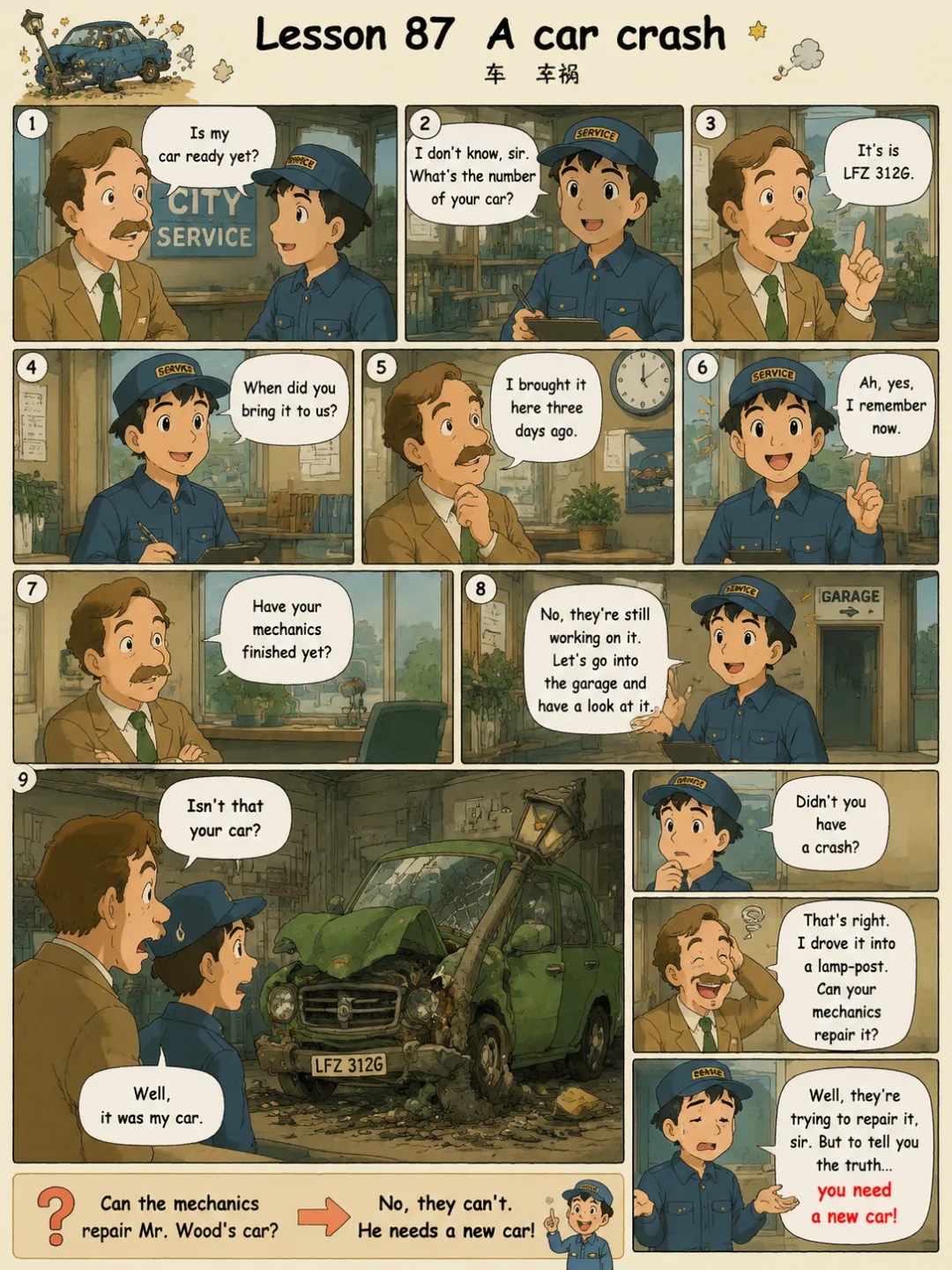
Lesson 87 A car crash
📜 课文原文(含语音标注)
MR. WOOD: Is my car `ready` yet? (ready连读至yet)
伍德先生:我的车修好了吗?
ATTENDANT: I don’t `know`, sir. What’s the `number` of your car? (know重读,number元音/ʌ/)
服务员:我不知道,先生。您的车牌号是多少?
MR. WOOD: It `is` LFZ 312G. (is弱读为/ɪz/)
伍德先生:是 LFZ 312G。
ATTENDANT: When did you `bring` it to us? (bring重读,did弱读)
服务员:您什么时候把车送到我们这里的?
MR. WOOD: I `brought` it here three days `ago`. (brought发音/brɔːt/,ago双元音/əʊ/)
伍德先生:我是三天前送到这里的。
ATTENDANT: Ah, `yes`, I `remember` now. (yes短促,remember重音在第二音节)
服务员:啊,是的,我现在记起来了。
MR. WOOD: Have your `mechanics` `finished` yet? (have弱读,mechanics重音在第二音节)
伍德先生:你们的修理工修好了吗?
ATTENDANT: No, they’re `still` `working` on it. Let’s go into the `garage` and have a look at it.
服务员:没有,他们还在修。我们到车间去看看吧。
ATTENDANT: `Isn’t` that your car? (Isn’t重读,反问语气上升)
服务员:那不是您的车吗?
MR. WOOD: `Well`, it `was` my car. (well拖长,was重读表示过去)
伍德先生:呃,它过去是我的车。
ATTENDANT: `Didn’t` you have a crash? (Didn’t重读,语调上升表惊讶)
服务员:您难道没出车祸吗?
MR. WOOD: That’s `right`. I `drove` it into a lamp-post. Can your mechanics `repair` it?
伍德先生:没错。我把它撞到路灯柱上了。你们的修理工能修好吗?
ATTENDANT: Well, they’re `trying` to repair it, sir. But to tell you the truth, you need a `new` car!
服务员:呃,他们正在努力修,先生。但是老实说,您需要一辆新车了!
Lesson 88 Have you… yet?
📜 课文原文(课文例句训练部分,用于语法操练)
Example:Have you bought a new car yet? Yes, I have already bought one. When did you buy it? I bought it three days ago.
Pattern Practice:Have they had their dinner yet? Yes, they have already had their dinner. When did they have it? They had it an hour ago.
Has she finished her homework yet? Yes, she has already finished it. When did she finish it? She finished it yesterday.
Have you seen that film yet? No, I haven’t seen it yet. Are you going to see it? Yes, I’m going to see it tonight.
情景说明:对话发生在一家汽车修理厂(garage)。伍德先生前来提取他的汽车,希望车子已经修好。修理厂的服务员接待了他,并开始核查相关信息。当他们来到车间时,伍德先生认出了自己的车——但它已经面目全非。服务员惊讶地问他是否出了事故,伍德先生承认自己把车撞到了路灯柱上。服务员坦言,虽然工人们还在努力修理,但老实说,伍德先生需要一辆新车了。这一场景生动展现了日常生活中的汽车维修服务场景,同时也包含了丰富的对话互动模式。
参考译文:伍德先生:我的车修好了吗?服务员:我不知道,先生。您的车牌号是多少?伍德先生:是 LFZ 312G。服务员:您什么时候把车送来的?伍德先生:我是三天前送到这里的。服务员:啊,是的,我现在记起来了。伍德先生:你们的修理工修好了吗?服务员:没有,他们还在修。我们到车间去看看吧。服务员:那不是您的车吗?伍德先生:呃,它过去是我的车。服务员:您难道没出车祸吗?伍德先生:没错。我把它撞到路灯柱上了。你们的修理工能修好吗?服务员: 呃,他们正在努力修,先生。但是老实说,您需要一辆新车了!
🔍 第二部分:逐句精讲与词块总结
句子1
原文: Is my car ready yet?
翻译: 我的车修好了吗?
句子结构: 主系表结构(一般疑问句)。Is(系动词)my car(主语)ready(表语)yet(时间状语)。这是一个现在时态的疑问句,yet用于疑问句中表示“已经”。
重点词汇:
ready 蓝思值 320 L
英音 /ˈredi/ 美音 /ˈredi/ 词性:形容词
释义:准备好的,准备就绪的
常用语块:get ready(准备好),ready for(为……做好准备),ready to do(准备做某事)
例句一:I am ready to leave now. 我现在准备好出发了。
例句二:The dinner is ready. Please come to the table. 晚餐准备好了,请入座。
拓展:ready源自中古英语,与ride(骑行)同源,原指“准备好骑马上路的”。搭配get ready for可记忆为“为……做好准备”,如get ready for school(准备上学)。注意ready后可接to do或for doing,但以to do更常见。
yet 蓝思值 240 L
英音 /jet/ 美音 /jet/ 词性:副词
释义:已经(用于疑问句);还(用于否定句)
常用语块:not yet(还没有),have you… yet?(你已经……了吗?)
例句一:Have you finished your work yet? 你完成工作了吗?
例句二:He hasn’t arrived yet. 他还没有到。
拓展:yet是现在完成时标志性时间副词,与already相对。yet用于否定句表示“尚未”,用于疑问句表示“已经”。注意yet通常放在句末。与still不同,still表示“仍然”,强调动作持续,而yet侧重于“预期事件是否发生”。
语法点睛:本句是现在完成时态的一般疑问句形式。现在完成时的基本结构为“have/has + 过去分词”。yet用于疑问句中表示对已完成动作的询问。在现在完成时中,yet总是放在句尾,用于询问某件事是否已经发生。注意:have/has助动词在疑问句中提前,与主语倒装。在本课重点句型“Have you… yet?”中,这个结构承载了“询问是否已完成某事”的核心功能。来源于[NCE知识点笔记]
语音要点: Is首音/ɪz/弱读;my重读表示所属;ready中/r/音需充分卷舌;yet位于句末,读降调但声音不完全沉降,暗示期待回答。整句语调从前向上升,再在ready处下抑,yet处微降。
句子2
原文: I don’t know, sir. What’s the number of your car?
翻译: 我不知道,先生。您的车牌号是多少?
句子结构: 这是一个由两个独立句子构成的复合发言。第一句为主谓宾结构(I主语,don’t know谓语,省略宾语从句);第二句为特殊疑问句(What’s系动词,the number主语,of your car介词短语作定语修饰number)。
重点词汇:
know 蓝思值 100 L
英音 /nəʊ/ 美音 /noʊ/ 词性:动词
释义:知道,了解,认识
常用语块:know about(了解),know how to(知道如何),let me know(告诉我)
例句一:Do you know the answer? 你知道答案吗?
例句二:I don’t know where he lives. 我不知道他住在哪里。
拓展:know属高频动词,其过去式knew,过去分词known。需要区分know和know about的细微差异——know表示直接认识或知晓,know about表示间接了解或听说过。如I know him(我认识他本人)vs I know about him(我听说过他)。
number 蓝思值 120 L
英音 /ˈnʌmbə/ 美音 /ˈnʌmbər/ 词性:名词
释义:数字,号码,数量
常用语块:phone number(电话号码),room number(房间号码),number of(……的数量)
例句一:What is your house number? 你的门牌号是多少?
例句二:The number of students is increasing. 学生数量在增加。
拓展:number在本课中特指车牌号(car number或license number)。英美说法存在差异:英国常用registration number或number plate指车牌,美国多用license plate number。numb源自中古英语nombe,最终源于拉丁语numerus。
sir 蓝思值 60 L
英音 /sɜː/ 美音 /sɜːr/ 词性:名词
释义:先生(尊称)
常用语块:yes sir(是,先生),Dear Sir(尊敬的先生——书信开头)
例句一:Can I help you, sir? 需要帮忙吗,先生?
例句二:Thank you, sir. 谢谢您,先生。
拓展:sir是英语中非常正式的尊称,用于称呼男性,通常用于服务行业、军队、正式场合。与之对应的是madam(女士)。注意sir不与姓氏连用,Sir(首字母大写)在英国用于爵士的称号,如Sir Paul McCartney。
car 蓝思值 60 L
英音 /kɑː/ 美音 /kɑːr/ 词性:名词
释义:汽车,轿车
常用语块:by car(开车),car park(停车场),new car(新车)
例句一:She drives her car to work every day. 她每天开车上班。
例句二:This car can seat five people. 这辆车可以坐五个人。
拓展:car是automobile的口语简称,源自拉丁语carrus(四轮马车)。与汽车相关的词汇丰富:sedan(轿车),SUV(运动型多用途车),convertible(敞篷车),hatchback(掀背车)。注意英式英语中car还指火车车厢,如dining car(餐车)。
语法点睛:这是一个使用“don’t know”表示“不知道”的否定陈述句,搭配“What’s…?”特殊疑问句。值得注意的是,服务员在不知道具体信息时直接说“I don’t know”,体现了诚实直接的服务态度。这种“否定陈述+说明”的模式在英语日常对话中非常自然,常用于正式或半正式的服务场景。来源于[NCE知识点笔记]
语音要点: don't know连读时/dəʊnt/轻促;sir音调微升,体现礼貌;number中/m/音需双唇闭合;what's与the连读为/wɒtsðə/;整句语速适中,体现正式又不失亲切的服务语气。
句子3
原文: It is LFZ 312G.
翻译: 是LFZ 312G。
句子结构: 主系表结构(陈述句)。It(主语)is(系动词)LFZ 312G(表语/号码)。这里it指代“车牌号码”,而非汽车本身。
重点词汇:
LFZ 312G
车牌号在英国通常采用“两个字母+两个数字+三个字母”或“三个字母+四个数字+一个字母”等格式。LFZ 312G中的LFZ可能是地名代码,312为序列号,G代表车辆注册年份代码。本课中使用虚构号码LFZ 312G。
语法点睛:这是一句简短的陈述句,但包含英语中一个独特的语法现象:在说明车牌号码时,英文字母需要逐个读出,数字常规读出。当it指代上文提到的“车牌号码”时,it is的省略形式it’s常用于口语中。本句未使用缩略形式‘It’s’,而用全称,可能是对话需要清晰强调号码的原因。来源于[NCE知识点笔记]
语音要点:数字和字母的表达要清晰、一字一顿。LFZ需逐个发音:/el/ /ef/ /zed/(英式发音zed而非zee);312读作three one two而非three hundred and twelve;G为/dʒiː/。整句采用平稳降调,体现给出信息的确定性。
句子4
原文: When did you bring it to us?
翻译: 您什么时候把车送到我们这里的?
句子结构: 特殊疑问句。When(疑问副词)did(助动词)you(主语)bring(谓语动词)it(宾语)to us(介词短语作地点状语)。这是一个一般过去时的特殊疑问句。
重点词汇:
bring 蓝思值 120 L
英音 /brɪŋ/ 美音 /brɪŋ/ 词性:动词(不规则动词)
释义:带来,拿来
常用语块:bring to(带到),bring back(带回来),bring in(带进来),bring up(抚养/提出)
例句一:Please bring your book to class tomorrow. 请明天把你的书带到课堂上来。
例句二:The waiter brought the menu to us. 服务员把菜单拿给了我们。
拓展:bring与take是英语学习中极易混淆的一对。bring表示“带来”(向着说话者的方向),take表示“带去”(远离说话者的方向)。如“Bring it here”(拿到这儿来)vs “Take it away”(把它拿走)。记忆口诀:带来用bring,带去用take。
us 蓝思值 40 L
英音 /ʌs/ 美音 /ʌs/ 词性:代词(人称代词we的宾格)
释义:我们
常用语块:to us(给我们),with us(和我们在一起),for us(为了我们)
例句一:She gave the keys to us. 她把钥匙给了我们。
例句二:He came with us to the park. 他和我们一起去公园。
拓展:us是we的宾格形式,在句子中作宾语。注意区分we(主格——作主语)和us(宾格——作宾语)。口语中us经常弱读为/əs/。在非正式美语中,us有时在口语中用于替代me,如“Give us a call”,但在正式写作中应避免。
when 蓝思值 80 L
英音 /wen/ 美音 /wen/ 词性:疑问副词/连词
释义:什么时候
常用语块:when did(疑问句结构),when to do(何时做)
例句一:When does the train leave? 火车什么时候出发?
例句二:Tell me when you are ready. 当你准备好时告诉我。
拓展:when是时间状语从句最常见的引导词之一。注意when引导的从句中不应再使用将来时(用一般现在时表将来),如“I will call you when I arrive”(我到达时会给你打电话),而非“when I will arrive”。
语法点睛:本句是典型的一般过去时特殊疑问句。其结构为“When + did + 主语 + 动词原形 + 其他成分”。使用此结构时,疑问词when提问“什么时候”,助动词did表明时态为一般过去时,后面的实义动词必须使用原形。这个结构与本课重点语法“现在完成时”形成鲜明对比——一般过去时关注过去特定时间发生的动作,现在完成时关注的是过去动作与现在的联系。本句中出现“I brought it here three days ago”的回答,恰好展示了两种时态的配合使用。来源于[NCE知识点笔记]
语音要点: When首音/w/需圆唇,did短促不重读,bring清晰强调/b/音,it弱读/t/,us弱读/əs/。整句语调先升后降,when高起,语法结构did处音调下降,bring处稍升,us处降调收尾。
句子5
原文: I brought it here three days ago.
翻译: 我是三天前把它送到这里的。
句子结构: 主谓宾状结构。I(主语)brought(谓语)it(宾语)here(地点状语)three days ago(时间状语)。这是一般过去时的肯定陈述句。
重点词汇:
brought 蓝思值 260 L
英音 /brɔːt/ 美音 /brɔːt/ 词性:动词(bring的过去式和过去分词形式)
释义:带来(过去时间发生的动作)
常用语块:brought to(带到了),brought with(随身带了),brought back(带回了)
例句一:She brought her friend to the party last night. 她昨晚带朋友来参加了派对。
例句二:They brought some food with them. 他们随身带了一些食物。
拓展:brought是bring的不规则变化形式。记忆规则动词变化只需加-ed,而不规则动词需逐个记忆。brought容易与bought(buy的过去式/buy的发音为baɪ/,过去式为bɔːt/)混淆。记忆口诀:bring-brought-brought,想到“把东西拿来”,过去式仍然不“规则”。
ago 蓝思值 200 L
英音 /əˈɡəʊ/ 美音 /əˈɡoʊ/ 词性:副词
释义:以前
常用语块:… days ago(……天前),long ago(很久以前),a while ago(一会儿前)
例句一:His father died three years ago. 他的父亲三年前去世了。
例句二:I met her a week ago. 我一周前遇见了她。
拓展:ago与before的辨析是英语学习的重点。ago表示“从现在往回推”,用于一般过去时,如two days ago(两天前)。before表示“从过去某个时间往回推”,可用于过去完成时,如She said she had finished it two days before(她说她两天前就完成了)。简单记忆:ago以现在为起点,before以过去某时为起点。
here 蓝思值 80 L
英音 /hɪə/ 美音 /hɪr/ 词性:副词
释义:这里,在这儿
常用语块:over here(在这儿),here and there(到处),here you are(给你)
例句一:Put the bag here. 把包放在这里。
例句二:I live here. 我住在这里。
拓展:here与there成对出现(此处与彼处)。注意here提前的倒装结构:如果主语是名词,动词要放在here之后、主语之前(Here comes the bus),但如果主语是代词,则不倒装(Here he comes)。
语法点睛:brought是本课语法精讲的关键词汇——它是不规则动词bring的过去式。本句使用了“一般过去时(brought)+ 时间状语(three days ago)”的经典搭配,表达“过去特定时间发生的动作,与现在无必然联系”。这正是一般过去时与本课语法核心“现在完成时”的根本区别:一般过去时聚焦过去,现在完成时连接过去与现在。来源于[NCE知识点笔记]
语音要点: I发长音/aɪ/;brought中/br/爆破连读,/ɔː/长元音需发音到位,/t/轻微爆破。here处语速略慢,体现“这里”的位置强调;three days ago中three和days连读/ðriː-deɪz/,ago双元音/əʊ/需充分。整句降调平稳,confirm信息。
句子6
原文: Ah, yes, I remember now.
翻译: 啊,是的,我现在记起来了。
句子结构: 这是一个由感叹词(Ah)引出、以yes作为确认的句子。主句为“I remember now”,是主谓结构(I主语,remember谓语,now时间状语)。句中yes作为确认回应,体现对话互动性。
重点词汇:
remember 蓝思值 340 L
英音 /rɪˈmembə/ 美音 /rɪˈmembər/ 词性:动词
释义:记住,记得,回忆起
常用语块:remember to do(记得去做某事),remember doing(记得做过某事),remember well(记得很清楚)
例句一:Please remember to lock the door. 请记得锁门。
例句二:I don’t remember seeing that film. 我不记得看过那部电影。
拓展:remember后接不定式和动名词时含义不同:remember to do表示“记得要做某事(还未做)”,remember doing表示“记得做过某事(已发生)”。对比:I remember to post the letter(我记得要去寄信)vs I remember posting the letter(我记得寄过信了)。记忆方法:re-(再次)+ member(成员)→再次成为成员→记起。
now 蓝思值 80 L
英音 /naʊ/ 美音 /naʊ/ 词性:副词/连词
释义:现在,目前
常用语块:right now(立刻),by now(到如今),now and then(偶尔)
例句一:What are you doing now? 你现在在做什么?
例句二:Now listen to me carefully. 现在仔细听我说。
拓展:now的发音需注意双元音/aʊ/,可通过mouth的发音类比记忆。now常与过去对比使用,如“Before I didn’t know, but now I know”。
语法点睛:本句的语法要点是现在时动词remember的运用。remember是一般现在时的陈述句,与前面讨论的过去时形成时态对比。now作为时间状语,表示“在此刻”,进一步强化了现在时态。值得注意:why用“now”而非“then”?因为remember这个动作发生在说话的那一刻。来源于[NCE知识点笔记]
语音要点: Ah为感叹词,音调上升,嘴张开发/aː/;yes短促肯定;I稍重读;remember重音在第二音节;now双元音充分发音,语调下降表示确认。整句体现“恍然大悟”的语气。
句子7
原文: Have your mechanics finished yet?
翻译: 你们的修理工修好了吗?
句子结构: 现在完成时的一般疑问句。Have(助动词)your mechanics(主语)finished(过去分词做谓语核心)yet(时间状语)。主语your mechanics是第三人称复数,因此助动词用have而非has。
重点词汇:
mechanic 蓝思值 600 L
英音 /məˈkænɪk/ 美音 /məˈkænɪk/ 词性:名词
释义:机械师,修理工
常用语块:car mechanic(汽车修理工),trained mechanic(训练有素的技工)
例句一:The mechanic fixed my car in two hours. 修理工两小时内修好了我的车。
例句二:My brother is a mechanic. He works in a garage. 我哥哥是修理工,他在一家修车厂工作。
拓展:mechanic与machine(机器)同源,均源于希腊语mekhane(装置、机器)。后缀-ic常表示“与……相关的人”。相关词汇:mechanical(机械的),mechanics(机械学),mechanism(机制)。注意发音时/ə/音不可省略,重音在第二音节。
finish 蓝思值 220 L
英音 /ˈfɪnɪʃ/ 美音 /ˈfɪnɪʃ/ 词性:动词
释义:完成,结束
常用语块:finish doing(完成做某事),finish up(结束),finish line(终点线)
例句一:Have you finished your homework? 你完成作业了吗?
例句二:The film finishes at nine o‘clock. 电影九点结束。
拓展:finish与end的区别:finish侧重“完成、做完”,end侧重“结束、终止”。如finish a book表示“读完一本书”,end a story表示“结束一个故事”。finish后只能接动名词(finish doing),不能接不定式(不能说finish to do)。
语法点睛:本句是现在完成时疑问句的典型句式,与本课重点句型“Have you… yet?”完全一致。结构为“Have/Has + 主语 + 过去分词 + yet”。这个结构用来询问某事是否已经完成或发生,yet位于句末。回答时肯定用“Yes, … have/has already…”,否定用“No, … haven’t/hasn’t… yet”。注意:疑问句中的yet与肯定句中的already是这对用的。来源于[NCE知识点笔记]
语音要点: Have弱读/həv/;your mechanics中your轻读/微连读;finished重音在第一音节;yet短促但完整,语调略升。整句为疑问句,末尾升调。
句子8
原文: No, they’re still working on it. Let’s go into the garage and have a look at it.
翻译: 没有,他们还在修。我们到车库去看看吧。
句子结构: 这是一个由两个句子构成的复合发言。第一句“No, they’re still working on it”是现在进行时的否定陈述句(they’re working,still修饰,on it做状语)。第二句“Let’s go into the garage and have a look at it”是祈使句(Let’s引导的建议句式)。
重点词汇:
still 蓝思值 180 L
英音 /stɪl/ 美音 /stɪl/ 词性:副词
释义:仍然,依旧
常用语块:still doing(仍在做),still there(仍然在那里),still waiting(仍在等待)
例句一:Is it still raining? 雨还在下吗?
例句二:She still loves him. 她仍然爱着他。
拓展:still与yet的区别:still表示“仍然(持续状态)”,常用于肯定句和疑问句;yet表示“还未”,常用于否定句和疑问句。对比:He is still sleeping(他还在睡)vs He hasn’t woken up yet(他还没醒)。still在句中位于行为动词之前,be动词之后。
garage 蓝思值 440 L
英音 /ˈɡærɑːʒ/ 美音 /ɡəˈrɑːʒ/(美式发音重音在第二音节)
释义:车库;修车厂
常用语块:in the garage(在车库里),park in the garage(停在车库里),garage sale(庭院旧物出售——在车库里进行的)
例句一:My father parks his car in the garage every night. 我父亲每晚把车停在车库里。
例句二:The garage is located near the main street. 修车厂位于主街附近。
拓展:garage源自法语garer(保护、停放)。英美发音有显著差异:英式/ˈɡærɑːʒ/,美式/ɡəˈrɑːʒ/(也可读作/ˈɡærɪdʒ/)。garage在美国还常指“加油站”(gas station)以外的汽车服务场所。相关词汇:garaging(停放于车库),garageman(修车厂工人)。
look 蓝思值 80 L
英音 /lʊk/ 美音 /lʊk/ 词性:动词/名词
释义:看,瞧(本课中作名词使用:have a look)
常用语块:have a look(看一看),look at(看着),look for(寻找),look after(照顾)
例句一:Let me have a look at your photo. 让我看看你的照片。
例句二:She looked out of the window. 她向窗外看去。
拓展:look相关的短语动词极多:look up(查阅/仰望),look down on(看不起),look forward to(期待),look into(调查)等。注意look与see、watch的区别——look强调“有意识地看”,see强调“看见(结果)”,watch强调“注视(动态)”。
go into 蓝思值 130 L
英音 /ɡəʊ ˈɪntuː/ 美音 /ɡoʊ ˈɪntu/ 词性:短语动词(go + into)
释义:进入(某处)
常用语块:go into the room(进入房间),go into detail(详细说明)
例句一:Please go into the office and wait. 请进办公室等候。
例句二:Don’t go into my bedroom without knocking. 别不敲门就进我的卧室。
拓展:go into是由不及物动词go和介词into构成的短语动词,后接地点名词。类似结构:get into(进入/陷入),come into(进入),run into(跑进/偶遇)。
语法点睛:第一句使用了现在进行时(are working),表示“正在进行的动作”,与前面询问现在完成时(Have your mechanics finished yet?)形成对照——现在完成时问“是否已完成(结果)”,现在进行时回答“还在做(过程)”。第二句“Let’s go…”是建议祈使句,Let’s = Let us。祈使句中使用and连接两个动词短语(go into和have a look)是英语常见结构,相当于“go in order to have a look”。来源于[NCE知识点笔记]
语音要点: No降调,they’re弱读;still重读,强调“仍然”;working中/ɜː/发音需到位,on it连读/ɒnɪt/;Let’s短促有效,go强调双元音/əʊ/;garage重音在第二音节(美式),have a look连读/hævəlʊk/;at it连读/ætɪt/。
句子9
原文: Isn’t that your car?
翻译: 那不是您的车吗?
句子结构: 否定疑问句。Isn’t(is not的缩略形式——系动词否定,提前至主语前)that(主语)your car(表语)。否定疑问句表示惊讶、确认或期望得到肯定回答。
重点词汇:
isn’t 蓝思值 40 L
英音 /ˈɪzənt/ 美音 /ˈɪzənt/ 词性:动词缩略形式(is not的否定缩略形式)
释义:不是
常用语块:isn’t it?(不是吗?——反问),isn‘t that(那不是)
例句一:It isn't a problem. 这不是问题。
例句二:Isn’t she beautiful? 她难道不漂亮吗?
拓展:isn’t是英语中最常见的否定缩略形式之一。否定疑问句使用缩略形式在口语中十分自然。注意否定疑问句带有强烈的感情色彩,如惊讶、责备、期待等,不同于一般疑问句的中性询问。
that 蓝思值 50 L
英音 /ðæt/ 美音 /ðæt/ 词性:代词/连词/限定词
释义:那个,那(本课中用作主语代词)
常用语块:that is(那是),that one(那个),that way(那个方向/方式)
例句一:That is my house. 那是我的房子。
例句二:Who said that? 谁说的那个?
拓展:that在英语中有多重词性,是最高频单词之一。作为代词时,指代离说话者较远的人或事物(与this相对)。注意that在口语中常弱读/ðət/。
语法点睛:否定疑问句(Isn’t that…?)在本课语法中具有重要功能——表达惊讶和确认。否定疑问句的结构为“否定助动词/系动词 + 主语 + 谓语”,期望对方给出肯定回答(Yes, it is.)。这种句式通常表示说话者根据自己的观察或判断,对某事感到惊讶或质疑,期待对方确认。本句中的Isn’t that your car? 隐含着“我认为那应该是你的车,但情况似乎不对”的意思。注意:回答否定疑问句时,Yes/No根据事实而非句式——事实肯定就说Yes,事实否定就说No,与汉语习惯不同。来源于[NCE知识点笔记]
语音要点: Is n’t 重音在第一音节,语调先升后降——升的部分表达疑问,降的部分表达确认的期待。that和your短促,car长元音/ɑː/拉长显强调。整句为否定疑问句,一般升调结尾表惊讶。
句子10
原文: Well, it was my car.
翻译: 呃,它过去是我的车。
句子结构: 主系表结构。Well(语气词)it(主语)was(系动词——过去时)my car(表语)。这是伍德先生对服务员判断的回应,通过时态由is变为was,表达出车辆现状的改变。
重点词汇:
was 蓝思值 40 L
英音 /wɒz/ 美音 /wʌz/ 词性:动词(be的过去式——第一、三人称单数)
释义:(过去)是
常用语块:it was(它是),I was(我是),there was(曾有)
例句一:He was a teacher ten years ago. 他十年前是老师。
例句二:I was at home yesterday. 我昨天在家。
拓展:was是be动词的过去式单数形式(复数用were)。was发音在英式与美式略有差异。注意was not的缩略形式为wasn’t(/ˈwɒzənt/或/ˈwʌzənt/)。
my 蓝思值 40 L
英音 /maɪ/ 美音 /maɪ/ 词性:形容词性物主代词
释义:我的
常用语块:my book(我的书),my friend(我的朋友),my name(我的名字)
例句一:This is my pen. 这是我的钢笔。
例句二:I love my family. 我爱我的家人。
拓展:my的对应宾格是me(我),名词性物主代词是mine(我的)。注意区分my + 名词结构与名词性物主代词mine的用法:This is my book = This book is mine。
语法点睛:本句的语法核心是时态对比——was(过去时)与句9中隐含的is(现在时)的对立。伍德先生使用was而非is,暗示“这辆车已经不再是过去的车了(因为撞坏了)”。这种通过时态变化表达复杂含义的手法在英语中非常常见。例如:“He was a good friend”暗示“他现在已经不算/不再是好朋友了”。来源于[NCE知识点笔记]
语音要点: Well拖长,表示犹豫;it弱读/t/;was重读,强调时间(过去);my拉长语调稍升;car降调,伴随意味深长的停顿。整句语调体现无奈和幽默——车子被撞得面目全非,不再像“他的车”了。
句子11
原文: Didn’t you have a crash?
翻译: 您难道没出车祸吗?
句子结构: 一般过去时的否定疑问句。Didn’t(did not的缩略形式——助动词否定,提前至主语前)you(主语)have(谓语动词原形)a crash(宾语)。这是对过去特定事件的确认询问。
重点词汇:
crash 蓝思值 390 L
英音 /kræʃ/ 美音 /kræʃ/ 词性:名词/动词
释义:碰撞;车祸;坠毁
常用语块:car crash(车祸),plane crash(飞机失事),crash into(撞上)
例句一:There was a serious car crash on the highway. 高速公路上发生了一起严重车祸。
例句二:The driver crashed the car into a tree. 司机把车撞到树上。
拓展:crash既可是名词(事故),也可是动词(撞)。注意crash与collision的区别:crash侧重“猛烈碰撞”的结果,collision侧重“碰撞”的动作本身。与bang、bump相比,crash的程度更重,损失更大。相关短语词:crash out(撞出),crash through(撞穿)。
didn‘t 蓝思值 60 L
英音 /ˈdɪdənt/ 美音 /ˈdɪdənt/ 词性:助动词否定缩略形式(did not)
释义:没有(用于过去时否定)
常用语块:didn’t know(不知道),didn‘t go(没有去),didn’t want(不想要)
例句一:She didn‘t come to the party. 她没有来派对。
例句二:They didn’t finish the work on time. 他们没有按时完成工作。
拓展:didn‘t是构成一般过去时否定句和否定疑问句的核心助动词,后接动词原形。注意didn’t本身已经包含了时态信息(过去),后面的动词不能再变过去式。常见错误:I didn‘t went(×)→ I didn’t go(√)。
语法点睛:这是过去时的否定疑问句(Didn‘t you…?),与句9的现在时否定疑问句(Isn’t that…?)形成时态呼应。否定疑问句在本课中连续出现两次,表达的意义极具戏剧效果——服务员看到面目全非的汽车后,半信半疑地确认“你是否出了事故”。这种“否定疑问句+后续解释”的模式(问句引出回答,回答者解释原因)是英语日常对话中非常自然的交流节奏。来源于[NCE知识点笔记]
语音要点: Didn‘t重读,发音清晰;you弱读/ju/;have短促;crash重读强调事故严重性,爆破音/kræʃ/。整句语调先升后降——否定疑问句特有的语调模式,前半升表疑问,后半降表确认期待。
句子12
原文: That’s right. I drove it into a lamp-post. Can your mechanics repair it?
翻译: 没错。我把它撞到路灯柱上了。你们的修理工能修好吗?
句子结构: 三个独立句子。第一句“That‘s right”是主系表结构(简略肯定)。第二句“I drove it into a lamp-post”是主谓宾状结构。第三句“Can your mechanics repair it?”是情态动词can引导的一般疑问句。
重点词汇:
drove 蓝思值 260 L
英音 /drəʊv/ 美音 /droʊv/ 词性:动词(drive的过去式)
释义:驾驶(过去时间发生的动作)
常用语块:drove to(开车到),drove into(开进了/撞上了),drove away(开走了)
例句一:He drove to the airport by himself. 他自己开车去了机场。
例句二:She drove the car into the garage. 她把车开进了车库。
拓展:drive(v.驾驶)→ drove(过去式)→ driven(过去分词)。不规则动词变化需要记住:drive-drove-driven。drive into既可表示“开车进入”,也可表示“撞上”。本课中“drove it into a lamp-post”用了into表示“撞上”的含义,强调运动的终点是路灯柱。
lamp-post 蓝思值 720 L
英音 /ˈlæmp pəʊst/ 美音 /ˈlæmp poʊst/ 词性:名词(复合名词)
释义:路灯柱
常用语块:hit a lamp-post(撞到路灯柱),street lamp(路灯)
例句一:The car hit the lamp-post and stopped. 汽车撞到路灯柱后停了下来。
例句二:There is a lamp-post in front of our house. 我们家门前有一个路灯柱。
拓展:lamp-post是由lamp(灯)+ post(柱子)构成的复合名词。类似的复合词:lampshade(灯罩),lamplight(灯光)。注意lamp(灯)与light(光/灯)的区别——lamp侧重“灯具”,light侧重“光源/光线”。
repair 蓝思值 360 L
英音 /rɪˈpeə/ 美音 /rɪˈper/ 词性:动词/名词
释义:修理,修复
常用语块:repair a car(修车),under repair(正在修理中),repair shop(修理铺)
例句一:Can you repair this watch? 你能修这块表吗?
例句二:The bridge is under repair. 这座桥正在维修中。
拓展:repair与fix/mend的区别:repair较正式,多用于需要专业技能的修理;fix是口语中最常用的“修理”;mend侧重“修补(使恢复原状)”,如mend a sock(补袜子)。相关词汇:reparation(赔偿),repairable(可修理的)。
can 蓝思值 40 L
英音 /kæn/ 美音 /kæn/ 词性:情态动词
释义:能够,可以
常用语块:can do(能做),can see(能看到),can help(能帮忙)
例句一:I can swim very well. 我游泳游得很好。
例句二:Can I open the window? 我可以打开窗户吗?
拓展:can是英语中使用频率最高的情态动词之一,表示能力、可能性、许可。过去式为could。否定形式为can’t(/kɑːnt/英式 /kænt/美式)。注意can在口语中常弱读为/kən/,但强调时读/kæn/。
语法点睛:本句中包含三个重要语法结构:①一般过去时(drove)用于描述过去已发生的事件;②短语动词(drove it into a lamp-post)中的into表示动态进入/撞击的方向;③情态动词can表示能力或可能性(Can your mechanics repair it?——询问修理工是否有能力修复)。这三句合在一起展示了过去行为(发生事故)、和当前结果(询问能否修复)之间的时间逻辑关系,完整呈现了本课语法对比的核心——一般过去时与现在完成时的配合使用。来源于[NCE知识点笔记]
语音要点: That‘s right短促肯定;I drove中dr振动音需强烈、双元音/əʊ/充分发音;into-a连读/ɪntə/;lamp-post双词读近一个单词,lamp发音略短;Can助动词弱读/kən/,mechanics清晰发音;repair处于句末,语调上升表示能否修复的询问。
句子13
原文: Well, they’re trying to repair it, sir. But to tell you the truth, you need a new car!
翻译: 呃,他们正在努力修理,先生。但是老实说,您需要一辆新车了!
句子结构: 两个句子。第一句为现在进行时陈述句“they’re trying to repair it”。第二句为并列句“But to tell you the truth, you need a new car”,其中But是连接词,to tell you the truth是插入语(不定式短语作评论性状语),主句为you need a new car。
重点词汇:
try 蓝思值 160 L
英音 /traɪ/ 美音 /traɪ/ 词性:动词
释义:尝试,试图,努力
常用语块:try to do(努力/试图做),try doing(尝试做),try one’s best(尽力)
例句一:I will try my best to help you. 我将尽力帮助你。
例句二:Why don’t you trying calling him again? 你为什么不试试再给他打个电话?
拓展:try to do与try doing的区别:try to do表示“努力/试图去做某事(可能成功也可能失败)”,try doing表示“尝试做某事(看看效果如何)”。对比:I tried to open the door(我努力想打开门)vs I tried opening the door with a key(我试着用钥匙开门)。
truth 蓝思值 380 L
英音 /truːθ/ 美音 /truːθ/ 词性:名词
释义:真相,事实;真理
常用语块:tell the truth(说实话),the truth(真相),in truth(事实上)
例句一:Always tell the truth. 永远说实话。
例句二:The truth is that he didn’t know. 事实是他不知道。
拓展:truth是true(真实的)的名词形式。相关词汇:true(adj.真实的),truly(adv.真地),truthful(adj.诚实的)。记忆方法:true + th(名词后缀)= truth。类似构词:warm → warmth(温暖)。
new 蓝思值 80 L
英音 /njuː/ 美音 /nuː/ 词性:形容词
释义:新的
常用语块:new car(新车),new house(新房子),new year(新年)
例句一:She bought a new dress for the party. 她为聚会买了一件新裙子。
例句二:What’s new? 有什么新鲜事?
拓展:new的反义词是old。注意new与brand new(全新)的区别——brand new程度更强。美式英语中new有时被读作/nuː/,省略了/j/音。
语法点睛:本句包含多个语法亮点。第一,现在进行时“they’re trying”表示现在正在进行的动作,与前面问句的现在完成时(Have…finished?)形成过程-结果对照。第二,不定式短语“to tell you the truth”是评论性状语(disjunct),修饰整个句子,表达说话者的立场或态度。第三,need后接名词“a new car”是动词后接宾语的最简单形式。最后,but作为并列连词,体现了诚实但无奈的语气转折——他们正在努力,但真的修不好了。来源于[NCE知识点笔记]
语音要点: Well拖长表犹豫;they’re弱读;trying中/tr/爆破,/aɪ/双元音充分发音;repair it连读/riːpeərɪt/;sir语调微升表礼貌;But短促转折重读;to tell you the truth三个词音调降低表示“实话实说”;need a new car中need和a连读,new和car均重读强调“新车”。整句语调先平后升再降,结尾处car长音拉长,暗示结论令人意外。
📌 核心词块总结
1. have a crashMeaning: to be involved in a car accidentExample: He had a crash when he was driving home.
2. drive intoMeaning: to hit something while drivingExample: The man drove his car into a lamp-post.
3. to tell you the truthMeaning: to be honest / speaking honestlyExample: To tell you the truth, I don’t like this film.
4. work onMeaning: to spend time repairing or improving somethingExample: The mechanics are still working on your car.
5. have a look atMeaning: to examine or check somethingExample: Let me have a look at your new phone.
6. bring toMeaning: to take something or someone to a placeExample: She brought her daughter to the school.
💬 第三部分:基础会话技巧
1. 课文中的日常用语、礼貌表达、问答模式分析
第87课提供了一个非常生活化的服务场景对话,其中包含多个英语日常会话的核心技巧:
服务用语模式:- 问题引导对话:顾客开车到修车厂,对话以问询开始——“Is my car ready yet?” 这是服务场景的典型问题模式:顾客询问服务是否完成。- 信息核实机制:服务员立即进行信息核实——“What’s the number of your car?” 在日常服务对话中,核实信息是确保服务准确的关键步骤,对应中文的“请确认一下信息”。- 记忆触发:当服务员经提醒后想起,使用“Ah, yes, I remember now”来表达恍然大悟,体现了英语中的反应短语(response phrase)在对话中的自然运用。
礼貌表达技巧:- 尊称的使用:服务员全程以“sir”称呼伍德先生,在英语服务场景中体现了礼貌与尊重。- 间接表达负面信息:当需要告诉对方车子可能修不好时,使用“But to tell you the truth”作为缓冲,避免直接说“You need a new car”带来冲击。这是英语中表达负面消息时的宝贵技巧——用前置缓冲短语软化负面信息的力道。- Let’s建议句式:使用“Let’s go into the garage and have a look at it”表达提出建议的方式,较之“We should go”或“Go to the garage”更加礼貌、协作。
问答模式:- 一般疑问句开启→特殊疑问句追问→陈述句回答→否定疑问句确认→解释原因→新问题。这是一个完整的对话链条,展示了英语服务类对话的标准流程:问询-核实-确认-检查-结论。- 现在完成时与一般过去时的交替使用:问现在完成时(Have…finished?)→ 回答现在进行时(they‘re still working)→ 叙述过去(I drove it into...)→ 询问未来可能性(Can…repair it?)。这种时态的自然切换是英语会话中一个核心技能。
2. 类似场景的扩展对话示例
扩展对话一:在修车厂Customer: Is my car ready yet?Attendant: Let me check. What model is your car?Customer: It’s a blue Toyota Corolla.Attendant: I see. When did you bring it here?Customer: I brought it here yesterday morning.Attendant: Ah, yes. The mechanic is still working on it. He’s checking the engine.Customer: How long will it take?Attendant: It should be ready by five o’clock this afternoon.
扩展对话二:在洗衣店Customer: Are my clothes ready yet?Shop assistant: I’m not sure. What’s your name, please?Customer: My name is John Smith.Shop assistant: When did you bring them in?Customer: I brought them in two days ago.Shop assistant: Just a moment, please. Yes, your clothes are ready. Here they are.Customer: Thank you. How much do I need to pay?Shop assistant: That will be fifteen pounds.
扩展对话三:上周末的光景(现在完成时vs一般过去时)A: Have you finished your homework yet?B: Yes, I have already finished it.A: When did you do it?B: I did it last night.A: Have you seen the new film yet?B: No, I haven’t seen it yet. Have you?A: Yes, I saw it yesterday.B: Was it good?A: Yes, it was really interesting.
3. 角色扮演活动建议
活动一:修车厂情境模拟- 角色A:修车厂服务员,检查车辆信息,告知修理进度- 角色B:顾客,询问汽车修理情况,询问费用和完成时间- 在扮演中使用句型:Is my car ready yet? / Have your mechanics finished yet? / When did you bring it? / I brought it (time) ago. / Let’s go and have a look.
活动二:互相询问完成情况- 两人一组,轮流使用“Have you + 过去分词 + yet?”进行提问- 回答时使用“Yes, I have already + 过去分词 / No, I haven’t + 过去分词 + yet”- 然后使用一般过去时追问细节:“When did you + 动词原形?”- 建议词汇列表:finish homework, read the book, clean the room, buy a present, write the letter, make dinner, see the doctor, call your mother
活动三:事故情景重现- 根据课文内容,重现伍德先生到修车厂的完整对话- 额外加入:司机描述事故经过的细节(time, place, reason)- 可扩展:等待时间(waiting time),费用问题(cost),是否可以走保险(insurance)
4. 基础思考与代入式问题
1. 请你想象自己是伍德先生:当你看到自己的车被撞得面目全非时,你的心情是怎样的?你会对服务员说什么?请你用英语写三句话描述你的感受。2. Have you ever(曾经)had a bad experience(不好的经历)with your bicycle, phone or anything? 讲一件你不得不“修理”某样东西的经历。你最后修好了它,还是不得不买新的?
📐 第四部分:本课语法精析(加强版)
语法核心主题:现在完成时与一般过去时的对比;现在完成时中yet/already的用法
核心语法一:现在完成时(Present Perfect Tense)——与一般过去时的对比
1. 基本结构和含义现在完成时的基本结构为:助动词have/has + 过去分词过去分词的形式规则:- 规则动词:动词原形 + -ed(如finish → finished,look → looked,work → worked)- 不规则动词:需单独记忆(如bring → brought,drive → driven,go → gone,see → seen)
来源于[NCE知识点笔记]明确指出:现在完成时表示“过去发生但与现在有联系的动作或状态”。这一定义揭示了现在完成时的本质特征——它关注的不是过去的动作本身,而是过去动作的现在结果。
来源于[名师精讲]中强调:现在完成时有两个核心用法:①表示过去发生的动作对现在产生的影响或结果;②表示从过去延续到现在的动作或状态。
2. 现在完成时 vs 一般过去时的核心区别
来源于[语法新思维]提供了清晰对比:
维度:- 时间焦点:现在完成时——现在(强调与现在的联系);一般过去时——过去(单纯的过去事实)- 时间状语:现在完成时——yet, already, ever, never, just, recently, so far;一般过去时——yesterday, last week, ago, in 2015, at that time- 是否指定时间:现在完成时——不能与明确过去时间连用;一般过去时——必须/可以明确过去时间连用- 例句:现在完成时——I have finished my homework.(现在可以休息了);一般过去时——I finished my homework at 8 o‘clock.(只说过去事实)- 含义侧重:现在完成时——结果/经历/延续;一般过去时——动作发生的时间/背景
来源于[NCE知识点笔记]特别指出:现在完成时和一般过去时在同一对话中交替使用是英语中非常常见的现象,如本课对话中:- Question (Present Perfect): Have your mechanics finished yet? — 关注“现在是否完成”- Answer (Present Continuous): They’re still working on it. — 关注“现在正在做”- Past: I drove it into a lamp-post. — 叙述过去发生的事
这种时态的灵活转换,体现了说话者根据不同交际需求选择对应时态的能力。
对比实例分析:(1) I have lost my key.(现在完成时)— 强调“现在我没有钥匙了”(结果)(2) I lost my key yesterday.(一般过去时)— 强调“昨天钥匙丢了”这一事实(时间)(3) She has been to Paris.(现在完成时)— 强调“她去过巴黎(有这段经历/现在已经回来了)(4) She went to Paris last year.(一般过去时)— 单纯叙述“去年去巴黎”这件事(5) Have you finished your homework yet?(现在完成时问句)— 询问“目前是否完成”(6) When did you finish your homework?(一般过去时问句)— 询问“完成的具体时间”
3. yet和already的用法
来源于[NCE知识点笔记]和[名师精讲]均对yet和already做了重点讲解:
yet的用法:- yet用于疑问句,意为“已经”,表示询问某件事是否已发生——如“Have you finished yet?”- yet用于否定句,意为“还(没)”,表示某事尚未发生——如“I haven’t finished yet.”- yet在句中的位置:通常放在句末(否定句和疑问句)
already的用法:- already用于肯定陈述句,意为“已经”,表示某件事在预料之前已经发生——如“I have already finished.”- already也可用于疑问句(表惊讶),意为“已经……了?——如“Have you already finished?”(你已经做完了?这么快!)- already通常放在助动词与过去分词之间(如have already finished),也可放在句末
yet和already的对比表:肯定句:yet —(不使用);already — I have already finished.否定句:yet — I haven’t finished yet.;already —(不使用)疑问句:yet — Have you finished yet?;already — Have you already finished?(表惊讶)
情景对比训练:- A: Have you eaten yet? — 中性询问,期待信息- B: Yes, I have already eaten. — 肯定的回答,说明已经完成- A: Have you already eaten? — 带惊讶的询问(可能因为时间还早或事情与预期不符)
4. 现在完成时的否定句和疑问句
否定句结构: have/has + not + 过去分词- I have not (haven‘t) finished my homework yet.- She has not (hasn’t) arrived yet.
疑问句结构: Have/Has + 主语 + 过去分词 + 其他?- Have you finished your homework yet?- Has she arrived yet?
特殊疑问句结构: 疑问词 + have/has + 主语 + 过去分词 + 其他?- When have you finished your homework? — 通常用于现在完成时的特殊疑问句较少使用时间词,因为现在完成时不能与明确过去时间连用。但可问:How many pages have you read?
5. 本课练习设计(10道完形/句型转换题,含答案)
一、用所给词的适当形式填空(现在完成时或一般过去时):1. I __________ (see) that film last night.2. She __________ (finish) her work yet?3. They __________ (already / have) lunch.4. He __________ (buy) a new car three days ago.5. We __________ (not / see) the new film yet.
二、句型转换(按要求完成句子):1. She has finished her homework.(改为否定句)2. They have bought a new house.(改为一般疑问句)3. He saw the film yesterday.(改为现在完成时句)4. The mechanics have repaired the car.(改为否定句)5. Have you had your dinner?(用yet进行改写)
参考答案:1. saw —— 因为“last night”是明确过去时间,必须用一般过去时2. Has she finished —— “yet”提示为现在完成时疑问句3. have already had —— “already”在肯定句中表完成4. bought —— “three days ago”是明确过去时间,用一般过去时5. haven‘t seen —— “yet”提示现在完成时否定6. She hasn’t finished her homework yet.7. Have they bought a new house?8. He has seen the film.(或He has already seen the film.)9. The mechanics haven‘t repaired the car yet.10. Have you had your dinner yet?
核心语法二:否定疑问句(Negative Questions)
来源于[NCE知识点笔记]讨论了否定疑问句在本课中的运用。
结构: 否定的助动词/be动词 + 主语 + 其他成分 + ?
句型示例:- Isn’t that your car?(那不是你的车吗?)- Didn‘t you have a crash?(你难道没出车祸吗?)
否定疑问句的三重功能:1. 表示惊讶 —— 说话者对某事感到意外(本课的用法)2. 表示期待肯定回答 —— 说话者认为某事应该是事实3. 表示确认 —— 用于确认不是自己误听或误解
否定疑问句的回答: 按照事实回答——肯定的用Yes,否定用No,不受句式形式的影响。
示例:Q: Isn’t this your car?A: Yes, it is.(肯定——是的,它是我的车——句式“是的,它是”对应肯定事实)A: No, it isn‘t.(否定——不,它不是我的车——句式“不,它不是”对应否定事实)
注意: 汉语和英语在回答否定疑问句时正好相反——汉语根据问句的形式回答,英语根据事实回答。
练习:1. Q: Isn’t she your sister?(她是你妹妹)A: __________(是的,她是)—— Yes, she is.2. Q: Didn‘t he go to the party?(他没去派对)A: __________(不,他去了)—— Yes, he did.(英语:Yes对应事实“他去了”的肯定)
核心语法三:祈使句(Let’s结构)
来源于[名师精讲]评述了“Let‘s go into the garage and have a look at it”这一祈使句的构成。
Let’s结构: Let us的缩略形式 + 动词原形
表意功能: Let‘s用于提出建议,包含说话者和听话者双方参与,意为“我们……吧”。
后续动词: 建议后的动词用原形(Let’s go / Let‘s have / Let’s eat / Let‘s wait)
and的并列结构: Let’s go into the garage and have a look at it中的and连接了两个并列动词短语(go into和have),两个动作之间是顺序关系。
对比:- Let‘s eat.(我们吃饭吧。)—— 一个动作- Let’s eat and then watch a film.(我们吃饭然后看电影。)—— 两个顺序动作- Let‘s go into the garage and have a look.(我们进车库看看。)—— 两个连续动作
核心语法四:情态动词can
can在句子中的用法有三种:1. 表示能力: “I can swim.”(我很会游泳)2. 表示可能性/许可: “Can I come in?”(我能进来吗?)3. 表示请求或能力询问: “Can your mechanics repair it?”(修理工能修好吗?)
在本课中,can使用第三功能向听话者请求其对第三方能力的判断——这是can在日常对话中很自然的用法。
对比can与be able to:- can:简单、直接,用于一般现在时和一般过去时(could)- be able to:更正式,可用于各种时态
I can repair the car.(我现在能修车。)I will be able to repair it tomorrow.(明天能修——将来时只能用be able to)
✏️ 第五部分:基础练习与活动
跟读练习模仿课文录音,注意以下要点:1. 服务员说的“I don’t know”要弱读,保持自然速度2. “When did you bring it to us”中did弱读,bring重读3. “I brought it here three days ago”中的ago双元音发音到位4. “Isn‘t that your car”用提高声调表示惊讶5. 全篇模仿的语气:服务员——礼貌、惊讶但克制;伍德先生——无奈、幽默
角色扮演(替换练习)将课文关键成分按以下结构进行替换:
模式A —— 原结构练习:Is my [物品] ready yet?I brought [物品] here [时间段] ago.Have your [人员] finished yet?
模式B —— 时间状语替换(现在完成时 → 一般过去时):
练习表:现在完成时例句:I have finished my homework. → 一般过去时间状语:an hour ago → 改写句:I finished my homework an hour ago.现在完成时例句:She has arrived. → 一般过去时间状语:ten minutes ago → 改写句:She arrived ten minutes ago.现在完成时例句:They have left. → 一般过去时间状语:five minutes ago → 改写句:They left five minutes ago.现在完成时例句:We have seen the film. → 一般过去时间状语:last week → 改写句:We saw the film last week.现在完成时例句:He has bought a car. → 一般过去时间状语:three days ago → 改写句:He bought a car three days ago.
模式C —— Yet/Already替换训练:根据提示信息填空或改写:1. A: Have you ______ finished your homework?B: No, not______. → yet / yet2. A: Has she arrived______?B: Yes, she has______arrived. → yet / already3. A: I________ (already / eat) lunch.B: Really? You’re so early! → have already eaten4. A: They haven‘t finished the project ______.B: When did they start? → yet
听力理解题目
根据课文录音判断正误(T/F):1. Mr. Wood brought his car to the garage three days ago. (T)2. The mechanics have finished repairing the car. (F)3. Mr. Wood remembers the number of his car. (T)4. The car is still in perfect condition. (F)5. Mr. Wood drove his car into a tree. (F — he drove it into a lamp-post)6. The attendant says Mr. Wood needs a new car. (T)
根据课文录音回答问题:1. What is the number of Mr. Wood’s car? (It‘s LFZ 312G.)2. When did Mr. Wood bring the car to the garage? (Three days ago.)3. Are the mechanics still working on the car? (Yes, they are still working on it.)4. What happened to Mr. Wood’s car? (He drove it into a lamp-post.)5. What does the attendant say at the end of the dialogue? (He says Mr. Wood needs a new car.)
课文改写版本(更简单的词汇)Mr. Wood:Is my car ready?Man:I don‘t know. What is the number of your car?Mr. Wood:It is LFZ 312G.Man:When did you bring it here?Mr. Wood:I brought it three days ago.Man:Oh yes, I remember now.Mr. Wood:Have your workers finished?Man:No, they are still working on it. Let’s go and see.Man:Isn‘t that your car?Mr. Wood:Well, it was my car.Man:You had a crash?Mr. Wood:Yes. I drove it into a lamp-post. Can your workers fix it?Man: They are trying, Sir. But the truth is, you need a new car!
🤔 第六部分:英文深度思考与拓展(强化版)
A. 层次化英文问题与答案
Level 1 (Factual) — 事实性问题(至少3个)Question 1:What is the number of Mr. Wood’s car?Answer:The number of Mr. Wood‘s car is LFZ 312G.Question 2:When did Mr. Wood bring his car to the garage?Answer:He brought his car to the garage three days ago.Question 3:What did Mr. Wood drive his car into?Answer:He drove his car into a lamp-post.Question 4:What does the attendant think about the condition of the car at the end?Answer: The attendant thinks that Mr. Wood needs a new car.
Level 2 (Inferential) — 推理性问题(至少3个)Question 5:Why does Mr. Wood say “It WAS my car” instead of “It IS my car”?Answer:Mr. Wood says “It was my car” because the car is now so badly damaged that it doesn’t look like the same car he brought. He uses “was” to show that the car is no longer in the same condition — it is now broken and unrecognizable.Question 6:Why does the attendant ask “Didn‘t you have a crash?” in the form of a negative question?Answer:The attendant asks a negative question because he is surprised by what he sees and wants to confirm his guess. The negative question shows that the attendant already thinks there was a crash, but wants to make sure.Question 7:When the attendant says “But to tell you the truth, you need a new car,” what does this imply about the mechanics’ work?Answer:This implies that the damage is very serious and the mechanics may not be able to repair the car successfully. The work they are doing may not be enough to make the car drivable again.Question 8:Why does Mr. Wood first ask about the mechanics‘ progress, and then ask “Can your mechanics repair it?” a second time later?Answer: Mr. Wood first asks a general question about completion (Have they finished?), and after seeing the damaged car, he asks a new question about their ability (Can they repair it?). This shows his growing concern — first he expects it to be repaired, but later he is no longer sure.
Level 3 (Evaluative/Creative) — 评价/创造性问题(至少3个)Question 9:If you were Mr. Wood, how would you feel when you saw your crashed car? What would you say to the attendant?Answer:If I were Mr. Wood, I would feel very sad and disappointed. My favourite car was damaged. I would probably say, “This is terrible! I really liked this car. Do you think you can fix it, or should I start looking for a new one?” I would try to stay calm, but I would be worried about the cost as well.Question 10:Do you think it is better to repair a damaged car or buy a new one? Why?Answer:I think it depends on how old the car is and how much it costs to repair. If the car is old and the repair is very expensive, it is probably better to buy a new one. But if the car is still quite new and the repair is not too much, it might be better to repair it. For example, if the repair costs half the price of a new car, I would buy a new one.Question 11:What safety advice would you give to someone who is learning to drive?Answer:I would give them several pieces of advice. First, always drive slowly and carefully, especially when you are a new driver. Second, never use your phone while driving — it is very dangerous. Third, always keep a safe distance from the car in front of you. And most importantly, always wear your seatbelt. Safe driving can prevent accidents like Mr. Wood’s crash.Question 12:Imagine you are the mechanic. The owner asks if you can fix his car, but you are not sure. What would you say?Answer: I would be honest. I would say, “Sir, I am trying my best to repair your car. But the damage is very serious. The front of the car is badly damaged because you drove it into a lamp-post. I think we may not be able to make it like new again. Please be prepared to buy a new car if necessary.”
B. 多类型拓展阅读
Type 1: 现代场景故事At the Car Repair ShopTom’s car broke down on his way to work yesterday. He heard a strange noise, and then the engine stopped. He called a friend who is a mechanic. The friend said, “Bring your car to my garage tomorrow.” So Tom brought his car to the garage this morning. His friend checked the engine carefully. “Have you had any problems before?” his friend asked. “No,” Tom said. “It was working fine until yesterday.” The mechanic said, “I think the engine needs a major repair. I’m afraid you may need a new engine.” Tom was very sad because his car was not very old. He asked, “How much will it cost?” The mechanic said, “Let me give you a full check. I‘ll tell you tomorrow.”引导性问题: Why did Tom’s car stop working? What do you think Tom should do — repair the engine or buy a new car?
Type 2: 文化背景小知识Car Number Plates in the UKIn the United Kingdom, every car has a number plate — you see it at the front and back of the car. The number plate system is very interesting. Before 1983, number plates in the UK had three letters, three numbers, and a final letter. For example, LFZ 312G — the L showed where the car was registered (registered area), the numbers were the serial number, and the final letter G showed the year. The letter changed every year. Old number plates can tell you a lot about a car’s history. Today, the system is different — modern number plates have two letters, two numbers, and three letters. For example, AB23 XYZ. The first two letters show where the car was registered. The two numbers show when — ‘23’ means 2023. The last three letters are just random letters. So now, you can tell how old a car is just by looking at its number plate!引导性问题: What can you learn about a car from its number plate in the UK? How is today‘s system different from the old system?
Type 3: 今昔对比Car Repair: Then and NowFifty years ago, cars were simpler. A good mechanic could fix almost any problem with basic tools. They could repair engines, change tires, and fix broken lights very quickly. Many people fixed their own cars at home. Today, cars are very different. Modern cars have computers inside them. They have electronic systems that control everything — the engine, the brakes, the windows, and even the doors. When a modern car breaks down, the mechanic uses a special computer to find the problem. Some problems cannot be fixed without this special computer. Because of this, car repair today is more expensive and more difficult than it was many years ago. Mechanics today need special training to fix modern cars. However, some things haven’t changed. People still drive their cars into lamp-posts sometimes — just like Mr. Wood in our lesson!引导性问题: What is the biggest difference between car repair fifty years ago and today? Can you think of another thing that has changed a lot over time?
Type 4: 新潮英语改写Crash DiaryOMG! So, yesterday was literally the worst day of my life. I was driving home from work, totally tired after a long day. I was singing along to my favorite playlist — you know how it is. And then BAM! I totally didn‘t see the lamp-post on the corner. Like, I swear it came out of nowhere! The front of my car is, like, completely messed up. The mechanic is trying to fix it, but honestly? He’s not super optimistic. He was like, “To be real with you, you might as well start looking for a new ride.” Major bummer, right? This is going to cost me a fortune. My friend was like, “Did you even see that lamp-post?” And I was like, “Nope. Didn‘t see it coming.” So now I’m car-less and sad. Has this ever happened to you? Tell me I‘m not the only one!引导性问题: What is the writer’s feeling about this experience? How is this story the same as Mr. Wood‘s story in Lesson 87?
Type 5: 难度略高的拓展阅读The Legacy of Alexander and His New Concept EnglishL.G. Alexander, the writer of New Concept English, began his work in the 1960s. His first major series was New Concept English, published in 1967. It was a revolutionary approach to teaching English — an integrated course that combined listening, speaking, reading, and writing. For the first time, learners had a complete system that guided them from beginner (First Things First) to advanced (Fluency in English). Alexander’s method was based on the idea of progressive patterns — students learn simple sentence structures first, then gradually build up to more complex ones. He believed that language learning must be practical and contextual. Today, millions of learners in China still use New Concept English to build their English skills. Its simple structure — lessons organized by patterns and vocabulary — has helped countless students pass exams and improve their communication skills. The dialogue in Lesson 87 is a perfect example: simple vocabulary, a real-life situation, and natural interaction. It is not just language learning; it is learning how to use English in everyday life. That is why New Concept English has remained so popular for over fifty years.引导性问题: Why do you think New Concept English has remained popular for such a long time? What is special about its method of teaching English?
Type 6: 简单科普或趣闻Why Do Cars Get Damaged So Easily?Have you ever wondered why a car gets damaged so easily when it hits something? It is because of something called kinetic energy, which is the energy of movement. When a car is moving, it has a lot of kinetic energy. When it hits a lamp-post or another car, that energy has to go somewhere. The front of the car is designed to crumple, which means to fold and bend. This is called a crumple zone. The crumple zone absorbs the energy of the crash so that the people inside the car are safer. So when Mr. Wood drove his car into a lamp-post, the front of his car crumpled to protect him. That is why his car was so badly damaged. And that is also why he was probably not badly hurt. Car designers are very clever — they design cars to break in a way that keeps you safe. Maybe Mr. Wood should be thankful that his car got so damaged because it saved his life!引导性问题: Why do engineers design cars to crumple in a crash? How does this help keep people safer?
🌍 第七部分:日常应用延伸
1. 本课语言点在日常生活中的应用场景
场景一:在干洗店/修鞋店/手机维修店- 询问是否完成:Is my coat ready yet?- 追问时间:When did you bring it here? — Yesterday. / Three days ago.- 确认现在状态:Have your workers finished repairing my phone yet?
场景二:家庭成员之间互相询问- 问孩子:Have you finished your homework yet?- 回答:I haven‘t finished it yet. / Yes, I have already finished it.- 追问:When did you finish it? — Before dinner.
场景三:朋友间谈论经历- Have you seen that new film yet? — Yes, I have already seen it. / No, not yet.- 追问细节:When did you see it? — I saw it last weekend.
场景四:餐厅场景- Have you ordered yet? — No, not yet. Let’s look at the menu first.- Has the waiter brought our drinks yet? — Yes, he has already brought them.
2. 简单拓展学习材料推荐
推荐1:不规则动词表重点学习本课出现的不规则动词:bring-brought-brought, drive-drove-driven, go-went-gone, see-saw-seen, buy-bought-bought
推荐2:yet和already练习编写5个使用“Have you… yet?”的问题,每天和同学或家人互相练习。例如:Have you cleaned your room yet? / Have you read today’s news yet?
推荐3:汽车相关词汇收集收集10个与汽车相关的英文词汇,并尝试造句。例如:steering wheel(方向盘),seatbelt(安全带),engine(发动机),headlight(前灯),brake(刹车),tire(轮胎),mirror(后视镜),gearbox(变速箱),bumper(保险杠),windshield(挡风玻璃)。
3. 英美生活小常识
小常识一: 在英国和美国,修车厂的服务提供商可能有不同名称。英国常用“garage”,美国常用“auto repair shop”或“mechanic shop”。另外,“auto body shop”专门修理车身损坏。
小常识二: 在英国,“service”(保养)和“repair”(维修)是两回事。Service是定期保养检查(oil, filter, tire等),repair是遇到故障后的维修。车主通常会定期做service以防需要维修。
小常识三: 在英美国家,车内必须始终携带驾驶证(driver‘s license)、车辆注册证(vehicle registration)和保险证明(insurance proof),否则可能被罚款。如果发生事故,首先要确保无人受伤,然后联系警察,再与对方交换保险信息。
小常识四: 英美国家路面常见的警告交通标志包括:ROAD WORK AHEAD(前方修路),SLIPPERY WHEN WET(雨后路滑),以及SCHOOL ZONE(学校区域——需慢行)。了解这些标志对安全驾驶非常重要。
🗂️ 第八部分:本课知识图谱(结构化逻辑图)
层级结构——核心对话主题 → 主要句型 → 关键词汇
第一层核心:修车服务场景对话├──第二层:询问完成情况│ ├── 现在完成时一般疑问句:Have your mechanics finished yet?│ │ ├── 关键词汇:have, finished, yet│ │ ├── 相关语法点:现在完成时(have + 过去分词)│ │ └── 反问句式延伸:Has she arrived yet?│ └── 现在完成时否定回答:No, they haven’t finished yet.│ ├── 关键词汇:haven‘t, not, yet│ └── 相关语法点否定结构:have/has + not + 过去分词 + yet│├──第二层:询问服务完成状态│ ├── 现在完成时疑问:Is my car ready yet?│ │ ├── 关键词汇:ready, yet│ │ └── 语法延伸:Be (ready, done, finished等表状态的形容词)│ └── 状态说明:They’re still working on it.│ ├── 关键词汇:still, working, on│ └── 语法延伸:现在进行时与现在完成时对比│├──第二层:时间追溯(一般过去时切换)│ ├── 特殊疑问句:When did you bring it to us?│ │ ├── 关键词汇:when, bring, us│ │ └── 语法延伸:一般过去时 + did + 动词原形│ └── 时间点回答:I brought it here three days ago.│ ├── 关键词汇:brought, three days ago│ └── 时态对比:一般过去时(明确过去时间)vs 现在完成时(不确定性/与现在联系)│├──第二层:确认与惊讶(否定疑问句)│ ├── 否定疑问句确认:Isn’t that your car?│ │ ├── 关键词汇:isn‘t, that, your│ │ └── 语法延伸:否定疑问句表惊讶/期待肯定回答│ └── 时态讽刺回答:It was my car.│ ├── 关键词汇:was, my car│ └── 语法对比:was(过去拥有)vs is(现在状态)│├──第二层:事故描述(一般过去时)│ └── 事件叙述:I drove it into a lamp-post.│ ├── 关键词汇:drove (drive的过去式), crash, lamp-post│ ├── 动词短语:drive into (撞上)│ └── 其他事故动词扩展:hit (撞), crashed (撞毁), damaged (损坏)│├──第二层:能力询问(情态动词can)│ └── 能力疑问句:Can your mechanics repair it?│ ├── 关键词汇:can, repair, mechanic│ └── 语法延伸:can表能力/可能性│└──第二层:诚实回应(让步结构)└── 转折话语:But to tell you the truth, you need a new car├── 关键词汇:truth, need, new├── 插入语:to tell you the truth(老实说)├── 转折连词:but(表示语气转折)└── 实用短语:you need...(你需要……——用于直接结论)
跨层连接节点:- 现在完成时 ↔ 一般过去时:对话中自然切换,展示时态对比- 肯定句 ↔ 否定句:now ↔ yet/already的位置变化- 肯定疑问句 ↔ 否定疑问句:询问 ↔ 惊讶/确认的不同语气强度- 陈述句 ↔ 祈使句:信息交换 ↔ 行动建议的功能转换
词汇层级关系:- 核心动作:bring(带来)→ repair(修理)→ finish(完成)→ need(需要)- 时间标志:now(现在)→ still(仍然)→ yet(已经/还)→ already(已经)→ ago(以前)- 场景名词:car(车)→ garage(车库)→ mechanic(修理工)→ lamp-post(路灯柱)- 事故相关:crash(车祸)→ damage(损坏)→ repair(修理)→ new(新的)
© 本文为狂暴英语教案 · 新概念英语第一册第87-88课
排版设计 · 仅供学习交流使用

贝琪酱英语无痛逆袭站
微信扫描二维码,关注我的账号