新视野大学英语视听说教程 第1册 课后习题答案+课件PPT+听力原文+听力音频视频(第四版/思政智慧版)。课本答案和听力原文都在ppt里面!!!通过夸克网盘分享的文件:「视听说教程1答案+PPT+听力音频」链接:https://pan.quark.cn/s/f231a1d8b436
复制以上链接打开「夸克」APP,即可下载
或者点击文章末尾左下角“阅读原文”直接保存
Unit1_Taking in_Listening to China_听力原文
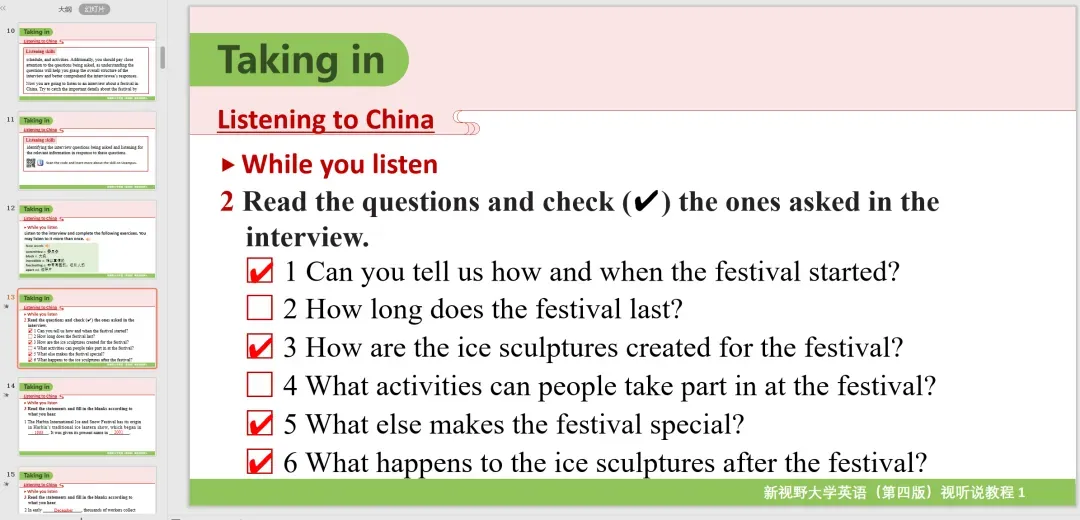
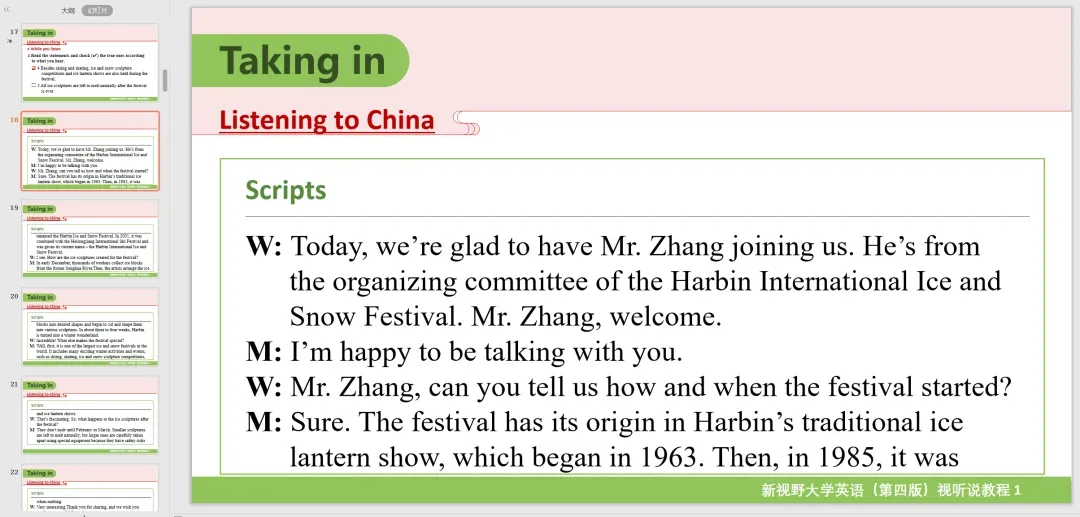
W: Today, we’re glad to have Mr. Zhang joining us. He’s from the organizing committee of the Harbin International Ice and Snow Festival. Mr. Zhang, welcome.
M: I’m happy to be talking with you.
W: Mr. Zhang, can you tell us how and when the festival started?
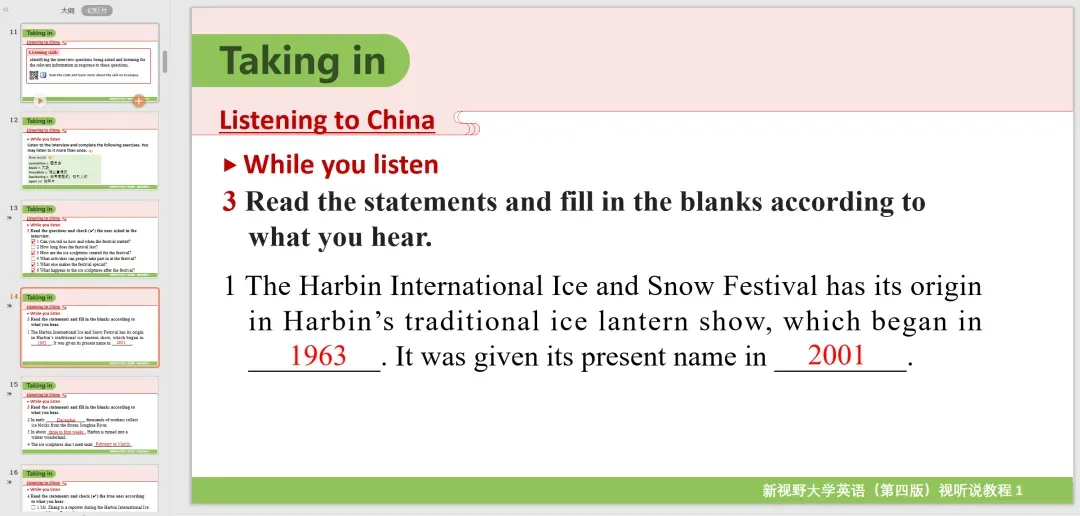
M: Sure. The festival has its origin in Harbin’s traditional ice lantern show, which began in 1963. Then, in 1985, it wasrenamed the Harbin Ice and Snow Festival. In 2001, it was combined with the Heilongjiang International Ski Festival and was given its current name – the Harbin International Ice and Snow Festival.
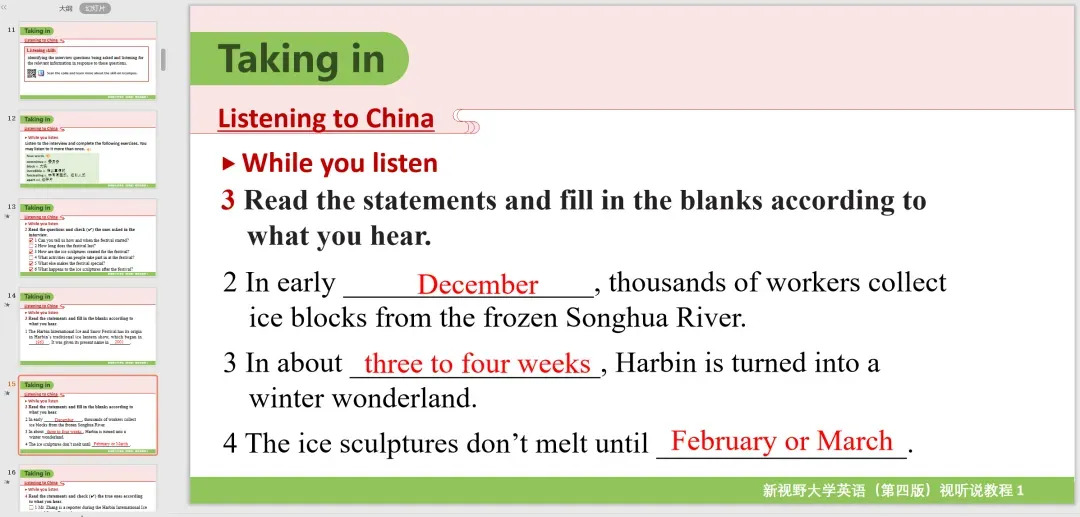
W: I see. How are the ice sculptures created for the festival? M: In early December, thousands of workers collect ice blocks from the frozen Songhua River.Then, the artists arrange the ice blocks into desired shapes and begin to cut and shape them into various sculptures. In about three to four weeks, Harbin is turned into a winter wonderland.
W: Incredible! What else makes the festival special?
M: Well, first, it is one of the largest ice and snow festivals in the world. It includes many exciting winter activities and events, such as skiing, skating, ice and snow sculpture competitions, and ice lantern shows.
W: That’s fascinating. So, what happens to the ice sculptures after the festival?
M: They don’t melt until February or March. Smaller sculptures are left to melt naturally, but larger ones are carefully taken apart using special equipment because they have safety risks when melting.
W: Very interesting.Thank you for sharing, and we wish you another successful festival.
M: Thank you.
Unit1_Taking in_Viewing world cultures_听力原文
V = Voice-over; M1 = Man 1, etc.; W1 = Woman 1, etc.
V: All over the world, festivals bring people together. But why do people go? For the music? The food? The fun and games? We went to Bestival in the Isle of Wight, England, to find out. But the first question is: Where do we sleep?
M1: Um, I’ve got a beach hut up here to stay in; I’ve got the key.
V: One man said it was like sleeping in the back garden.
M2: It’s like opening your back door, going down to the end of your garden, getting in your shed with your baby and wife, and then calling it a holiday.
V: You can stay in a hut, but most people here sleep in tents. There are a lot of different people here – families, young people, older people. We asked: Why do so many different people come to festivals?
W1: Well, I suppose it gives everybody a chance just to be themselves, and just be free and be away from their normal jobs.
W2: People will respect each other and have … um … some of those old-fashioned traditional values, but actually values that everyone really likes.
M3: The thing I always think about festivals is they’re just playgrounds for grown-ups.
V: And, of course, there’s one reason everyone is here: the music. This really is a festival for all the community, young and old mixing together. In the tea tent, these women are having a great time. Why do they go to festivals?
W3: The community getting together, the young mixing with the older people. We make cakes; we do pop festivals; we’ll go anywhere, do anything.
V: So, if there’s one answer to the question “Why are you here?”, one thing that everyone talks about is this: being together.