读外刊,接触原汁原味的英文表达,
欢迎关注以下公众号+设为星标+推荐给朋友。▼
📚 狂暴英语教案 · 新概念英语第二册
第15课 Good news
好消息
🎯 本课学习目标
词汇:
掌握与办公室、职场、财务相关的核心词汇,如 secretary, nervous, business, afford, salary 等,并学习其准确用法和搭配。
语法:
核心语法点为间接引语(Reported Speech),特别是当主句动词为过去时(如 said, told)时,从句时态的后移规则(时态呼应)。同时复习一般过去时和过去完成时的运用。
技能(段落写作):
学习如何按照时间顺序(chronological order)清晰叙述一个包含对话的小故事,并练习将直接对话转化为叙述性段落。
文化:
初步了解英语国家职场沟通的一些特点,如正式与非正式场合的用语差异,以及如何委婉地传达负面或敏感信息。
📖 第一部分:课文完整内容
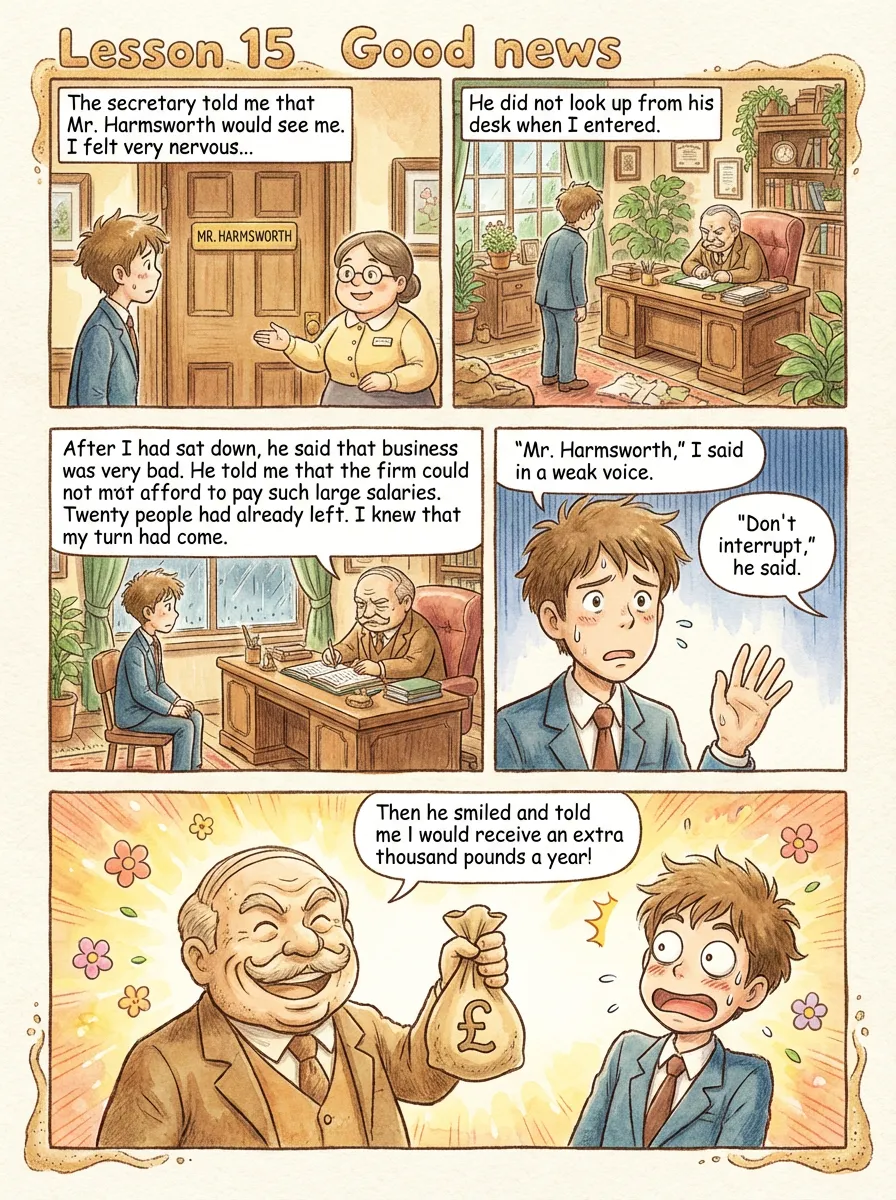
Lesson 15 Good news
背景简介:本课课文是一篇微型叙事文,描绘了一个普通职员被老板召见时,从极度担忧到惊喜反转的心理历程。故事场景设定在典型的办公室环境,反映了职场中常见的关于薪酬、公司运营和个人前途的焦虑。这种"先抑后扬"的叙事手法在英语短篇故事中十分常见,能有效吸引读者并制造幽默或感人的效果。
📜 课文原文
The secretary told me that Mr. Harmsworth would see me. I felt very nervous when I went into his office. He did not look up from his desk when I entered. After I had sat down, he said that business was very bad. He told me that the firm could not afford to pay such large salaries. Twenty people had already left. I knew that my turn had come. 'Mr. Harmsworth,' I said in a weak voice. 'Don't interrupt,' he said. Then he smiled and told me I would receive an extra thousand pounds a year!
秘书告诉我哈姆斯沃斯先生要见我。我走进他的办公室时感到非常紧张。我进去时,他连头也没抬。待我坐下后,他说生意非常不景气。他还告诉我,公司支付不起这么庞大的工资开支。有20个人已经离去。我知道这次该轮到我了。"哈姆斯沃斯先生,"我无力地说道。"不要打断我的话,"他说。然后他微笑了一下告诉我说,我每年将得到1,000英镑的额外收入。
🔍 第二部分:逐句精讲
句子1
原文: The secretary told me that Mr. Harmsworth would see me.
翻译: 秘书告诉我哈姆斯沃斯先生要见我。
句子结构: 这是一个复合句。主句为 The secretary told me,后面跟了一个由 that 引导的宾语从句 that Mr. Harmsworth would see me,作 told 的直接宾语。me 是间接宾语。
重点词汇:
secretary 蓝思值 ~900L
英音[ˈsekrətri] 美音[ˈsekrəteri] 词性:n.
释义:秘书;书记;部长,大臣
常用语块:a personal secretary(私人秘书);the Secretary of State((美)国务卿;(英)国务大臣)
例句一:She asked her secretary to type the report. 她让她的秘书打这份报告。
例句二:He was appointed Secretary General of the UN. 他被任命为联合国秘书长。
拓展:注意与 secrecy(保密)和 secret(秘密)的词根关联。在商务环境中,secretary 是一个常见职位。
tell 蓝思值 ~600L
英音[tel] 美音[tel] 词性:v.
释义:告诉;讲述;吩咐;辨别
常用语块:tell sb. sth. / tell sth. to sb.(告诉某人某事);tell a story(讲故事)
例句一:Could you tell me the way to the station? 你能告诉我去车站的路吗?
例句二:I can't tell the twins apart. 我分不清这对双胞胎。
拓展:tell 在引导间接引语时,后面通常接间接宾语(人)和 that 从句,或接不定式短语(tell sb. to do sth.)。
语法点睛:本句是间接引语的典型范例。如果这是秘书的直接话语,她可能会说:"Mr. Harmsworth will see you." 当主句动词 told 是过去时,引语中的将来时 will 需要相应地变为过去将来时 would。这是间接引语时态后移规则的核心应用之一。
语音要点:told me 可连读;would see 中 would 弱读。
句子2
原文: I felt very nervous when I went into his office.
翻译: 我走进他的办公室时感到非常紧张。
句子结构: 复合句。主句 I felt very nervous,when 引导时间状语从句 when I went into his office。
重点词汇:
nervous 蓝思值 ~800L
英音[ˈnɜːvəs] 美音[ˈnɜːrvəs] 词性:adj.
释义:神经紧张的;不安的;神经系统的
常用语块:feel nervous(感到紧张);a nervous breakdown(神经衰弱)
例句一:Students often feel nervous before an exam. 考试前学生常常感到紧张。
例句二:She's nervous about speaking in public. 她对公开演讲感到紧张。
拓展:nervous 强调因担心、害怕而产生的情绪;anxious 程度更深,有"焦虑"之意;upset 则指因某事而心烦意乱。
office 蓝思值 ~700L
英音[ˈɒfɪs] 美音[ˈɔːfɪs] 词性:n.
释义:办公室;办事处;官职,职务
常用语块:a head office(总部);an office worker(办公室职员)
例句一:My office is on the third floor. 我的办公室在三楼。
例句二:He held the office of mayor for five years. 他担任市长职务五年。
拓展:office 可以指物理空间,也可以指职位或政府机构(如 the Foreign Office 外交部)。
语法点睛:when 时间状语从句,主句和从句都用一般过去时,描述同时发生的动作。
语音要点:felt nervous 连读;when I 可连读。
句子3
原文: He did not look up from his desk when I entered.
翻译: 我进去时,他连头也没抬。
句子结构: 复合句。主句 He did not look up from his desk,when I entered 时间状语从句。
重点词汇:
look up 蓝思值 ~500L
英音[lʊk ʌp] 美音[lʊk ʌp] 词性:动词短语 (v. + adv.)
释义:抬头看;查阅;好转;拜访
常用语块:look up a word in the dictionary(在字典里查单词)
例句一:She didn't look up from her book when I came in. 我进来时,她头也没抬,继续看书。
例句二:Things are looking up for our business. 我们的生意正在好转。
拓展:这是一个多义短语,需根据上下文判断含义。在本课中,look up 取其字面意思"向上看"。
enter 蓝思值 ~800L
英音[ˈentə(r)] 美音[ˈentər] 词性:v.
释义:进入;参加;输入
常用语块:enter a room(进入房间);enter a competition(参加比赛)
例句一:Please knock before you enter. 进来前请先敲门。
例句二:He entered the data into the computer. 他把数据输入了电脑。
拓展:enter 是及物动词,直接接地点宾语,无需加介词 into(除非是抽象意义的"进入"如 enter into an agreement)。
语法点睛:did not look up 是一般过去时否定,强调当时状态。when 从句时用 entered。
语音要点:look up 连读;did not 可缩读为 didn't。
句子4
原文: After I had sat down, he said that business was very bad.
翻译: 待我坐下后,他说生意非常不景气。
句子结构: 复合句。After I had sat down 时间状语从句(过去完成时),主句 he said 后接 that 宾语从句。
重点词汇:
business 蓝思值 ~900L
英音[ˈbɪznəs] 美音[ˈbɪznəs] 词性:n.
释义:商业,生意;公司;事务;职责
常用语块:do business with(与...做生意);on business(出差)
例句一:He runs a small business selling handmade crafts. 他经营一家卖手工制品的小生意。
例句二:It's none of your business. 这不关你的事。
拓展:business 作"公司"解时是可数名词(a business, many businesses);作"商业活动、事务"解时是不可数名词。
语法点睛:过去完成时 had sat 表示"坐下"发生在"说"之前;宾语从句 business was very bad 是间接引语,原句可能是 "Business is very bad"。
语音要点:After I 连读;had sat down 可读 /hæd sæt daʊn/。
句子5
原文: He told me that the firm could not afford to pay such large salaries.
翻译: 他还告诉我,公司支付不起这么庞大的工资开支。
句子结构: 复合句。主句 He told me,that 引导宾语从句,从句中不定式 to pay such large salaries 作 afford 的宾语。
重点词汇:
firm 蓝思值 ~1000L
英音[fɜːm] 美音[fɜːrm] 词性:n. & adj.
释义:n. 公司,商行;adj. 坚固的;坚定的;稳定的
常用语块:a law firm(律师事务所);a firm handshake(有力的握手)
例句一:She works for a large engineering firm. 她在一家大型工程公司工作。
例句二:The ground was firm after the frost. 霜冻过后地面很硬。
拓展:作名词时,firm 与 company, corporation 同义,但可能更常用于指合伙企业或专业性机构。
afford 蓝思值 ~900L
英音[əˈfɔːd] 美音[əˈfɔːrd] 词性:v.
释义:买得起,负担得起;提供,给予
常用语块:can/could afford sth./to do sth.(负担得起...)
例句一:We can't afford a new car this year. 我们今年买不起新车。
例句二:I can't afford to waste any more time. 我再也浪费不起时间了。
拓展:afford 常与 can, could, be able to 连用,多用于否定句和疑问句。注意其后的宾语可以是名词或不定式。
salary 蓝思值 ~1000L
英音[ˈsæləri] 美音[ˈsæləri] 词性:n.
释义:薪金,薪水(通常指白领或专业人员的月薪/年薪)
常用语块:an annual salary(年薪);a high/low salary(高/低薪)
例句一:What's your starting salary at the new job? 你新工作的起薪是多少?
例句二:She's on a salary of $80,000 a year. 她的年薪是八万美元。
拓展:与 wage(通常指蓝领工人的周薪/时薪)和 pay(泛指报酬,最通用)相区别。
语法点睛:间接引语中情态动词 can 变为 could;afford to do 固定搭配;such large salaries 中 such 修饰复数名词。
语音要点:could not afford 连读;pay such large salaries 中 such 重读。
句子6
原文: Twenty people had already left.
翻译: 有20个人已经离去。
句子结构: 简单句。主语 Twenty people,谓语 had already left(过去完成时)。
重点词汇:
leave 蓝思值 ~500L
英音[liːv] 美音[liːv] 词性:v.
释义:离开;留下;遗忘
常用语块:leave for(动身前往);leave a message(留言)
例句一:What time does the train leave? 火车什么时候开?
例句二:I left my keys at home. 我把钥匙忘在家里了。
拓展:leave 的过去式和过去分词都是 left。注意区分 leave(离开某地)和 forget(忘记某事/物,不接地点)。
语法点睛:过去完成时 had left 表示动作在"我"知道之前已经完成。
语音要点:had already 连读;already 重音在第二个音节。
句子7
原文: I knew that my turn had come.
翻译: 我知道这次该轮到我了。
句子结构: 复合句。主句 I knew,that 引导宾语从句 my turn had come。
重点词汇:
turn 蓝思值 ~600L
英音[tɜːn] 美音[tɜːrn] 词性:n. & v.
释义:n. 轮流,轮次;转弯;变化;v. 转动;转向;变成
常用语块:It's one's turn to do sth.(轮到某人做某事);take turns(轮流)
例句一:Please wait for your turn. 请排队等候。
例句二:It's your turn to wash the dishes. 轮到你洗碗了。
拓展:这是一个极其多义的词,需根据上下文判断。在本课中取其名词"轮次"之意。
语法点睛:宾语从句 had come 再次使用过去完成时,表示在"知道"时,轮次已经注定要发生。
语音要点:I knew that 连读;turn had come 可读 /tɜːn həd kʌm/。
句子8
原文: 'Mr. Harmsworth,' I said in a weak voice. 'Don't interrupt,' he said. Then he smiled and told me I would receive an extra thousand pounds a year!
翻译: "哈姆斯沃斯先生,"我无力地说道。"不要打断我的话,"他说。然后他微笑了一下告诉我说,我每年将得到1,000英镑的额外收入。
句子结构: 三句引语和一句叙述组成。直接引语 + 间接引语。
重点词汇:
interrupt 蓝思值 ~900L
英音[ˌɪntəˈrʌpt] 美音[ˌɪntəˈrʌpt] 词性:v.
释义:打断(谈话、工作等);中断
常用语块:interrupt sb./a conversation(打断某人/谈话)
例句一:It's rude to interrupt people when they are speaking. 打断别人说话是不礼貌的。
例句二:The program was interrupted by a news flash. 节目被一条新闻快报打断了。
拓展:名词形式为 interruption。
extra 蓝思值 ~700L
英音[ˈekstrə] 美音[ˈekstrə] 词性:adj. & adv. & n.
释义:adj. 额外的,附加的;adv. 特别地,额外地;n. 额外的事物,另外收费的项目
常用语块:extra money(额外的钱);extra help(额外的帮助)
例句一:We need extra chairs for the guests. 我们需要为客人准备额外的椅子。
例句二:This model comes with a few extras. 这个型号附带一些额外功能。
拓展:extra 作为形容词,通常放在名词前作定语。
receive 蓝思值 ~900L
英音[rɪˈsiːv] 美音[rɪˈsiːv] 词性:v.
释义:收到,接到;接待;遭受
常用语块:receive a letter/gift(收到信/礼物);receive treatment(接受治疗)
例句一:Did you receive my email? 你收到我的邮件了吗?
例句二:The hotel receives guests from all over the world. 这家酒店接待来自世界各地的客人。
拓展:注意与 accept 的区别。receive 指客观"收到",accept 指主观"接受"。
语法点睛:直接引语与间接引语混合使用。Don't interrupt 是祈使句的直接引语,若转间接应为 He told me not to interrupt.。最后一句间接引语中 would receive 是 will receive 的过去时。
语音要点:weak voice 中 weak 重读;Don't interrupt 连读;an extra 连读 /ən ˈekstrə/;感叹号用降调。
📌 核心词块总结 (Key Lexical Chunks)
feel nervous: to be worried and anxious about something that might happen. (e.g., I always feel nervous before a job interview.)
look up (from sth.): to raise your eyes from what you are doing to see something or someone. (e.g., He was so absorbed in his book that he didn't look up when I called his name.)
business is bad: the company is not doing well financially; trade is poor. (e.g., During the recession, business was bad for many small shops.)
afford to do sth.: to have enough money or time to be able to do something. (e.g., We can't afford to go on vacation this year.)
one's turn has come: it is now someone's time or chance to do something (often used when expecting something unpleasant). (e.g., After three colleagues were laid off, I feared my turn had come.)
in a weak voice: speaking softly and without strength, often due to fear, illness, or emotion. (e.g., "I'm sorry," she whispered in a weak voice.)
receive extra pay/money: to get additional payment on top of your normal salary. (e.g., For working on the holiday, the staff will receive extra pay.)
interrupt someone: to stop someone who is speaking by saying or doing something. (e.g., It's impolite to interrupt your teacher while she's explaining.)
📝 第三部分:语篇分析与段落写作技巧
语篇分析
① 识别宏观结构:本文是典型的"叙事性"结构,并包含一个"悬念-反转"的子模式。文章按照时间顺序展开:被召见→感到紧张→进入办公室→老板告知坏消息→"我"预感到厄运→对话→惊喜结局。
② 列举衔接手段:1. 时间连接词(when, after, then);2. 代词指代(I, me, he, his, my);3. 词汇复现(said, told, nervous, bad, afford, left, turn)。
③ 分析作者态度:焦虑:felt very nervous, did not look up, in a weak voice, my turn had come。反转与惊喜:Then he smiled, an extra thousand pounds a year!。
写作技巧
① 提炼写作逻辑:设定场景→描写感受→推进情节→制造悬念→给出结局。
② 段落写作范例(模仿课文风格):My teacher told me that the principal wanted to see me. I felt my heart sink as I walked to her office. I had no idea what I had done wrong. When I entered, she was looking over some papers seriously. After I stood nervously before her desk, she said that there had been a complaint about the class noise. She told me that as the monitor, I needed to take more responsibility. I thought I was about to be scolded. "Ms. Jones," I stammered. "Let me finish," she said. Then she looked up with a kind smile and told me that despite the noise, our class's project had won first prize in the school competition, and she was very proud.
③ 布置小练笔题目:请以"A Surprising Phone Call"为题,写一篇80-100词的英文段落。描述你接到一个电话,起初让你感到担心或困惑,但最终带来了一个好消息。请使用本课学到的至少3个核心词块和间接引语。
现代平行文本分析:Subject: Your Performance ReviewHi Alex,Can you come to my desk when you have a moment? We need to chat about your Q3 results.Best,Sarah (Manager)*(Alex's thought bubble: 'Q3 results? I thought I missed my targets... This can't be good.' He walks over, already rehearsing excuses.)*"Sarah, you wanted to see me?""Yes, Alex. Take a seat. So, about Q3... the numbers were lower than expected across the team."Alex's stomach tightened. 'Here it comes,' he thought."However," Sarah continued, turning her monitor, "your client feedback scores were through the roof. One even wrote a commendation email to the CEO. Because of that, we're putting you forward for the 'Star Employee' award next month. Well done!"
结构分析: 这是一段现代职场沟通的简化版,保留了核心的"悬念-反转"结构:模糊的邀请→内心的担忧→提及负面情况(团队数据低)→制造紧张→转折词(However)→揭示正面个人表现→给出奖励(好消息)。
📐 第四部分:本课语法精析(加强版)
1. 间接引语的概念与结构直接引语 (Direct Speech) 是原封不动地引用别人的话,放在引号内。间接引语 (Indirect Speech) 是用自己的话转述别人的意思,不用引号,通常在引述动词(如 say, tell, ask)后以宾语从句的形式出现。直接引语: He said, "I am busy." → 间接引语: He said that he was busy.
2. 时态变化规则(核心中的核心)当主句的引述动词是过去时(如 said, told, asked)时,间接引语中的谓语时态通常要向后推移一个时态。
| | |
|---|
| | "Business is bad." → He said business was bad. |
| | "I am reading." → He said he was reading. |
| | "Mr. Harmsworth will see you." → told me he would see me. |
| | "I have finished." → She said she had finished. |
| | "I saw the film." → He said he had seen the film. |
| | "I had done it." → She said she had done it. |
3. 其他成分的变化人称、指示代词、时间状语、地点状语等也需要相应变化。- 人称:第一、二人称变为第三人称或根据语境调整。如 "I will see you." → He said he would see me.- 指示代词:this → that, these → those- 时间状语:now → then, today → that day, yesterday → the day before, tomorrow → the next/following day, ago → before- 地点状语:here → there- 方向性动词:come, bring → go, take
4. 不同类型的句子转为间接引语- 陈述句:用 that 引导(口语中常省略)。- 一般疑问句:用 if 或 whether 引导,语序变为陈述语序。直接: He asked me, "Are you tired?" → 间接: He asked me if/whether I was tired.- 特殊疑问句:保留原疑问词,语序变为陈述语序。直接: She asked, "Where do you live?" → 间接: She asked where I lived.- 祈使句:改为 ask/tell/order sb. (not) to do sth. 结构。课文例句: "Don't interrupt." → He told me not to interrupt.
5. 间接引语中时态不变的特殊情况① 主句引述动词是现在时、将来时或现在完成时。② 转述的是客观真理、科学事实、格言或习惯性动作。例: The teacher said, "The earth revolves around the sun." → The teacher said the earth revolves around the sun.③ 直接引语中的动作在转述时仍在进行或仍未发生。
6. 常见错误及应对策略- 错误1:主句过去时,从句未后移时态。错:She said she is a teacher. → 对:She said she was a teacher.- 错误2:疑问句转述后未改用陈述语序。错:He asked where did I live. → 对:He asked where I lived.- 错误3:混淆 say 和 tell 的用法。tell 必须接间接宾语(tell sb. that...),而 say 不直接接人(say to sb. that... 或 say that...)。
7. 与第一册相关语法点的对比第一册接触了简单的直接引语和现在时态的转述(如 He says...)。第二册本课的系统学习是一个重要的进阶,引入了时态呼应这一复杂而核心的规则。这是从简单转述到准确、地道地叙述过去对话的关键跨越。
8. 语法练习① 填空(将直接引语改为间接引语,主句动词为过去时):1. "I work in a bank." → She said that she worked in a bank.2. "We are watching TV." → They told me they were watching TV.3. "It will rain tomorrow." → He said it would rain the next day.4. "I have lost my keys." → She said she had lost her keys.5. "I saw the film last week." → He said he had seen the film the week before.6. "Where is the station?" → She asked where the station was.7. "Do you like coffee?" → He asked me if/whether I liked coffee.8. "Please open the window." → She asked me to open the window.② 改错:1. My mother told me that she is going to the market. (is → was)2. He asked me what did I want for my birthday. (did I want → I wanted)3. She said she will help me later. (will → would)4. The teacher told to the students to be quiet. (去掉 to)③ 翻译:1. 他说他前一天已经完成了作业。 → He said (that) he had finished his homework the day before.2. 她问我是否去过巴黎。 → She asked me if/whether I had been to Paris.3. 警察告诉人们不要靠近那座建筑。 → The police told people not to go near that building.
🎧 第五部分:听力与阅读策略训练
听力技巧- 预测关键词 (Predicting Key Words): 在听课文录音前,根据标题"Good news"和图片,预测可能出现的词汇。例如:office, boss, nervous, salary, pay, extra money 等。- 抓主旨大意 (Listening for Gist): 第一遍听录音时,不纠结细节,只回答核心问题:What was the good news?- 笔记方法 (Note-taking): 第二遍听录音时,尝试用关键词或符号记录事件发展顺序。例如:Secretary: Mr. H will see me. → I: felt nervous. → He: didn't look up. → Said: business bad, can't afford salaries, 20 left. → I thought: my turn. → I: "Mr. H..." (weak voice). → He: "Don't interrupt." → He smiled: extra £1000/year!- 精听与模仿 (Intensive Listening & Imitation): 反复听录音,特别注意说话者的语调,进行跟读模仿。
阅读理解策略- 扫读寻找具体信息 (Scanning for Specific Information): 快速阅读课文,找出以下问题的答案:How did the writer feel? (Nervous.) How many people had left? (Twenty.) What did Mr. Harmsworth say before he smiled? ("Don't interrupt.")- 略读理解结构 (Skimming for Structure): 在1分钟内快速浏览课文,划分故事阶段:开端(被召见)、发展(紧张、被告知坏消息)、高潮(以为自己要被解雇)、结局(获得加薪)。- 推断词义 (Inferring Meaning from Context): 从上下文推断 afford, interrupt 等词义。- 理解指代关系 (Understanding Reference): 找出文中 he, his, me, my, I 分别指代谁,以及句子5中的 the firm 指代什么。
📚 第六部分:习题讲解
摘要写作 (Summary Writing)教材问题:Answer these questions in not more than 50 words.1. What did the secretary tell me?2. How did I feel when I went into the office?3. Where did Mr. Harmsworth look when I entered?4. What did he say about business?5. What did he tell me about salaries?6. How many people had left?7. What did I think then?8. What did I say to him?9. What did he ask me to do?10. What did he tell me about an extra thousand pounds?参考答案与思路:1. The secretary told me that Mr. Harmsworth would see me.2. I felt very nervous when I went into the office.3. He did not look up from his desk when I entered.4. He said that business was very bad.5. He told me that the firm could not afford to pay such large salaries.6. Twenty people had already left.7. I thought that my turn had come.8. I said "Mr. Harmsworth" in a weak voice.9. He asked me not to interrupt.10. He told me I would receive an extra thousand pounds a year.最终摘要(49词):The secretary told me Mr. Harmsworth would see me. I felt nervous entering his office. He didn't look up. After I sat down, he said business was bad and couldn't afford large salaries. Twenty people had left, so I thought my turn had come. When I spoke weakly, he told me not to interrupt. Then he smiled and said I'd get an extra £1000 a year!
关键句型与难点练习例题:Supply said or told in the following sentences. Give the correct form of the verbs in parentheses.1. He told me that she would come tomorrow.2. The gardener said that he had cut that tree down yesterday.3. I told you I had never played tennis before.
多项选择题1. The writer went to see Mr. Harmsworth because ______.a) he wanted a job b) he was asked to c) he had good news d) the secretary was nervous → 答案:b2. The writer felt nervous because ______.a) the secretary was angry b) he thought he might lose his job c) Mr. Harmsworth was smiling d) business was good → 答案:b3. "My turn had come" means the writer thought ______.a) it was time for him to speak b) he would be promoted c) he would have to leave the firm d) he would get more money → 答案:c
🤔 第七部分:英文深度思考与拓展
Level 1 (Factual):Q: Who wanted to see the writer? A: Mr. Harmsworth wanted to see the writer.Q: How many people had already left the firm? A: Twenty people had already left the firm.Q: What did Mr. Harmsworth finally tell the writer? A: He finally told the writer that he would receive an extra thousand pounds a year.
Level 2 (Inferential):Q: Why do you think Mr. Harmsworth did not look up when the writer entered?A: He was probably very busy, worried about the bad business, or perhaps he wanted to create a serious atmosphere before delivering what he thought might be perceived as bad news.Q: What can we infer about the writer's financial situation before hearing the "good news"?A: We can infer that he was probably worried about his job security and his salary, fearing a pay cut or even dismissal, especially after hearing about the firm's troubles and the colleagues who had left.Q: Why did Mr. Harmsworth say "Don't interrupt"?A: He likely hadn't finished explaining the situation and wanted to deliver the complete message (which included the surprise raise) without being stopped by the writer's anxious interjection.
Level 3 (Evaluative):Q: Do you think Mr. Harmsworth handled the conversation well? Why or why not?A: (Opinion) From a dramatic standpoint, it made for a great story. However, in real-life management, it was probably not very kind. He caused unnecessary stress by listing all the negative points first without any reassurance, which is poor communication practice. A better manager would be more direct and empathetic.Q: How would you have felt if you were the writer at the end of the conversation? Would your feelings towards Mr. Harmsworth change?A: (Opinion) I would feel a huge wave of relief, followed by excitement about the raise. However, I might also feel a bit annoyed or confused about why he made me so worried first. My feelings towards him might become mixed---grateful for the raise but less trusting of his communication style.Q: The story is titled "Good news." Is the news good for everyone in the firm? Explain.A: No, the news is not good for everyone. The "good news" is only for the writer personally (a raise). For the firm overall, the news is bad (poor business, unable to pay high salaries). For the twenty people who left, the news was certainly not good (they lost their jobs). The title highlights the personal, surprising twist for the narrator.Q: Can you relate this story to any modern workplace situations, like performance reviews or company meetings?A: Yes, absolutely. This is a classic "performance review" scenario. Employees often feel anxious before meeting their boss, fearing criticism or bad news about their job. Sometimes, after discussing areas for improvement (the "bad business"), the manager reveals positive outcomes like a bonus, promotion, or praise (the "extra thousand pounds"). The story captures that universal workplace anxiety.
多类型拓展阅读类型1:时事新闻拓展Title: Remote Work "Good News" SurpriseDuring a video call, Emma's manager asked her to stay behind. Her heart raced. Had her internet connection been too poor? Was her project delayed? The manager began, "As you know, adapting to remote work has been challenging for the company financially..." Emma braced herself. "...which is why we've had to make some tough decisions about office space." Emma was sure a layoff was coming. "However," her manager smiled, "your productivity reports are outstanding. To help you work even better, the company has decided to give you a permanent 'work-from-home' allowance and a new laptop. Congratulations!"类型2:文化背景解析Title: The "Annual Review" in British and American OfficesThe story "Good News" perfectly illustrates a common source of stress in Western workplaces: the annual performance review. In many UK and US companies, employees have a one-on-one meeting with their boss each year. They discuss the past year's work, strengths, weaknesses, and goals. Often, salary changes are announced here. Like the writer, many employees feel nervous before these meetings, unsure of the outcome. The formal setting (the boss's office) and the serious start (discussing business problems) are very typical. The surprise positive ending, while perhaps exaggerated for the story, reflects the hope for recognition and reward.类型3:今昔对比分析Title: Office News: Then and NowIn the past, as in our story, "good news" often came in a private, formal office meeting. The boss held all the power and information. Today, communication can be very different. Bad company news might come via a mass email. Good personal news, like a raise, might also arrive in an email or a message from HR software. While this is faster, some say it loses the personal touch and the chance for immediate conversation. However, the feeling of anxiety before checking an important email from your boss can be just as strong as walking into their office!类型4:新潮英语改写Title: The Teams Call (A Modern Retelling)DM from Boss: "Hey, need to hop on a quick call when you're free."Me: (Internal panic. What did I do? Is it about the typo in the Slack message?)On the call...Boss: "So, as you've seen in the all-hands, Q2 numbers aren't great. We're tightening budgets."Me: (Thinking: Here it comes. The "we're letting you go" speech.)Boss: "BUT---your client satisfaction scores are fire. Seriously, the best on the team. So, we're bumping up your bonus and giving you the lead on the new project. Awesome work."Me: (Types in chat) "OMG, thank you!!! 😅🙏"类型5:难度略高的拓展阅读Title: The Psychology of Workplace SurprisesThe narrative of "Good News" taps into a powerful psychological pattern: anticipation and relief. When humans anticipate a negative outcome, stress hormones like cortisol increase. The prolonged buildup in the story (the nervous walk, the averted gaze, the list of problems) heightens this anxiety. The sudden reversal---the smile and the raise---triggers a release of dopamine, the "reward" chemical. This contrast makes the "good news" feel exceptionally rewarding, a technique sometimes used in storytelling and even in some management styles to amplify gratitude. However, overusing such "emotional rollercoasters" can damage trust and increase chronic workplace stress.
🌍 第八部分:日常应用与文化拓展
文化背景知识:- 职场沟通风格:在英美职场,直接沟通通常被看重,但传达负面消息时,人们也常会采用一些委婉语或"三明治反馈法"(先肯定,再提改进点,最后再鼓励)。课文中的老板显然没用这种方法,而是制造了悬念,这更偏向于文学手法而非最佳管理实践。- 薪酬讨论:在西方公司,薪酬通常是保密的,同事之间公开讨论具体薪水数字有时被视为不礼貌或违反公司政策。像课文这样直接告知加薪数额,在现实中通常会在保密的情况下进行。- 办公室礼仪:文中老板没有抬头打招呼,在现代职场礼仪中通常被认为是不礼貌的,除非极度忙碌。一句 "I'll be with you in a moment" 会更得体。
推荐拓展学习资源:- 英文短片:可以在视频平台搜索 "A Surprise at Work" 或 "Performance Review" 等关键词,观看一些职场情景短剧,注意里面的对话和情绪表达。- 简易读物:推荐阅读一些职场主题的英语简易小说或故事集,例如《牛津书虫》系列中涉及工作话题的册子。- 实用网站:浏览像"BBC Learning English"的"Workplace English"板块,学习地道的办公室用语。
💡 第九部分:引导性思考
1. 如果故事中的"我"在老板说"生意不好"时,直接问"那我的工作呢?",故事的走向和效果会有什么不同? / How would the story's flow and impact change if the writer had directly asked, "What about my job?" when the boss said business was bad?
2. 你认为"好消息"仅仅是指加薪吗?这个故事在更深层次上可能想传达关于"希望"或"误解"的什么信息? / Is the "good news" only about the raise? What deeper message about "hope" or "misunderstanding" might this story want to convey?
3. 在现代社会,除了加薪,还有哪些事情可以被视为职场中的"好消息"? / In modern society, besides a raise, what other things can be considered "good news" in the workplace?
🗂️ 第十部分:本课知识图谱
核心事件: 一名职员在办公室与老板的会面中,经历了一场从担忧到惊喜的情绪反转。
├─ 支撑点1:会面前的紧张铺垫(秘书告知召见→感到非常紧张→老板没抬头)├─ 支撑点2:会面中令人焦虑的对话(老板告知生意惨淡→无力支付高额薪水→二十人已离职→"我"推断自己即将被解雇)├─ 支撑点3:试图插话与被打断(微弱的声音称呼老板→老板严厉要求不要打断)└─ 支撑点4:出乎意料的结局(老板露出微笑→宣布获得每年一千英镑额外收入)
核心语法: 间接引语(主句过去时下的时态后移规则)├─ 时态变化规则(一般现在→一般过去,将来→过去将来等)├─ 其他成分变化(人称、代词、状语)└─ 不同句式转换(陈述句、疑问句、祈使句)
核心语言技能: 按时间顺序叙述包含对话和心理活动的小故事。├─ 使用时间连接词(when, after, then)推进叙事├─ 混合使用直接引语和间接引语└─ 通过形容词和动词描写心理状态(nervous, weak voice, thought)
© 本文为狂暴英语教案 · 新概念英语第二册第15课

贝琪酱英语无痛逆袭站
微信扫描二维码,关注我的账号
 10个月宝宝每天需要喝多少奶粉?

