【狂暴英语教案】之《新概念英语》第二册第19课:票已售完
- 2026-08-04 22:21:05
读外刊,接触原汁原味的英文表达,
欢迎关注以下公众号+设为星标+推荐给朋友。▼
📚 狂暴英语教案 · 新概念英语第二册
第19课 Sold out
票已售完
📘 本课信息
教材:新概念英语第二册 · 第19课
核心功能:购票对话 · 失望与转折 · 礼貌请求
语法焦点:一般过去时 · 情态动词may/might · 习语might as well
🏷️ 热门标签
🎯 本课学习目标
词汇:
掌握核心动词短语 sell out、hurry to、get back 的用法;理解 just 作为副词的多种含义;区分 What a pity! 等感叹句的表达。
语法:
深化一般过去时的应用,重点在于不规则动词的过去式(如 sell-sold, buy-bought, get-got)以及过去时在叙事中的连贯使用。同时,初步感知 might 表示"可能"的推测性用法。
技能(段落写作):
学习如何用简洁的过去时态叙述一个包含"问题-尝试解决-结果"的小故事,掌握时间顺序(The play may begin at any moment → I hurried to → 'What a pity!' she said)和对话引用的基本方法。
文化:
了解英语国家剧院购票(box office)的相关常识,以及 What a pity! 这一常见口语表达所体现的礼貌与遗憾情感。
📖 第一部分:课文完整内容
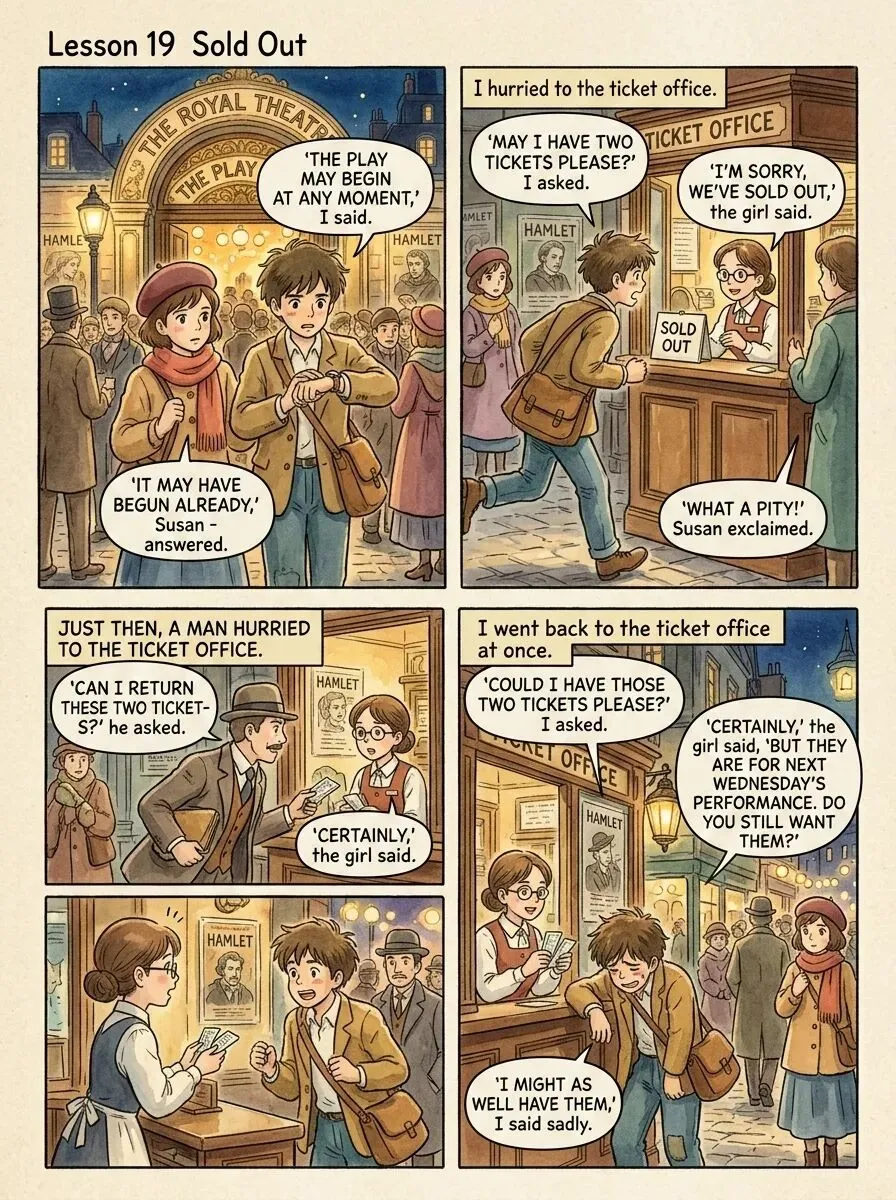
Lesson 19 Sold out
背景简介:本课是一篇简短的叙事对话,场景设定在剧院(theatre)售票处(ticket office或 box office)。故事围绕购票的急切、失望与转折展开,生动再现了日常生活中可能遇到的小插曲,语言口语化,情节富有戏剧性。
📜 课文原文(来自《官方教材之新概念英语学生用书 第2册》)
'The play may begin at any moment,' I said.
'It may have begun already,' Susan answered.
I hurried to the ticket office. 'May I have two tickets please?' I asked.
'I'm sorry, we've sold out,' the girl said.
'What a pity!' Susan exclaimed.
Just then, a man hurried to the ticket office.
'Can I return these two tickets?' he asked.
'Certainly,' the girl said.
I went back to the ticket office at once.
'Could I have those two tickets please?' I asked.
'Certainly,' the girl said, 'but they are for next Wednesday's performance. Do you still want them?'
'I might as well have them,' I said sadly.
"剧马上就要开演了,"我说。
"也许已经开演了呢,"苏珊回答说。
我匆匆赶到售票处。"我可以买两张票吗?"我问。
"对不起,票已售完,"那位姑娘说。
"真可惜!"苏珊大声说。
就在这时,一个男子匆匆来到售票处。
"我可以退掉这两张票吗?"他问。
"当然可以,"那位姑娘说。
我马上又回到售票处。
"我可以买那两张票吗?"我问。
"当然可以,"那位姑娘说,"不过这两张票是下星期三的。您还要吗?"
"我还是买下的好,"我垂头丧气地说。
🔍 第二部分:逐句精讲与词块总结
句子1
原文: 'The play may begin at any moment,' I said.
翻译: "剧马上就要开演了,"我说。
句子结构: 包含直接引语的简单句。主句 I said,引语是简单陈述句,使用情态动词 may 表示可能性。
重点词汇:
play 蓝思值 400L
英音[pleɪ] 美音[pleɪ] 词性:n.
释义:戏剧,剧本;游戏,玩耍
常用语块:go to the play (去看戏); put on a play (上演一出戏)
短语搭配:a play by Shakespeare (莎士比亚的戏剧); children at play (在玩耍的孩子们)
例句一:We went to see a play at the National Theatre last night. 我们昨晚去国家剧院看了一场戏。
例句二:All work and no play makes Jack a dull boy. 只工作不玩耍,聪明孩子也变傻。(谚语)
拓展:作动词时意为"玩耍;演奏;扮演"。同义词:drama (n. 戏剧,更正式)。反义词:work (n. 工作)。
may 蓝思值 300L
英音[meɪ] 美音[meɪ] 词性:modal v.
释义:(表示可能性)可能,也许;(表示许可)可以
常用语块:may be (可能是); may have done (可能已经做了)
短语搭配:May I...? (我可以......吗?)
例句一:He may come, or he may not. 他可能来,也可能不来。
例句二:May I use your phone? 我可以用一下你的电话吗?
拓展:may 表示现在的可能性,语气没有 must 肯定,比 might 稍强。其过去式是 might。否定式 may not。
at any moment 蓝思值 500L
英音[ət ˈeni ˈməʊmənt] 美音[ət ˈeni ˈmoʊmənt] 词性:介词短语
释义:随时,在任何时刻
常用语块:may/can happen at any moment (随时可能发生)
短语搭配:at the moment (此刻); for a moment (一会儿)
例句一:The bus should be here at any moment. 公共汽车随时可能到。
例句二:Be careful, the situation could change at any moment. 小心,情况随时可能变化。
拓展:强调紧迫性和不确定性。近义短语:any minute now, any second now。
语法点睛:本句的核心语法点是情态动词 may 表示"可能性"的用法。may 在这里表示对现在或将来情况的推测,语气较为委婉,不如 will 肯定,但比 might 的可能性稍大。at any moment 这个时间状语加强了"即将发生"的紧迫感。
语音要点:略。
句子2
原文: 'It may have begun already,' Susan answered.
翻译: "也许已经开演了呢,"苏珊回答说。
句子结构: 简单句。直接引语为主系表结构,It 为主语,may have begun 为复合谓语(情态动词+完成时),already 为状语。
重点词汇:
may have begun 蓝思值 600L
英音[meɪ həv bɪˈɡʌn] 美音[meɪ həv bɪˈɡʌn] 词性:情态动词+完成时结构
释义:可能已经开始了
常用语块:may have done (可能已经做了某事)
例句一:She may have left the office by now. 她现在可能已经离开办公室了。
例句二:I can't find my keys. I may have left them in the car. 我找不到钥匙了,我可能把它们落在车里了。
拓展:may/might/could + have + 过去分词 用于表示对过去已发生事情的推测。must have done 表示"肯定已经",语气最强。
already 蓝思值 300L
英音[ɔːlˈredi] 美音[ɔːlˈredi] 词性:adv.
释义:已经
常用语块:have already done (已经做了)
短语搭配:yet (用于疑问句和否定句)
例句一:I have already finished my homework. 我已经做完作业了。
例句二:Has the film started yet? 电影开始了吗?(否定:No, not yet. 还没。)
拓展:already 通常用于肯定句,放在助动词之后、实义动词之前,或句末。在疑问句中用 already 表示惊讶(如:Have you finished already? 你已经做完了?)。
语法点睛:本句引入了 may have + 过去分词的结构,表示对过去动作的推测。这是情态动词与完成时态的结合,是英语语法中的一个重要知识点。苏珊用这个结构表示"开演"这个动作在说话时可能已经完成了,与"我"说的"即将开演"形成时间上的递进与对话的互动。
语音要点:略。
句子3
原文: I hurried to the ticket office.
翻译: 我匆匆赶到售票处。
句子结构: 简单句(主谓宾)。I 为主语,hurried 为谓语动词(不及物),to the ticket office 为介词短语作方向状语。
重点词汇:
hurried (hurry的过去式) 蓝思值 400L
英音[ˈhʌrid] 美音[ˈhɜːrid] 词性:v. (过去式)
释义:匆忙,赶快
常用语块:hurry to (匆忙赶往); hurry up (快点)
短语搭配:in a hurry (匆忙地)
例句一:She hurried to catch the bus. 她匆忙去赶公共汽车。
例句二:Don't hurry, we have plenty of time. 别急,我们时间很充裕。
拓展:hurry 既可作动词也可作名词。形容词 hurried 意为"匆忙的"。近义词:rush。
ticket office 蓝思值 500L
英音[ˈtɪkɪt ˈɒfɪs] 美音[ˈtɪkɪt ˈɔːfɪs] 词性:n. phrase
释义:售票处
常用语块:go to the ticket office (去售票处)
短语搭配:box office (票房,售票处,尤指剧院)
例句一:You can buy train tickets at the ticket office or online. 你可以在售票处或网上买火车票。
例句二:The box office opens at 10 a.m. 售票处上午10点开门。
拓展:同义词 box office 更常用於剧院、影院。ticket office 适用范围更广(车站、景点等)。
语法点睛:本句使用了一般过去时 hurried,叙述故事中的动作。to the ticket office 指明了动作的方向。这里体现了叙事文中按时间顺序推进的写作手法。
语音要点:略。
句子4
原文: 'May I have two tickets please?' I asked.
翻译: "我可以买两张票吗?"我问。
句子结构: 简单句。直接引语为一般疑问句,使用 May I...? 句型表示礼貌请求。
重点词汇:
May I have...? 蓝思值 300L
英音[meɪ aɪ həv] 美音[meɪ aɪ həv] 词性:句型
释义:我可以要......吗?(礼貌请求)
常用语块:May I have a look? (我可以看看吗?); May I have the bill? (我可以结账吗?)
例句一:May I have a glass of water, please? 请给我一杯水好吗?
例句二:May I have your name, please? 请问您叫什么名字?
拓展:这是非常正式和礼貌的请求方式。更口语化的有 Can I have...? 或 Could I have...?,其中 Could I...? 语气最委婉。
语法点睛:May I...? 是情态动词 may 的另一个核心用法——表示许可或请求。在购物、询问等场合,这是非常得体礼貌的表达方式。句末的 please 进一步增强了礼貌程度。
语音要点:略。
句子5
原文: 'I'm sorry, we've sold out,' the girl said.
翻译: "对不起,票已售完,"那位姑娘说。
句子结构: 复合句。直接引语包含两个分句:I'm sorry (主系表) 和 we've sold out (主谓),后者是现在完成时。
重点词汇:
sold out (sell out的现在完成时) 蓝思值 500L
英音[səʊld aʊt] 美音[soʊld aʊt] 词性:v. phrase (phrasal verb)
释义:售完,卖光
常用语块:be sold out (被卖光); sell out of sth. (卖光某物)
例句一:The concert tickets were sold out in two hours. 音乐会门票两小时内就售罄了。
例句二:I went to buy the new phone, but they had sold out. 我去买新手机,但已经卖完了。
拓展:sell out 也可引申为"背叛"(如:sell out one's principles 背叛原则)。反义短语:in stock (有存货)。
语法点睛:本课标题和核心短语。sell out 是一个短语动词(phrasal verb),sold 是 sell 的过去分词。we've sold out 是现在完成时 (have + sold),表示动作发生在过去,但对现在造成影响(即现在没票了)。这是现在完成时的典型用法之一。
语音要点:略。
句子6
原文: 'What a pity!' Susan exclaimed.
翻译: "真可惜!"苏珊大声说。
句子结构: 简单句。直接引语为感叹句。
重点词汇:
What a pity! 蓝思值 400L
英音[wɒt ə ˈpɪti] 美音[wʌt ə ˈpɪti] 词性:感叹句
释义:真遗憾!真可惜!
常用语块:That's a pity. (那很遗憾。)
短语搭配:feel pity for sb. (同情某人)
例句一:You can't come to the party? What a pity! 你不能来参加派对?太遗憾了!
例句二:It's a pity that it's raining today. 可惜今天下雨了。
拓展:pity 作名词意为"遗憾,同情"。What a + 名词 是构成感叹句的一种方式(如:What a day! 多么糟糕/美好的一天啊!)。
exclaimed 蓝思值 600L
英音[ɪkˈskleɪmd] 美音[ɪkˈskleɪmd] 词性:v. (过去式)
释义:呼喊,惊叫,大声说
常用语块:exclaim in surprise (惊讶地叫起来)
例句一:'Look out!' he exclaimed. "小心!"他喊道。
例句二:She exclaimed that the cake was delicious. 她惊叹蛋糕非常美味。
拓展:比 said 更具感情色彩,表示因惊讶、喜悦、愤怒等而提高声调说话。近义词:cry out, shout。
语法点睛:本句展示了由 What 引导的感叹句结构:What + a/an + (形容词) + 可数名词单数 + (主语+谓语)!。这是表达强烈情感的重要句型。同时,用 exclaimed 替代 said,生动刻画了苏珊失望的情绪。
语音要点:略。
句子7
原文: Just then, a man hurried to the ticket office.
翻译: 就在这时,一个男子匆匆来到售票处。
句子结构: 简单句。Just then 为时间状语,a man 为主语,hurried 为谓语,to the ticket office 为状语。
重点词汇:
Just then 蓝思值 450L
英音[dʒʌst ðen] 美音[dʒʌst ðen] 词性:adv. phrase
释义:就在那时,正当那时
常用语块:and just then (而就在那时)
例句一:I was about to leave. Just then, the phone rang. 我正要离开。就在那时,电话响了。
例句二:The situation seemed hopeless. Just then, help arrived. 情况似乎毫无希望。就在那时,救援到了。
拓展:用于叙述中,表示一个关键时刻或转折点的发生。强调事件的巧合性与突然性。
语法点睛:Just then 是一个重要的叙事衔接词,它标志着故事转折点的到来,从"失望"过渡到"出现转机"。在写作中,这类时间状语是保持叙事连贯性的关键手段。
语音要点:略。
句子8
原文: 'Can I return these two tickets?' he asked.
翻译: "我可以退掉这两张票吗?"他问。
句子结构: 简单句。直接引语为一般疑问句,使用 Can I...? 表示请求。
重点词汇:
return 蓝思值 450L
英音[rɪˈtɜːn] 美音[rɪˈtɜːrn] 词性:v.
释义:归还;返回;退还
常用语块:return sth. to sb./somewhere (把某物归还给某人/某地)
短语搭配:return home (回家); in return (作为回报)
例句一:You must return the books to the library by Friday. 你必须在周五前把书还给图书馆。
例句二:I need to return this shirt because it's too small. 我需要退掉这件衬衫,因为它太小了。
拓展:作名词时意为"返回;回报"。近义词:give back (归还)。
语法点睛:这里使用了 Can I...? 来表达请求,比之前的 May I...? 在正式程度上稍弱,但在日常口语中极其常见。these two tickets 中的 these 是指示代词,指代男子手中持有的票,为下文 those two tickets 埋下伏笔。
语音要点:略。
句子9
原文: 'Certainly,' the girl said.
翻译: "当然可以,"那位姑娘说。
句子结构: 简单句。
重点词汇:
Certainly 蓝思值 350L
英音[ˈsɜːtnli] 美音[ˈsɜːrtnli] 词性:adv.
释义:当然,肯定地
常用语块:Yes, certainly. (是的,当然。)
短语搭配:certainly not (当然不)
例句一:--- Could you help me with this? --- Certainly. ——你能帮我一下吗?——当然可以。
例句二:She will certainly win the competition. 她肯定会赢得比赛。
拓展:用于肯定回答,语气正式且肯定。同义词:of course, sure (后者更口语化)。
语法点睛:简单的应答,体现了对话的真实性。Certainly 是服务行业常见的礼貌用语。
语音要点:略。
句子10
原文: I went back to the ticket office at once.
翻译: 我马上又回到售票处。
句子结构: 简单句(主谓状)。I 为主语,went 为谓语,back to the ticket office 为方向状语,at once 为时间状语。
重点词汇:
went back (go back的过去式) 蓝思值 400L
英音[went bæk] 美音[went bæk] 词性:v. phrase
释义:回去,返回
常用语块:go back to (返回到......); go back home (回家)
例句一:After university, he went back to his hometown. 大学毕业后,他回到了家乡。
例句二:Let's go back to the main point. 让我们回到重点上来。
拓展:go back 强调返回原处或原状态。go back to doing sth. 重新开始做某事。
at once 蓝思值 450L
英音[ət wʌns] 美音[ət wʌns] 词性:adv. phrase
释义:立刻,马上
常用语块:do sth. at once (立刻做某事)
例句一:Please come to my office at once. 请立刻来我办公室。
例句二:The medicine should be taken at once after meals. 这药应在饭后立即服用。
拓展:强调毫不延迟。同义词:immediately, right away, instantly。
语法点睛:went 是 go 的不规则过去式 (go-went-gone)。at once 这个时间状语生动地表现了"我"抓住机会的急切心情,是叙事中刻画人物心理的细节。
语音要点:略。
句子11
原文: 'Could I have those two tickets please?' I asked.
翻译: "我可以买那两张票吗?"我问。
句子结构: 简单句。直接引语为一般疑问句,使用 Could I...? 句型,是比 Can I...? 和 May I...? 更委婉、更礼貌的请求方式。
重点词汇:
Could I have...? 蓝思值 400L
英音[kʊd aɪ həv] 美音[kʊd aɪ həv] 词性:句型
释义:我可以要......吗?(非常礼貌的请求)
常用语块:Could I have a word with you? (我能和您说句话吗?)
例句一:Could I have the menu, please? 请把菜单给我好吗?
例句二:Could I have your attention, please? 请大家注意一下好吗?
拓展:could 是 can 的过去式,但在这里表示现在的委婉请求,语气最客气。those two tickets 指代上文男子要退的票。
语法点睛:本句再次展示了礼貌请求的句型升级:从 May I have...? 到 Could I have...?。those 与上文的 these 形成指代呼应,体现了语言的连贯性。
语音要点:略。
句子12
原文: 'Certainly,' the girl said, 'but they are for next Wednesday's performance. Do you still want them?'
翻译: "当然可以,"那位姑娘说,"不过这两张票是下星期三的。您还要吗?"
句子结构: 并列复合句。售票员的话由三个句子组成:1) Certainly (简单句);2) but they are for next Wednesday's performance (并列句中的转折分句,主系表结构);3) Do you still want them? (一般疑问句)。
重点词汇:
performance 蓝思值 550L
英音[pəˈfɔːməns] 美音[pərˈfɔːrməns] 词性:n.
释义:演出,表演;表现,性能
常用语块:give a performance (进行表演); live performance (现场演出)
短语搭配:performance review (绩效评估); computer performance (电脑性能)
例句一:The orchestra gave a brilliant performance last night. 管弦乐队昨晚的演出非常精彩。
例句二:His performance at work has improved a lot. 他的工作表现改善了很多。
拓展:动词形式是 perform。next Wednesday's performance 使用了名词所有格 ('s)。
still 蓝思值 350L
英音[stɪl] 美音[stɪl] 词性:adv.
释义:仍然,还
常用语块:still do (仍然做)
短语搭配:stand still (站着不动)
例句一:I still remember my first day at school. 我仍然记得我上学的第一天。
例句二:Are you still working on that project? 你还在做那个项目吗?
拓展:用于肯定句和疑问句,表示持续状态。在否定句中常用 yet (如:He hasn't finished yet.)。
语法点睛:本句出现了名词所有格 next Wednesday's performance,表示所属关系。but 引导的转折分句揭示了故事的戏剧性转折和最终"遗憾"的原因——票是另一天的。Do you still want them? 中的 still 强调了在得知新信息后,选择是否继续的意味。
语音要点:略。
句子13
原文: 'I might as well have them,' I said sadly.
翻译: "我还是买下的好,"我垂头丧气地说。
句子结构: 简单句。直接引语为主谓宾结构,I 为主语,might as well have 为谓语(情态动词短语+动词),them 为宾语。
重点词汇:
might as well 蓝思值 650L
英音[maɪt əz wel] 美音[maɪt əz wel] 词性:情态动词短语
释义:不妨,也好,还是......的好(常表示无奈或没有更好选择)
常用语块:might as well do sth. (不妨做某事)
例句一:The bus is late. We might as well walk. 公共汽车晚点了,我们不妨走路去。
例句二:Since you've already started the job, you might as well finish it. 既然你已经开始了这项工作,不妨把它做完。
拓展:表达一种退而求其次、勉强接受的选择。may as well 意思相同,might 语气更不确定些。
sadly 蓝思值 450L
英音[ˈsædli] 美音[ˈsædli] 词性:adv.
释义:伤心地,悲哀地;遗憾的是
常用语块:say/answer sadly (伤心地说/回答)
例句一:He shook his head sadly. 他伤心地摇了摇头。
例句二:Sadly, the old theatre will be closed next month. 遗憾的是,这家老剧院下个月就要关闭了。
拓展:由形容词 sad 加 -ly 构成。修饰动词,描述说话时的情绪状态。
语法点睛:本课核心语法点之一。might as well 是一个重要的习语性情态动词短语,用于表达在特定情况下(通常是不太理想的情况下)做出的勉强或无奈的选择。它完美地刻画了主人公既失望又不愿完全放弃的复杂心理。sadly 这个副词作状语,进一步烘托了这种情绪。
语音要点:略。
📌 核心词块总结 (Key Lexical Chunks)
sell out: (of tickets, products, etc.) to be all sold. 售罄,卖光。 (e.g., The new smartphone model sold out within minutes of its release.)
hurry to (somewhere): to go or move to a place quickly. 匆忙赶往(某地)。 (e.g., She hurried to the station to catch the last train.)
May/Can/Could I have...?: polite ways to ask for something. 我可以要......吗?(礼貌请求)。 (e.g., Could I have a cup of coffee, please?)
What a pity!: used to express disappointment or sympathy. 真遗憾!真可惜! (e.g., You can't come? What a pity!)
at once: immediately; without delay. 立刻,马上。 (e.g., Please stop that noise at once!)
go back (to): to return to a place. 返回(某地)。 (e.g., I had to go back home to get my umbrella.)
might as well (do sth.): used to suggest doing something because there is no better alternative. 不妨,还是做某事的好。 (e.g., It's raining heavily. We might as well stay indoors and watch a movie.)
📝 第三部分:语篇分析与段落写作技巧
语篇分析
① 识别宏观结构 (Identify the macrostructure): 本文是一个典型的微型"问题-解决"模式 ("problem-solution" pattern) 叙事文,但带有意外的转折(twist)。
- 问题 (Problem): "我"和苏珊想看剧,但到达时票已售完 (sold out)。
- 尝试解决 (Attempted Solution): 出现转机,一个男子来退票。
- 结果 (Result): "我"买到了票,但发现是下周三的,并非当晚的,问题并未真正解决,最终以无奈接受 (might as well) 结束。这种结构让故事短小却充满波澜。
② 列举衔接手段 (List cohesive devices): 文中使用了多种衔接手段保证连贯。
- 代词指代 (Reference): 使用代词指代前文出现的人或物,避免重复。例如:'It may have begun already,' 中的 It 指代前句的 the play;'Could I have those two tickets please?' 中的 those 指代男子要退的票 (these two tickets)。
- 连接词 (Conjunction): 使用 but 表示转折关系,连接语义相反或相对的部分。例如:'Certainly,' the girl said, 'but they are for next Wednesday's performance.'
- 词汇复现 (Lexical repetition): 关键词的重复形成主题链。例如:ticket office 出现了三次 (hurried to the ticket office, went back to the ticket office),tickets 出现了五次, said 作为引述动词多次出现,这些都紧密地围绕购票这个核心事件。
- 时间顺序连接 (Chronological linking): 通过 at any moment, Just then, at once 等时间状语,清晰地交代了事件发展的先后顺序。
③ 分析作者态度 (Analyze the author's attitude): 作者通过人物的对话和副词,巧妙地传达了情感态度。
- 通过苏珊的 'What a pity!' 和 exclaimed(惊叫),直接表达了强烈的失望情绪。
- 通过"我"最后的回应 'I might as well have them,' 和副词 sadly,生动地刻画了从希望到失望,再到无奈接受这种复杂、沮丧的心理状态。整个故事的语气是略带幽默和自嘲的。
此外,段落逻辑框架遵循清晰的时间顺序:到达剧场→询问购票→被告知售罄→出现退票者→急忙返回→得知票日期不对→无奈购买。语言风格口语化、对话驱动,非常生活化。隐含主题可能是关于生活中小失望的幽默写照,或者"事情并不总是像看起来那样"(Things are not always what they seem)。
写作技巧
① 提炼本课的写作逻辑:本课展示了如何用极简的篇幅讲述一个完整的小故事。其逻辑是:设定场景和需求 → 遭遇挫折(核心冲突)→ 出现转机(情节转折)→ 揭示新问题(意外结局)→ 表达人物反应(情绪收尾)。对话是推动情节和展现人物的主要手段。
② 提供段落写作范例(基于课文摘要写作练习改写):
The writer and his friend Susan wanted to see a play. They thought it might have already begun, so the writer hurried to the ticket office. However, the girl told him that the tickets were sold out. Just then, a man came to return two tickets. The writer immediately went back and asked for them. The girl said he could have them, but they were for the next Wednesday's performance. Although disappointed, the writer said he might as well buy them.
分析:这个段落用过去时态,按照时间顺序,将对话内容转化为间接叙述,概括了故事的主要情节,逻辑清晰。
③ 布置小练笔题目:请用80-100个单词,叙述一次你"差点成功"或"空欢喜一场"的经历。例如:排队购买限量商品最后却卖完了,或者收到一个以为是好消息的通知后来却发现是误会。要求使用本课学到的 hurried to, but, What a pity!, might as well 等至少两个词块或句型。
现代平行文本例文与分析:
The Online Concert Ticket (现代平行文本)
I clicked 'refresh' frantically at 10:00 a.m., the exact moment the tickets for my favorite band's online concert went on sale. The page loaded slowly. My heart sank when I saw the dreaded message: "SOLD OUT." I posted a sad emoji on social media. A minute later, a friend DM'd me: "I bought two by accident! Want one?" I couldn't believe my luck! I transferred the money instantly. Then she added, "Oh, just to be clear, it's for the live stream next month, not the VIP interactive session today." My excitement vanished. "Well," I replied, typing slowly, "I guess a recorded stream is better than nothing..."
结构分析:这篇现代文本同样采用了"问题-解决-意外转折"结构。问题:票售罄 (SOLD OUT)。转机:朋友多买了一张 (bought two by accident)。意外转折:票是下个月的录播,不是今天的互动场 (for the live stream next month, not the VIP interactive session today)。结局:无奈接受 (better than nothing)。它映射了本课的核心语块 sold out 和 might as well (这里用 better than nothing 表达了类似含义) 的现代应用场景。
📐 第四部分:本课语法精析(加强版)
1. 一般过去时的核心地位与不规则动词
在本课的叙事中,一般过去时是贯穿始终的时态。第二册需要熟练掌握不规则动词的过去式和过去分词。
- 规则回顾:一般过去时表示在过去某个特定时间发生并已完成的动作或状态。常与 yesterday, last week, just then, at once (在本课中表示过去瞬间) 等时间状语连用。
- 本课不规则动词清单(必须熟记):
say --- said --- said;begin --- began --- begun;hurry --- hurried --- hurried (规则变化,但注意 y 变 i 加 ed);sell --- sold --- sold;go --- went --- gone (在 went back 中);get --- got --- got (在 may have begun 的完成时中,begun 是 begin 的过去分词)。
- 常见错误警示:学生容易将不规则动词按规则变化,如将 sell 的过去式误写为 selled,或将 begin 的过去分词误写为 begined。必须通过反复记忆和造句来巩固。
- 练习1(填空):用动词的适当形式填空。
1. I ______ (hurry) to the shop, but it ______ (close) five minutes earlier. → hurried, had closed
2. She ______ (say) she ______ (buy) the last ticket. → said, had bought
3. They ______ (go) to the cinema last night and ______ (see) a great film. → went, saw
2. 情态动词 may 和 might 表示推测 (Speculation)
这是本课语法重点之一。may/might 表示可能性的用法对比:
- 基本用法:
may + 动词原形:表示对现在或将来情况的推测,可能性约为50%。例句:The play may begin at any moment. (剧可能马上开始。)
might + 动词原形:也表示对现在或将来的推测,但可能性比 may 更小,更不确定,或语气更委婉。例句:It might rain later, but I'm not sure. (稍后可能下雨,但我不确定。)
may/might + have + 过去分词:表示对过去已发生事情的推测。例句:It may have begun already. (剧可能已经开始了。) He might have left his keys at home. (他可能把钥匙落家里了。)
- 与 must, can't 的对比:
must 表示非常肯定的推测("一定"),must have done 表示过去一定发生了。
can't 表示否定的推测("不可能"),can't have done 表示过去不可能发生。
may not 表示"可能不",might not 表示"也许不",否定程度较弱。
- 练习2(选择):选择 may, might, must, can't 填空。
1. The lights are off. They ______ (be) at home. → can't
2. She studied very hard. She ______ (pass) the exam easily. → must
3. He ______ (be) in the library. I saw him there an hour ago, but he's not there now. → may/might
4. A: Is John coming to the meeting? B: I'm not sure. He ______ (come) if he finishes his work. → may/might
3. 情态动词表示请求 (Requests):May I...?, Can I...?, Could I...?
这三个句型用于礼貌地请求许可或提出要求,礼貌程度递增。
- May I...?:正式、礼貌。常用于较正式场合或对陌生人、长辈。例句:May I have two tickets please?
- Can I...?:最常用,口语化,用于朋友、熟人之间或非正式场合。例句:Can I use your phone?
- Could I...?:最礼貌、最委婉。在陌生场合或想显得特别客气时使用。例句:Could I have those two tickets please?
- 在回答时,Certainly. / Of course. / Sure. 表示同意;I'm afraid not. / Sorry, you can't. 表示拒绝。
- 练习3(改写):将下列请求句改为更礼貌的形式。
1. Can I borrow your pen? (用 Could 改写) → Could I borrow your pen?
2. I want a ticket. (用 May I have...? 改写为礼貌问句) → May I have a ticket, please?
3. Give me the book. (用 Could I...? 改写为礼貌请求) → Could I have the book, please? / Could you give me the book, please?
4. 习语:might as well 的用法
这是本课最高级的语法点之一。
- 含义:表示"不妨,也好,还是......的好"。用于建议做某事,因为似乎没有更好的选择,或者不做白不做,常带有无奈、勉强或幽默的意味。
- 结构:主语 + might as well + 动词原形 (+ as + 动词原形)。后者 as 引导的比较部分常省略。
- 语境:通常用在经过考虑或遇到挫折后,做出一个退而求其次的决定。课文例句:'I might as well have them,' I said sadly. (在得知票是下周三的后,虽然失望,但觉得总比没有强,无奈买下。)
- 更多例句:
The last bus has gone. We might as well take a taxi. (末班车走了,我们不妨打车吧。)
You've already waited for an hour. You might as well wait a bit longer. (你已经等了一小时,不妨再多等一会儿。)
Since nobody else wants this cake, I might as well eat it. (既然没人要这块蛋糕,我不妨把它吃了。)
- 与 may as well 的区别:两者意思基本相同,might 语气更不确定、更委婉一些,在实际使用中常可互换。
- 练习4(翻译):翻译以下句子,使用 might as well。
1. 既然电影这么无聊,我们不妨回家。 → Since the movie is so boring, we might as well go home.
2. 雨下得这么大,我们不妨取消野餐。 → It's raining so heavily, we might as well cancel the picnic.
3. 你反正要经过邮局,不妨帮我把这封信寄了。 → You're going past the post office anyway, you might as well post this letter for me.
5. 现在完成时:have sold out
本课中 we've sold out 是现在完成时。现在完成时强调过去动作对现在的影响或结果。
- 在本课的应用:sell out 这个动作发生在过去(票被卖光),但其结果影响持续到现在——售票员说话的时候没票可卖。这正是现在完成时的经典应用场景之一。
- 结构:have/has + 过去分词。本课是 we have sold out 的缩写 we've sold out。
- 与一般过去时对比:如果说 We sold out at 5 p.m.,只是陈述票在下午5点卖光这一过去事实。而 We've sold out 则是在告诉询问者"现在没票了"这个现状。
- 练习5(判断时态):判断下列句子中 sell out 使用的时态及其含义差别。
1. All the tickets for Friday's show sold out in one day. → 一般过去时 (sold out)。单纯叙述周五演出的票在一天内卖光这一过去事件。
2. I'm sorry, we've sold out of Friday's show. → 现在完成时 (have sold out)。告知对方当前状态:票已售罄,你现在买不到。
🎧 第五部分:听力与阅读策略训练
听力技巧
- 预测关键词:在听课文录音前,根据标题 Sold out 和图片(如果有),预测可能听到的关键词,如 ticket, theatre, play, sorry, sell out, return 等。
- 抓主旨大意:第一遍听,回答核心问题:When will the writer see the play? (Next Wednesday.) 训练抓住故事结局这一核心信息的能力。
- 笔记方法:第二遍听,尝试用关键词或简单符号记录事件发展顺序:play begin? → hurried → sold out → man return → went back → for next Wed → might as well。
- 设计听力理解题:
1. Why did the writer hurry to the ticket office? (Because he thought the play might begin at any moment.)
2. What did the girl say when the writer first asked for tickets? ("I'm sorry, we've sold out.")
3. What did the man want to do at the ticket office? (Return two tickets.)
4. What was wrong with the two tickets the writer finally got? (They were for next Wednesday's performance.)
阅读理解策略
- 扫读 (Scanning):快速阅读课文,找出以下具体信息:1) 故事中有几个人物? (Three: the writer, Susan, the girl, the man.) 2) "我"一共去了几次售票处? (Twice.)
- 略读 (Skimming):快速浏览全文,总结故事大意:一个人买票看戏,票已售罄,后有人退票,他买下后发现票是另一天的,只好无奈接受。
- 推断词义 (Inferring meaning):根据上下文推断 exclaimed 的意思。上文是 What a pity!,这是一种强烈的感情表达,因此可以推断 exclaimed 比 said 更富有感情,意为"大声说、惊叫"。
- 设计阅读题:
1. What does "sold out" mean in this context? (It means all the tickets have been sold; there are no tickets left.)
2. How did the writer feel at the end of the story? Find words to support your answer. (He felt disappointed and sad. The words "sadly" and "might as well" show his reluctant and unhappy acceptance.)
📚 第六部分:习题讲解
关键句型 (Key Structures) 练习
示例讲解:将 'The play may begin at any moment,' I said. 改为间接引语。
思路:间接引语中,引述动词 said 后接 that 从句(that 可省略)。主语 I 变为 he,情态动词 may 变为 might (也可不变),引语中的句子变为陈述语序。
答案:I said (that) the play might begin at any moment.
难点 (Special Difficulties) 练习
示例讲解(来自练习详解):用 its 或 it's 填空:______ a pity that you don't understand ______ meaning.
思路:it's 是 it is 的缩写;its 是物主代词,意为"它的"。第一个空需要主语+动词,填 It's;第二个空修饰 meaning,填 its。
答案:It's a pity that you don't understand its meaning.
多项选择题 (Multiple choice questions) 讲解
示例:'Can I return these two tickets?' he asked. He asked ______ he ______ return two tickets. a) if...can b) if...could c) whether...can d) whether...could
思路:改为间接引语的一般疑问句,用 if 或 whether 引导,时态要呼应,主句 asked 是过去时,从句 can 要变为 could。
答案:b) if...could 或 d) whether...could 均可,但根据常见选项设置,可能选 b)。
书面练习答案概览(参考《官方教材之新概念英语练习详解 第2册.pdf》及《讲师用书》):
- 关键句型练习:可能涉及动词过去式填空、情态动词填空等。
- 难点练习:可能包括 its/it's, exciting/excited/interesting/interested 等词的辨析(这些词常在难点中出现)。
- 多项选择题答案(根据《讲师用书新版2》提供的Lesson 19答案):1. b 2. c 3. b 4. b 5. c 6. b 7. c 8. a 9. c 10. c 11. d 12. a
- 句子结构:I often fish for hours without catching anything. (此句为另一课练习,此处仅作格式示例。本课可能为改写直接引语等。)
🤔 第七部分:英文深度思考与拓展(强化版)
A. 层次化英文问题与答案 (Graded English Questions with Answers)
Level 1 (Factual):
1. Q: Where did the writer go quickly after talking to Susan?
A: He hurried to the ticket office.
2. Q: What did the girl at the ticket office say when the writer first asked for tickets?
A: She said, "I'm sorry, we've sold out."
3. Q: For which day were the two tickets that the man returned?
A: They were for next Wednesday's performance.
Level 2 (Inferential):
4. Q: Why do you think Susan exclaimed, "What a pity!"?
A: She exclaimed because she was very disappointed that they couldn't get tickets to see the play that night.
5. Q: How did the writer probably feel when he heard the man ask, "Can I return these two tickets?"
A: He probably felt hopeful and excited, thinking he might have a chance to get the tickets after all.
6. Q: What does the phrase "might as well" tell us about the writer's final decision?
A: It tells us that he was not happy or enthusiastic about buying the tickets for next Wednesday. He bought them reluctantly because it seemed better than having no tickets at all.
Level 3 (Evaluative):
7. Q: Do you think the writer made a good decision by buying the tickets for next Wednesday? Why or why not?
A: (Sample answer) It depends. If he really wanted to see that particular play and was free next Wednesday, then it was a reasonable decision, even if disappointing. However, if he had other plans or didn't like the play that much, it might have been a waste of money. The phrase "might as well" suggests he himself wasn't fully convinced it was a good decision.
8. Q: Have you ever had a similar experience where something seemed promising but ended up being disappointing? Briefly describe it.
A: (Sample answer) Yes, once I saw an advertisement for a huge discount on a game console online. I clicked immediately, filled all my details, but at the final payment step, a message said "Offer expired." I felt just like the writer in the story—excited and then suddenly disappointed.
9. Q: In your opinion, is it better to use "May I...?", "Can I...?", or "Could I...?" when asking a stranger for a favor? Explain your choice.
A: (Sample answer) I think "Could I...?" is the best choice when asking a stranger for a favor. It sounds the most polite and respectful. "May I..." is also good but can sound a bit formal. "Can I..." is more casual and might not show enough politeness to someone you don't know.
10. Q: The story is called "Sold out," but the writer eventually gets tickets. Is this title misleading or ironic? Discuss.
A: (Sample answer) The title is ironic. It initially means the tickets for that night are sold out, which is the main problem. However, the writer does get tickets in the end, but for a different night. So, the immediate problem ("sold out" for tonight) isn't solved in the way he hoped. The title highlights the initial disappointment, while the story adds a twist of ironic "success."
B. 多类型拓展阅读 (Multi-type Extended Reading)
类型1:时事新闻拓展 (Current News Extension - Same Difficulty)
Concert Chaos: Tickets Gone in Seconds
Last Saturday, tickets for pop star Zara Moon's "Starlight" tour went on sale online at 9 a.m. Thousands of fans logged in at the same time. For many, the website showed a long waiting queue. After a few minutes, a red "SOLD OUT" message appeared on the screen. Social media was flooded with disappointed comments. "I clicked the second it turned 9! What a pity!" wrote one fan. However, some people who got tickets later found they were for a city far away, not their local show. "I might as well plan a trip now," one joked sadly.
语言点映射:本文直接使用了本课核心词块 SOLD OUT, What a pity!, 和 might as well,再现了"售罄-失望-无奈接受"的场景。
类型2:文化背景解析 (Cultural Background - Same Difficulty)
The "Box Office" in London's West End
London's West End is famous for its theatres, much like Broadway in New York. Before a show, you can see crowds near the "box office" -- the theatre's ticket office. People often ask, "Are there any tickets for tonight?" or "May I have two seats together?" Popular shows often sell out weeks in advance. Sometimes, people queue for "day seats" -- cheaper tickets sold on the day. If you hear "Sorry, sold out," don't give up immediately. Like in our story, sometimes last-minute returns happen, or you might get tickets for another day.
语言点映射:介绍了 box office (同 ticket office),并重现了 sell out 和 May I have...? 的实用场景。
类型3:今昔对比分析 (Past-Present Comparison - Same Difficulty)
Buying Tickets: Then and Now
In the past, like in our story "Sold out," people bought tickets only at a physical ticket office. They had to hurry there and hope for the best. Today, buying tickets is very different. We use apps or websites on our phones. We can see which seats are available and book them instantly. However, the problem of "selling out" is still common, maybe even faster! Now, tickets for big events can sell out online in minutes. The disappointment is the same, but the "ticket office" is now in our pockets.
语言点映射:对比了过去的 hurry to the ticket office 和现代的购票方式,但核心问题 selling out 依然存在。
类型4:新潮英语改写 (Trendy English Rewrite - Same Difficulty)
DM for Tickets? (A Social Media Version)
Post: OMG, the play is starting like NOW! @Susan, let's go!
Reply: LOL, it might have already begun! No way we get tix.
[At the ticket counter...]
Me: Hey, any tickets left?
Staff: Sorry, totally sold out. #nope
Me: Ugh. What a pity!
[Dude walks up.]
Dude: Yo, can I return these two?
Staff: Sure.
Me: (Rushing back) Could I have those? Pls!
Staff: Ok, but heads up -- they're for next Wed.
Me: Sigh. I guess I might as well take them. *sad face emoji*
语言点映射:用社交媒体和网络用语 (OMG, LOL, tix, #nope, Yo, Pls, emoji) 趣味性地重现了课文全部关键对话和句型 (might have, sold out, What a pity!, Can I...?, Could I...?, might as well)。
类型5:难度略高的拓展阅读 (Slightly Higher Difficulty)
The Psychology of "Might As Well"
The phrase "might as well" is more than just grammar; it reveals a common human thinking pattern. When we face a situation where our first choice is gone, we often accept a less ideal option to avoid feeling like we wasted our effort or opportunity. Psychologists call this "sunk cost fallacy" or "making the best of a bad situation." In the story, the writer already hurried to the theatre and got his hopes up. Leaving with nothing would feel like a total loss. Buying the future ticket, even if not perfect, feels like saving something from the experience. This "might as well" attitude helps us cope with minor disappointments in daily life.
语言点映射:深入探讨了本课核心短语 might as well 背后的心理逻辑,词汇 (psychology, pattern, sunk cost fallacy, cope with) 和句型复杂度略高于课文。
🌍 第八部分:日常应用与文化拓展
文化背景知识:
- 剧院礼仪:在英语国家,观看戏剧 (play)、音乐剧 (musical) 是一种常见的文化活动。通常需要提前购票,着装可商务休闲 (smart casual)。演出期间应保持安静,关闭手机。在精彩段落结束后鼓掌,但通常不在演出中间鼓掌打断。
- 购票渠道:除了售票处 (box office/ticket office),还可以通过官方网站、电话或第三方票务平台购票。热门演出 (hit show) 常需要提前数月预订。
- "What a pity!"的使用场景:这是一个非常地道的口语表达,用于对他人不幸或遗憾之事表示同情。类似表达还有 That's too bad., That's a shame., Sorry to hear that.。
推荐拓展学习资源:
- 英文短片:可以在视频平台搜索"West End theatre tour"或"Broadway behind the scenes",了解剧院后台和购票知识。
- 简易读物:推荐《书虫》系列等分级读物中关于剧院、表演的故事,如《爱情与金钱》等(选择初级或中级)。
- 实用网站/App:可以浏览像 London Theatre Direct 或 TodayTix 这类票务网站的英文界面,学习相关词汇。
💡 第九部分:引导性思考
1. 如果故事中的"我"当时直接问售票员:"这退的票是今天晚上的吗?",整个故事会怎样发展?这告诉我们沟通中什么很重要?
If the writer had asked, "Are these returned tickets for tonight?", how would the story have changed? What does this tell us about communication?
2. 在生活中,你是更倾向于像"我"一样"不妨"接受一个次优选择,还是宁愿完全放弃、等待下一次机会?为什么?
In life, are you more likely to "might as well" accept a second-best option, or would you rather give up completely and wait for another chance? Why?
3. "Sold out" 这个词除了形容票,还可以形容什么?这反映了怎样的消费或社会现象?
Besides tickets, what else can be described as "sold out"? What kind of consumer or social phenomenon does this reflect?
🗂️ 第十部分:本课知识图谱
核心事件: 一次令人失望又略带幽默的剧院购票经历。
├─ 支撑点1:期望与急切。
│ ├─ 细节1:担心剧马上开演 (may begin at any moment)。
│ └─ 细节2:匆忙赶往售票处 (hurried to)。
├─ 支撑点2:遭遇挫折。
│ ├─ 细节1:票已售罄 (sold out)。
│ └─ 细节2:表达强烈失望 (What a pity! exclaimed)。
├─ 支撑点3:出现转机。
│ ├─ 细节1:男子前来退票 (return these tickets)。
│ └─ 细节2:"我"立刻返回询问 (went back at once)。
└─ 支撑点4:意外转折与结局。
│ ├─ 细节1:票是下周三的 (for next Wednesday's performance)。
│ └─ 细节2:无奈接受 (might as well have them, said sadly)。
├─ 语言要素层:
│ ├─ 关键语法:一般过去时叙事;情态动词 may/might 表推测和请求;习语 might as well。
│ ├─ 核心词块:sell out, hurry to, May/Can/Could I have...?, What a pity!, go back, at once, might as well。
│ └─ 语篇特征:"问题-解决-转折"结构;对话驱动;时间顺序衔接。
© 本文为狂暴英语教案 · 新概念英语第二册第19课
排版设计 · 仅供学习交流使用

贝琪酱英语无痛逆袭站
微信扫描二维码,关注我的账号
随机文章
-
 10个月宝宝每天需要喝多少奶粉?
- 【精品课Ai赋能】一下《中国美食》课件教案逐字稿学习单
- 【精品课件】党校基本培训:关于社会主义政治建设论述(2.2万字课稿+35页PPT)
- 人教版语文教案三年级 | 下册 | 《昆虫备忘录》第1课时
- 情境贯穿 精品课件 | 新人教八下6.1.2 有性生殖——从一朵花到一群鸟生命的诞生@青禾
- 零代码!Kimi K2.5快速制作交互课件,一线教师也能轻松上手!
- 浙美版三年级下册第一单元教案
- 新教材三下数学核心素养教案(人教版)
- 《声声慢》中职语文基础模块下册课件PPT
- 1-6下道法全册课件教案 | 《做事要仔细 第1课时》
- 初中全册课件教案 | 《第04课 孙权劝学》

