读外刊,接触原汁原味的英文表达,
欢迎关注以下公众号+设为星标+推荐给朋友。▼
📚 狂暴英语教案 · 新概念英语第一册
第17-18课 How do you do? & What are their jobs?
你好! / 他们是做什么工作的?
📘 本课信息教材:新概念英语第一册 · 第17-18课核心功能:办公室介绍 · 询问职业 · 正式问候语法焦点:名词复数 · 物主代词 · 特殊疑问句
🎯 本课学习目标
词汇:
掌握与职业、介绍、问候相关的核心名词和表达,如 employee, sales rep, office assistant, meet, job 等,并理解其用法。
语法:
掌握名词复数的规则变化(-s, -es);理解并运用物主代词(our, their, his, her);巩固特殊疑问句 What...? 的构成与回答。
技能(日常对话):
能够在正式或半正式场合进行初次见面问候、介绍他人及询问职业的对话。
文化:
了解英语中初次见面问候语 How do you do? 的正式用法及回应方式;初步感知不同职业的常见英文表达。
📖 第一部分:课文完整内容
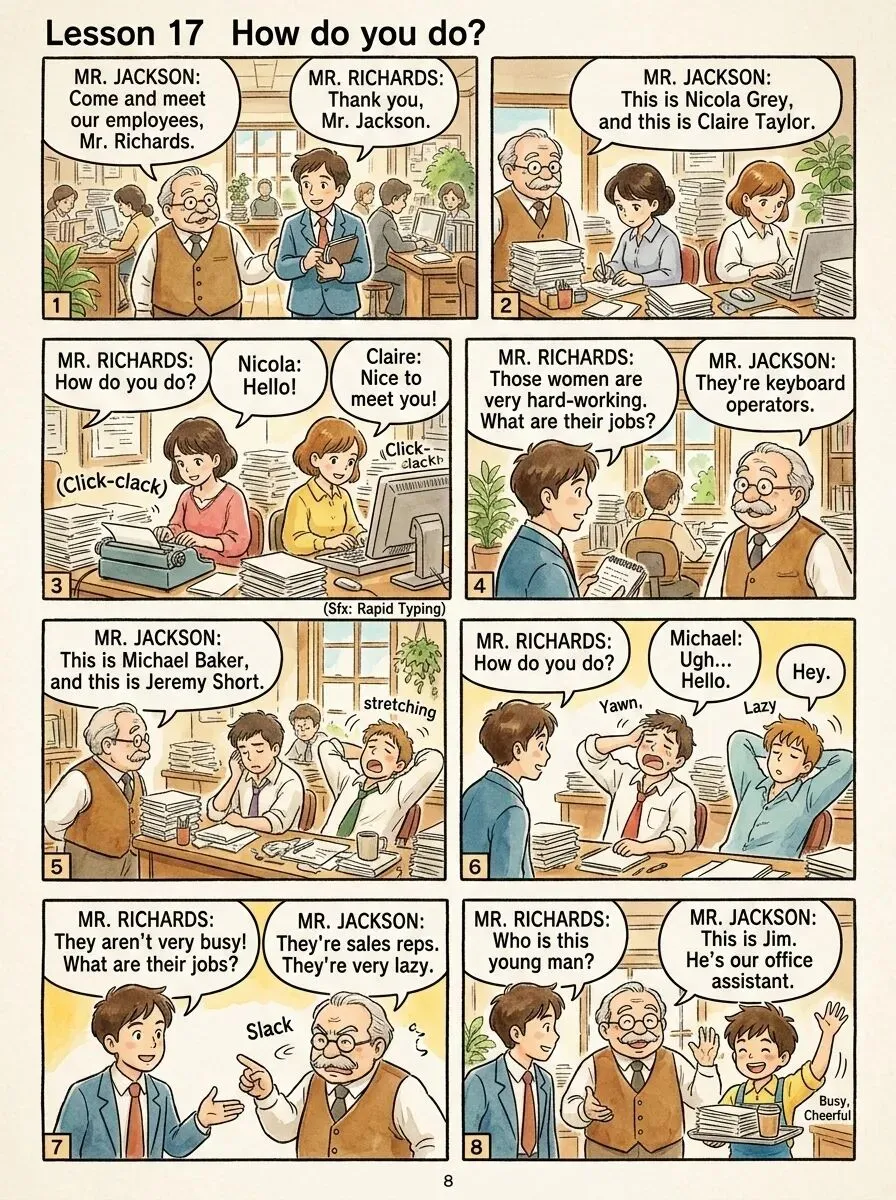
情景说明:第17课的场景发生在一间办公室或工作场所。老板杰克逊先生(Mr. Jackson)正在向访客理查兹先生(Mr. Richards)介绍公司的员工。这是一个典型的商务社交场景,涉及初次见面、互相介绍和询问工作职责。对话展现了正式问候、人物介绍和职业描述。
Lesson 17 How do you do?
📜 课文原文(含语音标注)
Mr. Jackson: Come and meet our employees, Mr. Richards.
杰克逊先生:来见见我们的雇员,理查兹先生。
Mr. Richards: Thank you, Mr. Jackson.
理查兹先生:谢谢,杰克逊先生。
Mr. Jackson: This is Nicola Grey, and this is Claire Taylor.
杰克逊先生:这位是尼古拉·格雷,这位是克莱尔·泰勒。
Mr. Richards: How do you do?
理查兹先生:你们好!
Mr. Richards: Those women are very hard-working. What are their jobs?
理查兹先生:那些女士很勤快。她们是做什么工作的?
Mr. Jackson: They're keyboard operators.
杰克逊先生:她们是电脑录入员。
Mr. Richards: This is Michael Baker, and this is Jeremy Short.
理查兹先生:这位是迈克尔·贝克,这位是杰里米·肖特。
Mr. Richards: How do you do?
理查兹先生:你们好!
Mr. Richards: They aren't very busy! What are their jobs?
理查兹先生:他们不很忙啊!他们是做什么工作的?
Mr. Jackson: They're sales reps. They're very lazy.
杰克逊先生:他们是推销员。他们非常懒。
Mr. Richards: Who is this young man?
理查兹先生:这个年轻人是谁?
Mr. Jackson: This is Jim. He's our office assistant.
杰克逊先生:这是吉姆。他是我们办公室的勤杂人员。
语音标注: Come and meet 中 Come and 连读 /ˈkʌm ən/;employee 重音在第三音节;How do you do? 语调降调;Those women are 连读;aren't 发音 /ɑːnt/;sales reps 中 sales 和 reps 重读;Who is 连读 /huːz/。
情景说明:第18课则是一个集中的句型操练,通过一系列图片问答,反复练习询问和回答复数主语的职业,并引入了选择疑问句(or)的结构。这课没有具体情景,是纯粹的语法和句型巩固练习。
Lesson 18 What are their jobs?
📜 课文原文
What are their jobs?Are they keyboard operators or air hostesses?They aren't keyboard operators. They're air hostesses.What are their jobs?Are they postmen or policemen?They aren't postmen. They're policemen.What are their jobs?Are they policewomen or nurses?They aren't policewomen. They're nurses.What are their jobs?Are they customs officers or hairdressers?They aren't customs officers. They're hairdressers.What are their jobs?Are they hairdressers or teachers?They aren't hairdressers. They're teachers.What are their jobs?Are they engineers or taxi drivers?They aren't engineers. They're taxi drivers.What are their jobs?Are they policewomen or air hostesses?They aren't policewomen. They're air hostesses.What are their jobs?Are they engineers or teachers?They aren't engineers. They're teachers.
他们是做什么工作的?她们是电脑录入员还是空中小姐?她们不是电脑录入员。她们是空中小姐。他们是做什么工作的?他们是邮递员还是警察?他们不是邮递员。他们是警察。她们是做什么工作的?她们是女警察还是护士?她们不是女警察。她们是护士。他们是做什么工作的?他们是海关官员还是理发师?他们不是海关官员。他们是理发师。他们是做什么工作的?他们是理发师还是教师?他们不是理发师。他们是教师。他们是做什么工作的?他们是工程师还是出租车司机?他们不是工程师。他们是出租车司机。她们是做什么工作的?她们是女警察还是空中小姐?她们不是女警察。她们是空中小姐。他们是做什么工作的?他们是工程师还是教师?他们不是工程师。他们是教师。
语音标注: What are 连读;or 前后的选择项需重读;aren't 发音清晰。
🔍 第二部分:逐句精讲与词块总结
句子1
原文: Come and meet our employees, Mr. Richards.
翻译: 来见见我们的雇员,理查兹先生。
句子结构: 祈使句。Come and meet 并列动词原形作谓语,our employees 宾语,Mr. Richards 呼语。
重点词汇:
come 蓝思值 10L
英音 /kʌm/ 美音 /kʌm/ 词性:v.
释义:来;来到
常用语块:come here, come in, come on, come and...
例句一:Please come to my office. 请来我的办公室。
例句二:Come and see my new car. 来看看我的新车。
拓展:come and + 动词原形 相当于 come to do sth.
meet 蓝思值 10L
英音 /miːt/ 美音 /miːt/ 词性:v.
释义:遇见;见面;认识;迎接
常用语块:meet sb., Nice to meet you., meet the needs
例句一:I met an old friend in the street. 我在街上遇到一位老朋友。
例句二:Let's meet at the station. 我们在车站见面吧。
拓展:meet 作"认识"讲时用于初次见面。meet with 指会晤。
employee 蓝思值 300L
英音 /ɪmˈplɔɪiː/; /ˌemplɔɪˈiː/ 美音 /ɪmˈplɔɪiː/; /ˌemplɔɪˈiː/ 词性:n.
释义:雇员,员工
常用语块:a government employee, full-time employee
例句一:The company has over a thousand employees. 这家公司有一千多名员工。
例句二:She is a new employee in the sales department. 她是销售部的新员工。
拓展:employ (v.),employer (雇主),employment (就业)。-ee 表示"被...的人"。
our 蓝思值 BR L
英音 /ˈaʊə(r)/ 美音 /ˈaʊər/; /ɑːr/ 词性:pron.
释义:我们的 (形容词性物主代词)
常用语块:our country, our friends
例句一:This is our classroom. 这是我们的教室。
例句二:Our teacher is very kind. 我们的老师非常和蔼。
拓展:形容词性物主代词后必须接名词。名词性物主代词是 ours。
语法点睛:本句的核心语法点是祈使句和形容词性物主代词 our 的用法。祈使句用于发出命令、请求或邀请,主语 you 通常省略,动词用原形。our 是形容词性物主代词,修饰名词 employees,表示所属关系。来源 [NCE知识点笔记]
语音要点:Come and 可以发生连读,读作 /ˈkʌm ən/。our employees 中,our 以元音 /aʊə/ 结尾,employees 以元音 /ɪ/ 开头,可以轻微连读,但通常不强制。注意 employee 的重音在第三个音节 /iː/ 上。
句子2
原文: Thank you, Mr. Jackson.
翻译: 谢谢,杰克逊先生。
句子结构: 简单句。Thank 谓语动词,you 宾语,Mr. Jackson 呼语。
重点词汇:
thank 蓝思值 BR L
英音 /θæŋk/ 美音 /θæŋk/ 词性:v.
释义:感谢
常用语块:thank you, thank sb. for sth.
例句一:I thank you for your help. 我感谢你的帮助。
例句二:Don't thank me. Thank him. 别谢我。谢他。
拓展:名词形式 thanks。Thank you 的正式回应是 You're welcome.
语法点睛:这是一个表示感谢的常用句型。Thank 是及物动词,后面直接接感谢的对象(宾语)。来源 [NCE知识点笔记]
语音要点:Thank you 常被弱读和连读为 /ˈθæŋk juː/ 或更快的 /ˈθæŋk jə/。
句子3
原文: This is Nicola Grey, and this is Claire Taylor.
翻译: 这位是尼古拉·格雷,这位是克莱尔·泰勒。
句子结构: 并列句,由 and 连接两个主系表结构:This is Nicola Grey / this is Claire Taylor。
重点词汇:
this 蓝思值 BR L
英音 /ðɪs/ 美音 /ðɪs/ 词性:pron.
释义:这,这个
常用语块:this way, this morning, like this
例句一:This is my book. 这是我的书。
例句二:Who is this? 这位是谁?
拓展:this 的复数形式是 these。
语法点睛:这是介绍他人的经典句型 This is...。注意在介绍多人时,可以用 and 连接。This 是指示代词,在句中作主语。来源 [NCE知识点笔记]
语音要点:This is 常发生连读,读作 /ˈðɪs ɪz/。两个 this is 结构并列,语调在第一个名字后稍作停顿并上扬,在第二个名字后下降,表示介绍完毕。
句子4
原文: How do you do?
翻译: 你好!/ 幸会!
句子结构: 特殊疑问句。How (疑问副词) + do (助动词) + you (主语) + do (谓语动词原形)?
重点词汇:
how 蓝思值 BR L
英音 /haʊ/ 美音 /haʊ/ 词性:adv.
释义:怎样,如何
常用语块:how many, how much, how old, how about...
例句一:How are you? 你好吗?
例句二:How do you spell it? 你怎么拼写它?
拓展:How do you do? 是固定短语,用于非常正式的初次见面问候。对方也应回答 How do you do?。
语法点睛:How do you do? 是一个固定的问候语套句。虽然结构上是疑问句,但功能上等同于一个问候语。回答时用相同的句子。这是英语社交礼仪的一部分。来源 [NCE知识点笔记]、[课堂笔记]
语音要点:这是一个完整的疑问句,语调通常为降调,表示礼貌和正式的结束。每个单词发音清晰,do you 可以弱读为 /də jə/。
句子5
原文: Those women are very hard-working. What are their jobs?
翻译: 那些女士很勤快。她们是做什么工作的?
句子结构: 第一句主系表:Those women (主语) + are (系动词) + very hard-working (表语)。第二句特殊疑问句:What (表语) + are (系动词) + their jobs (主语)?
重点词汇:
those 蓝思值 10L
英音 /ðəʊz/ 美音 /ðoʊz/ 词性:pron.
释义:那些
常用语块:those days, those people
例句一:Those cars are expensive. 那些车很贵。
例句二:I like those flowers. 我喜欢那些花。
拓展:those 是 that 的复数形式。
women 蓝思值 10L
英音 /ˈwɪmɪn/ 美音 /ˈwɪmɪn/ 词性:n.
释义:女人 (woman的复数)
常用语块:women's rights, young women
例句一:There are three women in the room. 房间里有三个女人。
例句二:These women are doctors. 这些女人是医生。
拓展:woman 的复数是不规则变化 women,发音变化明显。
hard-working 蓝思值 200L
英音 /ˌhɑːd ˈwɜːkɪŋ/ 美音 /ˌhɑːrd ˈwɜːrkɪŋ/ 词性:adj.
释义:勤奋的,努力工作的
常用语块:a hard-working student
例句一:My father is very hard-working. 我父亲工作非常努力。
例句二:We need hard-working employees. 我们需要勤奋的员工。
拓展:复合形容词,反义词 lazy。
what 蓝思值 BR L
英音 /wɒt/ 美音 /wʌt/; /wɑːt/ 词性:pron.
释义:什么
常用语块:what time, what color, what about...
例句一:What is this? 这是什么?
例句二:What do you want? 你想要什么?
拓展:What 用于询问事物、职业、颜色等。
their 蓝思值 BR L
英音 /ðeə(r)/ 美音 /ðer/ 词性:pron.
释义:他/她/它们的 (形容词性物主代词)
常用语块:their house, their parents
例句一:They are doing their homework. 他们正在做作业。
例句二:Their car is blue. 他们的车是蓝色的。
拓展:their 修饰名词 jobs。主格 they,宾格 them,名词性物主代词 theirs。
job 蓝思值 10L
英音 /dʒɒb/ 美音 /dʒɑːb/ 词性:n.
释义:工作;职业
常用语块:a good job, look for a job, do a good job
例句一:What's your job? 你是做什么工作的?
例句二:He has a part-time job. 他有一份兼职工作。
拓展:job 是可数名词,work 作"工作"讲时是不可数名词。
语法点睛:本句涉及多个语法点:1) 指示代词 those 的用法;2) 名词复数 women;3) 形容词 hard-working 作表语;4) 特殊疑问句 What are...? 询问复数主语的职业;5) 形容词性物主代词 their 的用法。What are their jobs? 是一个倒装结构,疑问词 What 提前,系动词 are 提到主语 their jobs 之前。来源 [NCE知识点笔记]、[语法新思维]
语音要点:Those women are 可以连读为 /ðəʊz ˈwɪmɪn ə/。hard-working 的重音在第一个音节 hard 上。What are 常弱读连读为 /ˈwɒt ə/ 或 /ˈwʌt ə/。
句子6
原文: They're keyboard operators.
翻译: 她们是电脑录入员。
句子结构: 主系表:They (主语) + 're (系动词 are 缩写) + keyboard operators (表语)。
重点词汇:
keyboard 蓝思值 400L
英音 /ˈkiːbɔːd/ 美音 /ˈkiːbɔːrd/ 词性:n.
释义:键盘
常用语块:computer keyboard, piano keyboard
例句一:I need a new keyboard for my computer. 我的电脑需要一个新键盘。
例句二:She types very fast on the keyboard. 她在键盘上打字很快。
拓展:复合词 key + board。
operator 蓝思值 500L
英音 /ˈɒpəreɪtə(r)/ 美音 /ˈɑːpəreɪtər/ 词性:n.
释义:操作员;接线员;经营者
常用语块:telephone operator, machine operator, tour operator
例句一:He works as a computer operator. 他的工作是电脑操作员。
例句二:Please dial zero for the operator. 请拨0找接线员。
拓展:动词 operate,名词 operation。-or 是表示"人"的后缀。
语法点睛:这是对 What are their jobs? 的标准回答。They're 是 They are 的缩写,在口语中非常常见。keyboard operators 是名词短语作表语。来源 [NCE知识点笔记]
语音要点:They're 读作 /ðeə(r)/,与 their 同音。keyboard operators 中,keyboard 重音在第一音节,operators 重音在第一音节。
句子7
原文: They aren't very busy! What are their jobs?
翻译: 他们不很忙啊!他们是做什么工作的?
句子结构: 第一句主系表否定句:They (主语) + aren't (系动词否定) + very busy (表语)。第二句同句子5。
重点词汇:
aren't 蓝思值 BR L
英音 /ɑːnt/ 美音 /ɑːrnt/ 词性:contraction
释义:= are not
常用语块:They aren't here., You aren't late.
例句一:We aren't students. 我们不是学生。
例句二:Those aren't my books. 那些不是我的书。
拓展:are not 的标准缩写,用于复数或第二人称主语。
busy 蓝思值 10L
英音 /ˈbɪzi/ 美音 /ˈbɪzi/ 词性:adj.
释义:忙碌的
常用语块:be busy with sth., busy street, busy signal
例句一:My mother is always busy. 我妈妈总是很忙。
例句二:Sorry, the line is busy. 抱歉,电话占线。
拓展:反义词 free, idle。
语法点睛:本句展示了系动词 be 的否定形式 aren't。be 动词的否定式是在后面直接加 not,并可缩写为 isn't, aren't。very 是程度副词,修饰形容词 busy。来源 [NCE知识点笔记]、[语法新思维]
语音要点:aren't 发音时,t 音在快速口语中可能不明显。very busy 中,very 的 v 音要清晰。
句子8
原文: They're sales reps. They're very lazy.
翻译: 他们是推销员。他们非常懒。
句子结构: 两个主系表简单句。
重点词汇:
sales rep 蓝思值 400L
英音 /ˈseɪlz ˌrep/ 美音 /ˈseɪlz ˌrep/ 词性:n. phrase
释义:推销员,销售代表
常用语块:work as a sales rep
例句一:She is a sales rep for a software company. 她是一家软件公司的销售代表。
例句二:Our sales reps travel a lot. 我们的销售代表经常出差。
拓展:sales rep 是 sales representative 的缩写。
lazy 蓝思值 10L
英音 /ˈleɪzi/ 美音 /ˈleɪzi/ 词性:adj.
释义:懒惰的
常用语块:lazy boy, lazy afternoon
例句一:Don't be so lazy! Get up! 别这么懒!起床!
例句二:He's too lazy to clean his room. 他太懒了,都不打扫房间。
拓展:反义词 hard-working, diligent。
语法点睛:这是对前一句 What are their jobs? 的回答和补充评论。句子结构简单,但通过 very lazy 表达了说话者的主观评价。来源 [NCE知识点笔记]
语音要点:sales reps 中,sales 和 reps 都是重读单词。very lazy 中,lazy 重音在第一音节。
句子9
原文: Who is this young man?
翻译: 这个年轻人是谁?
句子结构: 特殊疑问句。Who (疑问代词作表语) + is (系动词) + this young man (主语)?
重点词汇:
who 蓝思值 BR L
英音 /huː/ 美音 /huː/ 词性:pron.
释义:谁
常用语块:who is it?, who are you?
例句一:Who is that girl? 那个女孩是谁?
例句二:Who knows the answer? 谁知道答案?
拓展:Who 用于询问人,在句中可作主语、宾语或表语。
young 蓝思值 10L
英音 /jʌŋ/ 美音 /jʌŋ/ 词性:adj.
释义:年轻的
常用语块:young people, young tree, in my young days
例句一:She looks very young. 她看起来很年轻。
例句二:He has two young children. 他有两个年幼的孩子。
拓展:反义词 old。
man 蓝思值 BR L
英音 /mæn/ 美音 /mæn/ 词性:n.
释义:男人;人
常用语块:a young man, man and woman, space man
例句一:He is a tall man. 他是个高个子男人。
例句二:All men are equal. 人人生而平等。
拓展:复数形式是不规则 men /men/。
语法点睛:这是询问第三人称身份的句型 Who is...?。this young man 是名词短语作主语,young 是形容词修饰 man。Who 在句中作表语。来源 [NCE知识点笔记]
语音要点:Who is 可以连读为 /ˈhuː ɪz/ 或更快的 /ˈhuːz/。this young man 中,this 和 young 可以连读 /ðɪs jʌŋ/。
句子10
原文: This is Jim. He's our office assistant.
翻译: 这是吉姆。他是我们办公室的勤杂人员。
句子结构: 两个简单句。第一句介绍句型。第二句主系表:He (主语) + 's (is) + our office assistant (表语)。
重点词汇:
he 蓝思值 BR L
英音 /hiː/ 美音 /hiː/ 词性:pron.
释义:他
常用语块:he and she
例句一:He is my brother. 他是我哥哥。
例句二:Where is he? 他在哪里?
拓展:he 是主格,宾格 him,形容词性物主代词 his。
office 蓝思值 10L
英音 /ˈɒfɪs/ 美音 /ˈɑːfɪs/ 词性:n.
释义:办公室
常用语块:post office, office hours, office building
例句一:My father works in an office. 我父亲在办公室工作。
例句二:I'll be in my office all afternoon. 我整个下午都会在办公室。
拓展:office 可以指具体的房间,也可以指抽象的"职务"。
assistant 蓝思值 400L
英音 /əˈsɪstənt/ 美音 /əˈsɪstənt/ 词性:n.
释义:助手,助理
常用语块:shop assistant, teaching assistant, personal assistant
例句一:She works as a manager's assistant. 她是经理助理。
例句二:I need an assistant to help me. 我需要一个助手帮我。
拓展:动词 assist,名词 assistance。-ant 表示"人"的后缀。
语法点睛:这是对 Who is this young man? 的回答。先用 This is... 介绍名字,再用 He's... 说明其身份或与说话者的关系。our office assistant 中,our 和 office 都是定语,修饰 assistant。来源 [NCE知识点笔记]、[课堂笔记]
语音要点:He's 读作 /hiːz/。office assistant 中,office 重音在第一音节,assistant 重音在第二音节。
📌 核心词块总结 (Key Lexical Chunks)
Come and meet... 来见见...... (e.g., Come and meet my family.)
How do you do? 你好! (用于非常正式的初次见面) (e.g., ---How do you do? ---How do you do?)
What are their jobs? 他们是做什么工作的? (e.g., What are their jobs? They are engineers.)
They're (very) + adjective. 他们很...... (e.g., They're very friendly.)
This is... He's/She's our... 这是......。他/她是我们的...... (e.g., This is Lisa. She's our new teacher.)
keyboard operator / sales rep / office assistant 电脑录入员/推销员/办公室助理 (e.g., My sister is a keyboard operator.)
💬 第三部分:基础会话技巧
1. 分析课文中的日常用语、礼貌表达、问答模式- 正式介绍与问候:杰克逊先生使用"Come and meet..."发起介绍,然后逐一介绍员工("This is...")。被介绍的双方使用最正式的问候语"How do you do?"。- 询问职业的模式:理查兹先生观察后使用"What are their jobs?"询问一群人的职业。回答模式固定为"They're + 职业名称"。- 附加评论:在问答职业后,对话中加入了主观评论,如"very hard-working"和"very lazy",使对话更生动。
2. 提供类似场景的扩展对话示例场景:在学校,老师向新同学介绍班级干部。A (Teacher): Tom, come and meet our class committee. This is Lucy, and this is David.B (Tom): How do you do?C&D (Lucy & David): How do you do?B: They look very organized. What are their jobs in the class?A: Lucy is our monitor, and David is our PE representative.B: I see. Thank you.
3. 设计简单的角色扮演活动建议- 活动1:公司开放日。学生三人一组。一人扮演经理,一人扮演访客,一人扮演员工。经理向访客介绍员工,并询问员工的工作。访客进行问候并询问员工的职业。员工回答。- 活动2:职业猜猜猜。一位学生用"They are very [形容词]. What are their jobs?"来描述一种职业,其他学生猜测。
4. 融入基础思考- 如果你是理查兹先生,在听到杰克逊先生说某些员工"very lazy"时,你会怎么回应才显得礼貌?- 在你的生活中,什么时候会用到"How do you do?"这样的问候?什么时候用"Nice to meet you."更合适?
📐 第四部分:本课语法精析(加强版)
1. 名词的复数形式 (Plural Forms of Nouns)- 规则变化:大多数名词直接加 -s (employee→employees, job→jobs, operator→operators);以-s, -x, -ch, -sh结尾加 -es (bus→buses, box→boxes, watch→watches, dish→dishes);以辅音+y结尾变y为i加-es (country→countries);以-f或-fe结尾多数变-ves (wife→wives, knife→knives)。- 不规则变化:man→men, woman→women, child→children, foot→feet, tooth→teeth, mouse→mice。- 单复数同形:sheep, deer, fish, Chinese, Japanese。- 只有复数形式的名词:trousers, glasses, scissors (谓语用复数)。语法功能:名词复数与谓语动词复数形式(are)必须一致。例:Those women are hard-working.
2. 物主代词 (Possessive Pronouns)形容词性物主代词:后面必须紧跟名词,不能单独使用。our employees, their jobs, his book, her car, its tail, your name, my pen.人称代词系统表:
例句对比:They are in the office. I know them. Their office is big. This office is theirs.
3. 询问职业的特殊疑问句 (Special Questions about Jobs)- 结构:What + are + their jobs? (What 作表语,are 与复数主语一致)- 不同主语的转换:What is his/her job? / What does he/she do? (询问单个人);What are their jobs?;What is your job?;What are your jobs?- 选择疑问句:Are they + 职业A + or + 职业B? 回答不能用Yes/No,必须选择。课文模式:They aren't A. They're B.
练习题 1. 将下列名词变为复数形式:man, woman, job, assistant, box, watch, country, child. → men, women, jobs, assistants, boxes, watches, countries, children.2. 用 am, is, are 填空:Those ______ keyboard operators. Their office ______ very clean. I ______ an office assistant. → are, is, am3. 选择正确的物主代词填空:This is ______ (we/our) company. ______ (They/Their) jobs are interesting. → our, Their4. 根据括号内提示改写句子:They are nurses. (对划线部分提问,划线部分为nurses) → What are their jobs?5. 将下列句子改为选择疑问句:They are teachers. (给出选项:engineers) → Are they teachers or engineers?6. 回答选择疑问句:Are they postmen or policemen? (他们是邮递员。) → They aren't policemen. They're postmen.7. 翻译:那些勤奋的女人是我们的雇员。 → Those hard-working women are our employees.8. 翻译:这个年轻人是谁?他是我们的新销售代表。 → Who is this young man? He is our new sales rep.9. 用所给词的正确形式填空:Look at those ______ (woman). They are ______ (busy). → women, busy10. 补全对话:A: Come and meet ______ (we) team. B: OK. A: This is Tom, and this is Anna. B: ______ ______ ______? (正式问候) C&D: ______ ______ ______? B: What ______ ______ ______? (他们的工作) A: Tom is a designer, and Anna ______ ______ office manager. → our, How do you do, How do you do, are their jobs, is our
✏️ 第五部分:基础练习与活动
跟读练习:播放课文录音,学生逐句跟读。重点模仿"How do you do?"的正式语调,以及"What are their jobs?"的疑问句升调。
角色扮演:三人一组,分别扮演老板、访客和员工,模拟课文对话。然后互换角色,并使用第18课的不同职业进行替换练习。
简单替换练习:句型:What are their jobs? They are ______. 替换词:policemen, nurses, taxi drivers, engineers, hairdressers, teachers, air hostesses, keyboard operators. 扩展:加入形容词,如:They are very busy sales reps.
听力理解题目(根据课文录音):1. Mr. Richards meets Mr. Jackson's employees. (T)2. Nicola and Claire are very lazy. (F)3. Michael and Jeremy are hard-working. (F)4. Michael and Jeremy are sales reps. (T)5. Jim is the office assistant. (T)
课文改写版本(词汇更简单):Boss: Hello, Mr. Lee. Meet my workers.Visitor: Thanks.Boss: This is Anna. This is Bella.Visitor: Hello.Visitor: Those women work hard. What do they do?Boss: They type on computers.Boss: This is Carl. This is Dan.Visitor: Hello.Visitor: They are not busy! What do they do?Boss: They sell things. They are lazy.Visitor: Who is that boy?Boss: This is Tim. He helps in our office.
🤔 第六部分:英文深度思考与拓展
A. 层次化英文问题与答案
Level 1 (Factual):1. Who does Mr. Jackson ask Mr. Richards to meet? → Mr. Jackson asks Mr. Richards to meet their employees.2. What are the names of the two women introduced? → Their names are Nicola Grey and Claire Taylor.3. What are the jobs of Michael Baker and Jeremy Short? → They are sales reps.4. How does Mr. Jackson describe the sales reps? → He describes them as very lazy.5. Who is the young man at the end? → He is Jim, the office assistant.
Level 2 (Inferential):1. Where do you think the conversation in Lesson 17 takes place? Why? → In an office or a company, because Mr. Jackson is introducing his employees to a visitor.2. Why does Mr. Richards say "Those women are very hard-working" and "They aren't very busy"? → He is making observations based on what he sees.3. What might be the relationship between Mr. Jackson and Mr. Richards? → They are likely business associates or potential partners.4. From Mr. Jackson's words, what kind of boss do you think he is? → Straightforward, perhaps a bit unprofessional to call employees lazy in front of a visitor.
Level 3 (Evaluative/Creative):1. In your opinion, is it polite for Mr. Jackson to call his employees "lazy" in front of a visitor? Why or why not? → Not very polite; it might give a negative impression and embarrass employees.2. If you were Jim, and you heard your boss introduce you, how would you feel and what would you say? → Proud, smile and say "How do you do? It's nice to meet you."3. Think of three different jobs not mentioned in Lessons 17-18. How would you ask and answer about them using the patterns? → e.g., Chef: Are they waiters or chefs? They aren't waiters. They're chefs. etc.4. "How do you do?" is very formal. When do you think people use less formal greetings like "Hello" or "Hi"? → In casual, everyday situations with friends, family, or informal work settings.
B. 多类型拓展阅读
1. 现代场景故事 (Modern Scenario)
The Intern's First DayIt was Emma's first day as an intern at "TechFlow," a buzzing startup. Her mentor, Ms. Chen, greeted her warmly. "Welcome, Emma! Come and meet our core team," she said, leading her into an open-plan office filled with plants and colorful chairs."This is Alex, our lead software developer," Ms. Chen pointed to a young man wearing headphones. "And this is Maya, our UI/UX designer." Both looked up from their screens and smiled. "Hi there!" they said almost together. Emma, remembering her training, replied with a confident, "Hello! Nice to meet you both."Ms. Chen continued, "They're incredibly creative and hard-working." Emma noticed another group laughing by the coffee machine. "What are their jobs?" she asked. "Oh, they're our sales and marketing squad. They're very energetic, as you can see!" Ms. Chen explained. Just then, a friendly young man walked by carrying a box of supplies. "And who is this?" Emma inquired. "That's Leo, our office assistant. He keeps everything running smoothly!" Emma felt excited. It seemed like a great place to learn.
引导性问题:How is the atmosphere at "TechFlow" different from the office in the original Lesson 17?
2. 文化背景小知识 (Cultural Background)
"How Do You Do?" and BeyondThe greeting "How do you do?" is a relic of a more formal time in English-speaking cultures, particularly in Britain. It's a fixed phrase, meaning the expected response is the same words: "How do you do?" It's not a real question about your health or feelings. Using it signals a very formal, respectful, and often first-time meeting, common in business introductions, meeting a friend's parents, or at official events.Today, "Nice to meet you" or "Pleased to meet you" are far more common, even in professional settings. They feel warmer and less stiff. "Hello" or "Hi" with a handshake is also perfectly acceptable in many business contexts now. The choice depends on the company culture and the region. In the United States, formality is generally lower than in the UK.Knowing when to use "How do you do?" shows cultural awareness. If someone says it to you, simply repeat it back with a smile. If you're unsure, "Nice to meet you" is almost always a safe and polite choice.
引导性问题:Why is it important to know that "How do you do?" is a fixed phrase?
3. 今昔对比 (Then and Now)
Offices: Then and NowThe office scene in Lesson 17 likely represents a workplace from the mid-20th century when the textbook was written. Imagine a quiet room with desks in rows, typewriters (keyboards for typing machines), filing cabinets, and perhaps a telephone on each desk. Employees like "keyboard operators" typed documents all day. The "sales reps" might have been out visiting clients or making phone calls from their desks. The boss had a private office.Contrast that with a modern office. Open spaces are common, promoting collaboration. The "keyboard operator" job has largely evolved into "data entry specialist" or "administrative assistant," using computers. Sales reps might be "account managers" or "business development executives," connecting with clients globally via video calls from anywhere. The "office assistant" role still exists but might involve managing digital calendars, ordering supplies online, and coordinating IT support. Technology has changed the tools, but the core functions—organizing, communicating, and selling—remain.
引导性问题:What is one major technological change that has affected the jobs mentioned in the lesson?
4. 新潮英语改写 (Trendy English Rewrite)
Lesson 17: The Vibe CheckYo, Mr. Jackson was giving Mr. Richards the grand tour. "Alright, come meet the squad," he says, all casual.He points, "This is Nic, and this is Claire." They both give a nod. "Hey," says Mr. Richards.He checks out the scene. "Those two are totally grinding," he observes, meaning they're working hard. "What's their gig?" he asks."They're our data ninjas," Mr. Jackson replies. (That means expert keyboard/computer operators).Then he waves at two guys looking chill. "And this is Mike and Jere.""Sup," says Mr. Richards. "They seem... relaxed. What do they do?""They're in sales. Honestly, they're majorly slacking off today," Mr. Jackson admits with a laugh.Spotting a young guy organizing stuff, Mr. Richards asks, "Who's that?""That's Jim. He's our go-to guy, keeps the place from falling apart!" says Mr. Jackson.
引导性问题:How does the use of words like "squad," "grinding," and "gig" change the feel of the conversation?
5. 难度略高的拓展阅读 (Slightly Higher Difficulty)
The Importance of Office AssistantsOften overlooked, the role of an office assistant is the glue that holds many workplaces together. Far from just making coffee or answering phones, modern office assistants are organizational hubs. Their duties can range from managing complex schedules and coordinating meetings to handling correspondence, maintaining office supplies, and serving as the first point of contact for visitors and clients.In the context of Lesson 17, Jim is likely responsible for ensuring the office runs smoothly so that the keyboard operators and sales reps can focus on their core tasks. He might prepare documents for typing, distribute mail, ensure equipment is working, and maintain a welcoming environment for guests like Mr. Richards. A good office assistant possesses strong communication skills, attention to detail, and the ability to multitask. They often have a good understanding of everyone's role in the office, making them a valuable source of information. While entry-level, this position can be a stepping stone to roles in administration, human resources, or management, as it provides a broad view of how a company operates.
引导性问题:According to the text, why is the office assistant role considered important beyond simple tasks?
6. 简单科普或趣闻 (Simple Popular Science or Anecdote)
Why "Women" and Not "Womans"?The English words man and woman have fascinating histories that explain their irregular plurals men and women. They come from Old English. Man originally meant "human being" or "person," not specifically a male. The word for a male person was wer (as in "werewolf" — man-wolf), and for a female person was wif (which became "wife").Over centuries, man gradually took on the meaning of an adult male human. The plural men also evolved from an old plural form. Woman comes from wif + man, meaning "female human." Its plural, women, underwent a special sound change in Middle English where the i in wif shifted, and the spelling stabilized as o, but the pronunciation became /ˈwɪmɪn/.Many common, everyday words in English have irregular plurals because they are very old and their forms were set before spelling rules were standardized. Other examples are foot/feet, tooth/teeth, mouse/mice, and child/children. So, every time you say "women," you're using a word shaped by over a thousand years of language history!
引导性问题:What is the original meaning of the word "man," and how did it change?
🌍 第七部分:日常应用延伸
本课语言点在日常生活中应用场景:- 介绍朋友/同事:在聚会或活动上,用"Come and meet my friend..."或"This is..."介绍他人。- 初次见面:在非常正式的场合(如面试、商务会议、见长辈),如果对方先说"How do you do?",礼貌地回以"How do you do?"。- 询问职业:在社交中,想了解一群人的工作,可以问"What are their jobs?"。如果想问一个人,更常用"What do you do (for a living)?"。- 描述他人:用"They are very + 形容词"描述观察到的特点,如"They are very friendly/talented/noisy."
简单拓展学习材料:- 视频:搜索"English introductions formal business"或"How to introduce people in English"观看相关短视频。- 歌曲:听一些歌词中包含多种职业的简单英文儿歌或流行歌曲,如"People in My Town"等。- 绘本/读物:寻找儿童英文读物中关于"Jobs"或"When I Grow Up"主题的书籍。
英美生活小常识:- 关于问候:在英美,即使是正式场合,"Nice to meet you"也已非常普遍。用力适中的握手并保持眼神接触是标准礼仪。- 关于谈论工作:询问工作是一种常见的闲聊(small talk)开场白。但避免直接问"How much do you earn?",这被视为不礼貌和侵犯隐私。- 办公室文化:现代英美办公室文化强调团队合作和沟通。像"office assistant"这样的支持性角色受到尊重,因为他们对团队效率至关重要。
🗂️ 第八部分:本课知识图谱
核心对话主题:办公室介绍与职业询问
├─ 主要句型1:发起介绍与问候 — Come and meet our... / This is... (and this is...). / How do you do?├─ 主要句型2:观察与询问职业 — Those/These + 复数名词 + are + (very) + 形容词. / What are their jobs? — They are + 职业名称 (复数). / They are (very) + 形容词.├─ 主要句型3:确认身份 — Who is this/that...? — This is... He's/She's our...├─ 关键语法节点:名词复数规则与不规则 (men, women);形容词性物主代词 (our, their);特殊疑问句 (What are...?) 与选择疑问句 (Are they A or B?)└─ 关键词汇网络:人物:employee, man/men, woman/women, young man;职业:keyboard operator, sales rep, office assistant, policeman, nurse, teacher, engineer, taxi driver, air hostess, hairdresser, customs officer, postman;描述:hard-working, busy, lazy;动词/短语:come, meet, thank.
© 本文为狂暴英语教案 · 新概念英语第一册第17-18课
仅供学习交流使用

贝琪酱英语无痛逆袭站
微信扫描二维码,关注我的账号