【狂暴英语教案】新概念英语第二册第24课:不幸中之万幸
- 2026-08-04 00:56:02
读外刊,接触原汁原味的英文表达,
欢迎关注以下公众号+设为星标+推荐给朋友。▼
📚 狂暴英语教案 · 新概念英语第二册
第24课 It could be worse
不幸中之万幸
📘 本课信息教材:新概念英语第二册 · 第24课核心功能:叙事短文 · 丢失与找回 · 乐观主义语法焦点:情态动词could表虚拟/可能 · have sth. done · few/little辨析 · 形容词顺序
🏷️ 热门标签
🎯 本课学习目标
词汇:
掌握核心词汇 manager, upset, sympathetic, complain, wicked, contain, honesty 的拼写、发音、词性、核心释义及常用搭配。理解并运用与"丢失"、"抱怨"、"情绪"相关的短语和表达。通过词根词缀拓展词汇量,如 sym-, -tain 等。
语法:
掌握情态动词 could 在虚拟语气中表示"可能"或"本可以"的用法。巩固 have 作为使役动词的用法 (have sth. done)。复习并深化对 a few, few, a little, little 用法的辨析。学习用多个形容词修饰名词时的语序规则。
技能(段落写作):
学习如何构建一个包含"问题-反应-转折-结果"的叙事段落。掌握通过细节描写(如人物神态、动作)来增强故事生动性的技巧。练习使用直接引语和间接引语来推进叙事。
文化:
初步了解西方职场中,员工与经理沟通问题时的常见方式与礼仪。体会课文中体现的"塞翁失马,焉知非福"的乐观主义处世哲学。
📖 第一部分:课文完整内容
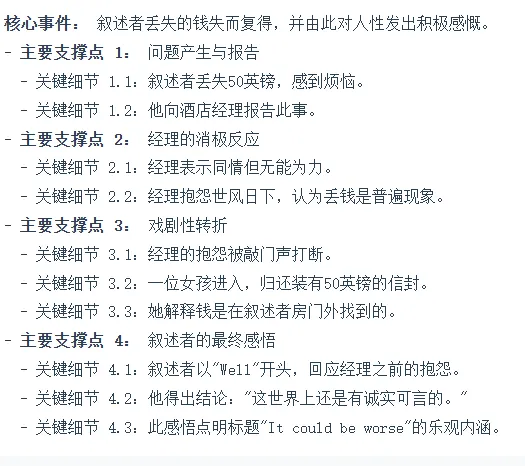
背景简介:本课是一篇简短的叙事文,讲述了一个关于丢失与找回钱财的小故事,情节简单但富有转折,语言生动,通过对话和细节刻画人物。故事核心在于通过一个意外的好结果,来反衬并轻微讽刺了经理对世风日下的抱怨,最终以一句乐观的感慨收尾,点明主题"It could be worse"(不幸中之万幸)。
课文原文
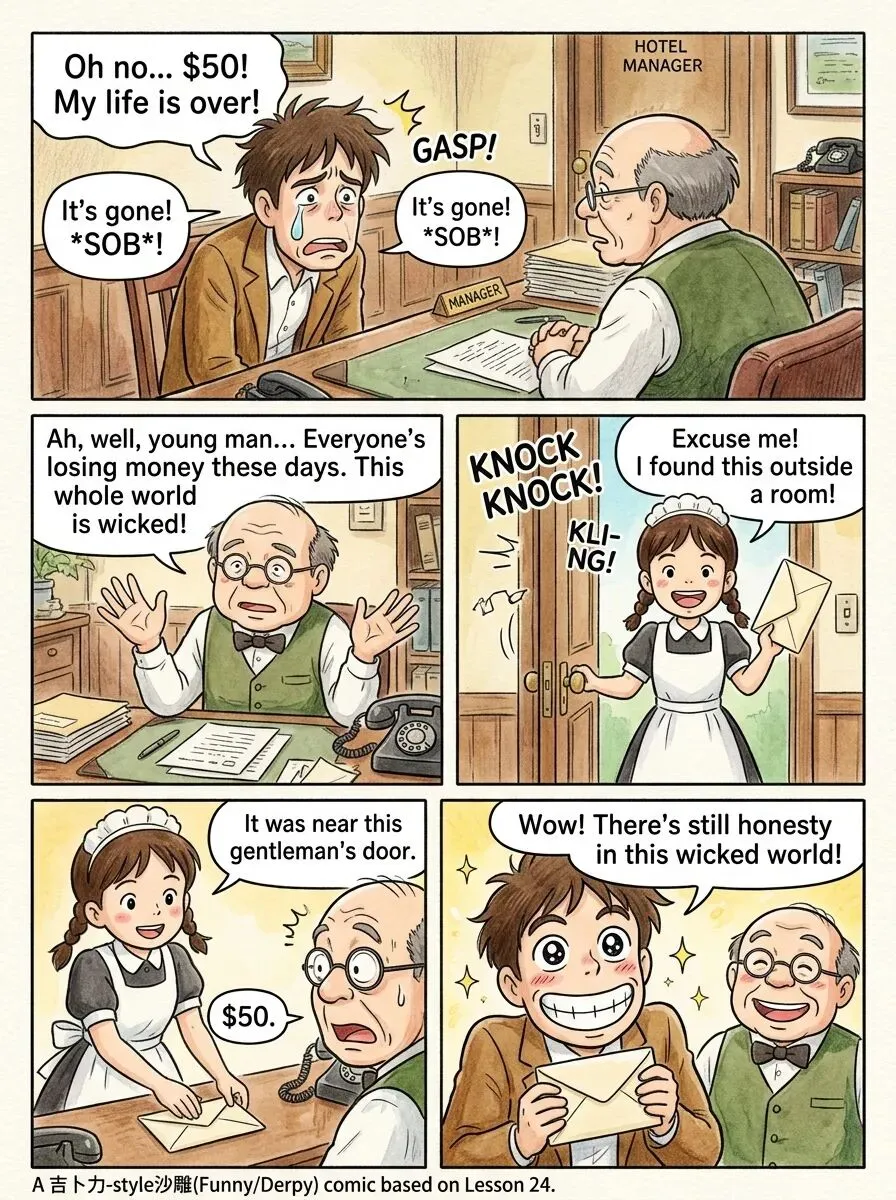
I entered the hotel manager's office and sat down. I had just lost £50 and I felt very upset.'I left the money in my room,' I said, 'and it's not there now.'The manager was sympathetic, but he could do nothing.'Everyone's losing money these days,' he said.He started to complain about this wicked world but was interrupted by a knock at the door. A girl came in and put an envelope on his desk. It contained £50.'I found this outside this gentleman's room,' she said.'Well,' I said to the manager, 'there is still some honesty in this world!'
我走进饭店经理的办公室,坐了下来。我刚刚丢了50英镑,感到非常烦恼。"我把钱放在房间里了,"我说,"可现在不见了。"经理深表同情,但却无能为力。"现在大家都在丢钱,"他说。他开始抱怨起这个邪恶的世道来,却被一阵敲门声打断了。一个姑娘走了进来,把一个信封放在了他桌上。里面装着50英镑。"这是我在这位先生的房门外找到的,"她说。"嗯,"我对经理说,"这世界上还是有诚实可言的!"
📑 参考译文
我走进饭店经理的办公室,坐了下来。我刚刚丢了50英镑,感到非常烦恼。"我把钱放在房间里了,"我说,"可现在不见了。"经理深表同情,但却无能为力。"现在大家都在丢钱,"他说。他开始抱怨起这个邪恶的世道来,却被一阵敲门声打断了。一个姑娘走了进来,把一个信封放在了他桌上。里面装着50英镑。"这是我在这位先生的房门外找到的,"她说。"嗯,"我对经理说,"这世界上还是有诚实可言的!"
🔍 第二部分:逐句精讲
句子1
原文: I entered the hotel manager's office and sat down.
翻译: 我走进饭店经理的办公室,坐了下来。
句子结构: 简单句,由 and 连接两个并列谓语 entered 和 sat down,主语 I。
重点词汇:
enter 蓝思值 600L
英音[ˈentə(r)] 美音[ˈentər] 词性:vt./vi.
释义:进入;参加;登记
常用语块:enter a room/building(进入房间/建筑);enter for a competition(报名参加比赛)
短语搭配:enter into(开始从事,进入...状态);enter upon(开始,着手)
例句一:He entered the room quietly. 他悄悄地走进了房间。
例句二:She decided to enter for the singing contest. 她决定报名参加歌唱比赛。
拓展:注意 enter 本身意为"进入",是及物动词,后面直接接地点,不需要加介词 into。enter into 是一个短语动词,意为"开始(讨论、协议等)"。[NCE知识点笔记]
manager 蓝思值 700L
英音[ˈmænɪdʒə(r)] 美音[ˈmænɪdʒər] 词性:n.
释义:经理;管理人
常用语块:hotel manager(酒店经理);sales manager(销售经理)
短语搭配:branch manager(分公司经理);general manager(总经理)
例句一:The manager called a meeting to discuss the new project. 经理召开会议讨论新项目。
例句二:She is a very capable project manager. 她是一位非常有能力的项目经理。
拓展:动词形式为 manage(管理,设法做到),名词 management(管理)。hotel manager's office 使用了名词所有格,表示"酒店经理的办公室"。
sat down
词块:坐下。sit 的过去式。反义词:stand up(站起来)。常用短语:sit back(放松);sit in on(列席,旁听)。
语法点睛: 本句使用了一般过去时 (entered, sat),清晰地交代了故事的开端动作。连词 and 连接两个先后发生的动作,使叙事流畅。句子虽简单,但开门见山,直接进入场景。[NCE知识点笔记]
语音要点: entered 发音 /ˈentəd/,sat down 连读。
句子2
原文: I had just lost £50 and I felt very upset.
翻译: 我刚刚丢了50英镑,感到非常烦恼。
句子结构: 并列句。由 and 连接两个分句。第一个分句是 I had just lost £50,第二个分句是 I felt very upset。
重点词汇:
lost 蓝思值 500L
英音[luːz] 美音[luːz] 词性:vt.
释义:丢失;输掉;迷失
常用语块:lose money/keys(丢钱/钥匙);lose weight(减肥);lose a game(输掉比赛)
短语搭配:lose one's way(迷路);lose heart(灰心);lose touch with(与...失去联系)
例句一:I lost my wallet on the bus yesterday. 我昨天在公交车上丢了钱包。
例句二:Don't lose hope; things will get better. 别失去希望,事情会好起来的。
拓展:名词形式为 loss(损失)。过去式、过去分词均为 lost。注意与 loose(松的)区分。
upset 蓝思值 800L
英音[ʌpˈset] 美音[ʌpˈset] 词性:adj./vt.
释义:(adj.) 心烦的,苦恼的;(vt.) 使心烦,打翻
常用语块:feel upset(感到心烦);get upset about/over sth.(为某事烦恼)
短语搭配:an upset stomach(肠胃不适);upset the balance(打破平衡)
例句一:She was upset because her pet dog was ill. 因为宠物狗病了,她很心烦。
例句二:The news upset him greatly. 这个消息让他非常不安。
拓展:作为形容词,描述人的情绪状态。近义词:disturbed, troubled。
语法点睛: 本句使用了过去完成时 had lost,搭配时间状语 just,强调"丢钱"这个动作发生在"走进办公室并坐下"之前,并且其影响(感到烦恼)持续到了"坐下"那一刻。这是过去完成时的典型用法之一:表示在过去某一时间或动作之前已经发生或完成的动作。[名师精讲]
语音要点: had just 连读,felt upset 中 felt 的 /t/ 与 upset 的 /ʌ/ 过渡。
句子3
原文: 'I left the money in my room,' I said, 'and it's not there now.'
翻译: "我把钱放在房间里了,"我说,"可现在不见了。"
句子结构: 直接引语。引语部分本身是一个并列句,由 and 连接。I said 是插入的主句。
重点词汇:
left 蓝思值 400L
英音[liːv] 美音[liːv] 词性:vt.
释义:留下;离开;遗忘
常用语块:leave sth. somewhere(把某物留在某地);leave home(离开家)
短语搭配:leave behind(留下,忘带);leave for(动身前往);leave out(省略,遗漏)
例句一:He left his umbrella in the taxi. 他把伞忘在出租车上了。
例句二:She left a note on the table. 她在桌上留了张便条。
拓展:leave 表示"留下(某物)"时,强调放置后离开。注意与 forget(忘记)的区别:forget 侧重"遗忘"这个心理活动,而 leave 侧重"把实物落在某处"这个结果。
语法点睛: 本句展示了直接引语的写法。说话内容用引号括起,叙述性插入语 I said 放在中间,将引语分成两部分,这种写法使叙述更有节奏感。引语中 it's not there now 使用了一般现在时,虽然主叙事是过去时,但在转述当时所说的话时,引语内部的时态可以保持说话人当时的视角,但更常见的做法是保持与主句一致的过去时 (it wasn't there then)。此处使用现在时,可能为了强调"现在(对我而言)不见了"这一当前状态,使对话更生动。[NCE知识点笔记]
语音要点: left the money 连读,it's not there now 中 not 重读。
句子4
原文: The manager was sympathetic, but he could do nothing.
翻译: 经理深表同情,但却无能为力。
句子结构: 并列句。由转折连词 but 连接两个分句,形成语义上的对比。
重点词汇:
sympathetic 蓝思值 900L
英音[ˌsɪmpəˈθetɪk] 美音[ˌsɪmpəˈθetɪk] 词性:adj.
释义:表示同情的;赞同的
常用语块:a sympathetic person(有同情心的人);a sympathetic response(同情的回应)
短语搭配:be sympathetic to/towards sb.(对某人表示同情);be sympathetic to an idea(赞同某个想法)
例句一:She gave me a sympathetic smile when I told her my problem. 当我告诉她我的问题时,她给了我一个同情的微笑。
例句二:The teacher was very sympathetic to the students' difficulties. 老师非常体谅学生的困难。
拓展:名词为 sympathy(同情),动词为 sympathize(同情)。词根 path 表示"感觉",前缀 sym- 表示"共同",因此 sympathetic 意为"有共同感受的",即"同情的"。
could
词性:情态动词 can 的过去式。释义:能够;可能(表示能力或可能性)常用语块:could do nothing(无能为力);could you...?(你能...吗?礼貌请求)例句一:I could run fast when I was young. 我年轻时跑得很快。(过去能力)例句二:Could you pass me the salt, please? 请问你能把盐递给我吗?(礼貌请求)拓展:在本句中,could 表示"能力",但用在过去时语境中。do nothing 是一个固定搭配,意为"无能为力,什么也做不了"。
语法点睛: 本句通过 but 实现了强烈的转折,刻画了经理"心有余而力不足"的形象。could do nothing 是 can do nothing 的过去式,简洁有力地表达了无能为力的状态。这种"同情但无法提供实质帮助"的反应,为后文戏剧性的转折做了铺垫。[语法新思维]
语音要点: was sympathetic 中 was 弱读,could do nothing 中 could 弱读,nothing 重读。
句子5
原文: 'Everyone's losing money these days,' he said.
翻译: "现在大家都在丢钱,"他说。
句子结构: 直接引语。引语是一个现在进行时 (is losing) 的简单句。
重点词汇:
these days
词块:现今,如今。相当于 nowadays。用于描述当前一段时间内的普遍情况。例句:These days, people rely heavily on smartphones. 如今,人们非常依赖智能手机。
语法点睛: 经理的话使用了现在进行时 is losing。这里并非描述说话时正在发生的动作,而是表示现阶段(these days)一种反复或频繁发生的现象,带有一定的感情色彩(抱怨、感慨)。这种用法扩展了现在进行时的功能,使其可以表示一个当前阶段内令人不悦的 habitual action(习惯性动作)。[名师精讲]
语音要点: Everyone's losing 连读,these days 中 these 弱读。
句子6
原文: He started to complain about this wicked world but was interrupted by a knock at the door.
翻译: 他开始抱怨起这个邪恶的世道来,却被一阵敲门声打断了。
句子结构: 简单句,主语 He,有两个由 but 连接的并列谓语:started to complain 和 was interrupted。第二个谓语是被动语态。
重点词汇:
complain 蓝思值 800L
英音[kəmˈpleɪn] 美音[kəmˈpleɪn] 词性:vi.
释义:抱怨,投诉
常用语块:complain about sth.(抱怨某事);complain to sb.(向某人投诉)
短语搭配:complain of(诉说(病痛等))
例句一:Customers have the right to complain if the service is poor. 如果服务差,顾客有权投诉。
例句二:He's always complaining about the weather. 他总是抱怨天气。
拓展:名词形式为 complaint(抱怨,投诉)。complain about 后接抱怨的对象。
wicked 蓝思值 1000L
英音[ˈwɪkɪd] 美音[ˈwɪkɪd] 词性:adj.
释义:邪恶的;淘气的;严重的
常用语块:a wicked person(恶人);a wicked smile(坏笑)
短语搭配:wicked weather(恶劣的天气)
例句一:In fairy tales, there is often a wicked witch. 童话里常常有个邪恶的女巫。
例句二:That was a wicked thing to do! 那样做太缺德了!
拓展:比 bad 或 evil 语气更强,常带有道德谴责意味。也可在非正式语境中表示"很棒,很厉害"(俚语)。
interrupt 蓝思值 900L
英音[ˌɪntəˈrʌpt] 美音[ˌɪntəˈrʌpt] 词性:vt.
释义:打断(谈话、工作等);中断
常用语块:interrupt sb./a conversation(打断某人/谈话)
短语搭配:sorry to interrupt(抱歉打断一下)
例句一:It's rude to interrupt people when they are speaking. 别人说话时打断是不礼貌的。
例句二:The broadcast was interrupted by a news flash. 广播被一则新闻快报打断了。
拓展:名词形式为 interruption(打断,中断)。词根 rupt 意为"打破"。
a knock at the door
词块:敲门声。knock 既可作名词(敲击声),也可作动词(敲)。类似表达:a knock on the window(敲窗声)。
语法点睛: 本句是故事的关键转折点。started to complain 使用了一般过去时,表示动作的开始。but was interrupted by... 使用了被动语态,强调经理的抱怨行为被外部事件(敲门声)所打断,使叙事视角自然地从经理转向新出现的人物。被动语态在此突出了动作的承受者 (He) 和中断的原因 (a knock),使句子重点突出。[NCE知识点笔记]
语音要点: started to 中 to 弱读,was interrupted 中 was 弱读,a knock at the door 连读。
句子7
原文: A girl came in and put an envelope on his desk.
翻译: 一个姑娘走了进来,把一个信封放在了他桌上。
句子结构: 简单句。由 and 连接两个并列谓语 came in 和 put。
重点词汇:
envelope 蓝思值 700L
英音[ˈenvələʊp] 美音[ˈenvəloʊp] 词性:n.
释义:信封
常用语块:put sth. in an envelope(把某物装入信封);seal an envelope(封上信封)
短语搭配:a stamped addressed envelope(贴好邮票、写好地址的信封)
例句一:He wrote the letter and put it in an envelope. 他写好信,把它装进信封。
例句二:Please enclose a self-addressed envelope with your application. 请随申请附上一个写有你自己地址的信封。
拓展:注意与 develop(发展)的拼写和发音区别。
语法点睛: 本句继续使用一连串的简单过去时动词 (came, put),清晰地描述了新人物出场及其动作,叙事节奏明快。put sth. on his desk 是一个"动词+宾语+地点状语"的典型结构。[NCE知识点笔记]
语音要点: came in 连读,put an envelope 连读。
句子8
原文: It contained £50.
翻译: 里面装着50英镑。
句子结构: 简单句。主语 It 指代 envelope。
重点词汇:
contained 蓝思值 900L
英音[kənˈteɪn] 美音[kənˈteɪn] 词性:vt.
释义:包含,容纳;控制
常用语块:contain information(包含信息);a box containing books(一个装书的盒子)
短语搭配:contain oneself(克制自己)
例句一:This book contains all the information you need. 这本书包含了你需要的所有信息。
例句二:The bottle contains two litres of water. 这个瓶子能装两升水。
拓展:词根 tain 意为"握住,保持"。同根词:obtain(获得),maintain(维持),retain(保留)。注意与 include(包括)的区别:contain 强调"内有",include 强调"包含作为一部分"。
语法点睛: 这是一个非常简短的陈述句,却包含了故事的核心信息——失而复得的金额。句子极度简洁,制造了悬念解除的效果。contained 这个动词准确描述了信封与钱的关系。[语法新思维]
语音要点: contained 重读第二音节。
句子9
原文: 'I found this outside this gentleman's room,' she said.
翻译: "这是我在这位先生的房门外找到的,"她说。
句子结构: 直接引语。引语是一个简单句,outside this gentleman's room 是地点状语。
重点词汇:
found 蓝思值 500L
英音[faɪnd] 美音[faɪnd] 词性:vt.
释义:找到,发现;认为
常用语块:find sth. somewhere(在某处找到某物);find a job(找到工作)
短语搭配:find out(查明,发现);find it difficult to do sth.(发现做某事很难)
例句一:I found my keys under the sofa. 我在沙发下找到了钥匙。
例句二:I find him a very pleasant person. 我觉得他是个很讨人喜欢的人。
拓展:过去式、过去分词均为 found。注意与 found(建立,创立)的动词原形区分。
outside
英音[ˌaʊtˈsaɪd] 美音[ˌaʊtˈsaɪd] 词性:prep./n./adj./adv.
释义:(prep.) 在...外面
常用语块:outside the house(在房子外面);wait outside(在外面等)
例句:It's cold outside; you'd better wear a coat. 外面很冷,你最好穿件外套。
拓展:反义词是 inside(在...里面)。
gentleman 蓝思值 700L
英音[ˈdʒentlmən] 美音[ˈdʒentlmən] 词性:n.
释义:先生;绅士
常用语块:a gentleman(一位先生/绅士);ladies and gentlemen(女士们先生们)
例句:He behaved like a perfect gentleman. 他的举止像个十足的绅士。
拓展:复数形式为 gentlemen。是对男性的礼貌称呼,比 man 更正式、更尊重。
语法点睛: 女孩的话解释了钱的来源,解决了故事的核心悬念。this gentleman 指代故事叙述者"我",是一种礼貌的指称。直接引语的使用让解释显得直接而可信。[NCE知识点笔记]
语音要点: found this 连读,outside this gentleman's room 连读。
句子10
原文: 'Well,' I said to the manager, 'there is still some honesty in this world!'
翻译: "嗯,"我对经理说,"这世界上还是有诚实可言的!"
句子结构: 直接引语。I said to the manager 是插入语。引语部分是一个 There be 句型。
重点词汇:
honesty 蓝思值 900L
英音[ˈɒnəsti] 美音[ˈɑːnəsti] 词性:n.
释义:诚实,正直
常用语块:honesty is the best policy(诚实为上策);appreciate sb.'s honesty(欣赏某人的诚实)
短语搭配:in all honesty(老实说)
例句一:I admire her honesty and courage. 我钦佩她的诚实和勇气。
例句二:In all honesty, I don't think the plan will work. 老实说,我认为这个计划行不通。
拓展:形容词形式为 honest(诚实的)。反义词:dishonesty(不诚实)。
in this world
词块:在这个世界上。world 前常用介词 in。
语法点睛: 这是课文的点睛之句,也是标题"It could be worse"的乐观诠释。叙述者"我"对经理说这句话,形成了巧妙的呼应和轻微的讽刺——刚刚经理还在抱怨"wicked world",现在"我"就用事实指出"still some honesty"。There is still some honesty 使用了 There be 句型的一般现在时,表达了一个普遍存在的、积极的事实,与经理之前抱怨的普遍负面现象形成对比。some 修饰不可数名词 honesty,表示"一些",语气肯定。[名师精讲]
语音要点: Well 升调表犹豫或转折,there is still 连读,honesty 重读第一音节。
📌 核心词块总结
1. lose money (丢钱): To no longer have money in one's possession, typically unintentionally. *Example: Many people lose money by investing in risky schemes.*
2. feel upset (感到烦恼): To feel unhappy, disappointed, or worried about something. *Example: She felt upset after hearing the bad news.*
3. be sympathetic (表示同情): To show that you understand and care about someone's problems or suffering. *Example: The teacher was very sympathetic when I explained why I was late.*
4. complain about (抱怨...): To express dissatisfaction or annoyance about something. *Example: He's always complaining about the traffic in the city.*
5. a knock at the door (敲门声): The sound made by someone hitting a door with their knuckles to attract attention. *Example: We were having dinner when we heard a knock at the door.*
6. contain money (装着钱): To have money inside. *Example: The wallet contained a hundred dollars and some credit cards.*
7. find something outside (在外面找到某物): To discover something located in the area external to a building or room. *Example: I found my cat sleeping outside the back door.*
8. There is still some honesty. (仍有诚实存在。): An expression used to affirm that honest people or acts exist, often after a doubt or negative comment. *Example: Despite all the scams, I believe there is still some honesty in business.*
📝 第三部分:语篇分析与段落写作技巧
1. 语篇分析
① 识别宏观结构: 本课课文是一个典型的微型叙事段落,遵循"背景-问题-反应-转折-解决-评论"的经典叙事结构。- 背景/开端: 句子1-2:叙述者进入经理办公室并说明原因(丢钱且烦恼)。- 问题呈现: 句子3-4:叙述者向经理陈述问题(钱丢了)。- 反应: 句子5-6:经理的反应(同情但无力,并开始抱怨世风日下)。- 转折点: 句子6后半句-7:敲门声打断抱怨,女孩入场。- 问题解决: 句子8-9:女孩放下信封,说明钱是在门外找到的。- 评论/结尾: 句子10:叙述者对经理发表感慨,点明主题。
② 列举衔接手段: - 时间顺序连接: and then 的隐含逻辑(entered... and sat down, came in and put),just(表示刚刚发生),these days(表示当前阶段)。 - 逻辑连接词: but(句子4、6中表示转折),and(连接并列动作或分句)。 - 指代: I, he, she 清晰指代不同人物;it(句子3指钱,句子8指信封);this(句子9指信封)。 - 词汇衔接: 围绕"丢失"主题:lost, not there, losing money;围绕"钱":£50, money, £50;围绕"世界":wicked world, in this world。
③ 分析作者态度: 叙述者(作者代言人)的态度经历了一个变化:从开始的烦恼 (upset),到听完经理抱怨后的无奈或认同(未明说,但语境暗示),最后在钱失而复得后转为一种温和的、带点讽刺的乐观 (Well,... there is still some honesty in this world!)。作者通过这个短小的故事,传达了一种"事情可能没有看起来那么糟"、"人性中仍有闪光点"的积极态度,这与标题"It could be worse"完美呼应。
2. 写作技巧
①提炼写作逻辑: 本课的写作逻辑非常清晰:**用具体事件反驳一个笼统的负面论断**。经理抱怨"这个世界很邪恶"(抽象论断),随后立刻发生了一件体现"诚实"的具体好事(女孩还钱),从而自然引出了叙述者的正面结论。这种"立靶子-反驳"的逻辑在议论文和叙事文中都很有效。
②提供段落写作范例:主题:A Small Act of Kindness(一次小小的善举)Last Tuesday, I was rushing to work and spilled my coffee all over my white shirt. I felt terrible and complained to my colleague, "Nothing goes right this morning! People are always in such a hurry that they don't care about others." Just as I finished speaking, a stranger from the next table walked over. He handed me a small packet of wet wipes without saying a word. "Well," I said to my colleague, my face turning red, "I guess there are still thoughtful people around." That small act of kindness completely changed my day.
③布置小练笔并提供例文小练笔:请模仿课文结构,写一个约100词的段落,讲述一次由一件小事改变你或他人对某个普遍看法(如"现代人很冷漠"、"网络信息都不可信"等)的经历。需包含:1) 背景与问题;2) 负面评论;3) 转折事件;4) 新的感悟。例文:My younger brother failed his math test again. He threw his textbook on the floor and shouted, "All these online learning videos are useless! They just want your money." Mom was about to comfort him when his phone buzzed. It was a message from his math tutor, Mr. Li: "I saw your test score. Don't worry. I've prepared some extra exercises for you, free of charge. Let's work on it together tonight." My brother read the message, his anger fading. He picked up the textbook and whispered, "Maybe not everyone online is just after profit."结构分析:背景与问题: 弟弟考试失败,情绪激动。负面评论: 弟弟对网络学习资源的笼统负面评价。转折事件: 辅导老师发来免费帮助的信息。新的感悟: 弟弟的看法发生微妙转变。语言点映射: 直接引语表达情绪和观点;was about to... when... 句型描述转折时机;通过人物动作 (threw, picked up) 和神态 (anger fading, whispered) 展现情绪变化。
📐 第四部分:本课语法精析(加强版)
1. 情态动词 could 的虚拟、推测与委婉语气来源 [NCE知识点笔记],[名师精讲],[语法新思维]本课标题 **"It could be worse."** 是理解 could 进阶用法的绝佳范例。此处的 could 并非单纯表示过去的能力,而是情态动词的核心功能之一:表示**可能性**,且带有特定的语气色彩。-虚拟可能性(对过去或现在):说话人回顾"丢钱"这件事,认为在当时的情况下,存在出现比"钱被找回"更坏结果(如钱永久丢失)的可能性。但它并未发生,因此带有"庆幸"的虚拟意味。相当于"It might have been worse (but it wasn't)." 或 "Fortunately, it wasn't worse." 这种用法常用来安慰他人或表达乐观。-推测可能性(语气更不确定):could 表示的可能性比 may 或 might 更弱,更不确定。例如:"Where's John?" "He could be in the library."(他可能在图书馆。)表示一种猜测。-委婉建议或请求:Could you...? 比 Can you...? 更礼貌。You could try calling him.(你可以试试打电话给他。)比 You can try... 更委婉。与第一册对比分析:在第一册中,can/could 的学习重点在于表示"能力"(ability)和"许可"(permission)。例如:I can swim.(能力)Can I go out?(许可)。在第二册,重点扩展到表示"可能性"(possibility)和"虚拟语气"(subjunctive mood),这是语法深化的关键一步。例句扩展(不少于10个):1. The situation is bad, but it **could be** worse. We still have time.2. You were late, but you **could have missed** the flight entirely!3. If we don't leave now, we **could be** late for the show.4. **Could** you please pass me the salt?5. That noise **could be** the wind, or it **could be** someone outside.6. A: I feel so tired. B: You **could** take a nap.7. With more effort, he **could have passed** the exam.8. It **could** rain later, so take an umbrella.9. I **could** hear them arguing from my room.10. In theory, anyone **could** apply for the scholarship.
2. 使役动词 have 的用法:have sth. done来源 [NCE知识点笔记],[语法新思维]虽然本课课文未直接出现此结构,但在《新概念英语》第二册的语法体系中,这是一个重要考点,常与类似语境(如修理、服务)结合出现。其核心含义是"让/叫/请别人做某事",主语自己不执行动作。-结构:have + 宾语 + 过去分词-含义:强调宾语承受某个动作,该动作由他人完成。-与主动语态对比:I repaired my car. (我自己修了车。) I had my car repaired. (我(请人)把车修了。)-常见使用场景:理发 (have my hair cut),修车 (have the car fixed),看病 (have my eyes tested),建造房屋 (have a house built)。例句扩展(不少于8个):1. I **have my clothes washed** at the laundry.2. We are **having our house painted** next week.3. You should **have that tooth filled**.4. He **had his passport stolen** while traveling.5. She **has her groceries delivered** every Friday.6. How often do you **have your car serviced**?7. I need to **have these documents translated** into English.8. They **had a beautiful photo taken** for their wedding anniversary.
3. 限定词辨析:a few / few / a little / little来源 [NCE知识点笔记],[名师精讲],[语法新思维]本课最后一句 there is still **some** honesty 中使用了 some 修饰不可数名词。与此紧密相关且常考的是 a few/few (修饰可数名词) 和 a little/little (修饰不可数名词) 的辨析。-a few / a little:表示"有一些",具有**肯定**含义,虽然不多但足够。 I have **a few** friends here. There is **a little** milk left in the fridge.-few / little:表示"几乎没有",具有**否定**含义,强调数量不足。 He has **few** friends here. There is **little** milk left in the fridge.-记忆口诀:"有a就有,没a就无"。即带 a 的表示肯定(有一些),不带 a 的表示否定(几乎没有)。例句扩展(不少于7个):1. **Few** people understood his theory.2. **A few** people agreed with him.3. We have **little** time to waste.4. Could you give me **a little** help?5. She has **some** interesting ideas.6. There's **little** hope of finding the lost ring.7. After the explanation, he had **a few** questions.
4. 多个形容词修饰名词的语序来源 [语法新思维],[手绘版新概念语法笔记]当多个形容词共同修饰一个名词时,需要遵循一定的顺序规则。本课虽无复杂例子,但此语法点是第二册需要构建的知识体系的一部分。- 基本顺序口诀(限观形龄色国材): 限定词(a, the, this...)→ 观点形容词 (opinion) → 形状大小 (size) → 年龄新旧 (age) → 颜色 (color) → 国籍出处 (origin) → 材料质地 (material) → 名词。- 观点形容词: 描述个人主观感受,如 beautiful, delicious, expensive, comfortable。- 事实形容词: 描述客观特征,如 big, old, red, Chinese, wooden。例句:- a beautiful small old round brown Chinese wooden table- a comfortable big black leather sofa- those delicious little French cakes
练习题1. 用 could, could have 或 was/were able to 填空(was/were able to 强调过去具体某次成功做到):a) I ______ hear every word she said because the room was so quiet. (could)b) He ______ finish the marathon last year, despite the injury. (was able to)c) You're lucky. The accident ______ much more serious. (could have been)d) ______ I borrow your pen for a moment? (Could)e) They ______ find the hotel easily because they had a map. (were able to)2. 将下列句子改为 have sth. done 结构:a) Someone cleaned my apartment yesterday. → I **had my apartment cleaned** yesterday.b) A mechanic is going to service my car tomorrow. → I **am going to have my car serviced** tomorrow.c) Did someone cut your hair last week? → **Did you have your hair cut** last week?3. 选择 a few, few, a little 或 little 填空:a) He has ______ interest in politics. (little)b) Can I have ______ sugar in my coffee, please? (a little)c) ______ students passed the very difficult exam. (Few)d) I need ______ minutes to finish this email. (a few)e) There's ______ point in arguing with him; he never listens. (little)4. 改正句子中的错误:a) I have my car to wash every weekend. → I have my car **washed** every weekend.b) It could be rained later. → It **could rain** later.c) She has few friends, so she's always happy. (语义矛盾) → She has **a few** friends, so she's always happy. 或 She has few friends, so she's often lonely.d) There is still a few honesty in this world. → There is still **some / a little** honesty in this world.5. 翻译句子,注意使用正确的语法结构:a) 你应该让人检查一下你的视力。(have sth. done)→ You should **have your eyesight tested**.b) 情况本来可能更糟,幸好没人受伤。(could have been)→ It **could have been** worse; fortunately, no one was hurt.c) 瓶子里几乎没水了,我们去买一些吧。(little, some)→ There is **little** water left in the bottle. Let's go and buy **some**.d) 我能用一下你的电话吗?(委婉请求)→ **Could** I use your phone?6. 根据形容词顺序规则,排列下列形容词:(old, beautiful, Italian, large) painting → a **beautiful large old Italian** painting(wooden, round, small, antique) table → a **small round antique wooden** table
练习题答案解析1. a) could (过去的一般能力) b) was able to (强调在受伤情况下具体做到了) c) could have been (对过去可能性的虚拟) d) Could (委婉请求) e) were able to (强调凭借地图成功做到)2. 本题考查 have sth. done 结构的转换,关键是识别原句主语是动作的承受者,且动作由他人完成。3. a) little (interest不可数,且为否定含义"没兴趣") b) a little (sugar不可数,肯定含义"一点") c) Few (students可数,否定含义"几乎没学生") d) a few (minutes可数,肯定含义"几分钟") e) little (point不可数,否定含义"没意义")4. a) have sth. done 结构中必须用过去分词。b) could 后接动词原形。c) few 表否定,与"开心"矛盾,需根据语境调整。d) honesty 不可数,不能用 a few 修饰。5. 本题考查综合运用能力。a) 使役结构。b) 虚拟语气。c) 限定词辨析。d) 情态动词礼貌用语。6. 考查形容词排序:观点(beautiful) → 大小(large) → 年龄(old) → 出处(Italian)。观点(无) → 大小(small) → 形状(round) → 年龄(antique) → 材料(wooden)。
🎧 第五部分:听力与阅读策略训练
1. 听力技巧① 预测关键词: 在听录音前,根据标题"It could be worse",预测故事可能涉及哪些关键词?(如:lose, money, upset, manager, sympathetic, complain, knock, envelope, found, honesty)② 抓主旨大意: 第一遍听录音,回答:What is the main problem in the story? (The narrator lost £50.) What is the unexpected outcome? (The money was found and returned by a girl.)③ 细节听力与笔记方法: 第二遍听录音,完成表格信息填空:
Who? | What did they do/say? | How did they feel? |
The narrator | Entered the office, lost £50, said: “I left the money...” | Very upset |
The manager | Was sympathetic, said: “Everyone’s losing money...”, started to complain | Seemed helpless and negative |
A girl | Came in, put an envelope, said: “I found this...” | (Not stated, but implied honest) |
④ 跟读与模仿: 第三遍听录音,逐句跟读,特别注意模仿说话人的语调(如叙述者的烦恼、经理的抱怨、女孩的平静陈述)和句子重音(如:I had just LOST £50. It's NOT there NOW. There is still SOME HONESTY.)。
2. 阅读理解策略① 扫读: 快速阅读课文,找出以下具体信息(限时30秒):- How much money was lost? (£50) - Where did the narrator leave the money? (In his room) - Who found the money? (A girl) - Where did she find it? (Outside the gentleman's room)② 略读: 快速浏览课文,总结故事的三段式结构(限时1分钟):- Part 1 (Problem): The narrator lost money and told the manager. - Part 2 (Reaction): The manager was sympathetic but complained about the world. - Part 3 (Solution & Comment): A girl returned the money, leading to a positive comment.③ 推断词义: 根据上下文推断划线词的含义:- "The manager was *sympathetic*, but he could do nothing." (Sympathetic 可能是什么意思?从 but he could do nothing 可推断,经理的态度是表示理解或同情。) - "He started to complain about this *wicked* world..." (Wicked 可能是什么意思?从 complain about 和整个故事的反转可推断,意为"坏的、邪恶的"。)④ 理解作者意图: 作者通过这个小故事想传达什么主要信息?(A. 酒店管理有问题;B. 世界上仍有诚实的人;C. 钱很容易丢。)(正确答案:B)
📝 第六部分:习题讲解
关键句型 (Key Structures) 与 难点 (Special Difficulties) 练习概览:通常针对本课的练习会围绕以下要点:1. have 的使役用法 (have sth. done):进行句型转换练习,如将主动语态"Someone is repairing my car." 转换为 "I am having my car repaired."2. a few/few/a little/little 辨析:完成句子填空,选择正确的限定词。3. 形容词顺序:将一组打乱顺序的形容词正确排列以修饰名词。4. 词汇应用:用 complain, contain, sympathetic, wicked, honesty 等本课核心词汇完成句子或替换划线词。
示例习题讲解:假设教材练习中有这样一道题:原题:Rewrite these sentences using 'have' followed by a past participle.1.Someone is cleaning my suit at the moment.讲解:原句主语是"Someone",动作是"cleaning",宾语是"my suit"。使用 have sth. done 结构时,要将动作承受者"my suit"作为宾语,动作改为过去分词"cleaned",主语变为"我",表示"我让他人清洗"。答案为:I am having my suit cleaned at the moment.2.Did they build a new garage for you last year?讲解:这是一个一般疑问句。原句意为"他们去年为你建了一个新车库吗?"。转换时,主语变为"you",宾语是"a new garage",动词"build"改为过去分词"built"。注意时态保持一致(last year → 过去时)。答案为:Did you have a new garage built last year?
解题思路总结:1. 识别原句中动作是否由他人完成。2. 确定新句子的主语(通常是原句中服务的对象)。3. 确定宾语(原句中动作的承受对象)。4. 将原句中的主动词变为过去分词。5. 用 have 作谓语动词,并根据原句时态调整 have 的形式。
🤔 第七部分:英文深度思考与拓展
A. 层次化英文问题与答案Level 1 (Factual):1. Q: Where did the narrator go at the beginning of the story?
A: He entered the hotel manager's office.
2. Q: How much money did the narrator lose?
A: He lost fifty pounds (£50).
3. Q: What did the manager say about losing money?
A: He said, "Everyone's losing money these days."
4. Q: Who brought the envelope into the office?
A: A girl brought the envelope into the office.
Level 2 (Inferential):5. Q: Why do you think the manager said he could do nothing?
A: He probably meant that it was not the hotel's responsibility if money was lost from a guest's room, or he had no way of investigating the loss.
6. Q: What might the manager have continued to say if he wasn't interrupted by the knock?
A: He might have continued complaining about how dishonest or difficult the world had become, giving more examples of bad things happening.
7. Q: How did the narrator's feeling likely change from the start to the end of the story?
A: He probably changed from feeling upset and worried about his loss to feeling relieved, surprised, and finally optimistic or mildly triumphant after the money was returned.
8. Q: What does the girl's action imply about her character? A: It implies that she is honest, responsible, and helpful. She took the effort to find the owner of the money and return it.
Level 3 (Evaluative):9. Q: Do you think the title "It could be worse" is a good fit for the story? Why or why not?
A: Yes, it's an excellent fit. The story shows a situation (losing money) that initially seems bad, but the outcome (getting it back) makes it not so bad after all. The title captures the narrator's (and reader's) feeling of relief and the idea that one should maintain perspective.
10. Q: Is the manager's initial attitude ("Everyone's losing money...") justified or overly pessimistic? Explain.
A: It seems overly pessimistic and generalized. While thefts occur, stating that "everyone" is losing money is an exaggeration. His attitude contrasts sharply with the girl's honest act, highlighting that good things still happen.
11. Q: Could this story be interpreted as a mild criticism of people who complain too quickly? How?
A: Yes. The manager immediately jumped to a general complaint about the "wicked world" based on one incident (or common hearsay). The quick return of the money proved his generalization wrong, suggesting we should not be too quick to judge or despair.
12. Q: In today's world of digital payments and surveillance, is the message of this story still relevant?
A: Absolutely. While the context (cash, physical loss) may be less common, the core message about honesty, unexpected kindness, and maintaining a positive outlook ("it could be worse") remains universally relevant. Acts of integrity and optimism are always valuable.
B. 多类型拓展阅读
1. 时事新闻拓展 (Current News Extension)标题:Lost Wallet, Found Faith: A Modern "It Could Be Worse" StoryLast month in Toronto, a tourist named Anna thought her trip was ruined when she lost her wallet containing her ID, credit cards, and $200 in cash. She reported it to a mall security officer, who, like the hotel manager in our story, was sympathetic but not hopeful. "These things happen often," he sighed. Just as Anna was about to cancel her cards, the officer received a call. A cleaner had found the wallet in a restroom and turned it in immediately---nothing was missing. "It restored my faith in people," Anna said, echoing the famous lesson. In an age of digital scams, this simple act of honesty proved that some values never go out of style.引导性问题:How is this modern story similar to and different from the textbook story?2. 文化背景解析 (Cultural Background)标题:The British "Stiff Upper Lip" vs. "It Could Be Worse"The British are often stereotyped for their "stiff upper lip"---a tendency to suppress emotions and remain resolute in adversity. The phrase "It could be worse" fits perfectly into this cultural mindset. It's not about denying problems, but about employing understatement and perspective to cope. In our story, the narrator doesn't panic dramatically over his loss; he calmly reports it. The manager's complaint, while negative, is delivered in a matter-of-fact tone. Even the final, positive remark ("there is still some honesty") is delivered dryly as "Well,...". This reflects a cultural communication style that values restraint, irony, and finding the silver lining without excessive emotion.引导性问题:What does the phrase "stiff upper lip" mean, and how does it relate to the title?3. 今昔对比分析 (Then-and-Now Analysis)标题:From Hotel Desk to Digital Platform: The Evolution of Lost & FoundIn the past, losing an item like money in a hotel often meant a trip to the manager's office, relying on the honesty of staff or other guests---exactly as in our 20th-century textbook story. Today, the process is often digital. Many hotels have online lost-and-found forms. Apps and social media communities are dedicated to reuniting people with lost items in cities worldwide. Security cameras can sometimes trace steps. While technology has changed the *method*, the core human elements remain: the initial distress ("upset"), the role of an intermediary (manager/platform), and the hope for an honest finder. The emotional arc from loss to potential recovery is timeless, even if the setting has upgraded from a physical envelope to a notification on your phone.引导性问题:What are the advantages and disadvantages of the modern digital lost-and-found system compared to the old-fashioned way?4. 新潮英语改写 (Trendy English Rewrite)标题:Plot Twist at the Front Desk! #Blessed #FaithInHumanityRestoredOkay, so major fail today. Was chillin' in my hotel room, then realized my cash---a whole £50---was GONE. Freaked out a bit, ngl. Went down to the manager dude. He was like, "I feel you, bro, but what can I do? Everyone's getting their stuff jacked these days." Started going on this whole rant about the world being a hot mess... typical. But then, knock knock! A staff girl walks in, drops an envelope on his desk. Guess what? MY MONEY! She was all, "Found this outside his room." I just looked at the manager and dropped the mic: "Well... guess there ARE some good vibes left in the world after all." #Winning #ItCouldBeWorse引导性问题:Identify three slang or informal expressions in this rewrite and explain what they mean.5. 难度略高的拓展阅读 (Higher-Difficulty Extension)标题:A Philosophical Take on "It Could Be Worse": Stoicism in Everyday LifeThe seemingly simple phrase "It could be worse" echoes a core principle of Stoic philosophy, practiced by ancient thinkers like Marcus Aurelius. Stoicism teaches the importance of distinguishing between what we can control and what we cannot. The narrator lost money (outside his immediate control), but he controlled his response: reporting it calmly. More importantly, Stoicism encourages "negative visualization"---consciously considering that things could indeed be worse. This practice isn't about pessimism, but about building resilience and appreciating what we have. When the money was returned, the narrator didn't just get his cash back; he gained a reinforced perspective. His final comment is a Stoic victory: acknowledging the good (honesty) without ignoring the potential for bad, thus finding tranquility in a turbulent world.引导性问题:How can adopting the mindset of "It could be worse" be beneficial to our mental well-being in modern stressful life?6. 真实故事/人物传记 (略高难度) – 标题:The Honest Cleaner of HeathrowIn 2019, a cleaner at Heathrow Airport found a bag containing £50,000 in cash left unattended in a terminal. Despite the temptation, he immediately handed it over to airport security. The money was returned to its owner, a businessman who had been rushing to a flight. The cleaner's simple act of honesty became a small international news story. When asked why he didn't keep it, he said, "It wouldn't feel right. I sleep well at night knowing I did the right thing." His story, like the girl's in our lesson, proves that honesty still exists and that a good deed can restore faith in humanity.引导性问题:What does this real-life story have in common with the lesson's story?
🌍 第八部分:日常应用与文化拓展
相关文化背景知识- 英国货币 (£): 课文中的 £50 指50英镑。英镑 (Pound Sterling) 是英国官方货币,符号为 £。在口语中,"quid"常作为"pound"的俚语(如 fifty quid)。了解基本货币单位是理解许多英语故事的基础。- 酒店服务与责任: 在西方,酒店通常对客房内客人的现金或贵重物品的丢失负有**有限责任**。许多酒店会提供房间内的保险箱,并建议客人使用。如果物品未存放在前台保险柜,酒店的责任可能很有限。这解释了经理"could do nothing"的部分法律背景。- "Stiff Upper Lip" 与英国式幽默: 正如拓展阅读所述,课文中的对话体现了典型的英国式低调和含蓄的幽默。不过度情绪化,用轻描淡写 (It could be worse) 或略带讽刺的反转 (there is still some honesty) 来表达情感,是常见的英式交流风格。
💭 第九部分:引导性思考
1. Have you ever experienced a situation similar to the one in the text, where something bad turned out to have a positive side or a good outcome? What did you learn from it? / 你是否经历过类似课文中的情况,一件坏事最终带来了好的转机或结果?你从中学到了什么?
2. The manager and the girl represent two different attitudes towards the world (cynical vs. trustworthy). Which attitude do you think is more common in today's society? How can we cultivate and encourage the better one? / 经理和女孩代表了两种不同的处世态度(愤世嫉俗 vs. 值得信赖)。你认为哪种态度在当今社会更普遍?我们该如何培养和鼓励更好的那种?
3. "It could be worse" is often used to comfort others. Can there be any downside to saying this to someone who is genuinely suffering? When is it appropriate and when might it be insensitive? / "不幸中之万幸"常被用来安慰他人。但对真正遭受痛苦的人说这句话,是否有其弊端?在什么情况下它是合适的,什么情况下可能显得 insensitive(不体贴)?
🗂️ 第十部分:本课知识图谱
© 本文为狂暴英语教案 · 新概念英语第二册第24课
仅供学习交流使用

贝琪酱英语无痛逆袭站
微信扫描二维码,关注我的账号