新视野大学英语视听说教程 第2册 参考答案+课件PPT+听力音频(第四版/思政智慧版)。课本答案和听力原文都在ppt里面!!!通过夸克网盘分享的文件:「视听说教程2答案及听力原文」链接:https://pan.quark.cn/s/58c351827a06
复制以上链接打开「夸克」APP,即可下载
Unit1_Taking in_Listening to China_听力原文
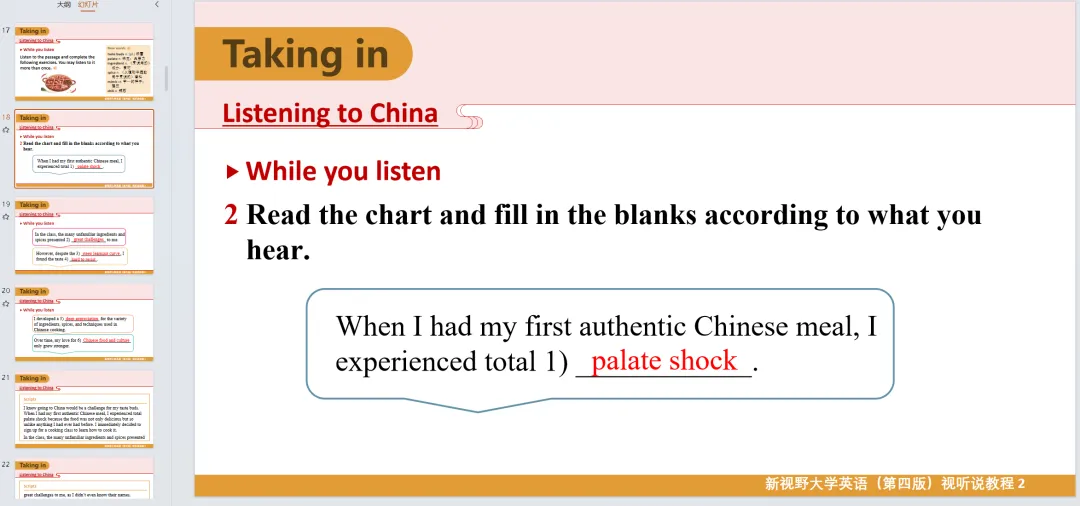
I knew going to China would be a challenge for my taste buds. When I had my first authentic Chinese meal, I experienced total palate shock because the food was not only delicious but so unlike anything I had ever had before. I immediately decided to sign up for a cooking class to learn how to cook it.
In the class, the many unfamiliar ingredients and spices presented great challenges to me, as I didn’t even know their names. Moreover, the cooking techniques were completely new to me. The cook showed me how to make the dishes, and then I mimicked her to try and make them myself. When the cook poured chili oil, I poured chili oil. When the cook added vinegar, I added vinegar. However, when the cook added salt, I accidentally added two spoons of sugar instead! Mistakes like this were easy to make when there were so many different ingredients! However, despite the steep learning curve, I found the taste hard to resist.
As I tried cooking more and more Chinese food, I developed a deep appreciation for the variety of ingredients, spices, and techniques used in Chinese cooking. I found myself drawn to dishes like Kung Pao Chicken, Hot and Sour Soup, and Mapo Tofu.
But it wasn’t just the food that won my heart; it was also the rich history and culture behind it. Soon after I started learning to cook Chinese food, I also began studying the Chinese language and history, and even started attending cultural events and festivals in the community.
Over time, my love for Chinese food and culture only grew stronger. I now consider myself a true fan of all things Chinese, from the complex and varied cuisine to the profound customs and traditions. And while I still enjoy a good steak every once in a while, I can’t imagine ever going back to a life without Chinese food in it.
Unit1_Taking in_Viewing world cultures_听力原文
N = Narrator; W1 = Woman 1, etc.;
M1 = Man 1, etc.; I = Ian Deary
N: Recent research into the history of IQ tests in Scotland suggests your IQ score might predict, to an extent at least, your health and even your life expectancy.
W1: You have 45 minutes to do the test, OK?
M1: OK.
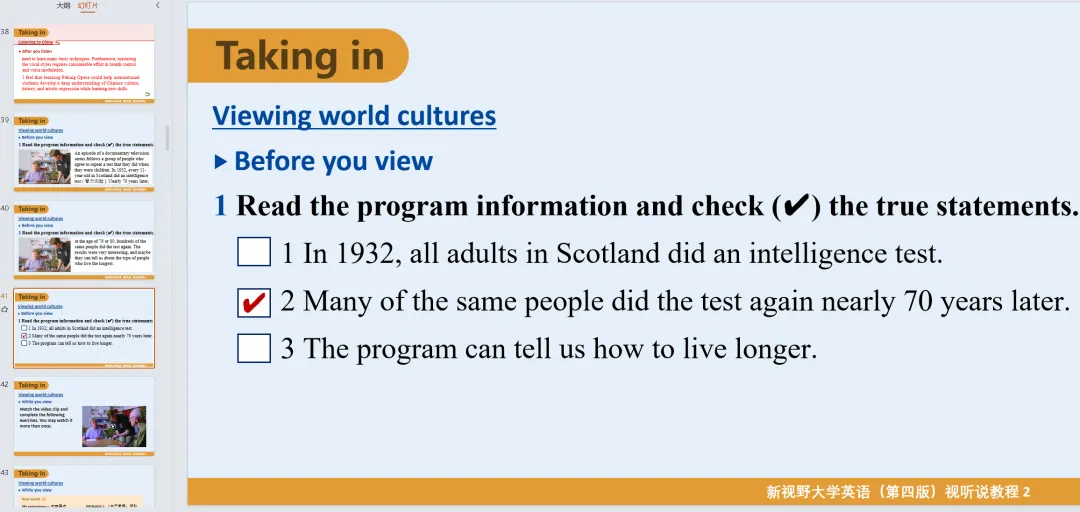
N: Bill and Davina are 79 years old. This is the second time they’ve done this test. The first time was in 1932, when every 11-year-old in Scotland was put through an intelligence test. It’s the only time this kind of mass testing has ever been done in the U.K. The results were rediscovered recently in an Edinburgh basement. If you want to know how our intelligence changes as we get older, these results are a potential goldmine.
I: We brought hundreds of people back, and we got them to sit the exact same test that they had sat when they were aged 11. Now, these people are now 79 or 80 years old. We gave the same instructions. We gave the same test. And we gave the same time limit.
M2: It was a little stickier than I thought it would be.
M3: I walked through it quite happily, quite honestly.
W2: I felt I must have been very bright at 11 if I sat that exam and passed.
N: There were some intriguing results. Almost everyone had a better score at 80 than they did at 11. But some had gone from being just averagely intelligent to a much higher level.
I: Now, that’s what really drives our research. We’re intereste in: Why have those people (who’ve) gone from IQ 100, at age 11, up to 110 or 120? What have they done right? What can be the recipe for successful aging? We’re finding that the person with more education, even though they had the same IQ in childhood, is doing slightly better in old age, on average. The people who smoked have got slightly less good mental ability than you would expect.
N: What’s even more remarkable is that the kids who had higher IQ scores at 11 are the very ones still alive today. So it seems high IQ in childhood is good for survival.


 10个月宝宝每天需要喝多少奶粉?

