【狂暴英语教案】新概念英语第一册第35-36课:我们的村庄 / 他们在做什么?
- 2026-07-21 13:10:22
读外刊,接触原汁原味的英文表达,
欢迎关注以下公众号+设为星标+推荐给朋友。▼
📚 狂暴英语教案 · 新概念英语第一册
第35-36课 Our village & What are they doing?
我们的村庄 / 他们在做什么?
📘 本课信息
教材:新概念英语第一册 · 第35-36课
核心功能:描述村庄 · 方位介绍 · 询问正在进行的活动
语法焦点:现在进行时 · There be 句型 · 方位介词
🏷️ 热门标签
🎯 本课学习目标
词汇:
掌握与地理方位、村庄描述相关的核心名词(如 village, valley, hill, river, bank, park, building)和介词(如 between, into, out of)。学习描述人物动作的动词及现在分词形式(如 walking, looking at, cooking, eating, drinking)。所有重点词汇均标注蓝思值,便于分级阅读参考。
语法:
深入理解并掌握现在进行时 (Present Continuous Tense) 的构成(be动词 + 动词-ing)及其表意功能(描述正在发生的动作)。巩固 There be 句型在描述场景中的应用。学习方位介词(between, beside, on the right/left)的准确使用。
技能(日常对话):
能够用英语简单描述一个地方(如自己的家乡、公园、学校)的布局和景物。能够询问并描述他人正在进行的活动。培养观察并用英语即时描述所见场景的能力。
文化:
初步了解英语国家典型乡村的构成元素(如 church, valley)。体会英语中描述静态场景与动态活动的不同语言逻辑。
📖 第一部分:课文完整内容
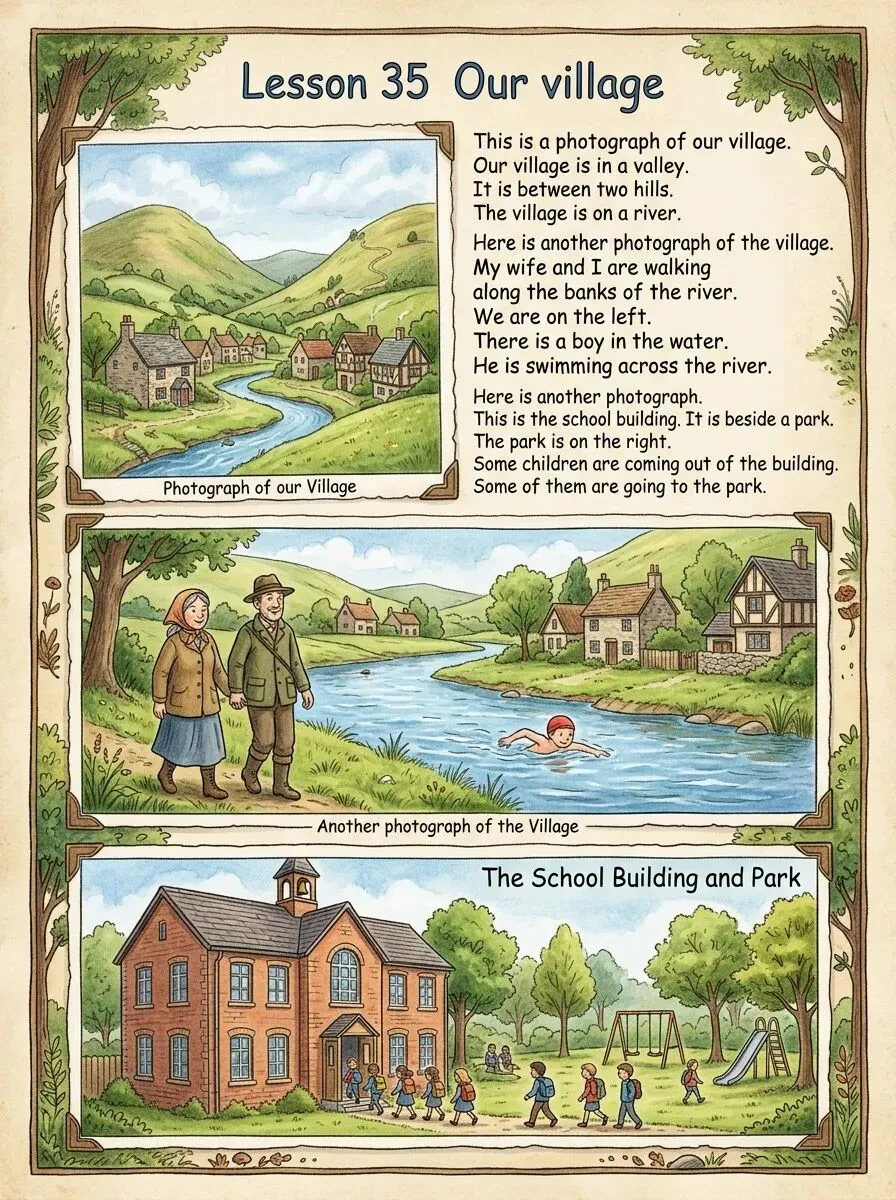
Lesson 35: Our village
📜 课文原文(含语音标注)
This is a photograph of our village.
Our village is in a valley.
It is between two hills.
The village is on a river.
Here is another photograph of the village.
My wife and I are walking along the banks of the river.
We are on the left.
There is a boy in the water.
He is swimming across the river.
Here is another photograph.
This is the school building.
It is beside a park.
The park is on the right.
Some children are coming out of the building.
Some of them are going into the park.
语音标注: photograph of our village:of our 可弱读为 /əv aʊə/ 或连读为 /ə'vaʊə/。walking along:king a 可连读为 /kɪŋ ə/。banks of the river:of the 弱读为 /əv ðə/。swimming across:ming a 连读为 /mɪŋ ə/。coming out of:out of 连读为 /'aʊtəv/。going into:go-ing in-to 注意 /ɪŋ/ 和 /ɪn/ 的发音区别。
情景说明:第35课:叙述者正在向他人展示几张关于自己村庄的照片。第一张是村庄全景,描述了村庄的地理位置(山谷中,两山之间,河畔)。第二张是叙述者和妻子在河边散步的情景。第三张是学校大楼及旁边的公园,并捕捉到孩子们从学校出来走进公园的动态瞬间。整个对话发生在一种分享和介绍的轻松氛围中。
参考译文:
这是我们村庄的一张照片。
我们的村庄坐落在一个山谷里。
它位于两座小山之间。
村庄傍河而建。
这是另一张村庄的照片。
我和妻子正沿着河岸散步。
我们在河的左侧。
水里有个男孩。
他正横渡河流。
这是另一张照片。
这是学校大楼。
它位于一个公园旁边。
公园在右边。
一些孩子正从大楼里出来。
他们中的一些人正走进公园。
Lesson 36: Where...? & What...?
📜 课文原文
Where are you going? ... To the bookshop. ... What are you doing? ... I'm reading.
Where is he going? ... To the barber's. ... What is he doing? ... He's shaving.
Where are they going? ... To the baker's. ... What are they doing? ... They're eating.
Where are you going? ... To the butcher's. ... What are you doing? ... I'm buying meat.
Where is she going? ... To the cinema. ... What is she doing? ... She's watching a film.
Where are they going? ... To the library. ... What are they doing? ... They're borrowing books.
Where are they going? ... To the grocer's. ... What are they doing? ... They're buying fruit.
Where is he going? ... To the dentist's. ... What is he doing? ... He's cleaning his teeth.
Where is she going? ... To the doctor's. ... What is she doing? ... She's taking medicine.
Where are they going? ... To the stationer's. ... What are they doing? ... They're buying paper.
语音标注: What are you:在口语中常缩读为 What're you /'wɒt ə juː/ 或更随意的 /'wɒtʃə/。He's shaving:He's 是 He is 的缩写,发音为 /hiːz/。
情景说明:第36课以一系列问答形式,展示了不同人物前往不同地点(书店、理发店、面包店等)并正在从事相应活动的场景。这些对话模拟了日常生活中询问他人去向和活动的典型情景。
参考译文:
你们要去哪儿?......去书店。......你们在做什么?......我在看书。
他要去哪儿?......去理发店。......他在做什么?......他在刮胡子。
他们要去哪儿?......去面包店。......他们在做什么?......他们在吃东西。
你要去哪儿?......去肉店。......你在做什么?......我在买肉。
她要去哪儿?......去电影院。......她在做什么?......她在看电影。
他们要去哪儿?......去图书馆。......他们在做什么?......他们在借书。
他们要去哪儿?......去食品杂货店。......他们在做什么?......他们在买水果。
他要去哪儿?......去牙医诊所。......他在做什么?......他在清洁牙齿。
她要去哪儿?......去看医生。......她在做什么?......她在吃药。
他们要去哪儿?......去文具店。......他们在做什么?......他们在买纸。
🔍 第二部分:逐句精讲与词块总结
句子1
原文: This is a photograph of our village.
翻译: 这是我们村庄的一张照片。
句子结构: 主系表结构 (SVC)。This (主语) + is (系动词) + a photograph of our village (名词短语作表语)。
重点词汇:
photograph 蓝思值 600L
英音 /ˈfəʊtəɡrɑːf/ 美音 /ˈfoʊtəɡræf/ 词性:n. & v.
释义:n. 照片,相片;v. 拍照
常用语块:take a photograph (拍照),a photograph of ... (一张...的照片)
例句一:This is an old photograph of my family. 这是一张我的家庭老照片。
例句二:She photographed the beautiful sunset. 她拍摄了美丽的日落。
拓展:口语中常缩写为 photo。词根 photo- 表示"光",-graph 表示"写、记录",合起来即"用光记录下来的东西"。
village 蓝思值 500L
英音 /ˈvɪlɪdʒ/ 美音 /ˈvɪlɪdʒ/ 词性:n.
释义:村庄,乡村
常用语块:a small village (小村庄),village life (乡村生活)
例句一:He grew up in a fishing village. 他在一个渔村长大。
例句二:The whole village came to the celebration. 全村人都来参加庆祝活动。
拓展:注意与 town (城镇) 和 city (城市) 在规模上的区别。villager 指村民。
语法点睛: 本句是简单的 This is... 介绍句型,用于引出将要谈论的对象。of our village 是介词短语作后置定语,修饰 photograph,说明照片的内容。这是英语中表示所属或描述关系的常见结构。
语音要点: This is a 可以连读为 /ðɪ sɪ zə/。photograph of 中,of 弱读为 /əv/。
句子2
原文: Our village is in a valley.
翻译: 我们的村庄坐落在一个山谷里。
句子结构: 主系表结构 (SVC)。Our village (主语) + is (系动词) + in a valley (介词短语作表语,表示地点)。
重点词汇:
valley 蓝思值 700L
英音 /ˈvæli/ 美音 /ˈvæli/ 词性:n.
释义:山谷,溪谷
常用语块:a river valley (河谷),a deep valley (深谷)
例句一:The town lies in a lush green valley. 小镇位于一个郁郁葱葱的山谷中。
例句二:They hiked through the valley. 他们徒步穿越了山谷。
拓展:常与 hill (小山) 和 mountain (高山) 相关联。
语法点睛: 介词 in 用于表示在一个三维空间或区域内部。这里描述村庄的地理位置。
语音要点: is in a 可以连读为 /ɪ zɪ nə/。
句子3
原文: It is between two hills.
翻译: 它位于两座小山之间。
句子结构: 主系表结构 (SVC)。It (主语,指代 village) + is (系动词) + between two hills (介词短语作表语)。
重点词汇:
between 蓝思值 400L
英音 /bɪˈtwiːn/ 美音 /bɪˈtwiːn/ 词性:prep.
释义:在...之间(通常指两者之间)
常用语块:between A and B (在A和B之间),choose between (在...之间选择)
例句一:The bank is between the post office and the supermarket. 银行在邮局和超市之间。
例句二:There is a strong friendship between them. 他们之间有着深厚的友谊。
拓展:注意与 among (在三者或以上之中) 的区别。
hill 蓝思值 500L
英音 /hɪl/ 美音 /hɪl/ 词性:n.
释义:小山,丘陵
常用语块:climb a hill (爬山),over the hill (在山的另一边;引申为过了巅峰期)
例句一:They had a picnic on top of the hill. 他们在山顶野餐。
例句二:The house is on a hill overlooking the sea. 房子在可俯瞰大海的小山上。
拓展:比 mountain 规模小,坡度较缓。
语法点睛: 介词 between 用于表示在两者之间的位置关系。two hills 是介词 between 的宾语。
语音要点: It is 常缩读为 It's /ɪts/。between two 中,between 的 /n/ 与 two 的 /t/ 可产生轻微爆破。
句子4
原文: The village is on a river.
翻译: 村庄傍河而建。
句子结构: 主系表结构 (SVC)。The village (主语) + is (系动词) + on a river (介词短语作表语)。
重点词汇:
on 蓝思值 BR-200L
英音 /ɒn/ 美音 /ɑːn/ 词性:prep.
释义:在...上;靠近...旁;关于
常用语块:on the table (在桌上),on Monday (在周一),a book on history (一本关于历史的书)
例句一:The picture is on the wall. 画在墙上。
例句二:London is on the River Thames. 伦敦位于泰晤士河畔。
拓展:此处 on a river 并非指“在河面上”,而是指“在河畔”、“临河”,表示地理位置上的毗邻关系。
river 蓝思值 500L
英音 /ˈrɪvə(r)/ 美音 /ˈrɪvər/ 词性:n.
释义:河,江
常用语块:cross the river (过河),river bank (河岸)
例句一:The Yangtze River is the longest in Asia. 长江是亚洲最长的河流。
例句二:They went swimming in the river. 他们去河里游泳了。
拓展:riverbed (河床),riverside (河边)。
语法点睛: 介词 on 在此表示“在...旁”、“毗邻”的含义,用于描述村庄与河流的位置关系。
语音要点: on a 连读为 /ɒ nə/。
句子5
原文: Here is another photograph of the village.
翻译: 这是另一张村庄的照片。
句子结构: 倒装句。表语 Here + 系动词 is + 主语 another photograph of the village。正常语序为:Another photograph of the village is here.
重点词汇:
another 蓝思值 400L
英音 /əˈnʌðə(r)/ 美音 /əˈnʌðər/ 词性:det. & pron.
释义:又一,再一;另一个(泛指)
常用语块:another day (改天),one another (互相)
例句一:Would you like another cup of tea? 你想再来一杯茶吗?
例句二:This pen doesn't work. Can I try another? 这支笔坏了。我能试试另一支吗?
拓展:由 an + other 构成,用于三者或以上中的另一个。注意与 the other (两者中的另一个) 区别。
语法点睛: 以 Here 或 There 开头的句子,如果主语是名词,常用倒装结构(Here/There + V + S),起到强调地点或引入新事物的作用。如果主语是代词,则不倒装(Here/There + S + V),如:Here it is.
语音要点: Here is 连读为 /hɪə rɪz/。another 重音在第二音节。
句子6
原文: My wife and I are walking along the banks of the river.
翻译: 我和妻子正沿着河岸散步。
句子结构: 主谓结构 (SV)。My wife and I (并列主语) + are walking (谓语动词,现在进行时) + along the banks of the river (介词短语作状语,表示方式/地点)。
重点词汇:
wife 蓝思值 400L
英音 /waɪf/ 美音 /waɪf/ 词性:n.
释义:妻子
常用语块:husband and wife (夫妻)
例句一:His wife is a doctor. 他的妻子是医生。
例句二:They have been husband and wife for 30 years. 他们做夫妻已经30年了。
拓展:复数形式为 wives。对应词为 husband。
walk 蓝思值 BR-200L
英音 /wɔːk/ 美音 /wɔːk/ 词性:v. & n.
释义:v. 行走,散步;n. 步行,散步
常用语块:go for a walk (去散步),walk home (步行回家)
例句一:I walk to school every day. 我每天步行上学。
例句二:Let's take a walk in the park. 我们去公园散散步吧。
拓展:walker (步行者),walkway (人行道)。walk along 表示“沿着...走”。
along 蓝思值 400L
英音 /əˈlɒŋ/ 美音 /əˈlɔːŋ/ 词性:prep. & adv.
释义:prep. 沿着,顺着;adv. 向前,一起
常用语块:walk along the street (沿街走),come along (一起来;进展)
例句一:Trees were planted along the road. 沿路种了树。
例句二:How is your work coming along? 你的工作进展如何?
拓展:常与表示路径的名词连用。
bank 蓝思值 600L
英音 /bæŋk/ 美音 /bæŋk/ 词性:n.
释义:河岸;银行
常用语块:river bank (河岸),on the bank (在岸上)
例句一:We sat on the bank and fished. 我们坐在岸上钓鱼。
例句二:I need to go to the bank. 我需要去银行。
拓展:一词多义,需根据上下文判断。此处指河岸。
语法点睛: 本句首次出现现在进行时:are walking。结构为:be动词 (are) + 动词的现在分词 (walking)。用于描述说话时正在进行的动作。My wife and I 作为并列主语时,be 动词用复数 are。along 是介词,引导表示路径的状语。
语音要点: My wife and I 注意 and 弱读为 /ən/。are walking 中 are 弱读为 /ə/。along the 连读为 /əˈlɒŋ ðə/。
句子7
原文: We are on the left.
翻译: 我们在河的左侧。
句子结构: 主系表结构 (SVC)。We (主语) + are (系动词) + on the left (介词短语作表语)。
重点词汇:
left 蓝思值 BR-200L
英音 /left/ 美音 /left/ 词性:n., adj. & adv.
释义:n. 左边,左侧;adj. 左边的;adv. 向左
常用语块:on the left (在左边),turn left (向左转)
例句一:In Britain, people drive on the left. 在英国,人们靠左行驶。
例句二:My house is the left one. 我的房子是左边那栋。
拓展:反义词为 right (右边)。left-hand (左手的)。
语法点睛: 介词短语 on the left/right 用于表示方位。此处是承接上一句照片的描述,指明“我们”在照片中的位置(河的左岸)。
语音要点: We are 可缩读为 We're /wɪə/。
句子8
原文: There is a boy in the water.
翻译: 水里有个男孩。
句子结构: There be 句型。There (引导词) + is (谓语动词) + a boy (主语) + in the water (介词短语作状语,修饰主语)。
重点词汇:
water 蓝思值 BR-200L
英音 /ˈwɔːtə(r)/ 美音 /ˈwɔːtər/ 词性:n. & v.
释义:n. 水;v. 给...浇水
常用语块:drink water (喝水),under water (在水下)
例句一:Fish live in water. 鱼生活在水中。
例句二:Don't forget to water the plants. 别忘了给植物浇水。
拓展:不可数名词。表示“一片水域”或“海水/河水”时可用复数 waters。
语法点睛: There is/are... 句型表示“某处有某物”。主语是 a boy,单数,故用 is。in the water 说明男孩的位置。
语音要点: There is 常缩读为 There's /ðeəz/。in the 连读为 /ɪn ðə/。
句子9
原文: He is swimming across the river.
翻译: 他正横渡河流。
句子结构: 主谓结构 (SV)。He (主语) + is swimming (谓语动词,现在进行时) + across the river (介词短语作状语,表示方向/路径)。
重点词汇:
swim 蓝思值 400L
英音 /swɪm/ 美音 /swɪm/ 词性:v. & n.
释义:v. 游泳;n. 游泳
常用语块:go swimming (去游泳),swimming pool (游泳池)
例句一:Can you swim? 你会游泳吗?
例句二:Let's go for a swim. 我们去游个泳吧。
拓展:现在分词为 swimming,注意双写 m。过去式 swam,过去分词 swum。
across 蓝思值 500L
英音 /əˈkrɒs/ 美音 /əˈkrɔːs/ 词性:prep. & adv.
释义:prep. 横过,穿过;在...对面;adv. 从一边到另一边
常用语块:walk across the street (穿过街道),across from (在...对面)
例句一:The bridge across the river is new. 横跨河流的那座桥是新的。
例句二:My house is just across the road. 我家就在马路对面。
拓展:强调从一边到另一边的横向运动。与 through (从内部穿过) 不同。
语法点睛: 继续使用现在进行时 is swimming,描述照片捕捉到的瞬间动作。across 是介词,表示动作的方向是“横穿”河流。
语音要点: He is 缩读为 He's /hiːz/。swimming across 连读为 /ˈswɪmɪŋ əˈkrɒs/。
句子10
原文: Here is another photograph.
翻译: 这是另一张照片。
句子结构: 倒装句,同句子5。
语法点睛: 同句子5,用 Here is 引入新照片。
语音要点: Here is 连读为 /hɪə rɪz/。
句子11
原文: This is the school building.
翻译: 这是学校大楼。
句子结构: 主系表结构 (SVC)。This (主语) + is (系动词) + the school building (名词短语作表语)。
重点词汇:
building 蓝思值 500L
英音 /ˈbɪldɪŋ/ 美音 /ˈbɪldɪŋ/ 词性:n.
释义:建筑物,大楼
常用语块:an office building (办公楼),build a building (建造一栋楼)
例句一:That tall building is a hotel. 那栋高楼是家酒店。
例句二:Building a house takes time. 建房子需要时间。
拓展:由动词 build (建造) 派生而来。-ing 后缀在此将动词变为名词。
语法点睛: 简单的 This is... 介绍句型。school 作为名词修饰 building,说明建筑物的用途。
语音要点: This is 连读为 /ðɪ sɪz/。school building 中,school 的尾音 /l/ 与 building 的开头 /b/ 略有停顿。
句子12
原文: It is beside a park.
翻译: 它位于一个公园旁边。
句子结构: 主系表结构 (SVC)。It (主语,指 school building) + is (系动词) + beside a park (介词短语作表语)。
重点词汇:
beside 蓝思值 500L
英音 /bɪˈsaɪd/ 美音 /bɪˈsaɪd/ 词性:prep.
释义:在...旁边,靠近
常用语块:sit beside me (坐我旁边),beside the point (离题,不相关)
例句一:The lamp is beside the bed. 灯在床边。
例句二:He stood beside his father. 他站在父亲身旁。
拓展:注意与 besides (除了...之外;而且) 的区别,两者词性和意思都不同。
park 蓝思值 400L
英音 /pɑːk/ 美音 /pɑːrk/ 词性:n. & v.
释义:n. 公园;v. 停车
常用语块:national park (国家公园),park a car (停车)
例句一:Children are playing in the park. 孩子们在公园里玩耍。
例句二:You can't park here. 你不能在这里停车。
拓展:一词多义。
语法点睛: 介词 beside 表示“在...旁边”,描述两个物体的相对位置。
语音要点: It is 缩读为 It's /ɪts/。beside a 连读为 /bɪˈsaɪ də/。
句子13
原文: The park is on the right.
翻译: 公园在右边。
句子结构: 主系表结构 (SVC)。The park (主语) + is (系动词) + on the right (介词短语作表语)。
重点词汇:
right 蓝思值 BR-200L
英音 /raɪt/ 美音 /raɪt/ 词性:n., adj. & adv.
释义:n. 右边,右侧;正确;权利;adj. 右边的;正确的;adv. 向右;正确地
常用语块:on the right (在右边),right now (现在),human rights (人权)
例句一:Turn right at the traffic lights. 在交通灯处向右转。
例句二:You are right. 你是对的。
拓展:多义词,需根据上下文判断。此处与 left 对应,表示方位。
语法点睛: on the right 与前面的 on the left 对应,构成完整的方位描述。通常以叙述者或照片的视角为参照。
语音要点: park is 连读为 /pɑː kɪz/。
句子14
原文: Some children are coming out of the building.
翻译: 一些孩子正从大楼里出来。
句子结构: 主谓结构 (SV)。Some children (主语) + are coming (谓语动词,现在进行时) + out of the building (介词短语作状语,表示方向)。
重点词汇:
some 蓝思值 BR-200L
英音 /sʌm/ 美音 /sʌm/ 词性:det. & pron.
释义:det. 一些,若干;pron. 有些人,有些东西
常用语块:some water (一些水),some of them (他们中的一些)
例句一:I need some help. 我需要一些帮助。
例句二:Some like coffee, others prefer tea. 有些人喜欢咖啡,另一些人更喜欢茶。
拓展:用于肯定句,修饰可数名词复数或不可数名词。
come 蓝思值 BR-200L
英音 /kʌm/ 美音 /kʌm/ 词性:v.
释义:来,来到;发生
常用语块:come here (过来),come from (来自)
例句一:She is coming to the party. 她要来参加派对。
例句二:Spring comes after winter. 冬去春来。
拓展:不规则动词:过去式 came,过去分词 come。come out 意为“出来”。
out of 蓝思值 400L
词性:prep. phrase
释义:从...里面出去;离开;由于;缺乏
常用语块:get out of the car (下车),out of work (失业)
例句一:He walked out of the room. 他走出了房间。
例句二:We're out of milk. 我们的牛奶喝完了。
拓展:反义词组是 into (进入)。
语法点睛: 现在进行时 are coming。out of 是一个固定介词短语,表示“从...内部向外的运动”。
语音要点: Some children are 中 are 弱读为 /ə/。coming out of 连读为 /ˈkʌmɪŋ ˈaʊtəv/。
句子15
原文: Some of them are going into the park.
翻译: 他们中的一些人正走进公园。
句子结构: 主谓结构 (SV)。Some of them (主语) + are going (谓语动词,现在进行时) + into the park (介词短语作状语,表示方向)。
重点词汇:
them 蓝思值 BR-200L
英音 /ðem/ 美音 /ðem/ 词性:pron.
释义:他们,她们,它们(they的宾格)
常用语块:give them (给他们),with them (和他们一起)
例句一:I know them. 我认识他们。
例句二:The books are here. Put them on the shelf. 书在这儿。把它们放到架子上。
拓展:they 的宾格形式。
go 蓝思值 BR-200L
英音 /ɡəʊ/ 美音 /ɡoʊ/ 词性:v.
释义:去,走;变得
常用语块:go home (回家),go shopping (去购物)
例句一:I go to school by bus. 我乘公交车上学。
例句二:The milk went sour. 牛奶变酸了。
拓展:不规则动词:过去式 went,过去分词 gone。go into 意为“进入”。
into 蓝思值 400L
英音 /ˈɪntə/ 美音 /ˈɪntə/ 词性:prep.
释义:进入...里面;成为;关于
常用语块:walk into the room (走进房间),translate into (翻译成)
例句一:She jumped into the water. 她跳进了水里。
例句二:Turn this passage into English. 把这段文字译成英语。
拓展:表示动作的方向是“进入...内部”。与 out of 相反。
语法点睛: 现在进行时 are going。Some of them 是“部分”的表达,of 表示所属关系。into 表示“进入...内部”的方向。
语音要点: Some of them 连读为 /sʌm əv ðəm/。going into 连读为 /ˈɡəʊɪŋ ˈɪntə/。
📌 核心词块总结
1. a photograph of... (一张...的照片) Example: This is a photograph of my family.
2. between A and B (在A和B之间) Example: The bank is between the supermarket and the post office.
3. walk along... (沿着...走) Example: They are walking along the beach.
4. on the left/right (在左边/右边) Example: In the photo, my sister is on the left, and I am on the right.
5. come out of... (从...出来) Example: The students are coming out of the classroom.
6. go into... (进入...) Example: He is going into the house.
💬 第三部分:基础会话技巧
1. 分析课文中的日常用语、礼貌表达、问答模式
- 第35课主要是描述性独白,使用 This is..., It is..., There is... 等句型客观介绍场景。语言平实,逻辑清晰(从全景到细节,从静态到动态)。
- 第36课是典型的日常问答模式。Where are you going? 和 What are you doing? 是询问他人动向和活动的万能句。回答简洁,常用省略形式 (To the...) 或直接陈述 (I'm V-ing.)。这种问答高度场景化,与地点 (bookshop, cinema) 和在该地点的典型活动 (reading, watching a film) 紧密绑定。
2. 提供类似场景的扩展对话示例
场景:在公园遇见朋友
A: Hi, Tom! What are you doing here?
B: Oh, hi, Lisa! I'm walking my dog. (指着远处) He's running on the grass.
A: I see. The park is really nice, isn't it? Look, there are some children playing football over there.
B: Yes. And there's a man sitting on that bench and reading a newspaper.
A: Well, I'm going to the lake. Some ducks are swimming in it. Want to come with me?
B: Sure! Let's go.
3. 设计简单的角色扮演活动建议
- 活动1:我是导游。学生A手持一张风景或校园照片(或自行绘制简单图画),向学生B介绍图片内容。必须使用 This is..., It is between/beside..., There is/are..., Some people are V-ing... 等句型。
- 活动2:猜猜我在哪儿/在干嘛。学生A在心里想一个地点(如 library, swimming pool)或一个动作(如 eating an apple, listening to music)。学生B用 Where are you going? 或 What are you doing? 提问来猜测。A只能回答 Yes 或 No。B需要在有限次数内猜中。
4. 融入基础思考:设计1-2个简单的代入式问题
- 问题1:如果你要向一位外国朋友介绍你的学校或你家附近的一个公园,你会首先描述什么?你会用课文里的哪些句子?
- 问题2:观察一下你周围的人,他们正在做什么?尝试用英语在心里默默描述一下,比如 "My classmate is writing." "The teacher is talking."
📐 第四部分:本课语法精析(加强版)
现在进行时 (Present Continuous Tense)
一、现在进行时的构成与基本概念
由 "be动词 (am/is/are) + 动词的现在分词 (V-ing)" 构成。主要表示说话时或现阶段正在进行的动作或发生的状态。强调动作的进行性、暂时性和未完成性。
二、现在分词的构成规则
1. 一般情况下,直接加 -ing。 do → doing, read → reading, walk → walking
2. 以不发音的 e 结尾,去 e 加 -ing。 come → coming, write → writing, make → making
3. 以重读闭音节结尾,且末尾只有一个辅音字母,双写该辅音字母再加 -ing。 run → running, swim → swimming, sit → sitting, put → putting
4. 以 ie 结尾,变 ie 为 y,再加 -ing。 die → dying, lie → lying, tie → tying
三、现在进行时的具体用法(结合本课例句)
1. 表示说话时正在发生的动作:My wife and I are walking along the banks. / He is swimming across the river. / Some children are coming out of the building.
2. 表示现阶段(但非说话瞬间)正在进行的动作:I am reading a very interesting novel this week.
3. 表示近期计划好的、将要发生的动作(常用于 go, come, leave, start 等):Where are you going? I'm going to the bookshop.
四、现在进行时与一般现在时的对比分析
- 一般现在时:表示经常性、习惯性的动作或普遍真理。例:I walk to school every day.
- 现在进行时:表示此时此刻或现阶段正在进行的动作。例:I am walking to school now.
五、现在进行时的句型结构
肯定句:主语 + am/is/are + V-ing + (其他).
否定句:在 am/is/are 后加 not。
一般疑问句:将 am/is/are 提到主语前。
特殊疑问句:疑问词 + am/is/are + 主语 + V-ing + (其他)?
六、不能用于进行时态的动词
感知动词 (see, hear, smell, taste, feel);情感动词 (like, love, hate, want);思维动词 (know, think, believe);所属动词 (have, own) 等,通常不用进行时。
七、练习题(不少于10道)
1. 用所给动词的现在进行时形式填空。
a) Look! The boys __________ (play) football on the playground.
b) Listen! Someone __________ (knock) at the door.
c) --- Where is Mum? --- She __________ (cook) in the kitchen.
d) Be quiet! The baby __________ (sleep).
e) It's 8 o'clock now. We __________ (have) an English lesson.
f) --- What __________ you __________ (do)? --- I __________ (write) an email.
g) They __________ (not watch) TV. They __________ (read) books.
h) --- __________ your sister __________ (come) with us? --- Yes, she is.
i) The students __________ (walk) into the classroom.
j) The river __________ (flow) very fast today.
2. 将下列句子改为一般疑问句并作肯定和否定回答。
a) Tom is cleaning his bike.
b) The birds are singing in the tree.
3. 将下列句子改为否定句。
a) I am waiting for the bus.
b) She is telling a story.
4. 用现在进行时或一般现在时填空。
a) I usually __________ (go) to school by bike, but today I __________ (walk).
b) He __________ (watch) TV every evening, but now he __________ (listen) to music.
c) Water __________ (boil) at 100 degrees Celsius. Look, the water __________ (boil) now.
八、练习题答案
1. a) are playing b) is knocking c) is cooking d) is sleeping e) are having f) are... doing; am writing g) are not watching; are reading h) Is... coming i) are walking j) is flowing
2. a) Is Tom cleaning his bike? Yes, he is. / No, he isn't. b) Are the birds singing in the tree? Yes, they are. / No, they aren't.
3. a) I am not waiting for the bus. b) She is not telling a story.
4. a) go; am walking b) watches; is listening c) boils; is boiling
✏️ 第五部分:基础练习与活动
1. 跟读练习:播放课文录音,学生逐句跟读,特别注意 are walking, is swimming, are coming, going into 等现在分词和介词的连读。重点练习第36课的问答句型,模仿其自然的语调和缩读形式 (Where're you going?, What're you doing?)。
2. 角色扮演:活动:周末计划。两人一组。学生A用 What are you doing this weekend? 提问。学生B根据抽到的卡片(卡片上写有地点和活动,如 cinema / watch a new film, park / fly a kite)回答 I'm going to the... I'm ...ing.。然后互换角色。
3. 简单替换练习:替换主语:He is swimming. → They are swimming. / The boy is swimming. 替换动词:We are walking. → We are running. / We are jumping. 替换地点状语:They are going into the park. → They are going into the school. / They are coming out of the shop. 综合替换:根据图片造句。图片1:一个女孩在读书。→ The girl is reading a book.
4. 听力理解题目:(假设一段简短录音,描述一个公园场景)
问题1:Where are the two speakers?
问题2:What is the man doing?
问题3:What are the children doing?
问题4:Is there a river in the park?
(参考答案可根据自编的录音内容设定,例如:1. In a park. 2. He is sitting on a bench and reading a newspaper. 3. They are playing football. 4. Yes, there is.)
5. 课文改写版本(词汇更简单):Lesson 35 简化版:This is a picture of our town. Our town is in a valley. It is between two small mountains. The town is near a river. In this picture, my mother and I are walking by the river. We are on the left side. A boy is in the water. He is swimming. In another picture, this is the school. It is next to a garden. The garden is on the right. Some boys and girls are leaving the school. Some are going into the garden.
🤔 第六部分:英文深度思考与拓展(强化版)
A. 层次化英文问题与答案
Level 1 (Factual):
1. Q: Where is the village in the photograph? A: The village is in a valley.
2. Q: What are the man and his wife doing in the second photograph? A: They are walking along the banks of the river.
3. Q: Where is the park in relation to the school building? A: The park is beside the school building, and it is on the right.
4. Q: What is the boy in the water doing? A: He is swimming across the river.
Level 2 (Inferential):
5. Q: Why does the speaker show several photographs instead of just one? A: He probably wants to give a more complete picture of his village, showing its location, the people's activities, and different places like the river and the school.
6. Q: Based on the activities described (walking, swimming, children coming out of school), what time of day do you think it might be in the photographs? Why? A: It might be in the afternoon. Children are coming out of the school building, which suggests school is over. It could be a time when people are enjoying leisure activities outdoors.
7. Q: If you hear someone ask "Where are you going?" and the answer is "To the baker's," what can you infer the person is likely to do there? A: You can infer that the person is likely to buy bread, cakes, or other baked goods.
8. Q: What does the use of the Present Continuous Tense in Lesson 36 tell us about the nature of the questions "Where are you going?" and "What are you doing?" A: It tells us that these questions are about actions that are happening right now or are about to happen very soon. They are not about habitual routines.
Level 3 (Evaluative/Creative):
9. Q: Imagine you are one of the children coming out of the school building. What are you thinking about or where are you planning to go after entering the park? A: (Example answer) I am thinking about meeting my friends under the big tree. We plan to play football in the park until dinner time.
10. Q: Do you think living in a village "between two hills" and "on a river" would be nice? Why or why not? A: (Example answer) Yes, I think it would be very peaceful and beautiful. There would be fresh air, nice views, and you could enjoy activities like walking by the river or swimming. However, it might be less convenient than living in a city with more shops and services.
11. Q: Create a short dialogue between two friends using the pattern from Lesson 36, but set it in a modern context (e.g., going to a shopping mall, a gym, or using a smartphone). A: (Example answer) A: Hey, where are you going? B: To the shopping mall. A: What are you doing there? B: I'm meeting my cousin. We're watching a movie and maybe getting some bubble tea later.
12. Q: The text describes a scene passively ("Some children are coming out..."). If you were a film director shooting this scene, what sounds or close-up details would you add to make it more vivid for the audience? A: (Example answer) I would add the sound of a school bell ringing, children laughing and talking, the rustling of their bags, and maybe the sound of a ball bouncing. A close-up could show a child's smiling face or their shoes stepping from the school stairs onto the park path.
B. 多类型拓展阅读
1. 现代场景故事 (Modern Scene Story)
My Digital Village
This isn't a photograph; it's a screenshot from my drone! Our neighborhood isn't in a valley, but between two busy highways. You can see the community park on the riverbank, which is actually a man-made canal. My friend and I are walking along the jogging track, not dirt banks. We're on the left side of the picture, wearing sports watches. Look! There's a guy on a stand-up paddleboard, not swimming, going across the canal. In another screenshot, that's the community center building. Beside it is a skate park, always on the right when you approach from the main gate. Some teenagers are coming out of the center after a coding club. A few of them are heading into the skate park with their boards.
引导性问题:How is this modern "village" similar to and different from the one in the textbook?
2. 文化背景小知识 (Cultural Background)
The English Village
The traditional English village often had a clear layout. At its heart was the village green, a common grassy area for gatherings. The church was usually a prominent building. A pub (public house) was the social center. Villages were often built near a river for water and sometimes for power for mills. The description in our lesson---"between two hills, on a river"---is classic. "Walking along the banks" is a very popular leisure activity in Britain, known as a "riverside walk." The "school building" in the photo might be the village school, which was (and in some places still is) a key institution for community life.
引导性问题:What are the key parts of a traditional English village according to this passage?
3. 今昔对比 (Then and Now)
Then:"Here is another photograph of the village," said Grandfather, holding up a faded black-and-white picture. "My wife and I are walking along the banks of the river. The water was so clean we could swim in it. That boy there is swimming across." He pointed to a blurry figure. "The school building was small, made of stone. Children walked home or played in the park right after."
Now:Emma swiped on her tablet. "This is a live stream from our home camera. See, that's the same river, but now there's a paved path along the bank. People are cycling and jogging. The old school is now a community museum. The new school, that big glass building beside the sports field, is just off-screen. Kids come out and many get on buses or are picked up by cars."
引导性问题:What are two major changes in how people use the riverbank and what happens after school?
4. 新潮英语改写 (Trendy English Rewrite)
Yo, Check Out My 'Hood!
Okay, so this is a pic of my village. Lit, right? It's, like, chilling in this valley. Smack dab between two hills. And yeah, it's right by the river. Swipe left? Here's another one. That's me and my SO (significant other) strolling by the river. We're on the left. Dude in the water? He's totally swimming across. Next pic! That's the school. It's next to this park---park's on the right. Some kids are bouncing out of school. And a bunch are, like, heading into the park to hang. #Vibes #CountryLife
引导性问题:What slang or informal words in this passage mean "person you love," "walking," and "very good/cool"?
5. 难度略高的拓展阅读 (Slightly Higher Difficulty)
The Dynamics of a Snapshot
A photograph freezes a moment, but language, especially the Present Continuous tense, can inject life back into it. The text doesn't just say "There is a boy in the water." It says "He is swimming across the river," implying movement, effort, and a goal (the other side). Similarly, "children are coming out" suggests a flow, a process of dispersal after hours of containment. The use of "some... some of them" adds a sense of randomness and individual choice within a group activity. This grammatical choice transforms a static list of elements into a miniature narrative, asking the viewer to imagine the seconds before and after the shutter clicked. It turns a mere description of a scene into a story about what is happening in that scene.
引导性问题:According to the author, how does using the Present Continuous tense change the way we understand a photograph?
🌍 第七部分:日常应用延伸
1. 提供本课语言点在日常生活中的应用场景
- 描述照片或视频:向朋友展示手机里的照片或短视频时,可以使用 This is a picture of..., Here, I'm V-ing..., He/She is V-ing...。
- 电话或即时通讯:当别人问“你在干嘛?”(What are you doing?),你可以用 I'm V-ing... 如实回答,如 I'm cooking dinner., I'm waiting for the bus.
- 指路或说明位置:The post office is between the bank and the supermarket. The cafe is beside the bookstore, on the right.
- 询问他人动向:看到同事或家人准备出门,可以问 Where are you going?。看到他们专注某事,可以问 What are you doing?。
2. 建议简单拓展学习材料
- 歌曲:歌曲《Lemon Tree》的副歌部分 "I'm sitting here in the boring room..." 和 "I'm wasting my time..." 是现在进行时的典型例句,旋律简单易记。
- 绘本/漫画:选择画面富有动感的绘本或漫画(如《父与子》),尝试用现在进行时描述每一幅画面中人物正在做什么。
- 英语学习APP:使用像“多邻国”(Duolingo)或“每日英语听力”等APP,寻找有关“日常活动”或“描述图片”的练习模块。
3. 可附加英美生活小常识
- High Street vs. Mall:在英国,人们常说“going to the high street”购物,因为传统上各种店铺 (bookshop, butcher's, baker's) 都集中在镇上的主街 (High Street)。而在美国,人们更常说“going to the mall”(购物中心)。第36课中的各种店铺 (the baker's, the butcher's) 非常具有英国传统社区特色。
- Riverside Walks:在英国,沿河散步 (walking along the banks of the river) 是一种非常普遍且受喜爱的休闲方式。许多城市和乡村都有精心维护的河滨步道。
🗂️ 第八部分:本课知识图谱(结构化逻辑图)
核心对话主题:描述地点与询问正在进行的活动
├─ 主要句型1:描述静态场景与位置
│ ├─ 存在句:There is a boy (in the water).
│ ├─ 主系表结构(方位):It/The village is (in a valley / between two hills / on a river / beside a park). The park is (on the right). We are (on the left).
│ └─ 介绍句:This/Here is (a photograph of our village / the school building).
├─ 主要句型2:描述动态活动(现在进行时)
│ ├─ 肯定陈述:主语 + am/is/are + V-ing + (状语).
│ │ └─ 人物 + be + 移动/活动 + 方位/方向:We are walking along the banks. / He is swimming across the river. / Children are coming out of the building (into the park).
│ └─ 特殊疑问:询问活动:What + am/is/are + 主语 + doing? → I am/He is/They are + V-ing. 询问去向:Where + am/is/are + 主语 + going? → (To) + 地点名词.
└─ 关键词汇网络
├─ 地点名词:village, valley, hill, river, bank, park, building, water, bookshop, cinema...
├─ 方位介词:in, on, between, beside, along, across, out of, into.
├─ 方位短语:on the left, on the right.
└─ 活动动词(V-ing):walking, swimming, coming, going, reading, watching, eating...
© 本文为狂暴英语教案 · 新概念英语第一册第35-36课
供学习交流使用

贝琪酱英语无痛逆袭站
微信扫描二维码,关注我的账号
随机文章
-
 10个月宝宝每天需要喝多少奶粉?
- 清明节安全主题班会课件教案+手抄报,一键免费下载
- 现场授课课件:北师大版必修第一册 Unit 2 Lesson 3 Vocabulary (甘肃 王潇燕)
- 《猫眼看教会,张凯律师为锡安教案而吊销执照》
- 新高教版中职信息技术基础模块下册 教案+课件PPT,可下载编辑!
- 小学英语六年级上册(外研版3起)教案+PPT课件,可下载编辑!
- 幼儿园数学启蒙教案:认识日期(含小中大班课件+教案+素材)
- 【精品PPT课件】:水痘预防小知识科普宣传主题教育班会ppt课件
- 【九年级上-唐诗三百首】章节课件-卷四《七言乐府》-02主旨情感+03名句积累(2元)
- 2026年春陕旅版五年级英语教案简案(1-8单元)
- 2026年春陕旅版三年级英语教案简案(1-8单元)

