【狂暴英语教案】新概念英语第一册第61-62课:重感冒 / 他怎么了?
- 2026-07-08 22:44:39
读外刊,接触原汁原味的英文表达,
欢迎关注以下公众号+设为星标+推荐给朋友。▼
📚 狂暴英语教案 · 新概念英语第一册
第61-62课 A Bad Cold & What's the matter with him?
重感冒 / 他怎么了?
📘 本课信息
教材:新概念英语第一册 · 第61-62课
核心功能:描述病情 · 表达关切 · 提出建议与医嘱
语法焦点:情态动词must · have表示患病 · What's the matter with...? · 系动词feel/look
🏷️ 热门标签
🎯 本课学习目标
词汇维度:
1. 掌握与疾病、身体部位及感觉相关的核心词汇,如 feel, look, must, call, doctor, telephone, remember, mouth, tongue, bad, cold, headache, aspirin 等。2. 理解并运用描述健康状况的形容词,如 ill, well, terrible。3. 学习动词 have 在表示“患病”时的用法。
语法维度:
1. 深入理解并运用情态动词 must 表示“必须”和“推测”的两种核心功能。2. 巩固 have 的用法,特别是 have + a + 疾病名词 的结构。3. 掌握由 What's the matter with...? 引导的、询问他人状况的特殊疑问句及其回答。4. 复习并巩固一般现在时(特别是第三人称单数)的疑问句和否定句形式。
技能(日常对话)维度:
1. 能够用英语描述自己或他人的不适症状。2. 能够模拟打电话叫医生的场景,使用恰当的礼貌用语和指令。3. 能够听懂并回应关于健康状况的询问。
文化维度:
1. 了解在英语文化中表达关切和提供帮助的常用方式。2. 初步接触西方就医前预约(打电话)的文化习惯。3. 认识常见非处方药(如阿司匹林)的英文名称。
📖 第一部分:课文完整内容
课文原文(含语音标注)
Lesson 61 A bad cold
📜 课文原文
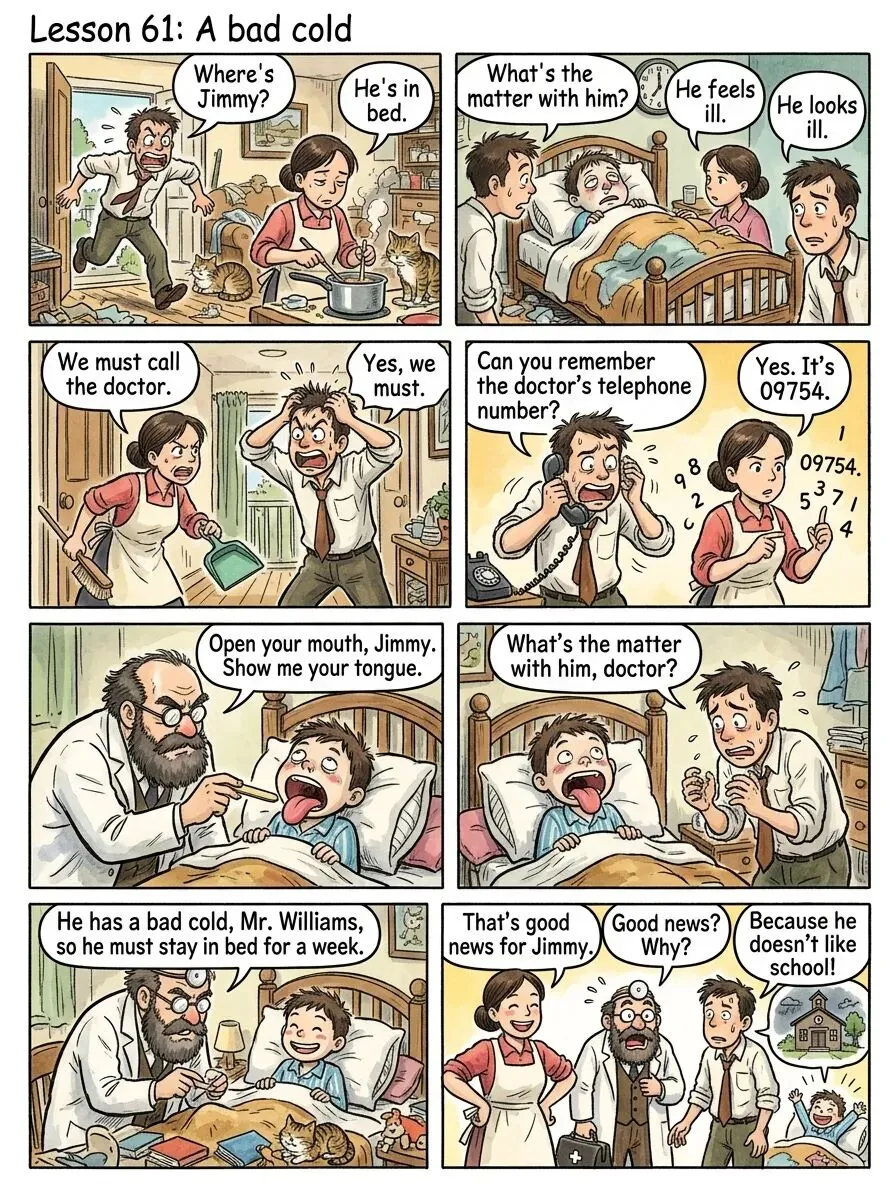
MR. WILLIAMS: Where's Jimmy?
MRS. WILLIAMS: He's in bed.
MR. WILLIAMS: What's the matter with him? /wɒts ðə ˈmætə wɪð hɪm/ (注意 the matter 中 the 弱读为 /ðə/, with him 可连读为 /wɪðɪm/)
MRS. WILLIAMS: He feels ill.
MR. WILLIAMS: He looks ill. /hiː lʊks ɪl/ (注意 looks ill 连读)
MRS. WILLIAMS: We must call the doctor.
MR. WILLIAMS: Yes, we must.
MR. WILLIAMS: Can you remember the doctor's telephone number? /kæn juː rɪˈmembə ðə ˈdɒktəz ˈtelɪfəʊn ˈnʌmbə/ (注意 doctor's 的 /z/ 音与 telephone 的 /t/ 音,略有停顿)
MRS. WILLIAMS: Yes. It's 09754.
MR. WILLIAMS: What's the matter with Jimmy, doctor? /wɒts ðə ˈmætə wɪð ˈdʒɪmi ˈdɒktə/ (句末称呼 doctor 语调下降)
DOCTOR: He has a bad cold, Mr. Williams, so he must stay in bed for a week.
MR. WILLIAMS: That's good news for Jimmy. /ðæts ɡʊd njuːz fə ˈdʒɪmi/ (good news 中 d 不完全爆破)
DOCTOR: Good news? Why?
MR. WILLIAMS: Because he doesn't like school!
Lesson 62 What's the matter with them? What must they do?
📜 课文原文(本课为练习课,核心句型如下)
(此课为练习课,核心句型为:What's the matter with him/her/them? He/She/They has/have a [疾病]. He/She/They must [行动].)
例如:
What's the matter with George? He has a headache. He must take an aspirin.
What's the matter with him? He has a toothache. He must see a dentist.
情景说明:第61课的场景发生在一个家庭内部。威廉姆斯先生发现儿子吉米不在,于是与妻子展开对话。对话从询问吉米去向开始,迅速聚焦于他的健康状况。妻子描述吉米“感觉病了”,先生观察后也认为他“看起来病了”,这体现了英语中 feel (主观感受) 和 look (客观外观) 在描述状态时的区别。随后,夫妇二人达成共识“必须叫医生”,并顺利回忆起医生的电话号码。第二部分场景切换到医生诊断后与威廉姆斯先生的沟通。医生给出了“重感冒,必须卧床一周”的诊断和建议。最后,威廉姆斯先生一句“这对吉米是个好消息”制造了一个幽默转折,揭示了孩子“不喜欢上学”的心理,为严肃的就医对话增添了一丝生活化的诙谐。整个对话层层递进,从发现异常、初步判断、决定行动到获得专业诊断,完整呈现了一个应对家庭成员生病的常见流程。第62课则通过图片和句型替换练习,巩固“询问病症”和“给出建议”的对话模式,将词汇(各种疾病)和语法(must 的建议功能)融入实际操练。
参考译文:
第61课 重感冒
威廉姆斯先生:吉米在哪儿?
威廉姆斯夫人:他在床上。
威廉姆斯先生:他怎么啦?
威廉姆斯夫人:他觉得不舒服。
威廉姆斯先生:他看上去是病了。
威廉姆斯夫人:我们得去请医生。
威廉姆斯先生:对,一定得请。
威廉姆斯先生:你还记得医生的电话号码吗?
威廉姆斯夫人:记得。是09754。
(医生诊断后)
威廉姆斯先生:医生,吉米得了什么病?
医生:他得了重感冒,威廉姆斯先生,因此他必须卧床一周。
威廉姆斯先生:这对吉米是个好消息。
医生:好消息?为什么?
威廉姆斯先生:因为他不喜欢上学!
第62课 他们怎么了?他们该怎么办?
(练习课,无连续译文)
🔍 第二部分:逐句精讲与词块总结
句子1
原文: Where's Jimmy?
翻译: 吉米在哪儿?
句子结构: 特殊疑问句。Where (疑问副词,作表语) + is (系动词) + Jimmy (主语)。属于“主系表”结构(SVC)的疑问形式。
重点词汇:
Jimmy 蓝思值 <100L
英音[ˈdʒɪmi] 美音[ˈdʒɪmi] 词性:名词 (n.)
释义:吉米(男子名,James的昵称)。
常用语块:无特定语块。
例句一:Jimmy is my little brother. 吉米是我的弟弟。
例句二:Where did Jimmy go? 吉米去哪儿了?
拓展:英文中许多正式名字都有对应的昵称(diminutive),如 William → Bill/Will, Robert → Bob, Elizabeth → Liz/Beth。使用昵称通常表示关系亲密或非正式场合。
语法点睛: 本句是典型的由 Where 引导的询问地点或方位的特殊疑问句。其结构为:Where + be动词 + 主语?。回答通常用“主语 + be动词 + 地点状语”,如:He is in bed.。这是第一册前期就学习的核心句型,在此课中作为对话的起始句出现。[NCE知识点笔记]
语音要点: Where's 是 Where is 的缩略形式,发音为 /weəz/。注意 /w/ 的圆唇和 /eə/ 的双元音滑动。句子语调通常为降调,表示一个完整的疑问。
句子2
原文: He's in bed.
翻译: 他在床上。
句子结构: 陈述句。He (主语) + is (系动词,缩略为 's) + in bed (介词短语作表语)。属于“主系表”结构(SVC)。
重点词汇:
bed 蓝思值 200L
英音[bed] 美音[bed] 词性:名词 (n.)
释义:床。
常用语块:in bed (卧床);go to bed (上床睡觉);make the bed (铺床)。
例句一:It's time to go to bed. 该上床睡觉了。
例句二:She is reading a book in bed. 她正躺在床上看书。
拓展:注意 in bed 强调“卧于床上的状态”,而 on the bed 仅表示“在床的表面上”。in hospital (住院) 和 in the hospital (在医院里) 也有类似区别。
语法点睛: 介词 in 表示“在......里面”或“处于某种状态”。in bed 是一个固定搭配,表示“卧床”,通常指生病、休息或睡觉的状态。此处回答 Where 的问句,提供了吉米的具体位置和状态。[NCE知识点笔记]
语音要点: He's 发音为 /hiːz/。in bed 连读为 /ɪn bed/,无明显连读或弱读。句子为陈述句,用降调。
句子3
原文: What's the matter with him?
翻译: 他怎么啦?/ 他出什么事了?
句子结构: 特殊疑问句。What (疑问代词,作主语) + is (系动词,缩略为 's) + the matter (表语) + with him (介词短语作定语,修饰 the matter)。整体可视为一个固定的疑问句型。
重点词汇:
matter 蓝思值 400L
英音[ˈmætə] 美音[ˈmætər] 词性:名词 (n.)
释义:事情;问题;麻烦。
常用语块:What's the matter (with...)? (......怎么了?);It doesn't matter. (没关系。)
例句一:What's the matter with your car? 你的车出什么毛病了?
例句二:Is anything the matter? 有什么问题吗?
拓展:matter 在此句型中是名词,the matter 相当于形容词 wrong。所以 What's the matter with him? 等同于 What's wrong with him?。
with 蓝思值 <100L
英音[wɪð] 美音[wɪð] 词性:介词 (prep.)
释义:和......一起;对于;关于;带有;用。
常用语块:What's wrong with...?;play with;agree with。
例句一:I live with my parents. 我和父母住在一起。
例句二:What do you want with me? 你找我有什么事?
拓展:在本句型中,with 引出所关切的对象。注意介词后面跟人称代词时要用宾格形式 (me, him, her, us, them)。
语法点睛: What's the matter with...? 是英语中询问某人或某物“出了什么问题”、“有什么麻烦”或“哪里不舒服”的最常用句型之一。with 后面接询问对象。回答时,可以直接说明情况,如 He feels ill. 或 He has a cold.。这是本课的核心句型。[NCE知识点笔记]
语音要点: What's the 连读时,What's 的 /ts/ 与 the 的 /ðə/ 之间略有停顿,但 the 通常弱读。matter with him 可以连读为 /ˈmætə wɪð ɪm/,其中 with him 常读作 /wɪðɪm/。整个疑问句用升调,表示关切和疑问。
句子4
原文: He feels ill.
翻译: 他觉得不舒服/病了。
句子结构: 陈述句。He (主语) + feels (系动词) + ill (形容词作表语)。属于“主系表”结构(SVC)。
重点词汇:
feel 蓝思值 300L
英音[fiːl] 美音[fiːl] 词性:动词 (v.);系动词 (link-v.)
释义:感觉;触摸;认为。
常用语块:feel ill/well/cold/happy (感觉病了/很好/冷/高兴);feel like (想要;感觉像)。
例句一:I feel tired after the long journey. 长途旅行后我感到很累。
例句二:How are you feeling today? 你今天感觉怎么样?
拓展:feel 作为系动词,后面直接跟形容词作表语,描述主语的感觉或状态。它与 look (看起来)、sound (听起来)、smell (闻起来)、taste (尝起来) 属于同一类感官动词。
ill 蓝思值 400L
英音[ɪl] 美音[ɪl] 词性:形容词 (adj.)
释义:生病的;不舒服的。
常用语块:fall ill (生病);be taken ill (突然病倒);ill health (不健康)。
例句一:She can't come to work because she is ill. 她生病了,不能来上班。
例句二:He was taken ill suddenly at the party. 他在聚会上突然病倒了。
拓展:ill 通常作表语,表示“生病的状态”。作定语时(放在名词前)多表示“坏的、邪恶的”,如 ill luck (厄运)。在美式英语中,sick 更常用作表语表示“生病”,而 ill 更正式。
语法点睛: 本句展示了系动词 feel 的用法。系动词本身有词义,但不能单独作谓语,后面必须接形容词、名词等作表语,构成“主系表”结构,用以说明主语的特征、状态或身份。feel ill 是描述主观健康状况的常见搭配。[名师精讲]
语音要点: He feels 连读为 /hiː fiːlz/,注意 feels 的尾音 /lz/ 要清晰。ill 发音为 /ɪl/,短元音。句子为降调。
句子5
原文: He looks ill.
翻译: 他看上去是病了。
句子结构: 陈述句。He (主语) + looks (系动词) + ill (形容词作表语)。属于“主系表”结构(SVC)。
重点词汇:
look 蓝思值 <100L
英音[lʊk] 美音[lʊk] 词性:动词 (v.);系动词 (link-v.)
释义:看;看起来。
常用语块:look at (看);look for (寻找);look after (照顾);look ill/well/tired (看起来病了/很好/累)。
例句一:You look very happy today. 你今天看起来很高兴。
例句二:Look at the blackboard, please. 请看黑板。
拓展:look 作为系动词时,表示“看起来......”,是根据视觉印象做出的判断,强调客观外观。它与 feel (主观感觉) 形成对比。作为实义动词时,意为“看”,常与 at 连用。
语法点睛: 同样是系动词结构,look ill 是基于外观的客观判断,而上一句 feel ill 是主观感受。这种对比在对话中生动地体现了夫妇二人从不同角度确认吉米生病的事实。系动词后接形容词的用法需要牢固掌握。[语法新思维]
语音要点: looks ill 可以连读为 /lʊks ɪl/,但 /ks/ 和 /ɪ/ 之间过渡自然即可。句子为降调,表示肯定的判断。
句子6
原文: We must call the doctor.
翻译: 我们得去请医生。
句子结构: 陈述句。We (主语) + must (情态动词) + call (动词原形,作谓语) + the doctor (宾语)。属于“主谓宾”结构(SVO)。
重点词汇:
must 蓝思值 300L
英音[mʌst] 美音[mʌst] 词性:情态动词 (modal v.)
释义:必须;一定;想必。
常用语块:must do (必须做);must be (一定是)。
例句一:You must finish your homework before dinner. 你必须在晚饭前完成作业。
例句二:He isn't here. He must be in the library. 他不在这儿。他一定在图书馆。
拓展:must 表示强烈的必要性或义务(主观认为必须),或很有把握的推测(用于肯定句)。否定形式 must not/mustn't 表示“禁止”、“不准”。询问“必须吗?”用 Must I/we...?。
call 蓝思值 300L
英音[kɔːl] 美音[kɔːl] 词性:动词 (v.)
释义:打电话;叫喊;称呼;拜访。
常用语块:call the doctor/police (叫医生/报警);call sb. (给某人打电话);call on sb. (拜访某人)。
例句一:I'll call you tomorrow evening. 我明天晚上给你打电话。
例句二:Please call a taxi for me. 请帮我叫辆出租车。
拓展:call 含义丰富,本课取“召唤、请来”之意。在电话语境中,call 等同于 phone 或 ring。
doctor 蓝思值 400L
英音[ˈdɒktə] 美音[ˈdɑːktər] 词性:名词 (n.)
释义:医生;博士。
常用语块:see a doctor (看医生);at the doctor's (在诊所)。
例句一:You should see a doctor if you have a fever. 如果你发烧了,应该去看医生。
例句二:She is a Doctor of Philosophy. 她是一位哲学博士。
拓展:在英语中,doctor 可指内科、外科等各类医生。更具体的称呼有 physician (内科医生), surgeon (外科医生), dentist (牙医)等。the doctor's 指医生的诊所。
语法点睛: 本句引入了情态动词 must 表示“必须”的用法。情态动词不能单独作谓语,必须后接动词原形,共同构成谓语部分。must 在这里表达了在紧急或必要情况下采取行动的强烈决心和义务感,是对话逻辑推进的关键。[NCE知识点笔记]
语音要点: must 发音为 /mʌst/,注意 /ʌ/ 的短促。call the 中,call 的尾音 /l/ 与 the 的 /ðə/ 可以连读,但 /l/ 音要轻。句子为降调,表示决定。
句子7
原文: Yes, we must.
翻译: 对,一定得请。
句子结构: 省略的肯定回答。Yes (感叹词) + we (主语) + must (情态动词,省略了后面的 call the doctor)。完整的句子是 Yes, we must call the doctor.
重点词汇: (本句为重复肯定,无新重点词汇)
语法点睛: 在对话中,为了避免重复,常使用省略句。当情态动词 must, can, will 等后面的动词成分在上文已明确时,可以单独使用情态动词进行简略回答。例如:Can you swim? Yes, I can. 这种省略使对话更简洁流畅。[NCE知识点笔记]
语音要点: Yes 发音为 /jes/,短促有力。we must 连读为 /wiː mʌst/。must 重读,强调必要性。句子为降调,表示肯定。
句子8
原文: Can you remember the doctor's telephone number?
翻译: 你还记得医生的电话号码吗?
句子结构: 一般疑问句。Can (情态动词) + you (主语) + remember (动词原形,作谓语) + the doctor's telephone number (宾语)。属于“主谓宾”结构(SVO)的疑问形式。
重点词汇:
remember 蓝思值 400L
英音[rɪˈmembə] 美音[rɪˈmembər] 词性:动词 (v.)
释义:记得;记住;代......问好。
常用语块:remember to do sth. (记得要做某事);remember doing sth. (记得做过某事)。
例句一:I remember locking the door when I left. 我记得离开时锁了门。
例句二:Please remember me to your family. 请代我向你家人问好。
拓展:remember 的反义词是 forget。remember to do 指记住要去做(未做),remember doing 指记得做过(已做)。
telephone 蓝思值 500L
英音[ˈtelɪfəʊn] 美音[ˈtelɪfoʊn] 词性:名词 (n.);动词 (v.)
释义:电话;打电话。
常用语块:telephone number (电话号码);on the telephone (在通电话);telephone booth (电话亭)。
例句一:May I have your telephone number? 可以告诉我你的电话号码吗?
例句二:I'll telephone you later. 我稍后给你打电话。
拓展:telephone 是正式用语,口语中常用 phone。number 在此指“号码”。
number 蓝思值 300L
英音[ˈnʌmbə] 美音[ˈnʌmbər] 词性:名词 (n.)
释义:数字;号码;数量。
常用语块:telephone number;room number;a number of (许多)。
例句一:What's your seat number? 你的座位号是多少?
例句二:A number of students were absent. 许多学生缺席了。
拓展:number 缩写为 No. 或 no.。注意与 amount 的区别:number 修饰可数名词,amount 修饰不可数名词。
语法点睛: 本句是 Can you...? 引导的一般疑问句,表示“你能......吗?”,用于询问能力或许可。the doctor's 是名词所有格,表示“医生的”,后面接 telephone number。名词所有格 's 的用法在此复习巩固。[NCE知识点笔记]
语音要点: Can you 常连读为 /kæn juː/ 或 /kən juː/ (can 弱读)。remember the 连读时,remember 的尾音 /ə/ 与 the 的 /ðə/ 自然过渡。doctor's telephone 中,doctor's 的 /z/ 音和 telephone 的 /t/ 音之间略有停顿。疑问句用升调。
句子9
原文: Yes. It's 09754.
翻译: 记得。是09754。
句子结构: 省略回答 + 陈述句。Yes (省略句,完整为 Yes, I can remember it.) + It (主语) + is (系动词,缩略为 's) + 09754 (表语,数字作表语)。第二句为“主系表”结构(SVC)。
重点词汇: (本句无新重点词汇,数字为常识)
语法点睛: 用 It's... 来直接陈述电话号码,是英语中告知数字信息的常见方式。数字 0 在电话号码中常读作 /əʊ/ (英) 或 zero (美)。[NCE知识点笔记]
语音要点: It's 发音为 /ɪts/。读电话号码时,通常将数字逐个读出:zero nine seven five four (英式) 或 oh nine seven five four。句子为降调。
句子10
原文: What's the matter with Jimmy, doctor?
翻译: 医生,吉米得了什么病?
句子结构: 特殊疑问句。What (疑问代词) + is (系动词) + the matter (表语) + with Jimmy (定语) + doctor (呼语)。句型同句子3。
重点词汇: (句型与词汇同句子3,doctor 为呼语)
语法点睛: 重复核心句型 What's the matter with...?,此处询问对象是 Jimmy。句末的 doctor 是呼语(直接称呼),用逗号隔开,语调通常下降。这体现了对话中礼貌地直接向专业人士提问的方式。[NCE知识点笔记]
语音要点: 同句子3,句末 doctor 用降调。
句子11
原文: He has a bad cold, Mr. Williams, so he must stay in bed for a week.
翻译: 他得了重感冒,威廉姆斯先生,因此他必须卧床一周。
句子结构: 并列句。He has a bad cold (分句1,主谓宾结构) + , Mr. Williams, (插入的呼语) + so (并列连词) + he must stay in bed for a week (分句2,主谓状结构)。分句2中,he (主语) + must stay (谓语) + in bed (地点状语) + for a week (时间状语)。
重点词汇:
has 蓝思值 <100L
英音[hæz] 美音[hæz] 词性:动词 (v.),have 的第三人称单数现在式。
释义:有;患(病);吃;进行。
常用语块:have a cold/headache/toothache (感冒/头痛/牙痛);have breakfast/lunch/dinner (吃早/午/晚餐);have a lesson/meeting (上课/开会)。
例句一:She has a beautiful voice. 她有一副好嗓子。
例句二:I have a meeting at 3 o'clock. 我三点有个会议。
拓展:have 是英语中最常用的动词之一,含义极其广泛。在本课表示“患有(疾病)”,是 have + a + 疾病名词 的固定结构。
bad 蓝思值 200L
英音[bæd] 美音[bæd] 词性:形容词 (adj.)
释义:坏的;严重的;劣质的。
常用语块:a bad cold (重感冒);bad luck (倒霉);go bad (变质)。
例句一:He has a bad temper. 他脾气很坏。
例句二:The milk has gone bad. 牛奶变质了。
拓展:bad 的比较级和最高级是不规则变化:worse, worst。a bad cold 指症状较重的感冒。
cold 蓝思值 300L
英音[kəʊld] 美音[koʊld] 词性:名词 (n.);形容词 (adj.)
释义:感冒;寒冷;冷的。
常用语块:catch (a) cold (感冒);have a cold (患感冒);cold weather (寒冷的天气)。
例句一:Don't go out without a coat; you might catch a cold. 别不穿外套就出去,你会感冒的。
例句二:It's cold outside. 外面很冷。
拓展:表示“感冒”时,cold 是可数名词,前面常加不定冠词 a。catch a cold 强调“染上”的动作,have a cold 强调“患有”的状态。
so 蓝思值 300L
英音[səʊ] 美音[soʊ] 词性:连词 (conj.);副词 (adv.)
释义:因此,所以(连词);如此,这么(副词)。
常用语块:so... that... (如此......以致......);so that (以便)。
例句一:It was raining, so we stayed at home. 下雨了,所以我们待在家里。
例句二:He is so tall that he can touch the ceiling. 他高得能碰到天花板。
拓展:so 作连词时,连接两个分句,表示因果关系。注意它与 because (因为) 的区别:because 引导原因,so 引导结果,二者不能在同一句中同时使用。
stay 蓝思值 400L
英音[steɪ] 美音[steɪ] 词性:动词 (v.)
释义:停留;保持;暂住。
常用语块:stay in bed (卧床);stay at home (待在家里);stay up late (熬夜)。
例句一:You should stay in bed and have a good rest. 你应该卧床好好休息。
例句二:I stayed at a hotel during my trip. 我旅行期间住在酒店。
拓展:stay 作为系动词时,后接形容词,表示“保持某种状态”,如 stay calm (保持冷静)。
week 蓝思值 300L
英音[wiːk] 美音[wiːk] 词性:名词 (n.)
释义:周,星期。
常用语块:for a week (一周时间);last week (上周);next week (下周)。
例句一:There are seven days in a week. 一周有七天。
例句二:I'll be on holiday for two weeks. 我将休假两周。
拓展:weekday 指工作日(周一到周五),weekend 指周末。for + 一段时间 表示动作或状态持续多久。
语法点睛: 本句是复合句,包含两个核心语法点。1. have + a + 疾病名词:表示“患......病”,是描述疾病的固定结构。2. so 作连词表结果:连接前后两个有因果关系的分句。前因(He has a bad cold)后果(he must stay in bed)。同时,must 再次出现,此处是医生基于诊断给出的强制性建议,语气权威。[NCE知识点笔记] [语法新思维]
语音要点: He has a 连读为 /hiː hæz ə/。bad cold 中,bad 的尾音 /d/ 与 cold 的 /k/ 发生不完全爆破,即 /d/ 只做口型不发音,稍作停顿后发 /k/。Mr. Williams 作为插入语,前后有停顿,语调平缓。so 可轻读。stay in bed 连读为 /steɪ ɪn bed/。for a week 中,for a 常连读为 /fər ə/。整句较长,医生在陈述诊断和建议,总体用降调,但在 Mr. Williams 处可能有轻微起伏以示礼貌。
句子12
原文: That's good news for Jimmy.
翻译: 这对吉米是个好消息。
句子结构: 陈述句。That (主语) + is (系动词,缩略为 's) + good news (名词短语作表语) + for Jimmy (介词短语作定语,修饰 news)。属于“主系表”结构(SVC)。
重点词汇:
news 蓝思值 500L
英音[njuːz] 美音[nuːz] 词性:名词 (n.)
释义:新闻;消息。
常用语块:good/bad news (好/坏消息);a piece of news (一则消息)。
例句一:I have some good news to tell you. 我有一些好消息要告诉你。
例句二:What's the latest news? 最新消息是什么?
拓展:news 是不可数名词,形式上以 -s 结尾,但谓语动词用单数。表示“一条消息”用 a piece/item of news。
for 蓝思值 <100L
英音[fɔː] 美音[fɔːr] 词性:介词 (prep.)
释义:为了;给;对于;因为;达(时间)。
常用语块:good for you (对你有好处);wait for (等待);for example (例如)。
例句一:This letter is for you. 这封信是给你的。
例句二:I bought a gift for my mother. 我给我妈妈买了一份礼物。
拓展:for 在本句中表示“对......而言”,引出消息的相关对象或受益者。
语法点睛: news 是不可数名词的典型例子。That's good news. 是一个常用表达。for Jimmy 说明了这消息是针对或关于吉米的。从上下文看,这是一句带有反讽意味的评论,因为生病卧床通常不是“好消息”,但结合吉米不喜欢上学,对他个人而言就成了“好消息”,制造了幽默效果。[NCE知识点笔记]
语音要点: That's good 中,That's 的 /ts/ 与 good 的 /g/ 之间自然过渡。good news 中,good 的尾音 /d/ 与 news 的 /n/ 发生鼻腔爆破,即 /d/ 的爆破音在鼻腔中完成。for Jimmy 连读为 /fɔː ˈdʒɪmi/。句子为降调,但可能带有调侃的语气。
句子13
原文: Good news? Why?
翻译: 好消息?为什么?
句子结构: 省略疑问句 + 特殊疑问句。Good news? (省略句,完整为 Is that good news?) + Why? (省略的特殊疑问句,完整为 Why is that good news?)。
重点词汇:
why 蓝思值 <100L
英音[waɪ] 美音[waɪ] 词性:副词 (adv.)
释义:为什么。
常用语块:Why not? (为什么不呢?)
例句一:Why are you late? 你为什么迟到?
例句二:I don't know why he left. 我不知道他为什么离开。
拓展:why 引导特殊疑问句,询问原因。回答常用 because。
语法点睛: 口语中大量使用省略句以求简洁。Good news? 是升调,表示惊讶和疑问。Why? 是单独使用的疑问词,要求对方解释原因。这种简短的追问非常符合真实对话场景。[NCE知识点笔记]
语音要点: Good news? 用高升调,表示难以置信和疑问。Why? 也用升调,表示追问。
句子14
原文: Because he doesn't like school!
翻译: 因为他不喜欢上学!
句子结构: 陈述句。Because (从属连词) + he (主语) + does not (助动词否定式,缩略为 doesn't) + like (动词原形,作谓语) + school (宾语)。是一个原因状语从句。
重点词汇:
because 蓝思值 300L
英音[bɪˈkɒz] 美音[bɪˈkɔːz] 词性:连词 (conj.)
释义:因为。
常用语块:because of (因为,由于)。
例句一:We stayed indoors because it rained. 我们待在室内因为下雨了。
例句二:He failed because of his carelessness. 他因为粗心而失败了。
拓展:because 引导原因状语从句,回答 why 的问句。注意与 so 不能连用。
doesn't 蓝思值 <100L
英音[ˈdʌznt] 美音[ˈdʌznt] 词性:does not 的缩略形式。
释义:不(用于第三人称单数一般现在时的否定)。
常用语块:He/She/It doesn't...
例句一:He doesn't speak French. 他不会说法语。
例句二:It doesn't matter. 没关系。
拓展:doesn't 是助动词 do 的第三人称单数否定式,后接动词原形,构成一般现在时的否定句。
like 蓝思值 <100L
英音[laɪk] 美音[laɪk] 词性:动词 (v.);介词 (prep.)
释义:喜欢;像......一样。
常用语块:like doing/to do sth. (喜欢做某事);look like (看起来像)。
例句一:I like swimming in the sea. 我喜欢在海里游泳。
例句二:What's the weather like today? 今天天气怎么样?
拓展:作动词“喜欢”时,后接名词、动名词或不定式。作介词“像”时,后接名词或代词。
school 蓝思值 300L
英音[skuːl] 美音[skuːl] 词性:名词 (n.)
释义:学校;上学;学派。
常用语块:go to school (上学);at school (在学校);after school (放学后)。
例句一:My children go to school by bus. 我的孩子们乘公交车上学。
例句二:School begins at 8 a.m. 学校早上8点开始上课。
拓展:school 指“上学”这项活动时,前面不加冠词,如 go to school。指具体的学校建筑时,可加冠词,如 the school is over there。
语法点睛: 本句是 because 引导的原因状语从句,直接回答了 Why? 的提问。主句(That's good news)被省略。从句中 doesn't like 是一般现在时第三人称单数的否定形式,这是需要熟练掌握的核心语法点。句末的感叹号增强了幽默和调侃的语气。[NCE知识点笔记] [语法新思维]
语音要点: Because he 连读为 /bɪˈkɒz iː/ 或 /bɪˈkəz iː/ (because 常弱读为 /bɪˈkəz/)。doesn't like 中,doesn't 的 /t/ 与 like 的 /l/ 可以连读,但 /t/ 音很轻。school 发音为 /skuːl/,长元音。整句用降调,但可能带有轻松、调侃的语气,揭示“秘密”。
📌 核心词块总结
1. What's the matter with...? -- Used to ask what is wrong or what problem someone has.
例句: What's the matter with your computer? It won't turn on.
2. feel/look ill -- To experience the sensation of being sick (feel) / To appear sick from an observer's perspective (look).
例句: I feel ill after eating that seafood. / You look ill; you should see a doctor.
3. must call the doctor -- Expresses a strong necessity or obligation to summon a doctor.
例句: His fever is very high; we must call the doctor immediately.
4. have a bad cold -- To be suffering from a severe common cold.
例句: She can't come to the party because she has a bad cold.
5. must stay in bed -- A strong recommendation or order to remain resting in bed, usually due to illness.
例句: The doctor said you must stay in bed for three days to recover fully.
6. good news for someone -- Information that is beneficial or welcome to a particular person.
例句: The scholarship is good news for students from low-income families.
💬 第三部分:基础会话技巧
1. 分析课文中的日常用语、礼貌表达、问答模式
- 关切询问: What's the matter with...? 是表达关切、询问问题的万能句型,比 What's wrong? 稍正式,适用于各种场合。
- 描述症状: 使用 feel + 形容词(ill, terrible, awful, dizzy)表达主观感受;使用 look + 形容词(ill, pale, tired)描述他人外观。
- 决策与建议: We must... 用于共同决策或表达强烈的个人义务感。在转述医嘱或给出强烈建议时,must 体现了权威性和必要性。
- 信息确认: Can you remember...? 是一种礼貌地询问对方是否掌握某信息的方式,比 Do you know...? 更具体,聚焦于“记忆”。
- 幽默与转折: 课文结尾通过 That's good news. 与常识(生病是坏事)形成反差,再用 because 揭示出人意料的原因(不喜欢上学),构成了一个简单的英式幽默。这种“意料之外,情理之中”的结尾是口语中制造轻松氛围的常见技巧。
2. 提供类似场景的扩展对话示例
场景: 同事之间
A: You don't look well, Sarah. What's the matter? (你看起来气色不好,莎拉。怎么了?)
B: I feel terrible. I have a splitting headache. (我感觉糟透了。我头痛欲裂。)
A: Oh dear. You must go home and rest. (天啊。你必须回家休息。)
B: I think you're right. Can you cover my meeting this afternoon? (我想你说得对。你能替我参加今天下午的会议吗?)
A: Of course. Don't worry about it. Feel better soon! (当然。别担心。祝你早日好起来!)
B: Thanks. I'll call the manager to let him know. (谢谢。我会打电话告诉经理。)
3. 设计简单的角色扮演活动建议
活动:“小小家庭医生”
-准备:制作一些简单的“症状卡”,上面写有 a headache, a toothache, a stomachache, a fever, a cough, a sore throat。
-角色:学生A扮演“病人”,学生B扮演“家人”,学生C扮演“医生”。
-流程:
1. “病人”抽一张症状卡,并表演出相应的不适。
2. “家人”发现异常,上前询问:What's the matter? You look...。
3. “病人”回答:I feel... I have a...。
4. “家人”决定:We must call the doctor. 并假装打电话。
5. “医生”接电话后前来(或通过电话问诊),询问:What's the matter with him/her?
6. “家人”转述症状。
7. “医生”诊断:He/She has a... He/She must... (stay in bed, take medicine, drink water, see a dentist等).
-目标: 熟练运用本课核心句型,并复习之前学过的身体部位和简单动词。
4. 融入基础思考:设计1-2个简单的代入式问题
① 如果你是威廉姆斯夫人,在丈夫问“What's the matter with him?”时,除了说“He feels ill.”,还可以怎么更具体地描述吉米的状态? (例如:He has a fever. / He is coughing a lot. / He says his throat hurts.)
② 当医生说“He must stay in bed for a week.”时,如果你是吉米,你心里可能会想些什么?你觉得一周后他真的会完全康复吗?为什么? (引导学生思考医嘱的合理性,以及孩子对生病和上学的真实心理。)
📐 第四部分:本课语法精析(加强版)
本课语法焦点高度集中于两个核心点:情态动词 must 的用法,以及 have 表示“患病”的用法。同时,What's the matter with...? 句型、系动词 feel/look 的用法以及一般现在时第三人称单数的否定式也得到巩固和运用。
1. 情态动词 must 的深度解析
must 是英语中最常用的情态动词之一,它不能单独作谓语,必须后接动词原形。其核心含义有两层:[NCE知识点笔记] [名师精讲] [语法新思维]
-表示“必须”、“务必”(Necessity or Obligation):表达说话人主观认为强烈的必要性、义务或命令。这种“必须”通常源于内部责任、道德规范或紧迫情况。
-例句1 (主观决定):We must call the doctor. (我们必须叫医生。) ------ 基于孩子病了的紧急情况。
-例句2 (规定/规则):You must stop when the traffic light is red. (红灯时必须停车。)
-例句3 (强烈建议):You must see this film; it's fantastic! (你一定要看这部电影,太棒了!)
-否定形式 must not / mustn't:表示“禁止”、“不准”,语气强烈。
-例句:You mustn't play with fire. (严禁玩火。)
-疑问形式 Must I/we...?:询问是否“必须”做某事。
-例句:Must I finish all the homework tonight? (我必须今晚完成所有作业吗?)
-回答:肯定回答 Yes, you must.;否定回答 No, you needn't. 或 No, you don't have to. (注意:不能用 No, you mustn't.,因为 mustn't 是“禁止”)。
-表示“肯定”、“一定”(Logical Certainty):用于肯定句,表示非常有把握的推测或推断,意为“一定”、“肯定”。通常指根据现有情况做出的逻辑判断。
-例句1 (对现状推测):He looks pale. He must be ill. (他脸色苍白。他一定是病了。)
-例句2 (对过去推测):The ground is wet. It must have rained last night. (地面是湿的。昨晚一定下雨了。) (注:must have done 是对过去的推测,第一册暂未涉及)
-注意:表示推测时,must 的否定形式不是 mustn't,而是 can't (不可能)。
-例句:He can't be at home; his lights are off. (他不可能在家;灯关着。)
本课中 must 的对比:
- We must call the doctor. ------ 属于第一种用法(必须),是夫妇基于关切做出的决定。
- He must stay in bed for a week. ------ 属于第一种用法(必须),是医生基于专业诊断给出的强制性医嘱。
-思考: 能否将医生的句子理解为推测?(不能。上下文是给出指令,不是推测他将会做什么。)
2. 动词 have 表示“患(病)”的用法
have 是一个功能极其强大的动词,本课重点学习其表示“患有(某种疾病)”的用法。[NCE知识点笔记] [名师精讲]
-结构:have + a/an + 疾病名称(可数名词单数)
- have a cold (感冒) have a bad cold (重感冒)
- have a headache (头痛) have a toothache (牙痛)
- have a fever (发烧) have a stomachache (胃痛)
-特点:这里的 have 是实义动词,拥有其完整的词形变化(has, had, having)。在疑问句和否定句中,需要借助助动词 do/does。
-肯定句:He has a cold. / I have a headache.
-一般疑问句:Does he have a cold? / Do you have a headache?
-否定句:He doesn't have a cold. / I don't have a headache.
-与 feel 的区别:have 侧重客观陈述“患有某种疾病”的事实;feel 侧重描述主观的“不舒服的感觉”。一个人可以 feel ill 但不一定 have 一个明确的病名;反之,一个人可能 have a slight cold 但 feel 还好。
-拓展: have 的其他常见搭配在本册已陆续出现,如 have a lesson (上课), have breakfast (吃早餐), have a bath (洗澡), have a good time (过得愉快)。这些都需要作为固定短语来记忆。
3. 句型 What's the matter with...? 的详细拆解
这是一个非常实用的口语句型。[NCE知识点笔记]
-结构分析:What (主语) + is (系动词) + the matter (表语) + with + 宾语 (介词短语作后置定语,修饰 the matter)。
-功能:询问某人或某物“出了什么问题”、“有什么麻烦”、“哪里不舒服”。with 后面可以接人 (you, him, the child),也可以接物 (the car, the computer)。
-同义句型:
- What's wrong with...? (更口语化)
- What's the problem with...?
- Is anything the matter with...?
-回答方式:直接说出问题所在。
- He has a cold.
- My car won't start.
- I feel dizzy.
-注意: 当 with 后面接人称代词时,必须用宾格 (me, him, her, us, them)。
4. 系动词 feel 与 look 的用法巩固
feel 和 look 作为系动词,后接形容词构成“主系表”结构,描述主语的状态或特征。[语法新思维]
- feel: 强调主语自身的主观感受(触觉、身体感觉、情绪感受)。
- I feel cold/hot/tired/happy/sick.
- look: 强调从外部观察得出的客观印象(视觉印象)。
- You look cold/tired/beautiful/pale.
- 其他常见系动词: sound (听起来), smell (闻起来), taste (尝起来), become/get (变得), seem (似乎)。
- 语法关键: 系动词后的成分叫“表语”,可以是形容词、名词、介词短语等。系动词和表语合起来说明主语。
5. 一般现在时第三人称单数否定式:doesn't + 动词原形
本课在 because he doesn't like school 中复习了这一重要语法点。[名师精讲]
- 规则: 当主语是第三人称单数 (he, she, it 或单个人名、物名) 时,在一般现在时的否定句中,使用助动词 does 的否定形式 does not (缩略 doesn't),后面的主要动词用原形。
- 例句:
- He doesn't live here. (他不住这儿。)
- She doesn't speak Italian. (她不会说意大利语。)
- My cat doesn't like milk. (我的猫不喜欢牛奶。)
- 常见错误: 误写成 He doesn't likes... 或 He don't like...。务必牢记:doesn't 后面永远跟动词原形。
语法练习题(不少于10道)
1.用 must 或 mustn't 填空。
① You ______ cross the road when the light is red.
② It's late. I ______ go home now.
③ Students ______ talk loudly in the library.
④ You look pale. You ______ see a doctor.
⑤ She ______ finish her project by Friday; it's the deadline.
答案:① mustn't ② must ③ mustn't ④ must ⑤ must
2.将下列句子改为否定句。
① He has a headache.
② She feels very well.
③ Jimmy likes school.
④ The doctor knows my number.
答案:
① He doesn't have a headache.
② She doesn't feel very well.
③ Jimmy doesn't like school.
④ The doctor doesn't know my number.
3.用 What's the matter with...? 根据提示提问。
① (your sister) She looks sad.
② (the TV) It has no picture.
③ (you) I have a toothache.
答案:
① What's the matter with your sister?
② What's the matter with the TV?
③ What's the matter with you?
4.选择 feel 或 look 的正确形式填空。
① You ______ tired. Did you sleep well?
② I ______ cold. Can I close the window?
③ This soup ______ delicious.
④ That dress ______ beautiful on you.
答案:① look ② feel ③ tastes (smells) ④ looks
5.连词成句。
① must, bed, in, stay, he, week, a, for
② the, remember, you, can, number, telephone
③ matter, what's, him, with, the
答案:
① He must stay in bed for a week.
② Can you remember the telephone number?
③ What's the matter with him?
6.根据答句写出问句。
① Q: _________________________________?
A: Because I have a bad cold.
② Q: _________________________________?
A: He must take some medicine.
③ Q: _________________________________?
A: It's 123456.
答案:
① What's the matter with you? / Why are you in bed?
② What must he do?
③ What's your telephone number? / Can you tell me your number?
7.改正句中的错误。
① What's matter with you?
② He must to see a dentist.
③ She doesn't feels well.
④ We must calling the doctor.
答案:
① What's the matter with you?
② He must see a dentist.
③ She doesn't feel well.
④ We must call the doctor.
8.翻译句子。
① 我的电脑出问题了。
② 你记得医生的地址吗?
③ 她必须卧床休息两天。
④ 他觉得恶心,看起来脸色苍白。
答案:
① What's the matter with my computer? / There's something wrong with my computer.
② Can you remember the doctor's address?
③ She must stay in bed for two days.
④ He feels sick and looks pale.
9.将直接引语改为间接引语。
The doctor says, “You must stay in bed.”
→ The doctor says that ___________________________.
答案:I must stay in bed. (注意人称随语境可能变化)
10.情景选择:哪句话是表示“推测”?
A. You must be quiet in the hospital.
B. He's not here. He must be in the garden.
C. We must water the plants today.
答案: B
✏️ 第五部分:基础练习与活动
1. 跟读练习 (Shadowing)
- 步骤: 播放课文录音。第一遍,静听,注意语音语调。第二遍,按暂停键,逐句跟读,模仿录音中的发音、连读和语调。第三遍,不停顿,尝试与录音同步跟读。
- 重点句跟读:
- What's the matter with him? (注意 the 弱读,with him 连读)
- He feels ill. / He looks ill. (注意 feels 和 looks 的 /z/ 音,以及 ill 的短元音)
- We must call the doctor. (注意 must 的 /ʌ/ 音)
- He has a bad cold. (注意 has a 连读,bad cold 的不完全爆破)
2. 角色扮演 (Role-play)
- 情景1: 模仿课文,三人一组(父、母、医生)表演整个对话。
- 情景2: 改编对话。假设生病的是“奶奶”(grandma),症状是“胃痛”(a stomachache)。医生建议“喝温水,吃清淡食物”(drink warm water and eat light food)。重新编排对话。
- 目标: 在表演中自然运用 What's the matter?, feel/look, must, have a... 等核心表达。
3. 简单替换练习 (Substitution Drill)
-练习1:替换“人物”
T: What's the matter with Jimmy?
S: What's the matter withyour sister?
(替换词:your brother, the cat, Mrs. Smith, that man)
-练习2:替换“疾病”
T: He has a bad cold.
S: He hasa headache.
(替换词:a toothache, a fever, a stomachache, an earache)
-练习3:替换“建议”
T: He must stay in bed.
S: He musttake an aspirin.
(替换词:see a dentist, drink more water, go to hospital, have a rest)
4. 听力理解题目
听一段新的短对话(可由教师朗读或播放自制音频),回答问题。
对话内容:
Tom: Hi, Lucy. You don't look very well.
Lucy: Hi, Tom. I feel awful. I have a terrible headache and a sore throat.
Tom: Oh no! You must go home and rest. Can you remember your doctor's number?
Lucy: Yes, it's 555-1234. But I think I just need some sleep.
Tom: Okay. Feel better soon!
问题:
① What's the matter with Lucy?
② How does she feel?
③ What does Tom say she must do?
④ What is Lucy's doctor's telephone number?
⑤ What does Lucy think she needs?
答案:
① She has a terrible headache and a sore throat.
② She feels awful.
③ She must go home and rest.
④ It's 555-1234.
⑤ Some sleep.
5. 课文改写版本(词汇更简单)
Dad:Where is Jimmy?
Mum:He is in his bed.
Dad:What's wrong with him?
Mum:He is sick.
Dad:He looks sick.
Mum:We need to call the doctor.
Dad:Yes.
Dad:Do you know the doctor's phone number?
Mum:Yes. It's 09754.
(Later)
Dad:Doctor, what's wrong with Jimmy?
Doctor:He has a very bad cold. So he needs to stay in bed for seven days.
Dad:Jimmy will like that!
Doctor:Why?
Dad: Because he doesn't like school!
🤔 第六部分:英文深度思考与拓展(强化版)
A. 层次化英文问题与答案
Level 1 (Factual): 事实性问题
1.Q:Where is Jimmy at the beginning of the conversation?
A:He is in bed.
2.Q:What do Mr. and Mrs. Williams decide to do when they see Jimmy is ill?
A:They decide they must call the doctor.
3.Q:What is the doctor's diagnosis for Jimmy?
A:The doctor says Jimmy has a bad cold.
4.Q:What does the doctor say Jimmy must do?
A:The doctor says Jimmy must stay in bed for a week.
Level 2 (Inferential): 推理性问题
1.Q:Why does Mr. Williams say “He looks ill” after Mrs. Williams says “He feels ill”?
A:He probably observes Jimmy's appearance (like being pale, sweating, or having tired eyes) which confirms the feeling of illness. It shows he is checking the situation himself.
2.Q:Why does Mr. Williams think the doctor's news is “good news for Jimmy”?
A:Because he knows that Jimmy dislikes going to school. Staying in bed for a week means no school, which from Jimmy's perspective might be enjoyable.
3.Q:What can we infer about Jimmy's attitude towards school from the last line?
A:We can infer that Jimmy does not enjoy school very much. He might find it boring, difficult, or unpleasant.
4.Q:How would you describe the relationship between Mr. Williams and the doctor based on their brief exchange?
A:It seems polite and formal. Mr. Williams addresses him as “doctor”, and the doctor calls him “Mr. Williams”. It suggests a respectful patient-doctor relationship.
Level 3 (Evaluative/Creative): 评价/创造性问题
1.Q:Do you think it is responsible for Mr. Williams to find “good news” in his son's illness? Why or why not?
A:(Sample) On one hand, it's not responsible because a parent should prioritize a child's health over skipping school. On the other hand, it might just be a light-hearted joke to ease the tension, showing he understands his son's feelings while still taking care of him.
2.Q:If you were Jimmy's friend and knew he was faking a cold to avoid a test, what would you say to him using the language from this lesson?
A:(Sample) “Jimmy, what's the matter with you? You don't look ill. You must go to school and take the test. It's important.”
3.Q:Besides calling the doctor, what are some other things Mr. and Mrs. Williams “must” do or “must not” do to take good care of Jimmy?
A:(Sample) They must make sure he drinks plenty of water. They must give him his medicine on time. They must not let him play outside. They must check his temperature regularly.
4.Q:Imagine you are the doctor. How would you explain to Jimmy (not just his father) why he “must” stay in bed, in a way a child would understand?
A: (Sample) “Jimmy, your body is fighting some germs. Staying in bed is like letting your army of soldiers rest and get strong inside you. If you run around, your soldiers get tired and the germs win. So you must stay here and help your soldiers win the battle.”
B. 多类型拓展阅读
1. 现代场景故事 (Modern Scenario Story)
Lily stared at her buzzing phone. It was her third video call from her mom today. “Lily, you look exhausted on the screen!” her mom said, worried. “What's the matter? Are you working too hard?” Lily sighed. “I feel okay, Mom, just a bit of a headache from staring at the computer.” “You must remember to take breaks!” her mom insisted. “Every hour, get up and look out the window. And drink water!” Lily smiled. “Yes, I remember. I'll set a reminder.” Sometimes, even with modern technology, the best advice is still the oldest: rest your eyes and drink water.
Question: How is Lily's problem similar to and different from Jimmy's?
2. 文化背景小知识 (Cultural Background)
In many Western countries, especially in places like the UK and the US, you usually need to make an appointment to see a doctor. You call the clinic or hospital, just like Mr. Williams did. For non-emergencies, you might have to wait days or even weeks. That's why there is something called “General Practitioner (GP)”, your local doctor who knows your basic health history. For a sudden bad cold or high fever, you might visit a “walk-in clinic” without an appointment, but you often wait for hours. In a real emergency, you call 999 (UK) or 911 (US) for an ambulance. So, “calling the doctor” is the first step, not always getting immediate help.
Question: Why is it important to know your doctor's telephone number?
3. 今昔对比 (Then and Now Contrast)
Thirty years ago, when a child like Jimmy had a bad cold, the family doctor might actually visit the house! This was called a “house call”. The doctor would come with a black bag, check the patient in their own bed, and give advice. Today, house calls are very rare. Most people go to the doctor's office or clinic. Also, communication is different. Mr. Williams had torememberthe phone number. Today, we have it saved in our mobile phones. We might even send a text message or email to the clinic. However, the advice “stay in bed and rest” hasn't changed much over time!
Question: What are two main differences between seeing a doctor in the past and now?
4. 新潮英语改写 (Trendy English Rewrite)
Yo, Dad texts Mom: “Where's J?”
Mom texts back: “In his room. Chillin' in bed.”
Dad: “What's up with him? 🤒”
Mom: “Says he feels like crap.”
Dad: “OMG, he looks rough on the cam. We gotta call Doc. Lee.”
Mom: “Totally. U got his digits?”
Dad: “Nah, u?”
Mom: “Yep, 555-HELP.”
(Later, on a video call)
Dad: “Doc, what's the deal with J?”
Doc Lee: “Major cold. He needs to Netflix and chill for a solid week, no school.”
Dad: “LOL! J's gonna love that. #SilverLining”
Doc Lee: “???”
Dad: “Cuz school's his nemesis! 😂”
Question: How does using texts and emojis change the feeling of the story?
5. 难度略高的拓展阅读 (Slightly Higher Difficulty)
The common cold, while often called “just a cold”, can indeed be quite debilitating, warranting the description “a bad cold”. It is caused by viruses, not bacteria, which is why antibiotics are ineffective. Symptoms like a runny nose, sore throat, cough, and mild fever are the body's immune response. The doctor's advice for Jimmy to “stay in bed for a week” is rooted in solid medical reasoning. Rest allows the body to divert energy to the immune system. Furthermore, staying home prevents spreading the virus to classmates, a concept known as “social responsibility”. While Jimmy might see it as a holiday, proper rest accelerates recovery and protects others. Hydration and over-the-counter medicine like aspirin (for adults) or paracetamol can alleviate symptoms, but there is no “cure”; time and rest are the best medicines.
Question: According to the text, what are two reasons why resting at home is important when you have a bad cold?
🌍 第七部分:日常应用延伸
1. 本课语言点在日常生活中的应用场景
- 关心他人: 看到朋友、家人或同事表现出不适时,可以自然地使用本课句型表达关切。例如,在办公室看到同事不停咳嗽,可以问:“What's the matter? You don't look well.”(怎么了?你看起来不太舒服。)或者更直接地说:“You look pale. Do you feel ill?”(你脸色苍白。感觉不舒服吗?)这种表达比简单问“Are you okay?”更具体,更能体现关心。
- 描述自身状况: 当你自己感到不适,需要向老师、上司请假或向朋友解释时,可以运用 feel 和 have 结构。例如,给老师发邮件:“Dear Mr. Smith, I feel terrible and have a bad headache, so I must stay at home today.”(亲爱的史密斯老师,我感觉很难受,头痛得厉害,所以今天必须待在家里。)或者告诉朋友:“I can't go to the movie. I have a cold.”(我不能去看电影了,我感冒了。)
- 提出必要建议或行动: 在紧急或重要情况下,使用 must 来表达强烈的必要性。例如,看到有人受伤,可以说:“We must call an ambulance!”(我们必须叫救护车!)或者提醒家人:“You have a high fever; you must see a doctor now.”(你发高烧了,必须立刻去看医生。)在非正式场合,也可以用于强调个人建议,如:“You must try this new restaurant; the food is amazing!”(你一定要试试这家新餐厅,食物太棒了!)
- 信息确认与求助: 需要他人提供或确认关键信息时,可以使用 Can you remember...? 的句型,显得礼貌且聚焦。例如,在机场找不到登机口时问同伴:“Can you remember the gate number?”(你还记得登机口号码吗?)或者请同事帮忙:“Can you remember how to fix this printer?”(你还记得怎么修这台打印机吗?)
2. 建议简单拓展学习材料
- 听力与口语: 强烈推荐使用《会说话的新概念英语单词.pdf》的配套MP3。针对本课的 feel, ill, cold, headache, doctor 等词汇,听外教朗读的地道对话,并进行模仿。可以尝试跟读并录制自己的声音进行对比,这是提升语感和发音的绝佳方式。
- 语法巩固: 完成《新概念英语同步语法强化 第1册.pdf》中与情态动词 must 和 have 用法相关的单元练习。同时,可以翻阅《手绘版新概念语法笔记.pdf》中关于“情态动词”和“动词”的章节,通过图表和口诀加深理解,形成系统的语法网络。
- 阅读与写作: 阅读《新概念英语美文欣赏 第1册.pdf》中与健康、关怀主题相关的短文,积累不同的表达方式。尝试模仿《新概念英语写作全攻略 (王惠宁编著).pdf》中的句型,用本课所学写一篇简短的日记,记录一次自己或家人生病的经历,描述症状、感受以及采取的措施。
- 词汇扩展: 利用《新概念英语全单词表(带音标)完整版.doc》或《新概念英语pro 第1册.pdf》的词根目录,拓展与疾病相关的词汇。例如,学习 toothache (牙痛), stomachache (胃痛), fever (发烧), cough (咳嗽), sore throat (喉咙痛) 等,并尝试用 have a... 结构造句。
3. 可附加英美生活小常识
- 就医习惯: 在英美国家,除非是紧急情况(拨打999或911),否则看医生通常需要提前预约(make an appointment)。像课文中的“重感冒”,一般会预约社区医生(GP, General Practitioner)。药剂师(Pharmacist)也能就轻微症状提供非处方药建议。
- “生病”的不同表达: 在美式英语中,表示“生病”更常用 sick 作表语,如 I feel sick. 或 He looks sick.。而 ill 在英式英语中更常见,且听起来稍正式一些。Under the weather 是一个常用的俚语,表示“感觉有点不舒服,微恙”。
- 非处方药: 课文中提到的 aspirin(阿司匹林)是一种常见的非处方止痛药。在药店,你还会看到 paracetamol(扑热息痛,英)或 acetaminophen(对乙酰氨基酚,美)用于退烧止痛,ibuprofen(布洛芬)用于消炎止痛。购买时需说明症状,并遵守剂量说明。
- 表达关心与祝福: 当得知他人生病时,常用的关心语有:“I'm sorry to hear that.”(听到这个消息我很难过。)“Get well soon!”(早日康复!)“I hope you feel better soon.”(希望你很快好起来。)在比较亲近的人之间,也可以说“Take care of yourself.”(照顾好自己。)
🗂️ 第八部分:本课知识图谱(结构化逻辑图)
本课核心围绕 “发现健康问题、表达关切、寻求专业帮助及理解后续建议” 这一现实生活流程展开。所有语言点均服务于这一主题链条。
- 核心对话主题:家庭健康关切与就医
-主要情境1:发现与初步判断
-关键句型1:询问状况
- What's the matter with + [某人]?
-功能词汇:matter, with
-关键句型2:描述主观感受与客观外观
- [某人] + feels + [形容词 (如 ill, terrible)].
- [某人] + looks + [形容词 (如 ill, pale)].
-功能词汇:feel (系动词), look (系动词), ill
-主要情境2:决策与行动
-关键句型3:表达强烈必要性(决定)
- [我们/你] + must + [动词原形] + [目标].
-例句:We must call the doctor.
-功能词汇:must (情态动词), call, doctor
-关键句型4:确认关键信息
- Can you remember + [信息]?
-功能词汇:remember, telephone number
-主要情境3:获得诊断与医嘱
-关键句型5:陈述疾病事实
- [某人] + has + a/an + [疾病名词].
-例句:He has a bad cold.
-功能词汇:has (have的第三人称单数), bad, cold, headache, toothache等疾病名词
-关键句型6:表达强烈必要性(建议/医嘱)
- [某人] + must + [动词原形] + [其他].
-例句:He must stay in bed for a week.
-功能词汇:must, stay, bed, week, for (表示一段时间)
-主题延伸:幽默与因果解释
-关键句型7:陈述个人好恶(提供原因)
- [某人] + doesn't like + [某物/活动].
-例句:He doesn't like school.
-功能词汇:doesn't (助动词否定式), like, school
-逻辑连接:
- Because... (连接原因)
🔖 相关热门标签
© 本文为狂暴英语教案 · 新概念英语第一册第61-62课
排版设计 · 仅供学习交流使用

贝琪酱英语无痛逆袭站
微信扫描二维码,关注我的账号
随机文章
-
 10个月宝宝每天需要喝多少奶粉?
- 法兰基础知识培训课件——PPT
- 说课课件:北师大版选择性必修第三册 Unit 7 Lesson 3 说课课件 (福建 李琳)
- 蓝绿渐变护患沟通技巧培训(文末附课件获取方式)
- 【课件PPT】2026年职业病防治法宣传周劳动防护用品正确使用PPT(39页)
- 围手术期前后护理(文末附课件获取方式)
- 党校基本培训课增强防范化解风险本领(课件80页,讲稿3万字)
- 【培训课件】2026年《职业病防治法》宣传周主题宣讲培训PPT(39页).ppt
- 【教学课件】新教材人教版八年级下册快乐英语Unit7 A Good Read Period7 Section B Reading Plus
- 一元型作文写作审题立意课件(41张PPT)
- 捧气贯顶法教案 功法讲解:意念部分

