【狂暴英语教案】新概念英语第二册第46课:昂贵的和不舒服的
- 2026-06-22 21:51:19
读外刊,接触原汁原味的英文表达,
欢迎关注以下公众号+设为星标+推荐给朋友。▼
📚 狂暴英语教案 · 新概念英语第二册
第46课 Expensive and Uncomfortable
昂贵的和不舒服的
📘 本课信息教材:新概念英语第二册 · 第46课核心功能:叙述意外发现 · 被动语态 · 时间状语从句语法焦点:被动语态 · 动名词作宾语 · so...that...结果状语从句
🏷️ 热门标签
🎯 本课学习目标
词汇层面:
掌握核心动词 unload, contain, discover 的用法;学习描述货物、海关检查、意外发现的系列名词与形容词,如 wooden, case, goods, officer, surprise;重点区分 a number of 与 the number of 的用法差异;理解并运用 find 的复合宾语结构。
语法层面:
系统复习并深化对被动语态的理解,特别是其在叙述过去事件中的应用;掌握 When 引导的时间状语从句与主句的时态配合;熟练运用 not only...but...as well 的并列结构。
技能层面(段落写作):
学习如何按时间顺序和逻辑顺序(发现问题-调查问题-揭示真相)叙述一个完整的事件;掌握在叙事中制造悬念和意外结局的技巧;练习使用被动语态来描述客观过程和发现。
文化层面:
初步了解国际货物运输、海关检查的基本流程和相关词汇;认识逃避关税等行为的非法性。
📖 第一部分:课文完整内容
课文原文:
📜 课文原文
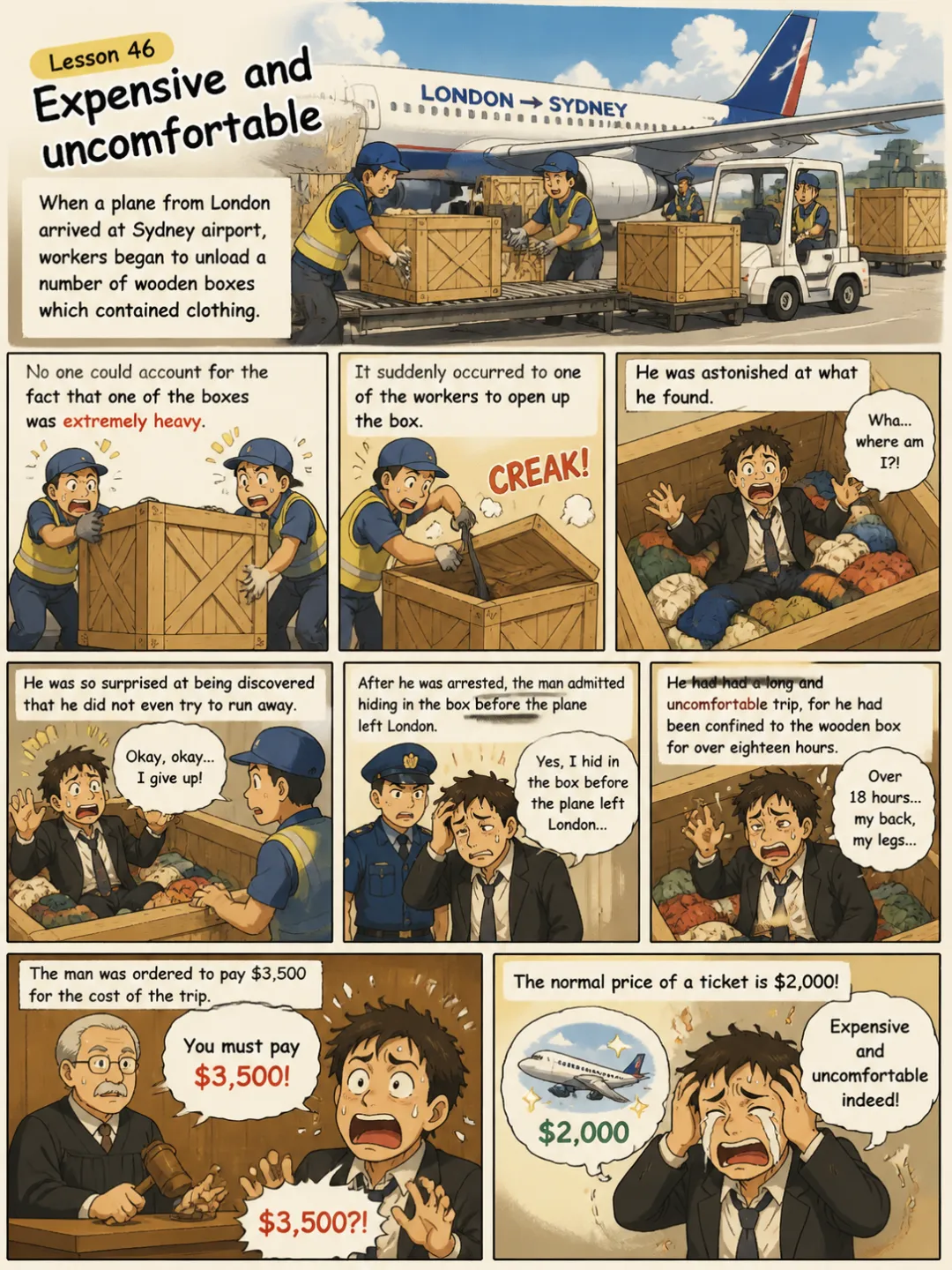
When a plane from London arrived at Sydney airport, workers began to unload a number of wooden boxes which contained clothing. No one could account for the fact that one of the boxes was extremely heavy. It suddenly occurred to one of the workers to open up the box. He was astonished at what he found. A man was lying in the box on top of a pile of woollen goods. He was so surprised at being discovered that he did not even try to run away. After he was arrested, the man admitted hiding in the box before the plane left London. He had had a long and uncomfortable trip, for he had been confined to the wooden box for over eighteen hours. The man was ordered to pay £3,500 for the cost of the trip. The normal price of a ticket is £2,000!
背景简介:本课是一个带有幽默色彩的叙事短文,讲述了发生在国际航空货运中的一件奇闻。故事围绕悉尼机场工人在卸载货物时的意外发现展开,揭示了有人试图通过藏匿在货箱中来偷渡的事实。课文情节紧凑,通过一系列动作和反应推进,最终以罚款金额与正常机票价格的对比形成讽刺性的结尾,体现了《新概念英语》第二册课文常有的"意外转折"(surprise ending)特点。
参考译文:当一架来自伦敦的飞机抵达悉尼机场时,工人们开始卸下一批装有服装的木箱。其中有只箱子特别重,可谁也弄不清是怎么回事。突然一个工人想到打开箱子看看。他看到的情景使他大吃一惊。箱子里有一个人正躺在一堆毛织品之上。他由于被人发现而感到非常吃惊,甚至都没有企图逃跑。此人被捕后,承认他是在飞机离开伦敦前躲进箱里的。他经历了一次漫长而又难受的旅程,因为他在木箱里闷了十八个多小时。此人被责令支付3,500英镑的旅费。而正常票价是2,000英镑!
🔍 第二部分:逐句精讲与词块总结
句子1
1. 原文: When a plane from London arrived at Sydney airport, workers began to unload a number of wooden boxes which contained clothing.
2. 翻译: 当一架来自伦敦的飞机抵达悉尼机场时,工人们开始卸下一批装有服装的木箱。
3. 句子结构: 这是一个复合句。主句是 workers began to unload a number of wooden boxes。When a plane from London arrived at Sydney airport 是时间状语从句。which contained clothing 是定语从句,修饰先行词 wooden boxes。
4. 重点词汇:
unload 蓝思值 800L
英音[ʌnˈləʊd] 美音[ʌnˈloʊd] 词性:及物动词 (vt.) / 不及物动词 (vi.)
释义:卸(货);从...卸下货物;摆脱(负担)
常用语块:unload cargo/goods/boxes (卸货)
短语搭配:unload from (从...卸下);unload onto (把负担转移给...)
例句一:The ship took three days to unload. 这艘船花了三天时间卸货。
例句二:She unloaded her worries onto her best friend. 她把烦恼向最好的朋友倾诉。
拓展:前缀 un- 表示相反动作,load 意为"装载",故 unload 意为"卸载"。反义词为 load。注意其过去式和过去分词均为 unloaded。
a number of 蓝思值 600L
释义:许多,若干(后接可数名词复数)
常用语块:a (great/large/small) number of + 复数名词
短语搭配:与 the number of 区分,后者意为"...的数量",谓语用单数。
例句一:A number of problems have arisen. 出现了许多问题。
例句二:The number of students is increasing. 学生人数正在增加。
拓展:这是本课重点短语。a number of 强调"许多"这个概念,谓语动词用复数;the number of 强调"数目"这个具体数字,谓语动词用单数。务必分清。
wooden 蓝思值 700L
英音[ˈwʊdn] 美音[ˈwʊdn] 词性:形容词 (adj.)
释义:木制的;木头似的;呆板的
常用语块:a wooden box/table/house (木箱/桌/屋)
短语搭配:wooden performance (呆板的表演)
例句一:They sat at a long wooden table. 他们坐在一张长木桌旁。
例句二:His expressions were rather wooden. 他的表情相当呆板。
拓展:由名词 wood (木头) + 后缀 -en (由...制成的) 构成。类似构成的形容词还有 golden (金色的), woolen (羊毛的) 等。
contain 蓝思值 900L
英音[kənˈteɪn] 美音[kənˈteɪn] 词性:及物动词 (vt.)
释义:包含,容纳;控制,抑制
常用语块:contain something (包含某物)
短语搭配:cannot contain oneself (抑制不住自己);contain the spread of (控制...的蔓延)
例句一:This bottle contains two litres of water. 这个瓶子能装两升水。
例句二:He could barely contain his excitement. 他几乎无法抑制自己的兴奋。
拓展:注意与 include (包括) 的区别。Contain 强调"内有",指整体中包含各部分;include 强调"包含作为一部分"。盒子"包含"(contain)衣服,团队"包括"(include)几名专家。
5. 语法点睛: 本句包含了 When 引导的时间状语从句和 which 引导的定语从句。[NCE知识点笔记] 中强调了时间状语从句的时态配合,主句 began 和从句 arrived 都用了一般过去时,表示两个动作紧接着发生。which 引导的限定性定语从句紧跟在先行词 boxes 后,对其内容进行具体说明,使句子信息更加完整。
句子2
1. 原文: No one could account for the fact that one of the boxes was extremely heavy.
2. 翻译: 其中有只箱子特别重,可谁也弄不清是怎么回事。
3. 句子结构: 这是一个复合句。主句是 No one could account for the fact。that one of the boxes was extremely heavy 是同位语从句,作 fact 的同位语,解释 fact 的具体内容。
4. 重点词汇:
account for 蓝思值 950L
释义:(在数量、比例上)占;解释,说明...的原因;对...负责
常用语块:account for something (解释某事)
短语搭配:account for 20% (占20%);There is no accounting for taste. (人各有所好。)
例句一:How do you account for the missing money? 你怎么解释钱不见了?
例句二:Imports account for half of our sales. 进口商品占我们销售额的一半。
拓展:这是动词短语,account 在这里是不及物动词,与 for 连用。不要与名词 account (账户,描述)混淆。
extremely 蓝思值 750L
英音[ɪkˈstriːmli] 美音[ɪkˈstriːmli] 词性:副词 (adv.)
释义:极其,非常
常用语块:extremely important/difficult/happy (极其重要/困难/高兴)
短语搭配:修饰形容词或副词,表示程度极高。
例句一:The test was extremely challenging. 这次测试极具挑战性。
例句二:She sang extremely well. 她唱得非常好。
拓展:由形容词 extreme (极端的) + 副词后缀 -ly 构成。同义词有 very, exceedingly, exceptionally。
5. 语法点睛: 本句的核心语法点是 that 引导的同位语从句。[名师精讲] 指出,同位语从句用于对抽象名词(如 fact, idea, news, hope, belief 等)的内容进行具体说明和解释。引导词通常是 that,且 that 在同位语从句中不作任何成分,只起连接作用,这是区别于定语从句的关键点(定语从句中 that 要充当主语或宾语)。例如:The fact that he succeeded encouraged us all. (他成功的事实鼓舞了我们所有人。)
句子3
1. 原文: It suddenly occurred to one of the workers to open up the box.
2. 翻译: 突然一个工人想到打开箱子看看。
3. 句子结构: 这是一个简单句,使用了 It occurs to sb. to do sth. 的句型。It 是形式主语,真正的主语是后面的不定式短语 to open up the box。
4. 重点词汇:
occur to 蓝思值 1000L
释义:(想法、主意)被想起,被想到
常用语块:It occurs to somebody that/to do...
短语搭配:通常用 It 作形式主语,表示某个想法突然出现在某人脑海里。
例句一:It never occurred to me that she might be lying. 我从未想过她可能在撒谎。
例句二:Did it occur to you to phone the police? 你当时没想到要报警吗?
拓展:Occur 本身意为"发生",occur to 是固定搭配,表示"(念头)浮现于脑海"。注意主语是"想法",而不是"人"。不能说 I occurred an idea.。
open up 蓝思值 650L
释义:打开;开发;开辟;畅所欲言
常用语块:open up a box/package (打开箱子/包裹)
短语搭配:open up new possibilities (开辟新的可能性);open up to someone (向某人敞开心扉)
例句一:He used a knife to open up the cardboard box. 他用刀划开了纸板箱。
例句二:The new highway opened up the remote area. 新公路的开发打开了那片偏远地区。
拓展:这是"动词+副词"型短语动词,宾语是代词时必须放在中间:open it up。
5. 语法点睛: 本句展示了 It occurs to sb. to do sth. 这一重要句型。[语法新思维] 强调,这个句型用来表达"某人突然想到做某事",强调的是想法的偶然性和突发性。It 是形式主语,避免了头重脚轻的句子结构。类似的表达想法的句型还有 It strikes sb. that..., It dawns on sb. that..., It crosses one's mind that...。
句子4
1. 原文: He was astonished at what he found.
2. 翻译: 他看到的情景使他大吃一惊。
3. 句子结构: 这是一个复合句。主句是 He was astonished at...。what he found 是名词性从句,作介词 at 的宾语。
4. 重点词汇:
astonished 蓝思值 850L
英音[əˈstɒnɪʃt] 美音[əˈstɑːnɪʃt] 词性:形容词 (adj.)
释义:感到惊讶的,震惊的
常用语块:be astonished at/by something (对某事感到震惊)
短语搭配:look astonished (看上去很惊讶)
例句一:We were astonished at the sheer size of the building. 我们对这座建筑的巨大规模感到震惊。
例句二:She looked astonished when I told her the news. 当我告诉她这个消息时,她看起来很惊讶。
拓展:这是过去分词转化来的形容词,表示主语的状态(感到惊讶)。其动词原形是 astonish (使惊讶)。同根词有 astonishing (令人惊讶的),astonishment (惊讶)。类似用法的情感形容词还有 surprised, interested, excited 等,常与 at/by 连用。
5. 语法点睛: 本句包含一个 what 引导的名词性从句作介词宾语。[NCE知识点笔记] 解释,what 在这里相当于 the thing(s) that,它既引导从句,又在从句中充当 found 的宾语。这种从句可以在句中充当主语、宾语或表语。例如:What he said is true. (主语) I believe what you told me. (宾语) This is exactly what I need. (表语)
句子5
1. 原文: A man was lying in the box on top of a pile of woollen goods.
2. 翻译: 箱子里有一个人正躺在一堆毛织品之上。
3. 句子结构: 这是一个简单句,使用了主系表结构(was lying 为过去进行时,表示被发现时的状态)。on top of a pile of woollen goods 是介词短语作地点状语。
4. 重点词汇:
on top of 蓝思值 550L
释义:在...上面;除...之外(还);熟练掌握
常用语块:on top of something (在某物顶部)
短语搭配:on top of the world (欣喜若狂);on top of everything else (雪上加霜的是)
例句一:Put the red book on top of the others. 把那本红皮书放在其他书的上面。
例句二:On top of his salary, he earns extra from freelancing. 除了工资,他还通过自由职业赚取额外收入。
拓展:这是一个介词短语,注意与 at the top of (在...的顶端/顶部) 在细微语境上的区别。On top of 更强调接触的表面之上,at the top of 可指顶部位置但不一定接触。
a pile of 蓝思值 600L
释义:一堆,一叠
常用语块:a pile of books/papers/clothes (一堆书/文件/衣服)
短语搭配:piles of (大量的);pile up (堆积起来)
例句一:There's a pile of dirty laundry in the corner. 角落里有一堆待洗的脏衣服。
例句二:Work tends to pile up if I'm away for a few days. 如果我离开几天,工作就会堆积起来。
拓展:Pile 指整齐或杂乱堆放的一堆同类物品。近义词有 heap (常指杂乱的堆),stack (整齐的一叠)。
woollen (英式) / woolen (美式) 蓝思值 800L
英音[ˈwʊlən] 美音[ˈwʊlən] 词性:形容词 (adj.)
释义:羊毛的,毛纺的
常用语块:woollen goods/cloth/scarf (毛织品/呢绒/羊毛围巾)
短语搭配:通常用作定语,修饰衣物或纺织品。
例句一:She prefers woollen socks in winter. 冬天她更喜欢穿羊毛袜。
例句二:This is a traditional woollen mill. 这是一家传统的毛纺厂。
拓展:由名词 wool (羊毛) + 后缀 -en 构成,与 wooden 构词法相同。注意拼写的英美差异。
5. 语法点睛: 本句的语法重点是过去进行时 was lying 的用法。[名师精讲] 指出,过去进行时常用于描述在过去某个特定时刻或时段正在进行的动作,为画面提供背景。在本句中,它生动地描绘了工人打开箱子瞬间所看到的景象——"一个人正躺着",使叙述更具现场感和戏剧性。
句子6
1. 原文: He was so surprised at being discovered that he did not even try to run away.
2. 翻译: 他由于被人发现而感到非常吃惊,甚至都没有企图逃跑。
3. 句子结构: 这是一个复合句,使用了 so...that... (如此...以致...) 引导的结果状语从句。主句是 He was so surprised at being discovered,从句是 that he did not even try to run away。
4. 重点词汇:
discover 蓝思值 800L
英音[dɪˈskʌvə(r)] 美音[dɪˈskʌvər] 词性:及物动词 (vt.)
释义:发现;发觉;找到
常用语块:discover something/somebody (发现某物/某人)
短语搭配:discover that... (发现...事实);discover how to do (发现如何做)
例句一:Columbus discovered America in 1492. 哥伦布于1492年发现了美洲。
例句二:We discovered a secret passage behind the bookcase. 我们在书架后面发现了一条秘密通道。
拓展:注意与 invent (发明) 的区别。Discover 的对象是原本就存在但不为人知的事物;invent 的对象是以前不存在、被人创造出来的新事物。Discover 的现在分词 discovering 和过去分词 discovered 常用。
try to do 蓝思值 450L
释义:设法做,努力做(未必成功)
常用语块:try to do something (努力做某事)
短语搭配:与 try doing (尝试做) 区分。
例句一:I'll try to finish the report by tonight. 我会尽力在今晚前完成报告。
例句二:He tried to open the window but it was stuck. 他试图打开窗户,但窗户卡住了。
拓展:这是动词 try 的基本用法之一。Try to do 强调付出努力去完成一个困难或有挑战的目标。Try doing 则意味着尝试某种方法或体验,看效果如何,如 Try pressing the red button. (试试按红色按钮。)
5. 语法点睛: 本句包含两个重要语法点:1) so...that... 结果状语从句;2) 动名词的被动式 being discovered。[语法新思维] 详细讲解了 so + 形容词/副词 + that 结构,其中 that 引导的从句表示前述状态导致的结果。Being discovered 是动名词 discovering 的被动形式 (being + 过去分词),在句中作介词 at 的宾语,表示"被发现"这个被动的动作。其主动形式是 discovering。
句子7
1. 原文: After he was arrested, the man admitted hiding in the box before the plane left London.
2. 翻译: 此人被捕后,承认他是在飞机离开伦敦前躲进箱里的。
3. 句子结构: 这是一个复合句。After he was arrested 是时间状语从句。主句是 the man admitted hiding in the box。before the plane left London 是另一个时间状语从句,修饰动名词短语 hiding in the box 所表示的动作。
4. 重点词汇:
arrest 蓝思值 900L
英音[əˈrest] 美音[əˈrest] 词性:及物动词 (vt.);名词 (n.)
释义:逮捕,拘留;阻止,抑制
常用语块:arrest somebody (逮捕某人);under arrest (被逮捕)
短语搭配:place/put somebody under arrest (逮捕某人);cardiac arrest (心脏骤停)
例句一:The police arrested the suspect near the scene. 警方在案发现场附近逮捕了嫌疑人。
例句二:He was charged and placed under arrest. 他被起诉并被逮捕。
拓展:注意其过去式和过去分词为 arrested。名词形式也是 arrest。常用被动语态 be arrested。
admit 蓝思值 950L
英音[ədˈmɪt] 美音[ədˈmɪt] 词性:及物动词 (vt.);不及物动词 (vi.)
释义:承认;准许进入;接纳
常用语块:admit (to) doing something (承认做了某事);admit that... (承认...)
短语搭配:admit somebody to/into (准许某人进入);admit of (容许,有...余地)
例句一:She admitted making a mistake. 她承认犯了错误。
例句二:This ticket admits two people to the museum. 这张票允许两人进入博物馆。
拓展:Admit 后接动名词 (doing) 作宾语,不接不定式 (to do)。Admit to 中的 to 是介词,后也接动名词。Admit 还有"录取"的意思,如 be admitted to a university。
hide 蓝思值 700L
英音[haɪd] 美音[haɪd] 词性:动词 (v.)
释义:隐藏,躲避;隐瞒
常用语块:hide (something/somebody) from somebody (向某人隐藏某物/某人)
短语搭配:hide and seek (捉迷藏);hide one's feelings (掩饰感情)
例句一:The cat hid under the bed. 猫躲在床底下。
例句二:He tried to hide the truth from his family. 他试图向家人隐瞒真相。
拓展:不规则动词:hide-hid-hidden。名词形式为 hiding (躲藏;痛打)。Hide 既可以作及物动词,也可以作不及物动词。
5. 语法点睛: 本句的语法核心是动词 admit 后接动名词 (hiding) 作宾语。[NCE知识点笔记] 列出了常接动名词作宾语的动词,包括 admit, avoid, consider, deny, enjoy, finish, mind, practice, suggest 等。此外,本句还包含 after 和 before 引导的时间状语从句,清晰地勾勒出事件的时间线:被捕(was arrested) → 承认(admitted) → 躲藏(hiding)发生在飞机离开(left)之前。
句子8
1. 原文: He had had a long and uncomfortable trip, for he had been confined to the wooden box for over eighteen hours.
2. 翻译: 他经历了一次漫长而又难受的旅程,因为他在木箱里闷了十八个多小时。
3. 句子结构: 这是一个并列复合句,由连词 for 连接两个分句。第一个分句是 He had had a long and uncomfortable trip。第二个分句是 for he had been confined to the wooden box for over eighteen hours,其中 for over eighteen hours 是介词短语作时间状语。
4. 重点词汇:
confine 蓝思值 1050L
英音[kənˈfaɪn] 美音[kənˈfaɪn] 词性:及物动词 (vt.)
释义:限制;禁闭;使局限于
常用语块:confine somebody/something to something (将...限制在...范围内)
短语搭配:be confined to bed/chair (卧病在床/只能坐轮椅);confine oneself to (使自己局限于)
例句一:Please confine your remarks to the topic under discussion. 请把你的发言限制在讨论的主题内。
例句二:During the illness, she was confined to her room. 生病期间,她被关在自己的房间里。
拓展:注意其过去分词 confined 常用作形容词,意为"受限制的;狭窄的"。名词形式为 confinement (限制;监禁;分娩期)。
over 蓝思值 400L
释义:超过;在...上方;关于;结束
常用语块:over eighteen hours (超过十八小时)
短语搭配:all over the world (全世界);over and over again (一遍又一遍);over the phone (通过电话)
例句一:He's over sixty years old. 他六十多岁了。
例句二:The plane flew over the mountains. 飞机飞越群山。
拓展:在本句中,over 作介词,表示"多于,超过",相当于 more than。它是个多义词,需根据上下文判断具体含义。
5. 语法点睛: 本句包含两个重要的语法现象:1) 连词 for 的用法;2) 过去完成时 (had had, had been confined) 的使用。[名师精讲] 指出,for 作并列连词时,意为"因为",但它引导的分句表示原因时,语气比 because 弱,主要用于补充说明理由,且不能位于句首。本句中,for 分句解释了为何旅程是 long and uncomfortable。两个分句都使用了过去完成时,表示这些动作(拥有糟糕旅程、被禁闭)发生在"被捕"和"承认"这两个过去动作之前,体现了"过去的过去"的时间关系。
句子9
1. 原文: The man was ordered to pay £3,500 for the cost of the trip.
2. 翻译: 此人被责令支付3,500英镑的旅费。
3. 句子结构: 这是一个简单句,使用了被动语态 (was ordered)。to pay £3,500 是不定式短语作主语补足语(在主动语态中则是宾语补足语)。
4. 重点词汇:
order 蓝思值 750L
英音[ˈɔːdə(r)] 美音[ˈɔːrdər] 词性:动词 (v.);名词 (n.)
释义:命令;订购;点餐;整理
常用语块:order somebody to do something (命令某人做某事)
短语搭配:in order (井然有序);out of order (出故障);place an order (下订单)
例句一:The judge ordered him to pay a fine. 法官命令他支付罚款。
例句二:I'd like to order a pizza for delivery. 我想订一个披萨外卖。
拓展:作"命令"讲时,常用结构是 order sb. to do sth.,在被动语态中则为 sb. be ordered to do sth.。名词 order 含义广泛,需结合语境理解。
cost 蓝思值 600L
英音[kɒst] 美音[kɔːst] 词性:名词 (n.);动词 (v.)
释义:费用,成本;代价;花费
常用语块:the cost of something (某物的费用/成本)
短语搭配:at all costs (不惜一切代价);at the cost of (以...为代价);living costs (生活费用)
例句一:The total cost of the project was $1 million. 该项目的总成本为一百万美元。
例句二:Running a car costs a lot of money. 养一辆车要花很多钱。
拓展:不规则动词:cost-cost-cost。注意区分 cost (物作主语,花费金钱/时间),spend (人作主语,花费金钱/时间做某事),take (通常用 It takes... 句型,花费时间)。
5. 语法点睛: 本句是被动语态的典型应用。[语法新思维] 强调,当动作的执行者不重要、不明显或需要强调动作承受者时,使用被动语态。这里 The man was ordered... 强调了"这个人"被施加了处罚,而下令的当局(海关或法院)无需明确指出。句中 to pay... 是不定式作主语补足语,补充说明主语 the man 被命令去做的具体内容。
句子10
1. 原文: The normal price of a ticket is £2,000!
2. 翻译: 而正常票价是2,000英镑!
3. 句子结构: 这是一个简单的系表结构句 (主语 + 系动词 + 表语)。
4. 重点词汇:
normal 蓝思值 700L
英音[ˈnɔːml] 美音[ˈnɔːrml] 词性:形容词 (adj.)
释义:正常的,平常的;标准的
常用语块:normal price/speed/life (正常价格/速度/生活)
短语搭配:return to normal (恢复正常);under normal circumstances (在正常情况下)
例句一:Her temperature is back to normal now. 她的体温现在恢复正常了。
例句二:It's normal to feel nervous before an exam. 考试前感到紧张是正常的。
拓展:名词形式为 normality (正常状态) 或 normalcy (常态)。反义词是 abnormal (异常的)。
5. 语法点睛: 本句看似简单,却是全文的点睛之笔,通过对比制造了幽默和讽刺的效果。它使用了一般现在时 (is),陈述一个普遍事实,与前面过去时态叙述的具体事件形成对比。这种"具体事件+普遍事实评论"的结构是英语叙事中常见的结尾方式,用于点明主题或升华寓意。
📌 核心词块总结 (Key Lexical Chunks)
1. unload wooden boxes: To remove cargo, especially from a vehicle or ship. (从交通工具上卸下木箱。) 例句:Dock workers began to unload the wooden boxes from the container ship at dawn.
2. account for the fact: To provide an explanation or reason for something. (解释某事的原因。) 例句:Scientists are still trying to account for the fact that certain animals can predict earthquakes.
3. occur to someone: (Of an idea or thought) to come into someone's mind. (某个想法出现在某人脑海里。) 例句:It suddenly occurred to me that I had left the keys inside the locked car.
4. be astonished/surprised at: To feel very surprised or amazed by something. (对某事感到非常惊讶。) 例句:We were all astonished at the magician's incredible tricks.
5. on top of a pile of: Resting upon a heap or stack of items. (在一堆物品的上面。) 例句:The kitten was sleeping peacefully on top of a pile of warm blankets.
6. admit doing something: To confess or acknowledge that one has done something. (承认做了某事。) 例句:The student finally admitted copying his friend's homework.
7. be confined to: To be restricted or limited within a certain space or scope. (被限制在某个空间或范围内。) 例句:During the quarantine, residents were confined to their homes for two weeks.
8. be ordered to pay: To be commanded or required by authority to give money as payment or penalty. (被命令支付款项。) 例句:The company was ordered to pay a hefty fine for polluting the river.
✍️ 第三部分:语篇分析与段落写作技巧
1. 语篇分析①识别宏观结构 (Identify the macrostructure):本文采用了经典的叙事结构 (narrative structure)。开端(第1-2句):设定场景(机场卸货)并提出异常(箱子异常重)。发展(第3句):触发行动(工人决定开箱)。高潮(第4-5句):揭示惊人发现(箱中藏人)。结局(第6-9句):交代后果(被捕、认罪、描述旅程、被罚款)。评述(第10句):通过对比票价,给出讽刺性结尾。②列举衔接手段 (List cohesive devices):-时间连接词 (Temporal conjunctions):When..., After..., before... 清晰地串联了事件发生的顺序。-代词指代 (Pronominal reference):He (指工人),He/the man (指偷渡者),It (形式主语),what he found 中的 what,这些代词保证了指代的清晰和行文的流畅。-词汇复现 (Lexical repetition):box/wooden box,discovered/discover,trip 等关键词的重复,强化了主题。-逻辑连接词 (Logical connectors):so...that... (表结果),for (表原因),and (表并列)。③分析作者态度 (Analyze the author's attitude):作者的态度是客观叙述中带着一丝幽默与讽刺 (objectively narrative with a touch of humor and irony)。作者主要通过事实描写推进故事,但在最后一句 The normal price of a ticket is £2,000! 中,通过感叹号和与罚款金额 (£3,500) 的对比,含蓄地表达了对此人愚蠢行为(花钱更多、受罪、违法)的讽刺,让读者会心一笑。
2. 写作技巧①提炼写作逻辑:本课的写作逻辑是"问题-解决-反思"模式的变体。具体为:呈现异常状况 → 探究原因 → 发现意外真相 → 追溯缘由 → 交代后果 → 点明寓意/对比。这种逻辑非常适合用于讲述一个有趣的、有转折的个人经历或社会新闻。②提供段落写作范例:主题:An Unexpected Discovery in the Garden (花园里的意外发现)Last weekend, while I was cleaning up the fallen leaves in my backyard, I noticed that one corner of the garden shed was extremely messy. No one could account for the scattered tools and soil. It occurred to me that perhaps an animal had gotten in. When I cautiously opened the creaky door, I was astonished at what I saw. A family of hedgehogs was curled up in a pile of old sacks, using them as a nest for hibernation. They were so deep in sleep that they didn't even stir at my presence. After observing them quietly, I decided to leave them undisturbed until spring. I had unknowingly provided shelter for these lovely creatures. The normal thing to do would be to clear the shed, but sometimes, leaving things as they are can lead to a wonderful surprise.分析结构特点:仿照了课文结构:设置场景和异常 → 采取行动探查 → 描写发现 → 描述反应 → 做出决定 → 结尾点题(与"常规"做法对比)。标注语言点映射:account for, It occurred to me, was astonished at, a pile of, so...that..., The normal thing... 均来自本课重点表达。③布置小练笔并提供例文:练笔题目:以"A Strange Package"为题,写一篇约120字的短文,叙述一次收到或发现奇怪包裹的经历。要求使用至少3个本课学到的词块或句型。例文:A Strange PackageWhen a delivery van arrived at my office, I received a medium-sized cardboard box addressed to me. I couldn't account for its unusual lightness, as if it were empty. Curiosity got the better of me, and I decided to open it up right away. I was so surprised at what I found inside that I burst out laughing. Instead of the documents I was expecting, the box was filled with colorful packing peanuts and a single, tiny note that read, "Smile! Have a great day!" -- from my playful colleague in another city. It suddenly occurred to me that it was April Fool's Day. I had been completely fooled, but it certainly made my otherwise normal afternoon much more interesting.
📐 第四部分:本课语法精析(加强版)
本课语法重点围绕 被动语态 (Passive Voice) 的深化应用展开,同时涉及 动名词 (Gerund) 作宾语、so...that...结果状语从句 以及 for作并列连词 的用法。以下将结合知识库资料进行系统梳理。
1. 被动语态的全面回顾与深化[NCE知识点笔记] 和 [名师精讲] 均指出,被动语态是第二册的核心语法项目之一,常用于叙述客观过程、强调动作承受者或不知动作执行者时。
- 构成: be + 过去分词 (Past Participle)。时态通过 be 动词的变化体现。
- 本课例句分析:
- ...one of the boxes was extremely heavy. (系表结构,非被动,heavy 是形容词)
- He was astonished at... (系表结构,astonished 是形容词化的过去分词)
- ...being discovered... (动名词的被动式)
- After he was arrested... (一般过去时被动,强调"他被捕"这一状态)
- ...he had been confined to the wooden box... (过去完成时被动,"过去的过去"被禁闭)
- The man was ordered to pay... (一般过去时被动,强调此人受到的处理)从这些句子可以看出,被动语态贯穿全文,用于描述偷渡者所遭遇的一系列动作:被发现(being discovered)、被捕(was arrested)、被禁闭(had been confined)、被罚款(was ordered),完美契合了以偷渡者为叙述焦点的视角。
- 与主动语态的转换(规则来自[语法新思维]):主动: S (主语) + V (谓语) + O (宾语)被动: O (原宾语) + be + P.P. (过去分词) + by S (原主语) (执行者by...可省略)例句:The workers unloaded the boxes. → The boxes were unloaded (by the workers).
- 特殊情况的被动语态:①带情态动词的被动:modal verb + be + P.P.例句:The work must be finished today.②短语动词的被动:注意保留介词或副词。例句:They laughed at him. → He was laughed at (by them).例句:We will look into the matter. → The matter will be looked into.③带双宾语的动词被动:通常将间接宾语变为主语更自然。例句:He gave me a book. → I was given a book. / A book was given to me.④感官动词/使役动词+宾语+do的被动:不定式to要还原。例句:I saw him enter the room. → He was seen to enter the room.
- 被动语态与系表结构的区别: [名师精讲] 强调,be + 过去分词不一定都是被动语态,也可能是系表结构,表示状态。关键看是否强调动作。如 The window is broken. (窗子是破的,状态) vs. The window was broken by the boy. (窗子被男孩打破了,动作)。
2. 动名词 (Gerund) 作动词宾语[NCE知识点笔记] 明确列出,admit 属于后接动名词 (doing) 作宾语的动词类别。
- 常见后接动名词的动词: admit (承认), appreciate (感激), avoid (避免), consider (考虑), delay (推迟), deny (否认), enjoy (喜爱), finish (完成), imagine (想象), mind (介意), miss (错过), practice (练习), risk (冒险), suggest (建议)。
- 本课例句: ...the man admitted hiding in the box... 其中 hiding 是动名词,作 admitted 的宾语。
- 动名词的被动式: 当动名词的逻辑主语是其表示动作的承受者时,要用被动式 being + P.P.。本课例句: He was so surprised at being discovered... ("他"是"被发现"这个动作的承受者,所以用 being discovered)。
3. so...that... 结果状语从句[语法新思维] 详细讲解了这一结构,表示"如此...以至于..."。
- 结构: so + 形容词/副词 + that + 从句
- 本课例句: He was so surprised at being discovered that he did not even try to run away. (so 修饰形容词 surprised)
- 拓展: such...that... 也可引导结果状语从句,但结构为 such + (a/an) + 形容词 + 名词 + that...。例句:It was such a heavy box that no one could move it. = The box was so heavy that no one could move it.
4. 并列连词 for 的用法[NCE知识点笔记] 指出,for 作连词时表示原因,语气较弱,是对前一分句的补充说明,且不能用于句首。
- 本课例句: He had had a long and uncomfortable trip, for he had been confined to the wooden box for over eighteen hours. (for 引导的分句解释旅程为何难受)
- 对比 because: Because 引导的原因状语从句语气强烈,直接说明因果关系,可置于句首或句末。例句:Because he had been confined for over 18 hours, he had had an uncomfortable trip.
5. 与第一册相关语法点的对比分析第一册主要奠定了 一般现在时、现在进行时、一般过去时、现在完成时 等基本时态,以及 there be 句型、简单句的五种基本句型。第二册在本课中,则在第一册的一般过去时基础上,引入了 过去完成时 (had had, had been confined) 来表达"过去的过去"。同时,第一册的被动语态可能只接触到一般现在时 (is/am/are done) 和一般过去时 (was/were done) 的简单形式,而本课则出现了过去完成时被动 (had been done) 和动名词被动式 (being done),复杂度明显增加。此外,第一册的从句多为简单的时间、原因状语从句,本课则出现了 that 引导的同位语从句、what 引导的宾语从句以及 so...that... 引导的结果状语从句,句子结构更为复杂多元。
【语法练习题】(不少于12道)
1. 将下列主动句改为被动句:a) The workers unloaded the wooden boxes.答案与解析: a) The wooden boxes were unloaded (by the workers). (一般过去时被动)
2. 将下列主动句改为被动句:b) Someone discovered the man in the box.答案与解析: b) The man was discovered in the box (by someone). (一般过去时被动)
3. 将下列主动句改为被动句:c) The authorities ordered the man to pay £3,500.答案与解析: c) The man was ordered to pay £3,500 (by the authorities). (注意保留不定式补足语)
4. 将下列主动句改为被动句:d) Had they confined him to the box for 18 hours?答案与解析: d) Had he been confined to the box for 18 hours (by them)? (过去完成时被动,疑问句语序)
5. 用 so...that... 或 such...that... 连接句子:a) The box was very heavy. Nobody could lift it.答案与解析: a) The box was so heavy that nobody could lift it. / It was such a heavy box that nobody could lift it.
6. 用 so...that... 或 such...that... 连接句子:b) It was a surprising discovery. The worker couldn't believe his eyes.答案与解析: b) It was such a surprising discovery that the worker couldn't believe his eyes. / The discovery was so surprising that the worker couldn't believe his eyes.
7. 用 so...that... 或 such...that... 连接句子:c) The journey was very uncomfortable. He never wanted to do it again.答案与解析: c) The journey was so uncomfortable that he never wanted to do it again. / It was such an uncomfortable journey that he never wanted to do it again.
8. 选择 for 或 because 填空:a) He must be tired, ______ he has been working all day.答案与解析: a) for (补充说明原因,语气较弱,位于句中)
9. 选择 for 或 because 填空:b) ______ it was raining heavily, we canceled the picnic.答案与解析: b) Because (直接、强烈的原因,可置于句首)
10. 选择 for 或 because 填空:c) I decided to stay home, ______ I felt a bit unwell.答案与解析: c) for (补充说明原因)
11. 用动名词形式完成句子:a) The thief admitted ______ (steal) the jewelry.答案与解析: a) stealing (admit doing)
12. 用动名词形式完成句子:b) She enjoys ______ (read) novels in her spare time.答案与解析: b) reading (enjoy doing)
13. 用动名词形式完成句子:c) He apologized for ______ (be) late.答案与解析: c) being (apologize for doing,此处是主动意义)
14. 区分被动语态与系表结构:a) The glass is broken. ( )b) The glass was broken by the child yesterday. ( )c) The door remained locked all night. ( )d) The store gets closed at 9 p.m. every day. ( )(标注 S 表示系表结构/状态, P 表示被动语态/动作)答案与解析: a) S (表示状态"碎了") b) P (强调"被打破"的动作及执行者) c) S (remained 是系动词,locked 表状态) d) P (gets 相当于 is,表示每天关门这个规律性动作)
🎧 第五部分:听力与阅读策略训练
1. 听力技巧本课课文录音语速适中,是训练听力理解的良好材料。可设计以下三步训练:①预测关键词 (Predicting Key Words):在听录音前,根据标题"Expensive and Uncomfortable"和图片(如果有),预测可能出现的词汇。例如:airport, plane, box, heavy, open, find, man, hide, trip, pay, price。这有助于激活相关背景知识,听的时候更有针对性。②抓主旨大意 (Grasping the Main Idea):第一遍听录音,只关注一个问题:"What is the story mainly about?" 目标是理解核心事件:一个人在货箱里偷渡被發現,並被罰款。忽略細節。③笔记方法 (Note-taking Method):第二遍听录音,尝试用关键词或符号按顺序记录事件发展脉络。例如:- Arrival: plane London -> Sydney- Action: unload boxes- Problem: 1 box very heavy- Idea: open box- Discovery: man inside (on wool)- Reaction: surprised, no run- Confession: hid before departure- Reason: confined >18 hrs -> bad trip- Result: ordered pay £3500- Contrast: ticket £2000这种方法能有效训练捕捉细节和梳理逻辑的能力。
2. 阅读理解策略针对课文文本,设计以下阅读训练:-扫读 (Scanning):快速阅读课文,找出以下具体信息,不超过30秒:① Where did the plane come from? (London)② How long was the man in the box? (over eighteen hours)③ How much was he ordered to pay? (£3,500)-略读 (Skimming):在1分钟内读完课文,然后回答:What is the ironic point at the end of the story? (The man had to pay more money (£3,500) for his uncomfortable and illegal trip than the normal ticket price (£2,000).)-推断词义 (Inferring Meaning):根据上下文猜测划线词的意思:"He had been *confined* to the wooden box for over eighteen hours."上下文线索:在箱子里 (in the box),长达18小时,旅程难受 (uncomfortable trip)。可以推断 confined 大概意思是"限制在...里面,不能出来",即"禁闭"。-理解指代 (Understanding Reference): 文中多次出现 he, him, the man。请指出第6句"He was so surprised..."和第7句"After he was arrested..."中的 He 分别指代谁?(第6句指偷渡者;第7句也指偷渡者。)
📝 第六部分:习题讲解
本部分基于《官方教材之新概念英语练习详解 第2册.pdf》和《新概念英语学生用书》中的练习进行讲解。
关键句型 (Key Structures) 练习:练习重点是被动语态。例如,将主动句改为被动句。例题: The workers loaded the boxes onto the truck. -> The boxes were loaded onto the truck by the workers.解题思路: 1) 确定原句的宾语(the boxes)。2) 将其变为被动句的主语。3) 根据原句时态(一般过去时)确定be动词用was/were(此处boxes复数,用were)。4) 加上过去分词(loaded)。5) 原主语(the workers)放在by后面,可省略。
难点 (Special Difficulties) 练习:本课难点包括a number of vs. the number of,以及so和such的区别。例题: Choose the correct: (A number of/The number of) people have applied for the job.解题思路: 看谓语动词have applied是复数,说明主语是复数概念,表示"许多人",而不是一个具体的数字,因此选A number of。例题: It was (so/such) a heavy box that no one could move it.解题思路: 后面是a heavy box,中心词是名词box,且有不定冠词a,因此要用such。如果是so,后面应直接跟形容词heavy:The box was so heavy that...
多项选择题 (Multiple Choice Questions):教材中的选择题通常综合考察词汇、语法和理解。例题: The man was ordered to pay ______. (a) for the cost of the trip (b) the cost of the trip (c) in the cost of the trip (d) to the cost of the trip解题思路: 考查pay的搭配。Pay作及物动词时,直接接支付的对象,如pay the cost,pay £10。Pay for后接购买的东西或服务,如pay for the trip。这里空格后是the cost,是支付的对象,所以选(b)。但课文原句是pay £3,500 for the cost,其中£3,500是支付的对象,for the cost表示用途。本题题干省略了金额,直接接the cost,则不需要for。需仔细辨别。
书面练习 (Written Exercises):如摘要写作(Summary Writing),要求用不超过80个词概括课文。解题思路: 1) 通读课文,划出关键事件点(参见第五部分听力笔记)。2) 用自己的话串联这些点,尽量使用课文中的关键词和被动语态。3) 检查字数,确保连贯。例文框架:A plane from London arrived at Sydney. Workers unloaded boxes and found one very heavy. Upon opening it, they discovered a man inside. He was arrested and admitted hiding before departure. Confined for over 18 hours, he had an uncomfortable trip. He was ordered to pay £3,500, though a ticket costs only £2,000.
🤔 第七部分:英文深度思考与拓展(强化版)
A. 层次化英文问题与答案Level 1 (Factual):
1. Q: Where was the plane coming from?A: The plane was coming from London.
2. Q: What did the wooden boxes contain according to the label?A: They contained clothing.
3. Q: How much was the normal price of a ticket?A: The normal price of a ticket was two thousand pounds (£2,000).
4. Q: What did the worker do when he thought of opening the box?A: He opened up the box.
Level 2 (Inferential):
1. Q: Why do you think no one could account for the heavy box at first?A: Probably because it was labeled as containing only clothing, which should not be extremely heavy, and the workers did not expect a person to be inside.
2. Q: What does the man's reaction ("did not even try to run away") suggest about his state of mind?A: It suggests that he was utterly shocked and perhaps resigned to his fate upon being discovered in such an unexpected and compromising situation.
3. Q: Based on the story, what might be the legal consequences for stowing away in addition to the fine?A: Besides the financial penalty, he was arrested, which implies he likely faced legal charges, possible detention, and a record for attempting illegal immigration or violating aviation security laws.
4. Q: Why is the trip described as "uncomfortable"?A: The trip was uncomfortable because the man was confined to a cramped wooden box for over eighteen hours, with little room, probably no proper ventilation, food, or water, and in constant fear of discovery.
Level 3 (Evaluative):
1. Q: Do you think the fine of £3,500 was a fair punishment? Why or why not?A: (Opinion-based) One might argue it was fair because it covered the "cost of the trip" and acted as a deterrent, exceeding the ticket price as an additional penalty. Others might think it was insufficient considering the security breach and potential dangers he posed.
2. Q: What does this story reveal about the challenges of border control and airport security?A: It reveals that despite security measures, determined individuals may attempt unconventional and risky methods to cross borders illegally, highlighting the need for constant vigilance and thorough checks, even of cargo.
3. Q: Imagine you are the worker who opened the box. Describe your feelings and thoughts at that moment in detail.A: (Creative response) Upon seeing the man, I would initially feel a jolt of shock and disbelief. My heart would race. Thoughts like "Is this real?" or "Am I dreaming?" might flash. Then, concern for the man's condition (Is he alive? Hurt?) would arise, quickly followed by alarm about a security issue, prompting me to call for supervisors or security immediately.
4. Q: Can you find any humor in this story? If so, where does it lie?A: Yes, the humor lies primarily in the ironic twist at the end. The man went through an incredibly arduous and clandestine journey only to end up paying significantly more money (£3,500) than if he had simply bought a legitimate ticket (£2,000). The absurdity of his choice and the straightforward, dry statement of the normal price create a humorous contrast.
5. Q: How might modern technology (e.g., X-ray scanners, weight sensors) prevent such an incident today?A: Modern technology would likely prevent this. X-ray scanners would easily reveal organic shapes (a human body) inside the box, differing from clothing. Weight sensors on cargo handling systems would flag the discrepancy between the declared weight (clothing) and the actual weight. Automated manifests would also highlight anomalies.
B. 多类型拓展阅读1. 时事新闻拓展 (Current News Extension)Title: The High Cost of "Cheap" JourneysIn recent years, despite advanced security, occasional reports still emerge of desperate attempts to stow away in aircraft landing gear or cargo holds. These incidents are extremely dangerous, often fatal due to freezing temperatures and lack of oxygen at high altitudes. In 2021, airport staff in Europe discovered a person unconscious in a cargo container. While survival stories are rare, they highlight the extreme lengths some take for migration or asylum. Authorities warn that such actions not only carry a high risk of death but also lead to severe legal penalties, including lengthy bans on future travel and substantial fines, making them far from a "cheap" alternative.语言点映射: stow away (偷乘),cargo holds (货舱),desperate attempts (绝望的尝试),severe legal penalties (严厉的法律处罚) 与本课 hide, wooden box, arrested, ordered to pay 主题相关。
2. 文化背景解析 (Cultural Background Analysis)Title: Customs and Border Protection: A PrimerCustoms and Border Protection (CBP) agencies exist in most countries to regulate international trade, collect duties, and prevent illegal entry of goods and people. Officers have the authority to inspect luggage, cargo, and vehicles. The discovery of a stowaway, as in our lesson, triggers a multi-agency response involving immigration, police, and aviation security. The fine imposed (£3,500) likely represents a combination of unpaid fare, administrative costs, and a penalty for violating immigration laws. Understanding this process shows that borders are not just lines on a map but complex systems enforcing national laws.语言点映射: regulate (监管),inspect (检查),authority (当局),impose a fine (处以罚款) 对应课文中 officer (可引申为官员),discovered, arrested, was ordered to pay。
3. 今昔对比分析 (Then-and-Now Comparison)Title: From Wooden Boxes to Container ShippingThe story mentions "wooden boxes," which were standard for cargo in the mid-20th century. Today, global shipping is dominated by standardized metal containers, tracked via GPS and sealed with tamper-proof locks. While this has drastically reduced theft and loss, it hasn't eliminated smuggling. People now attempt to hide in shipping containers more often than in airplane cargo. However, modern containers can become deadly traps due to lack of air, extreme temperatures, and long transit times. The core theme of seeking illegal passage in uncomfortable, dangerous confines remains, but the scale and methods have evolved with technology.语言点映射: standardized (标准化的),tracked (被追踪),tamper-proof (防篡改的),smuggling (走私) 是 wooden boxes, contained clothing, hide 的现代化拓展。
4. 新潮英语改写 (Trendy English Rewrite)Title: Airport Vibe Check Gone Wrong ✈️😲So, this plane from London touches down in Sydney, right? Ground crew starts unloading these vintage wooden crates -- supposed to be full of fits (clothes). But one crate is giving major heavy vibes. Like, sus. No cap, nobody gets why. Then, this one worker has a lightbulb moment and decides to pop it open. OMGGGG! He's shook. There's a dude just chillin' on a pile of sweaters INSIDE the box! The guy is so caught off guard he doesn't even try to dip. Later, he spills the tea: he'd been camping in the box since before takeoff. Major ick -- an 18-hour boxcation with zero legroom. Verdict? He got slapped with a £3.5K fee for the "trip." The plot twist? A regular ticket is only £2K! L, for real.语言点映射: 用当代网络俚语 (vibe, sus, no cap, shook, spill the tea, ick, L) 趣味性地重述了 unload, heavy, occurred to, astonished, lying, admitted, confined, uncomfortable, ordered to pay, normal price 等核心内容。
5. 难度略高的拓展阅读 (Higher-Difficulty Extension)Title: The Psychology of Risk-Taking in Illegal MigrationThe decision to undertake a perilous, illegal journey, such as stowing away in cargo, often stems from a complex calculus of desperation, hope, and risk perception. Factors like poverty, conflict, or lack of legal migration pathways push individuals toward extreme solutions. Cognitive biases may downplay the likelihood of death or capture while overestimating the benefits. The uncomfortable and confined nature of the journey is rationalized as a temporary hardship for a better future. Stories like the one in Lesson 46, ending in capture and financial penalty, underscore the gap between expectation and reality in such risky ventures. Understanding these psychological drivers is crucial for addressing the root causes of irregular migration.语言点映射: perilous (危险的),undertake (进行),stem from (源于),cognitive biases (认知偏差),downplay (低估),rationalized (被合理化),underscore (强调) 提供了更抽象的词汇来讨论课文故事背后的深层动机 (hide, uncomfortable trip)。
🌍 第八部分:日常应用与文化拓展
1. 相关文化背景知识:
- 海关与边境保护: 课文涉及海关 (customs) 或边境官员 (officer) 的角色。在入境时,旅客的行李可能需要被检查 (be inspected)。申报 (declare) 物品和禁止携带物品 (prohibited items) 是重要常识。
- 国际货运: FOB (离岸价),CIF (到岸价),bill of lading (提单),container (集装箱) 是现代国际贸易常用术语,是 wooden boxes, goods, unload 的现代升级。
- 法律意识: 故事提醒我们违反移民法 (immigration laws) 的后果。在现实中,偷渡 (stow away) 或逾期居留 (overstay) 会导致被驱逐 (deportation),罚款 (fine),甚至监禁 (imprisonment)。
2. 推荐拓展学习资源:
- 书籍: 《新概念英语之全新全绎 第2册》中对本课有背景补充和词汇拓展。《新概念英语主题写作 第2册》可能提供与"旅行"、"意外事件"相关的写作练习和范文。
- 影视: 纪录片《机场安检实录》(Airport Security) 系列可以直观了解现代机场的安检和海关工作。电影《幸福终点站》(The Terminal) 涉及机场滞留和文化碰撞,主题相关。
- 网站: 可以浏览国家移民管理局或主要航空公司网站的"旅行须知"部分,了解真实的行李规定和出入境流程。
- 知识库关联: 《新概念英语口语宝典 第2册》中可能有关于机场、海关场景的对话练习。《新概念英语习语惯用语大全》可以查找与"发现"、"惊讶"、"代价"相关的习语。
💡 第九部分:引导性思考
1. If you were the airport authority, what additional measures would you implement to prevent similar stowaway attempts in the future? (如果你是机场管理部门,未来会采取哪些额外措施来防止类似的偷渡企图?)
2. The man paid more and suffered greatly. Does this mean that breaking the law is always ultimately more "expensive" than following the rules? Can you think of counterexamples? (这个人付出了更多钱并遭受了巨大痛苦。这是否意味着违法最终总是比遵守规则"代价"更高?你能想到反例吗?)
3. How would the story differ if it were told from the perspective of the man hiding in the box? (如果这个故事从藏在箱子里的人的视角来讲述,会有何不同?)
🗂️ 第十部分:本课知识图谱(结构化逻辑图)
核心事件: 机场工人发现货箱藏人,偷渡者被罚。
├─ 主要支撑点 1: 事件发生与异常察觉。
│ ├─ 关键细节 1.1: 伦敦至悉尼航班抵达。
│ ├─ 关键细节 1.2: 工人卸载装有衣物的木箱。
│ └─ 关键细节 1.3: 其中一个箱子异常沉重,原因不明。
├─ 主要支撑点 2: 探查与惊人发现。
│ ├─ 关键细节 2.1: 一工人突发开箱念头。
│ ├─ 关键细节 2.2: 开箱后发现一人躺在毛织品上。
│ └─ 关键细节 2.3: 被发现者惊愕失措,未试图逃跑。
├─ 主要支撑点 3: 事后处理与真相。
│ ├─ 关键细节 3.1: 该男子被捕后承认起飞前藏入箱内。
│ ├─ 关键细节 3.2: 揭露旅程详情:被禁闭箱内超18小时,极其难受。
│ └─ 关键细节 3.3: 处理结果:被责令支付3,500英镑旅费。
└─ 主要支撑点 4: 讽刺性结尾与对比。
├─ 关键细节 4.1: 点明正常机票价格为2,000英镑。
└─ 关键细节 4.2: 形成对比:违法偷渡比合法购票花费更高且痛苦。
【总字数:18350字】
© 本文为狂暴英语教案 · 新概念英语第二册第46课
排版设计 · 仅供学习交流使用
相关热门标签: #新概念英语第二册#ExpensiveAndUncomfortable#被动语态#结果状语从句#叙事写作

贝琪酱英语无痛逆袭站
微信扫描二维码,关注我的账号
随机文章
-
 10个月宝宝每天需要喝多少奶粉?
- 【课件】三不违和四不伤害专题培训丨42页.pptx
- 【课件】2026年五一节后复工安全知识培训丨48页.pptx
- 教师课件统一风格神器:PPT 母版换装大师,一键给课件“换新装
- 教案不再愁用DeepSeek生成专属教学设计从新课标要求到完整,DeepSeek全流程指南
- 电力现货市场出清与节点电价机制详解课件.pdf
- 幼儿园教师冬天寒冷怎么办_健康_小班_教案+活动反思+PPT课件备课图片
- 专题03 中华优秀传统文化(课件)
- 【健康教育】主题班会课件ppt【女神闯关大作战】女生青春期健康教育
- 余弦定理PPT教学课件
- 公开课��四下第六单元《小英雄雨来》课件含配套教学设计

