【狂暴英语教案】新概念英语第二册第25课:英国人会讲英语吗?
- 2026-07-24 11:02:59
读外刊,接触原汁原味的英文表达,
欢迎关注以下公众号+设为星标+推荐给朋友。▼
📚 狂暴英语教案 · 新概念英语第二册
第25课 Do the English speak English?
英国人讲的是英语吗?
📘 本课信息教材:新概念英语第二册 · 第25课核心功能:语言交流误解 · 叙事幽默 · 文化差异语法焦点:并列句 (and, but, so, or) · 关联连词 (not only... but... neither... nor...) · however用法
🏷️ 热门标签
🎯 本课学习目标
词汇:
掌握约15个核心词汇(如arrive, railway station, porter, wonder, several, neither, foreigner等)的音、形、义及用法,并了解其蓝思值。
语法:
深入理解并列句(Compound Sentences)的结构与功能,掌握连词and, but, so, or, for等在连接两个独立分句时的用法与区别。
技能(段落写作):
学习如何运用并列句构建连贯的叙事段落,描述一次包含转折、因果关系的经历。
文化:
初步体会英语语言内部的多样性(如口音、用词差异),并了解在英国问路、寻求帮助时的基本交际方式。
📖 第一部分:课文完整内容
背景简介:本课选自《新概念英语》第二册,以一个初到伦敦的外国人的视角,讲述了他与火车站搬运工之间因语言(实为口音和语速)问题引发的有趣误会。故事幽默地揭示了英语作为一种全球性语言,其内部存在的口音、语速和用词习惯的多样性。这不仅是语言学习,更是跨文化交际意识的启蒙。根据《新概念英语讲师用书新版2》,本课的核心教学目标是训练学生使用并列连词构建复合句,并理解其表达的转折、因果等逻辑关系。
课文原文
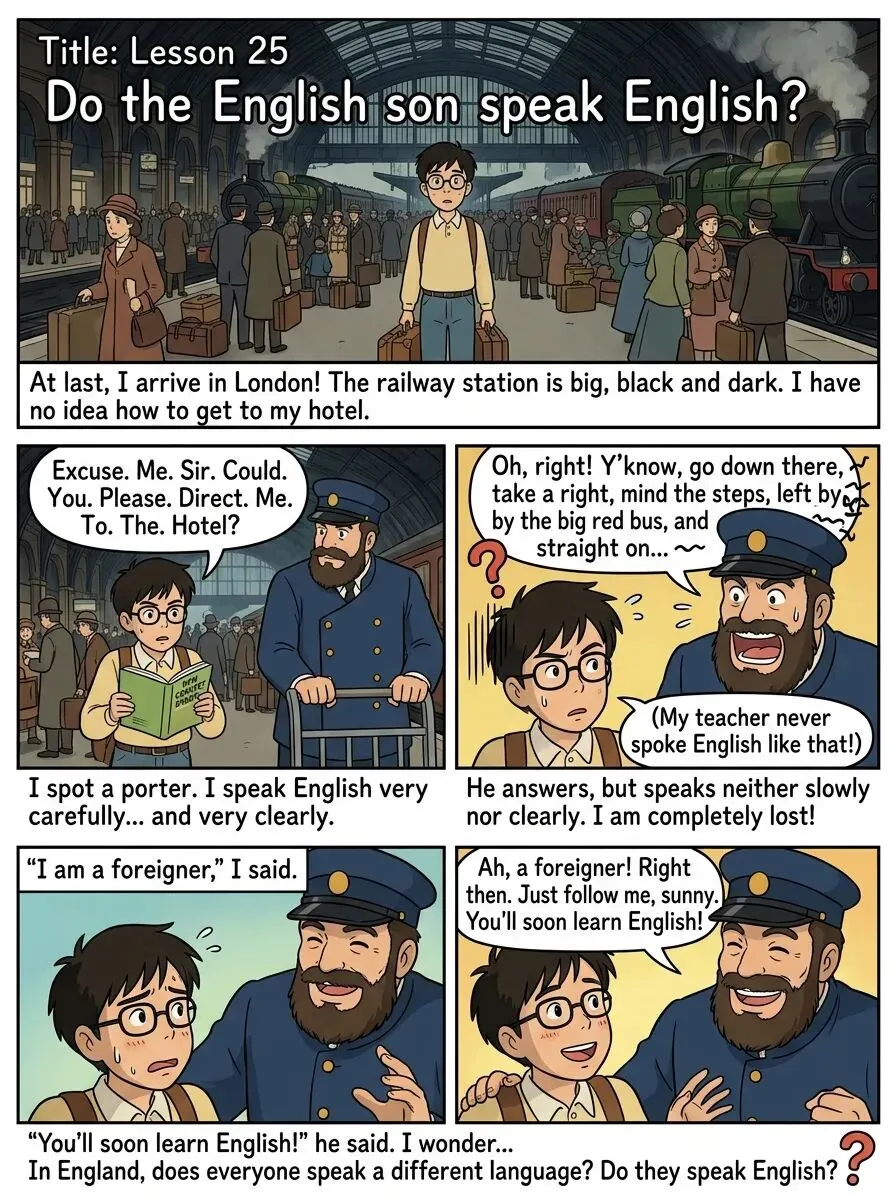
I arrived in London at last. The railway station was big, black and dark. I did not know the way to my hotel, so I asked a porter. I not only spoke English very carefully, but very clearly as well. The porter, however, could not understand me. I repeated my question several times and at last he understood. He answered me, but he spoke neither slowly nor clearly. 'I am a foreigner,' I said. Then he spoke slowly, but I could not understand him. My teacher never spoke English like that! The porter and I looked at each other and smiled. Then he said something and I understood it. 'You'll soon learn English!' he said. I wonder. In England, each person speaks a different language. The English understand each other, but I don't understand them! Do they speak English?
我终于到了伦敦。火车站很大,又黑又暗。我不知道去酒店的路,于是问了一个搬运工。我不仅英语讲得非常认真,而且也非常清晰。然而,搬运工却没听懂我的话。我把问题重复了好几遍,他终于听懂了。他回答了我,但他讲得既不慢也不清楚。"我是个外国人,"我说。然后他说得慢了,可我又听不懂了。我的老师从来不那样讲英语!搬运工和我相视而笑。接着,他说了点什么,我听懂了。"你很快就能学会英语的!"他说。我感到疑惑。在英国,每个人都说着一种不同的语言。英国人之间能互相听懂,可我却听不懂他们的话!他们讲的是英语吗?
📑 参考译文
我终于到了伦敦。火车站很大,又黑又暗。我不知道去酒店的路,于是问了一个搬运工。我不仅英语讲得非常认真,而且也非常清晰。然而,搬运工却没听懂我的话。我把问题重复了好几遍,他终于听懂了。他回答了我,但他讲得既不慢也不清楚。"我是个外国人,"我说。然后他说得慢了,可我又听不懂了。我的老师从来不那样讲英语!搬运工和我相视而笑。接着,他说了点什么,我听懂了。"你很快就能学会英语的!"他说。我感到疑惑。在英国,每个人都说着一种不同的语言。英国人之间能互相听懂,可我却听不懂他们的话!他们讲的是英语吗?
🔍 第二部分:逐句精讲
句子1
原文: I arrived in London at last.
翻译: 我终于到了伦敦。
句子结构: 简单句。主语(I) + 谓语(arrived) + 地点状语(in London) + 时间状语(at last)。
重点词汇:
arrive 蓝思值 400L
英音[əˈraɪv] 美音[əˈraɪv] 词性:vi.
释义:到达,抵达
常用语块:arrive in + 大地点(城市、国家);arrive at + 小地点(机场、车站、酒店)
短语搭配:arrive home(直接跟副词,无介词);arrive on time 准时到达
例句一:We arrived in Paris on a rainy morning. 我们在一个雨天的早晨抵达巴黎。
例句二:The train arrived at the station ten minutes late. 火车晚点十分钟到站。
拓展:同义词辨析:arrive (vi.) 强调"到达"的结果;reach (vt.) 是及物动词,直接接地点;get to (phr.v.) 口语化表达。反义词:depart (离开)。派生词:arrival (n. 到达)。
语法点睛: 本句是典型的主谓结构简单句,重点在于不及物动词arrive与介词in/at的固定搭配。at last作为时间状语,表达了经过一番周折后的最终结果,带有如释重负的感情色彩。在叙事中,这样的开头直接切入事件发生的地点与状态。[NCE知识点笔记]
语音要点: at last 连读,arrived 中 /d/ 轻微爆破。
句子2
原文: The railway station was big, black and dark.
翻译: 火车站很大,又黑又暗。
句子结构: 简单句。主语(The railway station) + 系动词(was) + 并列表语(big, black and dark)。
重点词汇:
railway station 蓝思值 500L
英音[ˈreɪlweɪ ˈsteɪʃn] 美音[ˈreɪlweɪ ˈsteɪʃn] 词性:n. phrase
释义:火车站
常用语块:go to the railway station
短语搭配:at the railway station 在火车站
例句一:He waited for her at the railway station for two hours. 他在火车站等了她两个小时。
例句二:The new railway station is much more modern than the old one. 新火车站比旧的那个现代得多。
拓展:同义词:train station (更常用)。相关词:subway station (地铁站),bus station (汽车站)。
语法点睛: 本句使用了"主系表"结构,并通过连词and连接三个形容词作表语,描述了火车站给作者留下的初步印象。这种并列形容词的用法使描述更为生动和全面。注意black和dark在描述环境时的细微差别:black可能指颜色深,dark强调光线不足。[名师精讲]
语音要点: big, black and dark 中 and 弱读 /ən/。
句子3
原文: I did not know the way to my hotel, so I asked a porter.
翻译: 我不知道去酒店的路,于是问了一个搬运工。
句子结构: 并列句。由连词so连接两个独立分句,表示因果关系。
重点词汇:
porter 蓝思值 600L
英音[ˈpɔːtə(r)] 美音[ˈpɔːrtər] 词性:n.
释义:(火车站、机场的)搬运工;门卫
常用语块:ask a porter for help
短语搭配:hotel porter 酒店行李员
例句一:The porter helped me carry my heavy suitcase. 搬运工帮我提了沉重的行李箱。
例句二:You can find a porter near the information desk. 你可以在问讯处附近找到搬运工。
拓展:词根port-意为"携带,运载"。同根词:transport (运输),export (出口),import (进口),portable (便携的)。
语法点睛: 这是本课第一个典型的并列句。连词so表示结果,意为"因此,所以",清晰地表明了"不知道路"是"询问搬运工"的原因。在写作中,使用so可以简洁地建立因果逻辑,使叙事流畅。注意:so引导的结果分句前通常用逗号隔开。[NCE知识点笔记]
语音要点: so 弱读 /sə/,asked a 连读 /ɑːskt ə/。
句子4
原文: I not only spoke English very carefully, but very clearly as well.
翻译: 我不仅英语讲得非常认真,而且也非常清晰。
句子结构: 简单句,但使用了关联连词not only... but... as well连接两个副词短语(very carefully和very clearly),共同修饰谓语动词spoke。
重点词汇:
carefully 蓝思值 300L
英音[ˈkeəfəli] 美音[ˈkerfəli] 词性:adv.
释义:仔细地,认真地,小心地
常用语块:do something carefully
短语搭配:listen carefully 仔细听;drive carefully 小心驾驶
例句一:She read the instructions carefully before using the machine. 她在使用机器前仔细阅读了说明书。
例句二:He walked carefully on the icy road. 他在结冰的路上小心地行走。
拓展:形容词形式:careful。反义词:carelessly (粗心地)。同根词:care (n./v. 关心)。
clearly 蓝思值 300L
英音[ˈklɪəli] 美音[ˈklɪrli] 词性:adv.
释义:清楚地,清晰地
常用语块:speak clearly
短语搭配:see clearly 看得清楚;think clearly 思路清晰
例句一:Please write your name clearly on the form. 请在表格上清楚地写下你的名字。
例句二:The speaker explained the concept very clearly. 演讲者非常清晰地解释了这个概念。
拓展:形容词形式:clear。反义词:unclearly (不清楚地)。
语法点睛: 本句展示了not only... but... (as well/also)这一重要关联连词结构,用于强调两个并列的成分。as well通常放在句末,also放在but和形容词/副词之间(如but also very clearly)。这个结构使句子重点突出,强调了说话者自认为表达得既谨慎又清楚,为后文的误解埋下伏笔。[语法新思维]
语音要点: not only 重读,but very clearly as well 中 as well 弱读。
句子5
原文: The porter, however, could not understand me.
翻译: 然而,搬运工却没听懂我的话。
句子结构: 简单句。主语(The porter) + 插入语(however) + 谓语(could not understand) + 宾语(me)。
重点词汇:
however 蓝思值 700L
英音[haʊˈevə(r)] 美音[haʊˈevər] 词性:adv.
释义:然而,可是(表示转折)
常用语块:用于句首、句中或句末,常用逗号与句子其他部分隔开。
例句一:The weather was bad. However, we decided to go hiking. 天气很糟。然而,我们决定去徒步。
例句二:He is very talented; however, he is also quite lazy. 他很有天赋;然而,他也相当懒惰。
拓展:同义词:but, yet, nevertheless。however语气较but更正式,位置更灵活。
understand 蓝思值 400L
英音[ˌʌndəˈstænd] 美音[ˌʌndərˈstænd] 词性:v. (understood, understood)
释义:理解,明白,懂
常用语块:understand sb./sth.
短语搭配:make oneself understood 使自己的意思被明白;It is understood that... 大家明白...
例句一:Do you understand what I mean? 你明白我的意思吗?
例句二:I can't understand why he did that. 我不理解他为什么那样做。
拓展:派生词:understanding (n. 理解;谅解),misunderstand (v. 误解)。
语法点睛: however作为转折副词,在此处起到了关键的叙事转折作用。它插在主语和谓语之间,用逗号隔开,使语气有一个停顿,强调了预期(我说得清楚)与现实(他没听懂)之间的反差。这是构建故事冲突的经典手法。[课堂笔记]
语音要点: however 重读第二音节,前后有停顿。
句子6
原文: I repeated my question several times and at last he understood.
翻译: 我把问题重复了好几遍,他终于听懂了。
句子结构: 并列句。由连词and连接两个分句,表示顺承关系。
重点词汇:
several 蓝思值 400L
英音[ˈsevrəl] 美音[ˈsevrəl] 词性:det./pron.
释义:几个,数个(通常指三个以上,但不多)
常用语块:several times 好几次;several people 几个人
短语搭配:on several occasions 在好几个场合
例句一:I've been to Beijing several times. 我去过北京好几次了。
例句二:Several students were absent from class today. 今天有几个学生缺课。
拓展:与a few意思相近,但several语气更强,数量可能略多于a few。反义概念:many (许多),none (没有)。
at last
英音[ət lɑːst] 美音[ət læst] 词性:adv. phrase
释义:终于,最后(经过等待或困难后)
常用语块:放在句首或句末。
例句一:At last, the bus arrived. 公共汽车终于来了。
例句二:He finished his homework at last. 他终于完成了作业。
拓展:同义词:finally, in the end。at last常带有感情色彩,如释重负或期盼已久。
语法点睛: 本句再次使用并列连词and,连接两个先后发生的动作,叙事流畅。several times和at last这两个时间状语共同描绘了沟通的艰难过程,at last呼应了第一句的at last,形成一种结构上的回环,强调了"最终达成理解"这一结果来之不易。[NCE知识点笔记]
语音要点: several times 中 /l/ 清晰,at last 连读。
句子7
原文: He answered me, but he spoke neither slowly nor clearly.
翻译: 他回答了我,但他讲得既不慢也不清楚。
句子结构: 并列句。由连词but连接两个分句,表示转折关系。后一分句中使用了关联连词neither... nor...连接两个副词(slowly和clearly)。
重点词汇:
neither... nor... 蓝思值 600L
英音[ˈnaɪðə(r) nɔː(r)] 美音[ˈniːðər nɔːr] 词性:conj.
释义:既不...也不...(用于连接两个并列的否定成分)
常用语块:连接两个主语、谓语、宾语、表语或状语。
短语搭配:遵循"就近原则",谓语动词的单复数与nor后面的主语一致。
例句一:He neither smokes nor drinks. 他既不抽烟也不喝酒。
例句二:Neither my father nor my mother is at home. 我爸爸和妈妈都不在家。
拓展:反义结构:both... and... (既...又...)。对应词:either... or... (要么...要么...)。
语法点睛: 这是本课第二个使用but的并列句,转折意味强烈。but前后分句形成了鲜明对比:"他回答我了"(积极动作)与"他回答的方式很差"(消极描述)。neither... nor...结构精炼地表达了双重否定,强调了搬运工说话方式在"语速"和"清晰度"两个维度上都存在问题,这正是导致"我"再次听不懂的原因。这是故事中第二个冲突点。[名师精讲]
语音要点: neither 在英式发音为/naɪðə/,美式为/niːðər/,nor 重读。
句子8
原文: 'I am a foreigner,' I said.
翻译: "我是个外国人,"我说。
句子结构: 直接引语+主句。引导内的句子为直接引语,I said是主句。
重点词汇:
foreigner 蓝思值 500L
英音[ˈfɒrənə(r)] 美音[ˈfɔːrənər] 词性:n.
释义:外国人
常用语块:a foreigner in a country
短语搭配:feel like a foreigner 感觉像个外国人
例句一:As a foreigner, he found it difficult to adapt to the local customs. 作为一个外国人,他发现很难适应当地风俗。
例句二:The city attracts many foreigners every year. 这个城市每年吸引许多外国人。
拓展:形容词形式:foreign (外国的)。相关词:alien (外星人;外国人,法律用语),immigrant (移民)。
语法点睛: 本句引入了直接引语,使叙事更生动,直接呈现了人物的对话。直接引语需用引号括起来,且引语末尾的标点(逗号、句号等)放在引号内。主句I said可以放在引语前、后或中间。这是记叙文中丰富叙事手法的重要技巧。[NCE知识点笔记]
语音要点: foreigner 重读第一音节 /ˈfɒr/。
句子9
原文: Then he spoke slowly, but I could not understand him.
翻译: 然后他说得慢了,可我又听不懂了。
句子结构: 并列句。由连词but连接,表示转折。前一分句:Then he spoke slowly;后一分句:I could not understand him。
语法点睛: 这是故事中第三次使用but,也是矛盾的高潮。尽管搬运工根据"我"的提示("我是外国人")调整了语速(spoke slowly),但"我"仍然听不懂。这个转折极具幽默效果,也引出了下文的核心困惑:为什么老师的英语和真实生活中的英语如此不同?Then作为时间副词,清晰地标示了动作的先后顺序。[语法新思维]
语音要点: Then 重读,but 弱读 /bət/。
句子10
原文: My teacher never spoke English like that!
翻译: 我的老师从来不那样讲英语!
句子结构: 简单句。主语(My teacher) + 谓语(never spoke) + 宾语(English) + 方式状语(like that)。
重点词汇:
like that
英音[laɪk ðæt] 美音[laɪk ðæt] 词性:adv. phrase
释义:像那样,那样地
常用语块:do something like that
例句一:Don't treat your friends like that. 不要那样对待你的朋友。
例句二:I've never seen a car like that before. 我以前从未见过那样的车。
拓展:like this (像这样)。that指代前文提到的搬运工说话的方式。
语法点睛: 本句是"我"内心的独白和评论,使用了强烈的否定词never和感叹号,表达了惊讶、不解甚至有点懊恼的情绪。like that作为方式状语,指代前文描述的搬运工的说话方式。这句话巧妙地将课堂英语与真实环境中的英语对立起来,点出了许多语言学习者的共同困惑。[课堂笔记]
语音要点: never 重读,like that 连读。
句子11
原文: The porter and I looked at each other and smiled.
翻译: 搬运工和我相视而笑。
句子结构: 简单句。主语(The porter and I) + 并列谓语(looked at each other and smiled)。
重点词汇:
each other 蓝思值 300L
英音[iːtʃ ˈʌðə(r)] 美音[iːtʃ ˈʌðər] 词性:pron.
释义:互相,彼此(指两者之间)
常用语块:动词 + each other
短语搭配:help each other 互相帮助;love each other 彼此相爱
例句一:The two sisters often help each other with homework. 两姐妹经常互相帮助做作业。
例句二:They looked at each other without saying a word. 他们彼此看着,一言不发。
拓展:指三者或三者以上之间用one another,但在现代英语中常可互换。
语法点睛: 本句主语是并列结构The porter and I,谓语也是由and连接的并列动词短语。looked at each other and smiled这个连续动作描绘了一个充满默契和幽默感的瞬间,化解了之前的尴尬,表明双方都意识到了沟通中的滑稽之处。这是故事情绪的一个转折点,从困惑转向了会心一笑。[NCE知识点笔记]
语音要点: looked at 连读 /lʊkt ət/。
句子12
原文: Then he said something and I understood it.
翻译: 接着,他说了点什么,我听懂了。
句子结构: 并列句。由and连接,表示顺承。前一分句:Then he said something;后一分句:I understood it。
重点词汇:
something 蓝思值 200L
英音[ˈsʌmθɪŋ] 美音[ˈsʌmθɪŋ] 词性:pron.
释义:某事,某物(用于肯定句)
常用语块:动词 + something
短语搭配:something else 别的东西;something wrong 有问题;have something to do with... 与...有关
例句一:I'm hungry. I want to eat something. 我饿了,想吃点东西。
例句二:There's something interesting in this book. 这本书里有些有趣的东西。
拓展:对应词:anything (用于疑问句和否定句),nothing (没有东西)。
语法点睛: 简单的并列句,and连接了"说"和"懂"两个动作。something和it的指代增加了悬念和真实感——我们不知道具体内容,但知道沟通终于成功了一次。这为下一句揭示具体内容做了铺垫。[名师精讲]
语音要点: said something 连读,understood it 连读。
句子13
原文: 'You'll soon learn English!' he said.
翻译: "你很快就能学会英语的!"他说。
句子结构: 直接引语+主句。引语为一句鼓励的话,使用了一般将来时(will learn)。
重点词汇:
soon 蓝思值 300L
英音[suːn] 美音[suːn] 词性:adv.
释义:不久,很快
常用语块:soon after ...之后不久;as soon as ---就...
短语搭配:see you soon 回头见;sooner or later 迟早
例句一:Dinner will be ready soon. 晚饭很快就好了。
例句二:He left soon after you called. 你打电话后不久他就走了。
拓展:比较级和最高级:sooner, soonest。
语法点睛: 搬运工的话You'll soon learn English!是故事的点睛之笔,既是一种友好的鼓励,也暗含了"你多听听我们这样说话就能学会"的意思,幽默地回应了"我"之前的困惑。主句he said放在引语后,是英语中常见的引语结构。[课堂笔记]
语音要点: You'll 缩读 /juːl/,learn English 连读。
句子14
原文: I wonder.
翻译: 我感到疑惑。
句子结构: 简单句。主语(I) + 谓语(wonder)。
重点词汇:
wonder 蓝思值 500L
英音[ˈwʌndə(r)] 美音[ˈwʌndər] 词性:v.
释义:想知道;感到疑惑
常用语块:wonder + wh-从句(who, what, where, why, how等);I wonder if...
短语搭配:no wonder 难怪
例句一:I wonder what he is doing now. 我想知道他现在在做什么。
例句二:I wonder if you can help me. 不知你能否帮我。
拓展:名词wonder意为"奇迹"。形容词:wonderful (极好的)。
语法点睛: 这个极其简短的句子独立成段,在叙事节奏上形成一个停顿,强调了"我"内心持续的、深层次的困惑。它承上启下,既是对搬运工乐观预言的怀疑,也是引出下文作者个人感慨的过渡。[NCE知识点笔记]
语音要点: wonder 重读第一音节,降调表怀疑。
句子15
原文: In England, each person speaks a different language.
翻译: 在英国,每个人都说着一种不同的语言。
句子结构: 简单句。地点状语(In England) + 主语(each person) + 谓语(speaks) + 宾语(a different language)。
重点词汇:
each 蓝思值 400L
英音[iːtʃ] 美音[iːtʃ] 词性:det./pron.
释义:每个,各自(强调个体)
常用语块:each + 单数名词;each of + 复数名词
短语搭配:each other 互相;each time 每次
例句一:Each student has a dictionary. 每个学生都有一本词典。
例句二:Each of the rooms is painted a different color. 每个房间都漆成了不同的颜色。
拓展:与every辨析:every强调整体中的每一个,更侧重"全体";each侧重个体。each可指两者或以上,every指三者或以上。
语法点睛: 这是作者带有夸张和幽默色彩的结论。each person作主语,谓语动词用单数speaks。a different language并非指完全不同的语种,而是幽默地指代不同的口音、语速和用语习惯。这句话生动地表达了语言学习者在真实语言环境中的最初感受。[语法新思维]
语音要点: each person 连读,speaks 中 /s/ 清晰。
句子16
原文: The English understand each other, but I don't understand them!
翻译: 英国人之间能互相听懂,可我却听不懂他们的话!
句子结构: 并列句。由but连接,表示强烈转折。
语法点睛: 本句是上一个句子的具体阐述和对比。The English指"英国人"这个群体,谓语用复数understand。but引导的转折句,主语换成了I,将英国人的"内部畅通"与"我"的"外部隔阂"形成尖锐对比,充满了自嘲的幽默感,也点出了语言习得中的"局外人"视角。[名师精讲]
语音要点: The English 中 The 读 /ði/ 因 English 元音开头,but 弱读,don't 重读。
句子17
原文: Do they speak English?
翻译: 他们讲的是英语吗?
句子结构: 一般疑问句。助动词(Do) + 主语(they) + 谓语(speak) + 宾语(English)?
语法点睛: 以这样一个看似荒谬实则深刻的问题结尾,是本文最大的亮点。它用一个简单的疑问句,升华了全文的主题:对"标准英语"与"生活英语"之间差异的反思。这句话留给读者无限的思考空间,幽默而有力。[课堂笔记]
语音要点: Do 弱读,they speak English 中 speak 重读,疑问句升调。
📌 核心词块总结
1. arrive in London: To reach or come to the city of London. *(I arrived in London at last.)*
2. ask a porter: To request information or help from a person who carries luggage at a station. *(I asked a porter for directions.)*
3. not only... but... as well: Used to add another piece of information, emphasizing both parts. *(She is not only intelligent but also very kind.)*
4. could not understand: Was unable to comprehend the meaning of something said. *(He spoke so fast that I could not understand him.)*
5. neither slowly nor clearly: Not in a slow manner and also not in a clear manner. *(The instructions were given neither slowly nor clearly.)*
6. look at each other and smile: To make eye contact and then form a smile, often indicating shared understanding or amusement. *(After the joke, they looked at each other and smiled.)*
7. I wonder: An expression used to show that you are thinking about something and perhaps doubting it. *(He said it would be easy. I wonder.)*
8. speak a different language: (Here used humorously) To have a way of speaking that is difficult for others to understand due to accent or style. *(With his strong accent, it's like he speaks a different language.)*
📝 第三部分:语篇分析与段落写作技巧
1. 语篇分析① 识别宏观结构:
- 开端 (Arrival & Problem): 句子1-3:抵达伦敦,遇到问题(不知路)。
- 发展 (Attempt & Failure): 句子4-9:尝试沟通(认真清晰地问路),却遭遇两次失败(搬运工听不懂我;他回答后我听不懂他)。
- 高潮 (Realization & Humor): 句子10-11:内心感慨(老师不这样教)与外部互动(相视而笑)。
- 结局 (Partial Success & Reflection): 句子12-17:一次成功的理解,搬运工的鼓励,以及作者深刻的、幽默的反思。
② 列举衔接手段:
- 逻辑连接词: so (因果),however (转折),and (顺承),but (转折),then (时间顺承)。
- 指代: me, he, him, it, them, each other 等代词有效指代前文出现的人或事,避免重复。
- 词汇衔接: understand (不理解) 与 understood (理解) 的重复与对比;spoke English 这一核心行为的多次出现;foreigner 与 The English 的对比。
- 时间顺序: at last, then, soon 等词清晰地标明了事件发展的顺序。
③ 分析作者态度: 困惑 (Puzzled)、沮丧与惊讶 (Frustrated & Surprised)、幽默与自嘲 (Humorous & Self-deprecating)、反思 (Reflective)。
2. 写作技巧① 提炼写作逻辑: 本课展示了如何用一系列并列句讲述一个包含"问题-尝试-挫折-转折-感悟"的完整小故事。逻辑链条如下:情境设定 → 引出问题 → 描述行动 → 制造冲突 → 插入评论 → 情节缓和 → 部分解决 → 深化主题。② 提供段落写作范例: 主题:A Misunderstanding in a Café (咖啡馆里的一次误会)I walked into a small café in Paris and wanted to order a coffee. I remembered the French word for coffee, so I said "café" clearly to the waiter. The waiter, however, looked confused and asked me a question in rapid French. I did not understand him at all, so I just smiled and pointed at the menu. He then spoke more slowly, but I still couldn't catch the words. My phrasebook was useless at that moment! Finally, he simply brought me a black coffee and a glass of water. I thanked him, and he smiled back. I realized that sometimes, gestures work better than words when you're a beginner. Do we really need to speak to communicate?③ 布置小练笔并提供例文 (略,详见文档)
📐 第四部分:本课语法精析
1. 并列句的核心概念与连词- 定义:并列句由两个或两个以上互不依从的独立分句组成,通过并列连词连接。- 核心并列连词 (FANBOYS记忆法): For (因为), And (和,然后), Nor (也不), But (但是), Or (或者,否则), Yet (然而), So (所以)。本课例句:- I did not know the way to my hotel, so I asked a porter. (so表因果)- He answered me, but he spoke neither slowly nor clearly. (but表转折)- I repeated my question several times and at last he understood. (and表顺承)- Then he spoke slowly, but I could not understand him. (but表转折)- The English understand each other, but I don't understand them! (but表强烈对比)
2. 关联连词 (Correlative Conjunctions)- not only... but also... / not only... but... as well: "不仅...而且..."。课文例句:I not only spoke English very carefully, but very clearly as well.- neither... nor...: "既不...也不..."。课文例句:he spoke neither slowly nor clearly.- either... or...: "要么...要么..."。both... and...: "既...又..."。
3. 转折副词 however 与连词 but 的区别- But是连词,必须连接两个分句,通常放在两个分句之间,前面加逗号。- However是副词,表示转折语气。它的位置非常灵活:可置于句首、句中或句末,必须用逗号与句子其他部分隔开。课文例句:The porter, however, could not understand me.
4. 并列句的标点使用分句1 + 逗号 + 并列连词 + 分句2。分句很短时可省略逗号,但加上逗号永远正确。
练习题(不少于12道)1. 用合适的并列连词填空: a) I wanted to go to the party, ______ I had too much work to do. (but) b) It started to rain heavily, ______ we decided to stay indoors. (so) c) You must finish your homework now, ______ you cannot watch TV. (or) d) He is very old, ______ he is still very active. (but) e) She must be at home, ______ her car is in the driveway. (for)2. 用 not only... but also... 或 neither... nor... 连接句子: a) He can speak French. He can speak German. → He can not only speak French but also German. b) She didn't write to me. She didn't call me. → She neither wrote to me nor called me. c) The book is interesting. The book is educational. → The book is not only interesting but also educational.3. 改正句子中的错误: a) I was tired, however I continued working. → I was tired, but I continued working. b) Neither my sister or my brother is here. → Neither my sister nor my brother is here.4. 选择 however 或 but 填空: a) The idea is good. ______, it's not practical. (However) b) I'd like to help you, ______ I'm too busy right now. (but)5. 将两个简单句合并成一个并列句: a) I finished my work. I went home. → I finished my work and went home. b) He studied hard. He failed the exam. → He studied hard, but he failed the exam.6. 翻译句子: a) 我既没时间也没钱去旅行。 → I have neither time nor money for traveling. b) 请大声点说,否则后面的人听不见。 → Please speak louder, or the people at the back won't hear you. c) 她不仅是一位好老师,还是我们的朋友。 → She is not only a good teacher but also our friend. d) 天气很冷,但我们玩得很开心。 → It was very cold, but we had a great time.(答案及解析详见文档)
🎧 第五部分:听力与阅读策略训练
1. 听力技巧① 预测关键词:根据标题"Do the English speak English?",预测故事可能涉及的关键词:arrive, London, railway station, hotel, porter, speak English, understand, foreigner, language, wonder。② 抓主旨大意:第一遍听录音,回答:What is the main problem the narrator faces? (He has trouble communicating with a porter in London despite speaking English.) What is his final conclusion? (He humorously doubts if the English really speak English because they all sound different to him.)③ 细节听力与笔记方法:第二遍听录音,完成表格信息填空,聚焦沟通的"回合"(详见文档)。④ 跟读与模仿:第三遍听录音,逐句跟读,特别注意模仿不同角色的语调。
2. 阅读理解策略① 扫读:快速阅读课文,找出以下具体信息:Where did the narrator arrive? (In London) Who did he ask for help? (A porter) How many times did he repeat his question? (Several times) What did the porter say at the end that the narrator understood? ("You'll soon learn English!")② 略读:快速浏览课文,找出标志故事情绪或阶段变化的关键句(详见文档)。③ 推断词义:根据上下文推断划线词的含义:"I arrived in London *at last*." (at last暗示旅程漫长或不易)"He answered me, but he spoke *neither* slowly *nor* clearly." (neither... nor...意为"既不...也不...")"I *wonder*." (wonder此处表示"感到怀疑、疑惑")④ 理解作者意图:作者写这个故事的主要目的是?(B. 讲述一个有趣的个人经历来说明真实环境中的英语与课堂英语的差异。)
📝 第六部分:习题讲解
关键句型 (Key Structures) 与 难点 (Special Difficulties) 练习概览:通常针对本课的练习会围绕以下要点:1. 并列句连词 (and, but, so, or) 的选择与运用。2. 关联连词 (both... and..., neither... nor..., either... or..., not only... but... as well) 的运用。3. 词汇应用:用 wonder, several, at last, each, neither... nor... 等本课核心词汇完成句子。4. 介词辨析:如 arrive in 与 arrive at 的区别。示例习题讲解:*原题:Join these sentences with the words in brackets.*1. I went into the kitchen. I turned on the light. (and) → I went into the kitchen and turned on the light.2. He played football. He played tennis. (not only... but... as well) → He not only played football but played tennis as well.3. I couldn't find my bag. I couldn't find my wallet. (neither... nor...) → I could find neither my bag nor my wallet.解题思路总结: 1. 分析两个句子之间的逻辑关系。2. 根据逻辑关系选择合适的连词。3. 注意连词的固定搭配和结构。4. 检查连接后的句子是否语法正确、结构对称。
🤔 第七部分:英文深度思考与拓展
A. 层次化英文问题与答案Level 1 (Factual):1. Q: Where did the story take place? A: The story took place at a railway station in London.2. Q: Why did the narrator ask a porter for help? A: Because he did not know the way to his hotel.3. Q: How did the narrator describe the way he spoke English to the porter? A: He said he spoke English very carefully and very clearly.4. Q: What did the porter finally say that the narrator understood? A: The porter said, "You'll soon learn English!"Level 2 (Inferential):5. Q: Why do you think the porter couldn't understand the narrator at first, even though he spoke carefully and clearly? A: Possibly because the narrator had a foreign accent, used textbook-perfect but unnatural phrasing, or because the porter was expecting a different question or accent common in that area.6. Q: What does the phrase "My teacher never spoke English like that!" reveal about the narrator's previous English learning experience? A: It reveals that he learned English in a classroom setting, probably with a teacher who spoke slowly, clearly, and with a standard "textbook" accent, which is very different from the fast, possibly accented, and idiomatic English used by native speakers in daily life.7. Q: Why did the porter and the narrator look at each other and smile? A: They smiled because they both realized the humor and absurdity of the situation—they were both speaking English but failing to communicate effectively. It was a moment of shared understanding beyond words.8. Q: Is the narrator's final question "Do they speak English?" meant to be taken literally? What does he really mean? A: No, it's not meant literally. It's a humorous and exaggerated way of expressing his frustration and surprise. He means that the English spoken by native people in real life (with various accents, speeds, and slang) is so different from the "standard" English he learned that it almost feels like a different language.Level 3 (Evaluative): (更多问题详见文档)
B. 多类型拓展阅读1. 时事新闻拓展:AI Translation Earbuds: Bridging the Gap or Creating New Dependencies?In today's globalized world, the frustration felt by the narrator of our textbook story is being targeted by technology. Companies are selling real-time translation earbuds that can instantly convert spoken language. A tourist in Tokyo can hear a vendor's Japanese as English in their ear, and reply in English, which the vendor hears in Japanese. While this seems like a magic solution to the "Do they speak English?" dilemma, linguists raise concerns. They argue that over-reliance on such tools might discourage people from genuinely learning a language and its culture. The shared smile between the porter and the narrator---a human moment born of struggle---might be lost. The question remains: should we use technology to eliminate language barriers, or embrace the challenge as part of the travel experience?引导性问题:Do you think the narrator of the textbook story would have benefited from such earbuds? Would using them have changed the core message of his experience?2. 文化背景解析:The Many Voices of "English": Accents and Class in the UKThe narrator's bewildered question, "Do they speak English?", humorously touches on a deep truth about the United Kingdom: its incredible diversity of accents. The porter likely spoke with a regional accent (Cockney from London, or another working-class accent). The narrator, probably taught "Received Pronunciation" (RP) or a standard American accent, couldn't comprehend it. Historically, accents in Britain have been strongly tied to social class and region. RP, often called "BBC English" or "the Queen's English," was associated with the educated upper class. Regional accents were sometimes looked down upon. Today, while accents are more celebrated as part of local identity, they can still cause misunderstandings, exactly as in our story. The porter's fast, clipped speech was not "bad English"---it was just a different, authentic variety of it.引导性问题:What does the author mean by "a different, authentic variety"?3. 今昔对比分析:From Railway Porters to Voice Assistants: The Evolution of Asking for DirectionsIn the mid-20th-century setting of our textbook, a lost traveler's only recourse was to ask a human---a porter, a policeman, a local. This required courage, clear speech, and dealing with accents, just as the narrator did. The process was social but prone to misunderstanding. Fast forward to today. A traveler arriving at London's King's Cross station would likely pull out a smartphone. They might type the hotel name into Google Maps, which gives precise walking directions with voice guidance. They could ask Siri or Google Assistant, "How do I get to my hotel?" The interaction is with an algorithm, not a person. It's efficient and accent-free, but it eliminates the human element---the potential for a friendly smile, a helpful tip about a local café, or the funny, frustrating, and ultimately memorable interaction that makes for a good story. We've solved the practical problem but perhaps lost a piece of the travel experience.引导性问题:Which method of asking for directions do you prefer---the old-fashioned human way or the modern technological way? Why?4. 新潮英语改写:Lost in Translation: London Edition #CultureShock #LanguageBarrierJust touched down in London. Major vibe: big, dark, Victorian-era station. No clue how to get to my Airbnb. Spotted a station guy. Okay, time to use my Duolingo English. I enunciated. Like, really enunciated. "Excuse me, sir, could you direct me to..." Dude looked at me like I was speaking alien. #Awkward. Repeated myself, like, three times. Finally, he got it. His reply? A rapid-fire string of words that sounded like English but felt like gibberish. I had to hit him with the "I'm a foreigner, bro." He slowed down. Still. Nothing. My English teacher back home definitely did NOT sound like this. We just locked eyes and... smiled. It was that kind of moment. Then he mumbled something and I actually caught it: "You'll get the hang of it." Sure, man. But seriously, does everyone here have their own secret version of English? They all understand each other, but I'm out here lost. #DoTheyEvenSpeakEnglish引导性问题:Identify three slang or informal expressions in this rewrite and explain what they mean.5. 难度略高的拓展阅读:Linguistic Relativity and the "English" Conundrum: A Deeper DiveThe humorous tale of the confused traveler inadvertently brushes against a profound concept in linguistics: the principle of linguistic relativity, often associated with the Sapir-Whorf hypothesis. This idea suggests that the structure of a language affects its speakers' worldview or cognition. While the strong version (language determines thought) is largely discredited, a weak version is widely accepted: language influences perception. The narrator learned one conceptualization of "English"---a standardized, pedagogical construct. In London, he encountered multiple, fluid, socially-embedded *Englishes*. His shock ("My teacher never spoke like that!") and final question are not just about accent but about encountering a living, evolving linguistic system that doesn't match his mental model. His experience is less about not understanding words and more about failing to navigate a different *discourse community*. True fluency involves adapting not just to grammar, but to the unspoken rules of how language is used in context---something no single teacher can fully impart.引导性问题:How does the concept of a "discourse community" help explain why the narrator struggled, even after the porter spoke slowly?
🌍 第八部分:日常应用与文化拓展
相关文化背景知识- 英国口音的多样性: 英国是一个口音极其多样的国家。除了标准的Received Pronunciation (RP),还有苏格兰口音、爱尔兰口音、威尔士口音,以及英格兰内部的众多口音,如利物浦的Scouse、纽卡斯尔的Geordie、伦敦的Cockney和Estuary English等。理解这种多样性是理解现代英国社会和文化的重要一环。- 问路与求助礼仪: 在英国(及其他英语国家),问路时通常以"Excuse me"开头,显得礼貌。可以说"Excuse me, could you tell me the way to...?" 或 "Excuse me, how can I get to...?"。即使对方口音难懂或指路复杂,听完后说一句"Thank you very much for your help."或"Cheers!"是基本的礼貌。课文中的"I am a foreigner"也是一种有效的沟通策略,可以提示对方调整说话方式。- 铁路系统与Porters: 传统的"porter"角色在现代英国大型火车站依然存在,但更多被称为"station assistant"或"customer service assistant"。他们不仅搬运行李,也提供信息咨询。了解基本的车站设施词汇(如 ticket office, platform, waiting room, information desk)对旅行很有帮助。
💭 第九部分:引导性思考
1. Have you ever had an experience where you found the real-world use of a skill (like speaking a language, using software, or playing a sport) was very different from how you learned it in a class or from a book? How did you adapt? / 你是否曾有过这样的经历:某项技能(如说一门语言、使用软件或进行一项运动)的实际应用与你课堂上或书本中学到的非常不同?你是如何适应的?
2. The story ends with a humorous doubt. Can humor be an effective way to deal with frustration and cultural misunderstandings? Why or why not? / 故事以一个幽默的怀疑结尾。幽默能否成为应对挫折和文化误解的有效方式?为什么?
3. If you were to give advice to the narrator after his experience, what would you tell him about learning to understand "real" English? / 如果你在叙述者经历此事后要给他建议,关于如何学会理解"真正的"英语,你会告诉他什么?
🗂️ 第十部分:本课知识图谱
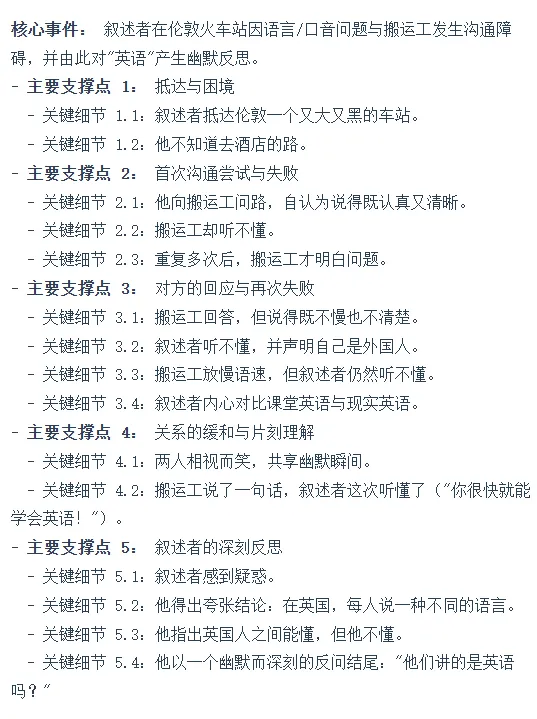
© 本文为狂暴英语教案 · 新概念英语第二册第25课
排版设计 · 仅供学习交流使用

贝琪酱英语无痛逆袭站
微信扫描二维码,关注我的账号
随机文章
-
 10个月宝宝每天需要喝多少奶粉?
- 课件:第2章 无人机结构与系统(附下载)
- 中小学生习惯养成主题班会课件+教案(共33张ppt)
- 『课件教案』八上生物课件教案(新教材),部编苏教版初中生物学初二年级上册核心素养教学设计+配套PPT课件资源包网盘免费下载分享!
- 【课件】2.5.1圆的标准方程
- 初中全科目《课件教案》整理汇总(2026年春)语文数学英语科学道法免费下载(持续更新)
- 2026更新版海姆立克急救法(文末附课件获取方式)
- 小学安全教育班会教案
- 高中全科目《课件教案》整理汇总(2026年春)语文数学英语科学道法免费下载(持续更新)
- 高中部编版《语文》必修下册核心素养教案+课件+学案+知识点等,可下载!
- 医院感染知识PPT课件

