【狂暴英语教案】新概念英语第一册第53-54课:有趣的气候 & 他们是哪国人?
- 2026-07-12 23:14:45
读外刊,接触原汁原味的英文表达,
欢迎关注以下公众号+设为星标+推荐给朋友。▼
📚 狂暴英语教案 · 新概念英语第一册
第53-54课 An Interesting Climate & What nationality are they?
有趣的气候 & 他们是哪国人?
📘 本课信息教材:新概念英语第一册 · 第53-54课核心功能:询问国籍 · 描述气候与季节 · 表达偏好语法焦点:一般现在时第三人称单数疑问句与否定句 · Which特殊疑问句 · 方位表达
🏷️ 热门标签
🎯 本课学习目标
词汇维度:
1. 掌握与气候、方位、季节相关的核心名词和形容词,如:climate, mild, north, south, east, west, winter, summer。2. 熟练运用国家、国籍及对应语言的词汇,如:Australia/Australian, Austria/Austrian, Canada/Canadian, China/Chinese, Finland/Finnish。3. 理解并初步运用描述天气和气候的句型。
语法维度:
1. 巩固一般现在时第三人称单数(he/she/it)的疑问句(Does...?)和否定句(...doesn't...)的构成与用法。2. 掌握以疑问词"Which"引导的特殊疑问句,用于询问偏好。3. 复习并熟练运用"come from"和"be from"表达来源。
技能维度(日常对话):
1. 能够就国籍、来源国进行简单的问答对话。2. 能够初步描述一个国家或地区的气候特点。3. 能够询问并表达对季节的喜好。
文化维度:
1. 了解几个典型国家(澳大利亚、奥地利、加拿大、中国、芬兰)的地理方位和文化标签。2. 初步建立气候与地理方位(东南西北)相关的概念。3. 感知不同国家的人在自我介绍时的语言习惯。
📖 第一部分:课文完整内容
Lesson 53 An interesting climate
📜 课文原文(含语音标注)
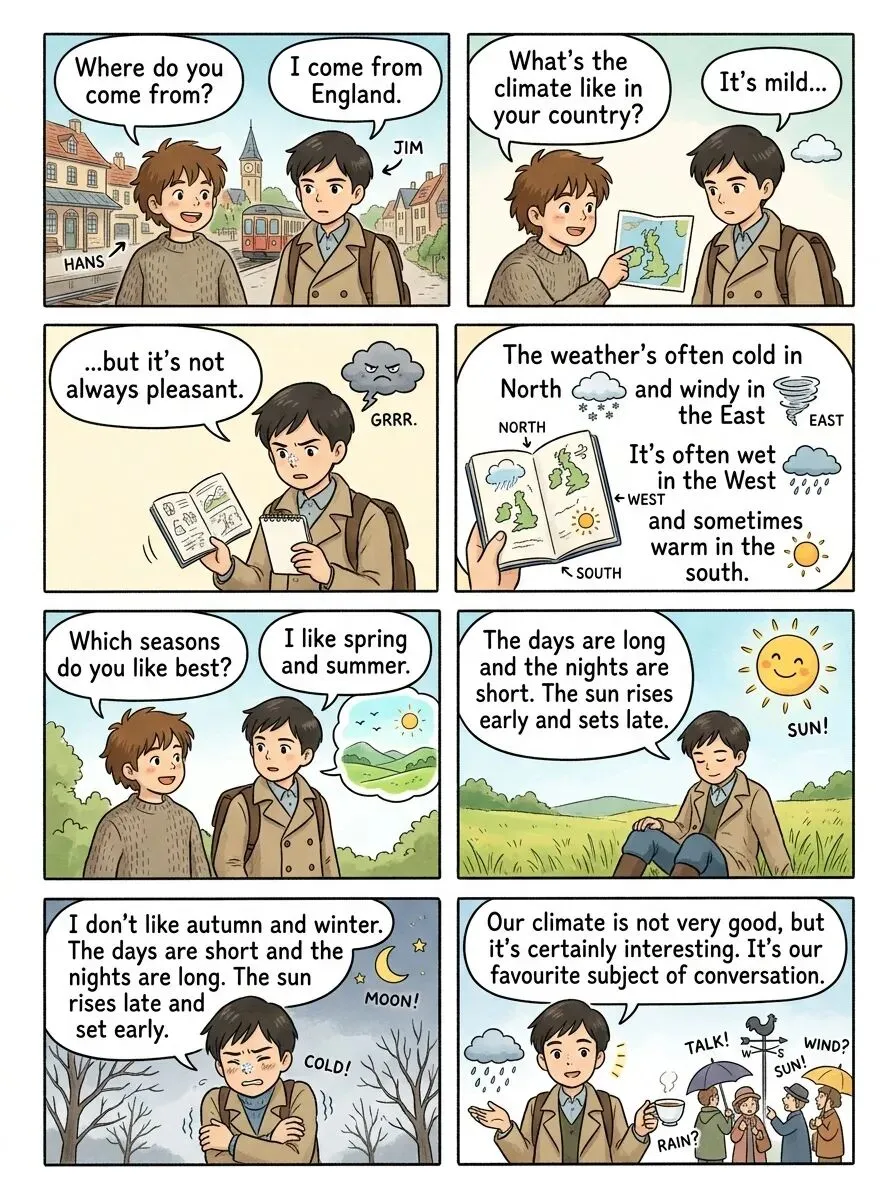
HANS: Where do you come from?
汉斯:你是哪国人?
JIM: I come from England.
吉姆:我是英国人。
HANS: What's the climate like in your country?
汉斯:你们国家的气候怎么样?
JIM: It's mild, but it's not always pleasant.
吉姆:气候温和,但并不总是宜人。
JIM: The weather's often cold in the North and windy in the East. It's often wet in the West and sometimes warm in the South.
吉姆:北部地区常常寒冷,东部地区常常多风。西部地区常常潮湿,而南部地区有时则很温暖。
HANS: Which seasons do you like best?
汉斯:你最喜欢哪些季节?
JIM: I like spring and summer. The days are long and the nights are short. The sun rises early and sets late.
吉姆:我喜欢春天和夏天。白天长而夜晚短。太阳升得早落得晚。
JIM: I don't like autumn and winter. The days are short and the nights are long. The sun rises late and sets early. Our climate is not very good, but it's certainly interesting.
吉姆:我不喜欢秋天和冬天。白天短而夜晚长。太阳升得晚落得早。我们国家的气候虽然不很好,但又确实很有意思。
HANS: It's our favourite subject of conversation.
汉斯:天气是我们最喜欢谈论的话题。
语音标注: What's the 连读为 /ˈwɒts ðə/;climate like in 中,climate 尾音 /t/ 与 like 首音 /l/ 产生舌侧爆破,like in 可连读为 /ˈlaɪ kɪn/;It's mild 中,It's 的 /ts/ 音要清晰;but it's not always 中,but it's 连读为 /bə tɪts/,not always 中 /t/ 与 /ɔː/ 之间略有停顿;in the North 连读为 /ɪn ðə ˈnɔːθ/;The sun rises early 中,rises early 可连读为 /ˈraɪzɪz ˈɜːli/;sets late 中,sets 的 /ts/ 与 late 的 /l/ 形成舌侧爆破;favourite subject 中,favourite 尾音 /t/ 与 subject 首音 /s/ 相遇,/t/ 失去爆破。
Lesson 54 What nationality are they?
📜 课文原文(本课为练习课,核心句型如下)
- What nationality are they? /wɒt ˌnæʃəˈnæləti ə ðeɪ/- They're Australian. /ðeə ɒˈstreɪliən/
- Where do you come from? /weə də jə ˈkʌm frəm/- I come from Austria. /aɪ ˈkʌm frəm ˈɒstriə/
- What's the climate like in your country? /wɒts ðə ˈklaɪmət laɪk ɪn jɔː ˈkʌntri/- It's very pleasant. /ɪts ˈveri ˈpleznt/
(后续替换不同国家:Canada, China, Finland 等)
情景说明:本课对话发生在两个朋友(汉斯和吉姆)之间,很可能是在一次社交场合或日常闲聊中。汉斯对吉姆的祖国(英国)感到好奇,引发了一场关于英国气候和季节的对话。对话从询问国籍开始,自然过渡到该国最普遍的话题——天气。吉姆作为英国人,对本国气候的特点(多变、地域差异大)有着典型的自嘲又略带自豪的描述,最后两人一致认为天气是英国人最喜爱的谈资。整个对话是英式社交中“以天气打开话匣子”的经典范例,语境自然、真实。第54课为练习课,聚焦于不同国家、国籍及气候的问答替换。
参考译文:第53课汉斯:你是哪国人?吉姆:我是英国人。汉斯:你们国家的气候怎么样?吉姆:气候温和,但并不总是宜人。吉姆:北部地区常常寒冷,东部地区常常多风。西部地区常常潮湿,而南部地区有时则很温暖。汉斯:你最喜欢哪些季节?吉姆:我喜欢春天和夏天。白天长而夜晚短。太阳升得早落得晚。吉姆:我不喜欢秋天和冬天。白天短而夜晚长。太阳升得晚落得早。我们国家的气候虽然不很好,但又确实很有意思。汉斯:天气是我们最喜欢谈论的话题。第54课他们是哪国人?他们是澳大利亚人。你来自哪里?我来自奥地利。你们国家的气候怎么样?非常宜人。(替换为加拿大、中国、芬兰等)
🔍 第二部分:逐句精讲与词块总结
句子1
原文: Where do you come from?
翻译: 你是哪国人?/ 你来自哪里?
句子结构: 特殊疑问句。结构为:疑问副词(Where)+ 助动词(do)+ 主语(you)+ 谓语动词原形(come)+ 介词(from)?属于“主语+谓语+状语”的变体,核心是询问动作“come”的方向来源地。
重点词汇:
come 蓝思值 10L
英音 /kʌm/ 美音 /kʌm/ 词性:动词 (vi.)
释义:来;来到;来自;产生于
常用语块:come from(来自),come in(进来),come on(加油;得了吧),come true(实现)
例句一:She comes from a small town in Italy. 她来自意大利的一个小镇。
例句二:Spring comes after winter. 冬去春来。
拓展:不规则动词(come-came-come)。在询问来源时,“come from”与“be from”基本同义,但“come from”更强调动作和来源的过程。
from 蓝思值 10L
英音 /frɒm/ 美音 /frɑːm/ 词性:介词
释义:从...起;来自;由于;离...
常用语块:from...to...(从...到...),come from(来自),be from(来自),from now on(从现在开始)
例句一:The train from London arrives at platform 2. 从伦敦来的火车停靠在2号站台。
例句二:He works from Monday to Friday. 他从周一到周五工作。
拓展:用于表示时间、地点的起点,或事物的来源。
语法点睛: 本句是“Where”引导的特殊疑问句,用于询问地点或来源。其结构为“Where + 一般疑问句语序”。在一般现在时中,当主语是“you/we/they/I”或复数名词时,使用助动词“do”提问。这是对之前所学“Where is/are...?”(询问静态位置)的延伸,用于询问动态来源。
语音要点: “Where do you” 在口语中常弱读连读为 /ˈweə də jə/ 或 /ˈweə djuː/。“come from” 连读为 /ˈkʌm frɒm/。整句语调为典型的特殊疑问句降调。
句子2
原文: I come from England.
翻译: 我来自英国。/ 我是英国人。
句子结构: 简单句,主语(I)+ 谓语(come)+ 状语(from England)。陈述句语序,直接回答上一句的提问。
重点词汇:
England 蓝思值 20L
英音 /ˈɪŋɡlənd/ 美音 /ˈɪŋɡlənd/ 词性:名词
释义:英格兰(英国的主要部分);常用来泛指英国
常用语块:in England(在英格兰/英国),from England(来自英格兰/英国)
例句一:London is the capital of England. 伦敦是英格兰的首府。
例句二:He studied history in England for three years. 他在英国学习了三年历史。
拓展:需注意与“Britain”(不列颠)、“UK”(United Kingdom,联合王国)、“Great Britain”(大不列颠)的区别。在日常非正式对话中,用“England”指代英国很常见,但在正式场合或涉及苏格兰、威尔士、北爱尔兰时,用“UK”更准确。
语法点睛: 一般现在时的肯定陈述句,表示习惯性、永久性或事实性的状态。“I come from...” 是表达国籍或出生地的标准句型之一。与之可互换的句型是“I am from...”。
语音要点: “I come from” 连读为 /aɪ ˈkʌm frɒm/。“England” 重音在第一音节。整句为降调,陈述事实。
句子3
原文: What's the climate like in your country?
翻译: 你们国家的气候怎么样?
句子结构: 特殊疑问句。结构为:疑问代词(What)+ 系动词('s/is)+ 主语(the climate)+ 表语(like)+ 地点状语(in your country)?这是一个固定句型“What's...like?”,用于询问事物的性质或特征。
重点词汇:
climate 蓝思值 600L
英音 /ˈklaɪmət/ 美音 /ˈklaɪmət/ 词性:名词
释义:气候(一个地区长期的天气模式);风气,趋势
常用语块:tropical climate(热带气候),mild climate(温和的气候),climate change(气候变化)
例句一:The island has a warm, tropical climate. 这个岛屿属于温暖的热带气候。
例句二:The political climate in the country is unstable. 这个国家的政治风气不稳定。
拓展:与“weather”(天气,指短期的气象状况)区别。“climate”是长期的、稳定的;“weather”是短期的、多变的。记忆:Climate is what you expect; weather is what you get.
like 蓝思值 10L(此处作介词)
英音 /laɪk/ 美音 /laɪk/ 词性:介词
释义:像,类似
常用语块:look like(看起来像),sound like(听起来像),What's...like?(...怎么样?)
例句一:She sings like an angel. 她唱歌像天使一样。
例句二:What's your new teacher like? 你的新老师怎么样?
拓展:此处“like”是介词,与前面的“what”构成固定句型。不要与动词“like”(喜欢)混淆。
country 蓝思值 200L
英音 /ˈkʌntri/ 美音 /ˈkʌntri/ 词性:名词
释义:国家;乡村
常用语块:all over the country(全国),in the country(在乡下),home country(祖国)
例句一:Japan is an island country. 日本是一个岛国。
例句二:They prefer living in the country. 他们更喜欢住在乡下。
拓展:一词多义。根据上下文区分“国家”和“乡村”。此处与“your”连用,显然指“国家”。
语法点睛: “What's...like?” 是一个极其重要的口语句型,用于询问人或事物的外观、性格、性质或状况。回答时通常用形容词来描述。例如:-What's her brother like? -He's very tall and friendly. 本课将其应用于询问气候特征。
语音要点: “What's the” 连读为 /ˈwɒts ðə/。“climate like in” 中,climate的/t/与like的/l/形成舌侧爆破,like in连读为/ˈlaɪ kɪn/。句子为降调。
句子4
原文: It's mild, but it's not always pleasant.
翻译: (气候)温和,但并不总是宜人。
句子结构: 并列句。由连词“but”连接两个分句。第一个分句:主语(It)+ 系动词('s/is)+ 表语(mild)。第二个分句:主语(it)+ 系动词('s/is)+ 否定状语(not)+ 频率状语(always)+ 表语(pleasant)。
重点词汇:
mild 蓝思值 500L
英音 /maɪld/ 美音 /maɪld/ 词性:形容词
释义:(气候)温和的;(人、性格)温和的;(味道)清淡的;(疾病)轻微的
常用语块:mild climate(温和的气候),mild cheese(淡味奶酪),mild winter(暖冬)
例句一:We enjoy the mild winters in this region. 我们喜欢这个地区温和的冬天。
例句二:He's a very mild-mannered person. 他是个举止非常温和的人。
拓展:多义词,需根据语境判断。描述气候是其核心义项之一。
pleasant 蓝思值 400L
英音 /ˈpleznt/ 美音 /ˈpleznt/ 词性:形容词
释义:令人愉快的,舒适的,友好的
常用语块:pleasant weather(宜人的天气),pleasant surprise(惊喜),pleasant person(和善的人)
例句一:We spent a pleasant afternoon in the garden. 我们在花园里度过了一个愉快的下午。
例句二:She has a very pleasant voice. 她的声音很悦耳。
拓展:名词形式为“pleasure”(愉快)。反义词为“unpleasant”(令人不快的)。
always 蓝思值 10L
英音 /ˈɔːlweɪz/ 美音 /ˈɔːlweɪz/ 词性:副词
释义:总是,一直;永远
常用语块:almost always(几乎总是)
例句一:The sun always rises in the east. 太阳总是从东方升起。
例句二:I will always remember your kindness. 我将永远记得你的好意。
拓展:频率副词,位于实义动词之前,be动词、助动词之后。在否定句中,“not always”表示部分否定,意为“并非总是”,而不是“总是不”。
语法点睛: 连词“but”用于连接两个意思转折或对等的分句。频率副词“always”在句子中的位置:在肯定句中,位于be动词之后、实义动词之前;在否定句中,位于“not”之后,构成“not always”,表示“不总是”,是一种部分否定,语气比“never”(从不)要缓和。
语音要点: “It's mild” 中,“mild” 尾音/d/需清晰发出。“but it's” 连读为 /bə tɪts/。“not always” 中,/t/在/ɔː/前轻微失去爆破。整句语调先平后降,在“but”处有轻微转折语气。
句子5
原文: The weather's often cold in the North and windy in the East.
翻译: (英国的)天气在北部常常寒冷,在东部常常多风。
句子结构: 并列简单句。主语(The weather)+ 系动词('s/is)+ 表语1(cold)+ 地点状语1(in the North)+ 连词(and)+ 表语2(windy)+ 地点状语2(in the East)。句子核心是描述天气在不同地区的两种常态。
重点词汇:
weather 蓝思值 200L
英音 /ˈweðə(r)/ 美音 /ˈweðər/ 词性:名词(不可数)
释义:天气,气象
常用语块:weather forecast(天气预报),bad weather(坏天气),under the weather(身体不适)
例句一:What will the weather be like tomorrow? 明天天气会怎样?
例句二:We can't go out in this weather. 这种天气我们不能出去。
拓展:不可数名词,前面不能加“a”。与“climate”的区别见前文。是英国人最经典的聊天话题。
often 蓝思值 10L
英音 /ˈɒfn/ 美音 /ˈɔːfn/ 词性:副词
释义:经常,时常
常用语块:more often than not(往往,多半)
例句一:I often go swimming on weekends. 我经常在周末去游泳。
例句二:How often do you visit your grandparents? 你多久去看一次你的祖父母?
拓展:频率副词,位置与“always”类似。发音时注意“t”不发音。
north 蓝思值 200L
英音 /nɔːθ/ 美音 /nɔːrθ/ 词性:名词;形容词;副词
释义:北,北方;北方的;向北
常用语块:in the north(在北方),North America(北美洲),north wind(北风)
例句一:Scotland is in the north of Great Britain. 苏格兰位于大不列颠的北部。
例句二:The room faces north, so it gets little sun. 房间朝北,所以几乎晒不到太阳。
拓展:表示方位时,常与定冠词“the”连用,如“the north”。形容词为“northern”。
windy 蓝思值 300L
英音 /ˈwɪndi/ 美音 /ˈwɪndi/ 词性:形容词
释义:多风的,风大的
常用语块:windy day(大风天)
例句一:It's too windy to fly a kite today. 今天风太大,不能放风筝。
例句二:Chicago is known as the "Windy City". 芝加哥被称为“风城”。
拓展:由名词“wind”(风)加后缀“-y”构成,表示“充满...的”、“有...特性的”。类似构词:sunny, rainy, cloudy。
east 蓝思值 200L
英音 /iːst/ 美音 /iːst/ 词性:名词;形容词;副词
释义:东,东方;东方的;向东
常用语块:in the east(在东方),East Asia(东亚),east coast(东海岸)
例句一:The sun rises in the east. 太阳从东方升起。
例句二:They traveled east for several days. 他们向东旅行了好几天。
拓展:形容词为“eastern”。注意首字母大写时(the East)可能指“东方国家”或“东亚”。
语法点睛: 本句展示了用“and”连接两个并列的“主系表+状语”结构,使句子简洁且信息丰富。介词短语“in the North/East”作地点状语,修饰前面的形容词“cold”和“windy”,说明这种天气特征发生的地点。注意方位名词(North, East等)在这里特指英国的北部和东部,因此前面加定冠词“the”。
语音要点: “weather's often” 连读为 /ˈweðəz ˈɒfn/。“cold in the” 连读为 /ˈkəʊld ɪn ðə/。“North and” 中,/θ/和/ə/连读。“windy in the” 连读为 /ˈwɪndi ɪn ðə/。“East” 发音清晰。句子为降调,并列部分语调平行。
句子6
原文: It's often wet in the West and sometimes warm in the South.
翻译: (天气)在西部常常潮湿,而在南部有时温暖。
句子结构: 结构与句子5完全平行。主语(It,指代天气)+ 系动词('s/is)+ 表语1(wet)+ 地点状语1(in the West)+ 连词(and)+ 频率状语(sometimes)+ 表语2(warm)+ 地点状语2(in the South)。
重点词汇:
wet 蓝思值 10L
英音 /wet/ 美音 /wet/ 词性:形容词
释义:湿的,潮湿的;多雨的
常用语块:wet clothes(湿衣服),wet weather(潮湿的天气),get wet(淋湿)
例句一:Don't touch the paint; it's still wet. 别碰油漆,还没干。
例句二:The climate is hot and wet in the rainforest. 热带雨林气候炎热潮湿。
拓展:反义词是“dry”(干的)。描述天气时,指潮湿或多雨,是英国天气的典型特征之一。
west 蓝思值 200L
英音 /west/ 美音 /west/ 词性:名词;形容词;副词
释义:西,西方;西方的;向西
常用语块:in the west(在西方),West Europe(西欧),go west(失败;上西天)
例句一:The sun sets in the west. 太阳在西方落下。
例句二:There are mountains in the west of the country. 这个国家的西部有山脉。
拓展:形容词为“western”。首字母大写(the West)常指“西方世界”。
sometimes 蓝思值 10L
英音 /ˈsʌmtaɪmz/ 美音 /ˈsʌmtaɪmz/ 词性:副词
释义:有时,间或
例句一:Sometimes I drive to work, and sometimes I take the bus. 有时我开车上班,有时我坐公交。
例句二:He is sometimes late for meetings. 他开会有时会迟到。
拓展:频率副词,表示发生的频率低于“often”。它在句中的位置比较灵活,可置于句首、句中或句末。
south 蓝思值 200L
英音 /saʊθ/ 美音 /saʊθ/ 词性:名词;形容词;副词
释义:南,南方;南方的;向南
常用语块:in the south(在南方),South Africa(南非),south pole(南极)
例句一:They moved to the south for a warmer climate. 他们为了更温暖的气候搬去了南方。
例句二:The window faces south. 窗户朝南。
拓展:形容词为“southern”。注意“South”大写时可能指特定区域,如“the American South”(美国南部)。
语法点睛: 本句继续巩固方位表达和频率副词的用法。“sometimes”作为频率副词,其位置可以在be动词之后(如本句),也可以在实义动词之前,还可以在句首,灵活性较高。它与“often”一起,描绘了英国不同地区天气变化的频率差异。
语音要点: “wet in the” 连读为 /ˈwet ɪn ðə/。“West and” 连读为 /ˈwest ənd/。“sometimes warm in the” 中,“sometimes”重音在第一音节,“warm in the”连读为/ˈwɔːm ɪn ðə/。句子为降调。
句子7
原文: Which seasons do you like best?
翻译: 你最喜欢哪些季节?
句子结构: 特殊疑问句。结构为:疑问代词(Which)+ 名词(seasons)+ 助动词(do)+ 主语(you)+ 谓语动词原形(like)+ 副词(best)?用于在有限范围内(四季)询问对方的偏好。
重点词汇:
season 蓝思值 200L
英音 /ˈsiːzn/ 美音 /ˈsiːzn/ 词性:名词
释义:季节;(体育、活动等的)赛季
常用语块:four seasons(四季),rainy season(雨季),holiday season(假期季)
例句一:Spring is my favourite season. 春天是我最喜欢的季节。
例句二:The football season starts in August. 足球赛季在八月开始。
拓展:注意复数形式。动词意为“给...调味”,如“season the soup”(给汤调味)。
best 蓝思值 10L
英音 /best/ 美音 /best/ 词性:副词(本课词性);形容词
释义:最好地(adv.);最好的(adj.)
常用语块:like...best(最喜欢...),do one's best(尽力),best friend(最好的朋友)
例句一:I like summer best because I can swim. 我最喜欢夏天,因为可以游泳。
例句二:This is the best movie I've ever seen. 这是我看过的最好的电影。
拓展:“best”是“well”(副词)和“good”(形容词)的最高级形式。此处作副词,修饰动词“like”。
语法点睛: “Which”引导的特殊疑问句,用于从已知或有限的选项中做出选择。其后通常接名词(如本课的seasons)。句型“Which...do you like best?”是询问偏好的标准句式,相当于“What's your favourite...?”。回答时可以直接说“I like...best.”。
语音要点: “Which seasons” 连读为 /ˈwɪtʃ ˈsiːznz/。“do you” 弱读为 /də jə/。“like best” 中,“like”的/k/与“best”的/b/不完全爆破。句子为降调。
句子8
原文: I like spring and summer.
翻译: 我喜欢春天和夏天。
句子结构: 简单句。主语(I)+ 谓语(like)+ 宾语(spring and summer)。直接回答上一句的提问。
重点词汇:
spring 蓝思值 200L
英音 /sprɪŋ/ 美音 /sprɪŋ/ 词性:名词
释义:春天;泉水;弹簧;跳跃
常用语块:in spring(在春天),spring water(泉水),spring bed(弹簧床)
例句一:Flowers bloom in spring. 花朵在春天绽放。
例句二:There is a natural spring in the forest. 森林里有一处天然泉水。
拓展:一词多义。作为季节,是不可数名词,但常与定冠词“the”连用(the spring),或直接使用。
summer 蓝思值 200L
英音 /ˈsʌmə(r)/ 美音 /ˈsʌmər/ 词性:名词
释义:夏天,夏季
常用语块:in summer(在夏天),summer holiday/vacation(暑假),summer camp(夏令营)
例句一:We usually go to the beach in summer. 我们夏天通常去海滩。
例句二:The summer of 2020 was very hot. 2020年的夏天非常炎热。
拓展:同样,作为季节常与“the”连用或直接使用。
语法点睛: 一般现在时表达个人喜好或习惯。用“and”连接两个并列的宾语。这是对“like”动词用法的巩固。
语音要点: “I like” 连读为 /aɪ ˈlaɪk/。“spring and” 连读为 /ˈsprɪŋ ənd/。“summer” 发音清晰。句子为降调。
句子9
原文: The days are long and the nights are short.
翻译: 白天长,夜晚短。
句子结构: 并列句。由“and”连接两个结构相同的分句:主语1(The days)+ 系动词(are)+ 表语1(long);主语2(the nights)+ 系动词(are)+ 表语2(short)。解释喜欢春夏的原因。
重点词汇:
day 蓝思值 10L
英音 /deɪ/ 美音 /deɪ/ 词性:名词
释义:一天,日;白天
常用语块:all day(一整天),day and night(日日夜夜),these days(如今)
例句一:There are seven days in a week. 一周有七天。
例句二:I prefer to work during the day. 我更喜欢在白天工作。
拓展:注意复数形式“days”。反义词是“night”(夜晚)。
long 蓝思值 10L
英音 /lɒŋ/ 美音 /lɔːŋ/ 词性:形容词;副词
释义:长的;长久的;长期地
常用语块:long hair(长发),long time(很长时间),how long(多久)
例句一:The Nile is a very long river. 尼罗河是一条很长的河。
例句二:I have long wanted to visit Paris. 我长久以来一直想去巴黎。
拓展:反义词是“short”(短的)。注意副词形式也是“long”,如“stay long”(呆很久)。
night 蓝思值 10L
英音 /naɪt/ 美音 /naɪt/ 词性:名词
释义:夜,夜晚
常用语块:at night(在晚上),last night(昨晚),good night(晚安)
例句一:Stars appear at night. 星星在夜晚出现。
例句二:I slept well last night. 我昨晚睡得很好。
拓展:与“day”相对。注意“at night”是固定搭配。
short 蓝思值 10L
英音 /ʃɔːt/ 美音 /ʃɔːrt/ 词性:形容词;副词
释义:短的;矮的;短缺的;简短地
常用语块:short story(短篇小说),short of(缺乏),in short(简言之)
例句一:She has short hair. 她留着短发。
例句二:Time is short; we must hurry. 时间不多了,我们必须快点。
拓展:反义词是“long”(长的)或“tall”(高的)。注意“short”作副词时,意为“突然地”,如“stop short”(突然停下)。
语法点睛: 用并列句列举原因,结构工整,逻辑清晰。这是描述自然现象(昼夜长短)的客观事实句,使用一般现在时。
语音要点: “days are” 连读为 /ˈdeɪz ə/。“long and the” 连读为 /ˈlɒŋ ən ðə/。“nights are” 连读为 /ˈnaɪts ə/。“short” 发音清晰。句子为降调,两个分句语调平行。
句子10
原文: The sun rises early and sets late.
翻译: 太阳升得早落得晚。
句子结构: 并列句。主语(The sun)+ 谓语1(rises)+ 时间状语1(early)+ 连词(and)+ 谓语2(sets)+ 时间状语2(late)。进一步解释昼夜长短的原因。
重点词汇:
sun 蓝思值 10L
英音 /sʌn/ 美音 /sʌn/ 词性:名词(常与the连用)
释义:太阳;日光
常用语块:in the sun(在阳光下),sunshine(阳光),sunrise(日出)
例句一:The sun gives us light and heat. 太阳给我们光和热。
例句二:Don't read in the sun; it's bad for your eyes. 别在太阳下看书,对眼睛不好。
拓展:定冠词“the”与“sun”连用,表示世界上独一无二的事物。类似的有“the moon”(月亮)、“the earth”(地球)。
rise 蓝思值 200L
英音 /raɪz/ 美音 /raɪz/ 词性:动词 (vi.);名词
释义:升起;上升;上涨;增加
常用语块:sun rise(日出),rise to the occasion(应付自如),price rise(价格上涨)
例句一:The balloon rose slowly into the sky. 气球缓缓升上天空。
例句二:There has been a sharp rise in living costs. 生活成本急剧上涨。
拓展:不规则动词(rise-rose-risen)。是不及物动词,后面不能直接接宾语。反义词是“set”(落下)或“fall”(下降)。
early 蓝思值 10L
英音 /ˈɜːli/ 美音 /ˈɜːrli/ 词性:副词;形容词
释义:早;早期的
常用语块:early in the morning(清早),early bird(早起者;早到者),early years(早年)
例句一:I get up early every day. 我每天早起。
例句二:We had an early dinner. 我们很早就吃了晚饭。
拓展:反义词是“late”(晚的)。既可以修饰动词作状语,也可以修饰名词作定语。
set 蓝思值 200L
英音 /set/ 美音 /set/ 词性:动词 (vi., vt.);名词
释义:(日、月)落,下沉;放置;设定;一套
常用语块:sunset(日落),set the table(摆餐具),a set of rules(一套规则)
例句一:In summer, the sun sets later. 夏天,太阳落山较晚。
例句二:Please set the box down here. 请把盒子放在这里。
拓展:不规则动词(set-set-set)。含义极多,此处作不及物动词,指太阳落下。
late 蓝思值 10L
英音 /leɪt/ 美音 /leɪt/ 词性:副词;形容词
释义:晚,迟;晚期的;已故的
常用语块:be late for(迟到),late at night(深夜),in late autumn(深秋)
例句一:The train arrived ten minutes late. 火车晚点了十分钟。
例句二:She works until late in the evening. 她工作到晚上很晚。
拓展:反义词是“early”(早的)。副词和形容词同形。
语法点睛: 本句描述自然规律,使用一般现在时。动词“rise”和“set”都是不及物动词,后面接副词“early”和“late”作状语,修饰动词发生的时间。这是对第37课所学“The sun sets late.”句型的扩展和应用。
语音要点: “sun rises” 连读为 /ˈsʌn ˈraɪzɪz/。“early and” 连读为 /ˈɜːli ənd/。“sets late” 中,“sets”的/ts/与“late”的/l/形成舌侧爆破。句子为降调。
句子11
原文: I don't like autumn and winter.
翻译: 我不喜欢秋天和冬天。
句子结构: 简单句的否定形式。主语(I)+ 助动词否定式(don't)+ 谓语动词原形(like)+ 宾语(autumn and winter)。表达不喜欢的季节。
重点词汇:
autumn 蓝思值 200L (美式英语常用 fall)
英音 /ˈɔːtəm/ 美音 /ˈɔːtəm/ 词性:名词
释义:秋天,秋季
常用语块:in autumn(在秋天),autumn leaves(秋叶),mid-autumn festival(中秋节)
例句一:The leaves turn yellow in autumn. 树叶在秋天变黄。
例句二:Autumn is the season of harvest. 秋天是收获的季节。
拓展:英式英语用“autumn”,美式英语更常用“fall”。都是不可数名词。
winter 蓝思值 200L
英音 /ˈwɪntə(r)/ 美音 /ˈwɪntər/ 词性:名词
释义:冬天,冬季
常用语块:in winter(在冬天),winter sports(冬季运动),winter coat(冬衣)
例句一:It snows a lot here in winter. 这里冬天常下雪。
例句二:Many birds fly south for the winter. 许多鸟儿飞到南方过冬。
拓展:四季之一。形容词是“wintry”(冬天的,寒冷的)。
语法点睛: 一般现在时的否定句。当主语是“I/you/we/they”时,在谓语动词前加“do not”(缩写为don't)构成否定。本句是对“like”的否定表达,与前面的肯定句形成对比。
语音要点: “don't like” 连读为 /ˈdəʊnt ˈlaɪk/,注意“don't”的尾音/t/在/l/前轻微失去爆破。“autumn and” 连读为 /ˈɔːtəm ənd/。“winter” 发音清晰。句子为降调。
句子12
原文: The days are short and the nights are long.
翻译: 白天短,夜晚长。
句子结构: 与句子9结构完全相同,但表语内容相反。并列句,解释不喜欢秋冬的原因。
重点词汇: (词汇已在句子9中讲解)
语法点睛: 再次使用并列结构描述客观事实,与句子9形成鲜明对比,突出季节差异。巩固“主系表”结构和并列连词“and”的用法。
语音要点: 与句子9类似,“days are”连读,“short and the”连读为/ˈʃɔːt ən ðə/,“nights are”连读,“long”发音清晰。降调。
句子13
原文: The sun rises late and sets early.
翻译: 太阳升得晚落得早。
句子结构: 与句子10结构完全相同,但状语内容相反。并列句,进一步解释秋冬昼夜长短的原因。
重点词汇: (词汇已在句子10中讲解)
语法点睛: 与句子10形成对比,通过副词“late”和“early”位置的调换,清晰地表达了完全相反的自然现象。这是语言简洁性和逻辑性的很好体现。
语音要点: “rises late” 连读为 /ˈraɪzɪz ˈleɪt/。“and sets” 连读为 /ən ˈsets/。“early” 发音清晰。降调。
句子14
原文: Our climate is not very good, but it's certainly interesting.
翻译: 我们国家的气候虽然不很好,但又确实很有意思。
句子结构: 并列句,含转折。分句1:主语(Our climate)+ 系动词(is)+ 否定状语(not)+ 程度状语(very)+ 表语(good)。分句2:连词(but)+ 主语(it)+ 系动词('s/is)+ 强调副词(certainly)+ 表语(interesting)。典型的英式自嘲与幽默。
重点词汇:
certainly 蓝思值 400L
英音 /ˈsɜːtnli/ 美音 /ˈsɜːrtnli/ 词性:副词
释义:无疑,确定;当然(用于回答)
例句一:She will certainly succeed. 她一定会成功。
例句二:-Can you help me? -Certainly! ——你能帮我吗?——当然!
拓展:由形容词“certain”(确定的)加副词后缀“-ly”构成。用于加强语气,表示肯定。
interesting 蓝思值 200L
英音 /ˈɪntrəstɪŋ/ 美音 /ˈɪntrəstɪŋ/ 词性:形容词
释义:有趣的,引起兴趣的
常用语块:interesting book(有趣的书),find sth. interesting(发现...有趣)
例句一:He told us an interesting story. 他给我们讲了一个有趣的故事。
例句二:I find history very interesting. 我觉得历史非常有趣。
拓展:由动词“interest”(使感兴趣)的现在分词转化而来。注意区分“interested”(人对...感兴趣的),主语通常是人。
语法点睛: 程度副词“very”修饰形容词“good”,加强语气。转折连词“but”连接两个在评价上形成对比的分句,前贬后褒,体现了说话者复杂而微妙的态度。副词“certainly”置于be动词之后、形容词之前,起到强调作用。
语音要点: “climate is not” 连读为 /ˈklaɪmət ɪz ˈnɒt/。“very good” 连读。“but it's certainly” 中,“but it's”连读为/bə tɪts/,“certainly”重音在第一音节。“interesting”重音也在第一音节。整句语调在“but”处转折,后半句语气更肯定。
句子15
原文: It's our favourite subject of conversation.
翻译: (天气)是我们最喜欢谈论的话题。
句子结构: 简单句。主语(It,指代气候/天气)+ 系动词('s/is)+ 表语(our favourite subject of conversation)。对上一句“interesting”的补充和总结,点明文化现象。
重点词汇:
favourite 蓝思值 200L (美式拼写 favorite)
英音 /ˈfeɪvərɪt/ 美音 /ˈfeɪvərɪt/ 词性:形容词;名词
释义:最喜欢的;最喜爱的人或物
常用语块:favourite colour(最喜欢的颜色),favourite food(最喜欢的食物)
例句一:Blue is my favourite colour. 蓝色是我最喜欢的颜色。
例句二:This book is an old favourite of mine. 这本书是我一直以来最喜爱的。
拓展:无比较级和最高级。名词用法相当于“favourite one”。
subject 蓝思值 500L
英音 /ˈsʌbdʒɪkt/ 美音 /ˈsʌbdʒɪkt/ 词性:名词
释义:主题,话题;学科;主语;(君主国的)臣民
常用语块:subject of conversation(话题),school subject(学校科目),on the subject of(关于)
例句一:Let's change the subject. 我们换个话题吧。
例句二:Maths was my best subject at school. 数学是我在学校里学得最好的科目。
拓展:一词多义,需根据语境判断。此处指“话题”。
conversation 蓝思值 600L
英音 /ˌkɒnvəˈseɪʃn/ 美音 /ˌkɑːnvərˈseɪʃn/ 词性:名词
释义:谈话,交谈,会话
常用语块:have a conversation(进行谈话),make conversation(闲聊,搭讪),conversation starter(开场白)
例句一:I had a long conversation with my teacher. 我和老师进行了一次长谈。
例句二:Their conversation was interrupted by a phone call. 他们的谈话被一个电话打断了。
拓展:正式程度高于“talk”和“chat”。动词形式为“converse”。
语法点睛: 名词所有格“our favourite subject”作表语。介词短语“of conversation”作后置定语,修饰“subject”,说明是哪方面的主题。这是一个揭示英国社会文化的经典句子。
语音要点: “It's our” 连读为 /ɪts ˈaʊə/。“favourite subject” 中,“favourite”的尾音/t/在“subject”的/s/前失去爆破,读作 /ˈfeɪvərɪt ˈsʌbdʒɪkt/。“of conversation” 连读为 /əv ˌkɒnvəˈseɪʃn/。句子为降调,总结性语气。
📌 核心词块总结
1. Come from... - To originate from a particular place or country. 例句: Where do you come from? I come from China.
2. What's...like? - Used to ask for a description of someone or something. 例句: What's the weather like today? It's sunny and warm.
3. In the North/South/East/West - Referring to a specific geographical region within a larger area. 例句: It's colder in the north of the country.
4. Like...best - To prefer something over others. 例句: Which season do you like best? I like spring best.
5. Rise early / set late - Describes the sun appearing above the horizon early and disappearing below it late, indicating long days. 例句: In summer, the sun rises early and sets late.
6. Subject of conversation - A topic that people talk about. 例句: Football is a common subject of conversation among friends.
💬 第三部分:基础会话技巧
1. 分析课文中的日常用语、礼貌表达、问答模式- 开启话题: 对话以询问来源(Where do you come from?)开始,这是一个非常中性且常见的社交开场白,适用于初次见面或想了解对方背景时。- 深入询问: 在得知对方国籍后,汉斯自然地追问该国的一个普遍特征——气候(What's the climate like...?)。这种由泛到细的提问方式使对话流畅深入。- 描述与评价: 吉姆在描述气候时,采用了“总体评价+具体分述”的模式:先总说“温和但不总宜人”,然后分方位描述特点,最后表达个人对季节的喜好及原因。这种结构清晰有条理。- 幽默与共鸣: 吉姆最后用自嘲的语气说气候“not very good, but certainly interesting”,并引出“favourite subject of conversation”,这是典型的英式幽默,轻松化解了对本国气候的轻微抱怨,并引发了听者的共鸣(汉斯表示同意)。这种表达拉近了对话者的距离。- 问答模式: 本课展示了完整的“提问-详细回答-进一步提问-详细回答”的对话链条,是练习扩展对话的绝佳范例。
2. 提供类似场景的扩展对话示例场景: 两个国际学生在校园咖啡厅聊天。A: Hi, I'm Alex. I haven't seen you before. Where are you from?B: Hi Alex, I'm Sofia. I'm from Brazil.A: Brazil! That's exciting. What's the climate like there? I imagine it's very hot.B: Well, it's mostly tropical, so it is warm or hot all year round. But it's not the same everywhere. In the south, it can be quite mild and even cold in winter. In the north, it's always hot and humid.A: Which season do you prefer there?B: I actually like our winter, which is from June to August. It's drier and slightly cooler, perfect for being outdoors. What about you? Where do you come from?A: I'm from Canada.B: Oh, it must be very cold!A: (Laughs) That's the usual thought! Actually, it's not always freezing. The climate varies a lot. Summers in the south can be quite warm and pleasant. But yes, winters are long and cold, especially in the north and inland. I love summer for camping and hiking.B: So, weather is a big topic in Canada too?A: Absolutely! "How's the weather?" is probably the most common greeting after "Hello"!
3. 设计简单的角色扮演活动建议活动: “国际友人见面会”- 准备: 制作一些写有国家名称和简单气候关键词(如:sunny, snowy, rainy, mild)的卡片。- 步骤: 1. 学生两人一组,随机抽取卡片。一人为A,一人为B。2. A根据卡片上的国家信息,扮演来自该国的角色。B作为提问者。3. B使用本课句型发起对话:Where do you come from? → What's the climate like in your country? → Which season do you like best? 4. A根据卡片信息和自己的想象进行回答,尽量使用课文中的词汇和句型(in the north, often cold, like spring best because...等)。5. 一轮结束后,角色互换,或更换卡片与新的伙伴练习。- 目标: 熟练运用询问和描述国籍、气候、季节喜好的基本对话框架。
4. 融入基础思考:设计1-2个简单的代入式问题① 如果你是吉姆(Jim),在向一个来自热带沙漠国家(如沙特阿拉伯)的朋友描述英国气候时,你会重点强调哪些方面?为什么?- 引导思考: 可以从对比的角度出发,强调英国气候中与沙漠气候截然不同的特征,如“mild”(温和,非极端炎热或寒冷),“often wet”(潮湿,而非干燥),“changeable”(多变)等,并解释这些差异如何影响日常生活和感受。② 汉斯(Hans)听完吉姆的描述后,说“It's our favourite subject of conversation.” 你认为汉斯可能是哪国人?你的理由是什么?- 引导思考: 课文暗示汉斯可能也来自一个气候多变或人们常谈论天气的国家。许多温带海洋性气候国家(如德国、荷兰、爱尔兰等)都有类似的文化。学生可以根据“our”(我们的)这个代词推断汉斯可能与吉姆有共鸣,从而猜测他的国籍背景。
📐 第四部分:本课语法精析(加强版)
1. 一般现在时第三人称单数的疑问句:Does...?当主语是第三人称单数(he, she, it, 单个人名或单数名词)时,要使用助动词does来构成一般疑问句,并将谓语动词恢复为原形。结构:Does + 主语(单数)+ 动词原形 + 其他?功能:询问习惯、事实或现状。例句(不少于10个):1. Does the sun rise in the east? (太阳从东方升起吗?)2. Does she like coffee? (她喜欢咖啡吗?)3. Does it rain a lot in London? (伦敦经常下雨吗?)4. Does your father work in a bank? (你父亲在银行工作吗?)5. Does this bus go to the city center? (这趟公交车去市中心吗?)6. Does he speak English? (他说英语吗?)7. Does the shop open at 9 a.m.? (这家店早上9点开门吗?)8. Does your dog like to go for walks? (你的狗喜欢散步吗?)9. Does the movie start at 7:30? (电影7点半开始吗?)10. Does it snow here in December? (这里十二月下雪吗?)回答方式:Yes, 主语 + does. / No, 主语 + doesn't.
2. 一般现在时第三人称单数的否定句:...doesn't...否定形式是在谓语动词前加does not(缩写为doesn't),谓语动词同样用原形。结构:主语(单数)+ doesn't + 动词原形 + 其他。功能:否定习惯、事实或现状。例句(不少于10个):1. He doesn't like cold weather. (他不喜欢寒冷的天气。)2. She doesn't live in Paris. (她不住在巴黎。)3. It doesn't snow in my hometown. (我的家乡不下雪。)4. My brother doesn't play football. (我哥哥不踢足球。)5. The cat doesn't drink milk. (这只猫不喝牛奶。)6. This computer doesn't work properly. (这台电脑工作不正常。)7. The sun doesn't set in the north. (太阳不从北方落下。)8. Her job doesn't finish late. (她的工作结束得不晚。)9. The train doesn't stop at this station. (这列火车不在本站停靠。)10. Mr. Smith doesn't teach Chinese. (史密斯先生不教中文。)与之前语法的对比: 在第一册前半部分,我们学习了当主语是I/you/we/they时,用do和don't。本课学习的does和doesn't是其在第三人称单数情况下的对应形式,这是英语动词变位的一个核心规则。
3. “Which”引导的特殊疑问句“Which”用于从已知或有限的选项中做出选择。其后可接名词,也可单独使用。结构A(接名词):Which + 名词 + 一般疑问句语序? 如:Which seasons do you like best? (你最喜欢哪些季节?)结构B(不接名词):Which + 一般疑问句语序? (此时“which”本身代表“哪一个事物”) 如:Which do you prefer, tea or coffee? (你更喜欢哪个,茶还是咖啡?)与“What”的区别:“What”的提问范围通常更广、更开放。“Which”则暗示选择范围是有限的、明确的。
4. 方位介词:in the North/South/East/West表示在一个国家或地区的内部方位时,使用介词in。方位词(north, south等)首字母通常大写,特别是当它们特指某个国家的一部分时(如课文中的英国各地),并与定冠词the连用。用法:in the + 方位词 如:It is often warm in the South. (南方通常很温暖。)拓展:表示“在...的北部”也可以用in the northern part of...。表示方位时,on用于接壤(如Canada is on the north of the USA.),to用于不接壤(如Japan is to the east of China.)。
5. 频率副词:often, sometimes, always频率副词表示动作或状态发生的频率。本课出现了三个。- always (100%):总是。The sun always rises in the east.- often (约70%):经常。It often rains in April.- sometimes (约30%):有时。I sometimes go to the cinema.在句中的位置:通常位于be动词之后,实义动词之前。否定句中,位于not之后:It is not always cold. (并非总是冷。)注意“not always”是部分否定,意为“不总是”,而不是“总不”(后者用never)。
练习题(不少于10道)1. 将下列句子改为一般疑问句:She likes music. → Does she like music?2. It rains in summer. → Does it rain in summer?3. He comes from Germany. → Does he come from Germany?4. The dog sleeps on the sofa. → Does the dog sleep on the sofa?5. My sister works in a hospital. → Does your sister work in a hospital?6. 将下列句子改为否定句:He plays tennis every week. → He doesn't play tennis every week.7. She lives in a big city. → She doesn't live in a big city.8. The film starts at eight. → The film doesn't start at eight.9. This plant needs a lot of water. → This plant doesn't need a lot of water.10. 用“Which”或“What”填空:______ colour is your new car? (有限选择) → Which11. ______ is your favourite food? (开放问题) → What12. 用适当的频率副词填空:The weather ______ changes quickly in the mountains. (often) I ______ drink coffee in the morning, but not every day. (sometimes) She is ______ kind and helpful to everyone. (always)13. 翻译:你妹妹喜欢冬天吗?不,她不喜欢。 → Does your sister like winter? No, she doesn't.14. 伦敦的天气怎么样?常常多云且多风。 → What's the weather like in London? It's often cloudy and windy.答案: 1.Does she like music? 2.Does it rain in summer? 3.Does he come from Germany? 4.Does the dog sleep on the sofa? 5.Does your sister work in a hospital? 6.He doesn't play tennis every week. 7.She doesn't live in a big city. 8.The film doesn't start at eight. 9.This plant doesn't need a lot of water. 10.Which 11.What 12.often, sometimes, always 13.Does your sister like winter? No, she doesn't. 14.What's the weather like in London? It's often cloudy and windy.
✏️ 第五部分:基础练习与活动
1. 跟读练习: 播放课文录音,学生先听一遍,然后逐句跟读。重点练习:What's the climate like in your country? 中的连读;方位短语的读法;The sun rises early and sets late. 中动词与副词的搭配及节奏;整个对话的升降调。
2. 角色扮演: “世界气候播报员”。学生两人一组,一人扮演当地居民,一人扮演采访记者。使用本课句型采访。鼓励使用in the..., often, sometimes, like...best because...等结构。
3. 简单替换练习:- 句型1:Where do you come from? → I come from [Country]. (替换词:France, Japan, India, Italy, Spain, Brazil等)- 句型2:What's the climate like in [Country]? → It's [Adj.]. (替换词:hot, cold, dry, wet, sunny, snowy, tropical, continental等)- 句型3:Which season do you like best? → I like [Season] best. (替换词:spring, summer, autumn, winter)- 句型4:Does he/she come from [Country]? → Yes, he/she does. / No, he/she doesn't.
4. 听力理解题目(可结合课文录音):听课文对话录音,判断正误(True or False):① Jim comes from America. (F)② The climate in England is always pleasant. (F)③ It's often windy in the East of England. (T)④ Jim likes autumn and winter because the days are long. (F)⑤ The sun rises early and sets late in summer. (T)⑥ Jim thinks the English climate is very good. (F)⑦ Weather is a favourite topic in England. (T)听录音,填空:Hans: What's the climate like in your ______?Jim: It's mild, but it's not always ______.Jim: The weather's often cold in the ______ and windy in the ______. It's often wet in the ______ and sometimes warm in the ______.Jim: I like spring and summer. The days are ______ and the nights are ______.答案: country, pleasant, North, East, West, South, long, short.
5. 课文改写版本(词汇更简单):A Simple Version:A: Where are you from?B: I'm from England.A: How is the weather in your country?B: It's nice, but not always good.B: In the north, it's often cold. In the east, it's often windy. In the west, it's often rainy. In the south, it's sometimes warm.A: What is your favourite time of year?B: I like spring and summer. The day is long. The night is short. The sun comes up early and goes down late.B: I don't like autumn and winter. The day is short. The night is long. The sun comes up late and goes down early. Our weather is not very good, but it is interesting.A: We like to talk about the weather!
🤔 第六部分:英文深度思考与拓展(强化版)
A. 层次化英文问题与答案Level 1: Factual Questions (事实性问题)1. Q: Where is Sally in the beginning of the dialogue? A: In the beginning of the dialogue, Sally is in the garden.2. Q: What is Sally doing under the tree? A: Sally is sitting under the tree.3. Q: Is the cat climbing the tree at the end? A: No, the cat is not climbing the tree at the end. It is running after a bird.Level 2: Inferential & Analytical Questions (推理与分析性问题)4. Q: Why does Jean ask "What's the matter?" when she hears the cat is climbing the tree? A: Jean asks "What's the matter?" because she is likely concerned. Climbing a tree can be dangerous for a cat, or she might be worried about the tree or the cat causing trouble.5. Q: Based on the dialogue, what might be the relationship between Jean and Jack? A: Based on the casual way they speak to each other ("Jean", "Jack") and their shared concern for Sally and the cat, they are likely family members (e.g., mother and father) or close friends.6. Q: What can we infer about the setting from the words "garden", "tree", "bird", and "cat"? A: We can infer that the setting is likely a peaceful, outdoor home environment, probably a house with a backyard or garden, which is a common setting in British and American family life.7. Q: If Jack says "The cat is climbing the tree" but then we learn it's running, what does this tell us about observing events? A: This tells us that situations can change quickly. What we describe as happening now ("is climbing") might change in the next moment ("is running"). It emphasizes the use of the present continuous tense for actions in progress at the moment of speaking.Level 3: Evaluative & Creative Questions (评价与创造性问题)8. Q: In your opinion, is it a good idea for the cat to chase the bird? Why or why not? A: (Example answer) In my opinion, it is not a good idea for the cat to chase the bird. It is the cat's natural instinct, but it could harm the bird or cause the cat to get lost or injured if it runs too far.9. Q: What do you think might happen next after the cat runs after the bird? A: (Example answer) I think the bird might fly away to safety. The cat might stop under another tree, or Sally might call the cat's name to make it come back.10. Q: Imagine you are Jean. What would you say or do after Jack tells you "It's running after a bird"? A: (Example answer) If I were Jean, I might say, "Oh dear! I hope it doesn't go into the neighbor's garden," or I might walk to the window to look at the cat myself.11. Q: Besides "in the garden" and "under the tree", where else in a house or neighborhood can people or pets be? Make a list using "in", "on", or "at". A: (Example answer) People or pets can be in the kitchen, in the living room, or in the bedroom. They can be on the sofa, on the bed, or on the floor. They can be at school, at the shop, or at the park.B. 多类型拓展阅读1. 现代场景故事 (A Modern Chat About Weather)Leo, a student from Spain, is video-calling his new friend Liam in Manchester, UK."So, Liam, what's it like there today?" Leo asks, smiling. Outside his own window in Madrid, the sun is blazing.Liam sighs and points his camera. "Typical! It was sunny when I woke up, so I didn't take a coat. Now look!" The screen shows a grey sky and rain dripping down the windowpane. "I'm soaked just from walking to the shop."Leo laughs. "Here, we can almost always guess the weather. Hot and dry in summer, mild in winter. Your weather seems... exciting.""That's one word for it!" Liam says. "We always check the forecast, but it's still a surprise. My mum says talking about the weather is our national hobby. It gives us something to say when we meet people, like 'Lovely day, isn't it?' even when it's pouring!""Maybe I should start doing that here," Leo jokes, looking at his perpetual sunshine.引导性问题:Why does Liam say talking about the weather is a "national hobby" in the UK?2. 文化背景小知识 (Why the British Talk About the Weather)The stereotype is true: people in the United Kingdom really do talk about the weather a lot. But there are historical and social reasons for this. Firstly, the UK's climate is maritime temperate, meaning it is influenced by the sea. This leads to weather that is famously changeable---sunshine, rain, clouds, and wind can all occur in a single afternoon. This unpredictability affects daily life, from clothing choices to picnic plans, making it a shared, relevant experience.Secondly, discussing the weather is a safe and polite social ritual. It's a neutral topic that avoids personal or controversial subjects. Starting a conversation with "Bit chilly today, isn't it?" is an easy way to build rapport with strangers, colleagues, or neighbours. It's a form of "phatic communication"---talk whose primary function is to establish or maintain social connection rather than convey information. So, when Jim in the lesson says weather is "our favourite subject of conversation," he is describing a deep-seated cultural habit.引导性问题:According to the text, what are the two main reasons why British people often talk about the weather?3. 今昔对比 (Climate Then and Now: A Letter)Excerpt from a letter written by a woman in London to her sister in Australia, 1960s:"My Dearest Eliza, The winter here has been dreadfully foggy again---they call it a 'pea-souper'. The air is thick and yellow, and you can barely see across the street. The children cough constantly. They say it's from the coal everyone burns to keep warm. The summer was pleasant, though rather short."Contrast with a modern social media post from London, 2020s:"Ugh, another grey drizzly day in London! ☔️ At least the infamous 'smog' is gone since we stopped using coal for heating. Now they warn us about 'climate change'---summers feel hotter and drier sometimes, and winters seem milder but wetter. The weather is still our top chat topic, but now we also complain about it being 'too hot' in July! #BritishWeather #ClimateChange"引导性问题:How has the main weather concern in London changed from the 1960s to now?4. 新潮英语改写 (The Lesson: A Text Message Version)Hans:Hey, where r u from?Jim:UK.Hans:Cool. What's the weather like there?Jim:Meh. It's ok but kinda random. Up north = cold. East = windy. West = rainy. South = sometimes nice.Hans:Fav season?Jim:Spring & summer FTW! Long days, sun's up early. Hate autumn/winter. Short days, sun's lazy.Jim:Overall, our weather's not awesome but never boring lol.Hans:Totally. Weather chat is our go-to convo starter!引导性问题:How does the text message version make the original conversation more casual and modern?5. 难度略高的拓展阅读 (Microclimates: The World in One Country)While we often label a country with a single climate type, many nations contain surprising variations called "microclimates." Take the United States as an example. It's inaccurate to simply say "The USA has a temperate climate." In reality, Alaska has a subarctic climate with long, freezing winters. Florida enjoys a tropical climate, hot and humid year-round. The southwest, like Arizona, has an arid desert climate. The Pacific Northwest (e.g., Washington state) has a maritime climate, mild and wet, similar to the UK.These microclimates exist due to factors like latitude, altitude, distance from the ocean, and mountain ranges. They dramatically influence local culture, economy, and lifestyle. People in sunny California might spend weekends at the beach, while those in snowy Colorado go skiing. Understanding microclimates helps explain why two people from the same large country can have completely different experiences of "weather at home." It reminds us that "What's the climate like in your country?" can be a wonderfully complex question.引导性问题:What is a "microclimate," and why does it make describing a country's climate complex?
🌍 第七部分:日常应用延伸
1. 提供本课语言点在日常生活中的应用场景- 社交破冰: 在聚会、会议或旅行中遇到新朋友时,可以使用本课句型开启对话。A: Hi, I'm [Your Name]. Where do you come from? B: I'm from [City/Country]. A: Really? What's the climate like there? (如果对方来自一个你知道气候特点的地方,可以接着说 I've heard it's very [hot/sunny/cold] there.) 这是一个安全、友好且能自然延伸话题的方式。- 旅行规划: 在计划旅行时,可以主动询问或搜索目的地气候信息。What's the weather like in Tokyo in April? (询问) I'm packing for my trip. It's often rainy in London in autumn, so I'll take an umbrella and a waterproof coat. (应用描述)- 表达个人偏好: 在聊天中自然表达对季节或天气的喜好。Which season do you like best in Beijing? I like autumn best. The sky is clear and it's very pleasant. I don't like the humid summer here. Me neither. I prefer dry heat.- 理解新闻与文化: 当看到国际新闻中提到"a heatwave in Europe"或"monsoon season in Asia"时,你能更好地理解其背景。当看英剧美剧时,角色抱怨天气或以此开场,你也能会心一笑。
2. 建议简单拓展学习材料- 音频/视频: BBC Learning English "6 Minute English" 搜索与"weather"或"climate"相关的主题;YouTube "Easy English"系列街头采访;《新概念英语》配套录音。- 阅读: 《新概念英语美文欣赏 第1册》中与自然、季节相关的短文;国家地理儿童版(National Geographic Kids)网站;英文天气预报网站如The Weather Channel, BBC Weather。- 词汇工具: 利用《新概念英语全单词表(带音标)完整版.doc》和《会说话的新概念英语单词.pdf》重点巩固与本课主题相关的词汇。
3. 可附加英美生活小常识- "Weather" as a Greeting: 在英国和许多其他英语国家,"Lovely day, isn't it?"、"Bit chilly, eh?" 或 "Stay dry!"(下雨时)是极其常见的寒暄方式,相当于中文的“吃了没?”。其目的不在于获取气象信息,而在于表达友好、开启对话。通常的回应是表示赞同("Yes, it is!"),即使你内心并不这么认为。- Small Talk Savvy: 在商务或正式社交场合,如果你不知道聊什么,从天气、对方旅程("Did you have a good trip?")、或对会议地点/城市的通用赞美开始,总是最安全的选择。这被称为"small talk"(闲聊),是一项重要的社交技能。- Seasonal Activities: 谈论季节时,可以关联到典型的季节活动,让对话更生动。例如:I love autumn because of Halloween and the beautiful fall foliage. Summer is great for barbecues and going to the beach.- 度量衡差异: 当谈论温度时,请注意英美使用华氏度(°F),而中国和世界多数地区使用摄氏度(°C)。在阅读英文资料时,看到"a high of 85°F"要知道这大约是29°C。简单换算口诀:°C = (°F - 32) / 1.8。
🗂️ 第八部分:本课知识图谱(结构化逻辑图)
核心对话主题:询问与描述国籍、来源国气候及个人季节偏好
├─ 主要句型分支一:询问与回答来源/国籍│ ├─ 句型1:询问来源 Where do you come from? / Where are you from?│ │ └─ 关键词汇:where, come from, be from│ │ └─ 回答模式:I come from [国家名]. / I'm from [国家名].│ └─ 句型2:询问国籍 What nationality are you?│ └─ 关键词汇:nationality, what│ └─ 回答模式:I'm [国籍形容词].│ └─ 关联知识:国家名 (Greece, England...)、国籍形容词 (Greek, English...)、语言名 (常与国籍形容词同形)├─主要句型分支二:询问与描述气候/天气│ ├─ 句型3:询问总体气候 What's the climate like in [地方]?│ │ └─ 关键词汇:climate, what's...like?, like (prep.)│ │ └─ 回答模式:It's [形容词]. (如 very pleasant, mild)│ ├─ 句型4:询问特定时间天气 What's the weather like in [季节/月份]? / Is it [adj.1] or [adj.2] in [季节]?│ │ └─ 关键词汇:weather, spring/summer/autumn/winter, month names, or (选择疑问)│ │ └─ 核心描述框架:It's [频率副词] [形容词] in [时间].│ │ ├─ 频率副词子分支:always > often > sometimes│ │ │ └─ 语法规则:位于 be 动词后,行为动词前。│ │ ├─ 天气形容词子分支:pleasant, warm, hot, cold, windy, wet│ │ └─ 自然现象动词子分支:rain, snow, shine│ │ └─ 语法规则:主语用 it,第三人称单数加 -s。│ └─ 句型5:转折补充描述 ..., but it [动词] sometimes.│ └─ 关键词汇:but (连词)│ └─ 功能:使描述更全面、客观。├─主要句型分支三:询问与表达季节偏好│ └─ 句型6:Which seasons do you like best?│ └─ 关键词汇:which, season, like, best│ └─ 回答模式:I like [季节] and [季节]. / I don't like [季节] and [季节].│ └─ 拓展理由描述:The days are long and the nights are short. / The sun rises early and sets late.└─关键词汇网络├─ 国家与国籍:England, Australia, Austria, Canada, China, Finland├─ 气候与天气:climate, weather, mild, pleasant, cold, warm, windy, wet├─ 方位:north, south, east, west (in the North)├─ 季节与时间:season, spring, summer, autumn, winter, day, night└─ 动词与副词:come from, like, rise, set, often, sometimes, always, certainly, early, late
© 本文为狂暴英语教案 · 新概念英语第一册第53-54课
仅供学习交流使用

贝琪酱英语无痛逆袭站
微信扫描二维码,关注我的账号


