【狂暴英语教案】新概念英语第一册第55-56课:索耶一家 / 他们通常做什么?
- 2026-07-11 21:35:23
读外刊,接触原汁原味的英文表达,
欢迎关注以下公众号+设为星标+推荐给朋友。▼
📚 狂暴英语教案 · 新概念英语第一册
第55-56课 The Sawyer family & What do they usually do?
索耶一家 / 他们通常做什么?
📘 本课信息
教材:新概念英语第一册 · 第55-56课
核心功能:描述家庭日常 · 频率副词 · 一般现在时第三人称单数
语法焦点:一般现在时 (Simple Present) · 频率副词位置 · 时间/地点状语
🏷️ 热门标签
🎯 本课学习目标
词汇:
掌握与家庭生活、日常作息相关的核心名词(如 family, housework, lunch, evening)和动词(如 live, stay, arrive, watch);理解并运用表示时间段的短语(如 in the morning/afternoon/evening, at noon/night)和地点短语(如 at home, to work/school/bed);学习频率副词(always, usually, often, sometimes)及其在句中的位置。
语法:
巩固一般现在时用于描述习惯性动作和日常生活的用法;掌握一般现在时第三人称单数(he/she/it)的动词变化规则;学会将频率副词与一般现在时结合使用;复习时间状语和地点状语的表达及位置。
技能(日常对话):
能够用英语简单描述自己或他人的家庭日常生活和固定作息;能够就日常活动进行问答;提升就熟悉话题进行连贯简短陈述的能力。
文化:
初步了解典型英国家庭的日常生活节奏和文化习惯;感知英语中通过一般现在时和频率副词来描述规律生活的思维模式。
📖 第一部分:课文完整内容
Lesson 55 The Sawyer family
📜 课文原文(含语音标注)
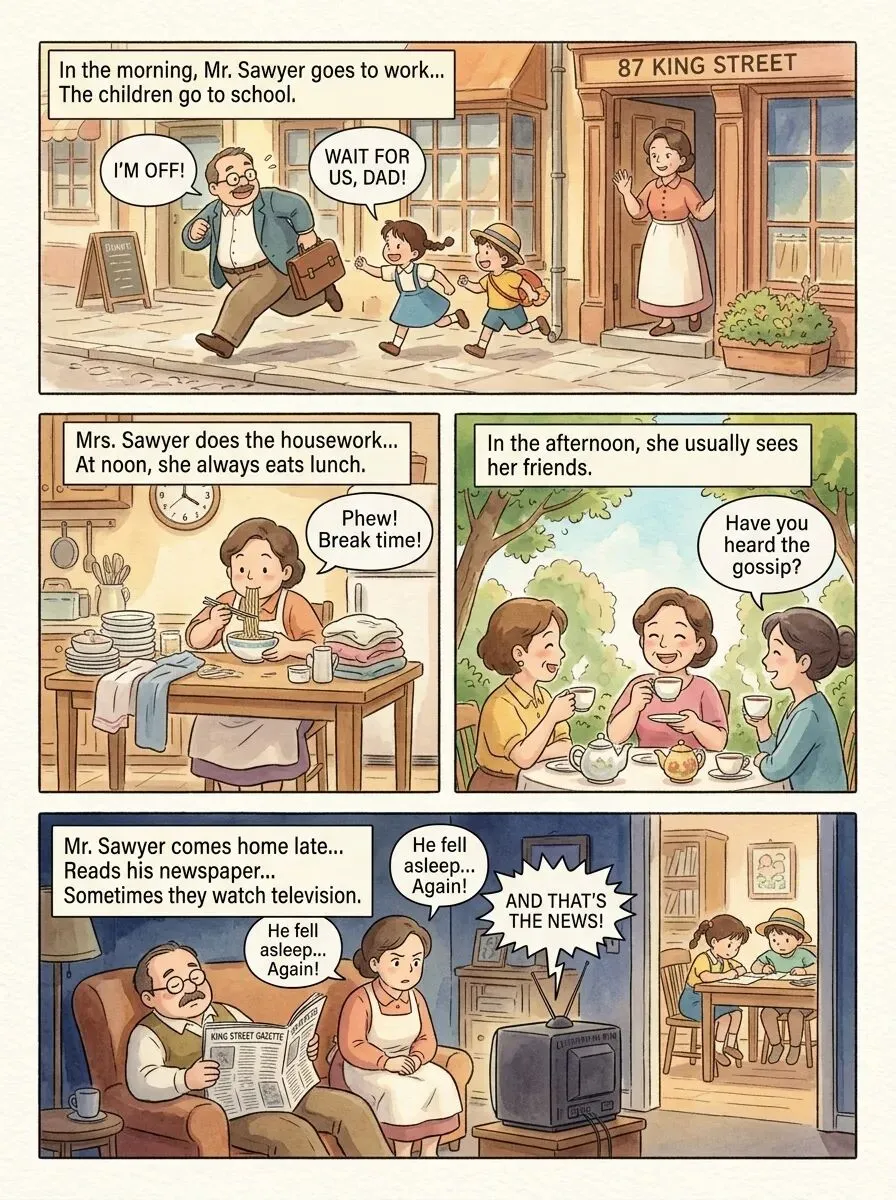
The Sawyer family live at 87 King Street.
索耶一家住在国王街87号。
In the morning, Mr. Sawyer goes to work and the children go to school.
早上,索耶先生去上班,孩子们去上学。
Their father takes them to school every day.
他们的父亲每天送他们去学校。
Mrs. Sawyer stays at home every day. She does the housework.
索耶太太每天呆在家里。她料理家务。
She always eats her lunch at noon.
她总是在正午吃午饭。
In the afternoon, she usually sees her friends. They often drink tea together.
下午,她通常去见她的朋友们。她们经常一起喝茶。
In the evening, the children come home from school. They arrive home early.
晚上,孩子们放学回家。他们到家很早。
Mr. Sawyer comes home from work. He arrives home late.
索耶先生下班回家。他到家很晚。
At night, the children always do their homework. Then they go to bed.
夜里,孩子们总是做作业。然后他们上床睡觉。
Mr. Sawyer usually reads his newspaper, but sometimes he and his wife watch television.
索耶先生通常看报纸,但有时他和他的妻子看电视。
语音标注: live at 连读 /lɪv æt/;goes to 连读 /ɡəʊz tə/;eats her 连读 /iːts ə(r)/;arrive home 连读 /əˈraɪv həʊm/;watch television 注意 /tʃ/ 与 /t/ 过渡。
Lesson 56 What do they usually do?
📜 核心句型练习
- What does he/she usually do?
- He/She always/usually/often/sometimes …
- What do they usually do?
- They always/usually/often/sometimes …
情景说明:本课描述了一个典型的英国家庭——索耶一家的日常生活。课文以时间顺序(早上、下午、晚上、夜里)为线索,清晰地展现了每个家庭成员在不同时间段的习惯性活动。场景从家庭住所延伸到工作场所、学校、家庭内部以及朋友社交。这是一篇经典的用于学习和练习一般现在时描述日常生活的叙述文,语言平实,逻辑清晰,极具代表性。第56课为句型操练课,巩固频率副词与一般现在时的结合。
参考译文:
第55课 索耶一家
索耶一家住在国王街87号。早上,索耶先生去上班,孩子们去上学。他们的父亲每天送他们去学校。索耶太太每天呆在家里。她料理家务。她总是在正午吃午饭。下午,她通常去见她的朋友们。她们经常一起喝茶。晚上,孩子们放学回家。他们到家很早。索耶先生下班回家。他到家很晚。夜里,孩子们总是做作业。然后他们上床睡觉。索耶先生通常看报纸,但有时他和他的妻子看电视。
第56课 他们通常做什么?(练习课)
🔍 第二部分:逐句精讲与词块总结
句子1
原文: The Sawyer family live at 87 King Street.
翻译: 索耶一家住在国王街87号。
句子结构: 主语 (The Sawyer family) + 谓语 (live) + 地点状语 (at 87 King Street)。属于“主语+谓语+状语”结构。
重点词汇:
family 蓝思值 10L-200L
英音 /ˈfæməli/ 美音 /ˈfæməli/ 词性:n.
释义:家,家庭;家庭成员
常用语块:the Sawyer family, a big family, family member
例句一:I have a happy family. 我有一个幸福的家庭。
例句二:My whole family likes traveling. 我们全家都喜欢旅行。
拓展:family 作为“家庭”整体看待时,谓语动词用单数。但本课中强调家庭成员个体,故谓语用复数 live。类似词:team, class, government。
live 蓝思值 10L-200L
英音 /lɪv/ 美音 /lɪv/ 词性:v.
释义:居住;生活
常用语块:live at + 门牌号, live in + 城市, live with sb.
例句一:Where do you live? 你住在哪里?
例句二:She lives in Beijing with her parents. 她和父母住在北京。
拓展:不及物动词,后接介词。注意与 life (n.) 区分。
at 蓝思值 BR-10L
英音 /æt/ 美音 /æt/ 词性:prep.
释义:在(某地点或时间点)
常用语块:at home, at school, at work, at night, at 87 King Street
例句一:Let's meet at the bus stop. 我们在公交车站见吧。
例句二:The class begins at 8 o'clock. 课在8点钟开始。
拓展:at 用于具体、精确的地点或时间点。与 in (内部/大范围)、on (表面/特定日期) 对比。
语法点睛: 本句使用一般现在时 (live),表示一个长期、稳定的状态(居住地点)。一般现在时用于表示经常性、习惯性的动作,或客观事实和真理。
语音要点: The Sawyer family 中 Sawyer 发音 /ˈsɔːjə(r)/。live at 可连读 /lɪv æt/,at 常弱读为 /ət/。
句子2
原文: In the morning, Mr. Sawyer goes to work and the children go to school.
翻译: 早上,索耶先生去上班,孩子们去上学。
句子结构: 时间状语 (In the morning) + 主语1 (Mr. Sawyer) + 谓语1 (goes) + 状语1 (to work) + 连词 (and) + 主语2 (the children) + 谓语2 (go) + 状语2 (to school)。并列句。
重点词汇:
go 蓝思值 BR-10L
英音 /ɡəʊ/ 美音 /ɡoʊ/ 词性:v.
释义:去
常用语块:go to work, go to school, go home, go to bed
例句一:I go to the park every Sunday. 我每个星期天都去公园。
例句二:He goes to the cinema on Fridays. 他每周五去看电影。
拓展:第三人称单数 goes /ɡəʊz/。go home 中 home 为副词,不加 to。
work 蓝思值 10L-200L
英音 /wɜːk/ 美音 /wɜːrk/ 词性:n. & v.
释义:n. 工作;职业;v. 工作
常用语块:go to work, at work, hard work
例句一:His work is very interesting. 他的工作很有趣。
例句二:She works in a hospital. 她在医院工作。
拓展:work 作为“工作”总称不可数。job 可数,指具体一份工作。
语法点睛: 一般现在时中,主语 Mr. Sawyer 第三人称单数,go 加 -es 为 goes;主语 the children 复数,go 用原形。体现主谓一致原则。
语音要点: goes to 连读为 /ɡəʊz tə/,to 弱读 /tə/。work 注意英音 /wɜːk/ 和美音 /wɜːrk/ 中 r 音差异。
句子3
原文: Their father takes them to school every day.
翻译: 他们的父亲每天送他们去学校。
句子结构: 主语 (Their father) + 谓语 (takes) + 宾语 (them) + 状语 (to school) + 时间状语 (every day)。
重点词汇:
take 蓝思值 10L-200L
英音 /teɪk/ 美音 /teɪk/ 词性:v.
释义:带(某人)去某处;拿,取
常用语块:take sb. to…, take a bus, take a photo
例句一:Can you take me to the airport? 你能带我去机场吗?
例句二:He takes his dog for a walk every evening. 他每晚都遛狗。
拓展:第三人称单数 takes /teɪks/。
every 蓝思值 BR-10L
英音 /ˈevri/ 美音 /ˈevri/ 词性:adj.
释义:每一个的
常用语块:every day, every week, every morning
例句一:I brush my teeth every morning and every night.
例句二:Every student in the class has a computer.
拓展:every day 短语作状语,与 everyday (adj.) 不同。
语法点睛: 第三人称单数主语对应 takes。时间状语 every day 置于句末,是描述习惯性动作的常见搭配。
语音要点: takes them 连读为 /teɪks ðəm/,them 常弱读 /ðəm/。every day 连读 /ˈevri deɪ/。
句子4
原文: Mrs. Sawyer stays at home every day.
翻译: 索耶太太每天呆在家里。
句子结构: 主语 (Mrs. Sawyer) + 谓语 (stays) + 地点状语 (at home) + 时间状语 (every day)。
重点词汇:
stay 蓝思值 10L-200L
英音 /steɪ/ 美音 /steɪ/ 词性:v.
释义:停留,呆在
常用语块:stay at home, stay in bed, stay with friends
例句一:I want to stay here for another week. 我想在这里再呆一周。
例句二:He usually stays up late on weekends. 他周末通常熬夜。
拓展:不及物动词。
语法点睛: 一般现在时第三人称单数 stays。at home 为地点状语,every day 为时间状语。
语音要点: stays at 连读为 /steɪz æt/ 或 /steɪz ət/ (at 弱读)。
句子5
原文: She does the housework.
翻译: 她料理家务。
句子结构: 主语 (She) + 谓语 (does) + 宾语 (the housework)。
重点词汇:
do 蓝思值 BR-10L
英音 /duː/ 美音 /duː/ 词性:v.
释义:做,干
常用语块:do the housework, do homework, do exercise
例句一:What are you doing? 你在做什么?
例句二:She does her homework after dinner.
拓展:第三人称单数 does /dʌz/。
housework 蓝思值 200L-400L
英音 /ˈhaʊswɜːk/ 美音 /ˈhaʊswɜːrk/ 词性:n.
释义:家务劳动
常用语块:do the housework
例句一:Sharing housework makes a family happier.
例句二:I hate doing housework on weekends.
拓展:不可数名词。
语法点睛: 实义动词 do 的第三人称单数形式 does。do the housework 是固定搭配。
语音要点: does the 连读为 /dʌz ðə/,the 弱读 /ðə/。
句子6
原文: She always eats her lunch at noon.
翻译: 她总是在正午吃午饭。
句子结构: 主语 (She) + 频率状语 (always) + 谓语 (eats) + 宾语 (her lunch) + 时间状语 (at noon)。
重点词汇:
always 蓝思值 10L-200L
英音 /ˈɔːlweɪz/ 美音 /ˈɔːlweɪz/ 词性:adv.
释义:总是,一直
常用语块:置于实义动词前,be/助动词后。
例句一:He always helps others.
例句二:She is always late for meetings.
拓展:频率副词,频率100%。
noon 蓝思值 200L-400L
英音 /nuːn/ 美音 /nuːn/ 词性:n.
释义:正午,中午12点
常用语块:at noon
例句一:We have a meeting at noon tomorrow.
例句二:The sun is directly overhead at noon.
拓展:at noon 固定搭配,不用冠词。
语法点睛: 频率副词 always 在句中的位置:主语之后,实义动词之前。本句结构展示了“主语 + 频率副词 + 谓语(第三人称单数)+ 宾语 + 时间状语”的典型模式。
语音要点: eats her 可以连读为 /iːts ə(r)/,her 弱读。at noon 连读为 /æt nuːn/。
句子7
原文: In the afternoon, she usually sees her friends.
翻译: 下午,她通常去见她的朋友们。
句子结构: 时间状语 (In the afternoon) + 主语 (she) + 频率状语 (usually) + 谓语 (sees) + 宾语 (her friends)。
重点词汇:
usually 蓝思值 10L-200L
英音 /ˈjuːʒuəli/ 美音 /ˈjuːʒuəli/ 词性:adv.
释义:通常
常用语块:位置同 always。
例句一:I usually get up at 7 a.m. 我通常早上7点起床。
例句二:They usually go shopping on Saturday. 他们通常周六去购物。
拓展:频率副词,约80%频率。
see 蓝思值 BR-10L
英音 /siː/ 美音 /siː/ 词性:v.
释义:看见;会见,见面
常用语块:see a film, see a doctor, see friends
例句一:I see my grandparents every weekend.
例句二:He sees his clients on Tuesday mornings.
拓展:第三人称单数 sees /siːz/。
语法点睛: 频率副词 usually 的用法和位置。与 always 一样,位于实义动词 sees 之前。
语音要点: sees her 连读为 /siːz ə(r)/。
句子8
原文: They often drink tea together.
翻译: 她们经常一起喝茶。
句子结构: 主语 (They) + 频率状语 (often) + 谓语 (drink) + 宾语 (tea) + 方式状语 (together)。
重点词汇:
often 蓝思值 10L-200L
英音 /ˈɒfn/ 美音 /ˈɔːfn/ 词性:adv.
释义:经常,常常
常用语块:位置灵活,可在实义动词前,也可在句首或句末。
例句一:We often play basketball after school.
例句二:Often, he works late into the night.
拓展:频率约60%。
together 蓝思值 10L-200L
英音 /təˈɡeðə(r)/ 美音 /təˈɡeðər/ 词性:adv.
释义:一起,共同
常用语块:do sth. together, live together
例句一:Let's have dinner together.
例句二:The family watches TV together.
拓展:由 to + gather 构成。
语法点睛: 频率副词 often 位于实义动词 drink 之前。方式状语 together 置于句末。
语音要点: drink tea 注意 /k/ 和 /t/ 两个爆破音相邻,前者发生不完全爆破。together 重音在第二个音节。
句子9
原文: In the evening, the children come home from school.
翻译: 晚上,孩子们放学回家。
句子结构: 时间状语 (In the evening) + 主语 (the children) + 谓语 (come) + 地点状语 (home) + 来源状语 (from school)。
重点词汇:
come 蓝思值 BR-10L
英音 /kʌm/ 美音 /kʌm/ 词性:v.
释义:来
常用语块:come home, come from…, come here
例句一:Please come to my office.
例句二:She comes from Italy.
拓展:come home 固定搭配。
from 蓝思值 BR-10L
英音 /frɒm/ 美音 /frʌm/ 词性:prep.
释义:从…来;来自
常用语块:come from…, from…to…
例句一:I get up from 6 to 7.
例句二:This gift is from my teacher.
拓展:表示起点或来源。
语法点睛: 一般现在时描述每天发生的动作 (come home)。注意 home 是副词,前面不加 to。
语音要点: come home 连读为 /kʌm həʊm/。from school 连读为 /frəm skuːl/。
句子10
原文: They arrive home early.
翻译: 他们到家很早。
句子结构: 主语 (They) + 谓语 (arrive) + 地点状语 (home) + 方式状语 (early)。
重点词汇:
arrive 蓝思值 200L-400L
英音 /əˈraɪv/ 美音 /əˈraɪv/ 词性:v.
释义:到达
常用语块:arrive home, arrive at + 小地点, arrive in + 大地点
例句一:What time does the train arrive?
例句二:We arrived in London yesterday.
拓展:arrive 不及物,后接 at 或 in 再接地点名词,但 arrive home 例外,home 为副词。
early 蓝思值 10L-200L
英音 /ˈɜːli/ 美音 /ˈɜːrli/ 词性:adv. & adj.
释义:早
常用语块:arrive early, get up early, early morning
例句一:Please come early tomorrow.
例句二:She is an early riser.
拓展:反义词 late。
语法点睛: arrive 与 come 都表示“来/到”,但 arrive 更强调“抵达”终点这一结果。
语音要点: arrive home 连读为 /əˈraɪv həʊm/。early 注意英音 /ˈɜːli/ 和美音 /ˈɜːrli/。
句子11
原文: Mr. Sawyer comes home from work.
翻译: 索耶先生下班回家。
句子结构: 主语 (Mr. Sawyer) + 谓语 (comes) + 地点状语 (home) + 来源状语 (from work)。
重点词汇: (comes, home, from, work 已讲解)
语法点睛: 与句子9结构平行,描述另一个家庭成员的习惯性动作。第三人称单数主语对应 comes。
语音要点: comes home 连读为 /kʌmz həʊm/。from work 连读为 /frəm wɜːk/。
句子12
原文: He arrives home late.
翻译: 他到家很晚。
句子结构: 主语 (He) + 谓语 (arrives) + 地点状语 (home) + 方式状语 (late)。
重点词汇:
late 蓝思值 10L-200L
英音 /leɪt/ 美音 /leɪt/ 词性:adv. & adj.
释义:晚
常用语块:arrive late, be late for…, late at night
例句一:Sorry, I'm late. 对不起,我迟到了。
例句二:He often works late. 他经常工作到很晚。
拓展:反义词 early。late 既可作表语形容词,也可作状语。
语法点睛: 与句子10 (They arrive home early.) 形成对比,通过 early 和 late 这对反义词描述不同家庭成员到家的时间。
语音要点: arrives home 连读为 /əˈraɪvz həʊm/。
句子13
原文: At night, the children always do their homework.
翻译: 夜里,孩子们总是做作业。
句子结构: 时间状语 (At night) + 主语 (the children) + 频率状语 (always) + 谓语 (do) + 宾语 (their homework)。
重点词汇:
night 蓝思值 BR-10L
英音 /naɪt/ 美音 /naɪt/ 词性:n.
释义:夜晚,晚上
常用语块:at night, good night, last night
例句一:I like to read at night.
例句二:The stars are beautiful at night.
拓展:at night 泛指夜晚,in the night 指在夜间某个时候。
语法点睛: 时间状语 At night 置于句首。频率副词 always 与实义动词 do 搭配,描述一个规律性极高的习惯。
语音要点: at night 连读为 /æt naɪt/。do their 连读为 /duː ðeə(r)/。
句子14
原文: Then they go to bed.
翻译: 然后他们上床睡觉。
句子结构: 时间状语 (Then) + 主语 (they) + 谓语 (go) + 状语 (to bed)。
重点词汇:
then 蓝思值 BR-10L
英音 /ðen/ 美音 /ðen/ 词性:adv.
释义:然后,接着
常用语块:用于承接上一个动作或时间。
例句一:First, we have breakfast. Then, we go to school.
例句二:He finished his work and then went home.
拓展:表示时间或顺序上的“接下来”。
语法点睛: Then 作为时间副词,常用于叙述一连串动作,使行文更连贯。go to bed 固定短语,指“上床睡觉”的动作,区别于 sleep (睡着状态)。
语音要点: go to 连读为 /ɡəʊ tə/,to 弱读。bed 注意 /e/ 发音。
句子15
原文: Mr. Sawyer usually reads his newspaper, but sometimes he and his wife watch television.
翻译: 索耶先生通常看报纸,但有时他和他的妻子看电视。
句子结构: 主语1 (Mr. Sawyer) + 频率状语 (usually) + 谓语1 (reads) + 宾语1 (his newspaper) + 连词 (but) + 频率状语 (sometimes) + 主语2 (he and his wife) + 谓语2 (watch) + 宾语2 (television)。并列复合句,表示转折对比。
重点词汇:
sometimes 蓝思值 10L-200L
英音 /ˈsʌmtaɪmz/ 美音 /ˈsʌmtaɪmz/ 词性:adv.
释义:有时
常用语块:位置灵活,可在句首、句中或句末。
例句一:Sometimes I walk to work. 有时我走路去上班。
例句二:He sometimes visits his old friends. 他有时会拜访老朋友。
拓展:频率约30%。
watch 蓝思值 BR-10L
英音 /wɒtʃ/ 美音 /wɑːtʃ/ 词性:v.
释义:观看;注视
常用语块:watch television/TV, watch a movie, watch a game
例句一:We watch the news every evening.
例句二:He is watching the birds outside the window.
拓展:强调专注地“观看”动态过程。与 see (看见)、look at (看) 区别。
television/TV 蓝思值 200L-400L
英音 /ˈtelɪvɪʒn/; /ˌtiː ˈviː/ 词性:n.
释义:电视
常用语块:watch television/TV, on television
例句一:There's a good film on television tonight.
例句二:Most families have a television.
拓展:television 正式,TV 缩写更口语化。
语法点睛: 本句集中展示频率副词对比 (usually vs sometimes) 和并列连词 but 的转折用法。同时,主语 he and his wife 是复数,所以谓语用 watch 而非 watches,复习了主谓一致原则。
语音要点: reads his 连读为 /riːdz ɪz/,his 弱读 /ɪz/。but sometimes 连读 /bʌt ˈsʌmtaɪmz/。watch television 中 watch 的 /tʃ/ 和 television 的 /t/ 相邻,注意发音清晰。
📌 核心词块总结 (Key Lexical Chunks)
1. live at + 地址: To reside at a specific street number. Example: My grandparents live at 22 Park Lane.
2. in the morning/afternoon/evening: Used to indicate the time of day. Example: She drinks coffee in the morning.
3. go to work/school/bed: To engage in daily routines. Example: Children go to school from Monday to Friday.
4. stay at home: To remain in one's house. Example: On rainy days, I prefer to stay at home.
5. do the housework/homework: To perform chores or assignments. Example: Students must do their homework every day.
6. arrive home early/late: To reach home at an early or late hour. Example: Traffic jams often make people arrive home late.
💬 第三部分:基础会话技巧
1. 分析课文中的日常用语、礼貌表达、问答模式
本课是一篇叙述文,而非对话,因此没有直接的问答和礼貌用语。但其语言是描述日常生活的典范,包含了丰富的“主语 + 频率副词 + 动词短语 + 时间/地点状语”的陈述句模式。这种模式是进行关于日常生活问答的基础。例如,要问出课文中的信息,会使用如下问句:
- Where does the Sawyer family live?
- What does Mr. Sawyer do in the morning?
- What does Mrs. Sawyer do every day?
- When does she eat her lunch?
- What do the children do at night?
回答则直接套用课文中的陈述句结构。这种“问答-陈述”的转换是掌握一般现在时描述习惯的关键。
2. 提供类似场景的扩展对话示例
A:Hi, Tom. Can you tell me something about your family's daily life?
B:Sure. We live on Green Street. My dad goes to work by car early in the morning. My mum is a teacher, she goes to school too, but a bit later.
A:What about you and your sister?
B:We go to the same school. My mum sometimes takes us. In the afternoon, I usually play basketball with friends. My sister often stays at home and practices the piano.
A:What do you do in the evening?
B:We always have dinner together at 7. Then I do my homework. My parents sometimes watch TV or read. We all go to bed before 11.
A:Sounds like a busy but regular day!
B: Yes, it is.
3. 设计简单的角色扮演活动建议
- 活动1:家庭记者会。一名学生扮演“家庭记者”,另一名或一组学生扮演“索耶一家”的成员。记者根据课文内容提问,家庭成员回答。问题可包括:Where do you live?, What's your daily routine?, What do you usually do in the afternoon? 等。
- 活动2:我的家庭日程表。两人一组。学生A用中文或简单英文描述自己家庭某位成员一天的主要活动和时间。学生B用英语记录并转述出来,尽量使用本课句型,如 Your father goes to work at…, You usually… after school. 然后交换角色。
- 活动3:猜猜是谁。一位学生心中想好课文中的一个人物,其他学生用一般现在时的一般疑问句提问来猜测,如 Does he go to work?, Does she stay at home?, Do they do homework at night? 被问者只能回答 Yes, he/she/they does/do. 或 No, he/she/they doesn't/don't. 看谁用最少问题猜中。
4. 融入基础思考:设计1-2个简单的代入式问题
- 问题1:如果你是索耶家的小孩,你喜欢你们家的日常生活安排吗?为什么?你觉得哪部分可以改变一下?(引导学生用中文或已学英语表达喜好和简单理由)
- 问题2:对比索耶一家和你自己家的日常生活,找出两个相同点和两个不同点。(引导学生观察和比较)
📐 第四部分:本课语法精析(加强版)
一般现在时 (The Simple Present Tense) 深度解析
一般现在时是英语中最基本、最常用的时态之一,其核心功能是表示习惯性、经常性的动作,或客观事实、真理及当前的状态。
1. 基本用法:
- 表示习惯性或经常反复发生的动作。常与 every day, often, always 等时间状语连用。
- 例句:Mr. Sawyer goes to work every day. (习惯) / The earth moves around the sun. (客观规律) / She lives in New York. (当前状态)
2. 句型结构:
- 肯定句:主语 + 动词原形(三单加-s/-es)。
- 否定句:主语 + do/does + not + 动词原形。
- 一般疑问句:Do/Does + 主语 + 动词原形?
- 特殊疑问句:疑问词 + do/does + 主语 + 动词原形?
3. 第三人称单数动词变化规则:
- 一般情况加-s:work → works, live → lives
- 以-ch, -sh, -s, -x, -o结尾加-es:watch → watches, go → goes, do → does
- 以“辅音字母+y”结尾,变y为i再加-es:study → studies
- 特殊变化:have → has
4. 时间状语:频率副词 (always, usually, often, sometimes, seldom, never);短语 (every day, once a week, on Sundays, in the morning)。
频率副词 (Adverbs of Frequency) 详解
常见频率:always (100%) → usually (80%) → often (60%) → sometimes (30%) → seldom (10%) → never (0%)。
位置:放在实义动词之前;be动词、助动词、情态动词之后。sometimes, often 可置于句首或句末。
时间状语和地点状语的表达与位置
- 时间状语回答“何时”,可放句首或句末。
- 地点状语回答“何地”,通常放句末。
- 介词搭配:at (具体小地点/时间点),in (大地点/时间段),on (表面/特定日期),to (方向),from (来源)。
对比分析与综合练习
对比现在进行时:She is drinking tea now. (此刻) / She often drinks tea in the afternoon. (习惯)
练习题(不少于10道):
① 用动词正确形式填空:
1. My father _____ (work) in a hospital.
2. She _____ (watch) TV every evening.
3. The dog _____ (run) very fast.
4. Tom _____ (study) English on Monday.
5. Water _____ (boil) at 100°C.
答案:1. works; 2. watches; 3. runs; 4. studies; 5. boils
② 选择频率副词填空:
6. I _____ (70%) get up at 7 a.m.
7. It _____ (100%) rains in the rainforest.
8. They _____ (30%) go to the cinema on weekends.
9. He is _____ (100%) friendly to others.
答案:6. usually; 7. always; 8. sometimes; 9. always
③ 改为否定句和一般疑问句:
10. She lives in Paris.
否定句:She does not (doesn't) live in Paris.
疑问句:Does she live in Paris?
11. They play football after school.
否定句:They do not (don't) play football.
疑问句:Do they play football?
④ 将频率副词放入句中正确位置:
12. He goes to bed late. (sometimes) → He sometimes goes to bed late. / Sometimes he goes to bed late.
13. They are happy. (always) → They are always happy.
14. Does she drink coffee? (often) → Does she often drink coffee?
⑤ 翻译句子:
15. 我弟弟每天骑自行车上学。→ My brother goes to school by bike every day.
16. 我父母通常晚上在家看书。→ My parents usually read books at home in the evening.
17. 她从不迟到。→ She is never late.
✏️ 第五部分:基础练习与活动
1. 跟读练习:播放课文录音,学生逐句跟读。重点模仿语音语调,特别是连读(如 goes to, lives at, eats her)和句子节奏。教师可对长句进行意群划分带读。
2. 角色扮演与替换练习
- 人物替换:将 The Sawyer family 替换为 My family 或 Lin Tao's family,复述课文主要活动。
- 活动替换:替换关键动词短语。例如:Mrs. Sawyer stays at home. → My mother works in an office. She always eats her lunch at noon. → She often has a meeting at noon.
- 时间频率替换:替换频率副词和时间状语。例如:She usually sees her friends in the afternoon. → She sometimes goes shopping in the afternoon.
3. 听力理解题目
听录音,判断正误 (True or False):
1. The Sawyer family lives at 97 King Street. (F)
2. Mr. Sawyer takes the children to school. (T)
3. Mrs. Sawyer goes to work every day. (F)
4. The children do their homework in the afternoon. (F)
5. Mr. Sawyer sometimes watches TV with his wife. (T)
听录音,回答问题:
1. Where does the Sawyer family live? → They live at 87 King Street.
2. What does Mrs. Sawyer do every day? → She stays at home and does the housework.
3. When does she eat lunch? → She always eats her lunch at noon.
4. What do the children always do at night? → They always do their homework.
5. What does Mr. Sawyer usually do in the evening? → He usually reads his newspaper.
4. 课文改写版本(词汇更简单)
The Smith Family (简化版)
The Smith family lives on Hill Street.
In the morning, Dad goes to work. The kids go to school. Dad takes them to school.
Mum stays at home. She cleans the house and cooks.
She eats lunch at 12 o'clock.
In the afternoon, she visits her friends. They talk and drink tea.
In the evening, the kids come home from school. They come home early.
Dad comes home from work. He comes home late.
At night, the kids do their school work. Then they sleep.
Dad reads a book. Sometimes, Mum and Dad watch TV together.
🤔 第六部分:英文深度思考与拓展(强化版)
A. 层次化英文问题与答案
Level 1: Factual Questions
1. Q: Where is the Sawyer family's home? A: Their home is at 87 King Street.
2. Q: Who takes the children to school every day? A: Their father, Mr. Sawyer.
3. Q: What does Mrs. Sawyer always do at noon? A: She always eats her lunch at noon.
4. Q: What do the children do after homework at night? A: They go to bed.
Level 2: Inferential & Analytical Questions
5. Q: Can we infer if Mr. Sawyer and the children work/study in the same area? A: Possibly not. Mr. Sawyer arrives home late, children arrive early, suggesting different locations or schedules.
6. Q: How does the Sawyer family's routine reflect the importance of indoor activities? A: Many indoor activities (housework, tea, homework, reading, TV) suggest a focus on indoor life, possibly influenced by weather.
7. Q: What does the choice of frequency adverbs tell us? A: It makes the description realistic and nuanced, showing structure with variety.
Level 3: Evaluative & Creative Questions
8. Q: If you could spend a day with one member of the Sawyer family, who and why? A: (Open) e.g., Mrs. Sawyer, to learn about her routine and join tea time.
9. Q: How might a new computer change their routine? A: Children might do online research; Mr. Sawyer might read news online; Mrs. Sawyer might connect with friends virtually.
10. Q: Is the division of roles common today? A: Less common today; many mothers work and fathers share housework. Other models include dual-income, single-parent families.
11. Q: Create a short "A Day in the Life" paragraph for a pet. A: In the morning, the dog Max eats breakfast. During the day, he sleeps on the sofa. In the evening, he plays with the children. At night, he sleeps in his basket.
B. 多类型拓展阅读
1. 现代场景故事 (A "Work-from-Home" Family Routine)
The Chen family's routine looks different. Mr. and Mrs. Chen both work from home. Their son, Leo, has online classes. There's no "going to work" or "going to school" in the traditional sense. The line between "home" and "work/school" is blurry. In the evening, they always go for a walk in the park—their way of "coming home" from work and school.
引导性问题:What is the biggest difference between the Chen family's and the Sawyer family's daily life regarding "work" and "home"?
2. 文化背景小知识 (The "Tea Time" Tradition)
Afternoon tea originated in early 19th century England. Anna, a Duchess, felt hungry in the afternoon and began having tea and snacks around 4 p.m. She invited friends, making it a social event. Traditional afternoon tea includes hot tea and a three-tier stand with sandwiches, scones, and pastries. Today, "having a cup of tea" remains a common way to relax and socialize.
引导性问题:What was the original practical reason for starting the afternoon tea tradition?
3. 今昔对比 (Family Routines: 1960s vs. 2020s)
1960s: Schedules set by broadcast rhythms. Father sole breadwinner, mother homemaker. Evening centered on one TV. Bedtimes early.
2020s: Schedules fragmented. Both parents often work. After-school activities fill time. Evening "family time" is rare; each member on personal devices. Constant connectivity blurs boundaries.
引导性问题:How has technology changed the way families spend their evenings compared to the 1960s?
4. 新潮英语改写 (The Sawyer Family — Social Media Bio Version)
📍 87 King Street
👨💼 Dad: Software engineer. Commute king. Loves newspapers & late-night documentaries. #WorkHard
👩🍳 Mum: Home CEO. ☕️ Afternoon tea enthusiast. #Homelife
🧒👧 Kids: Homework warriors. ⚽️ Park life after school. #SchoolDays
🏡 Our vibe: Structured chaos. Family dinners are sacred.
引导性问题:How does the social media version use symbols and hashtags to summarize each family member's role?
5. 难度略高的拓展阅读 (The Science of Habits and Routines)
Routines reduce decisions, conserving mental energy. Mr. Sawyer's morning commute is a habit loop: cue (morning), routine (go to work), reward (salary). Family routines give children security and teach time management. However, overly rigid routines can be monotonous. The Sawyer family balances with "sometimes" activities. Modern life's constant notifications can disrupt routines, leading to stress. Intentionally creating positive habits and protecting family routines may help manage busy modern minds.
引导性问题:What are the two main benefits of family routines, and what is one potential downside if they are too strict?
🌍 第七部分:日常应用延伸
1. 提供本课语言点在日常生活中的应用场景
- 自我介绍与家庭描述:结交新朋友时使用 My family lives in…, My father usually…, I often… 等句型。
- 制定与描述个人计划:I study English for one hour every evening. I always review my notes before class.
- 进行社会调查或访谈:What time do you usually get up? How do you often go to work/school?
- 阅读与理解生活类信息:学校日程表、公交时刻表等使用一般现在时。
- 讲述故事或复述经历:描述人物的习惯或特点。
2. 建议简单拓展学习材料
- 音频/视频:《新概念英语》配套录音;YouTube "Daily Routines" 相关视频;英语学习App日常生活听力短文。
- 阅读:《新概念英语课堂笔记/名师精讲笔记》;儿童绘本或分级读物(如"Spot"系列、"Peppa Pig"故事书)。
- 词汇与写作:《新概念英语全单词表》;参考主题写作范文,写一篇关于自己家庭日常的短文。
3. 可附加英美生活小常识
- "Home" vs. "House":house 指物理建筑,home 指情感归属的家。常说 make a house a home。
- 作息时间差异:英国晚餐时间可能较晚。Tea 有时指傍晚的一顿便餐。
- 家庭作业文化:英美学校普遍布置家庭作业,家长被期望督促。
- "Bedtime" Routine:固定的睡前程序(洗澡、刷牙、读故事)被认为是培养良好习惯的重要部分。
🗂️ 第八部分:本课知识图谱(结构化逻辑图)
核心对话主题:描述一个核心家庭(索耶一家)规律性的日常生活与作息习惯。
├─ 主要句型1:陈述居住地 — 主语 + live(s) at + 具体地址.
├─ 主要句型2:按时间顺序描述习惯性动作 — In the morning/afternoon/evening/At night, + 主语 + 频率副词 + 动词短语.
├─ 主要句型3:描述往返行程 — 主语 + go(es)/come(s) to + 地点. / 主语 + arrive(s) home + 时间副词. / 主语 + come(s)/go(es) home from + 地点.
├─ 主要句型4:表达规律性居家与休闲活动 — 主语 + stay(s) at home. / 主语 + do(es) the housework/homework. / 主语 + watch(es) television. / 主语 + read(s) the newspaper. / 主语 + see(s) friends. / 主语 + drink tea together.
└─ 关键词汇:家庭成员与称呼 (family, Mr., Mrs., father, children);日常生活动词 (live, stay, go, come, arrive, take, do, eat, see, drink, read, watch);时间分段 (morning, afternoon, evening, night, noon, day);地点与方向 (home, work, school, bed, street);频率副词 (always, usually, often, sometimes);时间副词与连词 (every day, early, late, then, together);介词 (at, in, from, to);其他名词 (newspaper, television/TV, friends, tea)。
© 本文为狂暴英语教案 · 新概念英语第一册第55-56课
仅供学习交流使用

贝琪酱英语无痛逆袭站
微信扫描二维码,关注我的账号