【狂暴英语教案】新概念英语第一册第75-76课:不舒服的鞋子 / 你什么时候...?
- 2026-06-27 00:21:48
读外刊,接触原汁原味的英文表达,
欢迎关注以下公众号+设为星标+推荐给朋友。▼
📚 狂暴英语教案 · 新概念英语第一册
第75-76课 Uncomfortable Shoes & When Did You...?
不舒服的鞋子 / 你什么时候...?
📘 本课信息教材:新概念英语第一册 · 第75-76课核心功能:购物对话 · 询问过去事件 · 时间状语 ago语法焦点:have作为普通动词 · 一般过去时 · ...ago时间状语 · 不规则动词过去式
🏷️ 热门标签
#have用法#...ago
🎯 本课学习目标
词汇:
掌握与购物、鞋类、时间表达相关的核心词汇,如 fashion, month, ago, pair, comfortable, uncomfortable, wear, buy, size, try on 等。重点词汇需掌握其音、形、义及在购物场景中的固定搭配。
语法:
系统学习并掌握 have 作为普通动词(表示"有")的用法,及其在一般过去时中的变化(had)。巩固不规则动词 wear(过去式 wore)和 buy(过去式 bought)的一般过去时。理解并运用表示过去的时间状语,如 a month ago, last year, yesterday。
技能(日常对话):
能够在购物场景中自然地询问产品、表达需求(如鞋子款式、尺码、舒适度)、询问价格并进行简单的讨价还价。掌握询问和回答过去事件发生时间的句型。
文化:
了解英美购物文化,特别是退换货政策、时尚潮流的变迁以及不同尺码系统的差异。体会通过礼貌表达来化解购物中遇到的不便的沟通方式。
📖 第一部分:课文完整内容
第75课 课文原文(含语音标注)
📜 课文原文(含语音标注)
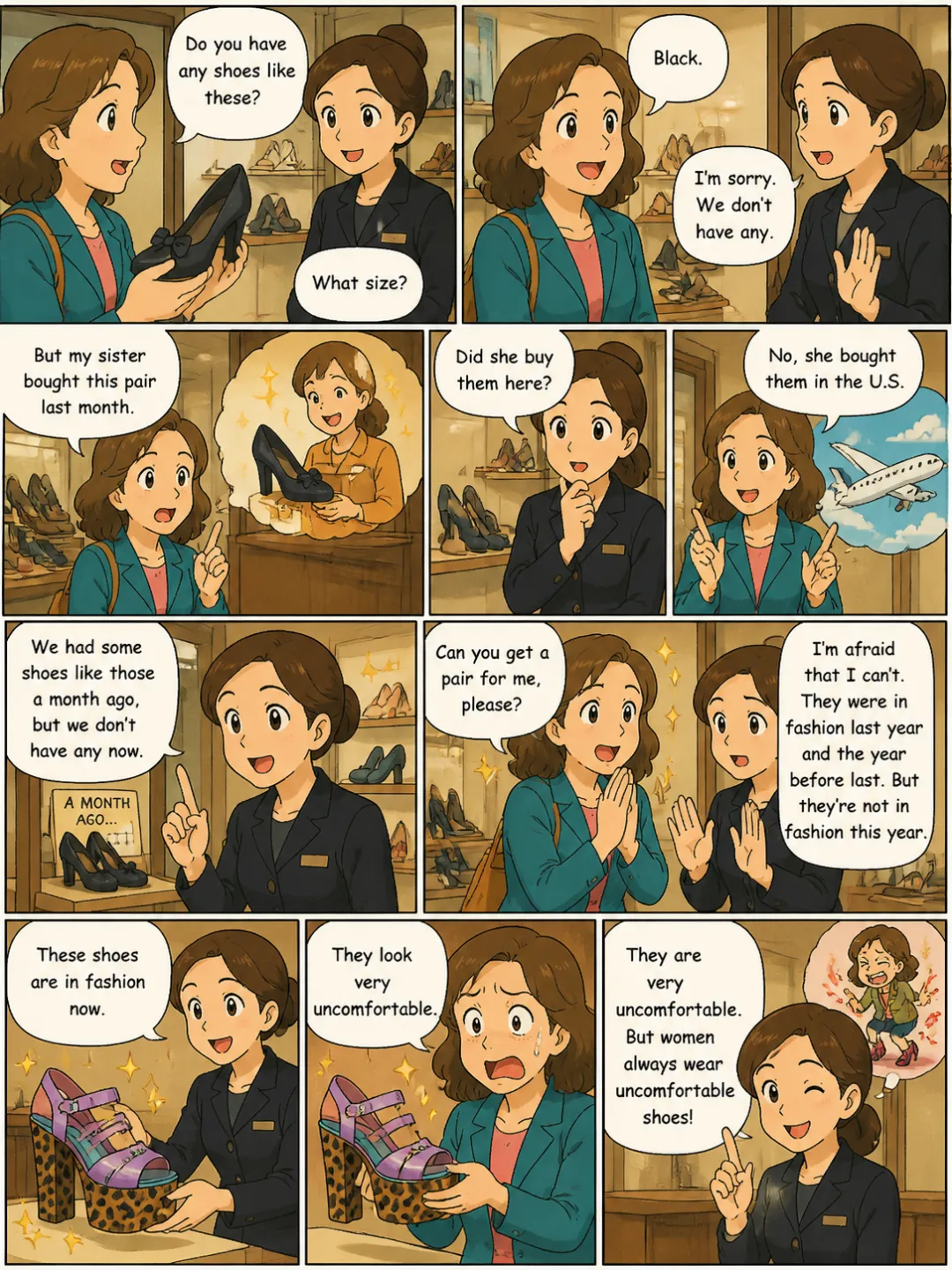
Customer: Do you have any shoes like these?
(have 重读,表示"有")
Saleswoman: What size?
(size 重读,语调上扬)
Customer: Size five.
Saleswoman: What colour?
(colour 重读,语调上扬)
Customer: Black.
Saleswoman: I'm sorry. We don't have any.
(don't 重读,表否定)
Customer: But my sister bought this pair last month.
(bought 重读过去式;pair 发音清晰)
Saleswoman: Did she buy them here?
(一般疑问句,句末升调)
Customer: No, she bought them in the U.S.
(bought 重读;U.S. 发音清晰的缩写)
Saleswoman: We had some shoes like those a month ago, but we don't have any now.
(had 表示"过去有";ago 弱读为 /əˈɡəʊ/;any 弱读为 /ˈeni/)
Customer: What a shame! Well, I'll try on this pair.
(What a shame! 语调下降,表惋惜;try on 连读)
Saleswoman: What size, madam?
(madam 礼貌称谓)
Customer: Size five.
Saleswoman: Here you are.
(Here you are. 常用语)
第76课 课文原文(含语音标注)
📜 课文原文(含语音标注)
Narrator: Look at this picture. When did you...?
Model Example A:
Question: When did you buy this pair of shoes?
Answer: I bought this pair of shoes a month ago.
Picture A:
Question: When did you buy this pair of shoes?
Answer: I bought this pair of shoes a month ago.
Picture B:
Question: When did you see this film?
Answer: I saw this film two months ago.
Picture C:
Question: When did you go to London?
Answer: I went to London a year ago.
Picture D:
Question: When did you get these letters?
Answer: I got these letters two weeks ago.
Picture E:
Question: When did you have your breakfast?
Answer: I had my breakfast an hour ago.
Picture F:
Question: When did you buy this book?
Answer: I bought this book a week ago.
Picture G:
Question: When did you sell your car?
Answer: I sold my car a month ago.
Picture H:
Question: When did you take a photograph?
Answer: I took a photograph half an hour ago.
Picture I:
Question: When did you lose your key?
Answer: I lost my key yesterday.
Picture J:
Question: When did you wash the dishes?
Answer: I washed the dishes this morning.
Picture K:
Question: When did you listen to the radio?
Answer: I listened to the radio yesterday evening.
Picture L:
Question: When did you paint the room?
Answer: I painted the room the day before yesterday.
情景说明第75课发生在一家鞋店里。一位顾客(Customer)看中了一款鞋子(鞋子),并询问店员(Saleswoman)是否有类似的款式。在得知没有后,顾客提到她的姐姐上个月买了同款。店员确认是否在本店购买,并解释一个月前店里还有这款,现在已经没有了。顾客感到遗憾(What a shame!),但决定试穿另一双。整个对话展现了购物中常见的沟通:询问款式、确认尺码、表达失望以及尝试替代品。核心围绕"拥有"(have)这一概念展开,区分了现在拥有的情况(一般现在时)和过去拥有的情况(一般过去时)。第76课则是语法操练课。通过十二幅图片展示了不同的人物和动作,核心句型是"When did you + 动词原形?"及回答"I + 动词过去式 + 时间状语"。回答中引入了一个新的时间表达单位"ago"(......以前),如"a month ago"、"two weeks ago"。这一课旨在巩固一般过去时的疑问句和回答,同时扩展关于时间状语的表达。
参考译文第75课顾客:你们有像这样的鞋子吗?店员:多大码的?顾客:5码。店员:什么颜色?顾客:黑色。店员:很抱歉。我们没有。顾客:但是我的姐姐上个月买了一双。店员:她是在这儿买的吗?顾客:不,她是在美国买的。店员:一个月前我们还有一些那样的鞋子,但现在没有了。顾客:真遗憾!好吧,我试一下这一双。店员:多大码,女士?顾客:5码。店员:给您。第76课旁白:看这幅图。你什么时候......?示例 A:问题:你什么时候买的这双鞋?回答:我一个月前买的这双鞋。图片 A:问题:你什么时候买的这双鞋?回答:我一个月前买的这双鞋。图片 B:问题:你什么时候看的这部电影?回答:我两个月前看的这部电影。图片 C:问题:你什么时候去的伦敦?回答:我一年前去的伦敦。图片 D:问题:你什么时候收到这些信的?回答:我两周前收到这些信的。图片 E:问题:你什么时候吃的早餐?回答:我一个小时前吃的早餐。图片 F:问题:你什么时候买的这本书?回答:我一周前买的这本书。图片 G:问题:你什么时候卖的车?回答:我一个月前卖的车。图片 H:问题:你什么时候拍的照片?回答:我半小时前拍的照片。图片 I:问题:你什么时候丢的钥匙?回答:我昨天丢的钥匙。图片 J:问题:你什么时候洗的盘子?回答:我今天早上洗的盘子。图片 K:问题:你什么时候听的收音机?回答:我昨天晚上听的收音机。图片 L:问题:你什么时候粉刷的房间?回答: 我前天粉刷的房间。
🔍 第二部分:逐句精讲与词块总结
句子1
1. 原文: Do you have any shoes like these?
2. 翻译: 你们有像这样的鞋子吗?
3. 句子结构: 这是一个一般现在时的疑问句。Do 是助动词,you 是主语,have 是谓语动词,any shoes 是宾语,like these 是介词短语作定语修饰 shoes。基本句型:SVO(主语-谓语-宾语)。
4. 重点词汇:
have 蓝思值 BR10L
英音[hæv] 美音[hæv] 词性:v. (动词)
释义:有;拥有;持有;吃(饭);喝(饮料)
常用语块:have any... (有...吗);have breakfast (吃早餐);have a good time (玩得开心)
例句一:I have a new car. 我有一辆新车。
例句二:Do you have any brothers or sisters? 你有兄弟姐妹吗?
拓展:本课中 have 作为普通动词(表示"拥有")使用,在疑问句和否定句中需要借助助动词 do/does/did。注意 have 与 have got 的区别:have got 在英式口语中更常用表示"有",但 have 的疑问句形式在美式英语中更为标准。第三单数形式为 has,过去式为 had。《新概念英语名师精讲笔记 第1册》指出,have 作为实义动词时,其疑问句和否定句必须使用助动词。
shoes 蓝思值 60L
英音[ʃuːz] 美音[ʃuːz] 词性:n. (名词,复数)
释义:鞋子(单数:shoe)
常用语块:a pair of shoes (一双鞋);put on one's shoes (穿上鞋);take off one's shoes (脱鞋)
例句一:These shoes are very comfortable. 这双鞋很舒服。
例句二:I need to buy a new pair of running shoes. 我需要买一双新的跑鞋。
拓展:复数形式特殊,通常以 shoes 形式出现。常用搭配 a pair of。文化知识:英美鞋码与中国不同,英国用UK码,美国用US码。本课中出现 size five(5码),指的是英码。
like 蓝思值 BR10L
英音[laɪk] 美音[laɪk] 词性:prep. (介词);v. (动词)
释义:prep. 像......一样;相似;v. 喜欢
常用语块:like these (像这样的);look like (看起来像);be like (像......)
例句一:She looks like her mother. 她长得像她妈妈。
例句二:I like this song. 我喜欢这首歌。
拓展:本句中 like 是介词,意为"像......一样",后跟名词或代词。注意与动词 like(喜欢)区分:I like these shoes.(我喜欢这些鞋。)vs. I want shoes like these.(我想要像这样的鞋。)[NCE知识点笔记] 中讲解了 like 的介词用法。
these 蓝思值 BR10L
英音[ðiːz] 美音[ðiːz] 词性:pron. (代词)
释义:这些(this的复数形式)
常用语块:these shoes (这些鞋);these days (如今);these people (这些人)
例句一:These are my books. 这些是我的书。
例句二:These flowers are beautiful. 这些花很漂亮。
拓展:指示代词,用于指代在空间或时间上离说话者较近的多个事物。其单数形式为 this,复数形式为 these。these 可以作主语、宾语或定语。注意与 those(那些)的区分。
5. 语法点睛: 本句的核心语法点是 have 作为普通动词的一般现在时疑问句结构。[NCE知识点笔记] 明确指出,have 表示"拥有"时,其疑问句和否定句的形式与普通动词一致,即需要借助助动词 do/does。结构为:Do/Does + 主语 + have + 宾语?。这与之前学过的 There be 结构(表示"某处有某物")和 have got 结构(英式口语表示"拥有")不同。本句采用美式标准用法 Do you have...?。
6. 语音要点: Do you 在口语中常连读为 /də juː/ 或 /dʒuː/。have 在这里重读,强调"拥有"的概念。any 弱读为 /ˈeni/,shoes 发音清晰,/ʃuːz/。like these 连读,/laɪk ðiːz/。
句子2
1. 原文: What size?
2. 翻译: 多大码的?
3. 句子结构: 这是一个省略的特殊疑问句,完整形式为 What size do you want? 或 What size would you like?。省略后的句子由疑问词 What + 名词 size 组成,通过语调(升调)表示询问。
4. 重点词汇:
size 蓝思值 120L
英音[saɪz] 美音[saɪz] 词性:n. (名词)
释义:尺寸;大小;尺码
常用语块:What size...? (多大尺寸?);in size (在大小方面);size large (大号)
例句一:What size do you wear? 你穿多大码?
例句二:This dress is the wrong size. 这条裙子尺码不对。
拓展:在服装、鞋类购物中是关键词汇。英美尺码系统不同,鞋子有UK码、US码、EU码。衣服有S(小号)、M(中号)、L(大号)、XL(加大号)等。
5. 语法点睛: 省略句在日常口语中非常常见,可以使对话更加简洁高效。在已知语境中,双方都能理解省略的内容。本句中,店员在听到顾客询问鞋子后,自然可以省略 do you want。What size? 的完整形式可以是 What size do you want? 或 What size would you like?,前者直接,后者更礼貌。[NCE知识点笔记] 中提到,省略句在符合语言习惯时,可以使表达更自然。
6. 语音要点: 这是一个简短的问句,句末要使用升调,表示询问。What 重读,size 也重读,语调呈上升趋势。
句子3
1. 原文: But my sister bought this pair last month.
2. 翻译: 但是我的姐姐上个月买了一双。
3. 句子结构: 这是一个一般过去时的陈述句。But 是连词,my sister 是主语,bought 是谓语动词,this pair 是宾语,last month 是时间状语。句型:SVO(主语-谓语-宾语)+ 状语。
4. 重点词汇:
bought 蓝思值 60L
英音[bɔːt] 美音[bɔːt] 词性:v. (动词,buy的过去式)
释义:买(buy的过去式)
常用语块:bought something (买了某物);bought from (从......买来)
例句一:I bought this book yesterday. 我昨天买了这本书。
例句二:She bought her mother a gift. 她给她妈妈买了一份礼物。
拓展:不规则动词 buy - bought - bought。在英语中 buy 的过去式是常用的不规则动词之一。注意其发音与 brought(bring的过去式)不同。
pair 蓝思值 100L
英音[peə(r)] 美音[per] 词性:n. (名词)
释义:一对;一双;一副
常用语块:a pair of (一双/一副...);in pairs (成对地)
例句一:I need a new pair of glasses. 我需要一副新眼镜。
例句二:The shoes are sold in pairs. 鞋子是按双卖的。
拓展:pair 用于表示成对物品。常见搭配:a pair of shoes(一双鞋)、a pair of socks(一双袜子)、a pair of gloves(一副手套)、a pair of trousers(一条裤子,注意trousers常用复数,a pair of表示一条裤子)。
last month 蓝思值 70L
英音[lɑːst mʌnθ] 美音[læst mʌnθ] 词性:n. (时间状语名词短语)
释义:上个月
常用语块:last week (上周);last year (去年);last night (昨晚)
例句一:I went to Beijing last month. 我上个月去了北京。
例句二:Last month was very busy. 上个月非常忙。
拓展:last + 时间单位构成表示过去的时间状语,如 last week/week/month/year/night。注意:yesterday 和 last night 都表示过去,但 last night 指昨天晚上,yesterday 指昨天一整天。
5. 语法点睛: 本句展现了 一般过去时 的核心用法——描述过去某个时间完成的动作。动词 buy 的过去式 bought 是不规则变化,需要单独记忆。时间状语 last month 明确了这个购买动作发生在过去,与现在没有直接关系。[NCE知识点笔记] 强调,一般过去时句子的时间状语可以是 last...、...ago、yesterday 等表示过去时间的词或短语。
6. 语音要点: bought 发音为 /bɔːt/,注意双元音 /ɔː/ 要发得饱满。this pair 连读 /ðɪs peə(r)/。last month 中 last 的尾音 /t/ 与 month 的开头 /m/ 相邻,/t/ 轻微失去爆破。
句子4
1. 原文: Did she buy them here?
2. 翻译: 她是在这儿买的吗?
3. 句子结构: 这是一个一般过去时的一般疑问句。Did 是助动词,she 是主语,buy 是动词原形,them 是宾语,here 是地点状语。句型:Aux + S + V + O + Modifier.
4. 重点词汇:
here 蓝思值 BR10L
英音[hɪə(r)] 美音[hɪr] 词性:adv. (副词)
释义:在这里;向这里
常用语块:over here (在这里);here and there (到处);come here (过来)
例句一:Come here, please. 请过来。
例句二:I live here. 我住在这里。
拓展:here 是地点副词,表示说话者所在的位置。反义词是 there(在那里)。常用于 Here you are.(给你。)等交际用语中。
them 蓝思值 BR10L
英音[ðəm] 美音[ðəm] 词性:pron. (代词)
释义:他/她/它们(they的宾格形式)
常用语块:give them (给他们);tell them (告诉他们);buy them (买它们)
例句一:I saw them yesterday. 我昨天看到他们了。
例句二:Give them the book. 把书给他们。
拓展:them 是第三人称复数 they 的宾格形式,用于动词或介词之后。注意 them 与 their(形容词性物主代词)和 theirs(名词性物主代词)的区分。
5. 语法点睛: 本句展示了 一般过去时疑问句 的标准结构:Did + 主语 + 动词原形 + 其他?。[NCE知识点笔记] 和 [名师精讲] 都强调,在疑问句中,助动词 did 承担了时态信息(过去时),因此 主要动词必须使用原形(buy,而不是 bought)。这是英语学习者最容易出错的地方之一。店员通过反问确认购买地点。
6. 语音要点: Did she 可以连读为 /dɪd ʃiː/。buy them 连读,/baɪ ðəm/,them 弱读。句末 here 用升调,表示这是一般疑问句。
句子5
1. 原文: No, she bought them in the U.S.
2. 翻译: 不,她是在美国买的。
3. 句子结构: 这是一般过去时的陈述句。No 是回答,she 是主语,bought 是谓语动词,them 是宾语,in the U.S. 是地点状语。
4. 重点词汇:
U.S./U.S.A. 蓝思值 50L
英音[juː es] 美音[juː es] 词性:n. (名词,缩写)
释义:美国(United States的缩写)
常用语块:in the U.S. (在美国);from the U.S. (来自美国);the U.S. government (美国政府)
例句一:She lives in the U.S. 她住在美国。
例句二:Many products are made in the U.S. 很多产品是美国制造的。
拓展:全称是 the United States of America(美利坚合众国)。口语中常用 the States 或 the U.S.。注意缩写读法:每个字母单独念 U /juː/ 和 S /es/。
5. 语法点睛: 一般过去时否定回答 No 后,再次使用 bought 来强调购买动作的地点。in the U.S. 介词短语作地点状语。[语法新思维] 指出,地点状语位于句末,表明事件发生的地点。本句也体现了过去时态在否定回答中的延续。
6. 语音要点: No 用降调,表示否定。bought them 连读 /bɔːt ðəm/。in the 弱读。U.S. 每个字母重读,/juː es/。
句子6
1. 原文: We had some shoes like those a month ago, but we don't have any now.
2. 翻译: 一个月前我们还有一些那样的鞋子,但现在没有了。
3. 句子结构: 这是一个由 but 连接的并列句。第一个分句使用一般过去时:We + had (谓语) + some shoes (宾语) + like those (定语) + a month ago (时间状语)。第二个分句使用一般现在时:we + don't have (谓语) + any (宾语) + now (时间状语)。
4. 重点词汇:
had 蓝思值 20L
英音[hæd] 美音[hæd] 词性:v. (动词,have的过去式)
释义:有(过去拥有);吃(过去吃);经历
常用语块:had breakfast (吃了早餐);had a good time (玩得开心);had a car (有过一辆车)
例句一:I had a dog when I was young. 我小时候有一只狗。
例句二:We had a great time at the party last night. 我们昨晚在派对上玩得很开心。
拓展:have 的不规则过去式。注意 had 既是 have/has 的过去式,也是过去分词。在一般过去时中,had 可以直接用于肯定句,不需要助动词。但在否定句和疑问句中,需要借助 did。
ago 蓝思值 140L
英音[əˈɡəʊ] 美音[əˈɡoʊ] 词性:adv. (副词)
释义:以前(用于表示一段时间之前)
常用语块:...ago (...以前);long ago (很久以前)
例句一:I met him two days ago. 我两天前见过他。
例句二:She left an hour ago. 她一个小时前离开了。
拓展:ago 通常与表示一段时间的短语连用,如 a month ago(一个月前)、a year ago(一年前)、a long time ago(很久以前)。ago 所表示的时间是从现在算起。注意与 before(过去某个时间点之前)区分。[语法新思维] 指出,ago 是时间状语,常与一般过去时连用。
5. 语法点睛: 本句的核心语法点是 一般过去时(had)与一般现在时(don't have)的对比。a month ago 是过去的时间状语,所以第一个分句使用一般过去时 had,表示"过去有"。now 是现在的时间状语,所以第二个分句使用一般现在时 don't have,表示"现在没有"。这种对比强调了时间变化。[NCE知识点笔记] 通过此类句子强调了时态必须与时间状语匹配的原则。
6. 语音要点: had some 连读 /hæd səm/。a month ago 弱读和连读,/ə mʌnθ əˈɡəʊ/。but 轻读,/bət/。don't have 连读,don't 失去爆破,/doʊnt hæv/。any now 重读,强调"现在没有任何"。
句子7
1. 原文: What a shame! Well, I'll try on this pair.
2. 翻译: 真遗憾!好吧,我试一下这一双。
3. 句子结构: 这是一个感叹句加一个陈述句的复合句。What a shame! 是感叹句,结构为 What a/an + 名词!。I'll try on this pair. 是陈述句,主语 I + 谓语 'll try on + 宾语 this pair。try on 是短语动词,宾语是 this pair。
4. 重点词汇:
shame 蓝思值 300L
英音[ʃeɪm] 美音[ʃeɪm] 词性:n. (名词)
释义:遗憾;羞耻;惭愧
常用语块:What a shame! (真遗憾!);It's a shame. (真可惜。);shame on you (你真丢脸)
例句一:What a shame that you can't come to the party! 你不能来参加派对真是太遗憾了!
例句二:He felt shame for his mistake. 他为自己的错误感到羞愧。
拓展:shame 表示"遗憾"时,常用于 What a shame! 或 It's a shame. 等固定表达中,表达同情或惋惜。语气比 What a pity! 更常用。
try on 蓝思值 180L
英音[traɪ ɒn] 美音[traɪ ɑːn] 词性:phr. v. (短语动词)
释义:试穿(衣服、鞋子等)
常用语块:try on clothes (试穿衣服);try on shoes (试穿鞋)
例句一:May I try on this dress? 我可以试穿这条裙子吗?
例句二:You should try on the shoes before buying them. 买鞋之前应该试穿一下。
拓展:try on 是"动词+副词"型短语动词。当宾语是名词时,可以放在 try on 中间或后面,如 try on the shoes 或 try the shoes on。当宾语是代词时,必须放在中间,如 try them on(试穿它们)。[新概念英语高材生学习笔记 第1册] 中强调了这一用法规则。
pair (已在前文讲解)
5. 语法点睛: What a shame! 是典型的感叹句结构,表示强烈的感情。I'll 是 I will 的缩写,表示"将要",这里表达了顾客在遗憾后做出尝试替代品的决定。try on 是短语动词的用法,代词作宾语时需放在中间。[NCE知识点笔记] 对感叹句和短语动词的用法均进行了讲解。
6. 语音要点: What a shame! 语调下降,shame 重读。Well 语调平缓,表示转折。I'll 发音为 /aɪl/,与 try 连读为 /aɪl traɪ/。try on 连读 /traɪ ɒn/。this pair 重读 pair。
句子8
1. 原文: Here you are.
2. 翻译: 给您(/你的东西在这儿)。
3. 句子结构: 这是一个倒装句,属于固定表达。主语是 you,表语是 here。正常语序应为 You are here,但在这个固定表达中,为了强调"东西在这儿",使用了倒装结构。
4. 重点词汇:
Here (已在前文讲解)
5. 语法点睛: Here you are. 是英语中的 固定表达,用于把某物递给对方,意为"给你"或"你要的东西在这儿"。类似的表达还有 Here you go.(给你)、Here it is.(在这里)。[口语宝典] 中将其列为购物场景中的核心用语。注意主语是第二人称 you 时,用 Here you are.;如果主语是第三人称单数,用 Here he/she/it is.。
6. 语音要点: Here you are. 语调下降,Here 和 are 重读,you 弱读。这是购物场景中最常用的表达之一,语气亲切自然。
第76课 句式精讲(以示例A和图片I为代表)
句式A
1. 原文: When did you buy this pair of shoes? / I bought this pair of shoes a month ago.
2. 翻译: 你什么时候买的这双鞋?/ 我一个月前买的这双鞋。
3. 句子结构: 这是一个特殊疑问句加陈述句的完整问答。疑问句:When + did (助动词) + you (主语) + buy (动词原形) + this pair of shoes (宾语)? 回答:I (主语) + bought (动词过去式) + this pair of shoes (宾语) + a month ago (时间状语)。
4. 重点词汇:
When 蓝思值 BR10L
英音[wen] 美音[wen] 词性:adv. (副词)
释义:什么时候(当疑问副词)
常用语块:When did...? (什么时候...?);When will...? (什么时候会...?)
例句一:When did you arrive? 你什么时候到的?
例句二:When is your birthday? 你的生日是什么时候?
拓展:when 用于询问具体的时间点。在本课中是特殊疑问句的核心引导词。注意 when 可以问具体的小时、天、月、年,甚至世纪。
a month ago 蓝思值 100L
英音[ə mʌnθ əˈɡəʊ] 美音[ə mʌnθ əˈɡoʊ] 词性:adv. phrase (副词短语)
释义:一个月前
常用语块:a week ago (一周前);a year ago (一年前);two days ago (两天前)
例句一:I started my new job a month ago. 我一个月前开始新工作。
例句二:He moved here a year ago. 他一年前搬来这里的。
拓展:ago 结构是英语中表示"距今......以前"的标准方式。ago 放在时间段之后。注意区分 ago(距今以前)与 before(过去某时以前):I saw him two years ago.(我两年前见过他。/从现至今)vs. I had seen him two years before.(我那时两年前见过他。/从过去某时往前推)。
5. 语法点睛: 本句是第76课的 核心句型:When did + 主语 + 动词原形 + 其他? 和 主语 + 动词过去式 + 其他 + 时间状语。[NCE知识点笔记] 和 [名师精讲] 反复强调:在 when 疑问句中,结构为"疑问词 + did + 主语 + 动词原形"。回答时,动词必须变为过去式,且时间状语必须使用过去时间,本课重点练习了 ...ago 结构。
6. 语音要点: When did you 连读为 /wen dɪd juː/ 或在快速口语中变为 /wen dɪdʒuː/。this pair of 连读为 /ðɪs peər əv/。a month ago 连读,/ə mʌnθ əˈɡəʊ/。疑问句用降调(特殊疑问句)。
图片I
1. 原文: When did you lose your key? / I lost my key yesterday.
2. 翻译: 你什么时候丢的钥匙?/ 我昨天丢的钥匙。
3. 句子结构: 疑问句与上述一致。回答句:I + lost (动词过去式) + my key (宾语) + yesterday (时间状语)。SVO结构。
4. 重点词汇:
lost 蓝思值 50L
英音[lɒst] 美音[lɔːst] 词性:v. (动词,lose的过去式);adj. (形容词)
释义:v. 丢失;迷失;输掉;adj. 迷路的;丢失的(已在前一课(73-74)出现过)
常用语块:lose one's way (迷路);lose one's keys (丢钥匙);lose a game (输掉比赛)
例句一:I lost my phone yesterday. 我昨天把手机丢了。
例句二:He lost his job last month. 他上个月丢了工作。
拓展:lose 的不规则动词,过去式 lost,过去分词 lost。注意与 loose(宽松的)区分。
key 蓝思值 40L
英音[kiː] 美音[kiː] 词性:n. (名词)
释义:钥匙;关键
常用语块:a set of keys (一串钥匙);room key (房间钥匙);key to success (成功的关键)
例句一:I can't find my car keys. 我找不到我的车钥匙。
例句二:Exercise is the key to good health. 运动是身体健康的关键。
拓展:key 可以作名词(钥匙、关键)和形容词(关键的)。复数形式是 keys。
yesterday 蓝思值 20L
英音[ˈjestədeɪ] 美音[ˈjestərdeɪ] 词性:n. & adv. (名词和副词)
释义:昨天
常用语块:yesterday morning (昨天早上);yesterday afternoon (昨天下午);yesterday evening (昨天晚上);the day before yesterday (前天)
例句一:I saw her yesterday. 我昨天见到她了。
例句二:Yesterday was my birthday. 昨天是我的生日。
拓展:yesterday 是常用的过去时间状语。注意与 last night(昨晚)区分:last night 通常指"今天的前一个晚上",而 yesterday 指"昨天一整天"。"前天"是 the day before yesterday。"今天早上"是 this morning(属于现在时间,但可用于过去时)。
5. 语法点睛: 本句继续巩固 When did...? 句型。lost 是不规则动词 lose 的过去式。yesterday 是典型的过去时间状语。[语法新思维] 指出,时间状语 yesterday 与一般过去时高度匹配,常用于对话中简单描述过去发生的事件。注意 yesterday 前不需要介词 on,这与 last week 类似。
6. 语音要点: When did you 连读规则同上。lose your 连读,/luːz jɔː(r)/,your 弱读为 /jə(r)/。key 发音清晰。yesterday 重音在第一音节 /ˈjestədeɪ/。
📌 核心词块总结 (Key Lexical Chunks)
1. have any...like these (有像这样的......吗) Meaning: To ask if a shop has items similar to a sample or picture. Example: Do you have any bags like this one? 例句:你们有像这样的包吗?
2. a pair of (一双/一副/一条) Meaning: Used to describe items that come in twos, like shoes, socks, gloves, or trousers. Example: I need to buy a new pair of jeans. 例句:我需要买一条新的牛仔裤。
3. try on (试穿) Meaning: To put on clothing or shoes to see if they fit and look good. Example: May I try on this jacket? 例句:我可以试穿这件夹克吗?
4. What a shame! (真遗憾!) Meaning: An expression used to show disappointment or sympathy about something. Example: You missed the concert? What a shame! 例句:你错过了音乐会?真遗憾!
5. Here you are. (给你。/ 给你的东西在这儿。) Meaning: A common phrase used when handing something to someone. Example: Can I have the menu, please? Here you are. 例句:请给我菜单好吗?/ 给您。
6. ...ago (......以前) Meaning: Used with a time period to indicate how far back in the past something happened. Example: I started learning English two years ago. 例句:我两年前开始学英语。
💬 第三部分:基础会话技巧
1. 分析课文中的日常用语、礼貌表达、问答模式
- 日常用语:
- 询问商品:Do you have any...? 是询问商品是否存在的标准句型,比 Are there...? 更直接。
- 确认细节:What size? / What colour? 简短有力,是购物中快速确认商品细节的标准省略问句。
- 表达遗憾:What a shame! 或 What a pity! 用于表达对令人失望的情况的惋惜。本课中用于对"没有想要的鞋子"表示遗憾。
- 尝试替代品:Well, I'll try on this pair. 中的 Well 是一个语篇标记,用于转折或思考后的决定。try on 是试穿的关键动词。
- 递送物品:Here you are. 是完成交易的标志性语言。
- 礼貌表达:整段对话语气客气。顾客用 Do you have any shoes like these? 而非直接问 Is there a shoe? 显得更婉转。店员使用 madam(女士)尊称顾客,体现了服务业的标准礼貌。
- 问答模式:这是标准的"提问-确认-否定-回应"的购物场景。顾客提出需求,店员确认细节,然后告知无法满足,顾客表达遗憾并转向替代品。第76课则是"询问过去行为-回答过去时间"的标准问答模式。
2. 提供类似场景的扩展对话示例(Scene: A customer wants to buy a shirt like the one her friend has.)Customer: Excuse me, do you have any shirts like this one?Salesperson: What size are you looking for?Customer: Size medium.Salesperson: What colour would you like?Customer: Blue, please.Salesperson: I'm sorry, madam. We don't have any blue ones in size medium. But we have some in large.Customer: Oh, that's too big. Do you have any in small?Salesperson: Yes, we have one in small. Here it is.Customer: Great! Could I try it on?Salesperson: Of course. The fitting room is over there.Customer: Thank you.
3. 设计简单的角色扮演活动建议
- 活动名称:"寻找完美的鞋子"
- 准备:准备几张不同款式、颜色、尺码的鞋子图片(或用实物)。准备一些写有"已售罄"或"无货"字样的卡片。
- 步骤:
1. 学生两人一组。A扮演顾客,B扮演店员。
2. A首先展示一张鞋子图片,使用 Do you have any shoes like these? 开始对话。
3. B询问 What size? 和 What colour?
4. B根据自己的卡片内容,要么告知顾客"有货"(可以使用 Yes, we have some. Here you are.),要么告知"没有"(I'm sorry, we don't have any.)。
5. 如果"没有",A必须表示遗憾(What a shame!),然后转向询问另一款或试穿其他替代品(Well, I'll try on this pair.)。
6. 交换角色,重复进行。鼓励使用 madam 或 sir 等礼貌称呼。
4. 融入基础思考:设计1-2个简单的代入式问题① 如果你很想买某双鞋,但店员告诉你他们不卖了(We don't have any now.),你会感到 What a shame! 然后试另一双吗?还是会继续问其他问题(比如什么时候会有货、还有其他分店有吗)?你觉得哪种做法更合适?② 第76课中,我们学了很多 ...ago 的句子。请你说出一件你 a month ago 做过的事,再用 yesterday 说出一件你做过的事。哪一件事感觉离现在更近?为什么?
📐 第四部分:本课语法精析(加强版)
本课语法核心是 have 作为普通动词的用法 与 一般过去时的深化,特别是与 ...ago 时间状语搭配的使用。
1. have 作为普通动词("拥有"义)的时态变化[NCE知识点笔记] 和 [名师精讲] 都明确指出,have 表示"拥有"时,其否定句和疑问句须借助助动词 do/does/did,此时 have 被称为"普通动词"或"实义动词",区别于作为助动词的 have(与 been/done 等构成完成时)。
- 一般现在时:Do/Does + 主语 + have + 其他?
- Do you have any shoes? (你们有鞋子吗?)――句中
- Does he have a car? (他有一辆车吗?)
- 否定句:I don't have any shoes. / She doesn't have a car.
- 一般过去时:Did + 主语 + have + 其他?
- Did she have a car? (她过去有一辆车吗?)
- 否定句:She didn't have a car.
- 肯定句:I had some shoes a month ago. ――本课中的 We had some shoes...(肯定句直接用过去式 had)
[语法新思维] 则从表意角度区分:have 作为普通动词强调"拥有"这个状态,而 have got(英式)则更强调"获得"或"已有"的完成意义。本课采用美式用法,用 do 提问。
2. 本课出现的核心不规则动词过去式总结本课以及第76课的图片练习中,集中出现了一批常用的不规则动词过去式,这是本阶段积累的重点。
- buy -> bought(买)
- go -> went(去)
- see -> saw(看见)
- get -> got(得到,收到)
- have -> had(有;吃)
- sell -> sold(卖)
- take -> took(拿;拍照)
- lose -> lost(丢)
- run -> ran(跑)
3. 时间状语 ...ago 的用法[NCE知识点笔记] 讲解:...ago 表示"从现在算起的......以前",常与一般过去时连用。"...ago"的结构是"时间段 + ago"。
- a month ago(一个月前)
- two weeks ago(两周前)
- a year ago(一年前)
- a long time ago(很久以前)
...ago 可以与 last... 互换使用,但表达习惯不同:
- a month ago = last month(但 a month ago 可以更精确,比如 two months ago,而 last two months 不常见)
- yesterday 也可以与 ...ago 类比,但 yesterday 是具体的一天,而 ...ago 表达的是时间段。
4. 与之前语法点的对比分析
- 一般过去时疑问句 vs. 一般现在时疑问句:两者结构一致,只是时态不同。一般现在时用 do/does,一般过去时用 did。这是本课练习的重点。如本课句子:Do you have any shoes?(一般现在时) vs. Did she buy them here?(一般过去时)。
- ...ago vs. last... vs. yesterday:三者都是过去时间状语,但表达方式不同。...ago 强调时间段,last... 强调最近一个周期,yesterday 强调具体一天。本课在第76课中混合使用了这三种状语,如 a month ago、last month、yesterday,让学生体会不同表达的细微差别。
- have 表示"有" vs. There be 表示"有":have 强调"某人拥有某物",而 There be 强调"某处存在某物"。两者不可混淆。如:I have a book.(我有一本书) vs. There is a book on the desk.(桌上有一本书)。
【例句库(不少于20个)】
1. Do you have any red shirts? 你们有红衬衫吗?
2. She has a beautiful garden. 她有一个漂亮的花园。
3. We had a great time at the park yesterday. 我们昨天在公园玩得很开心。
4. Did you have a busy day? 你今天过得忙碌吗?
5. I didn't have any money with me. 我身上没带钱。
6. He bought a new bike last week. 他上周买了一辆新自行车。
7. She saw a funny film two days ago. 她两天前看了一部有趣的电影。
8. They went to the beach a month ago. 他们一个月前去了海滩。
9. I got your letter a week ago. 我一周前收到了你的信。
10. She sold her old car yesterday. 她昨天卖掉了她的旧车。
11. He took a beautiful photo a year ago. 他一年前拍了一张漂亮的照片。
12. I lost my keys a month ago. 我一个月前丢了钥匙。
13. We had lunch an hour ago. 我们一小时前吃的午饭。
14. Did you see that movie? 你看了那部电影吗?
15. When did you start learning English? 你什么时候开始学英语的?
16. She bought this dress a month ago. 她一个月前买了这条裙子。
17. I don't have any brothers. 我没有兄弟。
18. He had a dog when he was six. 他六岁时有一只狗。
19. Do you have any questions? 你们有问题吗?
20. They painted their house the day before yesterday. 他们前天粉刷了房子。
【练习题(10道,附答案)】一、用动词的正确形式填空(注意时态)。
1. I ________ (have) a red bicycle. (一般现在时)
2. She ________ (buy) this dress a month ago.
3. ________ you ________ (see) the movie last night?
4. We ________ (not have) any milk now.
5. He ________ (lose) his phone yesterday.
二、将下列句子改为一般疑问句。6. She bought some shoes last week.→ ________ she ________ any shoes last week?7. They had a good time at the party.→ ________ they ________ a good time at the party?
三、根据提示回答问题。8. Q: When did you have breakfast? (an hour ago)A: I ________ breakfast ________ ________ ________ ________.9. Q: When did she go to London? (last month)A: She ________ to London ________ ________.10. Q: Do you have any pens? (没有)A: No, I ________ ________ any pens.
【答案】一、1. have 2. bought 3. Did, see 4. don't have 5. lost二、6. Did, buy 7. Did, have三、8. had, an hour ago 9. went, last month 10. don't have
✏️ 第五部分:基础练习与活动
1. 跟读练习目标:模仿第75课课文的语音语调,掌握购物对话的自然节奏和连读。方法:
- 播放第75课对话录音。第一遍静听,注意语调变化和重点词汇的重读。
- 第二遍逐句跟读,特别关注以下连读和弱读:
- Do you have any (快速连读)
- Did she buy them (连读,them 弱读)
- a month ago (弱读和连读)
- What a shame! (感叹语调下降)
- Here you are. (自然语调)
- 第三遍尝试与录音同步朗读,努力模仿角色的语气(顾客的遗憾、店员的礼貌)。
2. 角色扮演活动名称:"不成功的购物经历"准备:准备一些商品图片或其他物品,每个商品附带一个"库存状态"卡片(如"有货"、"无货"、"只有大号/小号"、"只有蓝色"等)。步骤:
1. 学生两人一组,A是顾客,B是店员。
2. A想买一个物品,使用 Do you have any...like this/these?。
3. B询问尺码、颜色等信息,然后查看库存卡。
4. 如果"无货",B必须用 I'm sorry. We don't have any. 告知。
5. A表达遗憾 What a shame!。
6. A然后问 What about this one? 或直接用 Well, I'll try on this one. 转向替代品。
7. B递上商品:Here you are.
3. 句式替换练习句型1(问过去行为):When did you + 动词原形...?替换动词:buy/see/go/lose/finish/start/meet/have (lunch)练习方式:教师说出动词和过去式,学生快速造出疑问句和回答句。
句型2(表达过去时间):I + 动词过去式 + ... + ...ago/yesterday/last...替换状时:a month ago / two weeks ago / yesterday / last week / the day before yesterday练习方式:教师说出动词和过去式,学生选择并造出包含时间状语的句子。
4. 听力理解题目材料:根据课文改编的对话。录音脚本(教师朗读):"Man: Excuse me. I'm looking for a pair of black shoes.Woman: What size, sir?Man: Size nine.Woman: I'm sorry, sir. We don't have any black shoes in size nine.Man: What a shame! Do you have any in brown?Woman: Yes, we have some brown ones in size nine. Here you are.Man: Thank you. I'll try them on."
问题:
1. What size shoes does the man want? (Size nine.)
2. What colour did he ask for first? (Black.)
3. Does the shop have black shoes in size nine? (No.)
4. What does the man say to show he is disappointed? (What a shame!)
5. What colour shoes does the man decide to try on? (Brown.)
5. 课文改写版本(词汇更简单)改写文:A woman goes to a shoe store. She asks, "Do you have shoes like this?" The shop girl asks, "What size?" "Size five." "What colour?" "Black." The shop girl says, "Sorry, not now. We had some a month ago." The woman is sad. "What a shame!" She sees another pair and says, "I'll try on this one." The shop girl gives it to her and says, "Here you are."
🤔 第六部分:英文深度思考与拓展(强化版)
A. 层次化英文问题与答案
Level 1 (Factual): 事实性问题 (至少3个)
1. Q: In Lesson 75, what does the customer want to buy?A: The customer wants to buy some shoes.
2. Q: What size shoes does the customer need?A: The customer needs size five.
3. Q: Why can't the shop sell the shoes the customer saw before?A: Because they don't have them anymore. They had them a month ago but now they don't.
4. Q: According to Lesson 76, how long ago did the person buy the pair of shoes in Picture A?A: The person bought the pair of shoes a month ago.
Level 2 (Inferential): 推理性问题 (至少3个)
1. Q: Why does the customer mention her sister bought the same shoes "last month"?A: She mentions it to show that the store did have these shoes before and that they should still sell them.
2. Q: Why does the saleswoman ask "Did she buy them here?"A: She wants to know if her sister bought the shoes from this shop, which explains why the shop does not have them now (because they ran out after selling them).
3. Q: What does the customer's action of saying "Well, I'll try on this pair" tell you about her character?A: It shows that the customer is flexible and doesn't let minor disappointment stop her. She is willing to look for an alternative.
4. Q: In Lesson 76, why are there so many different pictures with different actions (buying, seeing a film, going to London, getting letters, etc.)?A: The pictures are designed to give learners practice using the "When did you...?" question with many different verbs and past time expressions so they can master the pattern well.
Level 3 (Evaluative/Creative): 评价/创造性问题 (至少3个)
1. Q: If you were the customer in the story and the saleswoman said they didn't have the shoes, would you still try on another pair, or would you leave the shop? Why?A: (Sample answer) I would probably still try on another pair because maybe I would find something better I didn't expect to find. It's a good idea to be open to new possibilities.
2. Q: Do you think it is better to buy products (like shoes) online or in a physical store like this one? Why?A: (Sample answer) I think it is better to buy shoes in a physical store because you can try them on and see if they are comfortable. Online, you can't feel the material or check the fit before paying.
3. Q: Imagine you are the salesperson. What could you suggest to the customer after she says "What a shame!" to try to make the sale?A: (Sample answer) I could suggest a similar style, show her a different colour, tell her when new stock might arrive, or recommend another shop nearby.
4. Q: Create a "when did you" question for an unusual experience (e.g., When did you last ride a horse?). Answer it honestly.A: (Sample answer) Q: When did you last ride a horse? A: I rode a horse three years ago, when I was on holiday in the countryside.
B. 多类型拓展阅读(不少于5篇)
1. 现代场景故事 (Modern Scenario)Title: A New Dress for the PartyElena wanted a party dress like the one her friend showed her on her phone. She went to the mall and asked, "Do you have any dresses like this one?" The shop assistant looked at the photo. "I remember this style," she said. "We had a lot of them a month ago, but they sold out quickly." Elena felt disappointed. "What a shame! They look amazing." The assistant smiled. "But we have a new style. It's even better. You can try it on." Elena tried on the dress. It was perfect. "I'll take it!" she said happily. Sometimes, a change is a good thing.引导性问题:How does Elena's shopping experience differ from the one in Lesson 75?
2. 文化背景小知识 (Cultural Background)Title: Shopping Customs in English-Speaking CountriesWhen shopping in places like the UK, the US, or Australia, it is polite to start with "Excuse me" or "Hi." Store workers are often very friendly and helpful. One important word is "try on." In almost all clothing and shoe stores, you can ask, "Can I try this on?" The staff will show you a fitting room. Another key word is "size." Clothes have sizes like S, M, L (which stand for Small, Medium, Large). Shoes have numbers (like 5, 6, 7, 8). Remember, a UK size 6 shoe is different from a US size 6 shoe! So, when buying shoes in a different country, always know the local size system. Also, saying "Thank you" and "Have a nice day" is the normal way to end a shopping interaction politely.引导性问题:Why is it important to know the local shoe size system when traveling?
3. 今昔对比 (Then and Now)Title: Shopping Then and NowFifty years ago, people mostly shopped in small, local stores. The shopkeeper knew your name and what you liked. You might say, "Mrs. Smith, do you have any of those shoes like the ones you showed me last month?" The shopkeeper would remember you. Today, people often shop in big malls or online. The shop assistant might not know you. The question is still the same: "Do you have any shoes like these?" But now, you can also check the stock on the store's website. Even if the store doesn't have them, you can often order them online. The feeling of "What a shame!" when they don't have what you want is the same, but now you have more options to find what you're looking for.引导性问题:According to the passage, what is one big advantage of modern shopping compared to shopping fifty years ago?
4. 新潮英语改写 (Trendy Rewrite)Title: Shoe FailSo, this girl walks into a shoe store. She's like, "Yo, you got any kicks like these?" She shows a pic on her phone.Clerk: "What size?"Girl: "Size five."Clerk: "Color?"Girl: "Black."Clerk: "Sorry, fam. We're all out. Major bummer."Girl: "But my sis totally snagged this pair, like, a month ago!"Clerk: "Did she get 'em here?"Girl: "Nah, in the U.S."Clerk: "Ah right. We had some a month ago, but now... nada. Rip."Girl: "Ugh, what a shame! Fine, I'll try on these instead."Clerk: "Here you go."引导性问题:How does this version change the formality of the original store conversation?
5. 难度略高的拓展阅读 (Higher Difficulty)Title: The Psychology of "What a shame!"The phrase "What a shame!" is a powerful social signal. It conveys empathy and acknowledges shared disappointment without blaming anyone. In a sales context, when a customer hears the salesperson say "I'm sorry, we don't have any," the customer's natural response might be anger or frustration. However, by using the polite and sympathetic phrase "What a shame!" (often accompanied by a slight shake of the head), the customer can express disappointment in a socially acceptable way, maintaining a positive interaction. This phrase acts as a verbal "reset button," allowing both parties to move on to a potential solution (trying another pair) without any hard feelings. The emotional intelligence behind this simple phrase is crucial for smooth human communication.引导性问题:According to the text, what is the social function of saying "What a shame!" in a disappointing situation?
🌍 第七部分:日常应用延伸
1. 本课语言点在日常生活中的应用场景
- 购物:在服装店、鞋店、杂货店,都可以使用 Do you have any...? 询问是否有特定商品。确认尺码、颜色、款式是标准流程。当商品售罄时,可以使用 What a shame! 表达遗憾,并询问替代品或其他分店。try on 是试穿必备短语。Here you are. 是完成交易的标志。
- 描述时间:在和朋友聊天、回答调查问卷、写小日记时,都可以使用 ...ago、yesterday、last... 来描述过去的经历。例如:I finished my homework two hours ago.(我两小时前做完了作业。)I saw this movie last night.(我昨晚看了这部电影。)
- 表达遗憾与同情:听到朋友丢了东西、错过好机会、遇到麻烦,都可以用 What a shame! 或 I'm sorry to hear that. 来表达同情。
- 接受与尝试:当第一个方案不成功时,可以使用 Well, I'll... 的句式来提出替代方案或接受妥协。例如:Well, I'll have the salad instead.(好吧,那我改要沙拉。)
2. 建议简单拓展学习材料
- 视频:在YouTube或Bilibili搜索"English conversation shopping for shoes"或"Daily English - Shopping"。观看真实的购物对话,注意店员和顾客的语气、表情和互动。可以暂停视频,模仿其中的句子。
- 电影片段:许多英文电影中有购物场景,可以留意其中的购物用语,特别是试穿(try on)和尺码(size)。
- App:使用语音助手(如Siri、Google Assistant)的英文版,用 Do you have any reminders for today?(今天有提醒事项吗?)之类的句子来练习 have 的用法。使用手机计时器练习 ...ago:I set the timer five minutes ago.(我五分钟前设定了计时器。)
3. 英美生活小常识
- 退货政策:在英美国家,购物保留小票非常重要。很多商店允许在14-30天内退货(return),即使商品已经穿过或用过,只要保持良好状态。但鞋子通常需要保持原样和鞋盒。如果买回来发现鞋子不合脚、不舒适,可以拿着小票回去退货或换货。这很常见,不必觉得尴尬。
- 鞋码对照:英美欧鞋码非常不同。以男士和女士为例:美国女鞋6码约等于英国女鞋4码,欧洲女鞋36-37码。美国男鞋8码约等于英国男鞋7码,欧洲男鞋41码。所以,本课中Size 5(美码5)对于女士来说是一个较小的尺码。在国外买鞋一定要先确认当地尺码系统。
- 试穿注意事项:在英美商店里,试穿鞋子时,店员通常会递给你一支一次性丝袜或塑料鞋套(尤其是在高端店)。试穿后,即使不买也没关系,说一句 I'll think about it.(我考虑一下)或 Thanks for your help.(谢谢你的帮助)就可以了。不买不会受到冷眼。
🗂️ 第八部分:本课知识图谱(结构化逻辑图)
本课围绕 "购物与时间" 这一核心主题展开,将"现在"与"过去"进行对比,通过购物场景自然融入语法学习。以下以纵向层级列表形式呈现严格的逻辑关系:
核心对话主题:购物时的商品查询与回应 (Shopping Inquiry and Response)
├─ 主要句型1:询问现在是否有商品 (Inquiring about Present Availability)
│ ├─ 语法支撑:have 作为普通动词的一般现在时疑问句结构
│ │ └─ Do/Does + 主语 + have + 其他?
│ └─ 关键词汇支撑:
│ ├─ 动词:have (有)
│ ├─ 名词:shoes, size, colour, pair
│ └─ 介词/代词:like, these, those
│ └─ 功能短语:Do you have any...? -- 核心询问句型
├─ 主要句型2:回应商品的可用性 (Responding about Availability)
│ ├─ 肯定回应:Yes, we have some. / Here you are.
│ │ └─ 关键词汇:some, here, are
│ └─ 否定回应:I'm sorry. We don't have any.
│ ├─ 语法支撑:have 的一般现在时否定句
│ │ └─ 主语 + don't/doesn't + have + 宾语
│ └─ 关键词汇:sorry, any
├─ 主要句型3:表达遗憾与转向替代品 (Expressing Regret and Turning to Alternatives)
│ ├─ 语法支撑:感叹句结构 (What a/an + 名词!) + 将来时 ('ll + 动词原形)
│ ├─ 功能短语:
│ │ ├─ What a shame! -- 表达遗憾
│ │ └─ Well, I'll try on this pair. -- 转向替代方案
│ └─ 关键词汇:shame, try on, pair
核心语法主题:have 作为普通动词的时态变化与对比 (Tense Changes of "have" as a Lexical Verb)
├─ 现在时:表示现有的状态
│ ├─ 肯定:I/We/You/They have + 宾语
│ ├─ 肯定:He/She/It has + 宾语
│ ├─ 疑问:Do/Does + 主语 + have + 宾语?
│ ├─ 否定:主语 + don't/doesn't + have + 宾语
│ └─ 时间状语:now, today, at the moment
├─ 过去时:表示曾经拥有的状态
│ ├─ 肯定:主语 + had + 宾语
│ ├─ 疑问:Did + 主语 + have + 宾语?
│ ├─ 否定:主语 + didn't + have + 宾语
│ └─ 时间状语:...ago, yesterday, last week/month/year
└─ 对比要点:had 与 don't have 的对比体现了"过去有"与"现在没有"的时间变化
└─ 关键例句:We had some shoes a month ago, but we don't have any now.
核心语法主题:一般过去时疑问句与时间状语的深化 (Deepening the Past Simple Question and Time Expressions)
├─ 疑问句结构:When did + 主语 + 动词原形 + 其他?
│ └─ 关键词汇:When (疑问副词), did (助动词)
├─ 回答结构:主语 + 动词过去式 + 其他 + 过去时间状语
│ └─ 关键词汇:不规则动词过去式 (bought, went, saw, got, had, lost, sold, took)
└─ 过去时间状语体系:
├─ ...ago (从现起算) -- a month ago, a week ago, a year ago, half an hour ago
│ └─ 结构:时间段 + ago
├─ yesterday (过去具体的一天) -- yesterday, yesterday morning/afternoon/evening
├─ last... (最近过去的周期) -- last week, last month, last year, last night
├─ the day before yesterday (前天)
└─ this morning/afternoon/evening (今天早上/下午/晚上——可用于过去时,表示说话时已经过去的时间段)
关联语法背景 (与其他已学知识的连接):
├─ have 作为普通动词 vs. have got (英式口语"有") -- 本课采用美式标准用法 Do you have...?
├─ have 表示"有" vs. There be 表示"存在" -- I have a book. (我拥有) vs. There is a book on the table. (存在)
├─ 一般过去时 vs. 一般现在时 -- 通过本课第75课的对比句 (had vs. don't have) 和第76课的问答操练,强化两套时态的区分
└─ ...ago vs. last... (均表示"以前",但表达角度不同):...ago 强调从现起算的时间跨度;last... 强调最近一个自然周期。
© 本文为狂暴英语教案 · 新概念英语第一册第75-76课
排版设计 · 仅供学习交流使用
贝琪酱英语无痛逆袭站
微信扫描二维码,关注我的账号
随机文章
-
 10个月宝宝每天需要喝多少奶粉?
- 【优质获奖课件】高二语文选必下册|在“认命”与“抗争”之间照见生命的重量——《拟行路难(其四)》文本深读,教学设计+教学
- 课件|八下历史第十六课《夺取全面建设小康社会新胜利》,理论引领→实践突破→祖国统一
- 【九年级上-唐诗三百首】章节课件-爱情闺怨・相思缠绵类(20首)-名句积累+写法+对比阅读(5元)
- 课件:2026春季八下历史新教材 第13课 中国特色社会主义取得新成就
- 【课件】典型石化装置特点及损伤规律
- 现场授课课件:人教版必修第一册 Unit 2 词汇课 (辽宁 刘宇峰)
- 中考复习课件:中国近代史--近代经济、社会生活和教育事业的发展
- 高中历史课件推荐《中外历史纲要》(下)第19课 资本主义国家的新变化
- 慧窗||一上语文课件《古诗二首》
- 《爱莲说》两课时(分层教学)教案设计

