读外刊,接触原汁原味的英文表达,
欢迎关注以下公众号+设为星标+推荐给朋友。▼
📚 狂暴英语教案 · 新概念英语第二册
第48课 Did you want to tell me something?
你想告诉我什么吗?
📘 本课信息
教材:新概念英语第二册 · 第48课
核心功能:讲述牙医趣事 · 沟通障碍与幽默 · 过去完成时
语法焦点:过去完成时 · 间接引语 · 时间状语从句 · 并列结构
🎯 本课学习目标
词汇维度:
掌握与医疗、牙科、感觉、动作相关的词汇,如 dentist, pull out, cotton wool, mouthful, rest, nod, remove, meanwhile, collect 等,并能灵活运用相关语块。
语法维度:
系统学习和巩固"过去完成时"的用法,重点辨析过去完成时与一般过去时的区别,掌握其在间接引语和叙事中的时间参照功能。
技能维度:
能够运用时间顺序词(如 when, after, before, meanwhile)进行连贯的叙事写作;能分析故事中的幽默元素和意外结局,并将其运用到段落写作中;能根据上下文线索推断隐含信息。
文化维度:
了解西方文化中关于牙科治疗和医患沟通的常见场景与幽默表达,思考不同文化背景下对"疼痛"和"忍耐"的态度差异。
📖 第一部分:课文完整内容
Lesson 48 Did you want to tell me something?
📜 课文原文
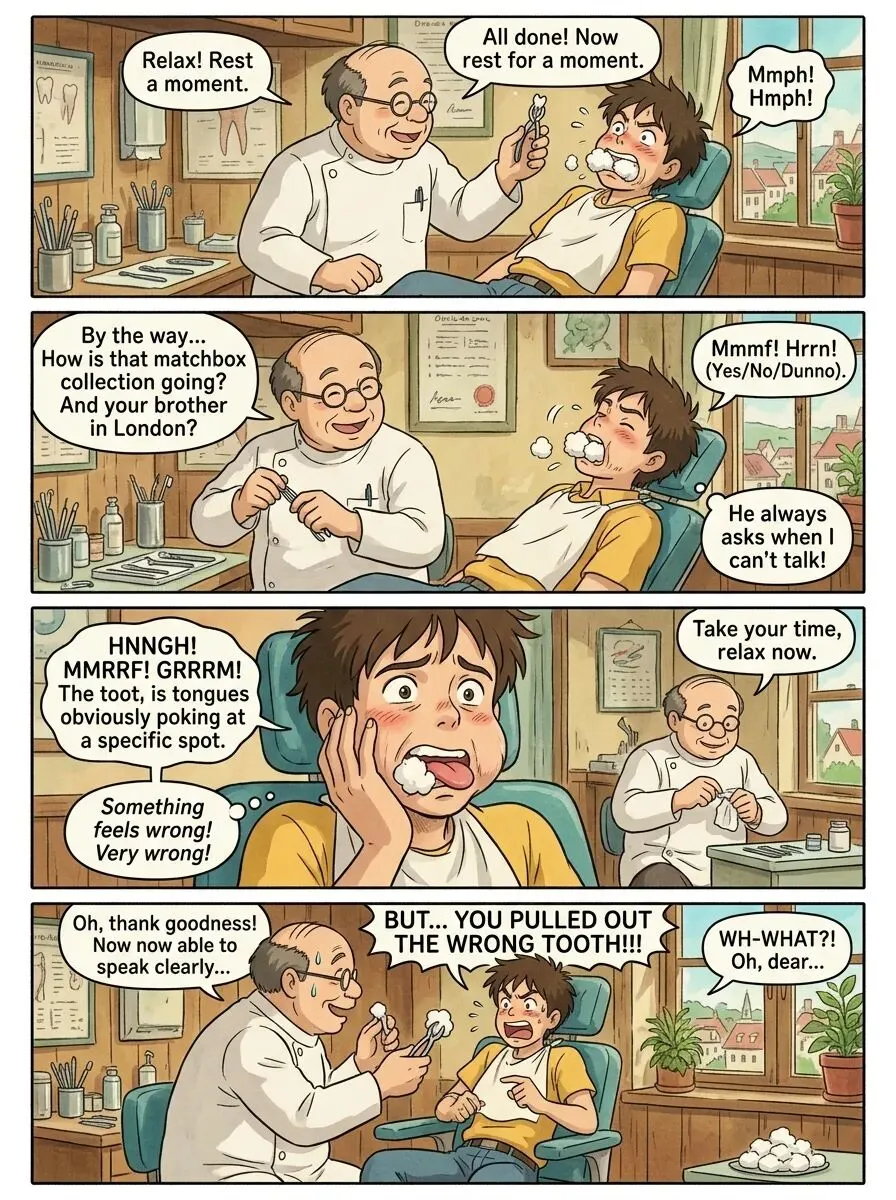
Dentists always ask questions when it is impossible for you to answer. My dentist had just pulled out one of my teeth and had told me to rest for a while. I tried to say something, but my mouth was full of cotton wool. He knew I collected match boxes and asked me whether my collection was growing. He then asked me how my brother was and whether I liked my new job in London. In answer to these questions I either nodded or made strange noises. Meanwhile, my tongue was busy searching out the hole where the tooth had been. I suddenly felt very worried, but could not say anything. When the dentist at last removed the cotton wool from my mouth, I was able to tell him that he had pulled out the wrong tooth.
背景简介
《新概念英语》第二册的课文以短小精悍的故事为主,旨在通过有趣的情节帮助学生掌握句型和语法。本课讲述了一个关于牙科治疗的幽默小故事,充满了戏剧性的反讽和意外结局。这种"医患沟通障碍"的主题在西方幽默文学中非常常见,它利用了"想说却不能说"的尴尬情境制造笑点。课文中的"我"在牙医拔牙后,因为嘴里塞满棉球而无法说话,只能被动回答牙医的问题,最后发现牙医拔错了牙。这种"事后诸葛亮"的叙事方式,让读者在会心一笑的同时,也体会到了主人公的无奈和牙医的粗心。
参考译文
牙科医生们总是在你无法回答的时候向你提出问题。我的牙科医生刚刚给我拔掉了一颗牙,叫我休息一会儿。我想说点什么,但我嘴里塞满了药棉。他知道我收集火柴盒,于是问我我的收藏品是否在增加。接着他又问我兄弟好吗,问我是否喜欢伦敦的新工作。作为对这些问题的回答,我不是点头,就是发出奇怪的声音。与此同时,我的舌头正在忙着寻找刚拔掉的那颗牙的伤口。我突然非常着急起来,但却什么也说不出来。当那位牙医最后将药棉从我嘴里取出时,我总算可以告诉他,他拔错了牙。
🔍 第二部分:逐句精讲与词块总结
句子1
1. 原文: Dentists always ask questions when it is impossible for you to answer.
2. 翻译: 牙科医生们总是在你无法回答的时候向你提出问题。
3. 句子结构: 这是一个复合句。主句是"Dentists always ask questions",从句是由"when"引导的时间状语从句"when it is impossible for you to answer"。从句中使用的是"it is + 形容词 + for sb. to do sth."的句型,其中"it"是形式主语,真正的主语是后面的不定式短语"for you to answer"。
4. 重点词汇:
dentist 蓝思值 770 L
英音[ˈdentɪst] 美音[ˈdentɪst] 词性:名词
释义:牙科医生
常用语块:go to the dentist (去看牙医)
短语搭配:see a dentist (看牙医); dentist's appointment (牙医预约)
例句一:I have a toothache, so I need to see a dentist. 我牙疼,所以需要去看牙医。
例句二:The dentist told me to brush my teeth twice a day. 牙医告诉我每天刷两次牙。
拓展:该词来自"dental"(牙齿的)加上表示"人"的后缀"-ist"。类似构词的有"artist"(艺术家)、"scientist"(科学家)。注意"dentist"特指牙医,而"doctor"泛指医生。
impossible 蓝思值 820 L
英音[ɪmˈpɒsəbl] 美音[ɪmˈpɑːsəbl] 词性:形容词
释义:不可能的
常用语块:it is impossible to do sth. (做某事是不可能的)
短语搭配:find it impossible (发现......不可能); make it impossible (使......不可能)
例句一:It is impossible for him to finish the work in one day. 他不可能在一天内完成这项工作。
例句二:The heavy rain made it impossible for us to go out. 大雨使我们无法外出。
拓展:该词由否定前缀"im-"加上"possible"(可能的)构成。反义词是"possible"。注意"impossible"语气很强,表示完全没有可能性,而"unlikely"则表示"不太可能",语气较弱。
5. 语法点睛: 本句的语法重点在于"when"引导的时间状语从句和"it is + 形容词 + for sb. to do sth."句型。[NCE知识点笔记]中明确指出,时间状语从句中,如果主句用一般现在时,从句也用一般现在时表示经常发生的动作。本句中"always"表示习惯性动作,所以主句和从句都使用一般现在时。此外,"it is impossible for you to answer"这个结构中的"for you"是不定式"to answer"的逻辑主语,这是英语中常见的表达方式。
句子2
1. 原文: My dentist had just pulled out one of my teeth and had told me to rest for a while.
2. 翻译: 我的牙科医生刚刚给我拔掉了一颗牙,叫我休息一会儿。
3. 句子结构: 这是一个并列句,由"and"连接两个并列的谓语部分。主语是"My dentist",谓语分别是"had just pulled out"和"had told"。两个谓语都使用了过去完成时(had + 过去分词),表示这两个动作都发生在"我"试图说话之前。
4. 重点词汇:
pull out 蓝思值 640 L
英音[pʊl aʊt] 美音[pʊl aʊt] 词性:动词短语
释义:拔出;抽出
常用语块:pull out a tooth (拔牙)
短语搭配:pull out of (从......中退出); pull out all the stops (全力以赴)
例句一:The dentist pulled out my bad tooth. 牙医拔掉了我的坏牙。
例句二:He pulled out a gun and pointed it at me. 他掏出一把枪,对准了我。
拓展:这是一个及物动词短语,宾语可以放在中间(pull the tooth out)或后面(pull out the tooth)。当宾语是代词时,必须放在中间(pull it out)。
rest 蓝思值 610 L
英音[rest] 美音[rest] 词性:动词 / 名词
释义:休息
常用语块:rest for a while (休息一会儿)
短语搭配:have a rest (休息一下); take a rest (休息); rest one's eyes (让眼睛休息)
例句一:You should rest after the operation. 手术后你应该休息。
例句二:I need a rest from all this hard work. 我需要从这些繁重的工作中休息一下。
拓展:作为动词,rest 可以作及物动词(rest sth.)或不及物动词(rest for...)。作为名词,rest 是不可数名词,但可以说"a rest"表示"一段休息时间"。
5. 语法点睛: 本句的核心语法是过去完成时。[名师精讲]中详细讲解了过去完成时的用法:它表示"过去的过去",即一个动作发生在另一个过去动作之前。在本句中,"拔牙"和"告诉休息"这两个动作都发生在"我试图说话"(隐含的过去时间点)之前,所以使用过去完成时。had just pulled out 中的 just 强调动作刚刚完成。had told me to rest 中的 to rest 是动词不定式作宾语补足语。
句子3
1. 原文: I tried to say something, but my mouth was full of cotton wool.
2. 翻译: 我想说点什么,但我嘴里塞满了药棉。
3. 句子结构: 这是一个由"but"连接的并列句,表示转折关系。第一个分句"I tried to say something",第二个分句"my mouth was full of cotton wool"。两个分句之间形成对比:主观意愿(想说)与客观障碍(嘴里有棉球)的矛盾。
4. 重点词汇:
try to do 蓝思值 620 L
英音[traɪ tuː duː] 美音[traɪ tuː duː] 词性:动词短语
释义:试图做某事;尽力做某事
常用语块:try to say something (试图说点什么)
短语搭配:try one's best to do (尽力做某事); try doing (尝试做某事)
例句一:I tried to open the door, but it was locked. 我试图打开门,但门是锁着的。
例句二:She tried to finish the work on time. 她尽力按时完成工作。
拓展:辨析 try to do 和 try doing。try to do 表示"努力/试图去做某事",强调动作的意图;try doing 表示"尝试做某事",强调试验一种方法。例如:I tried to open the window (我试图打开窗户,可能打不开). I tried opening the window (我试着打开窗户,看看效果如何).
be full of 蓝思值 680 L
英音[biː fʊl ɒv] 美音[biː fʊl ʌv] 词性:介词短语
释义:充满......的
常用语块:be full of water (充满水)
短语搭配:be full of energy (充满活力); be full of hope (充满希望)
例句一:The room was full of people. 房间里挤满了人。
例句二:Her eyes were full of tears. 她的眼里充满了泪水。
拓展:同义短语是"be filled with",但"be full of"更强调状态,而"be filled with"更强调动作的结果。例如:The glass is full of water. (杯子是满的,状态) The glass was filled with water. (杯子被装满了水,动作结果)
cotton wool 蓝思值 860 L
英音[ˈkɒtn wʊl] 美音[ˈkɑːtn wʊl] 词性:名词(不可数)
释义:药棉;脱脂棉
常用语块:a piece of cotton wool (一块药棉)
短语搭配:cotton wool balls (棉球)
例句一:The nurse used cotton wool to clean the wound. 护士用药棉清洗伤口。
例句二:He put some cotton wool in his ears to block out the noise. 他往耳朵里塞了些棉花来隔绝噪音。
拓展:在英式英语中常用"cotton wool",美式英语中更常用"cotton ball"或"absorbent cotton"。注意"wool"在这里不是指"羊毛",而是指"棉絮"状的材质。
5. 语法点睛: [语法新思维]中强调,并列连词"but"表示转折关系,连接两个语义上相反或对比的分句。本句中,"tried to say"和"was full of cotton wool"形成强烈对比,突出了主人公想说却不能说的尴尬处境,为后文的幽默结局埋下伏笔。
句子4
1. 原文: He knew I collected match boxes and asked me whether my collection was growing.
2. 翻译: 他知道我收集火柴盒,于是问我我的收藏品是否在增加。
3. 句子结构: 这是一个复合句。主句是"He knew ... and asked me ..."。第一个谓语"knew"后接一个省略了"that"的宾语从句"I collected match boxes"。第二个谓语"asked"后接一个由"whether"引导的宾语从句"whether my collection was growing"。两个宾语从句都使用了间接引语的形式。
4. 重点词汇:
collect 蓝思值 630 L
英音[kəˈlekt] 美音[kəˈlekt] 词性:动词
释义:收集;收藏
常用语块:collect stamps (集邮)
短语搭配:collect money (募捐); collect data (收集数据)
例句一:My brother collects model cars. 我哥哥收集模型汽车。
例句二:The teacher collected the homework. 老师收走了作业。
拓展:名词形式是"collection"(收藏品;收集)和"collector"(收藏家)。形容词"collective"意为"集体的"。
match box 蓝思值 820 L
英音[ˈmætʃ bɒks] 美音[ˈmætʃ bɑːks] 词性:名词
释义:火柴盒
常用语块:a match box collection (火柴盒收藏)
短语搭配:empty match box (空火柴盒)
例句一:He has a large collection of match boxes from different countries. 他收藏了大量来自不同国家的火柴盒。
例句二:I found an old match box in the drawer. 我在抽屉里发现了一个旧火柴盒。
拓展:这是一个复合名词,由"match"(火柴)和"box"(盒子)组成。注意"match"的复数形式是"matches"。
collection 蓝思值 720 L
英音[kəˈlekʃn] 美音[kəˈlekʃn] 词性:名词
释义:收藏品;收集物
常用语块:a stamp collection (邮票收藏)
短语搭配:a collection of (一批......); art collection (艺术收藏)
例句一:My stamp collection is very valuable. 我的邮票收藏非常珍贵。
例句二:There is a collection of old books in the library. 图书馆里有一批旧书。
拓展:该词来自动词"collect"加上名词后缀"-ion"。类似构词的有"action"(行动)、"education"(教育)。
5. 语法点睛: 本句的语法重点是间接引语。[NCE知识点笔记]中详细讲解了直接引语转换为间接引语的规则。当主句动词是过去时(如"knew"和"asked")时,间接引语中的时态需要"往回推"。本句中,直接引语"Do you collect match boxes?"和"Is your collection growing?"转换为间接引语后,一般现在时"collect"变为一般过去时"collected",现在进行时"is growing"变为过去进行时"was growing"。同时,一般疑问句转换为由"whether"或"if"引导的宾语从句。
句子5
1. 原文: He then asked me how my brother was and whether I liked my new job in London.
2. 翻译: 接着他又问我兄弟好吗,问我是否喜欢伦敦的新工作。
3. 句子结构: 这是一个复合句。主句是"He then asked me",后接两个并列的宾语从句。第一个宾语从句是由"how"引导的特殊疑问句转换而来:"how my brother was"。第二个宾语从句是由"whether"引导的一般疑问句转换而来:"whether I liked my new job in London"。两个从句由"and"连接。
4. 重点词汇:
then 蓝思值 520 L
英音[ðen] 美音[ðen] 词性:副词
释义:然后;接着
常用语块:and then (然后)
短语搭配:by then (到那时); from then on (从那时起)
例句一:I finished my homework, and then I watched TV. 我做完作业,然后看了电视。
例句二:We lived in Paris, then moved to London. 我们住在巴黎,然后搬到了伦敦。
拓展:then 常用于叙事中表示时间顺序。注意不要与 than(比)混淆。
job 蓝思值 540 L
英音[dʒɒb] 美音[dʒɑːb] 词性:名词
释义:工作;职业
常用语块:a new job (一份新工作)
短语搭配:look for a job (找工作); lose one's job (失业); do a good job (干得好)
例句一:She got a job as a teacher. 她找到了一份教师的工作。
例句二:He is looking for a job in London. 他正在伦敦找工作。
拓展:辨析 job 和 work。job 是可数名词,指具体的"一份工作";work 是不可数名词,泛指"工作"这个概念。例如:I have a job. (我有一份工作。) I have work to do. (我有工作要做。)
5. 语法点睛: 本句继续巩固间接引语的用法。[名师精讲]中强调,特殊疑问句转换为间接引语时,需要保留疑问词(如 how),并将疑问句语序改为陈述句语序。因此,"How is your brother?" 变为 "how my brother was"。同样,一般疑问句"Do you like your new job in London?" 变为 "whether I liked my new job in London"。注意时态的统一:主句用过去时,从句也相应地使用过去时。
句子6
1. 原文: In answer to these questions I either nodded or made strange noises.
2. 翻译: 作为对这些问题的回答,我不是点头,就是发出奇怪的声音。
3. 句子结构: 这是一个简单句。主语是"I",谓语是"either nodded or made",使用了"either...or..."结构连接两个并列的谓语动词。介词短语"In answer to these questions"作状语,表示目的或方式。
4. 重点词汇:
in answer to 蓝思值 820 L
英音[ɪn ˈɑːnsə tuː] 美音[ɪn ˈænsər tuː] 词性:介词短语
释义:作为对......的回答;响应
常用语块:in answer to your question (回答你的问题)
短语搭配:in answer to the call (响应号召)
例句一:In answer to his question, I shook my head. 作为对他问题的回答,我摇了摇头。
例句二:The company sent a letter in answer to my complaint. 公司寄了一封信来回应我的投诉。
拓展:这是一个固定短语,常用于正式或半正式的语境中。同义短语有"in response to"。
nod 蓝思值 660 L
英音[nɒd] 美音[nɑːd] 词性:动词
释义:点头
常用语块:nod one's head (点头)
短语搭配:nod in agreement (点头同意); nod off (打瞌睡)
例句一:She nodded when I asked if she understood. 当我问她是否明白时,她点了点头。
例句二:He nodded to me as he passed. 他经过时向我点了点头。
拓展:nod 的反义词是 shake one's head(摇头)。注意 nod 的过去式和过去分词是 nodded,现在分词是 nodding。
either...or... 蓝思值 720 L
英音[ˈaɪðə(r) ɔː(r)] 美音[ˈiːðər ɔːr] 词性:并列连词
释义:要么......要么......;不是......就是......
常用语块:either this or that (要么这个要么那个)
短语搭配:either...or... (连接两个并列成分)
例句一:You can either come with me or stay at home. 你要么跟我来,要么待在家里。
例句二:Either you apologize, or I will never speak to you again. 要么你道歉,要么我再也不跟你说话了。
拓展:either...or... 连接两个主语时,谓语动词的单复数遵循"就近原则",即与最靠近的主语保持一致。例如:Either you or he is wrong. (要么你错了,要么他错了。)
5. 语法点睛: [语法新思维]中讲解了"either...or..."结构的用法。它连接两个并列的语法成分,表示选择关系。在本句中,它连接两个并列的谓语动词"nodded"和"made",表示主人公只能在这两种反应中选择一种。这进一步强化了他无法正常说话的困境。
句子7
1. 原文: Meanwhile, my tongue was busy searching out the hole where the tooth had been.
2. 翻译: 与此同时,我的舌头正在忙着寻找刚拔掉的那颗牙的伤口。
3. 句子结构: 这是一个复合句。主句是"my tongue was busy searching out the hole",其中"was busy searching out"是"be busy doing sth."结构。从句是由"where"引导的定语从句"where the tooth had been",修饰先行词"the hole"。
4. 重点词汇:
meanwhile 蓝思值 810 L
英音[ˈmiːnwaɪl] 美音[ˈmiːnwaɪl] 词性:副词
释义:与此同时;在此期间
常用语块:meanwhile, back at the ranch (与此同时,在另一边)
短语搭配:in the meanwhile (在此期间)
例句一:I was cooking dinner. Meanwhile, my husband was setting the table. 我在做晚饭。与此同时,我丈夫在摆桌子。
例句二:The doctor will be here soon. Meanwhile, try to relax. 医生很快就到。在此期间,尽量放松。
拓展:meanwhile 常用于叙事中,表示两个事件同时发生。同义词是"in the meantime"。
be busy doing 蓝思值 680 L
英音[biː ˈbɪzi ˈduːɪŋ] 美音[biː ˈbɪzi ˈduːɪŋ] 词性:动词短语
释义:忙于做某事
常用语块:be busy working (忙于工作)
短语搭配:be busy with sth. (忙于某事)
例句一:She is busy preparing for the exam. 她正忙着准备考试。
例句二:The children are busy playing in the garden. 孩子们正在花园里忙着玩耍。
拓展:注意这个结构中的"doing"是动名词,不能改为不定式"to do"。可以说"be busy with sth.",其中"with"后接名词。
search out 蓝思值 790 L
英音[sɜːtʃ aʊt] 美音[sɜːrtʃ aʊt] 词性:动词短语
释义:找出;搜寻到
常用语块:search out the truth (找出真相)
短语搭配:search out a solution (寻找解决方案)
例句一:The detective searched out the hidden clue. 侦探找到了隐藏的线索。
例句二:My tongue searched out the hole where the tooth had been. 我的舌头找到了刚拔掉牙的那个洞。
拓展:search out 强调通过努力寻找而"找到"某物,比单纯的"search"(搜索)更强调结果。
5. 语法点睛: 本句包含一个由"where"引导的定语从句。[NCE知识点笔记]中讲解了关系副词"where"的用法,它相当于"in which"或"at which",在从句中作地点状语。本句中,"where the tooth had been"修饰"the hole",说明这个洞是"牙齿曾经所在的地方"。从句中使用过去完成时"had been",表示牙齿的"存在"状态在"舌头寻找"这个动作之前就已经结束了。
句子8
1. 原文: I suddenly felt very worried, but could not say anything.
2. 翻译: 我突然非常着急起来,但却什么也说不出来。
3. 句子结构: 这是一个由"but"连接的并列句。第一个分句"I suddenly felt very worried",第二个分句"could not say anything"。第二个分句省略了主语"I",以避免重复。两个分句之间形成转折关系:内心非常着急,但外在却无法表达。
4. 重点词汇:
suddenly 蓝思值 680 L
英音[ˈsʌdənli] 美音[ˈsʌdənli] 词性:副词
释义:突然地
常用语块:suddenly realize (突然意识到)
短语搭配:all of a sudden (突然)
例句一:Suddenly, the lights went out. 突然,灯灭了。
例句二:I suddenly remembered that I had left my keys at home. 我突然想起我把钥匙忘在家里了。
拓展:该词来自形容词"sudden"加上副词后缀"-ly"。同义词有"abruptly"。
worried 蓝思值 630 L
英音[ˈwʌrid] 美音[ˈwɜːrid] 词性:形容词
释义:担心的;着急的
常用语块:feel worried (感到担心)
短语搭配:be worried about (担心......)
例句一:She is worried about her exam results. 她担心她的考试成绩。
例句二:He looked worried when he heard the news. 他听到消息时看起来很担心。
拓展:该词来自动词"worry"(担心)的过去分词形式,作形容词使用。注意"worried"的主语通常是人,而"worrying"的主语通常是事物。例如:I am worried. (我很担心。) This is a worrying situation. (这是一个令人担忧的情况。)
5. 语法点睛: 本句的"but"再次强调了转折关系。主人公的"着急"与他"说不出话"的困境形成强烈对比,将故事的紧张感推向高潮。这种"内心活动"与"外在表现"的矛盾,是制造幽默和悬念的常用手法。
句子9
1. 原文: When the dentist at last removed the cotton wool from my mouth, I was able to tell him that he had pulled out the wrong tooth.
2. 翻译: 当那位牙医最后将药棉从我嘴里取出时,我总算可以告诉他,他拔错了牙。
3. 句子结构: 这是一个多重复合句。主句是"I was able to tell him",后接一个由"that"引导的宾语从句"that he had pulled out the wrong tooth"。主句前是一个由"When"引导的时间状语从句"When the dentist at last removed the cotton wool from my mouth"。整个句子清晰地表达了事件的时间顺序:牙医取出棉球之后,主人公才能说话。
4. 重点词汇:
at last 蓝思值 700 L
英音[æt lɑːst] 美音[æt læst] 词性:副词短语
释义:终于;最后
常用语块:at last, we arrived (我们终于到了)
短语搭配:at long last (终于;总算)
例句一:At last, the rain stopped. 雨终于停了。
例句二:He finished his homework at last. 他终于完成了作业。
拓展:at last 强调经过长时间的等待或努力后,某事终于发生。同义短语有"finally"和"in the end"。
remove 蓝思值 690 L
英音[rɪˈmuːv] 美音[rɪˈmuːv] 词性:动词
释义:移除;去掉
常用语块:remove sth. from (从......移除某物)
短语搭配:remove one's coat (脱掉外套); remove a stain (去除污渍)
例句一:Please remove your shoes before entering the room. 进入房间前请脱鞋。
例句二:The surgeon removed the tumor successfully. 外科医生成功切除了肿瘤。
拓展:该词由前缀"re-"(再次)加上词根"move"(移动)构成。名词形式是"removal"。
wrong 蓝思值 540 L
英音[rɒŋ] 美音[rɔːŋ] 词性:形容词
释义:错误的;不正确的
常用语块:the wrong tooth (错误的牙齿)
短语搭配:go wrong (出错); be wrong about (对......判断错误)
例句一:I took the wrong bus. 我坐错了公交车。
例句二:You are wrong about the time. 你把时间搞错了。
拓展:反义词是"right"或"correct"。注意"wrong"也可以作名词,意为"错误;不公正"。
5. 语法点睛: 本句是故事的结局,也是幽默的高潮。[名师精讲]中强调,宾语从句"that he had pulled out the wrong tooth"中使用了过去完成时"had pulled out",因为"拔错牙"这个动作发生在"告诉"这个动作之前。同时,主句中的"was able to"表示"终于能够",强调克服了之前的障碍(嘴里有棉球)。整个句子完美地结合了时间状语从句、宾语从句和过去完成时,清晰地展现了事件的因果关系和时间顺序。
📌 核心词块总结 (Key Lexical Chunks)
1. pull out: to remove something by pulling. Example: The dentist pulled out my aching tooth.
2. be full of: containing a large amount of something. Example: The room was full of smoke.
3. in answer to: as a reply or response to something. Example: In answer to my question, he just smiled.
4. either...or...: used to introduce two possibilities, one of which must be chosen. Example: You can either wait here or come with me.
5. be busy doing: to be occupied with an activity. Example: She is busy writing a report.
6. search out: to find something by looking carefully. Example: The dog searched out the hidden bone.
7. at last: after a long time; finally. Example: At last, the train arrived.
8. be able to: to have the ability or opportunity to do something. Example: I was able to finish the work on time.
✍️ 第三部分:语篇分析与段落写作技巧
1. 语篇分析
①Identify the macrostructure (识别宏观结构):本课是一篇典型的"幽默故事"类记叙文。其宏观结构可以概括为:背景介绍 (Situation) → 问题出现 (Problem) → 发展过程 (Development) → 高潮 (Climax) → 意外结局 (Unexpected Ending)。课文第一句是背景介绍(牙医总在无法回答时提问),第二句是问题出现(拔牙后嘴里塞满棉球),接着是发展过程(牙医不断提问,"我"只能点头或发出怪声),然后是高潮("我"发现牙被拔错,但无法说话),最后是意外结局(棉球取出后,"我"终于说出真相)。这种结构环环相扣,层层推进,最后以出人意料的方式收尾,制造了强烈的幽默效果。
②List cohesive devices (列举衔接手段):作者运用了以下衔接手段使故事连贯。
*逻辑连接词:when, but, then, meanwhile, at last.
*时间链接:had just pulled out, then, meanwhile, when...at last.
*代词指代:he (指代 the dentist), I (指代 the narrator), my (指代 the narrator's).
*重复与同义替换:questions → these questions; asked → nodded or made strange noises (作为回答).
*并列结构:either nodded or made strange noises; how my brother was and whether I liked my new job.
③Analyze the author's attitude (分析作者态度):作者以一种略带讽刺和幽默的口吻叙述了整个事件。通过第一人称的视角,读者能深切感受到主人公的无奈和尴尬。作者没有直接批评牙医的粗心,而是通过描述主人公的内心活动("I suddenly felt very worried")和最后的意外结局("he had pulled out the wrong tooth"),让读者自己体会到故事的幽默和讽刺。这种"不动声色"的叙述方式,反而增强了故事的戏剧效果。
2. 写作技巧
①提炼写作逻辑:本课展示了一种有效的"悬念与反转"写作逻辑。其模式是:
*设置障碍 (Set up an obstacle):主人公因为嘴里塞满棉球而无法说话。
*制造悬念 (Create suspense):牙医不断提问,主人公只能被动回应,同时内心越来越着急。
*揭示真相 (Reveal the truth):最后,障碍被移除,真相大白——牙医拔错了牙。
*产生幽默 (Generate humor):真相与之前的平静形成强烈反差,产生幽默效果。
②提供段落写作范例:
*题目: Write a short story about a misunderstanding that happened because you couldn't speak.
*范文:
My barber always asks questions when it is impossible for me to answer. He had just started cutting my hair and had covered my face with shaving cream. I tried to say something, but my mouth was full of foam. He knew I was a football fan and asked me whether I had watched the match last night. He then asked me who I thought would win the championship. In answer to these questions I either grunted or made strange sounds. Meanwhile, I was trying to tell him that he was using the wrong razor blade. I suddenly felt very worried, but could not say anything. When the barber at last wiped the foam from my face, I was able to tell him that he had cut my ear.
*结构特点分析:
*模仿句式:My barber always asks questions when it is impossible for me to answer. (模仿课文第一句句式)
*悬念逻辑:通过设置"脸上涂满剃须膏"的障碍,制造了与课文类似的"想说不能说"的困境。
*意外结局:最后发现理发师"割伤了耳朵",与课文的"拔错牙"异曲同工,都是出人意料的幽默结局。
*语言点映射:
* had just started cutting → 映射 had just pulled out
* was full of foam → 映射 was full of cotton wool
* either grunted or made strange sounds → 映射 either nodded or made strange noises
* was able to tell him → 映射 was able to tell him
③布置小练笔并提供例文:
*小练笔: 请模仿本课课文,写一个关于"在餐厅吃饭时,嘴里塞满食物无法说话,结果服务员误解了你的意思"的短故事。字数不限。
*例文:
Waiters always ask questions when it is impossible for you to answer. I had just taken a big bite of a hamburger and was chewing. The waiter came to my table and asked me whether I wanted more ketchup. I tried to say "yes", but my mouth was full of food. He then asked me whether the steak was cooked well. In answer to these questions I either nodded or waved my hands. Meanwhile, I was trying to swallow the food quickly. I suddenly felt very worried, but could not say anything. When I at last swallowed the food, I was able to tell him that I had wanted more ketchup, but now I needed a glass of water because I was choking.
*分析:
* 故事模仿了"设置障碍 → 制造悬念 → 意外结局"的结构。
* 使用了 had just taken, was full of, either...or..., was able to tell 等课文中的核心结构。
* 结局"需要一杯水,因为噎着了"是一个幽默的反转。
📐 第四部分:本课语法精析(加强版)
语法点:过去完成时 (The Past Perfect Tense)
本课的核心语法是过去完成时,其结构为"had + 过去分词"。此语法点在《NCE知识点笔记Book II.pdf》的第48课有详细总结 [NCE知识点笔记],同时在《新概念英语名师精讲笔记 第2册.pdf》 [名师精讲] 和《新概念英语语法新思维 第2册.pdf》 [语法新思维] 中也有深入讲解。以下是结合这些资料的系统讲解。
一、过去完成时的核心用法
过去完成时表示"过去的过去",即一个动作发生在另一个过去动作之前。它不能单独使用,必须有一个过去的时间点作为参照。
1. 表示两个过去动作的先后顺序:这是过去完成时最常见的用法。先发生的动作使用过去完成时,后发生的动作使用一般过去时。
- 来源: [NCE知识点笔记] 和 [名师精讲]
- 例句1: My dentist had just pulled out one of my teeth and had told me to rest for a while. (拔牙和告诉休息这两个动作都发生在"我试图说话"之前。) [课文原句]
- 例句2: When I arrived at the station, the train had already left. (我到达车站时,火车已经开走了。) [名师精讲]
- 例句3: She had finished her homework before she went to bed. (她在睡觉前已经完成了作业。)
- 例句4: He had never been to London before he moved there. (他在搬到伦敦之前从未去过那里。)
- 例句5: I had just eaten lunch when my friend called. (我朋友打电话来时,我刚吃完午饭。)
2. 用于间接引语中:当主句动词是过去时,间接引语中的时态需要"往回推"。一般过去时或现在完成时通常变为过去完成时。
- 来源: [语法新思维]
- 例句6: He said that he had seen the film before. (他说他以前看过这部电影。直接引语:I have seen the film before.)
- 例句7: She told me that she had lost her keys. (她告诉我她丢了钥匙。直接引语:I lost my keys.)
- 例句8: I was able to tell him that he had pulled out the wrong tooth. (我总算可以告诉他,他拔错了牙。) [课文原句]
- 例句9: The teacher asked if we had finished our homework. (老师问我们是否完成了作业。)
- 例句10: He wondered why she had left so early. (他想知道她为什么那么早就离开了。)
3. 用于描述一个持续到过去某个时间点的状态或动作:常与 for 或 since 连用。
- 来源: [语法新思维]
- 例句11: By the time he was ten, he had learned to play the piano for five years. (到他十岁时,他已经学了五年钢琴了。)
- 例句12: She had been ill for a week before she saw a doctor. (她病了一个星期才去看医生。)
- 例句13: They had lived in that house since 1990. (他们从1990年起就一直住在那所房子里。)
- 例句14: I had known him for a long time before we became friends. (在我们成为朋友之前,我已经认识他很久了。)
二、过去完成时与一般过去时的对比
这是本课语法学习的重点和难点。两者都表示过去发生的动作,但时间参照点不同。
- 一般过去时:表示一个在过去某个时间点发生的动作,与现在无关。它通常有一个明确的过去时间状语(如 yesterday, last week, in 1990)。
- 过去完成时:表示一个动作发生在另一个过去动作之前,强调"过去的过去"。它通常没有明确的时间状语,而是以另一个过去动作作为参照。
- 对比例句:
- 例句15: I ate breakfast at 7 o'clock. (我七点吃了早餐。一般过去时,有明确时间点。)
- 例句16: I had eaten breakfast before I went to school. (我去上学前已经吃了早餐。过去完成时,以"去上学"为参照。)
- 例句17: He finished his work yesterday. (他昨天完成了工作。一般过去时。)
- 例句18: He had finished his work when I arrived. (我到达时,他已经完成了工作。过去完成时,以"我到达"为参照。)
- 例句19: She was very tired because she had worked all night. (她很累,因为她工作了一整夜。was 是一般过去时,had worked 是过去完成时,表示"工作"发生在"累"之前。)
三、与第一册相关语法点的对比分析
在第一册中,我们学习了现在完成时(have/has + 过去分词),它表示一个过去发生的动作对现在造成的影响或结果。
- 第一册(现在完成时):
- I have lost my keys. (我丢了钥匙。) ------ 强调现在找不到钥匙了。
- She has finished her homework. (她完成了作业。) ------ 强调现在作业已经完成了。
- 第二册(本课,过去完成时):
- I had lost my keys before I left home. (我出门前就丢了钥匙。) ------ 强调"丢钥匙"发生在"出门"之前。
- She had finished her homework when I called her. (我打电话给她时,她已经完成了作业。) ------ 强调"完成作业"发生在"打电话"之前。
对比结论:从第一册的现在完成时到第二册的过去完成时,核心区别在于时间参照点的不同。现在完成时以"现在"为参照,强调对现在的影响;过去完成时以"过去的某个时间点"为参照,强调"过去的过去"。两者都使用"have/had + 过去分词"的结构,但助动词的时态不同(现在时 have/has vs. 过去时 had)。
四、练习题 (12题)
选择正确的选项填空。
1. By the time we arrived at the cinema, the film _______.
A. already started B. has already started C. had already started D. was already starting
2. She _______ her homework before her mother came home.
A. finished B. has finished C. had finished D. was finishing
3. He told me that he _______ the book before.
A. reads B. has read C. had read D. was reading
4. I _______ never _______ such a beautiful place before I went to Paris.
A. have; seen B. had; seen C. did; see D. was; seeing
5. When I got to the station, I realized I _______ my ticket at home.
A. left B. have left C. had left D. was leaving
6. After he _______ his work, he went out for a walk.
A. finishes B. has finished C. had finished D. was finishing
7. She was very happy because she _______ the exam.
A. passes B. has passed C. had passed D. was passing
8. The teacher asked if we _______ the experiment.
A. finish B. have finished C. had finished D. were finishing
9. They _______ in that city for ten years before they moved to the countryside.
A. lived B. have lived C. had lived D. were living
10. I _______ just _______ my breakfast when the doorbell rang.
A. have; finished B. had; finished C. did; finish D. was; finishing
11. He said that he _______ never _______ to a dentist before.
A. has; been B. had; been C. did; go D. was; going
12. By the end of last year, they _______ more than 1000 cars.
A. produce B. have produced C. had produced D. were producing
练习题答案解析
1. C. had already started。句意:我们到达电影院时,电影已经开始了。"开始"发生在"到达"之前,是"过去的过去",用过去完成时。
2. C. had finished。句意:她在妈妈回家之前已经完成了作业。"完成作业"发生在"妈妈回家"之前,用过去完成时。
3. C. had read。句意:他告诉我他以前读过这本书。间接引语中,主句是过去时,从句用过去完成时表示"读"发生在"告诉"之前。
4. B. had; seen。句意:在去巴黎之前,我从未见过如此美丽的地方。"从未见过"发生在"去巴黎"之前,用过去完成时。
5. C. had left。句意:当我到达车站时,我意识到我把票忘在家里了。"忘票"发生在"意识到"之前,用过去完成时。
6. C. had finished。句意:他完成工作后,出去散步了。"完成工作"发生在"出去散步"之前,用过去完成时。
7. C. had passed。句意:她很高兴,因为她通过了考试。"通过考试"是"高兴"的原因,发生在"高兴"之前,用过去完成时。
8. C. had finished。句意:老师问我们是否完成了实验。间接引语中,主句是过去时,从句用过去完成时。
9. C. had lived。句意:他们在搬到乡下之前,在那个城市住了十年。"住了十年"发生在"搬到乡下"之前,用过去完成时。
10. B. had; finished。句意:我刚吃完早餐,门铃就响了。"吃完早餐"发生在"门铃响"之前,用过去完成时。
11. B. had; been。句意:他说他以前从未看过牙医。间接引语中,主句是过去时,从句用过去完成时。
12. C. had produced。句意:到去年年底为止,他们已经生产了超过1000辆汽车。"by the end of last year"是一个表示"到过去某个时间点为止"的时间状语,通常与过去完成时连用。
🎧 第五部分:听力与阅读策略训练
1. 听力技巧
① 预测关键词 (Predicting Key Words):在听录音前,根据课文标题"Did you want to tell me something?"进行预测。这个标题暗示了故事可能与"沟通障碍"有关。预测可能听到的词汇,如 dentist, tooth, mouth, question, answer, cotton wool, wrong 等。这能帮助我们更快地进入听力情境,并抓取关键信息。
练习:听第一遍录音,写下你听到的至少5个与预测相关的词汇。
② 抓主旨大意 (Gist Listening):听第二遍录音,尝试用一句话概括故事的核心内容。关注故事的起因(牙医拔牙)、经过(牙医提问,"我"无法回答)、结果(发现拔错了牙)。
问题:What is the main problem the narrator faces in the story?
答案:He cannot speak because his mouth is full of cotton wool, and he later discovers the dentist has pulled out the wrong tooth.
③ 笔记方法 (Note-taking):听第三遍录音,用关键词和箭头记录事件的发展顺序。例如:
Dentist -> pulled out tooth
↓
Told me to rest
↓
Mouth full of cotton wool
↓
Dentist asked questions
↓
I nodded / made noises
↓
Tongue searched hole
↓
Felt worried
↓
Dentist removed cotton wool
↓
I told him -> pulled out wrong tooth
2. 阅读理解策略
① 扫读 (Scanning):快速扫读文章,找出下列细节信息。
- 牙医给"我"拔了几颗牙?(one)
- "我"的嘴里塞满了什么?(cotton wool)
- "我"收集什么东西?(match boxes)
- 牙医最后拔错了什么?(the wrong tooth)
② 略读 (Skimming):快速阅读全文,理解文章结构。本课采用了什么结构?(问题-解决式,但问题并未真正解决,而是以意外结局收尾。或者是"背景-事件-高潮-结局"式。)
③ 推断词义 (Inferring meaning from context):根据上下文推断下列划线单词或短语的意思。
- "My dentist had just pulled out one of my teeth..."
- 猜词策略:牙医和牙齿的关系,通常牙医会"拔牙",所以 "pulled out" 应该是"拔出"的意思。
- "...my mouth was full of cotton wool."
- 猜词策略:后文说"我"无法说话,所以嘴里应该是"塞满了"棉球,因此 "full of" 是"充满"的意思。
- "In answer to these questions I either nodded or made strange noises."
- 猜词策略:因为无法说话,所以只能用动作回应。"nodded" 是"点头"的意思,与"made strange noises"形成对比。
📝 第六部分:习题讲解
关键句型练习 (Key Structures)
- 练习 A: 完成句子,要求使用过去完成时。本课的关键句型是过去完成时。练习旨在巩固这个结构。
- 讲解思路:
1. When I arrived, the train _______ (leave).
- 答案: had already left
- 解题思路: "火车离开"发生在"我到达"之前,是"过去的过去",用过去完成时。
2. She _______ (finish) her work before she went home.
- 答案: had finished
- 解题思路: "完成工作"发生在"回家"之前,用过去完成时。
3. He told me that he _______ (see) the film before.
- 答案: had seen
- 解题思路: 间接引语中,主句是过去时,从句用过去完成时。
4. I _______ (never / be) to London before I went there last year.
- 答案: had never been
- 解题思路: "从未去过"发生在"去年去"之前,用过去完成时。
5. By the time he was ten, he _______ (learn) to play the piano.
- 答案: had learned
- 解题思路: "by the time he was ten"表示"到他十岁时",是一个过去的时间点,强调在此之前已经学会,用过去完成时。
- 练习 B: 改写句子,将直接引语改为间接引语。
- 讲解思路: 这类练习要求学生掌握直接引语转换为间接引语的规则,包括时态、人称、时间状语的变化。
- 直接引语:He said, "I have finished my work."
- 间接引语:He said that he had finished his work.
- 直接引语:She asked, "Do you like coffee?"
- 间接引语:She asked if/whether I liked coffee.
- 直接引语:He asked, "Where do you live?"
- 间接引语:He asked where I lived.
- 练习 C: 选择题。
- 讲解思路: 此练习测试学生对课文细节的理解和对应结构的掌握。主要题型是单项选择。
难点练习 (Special Difficulties)
本课的难点可能在于对 either...or... 和 neither...nor... 的辨析,以及一些动词短语的用法,如 pull out, search out, remove...from 等。
- either...or... vs. neither...nor...:either...or... 表示"要么......要么......",是肯定选择;neither...nor... 表示"既不......也不......",是否定选择。
- 例句:Either you or I am wrong. (要么你错了,要么我错了。) Neither you nor I am wrong. (你和我都没错。)
- pull out vs. take out:pull out 强调"用力拔出",常用于拔牙、拔钉子等;take out 更通用,表示"拿出;取出"。
- 例句:The dentist pulled out my tooth. (牙医拔掉了我的牙。) Please take out your books. (请拿出你们的书。)
- search out vs. find:search out 强调"通过努力寻找而找到";find 是"找到"的通用词。
- 例句:My tongue searched out the hole. (我的舌头找到了那个洞。) I found my keys. (我找到了我的钥匙。)
多项选择题
教师应带领学生完成教材后附的多项选择题,重点讲解阅读理解题和词汇结构题,并分析选择每个答案的原因。
🤔 第七部分:英文深度思考与拓展(强化版)
A. 层次化英文问题与答案
Level 1: Factual Questions (事实性问题)
1. Question: What did the dentist do to the narrator?
Answer: The dentist pulled out one of the narrator's teeth.
2. Question: Why couldn't the narrator answer the dentist's questions?
Answer: Because his mouth was full of cotton wool.
3. Question: What did the narrator discover when the dentist removed the cotton wool?
Answer: He discovered that the dentist had pulled out the wrong tooth.
Level 2: Inferential Questions (推理性问题)
4. Question: Why did the dentist ask the narrator about his match box collection and his brother?
Answer: The dentist was probably trying to make polite conversation and pass the time while the narrator was resting after the extraction.
5. Question: How did the narrator feel when his tongue was searching out the hole where the tooth had been?
Answer: He felt very worried because he realized something was wrong, probably that the hole was in the wrong place.
6. Question: Why did the narrator only nod or make strange noises instead of shaking his head?
Answer: Because he was trying to be polite and respond to the dentist's questions, even though he couldn't speak. Nodding was the easiest way to show he was listening.
Level 3: Evaluative Questions (评价性问题)
7. Question: Do you think the dentist was a good dentist? Why or why not?
Answer: No, I don't think he was a good dentist. A good dentist should be careful and make sure they pull out the correct tooth. His carelessness caused the narrator unnecessary pain and worry.
8. Question: What is the funniest part of the story? Explain your choice.
Answer: The funniest part is the ending, when the narrator finally says, "he had pulled out the wrong tooth." The humor comes from the contrast between the dentist's casual, friendly conversation and the shocking truth that he made a serious mistake. The reader can imagine the dentist's embarrassment.
9. Question: If you were the narrator, what would you have done differently?
Answer: If I were the narrator, I would have tried to make more obvious gestures or noises to stop the dentist from continuing his questions. I would have tried to grab a pen and paper to write down what was wrong, or I would have pointed to the wrong tooth.
10. Question: What does this story tell us about the importance of clear communication?
Answer: This story shows that clear communication is crucial, especially in situations like medical treatment. A simple misunderstanding or inability to communicate can lead to serious mistakes. It also highlights the importance of patients being able to express their concerns.
11. Question: How could the dentist have avoided this mistake?
Answer: The dentist could have avoided this mistake by double-checking the tooth before pulling it out. He could have asked the narrator to point to the painful tooth before the procedure, or he could have used a mirror to show the narrator which tooth he was going to remove. Better communication before the procedure would have prevented the error.
12. Question: Think of a similar situation where a lack of communication led to a funny or embarrassing outcome. Describe it briefly.
Answer: I once tried to order a "cappuccino" at a coffee shop, but because of the loud music, the barista thought I said "a cup of tea." I ended up with a cup of tea, which I didn't want. It was embarrassing because I had to explain the misunderstanding, and the barista had to make a new drink. It was a funny moment, but also a lesson in clear communication.
B. 多类型拓展阅读
类型 1: 时事新闻拓展
Title: Dentist Pulls Out Wrong Tooth: A Real-Life Case
A recent news report from a small town in the UK tells a story similar to our lesson. A patient, Mr. Smith, went to his dentist for a routine check-up. The dentist identified a tooth that needed to be extracted. However, due to a mix-up in the dental records, the dentist pulled out a healthy tooth instead of the decayed one. Mr. Smith only realized the mistake when the pain from the wrong tooth didn't go away. He sued the dentist for negligence and won a small compensation. This real-life case shows that the humorous story in our textbook is not just fiction. Such mistakes, though rare, do happen in the medical field, highlighting the critical need for careful verification and clear communication between doctors and patients.
- 引导性问题: What was the main cause of the dentist's mistake in this real-life story?
- 语言点映射: had pulled out (The dentist had pulled out the wrong tooth.) was able to tell (Mr. Smith was able to tell the dentist about the mistake.)
类型 2: 文化背景解析
Title: The Fear of the Dentist in Western Culture
In Western culture, a fear of the dentist, known as "dental anxiety" or "odontophobia," is very common. This fear often stems from the anticipation of pain, the sound of the drill, and the feeling of helplessness while sitting in the dental chair. Many jokes and cartoons are based on this fear. The story in our lesson plays on this fear by adding an extra layer of anxiety: not only is the patient in a vulnerable position, but he also cannot communicate a serious problem. This cultural context makes the story more relatable and humorous to Western readers. The dentist, often seen as a figure of authority and control, is portrayed as slightly incompetent, which subverts the usual power dynamic and adds to the comedy.
- 引导性问题: Why do you think the fear of the dentist is a common theme in Western humor?
- 语言点映射: impossible for you to answer (The patient's helplessness.) felt very worried (The patient's anxiety.)
类型 3: 今昔对比分析
Title: Dentistry: Then vs. Now
A hundred years ago, going to the dentist was a terrifying experience. Anesthesia was primitive, and extractions were often painful and brutal. Patients had little say in their treatment. Today, dentistry has advanced enormously. Local anesthesia is highly effective, making procedures nearly painless. X-rays and digital imaging allow for precise diagnosis. Dentists are trained to communicate with patients and explain procedures. The story in our lesson, written in 1967, reflects a time when dental practices were still quite traditional. The dentist's casual, one-sided conversation and the patient's inability to communicate would be less likely in a modern, patient-centered dental practice. However, the core theme of miscommunication remains relevant, reminding us that even with advanced technology, human error can still occur.
- 引导性问题: How has the relationship between dentists and patients changed from the past to the present?
- 语言点映射: had just pulled out (A past action.) was able to tell (The moment of communication.)
类型 4: 新潮英语改写
Title: The Barber's Mistake (现代场景改写)
Barbers always ask questions when it is impossible for you to answer. My barber had just started trimming my beard and had covered my face with hot foam. I tried to say something, but my mouth was full of foam. He knew I was a gamer and asked me whether I had finished the new game. He then asked me how my high score was and whether I liked the new update. In answer to these questions I either grunted or made strange noises. Meanwhile, my mind was busy realizing that he was using the wrong blade. I suddenly felt very worried, but could not say anything. When the barber at last wiped the foam from my face, I was able to tell him that he had cut my lip.
- 语言点映射: had just started trimming → had just pulled out. was full of foam → was full of cotton wool. either grunted or made strange noises → either nodded or made strange noises. was able to tell him → was able to tell him.
类型 5: 难度略高的拓展阅读
Title: The Psychology of Miscommunication in Medical Settings
The story in our lesson is a classic example of miscommunication in a medical setting. The patient, in a state of vulnerability and physical limitation, is unable to convey critical information. This situation is not just humorous but also psychologically significant. The power imbalance between the doctor (who is active and in control) and the patient (who is passive and constrained) can lead to serious errors. The patient's anxiety, combined with the physical inability to speak, creates a "communication breakdown." This breakdown is often the root cause of medical errors. The story serves as a cautionary tale, reminding medical professionals to be attentive to non-verbal cues and to ensure that patients have a clear channel to express their concerns, especially during procedures. The humor in the story masks a deeper, more serious message about patient safety.
- 引导性问题: What is the deeper, more serious message behind the humor of this story?
- 语言点映射: impossible for you to answer (The communication barrier.) felt very worried (The patient's psychological state.)
类型 6: 真实故事或人物传记
Title: The Inventor of the Modern Dental Chair
The modern dental chair, which allows patients to recline comfortably and gives dentists better access, was invented by a dentist named Dr. John Smith in the early 20th century. Before his invention, patients sat on ordinary chairs, which made procedures awkward and uncomfortable. Dr. Smith's innovation was driven by his desire to reduce patient anxiety and improve the quality of care. He believed that a comfortable patient would be less fearful and more cooperative. His invention revolutionized dentistry and is now a standard feature in every dental clinic. This story contrasts with our lesson, where the patient's discomfort is not physical (the chair) but communicative. It shows that while technology can improve the patient experience, it cannot replace the need for clear and effective communication.
- 引导性问题: How did Dr. Smith's invention address the problem of patient anxiety?
- 语言点映射: had just pulled out (A past action.) was able to tell (The moment of communication.)
🌍 第八部分:日常应用与文化拓展
1. 相关文化背景知识介绍
- 英国的牙科文化:在英国,牙科治疗(dental treatment)是国民健康服务体系(NHS)的一部分,但通常需要付费。很多人会选择私人牙医(private dentist)以获得更快的服务和更好的体验。看牙医(going to the dentist)是英国人生活中常见的活动,也是许多幽默故事的素材来源。
- "棉球"的幽默:课文中的"cotton wool"(药棉)是一个关键道具。它不仅是物理障碍,也是沟通障碍的象征。在西方幽默中,这种"想说却说不出"的困境经常被用来制造笑料,比如嘴里塞满食物、嘴里含着水等场景。
- 医患沟通的重要性:本课虽然是一个幽默故事,但也隐含了医患沟通的重要性。在现代医疗中,医生越来越重视与患者的沟通,确保患者能够充分表达自己的感受和需求。课文中牙医的粗心大意,从反面强调了这一点。
2. 推荐拓展学习资源
- 经典电影:《恐怖牙医》(The Dentist, 1996)——虽然是一部恐怖片,但可以了解西方文化中对牙医的恐惧心理。
- 喜剧短片:英国喜剧《憨豆先生》(Mr. Bean)中有一集关于看牙医的经典片段,充满了肢体幽默和沟通障碍,与本课主题高度相关。
- 书籍:英国作家Roald Dahl的短篇小说集《待宰的羔羊》(Lamb to the Slaughter)中有一些关于意外结局的黑色幽默故事,与本课的叙事风格相似。
- 在线资源:网站"BBC Learning English"上有关于"Going to the Dentist"的对话和听力练习,可以拓展相关词汇和表达。
💡 第九部分:引导性思考
1. English: In the story, the narrator could not speak because his mouth was full of cotton wool. What other situations in daily life can make it difficult or impossible for someone to communicate effectively? How would you handle such a situation? (在故事中,叙述者因为嘴里塞满棉球而无法说话。在日常生活中,还有哪些情况会使人难以或无法有效沟通?你会如何处理这种情况?)
2. English: Imagine you are the dentist in the story. Write a short apology note in English to the narrator after you realize your mistake. What would you say? (想象你是故事中的牙医。在你意识到自己的错误后,用英语给叙述者写一封简短的道歉信。你会说些什么?)
3. English: The story ends with the narrator telling the dentist about the wrong tooth. What do you think happened next? Write a short paragraph in English describing the possible consequences. (故事以叙述者告诉牙医拔错了牙结束。你认为接下来会发生什么?用英语写一个简短的段落描述可能的结果。)
🗂️ 第十部分:本课知识图谱(结构化逻辑图)
核心事件:叙述者在牙医拔牙后,因无法说话而未能及时阻止牙医拔错牙
├─ 主要支撑点一:沟通障碍的建立
│ ├─ 关键细节 1: 牙医拔掉了叙述者的一颗牙。
│ ├─ 关键细节 2: 牙医让叙述者休息,并在其嘴里塞满了药棉。
│ └─ 关键细节 3: 叙述者因此无法正常说话。
├─ 主要支撑点二:沟通障碍下的互动
│ ├─ 关键细节 1. 牙医的提问:
│ │ ├─ 牙医知道叙述者收集火柴盒,询问收藏情况。
│ │ ├─ 牙医询问叙述者兄弟的情况。
│ │ └─ 牙医询问叙述者是否喜欢伦敦的新工作。
│ └─ 关键细节 2. 叙述者的回应:
│ ├─ 由于无法说话,叙述者只能通过"点头"或"发出奇怪的声音"来回应。
│ └─ 叙述者的舌头在寻找拔牙后的伤口。
├─ 主要支撑点三:真相的发现与揭示
│ ├─ 关键细节 1. 叙述者的内心活动:
│ │ └─ 叙述者突然感到非常着急,并意识到可能出了问题,但无法表达。
│ ├─ 关键细节 2. 障碍的移除:
│ │ └─ 牙医终于取出了叙述者嘴里的药棉。
│ └─ 关键细节 3. 真相的揭示:
│ ├─ 叙述者终于能够说话。
│ └─ 他告诉牙医:他拔错了牙。
© 本文为狂暴英语教案 · 新概念英语第二册第48课
排版设计 · 仅供学习交流使用
贝琪酱英语无痛逆袭站
微信扫描二维码,关注我的账号