【狂暴英语教案】新概念英语第一册第81-82课:烤牛肉和土豆 / 我吃了...
读外刊,接触原汁原味的英文表达,
欢迎关注以下公众号+设为星标+推荐给朋友。▼
📚 狂暴英语教案 · 新概念英语第一册
第81-82课 Roast beef and potatoes & I had...
烤牛肉和土豆 / 我吃了...
📘 本课信息
教材:新概念英语第一册 · 第81-82课
核心功能:家中会客与晚餐 · 询问过去事件 · 表达失望
语法焦点:动态动词have · 一般过去时 · be going to · have与have got对比
🎯 本课学习目标
词汇维度:
掌握与日常饮食、家居生活相关的核心词汇,包括roast beef, potatoes, dinner, lunch, restaurant, upstairs, bath, whisky, cigarette, glass, nearly, ready等;掌握与"have"搭配的动态短语,如have a bath, have a cigarette, have a glass of whisky, have dinner, have lunch, have roast beef and potatoes等;理解并运用与邀请、拒绝、失望等情感相关的日常表达。
语法维度:
深入理解动词have作为普通动词表"进行、经历、吃喝"的动态用法,与之前所学的所有格have/has got形成对比;巩固一般过去时的构成与使用,重点掌握不规则动词have/had, go/went, eat/ate, drink/drank的过去式;掌握现在进行时表示正在进行的动作,以及be going to结构表示将来计划;熟练运用特殊疑问句What did you have?及相关答语。
技能维度:
能够运用本课句型描述自己和他人过去进行的活动(尤其是吃、喝、洗、玩等);能够就饮食经历进行简单问答;能够在日常对话中自然使用邀请与拒绝的表达方式;能够理解对话中的情感转折(如失望)并做出恰当回应。
文化维度:
了解英式传统晚餐"roast beef and potatoes"的文化背景及其在英国饮食中的重要地位;了解英式社交中邀请他人抽烟喝酒的习俗及其变迁;认识英国家庭晚餐的日常安排及"星期天烤肉"传统。
📖 第一部分:课文完整内容
第81课 课文原文(含语音标注)
📜 课文原文(含语音标注)
[第81课 对话全文]
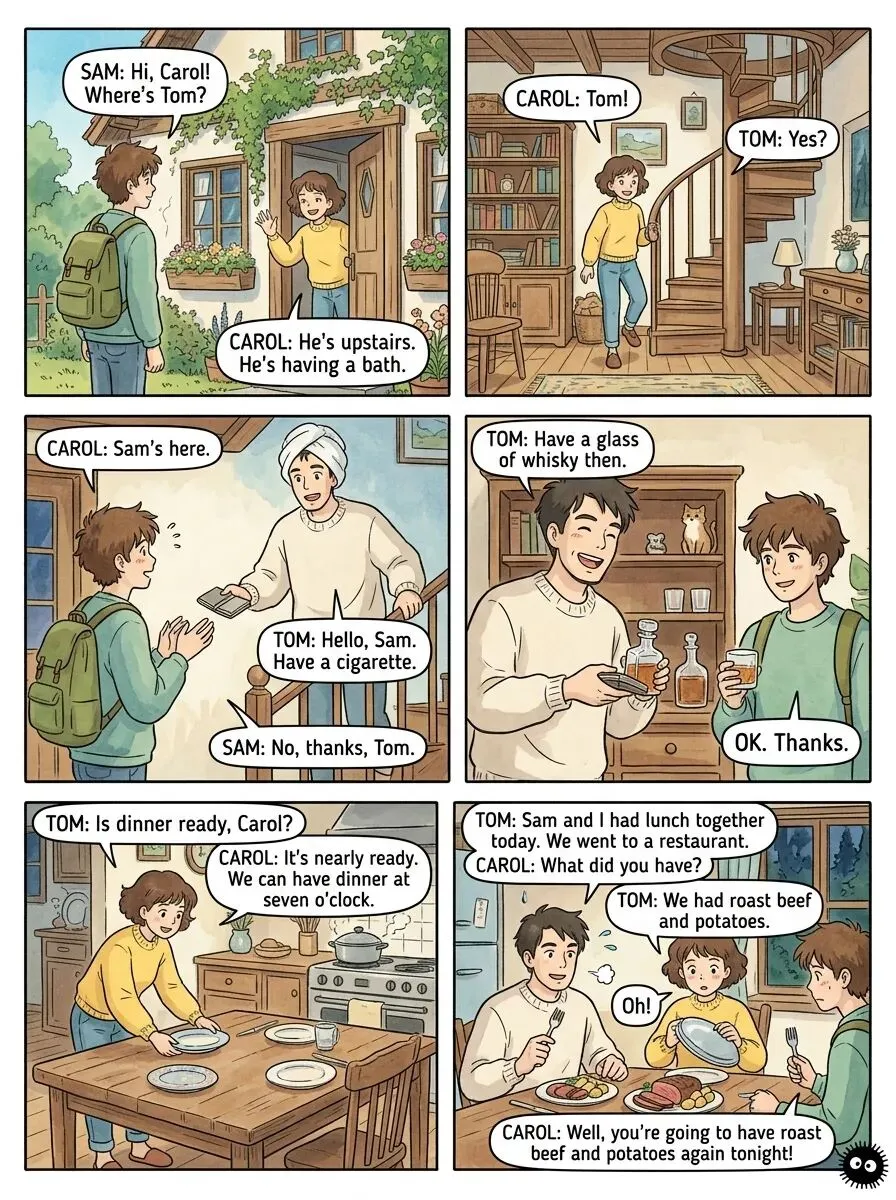
SAM: Hi, /haɪ/, Carol! Where's /weəz/ Tom?
CAROL: He's /hiːz/ upstairs. /ʌpˈsteəz/ He's /hiːz/ having a bath. /ˈbɑːθ/
TOM: Yes? /jes/
CAROL: Sam's /sæmz/ here. /hɪə/
TOM: I'm /aɪm/ nearly /ˈnɪəli/ ready. /ˈredi/ Hello, /həˈləʊ/ Sam. Have /hæv/ a cigarette. /ˌsɪɡəˈret/
SAM: No, thanks, /θæŋks/ Tom. /tɒm/
TOM: Well, /wel/ have /hæv/ a glass /ɡlɑːs/ of whisky /ˈwɪski/ then. /ðen/
SAM: OK. /əʊˈkeɪ/ Thanks. /θæŋks/ Is /ɪz/ dinner /ˈdɪnə/ ready, /ˈredi/ Carol? /ˈkærəl/
CAROL: It's /ɪts/ nearly /ˈnɪəli/ ready. /ˈredi/ We can have dinner at seven o'clock? /sevən əˈklɒk/?
TOM: Sam and I /aɪ/ had /hæd/ lunch /lʌntʃ/ together /təˈɡeðə/ today. /təˈdeɪ/ We went /went/ to a restaurant. /ˈrestərɒnt/
CAROL: What did you have? /wɒt dɪd juː hæv/
TOM: We had /hæd/ roast /rəʊst/ beef /biːf/ and potatoes /pəˈteɪtəʊz/.
CAROL: Oh! /əʊ/
TOM: What's /wɒts/ the matter, /ˈmætə/ Carol? /ˈkærəl/
CAROL: Well, /wel/ you're /jɔː/ going to have /ˈɡəʊɪŋ tə hæv/ roast /rəʊst/ beef /biːf/ and potatoes /pəˈteɪtəʊz/ again /əˈɡen/ tonight! /təˈnaɪt/
[第82课 练习句型]
第82课主要提供替换练习,没有独立对话,重点句型为:I had... / They had... / He had... / We are going to have... / They are having... / He must have... 等。详见语法部分。
情景说明
第81课的对话发生在Carol和Tom夫妇的家中,时间是晚餐前。Carol正在准备晚餐,Tom的同事Sam来访。Tom下楼接待Sam,并告知Sam自己正在洗澡。Carol告知晚餐即将准备好,暗示大家很快可以开饭。然而Tom随后透露,他和Sam中午已经在餐厅一起吃过午餐,前菜的正是烤牛肉和土豆。Carol顿时感到失望,因为她今晚准备的晚餐恰好完全一样。对话通过轻松幽默的方式展现了日常生活中的小意外,同时密集呈现了have在不同句式和时态中的灵活运用。
第82课是第81课后续的句型训练课,重点操练have作为普通动词在一般现在时、一般过去时、现在进行时、将来时(be going to)以及情态动词must等不同语境下的变化形式,帮助学习者巩固动态动词have的核心用法。
参考译文
[第81课 参考译文]
萨姆:嗨,卡罗尔!汤姆在哪儿?
卡罗尔:他在楼上。他正在洗澡。
汤姆:什么事?
卡罗尔:萨姆来了。
汤姆:我马上就准备好了。你好,萨姆。抽支烟吧。
萨姆:不了,谢谢,汤姆。
汤姆:那么,喝杯威士忌吧。
萨姆:好的,谢谢。卡罗尔,晚饭准备好了吗?
卡罗尔:快好了。我们可以在七点钟吃饭吗?
汤姆:萨姆和我今天一起吃的午餐。我们去了一家餐馆。
卡罗尔:你们吃了什么?
汤姆:我们吃了烤牛肉和土豆。
卡罗尔:哦!
汤姆:怎么了,卡罗尔?
卡罗尔:呃,你们今晚又要吃烤牛肉和土豆了!
[第82课 参考译文]
第82课为句型训练,无独立场景译文。
🔍 第二部分:逐句精讲与词块总结
句子1
1. 原文: SAM: Hi, Carol! Where's Tom?
2. 翻译: 萨姆:嗨,卡罗尔!汤姆在哪儿?
3. 句子结构: 感叹式问候句 + 特殊疑问句。Hi是感叹词,Carol是呼语,Where's Tom是特殊疑问句。Where是疑问副词,'s是is的缩略,Tom是主语。
4. 重点词汇:
Hi 蓝思值 130L
英音[haɪ] 美音[haɪ] 词性:感叹词
释义:(非正式)你好,嗨
常用语块:say hi to sb. 向某人打招呼
例句一:Hi, everyone! Let's begin. 嗨,大家!我们开始吧。
例句二:I just wanted to say hi. 我只是想打个招呼。
拓展:Hi比Hello更随意,常用于朋友、熟人或非正式场合。在《新概念英语口语宝典 第1册》中,hi是日常见面最常用的开场白之一,与课程Unit中"Casual Meeting"主题匹配。
Where 蓝思值 220L
英音[weə] 美音[wer] 词性:疑问副词
释义:在哪里,往哪里
常用语块:where to go 去哪里;where from 从何处来
例句一:Where is my book? 我的书在哪里?
例句二:Where do you live? 你住在哪里?
拓展:where引导特殊疑问句时,句式结构为"Where + be/助动词 + 主语?"。对比what(什么)、when(何时)、why(为什么)。本课中Where's是口语缩略形式。
's (is) 蓝思值 150L
英音[z] 美音[z] 词性:动词be的第三人称单数缩略形式
释义:是(he/she/it is的口语缩写)
常用语块:he's / she's / it's / where's / what's
例句一:He's a teacher. 他是一个老师。
例句二:Where's your sister? 你妹妹在哪里?
拓展:'s也可能是has的缩写,如He's got a car. 需要根据语境区分。本课为is。
5. 语法点睛: 特殊疑问句Where...? 用来询问地点或位置,结构为Where + be + 主语。这是自第1册第25课起反复训练的句型,属于最基础的疑问结构。[NCE知识点笔记]
6. 语音要点: Where's为连读,/weəz/。Hi语调上扬,表热情。整句话用升调疑问。
句子2
1. 原文: CAROL: He's upstairs. He's having a bath.
2. 翻译: 卡罗尔:他在楼上。他正在洗澡。
3. 句子结构: 两个简单句并列。第一句:He's upstairs. 主语+系动词+表语(副词)。第二句:He's having a bath. 主语+be+现在分词+宾语(现在进行时)。
4. 重点词汇:
upstairs 蓝思值 520L
英音[ˌʌpˈsteəz] 美音[ˌʌpˈsterz] 词性:副词
释义:在楼上,往楼上
常用语块:go upstairs 上楼;come upstairs 上楼来
例句一:My bedroom is upstairs. 我的卧室在楼上。
例句二:Please come upstairs. 请上楼。
拓展:分解up(向上)+ stairs(楼梯)。反义词downstairs。在英式英语中upstairs常与go/come搭配,表示方向性运动。本课作表语,表示位置。
bath 蓝思值 450L
英音[bɑːθ] 美音[bæθ] 词性:名词
释义:浴缸,洗澡
常用语块:have a bath 洗个澡;take a bath 洗澡
例句一:I have a bath every morning. 我每天早上洗澡。
例句二:The bath is full of hot water. 浴缸里装满了热水。
拓展:注意英式发音/bɑːθ/与美式/bæθ/的差异。bathroom表示浴室。have a bath是固定搭配,表示"洗澡"这一活动,have这里不是"拥有",而是"进行、享受"。该动态用法是本课核心语法点,在《新概念英语语法手册》中专门强调了have + 名词表示"经历、做"的结构,并引用了教材实例。[官方教材之新概念英语语法手册]
having 蓝思值 380L
英音[ˈhævɪŋ] 美音[ˈhævɪŋ] 词性:动词have的现在分词
释义:进行,做(与名词搭配表活动)
常用语块:having breakfast 吃早餐;having a lesson 上课
例句一:They are having lunch. 他们正在吃午饭。
例句二:She is having a shower. 她正在冲淋浴。
拓展:having是动态动词have的-ing形式,与现在进行时连用。不能与所有格的have got进行进行时搭配(不能说I'm having a car,除非表"我正在开着(体验)车"等特殊语境)。
5. 语法点睛: 现在进行时表示说话时刻正在进行的动作,结构为be + doing。本句He's having a bath表示汤姆洗澡的此刻正在发生的动作。注意have在这里是动态动词(dynamic verb),表示"经历、进行",与之前学的表示"拥有"的静态have不同。在《NCE知识点笔记Book I》中,第81课备注了"have作为普通动词表示'进行,吃,喝,洗,玩'等",强调其行为意义。[NCE知识点笔记]
6. 语音要点: He's upstairs中's与upstairs连读/hiːzʌpˈsteəz/;having a bath中having a连读/ˈhævɪŋə/,bath发音注意英式长元音/ɑː/。
句子3
1. 原文: TOM: Yes?
2. 翻译: 汤姆:什么事?
3. 句子结构: 单词句,用升调表示疑问,意为"什么事?"或"叫我吗?"
4. 重点词汇:
yes 蓝思值 100L
英音[jes] 美音[jes] 词性:感叹词/副词
释义:是,是的(这里表回应疑问)
常用语块:say yes 同意
例句一:Yes, I am. 是的,我是。
例句二:Yes? Can I help you? 什么事?我能帮你吗?
拓展:Yes? 升调时表示"什么事?",降调时表示肯定回答。本课中汤姆听到卡罗尔叫他的名字,用升调的Yes回应,相当于"What is it?"或"You called me?",是非常地道的生活口语。
5. 语法点睛: 单词句用语调表情感,升调表疑问或期待继续。
6. 语音要点: 升调/jes?/。
句子4
1. 原文: CAROL: Sam's here.
2. 翻译: 卡罗尔:萨姆来了。
3. 句子结构: 简单句。主语Sam's(Sam is)缩写,here作表语。
4. 重点词汇:
Sam 蓝思值 100L
英音[sæm] 美音[sæm] 词性:专有名词
释义:山姆(男子名)
常用语块:无
例句:Sam is my friend. 山姆是我的朋友。
here 蓝思值 150L
英音[hɪə] 美音[hɪr] 词性:副词
释义:在这里
常用语块:here you are 给你;over here 在这里
例句一:Come here! 过来!
例句二:Here is your coffee. 你的咖啡在这儿。
拓展:here在口语中常放在句首引起倒装:Here comes the bus. 但当主语是代词时用正常语序:Here he comes.
5. 语法点睛: 's是is的缩写。本句用一般现在时表示"萨姆在这儿(现在)",是一种状态描述。
6. 语音要点: Sam's与here连读/sæmzɪə/。
句子5
1. 原文: TOM: I'm nearly ready. Hello, Sam. Have a cigarette.
2. 翻译: 汤姆:我马上就准备好了。你好,萨姆。抽支烟吧。
3. 句子结构: 复合句。第一句I'm nearly ready为主系表结构;第二句Hello为问候;第三句Have a cigarette为祈使句(表建议)。
4. 重点词汇:
nearly 蓝思值 650L
英音[ˈnɪəli] 美音[ˈnɪrli] 词性:副词
释义:几乎,差不多
常用语块:nearly ready 快准备好了;nearly finished 快完成了;nearly all 几乎所有
例句一:It's nearly ten o'clock. 快到十点了。
例句二:I nearly fell. 我差点摔倒。
拓展:nearly与almost同义,但nearly常用于具体数字或程度。在此处nearly修饰ready,表示"几乎准备好但还不完全"。
ready 蓝思值 350L
英音[ˈredi] 美音[ˈredi] 词性:形容词
释义:准备好的
常用语块:be ready for 为......准备好;get ready 做好准备;ready to do 准备好做......
例句一:Are you ready? 你准备好了吗?
例句二:Dinner is ready. 晚饭准备好了。
拓展:ready在口语中极高频。本课的ready与dinner配合,直击家庭生活场景。
Hello 蓝思值 120L
英音[həˈləʊ] 美音[həˈloʊ] 词性:感叹词
释义:你好(通用问候)
常用语块:say hello to sb. 向某人问好
例句:Hello, this is Mary speaking. 你好,我是玛丽。
拓展:Hello比Hi正式,但在本句中汤姆刚洗完澡与Sam见面,用Hello是自然的转换。
cigarette 蓝思值 610L
英音[ˌsɪɡəˈret] 美音[ˈsɪɡəret] 词性:名词
释义:香烟,卷烟
常用语块:smoke a cigarette 抽烟;a pack of cigarettes 一包烟
例句一:He lit a cigarette. 他点燃了一支烟。
例句二:Do you have a cigarette? 你有烟吗?
拓展:cigarette是cigar(雪茄)的派生词。本课场景中汤姆邀请Sam抽烟,但在现代英式英语中,邀请抽烟已不如过去常见,适合讨论文化变迁。
5. 语法点睛: Have a cigarette是祈使句,用动词原形have表示建议或邀请。这种句式在社交场合相当于"请抽烟",是提供物品的礼貌方式。注意此时have是普通动词,意为"抽(烟)"。[名师精讲]
6. 语音要点: I'm nearly中nearly的/ɪə/音;Hello升调表热情;Have a cigarette中have a连读/ˈhævə/,cigarette重音在最后音节/ˈret/。
句子6
1. 原文: SAM: No, thanks, Tom.
2. 翻译: 萨姆:不,谢谢,汤姆。
3. 句子结构: 简单句,由否定词No和礼貌致谢构成,呼语Tom。
4. 重点词汇:
No 蓝思值 80L
英音[nəʊ] 美音[noʊ] 词性:感叹词/副词
释义:不,不是,没有
常用语块:No, thanks 不,谢谢;no way 没门
例句:No, I don't want any. 不,我什么都不要。
拓展:No后常加逗号再接thanks,是礼貌拒绝的标准模式。
thanks 蓝思值 250L
英音[θæŋks] 美音[θæŋks] 词性:名词复数(表感激)
释义:谢谢,感谢
常用语块:thanks a lot 多谢;many thanks 万分感谢;no thanks 不必了谢谢
例句一:Thanks for your help. 谢谢你的帮助。
例句二:Thanks, but I'm full. 谢谢,但我饱了。
拓展:thanks比thank you更随意。后可直接加for。
5. 语法点睛: 拒绝邀请的标准结构:No, thanks. 是礼貌的否定回应,不必扩展成完整句子。
6. 语音要点: 语调先降后升,No降调表否定,thanks升调表礼貌。
句子7
1. 原文: TOM: Well, have a glass of whisky then.
2. 翻译: 汤姆:那么,喝杯威士忌吧。
3. 句子结构: 祈使句。Well为语气词,have a glass of whisky为动词短语,then表示"那么"。
4. 重点词汇:
well 蓝思值 200L
英音[wel] 美音[wel] 词性:感叹词
释义:嗯,好吧,那么(语气词)
常用语块:well then 那么;oh well 哦好吧
例句一:Well, I don't know. 嗯,我不知道。
例句二:Well, let's go. 好吧,我们走。
拓展:well作为感叹词常用于转移话题、重新考虑或结束前一个话题。
glass 蓝思值 400L
英音[ɡlɑːs] 美音[ɡlæs] 词性:名词
释义:玻璃杯,一杯的量
常用语块:a glass of water 一杯水;a glass of wine 一杯酒
例句一:Can I have a glass of milk? 我能喝杯牛奶吗?
例句二:Pass me that glass. 把那个杯子递给我。
拓展:glass作为材质时不可数(a piece of glass),作为容器时可数。a glass of + 液体,是标准表达。
whisky 蓝思值 680L
英音[ˈwɪski] 美音[ˈwɪski] 词性:名词
释义:威士忌(烈酒)
常用语块:Scotch whisky 苏格兰威士忌;a bottle of whisky 一瓶威士忌
例句一:He drank too much whisky. 他喝了太多威士忌。
例句二:Would you like some whisky? 你想喝点威士忌吗?
拓展:whisky在不同国家拼写不同,苏格兰与加拿大拼whisky,爱尔兰与美国拼whiskey。英美都喝,但威士忌是典型英国烈酒。
then 蓝思值 250L
英音[ðen] 美音[ðen] 词性:副词
释义:那么,然后
常用语块:by then 到那时;since then 自从那时
例句一:Then what happened? 然后发生了什么?
例句二:If you're tired, then go to bed. 如果你累了,那就去睡觉。
5. 语法点睛: 本句继续使用祈使句表建议。have a glass of whisky与have a cigarette结构一致,展示have + 物品的用法。注意冠词:a glass of whisky,因为glass是可数名词,所以用a。
6. 语音要点: Well拖长音表思考;have a连读/ˈhævə/;glass of whisky连读/ɡlɑːsəvˈwɪski/。
句子8
1. 原文: SAM: OK. Thanks. Is dinner ready, Carol?
2. 翻译: 萨姆:好的。谢谢。卡罗尔,晚饭准备好了吗?
3. 句子结构: 三个简单句。OK表同意;Thanks表感谢;最后一个为一般疑问句Is dinner ready?,Carol为呼语。
4. 重点词汇:
OK 蓝思值 80L
英音[əʊˈkeɪ] 美音[oʊˈkeɪ] 词性:感叹词/形容词
释义:好的,行,可以
常用语块:OK with sb. 某人同意;It's OK 没关系
例句:OK, let's go. 好,我们走。
拓展:OK是世界通用的词,源自all correct的缩写。
dinner 蓝思值 350L
英音[ˈdɪnə] 美音[ˈdɪnər] 词性:名词
释义:正餐,晚餐
常用语块:have dinner 吃晚饭;dinner time 晚饭时间;dinner party 晚宴
例句一:What's for dinner? 晚饭吃什么?
例句二:We had dinner at a Chinese restaurant. 我们在一家中餐馆吃的晚饭。
拓展:dinner通常指一天中的主餐,可以是中餐(lunch)或晚餐,但在大多数英国家庭中指晚餐。现代英式英语中tea有时可指晚餐,但dinner更正式。[美文欣赏中也有解释]
5. 语法点睛: 一般疑问句Is dinner ready? 结构为Be动词+主语+表语,回答用Yes, it is. / No, it isn't. 本句询问状态,与前面询问位置的Where's Tom形成对比。
6. 语音要点: OK语调上扬表确认;dinner ready/dɪnəredi/连读;Carol呼语用降调。
句子9
1. 原文: CAROL: It's nearly ready. We can have dinner at seven o'clock?
2. 翻译: 卡罗尔:快好了。我们可以在七点钟吃饭吗?
3. 句子结构: 两个句子。第一个是主系表;第二个是包含情态动词can的陈述句,但句尾用升调表请求意见(相当于问句)。
4. 重点词汇:
can 蓝思值 200L
英音[kæn] 美音[kæn] 词性:情态动词
释义:可以,能够
常用语块:can do sth. 能做某事;can't 不能
例句一:Can I help you? 我能帮你吗?
例句二:We can go now. 我们现在可以走了。
拓展:can表示能力或允许。本句can表"可以(安排)",与时间搭配。
o'clock 蓝思值 250L
英音[əˈklɒk] 美音[əˈklɑːk] 词性:副词
释义:......点钟
常用语块:at one o'clock 在一点钟;two o'clock 两点钟
例句:The meeting starts at three o'clock. 会议三点开始。
拓展:o'clock是of the clock的缩写,只用于整点。非整点不用o'clock(如seven thirty)。
5. 语法点睛: 本句We can have dinner at seven o'clock用陈述句形式但用升调表提议,是日常口语中常用策略,相当于Shall we have dinner at seven o'clock? 这种间接提问方式在《新概念英语口语宝典》中归类为"Suggestions"(建议)。[口语宝典]
6. 语音要点: at seven o'clock中at弱读/ət/,seven o'clock连读/sevənəˈklɒk/。
句子10
1. 原文: TOM: Sam and I had lunch together today. We went to a restaurant.
2. 翻译: 汤姆:萨姆和我今天一起吃的午餐。我们去了一家餐馆。
3. 句子结构: 两个句子均为一般过去时的简单陈述句。第一句主语Sam and I,谓语had,宾语lunch,状语together today。第二句主谓状(to a restaurant)。
4. 重点词汇:
lunch 蓝思值 300L
英音[lʌntʃ] 美音[lʌntʃ] 词性:名词
释义:午餐,午饭
常用语块:have lunch 吃午饭;lunch break 午休;for lunch 作为午餐
例句一:What did you have for lunch? 你午餐吃了什么?
例句二:Let's have lunch together. 我们一起吃午饭吧。
拓展:lunch与dinner相对。have lunch是动态have的典型搭配。
together 蓝思值 420L
英音[təˈɡeðə] 美音[təˈɡeðər] 词性:副词
释义:一起,共同
常用语块:together with 和......一起;get together 聚会
例句一:We study together. 我们一起学习。
例句二:Put the books together. 把书放在一起。
拓展:由to + gather演变而来。反义词separately。
went 蓝思值 320L
英音[went] 美音[went] 词性:动词go的过去式
释义:去(过去动作)
常用语块:went home 回家;went to school 去上学;went shopping 去购物
例句一:I went to Beijing last year. 我去年去了北京。
例句二:She went away. 她走了。
拓展:go是不规则动词,过去式went,过去分词gone。本课涉及多个不规则过去式:have/had, go/went, eat/ate, drink/drank(虽未直接出现但通过练习呈现)。
restaurant 蓝思值 620L
英音[ˈrestərɒnt] 美音[ˈrestərɑːnt] 词性:名词
释义:餐馆,饭店
常用语块:at a restaurant 在餐厅;go to a restaurant 去餐厅吃饭;Chinese restaurant 中餐馆
例句一:Let's eat at a restaurant tonight. 今晚我们去餐馆吃吧。
例句二:The restaurant is very popular. 这家餐厅很受欢迎。
拓展:restaurant源自法语,重音在第一个音节。英美发音区别主要在于最后一个音节(/rɒnt/ vs /rɑːnt/)。
5. 语法点睛: 一般过去时表示过去发生的、已经结束的动作。had lunch和went to a restaurant都是今天中午已发生的事情。时间状语today虽然包含现在,但具体事件(lunch)已完成,所以用过去时。这是判断时态的重要依据。在《新概念英语语法新思维 第1册》中,一般过去时的核心用法为"表示过去某个时间发生的动作或存在的状态,常与yesterday, last week, in 1990等连用。但today也可用于过去时,只要动作已完成"。[语法新思维]
6. 语音要点: Sam and I连读/sæməndaɪ/;had lunch中had弱读/həd/;together today中两个t的发音注意区分/tə/。
句子11
1. 原文: CAROL: What did you have?
2. 翻译: 卡罗尔:你们吃了什么?
3. 句子结构: 特殊疑问句,一般过去时。疑问词What + 助动词did + 主语you + 动词原形have。
4. 重点词汇:
What 蓝思值 100L
英音[wɒt] 美音[wʌt] 词性:疑问代词
释义:什么
常用语块:what for 为什么;what about 怎么样
例句:What is this? 这是什么?
拓展:What询问动作的对象,本句询问所吃的食物。
5. 语法点睛: 本句是典型的过去时特殊疑问句结构:疑问词 + did + 主语 + 动词原形?注意当疑问词做宾语时,助动词用did,主动词用原形have。这是自第1册第69-70课以来持续强化的语法点。如果主语是第三人称,同样用did:What did he have? [NCE知识点笔记]
6. 语音要点: What did you中三词连读/wɒt dɪd juː/,常弱化为/wɒdɪdʒuː/;have重读。
句子12
1. 原文: TOM: We had roast beef and potatoes.
2. 翻译: 汤姆:我们吃了烤牛肉和土豆。
3. 句子结构: 简单句。主语We,谓语had,宾语roast beef and potatoes。
4. 重点词汇:
roast 蓝思值 520L
英音[rəʊst] 美音[roʊst] 词性:形容词/动词
释义:烤的,烤制的(adj.);烤(v.)
常用语块:roast chicken 烤鸡;roast beef 烤牛肉;roast potatoes 烤土豆
例句一:We roast the meat in the oven. 我们在烤箱里烤肉。
例句二:I like roast pork. 我喜欢烤猪肉。
拓展:roast作为形容词通常放在名词前,指用烧烤或烘烤方式烹饪的食物。英国著名的Sunday Roast传统即包括roast beef, roast potatoes, Yorkshire pudding等。在《会说话的新概念英语单词》中,roast被列为常见烹饪词汇。[会说话的新概念英语单词]
beef 蓝思值 400L
英音[biːf] 美音[biːf] 词性:名词
释义:牛肉
常用语块:roast beef 烤牛肉;beef steak 牛排;ground beef 碎牛肉
例句一:We had beef for dinner. 我们晚餐吃了牛肉。
例句二:Beef is a good source of protein. 牛肉是很好的蛋白质来源。
拓展:beef是牛的肉(cattle的肉),是不可数名词,没有复数形式。a beef指一种牛肉(品种)。对比pork(猪肉),lamb(羊肉),chicken(鸡肉)。
potato 蓝思值 420L
英音[pəˈteɪtəʊ] 美音[pəˈteɪtoʊ] 词性:名词
释义:马铃薯,土豆
常用语块:boiled potatoes 煮土豆;mashed potatoes 土豆泥;baked potatoes 烤土豆;potato chips 薯片
例句一:Potatoes are a staple food in many countries. 土豆是许多国家的主食。
例句二:I'll have the fish with a baked potato. 我要鱼配烤土豆。
拓展:复数加-es(potatoes),原因是以o结尾的名词多数加-es(tomato-tomatoes, hero-heroes),但photo, piano除外。这是《新概念英语语法新思维》名词复数章节的重点。[语法新思维]
5. 语法点睛: had是have的过去式,表"吃了",强调动作完成。roast beef and potatoes是不可数名词+复数名词的并列结构,做had的宾语。注意and连接两个物品时,主语视为复数,但谓语因为都是过去式所以无单复数问题。
6. 语音要点: roast beef中/rəʊst biːf/,and弱读/ən/,连读为/rəʊst biːf ən pəˈteɪtəʊz/。
句子13
1. 原文: CAROL: Oh!
2. 翻译: 卡罗尔:哦!
3. 句子结构: 感叹词,单独成句,表现惊讶、失望。
4. 重点词汇:
Oh 蓝思值 80L
英音[əʊ] 美音[oʊ] 词性:感叹词
释义:哦,啊,哎呀
常用语块:Oh dear! 哦天哪!Oh no! 哦不!
例句:Oh, I'm sorry. 哦,对不起。
拓展:Oh在不同语调下可表达多种情绪:降调表醒悟、失望;升调表疑问。本课因得知晚餐重复而失望,用降调。
5. 语法点睛: 无语法点,感叹词是独立语。
6. 语音要点: 长元音/əʊ/,降调。
句子14
1. 原文: TOM: What's the matter, Carol?
2. 翻译: 汤姆:怎么了,卡罗尔?
3. 句子结构: 特殊疑问句,What's = What is,主语the matter,呼语Carol。
4. 重点词汇:
matter 蓝思值 500L
英音[ˈmætə] 美音[ˈmætər] 词性:名词
释义:事情,问题,毛病
常用语块:What's the matter? 怎么了?What's the matter with...? ......出了什么问题?
例句一:What's the matter with you? 你怎么了?
例句二:There's nothing the matter. 没问题。
拓展:matter后可加with sb./sth. 表示出问题的对象。对比What's wrong? 两者可互换。
5. 语法点睛: What's the matter是一个固定句式,用于询问出了什么问题或有什么不对劲。注意语序:What is the matter,不能写成What the matter is。该句型自第1册第29课起已出现过。
6. 语音要点: What's the连读/wɒts ðə/;Carol降调。
句子15
1. 原文: CAROL: Well, you're going to have roast beef and potatoes again tonight!
2. 翻译: 卡罗尔:呃,你们今晚又要吃烤牛肉和土豆了!
3. 句子结构: 感叹式陈述句。Well为语气词,you're going to have是be going to结构表将来计划,again tonight为时间状语。
4. 重点词汇:
going to 蓝思值 280L
英音[ˈɡəʊɪŋ tə] 美音[ˈɡoʊɪŋ tə] 词性:短语(表将来)
释义:将要,打算
常用语块:be going to do 打算做;is going to rain 要下雨了
例句一:I'm going to visit my grandparents. 我打算去看望我的祖父母。
例句二:It's going to be a nice day. 将会是个好天。
拓展:be going to与will的区别:going to更强调计划性、意图或已有迹象,will更强调临时决定或预测。本课用going to表示卡罗尔已经准备了的计划,更显失望。
again 蓝思值 350L
英音[əˈɡen] 美音[əˈɡen] 词性:副词
释义:又,再次,又一次
常用语块:again and again 一次又一次;never again 再也不
例句一:Please say it again. 请再说一遍。
例句二:I'll never do that again. 我再也不那样做了。
拓展:again放在句末。今天已经吃过,今晚还要再吃,所以用again强调重复,增加失望语气。
tonight 蓝思值 380L
英音[təˈnaɪt] 美音[təˈnaɪt] 词性:名词/副词
释义:今晚
常用语块:tonight's dinner 今晚的晚餐;see you tonight 今晚见
例句一:What are you doing tonight? 你今晚做什么?
例句二:Tonight is going to be busy. 今晚会很忙。
拓展:tonight由to + night演变而来,同义词this evening,但tonight更强调晚上(夜晚)。
5. 语法点睛: be going to + 动词原形表示将来计划或预测。本句you're going to have表示"你们将要吃(我已经计划好的晚餐)"。因为卡罗尔原本准备的是roast beef and potatoes,现在得知汤姆和Sam中午已经吃过,但晚餐还是这个,所以强调计划与现实的冲突,用going to更自然。[官方教材之新概念英语练习详解] 第81课练习中包含对have的将来时和过去时的区别训练。
6. 语音要点: you're going to连读/jɔːˈɡəʊɪntə/;again tonight中again的音标/əˈgen/注意不同于against;tonight重音在第二个音节。
句子16(第82课核心句型示范)
第82课没有独立对话,而是通过替换练习展示have的各种形态。以下选择典型句子进行精讲:
1. 原文: They are going to have breakfast.
2. 翻译: 他们打算吃早餐。
3. 句子结构: 主语They + be going to + have + breakfast。
4. 重点词汇:
breakfast 蓝思值 330L
英音[ˈbrekfəst] 美音[ˈbrekfəst] 词性:名词
释义:早餐
常用语块:have breakfast 吃早餐;at breakfast 在早餐时
例句一:I usually have breakfast at seven. 我通常七点吃早餐。
例句二:Breakfast is the most important meal. 早餐是最重要的一餐。
拓展:breakfast由break(打破)+ fast(禁食)构成,字面意为"打破禁食"。
5. 语法点睛: be going to + have表示"将要吃"。注意have breakfast不加冠词,三餐前通常零冠词(除非有修饰:have a good breakfast)。
6. 语音要点: going to连读为/ˈɡəʊɪntə/。
句子17(第82课句型二)
1. 原文: They are having lunch.
2. 翻译: 他们正在吃午餐。
3. 语法点睛: 现在进行时表示正在进行的吃午餐的动作。have的现在分词having。
句子18(第82课句型三)
1. 原文: He must have tea.
2. 翻译: 他必须喝茶。
3. 语法点睛: must是情态动词,表"必须"。must + 动词原形,主语第三人称也不加s。have tea是喝下午茶的表达,tea在英国文化中可指下午茶(包括茶点和点心)。
句子19
1. 原文: They had dinner.
2. 翻译: 他们吃了晚餐。
3. 语法点睛: 一般过去时,had是have的过去式,表示过去完成的动作。
句子20
1. 原文: He had a haircut.
2. 翻译: 他理了发。
3. 语法点睛: have a haircut是固定搭配,表示"理发",属于have + 名词表"进行、经历"的动态用法。
(注:为节省篇幅,第82课其他句子不再重复精讲,但在语法精析部分会系统处理。)
📌 核心词块总结
以下词块为本课最核心、最实用的搭配,掌握它们可大幅提升日常会话自然度。
1. have a bath Meaning: to wash oneself in a bathtub. Example: I have a bath every evening to relax. 我每晚洗澡放松。
2. have a cigarette Meaning: to smoke a cigarette. Example: Would you like to have a cigarette? 你想抽支烟吗?
3. have a glass of whisky Meaning: to drink a glass of whisky. Example: After dinner, he had a glass of whisky. 晚餐后他喝了杯威士忌。
4. have dinner / lunch / breakfast Meaning: to eat the main meal of the day (dinner/lunch/breakfast). Example: We had lunch at a nice restaurant. 我们在一家好餐厅吃了午餐。
5. have roast beef and potatoes Meaning: to eat a traditional British meal consisting of roasted beef and potatoes. Example: For Sunday dinner, we often have roast beef and potatoes. 周日正餐我们常吃烤牛肉和土豆。
6. go to a restaurant Meaning: to go to a place where meals are prepared and served to customers. Example: Let's go to a restaurant tonight. 我们今晚去饭店吃吧。
7. What's the matter? Meaning: an expression used to ask what is wrong or what the problem is. Example: You look sad. What's the matter? 你看起来很伤心。怎么了?
8. be going to have Meaning: an expression used to talk about a planned future eating/drinking activity. Example: I'm going to have a party next week. 我下周要办个派对。
💬 第三部分:基础会话技巧
1. 课文中的日常用语分析
本课对话包含多种日常交际功能,是练习口语的绝佳素材:
寒暄与问候:对话以Hi开始,作为非正式场合的问候。随后汤姆下楼时说Hello,问候语自然切换。这些常用问候在第1册第1-5课就已出现,本课是综合运用。
邀请与提供:汤姆两次使用祈使句提供物品:"Have a cigarette." "Have a glass of whisky then." 这种祈使句表邀请在英式社交中很常见。注意语气:肯定祈使句加升调或语气词then可以软化命令感,使其更像建议。
礼貌拒绝:萨姆说"No, thanks, Tom." 这是标准拒绝模板。如果拒绝后提供理由,会更显礼貌,如"No, thanks. I don't smoke."
询问与回答:
- 询问位置:Where's Tom? → He's upstairs.
- 询问准备状态:Is dinner ready? → It's nearly ready.
- 询问过去事件:What did you have? → We had roast beef and potatoes.
- 询问问题:What's the matter? → 引出失望解释。
表达情绪:Oh! 一个简单的感叹词表现失望,语调起关键作用。Well, you're going to have... again tonight! 用well表无奈,加重语气。
2. 扩展对话示例
场景:朋友来访,发现晚餐重复
A: Hi, Jack! Dinner is almost ready. Please come in.
B: Thanks! I'm really hungry.
A: We're having chicken and rice tonight.
B: Oh! That's wonderful! I love chicken.
A: Wait... Did you have chicken for lunch too?
B: Well, yes. I had chicken and rice at a café.
A: Oh! Well, you're going to have chicken and rice again tonight!
场景:点餐时询问他人已吃过的食物
A: What did you have for lunch?
B: I had a sandwich and a cup of coffee.
A: That sounds light. I had a big burger and fries.
B: Lucky you! I'm going to have something bigger for dinner.
3. 角色扮演活动建议
活动一:信息差配对(Have you had...?)
将学生分为A、B两组。A组持有"今天中午已吃的食物"列表,B组持有"今晚晚餐准备的菜单"。A组用What did you have for lunch? 提问,B组用We had...回答。然后A组用You're going to have... again tonight! 作出反应。此活动同时训练过去时和将来时。
活动二:提供与拒绝角色扮演
模拟汤姆和萨姆的场景。一名学生扮演主人,用Have a ... / Would you like...? 提供物品(茶、咖啡、蛋糕等);另一名扮演客人,用No, thanks. / Yes, please. 回应。可扩展为更长的对话,加入Well, have something else then.
活动三:失望的厨师
学生A扮演厨师,学生B扮演刚回家的家人。学生B宣布中午已经吃了某样菜,学生A用Oh! What's the matter? 和Well, you're going to have... again tonight! 表达失望,保持幽默。
4. 基础思考代入式问题
① Imagine you are Carol. You spent all afternoon preparing roast beef and potatoes. How would you feel when Tom says he already had that for lunch? What would you say?
② In your culture, is it common to offer a cigarette or a glass of whisky to a guest? What do you usually offer?
③ If you were Tom, what could you do to make Carol feel better after the disappointment?
📐 第四部分:本课语法精析(加强版)
本部分字数要求1500-2000字,例句不少于20个,练习题不少于10道,附答案。
语法主题一:Have作为动态动词(普通动词)
本课的核心语法点是have作为动态动词的多种用法。在此之前,第1册主要学习了have表示"拥有"的静态用法(have/has got),如I have a car. / I've got a car. 从第77-78课起,have开始出现动态用法,如have a drink, have some water. 第81-82课全面展开have作为普通动词表示"进行、享受、经历、吃、喝、洗、玩"等含义。这在《NCE知识点笔记Book I》中有清晰总结:"have作为普通动词表示'进行,吃,喝,洗,玩'等"。[NCE知识点笔记]
与所有格have/has got不同,动态have:
- 可以用于进行时:He is having a bath.(正确)
- 不能用于所有格have got的进行时:He is having a car. ×(错误,除非指"体验开车")
- 过去式是规则变化的:have → had(不规则但频繁使用)
- 可以用于祈使句:Have a cigarette!
- 可以与情态动词连用:We can have dinner at seven.
- 可以用于be going to结构:You're going to have beef again.
常见动态have短语:
- have + 三餐:have breakfast, have lunch, have dinner, have tea
- have + 饮品:have a drink, have some water, have a cup of tea, have a glass of whisky
- have + 烟类:have a cigarette, have a cigar
- have + 洗浴:have a bath, have a shower, have a wash
- have + 娱乐:have a good time, have a party, have a holiday
- have + 学习工作:have a lesson, have a meeting, have a break
- have + 其他:have a haircut, have a swim, have a walk, have a rest
注意:与所有格have不同,动态haved的否定和疑问需要借助助动词do/does/did。例如:
- 所有格:I haven't got any money. / Have you got any money?
- 动态:I didn't have lunch. / Did you have lunch?
这一对比在第82课练习中反复出现。根据《官方教材之新概念英语自学导读 第1册》第82课练习答案,练习B要求区分have的各种时态和句式:[自学导读]
- They are going to have breakfast.(将来)
- They are having lunch.(现在进行)
- He must have tea.(情态)
- They had dinner.(过去)
- He is going to have a swim.(将来)
- He is having a bath.(现在进行)
- He had a haircut.(过去)
- They had a party.(过去)
- They are having a lesson.(现在进行)
- They must have a holiday.(情态)
语法主题二:一般过去时(与现在时、将来时对比)
本课是过去时的密集训练场。不规则动词have/had, go/went在本课反复出现。此外,练习中还涉及eat/ate, drink/drank。一般过去时的核心用法是表示过去某个时间发生的动作或状态,常与yesterday, last month, today(当动作已完成)等连用。在《手绘版新概念语法笔记》中,一般过去时被列为"专题十一:时态"的重要部分。[手绘版新概念语法笔记]
一般过去时结构:
- 肯定:主语 + 动词过去式 + 其他
- 否定:主语 + didn't + 动词原形
- 疑问:Did + 主语 + 动词原形?
- 特殊疑问:疑问词 + did + 主语 + 动词原形?
本课例句对比:
- 一般过去时:We had lunch together today.
- 现在进行时:He is having a bath.
- 将来be going to:We are going to have dinner soon.
- 情态+动词原形:We can have dinner at seven.
从《新概念英语语法一学就会 全4册》中,我们可以对比have在不同时态的形态:[语法一学就会]
- 一般现在时:I have dinner every day.
- 现在进行时:I am having dinner now.
- 一般过去时:I had dinner an hour ago.
- 将来时:I am going to have dinner soon. / I will have dinner later.
语法主题三:have与have got的对比
这是本课语法另一个重点。在《新概念英语之全新全绎 第1册》中,专门有一节讲解be动词和have/have got的区别。[全新全绎] 需要让学生明确:
-----------------------------------------------------------------------
语境have (动态)have got (所有格)
-------------- ---------------------- -------------------------------------
吃/喝/洗/玩 I have lunch at noon. I've got lunch.(✗除非表"我有午餐食物")
拥有 I have a I've got a car.(英式常见)
car.(美式常见)
否定 I don't have lunch. I haven't got lunch.
疑问 Do you have lunch? Have you got lunch?
进行时 I am having lunch. 不能用
-----------------------------------------------------------------------
例句(不少于20个):
1. He is having a bath now. 他现在正在洗澡。
2. I have a bath every day. 我每天洗澡。
3. She had a bath yesterday. 她昨天洗了澡。
4. They are going to have a bath. 他们打算洗澡。
5. He must have a bath before dinner. 他晚饭前必须洗澡。
6. We had lunch at a Chinese restaurant. 我们在一家中餐馆吃的午餐。
7. Did you have lunch? 你吃午餐了吗?
8. I didn't have breakfast this morning. 我今天早上没吃早餐。
9. What did you have for breakfast? 你早餐吃了什么?
10. She had a cigarette after dinner. 她晚餐后抽了支烟。
11. Have a glass of water, please. 请喝杯水。
12. They had a good time at the party. 他们在派对上玩得很开心。
13. We had a party last weekend. 我们上周末办了个派对。
14. He had a haircut yesterday. 他昨天理发了。
15. I'm going to have a swim. 我打算去游泳。
16. She is having a lesson now. 她正在上课。
17. They had a holiday in Spain. 他们在西班牙度假了。
18. We must have a holiday this summer. 我们今年夏天必须度假。
19. Did you have a good time? 你玩得开心吗?
20. I have got a new car.(所有格,对比)我有一辆新车。
21. I don't have a car.(否定,美式)我没有车。
22. Have you got any money?(所有格疑问)你有钱吗?
练习题(不少于10道,附答案)
选择填空(5题)
1. Listen! The phone is ringing. I can't answer because I ______ .
A. have a bath
B. am having a bath
C. had a bath
D. have got a bath
答案:B(现在进行时,强调正在洗澡)
2. We ______ lunch together yesterday.
A. have
B. are having
C. had
D. have got
答案:C(一般过去时,yesterday提示过去)
3. ______ you ______ dinner yet?
A. Did; have
B. Do; have
C. Have; got
D. Are; having
答案:A(过去时疑问句,"你已经吃过晚饭了吗?"注意yet常用完成时,但本课训练一般过去时,课本中用的是What did you have? 因此用Did...have也可表已完成。)
4. What are you going to do? --- I ______ a swim.
A. have
B. had
C. am going to have
D. have got
答案:C(be going to表将来计划)
5. I ______ a new computer.(强调拥有)
A. am having
B. have got
C. had
D. am having got
答案:B(所有格have got)
句型转换(3题)
6. He must have tea.(改为一般疑问句)
答案:Must he have tea?
7. They had dinner at a restaurant.(改为否定句)
答案:They didn't have dinner at a restaurant.
8. She is having a lesson.(对划线部分提问,划lessons)
答案:What is she having?
翻译(2题)
9. 你们中午在餐厅吃了什么?
答案:What did you have at the restaurant for lunch?
10. 我打算今晚洗个澡。
答案:I'm going to have a bath tonight.
语法精析来源标注汇总:
本部分语法观点主要源自:
- 《NCE知识点笔记Book I》------have动态用法总结 [NCE知识点笔记]
- 《新概念英语语法手册》------have句型分类 [官方教材之新概念英语语法手册]
- 《手绘版新概念语法笔记》------时态专题 [手绘版新概念语法笔记]
- 《新概念英语语法新思维 第1册》------一般过去时用法 [语法新思维]
- 《新概念英语之全新全绎 第1册》------have与have got对比 [全新全绎]
- 《官方教材之新概念英语自学导读 第1册》------练习答案 [自学导读]
✏️ 第五部分:基础练习与活动
1. 跟读练习
学生跟随录音跟读第81课对话,注意语音标注中的连读、弱读。可以分角色跟读,模仿语调。重点句:
- He's having a bath.(/hiːzˈhævɪŋə bɑːθ/注意连读)
- Have a cigarette.(/ˈhævə sɪɡəˈret/)
- What did you have?(/wɒt dɪdʒuː hæv/)
- We had roast beef and potatoes.(/wiː hæd rəʊst biːf ən pəˈteɪtəʊz/)
- You're going to have roast beef and potatoes again tonight!(/jɔːˈɡəʊɪntə hæv/)
2. 角色扮演
将学生分为三人一组,分别扮演Sam, Carol, Tom。朗读并表演对话。鼓励学生加入自己的情绪(Sam平静、Carol逐渐失望)。之后可以改编对话,将内容替换为其他食物和饮品(chicken and rice, fish and chips等)。
3. 简单替换练习
根据第82课模式,提供以下替换表,让学生造句:
-----------------------------------------------------------------------
主语时态/情态活动
-------------------- -------------------------------- -----------------
I/We/He/They am/is/are having a bath
am/is/are going to have a swim
must/have to have a lesson
had (yesterday) a haircut
didn't have a party
Did...have? a good time
-----------------------------------------------------------------------
示例:He is having a haircut. / They didn't have a party. / Did you have a good time?
4. 听力理解题目
听课文录音,回答以下问题(第一遍泛听,第二遍精听):
1. Where is Tom at the beginning of the conversation?
A. In the kitchen. B. Upstairs. C. In the garden.
答案:B
2. What is Tom doing when Sam arrives?
A. Having dinner. B. Having a bath. C. Having a cigarette.
答案:B
3. What does Tom offer Sam first?
A. A glass of whisky. B. A cigarette. C. A cup of tea.
答案:B
4. Where did Tom and Sam have lunch?
A. At home. B. At a restaurant. C. At Sam's house.
答案:B
5. What did they have for lunch?
A. Roast beef and potatoes. B. Chicken and rice. C. Fish and chips.
答案:A
6. Why is Carol disappointed?
A. Because she is hungry. B. Because the dinner is not ready. C. Because she is going to serve the same food.
答案:C
5. 课文改写版本(词汇更简单)
以下是简化版课文,适合基础较弱的学习者:
Sam: Hello, Carol! Where is Tom?
Carol: He is not here. He is in the bathroom.
Tom: Yes?
Carol: Sam is here.
Tom: I am almost ready. Hello, Sam. Please smoke.
Sam: No, thank you, Tom.
Tom: Then drink some whisky.
Sam: OK. Thank you. Carol, is dinner ready?
Carol: It is almost ready. We can eat at seven o'clock.
Tom: Sam and I ate lunch together today. We went to a restaurant.
Carol: What did you eat?
Tom: We ate roasted meat and potatoes.
Carol: Oh!
Tom: What is wrong, Carol?
Carol: You are going to eat roasted meat and potatoes again tonight!
(备注:将roast beef改为roasted meat,简化难度但保留核心结构)
🤔 第六部分:英文深度思考与拓展(强化版)
本部分总篇幅约2800字
A. 层次化英文问题与答案
Level 1 (Factual): 事实性问题
1. Q: Where is Tom at the beginning of the story?
A: Tom is upstairs. He is having a bath.
2. Q: What does Tom offer Sam when he comes downstairs?
A: First he offers Sam a cigarette, and then he offers Sam a glass of whisky.
3. Q: What did Tom and Sam have for lunch?
A: They had roast beef and potatoes.
4. Q: What does Carol say they can have dinner?
A: She says they can have dinner at seven o'clock.
5. Q: How does Carol react when Tom tells her what they had for lunch?
A: She says "Oh!" and then tells Tom that they are going to have roast beef and potatoes again tonight.
Level 2 (Inferential): 推理性问题
1. Q: Why does Tom offer Sam a cigarette first, and then a glass of whisky when Sam refuses?
A: Tom wants to make his guest feel welcome. When Sam turns down the cigarette, Tom tries another offer. This shows politeness and hospitality. In British culture, it is common to offer something to a guest right after they arrive.
2. Q: Why does Carol use the word "again" in her last sentence?
A: Carol uses "again" to emphasize that Tom and Sam have already eaten roast beef and potatoes for lunch, and now they are going to eat the same meal for dinner. This highlights the repetition and makes her disappointment clear.
3. Q: Do you think Tom realized that Carol had prepared the same meal? Why or why not?
A: Probably not. Tom seems surprised by Carol's reaction and asks "What's the matter, Carol?" If he had known, he might have warned Carol or suggested a different meal. His question shows he didn't expect her to be upset.
4. Q: Why does Carol ask "What did you have?" after Tom says they had lunch together?
A: Carol is making conversation and showing interest in their lunch. She doesn't suspect anything unusual. She probably expects them to have eaten something different from what she is cooking.
Level 3 (Evaluative/Creative): 评价/创造性问题
1. Q: Do you think Carol should be disappointed? Why or why not?
A: (Sample answer) Yes, she has a right to be disappointed because she probably spent time preparing the meal. She expected it to be a treat for Tom and his guest, but it turns out they already had the same food. However, Tom didn't know, so it's an honest mistake. Carol could try to see the funny side.
2. Q: If you were Tom, what would you say to make the situation less awkward?
A: (Sample answer) I would say something like, "I'm sorry, Carol. I didn't know you were making roast beef. But it's so good that I'm happy to eat it again! Next time, let me call and tell you what we had for lunch so you can choose something different."
3. Q: Imagine you are Carol. You have already prepared dinner. What could you do now?
A: (Sample answer) I could add a new side dish to make the meal feel different, like a different vegetable or a special sauce. Or I could make a dessert that is a surprise. Another option is to joke about it and say, "Well, tonight you can compare which roast beef was better, the restaurant's or mine!"
4. Q: In your country, do people often serve the same meal for lunch and dinner? Why might it be seen as a problem?
A: (Sample answer) In many cultures, lunch and dinner are different meals. People usually eat something light for lunch and a bigger meal for dinner. Having the same thing twice in one day can be boring. Also, if a guest is invited for dinner, the host usually wants to serve something special, not a repeat.
B. 多类型拓展阅读
1. 现代场景故事 (Modern Scenario)
Title: A Family Dinner Surprise
Mom called from the kitchen, "Dinner is almost ready! We're having spaghetti and meatballs!" Dad and I sat at the table. Dad started laughing. "What's so funny?" I asked. "Well," he said, "I just remembered. I had spaghetti and meatballs for lunch at the office cafeteria." I looked at him. "You're kidding! We're having spaghetti and meatballs too? Oh no, Mom is going to be disappointed. She spent two hours making the sauce." When Mom brought the big bowl to the table, Dad told her. Mom's smile disappeared for a moment. Then she laughed. "Well, you're going to have spaghetti and meatballs again tonight! But mine is better than the cafeteria's. Trust me!" We all laughed and started eating. She was right. Her spaghetti was the best.
引导性问题:How is this family dinner similar to the story in our textbook? What did Mom do differently compared to Carol?
2. 文化背景小知识 (Cultural Background)
Title: The British Sunday Roast
The Sunday roast is a very traditional British meal. Families often eat it on Sunday afternoon. The main dish is usually roasted meat: beef, chicken, lamb, or pork. The most famous is roast beef. It is served with roast potatoes, vegetables like carrots and peas, and Yorkshire pudding. Gravy (a sauce made from meat juices) is poured over everything. In the past, people went to church on Sunday morning, and the meal was cooked while they were at church. When they returned, the food was ready. Today, many British people still enjoy a Sunday roast at home or in a pub. The meal brings the family together. It is a symbol of comfort and tradition. In our lesson, Tom and Sam had roast beef and potatoes at a restaurant. This shows that this dish is not only for home but also popular in restaurants.
引导性问题:Why do you think the Sunday roast is an important tradition in Britain? Do you have a similar tradition in your country?
3. 今昔对比 (Then and Now)
Title: Dinner Conversations Then and Now
Fifty years ago, family dinner conversations in Britain were quite different from today. People usually ate at home, and the mother cooked everything. Fathers often came home from work, and children were expected to be quiet at the table. The dinner menu was simple: meat, potatoes, and vegetables. In the 1960s and 1970s, restaurants were not very common for ordinary families. Today, many families eat out more often, or order takeaway. The dinner conversation has also changed. Today, family members share their day, talk about their problems, and sometimes look at their phones. In our lesson, Tom's conversation about lunch shows that even decades ago, people talked about what they ate during the day. The surprise of having the same meal is a timeless situation that still happens today.
引导性问题:What are the biggest differences between family dinner time in the past and today? Which style do you prefer?
4. 新潮英语改写 (Trendy Rewrite)
Title: The Dinner Plot
Sam: Yo, Car! Where's Tom?
Carol: Upstairs, takin' a bath.
Tom: Yeah?
Carol: Sam's here!
Tom: Almost done. Hey Sam. Want a smoke?
Sam: Nah, I'm good, man.
Tom: Cool. How 'bout a whisky then?
Sam: Sure, thanks. So, is dinner ready, Carol?
Carol: Almost. We can eat at seven.
Tom: Actually, Sam and I grabbed lunch together today. We hit up a place downtown.
Carol: Oh yeah? What'd you have?
Tom: We had roast beef and potatoes. Classic.
Carol: Oh...
Tom: What's up?
Carol: Well... you're about to have roast beef and potatoes again tonight!
引导性问题:Which phrases in this version are more casual than the original? How does the tone change?
5. 难度略高的拓展阅读 (Higher Difficulty)
Title: The Psychology of Repetitive Meals
Why does Carol feel disappointed? The answer lies in the psychology of novelty and expectation. Humans naturally seek variety in food. Eating the same meal twice in one day can feel monotonous, even if the food is good. When Carol planned dinner, she anticipated satisfaction and the joy of serving a special meal. The discovery that the meal was already consumed earlier in the day invalidates her effort and reduces the excitement. This phenomenon is known as the "satiation effect": the more we consume something, the less pleasure we derive from it. However, cultural context also matters. In some cultures, leftovers are valued and second consumption is normal. In Western table culture, dinner is often seen as a separate culinary event from lunch, especially when hosting a guest. Carol's disappointment therefore reflects a clash between her expectation (a fresh, appreciated meal) and reality (a repetition). Language serves as a tool to express this complex emotion through simple words like "again" and "Oh!".
引导性问题:According to the text, what is the "satiation effect"? Why does Carol feel more disappointed because of the repetition?
6. 简单科普或趣闻 (Simple Science or Fun Fact)
Title: Why Do We Say "We Had Roast Beef"?
In English, we use the verb "have" not only for possession but also for many daily activities. This is called a "light verb" or "delexical verb". When we say "have dinner", the real meaning is "eat dinner". When we say "have a bath", we mean "take a bath". Why do we use "have" for so many things? It probably comes from old Germanic languages, where "have" originally meant "to hold or contain". Over time, it came to include the idea of "experiencing" an event. For example, "I had a dream" means "I experienced a dream". "I had surgery" means "I underwent surgery". This makes "have" one of the most versatile verbs in English! So when Carol says "We had roast beef and potatoes", she is using the same structure as having a bath or having a dream, but for eating. The more you learn these chunks, the more natural your English will sound.
引导性问题:Why is "have" called a "light verb"? Can you list five activities that can be expressed with "have"?
🌍 第七部分:日常应用延伸
1. 本课语言点在日常生活中的应用场景
- 家庭晚餐场景:询问晚餐准备情况、告诉家人可以吃饭了、报告中午吃了什么。英语例句:What's for dinner tonight? / We can have dinner at six. / I had pizza for lunch.
- 朋友来访场景:提供饮料或零食。英语例句:Have a seat. / Would you like a cup of tea? / Have a biscuit.
- 餐厅用餐场景:询问别人已经点了什么、抱怨重复菜单。英语例句:What did you have for your main course? / I'm having the fish again? I had that yesterday!
- 日常理发或娱乐场景:使用have a haircut, have a swim, have a party等。英语例句:I'm going to have a haircut this weekend. / We had a great party on Saturday.
- 表达惊讶或失望:使用Oh! / What's the matter? / Well, ... 英语例句:What's the matter? You look upset. / Oh, you're going to visit the same place again?
2. 建议简单拓展学习材料
- 视频:在YouTube搜索"British dinner conversation"或"English conversation at home",观察真实生活场景中的have用法。推荐视频系列"British Council: Everyday English"中的食物相关对话。
- 电影/电视剧片段:观看英剧《Mind Your Language》或《The Good Life》,注意角色在家庭用餐时的对话风格。特别是《The Good Life》中有很多关于花园晚餐的场景。
- App:使用Duolingo或Memrise,查找话题"Food & Drink"和"Daily Routine"中的have相关词块。将手机系统语言设为英语,增强日常浸泡。
- 歌曲:听The Beatles的"When I'm Sixty-Four",歌词中有"We'll have a drink"和"We'll do the garden"。或听Pharrell Williams的"Happy"中有"Wave that flag and have a party"。注意have在歌词中的动态用法。
- 阅读材料:阅读初级水平英语菜谱(如BBC Good Food的简版食谱),注意描述烹饪步骤时用的have表达(You'll have the meal ready in 30 minutes.)。
3. 英美生活小常识
- 英式邀请文化:在英国,当朋友来访时,主人通常会连续提供东西。即使客人拒绝了一样,主人会换另一样(如课文所示)。这是礼貌的表现,表示主人热情待客。如果客人两次拒绝,主人通常会尊重选择。现在很多英国家庭也会先问"Would you like...?"而非直接说"Have...",但祈使式仍然常见于亲密朋友之间。
- 烤肉晚餐的社交意义:在英国,"Sunday roast"不仅是食物,更是一种社交活动。许多家庭每周日聚在一起吃烤肉,有的酒吧也供应"Sunday lunch"。游客常把"having a Sunday roast"列为必做事项。其中roast beef配Yorkshire pudding是经典组合。
- Whisky的文化标签:在对话中,Sam拒绝香烟后接受了威士忌。威士忌是许多英国家庭的常见烈酒,尤其是苏格兰威士忌(Scotch whisky)。在正式晚宴上,餐后供应whisky或brandy是传统。
- Dinner与Tea的混淆:在英式英语不同区域,"dinner"既可以指中午也可以指晚上。工薪阶层有时把午餐叫"dinner",晚餐叫"tea";中产阶级用"lunch"和"dinner"。课文中的用法是标准的"lunch=午餐,dinner=晚餐"。在伦敦,大多数人用此区分。了解这一点可避免在英国不同地区造成误解。
🗂️ 第八部分:本课知识图谱(结构化逻辑图)
本课以"家中会客与晚餐准备"为核心场景,通过对话推进,系统训练动态动词have在不同时态、句式中的变化,并穿插日常交际功能。下图为逻辑层级结构:
核心场景:家中会客与晚餐(Hosting a Guest & Dinner Preparation)
故事线:
- 开场:Sam到访,询问Tom位置 → 卡罗尔告知Tom在洗澡(现在进行时)
- 接待:Tom下楼,两次邀请Sam(祈使句Have...)
- 询问:Sam问晚餐情况(一般疑问句Is dinner ready?)
- 转折:Tom告知中午已和Sam共进午餐(一般过去时had + went)
- 询问细节:卡罗尔问午餐内容(特殊疑问句What did you have?)
- 发现:Tom的回答引出重复菜单(had roast beef and potatoes)
- 失望反应:卡罗尔惊讶与揭露(感叹词Oh! + 将来时going to have)
- 关切:Tom询问原因(What's the matter?)
核心语法点:动词have的动态用法及其时态变化
- 现在进行时 (Present Continuous)
- 结构:am/is/are + having
- 功能:强调此刻正在进行的活动
- 课文例:He's having a bath.
- 扩展:I'm having dinner now.
- 一般过去时 (Simple Past)
- 结构:had (不规则) / 其他动词过去式
- 功能:表示过去完成的动作
- 课文例:We had lunch together. / We went to a restaurant.
- 扩展:What did you have? / They didn't have tea.
- 将来时 be going to (Future with going to)
- 结构:am/is/are going to have
- 功能:表示计划好的将来事件
- 课文例:You're going to have roast beef again.
- 扩展:She is going to have a swim.
- 情态动词 must + have
- 结构:must have + 名词
- 功能:表示必要性
- 课文例(第82课):He must have tea. / They must have a holiday.
- 祈使句 (Imperative)
- 结构:动词原形 Have + 名词
- 功能:邀请或建议
- 课文例:Have a cigarette. / Have a glass of whisky.
关键句型与功能对照
- 询问位置:Where is Tom? → He is upstairs.
- 告知状态:I'm nearly ready.
- 提供物品:Have a cigarette. → No, thanks.
- 询问准备:Is dinner ready? → It's nearly ready.
- 提议时间:We can have dinner at seven o'clock?
- 报告过去:Sam and I had lunch together.
- 询问细节:What did you have? → We had roast beef and potatoes.
- 表达失望:Oh! / Well, you're going to have ... again tonight!
- 关切询问:What's the matter?
重点词汇场
- 位置与动作:upstairs, have a bath, ready
- 食物与饮品:lunch, dinner, roast beef, potatoes, whisky, cigarette, tea
- 时间:today, tonight, again, at seven o'clock
- 交通场所:restaurant
- 情感:matter, Oh, Well
第82课的补充结构:动态have的完整变位表(核心操练)
- 肯定句:They are going to have breakfast. / They are having lunch. / He must have tea. / They had dinner. / He had a haircut.
- 否定句:They didn't have a party.
- 疑问句:Did you have breakfast?
与已学知识的连接
- 第1-30课:be动词、一般现在时、what/where疑问句
- 第31-60课:现在进行时、have got、there be
- 第61-80课:情态动词、一般过去时(规则)、have for meals
- 第81-82课:动态have全面展开、过去时不规则(had/went)、be going to与现在进行时对比
本课在四册体系中的位置(出自《新概念英语教学计划.doc》[教学计划]):第一册第81-82课属于第21教学单元,在完成第1-80课后,学生已掌握基础语法和词汇,本课是向更高阶段过渡的关键,开始密集训练过去时和不规则动词,为第二册的96篇故事做好铺垫。累计词汇量目标是达到800词左右。
© 本文为狂暴英语教案 · 新概念英语第一册第81-82课
排版设计 · 仅供学习交流使用

贝琪酱英语无痛逆袭站
微信扫描二维码,关注我的账号