读外刊,接触原汁原味的英文表达,
欢迎关注以下公众号+设为星标+推荐给朋友。▼
📚 狂暴英语教案 · 新概念英语第二册
第51课 Reward for virtue
对美德的奖赏
📘 本课信息教材:新概念英语第二册 · 第51课核心功能:幽默叙事 · 讽刺与反转 · 人性弱点探讨语法焦点:现在完成进行时 · 结果状语从句 · 双宾语结构 · 易混动词辨析
🎯 本课学习目标
词汇:
掌握本课核心词汇如 reward, virtue, diet, forbid, hurriedly, embarrass, guiltily, strict, occasionally 及其相关搭配和用法。重点区分 raise 与 rise 的用法。
语法:
系统掌握"现在完成进行时"(The Present Perfect Continuous Tense)的结构、用法及其与"现在完成时"(The Present Perfect Tense)的区别。理解并运用 get 构成的被动语态。
技能(段落写作):
学习如何通过具体事件和对话来发展一个故事段落,掌握使用副词(如 hurriedly, guiltily)来增强叙事的生动性。
文化:
了解西方社会中关于健康饮食、减肥(on a diet)的观念,以及"美德"(virtue)与"诱惑"(temptation)之间的常见冲突,体会故事中的幽默与讽刺。
📖 第一部分:课文完整内容
课文原文(含难词标注)
📜 课文原文
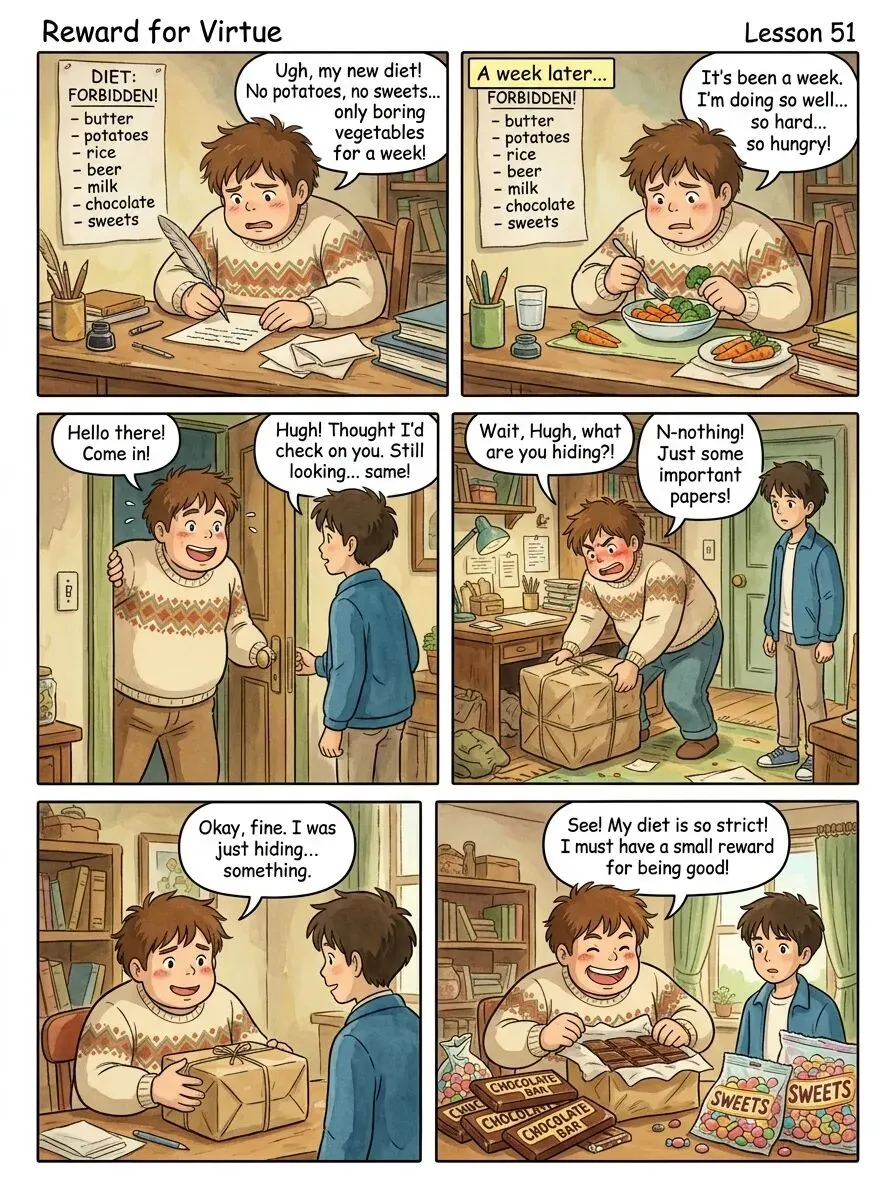
My friend, Hugh, has always been fat, but things got so bad recently that he decided to go on a diet. He began his diet a week ago. First of all, he wrote out a long list of all the foods which were forbidden. The list included most of the things Hugh loves: butter, potatoes, rice, beer, milk, chocolate, and sweets.
Yesterday I paid him a visit. I rang the bell and was not surprised to see that Hugh was still as fat as ever. He led me into his room and hurriedly hid a large parcel under his desk. It was obvious that he was very embarrassed. When I asked him what he was doing, he smiled guiltily and then put the parcel on the desk. He explained that his diet was so strict that he had to reward himself occasionally. Then he showed me the contents of the parcel. It contained five large bars of chocolate and three bags of sweets!
背景简介本课选自《新概念英语》第二册第51课,课文标题为"Reward for virtue"(对美德的奖赏)。故事以第一人称叙述,讲述作者拜访其朋友Hugh的经历。Hugh因为身体肥胖决定节食减肥,制定了严格的禁食清单,但最终难以抵挡诱惑,偷偷储备了大量高热量零食,并自我安慰称为"对美德的奖赏"。文章通过生动的对话和细节描写,幽默地揭示了人在面对诱惑时意志力的脆弱,以及为自身行为寻找合理化的心理。作者L.G. Alexander以其一贯的英式幽默,将一个日常生活中的小场景写得趣味盎然,同时也发人深省。
参考译文我的朋友休一直很胖,但是近来情况变得如此糟糕,以至于他决定节食。他是一周前开始节食的。首先,他开列了一张长长的单子,列出了所有禁吃的食物。这张单子包括了休最爱吃的大部分东西:黄油、土豆、大米、啤酒、牛奶、巧克力和糖果。昨天我去拜访了他。我按响了门铃,看到休仍和以前一样胖,并不感到惊奇。他把我领进屋,慌忙把一个大包藏在桌子下面。显然他感到很尴尬。当我问他正在干什么时,他内疚地笑了,然后把那个大包拿到了桌上。他解释说,他的饮食控制得太严格了,所以不得不偶尔奖赏自己一下。接着他给我看了包里的东西。里面有五大块巧克力和三袋糖果!
🔍 第二部分:逐句精讲与词块总结
句子1
1. 原文: My friend, Hugh, has always been fat, but things got so bad recently that he decided to go on a diet.
2. 翻译: 我的朋友休一直很胖,但是近来情况变得如此糟糕,以至于他决定节食。
3. 句子结构: 并列复合句。由 but 连接两个并列分句。第一个分句是简单句 My friend... fat。第二个分句是复合句,包含一个 so...that... 引导的结果状语从句。主句是 things got so bad,从句是 that he decided to go on a diet。
4. 重点词汇:
friend 蓝思值 290L
英音/frend/ 美音/frend/ 词性:n.
释义:朋友
常用语块:best friend; close friend
短语搭配:make friends with sb.
例句一:She is my best friend, and I trust her completely. 她是我最好的朋友,我完全信任她。
例句二:It is easy to make friends with people who share your interests. 和你有共同兴趣的人交朋友很容易。
拓展:该词源自古英语 freond,意为"爱、喜欢的人"。其反义词是 enemy(敌人)。
fat 蓝思值 210L
英音/fæt/ 美音/fæt/ 词性:adj.
释义:胖的,肥的
常用语块:get fat (变胖); fatty food (高脂肪食物)
短语搭配:live off the fat of the land (过着养尊处优的生活)
例句一:The doctor told him he was too fat and needed to exercise more. 医生告诉他他太胖了,需要多锻炼。
例句二:I've been eating too much recently, and I'm afraid I'm getting fat. 我最近吃得太多了,恐怕要变胖了。
拓展:fat 作形容词时,描述人或动物"肥胖的"。其比较级是 fatter,最高级是 fattest。形容一个人的胖,在英语中通常用 overweight 或 obese 会更礼貌,fat 有时会显得直接或不礼貌。作为名词,它指"脂肪"。
recently 蓝思值 530L
英音/ˈriːsntli/ 美音/ˈriːsntli/ 词性:adv.
释义:最近,近来
常用语块:quite recently (最近); until recently (直到最近)
短语搭配:as recently as (就在......时)
例句一:I haven't seen him recently. 我最近没见过他。
例句二:Until recently, I had no idea about this plan. 直到最近,我才知道这个计划。
拓展:recently 是一个副词,通常与现在完成时或一般过去时连用。例如,I have been busy recently(我最近一直很忙)用现在完成时;I saw him recently(我最近见过他)用一般过去时。它和 lately 意思相近,但 lately 更常用于疑问句或否定句。
decide 蓝思值 320L
英音/dɪˈsaɪd/ 美音/dɪˈsaɪd/ 词性:v.
释义:决定
常用语块:decide to do sth.;decide on sth.
短语搭配:It is decided that... (已决定......)
例句一:We need to decide where to go for our holiday. 我们需要决定去哪里度假。
例句二:She decided on the blue dress after trying on several. 试穿了几件之后,她决定买那条蓝裙子。
拓展:其名词形式为 decision(决定)。常见的错误用法:decide doing sth.,正确用法应为 decide to do sth.。decide on sth. 表示"就......做出决定"。
diet 蓝思值 470L
英音/ˈdaɪət/ 美音/ˈdaɪət/ 词性:n.
释义:日常饮食;节食
常用语块:go on a diet; balanced diet
短语搭配:be on a diet (在节食)
例句一:A balanced diet is essential for good health. 均衡的饮食对于健康至关重要。
例句二:My doctor advised me to go on a diet to lose some weight. 我的医生建议我节食来减重。
拓展:diet 可以指日常吃的"饮食",如 a healthy diet(健康的饮食);也可以指为了减肥或健康而进行的"限定饮食",即"节食",常与动词 go on 搭配。on a diet 是进行节食的状态。其形容词是 dietary(饮食的)。
5. 语法点睛: 本句涉及两个语法点:1. 现在完成时 (has always been):表示从过去某个时间开始持续到现在的状态。Hugh从过去到现在一直都很胖。 [NCE知识点笔记] 中强调,always 常用于现在完成时,表示"一直、总是",强调状态的持续性。2. 结果状语从句 (so...that...):这是一个非常核心的结构,表示"如此......以至于......"。so 后接形容词或副词,that 引导一个表示结果的从句。在本句中,so bad 是情况"如此糟糕",that he decided to go on a diet 是带来的结果"他决定节食"。[名师精讲] 指出,这是英语中表达因果关系的强力句型,能极大增强句子的逻辑性和表现力。
句子2
1. 原文: He began his diet a week ago.
2. 翻译: 他是一周前开始节食的。
3. 句子结构: 简单句。主语 He,谓语 began,宾语 his diet,时间状语 a week ago。
4. 重点词汇:
begin 蓝思值 210L
英音/bɪˈɡɪn/ 美音/bɪˈɡɪn/ 词性:v.
释义:开始
常用语块:begin to do sth.; begin with sth.
短语搭配:to begin with (首先,第一点)
例句一:The movie will begin in ten minutes. 电影十分钟后开始。
例句二:To begin with, I'd like to introduce myself. 首先,我想做个自我介绍。
拓展:begin 是动词"开始",其过去式是 began,过去分词是 begun。它和 start 意思非常接近,在很多情况下可以互换。但 start 更口语化,且可以表示"启动(机器)",而 begin 则更正式一些。其反义词是 end 或 finish。
5. 语法点睛: 本句使用一般过去时(began),因为"开始节食"是发生在过去的一个具体动作,并且有明确的过去时间状语 a week ago(一周前)。[语法新思维] 强调,一般过去时用于描述在过去某个特定时间点发生的、已经结束的动作或状态。
句子3
1. 原文: First of all, he wrote out a long list of all the foods which were forbidden.
2. 翻译: 首先,他开列了一张长长的单子,列出了所有禁吃的食物。
3. 句子结构: 主从复合句。主句是 he wrote out a long list of all the foods。后面 which were forbidden 是一个定语从句,由关系代词 which 引导,修饰先行词 the foods。which 在从句中作主语。
4. 重点词汇:
list 蓝思值 230L
英音/lɪst/ 美音/lɪst/ 词性:n.
释义:列表,清单
常用语块:a list of; shopping list; on the list
短语搭配:make/draw up a list (制作/起草一份清单)
例句一:Please make a list of everything you need for the trip. 请列出你旅行需要的一切东西。
例句二:Is my name on the list of participants? 我的名字在参加者名单上吗?
拓展:list 也可以作动词,意思是"列举"。例如:He listed all the things he had to do.(他列举了他必须做的所有事情。)
forbidden 蓝思值 980L
英音/fəˈbɪdn/ 美音/fərˈbɪdn/ 词性:adj.
释义:被禁止的
常用语块:forbidden fruit; forbidden zone
短语搭配:be forbidden to do sth. (被禁止做某事)
例句一:The garden was a forbidden place for the children. 那个花园是孩子们的禁地。
例句二:Smoking is strictly forbidden in this area. 这个区域严禁吸烟。
拓展:forbidden 是动词 forbid(禁止)的过去分词形式,在这里作形容词。forbid 的过去式是 forbade 或 forbad。其近义词是 prohibit(正式禁止)。forbidden fruit(禁果)是一个常见的文化典故,源自《圣经》中亚当和夏娃的故事。
5. 语法点睛: 本句重点在于定语从句 which were forbidden。这是一个被动语态的定语从句,用来修饰名词 foods。它的作用相当于一个形容词,说明是"哪一类食物"——即那些"被禁止的"食物。[语法一学就会] 指出,定语从句能让描述更精确,是构建复杂信息的关键。这里的 which 可以用 that 来替换。
句子4
1. 原文: The list included most of the things Hugh loves: butter, potatoes, rice, beer, milk, chocolate, and sweets.
2. 翻译: 这张单子包括了休最爱吃的大部分东西:黄油、土豆、大米、啤酒、牛奶、巧克力和糖果。
3. 句子结构: 主从复合句。主句是 The list included most of the things。Hugh loves 是一个省略了关系代词 that/which 的定语从句,修饰先行词 things。冒号后面是同位语,列举了 things 的具体内容。
4. 重点词汇:
include 蓝思值 360L
英音/ɪnˈkluːd/ 美音/ɪnˈkluːd/ 词性:v.
释义:包括,包含
常用语块:be included in (被包括在内)
短语搭配:include sb./sth. (in/on sth.)
例句一:The price of the ticket includes a free lunch. 票价包括一份免费午餐。
例句二:Did you include me in your party invitation list? 你的派对邀请名单里包括我吗?
拓展:include 是及物动词,后面直接跟宾语。它的名词形式是 inclusion。including 是介词,意为"包括......在内",常用于引出被包括的人或物。例如:Everyone had a great time, including me.(所有人都玩得很开心,包括我。)
love 蓝思值 170L
英音/lʌv/ 美音/lʌv/ 词性:v.
释义:爱;热爱,喜欢
常用语块:love to do sth.; love doing sth.; fall in love
短语搭配:would love to (非常乐意)
例句一:I love reading books before going to bed. 我喜欢睡觉前看书。
例句二:He loves playing football with his friends after school. 他喜欢放学后和朋友们踢足球。
拓展:love 作为动词,既可以接不定式(love to do),也可以接动名词(love doing)。前者通常指具体某次喜欢做的动作,后者更强调普遍爱好。
5. 语法点睛: 本课的关键句型之一是省略关系代词的定语从句。当关系代词 which, that, whom 在定语从句中作宾语时,经常可以省略。Hugh loves 中,loves 的宾语就是前面的 things,因此 which/that 被省略了。这是一种非常常见且自然的表达方式。[NCE知识点笔记] 特别强调,口语和非正式书面语中,这种省略非常普遍。
句子5
1. 原文: Yesterday I paid him a visit.
2. 翻译: 昨天我去拜访了他。
3. 句子结构: 简单句。主语 I,谓语 paid,间接宾语 him,直接宾语 a visit。这是一个典型的"主+谓+间宾+直宾"双宾语结构。
4. 重点词汇:
pay 蓝思值 210L
英音/peɪ/ 美音/peɪ/ 词性:v.
释义:支付;给予(注意、访问等)
常用语块:pay attention to; pay a visit; pay for
短语搭配:pay back (偿还); pay off (还清)
例句一:I paid twenty dollars for this book. 我花了20美元买这本书。
例句二:You should pay more attention to your health. 你应该多注意你的健康。
拓展:pay 的双宾语结构 pay sb. sth.(付给某人某物)是重点。除了"支付",pay 还有"给予(访问、注意等)"的意思。pay a visit to sb. 或 pay sb. a visit 是"拜访某人"的正式说法。
visit 蓝思值 240L
英音/ˈvɪzɪt/ 美音/ˈvɪzɪt/ 词性:n.
释义:访问,拜访
常用语块:pay a visit; a visit to
短语搭配:on a visit (在访问中)
例句一:She is on a visit to her grandparents in the countryside. 她在乡下拜访她的祖父母。
例句二:We had a lovely visit from our old friends last weekend. 上周末我们的老朋友来访,我们很开心。
拓展:visit 也可以作动词,意思是"访问,参观"。例如:I visited the museum yesterday.(我昨天参观了博物馆。)
5. 语法点睛: 本句是双宾语结构的一个典型例子。pay him a visit 中,him 是间接宾语(人),a visit 是直接宾语(物)。[名师精讲] 指出,含有双宾语结构的动词通常可以转换为两种形式:pay a visit to him。类似的动词还有 give, lend, send, show, tell, buy, make 等。
句子6
1. 原文: I rang the bell and was not surprised to see that Hugh was still as fat as ever.
2. 翻译: 我按响了门铃,看到休仍和以前一样胖,并不感到惊奇。
3. 句子结构: 并列复合句。and 连接 I rang the bell 和 was not surprised to see... 两个并列的谓语部分。that Hugh was still as fat as ever 是一个 that 引导的宾语从句,作动词 see 的宾语。从句内部包含一个 as...as... 同级比较结构。
4. 重点词汇:
surprise 蓝思值 370L
英音/səˈpraɪz/ 美音/sərˈpraɪz/ 词性:v.
释义:使惊奇,使意外
常用语块:be surprised to do sth.; be surprised at/by sth.; to one's surprise
短语搭配:take sb. by surprise (出乎某人的意料)
例句一:I was surprised to see him there. 我很惊讶在那儿看到他。
例句二:To my surprise, he agreed with my plan. 让我惊讶的是,他同意了我的计划。
拓展:surprised 的主语通常是人,意为"(人)感到惊讶的";surprising 的主语通常是物,意为"(事物)令人惊讶的"。例如:The news is surprising.(这个消息令人惊讶。)I am surprised.(我感到惊讶。)
ever 蓝思值 200L
英音/ˈevə(r)/ 美音/ˈevər/ 词性:adv.
释义:在任何时候;曾经
常用语块:as...as ever; for ever; ever since
短语搭配:hardly ever (几乎从不)
例句一:Have you ever been to Shanghai? 你曾经去过上海吗?
例句二:She is as beautiful as ever. 她还是像以前一样漂亮。
拓展:ever 常用于疑问句、否定句和条件句中。在 as...as ever 结构中,它表示"和以前一样......"。forever 是连写形式,表示"永远"。
5. 语法点睛: 本句包含 as...as... 同级比较结构。as fat as ever 意为"和以前一样胖"。[语法新思维] 详细讲解了此结构的用法:- 肯定形式:as + 形容词/副词原级 + as + 比较对象。表示两者在某方面程度相同。- 否定形式:not as/so + 形容词/副词原级 + as + 比较对象。表示前者不如后者。- 注意事项:as...as 中间必须用形容词或副词的原级,不能用比较级。
句子7
1. 原文: He led me into his room and hurriedly hid a large parcel under his desk.
2. 翻译: 他把我领进屋,慌忙把一个大包藏在桌子下面。
3. 句子结构: 简单句,包含两个并列的谓语动作 led me into his room 和 hid a large parcel under his desk,由 and 连接。hurriedly 是副词作状语,修饰第二个动作 hid。
4. 重点词汇:
lead 蓝思值 210L
英音/liːd/ 美音/liːd/ 词性:v.
释义:带领,引领
常用语块:lead sb. to/in/into; lead to (导致); lead the way (带路)
短语搭配:lead a ... life (过......的生活)
例句一:The guide led us through the forest. 向导带领我们穿过了森林。
例句二:Hard work can lead to success. 努力工作能带来成功。
拓展:lead 的过去式和过去分词均为 led。作为动词,它还有"领导、指挥"的意思,如 lead a team(领导一个团队)。作为名词,意为"领先地位",如 take the lead(领先)。
hurriedly 蓝思值 780L
英音/ˈhʌrɪdli/ 美音/ˈhɜːrɪdli/ 词性:adv.
释义:匆忙地,仓促地
常用语块:do sth. hurriedly
例句一:He finished his breakfast hurriedly and rushed out. 他匆忙吃完早餐冲了出去。
例句二:She wrote the letter hurriedly before the post office closed. 她在邮局关门前匆忙写了信。
拓展:hurriedly 是形容词 hurried(匆忙的)的副词形式,动词是 hurry(匆忙行事,赶紧)。例如 hurry up(快点)。与其意思相近的词有 quickly(快速地),但 hurriedly 更强调"因为时间紧或心虚而仓促"的意味,与本课语境(偷偷藏东西)非常契合。
parcel 蓝思值 530L
英音/ˈpɑːsl/ 美音/ˈpɑːrsl/ 词性:n.
释义:包裹
常用语块:a parcel of; send a parcel
短语搭配:part and parcel (重要的组成部分)
例句一:I received a parcel from my mother on my birthday. 我生日那天收到了妈妈寄来的一个包裹。
例句二:Please wrap this book as a parcel. 请把这本书包成一个包裹。
拓展:parcel 是英式英语常用词,美国人更常用 package(包裹)或 packet(小包)。
5. 语法点睛: 本句展示了并列谓语结构。一个主语(He)先后发出两个动作(led... 和 hid...),用 and 连接,形成并列谓语。[名师精讲] 指出,这种结构使句子紧凑,能高效地描述一系列连续的动作。副词 hurriedly 的使用,生动地刻画了主人公藏东西时的紧张和心虚,是叙事中重要的技巧。
句子8
1. 原文: It was obvious that he was very embarrassed.
2. 翻译: 显然他感到很尴尬。
3. 句子结构: 主从复合句。It 是形式主语,真正的主语是 that he was very embarrassed 这个主语从句。was obvious 是系表结构作谓语。
4. 重点词汇:
obvious 蓝思值 640L
英音/ˈɒbviəs/ 美音/ˈɑːbviəs/ 词性:adj.
释义:明显的,显然的
常用语块:be obvious to sb. (对某人来说很明显); It is obvious that...
短语搭配:state the obvious (说显而易见的事)
例句一:It was obvious that he was lying. 很明显他在撒谎。
例句二:The reasons for his decision were not immediately obvious. 他做决定的原因并非一望而知。
拓展:obvious 的副词形式是 obviously,常用来加强语气,或作为句子副词使用。例如:Obviously, he didn't want to go.(很明显,他不想去。)
embarrassed 蓝思值 750L
英音/ɪmˈbærəst/ 美音/ɪmˈbærəst/ 词性:adj.
释义:尴尬的,窘迫的
常用语块:feel embarrassed; be embarrassed about sth.; be embarrassed to do sth.
短语搭配:embarrassing moment (尴尬的时刻)
例句一:She felt very embarrassed when she forgot his name. 她忘记了他的名字,感到非常尴尬。
例句二:I was so embarrassed that I could feel my face turning red. 我尴尬极了,能感觉到脸都红了。
拓展:embarrassed 的主语通常是人,描述人的感受;embarrassing 的主语通常是物或事情,描述"令人尴尬的"。例如:The situation was embarrassing.(情形令人尴尬。这是一个 -ing 形容词和 -ed 形容词的区别。[手绘版新概念语法笔记] 对此有专题讲解,指出 -ed 形容词描述"感觉",-ing 形容词描述"性质"。
5. 语法点睛: 本句是一个典型的 It is + 形容词 + that 从句 句型。[语法新思维] 强调,It 在此作形式主语,避免了句子头重脚轻。真正的主语是后面的 that 从句。这种结构在英语中非常普遍,用于表达对某事的看法、情感或评价。类似的结构还有 It is important/necessary/possible that... 等。
句子9
1. 原文: When I asked him what he was doing, he smiled guiltily and then put the parcel on the desk.
2. 翻译: 当我问他正在干什么时,他内疚地笑了,然后把那个大包拿到了桌上。
3. 句子结构: 主从复合句。When I asked him what he was doing 是一个由 when 引导的时间状语从句。在这个从句内部,what he was doing 是 asked 的宾语从句。主句是 he smiled guiltily and then put the parcel on the desk,是一个并列谓语结构。
4. 重点词汇:
ask 蓝思值 230L
英音/ɑːsk/ 美音/æsk/ 词性:v.
释义:问,询问;请求
常用语块:ask sb. sth.; ask for; ask sb. to do sth.
短语搭配:ask a question (问一个问题)
例句一:Don't be afraid to ask questions in class. 在上课时不要害怕提问。
例句二:She asked me for directions to the nearest post office. 她问我到最近邮局怎么走。
拓展:ask 是双宾语动词,可以接间接宾语(人)和直接宾语(物或从句)。ask sb. for sth. 是"向某人要某物"。
guiltily 蓝思值 810L
英音/ˈɡɪltɪli/ 美音/ˈɡɪltɪli/ 词性:adv.
释义:内疚地,有罪地
常用语块:smile guiltily; look guiltily at
例句一:He looked guiltily at his mother when she found his broken toy. 妈妈发现他弄坏的玩具时,他内疚地看着她。
例句二:She guiltily ate another piece of cake when no one was looking. 没人注意时,她内疚地又吃了一块蛋糕。
拓展:guiltily 是形容词 guilty(内疚的,有罪的)的副词形式。动词是 guilt,但更常用的表达是 feel guilty(感到内疚)。名词是 guilt(内疚,罪责)。这个词生动地传递了主人公因为破坏了节食规定而感受到的心理压力。
5. 语法点睛: 1. 时间状语从句 (When I asked him...):when 引导的从句表示一个时间点,主句的动作发生在这个时间点上。主句和从句的动作有紧密的时间关联。[NCE知识点笔记] 提醒,when 从句的时态通常是一般过去时,主句根据具体情况使用相应的过去时态。2. 宾语从句 (what he was doing):这是一个由疑问词 what 引导的宾语从句,作 asked 的宾语。从句中用了过去进行时(was doing),表示"他当时正在做什么"。这体现了宾语从句的时态与主句时态保持一致(主句是过去时,从句也需用相应的过去时态)。
句子10
1. 原文: He explained that his diet was so strict that he had to reward himself occasionally.
2. 翻译: 他解释说,他的饮食控制得太严格了,所以不得不偶尔奖赏自己一下。
3. 句子结构: 主从复合句。主句是 He explained。that his diet was so strict that he had to reward himself occasionally 是一个 that 引导的宾语从句。在这个宾语从句内部,又包含了一个 so...that... 引导的结果状语从句。
4. 重点词汇:
explain 蓝思值 430L
英音/ɪkˈspleɪn/ 美音/ɪkˈspleɪn/ 词性:v.
释义:解释,说明
常用语块:explain sth. to sb.; explain that...
短语搭配:explain away (为......辩解)
例句一:Could you explain the rules of the game to me? 你能给我解释一下游戏规则吗?
例句二:He explained why he was late. 他解释了他为什么迟到。
拓展:explain 后面不能接双宾语(即不能说 explain sb. sth.),必须用 explain sth. to sb. 的结构。
strict 蓝思值 560L
英音/strɪkt/ 美音/strɪkt/ 词性:adj.
释义:严格的
常用语块:be strict with sb. (对某人严格); be strict about/in sth. (对某事严格)
短语搭配:strict rule; strict discipline
例句一:My parents are very strict with me. 我父母对我要求很严格。
例句二:There are strict rules about safety in the laboratory. 实验室里有严格的安全规定。
拓展:strict 的副词是 strictly,常用于 strictly speaking(严格来说)。
reward 蓝思值 830L
英音/rɪˈwɔːd/ 美音/rɪˈwɔːrd/ 词性:v.
释义:奖赏,酬谢
常用语块:reward sb. for (doing) sth.; reward sb. with sth.
短语搭配:as a reward for (作为对......的奖赏)
例句一:The company rewarded him for his excellent performance. 公司因他出色的表现而奖赏了他。
例句二:She rewarded the dog with a treat. 她用零食奖赏了这条狗。
拓展:reward 也可以作名词,意为"奖赏,回报"。例如:He got a reward for finding the lost wallet.(他因找到丢失的钱包而得到了报酬。)注意其与本课标题 Reward for virtue(对美德的奖赏)的呼应,具有讽刺意味。
occasionally 蓝思值 760L
英音/əˈkeɪʒnəli/ 美音/əˈkeɪʒnəli/ 词性:adv.
释义:偶尔地,间或
常用语块:only occasionally (仅仅偶尔)
短语搭配:occasionally happens (偶尔发生)
例句一:I occasionally go to the cinema with my friends. 我偶尔和朋友们去看电影。
例句二:The weather is usually hot, but it rains occasionally. 天气通常很热,但偶尔会下雨。
拓展:occasionally 表示频率,介于 sometimes(有时)和 rarely(很少)之间。其形容词是 occasional(偶尔的:an occasional visit)。
5. 语法点睛: 本句再次出现 so...that... 结构。so strict 解释了"为什么会这样做"的原因,that he had to reward himself 是其结果。同时,reward himself 体现了反身代词的用法,意为"奖励他自己"。[新概念英语之全新全绎 第2册.pdf] 提示,reward 作为动词,其动作的承受者通常是"别人"。
句子11
1. 原文: Then he showed me the contents of the parcel.
2. 翻译: 接着他给我看了包里的东西。
3. 句子结构: 简单句。主语 He,谓语 showed,间接宾语 me,直接宾语 the contents of the parcel。双宾语结构。
4. 重点词汇:
contents 蓝思值 810L
英音/ˈkɒntents/ 美音/ˈkɑːntents/ 词性:n. (pl.)
释义:所容纳之物,内容
常用语块:contents page (目录页); contents of (......的内容)
短语搭配:table of contents (目录)
例句一:The contents of the box were a complete mystery. 盒子里装的东西完全是个谜。
例句二:Have you read the contents of the letter yet? 你读过信的内容了吗?
拓展:content 作复数 contents 时,常指"容器内的东西"或"(书籍、文件等的)内容、目录"。其单数 content 是不可数名词,意为"满足、满意"或"含量"。例如:He was content with his life.(他对自己的生活很满意。)
5. 语法点睛: 本句又是一个双宾语结构的例子。show sb. sth.(给某人看某物)。[同步语法强化] 指出,双宾语动词的两种转换形式是:- 动词 + 间接宾语 + 直接宾语 (show me the contents) - 动词 + 直接宾语 + to/for + 间接宾语 (show the contents to me) show 属于将间接宾语改为 to 引导的短语的动词。
句子12
1. 原文: It contained five large bars of chocolate and three bags of sweets!
2. 翻译: 里面有五大块巧克力和三袋糖果!
3. 句子结构: 简单句。主语 It,谓语 contained,宾语 five large bars of chocolate and three bags of sweets。five large bars of chocolate 和 three bags of sweets 是并列的宾语。
4. 重点词汇:
contain 蓝思值 370L
英音/kənˈteɪn/ 美音/kənˈteɪn/ 词性:v.
释义:包含,容纳
常用语块:contain sth.
例句一:This bottle contains two liters of water. 这个瓶子能装两升水。
例句二:The report contains a lot of important information. 这份报告包含了很多重要信息。
拓展:contain 是及物动词,通常不用于进行时态。它强调"容器或物体内部有......"。其近义词是 include(包括),但 include 通常指作为整体的一部分,而 contain 强调容纳。
bar 蓝思值 490L
英音/bɑː(r)/ 美音/bɑːr/ 词性:n.
释义:条,块(长条状物);酒吧
常用语块:a bar of chocolate/ soap; bar code (条形码); coffee bar (咖啡吧)
短语搭配:behind bars (在狱中)
例句一:He took a chocolate bar from the fridge. 他从冰箱里拿了一块巧克力。
例句二:She ordered a drink at the bar. 她在吧台点了一杯饮料。
拓展:bar 是一个多义词,除了"条、块"和"酒吧",还可以指"(门、窗的)闩"、"(音乐的)小节"、"(法律)律师界"等。
sweet 蓝思值 170L
英音/swiːt/ 美音/swiːt/ 词性:n.
释义:糖果;甜点
常用语块:a bag of sweets; sweet tooth (爱吃甜食)
短语搭配:sweet and sour (糖醋)
例句一:Children love to eat sweets. 孩子们喜欢吃糖果。
例句二:Would you like some sweets after dinner? 晚饭后你要来点甜点吗?
拓展:sweet 作名词时,是英式英语中"糖果"的常用说法,美国人更常用 candy。它也可以作形容词,意为"甜的"或"可爱的"。
5. 语法点睛: 本句展示了量词短语的用法。a bar of chocolate (一块巧克力),a bag of sweets (一袋糖果)。[名师精讲] 强调,英语中,不可数名词不能直接用数词修饰,必须借助量词短语(a piece of, a bar of, a glass of 等)来量化。这是中国学生容易出错的地方。
📌 核心词块总结
1. go on a diet (节食)解释:To start eating only certain foods or smaller amounts of food in order to lose weight or improve health. 例句:She decided to go on a diet after the holiday because she had gained a few pounds.
2. first of all (首先)解释:Before anything else; as the first and most important point. 例句:First of all, let me thank you all for coming here today to celebrate with me.
3. write out (写出,开出(清单、支票等))解释:To write something in full or in a formal way. 例句:Could you please write out a list of all the equipment we will need for the experiment?
4. pay a visit (访问,拜访)解释:To go to see someone or a place for a short time. 例句:I decided to pay a visit to my elderly neighbor to see if she was feeling better.
5. as...as ever (和以前一样)解释:To the same degree as always or as before. 例句:After three years abroad, he returned and was as cheerful as ever.
6. lead sb. into (把某人领进)解释:To guide or take someone inside a place. 例句:The host led us into the living room and offered us tea.
7. reward sb. for (因......奖励某人)解释:To give something nice to someone as a reward for their hard work, good behavior, etc. 例句:The teacher rewarded the students for their consistent hard work with a trip to the museum.
✍️ 第三部分:语篇分析与段落写作技巧
1. 语篇分析①识别宏观结构 (Identify the macrostructure):本课短文属于典型的先果后因/叙事+解释的篇章结构。开头两句话(My friend...和 He began...)是事件背景,引出核心矛盾——节食。第三句(First of all...)是节食的具体行动。第四句(The list included...)是行动的具体内容,为后续的转折埋下伏笔。从第五句(Yesterday I paid him a visit)开始,故事进入高潮。通过作者的拜访、发现、询问和朋友的解释,层层递进地揭示了一个出乎意料的结果——节食者实际上在偷偷吃零食。整个故事遵循背景 → 行动 → 转折/发现 → 解释的流程。②列举衔接手段 (List cohesive devices):-时间连接:Yesterday(具体时间点);Then(时间顺序,表示"接着")。-逻辑连接:but (转折,连接背景与问题);First of all (顺序,说明第一步);When (时间状语从句,连接先后发生的两个动作);so...that... (因果,连接原因与结果);and (并列,连接动作或名词)。-指代:代词 he 和 Hugh 的交替使用,it 指代"他藏东西这件事"。-词汇衔接:diet, forbidden foods, reward 等词构成了本文的语义场,相互关联。③分析作者态度 (Analyze the author's attitude):作者通过旁观者的口吻,冷静而客观地叙述了事件。然而,通过选用 hurriedly, embarrassed, guiltily 等副词和形容词,以及结尾处对满包零食的描绘,作者的态度清晰可见:这是一种带着善意和理解的幽默。他并不严厉批判朋友的意志薄弱,而是以略带戏谑的口吻,揭示了人性中共有的"脆弱"和"自我安慰"心理。整篇文章的语气是温和的、幽默的、讽刺的。
2. 写作技巧①提炼写作逻辑:本课的写作核心逻辑是"对比与反转"。-承诺 vs. 行动:主人公下决心 go on a diet,列出了禁食清单,这是"承诺"。但他的实际行为却是 hid a large parcel 和 reward himself occasionally,这是"行动"。承诺与行动的巨大反差形成了幽默。-预设 vs. 现实:读者根据标题"美德的奖赏"会预设主人公是一位有毅力、能抵御诱惑的人。但现实却是一个偷偷藏零食的"伪君子"。这种预设与现实的冲突构成讽刺。-建议:在写作类似段落时,可以采用"设定标准 → 描写冲突 → 揭示真相"的框架。先介绍人物的决心或某种规则,然后描写一个违反此规则的行为/场景,最后揭示人物内心的挣扎或借口。②提供段落写作范例:题目:Write a short passage about someone who decides to give up a bad habit but fails.例文:Last month, my younger brother Tom decided to quit playing video games to focus on his studies. He even asked me to hide his console. First of all, he drew up a detailed study schedule. The schedule included all subjects: Math, English, and Physics. Yesterday, I came home early and was not surprised to find him in front of his computer. When I asked what he was doing, he smiled sheepishly and quickly minimized a window. He explained that his study schedule was so exhausting that he had to relax himself occasionally. Then I noticed a half-eaten bag of chips and a game controller hidden under a pile of books!③例文分析:-结构特点:严格遵循了"设定标准 → 描写冲突 → 揭示真相"的写作逻辑。第一句给出背景和决心(decided to quit)。第二、三句描绘具体行动(draw up a schedule)。第四句开始冲突(find him in front of his computer)。最后揭示真相(game controller hidden)。-语言点映射:- 使用了本课的核心句型 was not surprised to find。- 使用了副词 sheepishly 对应课文的 guiltily。- 使用了 When 时间状语从句和 that 宾语从句。- 使用了 so...that... 结构 (so exhausting that he had to relax)。- 结尾处的 hidden under a pile of books 呼应课文的 hid a large parcel under his desk。- 使用了 decided to, First of all, Yesteday, explain that, occasionally 等本课核心词汇与短语。③布置小练笔并提供例文:-小练笔:Write a short paragraph (about 100 words) describing a time when you or someone you know tried to change a bad habit but gave in to temptation. Use at least three of the key structures and vocabulary from Lesson 51 (e.g., go on a diet / quit a habit, so...that, as...as ever, be surprised to, guiltily/embarrassedly).-例文:My Father's "No Coffee" RuleMy father, Mr. Li, has always been a coffee lover. But last month, his doctor told him to cut down for his health. He decided togo on a no-coffee diet.First of all, he promised his family that he would only drink tea. A week later, I arrived home from school. I was notsurprisedto find himas happy as ever. Hehurriedlyhid a thermos. When I asked, he smiledguiltily. He explained his work wassostressfulthat he had to reward himself. Inside the thermos was, of course, a fresh and strong cup of coffee!
📐 第四部分:本课语法精析(加强版)
本部分字数不少于1500-2000字。
本课的核心语法是 现在完成进行时 (The Present Perfect Continuous Tense)。知识库中《NCE知识点笔记Book II.pdf》、《新概念英语名师精讲笔记 第2册.pdf》、《新概念英语语法新思维 第2册.pdf》以及《新概念英语语法一学就会 全4册.pdf》都对此有详细讲解。
1. 现在完成进行时的构成 [名师精讲]
- 肯定结构: have/has + been + 现在分词 (V-ing)
- 例句: I have been waiting for you for an hour. 我已经等你一小时了。
- 例句: She has been studying English since she was a child. 她从小就一直学习英语。
- 否定结构: have/has + not + been + 现在分词 (V-ing)
- 例句: They haven't been living here very long. 他们在这里住的时间并不长。
- 例句: He hasn't been feeling well recently. 他最近一直感觉不太好。
- 疑问结构: Have/Has + 主语 + been + 现在分词 (V-ing)?
- 例句: Have you been drinking my coffee? 你是不是一直在喝我的咖啡?
- 例句: Has it been raining all day? 是不是下了一整天雨了?
2. 现在完成进行时的核心用法 [语法新思维]
现在完成进行时主要用于以下两种情境:
- 动作从过去持续到现在,且可能仍在继续:强调动作的持续性和未完成性。
- 例句:They have been building a new bridge across the river. (他们一直在河上建一座新桥。强调建桥这个工程还在进行中) [NCE知识点笔记]
- 例句:His hands are very dirty. He has been repairing the car. (他的手很脏。他一直在修车。)
- 动作在过去某个时间开始,刚刚结束,并且其结果对现在有影响:强调动作的"近期完成性"及其对现在的可见后果。
- 例句:I'm sorry I'm late. Have you been waiting long? (抱歉我迟到了。你等很久了吗?——你"等"这个动作在我到来时刚刚结束,但其结果是"你感觉等待了很久"。)
- 例句:Your eyes are red. Have you been crying? (你眼睛红红的。你哭过了吗?——哭的动作刚结束,留下"眼睛红"的结果。)
3. 现在完成进行时 vs. 现在完成时 [语法一学就会] [语法新思维] [NCE知识点笔记]
这是本部分的重中之重。两者都表示与现在有联系,但其侧重点截然不同。
-------------------------------------------------------------------------------------------------------------------------------------------------------------------比较维度现在完成进行时 (Have/has been doing)现在完成时 (Have/has done)---------------------- -------------------------------------------------------------------- ----------------------------------------------------------------------① 强调重心强调动作本身、持续性、过程强调结果、完成性、总结例句对比一I have been writing a book. I have written a book.我一直在写本书。(强调我最近一直在从事"写书"这个活动,可能还没写完) 我写了一本书。(强调"写书"这件事完成了,有结果了)例句对比二He has been cleaning the house. He has cleaned the house.他一直在打扫房间。(强调"打扫"这个活动,可能还没干完) 他打扫完了房间。(强调"打扫"已经做完了,房间现在是干净的)② 时间长度暗示通常暗示动作尚未结束动作可能已完成,也可能持续例句对比三She has been living in Shanghai for 10 years. She has lived in Shanghai for 10 years.她已经在上海住了10年了。(强调她还会继续住下去) [同步语法强化] 她在上海住了10年。(只是陈述一个事实,可能她还会住,也可能她即将搬走)③ 动作的暂时性带有"暂时性"、"临时性"的色彩多用于永久性、长期性的情况例句对比四I have been working at this company recently. I have worked at this company for 20 years.我最近一直在这家公司工作。(暗示可能只是暂时的) 我在这家公司工作20年了。(暗示这是长期的、稳定的)④ 与数量/频率词的兼容通常不与表示具体数量的完成结构连用常与表示完成数量的词(since/for/once/twice)等连用例句对比五(错误) I have been reading the book three times. (正确) I have read (正确) I have read the book three times.the book three times. 这本书我读了三遍。⑤ 与状态动词不能与表示状态的动词(如 know, like, own, be 等)连用。可以与状态动词连用。例句对比六(错误) I have been knowing him for years. (正确) I have known him for years. 我认识他好多年了。-------------------------------------------------------------------------------------------------------------------------------------------------------------------
4. 跨单元对比分析 [语法一学就会]
现在完成进行时与现在完成时的对比,在本课之前,我们已经学过了多种时态。现在进行时(be doing)表示"现在正在进行的动作";过去进行时(was/were doing)表示"过去某个时刻正在进行的动作"。现在完成进行时则是在此基础上,与"完成时"的概念结合,表达了"从过去开始一直持续到现在"的动作。我们可以用一条时间轴来理解它们的区别:
- I am writing a letter. (现在进行时:正在写)
- I was writing a letter at 8:00 PM last night. (过去进行时:昨晚8点在写)
- I have written a letter. (现在完成时:我已经写完了)
- I have been writing a letter for two hours. (现在完成进行时:我已经写了2小时了,可能还没写完)
5. 本课中的现在完成进行时 [教材全解]
本课课文虽然没有直接出现现在完成进行时的句子(课文原文多用一般过去时和过去进行时),但它常作为本课的核心语法点被重点讲解。我们可以结合本课语境,进行造句练习,强化对其用法的理解。
- 应用场景一(描述持续性):Hugh **has been trying** to lose weight for a week, but it seems he hasn't made any progress. (休已经努力减肥一周了,但他似乎没有任何进展。)
- 应用场景二(描述近期影响):His face looks pale. He **has been eating** nothing but chocolate and sweets. (他脸色苍白。他一直在吃巧克力和糖果,别的都没吃。)
- 应用场景三(描述动作过程):I asked him what he **had been doing** behind my back. (我问他在我背后一直干什么。——这里是过去完成进行时,呼应主句过去时。)
- 应用场景四(与 just, already 对比):
- He **has already eaten** a whole bar of chocolate. (他已经吃了一整块巧克力。强调完成的动作/结果。)
- He **has been eating** chocolate. (他一直在吃巧克力。强调过程,可能还在吃。)
6. 练习题(不少于12道,附详细解析)
一、用括号内动词的适当形式填空 (现在完成时或现在完成进行时)。
1. I ___________ (read) this book for three weeks, and I still haven't finished it.
2. She ___________ (write) three emails this morning.
3. How long ___________ you ___________ (learn) English?
4. The children ___________ (watch) TV for two hours. Tell them to stop.
5. I ___________ (lose) my keys. Have you seen them?
6. He is tired because he ___________ (work) in the garden all day.
二、选择最佳答案。
7. --- You look tired. What have you been doing?--- I ___________ the house all afternoon.A. have cleanedB. have been cleaningC. cleaned
8. How many times ___________ you ___________ to the Great Wall?A. have, been goingB. have, goneC. have, been
9. I ___________ my homework. Now I can watch TV.A. have been finishingB. have finishedC. finish
10. He ___________ his roommate for ten years.A. has knownB. has been knowingC. knows
三、改错。
11. We have been knowing each other for a long time.
12. I have been writing three letters since morning.
四、翻译句子。
13. 这本书我看了三遍了。
14. 他一直在这家公司工作,已经有五年了。
详细解析:
1. 答案:have been reading解析:句中 for three weeks 表示时间段,且 I still haven't finished it 暗示"读"这个动作尚未完成,仍在持续。因此符合现在完成进行时"动作从过去持续到现在,可能还在继续"的用法。[语法新思维]
2. 答案:has written解析:this morning 虽然是时间段,但 three emails 是一个具体的完成数量。现在完成时强调"截止到现在已经完成的结果",因此用现在完成时。[NCE知识点笔记]
3. 答案:have, been learning解析:通常问"学英语学了多长时间了"时,一般暗含"从过去到现在一直在学,并且还会继续学下去"的含义。因此用现在完成进行时更自然。[名师精讲]
4. 答案:have been watching解析:for two hours 是时间段,且 Tell them to stop 暗示他们还在看。所以强调"持续观看"的动态过程。
5. 答案:have lost解析:lost my keys 强调的是一个已经完成并产生了结果(找不到钥匙)的动作。这里是在陈述一个事实结果,而不是强调过程。
6. 答案:has been working解析:He is tired 是结果。because 后面的从句解释他为什么累,用现在完成进行时强调"一直在工作"这个持续过程,非常生动。
7. 答案:B. have been cleaning解析:问句 What have you been doing? 关心的是"你一直在干什么",用现在完成进行时。回答应保持一致,强调"整个下午都在收拾"这个持续动作。
8. 答案:C. have, been解析:How many times 询问"做了多少次",是询问完成的次数。have been to a place 表示"曾经去过某地(已回来)",用现在完成时。have gone to 表示"去了某地(人未归)"。
9. 答案:B. have finished解析:I can watch TV now 是结果,表明"做作业"已经完成。现在完成进行时无法强调"完成"这个结果。
10. 答案:A. has known解析:know(知道,认识)是状态动词,不能用于进行时态(包括现在完成进行时 has been knowing 也是错误形式)。必须用现在完成时 has known。
11. 改正:We have known each other for a long time.解析:know 是状态动词,无进行时形式。
12. 改正:I have written three letters since morning. 或 I have been writing letters since morning.解析:现在完成进行时不能与具体的完成数量 (three) 连用。应去掉 three,或改为现在完成时。
13. 翻译:I have read this book three times.解析:强调"读"这个动作完成的次数,用现在完成时。
14. 翻译:He has been working for this company for five years. (强调还在继续工作)。或 He has worked for this company for five years. (更强调事实)。解析:两者都可以用,但第一句更符合日常口语,暗示他会继续做下去。
🎧 第五部分:听力与阅读策略训练
1. 听力技巧结合课文录音:本课的录音语速适中,语调生动,是训练听力策略的好素材。建议按照[新概念英语讲师用书新版2]的建议,分步进行听力训练。
① 预测关键词 (Predicting Keywords):在播放录音前,我们先看课文问题:"Why did Hugh's diet not work?" 根据这个问题和课文标题"Reward for virtue",我们可以预测录音中可能会听到关于 diet, forbidden food, friend, visit, parcel, chocolate, sweets, reward, temptation 等关键词。带着这些预判去听,能更迅速地定位到关键信息,提高听力效率。
② 抓主旨大意 (Gist Listening):第一遍听录音,不追求字字听懂,而是集中精力抓故事轮廓。重点关注:故事涉及的人物(Hugh 和 I)、核心事件(Hugh节食失败)、最意想不到的发现(large parcel 里的零食)。听完后,可以尝试用一句话概括。例如:Hugh started a strict diet but secretly hid a lot of chocolate and sweets, which ruined his diet. [新概念英语之全新全绎 第2册.pdf] 也强调,听力首先要把握主旨。
③ 笔记方法 (Note-taking Skills):听第二遍时,可以做简单笔记。写下关键短语和连接词,以厘清故事发展脉络。例如:
- Hugh -> fat -> decide diet
- Write -> list -> forbidden food
- Visit -> not surprised (still fat)
- Hugh -> hide parcel -> embarrassed
- Explain -> diet too strict -> reward
- Contents -> 5 bars chocolate + 3 bags sweets
听力理解题示例:
1. What did Hugh do first when he began his diet?A. He bought some chocolate.B. He wrote out a list of forbidden foods.C. He went to see a doctor.
2. How did the writer feel when he saw that Hugh was still fat?A. He was surprised.B. He was disappointed.C. He was not surprised.
3. Where did Hugh hide the parcel?A. Under his bed.B. Behind the door.C. Under his desk.
4. Why did Hugh say he was eating the sweets and chocolate?A. Because he was very hungry.B. Because he needed to reward himself for being strict.C. Because he bought them as a gift for the writer.
5. What was inside the parcel?A. Fruit and vegetables.B. Books and magazines.C. Large bars of chocolate and bags of sweets.
答案解析:
1. B (原文:First of all, he wrote out a long list of all the foods which were forbidden.)
2. C (原文:was not surprised to see that Hugh was still as fat as ever.)
3. C (原文:hurriedly hid a large parcel under his desk.)
4. B (原文:his diet was so strict that he had to reward himself occasionally.)
5. C (原文:It contained five large bars of chocolate and three bags of sweets!)
2. 阅读理解策略①扫读 (Scanning):为了快速找到特定信息,可以运用扫读策略。-题目:找出Hugh的节食清单包含哪些种类的食物。-方法:快速扫读"食物"相关词。在课文第一段末尾,可以找到 butter, potatoes, rice, beer, milk, chocolate, and sweets.-题目:Hugh把包裹藏在了哪里?-方法:扫读关于"隐藏"、"放"的动作。在第二段,找到 hid a large parcel under his desk.②略读 (Skimming):为了快速理解故事脉络,可以略读文章,主要关注每句话的开头或关键词。-方法:- 第一句:My friend... has always been fat... decided to go on a diet. (问题背景)- 第二句:He began... a week ago. (时间点)- 第三句:First of all... wrote out... forbidden. (行动开始)- 第四句:The list included... Hugh loves. (行动细节)- 第五句:Yesterday I paid him a visit. (事件转折)- 第六句:I rang the bell... not surprised... (事件发展)- 第七句:He led me... hid a parcel. (冲突出现)- 第八句:It was obvious... embarrassed. (人物状态)- 第九句:When I asked... smiled guiltily... (人物反应)- 第十句:He explained... reward himself. (解释原因)- 第十一句:Then he showed me... (结果)- 第十二句:It contained... sweets! (震撼结局)- 通过略读,我们快速抓住了故事从"立下誓言"→ "被发现" → "辩解" → "结局反转"的完整叙事弧。③推断词义 (Inferring meaning from context):根据上下文猜测生词的意思。-题目:阅读 He began his diet a week ago. 这句话,根据上下文猜测 diet 在这句话中的具体含义。-上下文线索:第一句说 Hugh has always been fat,所以他决定 go on a diet。-推理:结合"胖"和"开始"这两个线索,可以推断 diet 在这里指"限定饮食",即"节食",目的是减肥。而不是它作为"日常饮食"的宽泛含义。[官方教材之新概念英语学生用书 第2册.pdf] 中也通过课后练习引导读者根据语境理解词义。-题目:理解 reward 的讽刺性用法。-上下文线索:Hugh 的节食是很严格的(strict),所以他认为需要 reward himself。-推理:通常"奖赏"是针对好的、值得称赞的行为。但Hugh的"奖赏"是吃被禁止的高热量零食,这恰恰是他节食失败的原因。因此,标题"美德(节食)的奖赏(吃零食)"充满了讽刺意味,reward 在这里实际上变成了"破坏美德的藉口"。[钻研《新概念英语》啃课文第2册.pdf] 对类似语义层面进行了深度分析。
📝 第六部分:习题讲解
1. 针对教材中的书面练习进行详细讲解
本课的课后书面练习通常涵盖 关键句型 (Key Structures) 和 难点 (Special Difficulties) 两部分。我们将结合知识库中的资料进行详细讲解。
关键句型练习:现在完成进行时 vs. 现在完成时
- 练习示例:用 given verbs 的现在完成时或现在完成进行时形式完成句子。
1. I ________ (wait) for him for 20 minutes. (强调"等"这个动作持续了20分钟,可能还在等。)- 答案:have been waiting- 解析:for 20 minutes 是时间段,且表示等待这一动态动作的持续,用现在完成进行时最能体现这种持续性。[语法新思维]
2. She ________ (write) three letters today. (强调"写"这个动作已经完成的数量是"三封"。)- 答案:has written- 解析:three letters 是具体的完成数量,现在完成时强调动作的完成结果。[NCE知识点笔记]
3. The phone ________ (ring) for five minutes. (电话响了五分钟,这个动作是持续性的,但强调它一直持续。)- 答案:has been ringing- 解析:Ring 是一个瞬间动词,但这里用进行时使其具有延续性,表示"响铃"的状态在持续。[名师精讲]
4. How long ________ you ________ (know) her? (询问从过去到现在的持续状态。)- 答案:have, known- 解析:know 是状态动词,不能用于现在完成进行时,只能用现在完成时。[手绘版新概念语法笔记]
5. I'm sorry I'm late. ________ you ________ (wait) long? (询问对方"等待"这个动作的持续情况。)- 答案:Have, been waiting- 解析:根据对方的迟到道歉,询问"你等了很久吗",用现在完成进行时非常自然,关注的是"等待"这个动作的过程和持续。[同步语法强化]
难点练习 (Special Difficulties):raise vs. rise, lay vs. lie, beat vs. win
本课的"难点"练习重点区分了这些易混动词。
- raise vs. rise
- raise (蓝思值 570L):是及物动词,意为"举起、提高、抚养",过去式、过去分词为 raised。后面必须接宾语。例如:He raised his hand. (他举起了手。) Prices have been raised. (价格被提高了。)
- rise (蓝思值 420L):是不及物动词,意为"上升、升起、起床",过去式 rose,过去分词 risen。后面不接宾语。例如:The sun rises in the east. (太阳从东方升起。) Prices have risen. (价格上涨了。)
- 练习题:用 raise 或 rise 的适当形式填空。
1. The workers are demanding that the company ________ their wages.- 答案:raise- 解析:wages 是宾语,所以用及物动词 raise。
2. The bread dough didn't ________ properly because the yeast was old.- 答案:rise- 解析:面团自己"膨胀、升起",是不及物用法。
3. The flood waters ________ to a dangerous level last night.- 答案:rose- 解析:水位"上升",不及物,且是过去动作,用 rose。
- lay vs. lie
- lay (蓝思值 410L):及物动词,意为"放置、产(卵)",过去式、过去分词为 laid。后面必须接宾语。例如:Lay the book on the table. (把书放在桌子上。) The hen laid an egg. (母鸡下了一个蛋。)
- lie (蓝思值 560L):不及物动词,意为"躺、平放、位于",过去式 lay,过去分词 lain。后面不接宾语。例如:He lay on the bed. (他躺在床上。) The book lay on the table. (书平放在桌子上。)
- 练习题:用 lay 或 lie 的适当形式填空。
1. She ________ the baby gently in the crib.- 答案:laid- 解析:把婴儿"放置"在婴儿床里,是及物动词,用 lay 的过去式 laid。
2. The cat was ________ on the sofa all afternoon.- 答案:lying- 解析:猫自己"躺"在沙发上,是不及物动词。这里用的是 lie (躺) 的现在分词 lying。注意不要和 lie (说谎) 的现在分词 lying 混淆,但两者拼写相同。
3. I need to ________ the new carpet in the living room.- 答案:lay- 解析:铺设地毯,是及物动词。need to do 后接动词原形 lay。
- beat vs. win
- beat (蓝思值 340L):及物动词,意为"打败(某人/某队)",过去式 beat,过去分词 beaten。宾语通常是人、队伍、对手。例如:Our team beat theirs. (我们队打败了他们队。)
- win (蓝思值 280L):及物或不及物动词,意为"赢得(比赛、奖品)",过去式、过去分词为 won。宾语通常是比赛、奖品、战斗、荣誉等。例如:We won the game. (我们赢了比赛。) He won a prize. (他赢得了一个奖项。)
- 练习题:用 beat 或 win 的适当形式填空。
1. He managed to ________ his opponent in the final match.- 答案:beat- 解析:his opponent (他的对手) 是"人",所以用 beat。
2. Our school team ________ the championship last year.- 答案:won- 解析:the championship (冠军头衔) 是"奖、荣誉",所以用 win 的过去式 won。
3. Who do you think will ________ the election?- 答案:win- 解析:the election (选举) 是"比赛、活动",所以用 win。
多项选择题 (Multiple Choice Questions)
教材中通常会有5-10道阅读理解题和词汇题。以下是模拟题及讲解。
- 题目1:Hugh decided to go on a diet because ______ .- A. he wanted to save money on food- B. things got so bad that he became too fat- C. he wanted to reward himself- D. his friend advised him to- 答案:B- 解题思路:对应课文第一句 things got so bad recently that he decided to go on a diet。so...that... 结构表明情况变糟是原因。
- 题目2: When the writer visited Hugh, he was ______ .- A. surprised that Hugh was still fat- B. not surprised that Hugh had lost weight- C. not surprised that Hugh was still fat- D. surprised to find Hugh on a diet- 答案: C- 解题思路: 对应 was not surprised to see that Hugh was still as fat as ever。注意 not surprised 和 still fat 的对应。
- 题目3: Hugh hid the parcel because ______ .- A. it was a birthday present- B. he was embarrassed to be caught eating forbidden foods- C. he wanted to play a trick on the writer- D. he was afraid the writer would steal the sweets- 答案: B- 解题思路: 课文描述他 hurriedly hid 并且 embarrassed,上下文显示他因违反节食计划而感到惭愧。
- 题目4: The phrase "reward for virtue" in the title is ironic because ______ .- A. Hugh showed great virtue in his diet- B. the "reward" was actually a sign of his failure to keep his diet- C. Hugh was rewarded by his doctor- D. the writer gave Hugh a reward- 答案: B- 解题思路: "美德"指节食,"奖赏"应是促进节食的积极事物,但实际上是破坏节食的零食。这是一个强烈的讽刺。[钻研《新概念英语》啃课文第2册.pdf]
🤔 第七部分:英文深度思考与拓展(强化版)
本部分总篇幅不少于2500-3000字。
A. 层次化英文问题与答案
Level 1 (Factual): 事实性问题
1. Q: What was the first thing Hugh did when he started his diet?A: The first thing Hugh did was to write out a long list of all the foods which were forbidden.
2. Q: What did Hugh do when he led the writer into his room?A: He hurriedly hid a large parcel under his desk.
3. Q: What was inside the parcel that Hugh had hidden?A: It contained five large bars of chocolate and three bags of sweets.
Level 2 (Inferential): 推理性问题
4. Q: Why was the writer "not surprised" to see that Hugh was still as fat as ever?A: The writer was not surprised because he probably knew Hugh well and doubted that Hugh had the willpower to successfully follow such a strict diet. The discovery of the hidden sweets later confirmed this suspicion.
5. Q: Why did Hugh feel "embarrassed" and smile "guiltily"?A: He felt embarrassed and guilty because he was caught in the act of violating his own strict diet rules. He knew his behavior contradicted his promise to lose weight, and having a witness to his failure made him feel shame.
6. Q: How does Hugh's explanation that the reward was for "virtue" contradict his actual situation?A: His explanation is contradictory because, in reality, the "reward" represents a breakdown of his virtue (willpower). A person with true virtue would not reward themselves with the very things they were supposed to avoid. He is rationalizing his failure.
Level 3 (Evaluative): 评价性问题
7. Q: Do you think Hugh was truly trying to lose weight, or was he just making a show of it?A: I believe Hugh had good intentions and was initially serious about losing weight, as evidenced by his detailed list. However, his willpower was weak. The story suggests that many people start with good intentions but struggle with long-term discipline. Hugh's behavior is a common human failure rather than outright deception.
8. Q: The title "Reward for virtue" is deeply ironic. What is the central irony of the story, and why is it effective?A: The central irony is that the act of "rewarding" himself for being virtuous (sticking to a strict diet) involves the very actions that destroy that virtue (eating forbidden sweets). This irony is effective because it highlights a universal human tendency: the battle between discipline and temptation, and the creative ways we justify our weaknesses. It's both humorous and insightful.
9. Q: Do you think the writer's attitude towards Hugh is critical or sympathetic? Support your answer with evidence from the text.A: The writer's attitude is more sympathetic and humorous than critical. He uses words like not surprised and embarrassed which show understanding rather than judgment. The final line, which reveals the huge stash of sweets, is delivered with a sense of playful revelation, not anger or moral condemnation. The writer seems to accept Hugh's human flaw with a gentle smile.
10. Q: Compare Hugh's behavior with the concept of "virtue" as described in the New Concept English Quotations or similar resources. What does his story teach us about the nature of virtue?A: True virtue, as often cited in philosophical and literary texts, requires consistent effort and integrity. Hugh's virtue is superficial—a plan made but not executed. His story teaches us that willpower is not infinite and that setting overly strict rules (so strict) can backfire, leading to greater temptations. It shows that virtue is not just about creating a plan but about having the discipline to follow it, especially when no one is watching.
11. Q: How could Hugh have created a more successful diet plan that he could actually stick to? Apply the lesson from this story.A: Instead of completely banning all his favorite foods, Hugh could have adopted a more moderate approach. He could have allowed himself a small "treat" once a week to satisfy his cravings, which would make the diet sustainable. A successful plan requires self-awareness and realistic goals, recognizing that human nature, as demonstrated in the story, rebels against total deprivation.
B. 多类型拓展阅读
类型 1: 时事新闻拓展Title: The "Reward" Mentality and Modern BurnoutA recent report from a health psychology journal highlights the "reward" mentality in modern workplaces. Many employees, after completing a difficult task, allow themselves to "treat" themselves with activities that are ultimately unhealthy, like binge-watching TV or eating junk food. This is very similar to Hugh's behavior in our story. While rewarding oneself can be a healthy psychological tool, experts warn that it becomes a problem when the "reward" directly sabotages the original goal (e.g., a dieter eating cake). The study suggests that finding healthy rewards that align with one's long-term goals—like a relaxing walk, a hot bath, or reading a book—is more effective. Hugh's story from 1967 is a timeless reminder of this psychological trap.
- 引导性问题: What is the "reward mentality" problem as described in the news article, and how does it relate to Hugh's actions in the story?
- 语言点映射:
- "reward" mentality → 映射 reward himself, 标题 Reward for virtue
- treat themselves → 映射 reward himself occasionally
- sabotages the original goal → 映射 Hugh 的奖励行为破坏了他的节食目标。
类型 2: 文化背景解析Title: The Allure of "Forbidden Fruit"The concept of "forbidden fruit" is a powerful psychological and cultural idea. It originates from the biblical story of Adam and Eve, where eating fruit from the Tree of Knowledge was forbidden, creating a powerful temptation. In psychology, this relates to "reactance theory," where people value and desire things that are restricted. Hugh's diet operates on this principle: by creating a strict list of "forbidden" foods, he actually makes those foods (chocolate, sweets, butter) more attractive and desirable. His "reward" is therefore a direct result of this psychological process. The idea that "the stricter the rule, the greater the temptation" is a central theme in this lesson. This cultural understanding of forbidden fruit adds a rich layer to the humor and humanity of Hugh's struggle.
- 引导性问题: How does the concept of "forbidden fruit" help explain why Hugh ultimately failed to keep his diet?
- 语言点映射:
- forbidden fruit → 映射 which were forbidden (禁止的食物)
- temptation → 映射 reward himself (奖赏自己,实际上是屈服于诱惑)
- stricter the rule → 映射 so strict (饮食规定非常严格,导致逆反心理)
类型 3: 今昔对比分析Title: Dieting Then vs. NowIn the 1960s, when this lesson was written, dieting was simpler. People like Hugh focused mainly on cutting out obvious high-calorie foods like butter, potatoes, and sweets. Diets were often just lists of "forbidden foods." Today, dieting has become a multi-billion dollar industry. There are hundreds of specialized diets: Keto, Paleo, Vegetarian, Intermittent Fasting, etc. We have apps to count calories, smart scales to track weight, and personalized meal plans. The "list of forbidden foods" approach from Hugh's time is now considered too simplistic and often ineffective. Modern diets emphasize nutritional balance, sustainable changes, and understanding why we eat. However, Hugh's core problem—the failure of willpower and the psychology of temptation—remains timeless and relevant. Despite all our technology, people still hide their favorite snacks and feel guilty about it. The underlying human struggle hasn't changed, even if the diet theory has.
- 引导性问题: Is the central problem of Hugh's (failing willpower) still the main challenge for modern dieters, despite all the new technology and information available?
- 语言点映射:
- forbidden foods → 映射 a long list of all the foods which were forbidden
- willpower / temptation → 映射 Hugh's failure 的核心原因。
- feeling guilty → 映射 He smiled guiltily。
类型 4: 新潮英语改写Title: My Bud's Epic Diet FailSo, my buddy Hugh has always been a big guy, but things got so out of hand he was like, "I'm gonna start a diet." Last week, he writes up this massive list of stuff he can't eat—all his faves like butter, spuds, beer, chocolate. I swung by his place yesterday. I rang the bell and was totally not shocked to see he hadn't lost an ounce. He brings me in and frantically shoves this huge package under his desk. It was, like, super awkward. When I asked what's up, he grinned sheepishly and put it on the table. He was like, "Dude, my diet is so strict that I have to, you know, treat myself now and then." Then he opened it. Dude. It had five giant chocolate bars and three bags of candy! Epic fail!
- 语言点映射:
- big guy → 映射 fat
- frantically shoves → 映射 hurriedly hid
- super awkward → 映射 very embarrassed
- grinned sheepishly → 映射 smiled guiltily
- treat myself now and then → 映射 reward himself occasionally
- Epic fail! → 映射故事的讽刺性结局。
类型 5: 难度略高的拓展阅读Title: The Ego and Rationalization in Cognitive DissonanceHugh's behavior is a textbook example of cognitive dissonance—the mental stress experienced when a person holds two contradictory beliefs or behaviors. Hugh believes "I should diet to lose weight" (Belief A) and "I want to eat chocolate" (Belief B/Desire). The act of eating chocolate creates dissonance. To resolve this uncomfortable feeling, his ego uses a strategy called rationalization. He didn't simply admit "I lack willpower." Instead, he constructed a logical excuse: "My diet is so strict that I have to reward myself." This reframing transforms his failure of will into a calculated strategy. This psychological defense mechanism allows him to keep his self-image intact while still satisfying his immediate desire. Understanding this deeper psychological process makes the story not just a funny anecdote but a sharp observation of human nature's ability to deceive itself.
- 引导性问题: How does the psychological concept of "rationalization" explain the way Hugh justified eating the sweets?
- 语言点映射:
- cognitive dissonance → 解释 Hugh 内心的"矛盾"感。
- rationalization → 对应 He explained that his diet was so strict...,这是他为自己行为辩解的心理过程。
- failure of will → 对应故事的核心冲突。
类型 6: 真实故事或人物传记Title: The French Paradox and ModerationThe concept of "forbidden foods" as a path to diet failure is well-documented. Consider the so-called "French Paradox." French people are known for enjoying a diet rich in cheese, bread, and wine—which would be on Hugh's forbidden list—yet they generally have a lower rate of obesity than Americans. Many researchers attribute this not to genetics, but to a different philosophy of eating. They practice moderation and mindful eating. They allow themselves small amounts of everything, and they never feel deprived. For example, a French person might eat a small, high-quality piece of dark chocolate as a daily routine, not a "forbidden prize." By not creating a strict "forbidden" list, they avoid the psychological trap that Hugh fell into. This real-world observation of a successful dietary culture provides a powerful lesson: a flexible and moderate approach is often more effective than a rigid and absolute one. Hugh's failure validates this modern understanding of sustainable behavior change.
- 引导性问题: How does the "French Paradox" and its philosophy of moderation offer a solution to Hugh's problem?
- 语言点映射:
- forbidden list → 映射 a long list of all the foods which were forbidden
- deprivation (剥夺感) → 解释 Hugh 在极度限制下反而更想要。
- moderation → 映射故事隐含的教训:极端限制的失败,暗示温和可持续才是正道。
🌍 第八部分:日常应用与文化拓展
1. 介绍相关文化背景知识本课的故事是关于"节食"的。在许多西方国家,尤其是在20世纪60到80年代,节食(going on a diet)是一种非常流行的社会现象。人们常常通过列出"能吃的食物"和"不能吃的食物"来减肥。这种思维方式(将所有食物分为"好"与"坏")在今天看来有些过于简单,但在当时非常普遍。Hugh的故事正是对这种心态的幽默讽刺。同时,故事中 Hugh 的行为(偷偷藏东西、感到尴尬、为行为找借口)也是全球人类共通的。这种"人同此心"的情感,跨越了文化和时代,使得这个故事在今天的读者看来依然有趣、真实。
2. 推荐拓展学习资源
- 电影:《朱莉与朱莉娅》(Julie & Julia)。这部电影中有一个重要的情节:朱莉在尝试一年内做完朱莉娅·查尔德的524道菜时,体重明显增加,她的丈夫对此的评价以及她如何与食物斗争,与Hugh的故事有异曲同工之妙。它展示了计划、诱惑和妥协之间的平衡。
- 纪录片:《一部关于糖的电影》(That Sugar Film)。这部纪录片通过科学的视角,生动地解释了为什么像Hugh清单里的高糖食品对人的诱惑如此巨大,以及为什么"节食"如此困难。它把课本中的幽默故事提升到了一个严肃的科学讨论层面。
- 书籍:《习惯的力量》(The Power of Habit)by Charles Duhigg。这本书从科学角度解释了为什么我们养成坏习惯(比如吃零食)容易,而戒除好习惯困难。可以结合Hugh的故事,分析他的坏习惯是如何产生的。
- 名言:《新概念英语名人名言诵典.pdf》中收录的伏尔泰(Voltaire)的名言:"The secret of being boring is to say everything." (无聊的秘密在于把一切都说出来。) 我们可以改一下:The secret of diet failure is to forbid everything. (节食失败的秘密在于禁止一切。) 这句话的改编与本课标题形成完美互文:过于严苛的规则(forbid everything)本身就是失败的根源。
- 口语练习:参考《新概念英语口语宝典 第2册.pdf》中的"健康话题篇",鼓励学习者就"健康的生活方式"、"如何坚持一个好习惯"等话题进行口语表达。
💡 第九部分:引导性思考
1. English: The story uses a simple, everyday situation to explore a deep human truth about willpower and temptation. Can you think of another everyday situation (e.g., studying, saving money, exercising) where this same "forbidden fruit" or "reward" mentality leads to failure? How could the person in that situation learn from Hugh's mistake and succeed?中文:故事用简单的生活场景探讨了一个关于意志力和诱惑的深刻人性真相。你能想到另一个日常生活场景(如学习、存钱、锻炼),其中同样"禁果"或"奖赏"的心态导致了失败吗?这个场景中的人如何从休的错误中学习并取得成功?
2. English: Hugh calls his stash of sweets a "reward for virtue." From an outsider's perspective, however, it looks more like an act of deception towards himself. Do you believe that people can ever be truly objective about their own motivations, or are we always, like Hugh, creating excuses to justify what we want? How does this story change your view on personal discipline?中文:休把他的零食储备称为"对美德的奖赏"。然而,从旁观者的角度看,这更像是一种自欺欺人。你认为人们能否真正客观地看待自己的动机,还是我们总是像休一样,为自己的欲望找借口?这个故事如何改变了你对个人自律的看法?
3. English: The lesson's title "Reward for virtue" is deeply ironic. If you were asked to rewrite the title to capture the story's theme more accurately, what new title would you give it? Explain your choice.中文:课文的标题"对美德的奖赏"具有深刻的讽刺意味。如果要求你重写一个标题,使其更准确地抓住故事的主题,你会取什么新标题?请解释你的选择。
🗂️ 第十部分:本课知识图谱(结构化逻辑图)
核心事件:一个立下严苛节食誓言的人,最终被发现在偷偷囤积禁食零食。
├─ 主要支撑点一:立下目标与制定计划(The Goal & the Plan)
│ ├─ 关键细节 1: 休因肥胖而决定节食。
│ │ └─ 逻辑关系:问题产生了目标。
│ ├─ 关键细节 2: 他制定了严格的禁食清单(列出了自己最喜欢的食物)。
│ │ └─ 逻辑关系:目标转化为具体行动。清单的"严苛性"为后续失败埋下伏笔。
│ └─ 关键细节 3: 清单包括了绝大多数高热量美食(如巧克力、甜点)。
│ └─ 逻辑关系:清单内容与他的个人喜好直接冲突,奠定了冲突的基础。
├─ 主要支撑点二:冲突的暴露(The Conflict Exposed)
│ ├─ 关键细节 1: 作者来拜访,休慌忙藏起一个包裹。
│ │ └─ 逻辑关系:隐藏的行为暗示了秘密与羞愧,冲突开始显现。
│ ├─ 关键细节 2: 休的表情与状态——尴尬、内疚。
│ │ └─ 逻辑关系:非语言信息暴露了他内心的矛盾。
│ └─ 关键细节 3: 包裹的内容被揭露:大量高热量零食。
│ └─ 逻辑关系:真相大白,冲突达到高潮(Climax)。证据确凿,他"节食"的表象被彻底戳穿。
└─ 主要支撑点三:自我合理化与主题升华(The Rationalization & Theme)
├─ 关键细节 1: 休解释说自己的"严格饮食需要偶尔奖赏"。
│ └─ 逻辑关系:这是他对自身行为的辩护,是"认知失调"下的自我合理化。
└─ 关键细节 2: 标题"对美德的奖赏"与事实的鲜明对比。
└─ 逻辑关系:题目与现实的巨大反差形成了强烈的讽刺,升华了主题:过于严苛的规则反而会导致"禁果效应",最终摧毁了初衷——所谓对"美德"的奖赏,实际上是对"意志力薄弱"的妥协。
总结:故事遵循 制定规则 → 违反规则 → 自我辩解 的逻辑路径。通过行为(藏包裹、囤零食)与口才(严格饮食该奖赏)的巨大反差,揭示了人性的复杂与幽默。
© 本文为狂暴英语教案 · 新概念英语第二册第51课
仅供学习交流使用
贝琪酱英语无痛逆袭站
微信扫描二维码,关注我的账号