读外刊,接触原汁原味的英文表达,
欢迎关注以下公众号+设为星标+推荐给朋友。▼
📚 狂暴英语教案 · 新概念英语第二册
第26课 The best art critics
最好的艺术评论家
📘 本课信息教材:新概念英语第二册 · 第26课核心功能:议论与例证 · 比较级与最高级 · 艺术鉴赏讨论语法焦点:形容词和副词的比较级与最高级 · 一般现在时与现在进行时
🎯 本课学习目标
词汇:
掌握核心词汇如 pretend, appreciate, notice, critic, paint, pattern, material, critically, upside down 等的含义、用法及搭配,理解其蓝思值所代表的阅读难度层级。
语法:
系统掌握形容词和副词的比较级与最高级规则(规则变化与不规则变化),并能熟练运用于描述和比较;巩固一般现在时与现在进行时的用法。
技能(段落写作):
学习如何通过提出观点、进行对比论证,并用具体事例加以支撑的段落写作方法。
文化:
初步了解现代艺术的特点及公众对其的常见误解,探讨艺术鉴赏的本质,挑战关于“谁才是好的艺术评论家”的传统观念。
📖 第一部分:课文完整内容
Lesson 26 The best art critics
📜 课文原文
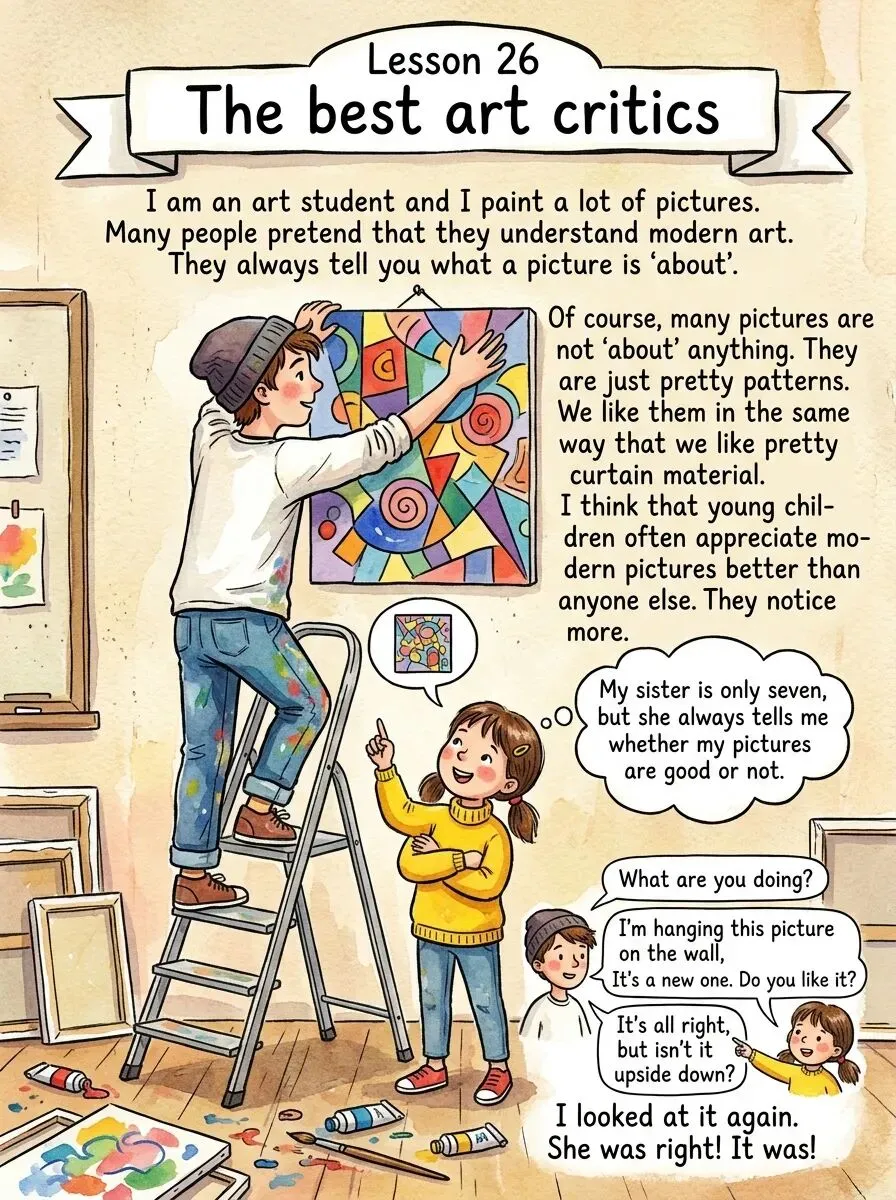
I am an art student and I paint a lot of pictures. Many people pretend that they understand modern art. They always tell you what a picture is 'about'. Of course, many pictures are not 'about' anything. They are just pretty patterns. We like them in the same way that we like pretty curtain material. I think that young children often appreciate modern pictures better than anyone else. They notice more. My sister is only seven, but she always tells me whether my pictures are good or not. She came into my room yesterday.
'What are you doing?' she asked.
'I'm hanging this picture on the wall,' I answered. 'It's a new one. Do you like it?'
She looked at it critically for a moment. 'It's all right,' she said, 'but isn't it upside down?'
I looked at it again. She was right! It was!
背景简介:本课以一名艺术学生的第一人称视角,探讨了现代艺术鉴赏这一主题。作者首先批评了那些不懂装懂、强行解读现代艺术的人,指出许多现代艺术作品本质上是悦目的图案。接着,他提出一个鲜明观点:孩子往往比任何人更能欣赏现代艺术。最后,他用自己七岁妹妹指出他画挂反了的生动事例,幽默而有力地证明了这一观点。文章结构清晰,观点鲜明,例证有趣,语言平实但富有启发性。
参考译文:我是个学艺术的学生,画了很多画。许多人装出一副懂现代艺术的样子。他们总是告诉你一幅画的“意思”是什么。当然,有很多画是什么“意思”也没有的。它们就是些好看的图案。我们喜爱它们就像我们喜欢漂亮的窗帘布一样。我觉得小孩子们往往比任何人都更能欣赏现代绘画。他们观察到的东西更多。我妹妹才七岁,但她总能判断出我的画是好是坏。昨天她进了我的房间。“你在干什么?”她问。“我正在把这幅画挂到墙上,”我回答说,“这是一幅新画。你喜欢吗?”她以挑剔的目光看了一会儿。“还行吧,”她说,“不过,是不是挂反了?”我又看了看。她说对了!是挂反了!
🔍 第二部分:逐句精讲与词块总结
句子1
原文: I am an art student and I paint a lot of pictures.
翻译: 我是个学艺术的学生,画了很多画。
句子结构: 并列句。由连词 and 连接两个简单句,共享主语 I。
重点词汇:
art student 蓝思值 500L
词性:n. phrase
释义:艺术系学生
常用语块:an art student 一名艺术生
短语搭配:art school 艺术学校;art gallery 美术馆;art history 艺术史
例句一:She is an art student specializing in oil painting. 她是一名专攻油画的艺术生。
例句二:The art student spent hours in the studio. 那个艺术生在画室里待了好几个小时。
拓展:student 后接 of 表示研究某学科的学生,如 a student of philosophy (哲学学生)。
paint 蓝思值 400L
英音[peɪnt] 美音[peɪnt] 词性:v. & n.
释义:v. 绘画;刷油漆;n. 油漆,颜料
常用语块:paint a picture 画一幅画
短语搭配:paint the wall 刷墙;oil paint 油画颜料;spray paint 喷漆
例句一:He paints landscapes in watercolor. 他用水彩画风景画。
例句二:The smell of fresh paint filled the room. 房间里充满了新刷的油漆味。
拓展:作动词时,paint 指用颜料作画;draw 多指用线条作画(素描、画图);sketch 指画草图或素描。
语法点睛: 本句使用一般现在时 (am, paint),用于陈述作者的身份和习惯性活动。a lot of 修饰可数名词 pictures,表示数量多,相当于 many。
语音要点: art student 连读,paint a lot of 中 a lot of 连读为 /ə ˈlɒt əv/。
句子2
原文: Many people pretend that they understand modern art.
翻译: 许多人装出一副懂现代艺术的样子。
句子结构: 主从复合句。主句 Many people pretend,后接 that 引导的宾语从句。
重点词汇:
pretend 蓝思值 600L
英音[prɪˈtend] 美音[prɪˈtend] 词性:v.
释义:假装,佯装
常用语块:pretend to do sth. 假装做某事;pretend that... 假装...
例句一:The children pretended to be pirates. 孩子们假装是海盗。
例句二:She pretended that she hadn't seen me. 她假装没看见我。
拓展:pretend 后可直接接不定式 (to do) 或 that 从句。其名词形式为 pretence (英) / pretense (美)。
modern art 蓝思值 700L
词性:n. phrase
释义:现代艺术
短语搭配:modern artist 现代艺术家;modern art museum 现代艺术博物馆;contemporary art 当代艺术
例句一:This gallery has a great collection of modern art. 这家美术馆收藏了大量现代艺术作品。
例句二:Some people find modern art confusing. 有些人觉得现代艺术令人困惑。
拓展:modern art 通常指大约从19世纪末到20世纪70年代的艺术运动;contemporary art 指当今仍在创作的艺术。
语法点睛: pretend 后接 that 引导的宾语从句,that 在口语中常可省略。从句中使用一般现在时 (understand),表示假装的状态。
语音要点: pretend that 中 that 弱读,modern art 重音在 modern 第一音节。
句子3
原文: They always tell you what a picture is 'about'.
翻译: 他们总是告诉你一幅画的“意思”是什么。
句子结构: 主从复合句。主句 They always tell you,后接 what 引导的宾语从句。
重点词汇:
about 蓝思值 300L
英音[əˈbaʊt] 美音[əˈbaʊt] 词性:prep. & adv.
释义:prep. 关于;adv. 大约,周围
常用语块:be about 关于,涉及
短语搭配:talk about 谈论;think about 思考;a book about history 一本关于历史的书
例句一:What is this novel about? 这本小说是关于什么的?
例句二:There were about fifty people at the party. 大约有五十人参加了派对。
拓展:在疑问句中,What is... about? 用于询问主题或内容。课文中的引号表示作者对人们强行赋予画作“意义”这一行为的讽刺。
语法点睛: what 在宾语从句中充当介词 about 的宾语,同时引导整个从句。always 与一般现在时连用,表示习惯性行为,带有轻微的批评意味。
语音要点: tell you 连读 /ˈtel juː/,what a 连读 /ˈwɒt ə/。
句子4
原文: Of course, many pictures are not 'about' anything.
翻译: 当然,有很多画是什么“意思”也没有的。
句子结构: 简单句。主语 many pictures + 系动词 are + 表语 not 'about' anything。Of course 为插入语。
重点词汇:
of course 蓝思值 300L
词性:adv. phrase
释义:当然,自然
常用语块:用作插入语,表示强调或同意
例句一:Of course, I'll help you with your homework. 当然,我会帮你做作业。
例句二:You are, of course, invited to the wedding. 你当然被邀请参加婚礼了。
拓展:of course 表示某事显而易见或理所当然。在表示强烈同意时,可单独使用。
语法点睛: 本句是 be 动词的一般现在时否定句。not 'about' anything 是对前句人们行为的直接反驳。anything 用于否定句。
语音要点: Of course 中 of 弱读,course 重读。not 'about' 中 not 重读以示强调。
句子5
原文: They are just pretty patterns.
翻译: 它们就是些好看的图案。
句子结构: 简单句。主语 They + 系动词 are + 表语 just pretty patterns。
重点词汇:
pretty 蓝思值 400L
英音[ˈprɪti] 美音[ˈprɪti] 词性:adj. & adv.
释义:adj. 漂亮的,悦目的;adv. 相当,很
常用语块:pretty patterns 漂亮的图案
例句一:She wore a pretty dress to the party. 她穿了一件漂亮的连衣裙去参加派对。
例句二:I'm pretty sure I locked the door. 我相当确定我锁了门。
拓展:作形容词时,多形容女性、小孩或精致的事物;作副词时,修饰形容词或副词,程度弱于 very。
pattern 蓝思值 600L
英音[ˈpætn] 美音[ˈpætərn] 词性:n.
释义:图案,花样;模式,方式
常用语块:pretty patterns 漂亮的图案
短语搭配:a pattern of behavior 行为模式;weather pattern 天气模式;follow a pattern 遵循某种模式
例句一:The fabric has a floral pattern. 这块布料有花卉图案。
例句二:There is a clear pattern of improvement in his work. 他的工作有明显的改进模式。
拓展:pattern 可指视觉上的重复设计,也可指事件发生的规律性方式。
语法点睛: 副词 just 在这里意为“仅仅,只是”,用于简化事物的本质,强调这些画作没有深层的“意义”,只是视觉形式。
语音要点: just pretty 中 just 尾音 /t/ 失去爆破,pretty 重音在首音节。
句子6
原文: We like them in the same way that we like pretty curtain material.
翻译: 我们喜爱它们就像我们喜欢漂亮的窗帘布一样。
句子结构: 主从复合句。主句 We like them,后接 in the same way that 引导的方式状语从句。
重点词汇:
curtain 蓝思值 500L
英音[ˈkɜːtn] 美音[ˈkɜːrtn] 词性:n.
释义:窗帘,幕
常用语块:curtain material 窗帘布料
短语搭配:draw the curtains 拉上窗帘;stage curtain 舞台幕布;iron curtain 铁幕(政治术语)
例句一:She bought new curtains for the living room. 她为客厅买了新窗帘。
例句二:The curtain rises at 7:30 p.m. 晚上七点半幕布升起。
拓展:curtain 通常指挂在窗户上的布;drape 是更正式的美式英语说法。
material 蓝思值 600L
英音[məˈtɪəriəl] 美音[məˈtɪriəl] 词性:n. & adj.
释义:n. 材料,布料;素材;adj. 物质的
常用语块:curtain material 窗帘布料
短语搭配:raw material 原材料;reading material 阅读材料;material world 物质世界
例句一:This coat is made of waterproof material. 这件外套是用防水材料做的。
例句二:We are collecting material for a documentary. 我们正在为一部纪录片收集素材。
拓展:作名词时,指构成物品的物理物质或用于工作的信息;作形容词时,与 spiritual (精神的) 相对。
语法点睛: in the same way that... 是一个重要的比较结构,用于说明两种喜爱方式的相似性。that 引导的从句修饰 way。
语音要点: in the same way that 中 that 弱读,curtain material 重音分别在首音节。
句子7
原文: I think that young children often appreciate modern pictures better than anyone else.
翻译: 我觉得小孩子们往往比任何人都更能欣赏现代绘画。
句子结构: 多重复合句。主句 I think,后接 that 引导的宾语从句,该从句中包含比较结构 better than anyone else。
重点词汇:
appreciate 蓝思值 700L
英音[əˈpriːʃieɪt] 美音[əˈpriːʃieɪt] 词性:v.
释义:欣赏,赏识;理解,体会;感激
常用语块:appreciate art/pictures 欣赏艺术/画作
短语搭配:appreciate your help 感谢你的帮助;appreciate the difficulty 理解困难所在
例句一:Not many people can appreciate classical music. 不是很多人都能欣赏古典音乐。
例句二:I really appreciate you taking the time to explain. 我真的很感谢你花时间解释。
拓展:appreciate 表示“欣赏”时,指能理解其价值并从中获得愉悦;表示“感激”时,后接名词或动名词。
better than anyone else 蓝思值 500L
词性:comparative phrase
释义:比任何其他人都好/更...
短语搭配:faster than anyone else 比任何人都快;more carefully than anyone else 比任何人都仔细
例句一:She sings better than anyone else in the choir. 她唱得比合唱团里其他人都好。
例句二:He understands the system better than anyone else. 他比任何人都更了解这个系统。
拓展:else 用于不定代词 (anyone, someone, nothing 等) 或疑问词 (who, what, where 等) 后,表示“其他的”。
语法点睛: 本句包含本课核心语法点:比较级。better 是 well (副词) 或 good (形容词) 的比较级。than 引出比较对象 anyone else。else 与 anyone 连用,相当于 any other person,在比较级中表达最高级的概念。
语音要点: think that 中 that 弱读,better than anyone else 中 than 弱读 /ðən/。
句子8
原文: They notice more.
翻译: 他们观察到的东西更多。
句子结构: 简单句。主语 They + 谓语 notice + 宾语 more。
重点词汇:
notice 蓝思值 500L
英音[ˈnəʊtɪs] 美音[ˈnoʊtɪs] 词性:v. & n.
释义:v. 注意到;n. 通知,布告;注意
常用语块:notice more 注意到更多
短语搭配:take notice of 注意;at short notice 在短时间内;give notice 通知(辞职等)
例句一:Did you notice the strange man standing outside? 你注意到站在外面的那个奇怪男人了吗?
例句二:The company posted a notice about the holiday schedule. 公司张贴了关于假期安排的通知。
拓展:作动词时,指无意或有意的观察;observe 更正式,指有目的的仔细观察。
语法点睛: more 在这里是代词,作 notice 的宾语,指代“更多(的细节或东西)”。它是 much 的比较级形式。
语音要点: notice more 中 more 稍重读,以示对比。
句子9
原文: My sister is only seven, but she always tells me whether my pictures are good or not.
翻译: 我妹妹才七岁,但她总能判断出我的画是好是坏。
句子结构: 并列复合句。由 but 连接两个并列分句,第二个分句中包含 whether... or not 引导的宾语从句。
重点词汇:
whether... or not 蓝思值 600L
词性:conj. phrase
释义:是否
常用语块:tell sb. whether... or not 告诉某人是否...
短语搭配:decide whether to go or not 决定是否去;doubt whether it's true or not 怀疑这是否真实
例句一:I need to know whether you agree or not. 我需要知道你同意与否。
例句二:Whether we win or not, we'll have done our best. 无论赢与否,我们都已尽了最大努力。
拓展:whether 引导名词性从句,表示两者选一。or not 可以紧接 whether 后 (whether or not),也可放在句末。
语法点睛: whether... or not 结构引导宾语从句,表示一种选择性的疑问。always 与一般现在时连用,强调妹妹这一行为的习惯性和可靠性。
语音要点: only seven 中 only 重读,but 转折重读,whether 首音节重读。
句子10
原文: She came into my room yesterday.
翻译: 昨天她进了我的房间。
句子结构: 简单句。主语 She + 谓语 came + 状语 into my room, yesterday。
重点词汇:
come into 蓝思值 400L
词性:phrasal verb
释义:进入
常用语块:come into a room 进入房间
短语搭配:come into being 形成;come into effect 生效;come into view 进入视野
例句一:He came into the office looking very serious. 他走进办公室,表情非常严肃。
例句二:A new law will come into effect next month. 一项新法律将于下月生效。
拓展:注意与 enter 的区别。enter 是及物动词,直接加地点,如 enter the room。come into 中的 into 是介词,后接名词。
语法点睛: 时间状语 yesterday 表明动作发生在过去,因此使用一般过去时 (came)。句子从一般性论述转入具体事例的叙述。
语音要点: came into 连读 /ˈkeɪm ˈɪntə/,my room 中 room 重读。
句子11
原文: 'What are you doing?' she asked.
翻译: “你在干什么?”她问。
句子结构: 直接引语 + 主句。主句为倒装结构 (she asked),引语为特殊疑问句。
重点词汇:
ask 蓝思值 200L
英音[ɑːsk] 美音[æsk] 词性:v.
释义:问,询问;请求
常用语块:ask a question 提问
短语搭配:ask for 请求;ask sb. to do sth. 要求某人做某事;ask about 询问
例句一:May I ask you a personal question? 我可以问你一个私人问题吗?
例句二:She asked for a glass of water. 她要了一杯水。
拓展:ask 后接双宾语时,结构为 ask sb. sth. 或 ask sth. of sb.。
语法点睛: 直接引语使用现在进行时 (are doing),描述说话时正在进行的动作。主句谓语动词用一般过去时 (asked),与叙述的整体时态保持一致。
语音要点: What are you doing 中 are you 连读 /ɑː juː/,句末升调。
句子12
原文: 'I'm hanging this picture on the wall,' I answered. 'It's a new one. Do you like it?'
翻译: “我正在把这幅画挂到墙上,”我回答说。“这是一幅新画。你喜欢吗?”
句子结构: 直接引语(包含三个句子) + 主句 I answered。引语包含现在进行时陈述句、一般现在时陈述句和一般疑问句。
重点词汇:
hang 蓝思值 500L
英音[hæŋ] 美音[hæŋ] 词性:v. (hung, hung)
释义:悬挂,吊
常用语块:hang a picture on the wall 把画挂在墙上
短语搭配:hang up 挂断电话;hang on 等一等;hang out 闲逛
例句一:She hung her coat on the hook. 她把外套挂在钩子上。
例句二:The decision is still hanging in the air. 决定仍然悬而未决。
拓展:hang 作“绞死”解时,过去式和过去分词为 hanged。
answer 蓝思值 300L
英音[ˈɑːnsə(r)] 美音[ˈænsər] 词性:v. & n.
释义:v. 回答;n. 答案
常用语块:answer a question 回答问题
短语搭配:answer the phone 接电话;answer the door 应门
例句一:Nobody answered my call for help. 没有人回应我的求助。
例句二:I'm waiting for an answer to my letter. 我在等回信。
one 蓝思值 200L
英音[wʌn] 美音[wʌn] 词性:pron.
释义:一个(代替前面提到的可数名词)
常用语块:a new one 一个新的
短语搭配:the blue one 那个蓝色的;this one 这个
例句一:My pen is broken. I need a new one. 我的钢笔坏了,需要一支新的。
例句二:Which one do you prefer? 你更喜欢哪一个?
拓展:复数形式为 ones。
语法点睛: 引语中 I'm hanging 是现在进行时,生动描述动作。It's a new one. 中 one 是代词,指代 picture,避免重复。Do you like it? 是一般现在时的一般疑问句,询问对方的喜好。
语音要点: I'm hanging 中 I'm 弱读,hanging 重音在首音节。new one 连读 /njuː wʌn/。
句子13
原文: She looked at it critically for a moment.
翻译: 她以挑剔的目光看了一会儿。
句子结构: 简单句。主语 She + 谓语 looked at + 宾语 it + 方式状语 critically + 时间状语 for a moment。
重点词汇:
critically 蓝思值 800L
英音[ˈkrɪtɪkli] 美音[ˈkrɪtɪkli] 词性:adv.
释义:批判性地,挑剔地
常用语块:look at sth. critically 批判性地看某物
短语搭配:think critically 批判性思维;critically ill 病危
例句一:The teacher read my essay critically. 老师以挑剔的目光读了我的文章。
例句二:He is critically injured. 他受了重伤。
拓展:形容词为 critical。
for a moment 蓝思值 400L
词性:phrase
释义:一会儿
短语搭配:wait for a moment 等一会儿;just a moment 稍等
例句一:He thought for a moment before answering. 他思考了片刻才回答。
例句二:Could you hold for a moment? 你能稍等一下吗?
拓展:for a moment 强调动作持续了一段时间。
语法点睛: 副词 critically 修饰动词短语 looked at,说明了“看”的方式,呼应了“艺术评论家”的角色。for a moment 作时间状语。
语音要点: looked at it 连读 /lʊkt æt ɪt/,critically 重音在首音节。
句子14
原文: 'It's all right,' she said, 'but isn't it upside down?'
翻译: “还行吧,”她说,“不过,是不是挂反了?”
句子结构: 直接引语(由两个分句用 but 连接) + 主句 she said。引语的第二部分是一个否定疑问句。
重点词汇:
all right 蓝思值 300L
词性:adj. phrase / interj.
释义:还行,不错;好吧
常用语块:It's all right. 还行。/没关系。
短语搭配:That's all right. 没关系。/不用谢。
例句一:The movie was all right, but not great. 电影还行,但不算很棒。
例句二:Is it all right if I open the window? 我打开窗户可以吗?
upside down 蓝思值 500L
词性:adv. phrase
释义:上下颠倒地
常用语块:hang upside down 倒挂着
短语搭配:turn sth. upside down 弄得底朝天;彻底搜查
例句一:The picture is hanging upside down. 画挂反了。
例句二:The burglars turned the house upside down. 窃贼把房子翻得乱七八糟。
拓展:相关短语 inside out 表示“里外翻转”。
语法点睛: isn't it...? 是否定疑问句,常用来表示惊讶、怀疑或寻求确认,期待一个肯定的回答。这里妹妹用这种句式,委婉但肯定地提出了她的发现,体现了对话的生动性。
语音要点: It's all right 中 all right 连读 /ɔːl raɪt/,isn't it 连读 /ˈɪznt ɪt/,upside down 重音在 down。
句子15
原文: I looked at it again.
翻译: 我又看了看。
句子结构: 简单句。主语 I + 谓语 looked at + 宾语 it + 状语 again。
重点词汇:
again 蓝思值 200L
英音[əˈɡen] 美音[əˈɡen] 词性:adv.
释义:又,再次
常用语块:look again 再看一次
短语搭配:again and again 一次又一次;now and again 偶尔
例句一:Please say that again. 请再说一遍。
例句二:It's cheap, but then again the quality is poor. 它很便宜,但另一方面质量很差。
语法点睛: 副词 again 修饰动词 looked,表示动作的重复,体现了作者从自信到怀疑的心理变化。
语音要点: looked at it again 中 again 重读第二音节。
句子16
原文: She was right! It was!
翻译: 她说对了!是挂反了!
句子结构: 两个简短感叹句。第二句是省略句,完整形式为 It was upside down! 或 It was (right about being upside down)!。
重点词汇:
right 蓝思值 300L
英音[raɪt] 美音[raɪt] 词性:adj., adv., n.
释义:adj. 正确的;adv. 正确地;n. 权利;右边
常用语块:be right 是正确的
短语搭配:all right 好吧;right now 现在;human rights 人权
例句一:Your answer is right. 你的答案是正确的。
例句二:Turn right at the corner. 在拐角处向右转。
拓展:反义词是 wrong 或 left。
语法点睛: 第二句 It was! 是典型的上下文省略。在对话或紧承上文的句子中,为了避免重复,可以省略上文已出现过的成分,使语言更加简洁有力,并增强了幽默和恍然大悟的效果。
语音要点: 两句都用降调,感叹号加强语气,It was! 中 was 重读。
📌 核心词块总结
1. pretend that...: To behave as if something is true when it is not. (假装...) 例句: He pretended that he was sick to avoid the test.
2. tell sb. what/where/whether...: To inform someone about something specific. (告诉某人...) 例句: Can you tell me what time the meeting starts?
3. in the same way that...: In a similar manner to... (以与...相同的方式) 例句: We learn from mistakes in the same way that babies learn to walk by falling.
4. appreciate sth. better than anyone else: To understand and enjoy the value of something more than any other person. (比任何人都更欣赏某物) 例句: She appreciates classical music better than anyone else I know.
5. notice more: To observe a greater number of details or things. (注意到更多) 例句: A good detective notices more at a crime scene.
6. look at sth. critically: To examine something with careful judgment, looking for faults or merits. (以批判的眼光看待某物) 例句: Before submitting, look at your essay critically.
7. for a moment: For a short period of time. (一会儿) 例句: He paused for a moment to collect his thoughts.
8. upside down: With the top at the bottom. (上下颠倒) 例句: The fly can walk upside down on the ceiling.
✍️ 第三部分:语篇分析与段落写作技巧
1. 语篇分析① 识别宏观结构 (Identify the macrostructure): 本文采用经典的“立论-论证-例证”结构。第一段(前8句)为立论与论证:作者先树立靶子(人们不懂装懂),提出自己的核心观点(孩子最能欣赏现代艺术),并给出理由(他们注意更多细节)。第二段(后8句)为具体例证:通过妹妹指出画挂反了的个人轶事,生动、幽默且有力地证明了第一段的观点。② 列举衔接手段 (List cohesive devices): 逻辑连接词 (Of course, but, and);指代 (I, me, my, they, them, we, she, it);词汇复现 (picture(s) 出现7次);比较结构 (better than anyone else, in the same way that);时态衔接 (一般现在时→一般过去时)。③ 分析作者态度 (Analyze the author's attitude): 作者的态度是批判性、幽默且带有教育意味的。他对伪艺术鉴赏家 (pretend) 持讽刺态度;他推崇真诚、直接的观察(孩子的方式);他通过自嘲(自己挂反画)使观点更易被接受,并最终表达了对妹妹敏锐观察力的钦佩与认可 (She was right!)。
2. 写作技巧① 提炼写作逻辑: 本课展示了如何构建一个有力的议论段落:首先定义或描述一个普遍现象/问题 → 对此提出批评或不同看法 → 明确提出自己的中心论点 → 简要说明理由 → 用一个具体、个人化、有说服力的事例来支撑论点。事例最好包含对话和细节,使论证栩栩如生。② 提供段落写作范例主题: The best travel advisors are often locals, not guidebooks.Many tourists rely heavily on detailed guidebooks, believing they contain all the secrets of a place. They follow recommended routes and eat at listed restaurants, often missing the authentic pulse of the city. I believe that local residents, especially shopkeepers or elderly people in parks, often give better advice than any publication. They know the recent changes, the hidden gems, and the true spirit of their neighborhood. Last year in Kyoto, my guidebook led me to a crowded, overpriced temple garden. Feeling lost, I asked a man sweeping leaves outside a small shrine for directions. He not only pointed the way but also said, "But if you want real peace, go to this little garden behind the noodle shop. No tourists, just the sound of water." I followed his advice. The garden was tiny but breathtakingly beautiful, an experience no guidebook could have offered. That local man, with his simple suggestion, was the best travel advisor I ever had.③ 布置小练笔并提供例文小练笔: 仿照课文结构,写一个约120-150词的段落,阐述“Sometimes, the most useful feedback comes from complete beginners.”(有时,最有用的反馈来自完全的新手。)要求包含对现象的批评、你的观点以及一个具体事例。例文:In many fields, we tend to value only expert opinions, dismissing newcomers as ignorant. People assume complex skills like cooking, coding, or playing an instrument can only be judged by masters. However, I find that complete beginners often provide the most useful feedback precisely because they lack preconceptions. They experience the product or performance with fresh eyes and immediate intuition. Last month, I was designing a website for a client. I had spent weeks perfecting the layout, convinced it was user-friendly. I showed it to my younger cousin, who has no tech background. She clicked around for a minute and said, "It looks cool, but why is the 'Buy Now' button the same color as the 'Cancel' button? I almost clicked the wrong one." I was stunned. I had been so focused on aesthetics that I overlooked a fundamental usability issue. Her beginner's perspective caught what my expert blindness had missed.分析其结构特点: 首句提出普遍现象及批评;第二句提出核心论点并说明理由;引入具体事例和人物;描述情境和问题;引用新手的直接反馈;描述结果和反思;结尾句总结回扣论点。标注语言点映射: dismissing... as (对比课文对 pretend 人群的态度);lack preconceptions (对应孩子 notice more 的原因);with fresh eyes (对应 young children);"It looks cool, but why is...?" (类似 "It's all right, but isn't...?" 的句式结构);overlooked (反义词映射课文的 notice)。
📐 第四部分:本课语法精析(加强版)
1. 比较级和最高级的构成与用法(1) 规则变化
| | | |
|---|
| | | |
| | | |
| 以“辅音+y”结尾,变 y 为 i 加 -er, -est | | | |
| 以“一个元音+一个辅音”结尾,双写辅音加 -er, -est | | | |
| | | |
(2) 不规则变化
(3) 比较句型-原级比较 (as...as): A + be动词/实义动词 + as + 形容词/副词原级 + as + B. 否定句用 not as/so...as.-比较级 (than): A + be动词/实义动词 + 形容词/副词比较级 + than + B.-“越来越...”: 比较级 + and + 比较级 或 more and more + 原级.-“越...就越...”: The + 比较级..., the + 比较级...-最高级: A + be动词/实义动词 + the + 形容词最高级 + (名词) + 比较范围(in/of/among...). 副词最高级前 the 可省略。-隐含最高级: 使用 比较级 + than anyone/anything else 或 比较级 + than any other + 单数名词 可以表达最高级含义。这正是本课句子7的用法。2. 与本课及第一册的关联与对比- 在第一册,已经接触了 good, better, best 和 bad, worse, worst 等少量不规则变化(如第107-108课)。第二册本课的系统学习,是将知识点全面扩展和深化,并引入 more/most 构成比较级和最高级的规则。- 课文标题"The best art critics"是最高级的典型应用,暗含“在所有评论家中,孩子是最好的”这一比较范围。- 句子7"young children often appreciate modern pictures better than anyone else"是“隐含最高级”的完美范例,使用了 better than anyone else。- 句子6"in the same way that..."是原级比较 (as...as) 的一种变体,表示方式的相似性。3. 一般现在时与现在进行时复习- 一般现在时: 用于陈述事实、习惯、观点和永久性状态。课文例句: I am an art student. (身份) Many people pretend... (普遍现象) They always tell you... (习惯) I think that... (观点) My sister is only seven. (状态)- 现在进行时: 用于描述说话时正在进行的动作或当前一段时间内的临时情况。课文例句: 'What are you doing?' 'I'm hanging this picture...' (说话时正在进行的动作)4. 练习题 (不少于12道)①用所给词的适当形式填空:1. My sister is much ______ (young) than me. (younger)2. This is ______ (good) film I've seen this year. (the best)3. He speaks English ______ (fluently) than his brother. (more fluently)4. The ______ (much) you read, the ______ (wise) you become. (more, wiser)5. This problem is ______ (difficult) than it looks. (more difficult)6. Of the two shirts, I prefer the ______ (expensive) one. It looks ______ (good). (more expensive, better)7. She felt ______ (bad) yesterday, but she's a little ______ (well) today. (worse, better)8. We need ______ (far) information to make a decision. (further)9. Who is ______ (old), Tom or Jerry? --- Tom is. He's the ______ (old) in the family. (older, eldest)10. The car is running ______ and ______ (fast) as it goes downhill. (faster, faster)②改错:11. He is more taller than his father. (去掉 more)12. This coffee is worst than the one I had yesterday. (worst → worse)5. 练习题解析① 填空解析: 1. younger (两者比较,用比较级) 2. the best (最高级) 3. more fluently (多音节副词) 4. more, wiser (越...越...) 5. more difficult (多音节) 6. more expensive, better (两者中更贵,看起来更好) 7. worse, better (bad和well的比较级) 8. further (更多的信息) 9. older, eldest (年龄比较,家庭中最年长) 10. faster, faster (越来越快)② 改错解析: 11. taller 本身已是比较级,不用 more 12. 两者比较用 worse,不是 worst。
🎧 第五部分:听力与阅读策略训练
1. 听力技巧① 预测关键词 (Predicting Keywords): 根据标题 "The best art critics",预测可能出现的词汇:art student, paint, modern art, pretend, understand, pictures, patterns, children, appreciate, notice, sister, critically, upside down。② 抓主旨大意 (Gist Listening): 第一遍听,尝试回答:What is the author's main opinion about who understands modern art best? (Young children.) What example does he use to support this? (His seven-year-old sister pointed out that he had hung a picture upside down.)③ 笔记方法 (Note-taking): 第二遍听,用关键词或思维导图记录文章逻辑和细节。2. 阅读理解策略① 扫读 (Scanning): 快速阅读课文,找出具体信息:作者职业 (art student),人们假装理解什么 (modern art),作者把一些画比作什么 (pretty curtain material),妹妹年龄 (seven),画有什么问题 (upside down)。② 略读 (Skimming): 快速浏览,总结文章目的和两部分大意。③ 推断词义 (Inferring Meaning): 根据上下文推断 'about' (引号表讽刺), critically (从她随后给出评价并指出错误可推断为“审视地”), It was! (省略,完整为 It was upside down!)。
📝 第六部分:习题讲解
关键句型 (Key Structures) 与 难点 (Special Difficulties) 练习概览本课课后练习重点围绕:1. 形容词和副词的比较级与最高级;2. 介词;3. 词汇应用;4. 时态区分。示例习题讲解题目一:选择正确的词填空。1. Many people (pretend/understand) that they know modern art. → pretend (根据课文,许多人“假装”懂)2. She looked at the picture (critical/critically). → critically (修饰动词需用副词)3. This picture is (good/better) than that one. → better (两者比较)4. He hung the picture (in/on/at) the wall. → on (附着在表面)题目二:将下列句子改为比较级或最高级形式。1. She is a good critic. (比较级:than anyone else) → She is a better critic than anyone else.2. This is a difficult problem. (最高级:in the book) → This is the most difficult problem in the book.3. He runs fast. (比较级:than his friend) → He runs faster than his friend.题目三:用所给动词的正确时态填空。1. I (paint) a lot of pictures. → paint (一般现在时陈述事实)2. What you (do)? -- I (hang) this picture. → are you doing, am hanging (现在进行时描述当前动作)3. She always (tell) me her opinion. → tells (一般现在时,第三人称单数习惯)
🤔 第七部分:英文深度思考与拓展(强化版)
A. 层次化英文问题与答案Level 1 (Factual):1. Q: What does the author do? A: He is an art student who paints a lot of pictures.2. Q: According to the author, what are many modern pictures actually like? A: They are not 'about' anything; they are just pretty patterns.3. Q: What specific question did the sister ask about the picture? A: She asked, "but isn't it upside down?"4. Q: What was the author's reaction after looking at the picture again? A: He realized she was right and that the picture was indeed upside down.Level 2 (Inferential):5. Q: Why does the author mention people who "pretend" to understand modern art? A: To set up a contrast and criticize adult over-intellectualization.6. Q: What does the comparison to "pretty curtain material" reveal? A: That the value of some modern art lies in visual appeal, not deep meaning.7. Q: How does the sister's comment "It's all right" function? A: It softens the criticism, showing social awareness.8. Q: What might the author have felt when he said, "She was right! It was!"? A: Surprise, embarrassment, amusement, and admiration.Level 3 (Evaluative/Creative):9. Q: Is noticing more details always equivalent to better appreciation? A: Not necessarily; context and knowledge matter, but for non-representational art, perception is key.10. Q: Could the story be interpreted as about expertise and humility? A: Yes, it shows that experts can miss basic flaws, and fresh perspectives are invaluable.11. Q: Is the author's definition of "understanding" art limited? A: Deliberately narrow for his argument, but honest perception is a valid form of engagement.12. Q: If the picture were realistic, would the story's message be stronger? A: It would be comically stronger but might weaken the link to modern art; the ambiguity of abstract art makes the observation more insightful.B. 多类型拓展阅读1. 现代场景故事 (Museums Experiment with "Child Curators")标题:Museums Experiment with "Child Curators" for Special Exhibitions
In an innovative move to attract younger audiences and challenge traditional curation, several museums in Europe have launched pilot programs involving “child curators.” Children aged 8-12 are invited to co-curate small exhibitions. They are given access to storage, taught basic handling, and asked to select works based on a simple theme like “Colors That Make Me Happy” or “Stories Without Words.” The results have been startling. While adult curators might group works by period or artist, children create connections based on emotion, shape, or even imagined dialogues between artworks. A recent exhibition in Berlin, co-curated by children, paired a serene Renaissance landscape with a vibrant, chaotic abstract expressionist piece because, as one child explained, “The calm green field looks like it’s dreaming of the wild red dance.” Critics are divided, but visitor engagement, especially among families, has soared. This trend echoes our textbook’s idea, giving institutional weight to the child’s perspective as a legitimate, refreshing critical voice.
引导性问题:What are the potential benefits and drawbacks of letting children co-curate museum exhibitions? Does this practice validate the textbook author's opinion?
2. 文化背景解析 (The "Childlike" in Modern Art)标题:The "Childlike" in Modern Art: From Inspiration to Aesthetic内容:The textbook author’s defense of the child’s perspective in art appreciation has deep roots in the history of modern art itself. In the late 19th and early 20th centuries, many avant-garde artists actively sought to break free from the rigid techniques and perspectives of academic art. They looked to so-called “primitive” art, folk art, and crucially, children’s art. Artists like Paul Klee, Joan Miró, and Jean Dubuffet were fascinated by the directness, spontaneity, and emotional honesty found in children’s drawings. Dubuffet even coined the term “Art Brut” (raw art) to describe work created outside the boundaries of official culture, which included art by children. For these artists, the child’s vision was not inferior but a purer form of expression, untainted by convention. Therefore, when the textbook author says children appreciate modern art better, he is unknowingly echoing a fundamental belief that helped shape modern art: that the untrained, intuitive eye can see truths that the over-educated eye obscures.
语言点映射:文中关键词:avant-garde (前卫的), break free from (摆脱), rigid (僵化的), academic art (学院派艺术), primitive (原始的), spontaneity (自发性), coined the term (创造了…术语), untainted by (未受…玷污), convention (惯例), intuitive (直觉的), obscures (使模糊)。
3. 今昔对比分析 (From "Is it upside down?" to Algorithmic Aesthetics)标题:From "Is it upside down?" to Algorithmic Aesthetics: How We Judge Images Now内容:The central moment in our textbook—a human, let alone a child, physically looking at a physical painting and judging its orientation—feels almost quaint in the age of digital images and AI. Today, millions of images are uploaded daily to social media, where they are “judged” not by a thoughtful glance, but by algorithms that promote content based on engagement metrics. Filters can instantly alter colors and patterns, making the “pretty pattern” the author describes a commodity anyone can create. There are even AI tools that claim to analyze the “aesthetic quality” of a photo. However, the human element of criticism persists in new forms: comment sections, live-streamed art critiques, and viral “roasts” of design fails. The question “Is it upside down?” has its digital equivalent: “Did you even check the alignment?” or “Why is the text backwards?”. The scale and medium have changed dramatically, but the core dynamics remain: a creator’s vulnerability, an audience’s gaze, and the enduring value of a simple, obvious observation that the creator missed. The child’s role is now played by the first commenter who spots the flaw.
引导性问题:Is the feedback from an algorithm or a crowd of online strangers comparable to the personal, direct feedback from the sister in the story?
4. 新潮英语改写 (My 7-Year-Old Sister, My Ultimate Art Critic)标题:My 7-Year-Old Sister, My Ultimate Art Critic & Humility Check内容:Okay, so I’m in art school, right? I live and breathe this stuff. And it’s wild how many people front about getting modern art. They’ll look at some abstract splashes and be like, “Ah, this represents the anguish of postmodern society.” Bro, sometimes it’s just cool colors. We vibe with it like we vibe with a sick wallpaper pattern. No cap, I think kids are low-key the best at this. No overthinking, just pure feel. They see everything. Enter my little sis. She’s seven. She’s my go-to for honest feedback on my pieces. So yesterday, I’m finally putting up this new canvas I’m kinda proud of. She walks in. “What’s the move?” she asks. “Just setting up the new piece,” I say. “Fire or basic?” She gives it the full side-eye, really studying it. “It’s… aiight,” she says, dragging it out. “But… you sure it’s not, like, upside down?” I freeze. Look. DEAD. It was totally inverted. I was so in my head about composition and texture that I missed the absolute basics. We both cracked up. Major L for the art student, but also, massive respect. She keeps me humble. The best critics don’t need a degree; they just need clear eyes.
引导性问题:How does the use of words like "squad," "grinding," and "gig" change the feel of the conversation?
语言点映射:识别文中俚语和网络用语:front about (假装), vibe with (与…合拍), sick (很棒的), No cap (说真的), low-key (有点,暗自), go-to (首选), What’s the move? (在干嘛?), Fire or basic? (棒还是俗?), side-eye (侧目,怀疑的眼神), aiight (alright 的变体), DEAD (形容极度尴尬或好笑), inverted (颠倒的), cracked up (大笑), Major L (重大失败), in my head (想太多), clear eyes (清晰的眼光)。
5. 真实故事或人物传记 (The "Upside-Down" Moment of Henri Matisse)标题:The "Upside-Down" Moment of Henri Matisse内容:The textbook story finds a fascinating parallel in the life of the great French artist Henri Matisse. In his later years, confined to a wheelchair and bed, Matisse developed his groundbreaking cut-out technique, using painted paper and scissors to create vibrant, large-scale compositions like “The Snail.” The work was monumental and complex. When it was first installed for an exhibition, there was confusion among the assistants about its correct orientation. The abstract, spiral-like arrangement made it ambiguous. According to some accounts, it was Matisse’s young granddaughter or a child visitor who, upon seeing the work, made a comment or gesture that helped clarify the intended “right-side-up” for the artist or the curators. While the details are anecdotal, the story persists because it resonates with a truth Matisse himself embraced: the pursuit of a childlike simplicity and directness in art. He famously said, “Creativity takes courage.” Part of that courage, as our textbook implies, is sometimes being willing to have the most basic aspect of your work—which way is up—validated by the least assuming critic: a child.
引导性问题:How does Matisse's pursuit of a "childlike" style relate to the textbook author's argument? Does the potential anecdote about his granddaughter strengthen the idea that children see what adults complicate?
🌍 第八部分:日常应用与文化拓展
1. 相关文化背景知识-现代艺术 (Modern Art) 的挑战: 现代艺术,特别是抽象艺术,主动放弃了描绘 recognizable reality(可识别的现实)。这迫使观众从寻找“故事”转向感受颜色、形状、线条、质地和构图本身。本课作者指出了这一点,并建议我们用欣赏装饰品般的直接感官愉悦来接近这类艺术。-艺术评论 (Art Criticism) 的多元性: 艺术评论并非权威的独白。它可以是专业的学术论文,可以是报纸上的专栏,也可以是朋友间的一句“我喜欢这个颜色”。妹妹的评论属于最后一种——基于直接观察的个人反应。-“初学者心态” (Beginner's Mind): 这是一个源自禅宗的概念,指面对任何事情都保持像初学者一样开放、好奇、不带先入为主观念的心态。本课中孩子的视角正是“初学者心态”的体现。2. 引导性思考- 作者看重孩子视角的诚实和对细节的关注。在你的生活中,能否想到一个“新手”或领域外的人给你带来惊人 helpful 建议的情况?是什么?- 故事表明 overthinking(想太多)会让我们对简单的真相视而不见。你是否同意,在现代信息时代,我们更容易 overthinking 而不是相信简单的观察?为什么?- 如果艺术是关于个人体验和感知,那么只要观者觉得悦目,一幅画是否挂反了还重要吗?“挂反了”的版本能否被视为对作品一种新的、有效的诠释?
🗂️ 第九部分:本课知识图谱
核心论点:年轻的孩子往往是最好的艺术评论家。
├─ 论证基础:对普遍现象的批判│ ├─ 关键细节1.1:许多人假装理解现代艺术,总是强行赋予画作“意义”。│ └─ 关键细节1.2:作者反驳:许多画没有“意义”,只是悦目的图案,我们喜欢它们如同喜欢漂亮的窗帘布。
├─ 核心主张与理由│ ├─ 关键细节2.1:主张:孩子比任何人都更能欣赏现代绘画。│ └─ 关键细节2.2:理由:他们注意到更多(细节)。
└─ 个人例证支撑├─ 关键细节3.1:引入人物:我七岁的妹妹,她总能判断我的画好坏。├─ 关键细节3.2:事件背景:昨天她进入我的房间,我正在往墙上挂一幅新画。├─ 关键细节3.3:互动过程:她询问,我回答并征求她的意见;她以挑剔的目光审视,先给出保留性评价,然后提出关键性质疑:画是不是挂反了?└─ 关键细节3.4:结果与印证:我再次检查,确认她是正确的。画确实挂反了。我的反应:惊叹并承认错误 (She was right! It was!)。
论点强化:这个具体、幽默的事例生动地证明了,孩子凭借其直接的观察力,能够发现成年人(甚至是艺术学生)因过度熟悉或思考而忽略的基本事实,从而支撑了“孩子是最好的评论家”这一核心论点。
© 本文为狂暴英语教案 · 新概念英语第二册第26课
仅供学习交流使用

贝琪酱英语无痛逆袭站
微信扫描二维码,关注我的账号
 10个月宝宝每天需要喝多少奶粉?

