读外刊,接触原汁原味的英文表达,
欢迎关注以下公众号+设为星标+推荐给朋友。▼
📚 狂暴英语教案 · 新概念英语第一册
第39-40课 Don't drop it! & What are you going to do?
别摔了它! / 你打算做什么?
📘 本课信息
教材:新概念英语第一册 · 第39-40课
核心功能:询问计划 · 发出指令 · 协商物品放置 · 安全警告
语法焦点:否定祈使句 · “be going to”结构
🎯 本课学习目标
词汇:
掌握与日常动作、物品相关的核心动词(如drop, put, show, send, take)和名词(如vase, flowers, front door)。理解并运用"be going to"结构中的动词短语。
语法:
系统掌握否定祈使句"Don't..."的构成与用法;深入理解并运用"be going to + 动词原形"结构表达即将发生的动作或意图。巩固现在进行时与"be going to"在表意上的区别。
技能(日常对话):
能够发出清晰的指令或警告;能够询问并回答关于近期计划或打算的问题。提升在家庭生活、帮忙做事等场景下的基础会话能力。
文化:
初步了解英语中表达“打算”的多种方式及其细微差别;体会祈使句在英语日常交流中的直接性与适用场合。
📖 第一部分:课文完整内容
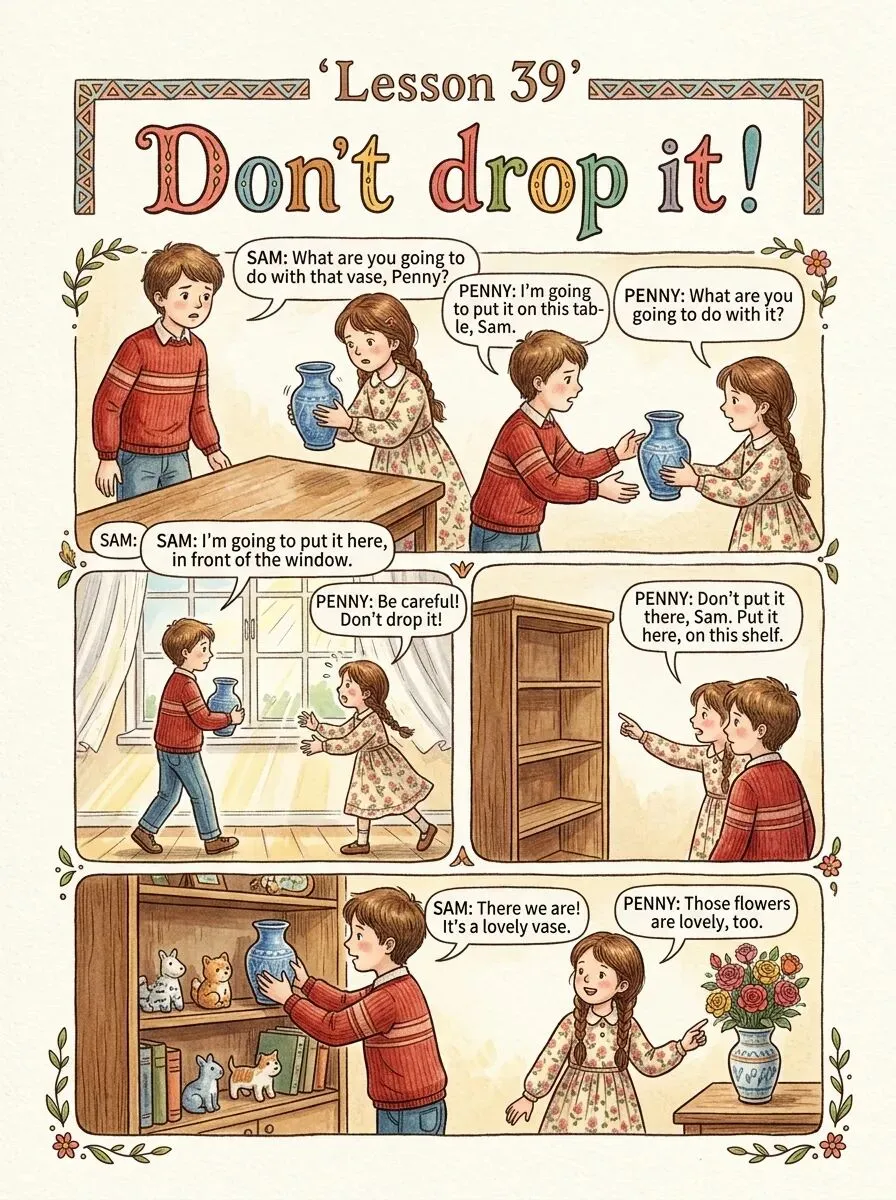
Lesson 39 Don't drop it!
📜 课文原文(含语音标注)
Sam: What are you going to do with that vase, Penny?
Penny: I'm going to put it on this table, Sam.
Sam: Don't do that. Give it to me.
Penny: What are you going to do with it?
Sam: I'm going to put it here, in front of the window.
Penny: Be careful! Don't drop it!
Penny: Don't put it there, Sam. Put it here, on this shelf.
Sam: There we are! It's a lovely vase.
Penny: Those flowers are lovely, too.
语音标注: Don't do that.:Don't 中的 /t/ 在快速口语中可能轻微失去爆破,do that 可以连读为 /duː ðæt/,注意 /ð/ 的咬舌音。I'm going to...:口语中常弱读为 I'm gonna /ˈɡənə/,但在正式学习时建议先掌握完整发音 /ˈɡəʊɪŋ tə/。front of:front 词尾的 /t/ 与 of 连读。Be careful!:Be 发音短促,重音在 careful 的第一个音节 /ˈkeə/ 上。There we are!:表示“好了!”,are 发音为 /ɑː(r)/,整体语调轻快。
Lesson 40 What are you going to do? I'm going to...
📜 课文原文
注:本课为句型操练课,无连续对话课文,核心句型为:
What are you going to do?
I'm going to put it on the table/floor/shelf/dressing table.
I'm going to take it to school/office/home.
I'm going to turn on the television/light/stereo.
I'm going to turn off the television/light/tap.
I'm going to put it on.
I'm going to take it off.
I'm going to put them on.
I'm going to take them off.
情景说明:第39课的场景发生在家中。Sam和Penny(可能是夫妻或室友)正在处理一个花瓶。Penny打算把花瓶放在桌子上,但Sam提出了不同意见,并主动接手。随后两人就花瓶的摆放位置进行了简单的讨论,期间Penny担心Sam把花瓶摔了,并最终指挥Sam把花瓶放到了架子上。对话展现了日常生活中就物品摆放进行协商、发出指令和提醒的常见互动。第40课则是对第39课引入的核心句型“What are you going to do? I'm going to...”进行系统性的扩展和替换练习,围绕“放置物品”、“携带物品”、“开关电器”、“穿戴衣物”等高频生活场景进行强化训练。
参考译文:
第39课 别摔了它!
萨姆:你打算如何处理那个花瓶,彭妮?
彭妮:我打算把它放在这张桌子上,萨姆。
萨姆:别那么做。把它给我。
彭妮:你打算用它来做什么?(或:你打算把它放哪儿?)
萨姆:我打算把它放在这儿,窗户前面。
彭妮:小心点!别摔了它!
彭妮:别放在那儿,萨姆。放在这儿,这个架子上。
萨姆:好啦!这个花瓶真漂亮。
彭妮:那些花也很漂亮。
第40课 你打算做什么?我打算......
(此课为句型练习,无连续译文)
🔍 第二部分:逐句精讲与词块总结
句子1
原文: What are you going to do with that vase, Penny?
翻译: 你打算如何处理那个花瓶,彭妮?
句子结构: 特殊疑问句。结构:特殊疑问词(What) + 一般疑问句语序(are you going to do) + 状语(with that vase) + 称呼语(Penny)。属于“主语(you) + 系动词(are) + 表语(going to do)”的扩展结构,其中“going to do”整体作为表语,表示将来计划。
重点词汇:
vase 蓝思值 500L
英音 /vɑːz/ 美音 /veɪs/ 或 /vɑːz/ 词性:n. 名词
释义:花瓶
常用语块:a flower vase (花瓶), a Ming vase (明代花瓶)
例句一:She filled the vase with water and arranged the roses. 她把花瓶装满水,然后插好玫瑰。
例句二:This antique vase is very valuable. 这个古董花瓶非常值钱。
拓展:注意英音和美音的主要区别在元音。记忆时可联想“ vase(花瓶)里插着花, face(脸)对着它笑”,通过face的发音/feɪs/来记忆美音。
语法点睛: 本句的核心是“be going to”结构用于询问对方的意图或计划。“be going to + 动词原形”表示“打算、准备做某事”或“根据现有迹象推断即将发生的事”。本课侧重前者。疑问句将be动词提前。
语音要点: “What are you”在口语中常连读为 /wɒt ə juː/ 或更快的 /wɒtʃə/。“going to”注意弱读现象。“with that”中,with 词尾的 /ð/ 与 that 开头的 /ð/ 相邻,发音时只需做一个稍长的咬舌音即可。
句子2
原文: I'm going to put it on this table, Sam.
翻译: 我打算把它放在这张桌子上,萨姆。
句子结构: 主语(I) + 系动词(am) + 表语(going to put) + 宾语(it) + 地点状语(on this table) + 称呼语(Sam)。是“主系表”结构,表语部分包含不定式“to put”。
重点词汇:
put 蓝思值 200L
英音 /pʊt/ 美音 /pʊt/ 词性:v. 动词
释义:放,安置
常用语块:put on (穿上,上演), put off (推迟), put away (收好), put up with (忍受)
例句一:Please put the books back on the shelf. 请把书放回书架。
例句二:He put his hands in his pockets. 他把手插进口袋。
拓展:put 是一个非常高频且搭配能力极强的动词,其含义高度依赖后面的介词或副词。本课是“put + 宾语 + 介词(on) + 地点”的典型结构。
语法点睛: 这是“be going to”结构的肯定句形式。I'm 是 I am 的缩写。to 后面必须接动词原形 put。这个结构比单纯的将来时“will”更强调“事先的打算或计划”。
语音要点: I'm 发音为 /aɪm/,短促。put it on 可以连读,put 的 /t/ 与 it 的 /ɪ/ 连,it 的 /t/ 与 on 的 /ɒ/ 连,整体听起来像 /ˈpʊt ɪ tɒn/。注意 on 的发音是 /ɒn/,不是 /ɔːn/。
句子3
原文: Don't do that. Give it to me.
翻译: 别那么做。把它给我。
句子结构: 这是两个祈使句。第一个是否定祈使句:Don't + 动词原形(do) + 宾语(that)。第二个是肯定祈使句:动词原形(Give) + 间接宾语(it) + 直接宾语(to me)。“Give it to me”是“动词+直接宾语+to+间接宾语”结构。
重点词汇:
drop 蓝思值 400L
英音 /drɒp/ 美音 /drɑːp/ 词性:v. 动词
释义:(使)落下,掉下;投下;放弃 n. 滴;下降
常用语块:drop a glass (摔碎杯子), drop a subject (放弃一个话题), drop by/in (顺便拜访), a drop of water (一滴水)
例句一:Be careful not to drop your phone. 小心别把手机掉了。
例句二:The temperature will drop sharply tonight. 今晚气温将骤降。
拓展:作为动词,既可以表示无意地“掉落”(如本课),也可以表示有意地“投下”(drop a bomb)或“放弃”(drop a plan)。名词“一滴”也很常用。
give 蓝思值 200L
英音 /ɡɪv/ 美音 /ɡɪv/ 词性:v. 动词
释义:给
常用语块:give up (放弃), give in (屈服), give away (赠送,泄露), give back (归还)
例句一:Can you give me a hand with this box? 你能帮我搬一下这个箱子吗?
例句二:She gave a presentation to the whole company. 她向全公司做了演示。
拓展:give 可以接双宾语:give sb. sth. = give sth. to sb.。但当sth.是代词(如it, them)时,通常只能用 give it/them to sb. 结构,如本句。
语法点睛: 本句引入了否定祈使句。祈使句用于发出命令、请求、劝告等。否定形式直接在动词原形前加“Don't”(Do not的缩写)。例如:Don't go. (别去。) Don't be late. (别迟到。)“Give it to me”展示了双宾语动词的另一种语序。
语音要点: Don't 重读,/t/ 发音清晰。do that 连读。Give it to me 中,give 和 it 可以连读,it 的 /t/ 在 to 前可能弱化,to me 连读为 /tə miː/。
句子4
原文: What are you going to do with it?
翻译: 你打算把它怎么样?(或:你打算用它来做什么?)
句子结构: 特殊疑问句。结构:特殊疑问词(What) + 一般疑问句语序(are you going to do) + 状语(with it)。与句子1结构完全相同,只是宾语由“that vase”换成了代词“it”。
重点词汇:
with 蓝思值 200L
词性:prep. 介词
释义:和...在一起;用;带有;关于
常用语块:do with (处理,对付), go with (搭配), agree with (同意), with pleasure (乐意地)
例句一:What shall we do with this old furniture? 我们怎么处理这些旧家具?
例句二:I'll have tea with sugar, please. 请给我加糖的茶。
拓展:do with 是一个常用搭配,What are you going to do with...? 是询问如何处理或利用某物的高频句型。
语法点睛: 复习“be going to”疑问句。“with it”中的“it”指代前文提到的“vase”,体现了代词的指代功能,使语言更简洁。
语音要点: 同句子1。注意“with it”连读,with 的尾音 /ð/ 与 it 的 /ɪ/ 自然过渡。
句子5
原文: I'm going to put it here, in front of the window.
翻译: 我打算把它放在这儿,窗户前面。
句子结构: 主语(I) + 系动词(am) + 表语(going to put) + 宾语(it) + 地点状语(here) + 同位语/补充说明(in front of the window)。“in front of the window”是对“here”的具体说明。
重点词汇:
front 蓝思值 400L
英音 /frʌnt/ 美音 /frʌnt/ 词性:n. 名词;adj. 形容词
释义:n. 前面,正面;前线 adj. 前面的
常用语块:in front of (在...前面), front door (前门), front page (头版), cold front (冷锋)
例句一:There's a garden in front of the house. 房子前面有个花园。
例句二:Please use the front entrance. 请使用前门入口。
拓展:注意区分 in front of (在外部的前面) 和 in the front of (在内部的前部)。例如:He sits in front of me in the cinema. (他在电影院坐在我前一排。) He stands in the front of the classroom. (他站在教室的前面/讲台位置。)
window 蓝思值 300L
英音 /ˈwɪndəʊ/ 美音 /ˈwɪndoʊ/ 词性:n. 名词
释义:窗户;(计算机)窗口
常用语块:look out of the window (望向窗外), window shopping (橱窗购物/只看不买), a window of opportunity (机会之窗)
例句一:She opened the window to let in some fresh air. 她打开窗户让新鲜空气进来。
例句二:Close all other windows before installing the software. 安装软件前关闭所有其他窗口。
拓展:由“窗户”引申为计算机的“视窗”或“窗口”,是非常形象的比喻。
语法点睛: 继续巩固“be going to”肯定句。“in front of”是一个常用的介词短语,用于表示位置。
语音要点: put it here 连读。in front of 连读,front 的 /t/ 与 of 的 /ə/ 连,of 弱读为 /əv/ 或 /ə/。“the window”中 the 在辅音 /w/ 前读 /ðə/。
句子6
原文: Be careful! Don't drop it!
翻译: 小心点!别摔了它!
句子结构: 两个祈使句。第一个是“系动词原形(Be) + 表语(careful)”构成的祈使句。第二个是否定祈使句:Don't + 动词原形(drop) + 宾语(it)。
重点词汇:
careful 蓝思值 300L
英音 /ˈkeəfl/ 美音 /ˈkerfl/ 词性:adj. 形容词
释义:小心的,仔细的
常用语块:be careful (小心), careful with (对...小心), careful about (在意...)
例句一:Be careful when you cross the road. 过马路时要小心。
例句二:She is very careful with her money. 她花钱很仔细。
拓展:反义词是 careless (粗心的)。副词是 carefully。Be careful! 是极其常用的警告语。
语法点睛: 本句展示了祈使句的另一种形式:以“Be”开头的形容词表语祈使句。例如:Be quiet! (安静!) Be patient! (耐心点!) 其否定式同样是“Don't be...”,如:Don't be silly. (别傻了。)
语音要点: Be careful! 语调通常上扬或急促,表示警告。Don't drop it! 中 drop it 连读,drop 的 /p/ 与 it 的 /ɪ/ 连,听起来像 /ˈdrɒ pɪt/。
句子7
原文: Don't put it there, Sam. Put it here, on this shelf.
翻译: 别放在那儿,萨姆。放在这儿,这个架子上。
句子结构: 两个祈使句。第一个是否定式:Don't + 动词原形(put) + 宾语(it) + 地点状语(there) + 称呼语(Sam)。第二个是肯定式:动词原形(Put) + 宾语(it) + 地点状语(here) + 同位语(on this shelf)。
重点词汇:
there 蓝思值 200L
英音 /ðeə(r)/ 美音 /ðer/ 词性:adv. 副词
释义:在那里
常用语块:over there (在那边), here and there (到处), there is/are (有...)
例句一:Put the box down there. 把箱子放在那儿。
例句二:Look! There's a cat on the roof. 看!屋顶上有只猫。
拓展:there 与 here (这里) 是反义词。注意其在“There be”句型中作为形式主语的用法。
shelf 蓝思值 500L
英音 /ʃelf/ 美音 /ʃelf/ 词性:n. 名词
释义:架子,搁板
常用语块:book shelf (书架), on the shelf (搁置的,闲置的), shelf life (保质期)
例句一:All the books are on the top shelf. 所有的书都在顶层架子上。
例句二:This product has a shelf life of six months. 这个产品的保质期是六个月。
拓展:复数形式为 shelves /ʃelvz/。短语 on the shelf 可以形容物品闲置,也可以形容人(尤指女性)未婚待嫁(略带贬义,现已少用)。
语法点睛: 对比使用肯定祈使句和否定祈使句来发出明确、相反的指令。there 和 here 作为地点副词,直接修饰动词 put,无需介词。
语音要点: Don't put it there 中,put it 连读,there 发音清晰。Put it here 连读。on this shelf 中,this 的 /s/ 与 shelf 的 /ʃ/ 是两个清辅音,需分别发清楚。
句子8
原文: There we are! It's a lovely vase.
翻译: 好啦!这个花瓶真漂亮。
句子结构: 第一句是固定表达“There we are!”。第二句是主系表结构:主语(It) + 系动词(is) + 表语(a lovely vase)。
重点词汇:
lovely 蓝思值 400L
英音 /ˈlʌvli/ 美音 /ˈlʌvli/ 词性:adj. 形容词
释义:可爱的,美丽的;令人愉快的
常用语块:a lovely day (美好的一天), a lovely child (可爱的孩子), lovely weather (好天气)
例句一:We had a lovely time at the party. 我们在聚会上玩得很开心。
例句二:What a lovely garden! 多么漂亮的花园啊!
拓展:lovely 比 beautiful 或 pretty 语气更主观,更口语化,常用来表达喜爱和赞美。注意区分 lovely (形容词) 和 lovingly (副词)。
语法点睛: “There we are!”是一个习惯用语,表示完成某事后松一口气或表示满意,类似中文的“好了!”“搞定!”。第二句是简单的“主系表”结构,复习冠词“a”的用法。
语音要点: “There we are!” 发音为 /ðeə wiː ɑː(r)/,语调轻快、下降,带有完成感。It's a 连读为 /ɪts ə/。
句子9
原文: Those flowers are lovely, too.
翻译: 那些花也很漂亮。
句子结构: 主系表结构:主语(Those flowers) + 系动词(are) + 表语(lovely) + 状语(too)。
重点词汇:
those 蓝思值 200L
英音 /ðəʊz/ 美音 /ðoʊz/ 词性:pron. 代词;adj. 形容词
释义:那些 (that的复数形式)
常用语块:those who... (那些...的人), in those days (在那些日子里)
例句一:I prefer these shoes to those. 比起那双鞋,我更喜欢这双。
例句二:Those apples look fresh. 那些苹果看起来很新鲜。
拓展:those 是指示代词/形容词,与 these (这些) 相对,指代距离说话者较远的人或物。单数形式是 that。
flower 蓝思值 300L
英音 /ˈflaʊə(r)/ 美音 /ˈflaʊər/ 词性:n. 名词
释义:花
常用语块:flower shop (花店), in flower (开花), the flower of youth (青春年华)
例句一:She received a bouquet of flowers. 她收到了一束花。
例句二:Cherry trees are in flower in April. 樱花树在四月开花。
拓展:常用复数 flowers 表示“花朵”。动词形式是 flower,意为“开花”。短语 in flower 表示状态。
语法点睛: 复习主谓一致:复数主语 Those flowers 搭配复数系动词 are。too 表示“也”,通常用于肯定句句末,前面有逗号隔开。
语音要点: Those flowers 连读,those 的 /z/ 与 flowers 的 /f/ 相邻,/z/ 音轻微。are lovely 连读。too 发音为 /tuː/,语调平缓。
📌 核心词块总结
1. be going to do (with)... - Used to talk about future plans or intentions. 例句: What are you going to do this weekend? (你这个周末打算做什么?)
2. Don't + verb! - Used to give a negative command or warning. 例句: Don't touch the hot stove! (别碰热炉子!)
3. put something somewhere - To place something in a particular position. 例句: Can you put the milk in the fridge? (你能把牛奶放进冰箱吗?)
4. in front of - At the front part of something; facing something. 例句: The car is parked in front of the building. (车停在大楼前面。)
5. Be careful! - Used to warn someone to pay attention to avoid danger or mistakes. 例句: Be careful! The floor is wet. (小心!地板是湿的。)
6. There we are! - Said when you have finished doing something, especially something that needed effort. 例句: (After fixing a toy) There we are! Good as new. (好啦!跟新的一样好。)
💬 第三部分:基础会话技巧
1. 分析课文中的日常用语、礼貌表达、问答模式
- 协商与建议:对话始于Sam询问Penny的计划(“What are you going to do...?”),这是一种开启话题或表示关心的方式,比直接命令更礼貌。
- 发出指令:Sam和Penny都使用了祈使句。Sam的“Give it to me”是直接请求。Penny的“Don't put it there... Put it here...”是给出明确的、替代性的指令,在家庭或亲密关系中很常见。
- 表达关心与警告:Penny说“Be careful! Don't drop it!”,这是典型的表示关心和发出警告的用语,语气急切。
- 表达满意:Sam在放好花瓶后说“There we are! It's a lovely vase.”,表示任务完成和欣赏之情,使对话结束在积极的氛围中。
2. 提供类似场景的扩展对话示例
场景: 兄弟俩在布置房间,处理一幅画。
A: What are you going to do with that painting, Tom?
B: I'm going to hang it above the sofa.
A: Don't hang it there. The light is too bright. Give it to me.
B: What are you going to do with it?
A: I'm going to put it on this wall, next to the bookshelf.
B: Be careful! Don't damage the frame! ... Okay, put it a bit higher. There! Perfect.
A: There we are! It looks great.
B: Yes, and those books on the shelf look good too.
3. 设计简单的角色扮演活动建议
- 活动1:指挥家。一人蒙上眼睛,另一人用英语指令(如:Put the pen on the book. Don't drop it. Turn left. Take three steps.)引导其完成一个简单任务(如把某个物品放到指定位置)。
- 活动2:计划搭档。两人一组,用“What are you going to do with this/that...?”和“I'm going to...”的句型,为教室里的物品(粉笔、板擦、盆栽、海报)设想一个“新用途”或“新位置”,并进行简短对话。
4. 融入基础思考:设计1-2个简单的代入式问题
- 如果你是Penny,当Sam说“Don't do that. Give it to me.”时,你心里可能会怎么想?(例如:可能觉得他有点专横,或者觉得他想帮忙。)
- “Be careful!” 和 “Don't drop it!” 这两句话,哪一句更侧重于提醒状态,哪一句更侧重于禁止动作?在什么情况下你会只选择说其中一句?
📐 第四部分:本课语法精析
一、否定祈使句 (Negative Imperative Sentences)
1. 构成与基本用法
祈使句用于表达命令、请求、劝告、警告等。否定形式直接在动词原形前加“Don't” (Do not 的缩写)。
- 肯定祈使句:动词原形 (+ 宾语/状语)。 Sit down. (坐下。) Open the door. (开门。)
- 否定祈使句:Don't + 动词原形 (+ 宾语/状语)。 Don't sit there. (别坐那儿。) Don't open the window. (别开窗。)
2. “Be”型祈使句的否定式
当祈使句以系动词“Be”开头时,其否定式为“Don't be”。
- 肯定:Be quiet. (安静。) Be patient. (耐心点。)
- 否定:Don't be noisy. (别吵。) Don't be late. (别迟到。)
- 课文例句:Be careful! (肯定) / Don't be careless. (否定,虽未出现,但可推导)
3. 功能与语气
- 命令/禁止:Don't move! (不许动!) —— 语气最强。
- 警告:Don't touch the wire! It's dangerous. (别碰那电线!危险。) —— 如课文中的“Don't drop it!”
- 劝告/建议:Don't work too hard. Have a rest. (别太拼命了,休息一下。) —— 语气较温和。
- 请求:Please don't smoke here. (请勿在此吸烟。) —— 加上“please”使语气礼貌。
4. 与肯定祈使句的对比使用
课文中出现了经典的“否定+肯定”指令对:“Don't put it there... Put it here...” 这种模式在给出明确指示时非常有效,先否定错误选项,再肯定正确选项。
5. 例句扩充 (不少于10个)
① Don't forget to call me. (别忘了给我打电话。)
② Don't eat too much junk food. (别吃太多垃圾食品。)
③ Don't be afraid to ask questions. (别害怕提问。)
④ Don't park your car in front of the gate. (别把你的车停在大门前。)
⑤ Please don't talk during the movie. (看电影时请不要说话。)
⑥ Don't use my computer without permission. (未经允许别用我的电脑。)
⑦ Don't be so sad. Everything will be fine. (别这么难过,一切都会好起来的。)
⑧ Don't leave your belongings unattended. (请勿留下无人看管的物品。)
⑨ Don't make the same mistake again. (别再犯同样的错误了。)
⑩ Don't interrupt me when I'm speaking. (我说话时别打断我。)
二、“be going to” 结构
1. 基本构成与含义
结构:主语 + be (am/is/are) + going to + 动词原形。它主要有两种含义:
- (本课重点) 表示“打算、计划、意图”做某事。这种打算通常是事先考虑过的。
例句:I'm going to visit my grandparents next week. (我打算下周去看望我的祖父母。)
- 表示“预见、推测”即将发生某事,通常有当前迹象表明。
例句:Look at those dark clouds! It's going to rain. (看那些乌云!要下雨了。)
2. 句式变化
- 肯定句:I am (I'm) going to stay at home. / He is (He's) going to buy a car.
- 否定句:在 be 动词后加 not。I am not (I'm not) going to tell him. / She is not (isn't) going to come.
- 一般疑问句:将 be 动词提到主语前。Are you going to have a party? Yes, I am. / No, I'm not.
- 特殊疑问句:特殊疑问词 + 一般疑问句语序。What are you going to do? Where is she going to study?
3. 与现在进行时表将来的区别
- “be going to”:强调主观的打算或客观迹象推断。
例句:I'm going to learn French. (我打算学法语。 —— 计划)
- “现在进行时”:强调按计划、安排即将发生的动作,且这些安排常是固定的、不容轻易改变的。常用于表示“来、去、出发、到达”等移动动词。
例句:I'm leaving for Shanghai tomorrow. (我明天出发去上海。 —— 已定行程)
对比:I'm going to leave for Shanghai soon. (我打算不久后去上海。 —— 意图,可能未定票)
4. “What...do with...?” 句型
“What are you going to do with that vase?” 中的“do with”是一个重要短语,意为“处理、对付、放置”。这个句型专门用于询问对某物的具体处理方式或用途。
例句:What did you do with the money I gave you? (我给你的钱你怎么花了?)
5. 例句扩充 (不少于10个)
① They are going to get married next month. (他们打算下个月结婚。)
② We are not going to accept this offer. (我们不打算接受这个报价。)
③ Is your brother going to take the exam? (你哥哥要参加考试吗?)
④ Who are you going to invite to your birthday? (你打算邀请谁参加你的生日会?)
⑤ I think it's going to be a successful event. (我认为这会是一次成功的活动。)
⑥ She's going to be a doctor when she grows up. (她长大后打算当医生。)
⑦ We're going to have a meeting at 2 p.m. (我们下午两点要开个会。)
⑧ He's not going to change his mind. (他不打算改变主意。)
⑨ What are we going to do about this problem? (我们打算怎么处理这个问题?)
⑩ Look at the time! We're going to be late. (看看时间!我们要迟到了。)
三、语法练习题 (不少于10道)
1. 将下列句子改为否定祈使句。
a) Open your book. → Don't open your book.
b) Be lazy. → Don't be lazy.
c) Put the cup on the floor. → Don't put the cup on the floor.
2. 用“be going to”的正确形式填空。
a) I __________ (buy) a new bicycle. → am going to buy
b) She __________ (not, attend) the conference. → is not going to attend
c) __________ they __________ (move) to a new house? (疑问句) → Are, going to move
d) What __________ you __________ (do) this evening? → are, going to do
3. 选择正确的选项:What are you going to do __________ this old magazine? A) on B) with C) for D) at → B) with
4. 根据中文提示完成句子:小心!别碰那幅画。__________! __________ the painting. → Be careful! Don't touch
5. 判断“be going to”在句中的含义(A. 计划 B. 推测):
a) He's going to study abroad next year. ( ) → A
b) The sky is clear. It's not going to rain. ( ) → B
6. 将下列对话补充完整:
A: What __________ with these boxes?
B: I __________ put them in the storeroom.
A: __________ put them there. It's full. __________ put them in the garage.
→ are you going to do, am going to, Don't, Put
7. 找出句中的错误并改正:Don't to be shy. → 去掉“to”。正确为:Don't be shy.
8. 连词成句:going / she / is / to / a / make / cake / ? → Is she going to make a cake?
9. 翻译:你打算如何处理你的假期? → What are you going to do with your vacation?
10. 情景反应:你的朋友正要用手去拿一个很烫的盘子,你应该说:__________! → Be careful! / Don't touch it!
✏️ 第五部分:基础练习与活动
1. 跟读练习
- 重点句跟读:反复跟读录音,模仿以下句子的语音语调,特别注意连读和弱读:What are you going to do with it? / I'm going to put it here. / Don't drop it! / Be careful! / There we are!
- 角色扮演跟读:分别扮演Sam和Penny,完整跟读第39课对话,注意角色的语气差异(Sam的询问和决定,Penny的警告和指令)。
2. 角色扮演
活动:搬家助手。学生A刚搬新家,有很多箱子。学生B来帮忙。使用以下句型进行对话:
A: What are you going to do with that box?
B: I'm going to put it in the bedroom/kitchen...
A: Don't put it there. Put it here.
B: Okay. Be careful! It's heavy.
A: There! Thanks for your help.
3. 简单替换练习
-句型1:What are you going to do with thatvase?替换词:book, pen, coffee, milk, picture, chair, bag
-句型2:I'm going to put iton the table.替换地点:in the box, under the bed, behind the door, near the window, next to the TV
-句型3:Don'tputit there. 替换动词:leave, throw, push, open, close, eat
4. 听力理解题目
对话:
M: What are you going to do with those glasses, Lisa?
W: I'm going to wash them.
M: Don't wash them now. We need to leave.
W: Okay. I'm going to put them in the sink.
M: Be careful! Don't break them.
W: I will.
问题:
① What is Lisa going to do with the glasses at first?
② Does the man want her to wash them now?
③ Where is Lisa going to put the glasses?
④ What does the man warn Lisa about?
答案:
① She is going to wash them.
② No, he doesn't.
③ In the sink.
④ He warns her not to break them.
5. 课文改写版本(词汇更简单)
Sam: What will you do with that bottle, Penny?
Penny: I will place it on this desk, Sam.
Sam: No. Give it to me.
Penny: What will you do?
Sam: I will place it here, by the window.
Penny: Watch out! Don't let it fall!
Penny: Not there, Sam. Place it here, on this board.
Sam: Done! It's a nice bottle.
Penny: The plants are nice too.
🤔 第六部分:英文深度思考与拓展
A. 层次化英文问题与答案
Level 1 (Factual):
1. Q: What does Penny want to do with the vase at first? A: Penny wants to put the vase on the table.
2. Q: Where does Sam want to put the vase? A: Sam wants to put the vase in front of the window.
3. Q: Where does the vase finally go? A: The vase finally goes on the shelf.
Level 2 (Inferential):
4. Q: Why do you think Sam says "Don't do that. Give it to me."? A: Probably because he has a different idea about where to put the vase, or he thinks he can do it better.
5. Q: How does Penny feel when Sam is carrying the vase? How do you know? A: She feels worried. We know this because she says "Be careful! Don't drop it!" which shows concern.
6. Q: What might be the relationship between Sam and Penny based on their conversation? A: They are likely family members (like husband and wife) or close friends/roommates, because they speak directly and give each other instructions in a casual way.
Level 3 (Evaluative/Creative):
7. Q: If you were Sam, after Penny said "Put it here, on this shelf," would you say anything else before "There we are!"? A: (Sample) I might say "Okay, like this?" or "Is this spot good?" to make sure it's exactly where she wants it.
8. Q: "Be going to" shows a plan. Do you always do what you plan? Give an example of a plan you made but didn't do. A: (Sample) Last weekend, I was going to clean my room, but my friend invited me to play football, so I didn't do it.
9. Q: Imagine you need to tell a young child not to run near a swimming pool. Which is better: "Don't run!" or "Please walk slowly."? Why? A: (Sample) "Please walk slowly." might be better because it tells the child what TO DO instead of just what NOT TO DO. It's more positive and clear.
B. 多类型拓展阅读
1. 现代场景故事 (Modern Scene Story)
Leo just bought a new smart speaker. He was excited and was going to put it in the middle of the living room table. His roommate, Mia, saw him. "Don't put it there," she said. "The table is for eating. It might get dirty." "What are you going to do with it then?" Leo asked. "I'm going to put it on the kitchen counter," Mia suggested. "We can listen to music while cooking." Leo thought for a second. "But what about in the bedroom? We can use it as an alarm clock." "Be careful!" Mia laughed. "Don't let it become a reason for us to stay in bed longer!" Finally, they decided to put it in the kitchen. "There!" they said together. Now, their kitchen is always filled with good music.
引导性问题:What are the two different plans for the smart speaker, and what is the final decision?
2. 文化背景小知识 (Cultural Background)
The phrase "There we are!" (or "There you are!") is a very common and useful expression in British and American English. It's not about location ("there"). Instead, it's said when you finish a task, often a small, tricky one like fixing something, finding something, or arranging things. It expresses a feeling of satisfaction or relief. You might say it when you finally untie a knot, when you hand someone the item they were looking for, or like Sam, when you place a vase perfectly. It's a friendly, informal way to say "Done!" or "All set!". A similar phrase is "There you go!", which can be used when giving someone something.
引导性问题:When do people usually say "There we are!"? Is it about a place?
3. 今昔对比 (Then and Now)
Thirty years ago, if someone said, "I'm going to send this letter," they meant they would put it in an envelope, stick a stamp on it, and drop it in a mailbox. The letter would travel for days. Today, when we say, "I'm going to send this," we often mean clicking an email attachment or a message on our phones. It arrives in seconds. The action ("send") is the same, but the tools and speed are totally different. Similarly, "I'm going to put a photo in front of you" once meant taking a physical picture from an album. Now, it might mean pulling out a smartphone and showing a screen. Our plans ("going to") stay human, but how we do them changes with technology.
引导性问题:How has the way we "send" things changed from the past to now?
4. 新潮英语改写 (Trendy English Rewrite)
Original:Don't drop it! Be careful!
New School:OMG, fragile! Handle with care, lol.
Original:What are you going to do with that vase?
New School:Yo, what's the move with that vase? Where's it gonna live?
Original:I'm going to put it on this shelf.
New School:I'm thinking it chills right here on this shelf. Vibes.
Original:There we are!
New School:Aight, perfect! Nailed it.
引导性问题:Can you find the slang words in the "New School" version that replace the standard words in the "Original"?
5. 难度略高的拓展阅读 (Slightly Higher Difficulty)
The imperative mood, which we use for commands like "Don't drop it," is direct and powerful. However, in many cultures, including British and American, being too direct can sometimes sound rude. To soften commands, we often add "please," use a questioning tone, or frame it as a suggestion. For example, instead of "Don't put it there," one might say, "Maybe we shouldn't put it there," or "How about putting it here instead?" The choice depends on your relationship with the person and the situation. In emergencies ("Don't touch that wire!"), directness is crucial. In casual collaboration among equals, as between Sam and Penny, a mix of direct and softened commands is natural. Understanding when to be direct and when to be polite is a key part of mastering conversational English.
引导性问题:Why might someone choose to say "How about putting it here?" instead of "Put it here"?
🌍 第七部分:日常应用延伸
1. 日常生活中的应用场景
- 家务协作:与家人一起打扫、整理房间时,大量使用“Put this there.”, “Don't throw that away.”, “I'm going to clean the windows.”。
- 厨房安全:“Be careful with the knife!”, “Don't touch the hot pot!”, “I'm going to turn on the oven.”
- 出行准备:“What are you going to do with this big bag?” “I'm going to take it on the train.” “Don't forget your passport!”
- 学习安排:“I'm going to finish my homework before dinner.” “Don't play games now.”
2. 建议简单拓展学习材料
- 歌曲:歌曲《I'm Gonna Be (500 Miles)》by The Proclaimers,可以感受“gonna”在歌曲中的大量使用。
- 儿童绘本/动画:许多低幼英文动画(如《Peppa Pig》)中有大量简单的祈使句和“going to”计划,如“Don't jump in muddy puddles!”, “We are going to have a picnic.”
- 生活类视频:在视频平台搜索“life hack”、“organization ideas”等,观看时注意听解说中如何使用“First, I'm going to...”, “Don't do this...”, “Be sure to...”等句型。
3. 英美生活小常识
- “There you go!”的妙用:除了表示“给你东西”或“完成了”,在美式英语中,“There you go!”也常用来表示“你说对了!”或“就是这样!”,用于鼓励或赞同对方刚刚说的话。
- 祈使句的礼貌边界:对陌生人或不熟悉的人,尽量避免使用赤裸裸的祈使句。加一个“Please”或“Could you...”会好得多。例如,在超市想问路,说“Could you tell me where the milk is?”比“Tell me where the milk is.”礼貌得多。但对好朋友或家人,直接的“Pass me the salt.”非常正常。
🗂️ 第八部分:本课知识图谱(结构化逻辑图)
核心对话主题: 协商物品放置与发出安全指令
├─ 主要句型1:询问与陈述未来计划 (What are you going to do...? / I'm going to...)
│ ├─ 关键词汇:do, put, take, turn on/off, with
│ └─ 语法核心:be going to + V原形 表意图
├─ 主要句型2:给出肯定与否定指令 (V原形... / Don't + V原形... / Be + adj.)
│ ├─ 关键词汇:give, drop, careful, there, here
│ └─ 语法核心:祈使句的肯定与否定形式
├─ 主要句型3:表达完成与满意 (There we are!)
│ ├─ 关键词汇:there (固定短语中)
│ └─ 语用功能:完成任务后的感叹
└─ 支撑性格子:指定位置 (in front of, on the shelf, on this table)
├─ 关键词汇:front, window, shelf, table
└─ 语法核心:介词短语作地点状语
© 本文为狂暴英语教案 · 新概念英语第一册第39-40课
仅供学习交流使用
贝琪酱英语无痛逆袭站
微信扫描二维码,关注我的账号