【狂暴英语教案】新概念英语第二册第30课:足球还是水球?
- 2026-07-15 21:17:26
读外刊,接触原汁原味的英文表达,
欢迎关注以下公众号+设为星标+推荐给朋友。▼
📚 狂暴英语教案 · 新概念英语第二册
第30课 Football or polo?
足球还是水球?
📘 本课信息教材:新概念英语第二册 · 第30课核心功能:叙述河边意外事件 · 幽默叙事语法焦点:so/such...that...结果状语从句 · some与any · 过去完成时 · 现在分词作定语
🏷️ 热门标签
🎯 本课学习目标
词汇:
掌握约15个核心词汇(如cut, row, towards, nearly, sight等)及其短语搭配;理解词汇在具体语境中的精确含义。
语法:
深入理解并运用“so/such...that...”引导的结果状语从句;辨析“some”与“any”在肯定、否定及疑问句中的用法区别。
技能(段落写作):
学习如何通过时间顺序和细节描写,叙述一个简短而完整的事件,并运用“so...that...”结构强调结果。
文化:
初步了解英国常见的河边休闲活动(如划船、水球),体会英式幽默在日常生活叙事中的体现。
📖 第一部分:课文完整内容
Lesson 30 Football or polo?
📜 课文原文
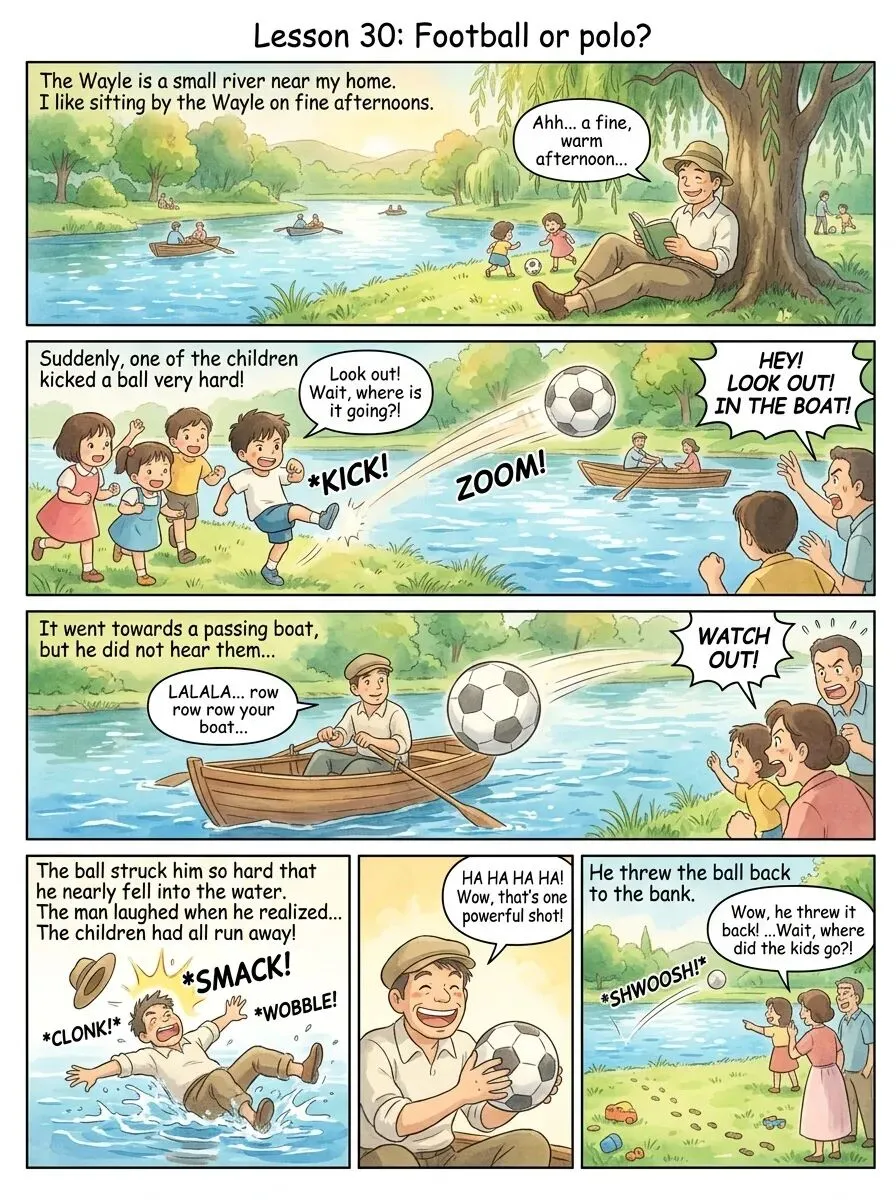
The Wayle is a small river that cuts across the park near my home. I like sitting by the Wayle on fine afternoons. It was warm last Sunday, so I went and sat on the river bank as usual. Some children were playing games on the bank and there were some people rowing on the river. Suddenly, one of the children kicked a ball very hard and it went towards a passing boat. Some people on the bank called out to the man in the boat, but he did not hear them. The ball struck him so hard that he nearly fell into the water. I turned to look at the children, but there weren't any in sight: they had all run away! The man laughed when he realized what had happened. He called out to the children and threw the ball back to the bank.
语音标注: The Wayle 中 the 读 /ðiː/ 因为 Wayle 以元音音素开头;cuts across 连读;like sitting 连读;went and sat 中 and 弱读 /ən/;called out 连读;struck him 连读 /strʌk ɪm/;laughed when 中 laughed 尾音 /t/ 与 when 的 /w/ 衔接。
背景简介:本课是一篇记叙文,描述了作者在河边目睹的一件趣事。故事发生在英国常见的公园小河(The Wayle)边,涉及了儿童游戏、划船等典型的英式休闲场景。课文通过一个意外事件(球击中划船人)及其幽默结局,展现了日常生活的小插曲。
参考译文:威尔河是横穿我家附近公园的一条小河。天气晴朗的下午,我喜欢坐在威尔河边。上星期日天气很暖和,于是我和往常一样,又去河边坐着。河岸上有些孩子正在玩耍,河面上有些人正在划船。突然,一个孩子狠狠地踢了一脚球,球便向着一只划过来的小船飞去。岸上的一些人对着小船上的人高喊,但是他没有听见。球重重地打在他身上,使他差点儿落入水中。我转过头去看那些孩子,但一个也不见,他们都跑了!当那个人明白了发生的事情时,笑了起来。他叫着那些孩子,把球扔回到岸上。
🔍 第二部分:逐句精讲与词块总结
句子1
原文: The Wayle is a small river that cuts across the park near my home.
翻译: 威尔河是横穿我家附近公园的一条小河。
句子结构: 主系表结构 + 定语从句。主语"The Wayle",系动词"is",表语"a small river",后接由"that"引导的定语从句"that cuts across the park near my home",修饰"a small river"。
重点词汇:
cut 蓝思值 200L
英音[kʌt] 美音[kʌt] 词性:动词 (v.)
释义:切,割,剪;穿过,开辟(道路)
常用语块:cut across(抄近路穿过,横穿)
短语搭配:cut down(砍倒,削减),cut off(切断,中断),cut in(插嘴,超车抢道)
例句一:The new highway cuts across the farmland. 新公路横穿了那片农田。
例句二:He cut his finger while cooking. 他做饭时割伤了手指。
拓展:本课中"cut across"形象地描述了河流的走向。其名词形式也为"cut",意为"切口,削减"。
across 蓝思值 300L
英音[əˈkrɒs] 美音[əˈkrɔːs] 词性:介词 (prep.) & 副词 (adv.)
释义:穿过,横过;在...对面
常用语块:go/walk/swim across(走过/游过)
短语搭配:across from(在...对面),come across(偶然遇见)
例句一:There is a bridge across the river. 河上有一座桥。
例句二:My house is just across the street. 我家就在街对面。
拓展:辨析:across强调从表面穿过(如过马路、过河);through强调从内部穿过(如穿过森林、隧道)。
语法点睛: 本句包含一个由关系代词"that"引导的定语从句。that在从句中作主语,指代先行词"a small river"。定语从句用于对先行词进行补充说明,使其更具体。这是第二册中反复出现的核心语法结构之一。
语音要点: The Wayle 中 the 读 /ðiː/ 因为 Wayle 以元音音素开头;cuts across 连读 /kʌts əˈkrɒs/。
句子2
原文: I like sitting by the Wayle on fine afternoons.
翻译: 天气晴朗的下午,我喜欢坐在威尔河边。
句子结构: 简单句。主语"I",谓语动词"like",宾语为动名词短语"sitting by the Wayle",时间状语"on fine afternoons"。
重点词汇:
fine 蓝思值 200L
英音[faɪn] 美音[faɪn] 词性:形容词 (adj.)
释义:美好的,优秀的;晴朗的;纤细的
常用语块:fine weather(好天气)
短语搭配:feel fine(感觉良好),a fine line(细微的差别)
例句一:It's a fine day for a picnic. 今天是野餐的好天气。
例句二:She has a fine taste in art. 她有很高的艺术品味。
拓展:fine作名词意为"罚款",作动词意为"处以罚款"。注意与sunny(阳光明媚的)在描述天气时的细微区别,fine更泛指"好天气"。
语法点睛: 动词"like"后接动名词"sitting"作宾语,表示一种习惯性或一般性的喜好。动名词具有名词性质,可以在句中充当主语、宾语、表语等成分。本课中"rowing"也是动名词用法。
语音要点: like sitting 连读 /laɪk ˈsɪtɪŋ/。
句子3
原文: It was warm last Sunday, so I went and sat on the river bank as usual.
翻译: 上星期日天气很暖和,于是我和往常一样,又去河边坐着。
句子结构: 并列句。由连词"so"连接两个分句,表示因果关系。第一个分句"It was warm last Sunday"说明原因,第二个分句"I went and sat on the river bank as usual"表示结果。
重点词汇:
bank 蓝思值 300L
英音[bæŋk] 美音[bæŋk] 词性:名词 (n.)
释义:河岸,堤岸;银行
常用语块:river bank(河岸)
短语搭配:on the bank of(在...的岸边),blood bank(血库)
例句一:We had a picnic on the south bank of the river. 我们在河南岸野餐。
例句二:He works in a bank downtown. 他在市中心的一家银行工作。
拓展:注意与shore(湖/海岸)、coast(海岸线)的区别。bank通常指河流的岸。
as usual 蓝思值 400L
释义:像往常一样,照例
例句一:As usual, he arrived last. 和往常一样,他最后一个到。
例句二:Despite the rain, the game continued as usual. 尽管下雨,比赛照常进行。
拓展:这是一个固定副词短语,在句中作状语。反义表达:unusually(不寻常地)。
语法点睛: 连词"so"用于连接表示因果关系的并列句,意为"因此,所以"。其位置在结果分句句首,前面通常有逗号。注意与"because"(因为)引导原因状语从句的区别:"because"从句说明原因,主句是结果;而"so"前是原因,后是结果。
语音要点: went and sat 中 and 弱读 /ən/。
句子4
原文: Some children were playing games on the bank and there were some people rowing on the river.
翻译: 河岸上有些孩子正在玩耍,河面上有些人正在划船。
句子结构: 并列句。由"and"连接两个分句。第一个分句是主谓结构"Some children were playing games on the bank";第二个分句是"There be"句型"there were some people",后接现在分词短语"rowing on the river"作后置定语,修饰"people"。
重点词汇:
row 蓝思值 400L
英音[rəʊ] 美音[roʊ] (作"划船"解) 词性:动词 (v.) & 名词 (n.)
释义:划(船);排,行
常用语块:row a boat(划船)
短语搭配:go rowing(去划船),in a row(连续地)
例句一:Can you row a boat? 你会划船吗?
例句二:The students stood in a row. 学生们站成一排。
拓展:注意发音,作"争吵"解时读作[raʊ]。动名词rowing是水上运动项目"赛艇"。
语法点睛: 本句出现了"There be + 名词 + 现在分词"结构,现在分词短语"rowing on the river"作定语,修饰"some people",表示当时正在进行的动作,相当于一个省略的定语从句"who were rowing"。这种结构使描写更生动、简洁。同时,本句两处使用了"some",用于肯定句中,表示"一些"。
语音要点: were playing 连读 /wə ˈpleɪɪŋ/;rowing on 连读 /ˈrəʊɪŋ ɒn/。
句子5
原文: Suddenly, one of the children kicked a ball very hard and it went towards a passing boat.
翻译: 突然,一个孩子狠狠地踢了一脚球,球便向着一只划过来的小船飞去。
句子结构: 并列句。由"and"连接两个分句。第一个分句"one of the children kicked a ball very hard",第二个分句"it went towards a passing boat"。"passing"是现在分词作定语,修饰"boat"。
重点词汇:
towards 蓝思值 300L
英音[təˈwɔːdz] 美音[tɔːrdz] 词性:介词 (prep.)
释义:向,朝;对于;接近
常用语块:go/walk towards(走向...)
短语搭配:attitude towards(对...的态度),towards the end of(快到...结束时)
例句一:He walked towards the door. 他朝门口走去。
例句二:She felt very friendly towards him. 她对他非常友善。
拓展:美式英语中也常写作toward。与to的区别:to强调目的地或方向终点,towards强调动作朝向某个方向,不强调到达。
passing 蓝思值 500L
英音[ˈpɑːsɪŋ] 美音[ˈpæsɪŋ] 词性:形容词 (adj.)
释义:经过的,短暂的
常用语块:a passing car(一辆经过的汽车)
短语搭配:in passing(顺便提及),passing interest(一时的兴趣)
例句一:I caught a glimpse of the passing scenery. 我瞥了一眼掠过的风景。
例句二:He made a passing reference to the incident. 他顺便提到了那件事。
拓展:来自动词pass(经过)。现在分词作定语有主动和进行含义,表示"正在经过的"。
语法点睛: 现在分词"passing"作前置定语,修饰名词"boat",表示主动和进行的意义,即"the boat that was passing"。这种用法可以简化句子结构,是英语中常见的表达方式。
语音要点: kicked a 连读 /kɪkt ə/;went towards 连读 /went təˈwɔːdz/。
句子6
原文: Some people on the bank called out to the man in the boat, but he did not hear them.
翻译: 岸上的一些人对着小船上的人高喊,但是他没有听见。
句子结构: 并列句。由转折连词"but"连接两个分句,表示语义的转折。介词短语"on the bank"和"in the boat"分别作后置定语,修饰前面的名词。
重点词汇:
call out 蓝思值 400L
释义:大声叫喊,召唤
例句一:She called out for help when she fell. 她摔倒时大声呼救。
例句二:The teacher called out the names of the students. 老师点名。
拓展:call out强调提高音量以引起注意。相关短语:call on(拜访),call off(取消),call for(要求,需要)。
语法点睛: 连词"but"表示转折,连接两个意思相反或形成对比的分句。本句中,前一个分句说人们喊叫,后一个分句说那人没听见,形成明显的转折关系。这是最基本的并列连词用法之一。
语音要点: called out 连读 /kɔːld aʊt/;did not hear 中 not 弱读 /nɒt/。
句子7
原文: The ball struck him so hard that he nearly fell into the water.
翻译: 球重重地打在他身上,使他差点儿落入水中。
句子结构: 复合句。主句"The ball struck him so hard",后接"that"引导的结果状语从句"that he nearly fell into the water"。"so...that..."结构连接主句和从句。
重点词汇:
strike 蓝思值 600L
英音[straɪk] 美音[straɪk] 词性:动词 (v.) & 名词 (n.)
释义:打,击;敲;罢工;给...以印象
常用语块:strike sb./sth.(击中某人/某物)
短语搭配:strike a match(划火柴),go on strike(举行罢工),strike as(给人...印象)
例句一:The lightning struck the tree. 闪电击中了那棵树。
例句二:His idea struck me as brilliant. 我觉得他的主意很棒。
拓展:过去式和过去分词均为struck。注意与hit(击中)的区别,strike更正式,且含义更广。
nearly 蓝思值 400L
英音[ˈnɪəli] 美音[ˈnɪrli] 词性:副词 (adv.)
释义:几乎,差不多
常用语块:nearly fall(差点摔倒)
短语搭配:nearly finished(快完成了),not nearly(远非,根本不)
例句一:I nearly missed the train. 我差点没赶上火车。
例句二:The job is nearly done. 工作差不多完成了。
拓展:与almost意思相近,常可互换。但nearly不能与no, none, nothing, never等否定词连用,而almost可以(如almost never)。
语法点睛: 本句核心语法点为"so + 形容词/副词 + that..."引导的结果状语从句。so修饰形容词hard,表示程度,that从句表示这种程度导致的结果。意为"如此...以至于..."。这是本课最重要的语法点。
语音要点: struck him 连读 /strʌk ɪm/;fell into 连读 /fel ˈɪntə/。
句子8
原文: I turned to look at the children, but there weren't any in sight: they had all run away!
翻译: 我转过头去看那些孩子,但一个也不见,他们都跑了!
句子结构: 并列句+解释性分句。由"but"连接两个转折分句。第二个分句"there weren't any in sight"后接冒号,引出一个解释性的分句"they had all run away",说明"看不见"的原因。
重点词汇:
sight 蓝思值 500L
英音[saɪt] 美音[saɪt] 词性:名词 (n.)
释义:视力;看见;景象;视野
常用语块:in sight(在视野内,看得见)
短语搭配:out of sight(看不见),catch sight of(瞥见),lose sight of(看不见,忘记)
例句一:The plane flew out of sight. 飞机飞得看不见了。
例句二:The Grand Canyon is an amazing sight. 大峡谷是令人惊叹的景象。
拓展:in sight的反义词是out of sight。sight还可作动词,意为"看见,发现",尤指首次看见(如sight land)。
run away 蓝思值 400L
释义:逃跑,跑开
例句一:The thief ran away when he saw the police. 小偷看到警察就跑了。
例句二:Don't run away, I want to talk to you. 别跑开,我想和你谈谈。
拓展:强调迅速离开现场,常因害怕或做错事。相关短语:run after(追赶),run into(偶然遇见),run out of(用完)。
语法点睛: 本句出现了"there weren't any"结构,这是"There be"句型的否定式,其中"any"用于否定句,代替"some children"。同时,冒号后的句子使用了过去完成时"had run away",表示在"我转头看"这个过去动作之前,孩子们"已经跑掉了",体现了"过去的过去"的时间关系。
语音要点: turned to 连读 /tɜːnd tə/;run away 连读 /rʌn əˈweɪ/。
句子9
原文: The man laughed when he realized what had happened.
翻译: 当那个人明白了发生的事情时,笑了起来。
句子结构: 复合句。主句"The man laughed",后接"when"引导的时间状语从句"when he realized what had happened"。该时间状语从句中又包含一个宾语从句"what had happened",作"realized"的宾语。
重点词汇:
realize 蓝思值 600L
英音[ˈrɪəlaɪz] 美音[ˈriːəlaɪz] 词性:动词 (v.)
释义:认识到,意识到;实现
常用语块:realize that...(意识到...)
短语搭配:realize one's dream(实现梦想),fully realize(充分认识到)
例句一:I suddenly realized I was wrong. 我突然意识到我错了。
例句二:He finally realized his ambition to become a pilot. 他终于实现了当飞行员的抱负。
拓展:英式拼写也可为realise。名词形式为realization。
语法点睛: "when"引导时间状语从句,表示主句动作发生的时间点。宾语从句"what had happened"中使用了过去完成时,因为"发生的事情"在"他意识到(realized)"这个过去动作之前就已经完成了。这再次巩固了过去完成时的用法。
语音要点: laughed when 连读 /lɑːft wen/;realized what 连读 /ˈrɪəlaɪzd wɒt/。
句子10
原文: He called out to the children and threw the ball back to the bank.
翻译: 他叫着那些孩子,把球扔回到岸上。
句子结构: 简单句。主语"He",并列谓语"called out"和"threw",由"and"连接。介词短语"to the children"和"back to the bank"分别作状语。
重点词汇:
throw 蓝思值 300L
英音[θrəʊ] 美音[θroʊ] 词性:动词 (v.)
释义:投,掷,扔
常用语块:throw sth. to sb.(把某物扔给某人)
短语搭配:throw away(扔掉),throw up(呕吐),throw a party(举办派对)
例句一:Please throw me the keys. 请把钥匙扔给我。
例句二:He threw the ball into the air. 他把球抛向空中。
拓展:过去式threw,过去分词thrown。注意throw to(扔给,意在接住)和throw at(砸向,意在攻击)的区别。
语法点睛: 本句是简单的并列谓语结构,用一个主语"He"统领两个连续的动作"called out"和"threw",清晰地描述了事件的结果,使叙事完整。这种结构在叙述文中非常常见。
语音要点: called out to 连读 /kɔːld aʊt tə/;threw the ball 连读 /θruː ðə bɔːl/。
📌 核心词块总结
1. cut across: to go straight from one side of an area to the other. (横穿) 例句:The path cuts across the meadow to the village.
2. as usual: in the way that happens most of the time or in most cases. (像往常一样) 例句:As usual, she was the first to arrive at the meeting.
3. call out (to sb.): to shout something, especially to get someone's attention. (向某人大声喊叫) 例句:I called out to him, but he was too far away to hear.
4. so...that...: used to emphasize the degree of something by mentioning the result it causes. (如此...以至于...) 例句:The music was so loud that we couldn't hear each other.
5. in sight: able to be seen. (看得见,在视野内) 例句:There wasn't a house in sight, just miles of empty road.
6. run away: to leave a place, especially secretly, in order to escape from someone or something. (跑开,逃跑) 例句:The dog ran away when it heard the thunder.
7. throw back: to return something by throwing it. (扔回) 例句:The fisherman threw the small fish back into the river.
✍️ 第三部分:语篇分析与段落写作技巧
1. 语篇分析① 识别宏观结构: 本文是一篇典型的微型记叙文。
结构清晰:
背景介绍(第1-3句:地点、习惯、当天天气)
→ 场景铺垫(第4句:人物活动)
→ 事件起因与发展(第5-7句:孩子踢球、球飞向船、喊叫未果、击中那人)
→ 事件高潮与转折(第8句:孩子逃跑)
→ 事件结局(第9-10句:那人笑并还球)。
遵循“开端-发展-高潮-结局”的叙事逻辑。
② 列举衔接手段:
时间顺序连接词: last Sunday, suddenly, when。这些词清晰地标明了事件发展的时序。
逻辑连接词: so(因果),and(并列),but(转折)。
代词照应: it(指代球),he/him(指代划船人),they/them(指代孩子们)。
词汇复现: children, bank, river, ball, boat 等关键词在文中多次出现,贯穿主题。
③ 分析作者态度:
作者以第一人称旁观者的视角叙述,语气平和、客观,略带幽默。通过“so hard that he nearly fell”(强调意外和力度)和“but there weren't any in sight”(突出孩子们的迅速反应和滑稽)等细节,生动地刻画了事件的趣味性。最后以划船人的“laughed”和“threw the ball back”收尾,传递出一种轻松、宽容的基调,使整个故事充满生活情趣而非冲突。
2. 写作技巧① 提炼写作逻辑: 本课展示了如何叙述一个简单的意外事件。关键在于:
a) 设定清晰的场景(时间、地点、人物);
b) 按时间顺序描述事件链条(一个动作引发下一个动作);
c) 使用细节描写增强生动性(如“kicked very hard”, “struck him so hard”);
d) 制造一个小转折或意外结局(孩子逃跑,大人反而笑了),增加故事的趣味性。
② 提供段落写作范例 (主题:An Unexpected Incident at the Park) 已包含在原文中。
③ 布置小练笔并提供例文 (主题:A Funny Moment in the Supermarket) 及分析已完整保留。
📐 第四部分:本课语法精析
1. “so...that...” 结构- 概念: 连接原因和结果,意为“如此...以至于...”。- 结构: so + 形容词/副词 + that从句;so + many/few + 可数名词复数 + that从句;so + much/little + 不可数名词 + that从句。- 与 “such...that...” 辨析: such + (a/an) + (形容词) + 名词 + that从句。- 课文例句: The ball struck him so hard that he nearly fell into the water.2. “some” 与 “any” 的用法辨析- 基本规则: some 用于肯定句;any 用于否定句和疑问句。- 特殊用法: any 用于肯定句表示“任何”;some 用于疑问句表示请求/邀请,期待肯定回答。- 课文例句: Some children were playing... / there weren't any in sight.3. 现在分词短语作定语- 单个分词常前置(a passing boat);分词短语常后置(people rowing on the river)。功能相当于主动语态的定语从句。4. 过去完成时- 结构: had + 过去分词。表示“过去的过去”。- 课文例句: they had all run away; what had happened.
语法练习题(不少于12道)一、用 so...that... 或 such...that... 连接句子。a) The music was loud. We couldn't talk. → The music was so loud that we couldn't talk.b) It was a boring film. I fell asleep. → It was such a boring film that I fell asleep.c) He made few mistakes. He got full marks. → He made so few mistakes that he got full marks.d) She told us a funny story. We all laughed. → She told us such a funny story that we all laughed.二、用 some 或 any 填空。a) Are there ______ students in the classroom? → anyb) I need ______ help with this heavy box. → somec) There isn't ______ milk left in the fridge. → anyd) Would you like ______ coffee? ( offering ) → somee) You can choose ______ book from the shelf. → any三、选择正确的分词形式填空 (passing/passed, rowing/rowed)。a) We waved at the ______ boat. → passingb) The people ______ on the lake looked happy. → rowingc) He showed me a photo of a ______ ship. → passed (已过去的) / passing (经过的,根据语境)d) Have you ever ______ a boat? → rowed四、将下列句子中的定语从句改为分词短语。a) The man who is talking to Mary is my boss. → The man talking to Mary is my boss.b) I received a letter that was written in French. → I received a letter written in French.c) People who live in glass houses shouldn't throw stones. → People living in glass houses shouldn't throw stones.五、根据上下文,用动词的正确时态填空(一般过去时或过去完成时)。When I ______ (get) to the station, the train ______ (already leave). I ______ (realize) I ______ (forget) my ticket at home. → got, had already left, realized, had forgotten.练习题解析 已完整包含在原文中。
🎧 第五部分:听力与阅读策略训练
1. 听力技巧① 预测关键词: river, bank, children, play, ball, kick, boat, row, water, fall, run away, laugh。② 抓主旨大意: 球意外击中划船人,最后以幽默收场。③ 笔记方法: 按时间顺序记录关键事件点:S: sunny, by river → Kids play, people row → Kid kick ball to boat → People shout, man not hear → Ball hit man (hard) → nearly fall → Look for kids → gone (run away) → Man laugh → throw ball back.
2. 阅读理解策略① 扫读: 找出具体信息:河流名称 (The Wayle);上周日天气 (Warm);谁喊叫 (Some people on the bank);球扔回哪里 (Back to the bank)。② 略读: 30秒快速浏览,回答故事主要关于谁 (Some children and a man in a boat)。③ 推断词义: struck (hit), in sight (able to be seen)。
📝 第六部分:习题讲解
关键句型练习A. 一般过去时和过去进行时: 描述背景用过去进行时,叙述具体事件用一般过去时。B. There was/were 和 There wasn't/weren't any 造句。C. 模仿课文用过去进行时描述背景画面。难点练习- some/any 区分;介词填空 (across, over, between, under, in front of, behind, off, along, into, out of)。多项选择题 (示例)1. The writer ---------. (c) likes sitting on the river bank.2. The writer ---------. (d) saw some children and a ball.解析: 根据课文细节定位,排除干扰项。
🤔 第七部分:英文深度思考与拓展
A. 层次化英文问题与答案Level 1 (Factual):1. Q: What is the name of the river in the story? A: The Wayle.2. Q: What were the children doing when the writer arrived? A: Playing games on the river bank.3. Q: What did the people on the bank do when they saw the ball going towards the boat? A: They called out to the man in the boat.4. Q: Where did the children go after the ball hit the man? A: They all ran away.Level 2 (Inferential):5. Q: Why do you think the man in the boat didn't hear the people calling out? A: Perhaps he was concentrating on rowing, or the distance and ambient noise made it hard to hear.6. Q: How do you know the ball was kicked with great force? A: Because the text says it was kicked "very hard" and it struck the man "so hard that he nearly fell into the water."7. Q: What does the reaction of the man (laughing and throwing the ball back) tell you about his character? A: He is good-natured, forgiving, and has a sense of humor.8. Q: Why might the children have run away immediately? A: They were probably scared that the man would be angry and shout at them or tell their parents.Level 3 (Evaluative):9. Q: Do you think the children's decision to run away was the right one? What could they have done instead? A: Not the most responsible; they could have stayed to apologize.10. Q: What message does the author want to convey about dealing with minor accidents in daily life? A: We should not take minor mishaps too seriously; a forgiving and humorous attitude can turn an unpleasant situation into a light-hearted moment.11. Q: Imagine you are the man in the boat. Describe your feelings. A: Shock and confusion, then amusement, deciding there was no reason to be upset.12. Q: Compare this story to a similar situation in a city park with cyclists. How would the dynamics be different? A: The cyclist might be more annoyed due to safety concerns; children might be less likely to run far.B. 多类型拓展阅读1. 时事新闻拓展 (Current News Extension)Title: Near Miss on the SerpentineLast Saturday afternoon, a similar amusing incident occurred on the Serpentine lake in London's Hyde Park. A group of teenagers were practicing their frisbee skills when an over-enthusiastic throw sent the disc soaring towards a classic wooden rowboat occupied by an elderly couple. The frisbee clipped the edge of the boat before landing in the water with a splash. The couple, initially startled, waved off the teenagers' frantic apologies with smiles. The young man who made the throw even swam out to retrieve the frisbee. "It's all part of the fun of a summer's day in the park," the gentleman was quoted saying. The incident was resolved with laughter, much like our textbook story, proving some scenes are timeless.语言点映射:clipped (轻击,类比struck), startled (吃惊的), waved off (挥手表示不在意,类比laughed), retrieve (取回,类比threw back).引导性问题:What are the similarities and differences between this incident and the one in the textbook?2. 文化背景解析 (Cultural Background)Title: "Polo" in "Football or Polo?" -- A Nod to British LeisureThe title "Football or Polo?" cleverly hints at two popular British outdoor activities. "Football" here almost certainly refers to the casual kicking of a ball, not an organized match. "Polo," however, is more specific. While water polo is a team sport played in a pool, the "polo" in this context likely refers to "canoe polo" or simply the playful idea of a ball game involving boats. The River Wayle, though fictional, represents the countless small rivers and canals crisscrossing the British countryside, which have been used for leisure boating for centuries. The scene of people "rowing on the river" is a classic image of an English summer afternoon, evoking traditions like the Oxford and Cambridge boat race or simple family outings. This cultural backdrop makes the story feel authentically British.引导性问题:Besides rowing, what other activities are common along British rivers?3. 今昔对比分析 (Then-and-Now Analysis)Title: From Riverbanks to Screens: Changing ChildhoodsThe children in Lesson 30 are playing outside, by a river, inventing their own games. This was a very common childhood experience in the past. Contrast this with many children today. Their "play" often involves digital screens, indoors. An accidental kick sending a ball into a neighbor's garden might be replaced by an accidental in-game item sent to the wrong player. The immediate fear of getting told off might be similar, but the resolution is virtual. While the outdoor play fosters physical activity, risk assessment (don't fall in the river!), and immediate social interaction (running away together), digital play offers different skills. The story invites us to appreciate the simple, unplanned physical interactions that shaped past generations' social experiences.引导性问题:Which type of play do you think is more beneficial for children's development? Why?4. 新潮英语改写 (Trendy Rewrite)Title: Oops! #RiverFailSo, last Sunday was totally warm, right? Chilling by my local river, the Wayle, as usual. Some kids were messing around on the bank, and a few peeps were out rowing. Epic fail moment: one kid absolutely yeets the ball. I mean, YEETS it. It's heading straight for this dude's boat. Everyone's yelling "Heads up!" but he's in his own world. SMACK! The ball nails him so hard he almost does a backflip into the water. I look for the kids... ghosted! Vanished! POOF! But then, plot twist: the guy just starts laughing! He's like, "Hey kids!" and tosses the ball back. Major good vibes. #KarmaNotAngry #GoodSport语言点映射:用yeet (用力扔), peeps (people), ghosted (消失), good vibes (好氛围) 等网络流行语和标签改写,展示语言的时代变化。引导性问题:Identify three slang words or phrases in this rewrite and explain what they mean.5. 难度略高的拓展阅读 (Slightly Higher Difficulty)Title: The Physics of a Wayle IncidentLet's analyze the incident scientifically. The child's foot imparts kinetic energy to the ball. The force (F) applied, combined with the angle of the kick, determines the ball's initial velocity and trajectory. Air resistance acts upon it during its parabolic flight across the river. The key factor is the transfer of momentum upon impact with the man. The text states the strike was "so hard that he nearly fell into the water." This implies a significant impulse was delivered, almost sufficient to overcome his static friction with the boat's floor and his center of gravity. His ability to recover, rather than capsize, speaks to his reflexive balance and the boat's stability. The children's rapid departure demonstrates an adrenaline-fueled fight-or-flight response. Thus, a simple anecdote encapsulates principles of mechanics, biology, and psychology.引导性问题:What scientific disciplines are mentioned in this analysis? How does this help us understand the story more deeply?
🌍 第八部分:日常应用与文化拓展
1. 相关文化背景知识- 英国河流与休闲: 划船(rowing)、撑船(punting)、canoeing(划独木舟)是深受欢迎的夏季休闲活动。- 英式幽默: 故事结局体现了 understatement(轻描淡写)和 self-deprecation(自嘲),用幽默化解而非愤怒指责。- "Football" vs "Soccer": 在英国,“football”通常指英式足球;美式足球称为“American football”。2. 推荐拓展学习资源- 书籍: 《新概念英语美文欣赏 第2册》- 视频: 搜索"Cambridge punting"、"Henley Royal Regatta"- 歌曲: 《Row, Row, Row Your Boat》- 网站: 英国环境署或国家信托网站
💡 第九部分:引导性思考
1. 如果那个划船的人真的掉进了水里,这个故事会怎样发展?作者的态度和文章的基调可能会发生什么变化?2. 在当今社会,公共场所的此类小意外(如骑车撞到人、球打到人)通常如何解决?人们的态度与课文描述的时代相比,是更宽容了还是更易怒了?3. “The man laughed when he realized what had happened.” 这一笑,是出于礼貌,还是真的觉得有趣?抑或是包含了无奈、释然等多种情绪?
🗂️ 第十部分:本课知识图谱
核心事件: 河边球击划船人事件
├─ 主要支撑点1: 事件背景与环境│ ├─ 地点: 威尔河(The Wayle),穿过公园│ ├─ 时间: 上一个温暖的周日│ └─ 人物初始状态: 作者在岸边;孩子们在岸上玩耍;人们在河里划船
├─ 主要支撑点2: 事件触发与升级│ ├─ 触发动作: 一个孩子用力踢球│ ├─ 危险发展: 球飞向一艘经过的船│ ├─ 干预失败: 岸上人喊叫,划船人未听见│ └─ 冲突发生: 球重重击中划船人,他险些落水
├─ 主要支撑点3: 事件转折与高潮│ ├─ 儿童反应: 全部逃跑,不见踪影│ └─ 划船人反应: 明白情况后大笑
└─ 主要支撑点4: 事件结局与主题├─ 和解动作: 划船人叫孩子并扔回球└─ 隐含主题: 幽默与宽容化解了小意外
© 本文为狂暴英语教案 · 新概念英语第二册第30课
仅供学习交流使用

贝琪酱英语无痛逆袭站
微信扫描二维码,关注我的账号


