读外刊,接触原汁原味的英文表达,
欢迎关注以下公众号+设为星标+推荐给朋友。▼
📚 狂暴英语教案 · 新概念英语第一册
第49-50课 At the butcher's & He likes... But he doesn't like...
在肉店 / 他喜欢……但是他不喜欢……
📘 本课信息
教材:新概念英语第一册 · 第49-50课
核心功能:肉店购物 · 表达食物喜好 · 家庭成员口味对比
语法焦点:一般现在时 (like) · 选择疑问句 · some/any · too/either · 第三人称单数否定
🎯 本课学习目标
词汇维度:
1. 掌握与肉类、食品购物相关的核心名词(如butcher, lamb, beef, steak, mince, chicken, tell, truth)。
2. 掌握动词like在陈述句、一般疑问句及否定句中的用法。
3. 理解并运用some与any在肯定句、疑问句和否定句中的区别。
4. 掌握“either”在否定句末表示“也”的用法。
语法维度:
1. 巩固和运用动词like的一般现在时态,包括第三人称单数形式。
2. 掌握由“Do you like...?”引导的选择疑问句及其回答。
3. 深入理解some与any在表示“一些”时的使用规则。
4. 学习“too”与“either”在肯定句和否定句中表示“也”的区别。
技能维度(日常对话):
1. 能够在肉店或食品店进行简单的购物对话,包括询问商品、表达喜好、询问数量及完成交易。
2. 能够就个人饮食喜好进行问答,表达喜欢或不喜欢某物。
3. 学会使用“To tell you the truth”作为口语中的过渡语,使表达更自然。
文化维度:
1. 了解英美国家肉店购物的一些基本习惯和常见肉类名称。
2. 初步感知在表达个人偏好时,西方文化中直接与委婉的表达方式。
📖 第一部分:课文完整内容
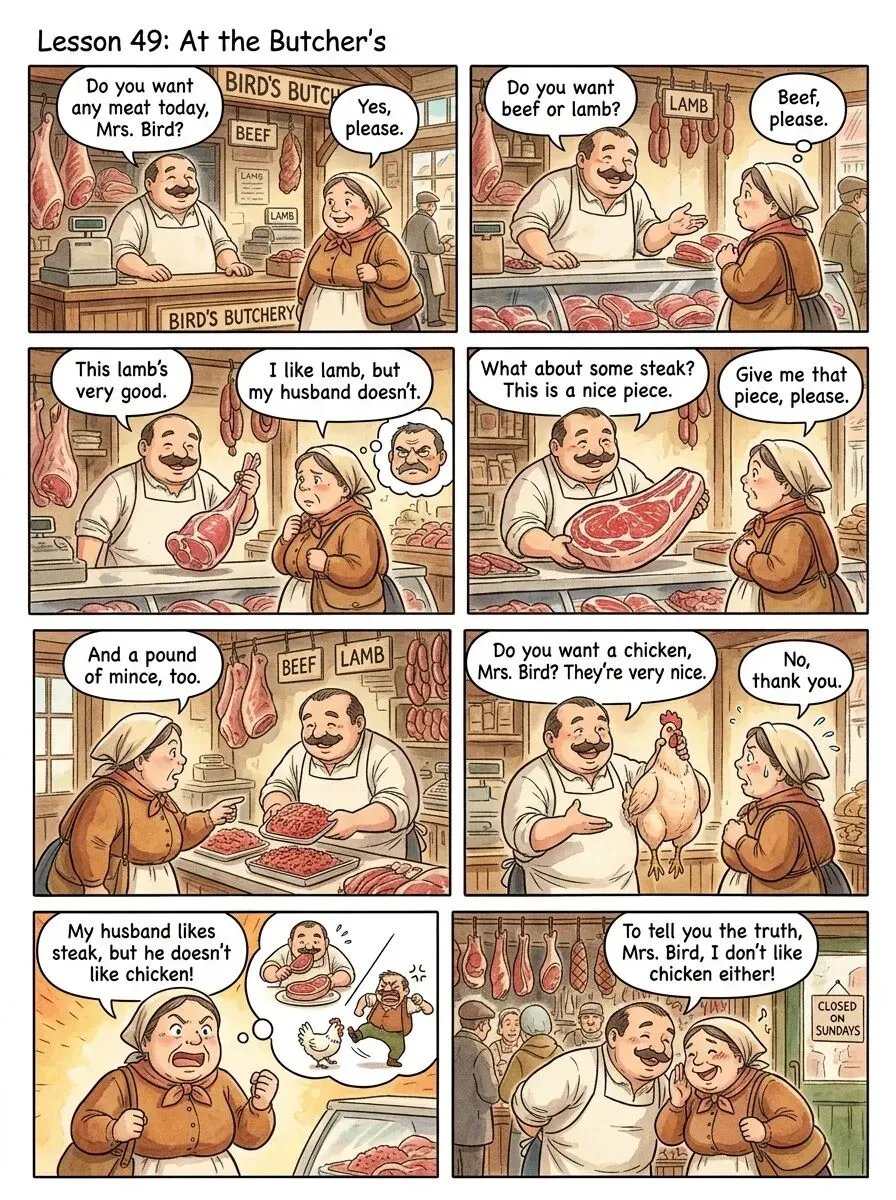
Lesson 49 At the butcher's
📜 课文原文(含语音标注)
BUTCHER: Do you want any meat today, Mrs. Bird? /djuː wɒnt ˈeni miːt təˈdeɪ, ˈmɪsɪz bɜːd/
MRS. BIRD: Yes, please. /jes pliːz/
BUTCHER: Do you want beef or lamb? /djuː wɒnt biːf ɔː læm/
MRS. BIRD: Beef, please. /biːf pliːz/
BUTCHER: This lamb's very good. /ðɪs læmz ˈveri ɡʊd/
MRS. BIRD: I like lamb, but my husband doesn't. /aɪ laɪk læm, bət maɪ ˈhʌzbənd ˈdʌznt/
BUTCHER: What about some steak? This is a nice piece. /ˈwɒt əbaʊt səm steɪk? ˈðɪs ɪz ə naɪs piːs/
MRS. BIRD: Give me that piece, please. /ˈɡɪv miː ðæt piːs pliːz/
BUTCHER: And do you want a chicken? /ənd djuː wɒnt ə ˈtʃɪkɪn/
MRS. BIRD: No, thank you. My husband likes steak, but he doesn't like chicken. /nəʊ θæŋk juː. maɪ ˈhʌzbənd laɪks steɪk, bət hiː ˈdʌznt laɪk ˈtʃɪkɪn/
BUTCHER: To tell you the truth, Mrs. Bird, I don't like chicken either! /tə ˈtel jə ðə truːθ, ˈmɪsɪz bɜːd, aɪ dəʊnt laɪk ˈtʃɪkɪn ˈaɪðə/
Lesson 50 He likes... But he doesn't like...
📜 课文原文(句型练习)
He likes potatoes, but he doesn't like peas.
She likes tea, but she doesn't like coffee.
They like books, but they don't like magazines.
We like apples, but we don't like oranges.
You like meat, but you don't like vegetables.
I like cabbages, but I don't like lettuces.
语音标注说明: 连读:Do you 常读作 /djuː/ 或 /dəjə/;want any 中 t 与 a 可产生轻微连读;but my husband 中 t 与 m 发生爆破音失去爆破,but 的 /t/ 不发音。弱读:or /ɔːr/ 在 beef or lamb 中可能弱读为 /ər/;a 在 a chicken, a nice piece 中弱读为 /ə/;to 在 to tell you 中弱读为 /tə/。语调:选择疑问句 Do you want beef or lamb? 前升(beef)后降(lamb)。一般疑问句 Do you want any meat...? Do you want a chicken? 用升调。陈述句用降调。重音:To TELL you the TRUTH 中 tell 和 truth 为重读词,强调语气。I DON'T like chicken EITHER! 中 don't 和 either 重读,加强否定和附和。
情景说明:本课对话发生在社区内一家传统的肉铺(butcher's shop)。顾客伯德夫人(Mrs. Bird)是店里的常客,与肉店老板(Butcher)彼此认识。对话围绕伯德夫人今日的肉类采购需求展开。老板主动询问需求,并提供牛肉和羊肉的选择。伯德夫人在表达自己喜好的同时,也提到了丈夫的不同口味(喜欢羊肉 vs 喜欢牛排但不喜欢鸡肉),展现了家庭成员饮食偏好的差异。最后,老板以一种轻松、拉近关系的口吻(“说实话...”)分享了自己也不喜欢鸡肉的个人看法,使对话超越了单纯的买卖,带有一丝熟人间的闲聊色彩。第50课则是对第49课核心语法结构(like的肯定与否定形式对比)进行的集中、系统性句型替换练习,旨在通过重复强化记忆和语感。
参考译文:
第49课 在肉店
肉店老板:伯德夫人,您今天要买点肉吗?
伯德夫人:是的,我要买。
肉店老板:您要牛肉还是羔羊肉?
伯德夫人:请给我牛肉。
肉店老板:这羔羊肉很好。
伯德夫人:我喜欢羔羊肉,但我丈夫不喜欢。
肉店老板:来点牛排怎么样?这块很好。
伯德夫人:请给我那块。
肉店老板:您要一只鸡吗?
伯德夫人:不要了,谢谢。我丈夫喜欢牛排,但他不喜欢鸡肉。
肉店老板:说实话,伯德夫人,我也不喜欢鸡肉!
第50课 他喜欢......但是他不喜欢......
他喜欢土豆,但不喜欢豌豆。
她喜欢茶,但不喜欢咖啡。
他们喜欢书,但不喜欢杂志。
我们喜欢苹果,但不喜欢橘子。
你喜欢肉,但不喜欢蔬菜。
我喜欢卷心菜,但不喜欢生菜。
🔍 第二部分:逐句精讲与词块总结
句子1
原文: Do you want any meat today, Mrs. Bird?
翻译: 伯德夫人,您今天要买点肉吗?
句子结构: 主语(You) + 谓语(want) + 宾语(any meat) + 时间状语(today) + 呼语(Mrs. Bird)。这是一个主谓宾结构的特殊疑问句(由助动词Do引导的一般疑问句)。
重点词汇:
butcher (蓝思值 600L)
英音 [ˈbʊtʃə(r)] 美音 [ˈbʊtʃər]
词性:n.
释义:屠夫;肉贩;肉店老板
常用语块:at the butcher's (在肉店)
例句一:My father bought some pork from the butcher. 我父亲从肉贩那里买了些猪肉。
例句二:There is a butcher's shop at the corner of the street. 街角有一家肉铺。
拓展:词根记忆:源自中古英语"boucher",与"buck"(公羊)有关,原指宰杀山羊的人。现代英语中专指售卖鲜肉的人或店铺。注意:butcher's 表示“肉店”,相当于 butcher's shop。
meat (蓝思值 400L)
英音 [miːt] 美音 [miːt]
词性:n.
释义:肉类(食用肉的总称)
常用语块:red meat (红肉,如牛羊肉), white meat (白肉,如鸡肉), fresh meat (鲜肉), cook meat (烹饪肉类)
例句一:We should eat more vegetables and less meat. 我们应该多吃蔬菜,少吃肉。
例句二:Is there any meat in the soup? 汤里有肉吗?
拓展:meat 是不可数名词,表示泛指。具体肉类有专有名词,如 beef (牛肉), pork (猪肉), chicken (鸡肉)。易错点:不说 a meat, 但可以说 a piece of meat (一块肉)。
any (蓝思值 300L)
英音 [ˈeni] 美音 [ˈeni]
词性:adj. / pron.
释义:一些;任何的(常用于疑问句、否定句或条件句)
常用语块:any meat (一些肉), any questions? (有问题吗?), not... any (一点也不)
例句一:Do you have any brothers or sisters? 你有兄弟姐妹吗?
例句二:There isn't any milk left in the fridge. 冰箱里一点牛奶都没剩了。
拓展:在期待对方肯定回答或表示邀请、请求时,疑问句中也可用 some。例如:Would you like some coffee? (你想喝点咖啡吗?)。any 修饰可数名词单数时,表示“任何一个”,如:Any student can answer this question. (任何一个学生都能回答这个问题。)
语法点睛: 本句是含有 any 的一般疑问句。Do you want any...? 是购物场景中服务员询问顾客需求的经典句型。any 常用于疑问句和否定句中,表示“一些”。本句中,肉店老板不确定伯德夫人是否有需求,故用 any meat 进行询问。
语音要点: Do you 连读为 /djuː/ 或 /dəjə/。want any 中,t 与 a 属于不同单词,可以产生轻微的连读,但 t 音仍可辨识。句子整体为升调,表示询问。
句子2
原文: Yes, please.
翻译: 是的,我要买。
句子结构: 省略句。完整形式可理解为 Yes, I want some meat, please. 或 Yes, I do, please. 这是对一般疑问句的肯定简略回答。
重点词汇:
please (蓝思值 200L)
英音 [pliːz] 美音 [pliːz]
词性:v. (使高兴); adv. (礼貌用语)请
释义:(本课)请(用于礼貌地请求或接受)
常用语块:Yes, please. (好的,请。/ 要的,谢谢。), No, thank you. (不,谢谢。)
例句一:--- Would you like some tea? --- Yes, please. --- 你想喝茶吗?--- 好的,请来一点。
例句二:Please sit down. 请坐。
拓展:Yes, please. 和 No, thank you. 是英语中接受或拒绝对方提供物品时最礼貌、最地道的固定搭配。please 作动词时意为“使满意”,如:The aim is to please the customers. (目的是让顾客满意。)
语法点睛: 这是对 Do you want...? 问句的标准礼貌肯定回答。please 在此表示礼貌的接受,使语气更委婉、客气。
语音要点: Yes 发音清晰,音调平稳或略降。please 发音完整,/pliːz/, 语调平缓。整个短语语气肯定而礼貌。
句子3
原文: Do you want beef or lamb?
翻译: 您要牛肉还是羔羊肉?
句子结构: 主语(You) + 谓语(want) + 并列宾语(beef or lamb)。这是一个选择疑问句。
重点词汇:
beef (蓝思值 500L)
英音 [biːf] 美音 [biːf]
词性:n.
释义:牛肉
常用语块:roast beef (烤牛肉), beef steak (牛排), minced beef (牛肉末)
例句一:I prefer beef to pork. 比起猪肉,我更喜欢牛肉。
例句二:How would you like your beef steak cooked? 您的牛排要几分熟?
拓展:beef 是不可数名词。相关词汇:cow (奶牛), bull (公牛), ox (阉牛)。在俚语中,beef 还可作动词,意为“抱怨”,如:He's always beefing about his job. (他总是抱怨他的工作。)
or (蓝思值 200L)
英音 [ɔː(r)] 美音 [ɔːr]
词性:conj.
释义:或者;还是(用于连接选择项)
常用语块:... or ... (......或者......), either... or... (要么......要么......)
例句一:Is it black or white? 它是黑的还是白的?
例句二:You can have tea or coffee. 你可以喝茶或者咖啡。
拓展:在否定句中,连接并列成分用 or 而非 and,如:I don't like beef or lamb. (我不喜欢牛肉和羊肉。)
lamb (蓝思值 600L)
英音 [læm] 美音 [læm]
词性:n.
释义:羔羊肉;小羊羔
常用语块:roast lamb (烤羔羊肉), lamb chop (羊排)
例句一:The lamb is very tender. 这羔羊肉很嫩。
例句二:Mary had a little lamb. 玛丽有只小羊羔。(著名儿歌)
拓展:lamb 作为“羊肉”讲时是不可数名词;作为“羊羔”讲时是可数名词。相关词:mutton 指成年羊肉,口感较老,现在较少用;lamb 指小羊肉,更嫩,更常见。
语法点睛: 本句是选择疑问句。结构为:一般疑问句 + or + 供选择的另一选项。朗读时,or 前的部分用升调,or 后的部分用降调。回答时,不用 yes 或 no, 而是直接说出选择项,或说完整句。
语音要点: beef 和 lamb 均为重读词。or 通常弱读为 /ər/。语调模式为:Do you want beef ↗ or lamb ↘?
句子4
原文: Beef, please.
翻译: 请给我牛肉。
句子结构: 省略句。完整形式为 I want beef, please. 这是对选择疑问句的直接回答。
语法点睛: 对选择疑问句的典型回答方式:直接说出所选项目,常加 please 表示礼貌。也可以说 I'd like beef, please. 更委婉。
语音要点: Beef 发音清晰,重读。please 轻读。语调为降调,表示确定。
句子5
原文: This lamb's very good.
翻译: 这羔羊肉很好。
句子结构: 主语(This lamb) + 系动词('s = is) + 表语(very good)。这是一个主系表结构的陈述句。
重点词汇:
good (蓝思值 200L)
英音 [ɡʊd] 美音 [ɡʊd]
词性:adj.
释义:好的;优质的;令人满意的
常用语块:very good (很好), good idea (好主意), be good at (擅长)
例句一:She is a good teacher. 她是位好老师。
例句二:The weather is good for a picnic. 这天气适合野餐。
拓展:good 的副词形式是 well。good 常用来形容事物的品质、人的品行或状态。在购物场景中,售货员说 This ... is very good. 是一种常见的推销话术。
语法点睛: 本句是主系表结构,is 为系动词,连接主语 this lamb 和形容词 good 构成的表语,说明主语的特征或状态。very 是副词,修饰形容词 good, 表示程度。
语音要点: This lamb's 中 is 弱读为 /z/, 与 lamb 连读。very good 中 very 重读,good 也重读,语调下降,带有推荐和肯定的语气。
句子6
原文: I like lamb, but my husband doesn't.
翻译: 我喜欢羔羊肉,但我丈夫不喜欢。
句子结构: 并列句。第一个分句:主语(I) + 谓语(like) + 宾语(lamb)。第二个分句:主语(my husband) + 助动词(doesn't = does not) 代替前文出现的谓语动词 like。由连词 but 连接,表示转折关系。
重点词汇:
husband (蓝思值 400L)
英音 [ˈhʌzbənd] 美音 [ˈhʌzbənd]
词性:n.
释义:丈夫
常用语块:my/her husband (我的/她的丈夫), husband and wife (夫妻)
例句一:Her husband is a doctor. 她的丈夫是医生。
例句二:They have been husband and wife for twenty years. 他们做夫妻已经二十年了。
拓展:对应词是 wife (妻子)。词源与“家庭管理者”有关。注意发音,d 不发音。
doesn't (蓝思值 300L)
英音 [ˈdʌznt] 美音 [ˈdʌznt]
词性:助动词/否定词 (does not 的缩略形式)
释义:(用于第三人称单数主语)不
常用语块:He/She/It doesn't... (他/她/它不......)
例句一:He doesn't speak French. 他不会说法语。
例句二:It doesn't matter. 没关系。
拓展:doesn't 是 does not 的口语缩略形式,用于一般现在时中主语为第三人称单数(he, she, it, 单个人名等)的否定句和疑问句中。肯定形式为 does。
语法点睛: 本句首次明确引入动词 like 的一般现在时第三人称单数否定形式 doesn't like, 并与第一人称 I like 形成对比。but 连接两个意义相反的分句。第二个分句 doesn't 后省略了宾语 lamb, 以避免重复,这是英语中常见的省略现象。
语音要点: I like lamb 语调平稳。but 轻读。my husband doesn't 中,husband 和 doesn't 重读,doesn't 的尾音 /t/ 在快速口语中可能弱化。整句语调在 but 后略有转折。
句子7
原文: What about some steak? This is a nice piece.
翻译: 来点牛排怎么样?这块很好。
句子结构: 第一句:省略的疑问句,核心是 What about...? 提议句型。第二句:主语(This) + 系动词(is) + 表语(a nice piece)。主系表结构。
重点词汇:
steak (蓝思值 600L)
英音 [steɪk] 美音 [steɪk]
词性:n.
释义:牛排;肉排;鱼排
常用语块:beef steak (牛排), T-bone steak (T骨牛排), well-done steak (全熟牛排)
例句一:I'd like my steak medium rare. 我的牛排要三分熟。
例句二:We're going out for steak tonight. 我们今晚出去吃牛排。
拓展:steak 通常指切片烹调的厚块肉,尤其是牛肉。也可指其他肉类或鱼的厚片,如 pork steak (猪排), salmon steak (三文鱼排)。它是可数名词。
piece (蓝思值 400L)
英音 [piːs] 美音 [piːs]
词性:n.
释义:块;片;段;件
常用语块:a piece of (一块/片/段......), a nice piece (很好的一块), piece by piece (一块一块地)
例句一:Can I have a piece of cake? 我能吃一块蛋糕吗?
例句二:The vase broke into pieces. 花瓶摔成了碎片。
拓展:piece 是可数名词,常与 of 连用,修饰不可数名词或抽象名词,使其可量化,如 a piece of paper (一张纸), a piece of advice (一个建议), a piece of news (一则新闻)。
nice (蓝思值 300L)
英音 [naɪs] 美音 [naɪs]
词性:adj.
释义:好的;令人愉快的;友好的
常用语块:a nice day (美好的一天), nice to meet you (很高兴见到你), a nice person (一个好人)
例句一:We had a nice time at the party. 我们在聚会上玩得很开心。
例句二:It's nice and warm by the fire. 火炉边温暖舒适。
拓展:nice 含义广泛,可用于形容人、事物、天气、体验等,表示正面评价。在购物语境中,售货员说 a nice piece 意指“品质上乘的一块”。
语法点睛: What about...? 或 How about...? 是用于提出建议、征求意见或询问情况的常用口语句型,后面接名词、代词或动词-ing形式。some 在这里用于疑问句中,表示一种肯定的提议或邀请,期待对方给予积极回应,这与本课开头用 any 的开放式询问形成微妙对比。
语音要点: What about 连读,about 的 /t/ 轻微。some steak 中 some 重读,表示“一些(不错的)”。This is a nice piece 中 nice 和 piece 重读,语调下降,带有推荐和欣赏的语气。
句子8
原文: Give me that piece, please.
翻译: 请给我那块。
句子结构: 谓语(Give) + 间接宾语(me) + 直接宾语(that piece) + 礼貌用语(please)。这是一个祈使句,表示请求。
语法点睛: 这是 give sb. sth. (给某人某物) 结构的祈使句应用。that piece 指代上文提到的 a nice piece of steak。please 使命令语气变为礼貌请求。
语音要点: Give me 连读为 /ˈɡɪv miː/。that piece 中 that 和 piece 均重读,指示明确。please 轻读。语调为降调,表示确定的请求。
句子9
原文: And do you want a chicken?
翻译: 您要一只鸡吗?
句子结构: 连词(And) + 主语(you) + 谓语(want) + 宾语(a chicken)。这是一个主谓宾结构的一般疑问句。
重点词汇:
chicken (蓝思值 400L)
英音 [ˈtʃɪkɪn] 美音 [ˈtʃɪkɪn]
词性:n.
释义:鸡;鸡肉
常用语块:fried chicken (炸鸡), chicken soup (鸡汤), raise chickens (养鸡)
例句一:We had roast chicken for dinner. 我们晚餐吃了烤鸡。
例句二:Don't be such a chicken! 别这么胆小!(俚语,意为“胆小鬼”)
拓展:chicken 作为“鸡”(动物)是可数名词;作为“鸡肉”是不可数名词。本课中 a chicken 指“一只(整)鸡”。
语法点睛: 本句是简单的 Do you want...? 一般疑问句。And 在这里起连接上下文的作用,使对话推进更自然,相当于中文的“那......”、“另外......”。
语音要点: And 轻读。Do you want a 可以连读,a 弱读为 /ə/。chicken 重读。句子用升调,表示询问。
句子10
原文: No, thank you. My husband likes steak, but he doesn't like chicken.
翻译: 不要了,谢谢。我丈夫喜欢牛排,但他不喜欢鸡肉。
句子结构: 第一句:否定回答。第二句:并列句。分句一:主语(My husband) + 谓语(likes) + 宾语(steak)。分句二:主语(he) + 谓语(doesn't like) + 宾语(chicken)。由 but 连接。
重点词汇:
like (蓝思值 200L)
英音 [laɪk] 美音 [laɪk]
词性:v.
释义:喜欢
常用语块:like sth./sb. (喜欢某物/某人), like doing/to do sth. (喜欢做某事), would like (想要)
例句一:Children like cartoons. 孩子们喜欢卡通片。
例句二:I like swimming in the sea. 我喜欢在海里游泳。
拓展:like 的一般现在时第三人称单数形式为 likes。其反义词是 dislike 或 don't/doesn't like。注意与介词 like (像......) 区分。
语法点睛: 本句集中展示了 like 在第三人称单数主语下的肯定形式 (likes) 和否定形式 (doesn't like)。这是本课的核心语法点。No, thank you. 是对 Do you want...? 问句的标准礼貌否定回答。
语音要点: No, thank you 语调平稳礼貌。My husband likes steak 中 likes 和 steak 重读。but he doesn't like chicken 中 doesn't 和 chicken 重读,like 轻读。通过重音突出喜好的对比。
句子11
原文: To tell you the truth, Mrs. Bird, I don't like chicken either!
翻译: 说实话,伯德夫人,我也不喜欢鸡肉!
句子结构: 状语(To tell you the truth) + 呼语(Mrs. Bird) + 主句:主语(I) + 谓语(don't like) + 宾语(chicken) + 状语(either)。主句为主谓宾结构。
重点词汇:
truth (蓝思值 700L)
英音 [truːθ] 美音 [truːθ]
词性:n.
释义:真相;事实;真理
常用语块:tell the truth (说实话), the truth is... (事实是......), in truth (事实上)
例句一:You should always tell the truth. 你应该始终说实话。
例句二:The truth finally came out. 真相终于大白了。
拓展:形容词形式是 true (真实的)。To tell (you) the truth 是固定短语,用作插入语,表示要说真心话了,常带有坦白、承认或强调的意味。
either (蓝思值 500L)
英音 [ˈaɪðə(r)] 美音 [ˈiːðər]
词性:adv.
释义:(用于否定句)也
常用语块:not... either (......也不)
例句一:I don't like coffee. --- I don't like it either. 我不喜欢咖啡。--- 我也不喜欢。
例句二:He isn't here, and she isn't here either. 他不在这儿,她也不在。
拓展:either 用于否定句句末,表示“也”。其肯定句的对应词是 too 或 also。also 常用于句中,too 常用于句末。例如:I like coffee too. (我也喜欢咖啡。)
语法点睛: To tell you the truth 是独立成分,作评注性状语,表达说话者的态度。either 用于否定句末尾表示“也”,是本课新出现的重点副词。其位置固定,放在句末,前面有逗号隔开更常见。
语音要点: To tell you the truth 作为一个意群,tell 和 truth 重读,语速可稍慢,引起听者注意。Mrs. Bird 是呼语,语调平缓。I don't like chicken either! 中 don't 和 either 重读,either 语调上扬或加重,强调共鸣,使句子带有感叹色彩,拉近双方距离。
📌 核心词块总结
Do you want any...? (您想要一些......吗?) - A polite way to ask about someone's desire for something, especially in a shopping context. 例句: Do you want any fruit from the market?
Beef or lamb? (牛肉还是羊肉?) - A classic example of an alternative question, offering a choice between two items. 例句: For breakfast, do you prefer toast or cereal?
I like..., but... doesn't. (我喜欢......,但是......不喜欢。) - A useful pattern to express contrasting preferences between people. 例句: I like action movies, but my sister doesn't.
What about some...? (来点......怎么样?) - A friendly suggestion or offer. 例句: What about some ice cream after dinner?
To tell you the truth,... (说实话,......) - A phrase used to introduce an honest opinion or confession. 例句: To tell you the truth, I find this book a bit boring.
... doesn't like... either. (......也不喜欢......。) - The structure to agree with a negative statement by adding "either" at the end. 例句: She doesn't enjoy hiking, and I don't enjoy it either.
💬 第三部分:基础会话技巧
1. 分析课文中的日常用语、礼貌表达、问答模式
- 服务者用语:肉店老板的对话体现了标准的服务流程:① 通用询问 (Do you want any...?);② 提供选择 (... or ...?);③ 推销推荐 (This ... is very good., What about some...?);④ 追加询问 (And do you want...?);⑤ 建立亲和力 (To tell you the truth,...)。
- 顾客用语:伯德夫人的回应简洁有效:① 肯定 (Yes, please.);② 做出选择 (Beef, please.);③ 陈述需求 (Give me..., please.);④ 礼貌拒绝 (No, thank you.);⑤ 提供决策理由 (My husband likes..., but he doesn't like...),这能让服务更精准。
- 礼貌核心:频繁使用 please 和 thank you。Yes, please. / No, thank you. 是接受或拒绝的黄金搭配。
- 问答模式:本课涵盖了三种疑问句及其回答:一般疑问句 (Do you want...? → Yes/No)、选择疑问句 (... or ...? → 直接选)、以及带有 What about...? 的建议性询问。
2. 提供类似场景的扩展对话示例
(At a Fruit Stall)
VENDOR: Good morning! Do you want any fruit today?
CUSTOMER: Yes, please. Those apples look nice.
VENDOR: They're very fresh. Do you want red apples or green apples?
CUSTOMER: Red apples, please.
VENDOR: What about some bananas? They're sweet.
CUSTOMER: No, thank you. I like bananas, but my son doesn't.
VENDOR: (Laughs) To tell you the truth, my daughter doesn't like them either! Here are your apples.
CUSTOMER: Thank you.
3. 设计简单的角色扮演活动建议
- 活动一:记忆与复述。两人一组,一人扮演Butcher,一人扮演Mrs. Bird,尽量不看课文进行对话复述。
- 活动二:替换练习。更换场景(如文具店、面包店)和商品(如 pens/pencils, bread/cakes),套用本课句型进行对话创作。例如:Do you want any notebooks today? Do you want a blue one or a black one? I like pens, but my classmate doesn't.
- 活动三:调查报告。用 Do you like... or...? 和 What about...? 的句型采访3位同学或家人关于食物、颜色、运动的喜好,并像课文一样用 ... likes..., but ... doesn't like... 的句式做简单记录和报告。
4. 融入基础思考:设计1-2个简单的代入式问题
- 问题1:如果你是肉店老板,听到顾客说“我丈夫不喜欢羊肉”,你接下来会推荐什么?为什么?(引导思考服务中的倾听与针对性推销)
- 问题2:伯德夫人最后没有买鸡,老板却说“我也不喜欢鸡”。你觉得老板为什么这么说?这样说会让顾客感觉更好还是更不好?(引导思考社交对话中寻找共同点以建立关系的作用。)
📐 第四部分:本课语法精析(加强版)
1. 动词 LIKE 的一般现在时
动词 like 表示“喜欢”,是一种状态或心理活动,常用于一般现在时来表达习惯性或长期性的喜好。
- 肯定句:主语(非三单) + like + 宾语: I/You/We/They like coffee. 主语(三单) + likes + 宾语: He/She/It/Tom likes tea. 例句:My father likes reading newspapers. (我父亲喜欢看报纸。) Those children like playing football. (那些孩子喜欢踢足球。)
- 否定句:主语(非三单) + do not (don't) + like + 宾语: We don't like noisy places. 主语(三单) + does not (doesn't) + like + 宾语: She doesn't like getting up early. 例句:I don't like cold weather. (我不喜欢寒冷的天气。) The cat doesn't like dogs. (这只猫不喜欢狗。)
- 一般疑问句:Do + 主语(非三单) + like + 宾语? Do they like Chinese food? Does + 主语(三单) + like + 宾语? Does your sister like music? 回答:Yes, ... do/does. 或 No, ... don't/doesn't. 例句:--- Do you like this movie? --- Yes, I do. / No, I don't.
- 特殊疑问句:疑问词 + do/does + 主语 + like? What do you like? What music does he like? 例句:Where do you like to go on holiday? (你喜欢去哪里度假?)
特别注意:like 后面可接名词、代词作宾语,也可接动词不定式 (to do) 或动名词 (doing),含义略有不同(like doing 常指一贯爱好,like to do 可指具体某次意愿),但在第一册阶段,通常接名词即可。
2. 选择疑问句
本课出现了 Do you want beef or lamb? 这类选择疑问句。
- 结构:一般疑问句 + or + 供选择的另一选项。
- 语调:or 前用升调,or 后用降调。
- 回答:不能用 Yes/No, 必须从给出的选项中选择其一,或说 Neither (两者都不), Both (两者都)。
例句:--- Is your bag red or blue? --- (It's) blue. --- Would you like tea or coffee? --- Coffee, please. --- Do you go to work by bus or by subway? --- By subway.
- 与一般疑问句区别:Do you like beef? (你喜欢牛肉吗?) 回答 Yes/No。Do you like beef or lamb? (你喜欢牛肉还是羊肉?) 回答 Beef 或 Lamb。
3. SOME 与 ANY 的用法辨析
这对词是本课及英语初阶的重点和难点。
- 基本规则:Some:通常用于肯定句中,表示“一些”。I have some friends. There is some milk in the bottle. Any:通常用于否定句和疑问句中,表示“一些;任何”。I don't have any money. Do you have any questions?
- 特殊用法(易错点):Some 用于疑问句:当提问者预期或希望得到肯定回答时,或表示邀请、请求、建议时。本课 What about some steak? 就是典型的建议性询问,期待对方接受。又如:Would you like some cake? (邀请) Can I have some water, please? (请求) Any 用于肯定句:当表示“任何一个”或“无论哪个”时,修饰可数名词单数或不可数名词。Any student can answer this. (任何一个学生。) You can come any day you like. (任何一天。)
- 对比练习:I need ___ apples. (肯定,填 some) / Do you need ___ apples? (一般询问,填 any) / Would you like ___ apples? (邀请,填 some) / I don't need ___ apples. (否定,填 any) / You can take ___ apple from the basket. (任何一个,填 any)
4. TOO 与 EITHER 表示“也”
- Too:用于肯定句句末,前面常有逗号。I like coffee. My wife likes coffee, too.
- Either:用于否定句句末,前面常有逗号。I don't like tea. My brother doesn't like tea, either.
- Also:比 too 更正式,通常用于肯定句句中(实义动词前,be动词/助动词后)。She also speaks French. I am also a teacher.
- 记忆口诀:肯定句末用 too,否定句末用 either,句中常用 also。
5. "To tell you the truth" 结构
这是一个固定短语,作插入语,用来引出一个坦诚的、有时可能是令人惊讶的或与之前看法不同的陈述。它使语言更口语化、更亲切。
- 类似表达:To be honest, Frankly speaking, Honestly,
- 例句:To tell you the truth, I was a little scared. To be honest, I don't think it's a good idea.
语法练习题(不少于10道)
1. 用 like 的正确形式填空:My sister ______ (like) pop music, but I ______ (not like) it.
2. 选择填空:--- Do you want ______ milk in your tea? --- Yes, just a little. (A. some B. any)
3. 改写句子:He likes apples. (改为一般疑问句)
4. 选择填空:I don't enjoy horror movies, and my friend doesn't enjoy them ______. (A. too B. either C. also)
5. 连词成句:or, want, you, do, fish, chicken?
6. 根据提示回答:--- Does your father like driving? (否定回答) --- No, ______.
7. 改正句中的错误:I have any good news for you.
8. 翻译:说实话,我觉得这本书有点难。
9. 用所给词完成对话:--- What about ______ (some) juice? --- No, thank you. I ______ (not like) juice.
10. 将两个句子合并为一句,用 but 连接:I like spring. My brother doesn't like spring.
练习题答案
1. likes, don't like 2. A 3. Does he like apples? 4. B 5. Do you want fish or chicken? 6. he doesn't 7. I have some good news for you. 8. To tell you the truth, I think this book is a bit difficult. 9. some, don't like 10. I like spring, but my brother doesn't.
✏️ 第五部分:基础练习与活动
1. 跟读练习:逐句跟读课文录音,特别注意 Do you want any...? 的连读、选择疑问句的语调以及 either 的句末重音。影子跟读训练语流和节奏。分角色朗读,模仿语气(老板的热情推荐、顾客的礼貌决定)。
2. 角色扮演
- 情景A:在蔬菜店。学生A扮演店主,学生B扮演顾客。商品替换为 tomatoes, potatoes, carrots, cabbages。必须使用句型:Do you want any...? ... or ...? What about some...? I like..., but ... doesn't. ... doesn't like... either.
- 情景B:调查爱好。学生A用 Do you like... or...? 询问学生B对以下项目的偏好:reading/watching TV, football/basketball, summer/winter。学生B回答并说明原因。
3. 简单替换练习
句型:I like ______, but ______ doesn't like ______.
替换1:(coffee, my mother, tea) → I like coffee, but my mother doesn't like tea.
替换2:(dogs, she, cats) → I like dogs, but she doesn't like cats.
替换3:(blue, he, red) → I like blue, but he doesn't like red.
4. 听力理解题目(可结合课文录音或教师朗读)
问题1:Where does the conversation take place? → At the butcher's.
问题2:What meat does Mrs. Bird choose? → Beef.
问题3:Does Mrs. Bird's husband like lamb? → No, he doesn't.
问题4:What does Mrs. Bird buy besides beef? → Some steak.
问题5:Who doesn't like chicken? → Mrs. Bird's husband and the butcher don't like chicken.
5. 课文改写版本(词汇更简单)
At a Food Shop
SHOPKEEPER: Do you want any food?
WOMAN: Yes.
SHOPKEEPER: Do you want bread or rice?
WOMAN: Bread, please.
SHOPKEEPER: This rice is good.
WOMAN: I like rice, but my son doesn't.
SHOPKEEPER: What about some eggs? These are good.
WOMAN: Give me those, please.
SHOPKEEPER: And do you want milk?
WOMAN: No, thank you. My son likes eggs, but he doesn't like milk.
SHOPKEEPER: Really? I don't like milk either!
🤔 第六部分:英文深度思考与拓展(强化版)
A. 层次化英文问题与答案
Level 1 (Factual):
1. Q: Where is Mrs. Bird? A: She is at the butcher's (shop).
2. Q: What are the two kinds of meat the butcher first offers? A: He offers beef and lamb.
3. Q: Does Mrs. Bird buy a chicken at the end? A: No, she doesn't.
4. Q: What does the butcher say about the lamb? A: He says, "This lamb's very good."
Level 2 (Inferential):
1. Q: Why does the butcher suggest steak after Mrs. Bird says her husband doesn't like lamb? A: He probably wants to suggest another popular meat that her husband might like, so he can still make a sale.
2. Q: How do you know that Mrs. Bird and the butcher might know each other quite well? A: The butcher calls her "Mrs. Bird," and at the end, he shares his personal opinion ("I don't like chicken either") in a friendly way, which is common between acquaintances.
3. Q: From the conversation, can we tell if Mrs. Bird herself likes chicken? Why or why not? A: We cannot be sure. She only says her husband doesn't like it and she doesn't buy it. She might not like it, or she might like it but not buy it because her husband doesn't.
4. Q: What is the purpose of the butcher saying "To tell you the truth"? A: It is used to introduce a honest, perhaps slightly surprising or personal comment, making the conversation more friendly and less formal.
Level 3 (Evaluative/Creative):
1. Q: If you were the butcher, what else could you say or do to be a better seller? A: I could ask, "How much steak would you like?" or suggest, "This mince is also very fresh for making burgers." I could also smile and thank her for her business.
2. Q: Do you think it's common for family members to have different food preferences? Give an example from your own life. A: Yes, it's very common. For example, in my family, I love spicy food, but my younger sister cannot eat anything spicy at all.
3. Q: "To tell you the truth" is a way to be honest. When is it good to be very honest, and when might it be better to be less direct? A: It is good to be honest with close friends and family about important things. However, sometimes with strangers or about small things (like not liking a gift), it might be kinder to be less direct or polite.
4. Q: Imagine a short conversation at a fruit market using the key patterns from this lesson (like, don't like, or, either). A: Vendor: "Do you want any fruit?" Customer: "Yes. Do you have peaches or plums?" Vendor: "We have both. These peaches are sweet." Customer: "I like peaches, but my daughter doesn't. She likes plums." Vendor: "Oh, my son doesn't like peaches either! Here are your plums."
B. 多类型拓展阅读
1. 现代场景故事 (Modern Scenario)
The Coffee Shop Choice
Emma steps into her favorite coffee shop. The barista, Leo, greets her with a smile. "Hi Emma! The usual latte today?" Emma hesitates. "Actually, Leo, I want to try something new. Do you recommend the caramel macchiato or the flat white?" Leo thinks for a second. "The macchiato is sweeter. The flat white has a stronger coffee taste. I like the flat white, but my manager doesn't. She finds it too bitter." "What about the mocha?" Emma asks. "It's chocolatey and good," Leo says, "but we don't have any chocolate syrup left today. To tell you the truth, I'm not a big fan of mochas either!" Emma laughs. "Okay, I'll try the caramel macchiato, please."
引导性问题:Why do you think Leo shares his manager's opinion about the flat white?
2. 文化背景小知识 (Cultural Background)
Butcher Shops: Then and Now
In many British and American towns, the local butcher's shop was once a central part of daily life. People knew their butcher by name. The butcher knew what cuts of meat each family preferred. Conversations like the one between Mrs. Bird and her butcher were common. Today, while large supermarkets sell most of the meat, traditional butcher shops still exist. They often focus on high-quality, locally sourced, or specialty meats. The personal service and advice, like suggesting "a nice piece" of steak, remain their key feature. Words like "lamb," "beef," "steak," and "mince" are essential vocabulary for shopping at such places.
引导性问题:What are two differences between a traditional butcher's shop and a supermarket meat section?
3. 今昔对比 (Then and Now Contrast)
Shopping in the 1990s vs. Today
In the 1990s, Mrs. Bird's shopping trip was typical. She went to specific shops: the butcher for meat, the greengrocer for vegetables, the bakery for bread. She talked to the shopkeepers. She touched and saw the actual piece of steak before buying. Today, many people like Mr. and Mrs. Chen shop differently. They use a smartphone app. They see pictures of beef, lamb, and chicken. They click "beef" and choose "ribeye steak 300g" from a list. They never speak to a butcher. The food arrives at their door in an hour. Mrs. Chen likes this way because it's fast. Mr. Chen doesn't like it because he misses choosing the meat himself. To tell you the truth, their daughter doesn't like either way---she prefers eating at restaurants!
引导性问题:According to the text, what is one advantage and one disadvantage of modern app-based shopping for food?
4. 新潮英语改写 (Trendy Rewrite)
DMs at the Online Grocery Chat
ButcherBot: Hey Mrs. B! U want any meat in ur cart 2day?
MrsBird: Yup, thx.
ButcherBot: Cool. Beef or lamb? Our lamb is 🔥 rn.
MrsBird: Beef pls.
ButcherBot: K. What abt some steak? This cut is *chef's kiss*.
MrsBird: Add that 1 pls.
ButcherBot: Aight. A whole chicken maybe?
MrsBird: Nah. My hubby likes steak but he's totally not into chicken.
ButcherBot: Omg, same! I don't like chicken either 😅. Ur order is ready for pickup.
引导性问题:How does the use of emojis and abbreviations like "rn" and "pls" change the feeling of the conversation?
5. 难度略高的拓展阅读 (Slightly Higher Difficulty)
The Psychology of "Like"
The simple verb "like" is powerful in language. When Mrs. Bird says, "I like lamb, but my husband doesn't," she does more than share information. She defines a small difference in their identities. Expressing likes and dislikes helps us connect with similar people and understand those who are different. The butcher's final comment, "I don't like chicken either," is a social strategy. By agreeing with her husband's dislike, he creates a moment of shared feeling with Mrs. Bird. This builds rapport, making her more likely to return to his shop. Even young children use "like" to form friendships ("I like dinosaurs too!"). So, a conversation about meat can teach us about relationships, identity, and social connection.
引导性问题:According to the text, what are two social purposes of talking about what we "like" and "don't like"?
🌍 第七部分:日常应用延伸
1. 本课语言点在日常生活中的应用场景
- 点餐/购物:在餐厅 (Do you want any dessert? Fish or chicken?)、咖啡馆 (What about some cake?)、市场 (This fruit is very good.), 可直接套用课文句型。
- 表达个人偏好:讨论电影 (I like comedies, but he doesn't.)、音乐 (Do you like pop or rock?)、颜色 (She likes blue. I don't like it either.)。
- 礼貌社交:Yes, please. / No, thank you. 适用于接受或拒绝任何帮助、邀请、提供物。To tell you the truth,... 可用于朋友间坦诚交流时开头。
- 家庭沟通:向家人说明其他家庭成员的喜好,便于安排饮食、活动等 (Dad likes football, but Mum doesn't.)。
2. 建议简单拓展学习材料
- 歌曲:儿童歌曲《Do You Like Broccoli Ice Cream?》以滑稽的方式练习 Do you like...? 句型。
- 视频:搜索英文版“购物对话”或“食物喜好调查”的短视频,观察真实语境中的肢体语言和语调。
- 绘本/读物:分级读物中关于购物 (At the Market) 或家庭 (All About My Family) 的主题,会复现相关词汇和句型。
- 实践任务:本周内,尝试用英语对一种食物说 I like it. 或 I don't like it.。用手机备忘录记下3样家人喜欢和3样不喜欢的东西,用 ... likes... 和 ... doesn't like... 的句式写下来。
3. 附加英美生活小常识
- 肉食习惯:在英美,牛肉 (beef)、鸡肉 (chicken)、猪肉 (pork)、火鸡肉 (turkey) 很常见。羊肉 (lamb) 也普遍,但价格常高于猪肉。牛排 (steak) 的熟度 (rare, medium rare, medium, well-done) 是点餐时的重要问题。
- 购物场所:Butcher's (肉店), Baker's (面包店), Greengrocer's (蔬菜水果店) 是传统的专业小店。Supermarket 或 Grocery store 是综合性超市。Market 常指露天市场或集市。
- "Please"的力量:在英国,please 的使用频率极高,被视为基本礼貌。在请求时几乎必须使用,否则会显得粗鲁。Yes, please. 和 No, thank you. 是教养的体现。
🗂️ 第八部分:本课知识图谱(结构化逻辑图)
核心对话主题:在肉店购物并谈论食物喜好
├─主要交际功能1:询问与确认需求
│ ├─ 关键句型1: Do you want any + (不可数/复数名词) ? → 典型回答: Yes, please. / No, thank you. → 关联词汇: meat, any, please, thank you
│ └─ 关键句型2: Do you want A or B? (选择疑问句) → 典型回答: A, please. / B, please. → 关联词汇: beef, lamb, or, please
├─主要交际功能2:推荐与建议
│ ├─ 关键句型1: This + (名词) + is very good. → 关联词汇: good, lamb, piece
│ ├─ 关键句型2: What about some + (名词) ? → 关联词汇: steak, some, what about
│ └─ 关键句型3: And do you want a/an + (单数名词) ? → 关联词汇: chicken, a/an
├─主要交际功能3:表达个人与第三方喜好
│ ├─ 核心语法结构: 动词 like 的一般现在时
│ │ ├─ 肯定式: I/You/We/They like... / He/She/It likes... → 关联词汇: like, lamb, steak
│ │ ├─ 否定式: ... don't/doesn't like... → 关联词汇: doesn't, like, chicken
│ │ ├─ 转折表达: ..., but ... doesn't. → 关联词汇: but, husband
│ │ └─ 否定句中的“也”: ... doesn't like ... either. → 关联词汇: either, truth (用于 To tell you the truth 引导句)
└─主要交际功能4:完成交易与社交寒暄
├─ 关键句型: Give me that..., please. → 关联词汇: give, that, piece, please
└─ 口语化插入语: To tell you the truth, ... → 关联词汇: truth, tell
© 本文为狂暴英语教案 · 新概念英语第一册第49-50课
仅供学习交流使用

贝琪酱英语无痛逆袭站
微信扫描二维码,关注我的账号