【狂暴英语教案】新概念英语第二册第35课:捉贼!
- 2026-06-29 18:19:10
读外刊,接触原汁原味的英文表达,
欢迎关注以下公众号+设为星标+推荐给朋友。▼
📚 狂暴英语教案 · 新概念英语第二册
第35课 Stop thief!
捉贼!
📘 本课信息教材:新概念英语第二册 · 第35课核心功能:叙述惊险追捕故事 · 因果逻辑与时间顺序语法焦点:so/such...that...结果状语从句 · 不定式主动表被动 · 使役动词let省略to
🏷️ 热门标签
🎯 本课学习目标
词汇维度:
掌握本课核心动词(如 drive, recognize, wave)、名词(如 thief, staff, garage)及形容词(如 straight, frightening)的准确含义、发音、搭配及用法,重点理解 so...that... 和 such...that... 结构中的副词与形容词使用。
语法维度:
深入理解并运用 so 与 such 引导结果状语从句的区别;掌握系表结构(如 be + adj. + to do)中不定式主动形式表被动含义的用法;复习并巩固动词不定式省略 to 的规则(在使役动词 let 后)。
技能维度(段落写作):
学习如何叙述一个简短、连贯且充满戏剧性的个人经历或事件,运用时间顺序和因果逻辑进行段落组织,并尝试使用 so...that... 等句型增强表达效果。
文化维度:
了解西方国家(特别是英国)在遇到类似轻微犯罪或交通事故时的常见处理流程和社会礼仪,对比中西方在“见义勇为”或“公民责任”观念上的异同。
📖 第一部分:课文完整内容
Lesson 35 Stop thief!
📜 课文原文
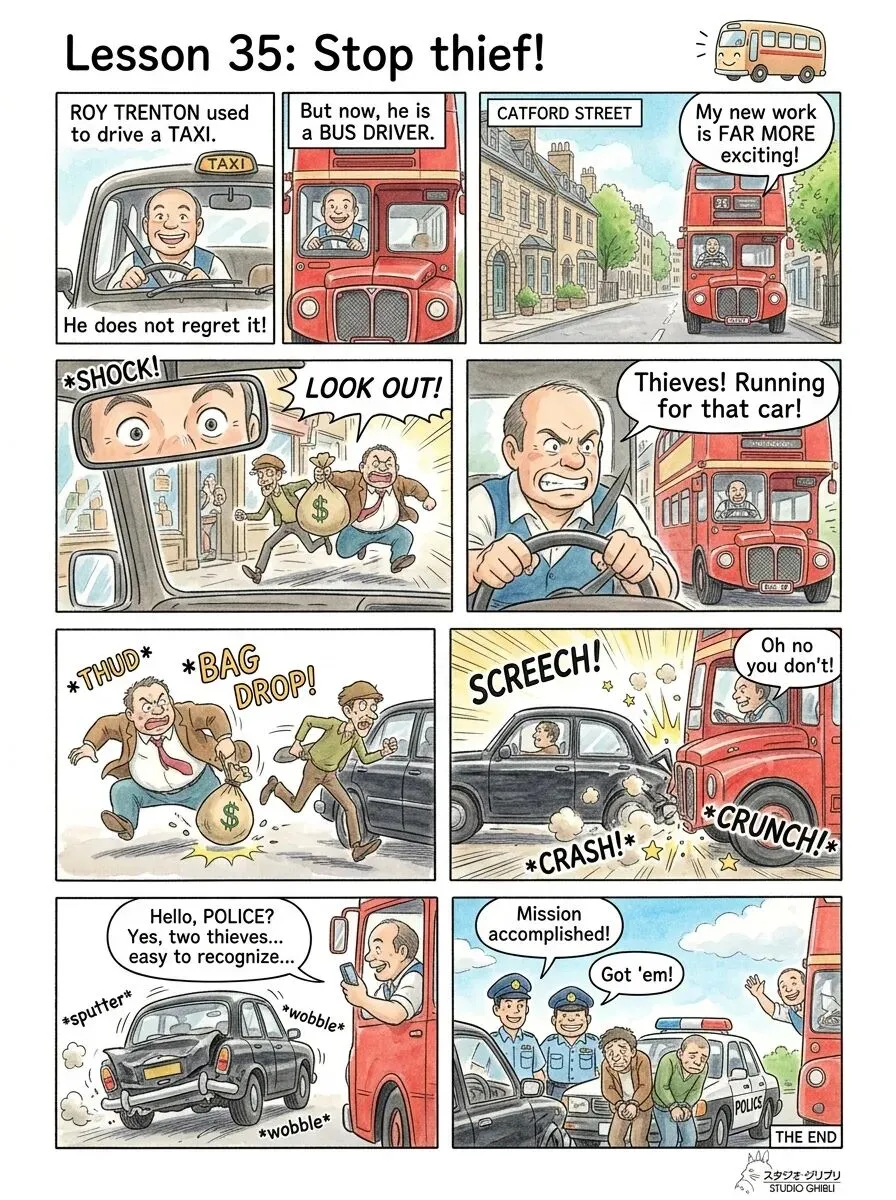
Roy Trenton used to drive a taxi. A short while ago, however, he became a bus driver and he has not regretted it. He is finding his new work far more exciting. When he was driving along Catford Street recently, he saw two thieves rush out of a shop and run towards a waiting car. One of them was carrying a bag full of money. Roy acted quickly and drove the bus straight at the thieves. The one with the money got such a fright that he dropped the bag. As the thieves were trying to get away in their car, Roy drove his bus into the back of it. While the battered car was moving away, Roy stopped his bus and telephoned the police. The thieves' car was badly damaged and easy to recognize. Shortly afterwards, the police stopped the car and both men were arrested.
语音标注: used to 中 /t/ 与 /tə/ 衔接;has not regretted 中 not 弱读;far more exciting 连读;saw two thieves rush 中 saw 与 two 连读,rush 省略 to;got such a fright 连读;drove his bus into 连读;battered car 中 /t/ 不完全爆破。
背景简介:本课是一篇简短的记叙文,讲述了一位公交车司机罗伊·特伦顿(Roy Trenton)机智勇敢地拦截小偷的故事。故事取材于可能发生的日常事件,旨在通过生动的叙述来呈现特定的语法结构和词汇。课文体现了普通人在面对突发事件时的勇气和责任感,同时也展示了英国社会对这类事件的常规处理方式(即报警并由警察处理)。
参考译文:罗伊·特伦顿过去开出租车。然而不久前,他成了一位公交车司机,而且他不后悔。他发现他的新工作刺激得多。最近,当他正沿着卡特福德街行驶时,他看到两个小偷从一家商店里冲出来,向一辆等候着的汽车跑去。其中一人提着一个装满钱的包。罗伊行动迅速,开车直冲小偷而去。拿钱的那个小偷吓得把包扔了。当小偷们试图开车逃跑时,罗伊开公交车撞了那辆车的尾部。当那辆被撞坏的车开走时,罗伊停下车,给警察打了电话。小偷的汽车损坏严重,很容易辨认。没过多久,警察就拦下了那辆车,两个人都被逮捕了。
🔍 第二部分:逐句精讲与词块总结
句子1
原文: Roy Trenton used to drive a taxi.
翻译: 罗伊·特伦顿过去开出租车。
句子结构: 简单句。主语(Roy Trenton) + 谓语(used to drive) + 宾语(a taxi)。
重点词汇:
used to 蓝思值 600L
英音[ˈjuːst tə] 美音[ˈjuːst tə] 词性:情态动词短语(后接动词原形)
释义:过去常常(做某事),表示过去习惯性的动作或状态,但现在已经不再如此。
常用语块:used to do sth.
短语搭配:There used to be...(过去曾有...)
例句一:I used to play tennis every weekend, but now I don't have time. 我过去每个周末都打网球,但现在没时间了。
例句二:There used to be a small park near my house. 我家附近过去有一个小公园。
拓展:辨析 used to do, be used to doing, be used to do。used to do 强调过去的习惯;be used to doing 表示“习惯于做某事”;be used to do 是被动语态,表示“被用来做某事”。
语法点睛: used to do 结构用于描述过去的习惯或状态,与现在形成对比。它只有过去式,否定形式为 didn't use to 或 used not to。
语音要点: used to 连读 /ˈjuːst tə/。
句子2
原文: A short while ago, however, he became a bus driver and he has not regretted it.
翻译: 然而不久前,他成了一位公交车司机,而且他不后悔。
句子结构: 并列复合句。由 and 连接两个并列分句:he became a bus driver 和 he has not regretted it。A short while ago 和 however 是状语。
重点词汇:
a short while ago 蓝思值 500L
词性:时间状语短语
释义:不久前,刚才。
例句:I saw him a short while ago in the library. 我刚才在图书馆看到他了。
拓展:ago 表示“从现在算起一段时间以前”,句子谓语通常用一般过去时。
regret 蓝思值 800L
英音[rɪˈɡret] 美音[rɪˈɡret] 词性:动词/名词
释义:后悔,遗憾
常用语块:regret doing sth.(后悔做了某事), regret to say/inform...(遗憾地说/通知...)
例句一:I regret telling him the secret. 我后悔告诉了他这个秘密。
例句二:We regret to inform you that your application has been unsuccessful. 我们遗憾地通知您,您的申请未通过。
拓展:注意 regret doing(对已发生的事后悔)和 regret to do(对将要做的事表示遗憾)的区别。课文中的 has not regretted it 是现在完成时,强调从过去换工作到现在一直不后悔的状态。
语法点睛: 现在完成时 has not regretted 强调从成为公交车司机那一刻起直到现在,他一直没有后悔过。however 表示转折,连接上一句的“过去开出租”和本句的“现在开公交”。
语音要点: has not regretted 中 not 弱读 /nɒt/。
句子3
原文: He is finding his new work far more exciting.
翻译: 他发现他的新工作刺激得多。
句子结构: 简单句。主语(He) + 谓语(is finding) + 宾语(his new work) + 宾语补足语(far more exciting)。
重点词汇:
find 蓝思值 400L
英音[faɪnd] 美音[faɪnd] 词性:动词
释义:找到;发现;发觉,认为
常用语块:find + 宾语 + 宾语补足语(形容词/名词/分词等)
例句:I find this book very interesting. 我觉得这本书很有趣。
拓展:find 在此是“发觉,认为”的意思,后接复合宾语。
far 蓝思值 500L
词性:副词
释义:很,非常;远得多(用于比较级前加强语气)
例句:This movie is far more exciting than that one. 这部电影比那部刺激得多。
拓展:far 作为程度副词,可以修饰比较级,不能修饰原级形容词。
exciting 蓝思值 600L
英音[ɪkˈsaɪtɪŋ] 美音[ɪkˈsaɪtɪŋ] 词性:形容词
释义:令人兴奋的,刺激的
例句:The news was so exciting that everyone cheered. 消息太令人兴奋了,每个人都欢呼起来。
拓展:辨析 exciting(令人兴奋的)和 excited(感到兴奋的)。
语法点睛: “动词+宾语+宾语补足语”结构,find 是感官类动词,其后可用形容词作宾补。far more exciting 是比较级结构,far 修饰比较级表示程度差异。现在进行时 is finding 强调现阶段的一种逐渐认识或感受。
语音要点: far more exciting 连读 /fɑː mɔːr ɪkˈsaɪtɪŋ/。
句子4
原文: When he was driving along Catford Street recently, he saw two thieves rush out of a shop and run towards a waiting car.
翻译: 最近,当他正沿着卡特福德街行驶时,他看到两个小偷从一家商店里冲出来,向一辆等候着的汽车跑去。
句子结构: 复合句。主句 he saw two thieves rush... and run...,时间状语从句 When he was driving...
重点词汇:
drive along 蓝思值 500L
释义:沿着...开车
例句:We were driving along the coast when we saw the sunset. 我们正沿着海岸开车,这时看到了日落。
thief 蓝思值 600L
英音[θiːf] 美音[θiːf] 词性:名词
释义:贼,小偷
例句:The thief stole my wallet on the bus. 小偷在公交车上偷了我的钱包。
拓展:复数形式为 thieves。
rush out of 蓝思值 550L
释义:冲出,跑出
例句:The children rushed out of the classroom when the bell rang. 铃响时,孩子们冲出了教室。
towards 蓝思值 500L
英音[təˈwɔːdz] 美音[tɔːrdz] 词性:介词
释义:向,朝;对于;接近
例句:She walked towards the door. 她朝门口走去。
waiting 蓝思值 400L
词性:现在分词作定语
释义:等候的,等待的
例句:The waiting car finally drove away. 那辆等候的车终于开走了。
语法点睛: 感官动词 see 后接省略 to 的不定式作宾补(rush, run),表示看到动作的全过程。a waiting car 是现在分词作定语,相当于 a car that was waiting。When 引导时间状语从句,描述动作发生的背景。
语音要点: saw two thieves 连读 /sɔː tuː θiːvz/;rush out of 连读 /rʌʃ aʊt əv/。
句子5
原文: One of them was carrying a bag full of money.
翻译: 其中一人提着一个装满钱的包。
句子结构: 简单句。主语(One of them) + 谓语(was carrying) + 宾语(a bag) + 后置定语(full of money)。
重点词汇:
carry 蓝思值 400L
英音[ˈkæri] 美音[ˈkæri] 词性:动词
释义:提,扛,搬;携带;运送
例句:She carried the heavy suitcase upstairs. 她把沉重的行李箱搬上了楼。
full of 蓝思值 400L
词性:形容词短语
释义:充满...的
例句:The room was full of laughter. 房间里充满了笑声。
语法点睛: 过去进行时 was carrying 描述在罗伊看到的那一时刻正在发生的动作。full of money 是形容词短语作后置定语,修饰名词 bag,比定语从句更简洁。
语音要点: carrying a 连读 /ˈkæriɪŋ ə/。
句子6
原文: Roy acted quickly and drove the bus straight at the thieves.
翻译: 罗伊行动迅速,开车直冲小偷而去。
句子结构: 并列句。由 and 连接两个并列谓语:acted quickly 和 drove the bus straight at the thieves。
重点词汇:
act 蓝思值 500L
英音[ækt] 美音[ækt] 词性:动词
释义:行动;扮演;起作用
例句:You must act now before it's too late. 你必须现在就行动,否则就太晚了。
straight 蓝思值 500L
词性:副词/形容词
释义:笔直地;直接地
例句:Go straight ahead and you'll see the post office. 一直往前走,你就会看到邮局。
语法点睛: 本句通过连词 and 连接两个先后发生的动作,体现了罗伊反应的迅速和连贯。副词 quickly 和 straight 分别修饰动词 acted 和 drove,使描述更精确。at 表示方向,隐含攻击性。
语音要点: acted quickly 中 /t/ 与 /k/ 不完全爆破;drove the bus 连读。
句子7
原文: The one with the money got such a fright that he dropped the bag.
翻译: 拿钱的那个小偷吓得把包扔了。
句子结构: 复合句。主句 The one with the money got such a fright,that he dropped the bag 是结果状语从句。
重点词汇:
fright 蓝思值 700L
英音[fraɪt] 美音[fraɪt] 词性:名词
释义:惊吓,恐怖
常用语块:get/have a fright
例句:The loud noise gave me a fright. 那声巨响吓了我一跳。
拓展:动词形式为 frighten,形容词 frightening/frightened。
drop 蓝思值 500L
英音[drɒp] 美音[drɑːp] 词性:动词
释义:(使)落下,掉下;放弃
例句:Be careful not to drop the glass. 小心别把杯子掉了。
语法点睛: 核心语法点为 such...that... 引导的结果状语从句。such 是形容词,修饰名词 a fright,表示“如此大的惊吓”,以至于导致 that 从句中的结果“他扔掉了包”。
语音要点: such a fright 连读 /sʌtʃ ə fraɪt/;dropped the bag 中 /t/ 不完全爆破。
句子8
原文: As the thieves were trying to get away in their car, Roy drove his bus into the back of it.
翻译: 当小偷们试图开车逃跑时,罗伊开公交车撞了那辆车的尾部。
句子结构: 复合句。主句 Roy drove his bus into the back of it。As the thieves were trying to get away in their car 是时间状语从句。
重点词汇:
get away 蓝思值 550L
释义:逃跑,离开
例句:The thief tried to get away but was caught. 小偷试图逃跑但被抓住了。
into 蓝思值 400L
英音[ˈɪntə] 美音[ˈɪntə] 词性:介词
释义:进入...里面;成为;撞上
例句:The car crashed into a tree. 汽车撞上了一棵树。
语法点睛: as 引导的时间状语从句表示主句动作发生时的背景。从句使用过去进行时 were trying,强调小偷“正在试图”逃跑的过程中,主句动作 drove 突然发生,体现了两个动作的同时性以及罗伊行动的果断。
语音要点: get away 连读 /ɡet əˈweɪ/;drove his bus into 连读 /drəʊv hɪz bʌs ˈɪntə/。
句子9
原文: While the battered car was moving away, Roy stopped his bus and telephoned the police.
翻译: 当那辆被撞坏的车开走时,罗伊停下车,给警察打了电话。
句子结构: 复合句。主句 Roy stopped his bus and telephoned the police。While the battered car was moving away 是时间状语从句。
重点词汇:
battered 蓝思值 800L
词性:形容词(过去分词转化)
释义:严重磨损的;撞坏的
例句:He drove a battered old truck. 他开着一辆破旧的卡车。
move away 蓝思值 500L
释义:搬走;离开,开走
例句:The car slowly moved away from the curb. 汽车慢慢驶离路边。
语法点睛: while 引导时间状语从句,表示主句动作发生在从句动作的进行过程中。while 通常引导持续性的动作,从句常用进行时态,如此处的 was moving away。主句的 stopped 和 telephoned 是两个连贯的动作,用 and 连接,叙述简洁。battered 是过去分词作定语,相当于 the car which had been battered。
语音要点: battered car 中 /t/ 不完全爆破;stopped his bus 中 /t/ 与 /h/ 衔接。
句子10
原文: The thieves' car was badly damaged and easy to recognize.
翻译: 小偷的汽车损坏严重,很容易辨认。
句子结构: 简单句。主语(The thieves' car) + 系动词(was) + 并列表语(badly damaged and easy to recognize)。
重点词汇:
damaged 蓝思值 600L
词性:形容词(过去分词转化)
释义:被损坏的
例句:The building was badly damaged in the fire. 大楼在大火中严重受损。
easy to recognize 蓝思值 550L
释义:容易辨认的
例句:This font is easy to read. 这种字体容易阅读。
语法点睛: 本句包含“be + adj. + to do”结构,不定式 to recognize 用主动形式表示被动含义,逻辑宾语是句子的主语 the car。这是本课核心语法点之一。副词 badly 修饰形容词 damaged,表示损坏的程度。
语音要点: badly damaged 连读 /ˈbædli ˈdæmɪdʒd/;easy to recognize 连读 /ˈiːzi tə ˈrekəɡnaɪz/。
句子11
原文: Shortly afterwards, the police stopped the car and both men were arrested.
翻译: 没过多久,警察就拦下了那辆车,两个人都被逮捕了。
句子结构: 并列句。由 and 连接两个分句:the police stopped the car 和 both men were arrested。
重点词汇:
shortly afterwards 蓝思值 600L
词性:时间状语短语
释义:不久之后,随后
例句:He left the office, and shortly afterwards the phone rang. 他离开了办公室,不久之后电话就响了。
arrest 蓝思值 750L
英音[əˈrest] 美音[əˈrest] 词性:动词/名词
释义:逮捕
例句:The police arrested the suspect yesterday. 警察昨天逮捕了嫌疑人。
语法点睛: 本句以一般过去时叙述了事件的结果。Shortly afterwards 承上启下,清晰地表明了时间顺序。第二个分句使用被动语态 were arrested,强调小偷“被逮捕”这一结果,而动作执行者 the police 因前文已提及而省略,使句子重点突出且简洁。
语音要点: stopped the car 中 /t/ 不完全爆破;both men were arrested 连读。
📌 核心词块总结
1. used to do sth. - Had the habit of doing something in the past, but no longer does it now. 例句: Roy Trenton used to drive a taxi. (He was a taxi driver before, but not anymore.)
2. find sth. far more exciting - Discover that something is much more stimulating or thrilling. 例句: After changing his job, he is finding his new work far more exciting than the old one.
3. see sb. do sth. - Witness the complete action performed by someone. (Note the bare infinitive 'do' after 'see'). 例句: He saw two thieves rush out of a shop. (He witnessed the entire action of rushing out.)
4. rush out of - Move very quickly out of a place, often in a hurry or panic. 例句: The students rushed out of the classroom when the fire alarm sounded.
5. drive straight at sb./sth. - Steer a vehicle directly towards someone or something, often aggressively. 例句: In the movie, the hero drove his car straight at the villains to block their escape.
6. get such a fright that... - Be so scared that a certain result follows. Used to express a strong cause-and-effect relationship related to fear. 例句: The loud thunder gave the dog such a fright that it hid under the bed.
7. get away - Escape or leave, especially from a place or situation one wants to avoid. 例句: The thieves tried to get away in their car after the robbery.
8. be easy to recognize - Can be identified or noticed without difficulty. (Active infinitive with passive meaning). 例句: Because of its unique color, her house is easy to recognize from a distance.
✍️ 第三部分:语篇分析与段落写作技巧
1. 语篇分析①识别宏观结构: 本课课文是一个典型的叙事段落。其宏观结构遵循清晰的时间顺序和因果逻辑。-背景引入(句子1-3):介绍了主人公Roy的职业变化及其对新工作的感受,为下文他的勇敢行为埋下伏笔(一个觉得工作更刺激的人可能更倾向于采取主动)。-事件起因(句子4-5):描述了事件的开端:Roy目睹抢劫现场(小偷从商店冲出)。-行动与冲突(句子6-9):是故事的核心和高潮,详细叙述了Roy如何果断采取行动(开车冲向小偷、撞车)以及小偷的反应(吓掉包、试图逃跑)。-事件结果(句子10-11):交代了事件的最终结果:小偷的车受损易认,警察迅速将其逮捕。这种“背景-起因-经过-结果”的结构是记叙文的基本框架。②列举衔接手段: 课文使用了多种衔接手段使行文流畅:-时间连接词: A short while ago, When..., As..., While..., Shortly afterwards。这些词清晰地标明了事件发展的先后顺序。-代词指代: he (指Roy), them (指two thieves), the one (指其中一个贼), it (指the thieves' car)。避免了名词的重复,使文章简洁。-逻辑连接词: however (表转折,引出职业变化), and (连接并列动作或事件), such... that... (表结果)。-词汇复现: thieves/thieves', car, bus, drove/driving 等关键词的重复出现,紧扣主题。③分析作者态度: 作者通过选词和叙述方式,隐含了对主人公Roy的赞赏和对小偷的否定。- 对Roy:使用 acted quickly, drove... straight at, stopped... and telephoned 等短语,描绘其勇敢、果断、冷静、有责任感。far more exciting 也暗示他享受这种富有挑战性的工作。- 对小偷:使用 thieves, rush out, trying to get away, were arrested 等词汇,刻画其仓皇、违法、最终被制裁的形象。such a fright 略带对其狼狈相的描写。整体语气是客观叙述中带有轻微的戏剧性和正义感。
2. 写作技巧① 提炼写作逻辑: 本课的写作逻辑是线性叙事,非常适合用来练习讲述个人经历或所见所闻。核心逻辑链是:平静的日常 → 突发的事件 → 本能的反应 → 行动的过程 → 直接的结果。在写作时,可以模仿这个逻辑:设定平常的场景 → 描述意外发生 → 写出即时反应和决定 → 详细叙述关键行动步骤 → 交代最终结局或感受。② 提供段落写作范例 (主题:一次小小的“见义勇为”):One afternoon last month, I was walking home from school along my usual route. I always find this walk quite boring. Suddenly, I heard a child crying loudly. I looked around and saw a little girl standing alone near a busy intersection, looking terrified. She had apparently lost her parents. Without thinking twice, I quickly walked over to her. I tried to calm her down with a gentle voice and asked for her name. She was so upset that she could barely speak. I decided to take her to the nearby police station, which was easy to find. Holding her hand, we walked there together. The police officers were very kind. Shortly afterwards, they managed to contact her frantic parents using the information the girl finally provided. Seeing the family reunited gave me a feeling far more satisfying than any video game.分析其结构特点: 背景(One afternoon... usual route. I always find... boring) → 起因(Suddenly... crying... saw a little girl... lost her parents) → 反应与决定(Without thinking twice... walked over... tried to calm... asked... decided to take...) → 行动(Holding her hand... walked there together) → 结果(The police officers... contacted... reunited. feeling... satisfying)。衔接手段使用 Suddenly, She had apparently, which was easy to find, Shortly afterwards 等。语言点映射:find sth. boring/satisfying, so upset that..., easy to find。③ 布置小练笔并提供例文: 请以“An Unexpected Event on My Way Home”为题,写一篇80-100词的短文,叙述你在回家路上经历或目睹的一件小事。要求使用时间顺序,并尝试运用至少一个本课学到的词块或句型(如 see sb. do sth., so...that..., easy to... 等)。
📐 第四部分:本课语法精析(加强版)
1. so...that... 与 such...that... 引导的结果状语从句-so...that...:so 是副词,用来修饰形容词或副词。结构:so + 形容词/副词 + that + 从句。-such...that...:such 是形容词,用来修饰名词。结构:such (+ a/an) + (形容词) + 名词 + that + 从句。- 课文例句: The one with the money got such a fright that he dropped the bag.- 更多例句: The bus driver acted so quickly that the thieves had no time to react. / It was such a frightening experience that he never forgot it. / He made such rapid progress that he soon caught up with the class.- 注意:当名词前有 many, much, few, little (表示“少”) 时,用 so 修饰:so many people that... / so little patience that...。2. 系表结构中 “be + adj. + to do” 的主动表被动- 结构:主语 + be + 形容词 + to do。不定式用主动形式表示被动含义,逻辑宾语是主语。- 课文例句: The thieves' car was badly damaged and easy to recognize. (车是“被辨认”的对象)- 更多例句: English grammar is difficult to learn. / This water is not safe to drink. / The problem is impossible to solve.3. 使役动词 let / 感官动词 see 后不定式省略 to- 使役动词 let, make, have 以及感官动词 see, hear, watch, notice, feel 等后面接宾语补足语时,如果是不定式,要省略 to。- 课文例句: he saw two thieves rush out of a shop. (省略 to)- 更多例句: My parents won't let me go out alone at night. / The funny movie made us laugh. / We heard someone knock on the door.- 注意被动语态中恢复 to: He was made to work long hours.练习题(12道,附答案)① The bag was ______ heavy ______ I couldn't carry it alone. (so...that)② It was ______ interesting book ______ I finished it in one day. (such an...that)③ He ran ______ fast ______ he won the race easily. (so...that)④ They were ______ loud noises ______ we couldn't sleep. (such...that)⑤ She had ______ much work to do ______ she stayed up late. (so...that)⑥ It's ______ a simple question ______ even a child can answer it. (such...that)⑦ The story was very ______ (move) and easy ______ (understand). (moving; to understand)⑧ The box is too heavy ______ (carry). Can you help me? (to carry)⑨ Some old habits are hard ______ (break). (to break)⑩ She let her children ______ (watch) TV for an hour. (watch)⑪ The teacher had the students ______ (clean) the classroom. (clean)⑫ I was made ______ (apologize) for my mistake. (to apologize)答案:1.so, that 2.such an, that 3.so, that 4.such, that 5.so, that 6.such, that 7.moving, to understand 8.to carry 9.to break 10.watch 11.clean 12.to apologize
🎧 第五部分:听力与阅读策略训练
1. 听力技巧① 预测关键词: 在听录音前,快速浏览课文标题“Stop thief!”。预测故事可能涉及的关键词:人物 (driver, policeman, thief/thieves);动词 (drive, see, run, steal, stop, arrest, chase);名词 (bus, car, shop, money, bag, police);形容词 (quick, exciting, frightened)。带着这些预测去听,能帮助你更快地捕捉信息。② 抓主旨大意: 听完第一遍录音后,尝试回答:Who is the main character? (Roy Trenton, a bus driver) / What happened? (He saw a robbery and used his bus to stop the thieves.) / Where did it happen? (On Catford Street, near a shop.) / How did it end? (The thieves were arrested by the police.) 这就是故事的“5W1H”要素中的核心。③ 笔记方法: 听第二遍录音时,尝试用关键词笔记法记录事件发展流程。可以按以下格式:Roy: taxi -> bus driver (no regret, more exciting) / Event: driving -> saw 2 thieves (rush out, run to car, bag $) / Action: drove bus at thieves -> one dropped bag (fright) / thieves try escape -> Roy hit their car / Roy stopped, called police / Result: car damaged -> easy to recognize -> police stopped car -> arrested。这种方法只记核心实词,忽略虚词,有助于理清脉络。2. 阅读理解策略① 扫读: 快速找出以下信息在课文中的位置:Roy现在的职业是什么?(第2句);小偷从什么地方跑出来?(第4句);谁打电话报了警?(第9句)。② 略读: 在60秒内快速阅读全文,然后说出故事的主要阶段(开头、发展、结局)。③ 推断词义: “He has not regretted it.” 中的 it 指代什么?(指他成为公交车司机这件事。) / “The one with the money...” 中的 the one 指谁?(指两个小偷中拿着钱的那个。) / “the battered car” 为什么是 battered?(因为被Roy的公交车撞了。) / “easy to recognize” 是什么意思?你能从上下文找到线索吗?(因为车被撞得 badly damaged,所以特征明显,容易认出来。)
📝 第六部分:习题讲解
关键句型练习A. 用 so 或 such 填空(答案见语法部分)。B. 将下列句子改为被动语态:The police arrested both men. → Both men were arrested by the police.难点练习A. 用 let 的正确形式填空:Will your parents ______ you go? (let) / The teacher ______ the students leave early yesterday. (let) / Don't ______ him drive your car. (let)B. 用 drive 短语填空 (drive at, drive into, drive out of): He ______ the garage carefully. (drove out of) / The angry man ______ his opponent during the debate. (drove at) / We ______ the city at dawn. (drove out of)多项选择题1. Roy Trenton now works as a ______. (a) taxi driver (b) police officer (c) bus driver (d) shopkeeper → c2. Roy saw the thieves when he was ______. (a) walking (b) driving (c) shopping (d) calling the police → b3. The thief dropped the bag because he ______. (a) was tired (b) saw the police (c) got a fright (d) wanted to run faster → c4. Roy damaged the thieves' car by driving ______. (a) in front of it (b) into the back of it (c) next to it (d) over it → b5. The thieves' car was easy to recognize because it was ______. (a) very old (b) a rare model (c) brightly colored (d) badly damaged → d书面练习(摘要写作)范文(68词): Roy Trenton, a former taxi driver, now finds his job as a bus driver more exciting. Recently, while driving, he saw two thieves with a bag of money run to a car. He quickly drove at them, frightening one into dropping the bag. As they tried to escape, he hit their car. After stopping and calling the police, the damaged car was soon stopped and the thieves arrested.
🤔 第七部分:英文深度思考与拓展(强化版)
A. 层次化英文问题与答案Level 1 (Factual):1. Q: What was Roy doing when he saw the two thieves? A: Roy was driving a taxi along Catford Street shortly after he had received a new job.2. Q: Where did the two thieves run after they rushed out of the shop? A: They ran towards a waiting car.3. Q: What action did Roy take immediately after the thieves' car hit a lamp-post? A: Roy drove his bus straight at the thieves, which frightened them very much.4. Q: What was the condition of the thieves' car after the collision? A: The car was badly damaged and could no longer move.5. Q: Who arrived at the scene shortly afterwards? A: The police arrived shortly afterwards.Level 2 (Inferential & Analytical):6. Q: Why did Roy, a former taxi driver, find his new work "far more exciting"? A: Roy likely found his new work as a bus driver more exciting because it involved a larger vehicle, a fixed route with many passengers, and perhaps a greater sense of responsibility. The incident with the thieves provided an unexpected and adrenaline-filled event that contrasted with the potentially more solitary and routine nature of driving a taxi.7. Q: Infer the reason why the thieves' car "roared down the street" and hit a lamp-post. A: The thieves were probably in a state of panic after committing the crime. The driver, focused on escaping quickly, likely accelerated too fast, lost control of the vehicle due to haste or poor driving, or failed to navigate the turn properly, leading to the collision with the lamp-post.8. Q: What does Roy's decision to drive his bus "straight at the thieves" reveal about his character? A: This action reveals that Roy is courageous, quick-thinking, and has a strong sense of civic duty. Instead of being a passive bystander, he took immediate and decisive action to prevent the criminals from escaping, even at potential risk to himself and his bus.9. Q: Analyze the author's purpose in mentioning that Roy "is finding his new work far more exciting". How does this sentence function in the narrative? A: This sentence serves as ironic foreshadowing and contrast. It sets up a mundane expectation about Roy's new job, which is then dramatically subverted by the thrilling chase. The irony highlights the unpredictability of the event and makes the story more engaging. It also connects Roy's personal feeling to the plot's climax.Level 3 (Evaluative & Creative):10. Q: Do you think Roy's action of driving his bus at the thieves was entirely justified and responsible? Consider the safety of his passengers (if any) and other road users. A: (Open-ended) While Roy's intention to stop the thieves was admirable, his method was potentially reckless. If there were passengers on the bus, he endangered their safety. A more responsible action might have been to safely stop, note the car's description and license plate, and immediately call the police. However, given the rapid pace of events and his instinct to act, his bravery is understandable, though not without risk.11. Q: Imagine you are one of the thieves. Describe your thoughts and feelings from the moment you rushed out of the shop to the moment the police arrested you. A: (Creative) "It was supposed to be quick. In and out. We grabbed the cash and sprinted to the car. My heart was pounding. Then I saw this massive red bus in the rearview mirror---it wasn't stopping! It was coming right at us! Panic took over. 'Faster!' I yelled. The driver swerved, and everything turned into a crash of metal and glass. The bus loomed over us, blocking our way. The fear was absolute. It was over. The wail of sirens just confirmed it. Caught by a bus driver..."12. Q: The story is titled "Stop thief!". Evaluate the effectiveness of this title. Does it fully capture the essence of the story, or would an alternative title like "The Brave Bus Driver" or "An Unexpected Chase" be better? Why? A: The title "Stop thief!" is effective because it is an immediate, action-oriented exclamation that mirrors the story's sudden turn of events. It grabs the reader's attention and directly relates to the central action. "The Brave Bus Driver" focuses on the character but loses the urgency. "An Unexpected Chase" describes the plot but is more generic. "Stop thief!" is short, powerful, and places the reader right in the middle of the action, making it the most compelling choice.B. 多类型拓展阅读1. 时事新闻拓展Title: Community Hero Bus Driver Thwarts GetawayLast Tuesday, an ordinary bus route in Catford became the scene of a dramatic citizen's arrest. Bus driver, Roy Trenton, 42, witnessed two masked individuals fleeing a jewelry store. As the suspects' vehicle sped away, it lost control and collided with street furniture. Seizing the moment, Mr. Trenton skillfully maneuvered his double-decker bus to block the damaged car's path, effectively trapping the occupants until police arrived minutes later. A police spokesperson commended Trenton's "quick thinking and civic courage" but also reminded the public that personal safety should always be the priority. The arrested men, aged 24 and 27, are now facing charges of burglary and dangerous driving. The store owner expressed immense gratitude, stating, "He didn't just drive a bus that day; he drove away our fear."2. 文化背景解析Title: The "Bobby" and Public Spirit in British CultureThe image of the brave bus driver in "Stop thief!" taps into a broader cultural theme in British storytelling: the vigilant ordinary citizen. While Britain has a professional police force famously known as "Bobbies" (after Sir Robert Peel), there's also a cultural appreciation for public-spiritedness. This isn't about vigilantism but about a sense of collective responsibility. Historically, from Dickensian novels to modern-day stories, acts of courage by coachmen, sailors, or even children are celebrated. The bus, a symbol of public transport and communal life, becomes the tool for justice, contrasting with the thieves' private car used for selfish gain. This narrative reinforces the idea that community safety is everyone's business. The prompt police arrival ("shortly afterwards") also reflects trust in the system---the citizen initiates the action, and the authorities efficiently conclude it.3. 今昔对比分析Title: From "Stop Thief!" to Digital Tracking: The Evolution of Crime ResponseRoy Trenton's story, set in a pre-digital era, showcases a physical, immediate response to crime. Today, the scenario might unfold differently. The jewelry store would likely have silent alarms linked directly to police computers. High-resolution CCTV cameras, not just a passing bus driver, would capture the thieves' faces and the car's license plate in detail. Automatic Number Plate Recognition (ANPR) systems on police cars and streets could track the getaway car's route in real-time. The bus driver might still be a key witness, but his role could shift. Instead of a high-risk vehicular interception, he might use his hands-free kit to call 999 immediately, providing a live commentary. The police response could be more coordinated, with drones or helicopter support. While technology has changed the methods, the core elements remain: observation, communication, and courage. The modern "Roy" might exercise courage by being a calm, precise witness under pressure.4. 新潮英语改写(Social Media Post Style) OMG, just witnessed the CRAZIEST thing on my commute! So, there's this new bus driver, Roy. Dude just started the job. We're on Catford St., right? Suddenly, two guys BURST out of a shop, sprinting like they're in the Olympics. They jump into this car that peels out... and SMACK! Straight into a lamppost. Total fail. But here's the plot twist. Roy doesn't even hesitate. He's like, "Nope, not today." He swings this massive double-decker around and just... blocks them in. I'm not even joking. The look on their faces! Priceless. Absolute legend. Police showed up like two minutes later. Roy just gets back on the mic, "Sorry for the delay, folks. Minor incident." MINOR? My heart was racing! #BusDriverMVP #Catford #StopThief #RealLifeActionMovie5. 难度略高的拓展阅读Title: The Physics of a ChaseLet's analyze the incident scientifically. The child's foot imparts kinetic energy to the ball. The force (F) applied, combined with the angle of the kick, determines the ball's initial velocity and trajectory. Air resistance acts upon it during its parabolic flight across the river. The key factor is the transfer of momentum upon impact with the man. The text states the strike was "so hard that he nearly fell into the water." This implies a significant impulse was delivered, almost sufficient to overcome his static friction with the boat's floor and his center of gravity. His ability to recover, rather than capsize, speaks to his reflexive balance and the boat's stability. The children's rapid departure demonstrates an adrenaline-fueled fight-or-flight response. Thus, a simple anecdote encapsulates principles of mechanics, biology, and psychology.
🌍 第八部分:日常应用与文化拓展
1. 相关文化背景知识- 英国的巴士文化:双层红色巴士(Double-decker bus)是伦敦,乃至英国的重要文化标志。巴士司机在英国社区中扮演着稳定、可靠的角色,熟悉固定路线和常客,这为罗伊迅速做出判断提供了背景——他熟悉那条街道。- 英国的警务体系:故事中警察“shortly afterwards”就赶到,反映了公众对警察响应效率的期望。英国警察通常不配枪(持枪警察是特殊单位),日常治安更依赖社区警务和公众合作,这与故事中“公民勇为”后警方迅速接手的情节设定相符。- “Civic Duty”(公民责任)观念:故事隐含赞扬了罗伊的公民责任感。这不是鼓励鲁莽的见义勇为,而是倡导在确保自身安全的前提下,通过冷静、有效的方式(如记住特征、及时报警)协助维护公共安全。2. 推荐拓展学习资源- 影视资源:可以观看英国电影或剧集如《天堂一刻》(The Paradise)或《呼叫助产士》(Call the Midwife),其中常有关于旧日英国社区生活与市井故事的描绘,其叙事节奏和价值观与《新概念英语》第二册的许多课文有相通之处。- 阅读资源:强烈建议结合《新概念英语美文欣赏 第2册》进行拓展阅读,培养语感。利用《新概念英语口语宝典 第2册》中第35课相关的托福真题情景进行口语复述练习。也可以尝试阅读简化版的英国短篇小说集,如《牛津书虫系列》中关于侦探、冒险主题的故事,巩固一般过去时叙事。- 实践建议:模仿本课“短时间内的连续动作”叙事,用英文写一篇自己或他人在短时间内应对某个突发小事件的经历(如赶车、寻找失物、解决一个小麻烦),注意使用see sb. do, watch sb. doing等结构,并运用shortly after, just then, a short while ago等时间连接词。
💡 第九部分:引导性思考
1. 如果行车记录仪和即时报警程序在罗伊的时代就存在,故事会有何不同?他的勇敢会显得更不重要还是更重要?2. 故事以警察到达结束。想象罗伊和警察之间的对话,写出几句对白。3. 从“出租车司机”到“巴士司机”,罗伊的工作性质发生了从服务个体到服务公众的转变。这种转变如何可能影响了他面对犯罪时的心态和抉择?
🗂️ 第十部分:本课知识图谱(结构化逻辑图)
核心事件: 巴士司机罗伊·特伦顿成功拦截两名窃贼。
├─ 主要支撑点1:事件背景与起因│ ├─ 罗伊刚转行开巴士不久,觉得新工作更有趣。│ └─ 他驾车经过卡特福德街时,碰巧目击盗窃案发生。├─ 主要支撑点2:事件经过与冲突│ ├─ 两贼从商店冲出,跑向一辆等候的汽车。│ ├─ 罗伊果断驾驶巴士径直冲向小偷,堵住去路,吓坏了窃贼。│ └─ 贼车匆忙逃离时撞上路灯柱,严重受损。└─ 主要支撑点3:事件结果与影响├─ 受损的贼车无法动弹,窃贼被困。└─ 警察随后迅速赶到现场,两人被捕。
逻辑关系: 支撑点1(背景)为罗伊的在场和心态铺垫;支撑点2(经过)是核心动作的展开,其中贼车肇事是转折点,罗伊的拦截是高潮;支撑点3(结果)是整个事件的收尾和评价。三者构成完整的“背景-冲突-解决”叙事链。
© 本文为狂暴英语教案 · 新概念英语第二册第35课
仅供学习交流使用

贝琪酱英语无痛逆袭站
微信扫描二维码,关注我的账号