【狂暴英语教案】新概念英语第二册第38课:唯独没有考虑到天气
- 2026-07-11 14:42:06
读外刊,接触原汁原味的英文表达,
欢迎关注以下公众号+设为星标+推荐给朋友。▼
📚 狂暴英语教案 · 新概念英语第二册
第38课 Everything except the weather
唯独没有考虑到天气
📘 本课信息教材:新概念英语第二册 · 第38课核心功能:讲述因忽略气候导致的计划失败 · 幽默叙事语法焦点:过去完成时(Past Perfect) · used to do · no sooner…than/hardly…when
🏷️ 热门标签
🎯 本课学习目标
词汇:
掌握核心动词如 retire, settle, dream of 的用法;理解描述天气与情感的形容词,如 continual, bitterly;学习 used to do 与 be used to doing 的辨析。
语法:
核心语法点为过去完成时 (Past Perfect Tense);次要语法点为 used to do 结构,表示过去习惯性的动作或状态。
技能(段落写作):
学习运用时间状语和对比结构叙述包含因果转折的个人经历故事,提升叙事段落的结构逻辑性。
文化:
初步了解英国多变的气候特征及其对人们生活、尤其是对从阳光充足地区归来者的心理影响。
📖 第一部分:课文完整内容
Lesson 38 Everything except the weather
📜 课文原文
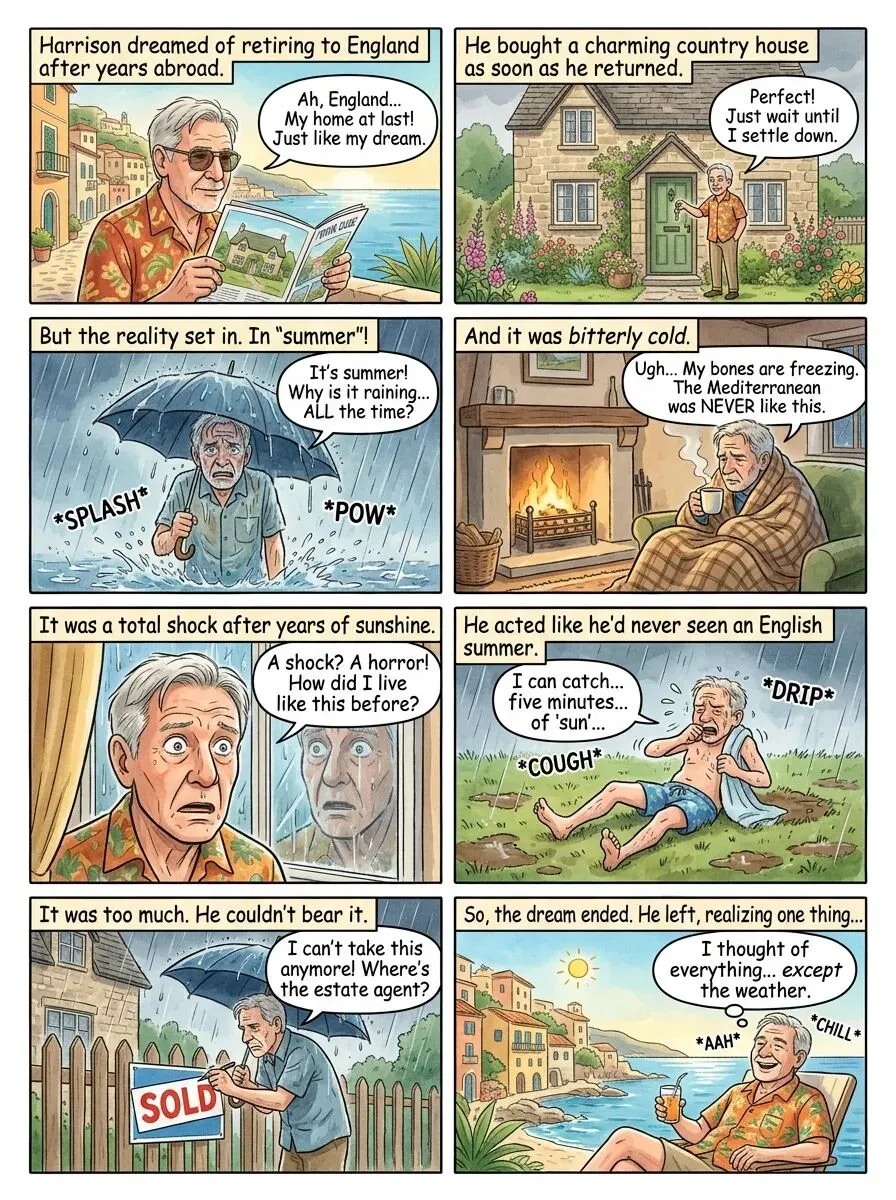
My old friend, Harrison, had lived in the Mediterranean for many years before he returned to England. He had often dreamed of retiring in England and had planned to settle down in the country. He had no sooner returned than he bought a fine house and went to live there. Almost immediately he began to complain about the weather, for even though it was still summer, it rained continually and it was often bitterly cold. After so many years of sunshine, Harrison got a shock. He acted as if he had never lived in England before. In the end, it was more than he could bear. He had hardly had time to settle down when he sold the house and left the country. The dream he had had for so many years ended there. Harrison had thought of everything except the weather.
语音标注: Mediterranean /ˌmedɪtəˈreɪniən/;retiring 注意 /rɪˈtaɪərɪŋ/;settle down /ˈsetl daʊn/;continually /kənˈtɪnjuəli/;bitterly /ˈbɪtəli/;shock /ʃɒk/;bear /beə(r)/;no sooner…than 连读;hardly…when 注意节奏。
背景简介:本课是一篇典型的叙事短文,通过哈里森(Harrison)的经历,幽默而深刻地揭示了理想与现实之间的差距,尤其是环境因素(如气候)对生活计划的决定性影响。文章结构紧凑,运用了丰富的时态(特别是过去完成时)来清晰表达事件的时间先后顺序。
参考译文:我的老朋友哈里森在回到英国以前曾多年居住在地中海地区。过去他常幻想退休后回到英国,并计划在乡间安顿下来。他刚一回到英国便买下了一幢漂亮的房子,并搬了进去。但几乎紧接着他就开始抱怨那里的天气了,因为即使那时仍为夏季,但雨总是下个不停,而且常常冷得厉害。在阳光下生活了那么多年的哈里森对此感到惊奇。他的举动就好像他从未在英国生活过一样。最后,他再也忍受不住了。他还没等安顿下来就卖掉了房子,离开了这个国家。他多年来的幻想从此破灭。哈里森把每件事情都考虑到了,唯独忽略了天气。
🔍 第二部分:逐句精讲与词块总结
句子1
原文: My old friend, Harrison, had lived in the Mediterranean for many years before he returned to England.
翻译: 我的老朋友哈里森在回到英国以前曾多年居住在地中海地区。
句子结构: 复合句。主句过去完成时,before时间状语从句一般过去时。
重点词汇:
Mediterranean 蓝思值 1100L-1300L
英音[ˌmedɪtəˈreɪniən] 美音[ˌmedɪtəˈreɪniən] 词性:n. & adj.
释义:地中海;地中海的
常用语块:the Mediterranean (Sea);Mediterranean climate
例句一:They spent their holiday on a Mediterranean cruise. 他们在地中海游轮上度假。
例句二:The Mediterranean diet is considered very healthy. 地中海饮食被认为非常健康。
拓展:源自拉丁语“mediterraneus”,意为“陆地中间的”。
语法点睛: 过去完成时 (had lived) 表示“过去的过去”,发生在 returned 之前。before 明确时间先后。
语音要点: Mediterranean 重音在第三音节 /ˌmedɪtəˈreɪniən/。
句子2
原文: He had often dreamed of retiring in England and had planned to settle down in the country.
翻译: 过去他常幻想退休后回到英国,并计划在乡间安顿下来。
句子结构: 简单句,并列谓语 had dreamed 和 had planned,均为过去完成时。
重点词汇:
dream of
释义:梦想,向往
例句一:She dreams of becoming a pilot. 她梦想成为飞行员。
例句二:I never dreamed of meeting you here. 从未想到会在这遇见你。
retire 蓝思值 800L-1000L
英音[rɪˈtaɪə(r)] 美音[rɪˈtaɪər] 词性:v.
释义:退休;退职
例句一:My father will retire next year. 我父亲明年退休。
例句二:The boxer retired undefeated. 拳击手不败退役。
拓展:名词 retirement;形容词 retired。
settle down
释义:定居,安顿下来
例句一:After traveling, he decided to settle down in Canada. 周游后决定在加拿大定居。
例句二:The children settled down to do homework. 孩子们静下心写作业。
语法点睛: 并列过去完成时,表示在 returned 之前持续的心理活动。
语音要点: dreamed of 连读 /driːmd əv/。
句子3
原文: He had no sooner returned than he bought a fine house and went to live there.
翻译: 他刚一回到英国便买下了一幢漂亮的房子,并搬了进去。
句子结构: no sooner…than… 句型,主句过去完成时,than从句一般过去时。
重点词汇:
no sooner…than…
释义:一……就……
例句一:No sooner had I arrived home than it started to rain. 我刚到家就下雨了。
例句二:He had no sooner sat down than the phone rang. 他刚坐下电话就响了。
拓展:倒装时 had 提前:No sooner had he returned than…
fine 蓝思值 400L-600L
英音[faɪn] 美音[faɪn] 词性:adj.
释义:美好的;优良的;晴朗的
例句一:They live in a fine old house. 他们住在一栋漂亮的老房子里。
例句二:It's a fine day for a picnic. 今天是野餐的好天气。
语法点睛: no sooner…than 强调动作紧接发生。主句常用过去完成时。
语音要点: no sooner 连读 /nəʊ ˈsuːnə/。
句子4
原文: Almost immediately he began to complain about the weather, for even though it was still summer, it rained continually and it was often bitterly cold.
翻译: 但几乎紧接着他就开始抱怨那里的天气了,因为即使那时仍为夏季,但雨总是下个不停,而且常常冷得厉害。
句子结构: 多重复合句。for 原因从句内含 even though 让步从句和并列主句。
重点词汇:
complain about
释义:抱怨,诉苦
例句一:Neighbours complained about the loud music. 邻居抱怨音乐声大。
例句二:He's always complaining about something. 他总是怨天尤人。
continually 蓝思值 1000L-1200L
英音[kənˈtɪnjuəli] 词性:adv.
释义:不断地,频繁地(令人厌烦)
例句一:The baby cried continually. 婴儿哭个不停。
例句二:Technology is continually changing. 科技不断变化。
拓展:与 continuously 区别:continually 有间断,continuously 不间断。
bitterly 蓝思值 1000L-1200L
英音[ˈbɪtəli] 词性:adv.
释义:极其,非常;苦涩地
例句一:It was a bitterly cold winter morning. 严寒的冬日早晨。
例句二:She was bitterly disappointed. 她极度失望。
语法点睛: for 引导原因,语气比 because 弱;even though 表示“即使”,突出矛盾。
语音要点: bitterly cold 连读 /ˈbɪtəli kəʊld/。
句子5
原文: After so many years of sunshine, Harrison got a shock.
翻译: 在阳光下生活了那么多年的哈里森对此感到惊奇。
句子结构: 简单句。After 介词短语作时间状语。
重点词汇:
sunshine 蓝思值 500L-700L
英音[ˈsʌnʃaɪn] 词性:n.
释义:阳光;晴天
例句一:We sat outside in the bright sunshine. 坐在明媚阳光下。
例句二:She brought sunshine into our lives. 她给我们的生活带来阳光。
shock 蓝思值 600L-800L
英音[ʃɒk] 美音[ʃɑːk] 词性:n. & v.
释义:震惊;使震惊
例句一:The news was a terrible shock. 消息令人震惊。
例句二:It shocked me to see how ill he looked. 看他病容我震惊。
语法点睛: After 短语总结过去阳光生活,与现状对比,引出反应。
语音要点: got a shock 连读 /ɡɒt ə ʃɒk/。
句子6
原文: He acted as if he had never lived in England before.
翻译: 他的举动就好像他从未在英国生活过一样。
句子结构: 复合句。as if 引导方式状语从句,从句用过去完成时表虚拟。
重点词汇:
act as if
释义:表现得好像……
例句一:He acts as if he owns the place. 他表现得好像这地方是他的一样。
例句二:She acted as if she hadn't seen me. 她表现得好像没看见我。
拓展:as if 从句常用虚拟语气。
语法点睛: as if + 过去完成时表示与过去事实相反的虚拟(他以前在英国生活过)。
语音要点: acted as if 连读 /ˈæktɪd æz ɪf/。
句子7
原文: In the end, it was more than he could bear.
翻译: 最后,他再也忍受不住了。
句子结构: 复合句。more than he could bear 为比较结构,内含定语从句。
重点词汇:
in the end
释义:最后,终于
例句一:We tried many ways, and in the end we succeeded. 最后成功了。
例句二:In the end, she decided to accept the job. 最终她接受了工作。
bear 蓝思值 700L-900L
英音[beə(r)] 美音[ber] 词性:v. (bore, borne)
释义:忍受;承受;生育
例句一:I can't bear the noise anymore. 再也受不了噪音。
例句二:The pain was almost more than he could bear. 疼痛几乎无法忍受。
语法点睛: more than one can bear 固定句型,意为“超出承受范围”。
语音要点: more than 连读 /mɔː ðən/。
句子8
原文: He had hardly had time to settle down when he sold the house and left the country.
翻译: 他还没等安顿下来就卖掉了房子,离开了这个国家。
句子结构: hardly…when… 句型,主句过去完成时,when从句一般过去时。
重点词汇:
hardly…when…
释义:刚……就……
例句一:Hardly had I finished my speech when someone asked a question. 我刚讲完就有人提问。
例句二:He had hardly arrived when he had to leave. 他刚到就得离开。
拓展:与 no sooner…than 同义,倒装时 hardly 提前。
语法点睛: 过去完成时 had had (第一个 had 助动词,第二个 had 实义动词)。强调时间之短。
语音要点: had hardly 连读 /həd ˈhɑːdli/。
句子9
原文: The dream he had had for so many years ended there.
翻译: 他多年来的幻想从此破灭。
句子结构: 复合句。定语从句 he had had 修饰 dream,主句 The dream ended there。
重点词汇:
dream 蓝思值 400L-600L
英音[driːm] 词性:n. & v.
释义:梦;梦想
例句一:It was her dream to travel around the world. 环游世界是她的梦想。
例句二:I dreamt about you last night. 昨晚梦到你了。
语法点睛: had had 为过去完成时,第一个 had 是助动词,第二个 had 是 have 的过去分词。
语音要点: he had had 连读 /hi həd hæd/。
句子10
原文: Harrison had thought of everything except the weather.
翻译: 哈里森把每件事情都考虑到了,唯独忽略了天气。
句子结构: 简单句。过去完成时,except 介词短语作状语。
重点词汇:
except 蓝思值 600L-800L
英音[ɪkˈsept] 词性:prep. & conj.
释义:除……之外
例句一:All the students passed except Tom. 除了汤姆都通过了。
例句二:The car is perfect except for the price. 车完美,除了价格。
拓展:辨析 except (排除), besides (包含), except for (修正细节)。
语法点睛: 过去完成时呼应开头,点明主题。except 精准幽默。
语音要点: thought of 连读 /θɔːt əv/。
📌 核心词块总结
1. dream of (doing) sth.: 向往,梦想。 例句:Many young people dream of traveling the world.
2. settle down: 定居,安顿。 例句:After years abroad, they decided to settle down in their hometown.
3. no sooner…than…: 一……就……。 例句:No sooner had we sat down to eat than the doorbell rang.
4. complain about: 抱怨。 例句:Tenants complained about the lack of hot water.
5. continually / bitterly cold: 下个不停/严寒。 例句:The expedition faced continually bad weather and bitterly cold nights.
6. act as if: 表现得好像。 例句:He acted as if he hadn't heard the bad news.
7. more than one can bear: 无法忍受。 例句:The loneliness was more than she could bear.
8. hardly…when…: 刚……就……。 例句:Hardly had the concert begun when the fire alarm sounded.
✍️ 第三部分:语篇分析与段落写作技巧
1. 语篇分析(关键术语标注英文)① 识别宏观结构 (Identify the macrostructure): 本文遵循经典的“背景-冲突-解决”结构。背景 (Background): 句子1-2,介绍哈里森过去的居住地、梦想和计划。冲突 (Conflict): 句子3-7,描述他回国后的行动以及立即面临的天气问题,及其剧烈反应。解决 (Resolution): 句子8-10,叙述他迅速卖房离开,梦想破灭,并点明原因。② 列举衔接手段 (List cohesive devices): 时间衔接 (Temporal cohesion): “before he returned”, “no sooner… than…”, “Almost immediately”, “After so many years of…”, “In the end”, “hardly… when…” 清晰地勾勒出事件发展顺序。语法衔接 (Grammatical cohesion): 大量使用过去完成时 (“had lived”, “had dreamed”, “had planned”, “had had”) 建立“过去的过去”时间框架,与一般过去时对比,层次分明。逻辑衔接 (Logical cohesion): “for”表原因,“even though”表让步,“as if”表方式,“except”表排除,体现逻辑关系。词汇衔接 (Lexical cohesion): 重复关键词如“dream”(dreamed of, dream), “settle down”, “England”, “weather”, “house”, “country”形成语义场。③ 分析作者态度 (Analyze the author's attitude): 作者的态度是略带幽默和讽刺的客观叙述。通过使用“had no sooner… than…”, “acted as if he had never lived in England before”, “had hardly… when…” 等夸张的时间结构和虚拟语气,放大了哈里森计划与现实的巨大反差和其行为的仓促可笑。
2. 写作技巧①提炼写作逻辑: 本课是学习如何讲述一个“计划失败”或个人挫折经历的绝佳范例。逻辑链条为:长期愿望/计划 → 付诸行动 → 遭遇意外阻碍 → 产生强烈反应 → 导致计划中止/改变 → 点明失败关键原因。②提供段落写作范例:主题:A Well-Planned Picnic That Went Wrong范文:My friends and I had planned a perfect picnic for weeks. We had chosen a beautiful lakeside spot, prepared delicious food, and even checked the weather forecast, which promised sunshine. We had no sooner arrived at the lake and spread out our blanket than dark clouds gathered overhead. Almost immediately, it began to drizzle, and soon the drizzle turned into a heavy downpour. After so much anticipation, we got a shock. We acted as if we had never been on a picnic before, scrambling to pack everything while getting soaked. In the end, it was more than we could bear. We had hardly taken any photos when we decided to abandon the picnic and run for shelter. Our dream of a lovely outdoor meal ended there. We had thought of everything except the possibility of the forecast being completely wrong.(译文:我和朋友们为一次完美的野餐计划了好几周。我们选了一个美丽的湖边地点,准备了美味的食物,甚至查看了天气预报,预报说是晴天。我们刚到湖边铺开毯子,乌云就聚集到了头顶。几乎立刻,天开始下毛毛雨,很快毛毛雨变成了倾盆大雨。期待了这么久,我们大吃一惊。我们表现得好像从未野餐过一样,一边被淋得湿透,一边手忙脚乱地收拾东西。最后,我们实在受不了了。还没拍几张照片,我们就决定放弃野餐,跑去躲雨。我们享受美好户外餐的梦想就此破灭。我们考虑了一切,唯独没料到天气预报会完全不准。)③布置小练笔并提供例文小练笔:请模仿第38课的叙事结构和逻辑,用80-120词写一段个人经历,讲述一个“因为忽略某个重要细节而导致计划受挫或出现意外结果”的故事。请尝试使用过去完成时和“no sooner… than…”或“hardly… when…”等句型。例文:I had always dreamed of baking a perfect chocolate cake for my mother's birthday. I had followed a famous recipe online and bought the finest ingredients. I had no sooner put the cake into the oven than I realized I had forgotten to add sugar. I remembered the recipe mentioning it, but I was distracted by a phone call. Almost immediately, I felt a sense of dread. After all that effort, I got a shock. I acted as if I had never baked before, frantically searching for a solution online. In the end, it was more than I could bear to serve a tasteless cake. I had hardly taken the cake out of the oven when I decided to order a beautiful one from a bakery instead. My plan to impress everyone with my baking ended there. I had thought of everything except paying full attention to each step.(译文:我一直梦想着为妈妈的生日烤一个完美的巧克力蛋糕。我按照网上一个著名的食谱,买了最好的原料。我刚把蛋糕放进烤箱,就意识到我忘了加糖。我记得食谱里提到了,但我被一个电话分心了。几乎立刻,我有了一种不祥的预感。付出了这么多努力后,我大吃一惊。我表现得好像从未烤过蛋糕一样,疯狂地在网上寻找解决办法。最后,我无法忍受端上一个无味的蛋糕。我刚把蛋糕从烤箱拿出来,就决定从面包店订一个漂亮的蛋糕。我想用烘焙技术给大家留下深刻印象的计划就此泡汤。我考虑了一切,唯独没有考虑到要全神贯注于每一个步骤。)分析其结构特点:例文严格遵循“背景-冲突-解决”结构,并映射了课文的关键语言点:过去完成时(had dreamed, had followed, had bought)、紧接时间句型(had no sooner… than…)、反应描述(got a shock, acted as if)、承受极限(more than… could bear)、另一个紧接句型(had hardly… when…)以及点明被忽略细节的结尾(had thought of everything except…)。标注语言点映射:过去完成时: had dreamed, had followed, had bought, had forgotten;no sooner… than…: had no sooner put… than I realized…;反应与感受: got a shock, acted as if I had never baked before;more than… could bear: more than I could bear to serve…;hardly… when…: had hardly taken… when I decided…;点题句: had thought of everything except…
📐 第四部分:本课语法精析(加强版)
一、 过去完成时 (Past Perfect Tense)1.构成与概念:由“had + 过去分词”构成,表示“过去的过去”。2.核心用法:- 用法1:表示在过去某个时间或动作之前已经完成的动作。例句:Harrison had lived in the Mediterranean for many years before he returned to England.- 用法2:表示从过去某一时间开始,持续到过去另一时间的动作或状态。例句:The dream he had had for so many years ended there.- 用法3:用于虚拟语气,表示与过去事实相反。例句:He acted as if he had never lived in England before.- 用法4:用于“no sooner… than…”和“hardly/scarcely… when…”句型的主句中。例句:He had no sooner returned than he bought a house. / He had hardly had time to settle down when he sold the house.3.与一般过去时和现在完成时的区别:一般过去时只陈述过去事实;过去完成时强调先后;现在完成时强调与现在的联系。二、 used to do 结构1.构成与概念:used to + 动词原形,表示过去习惯性的动作或状态,但现已不再如此。2.核心用法:I used to play football every weekend. 否定:didn't use to / used not to。疑问:Did… use to…? / Used… to…?3.辨析:be used to (doing) sth. 习惯于;get used to (doing) sth. 逐渐习惯。课文联系:哈里森过去习惯(used to live)地中海阳光,回到英国后无法习惯(could not get used to)阴冷天气。三、 语法练习题(不少于12道)及答案1. 用动词正确形式填空(过去完成时/一般过去时):a. After he ______ (finish) his work, he ______ (go) home. → had finished, wentb. The film ______ already ______ (begin) when we ______ (arrive). → had, begun, arrivedc. She told me she ______ (visit) Paris twice before 2020. → had visitedd. I ______ (not recognize) him because he ______ (change) so much. → didn't recognize, had changede. They ______ (be) tired because they ______ (walk) for hours. → were, had walked2. 用“used to do”或“be/get used to (doing)”填空:a. I ______ (drink) a lot of coffee, but I prefer tea now. → used to drinkb. It was difficult at first, but I ______ (live) in a big city now. → am used to livingc. Did you ______ (play) the piano when you were a child? → use to playd. He's finding it hard to ______ (the cold weather) in Scotland. → get used toe. There ______ (be) a park where the shopping mall now stands. → used to be3. 句型转换(no sooner…than / hardly…when):a. He returned. Then he bought a house immediately. → He had no sooner returned than he bought a house. / No sooner had he returned than he bought a house.b. I closed the door. The phone rang immediately. → I had hardly closed the door when the phone rang. / Hardly had I closed the door when the phone rang.4. 选择题:a. By the time we got to the theatre, the play ______ for half an hour. → C. had been onb. I ______ in this town for five years before I moved to London. → C. had livedc. — Do you smoke? — Not now, but I ______. → B. used tod. He acted ______ nothing had happened. → C. as if
🎧 第五部分:听力与阅读策略训练
1. 听力技巧:结合课文录音设计听力理解题。①预测关键词 (Predict key words): 在听录音前,根据课文标题"Everything except the weather",预测故事可能涉及哪些关键词?请列出至少5个。*参考答案:retire, settle down, house, weather, rain, cold, shock, sell, leave, dream.②抓主旨大意 (Grasp the main idea): 第一遍听录音,回答:What is the main reason why Harrison left England again?*参考答案:The main reason was the terrible weather (it rained continually and was bitterly cold), which he couldn't bear after living in the sunny Mediterranean for so long.③笔记方法 (Note-taking method): 第二遍听录音,尝试用时间线(Timeline)的方式做笔记,记录哈里森的关键行动和事件顺序。*示例笔记:* Past: Lived in Mediterranean → Dreamed of retiring in England.* Returned to England → Bought a house.* Immediately: Complained about weather (rainy, cold).* Reaction: Got a shock, acted strangely.* Result: Sold house, left country.* Conclusion: Dream ended. Forgot to consider weather.
2. 阅读理解策略:设计扫读、略读、推断词义等题目。①扫读 (Scanning): 快速阅读课文,找出以下具体信息:a. How long had Harrison lived in the Mediterranean?b. What did he buy as soon as he returned to England?c. Find two adjectives describing the English weather in summer.*参考答案:a. For many years. b. A fine house. c. Continually (raining), bitterly cold.②略读 (Skimming): 在60秒内快速浏览全文,总结故事的大意(不超过两句话)。*参考答案:Harrison retired and returned to England to settle down, but he couldn't stand the awful weather. So he quickly sold his house and left, realizing he had planned for everything except the climate.③推断词义 (Inferring word meaning): 根据上下文推断划线词的含义。a. "He had no sooner returned than he bought a fine house…" "Fine" here most likely means ______.A. healthy B. very thin C. very good D. sunnyb. "…it was often bitterly cold." "Bitterly" suggests the cold was ______.A. slightly unpleasant B. extremely unpleasant C. sweet D. usualc. "The dream he had had for so many years ended there." "Ended there" implies the dream ______.A. was achieved B. was forgotten C. came to a disappointing stop D. moved elsewhere* 参考答案:a. C; b. B; c. C.
📝 第六部分:习题讲解
(本部分主要基于《官方教材之新概念英语练习详解 第2册.pdf》和《官方教材之新概念英语自学导读 第2册.pdf》中的练习进行讲解。)
1. 关键句型 (Key Structures) 练习:通常聚焦本课核心语法。- 练习示例:用过去完成时改写句子或完成句子。- 解题思路:首先判断哪个动作发生在更早的过去,对该动作使用"had + 过去分词"。必须有一个明确的过去参照时间(另一个一般过去时动作或时间状语)。- 答案解析示例(来自自学导读):- 原题:He ______ (live) in the Mediterranean for many years before he returned to England.- 答案:had lived。解析:"居住"发生在"返回"之前,所以用过去完成时。
2. 难点练习 (Special Difficulties):通常聚焦词汇辨析、介词搭配或易错点。- 本课可能涉及:no sooner… than… vs hardly… when… 的用法;continually vs continuously 的区别;used to do 的否定和疑问形式。- 解题思路:仔细阅读题目说明和例句,理解两个易混点的细微差别。对于词汇辨析,要记住定义和典型语境。- 答案解析示例(来自练习详解):- 原题:He had ______ returned than he bought a house. (no sooner/hardly)- 答案:no sooner。解析:固定搭配是"no sooner… than…"。"hardly"需搭配"when"。
3. 多项选择题 (Multiple Choice Questions):综合考查理解、语法和词汇。- 解题思路:通读题干和所有选项。对于语法题,分析句子结构和时态需求。对于词汇题,将每个选项代入语境,看哪个最符合逻辑和搭配习惯。对于理解题,回到课文中找到对应部分。- 示例讲解:- 题干:Harrison sold the house because ______.- 选项:A. he had made a lot of money B. he didn't like the country C. he couldn't stand the weather D. he wanted to live in the Mediterranean- 答案:C。解析:这是课文的核心冲突点。文章明确说天气让他无法忍受(more than he could bear),导致他卖房离开。
4. 句子结构 (Sentence Structure) 练习:将一系列短句合并成一个复合句,模仿课文的长句结构。- 解题思路:找出句子间的逻辑关系(时间、因果、让步等),选择合适的连接词(before, after, because, even though, no sooner… than…等),并调整时态(常需用到过去完成时)。- 示例:将以下句子合并:Harrison lived in the Mediterranean for many years. Then he returned to England. He bought a fine house immediately.- 参考答案:After Harrison had lived in the Mediterranean for many years, he returned to England and bought a fine house immediately. / Harrison had no sooner returned to England than he bought a fine house.
🤔 第七部分:英文深度思考与拓展(强化版)
A. 层次化英文问题与答案①Level 1 (Factual): 事实性问题,至少3个。1. Where had Harrison lived before returning to England?*Answer: He had lived in the Mediterranean for many years.2. What did Harrison do almost immediately after buying the house?*Answer: He began to complain about the weather.3. What was the weather like in England even though it was summer?*Answer: It rained continually and was often bitterly cold.4. What did Harrison do in the end?*Answer: He sold the house and left the country.②Level 2 (Inferential): 推理性问题,至少3个。1. Why do you think Harrison had dreamed of retiring in England for so long?*Answer: Perhaps he had nostalgic feelings for his home country, or he idealized the English countryside based on memories or stories, forgetting about the practical aspect of the climate.2. What does the sentence "He acted as if he had never lived in England before" tell us about his reaction?*Answer: It tells us that his reaction was extreme and surprising. He was behaving in a way that didn't match someone familiar with England, showing how deeply shocked and unprepared he was for the weather, despite having lived there earlier in his life.3. Can we say Harrison's plan was completely foolish? Why or why not?*Answer: Not completely. His plan to retire in his home country was emotionally understandable. The foolish part was not factoring in a major practical element—the climate—especially after being accustomed to a very different one for decades. It was a failure of practical foresight, not of the dream itself.4. What might have happened if Harrison had visited England for a longer period (like a whole year) before buying the house?*Answer: He might have experienced different seasons and realized the weather challenge. He could have then made a more informed decision—perhaps chosen a different region within the UK, prepared himself mentally, or even reconsidered his retirement plan altogether.③Level 3 (Evaluative): 评价性问题,至少4个。1. The title is "Everything except the weather." What does this reveal about the importance of small details in life planning?*Answer: It reveals that sometimes the most obvious or seemingly small details can be the most critical. A single overlooked factor can undo extensive planning. It teaches us the importance of comprehensive and practical research, especially regarding environmental and lifestyle factors when making major life changes.2. Is Harrison more of a "dreamer" or a "planner"? Support your view with examples from the text.*Answer: He is more of a dreamer with some planning skills. He was a dreamer because he "had often dreamed of retiring in England" for years, which is an emotional, idealized vision. He did plan to "settle down" and took action by buying a house, showing he wasn't just dreaming. However, his planning failed because it was incomplete; he didn't test his dream against the key reality of weather, which is the hallmark of a thorough planner. So, his planning was superficial, overshadowed by his dream.3. How does the author use humor in this story? Is it effective in delivering the message?*Answer: The author uses subtle, ironic humor. It's not laugh-out-loud funny but rather a wry, observational humor. It's evident in the exaggeration of his quick actions ("no sooner… than…", "hardly… when…"), his dramatic reaction ("acted as if he had never lived in England before"), and the punchline-like title. This humor is very effective. It makes the story engaging and memorable, and it softens the lesson about human folly, allowing readers to smile at Harrison's mistake while absorbing the wisdom.4. Beyond weather, what other "unexpected factors" can disrupt well-laid retirement plans in today's world?*Answer: Many factors can disrupt retirement plans today: sudden health issues, unexpected financial changes (market crashes, inflation), family obligations (needing to care for grandchildren or elderly parents), changes in social circles or community, digital divide challenges in a new place, or even political instability in a chosen retirement country. The modern lesson from Harrison's story is to conduct thorough "what-if" scenario planning.5. If you were to give Harrison advice before his move, what would you say?* Answer: I would advise him to rent a house in his desired English location for at least a full year before buying anything. This would allow him to experience all seasons, integrate into the community, and verify if his dream matches the daily reality, especially regarding the climate he hasn't experienced for years.
B. 多类型拓展阅读1. 时事新闻拓展 (Current Affairs Extension)标题: The Rise of "Climate Migration" Among RetireesFor decades, British retirees flocked to sunny Spain. Now, a reverse trend is emerging. A 2025 report notes a growing number of retirees are leaving Mediterranean hotspots like Spain and Portugal. The reasons? Not just nostalgia, but practical concerns: intense, prolonged summer heatwaves are becoming dangerous for older populations, while the cost of cooling homes soars. Furthermore, access to specialized healthcare can be easier back in their home countries. This modern "climate migration" shows that retirement planning is increasingly weather-dependent, but the definition of "ideal weather" is shifting from constant sun to manageable, safe temperatures. The lesson echoes Harrison's: always factor in climate, but remember, climate itself is changing.-引导性问题: How is the modern retiree's climate concern different from Harrison's?-语言点映射: "flocked to" (蜂拥而至) 比 "moved to" 更生动;"emerging trend"(新兴趋势);"practical concerns"(实际顾虑);"factor in"(将……考虑在内)。2. 文化背景解析 (Cultural Background Analysis)标题: The British and Their Weather: A Love-Hate RelationshipThe British are famously obsessed with talking about the weather. It's a national ice-breaker. This obsession stems from reality: the UK has a maritime climate, meaning weather is highly changeable. Sunshine, rain, and clouds can alternate within hours. There's a saying: "If you don't like the weather in Britain, wait five minutes." While summers are rarelybitterlycold as in our story (that's more typical of winter), cool, damp summers do occur. The unpredictability is key. For someone used to the reliable Mediterranean sun, this variability itself can be a shock. Harrison's complaint about "continual" rain touches a core cultural experience. Britons often carry umbrellas "just in case" and have a stoic, humorous attitude towards their weather—a resilience Harrison lacked.-引导性问题: Why is talking about the weather so common in British social interaction?-语言点映射: "obsessed with"(痴迷于);"stem from"(源于);"changeable"(多变的);"alternate within hours"(几小时内交替);"stoic attitude"(坚忍的态度)。3. 今昔对比分析 (Then-and-Now Comparison)标题: Retirement Planning: From Harrison's Era to the Digital AgeHarrison's mistake might have been avoided today. In the past, understanding a foreign (or forgotten home) climate relied on memory, letters, or brief visits. Today, digital tools revolutionize retirement planning. Websites offer detailed climate data for any town—average rainfall, temperature graphs, sunshine hours—for every month. Virtual tours and online community forums let you "experience" a place and ask residents about daily life, including weather woes, before you go. Satellite images show greenery and urban layout. While these tools don't replace the physical experience of a full year, they provide a far richer, data-driven picture than Harrison had. The modern challenge isn't lack of information, but information overload and the risk of creating another idealized "digital dream."-引导性问题: What are the advantages and potential pitfalls of using digital tools for retirement planning compared to Harrison's time?-语言点映射: "revolutionize"(彻底改变);"data-driven"(数据驱动的);"information overload"(信息过载);"idealized digital dream"(理想化的数字梦想)。4. 新潮英语改写 (Trendy English Rewrite)标题: Harrison's #RetirementFail (A Social Media Story)Post 1 (Dreaming):Spent years grinding under the Med sun. #RetirementGoals? Moving back to the English countryside! Pic: a cozy cottage. #DreamLife #HomeSweetHomePost 2 (Reality Check):Okay, moved into the dream cottage. But OMG, the weather?! It's July and I'm wearing three layers. It hasn't stopped drizzling for days. #NotWhatIPictured #BritishSummerPost 3 (Vent):Seriously, how did I forget this? My joints ache. The garden is a mud pit. Acting like a total newbie who's never seen rain. #CultureShock #FailPost 4 (Decision):That's it. I'm out. Listed the house. Dream = officially downgraded to a nice idea. Lesson learned: always, ALWAYS check the weather app… for the whole year. #MovingOn #LessonLearned #EverythingExceptTheWeather-引导性问题: How does telling the story through social media posts change its tone and impact?-语言点映射: 学习网络用语和标签 (hashtags) 如 "#RetirementFail", "#OMG", "#Vent", "#CultureShock"。理解 "grinding"(辛苦工作), "reality check"(面对现实), "downgraded"(降级)。5. 难度略高的拓展阅读 (Slightly Higher Difficulty Extension)标题: The Psychology of "Home" and Environmental DisplacementHarrison's story is more than a weather joke; it's a case of environmental displacement. "Home" is a complex mix of memory, identity, and sensory familiarity. After decades in the Mediterranean, Harrison's physiological and psychological "normal" recalibrated to sunshine, dry heat, and specific scents and sounds. Returning to England, his senses were bombarded with unfamiliar stimuli: the smell of damp earth, the sound of relentless rain, the diffuse grey light. This sensory mismatch can cause profound discomfort, even if intellectually one knows it's "home." His shock ("got a shock") was likely as much sensory as emotional. The mind might remember "home," but the body rebels when its adapted environment is abruptly swapped. This explains why he "acted as if he had never lived there before." His neural pathways for "England" were outdated.-引导性问题: What does "environmental displacement" mean, and how does it explain Harrison's extreme reaction?-语言点映射: "environmental displacement"(环境错位);"recalibrated"(重新校准);"sensory familiarity"(感官熟悉度);"sensory mismatch"(感官不匹配);"neural pathways"(神经通路)。
🌍 第八部分:日常应用与文化拓展
1. 介绍相关文化背景知识:- 英国天气文化:正如拓展阅读所述,英国天气多变,谈论天气是英国人最安全、最普遍的社交开场白。这不仅是事实,也是一种文化习惯。相关的谚语很多,例如:"It's raining cats and dogs."(倾盆大雨),"Every cloud has a silver lining."(黑暗中总有一线光明,喻指否极泰来)。- 退休观念变迁:在哈里森的时代(故事背景可能设定在几十年前),退休后回到祖国或故乡是一种常见的情怀。如今,全球化使得"退休移民"更加普遍,人们根据气候、生活成本、医疗条件等因素在全球范围内选择退休地,但哈里森的故事提醒人们,现实细节不可忽视。2. 拓展学习资源推荐:- 书籍: 《The British Weather: A Cultural History》等。- 纪录片: BBC关于英国乡村和气候的纪录片,如《Countryfile》或《The Great British Weather》。- 网站: 英国气象局官网(Met Office),提供详细的气候数据和天气预报。- 词汇学习: 利用《会说话的新概念英语单词.pdf》和《新概念英语习语惯用语大全.pdf》,结合本课主题,拓展相关天气、情感和计划类词汇和表达。
💡 第九部分:引导性思考
1. 哈里森的故事提醒我们,在做重大决定时,哪些“软性因素”(如气候、文化、邻里关系)可能与“硬性因素”(如房价、医疗、交通)同样重要?请举例说明。2. 如果哈里森选择在英国的另一个地区(如阳光更充足的南部海岸)退休,故事可能会有怎样不同的结局?3. 在现代社会,人们可以通过哪些方式提前体验和评估一个陌生的居住环境,以避免哈里森式的错误?
🗂️ 第十部分:本课知识图谱(结构化逻辑图)
核心事件:哈里森因忽略天气退休计划失败├── 背景 (Background): 曾住地中海多年,梦想回英国退休定居├── 行动 (Action): 回国即买房 (no sooner…than)├── 冲突 (Conflict): 英国夏季阴冷多雨,无法适应 (complained, got a shock, acted as if)├── 结果 (Result): 无法忍受 (more than he could bear),迅速卖房离开 (hardly…when)├── 结局 (Conclusion): 梦想破灭 (dream ended there)└── 主题 (Theme): 万事俱备,唯忘天气 (Everything except the weather)
© 本文为狂暴英语教案 · 新概念英语第二册第38课
仅供学习交流使用

贝琪酱英语无痛逆袭站
微信扫描二维码,关注我的账号
随机文章
-
 10个月宝宝每天需要喝多少奶粉?
- 七下道法期中复习课件:第一单元 珍惜青春时光
- 高级心血管生命支持急救专项培训PPT课件
- 【教学课件】新教材人教版八年级下册快乐英语Unit7 A Good Read Period4 Section B 1a-2c
- 【课件分享】《祝福》教学课件
- 【课件】三级教育之公司级安全培训丨78页.pptx
- 幼儿园大班安全教育活动教案《游泳安全》含反思-培养幼儿安全意识提升,反应锻炼,探索交流分享等能力
- QClaw一键做PPT:说句话就出课件,老师备课再也不熬夜!
- 一年级下册语文课件《怎么都快乐》
- 【课件分享】CDE | 化学创新药药学审评的一般关注点
- 保险课件年金险基本法律概念场景从婚姻传承家企隔离讲年金

