【狂暴英语教案】新概念英语第一册第57-58课:不平常的一天 / 几点钟?
- 2026-06-28 18:50:55
读外刊,接触原汁原味的英文表达,
欢迎关注以下公众号+设为星标+推荐给朋友。▼
📚 狂暴英语教案 · 新概念英语第一册
第57-58课 An unusual day & What's the time?
不平常的一天 / 几点钟?
📘 本课信息
教材:新概念英语第一册 · 第57-58课
核心功能:询问与告知时间 · 描述日常作息 · 对比一般现在时与现在进行时
语法焦点:一般现在时(三单)· 现在进行时 · 时间介词at/in/on
🏷️ 热门标签
🎯 本课学习目标
词汇:
掌握与日常作息、时间点、活动相关的核心名词和动词,如 o'clock, shop, moment, tonight 等。理解并运用时间介词 at, in, on 的基本区别。积累描述一天不同时段和活动的词汇。
语法:
熟练掌握用一般现在时(特别是第三人称单数)描述习惯性动作和日常作息。巩固时间表达法,特别是整点、at + 时间点的结构。理解并初步运用 in the morning/afternoon/evening, at noon/night 等固定搭配。
技能(日常对话):
能够用英语询问和告知时间。能够用英语简单描述自己或他人一天的习惯性活动。能够在类似“商店购物”的日常场景中进行基础对话。
文化:
了解英语国家中描述日常作息的常用句式和时间观念的表达。初步接触不同时间段(如 noon, night)在英语语境中的使用场景。
📖 第一部分:课文完整内容
第57课 An unusual day
📜 课文原文
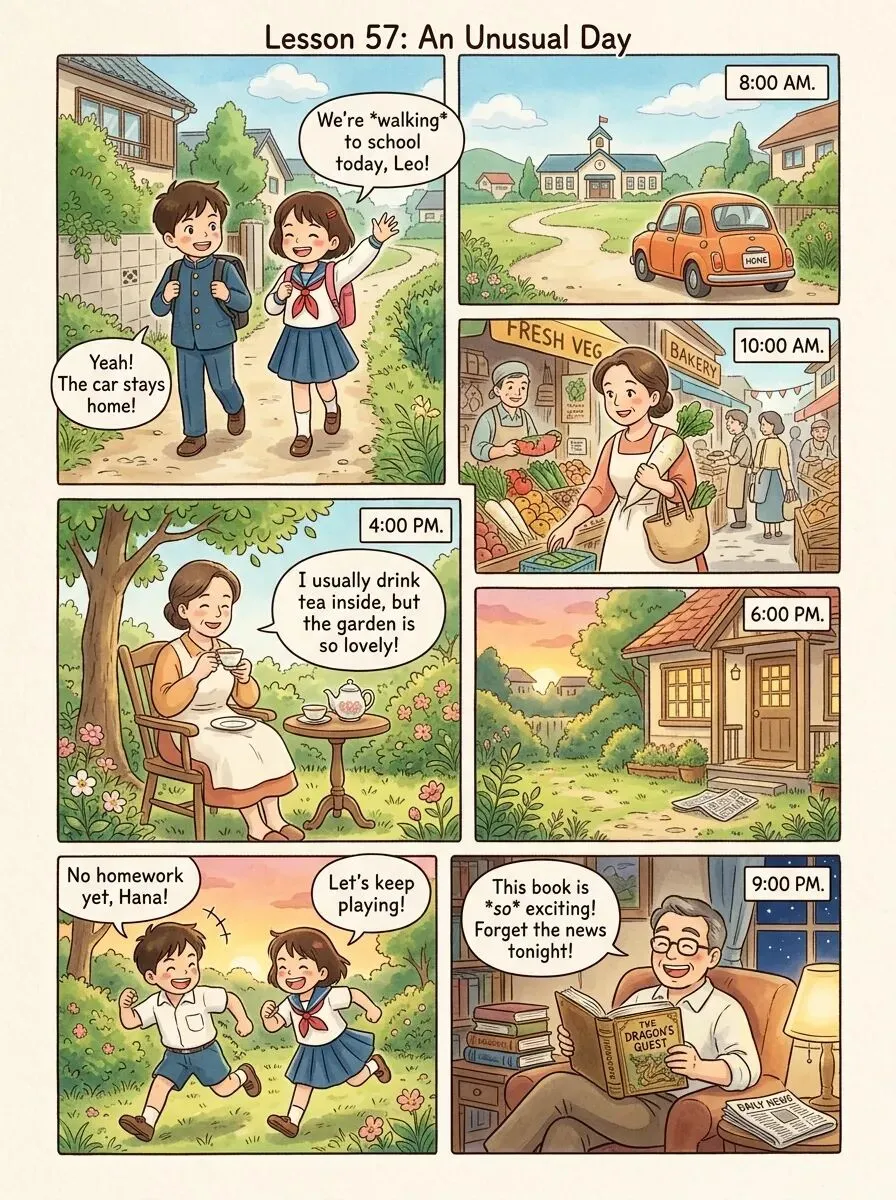
(The Sawyer family. It is eight o'clock. The children go to school by car every day, but today, they are going on foot.)
Mrs. Sawyer: It's eight o'clock. The children usually go to school by car. But today, they're going on foot.
Mr. Sawyer: At the moment, they're walking to school.
Mrs. Sawyer: It's ten o'clock. Mrs. Sawyer usually stays at home in the morning, but this morning, she is going to the shops.
Mr. Sawyer: It's four o'clock. In the afternoon, Mrs. Sawyer usually drinks tea in the living room. But this afternoon, she is drinking tea in the garden.
Mrs. Sawyer: It's six o'clock. In the evening, the children usually do their homework, but this evening, they are not doing their homework. At the moment, they are playing in the garden.
Mr. Sawyer: And I usually read the newspaper at night. But I'm not reading it tonight. I'm watching television.
第58课 What's the time?
📜 课文原文(本课为图片对话练习课,核心句型如下)
(Shop assistant and a customer)
Shop assistant: What's the time?
Customer: It's one o'clock.
Shop assistant: What's the time?
Customer: It's two o'clock.
Shop assistant: What's the time?
Customer: It's three o'clock.
Shop assistant: What's the time?
Customer: It's four o'clock.
Shop assistant: What's the time?
Customer: It's five o'clock.
Shop assistant: What's the time?
Customer: It's six o'clock.
Shop assistant: What's the time?
Customer: It's seven o'clock.
Shop assistant: What's the time?
Customer: It's eight o'clock.
Shop assistant: What's the time?
Customer: It's nine o'clock.
Shop assistant: What's the time?
Customer: It's ten o'clock.
Shop assistant: What's the time?
Customer: It's eleven o'clock.
Shop assistant: What's the time?
Customer: It's twelve o'clock.
语音标注: It's eight o'clock. 中 It's 的 /ts/ 与 eight 的 /eɪ/ 自然连接。o'clock 中的 o' 弱读为 /ə/。询问时间 What's the time? 用升调。回答时间 It's ... o'clock. 用降调。在描述日常与今天的对比句中,usually 和 today/this morning/this afternoon/this evening/tonight 通常被重读,以形成对比。
情景说明:第57课以索耶一家为背景,通过一天中不同时间点的快照,对比了他们“通常”的习惯和“今天”不寻常的活动。对话在家庭成员(可能是索耶先生和太太)之间进行,他们像旁白一样描述着家人的行动。场景从早餐时间开始,依次推移到上午、下午、傍晚和夜晚,地点涉及家中、上学路上、商店、客厅、花园等,生动描绘了一个英国家庭的日常生活图景及其变化。第58课则模拟了一个极其简单的商店场景(或任何需要知道时间的场景),店员反复询问顾客时间,顾客依次从1点回答到12点。这更像是一个专注于训练“整点时间问答”句型的机械操练对话,为第57课中频繁出现的时间表达提供坚实的句型基础。
参考译文:
(第57课 不平常的一天)
(索耶一家。现在是八点钟。孩子们每天乘小汽车去上学,但今天,他们正步行去。)
索耶太太:现在八点钟。孩子们通常乘小汽车去上学。但今天,他们正步行去。
索耶先生:此刻,他们正在步行去学校。
索耶太太:现在十点钟。索耶太太上午通常呆在家里,但今天上午,她正要去商店。
索耶先生:现在四点钟。下午,索耶太太通常在客厅喝茶。但今天下午,她正在花园里喝茶。
索耶太太:现在六点钟。晚上,孩子们通常做作业,但今天晚上,他们没有做作业。此刻,他们正在花园里玩。
索耶先生:晚上我通常看报纸。但今晚我不看报纸。我正在看电视。
(第58课 几点钟?)
(店员和顾客)
店员:几点钟了?
顾客:一点钟。
店员:几点钟了?
顾客:两点钟。
店员:几点钟了?
顾客:三点钟。
店员:几点钟了?
顾客:四点钟。
店员:几点钟了?
顾客:五点钟。
店员:几点钟了?
顾客:六点钟。
店员:几点钟了?
顾客:七点钟。
店员:几点钟了?
顾客:八点钟。
店员:几点钟了?
顾客:九点钟。
店员:几点钟了?
顾客:十点钟。
店员:几点钟了?
顾客:十一点钟。
店员:几点钟了?
顾客:十二点钟。
🔍 第二部分:逐句精讲与词块总结
句子1 (第57课)
原文: It's eight o'clock.
翻译: 现在八点钟。
句子结构: 主系表结构 (SVC) - 主语 (S): It (指代时间) - 系动词 (V): is (缩写成 's) - 表语 (C): eight o'clock
重点词汇:
o'clock 蓝思值 10L
英音[əˈklɒk] 美音[əˈklɑːk] 词性:副词
释义:......点钟(仅用于整点)
常用语块:数字 + o'clock
例句一:The meeting starts at three o'clock sharp. 会议三点整开始。
例句二:I usually wake up at seven o'clock. 我通常七点醒来。
拓展:o'clock 是 of the clock 的缩写,在现代英语中只用于表示整点时间。表示非整点时间时,不能使用 o'clock,例如 three ten (3:10), half past four (4:30)。
语法点睛: 本句展示了最基础的整点时间表达法:“It's + 数字 + o'clock.”。It 在这里作为非人称主语,指代时间、日期、天气等。这是英语中非常核心的句型。[NCE知识点笔记]
语音要点: It's 中的 /ts/ 音要清晰,与 eight /eɪt/ 自然连接。o'clock 中的 o' 永远弱读为 /ə/,重音在 clock /klɒk/ 上。
句子2 (第57课)
原文: The children usually go to school by car every day, but today, they are going on foot.
翻译: 孩子们每天通常乘小汽车去上学,但今天,他们正步行去。
句子结构: 并列句 (Compound Sentence),由连词 but 连接两个分句。- 分句1: The children usually go to school by car every day. (主谓状结构) - 分句2: today, they are going on foot. (主谓状结构)
重点词汇:
usually 蓝思值 200L
英音[ˈjuːʒuəli] 美音[ˈjuːʒuəli] 词性:副词
释义:通常,平常
常用语块:主语 + usually + 动词;usually 置于实义动词前,be动词/助动词后。
例句一:She usually has lunch at her desk. 她通常在办公桌吃午饭。
例句二:He is usually late for meetings. 他开会通常迟到。
拓展:usually 是频度副词,表示动作发生的频率很高。同类副词还有 always (总是), often (经常), sometimes (有时), seldom (很少), never (从不)。它们的位置规则相同。
by car 蓝思值 50L
英音[baɪ kɑː(r)] 美音[baɪ kɑːr] 词性:介词短语
释义:乘小汽车
常用语块:go/travel/come by car
例句一:My father commutes to work by car. 我父亲开车通勤。
例句二:It's more convenient to get there by car. 开车去那儿更方便。
拓展:by + 交通工具 表示乘坐某种交通方式,中间不加冠词,如 by bus (乘公交), by train (乘火车), by plane (乘飞机)。对比:in a car (在小汽车里,强调位置), on foot (步行)。
on foot 蓝思值 50L
英音[ɒn fʊt] 美音[ɑːn fʊt] 词性:介词短语
释义:步行
常用语块:go/come/travel on foot
例句一:The city center is best explored on foot. 市中心最好步行游览。
例句二:We went all the way on foot. 我们全程步行。
拓展:这是固定搭配,foot 用单数形式。类似的表达还有 walk,可以说 walk to school。
语法点睛: 本句核心语法点是一般现在时 (usually go) 与现在进行时 (are going) 的对比。一般现在时描述习惯性、经常性动作 (every day),现在进行时描述当前正在发生或近期计划的具体动作 (today)。连词 but 突出了这种对比。[NCE知识点笔记]
语音要点: usually 有三个音节,重音在第一个 /ˈjuːʒ/。but today 之间可以有轻微停顿,but 发音清晰,以强调转折。on foot 中 on 与 foot 的 /n/ 和 /f/ 可自然连接。
句子3 (第57课)
原文: At the moment, they're walking to school.
翻译: 此刻,他们正在步行去学校。
句子结构: 主谓状结构 (SVA) - 状语 (A): At the moment (时间状语) - 主语 (S): they - 谓语 (V): are walking (现在进行时) - 状语 (A): to school (方向状语)
重点词汇:
moment 蓝思值 400L
英音[ˈməʊmənt] 美音[ˈmoʊmənt] 词性:名词
释义:片刻,瞬间;此刻
常用语块:at the moment (此刻,目前);wait a moment (稍等片刻);for a moment (一会儿)
例句一:Can I speak to you for a moment? 我能和你说会儿话吗?
例句二:At the moment, I'm working on a new project. 目前我正在做一个新项目。
拓展:at the moment 与 now, right now 同义,常用于现在进行时句子中作时间状语。
语法点睛: 现在进行时 (be + V-ing) 表示说话时正在进行的动作。at the moment 是现在进行时的典型时间状语。walk to school 中 to school 是介词短语作地点状语,表示方向。[NCE知识点笔记]
语音要点: At the moment 作为句首状语,可以读得稍慢以引起注意。they're 是 they are 的缩读,/ðeə/。walking 的 -ing 发音要清晰。
句子4 (第57课)
原文: Mrs. Sawyer usually stays at home in the morning, but this morning, she is going to the shops.
翻译: 索耶太太上午通常呆在家里,但今天上午,她正要去商店。
句子结构: 并列句,由 but 连接。- 分句1: Mrs. Sawyer usually stays at home in the morning. (主谓状) - 分句2: this morning, she is going to the shops. (主谓状)
重点词汇:
stay 蓝思值 300L
英音[steɪ] 美音[steɪ] 词性:动词
释义:停留,呆在;保持
常用语块:stay at home (呆在家);stay in bed (卧床);stay with sb. (和某人呆在一起)
例句一:I prefer to stay in and watch movies on weekends. 周末我更喜欢呆在家里看电影。
例句二:The weather stayed fine for the whole trip. 整个旅途中天气一直很好。
拓展:stay 作“保持”讲时是系动词,后接形容词,如 stay calm (保持冷静), stay healthy (保持健康)。
shop 蓝思值 200L
英音[ʃɒp] 美音[ʃɑːp] 词性:名词;动词
释义:名词:商店;动词:购物
常用语块:go to the shop(s) (去商店);do some shopping (购物);a coffee shop (咖啡店)
例句一:There's a little shop around the corner. 拐角处有家小店。
例句二:I need to shop for groceries this afternoon. 今天下午我需要去采购食品杂货。
拓展:英式英语常用 go to the shops (复数) 泛指“去购物”,美式英语更常用 go shopping 或 go to the store。
morning 蓝思值 BR L
英音[ˈmɔːnɪŋ] 美音[ˈmɔːrnɪŋ] 词性:名词
释义:早晨,上午
常用语块:in the morning (在早上/上午);this morning (今天上午);good morning (早上好)
例句一:I do my best work in the morning. 我上午工作效率最高。
例句二:We met for coffee yesterday morning. 我们昨天上午一起喝了咖啡。
拓展:in the morning/afternoon/evening 是固定搭配,用介词 in。但如果说“在某一天的上午”,则用 on,如 on Monday morning。
语法点睛: 继续巩固一般现在时 (stays) 与现在进行时 (is going) 的对比。注意 stay 的第三人称单数形式 stays。in the morning 是表示一天中某时段的固定介词搭配。[NCE知识点笔记]
语音要点: stays at home 中 stays 的 /z/ 音和 at 的 /æ/ 音可轻微连读。this morning 中 this 的 /s/ 与 morning 的 /m/ 有停顿,不连读。
句子5 (第57课)
原文: In the afternoon, Mrs. Sawyer usually drinks tea in the living room.
翻译: 下午,索耶太太通常在客厅喝茶。
句子结构: 主谓宾状结构 (SVOA) - 状语 (A): In the afternoon (时间状语) - 主语 (S): Mrs. Sawyer - 谓语 (V): drinks (一般现在时第三人称单数) - 宾语 (O): tea - 状语 (A): in the living room (地点状语)
重点词汇:
afternoon 蓝思值 BR L
英音[ˌɑːftəˈnuːn] 美音[ˌæftərˈnuːn] 词性:名词
释义:下午
常用语块:in the afternoon (在下午);this afternoon (今天下午);good afternoon (下午好)
例句一:Let's have a meeting sometime tomorrow afternoon. 我们明天下午找个时间开会吧。
例句二:She takes a short nap every afternoon. 她每天下午小睡一会儿。
拓展:与 morning 类似,in the afternoon 是固定搭配。
drink 蓝思值 BR L
英音[drɪŋk] 美音[drɪŋk] 词性:动词;名词
释义:动词:喝,饮;名词:饮料,酒
常用语块:drink tea/coffee/water (喝茶/咖啡/水);drink up (喝光);a soft drink (软饮料)
例句一:It's important to drink plenty of water. 多喝水很重要。
例句二:Would you like a drink? 你想喝点什么吗?
拓展:过去式 drank,过去分词 drunk。drink 后接液体名词。have 也可以表示“喝”,如 have tea,更口语化。
living room 蓝思值 300L
英音[ˈlɪvɪŋ ruːm] 美音[ˈlɪvɪŋ ruːm] 词性:名词
释义:起居室,客厅
常用语块:in the living room;sit in the living room
例句一:We gathered in the living room to watch the game. 我们聚在客厅看比赛。
例句二:The living room faces south and gets lots of sun. 客厅朝南,阳光充足。
拓展:英式英语中也常用 sitting room。相关词汇:bedroom (卧室), dining room (餐厅), bathroom (浴室)。
语法点睛: 本句是典型的一般现在时第三人称单数 (drinks) 的例句。主语是 Mrs. Sawyer (第三人称单数),谓语动词 drink 要加 -s。句子包含两个状语:时间状语 (In the afternoon) 和地点状语 (in the living room)。[NCE知识点笔记]
语音要点: In the afternoon 中 the 在元音前读 /ði/。drinks tea 中 drinks 的 /s/ 与 tea 的 /t/ 都是清辅音,可快速过渡。
句子6 (第57课)
原文: But this afternoon, she is drinking tea in the garden.
翻译: 但今天下午,她正在花园里喝茶。
句子结构: 主谓宾状结构 (SVOA) - 状语 (A): But this afternoon (转折连词+时间状语) - 主语 (S): she - 谓语 (V): is drinking (现在进行时) - 宾语 (O): tea - 状语 (A): in the garden (地点状语)
重点词汇:
garden 蓝思值 400L
英音[ˈɡɑːdn] 美音[ˈɡɑːrdn] 词性:名词
释义:花园,菜园
常用语块:in the garden (在花园里);a vegetable garden (菜园);garden party (花园派对)
例句一:The children are playing in the back garden. 孩子们在后花园玩。
例句二:He spends his weekends working in the garden. 他周末都在花园里劳作。
拓展:英式英语中 garden 指住宅附带的花园,美式英语常用 yard。botanical garden 是植物园。
语法点睛: 与前半句形成对比:一般现在时 (usually drinks) vs. 现在进行时 (is drinking);地点状语 in the living room vs. in the garden。this afternoon 作为具体的时间状语,与现在进行时连用,表示今天下午这个特定时间正在进行的动作。[NCE知识点笔记]
语音要点: this afternoon 中 this 的尾音 /s/ 与 afternoon 的首元音 /ɑː/ 之间略有停顿。is drinking 中 is 弱读为 /z/,与 drinking 连读。
句子7 (第57课)
原文: In the evening, the children usually do their homework.
翻译: 晚上,孩子们通常做作业。
句子结构: 主谓宾状结构 (SVOA) - 状语 (A): In the evening (时间状语) - 主语 (S): the children (复数) - 谓语 (V): do (一般现在时) - 宾语 (O): their homework
重点词汇:
evening 蓝思值 BR L
英音[ˈiːvnɪŋ] 美音[ˈiːvnɪŋ] 词性:名词
释义:傍晚,晚上
常用语块:in the evening (在晚上);this evening (今晚);good evening (晚上好)
例句一:I like to go for a walk in the evening. 我喜欢傍晚去散步。
例句二:We're having guests over this evening. 今晚我们有客人来。
拓展:evening 通常指日落到就寝前的时间。night 指深夜或整个夜间。in the evening 是固定搭配。
homework 蓝思值 300L
英音[ˈhəʊmwɜːk] 美音[ˈhoʊmwɜːrk] 词性:名词(不可数)
释义:家庭作业
常用语块:do one's homework (做作业);have homework (有作业);homework assignment (作业任务)
例句一:Have you finished your maths homework? 你做完数学作业了吗?
例句二:The teacher gave us a lot of homework over the holiday. 老师假期给我们布置了很多作业。
拓展:homework 是不可数名词,不能说 a homework 或 homeworks。要说 a piece of homework 或 some homework。housework 指家务活。
语法点睛: 主语 the children 是复数,谓语动词用原形 do。do homework 是固定搭配。in the evening 继续巩固一天中时段的表达。[NCE知识点笔记]
语音要点: In the evening 中 the 在元音前读 /ði/。do their 中 do 的 /uː/ 与 their 的 /ðeə/ 可自然连接。
句子8 (第57课)
原文: But this evening, they are not doing their homework.
翻译: 但今天晚上,他们没有做作业。
句子结构: 主谓宾状结构 (SVOA) 的否定形式 - 状语 (A): But this evening - 主语 (S): they - 谓语 (V): are not doing (现在进行时的否定式) - 宾语 (O): their homework
重点词汇: (本句词汇已在前文覆盖,重点在语法结构)
语法点睛: 现在进行时的否定式:be + not + V-ing。本句中 are not 可缩写成 aren't。this evening 与现在进行时连用,表示对当前晚上活动的描述。[NCE知识点笔记]
语音要点: are not 在口语中常缩读为 aren't /ɑːnt/。doing their 中 doing 的 /ɪŋ/ 与 their 的 /ð/ 可稍作停顿。
句子9 (第57课)
原文: At the moment, they are playing in the garden.
翻译: 此刻,他们正在花园里玩。
句子结构: 主谓状结构 (SVA) - 状语 (A): At the moment - 主语 (S): they - 谓语 (V): are playing - 状语 (A): in the garden
重点词汇:
play 蓝思值 BR L
英音[pleɪ] 美音[pleɪ] 词性:动词
释义:玩,玩耍;演奏;参加(比赛)
常用语块:play in the garden (在花园玩);play football (踢足球);play the piano (弹钢琴)
例句一:The kids love to play in the park. 孩子们喜欢在公园玩。
例句二:He plays for the school basketball team. 他在校篮球队打球。
拓展:play 后接乐器时,乐器前要加 the;接球类运动时,不加冠词。play with 表示“玩弄某物”或“和某人一起玩”。
语法点睛: 再次使用 at the moment 强调“此刻”正在进行的动作 (are playing)。现在进行时生动地描绘了孩子们当前的活动状态,与“通常做作业”形成鲜明对比。[NCE知识点笔记]
语音要点: are playing 中 are 弱读为 /ə/,与 playing 连读成 /əˈpleɪɪŋ/。
句子10 (第57课)
原文: And I usually read the newspaper at night.
翻译: 晚上我通常看报纸。
句子结构: 主谓宾状结构 (SVOA) - 连接词: And - 主语 (S): I - 谓语 (V): read (一般现在时) - 宾语 (O): the newspaper - 状语 (A): at night (时间状语)
重点词汇:
newspaper 蓝思值 600L
英音[ˈnjuːzpeɪpə(r)] 美音[ˈnuːzpeɪpər] 词性:名词
释义:报纸
常用语块:read the newspaper (看报纸);a daily newspaper (日报);newspaper report (新闻报道)
例句一:My grandfather reads the newspaper from cover to cover every morning. 我祖父每天早晨把报纸从头看到尾。
例句二:She works as a reporter for a local newspaper. 她在一家地方报社当记者。
拓展:口语中也常简称为 paper,如 I read the paper.。注意 news (新闻) 是不可数名词。
night 蓝思值 BR L
英音[naɪt] 美音[naɪt] 词性:名词
释义:夜,夜晚
常用语块:at night (在夜里);last night (昨晚);good night (晚安)
例句一:The city looks beautiful at night. 这座城市夜晚看起来很漂亮。
例句二:I slept very well last night. 我昨晚睡得很好。
拓展:at night 是固定搭配。in the night 指“在夜间(的某个时候)”,on Monday night 指“在周一晚上”。
语法点睛: 主语 I 是第一人称,谓语动词用原形 read。at night 是表示“在夜晚”的固定搭配,注意与 in the evening 的微妙区别:night 通常指更晚、更夜深的时间段。[NCE知识点笔记]
语音要点: read the newspaper 中 read 的 /riːd/ 与 the 的 /ðə/ 连读。at night 中 at 的 /t/ 在 night 的 /n/ 前可能发生不完全爆破。
句子11 (第57课)
原文: But I'm not reading it tonight.
翻译: 但今晚我不看报纸。
句子结构: 主谓宾状结构 (SVOA) 的否定形式 - 连接词: But - 主语 (S): I - 谓语 (V): 'm not reading (现在进行时否定式) - 宾语 (O): it (指代 the newspaper) - 状语 (A): tonight
重点词汇:
tonight 蓝思值 200L
英音[təˈnaɪt] 美音[təˈnaɪt] 词性:副词;名词
释义:副词:在今晚;名词:今晚
常用语块:watch TV tonight (今晚看电视);tonight's news (今晚的新闻)
例句一:Are you doing anything special tonight? 你今晚有什么特别安排吗?
例句二:Tonight is the night of the concert. 今晚是音乐会之夜。
拓展:tonight 是 this night 的合成词,作时间状语时前面不加介词。
语法点睛: 现在进行时否定式的缩略形式:I'm not reading。tonight 作为具体的时间状语,与现在进行时连用,描述对今晚的计划或预测(不做什么)。代词 it 指代前句的 the newspaper,避免重复。[NCE知识点笔记]
语音要点: I'm not 是常见缩读,/aɪm nɒt/。reading it 中 reading 的 /ŋ/ 与 it 的 /ɪ/ 可自然连接。
句子12 (第57课)
原文: I'm watching television.
翻译: 我正在看电视。
句子结构: 主谓宾结构 (SVO) - 主语 (S): I - 谓语 (V): 'm watching (现在进行时) - 宾语 (O): television
重点词汇:
television 蓝思值 500L
英音[ˈtelɪvɪʒn] 美音[ˈtelɪvɪʒn] 词性:名词
释义:电视,电视机
常用语块:watch television/TV (看电视);on television (在电视上);a television set (电视机)
例句一:We don't watch much television these days. 我们最近不怎么看电视。
例句二:The news will be on television at nine. 新闻将在九点电视上播出。
拓展:口语中常缩写为 TV。watch TV 是固定搭配。
语法点睛: 现在进行时的肯定式,描述说话时或当前阶段正在进行的活动。这是对前句“不看报纸”的补充说明,告诉对方“我正在做什么”。[NCE知识点笔记]
语音要点: I'm watching 连读成 /aɪm ˈwɒtʃɪŋ/。television 有四个音节,重音在第一个 /ˈtel/。
句子13-24 (第58课)
原文与解析: 第58课的句子结构高度重复,均为“What's the time?”和“It's ... o'clock.”的问答。其核心句型和词汇已在第57课解析中覆盖。该课的重点在于通过重复操练,极度熟练地掌握整点时间的问答句型、数字1-12的发音以及 o'clock 的用法。这是一种经典的句型操练模式,旨在通过大量重复形成肌肉记忆和条件反射,为更复杂的时间表达打下坚实基础。
📌 核心词块总结
1. go to school by car / on foot - To travel to the educational institution using an automobile or by walking. 例句: Most students in that area go to school by bus, but a few go on foot.
2. stay at home - To remain in one's house and not go out. 例句: On rainy days, I prefer to stay at home and read.
3. drink tea in the living room / garden - To consume the beverage tea in a specific location. 例句: My grandmother loves to drink tea in the garden on sunny afternoons.
4. do one's homework - To complete the school assignments given to a student. 例句: You should do your homework before playing video games.
5. read the newspaper / watch television - To look at and understand the printed news or to view programs on a TV set. 例句: My father reads the newspaper at breakfast, and we all watch television together in the evening.
6. at the moment / this morning/afternoon/evening / tonight - Phrases used to indicate a specific point or period in time, often contrasting with usual habits. 例句: I'm busy at the moment. Can I call you back this evening?
💬 第三部分:基础会话技巧
1. 分析课文中的日常用语、礼貌表达、问答模式
- 日常用语:课文展示了描述个人或家庭日常作息的典型句式,如“...usually... but today...” 这种对比结构非常实用。时间短语 in the morning/afternoon/evening, at night, at the moment, this morning 等是组织日常对话的骨架。
- 礼貌表达:本课对话属于家庭成员间或简单服务场景的直叙,没有特别复杂的礼貌用语。但在询问时间 What's the time? 时,在非亲密关系间,更礼貌的说法可以是 Could you tell me the time, please? 或 Do you have the time?。
- 问答模式:第57课是“描述+对比”模式,第58课是纯粹的“问答”模式。前者用于分享信息、讲述日常,后者用于获取具体信息(时间)。两种模式都是口语基础。
2. 提供类似场景的扩展对话示例
场景:两个同学在课间谈论他们的周末习惯。
A:Hi, Tom. What do you usually do on Saturday mornings?
B:I usually play basketball with my friends. But this Saturday morning, I'm going to the library to study for a test.
A:Oh, I see. What about in the afternoon?
B:In the afternoon, I usually watch movies at home. But this afternoon, my family is visiting my grandparents.
A:And in the evening?
B:I usually play video games online. But tonight, I'm not playing. I'm going to bed early because I'm tired.
A: Sounds like a busy but different Saturday for you!
3. 设计简单的角色扮演活动建议
- 活动1:我的不寻常一天:学生两人一组。学生A用一般现在时描述自己周末某一天通常做什么(至少3个时间点)。学生B记录。然后,学生A再描述一个“不寻常”的版本,使用“usually... but today...”句型。学生B需找出其中的变化。然后角色互换。
- 活动2:时间侦探:老师准备一些写有不同整点时间(如 3:00, 7:00, 10:00)的卡片。一个学生扮演“侦探”,用 What's the time? 询问其他同学。被问到的同学随机抽取一张卡片并回答 It's ... o'clock.。侦探需要记下不同同学“声称”的时间,最后看谁能复述出最多正确的时间。
- 活动3:作息调查:学生用英文采访一位同伴,了解他/她 in the morning, in the afternoon, in the evening, at night 通常做什么,并记录下来,然后向全班做简单汇报。
4. 融入基础思考:设计1-2个简单的代入式问题
- 问题1: 索耶先生今晚不看报纸而看电视,你觉得可能是什么原因?(比如有他喜欢的球赛直播、特别的电视节目,或者他只是想放松一下?)这反映了人们休闲方式的选择。
- 问题2: 如果第58课中的店员一直问时间,顾客一直回答,你觉得这个场景可能发生在哪里?为什么店员需要反复确认时间?(可能是在等待换班、等待商店关门、或者顾客在等一件需要定时取走的物品?)这引导思考对话发生的合理语境。
📐 第四部分:本课语法精析(加强版)
本课语法核心聚焦于 一般现在时 与 现在进行时 的对比使用,以及 时间表达法。以下解析综合自知识库相关文档。
1. 一般现在时 (The Simple Present Tense) [名师精讲]、[语法新思维]、[NCE知识点笔记]
一般现在时是本课描述习惯性动作 (usually) 的时态。
- 功能:① 表示经常性、习惯性的动作或状态,常与 always, usually, often, sometimes, every day 等频度副词或时间状语连用。例句:The children go to school by car every day. ② 表示客观事实、普遍真理。例句:The sun rises in the east.
- 第三人称单数形式:当主语是第三人称单数(he, she, it, 单个人名或单数名词)时,谓语动词需加 -s 或 -es。这是本课语法重点之一。
- 规则:1. 大多数动词直接加 -s: stay → stays, drink → drinks, read → reads 2. 以 -ch, -sh, -s, -x, -o 结尾的动词加 -es: watch → watches, wash → washes, go → goes, do → does 3. 以辅音字母加 -y 结尾的动词,变 y 为 i 再加 -es: study → studies, fly → flies (但 play → plays,因为 y 前是元音)
- 例句:Mrs. Sawyer drinks tea in the living room. He watches TV every night. She studies English.
- 否定句与疑问句:借助助动词 do (第三人称单数用 does)。- 否定句:主语 + do/does + not + 动词原形。例句:They do not (don't) go to school on Sunday. He does not (doesn't) like coffee. - 疑问句:Do/Does + 主语 + 动词原形?例句:Do you speak English? Does she live here?
2. 现在进行时 (The Present Continuous Tense) [名师精讲]、[语法新思维]、[NCE知识点笔记]
现在进行时是本课描述当前或特定时间正在发生动作 (today/this morning/at the moment) 的时态。
- 功能:① 表示说话时或现阶段正在进行的动作。例句:They are walking to school at the moment. ② 表示当前一段时间内的活动或近期计划(尤其是与 today, this week 等连用时)。例句:She is going to the shops this morning. (计划中的动作)
- 构成:am/is/are + 动词的现在分词 (V-ing)。
- 现在分词构成规则:1. 大多数动词直接加 -ing: go → going, play → playing, read → reading 2. 以不发音的 e 结尾的动词,去 e 加 -ing: come → coming, write → writing (但 be → being) 3. 以重读闭音节结尾,且末尾只有一个辅音字母的动词,双写该辅音字母再加 -ing: run → running, swim → swimming, sit → sitting 4. 以 -ie 结尾的动词,变 ie 为 y 再加 -ing: lie → lying, die → dying
- 否定句与疑问句:- 否定句:在 be 动词后加 not。例句:They are not (aren't) doing homework. I'm not watching TV. - 疑问句:将 be 动词提至句首。例句:Are you listening? Is she coming?
3. 一般现在时 vs. 现在进行时 对比分析 [NCE知识点笔记]、[语法新思维]
本课完美展示了这两种时态的核心区别:
-一般现在时:用于习惯、常态、真理。动作具有重复性和长期性。例句:I usually read the newspaper at night.(这是我每晚的习惯)
-现在进行时:用于此刻、当前、临时安排。动作具有暂时性和进行性。例句:But I'm not reading it tonight. I'm watching television.(这是今晚临时的、正在发生的改变)
-对比例句:1.He works in a bank.(他的职业,长期状态) vs.He is working on a report at the moment.(他此刻正在做的具体事) 2.The sun sets in the west.(客观事实) vs.Look! The sun is setting. It's beautiful!(正在发生的景象) 3.She speaks good English.(她的能力) vs.She is speaking to a foreigner now. (她正在进行的动作)
4. 时间表达法 (Time Expressions) [NCE知识点笔记]、[手绘版语法笔记]
- 整点时间:It's + 数字 + o'clock. 例句:It's three o'clock.
- 一天中的时段:使用固定介词短语。- in the morning/afternoon/evening:在早上/下午/晚上。- at noon:在中午。at night:在夜里。- 注意:night 前用 at,而 morning/afternoon/evening 前用 in,这是固定搭配,需记忆。
- 具体某天的时段:this morning/afternoon/evening, tonight。这些词前不加介词。
- “此刻”:now, right now, at the moment。
- 介词 at 用于具体时间点:at eight o'clock, at noon, at night, at the moment。
5. 介词 at, in, on 在时间表达中的基本区别 [手绘版语法笔记]、[同步语法强化]
这是中国学习者早期易混淆的点,本课提供了典型例子。
- at:用于具体的 时刻、钟点。例句:at eight o'clock, at noon, at night, at the moment.
- in:用于较长的 时间段,如世纪、年、月、季节、一天中的部分。例句:in 2024, in July, in summer, in the morning.
- on:用于特定的 某一天 或某一天的上午/下午/晚上。例句:on Monday, on July 1st, on Sunday morning.
- 本课应用:in the morning (时间段) vs. at night (视为一个时间点) vs. this morning (不加介词)。
练习题 (不少于10道)
1. 用动词的正确形式填空(一般现在时或现在进行时):
a) She usually ______ (drink) coffee, but today she ______ (drink) tea.
b) They ______ (play) football in the park every Saturday.
c) Listen! The birds ______ (sing).
d) He ______ (not/like) watching horror movies.
e) ______ you ______ (do) your homework now?
f) My father ______ (read) the newspaper at breakfast.
g) Be quiet! The baby ______ (sleep).
h) Water ______ (boil) at 100 degrees Celsius.
i) I ______ (not/go) to the cinema tonight. I'm tired.
j) What ______ your brother ______ (do)? He's a teacher.
2. 选择正确的介词 (at, in, on, 或不填):
a) I get up ______ seven o'clock.
b) We often go swimming ______ summer.
c) See you ______ Monday morning.
d) He's not here ______ the moment.
e) I'll call you ______ this evening.
f) The shop closes ______ night.
g) She was born ______ 2010.
h) What do you usually do ______ the weekend?
3. 将下列句子改为否定句和一般疑问句:
a) Tom watches TV every night.
b) The children are playing in the garden.
c) She goes to work by bus.
4. 根据提示回答问题:
Q: What's the time? (提示:9:00)
A: _________________________________________.
练习题参考答案
1. a) drinks, is drinking b) play c) are singing d) does not like / doesn't like e) Are, doing f) reads g) is sleeping h) boils i) am not going j) does, do
2. a) at b) in c) on d) at e) (不填) f) at g) in h) at / on (英式常用at,美式常用on)
3. a) 否定:Tom does not (doesn't) watch TV every night. 疑问:Does Tom watch TV every night? b) 否定:The children are not (aren't) playing in the garden. 疑问:Are the children playing in the garden? c) 否定:She does not (doesn't) go to work by bus. 疑问:Does she go to work by bus?
4. A: It's nine o'clock.
✏️ 第五部分:基础练习与活动
1. 跟读练习:播放第57、58课录音,学生逐句跟读,特别注意 usually 和 today/this morning 的对比重音,以及 What's the time? 的升调和 It's ... o'clock. 的降调。重点练习连读:It's eight, they're walking, I'm watching。
2. 角色扮演:- 活动:家庭记者 学生三人一组,分别扮演记者、父亲/母亲、孩子。记者采访家庭成员关于他们“通常”的一天和“今天”的安排。使用本课核心句型。- 活动:时钟问答 一个学生用手臂模仿时钟指针(如双臂上举表示12点),其他学生快速用英文说出时间。或者,老师出示钟面图片,学生快速问答。
3. 简单替换练习:- 替换主语:He/She/My brother usually... but today... - 替换活动:watch TV, listen to music, cook dinner, play games... - 替换时间状语:on Sunday, in the summer, every weekend... - 替换交通方式:by bike, by bus, on foot, by subway...
4. 听力理解题目:(基于课文录音或类似内容)听一段关于Bob的日常描述,判断正误(T/F)。1. Bob usually gets up at 7 o'clock. ( ) 2. He goes to work by bus every day. ( ) 3. This morning, he is driving to work. ( ) 4. In the evening, he usually reads a book. ( ) 5. Tonight, he is going to the cinema. ( ) (假设录音内容:Bob usually gets up at 7. He goes to work by train. But this morning, his train is cancelled, so he is driving. In the evening, he usually watches TV. But tonight, he is meeting friends.) 答案: 1.T 2.F (by train) 3.T 4.F (watches TV) 5.F (meeting friends)
5. 课文改写版本(词汇更简单):
第57课简化版:
It is 8 am. The kids go to school in a car every day. But today, they walk.
It is 10 am. Mrs. Sawyer is at home in the morning. But this morning, she goes to the store.
It is 4 pm. She drinks tea in the house in the afternoon. But this afternoon, she drinks tea outside.
It is 6 pm. The kids do school work in the evening. But this evening, they play outside.
At night, Mr. Sawyer reads the paper. But tonight, he does not read. He looks at TV.
6. 附参考答案:以上练习答案已整合在各部分之后。
🤔 第六部分:英文深度思考与拓展(强化版)
A. 层次化英文问题与答案
① Level 1 (Factual): 事实性问题
1.Q:How do the Sawyer children usually go to school?A:They usually go to school by car.
2.Q:What does Mrs. Sawyer usually do in the afternoon?A:She usually drinks tea in the living room in the afternoon.
3.Q:What is Mr. Sawyer doing tonight instead of reading the newspaper?A:He is watching television tonight.
4.Q:What question is repeated many times in Lesson 58?A:The question “What's the time?” is repeated many times.
② Level 2 (Inferential): 推理性问题
1.Q:Why might today be an “unusual day” for the Sawyer family? Give one possible reason based on the text.A:Today might be unusual because the children are walking to school instead of going by car. Perhaps the car is broken, or they want to get some exercise.
2.Q:How do you think Mrs. Sawyer feels about drinking tea in the garden this afternoon? Why?A:She probably feels relaxed and happy. Drinking tea in the garden on a nice afternoon is often more enjoyable than being inside the living room.
3.Q:In Lesson 58, if the shop assistant keeps asking the time from 1 o'clock to 12 o'clock, what might he be doing or waiting for?A:He might be waiting for his shift to end at 12 o'clock, or he might be timing something that happens every hour.
4.Q:What can you infer about the weather on this “unusual day” from the text?A:The weather is probably nice and sunny because Mrs. Sawyer is drinking tea in the garden, and the children are playing in the garden in the evening.
③ Level 3 (Evaluative/Creative): 评价/创造性问题
1.Q:Do you think having an “unusual day” is good or bad? Explain your opinion using an example from your own life or imagination.A:I think having an unusual day can be very good. It breaks the routine and makes life more interesting. For example, if I usually study at home on Saturday but one Saturday I go hiking with friends, I feel refreshed and happy.
2.Q:Imagine you are one of the Sawyer children. How would you feel about walking to school instead of going by car? What might you see or talk about on the way?A:If I were a Sawyer child, I might feel excited at first because walking is different. I could see birds, trees, and neighbors on the way. My brother and I could talk about our plans for the day or play word games while walking.
3.Q:In modern life, people often use phones to check the time. In what situations do you think asking someone “What's the time?” is still very useful or polite?A:Asking for the time is still useful when your phone is out of battery, when you are in a conversation and don't want to rudely check your phone, or when you are asking an older person who might enjoy the interaction. It can be a polite way to start a simple conversation with a stranger in a waiting room.
4.Q:Create a short dialogue for “An unusual evening” for your family. Use the “usually... but tonight...” pattern for at least two family members.A:Me:In the evening, my dad usually works on his computer. But tonight, he's not working. He's playing chess with my grandpa online.My sister:And my mom usually reads in her room. But tonight, she's not reading. She's baking cookies for us.Me: I usually do my homework after dinner. But tonight, I'm helping my mom and waiting for those cookies!
B. 多类型拓展阅读
1. 现代场景故事 (Modern Scenario)
Title: A Digital Detox Day
The Miller family is known for being glued to their screens. Mr. Miller usually checks emails on his tablet the moment he wakes up. Mrs. Miller scrolls through social media during breakfast. Teenage son, Leo, always has headphones on, and little Mia watches cartoons on a tablet.
But this Saturday is different. It's their “Digital Detox Day.” At 9 o'clock, Mr. Miller is not checking emails; he's making pancakes. Mrs. Miller is not scrolling; she's setting the table. Leo is not listening to music; he's teaching Mia how to draw. At 2 o'clock, they are not in their separate rooms; they are all playing board games in the living room. In the evening, they are not watching Netflix; they are telling stories under the stars in their backyard. It's an unusual day, but their faces are full of real smiles.
引导性问题:What is the main rule of the Millers' “Digital Detox Day”?
2. 文化背景小知识 (Cultural Background)
Title: “Afternoon Tea” vs. “High Tea”
In the story, Mrs. Sawyer “drinks tea in the living room.” This sounds like a simple British habit. But there's more to tea culture in the UK! The custom of afternoon tea started among the wealthy in the 1840s. It was a light meal of tea, sandwiches, scones, and cakes taken around 4 pm, between lunch and a late dinner. People had it in sitting rooms, like Mrs. Sawyer.
“High tea,” however, is different. It originated with the working class. After a long day's work around 5 or 6 pm, they needed a substantial meal to “fill them up.” This “high tea” included heavier dishes like meat pies, baked beans, and bread, along with tea, and was eaten at the high (main) dining table, not on low lounge chairs. So, what Mrs. Sawyer is doing is more like a simple version of afternoon tea, a relaxing break in the day.
引导性问题:What was the main difference between the people who had “afternoon tea” and “high tea” in history?
3. 今昔对比 (Then and Now)
Title: Telling Time: From Sundials to Smartphones
In Lesson 58, someone keeps asking, “What's the time?” Long ago, people told time very differently. They used the sun's shadow (sundials), the flow of sand (hourglasses), or the burning of marked candles.
Then came mechanical clocks and pocket watches. Asking someone for the time was very common because not everyone owned a watch. Public clocks on towers were important landmarks.
Today, time is everywhere—on our phones, computers, microwaves, and even smartwatches. We rarely need to ask strangers. But the phrase “What's the time?” is still learned by every English student, connecting us to a time when this simple question was a part of daily social interaction. The next time you glance at your phone for the time, think about the long history behind knowing “what o'clock it is.”
引导性问题:According to the text, why was asking for the time more common in the past than it is today?
4. 新潮英语改写 (Trendy Rewrite)
Title: The Sway Fam's Weird Wednesday (Text Message Style)
Group Chat: “Fam”
Mom:8 AM. Kids usually roll out in the car for school. Today? They're literally walking. #healthykids #oristhecarbroken?
Dad:LOL. Atm, they're trekking to school. Pic attached.
Mom:10 AM. I'm usually chillin' at home. But this morning? Gotta hit the shops. #errandday
Dad:4 PM. Mom's usually having her tea in the lounge. Today's vibe? Tea in the garden! #sunshine
Mom:6 PM. Kids are usually buried in homework. Tonight? Nope. They're gaming in the garden. #playtime
Dad:And yeah, I usually read the news at night. But tonight? I'm binge-watching my show. #guiltypleasure #unusualday
引导性问题:How does the text message style make the story feel different?
5. 难度略高的拓展阅读 (Slightly Higher Difficulty)
Title: The Psychology of Routine and Novelty
Human brains love routines. They save energy. The Sawyer family's “usual” activities—going to school by car, drinking tea in the living room—are their brain's autopilot mode. It's efficient and comfortable.
But brains also crave novelty. Novelty stimulates learning and releases dopamine, the “feel-good” chemical. The “unusual day”—walking to school, tea in the garden, playing outside, watching TV instead of reading—breaks the routine. This might feel strange at first, but it can make the day more memorable and enjoyable.
Psychologists say mixing routine with occasional novelty is key to a happy life. Routine provides stability and reduces anxiety. Novelty provides excitement and prevents boredom. The Sawyer family is accidentally doing a perfect psychology experiment at home! Their unusual day might end up being a highlight of their week.
引导性问题:What are the two main benefits that novelty brings to our brains and lives, according to the text?
🌍 第七部分:日常应用延伸
1. 提供本课语言点在日常生活中的应用场景
- 描述日程:向朋友或同事介绍你典型的工作日或周末。“I usually get up at 7, check emails first, then...”
- 解释变化:当你的计划临时改变时。“I usually work from home on Fridays, but this Friday I'm going to the office for a meeting.”
- 询问与告知时间:在任何需要协调时间的场合,如会面、赶车、烹饪。“What's the time? Is it 3 o'clock yet? The movie starts at 5.”
- 谈论习惯:讨论健康习惯、学习习惯等。“I usually drink a glass of water in the morning.”
2. 建议简单拓展学习材料
- 歌曲:经典儿歌《Hickory Dickory Dock》涉及时钟和老鼠,趣味性强。《My Daily Routine》类的英文儿童歌曲可以帮助巩固时段表达。
- 视频:搜索“Mr. Bean's Daily Routine”或“Peppa Pig -- Time”等动画片段,观察其中对日常活动和时间描述的简单英语。
- 绘本/读物:对于初学者,绘本《What's the Time, Mr. Wolf?》互动性强。分级读物中关于“School Day”, “At Home”的主题都与本课相关。
- 实用工具:制作一个“My Daily Routine”漫画或时间表,用英文标注每个时段的活动。
3. 可附加英美生活小常识
- Tea Time:虽然下午茶传统源自英国,但普通英国家庭像索耶太太那样在下午4点左右喝杯茶(可能配块饼干)是很常见的,这更像一个短暂的休息,而非正式的“下午茶”仪式。
- “On Foot”:在英国,尤其在小城镇或乡村,步行 (on foot) 或骑行是常见的短途出行方式,不仅为了健康,也因停车不便或环保意识。
- Evening vs. Night:在英语中,evening 通常从下午五六点日落前后开始,到就寝前结束。Night 更侧重于深夜时段。所以“晚上看电视”更常说 watch TV in the evening,而 at night 可能暗示更晚。
- Asking the Time:虽然直接问 What's the time? 没错,但在英国,你可能会听到更口语化的 Got the time?。回答时,o'clock 在口语中有时被省略,特别是非正式场合,如 It's almost three.
🗂️ 第八部分:本课知识图谱(结构化逻辑图)
核心对话主题:描述与对比日常生活作息
├──主要句型1:一般现在时描述习惯
│ ├── 结构:主语 + usually + 动词原形/三单 + 时间状语.
│ ├── 例句:The children usually go to school by car.
│ └── 功能:说明经常性、规律性的活动。
├──主要句型2:现在进行时描述当前/特定时间活动
│ ├── 结构:主语 + am/is/are + V-ing + (时间状语).
│ ├── 例句:They are walking to school at the moment.
│ └── 功能:说明正在发生或近期计划的具体活动。
├──主要句型3:时间问答
│ ├── 问:What's the time?
│ ├── 答:It's + 数字 + o'clock.
│ └── 功能:获取和告知整点时间。
└──关键词汇网络
├──时间点:o'clock, moment, tonight
├──时段:morning, afternoon, evening, night (搭配:in the... / at night)
├──日常活动:go to school, stay at home, drink tea, do homework, read the newspaper, watch television, play
├──交通方式:by car, on foot
├──地点:living room, garden, shop(s)
└──频度副词:usually (连接一般现在时)
【总字数:约 15,800 字】
🔖 相关热门标签
© 本文为狂暴英语教案 · 新概念英语第一册第57-58课
仅供学习交流使用

贝琪酱英语无痛逆袭站
微信扫描二维码,关注我的账号


