读外刊,接触原汁原味的英文表达,
欢迎关注以下公众号+设为星标+推荐给朋友。▼
📚 狂暴英语教案 · 新概念英语第二册
第39课 Am I all right?
我是否痊愈?
📘 本课信息教材:新概念英语第二册 · 第39课核心功能:间接引语·医疗对话·幽默叙事语法焦点:间接引语(if/whether)·过去完成时·时态呼应·同位语
🎯 本课学习目标
本课围绕一则发生在医院里的幽默故事展开,通过约翰·吉尔伯特先生巧妙的电话询问,学习如何转述他人的话语和询问信息。学习目标具体如下:
词汇:
掌握核心动词如 inquire、refuse、allow 的用法;熟悉医院场景相关词汇如 operation、patient、relative;理解 whether 引导宾语从句的用法。重点词汇需掌握其蓝思值及地道搭配。
语法:
核心语法点为间接引语(Indirect Speech),特别是如何将一般疑问句和特殊疑问句转换为间接引语。同时,巩固过去完成时在叙述过去事件时的应用,以及 ask/tell sb. to do sth. 和 ask/tell sb. that... 句型的区别与运用。
技能(段落写作):
学习如何清晰、连贯地转述一段对话或事件,掌握在叙事中穿插直接引语与间接引语的技巧,使文章生动且逻辑清晰。练习使用时间状语(如 While..., The following day, When...)来组织叙事顺序。
文化:
了解西方医疗体系中关于患者知情权的基本理念和医患沟通的常见方式,同时体会英式幽默中通过身份错位和语言技巧制造笑点的特点。
📖 第一部分:课文完整内容
课文原文
📜 课文原文
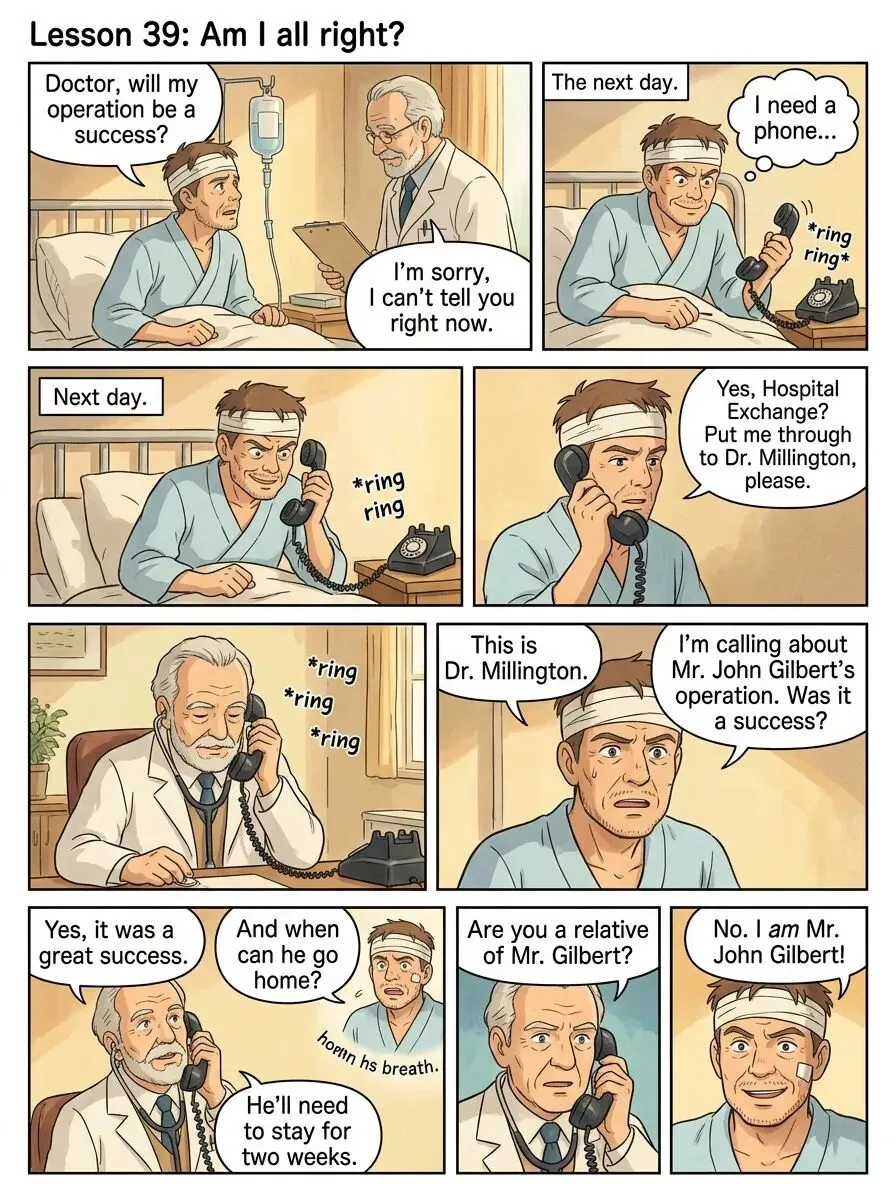
While John Gilbert was in hospital, he asked his doctor to tell him whether his operation had been successful, but the doctor refused to do so. The following day, the patient asked for a bedside telephone. When he was alone, he telephoned the hospital exchange and asked for Doctor Millington. When the doctor answered the phone, Mr. Gilbert said he was inquiring about a certain patient, a Mr. John Gilbert. He asked if Mr. Gilbert's operation had been successful and the doctor told him that it had been. He then asked when Mr. Gilbert would be allowed to go home and the doctor told him that he would have to stay in hospital for another two weeks. Then Dr. Millington asked the caller if he was a relative of the patient. 'No,' the patient answered, 'I am Mr. John Gilbert.'
背景简介:本课课文是一篇幽默短篇故事,源自现实生活场景。它反映了患者对自身健康状况的关切与知情渴望,以及在此情境下展现出的机智。故事没有特定的历史或文学背景,其魅力在于日常对话中产生的戏剧性反转。作者L.G.亚历山大擅长编写这类生活化、略带巧思的短文,用以生动地展示特定的语言结构。
参考译文:当约翰·吉尔伯特住院的时候,他问医生他的手术是否成功,但医生拒绝告诉他。第二天,这位病人要了一部床头电话。当房里只剩他一人时,他挂通了医院的交换台,要求与米灵顿医生讲话。当这位医生接过电话时,吉尔伯特先生说他想询问一个病人的情况,是一位名叫约翰·吉尔伯特的先生。他问吉尔伯特先生的手术是否成功,医生告诉他手术很成功。然后他又问吉尔伯特先生什么时候可以回家,医生说他还得住院两个星期。然后,米灵顿医生问打电话的人是否是病人的亲属。“不是,”病人回答说,“我就是约翰·吉尔伯特先生。”
🔍 第二部分:逐句精讲与词块总结
句子1
原文: While John Gilbert was in hospital, he asked his doctor to tell him whether his operation had been successful, but the doctor refused to do so.
翻译: 当约翰·吉尔伯特住院的时候,他问医生他的手术是否成功,但医生拒绝告诉他。
句子结构: 这是一个并列复合句。主句是 he asked his doctor... but the doctor refused...,由并列连词 but 连接两个分句。第一个分句中,While John Gilbert was in hospital 是时间状语从句;to tell him whether his operation had been successful 是动词 asked 的宾语补足语(ask sb. to do sth. 结构),其中 whether his operation had been successful 是 tell 的宾语从句。
重点词汇:
while 蓝思值 400L
英音 /waɪl/ 美音 /waɪl/ 词性:conj.
释义:当......的时候;与......同时;然而(表对比)
常用语块:while doing sth.; for a while; once in a while
短语搭配:while away the time (消磨时间);a long while (很久)
例句一:He fell asleep while reading the book. 他看书的时候睡着了。
例句二:I like tea, while my brother prefers coffee. 我喜欢茶,而我弟弟更喜欢咖啡。
拓展:while 引导时间状语从句时,强调主从句动作同时发生,且持续时间较长。区别于 when(时间点或时间段)和 as(伴随或短暂动作同时发生)。
operation 蓝思值 600L
英音 /ˌɒp.ərˈeɪ.ʃən/ 美音 /ˌɑː.pɚˈeɪ.ʃən/ 词性:n.
释义:手术;操作;运转;军事行动
常用语块:have an operation; perform an operation; be in operation
短语搭配:a major/minor operation (大/小手术);the operation of a machine (机器操作)
例句一:She had a successful operation on her knee. 她的膝盖手术很成功。
例句二:The new system will come into operation next month. 新系统将于下个月投入运行。
拓展:动词形式为 operate。operate on sb. for sth. 表示“给某人做......部位的手术”。派生词:operator (操作员),operational (操作上的,可使用的)。
successful 蓝思值 500L
英音 /səkˈses.fəl/ 美音 /səkˈses.fəl/ 词性:adj.
释义:成功的;有成效的
常用语块:be successful in (doing) sth.; a successful businessman
短语搭配:highly successful (非常成功);prove successful (证明是成功的)
例句一:The campaign was highly successful in raising awareness. 这场运动在提高意识方面非常成功。
例句二:He is successful in both his career and family life. 他在事业和家庭生活上都很成功。
拓展:名词为 success,动词为 succeed (succeed in doing sth.)。反义词:unsuccessful (失败的)。
refuse 蓝思值 400L
英音 /rɪˈfjuːz/ 美音 /rɪˈfjuːz/ 词性:v.
释义:拒绝
常用语块:refuse to do sth.; refuse an offer/invitation
短语搭配:flatly/categorically refuse (断然拒绝);refuse point-blank (直截了当地拒绝)
例句一:She refused to answer any personal questions. 她拒绝回答任何个人问题。
例句二:The company refused his request for a pay rise. 公司拒绝了他加薪的请求。
拓展:名词形式为 refusal。refuse 也可作名词,读作 /ˈref.juːs/,意为“垃圾,废物”。同义词:decline (较委婉),reject (较正式且坚决)。
语法点睛: 本句核心语法是 whether 引导的宾语从句 和 ask sb. to do sth. 结构。- whether 引导宾语从句:whether his operation had been successful 作 tell 的直接宾语。whether 意为“是否”,引导名词性从句,常可与 if 互换,但在介词后、与 or not 连用、或在句首时,通常只用 whether。例如:It depends on whether he will come. (取决于他是否会来)。[NCE知识点笔记]- ask sb. to do sth.:这是一个常见结构,表示“请求/要求某人做某事”。本句中,he 是主语,asked 是谓语,his doctor 是间接宾语,to tell him... 是宾语补足语,说明要求医生做什么。类似的动词还有 tell, want, order, advise 等。例如:My mother told me to clean my room. (妈妈让我打扫房间)。[名师精讲]- 过去完成时 had been:在 whether 从句中,手术 (operation) 发生在“询问” (asked) 这个过去动作之前,属于“过去的过去”,因此使用过去完成时 (had been)。这是叙述过去事件时保持时间逻辑清晰的关键。[语法新思维]
句子2
原文: The following day, the patient asked for a bedside telephone.
翻译: 第二天,这位病人要了一部床头电话。
句子结构: 这是一个简单句。The following day 是时间状语,the patient 是主语,asked for 是谓语动词短语,a bedside telephone 是宾语。
重点词汇:
following 蓝思值 500L
英音 /ˈfɒl.əʊ.ɪŋ/ 美音 /ˈfɑː.loʊ.ɪŋ/ 词性:adj.
释义:接下来的;下述的
常用语块:the following day/week/year; in the following way
短语搭配:as follows (如下);on the following Monday (在接下来的周一)
例句一:Please complete the following exercises. 请完成以下练习。
例句二:We met again the following morning. 第二天早上我们又见面了。
拓展:following 也可作介词,意为“在......之后”。例如:Following the meeting, we had lunch. (会议结束后,我们吃了午饭)。动词原形 follow 意为“跟随,遵循”。
patient 蓝思值 400L
英音 /ˈpeɪ.ʃənt/ 美音 /ˈpeɪ.ʃənt/ 词性:n. & adj.
释义:n. 病人;adj. 有耐心的
常用语块:a hospital patient; be patient with sb.
短语搭配:a cancer patient (癌症患者);patience is a virtue (耐心是一种美德)
例句一:The doctor is seeing a patient now. 医生正在看诊一位病人。
例句二:You need to be patient when teaching children. 教孩子时你需要有耐心。
拓展:名词 patience (耐心)。反义词:impatient (不耐烦的)。注意区分词性,作形容词时发音相同。
ask for 蓝思值 300L
英音 /ɑːsk fɔː(r)/ 美音 /æsk fɔːr/ 词性:phrasal verb
释义:要求得到;请求;找(人)
常用语块:ask for help/information; ask for trouble
短语搭配:ask for it (自找麻烦);ask for the moon (异想天开)
例句一:If you need anything, just ask for it. 如果你需要什么,尽管提。
例句二:He asked for Mr. Smith at the reception. 他在接待处找史密斯先生。
拓展:区别于 ask (询问) 和 ask sb. for sth. (向某人要某物)。ask for 后接想要的事物或人。
语法点睛: 本句语法点相对简单,主要涉及 时间状语 The following day 和 动词短语 ask for。- The following day:这是一个常用的时间状语,等同于 the next day,用于叙述中清晰地推进时间线。类似的表达还有 the previous day (前一天)。[NCE知识点笔记]- ask for:这是一个必须掌握的动词短语。ask 本身是“询问”,而 ask for 强调的是“提出要求以期获得”。本句中,病人“要求得到”一部电话。注意与 ask about (询问关于......的情况) 的区别,后者将在下文中出现。[名师精讲]
句子3
原文: When he was alone, he telephoned the hospital exchange and asked for Doctor Millington.
翻译: 当房里只剩他一人时,他挂通了医院的交换台,要求与米灵顿医生讲话。
句子结构: 这是一个复合句。When he was alone 是时间状语从句。主句是 he telephoned the hospital exchange and asked for Doctor Millington,其中包含两个由 and 连接的并列谓语 telephoned 和 asked for。
重点词汇:
alone 蓝思值 300L
英音 /əˈləʊn/ 美音 /əˈloʊn/ 词性:adj. & adv.
释义:adj. 单独的;adv. 独自地
常用语块:be alone; live alone; leave sb. alone
短语搭配:all alone (孤零零一人);let alone (更不用说)
例句一:She lives alone in a small apartment. 她独自住在一个小公寓里。
例句二:I prefer to work alone sometimes. 有时候我更喜欢独自工作。
拓展:alone 强调客观上的“独自一人”,没有感情色彩。lonely 则强调主观上感到“孤独、寂寞”。例如:He lives alone but never feels lonely. (他独自居住但从不感到孤独)。
exchange 蓝思值 700L
英音 /ɪksˈtʃeɪndʒ/ 美音 /ɪksˈtʃeɪndʒ/ 词性:n. & v.
释义:n. 交换台;交易所;交换;v. 交换
常用语块:telephone exchange; stock exchange; in exchange for
短语搭配:cultural exchange (文化交流);exchange rate (汇率)
例句一:In the past, you had to call the exchange to get connected. 过去,你必须拨打交换台才能接通。
例句二:We exchanged phone numbers before parting. 我们分别前交换了电话号码。
拓展:exchange 作动词时,常用结构为 exchange A for B (用A换B) 或 exchange sth. with sb. (与某人交换某物)。
语法点睛: 本句重点为 When 引导的时间状语从句 和 并列谓语。- When 引导的时间状语从句:When he was alone 明确指出了主句动作 telephoned 发生的具体时间条件。when 从句可以放在主句前或后,放在句首时常用逗号隔开。[NCE知识点笔记]- 并列谓语:主语 he 连续发出了两个动作:telephoned... 和 asked for...。使用 and 连接并列谓语,是英语中使句子信息更丰富、节奏更紧凑的常用手段。两个动词的时态需一致(这里都是过去时)。[语法新思维]
句子4
原文: When the doctor answered the phone, Mr. Gilbert said he was inquiring about a certain patient, a Mr. John Gilbert.
翻译: 当这位医生接过电话时,吉尔伯特先生说他想询问一个病人的情况,是一位名叫约翰·吉尔伯特的先生。
句子结构: 这是一个复合句。When the doctor answered the phone 是时间状语从句。主句是 Mr. Gilbert said he was inquiring about...,其中 he was inquiring about... 是 said 的宾语从句。a Mr. John Gilbert 是 a certain patient 的同位语,起补充说明作用。
重点词汇:
inquire 蓝思值 800L
英音 /ɪnˈkwaɪər/ 美音 /ɪnˈkwaɪər/ 词性:v.
释义:询问,打听
常用语块:inquire about sth.; inquire into sth.
短语搭配:inquire within (请入内询问);inquire after sb. (问候某人)
例句一:I am writing to inquire about the job vacancy. 我写信是想询问职位空缺的情况。
例句二:The police are inquiring into the cause of the accident. 警方正在调查事故原因。
拓展:inquire 是较正式的用词,等同于 enquire。名词形式为 inquiry。日常口语中更常用 ask。
certain 蓝思值 500L
英音 /ˈsɜː.tən/ 美音 /ˈsɝː.tən/ 词性:adj.
释义:某个;确定的;肯定的
常用语块:a certain person/place; for certain; make certain
短语搭配:certain about/of sth. (对某事确信);to a certain extent (在某种程度上)
例句一:A certain Mr. Brown called while you were out. 你出去时,有位布朗先生打过电话。
例句二:I'm not certain what time the meeting starts. 我不太确定会议什么时候开始。
拓展:certain 表示“某个”时,后接单数可数名词,表示说话者知道但未具体指明。表示“确定的”时,作表语。副词为 certainly。
语法点睛: 本句核心语法是 间接引语(宾语从句)的陈述句形式 和 同位语。- 间接引语(陈述句):Mr. Gilbert said (that) he was inquiring about... 这是将直接引语 Mr. Gilbert said, “I am inquiring about...” 转述而来的间接引语。转述时,引述动词 (said) 用过去时,则从句中的时态通常要相应后退一步(这里现在进行时 am inquiring 后退为过去进行时 was inquiring),人称也由 I 变为 he。连词 that 在口语中常省略。[NCE知识点笔记]- 同位语 a Mr. John Gilbert:同位语是对前面名词 (patient) 的进一步解释、说明或重命名,两者指代同一事物。本句中,a Mr. John Gilbert 让“某个病人”的身份具体化。注意 a 的使用,表示“一位名叫......的先生”。[名师精讲]
句子5
原文: He asked if Mr. Gilbert's operation had been successful and the doctor told him that it had been.
翻译: 他问吉尔伯特先生的手术是否成功,医生告诉他手术很成功。
句子结构: 这是一个并列复合句。由 and 连接两个分句。第一个分句 He asked if Mr. Gilbert's operation had been successful 中,if 引导宾语从句。第二个分句 the doctor told him that it had been 中,that 引导宾语从句,it had been 是省略形式,完整为 it had been successful。
重点词汇:
ask 蓝思值 200L
英音 /ɑːsk/ 美音 /æsk/ 词性:v.
释义:问;请求
常用语块:ask a question; ask sb. sth.; ask for sth.
短语搭配:ask around (四处打听);ask out (邀请外出约会)
例句一:May I ask you a personal question? 我可以问你一个私人问题吗?
例句二:She asked her boss for a day off. 她向老板请了一天假。
拓展:本句中 ask 后接 if 引导的宾语从句,表示“询问是否......”。这是 ask 的一个重要用法。
tell 蓝思值 200L
英音 /tel/ 美音 /tel/ 词性:v.
释义:告诉;讲述;辨别
常用语块:tell sb. sth.; tell a story; tell the truth
短语搭配:tell apart (区分);tell off (责备);tell the time (认时间)
例句一:Could you tell me the way to the station? 你能告诉我去车站的路吗?
例句二:He told us that he would be late. 他告诉我们他会迟到。
拓展:tell 后常接双宾语 (tell sb. sth.) 或宾语加宾语从句 (tell sb. that...)。say 强调说话内容,后接引语或 that 从句;tell 强调告知对象,后必须接人。
语法点睛: 本句是 间接引语中疑问句转换的集中体现。- if 引导的宾语从句(一般疑问句的间接引语):He asked if Mr. Gilbert's operation had been successful. 这来自于直接引语的一般疑问句:He asked, “Has Mr. Gilbert's operation been successful?” 转述时,将疑问句语序变为陈述句语序,用 if 或 whether 引导,时态由现在完成时 (has been) 后退为过去完成时 (had been)。[语法新思维]- that 引导的宾语从句及省略:the doctor told him that it had been (successful). 这是对肯定回答 “Yes, it has been successful.” 的转述。that 引导陈述句的间接引语。had been 后面省略了 successful,避免重复,使语言简洁。这种省略在上下文意思明确时很常见。[名师精讲]
句子6
原文: He then asked when Mr. Gilbert would be allowed to go home and the doctor told him that he would have to stay in hospital for another two weeks.
翻译: 然后他又问吉尔伯特先生什么时候可以回家,医生说他还得住院两个星期。
句子结构: 这是一个并列复合句。结构同句子5。第一个分句 He then asked when Mr. Gilbert would be allowed to go home 中,when 引导宾语从句。第二个分句 the doctor told him that he would have to stay... 中,that 引导宾语从句。
重点词汇:
allow 蓝思值 500L
英音 /əˈlaʊ/ 美音 /əˈlaʊ/ 词性:v.
释义:允许,准许
常用语块:allow sb. to do sth.; allow for sth.
短语搭配:allow me (让我来);allow of no delay (刻不容缓)
例句一:Smoking is not allowed in this building. 这栋楼内不允许吸烟。
例句二:The budget allows for a 10% increase in costs. 预算考虑到了成本10%的增长。
拓展:allow 的被动语态 be allowed to do 很常用。名词为 allowance (津贴,零花钱)。同义词:permit (更正式)。
would 蓝思值 400L
英音 /wʊd/ 美音 /wʊd/ 词性:modal v.
释义:(will的过去式)将,会;表示意愿或习惯
常用语块:would like to; would rather; would you mind
短语搭配:would do well to (最好做);would sooner (宁愿)
例句一:He said he would call me later. 他说他稍后会给我打电话。
例句二:When I was young, I would often go fishing with my grandfather. 我小时候常和爷爷去钓鱼。
拓展:在本句的间接引语中,直接引语中的将来时 (will be allowed) 在转述时后退为过去将来时 (would be allowed)。would 也是虚拟语气和委婉表达的常用词。
语法点睛: 本句继续深化 间接引语中疑问句的转换,此次是特殊疑问句。- when 引导的宾语从句(特殊疑问句的间接引语):He asked when Mr. Gilbert would be allowed to go home. 这来自于直接引语的特殊疑问句:He asked, “When will Mr. Gilbert be allowed to go home?” 转述时,保留特殊疑问词 (when),但将疑问句语序变为陈述句语序,时态由一般将来时 (will be allowed) 后退为过去将来时 (would be allowed)。其他疑问词如 what, where, why, how 等用法相同。[NCE知识点笔记]- would have to 表示过去的将来义务:在医生的转述中,would have to stay 表示从医生说话的那个过去时间点看,吉尔伯特“将必须”再住两周。have to 表示客观必要性,其过去将来形式就是 would have to。[语法新思维]
句子7
原文: Then Dr. Millington asked the caller if he was a relative of the patient.
翻译: 然后,米灵顿医生问打电话的人是否是病人的亲属。
句子结构: 这是一个复合句。Then Dr. Millington asked the caller 是主句,if he was a relative of the patient 是宾语从句,作 asked 的直接宾语(asked 的间接宾语是 the caller)。
重点词汇:
caller 蓝思值 600L
英音 /ˈkɔː.lər/ 美音 /ˈkɑː.lɚ/ 词性:n.
释义:打电话者;来访者
常用语块:an anonymous caller; a regular caller
短语搭配:cold caller (打陌生推销电话的人)
例句一:The caller refused to leave a message. 来电者拒绝留言。
例句二:We had an unexpected caller this afternoon. 今天下午我们有一位不速之客。
拓展:由动词 call (打电话;呼喊;拜访) 加后缀 -er (表示动作执行者) 构成。
relative 蓝思值 600L
英音 /ˈrel.ə.tɪv/ 美音 /ˈrel.ə.t̬ɪv/ 词性:n. & adj.
释义:n. 亲戚;adj. 相对的,比较的
常用语块:a close/distant relative; relative to sth.
短语搭配:relative pronoun (关系代词);relative humidity (相对湿度)
例句一:All her relatives came to the wedding. 她所有的亲戚都来参加了婚礼。
例句二:The cost is relative to the size of the project. 成本与项目规模相关。
拓展:名词 relation 也可指“亲属”,但更常指“关系”。relative 专指亲戚。副词 relatively (相对地)。
语法点睛: 本句再次出现 if 引导的宾语从句(一般疑问句的间接引语)。Dr. Millington asked the caller if he was... 来自于直接引语:Dr. Millington asked the caller, “Are you a relative of the patient?” 转述时,you 变为 he,are 变为 was,语序变为陈述句。这巩固了间接引语中主从句时态和人称需保持一致的原则。[名师精讲]
句子8
原文: 'No,' the patient answered, 'I am Mr. John Gilbert.'
翻译: “不是,”病人回答说,“我就是约翰·吉尔伯特先生。”
句子结构: 这是一个包含直接引语的简单句。the patient answered 是主句,'No,' 和 'I am Mr. John Gilbert.' 是 answered 的两个直接引语成分,用逗号隔开。
重点词汇:
answer 蓝思值 300L
英音 /ˈɑːn.sər/ 美音 /ˈæn.sɚ/ 词性:v. & n.
释义:v. 回答;接(电话);n. 答案;答复
常用语块:answer the phone/door; answer a question; in answer to
短语搭配:answer back (顶嘴);answer for (对......负责)
例句一:Nobody answered when I called his name. 我叫他名字时没人答应。
例句二:The answer to your question is on page 10. 你的问题答案在第10页。
拓展:本句中 answer 用作动词,后接直接引语。同义词 reply 更正式,常与 to 连用 (reply to a letter)。
语法点睛: 本句采用了 直接引语,与全文大量的间接引语形成鲜明对比,制造了故事的戏剧性高潮和幽默效果。- 直接引语的使用:作者在故事结尾让病人自己“现身说法”,直接说出 'I am Mr. John Gilbert.',瞬间揭晓了打电话者的真实身份,产生了强烈的反转效果。直接引语能原汁原味地呈现人物的原话,更具生动性和冲击力。[NCE知识点笔记]- 叙事节奏:全文以间接引语平稳推进,最后用直接引语戛然而止,这种写法使文章张弛有度,重点突出。在写作中,可以借鉴这种混合使用直接引语和间接引语来控制叙事节奏和强调关键信息。[语法新思维]
📌 核心词块总结
1. ask sb. to do sth. 请求/要求某人做某事 - He asked his doctor to tell him the truth.
2. refuse to do sth. 拒绝做某事 - She refused to accept the gift.
3. ask for sth. 要求得到某物 - The customer asked for the manager.
4. inquire about sb./sth. 询问关于某人/某事的情况 - I called to inquire about the delivery status.
5. a certain + n. 某个...... - A certain person left this message for you.
6. be allowed to do sth. 被允许做某事 - Children are not allowed to play here.
7. have to do sth. 必须/不得不做某事 - I have to finish this report by Friday.
8. a relative of sb. 某人的亲戚 - He is a close relative of mine.
✍️ 第三部分:语篇分析与段落写作技巧
1. 语篇分析①识别宏观结构 (Identify the macrostructure)本课课文是一个典型的叙事性语篇 (narrative discourse)。其宏观结构遵循“背景-问题-行动-结果-评价”的常见叙事模式。-背景 (Setting): While John Gilbert was in hospital... (第1句),建立时间、地点和人物。-问题 (Problem): ...he asked his doctor... but the doctor refused. (第1句),点明核心冲突:病人想知道手术结果,但医生不告诉。-行动 (Action): The following day... he telephoned... (第2-6句),描述病人为解决“问题”所采取的一系列具体行动:要电话、打电话、伪装身份询问。-结果 (Result): He asked if... and the doctor told him... He then asked when... and the doctor told him... (第5-6句),行动带来了“结果”:病人间接获得了想知道的所有信息(手术成功,还需住院两周)。-评价/高潮 (Evaluation/Climax): Then Dr. Millington asked... 'No,' the patient answered, 'I am Mr. John Gilbert.' (第7-8句),故事达到高潮并揭晓谜底,通过身份反转制造幽默效果,也是对病人机智行动的一种隐性“评价”。②列举衔接手段 (List cohesive devices)课文通过多种衔接手段使行文流畅、逻辑清晰:-时间连接词 (Temporal conjunctions): While..., The following day, When..., Then。这些词清晰地标明了事件发展的顺序。-代词指代 (Pronominal reference): 大量使用 he, him, his, the doctor, the patient, the caller 来指代约翰·吉尔伯特和米灵顿医生,避免名词重复。-词汇复现 (Lexical repetition): 关键词 ask/asked, tell/told, operation, patient, Mr. Gilbert, doctor 贯穿全文,形成语义场,紧扣主题。-平行结构 (Parallel structure): 第5、6句采用相同的“He asked... and the doctor told him that...”结构,使对两次问答的叙述工整、有节奏感。-逻辑连接词 (Logical conjunctions): but (表转折), and (表顺承或并列)。③分析作者态度 (Analyze the author's attitude)作者通过客观、平实的叙述,隐含了一种温和的幽默与对人物机智的欣赏。作者没有直接评价吉尔伯特先生的行为是“聪明”或“滑稽”,而是通过精心设计的情节——病人伪装成第三者询问自己病情,并在最后时刻亮明身份——让读者自己会心一笑。这种“展示而非告知 (show, don't tell)”的手法,使故事更生动,幽默感更自然。作者的态度是中立的,但叙事的选择(以病人的视角为主,详细描述其行动和对话)引导读者站在病人一边,理解并欣赏他的小计谋。
2. 写作技巧①提炼写作逻辑本课展示了如何清晰叙述一个包含多次对话的事件。其写作逻辑可提炼为:-确立冲突:开篇即点明核心矛盾(想知道 vs. 不告诉)。-按时间顺序推进:使用明确的时间状语 (The following day, When...) 引导读者。-详略得当:对关键行动(打电话、询问)进行详细描写,对非关键环节(如如何拿到电话)一笔带过。-对话转述技巧:大量使用间接引语来简洁、连贯地转述冗长对话,保持叙事流畅;在最关键、最出人意料处使用直接引语,达到“引爆笑点”的效果。-结尾点睛:结局简短有力,用人物自己的话揭示真相,戛然而止,余味无穷。②提供段落写作范例主题:一次巧妙的询问根据课文逻辑,写一段关于如何巧妙获取信息的文字。I needed to know if my surprise party was still on, but my friends were keeping it a secret. The next day, I pretended to be a delivery person and called my best friend Lisa. When she answered, I said in a disguised voice that I had a package for [My Name] and needed to confirm the address and whether someone would be home that evening. Lisa, thinking it was a real courier, happily told me that there would be a party at the house so someone would definitely be in. Then she asked for the tracking number. “I don't have a number,” I laughed, dropping the act, “but thanks for the surprise!” There was a moment of stunned silence before she burst out laughing on the other end of the line.-结构分析:背景(想知道秘密)-行动(伪装打电话)-过程(间接询问)-结果(获得信息)-高潮(揭晓身份)。完全模仿了课文的叙事框架。-语言点映射:使用了 pretended to be (类似 asked for a telephone 作为手段), said that... (间接引语), asked for (医生反问),直接引语揭晓真相。③布置小练笔并提供例文练笔任务:请模仿课文结构,写一个约120词的小段落,叙述你或某人通过一个“小计谋”成功获取某条信息或完成某件事的经历。(例如:想知道礼物是什么、打听考试成绩、了解某人的行程等)。例文:My younger brother Sam had hidden my favorite comic book, and he wouldn't tell me where it was. I knew he loved cookies. So, the following afternoon, I baked a batch of chocolate chip cookies and placed them in the kitchen. When he smelled them and came running, I casually said, “Oh, these are for later. I was thinking of reading my comic with them, but I can't find it.” His eyes darted towards the sofa. He mumbled, “Maybe it's somewhere comfortable to sit and read?” I pretended not to understand and offered him a cookie if he could find it for me. Eagerly, he dashed to the living room and pulled the comic from behind the sofa cushions. “Here!” he said. “Thanks, detective,” I replied, handing him the cookie. My plan worked perfectly.-结构特点:背景(书被藏)-问题(弟弟不说)-行动(利用美食设局)-过程(间接引导而非直接问)-结果(弟弟透露位置)-结局(计划成功)。使用了 wouldn't tell, casually said, pretended not to understand 等刻画“计谋”的词汇。-语言点映射:运用了 The following afternoon (时间推进),间接引语 (I casually said...),直接引语 (“Here!” he said.) 混合,以及 pulled the comic from 这样的具体动作描写。
📐 第四部分:本课语法精析(加强版)
本课的核心语法聚焦于 间接引语 (Indirect Speech / Reported Speech),这是英语中转述他人话语的关键技能。我们将结合知识库资料,进行深度解析。
一、 间接引语概述当我们转述别人说过的话时,有两种方法:一是原封不动地引用原话,用引号括起来,这叫 直接引语 (Direct Speech);二是用自己的话把意思转述出来,不用引号,这叫 间接引语。本课课文是学习间接引语的绝佳范例,文中除了最后一句,几乎全部使用间接引语来转述吉尔伯特和医生的对话。[NCE知识点笔记]
二、 陈述句变为间接引语规则:使用连词 that 引导宾语从句(口语中常省略),从句中人称、时态、时间/地点状语等需作相应调整。- 课文例句:Mr. Gilbert said he was inquiring about a certain patient... (来自直接引语: “I am inquiring about...”)- 变化总结:1. 人称:I → he 2. 时态:现在进行时 (am inquiring) → 过去进行时 (was inquiring)。因为主句动词 said 是过去时。3. 引导词:省略了 that。
三、 疑问句变为间接引语这是本课的重点。疑问句变间接引语时,不再使用疑问语序,而要用陈述句语序(主语在前,谓语在后)。1.一般疑问句:用 if 或 whether 引导。- 课文例句:He asked if Mr. Gilbert's operation had been successful. (来自: “Has Mr. Gilbert's operation been successful?”)- 变化:疑问词 Has 变为 if,语序变为 Mr. Gilbert's operation had been successful。时态由现在完成时后退为过去完成时。- 更多例句:- “Are you tired?” → She asked meif/whether I was tired.- “Did you see the film?” → He askedif/whether I had seen the film. [名师精讲]2.特殊疑问句:保留原来的疑问词 (what, when, where, why, how 等) 作为连接词。- 课文例句:He then asked when Mr. Gilbert would be allowed to go home. (来自: “When will Mr. Gilbert be allowed to go home?”)- 变化:保留 when,语序变为 Mr. Gilbert would be allowed to go home。时态由一般将来时后退为过去将来时。- 更多例句:- “What is your name?” → He asked mewhat my name was.- “Where do you live?” → She inquiredwhere I lived.- “Why are you late?” → The teacher askedwhy I was late. [语法新思维]
四、 时态后退规则当主句引述动词(如 said, told, asked)是过去时态时,从句的时态通常要向后推一步,这称为“时态一致”或“时态后退”。- 直接引语 → 间接引语- 一般现在时 → 一般过去时:“I like apples.” → He saidhe liked apples.- 现在进行时 → 过去进行时:“I am reading.” → She saidshe was reading.- 一般将来时 (will) → 过去将来时 (would):“I will come.” → He saidhe would come. (课文重点)- 现在完成时 → 过去完成时:“I have finished.” → She saidshe had finished. (课文重点)- 一般过去时 → 过去完成时或不变:“I saw the film.” → He saidhe had seen the film. (强调动作在先) / He saidhe saw the film. (仅转述事实)- 过去完成时 → 不变:“I had already left.” → She saidshe had already left.-课文时态后退实例分析:- “Has the operation been successful?” (现在完成时) → ...if the operationhad beensuccessful. (过去完成时)- “Whenwillhe be allowed to go home?” (一般将来时) → ...when hewould beallowed... (过去将来时)- “Are you a relative?” (一般现在时) → ...if hewas a relative. (一般过去时) [NCE知识点笔记]
五、 其他变化除了时态和人称,时间状语、地点状语和指示代词也可能需要变化。- now → then- today → that day- yesterday → the day before / the previous day- tomorrow → the next day / the following day (课文用了 the following day)- here → there- this → that- these → those- 例句:“I will do it tomorrow.” → He said he would do it the next day.
六、 与第一册相关语法点对比分析在第一册中,学生主要接触 直接引语 和简单的 宾语从句(如 I think (that)..., I hope (that)...),时态通常与主句一致(主句现在时,从句可用各种时态)。例如:- 第一册水平:He says, “I am busy.” (直接引语) 或 He says (that) he is busy. (主句现在时,从句现在时)- 第二册本课:引入了主句为过去时 (said, asked, told) 时,从句时态必须后退的规则。这是从简单转述到叙事性转述的关键跨越。同时,第一册的疑问句通常是直接提问,本课系统学习了如何将疑问句(一般/特殊)嵌入到陈述句中,变为间接引语,这是语法复杂度和表达能力的重要提升。[语法新思维]
七、 常见动词搭配:ask vs. tell本课大量使用了 ask 和 tell,需明确其搭配:1. ask:- ask sb. (问某人):He asked the doctor.- ask sb. sth. (问某人某事):He asked the doctor a question.- ask sb. to do sth. (要求某人做某事):He asked the doctor to tell him. (课文首句)- ask (sb.) if/whether... (问(某人)是否......):He asked (the doctor) if the operation was successful.- ask (sb.) wh-... (问(某人)特殊疑问内容):He asked (the doctor) when he could go home.2. tell:- tell sb. (告诉某人):He told the doctor. (但此结构不完整,需接内容)- tell sb. sth. (告诉某人某事):He told the doctor the news.- tell sb. to do sth. (告诉/命令某人做某事):The doctor told him to stay in bed.- tell sb. that... (告诉某人......):The doctor told him that the operation was successful.- tell sb. wh-... (告诉某人特殊疑问内容):The doctor told him when he could go home. [名师精讲]
八、 练习题(不少于12道)1. 将下列直接引语改为间接引语(主句动词为过去时):a) Tom said, “I am watching TV now.”b) Mary asked, “Do you like Chinese food?”c) The teacher said to us, “The earth goes around the sun.”d) He asked me, “Where did you buy this book?”e) She said, “I have lost my keys.”f) My father said, “I will repair the bike for you tomorrow.”2. 用 ask 或 tell 的正确形式填空:a) The patient ______ the nurse for a glass of water.b) Can you ______ me the time, please?c) My mom ______ me to clean my room yesterday.d) He ______ the policeman how to get to the station.e) The sign ______ people not to walk on the grass.f) She ______ her friend if she could borrow the dictionary.3. 选择正确的连接词完成间接引语:a) He asked me (what/if) I was doing.b) I wondered (that/whether) she would come.c) She told me (where/that) she had put the documents.d) Could you tell me (how long/how) the movie lasts?4. 改正句中的错误:a) He asked me where was I going.b) She said that she is feeling sick.c) I told to him the story.d) They asked that we wanted to join them.
练习题解析:1. a) Tom said(that) he was watching TV then. (现在进行时→过去进行时,now→then)b) Mary asked(me) if/whether I liked Chinese food. (一般疑问句用if/whether,一般现在时→一般过去时)c) The teacher told us(that) the earth goes around the sun. (客观真理,时态不变)d) He asked mewhere I had bought that book. (特殊疑问句保留where,过去时→过去完成时,this→that)e) She said(that) she had lost her keys. (现在完成时→过去完成时)f) My father said(that) he would repair the bike for me the next day. (一般将来时→过去将来时,tomorrow→the next day, you→me)2. a)asked(ask for sth.) b)tell(tell sb. sth.) c)told(tell sb. to do sth.) d)asked(ask sb. wh-...) e)tells(tell sb. not to do, 客观事实用现在时) f)asked(ask sb. if...)3. a)what(特殊疑问词) b)whether(是否,引导宾语从句) c)where或that(根据句意,若转述地点用where,若转述事实用that) d)how long(询问时长)4. a)He asked me where I was going.(间接引语用陈述语序) b)She said that she was feeling sick.(主句过去时,从句时态需后退) c)I told him the story.(tell 是及物动词,直接接间接宾语 him,不加 to) d)They asked if/whether we wanted to join them. (ask 后接疑问句的间接引语用 if/whether,不用 that)
🎧 第五部分:听力与阅读策略训练
1. 听力技巧本课课文录音语速适中,是训练听力理解和对间接引语敏感度的好材料。① 预测关键词:在听录音前,根据问题 Why did Mr. Gilbert telephone Dr. Millington? 预测关键词。可能会涉及:hospital, operation, doctor, tell, refuse, ask for, telephone, inquire about, patient, successful, go home, relative。带着这些关键词去听,能更快抓住主旨。② 抓主旨大意:第一遍听,忽略细节,专注回答核心问题。故事的主线是:病人因医生不告知病情,于是自己打电话伪装成他人询问,最终获得了信息。③ 笔记方法:第二遍听,尝试用简单符号或关键词记录事件发展顺序。* Hosp → ask doc → refused* Next day → ask for phone → call* Call → say: inquire about Mr. G* Ask: op成功? → Doc: Yes* Ask: 何时回家? → Doc: 2 weeks* Doc ask: relative? → Patient: No, I am Mr. G这种方法有助于理清包含多轮对话的复杂叙事。
2. 阅读理解策略① 扫读 (Scanning):快速阅读课文,找出以下具体信息:* Where was John Gilbert? (In hospital.)* What did he ask for the next day? (A bedside telephone.)* Who did he ask for on the phone? (Doctor Millington.)* How much longer did he have to stay in hospital? (Another two weeks.)② 略读 (Skimming):快速浏览全文,总结段落大意。本文大意:A patient tricks his doctor into telling him about his own condition over the phone.③ 推断词义 (Inferring meaning):* “...he asked his doctor to tell him whether his operation had been successful...” 从上下文可推断,operation 很可能是指“手术”,因为发生在医院。* “...he telephoned the hospital exchange...” 如果不知道 exchange,从 telephoned 和 hospital 可以推断这是医院里处理电话连接的部门或总机。* “...a certain patient, a Mr. John Gilbert.” 这里的 certain 不是“确定的”,而是“某个”,指说话者知道但未具体说或听者未知的一个人。④ 理解指代关系:文中 he, him, his 大量出现,需要准确判断指代谁。例如,第5句 He asked if Mr. Gilbert's operation... 中的 He 指代打电话的人(即吉尔伯特本人),而 Mr. Gilbert's 指代他伪装询问的那个“病人”。这种指代关系是理解幽默的关键。
📝 第六部分:习题讲解
(以下讲解基于《官方教材之新概念英语练习详解 第2册.pdf》及学生用书中的练习)本课课后练习通常包括:摘要写作 (Summary writing)、关键句型 (Key structures)、难点 (Special difficulties) 和多项选择 (Multiple choice questions)。
1. 摘要写作 (Summary writing)练习要求:用不超过80个单词写出课文摘要,回答“Why did Mr. Gilbert telephone Dr. Millington?”这个问题。解题思路:摘要需包含原因、主要行动和结果。避免细节对话,用间接引语概括。参考答案要点:After his doctor refused to tell him if his operation was successful, John Gilbert asked for a bedside telephone. When alone, he called the hospital, pretending to inquire about a patient named John Gilbert. He learned from Dr. Millington that the operation was successful but that he needed to stay for two more weeks. (约55词)解析:抓住了“医生拒绝告知”这个起因,以及“打电话伪装询问”这个核心行动,并用 learned that... 概括了询问结果。
2. 关键句型 (Key structures):间接引语练习会聚焦于将直接引语(尤其是疑问句)转换为间接引语。示例练习:将下列句子改为以 He asked... 或 He told... 开头的间接引语。a) “Is your operation successful?” (He asked...)b) “When will you be allowed to go home?” (He asked...)c) “You will have to stay for two weeks.” (He told...)答案与解析:a) He asked if my operation was successful. (一般疑问句,is→if... was)b) He asked when I would be allowed to go home. (特殊疑问句,保留when,will→would)c) He told me (that) I would have to stay for two weeks. (陈述句,that引导,you→I,will→would)
3. 难点 (Special difficulties):ask 与 tell 的区别练习会区分 ask 和 tell 的用法,以及 say 和 tell 的区别。示例练习:用 ask 或 tell 填空。a) He ______ me the time.b) She ______, “I'm leaving.”c) Can you ______ him to wait?d) Did you ______ the teacher your question?答案与解析:a)told(tell sb. sth.)b)said(这里用 said 接直接引语更合适,练习可能旨在对比)c)ask(ask sb. to do sth.)d)ask (ask sb. sth.)
4. 多项选择 (Multiple choice questions)考查对课文细节和词汇的理解。示例:Why did the doctor refuse to tell John Gilbert about his operation?a) He didn't know.b) It wasn't successful.c) He thought it was better for the patient not to know.d) John Gilbert wasn't his relative.(根据课文,医生没有说明原因,但通常医生可能选择暂时不告知是出于对患者心理的考虑,故c是合理推断。课文未明确,但这是理解题。)
🤔 第七部分:英文深度思考与拓展(强化版)
A. 层次化英文问题与答案Level 1 (Factual): 事实性问题1. Q: Where was John Gilbert at the beginning of the story?A: He was in the hospital.2. Q: What did John Gilbert want to know from his doctor?A: He wanted to know whether his operation had been successful.3. Q: Who did John Gilbert call on the telephone?A: He called Doctor Millington.4. Q: How much longer did John Gilbert have to stay in the hospital according to the doctor?A: He had to stay for another two weeks.Level 2 (Inferential): 推理性问题5. Q: Why do you think John Gilbert asked for a bedside telephone instead of using a public one?A: He probably wanted privacy to make his plan work without being overheard by nurses or other patients.6. Q: What does John Gilbert's plan tell us about his character?A: It suggests that he is clever, resourceful, determined, and perhaps a bit impatient. He finds a creative way to solve his problem.7. Q: How do you think Dr. Millington felt at the end of the phone call? Why?A: He probably felt surprised, embarrassed, and maybe a little amused. He was tricked by his own patient into revealing confidential information.8. Q: Could this story happen easily in today's world with strict patient privacy laws (like HIPAA)? Why or why not?A: It would be much harder. Today, hospital staff are rigorously trained not to disclose patient information over the phone without verifying the caller's identity through secure methods.Level 3 (Evaluative): 评价性问题9. Q: Was John Gilbert's action ethically right? Justify your opinion.A: This is debatable. One could argue it was not entirely right because he deceived the doctor. However, others might say he had a right to know about his own health, and the doctor's initial refusal forced him into this harmless trick. The ends (getting his own information) arguably justified the means (a small deception).10. Q: If you were Dr. Millington, how would you have handled the situation after discovering the truth?A: I would first acknowledge the patient's cleverness and perhaps apologize for not being more forthcoming initially. Then, I would have a serious conversation with him about his health, emphasizing the importance of direct communication and explaining my reasons for any previous hesitation.11. Q: How does the author use language to build up the humor in this story?A: The author builds humor through contrast and delayed revelation. The entire conversation is reported in serious, formal indirect speech, creating a sense of normal inquiry. The punchline comes suddenly with the direct quote “I am Mr. John Gilbert,” which sharply breaks the pattern and reveals the identity switch, creating a comic surprise.12. Q: Beyond the grammar lesson, what real-life lesson can we learn from this story?A: The story highlights the importance of clear communication and patient autonomy in healthcare. It also humorously reminds us that excessive secrecy can sometimes lead people to find unconventional, and perhaps less ideal, ways to get the information they feel entitled to.
B. 多类型拓展阅读1. 时事新闻拓展 (Current News Extension)标题: The “Right to Know” in Modern MedicineToday, patient rights are firmly enshrined in law. Regulations like HIPAA in the US not only protect privacy but also guarantee patients' access to their own medical records. Unlike John Gilbert's time, you can now often view test results, operation notes, and doctor's comments through secure online portals even before your follow-up appointment. This shift towards transparency aims to empower patients, reduce anxiety, and promote partnership in care. However, some doctors worry that patients might misinterpret complex data without professional guidance, leading to unnecessary worry. The balance between immediate access and supportive explanation remains a topic of discussion in modern healthcare.-引导性问题: What are the advantages and potential disadvantages of patients having instant access to their medical data online?2. 文化背景解析 (Cultural Background)标题: Bedside Telephones: A Glimpse into the PastThe “bedside telephone” in the story was a luxury and a novelty in many mid-20th-century hospitals. Before widespread personal telephony, hospital rooms might have had a shared phone at the nurse's station. A private phone allowed patients to connect with the outside world without leaving their bed, offering comfort and a sense of control. This detail subtly tells us that John Gilbert might have been in a private room or a well-equipped hospital, adding a layer of social context. It also provided the perfect tool for his scheme—a private line for a confidential, deceptive call. Today, with mobile phones ubiquitous, the idea of “asking for” a telephone seems charmingly dated.-语言点映射: The phrase “asked for a bedside telephone” reflects a specific historical and technological context. Modern equivalents might be “asked for the Wi-Fi password” or “requested a charging cable.”3. 今昔对比分析 (Then-and-Now Analysis)标题: From “Doctor Knows Best” to Shared Decision-MakingJohn Gilbert's story reflects an older medical model often called “paternalistic,” where the doctor made decisions, sometimes with limited patient input. The doctor's refusal to disclose information, while perhaps well-intentioned, exemplifies this. Contrast this with contemporary “shared decision-making” models. Now, doctors are trained to explain diagnoses, discuss treatment options (including risks and benefits), and respect patient values. Patients are encouraged to ask questions like “What are my alternatives?” and “What happens if I do nothing?” The humor in the story stems from a patient rebelling against the old paternalistic system using its own tools—a metaphor for the broader shift towards patient-centered care.-引导性问题: How does the relationship between John Gilbert and his doctor illustrate the “paternalistic” model? How would their interaction likely be different today?4. 新潮英语改写 (Trendy English Rewrite)标题: LOL, I Just Pranked My Own Doc!So, I'm chillin' in the hospital after my op, right? I'm like, “Doc, how'd it go?” And he's all mysterious, “Can't tell you.” Seriously? I need to know! So, next day, I get them to wheel in this old-school bedside phone. Epic. When I'm solo, I dial up the hospital main line. “Yeah, hi, can I speak to Dr. M? K, thanks.” He picks up. I put on my serious voice. “Hi, I'm calling about a patient, John Gilbert. Any news?” He's like, “Op was fine, but he's stuck here another fortnight.” I'm trying not to laugh. Then he goes, “Are you family?” I drop the act. “Nope. I AM John Gilbert.” Mic drop. The silence on the other end was priceless. Got my info, and probably made his day way more interesting.-语言点映射: This version uses contemporary slang (chillin', epic, priceless, mic drop), conversational phrasing (right?, And he's all..., I'm like), and abbreviations (op, doc). It transforms the formal narrative into a personal, humorous social media-style anecdote.5. 难度略高的拓展阅读 (Slightly Higher Difficulty)标题: The Ethics of Therapeutic PrivilegeThe doctor's initial refusal in the story touches on a complex ethical concept once known as “therapeutic privilege.” This is the notion that a physician may withhold information from a patient if disclosing it is believed to cause severe psychological harm, thereby impeding recovery. In John Gilbert's era, this was more commonly accepted. However, modern medical ethics has largely moved away from this paternalistic approach. The current consensus, embodied in principles of autonomy and informed consent, holds that truthful communication is paramount. While delivering bad news with sensitivity is crucial, outright withholding is rarely justified. John Gilbert's act, therefore, can be seen as a comic assertion of his ethical right to autonomy over the doctor's disputed claim of therapeutic privilege.-引导性问题: What is “therapeutic privilege”? Why is it controversial in modern medical ethics?
🌍 第八部分:日常应用与文化拓展
1. 文化背景知识- 医患沟通 (Doctor-Patient Communication): 在西方文化中,尤其是在近几十年,强调患者的“知情同意权”(informed consent)。患者有权详细了解自己的病情、治疗方案、风险和预后。课文中医生的拒绝反映了更早时期的一种做法,可能源于“保护患者免受坏消息打击”的好意,但与现代理念相悖。- 英式幽默 (British Humour): 这个故事是典型的英式低调幽默。它不靠夸张的表情或动作,而是依靠情境的荒谬、语言的机智(尤其是通过间接引语营造的严肃氛围与最终直接引语带来的反转)以及人物性格的反差(病人看似被动实则主动)来制造笑点。幽默往往含蓄、需要稍加思考。- 医院礼仪与隐私 (Hospital Etiquette and Privacy): 即使在今天,通过电话询问患者病情也会受到严格限制。医院通常会要求来电者提供密码或回答安全问题以验证其与患者的关系,以此保护患者隐私。这使课文中的情节在现代更难发生。2. 推荐拓展学习资源- 影视作品:可以观看一些医疗剧如《豪斯医生》(House, M.D.) 或《急诊室的故事》(ER),观察其中医患沟通的桥段,注意医生如何告知病情以及患者如何提问。- 阅读材料:可以阅读一些关于患者权利的简短英文文章或医院官方网站上的“Patient Rights and Responsibilities”章节,积累相关词汇。- 口语练习:模仿课文,与学习伙伴角色扮演一段“电话询问信息”的场景,可以设定为询问课程安排、活动详情等,练习使用 Could you tell me if...?, I was wondering when...?, Can you let me know whether...? 等间接、礼貌的询问句式。
💡 第九部分:引导性思考
1. 除了打电话,约翰·吉尔伯特还能用什么其他方法得知自己的手术情况?哪种方法你认为最有效或最合适?What other methods could John Gilbert have used to find out about his operation? Which one do you think is the most effective or appropriate?2. 如果米灵顿医生在电话中听出了吉尔伯特先生的声音,故事会如何发展?试想一下接下来的对话。If Dr. Millington had recognized Mr. Gilbert's voice on the phone, how would the story have developed? Imagine the following conversation.3. 这个故事对于“诚实”和“机智”的界限提出了怎样的思考?在什么情况下,一个小小的“计谋”或“谎言”是可以被接受的呢?What does this story make you think about the boundary between “honesty” and “cleverness”? Under what circumstances might a small “trick” or “white lie” be acceptable?
🗂️ 第十部分:本课知识图谱(结构化逻辑图)
核心事件:病人约翰·吉尔伯特巧妙获知自己手术详情。
├─ 主要支撑点1:起因——信息被拒。│ ├─ 关键细节1.1:吉尔伯特住院并接受手术。│ ├─ 关键细节1.2:他向医生询问手术结果。│ └─ 关键细节1.3:医生拒绝告知。
├─ 主要支撑点2:谋划与行动——自主调查。│ ├─ 关键细节2.1:次日,他要求安装床头电话(获取工具)。│ ├─ 关键细节2.2:独处时,他致电医院总机(创造机会)。│ └─ 关键细节2.3:他请求与米灵顿医生通话(锁定目标)。
├─ 主要支撑点3:执行——伪装询问。│ ├─ 关键细节3.1:他谎称是第三方,询问“病人约翰·吉尔伯特”的情况(建立伪装身份)。│ ├─ 关键细节3.2:他询问手术是否成功(获取核心信息1)。│ ├─ 关键细节3.3:他询问何时可以回家(获取核心信息2)。│ └─ 关键细节3.4:医生一一作答,告知手术成功但需再住院两周(行动成功)。
└─ 主要支撑点4:高潮与结局——身份揭晓。├─ 关键细节4.1:医生反问来电者是否是病人亲属(产生怀疑或例行询问)。└─ 关键细节4.2:病人否认,并直接表明“我就是约翰·吉尔伯特本人”(揭晓谜底,制造幽默反转)。
© 本文为狂暴英语教案 · 新概念英语第二册第39课
仅供学习交流使用
贝琪酱英语无痛逆袭站
微信扫描二维码,关注我的账号