读外刊,接触原汁原味的英文表达,
欢迎关注以下公众号+设为星标+推荐给朋友。▼
📚 狂暴英语教案 · 新概念英语第二册
第44课 Through the Forest
穿过森林
📘 本课信息教材:新概念英语第二册 · 第44课核心功能:叙述突发事件 · 动作描写 · 勇气与镇定语法焦点:so...that.../such...that...结果状语 · need+V-ing · with复合结构 · 过去时态协作
🎯 本课学习目标
1. 词汇:
掌握与突发事件、情绪反应、动作描写相关的核心词汇,如 risk, rush up to, struggle, possession, out of breath, catch up with, go through, straight at, get a fright, mend。理解并能在语境中运用 did not think of, with...in one's possession, so...that..., such...that... 等重点词块和句型。
2. 语法:
深入理解并熟练运用一般过去时叙述完整事件;掌握 so...that... 和 such...that... 引导的结果状语从句的结构与区别;复习 while 引导的时间状语从句;学习 need + V-ing 主动形式表被动含义的用法。
3. 技能(段落写作):
学习如何按照时间顺序(chronological order)清晰地叙述一个紧张刺激的短篇故事,并运用恰当的连接词和细节描写增强故事的连贯性与生动性。
4. 文化:
了解西方社会中个人财产保护意识以及面对突发侵害时可能的反应,体会课文中体现的勇气与镇定。
📖 第一部分:课文完整内容
课文原文
📜 课文原文
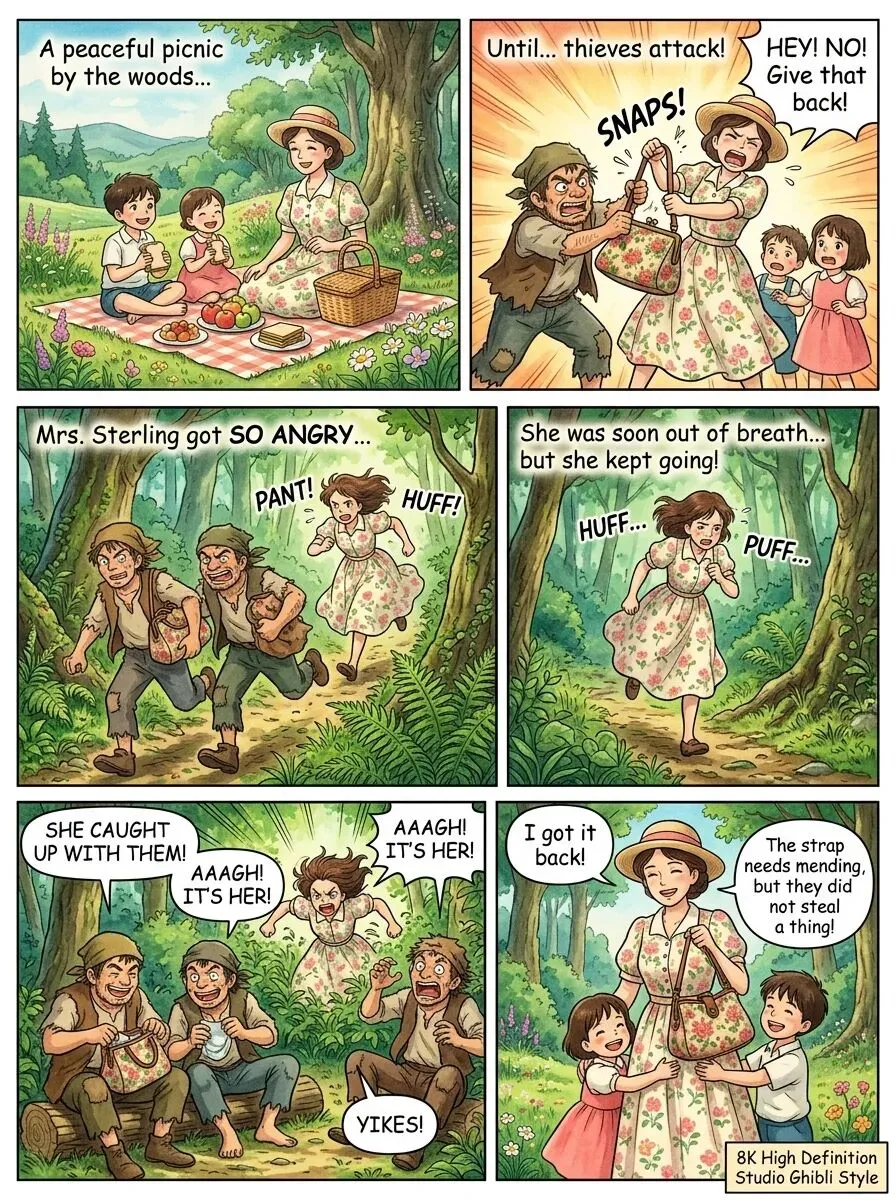
Mrs. Anne Sterling did not think of the risk she was taking when she ran through a forest after two men. They had rushed up to her while she was having a picnic at the edge of a forest with her children and tried to steal her handbag. In the struggle, the strap broke and, with the bag in their possession, both men started running through the trees. Mrs. Sterling got so angry that she ran after them. She was soon out of breath, but she continued to run. When she caught up with them, she saw that they had sat down and were going through the contents of the bag, so she ran straight at them. The men got such a fright that they dropped the bag and ran away. 'The strap needs mending,' said Mrs. Sterling later, 'but they did not steal anything.'
背景简介:本课是一个简短的叙事文,讲述了一位母亲安妮·斯特林在野外遭遇抢劫并勇敢追回财物的真实故事。这类故事常见于新闻报道或个人经历分享,旨在刻画普通人在危急时刻的反应与品格。课文语言简洁,动作描写连贯,情节紧凑,是学习叙事文写作的优秀范本。
参考译文:安妮·斯特林夫人在穿过森林追赶两个男人时,并没有想到自己所冒的风险。当时她正和孩子们在森林边上野餐,他们向她冲过来企图偷走她的手提包。在争抢中,手提包的带子断了,包落到了他们手里,两人开始向树林里跑去。斯特林夫人非常生气,于是在他们后面追赶。她很快就气喘吁吁了,但她还是继续跑着。当她追上他们时,看到他们已经坐下来,正在翻看包里的东西,于是她便直冲过去。这两人大吃一惊,丢下包就逃跑了。“这带子需要修一修了,”斯特林夫人后来说道,“不过他们什么也没偷走。”
🔍 第二部分:逐句精讲与词块总结
句子1
原文: Mrs. Anne Sterling did not think of the risk she was taking when she ran through a forest after two men.
翻译: 安妮·斯特林夫人在穿过森林追赶两个男人时,并没有想到自己所冒的风险。
句子结构: 这是一个复合句。主句是 Mrs. Anne Sterling did not think of the risk。she was taking 是省略了关系代词 that/which 的定语从句,修饰 the risk。when she ran through a forest after two men 是一个时间状语从句,修饰整个主句的动作。
重点词汇:
risk 蓝思值 600L
英音[rɪsk] 美音[rɪsk] 词性:n. & v.
释义:n. 危险,风险;v. 冒...的危险,冒险
常用语块:take a risk / take risks (冒险);at risk (处于危险中);run the risk of (冒着...的风险)
短语搭配:a high/great/serious risk (高风险);risk one's life (冒生命危险);risk assessment (风险评估)
例句一:Investing in stocks involves a certain degree of risk. 投资股票涉及一定程度的风险。
例句二:He risked his own safety to save the child from the fire. 他冒着自身安全危险把孩子从火里救出来。
拓展:同义词有 danger, hazard。Risk 更强调主动行为可能带来的不良后果,常与 take, run 搭配。Danger 泛指可能造成伤害的任何情况。Hazard 多指潜在的、固有的危险源。
think of
释义:想到,想起;考虑;认为
常用语块:think of sth./sb. (想到某事/某人);think of doing sth. (考虑做某事);what do you think of...? (你认为...怎么样?)
例句一:I can't think of his name right now. 我一时想不起他的名字。
例句二:We're thinking of moving to a bigger house. 我们正在考虑搬到一个更大的房子里去。
拓展:注意与 think about 的区别,两者在“考虑”义上常互换,但 think of 更侧重“念头闪现”、“想起”,think about 更侧重“仔细思考过程”。
through 蓝思值 400L
英音[θruː] 美音[θruː] 词性:prep. & adv.
释义:prep. 穿过,通过;凭借;由于;adv. 通过;从头到尾;彻底
常用语块:go/walk/run through (穿过);look through (浏览);get through (通过,完成);through and through (完全地,彻底地)
例句一:The River Thames flows through London. 泰晤士河流经伦敦。
例句二:I read through the report last night. 我昨晚把报告通读了一遍。
拓展:区分 across 和 through。Across 强调从表面横穿(如过马路 across the road),through 强调从内部空间穿过(如穿过森林 through the forest,穿过隧道 through the tunnel)。
语法点睛: 本句的核心语法点是 一般过去时 在叙述故事开头时的应用。did not think of, was taking, ran 均使用了一般过去时,确立了整个故事发生的时间背景是过去。[NCE知识点笔记] 指出,第二册大量课文使用一般过去时叙述完整事件,这是叙事文的基本时态。此外,when 引导的时间状语从句描述了主句动作发生的具体时间点,she was taking 这个定语从句则限定了 risk 的具体内容,体现了英语句子结构的紧凑性。
句子2
原文: They had rushed up to her while she was having a picnic at the edge of a forest with her children and tried to steal her handbag.
翻译: 当时她正和孩子们在森林边上野餐,他们向她冲过来企图偷走她的手提包。
句子结构: 这是一个并列复合句。主句由两个并列谓语构成:They had rushed up to her... and tried to steal her handbag。while she was having a picnic at the edge of a forest with her children 是一个时间状语从句,修饰第一个谓语动作 rushed up。
重点词汇:
rush up to 蓝思值 550L
释义:冲向,奔跑到...跟前
常用语块:rush up to sb./sth.
例句一:The fans rushed up to the movie star for autographs. 影迷们冲到那位电影明星面前索要签名。
例句二:He rushed up to me and told me the good news. 他冲到我面前告诉我这个好消息。
拓展:rush 本身意为“冲,匆忙”,up to 表示方向“到...跟前”。类似短语有 run up to。
while 蓝思值 400L
英音[waɪl] 美音[waɪl] 词性:conj. & n.
释义:conj. 当...的时候;然而;虽然;n. 一段时间,一会儿
常用语块:while doing sth. (当做某事时);for a while (一会儿);once in a while (偶尔)
例句一:Please don't talk while I'm speaking. 我说话的时候请不要讲话。
例句二:He likes sports, while his brother prefers reading. 他喜欢运动,而他弟弟更喜欢阅读。
拓展:While 引导时间状语从句时,强调主从句动作同时发生,且持续时间较长。区别于 when,when 可表示时间点或时间段,更通用。
edge 蓝思值 500L
英音[edʒ] 美音[edʒ] 词性:n. & v.
释义:n. 边缘;优势;刀刃;v. 缓慢移动;给...加边
常用语块:at/on the edge of (在...的边缘);have an edge over (比...有优势);cutting edge (前沿,尖端)
短语搭配:the water's edge (水边);a knife's edge (刀刃);edge closer (慢慢靠近)
例句一:Don't put that glass on the edge of the table; it might fall off. 别把那个杯子放在桌子边上,可能会掉下来。
例句二:His experience gave him an edge in the competition. 他的经验让他在竞争中占有优势。
try to do sth.
释义:试图做某事,努力做某事
常用语块:try to do sth. (试图做某事,强调努力和尝试);try doing sth. (尝试做某事,强调试验某种方法)
例句一:I'll try to finish the work by Friday. 我会尽力在周五前完成这项工作。
例句二:Try pressing the red button to restart the machine. 试试按红色按钮来重启机器。
拓展:Try to do 表示努力去做一件有难度的事。Try doing 表示尝试一种新的方法或体验,看效果如何。
语法点睛: 本句包含了 过去完成时 (had rushed) 和 过去进行时 (was having) 的对比使用。While 引导的从句使用过去进行时 was having,描绘了一个持续进行的背景画面(正在野餐)。主句的 had rushed up 使用过去完成时,表示这个“冲过来”的动作发生在“野餐”这个背景动作期间,并且先于主句另一个并列谓语 tried to steal。这种时态的搭配使得事件的先后顺序和同时关系非常清晰。[名师精讲] 强调,过去完成时常用于表示“过去的过去”,即在一个过去时间点之前已经完成的动作。在本课语境中,它为故事提供了更早的背景信息。
句子3
原文: In the struggle, the strap broke and, with the bag in their possession, both men started running through the trees.
翻译: 在争抢中,手提包的带子断了,包落到了他们手里,两人开始向树林里跑去。
句子结构: 这是一个由 and 连接的并列句。第一个分句是 the strap broke。第二个分句是 both men started running through the trees。In the struggle 是介词短语作状语。, with the bag in their possession, 是一个 with 复合结构作伴随状语,插入在第二个分句中。
重点词汇:
struggle 蓝思值 650L
英音[ˈstrʌɡl] 美音[ˈstrʌɡl] 词性:n. & v.
释义:n. 斗争,挣扎;搏斗;努力;v. 奋斗,挣扎;搏斗
常用语块:in the struggle (在争斗/挣扎中);struggle for (为...而斗争);struggle with/against (与...斗争);struggle to do sth. (努力做某事)
例句一:After a brief struggle, the police officer managed to handcuff the thief. 经过短暂的搏斗,警察设法给小偷戴上了手铐。
例句二:Many families struggle to make ends meet. 许多家庭艰难维持收支平衡。
拓展:作为名词,常与 in 搭配表示“在...过程中”。作为动词,强调克服困难的努力过程。
strap 蓝思值 700L
英音[stræp] 美音[stræp] 词性:n. & v.
释义:n. 带子,皮带;肩带;v. 用带子捆扎,固定
常用语块:a watch strap (表带);a shoulder strap (肩带);strap sth. on/in (用带子固定某物)
例句一:The strap on my backpack broke, so I had to carry it in my arms. 我背包的带子断了,所以我只好用手抱着。
例句二:Make sure all passengers are securely strapped in before driving. 开车前确保所有乘客都系好安全带。
拓展:特指细长的、用于固定、悬挂或携带物品的带子。
possession 蓝思值 750L
英音[pəˈzeʃn] 美音[pəˈzeʃn] 词性:n.
释义:拥有,占有;财产,所有物
常用语块:in one's possession (为某人所拥有);take possession of (占有,占领);personal possessions (个人财物)
短语搭配:come into possession of (获得);illegal possession (非法持有)
例句一:The house has been in the family's possession for over a century. 这房子归这个家族所有已有一个多世纪了。
例句二:Please ensure you have all your personal possessions before leaving the train. 下车前请确保带齐所有个人物品。
拓展:动词形式是 possess。With sth. in one's possession 是一个非常有用的独立主格结构,表示状态。
start doing sth.
释义:开始做某事
常用语块:start doing sth. / start to do sth.
例句一:It started raining just as we left the house. 我们刚离开家就开始下雨了。
例句二:He started to feel nervous before the interview. 面试前他开始感到紧张。
拓展:Start doing 和 start to do 通常可以互换。但在以下情况下倾向用 to do: 1) 主语是物时 (The ice started to melt.);2) start 本身是进行时时 (I'm starting to understand.);3) 描述心理活动或感知时 (start to believe/feel/think)。
语法点睛: 本句的亮点是 with 复合结构 (with the bag in their possession) 作伴随状语。这种结构由 “with + 名词/代词 + 介词短语/形容词/副词/分词” 构成,在句中表示伴随的状态、方式、原因等,能使句子更加简洁、生动。例如:He slept with the window open. (他开着窗睡觉。) With the guide leading the way, we had no trouble finding the village. (有向导带路,我们毫不费力就找到了村子。)[语法新思维] 指出,with 复合结构是英语中一种高级的造句手段,常用于书面语和文学描写中,使描述更具画面感。
句子4
原文: Mrs. Sterling got so angry that she ran after them.
翻译: 斯特林夫人非常生气,于是在他们后面追赶。
句子结构: 这是一个复合句,使用了 so...that... 引导的结果状语从句。so angry 是主句中的程度状语,that she ran after them 是从句,表示“生气”导致的结果。
重点词汇:
get angry
释义:变得生气,发怒
常用语块:get/become/be angry (生气);get angry with sb. (生某人的气);get angry about/at sth. (因某事生气)
例句一:Don't get angry; it was just a mistake. 别生气,只是个错误。
例句二:My teacher got angry with me for being late again. 老师因为我再次迟到而生我的气。
拓展:Get 在这里是系动词,相当于 become,表示状态的变化。类似的还有 get tired, get excited, get lost。
run after
释义:追赶,追逐;追求
常用语块:run after sb./sth.
例句一:The dog ran after the ball. 狗追着球跑。
例句二:He's always running after fame and fortune. 他总是追逐名利。
拓展:注意与 run behind (落后,延迟) 和 run into (偶然遇见;撞上) 的区别。
语法点睛: 本句的核心语法点是 so...that... 结果状语从句。So 是副词,后面接形容词或副词,表示程度,that 引导的从句表示这种程度导致的结果。结构为:so + adj./adv. + that + 从句。例如:He spoke so fast that I couldn't understand him. (他说得太快了,我听不懂。)[NCE知识点笔记] 详细讲解了 so...that... 和 such...that... 的区别,后者接名词或名词短语,结构为 such (+ a/an) + adj. + n. + that + 从句。本课下一句将出现 such...that... 结构,形成对比教学。
句子5
原文: She was soon out of breath, but she continued to run.
翻译: 她很快就气喘吁吁了,但她还是继续跑着。
句子结构: 这是一个由转折连词 but 连接的并列句,表示前后意义的转折。
重点词汇:
out of breath 蓝思值 550L
释义:上气不接下气,喘不过气来
常用语块:be out of breath
例句一:After climbing six flights of stairs, I was completely out of breath. 爬了六层楼梯后,我完全上气不接下气了。
例句二:He arrived at the meeting out of breath because he had run all the way. 他一路跑来,到达会场时气喘吁吁。
拓展:反义词是 get one's breath back (喘过气来)。Breath 是名词“呼吸”,动词是 breathe [briːð]。
continue to do sth. 蓝思值 500L
释义:继续做某事
常用语块:continue to do sth. / continue doing sth.
例句一:Despite the noise, she continued to read her book. 尽管有噪音,她还是继续看书。
例句二:The rain continued falling all afternoon. 雨持续下了一下午。
拓展:Continue to do 和 continue doing 意思基本相同,可以互换。Continue 后也可接名词作宾语,如 continue the work。
语法点睛: 本句语法相对简单,重点是 并列连词 but 的使用,表示转折关系。它连接了两个意义相反或形成对比的分句,突出了斯特林夫人尽管体力不支(out of breath)但仍坚持不懈(continued to run)的意志品质。这是叙事文中塑造人物性格的常用手法。
句子6
原文: When she caught up with them, she saw that they had sat down and were going through the contents of the bag, so she ran straight at them.
翻译: 当她追上他们时,看到他们已经坐下来,正在翻看包里的东西,于是她便直冲过去。
句子结构: 这是一个多重复合句。When she caught up with them 是时间状语从句。主句是 she saw that...,其中 that 引导宾语从句 they had sat down and were going through the contents of the bag。这个宾语从句本身又是一个并列句 (had sat down and were going through)。最后,so she ran straight at them 是一个由 so 引导的结果状语从句(或视为并列句),表示“看到那一幕”导致的结果。
重点词汇:
catch up with 蓝思值 550L
释义:赶上,追上;(不良后果)最终影响到
常用语块:catch up with sb./sth.
例句一:You walk ahead, and I'll catch up with you later. 你先走,我待会儿赶上你。
例句二:His lack of sleep finally caught up with him, and he became ill. 睡眠不足最终影响了他,他病倒了。
拓展:名词形式是 catch-up,如 play catch-up (奋力追赶)。
go through 蓝思值 600L
释义:检查,翻阅;经历,遭受;通过
常用语块:go through sth. (检查某物;经历某事);go through with (完成,实行)
例句一:I went through all the documents carefully but found nothing relevant. 我仔细翻阅了所有文件,但没找到相关的内容。
例句二:She went through a difficult period after losing her job. 失业后她经历了一段困难时期。
拓展:这是一个多义词组,具体含义需根据上下文判断。本课中是“翻看,检查”的意思。
contents 蓝思值 750L
英音[ˈkɒntents] 美音[ˈkɑːntents] 词性:n. (pl.)
释义:内容;所含之物;目录
常用语块:the contents of (...里面的东西);table of contents (目录)
例句一:The contents of the box spilled onto the floor. 盒子里的东西洒在了地上。
例句二:Check the contents page to find the chapter you need. 查看目录页找到你需要的章节。
拓展:单数 content [kənˈtent] 可以表示“内容”(抽象,不可数),如 the content of the speech (演讲内容),或“满意”(adj./n.)。复数 contents 指具体的、容器内的物品或书的目录。
straight 蓝思值 450L
英音[streɪt] 美音[streɪt] 词性:adv. & adj.
释义:adv. 径直地,直接地;立即;adj. 直的;直接的;诚实的
常用语块:go/run/walk straight to/at (径直走向/冲向...);straight away (立刻);keep straight on (一直往前走)
例句一:After school, he went straight home. 放学后他直接回家了。
例句二:Tell me straight what you think. 直接告诉我你的想法。
拓展:作副词时,表示方向上的“直”或时间上的“立即”。Run straight at them 生动地描绘了毫不犹豫、目标明确的冲击动作。
语法点睛: 本句时态运用丰富。caught up with, saw, ran 用一般过去时叙述主线动作。在宾语从句中,had sat down 使用过去完成时,表示“坐下”发生在“看见”之前,是“过去的过去”;were going through 使用过去进行时,描绘“看见”时他们正在进行的动作。这种时态的混合精确地刻画了事件发展的动态过程:追赶 -> 追上并看见(看见时对方已处于坐下状态,且正在翻包)-> 做出反应(直冲过去)。[名师精讲] 强调,在叙述复杂事件链时,灵活运用过去完成时和过去进行时能极大地增强表达的准确性和生动性。
句子7
原文: The men got such a fright that they dropped the bag and ran away.
翻译: 这两人大吃一惊,丢下包就逃跑了。
句子结构: 这是一个复合句,使用了 such...that... 引导的结果状语从句。such a fright 是主句中的名词短语,that they dropped the bag and ran away 是从句,表示“惊吓”导致的结果。
重点词汇:
get/have a fright 蓝思值 550L
释义:受惊,吓一跳
常用语块:get/have a fright;give sb. a fright (吓某人一跳)
例句一:I got a fright when the door slammed shut in the wind. 门被风吹得砰一声关上时,我吓了一跳。
例句二:Oh, you gave me such a fright creeping up behind me like that! 哦,你这样从我背后悄悄走过来,可把我吓坏了!
拓展:Fright 是名词“惊吓”,动词是 frighten。Be frightened of = be afraid of。
drop 蓝思值 400L
英音[drɒp] 美音[drɑːp] 词性:v. & n.
释义:v. (使)落下,掉下;放弃;下降;n. 滴;下降;空投
常用语块:drop sth. (丢掉某物);drop out of (退出);a drop of water (一滴水)
例句一:Be careful not to drop that vase; it's very fragile. 小心别摔了那个花瓶,它很容易碎。
例句二:He dropped the idea of studying abroad due to financial constraints. 由于经济限制,他放弃了出国留学的想法。
拓展:本课中是“(因受惊而)松手让某物掉落”的意思,非常形象。
run away 蓝思值 450L
释义:逃跑,跑开
常用语块:run away (from...) (从...逃跑)
例句一:The thief ran away before the police arrived. 小偷在警察到来之前就跑掉了。
例句二:He ran away from home when he was sixteen. 他十六岁时离家出走。
拓展:同义词有 flee。Run away 更口语化。
语法点睛: 本句的核心语法点是 such...that... 结果状语从句。Such 是形容词,后面接名词或名词短语,表示“如此...的”,that 引导的从句表示结果。结构为:such (+ a/an) + adj. + n. + that + 从句。例如:It was such a boring movie that I fell asleep. (这部电影太无聊了,我都睡着了。)[NCE知识点笔记] 对比了 so...that... 和 such...that...: - so + adj./adv. + that... (如句子4: so angry that...) - such (+ a/an) + adj. + n. + that... (如本句: such a fright that...) 如果名词前有 many, much, few, little 修饰,则用 so,如:so many people that...。
句子8
原文: 'The strap needs mending,' said Mrs. Sterling later, 'but they did not steal anything.'
翻译: “这带子需要修一修了,”斯特林夫人后来说道,“不过他们什么也没偷走。”
句子结构: 这是一个直接引语句。主句是 said Mrs. Sterling later,引语部分是两个由 but 连接的并列句。
重点词汇:
need 蓝思值 400L
英音[niːd] 美音[niːd] 词性:v. & n.
释义:v. 需要;必须;n. 需要;必需品
常用语块:need to do sth. (需要做某事);need doing (需要被...);in need of (需要...)
例句一:You need to finish your homework before watching TV. 你得先做完作业再看电视。
例句二:The plants need watering every day. 这些植物需要每天浇水。
拓展:Need 既可作实义动词,也可作情态动词(主要用于否定句和疑问句,如 Need I go? / You needn't worry.)。本课中是实义动词。
mend 蓝思值 650L
英音[mend] 美音[mend] 词性:v.
释义:修理,修补;改善,痊愈
常用语块:mend sth. (修理某物);mend one's ways (改过自新);on the mend (在好转中)
例句一:Can you mend this tear in my shirt? 你能帮我补一下衬衫上的这个破口吗?
例句二:It took him months to mend after the surgery. 手术后他花了几个月才康复。
拓展:与 repair 和 fix 同义,但 mend 常指修补破损的小物件(如衣服、玩具、关系),repair 更正式,用于较大或较复杂的物品(如汽车、房屋、道路),fix 最口语化,用途广泛。
语法点睛: 本句的重点语法是 need + V-ing 主动形式表被动含义。The strap needs mending = The strap needs to be mended。在这种结构中,动名词 (mending) 的主动形式表达了被动的意义,即“带子需要被修理”。英语中有些动词(如 need, want, require)后接动名词时,常以主动形式表被动。例如:Your hair wants cutting. (你该理发了。)[语法新思维] 指出,这是一种简洁地道的表达方式,强调了事物本身“需要被...”的属性。此外,直接引语的句式也是复习重点,注意引语内句子首字母大写以及逗号、引号的位置。
📌 核心词块总结
1. did not think of the risk: 没想到风险。用于描述行动时缺乏风险意识。 Example: The young climber didn't think of the risk when he attempted the peak alone.
2. rush up to sb.: 冲向某人。描述突然、快速的接近动作。 Example: As soon as the celebrity appeared, reporters rushed up to her.
3. in the struggle: 在争斗/挣扎中。指在肢体冲突或努力的过程中。 Example: In the struggle to control the fire, several firefighters were injured.
4. with sth. in one's possession: 某物在某人的占有下。表示所有权或控制权的状态。 Example: With the evidence in their possession, the police were confident of solving the case.
5. out of breath: 上气不接下气。形容剧烈运动后的喘息状态。 Example: After the marathon, every runner was completely out of breath.
6. catch up with sb.: 追上某人。指从后面赶上。 Example: I had to run fast to catch up with the rest of the group.
7. go through the contents: 翻看里面的东西。指仔细检查容器或包裹内的物品。 Example: Customs officers went through the contents of his suitcase thoroughly.
8. get such a fright that...: 受到如此大的惊吓以至于...。用于描述强烈惊吓导致的后果。 Example: The loud thunder gave the baby such a fright that she started crying.
✍️ 第三部分:语篇分析与段落写作技巧
1. 语篇分析①Identify the macrostructure (识别宏观结构): 本文是一个典型的线性叙事结构 (linear narrative structure)。按照事件发生的自然时间顺序展开:背景 (Setting)→冲突起因 (Inciting incident)→发展 (Development)→高潮 (Climax)→结局 (Resolution)→事后评论 (Reflection)。具体如下:- 背景/铺垫: 斯特林夫人和孩子们在森林边野餐。- 冲突起因: 两名男子冲过来试图抢包。- 发展: 争夺中包带断裂,劫匪夺包逃入森林;斯特林夫人愤怒追赶。- 进一步发展: 她追上时,发现劫匪正在翻包。- 高潮: 她直冲过去。- 结局: 劫匪受惊丢包逃跑。- 事后评论: 斯特林夫人谈论包带和结果。②List cohesive devices (列举衔接手段):-时间连接词 (Temporal conjunctions): when, while, and then (隐含), when, so (表先后结果)。-代词指代 (Pronominal reference): she, her, they, them, their 清晰地指代 Mrs. Sterling 和 the two men,避免重复。-词汇衔接 (Lexical cohesion): 围绕“追逐”主题的词链:ran after, out of breath, continued to run, caught up with, ran straight at, ran away。围绕“包”的词链:handbag, strap, bag, contents of the bag, dropped the bag。-逻辑连接词 (Logical connectors): but (表转折,突出毅力),so (表结果)。③Analyze the author's attitude (分析作者态度): 作者采用客观、平实的叙述语气,未加入明显的情感色彩或道德评判。然而,通过细节描写(如 did not think of the risk, got so angry, continued to run, ran straight at them)和直接引语,间接塑造了斯特林夫人勇敢、果断、有点鲁莽但又最终成功的普通人英雄形象。对劫匪的描写(got such a fright, dropped the bag and ran away)则略带讽刺,突出了他们的狼狈。
2. 写作技巧①提炼写作逻辑: 本课展示了如何写一个精彩的微型故事。秘诀在于:清晰的时序 + 具体的动作描写 + 简洁的对话/心理点缀。首先,用一两句话设定场景 (having a picnic at the edge of a forest)。然后,用一系列具体的动词短语 (rushed up to, tried to steal, the strap broke, started running, ran after, caught up with, saw...going through, ran straight at, dropped...and ran away) 推动情节快速发展,制造紧张感。最后,用一句直接引语收尾,既交代了结果 (did not steal anything),又增添了真实感和人物个性 (The strap needs mending),让人回味。②提供段落写作范例:Topic: A Brave Act You Witnessed or Heard AboutLast Tuesday afternoon, I was waiting for the bus at a crowded downtown stop. An elderly woman was standing near the curb, counting her change. Suddenly, a young man on a bicycle sped past her, and in a flash, he snatched her purse right out of her hands! The woman let out a cry of shock. Without a second thought, a teenage boy who was also waiting dropped his backpack and sprinted after the cyclist. He was incredibly fast. Within half a block, he managed to grab the back of the cyclist's jacket, causing him to lose balance and tumble onto the sidewalk. The teenager quickly picked up the fallen purse, while the would-be thief scrambled to his feet and fled empty-handed. Returning the purse to the grateful lady, the boy simply said, “I guess he wasn't expecting anyone to run that fast.” Everyone at the bus stop applauded.分析其结构特点:-时序清晰: Last Tuesday afternoon → Suddenly → Without a second thought → Within half a block → Returning the purse。-动作具体: was waiting, sped past, snatched, let out a cry, dropped, sprinted after, grab, lose balance, tumble, picked up, scrambled, fled, returning, applauded。-细节生动: counting her change, right out of her hands, empty-handed, the grateful lady。-点睛结尾: 用直接引语 (I guess he wasn't expecting...) 收尾,突出人物的淡定和幽默。③布置小练笔并提供例文:小练笔: 请模仿课文,用80-100个单词,叙述一次你或他人“失而复得”的经历(可以是物品,也可以是机会等)。要求使用至少5个本课所学词块,并注意动作描写的连贯性。例文:I once left my mobile phone in a taxi after a long day. I realized it only when I got home and felt panic. I didn't think of the risk of it being lost forever. Using my computer, I tracked its location and saw it was stationary at a café across town. I rushed to the café, out of breath from running. Inside, I saw a taxi driver sitting with my phone on the table, going through his own contacts to try and find me! I was so relieved that I thanked him repeatedly. He smiled and said, “It needs charging, but I didn't look at anything private.”语言点映射:- did not think of the risk: 对应课文中主角的初始心态。- rushed to: 类似 ran after,表示急切行动。- out of breath: 直接使用本课词块。- going through: 使用本课短语,但语境变为善意寻找失主信息。- so relieved that...: 模仿 so...that... 句型。- It needs charging: 模仿 need + V-ing 结构。
📐 第四部分:本课语法精析(加强版)
本课语法重点围绕叙述性过去时态的综合运用以及两个关键句型:so...that.../such...that... 和 need + V-ing。我们将结合知识库资料进行深度解析。
1. 一般过去时、过去进行时与过去完成时的叙事协作 [NCE知识点笔记]、[名师精讲]在第二册的叙事文中,这三种时态常常协同工作,构建出层次分明的时间线。-一般过去时 (Simple Past): 叙述故事的主干动作和事件。它是叙事的骨架。-Mrs. Sterling ran after them. She caught up with them. She ran straight at them.- 这些是推动情节向前发展的核心动作。-过去进行时 (Past Continuous): 描绘背景画面,或表示在过去某一时刻正在进行的动作。它为故事增添氛围和即时感。-...while she was having a picnic...(描绘抢劫发生时的背景状态)-...she saw that they were going through the contents...(描绘“看见”那一刻对方正在做的动作)- 结构:was/were + V-ing。-过去完成时 (Past Perfect): 表示“过去的过去”,即在一个过去时间点或动作之前已经发生或完成的动作。它用于提供背景信息或解释因果关系。-They had rushed up to her...(这个“冲上来”发生在故事开头叙述的“跑过森林追赶”之前,为故事提供更早的起因)-...she saw that they had sat down...(“坐下”发生在“看见”之前)- 结构:had + 过去分词。对比分析(与第一册): 第一册主要接触并掌握一般现在时、现在进行时和一般过去时的基本用法。第二册则在此基础上,引入并深化过去进行时和过去完成时在复杂叙事中的应用,要求学习者能够辨别和运用这三种时态来描述有先后、有重叠的过去事件链。这是叙事能力从简单到复杂的关键飞跃。
2. So...that... 与 Such...that... 结果状语从句 [NCE知识点笔记]、[语法新思维]这两个句型都用来引导结果状语从句,表示主句动作或状态的程度所导致的结果。区别在于 so 和 such 的词性和其后所接成分。-So + adjective/adverb + that-clause:- So 是副词,修饰形容词或副词。-Mrs. Sterling got so angry that she ran after them.(so + 形容词 angry)-He spoke so quickly that I missed half of his points.(so + 副词 quickly)-There was so little time that we had to take a taxi.(so + 限定词 little 修饰不可数名词 time。注意:many/much/few/little 前用 so)-Such (+ a/an) + adjective + noun + that-clause:- Such 是形容词,修饰名词。-The men got such a fright that they dropped the bag.(such + a + 名词 fright)-It was such a hot day that we decided to go swimming.(such + a + 形容词 hot + 名词 day)-They are such kind people that everyone likes them.(such + 形容词 kind + 复数名词 people,前面无冠词)常见错误警示:- 误:It was so a funny story that...(so 不能直接修饰“a + adj. + n.”)- 正:It was such a funny story that...或The story was so funny that...- 误:They are so friendly people that...(so 不能修饰“adj. + 复数名词”)- 正:They are such friendly people that...或They are so friendly that...练习题:1. The box was ___ heavy ___ I couldn't lift it. (so...that / such...that)2. It was ___ delicious cake ___ I had two slices. (so...that / such...that)3. He has ___ many books ___ his room looks like a library. (so...that / such...that)4. She felt ___ tired ___ she fell asleep immediately. (so...that / such...that)5. We had ___ awful weather ___ our picnic was canceled. (so...that / such...that)6. The movie generated ___ excitement ___ tickets sold out in hours. (so...that / such...that)答案与解析:1.so...that(heavy 是形容词)2.such...that(such a delicious cake)3.so...that(many books, many 是限定词)4.so...that(tired 是形容词)5.such...that(such awful weather)6.such...that (such excitement)
3. Need + V-ing 主动形式表被动 [语法新思维]、[名师精讲]这是一种特殊但常用的结构,表示“(某物)需要被...”。-结构: 主语 (通常是物) + need/want/require + V-ing (动名词)-含义: 等同于“主语 + need/want/require + to be + 过去分词”。-The strap needs mending. = The strap needs to be mended.-Your room wants cleaning. = Your room wants to be cleaned.-These plants require watering daily. = These plants require to be watered daily.-原理: 动名词 (mending, cleaning) 虽然形式上是主动的,但与其逻辑主语 (the strap, your room) 构成被动关系(带子被修理,房间被打扫)。这种表达更强调事物本身“需要某种处理”的属性,显得更地道、简洁。-与 need to do 的区别:- Need to do: 主语(通常是人)需要主动去做某事。I need to mend the strap.(我需要去修带子。)- Need doing: 主语(通常是物)需要被处理。The strap needs mending.(带子需要被修。)练习题:7. The windows are dirty. They ___. (need clean / need cleaning / need to clean)8. I'm afraid this report ___. It's full of errors. (needs rewrite / needs rewriting / needs to rewrite)9. You look exhausted. You ___ a good rest. (need having / need to have / need have)10. My car makes a strange noise. The engine probably ___. (needs check / needs checking / needs to check)11. Before the trip, we ___ our visas. (needed renewing / needed to renew / needed renew)12. This old fence is rotten. It ___. (needs replace / needs replacing / needs to replace)答案与解析:7.need cleaning(窗户需要被擦)8.needs rewriting(报告需要被重写)9.need to have(你需要去休息,主语是人,主动动作)10.needs checking(引擎需要被检查)11.needed to renew(我们需要去续签,主语是人,主动动作)12.needs replacing (篱笆需要被更换)
4. With 复合结构 [语法新思维]With + 名词/代词 + 介词短语/形容词/副词/分词 构成复合结构,在句中作状语,表示伴随、方式、原因、条件等,或作定语修饰名词。-with + n. + prep. phrase:..., with the bag in their possession, ...(伴随状态)-with + n. + adj.:He sleeps with the window open.(方式)-with + n. + adv.:She stood there with her head down.(方式)-with + n. + V-ing(主动):He fell asleep with the light still burning.(伴随)-with + n. + V-ed(被动):He was listening to music with his eyes closed.(方式)这种结构使句子信息密度更高,描写更生动。在写作中适时使用,可以提升语言质量。
5. 综合练习与句子改写13. 将下列句子合并为一句,使用 so...that... 或 such...that...:The music was very loud. We couldn't hear each other.14. 用 with 复合结构改写句子:The teacher entered the classroom. A book was in his hand.15. 用 need + V-ing 改写句子:It's necessary to paint this wall.16. 用正确的时态填空(一般过去/过去进行/过去完成):When I ___(arrive) at the party, most people ___(already, leave). Only a few friends ___(sit) in the corner and ___(talk).17. 翻译:看到那个场景,她如此害怕以至于尖叫起来。18. 找出下面句子的错误并改正: “My computer is so old machine that it can't run new software.”答案与解析:13.The music was so loud that we couldn't hear each other.或It was such loud music that we couldn't hear each other.14.The teacher entered the classroom with a book in his hand.15.This wall needs painting.16.arrived; had already left; were sitting; talking(到达是过去点动作;大部分人在此之前已离开,用过去完成;几个朋友在到达时正坐着聊天,用过去进行。)17.Seeing the scene, she got such a fright that she screamed.或...was so frightened that...18. 错误:so old machine。改正:such an old machine 或 so old a machine (后者较少用)。
🎧 第五部分:听力与阅读策略训练
1. 听力技巧假设我们播放课文录音(可从《新概念英语pro 第2册.pdf》或相关音频资源获取),进行以下训练:①预测关键词 (Predicting Keywords): 在听第一遍前,看课文标题“Through the Forest”,预测故事可能涉及哪些词汇?(e.g., run, tree, chase, animal, lost, path, danger, bag, thief 等)。听完后核对。②抓主旨大意 (Gist Listening): 听第一遍(不看文本),只回答一个问题:What is the main event of the story? (A woman chases two thieves through a forest and gets her bag back.)③笔记方法 (Note-taking): 听第二遍,尝试用关键词或符号按顺序记下故事的主要步骤。例如:- Picnic (forest edge) w/ kids- 2 men rush → try steal bag- Struggle → strap break → men run (bag)- Mrs.S angry → run after- Out of breath BUT continue- Catch up → see men sit, go thru bag→ Run straight at them- Men fright → drop bag, run away- Later: strap need mend, nothing stolen这种方法训练捕捉核心信息和事件顺序的能力。
2. 阅读理解策略① 扫读 (Scanning): 快速浏览课文,在30秒内找出以下具体信息:- Where was Mrs. Sterling having a picnic? (At the edge of a forest.)- What broke during the struggle? (The strap of the handbag.)- Why did the men drop the bag? (Because they got such a fright.)② 略读 (Skimming): 用1分钟阅读课文,然后说出故事的开始、中间和结束各发生了什么。(开始:野餐遭抢;中间:奋力追赶;结束:吓退窃贼,物归原主。)③ 推断词义 (Inferring Meaning): 根据上下文推断划线词的近似含义。- “...with the bag in their possession...” Possession likely means ___ (ownership, control).- “She was soon out of breath...” Out of breath likely means ___ (breathing heavily, panting).- “...going through the contents of the bag...” Contents likely means ___ (things inside).(答案:1. control; 2. breathing heavily; 3. things inside)
📝 第六部分:习题讲解
(本部分主要依据《官方教材之新概念英语练习详解 第2册.pdf》和《官方教材之新概念英语学生用书 第2册.pdf》中关于第44课的练习进行讲解。由于知识库片段未显示具体习题,以下为根据教材常见题型设计的模拟讲解。)
假设教材练习包括:
1. Comprehension Questions (理解性问题)- Q: Why did Mrs. Sterling run after the two men?A: Because they had tried to steal her handbag and succeeded in getting it, which made her very angry.- Q: What did she see when she caught up with them?A: She saw that they had sat down and were looking through the things inside her bag.解题思路: 这些问题答案直接来源于课文细节。仔细阅读对应句子即可找到。
2. Vocabulary (词汇题)- 选择同义词:risk (a. chance b. danger c. opportunity) 答案:b. danger。- 用短语填空:The children were ___ after playing football. (out of breath)。解题思路: 准确记忆单词释义和短语搭配是关键。
3. Key Structures (关键结构) - So...that... / Such...that...- 用 so 或 such 填空:It was ___ a warm day that we went to the beach. (such)He was ___ tired that he fell asleep in the chair. (so)解题思路: 判断空格后紧跟的是“a/an + adj. + n.”就用 such;如果是形容词或副词就用 so。
4. Special Difficulties (特殊难点) - Need- 改写句子:It is necessary to clean this room. → This room needs cleaning.解题思路: 识别主语是“物”,且需要被处理,则套用 need + V-ing 结构。
5. Composition (写作)- 根据关键词写一段话:picnic - rush up to - struggle - break - run after - out of breath - catch up with - run at - fright - drop - run away。解题思路: 将这些关键词作为故事发展的线索,按照逻辑顺序串联起来,并添加适当的连接词和细节,构成一个连贯的段落。这正是第三部分写作技巧的实践应用。
🤔 第七部分:英文深度思考与拓展(强化版)
A. 层次化英文问题与答案Level 1 (Factual):1. Where was Mrs. Sterling when the two men approached her?Answer: She was having a picnic at the edge of a forest with her children.2. What did the two men try to take from Mrs. Sterling?Answer: They tried to steal her handbag.3. What happened to the handbag during the struggle?Answer: The strap of the handbag broke.4. How did Mrs. Sterling feel when the men ran away with her bag?Answer: She got very angry.5. What were the two men doing when Mrs. Sterling finally caught up with them?Answer: They had sat down and were going through the contents of the bag.Level 2 (Inferential):6. Why do you think Mrs. Sterling continued to run even though she was out of breath?Answer: She was probably driven by a strong sense of anger and determination to get her property back. Her maternal instinct to protect her family's belongings might also have played a role.7. What does the reaction of the two men (“got such a fright”) suggest about their character?Answer: It suggests they were not professional or violent criminals, but rather opportunistic thieves who were easily scared when confronted directly.8. Why might the author have included Mrs. Sterling's final comment about the strap needing mending?Answer: This comment adds a touch of realism and ordinary life to the dramatic event. It shows her practicality and shifts the focus from the crime to a minor domestic issue, perhaps to underline that nothing truly valuable was lost and life goes on.Level 3 (Evaluative):9. Do you think Mrs. Sterling's decision to chase the thieves through the forest was wise? Why or why not?Answer: From a safety perspective, it was unwise because she was alone, potentially putting herself at greater risk. However, from the standpoint of courage and defending one's property, her action was brave and ultimately successful. The wisdom depends on whether one prioritizes personal safety or immediate justice.10. How does this story challenge or reinforce common stereotypes about victims of crime?Answer: It challenges the stereotype of victims as passive or helpless. Mrs. Sterling actively fought back and pursued the perpetrators, transforming from a victim into an active agent in her own story. It reinforces, however, the idea that quick, decisive action can sometimes deter crime.11. If this incident happened today, what additional factors (e.g., mobile phones, surveillance) might have changed the outcome or how it was handled?Answer: Today, Mrs. Sterling might have immediately called the police on her mobile phone instead of giving chase. The forest edge might have CCTV. The thieves' faces might have been captured on a phone camera. The pursuit might have been coordinated with police via GPS. The outcome might have been their arrest rather than just escaping.12. What broader message about human nature or society might this simple story convey?Answer: It conveys that even ordinary people are capable of extraordinary courage when provoked. It also highlights that crime, even petty theft, disrupts the peace of daily life (a picnic). Furthermore, it suggests that sometimes, sheer determination and a surprising act (running straight at them) can overcome a perceived power imbalance.
B. 多类型拓展阅读1. 时事新闻拓展 (Current News Extension)Title: Community Hero Chases Down Purse SnatcherLast Thursday in Brighton Park, a similar act of bravery unfolded. Emma Carter, 68, was feeding pigeons when a youth grabbed her shopping trolley. Instead of freezing, Mrs. Carter, a former PE teacher, shouted “Stop, thief!” and sprinted after him. Bystanders filmed the astonishing scene as she chased the suspect for nearly 200 meters. “I just reacted,” she told reporters later. “I wasn't thinking of the risk.” The thief, startled by her persistence and the growing crowd, abandoned the trolley near a bus stop. Police praised her courage but advised the public to prioritize calling 999 over direct confrontation. “My legs are sore,” Mrs. Carter joked, “but my groceries are safe.”Language Focus: 使用了本课词块 “wasn't thinking of the risk”。词汇:unfolded, bystanders, persistence, confronted.2. 文化背景解析 (Cultural Background Analysis)The “Handbag” in British CultureThe handbag, especially in stories like this, is more than just an accessory in British context; it often symbolizes personal security, privacy, and economic independence. For many women, particularly of older generations, the handbag contains essentials like keys, wallet, family photos, and perhaps a mobile phone now -- a microcosm of their daily life and connections. An attempt to steal it is therefore seen as a profound violation. The fact that Mrs. Sterling fights so hard for it resonates culturally. Historically, the phrase “handbagging” even entered political slang, meaning a forceful verbal attack (from the image of former PM Margaret Thatcher striking a desk with her handbag). This story taps into the deep-seated value placed on personal property and the dignity of defending it.Language Focus: 解析了课文核心物品 “handbag” 的文化象征意义。词汇:symbolizes, microcosm, violation, resonates, deep-seated.3. 今昔对比分析 (Then-and-Now Comparison)Crime and Response: 1970s vs. TodayThe scenario in Lesson 44 feels somewhat dated. In the mid-20th century, such a chase might have been the primary recourse in a remote area. Today, the sequence of events would likely differ drastically. Firstly, Mrs. Sterling would probably have a mobile phone. Her first action might be to call the police while shouting to alert others. Secondly, the thieves' getaway might be tracked if the bag contained a smartphone or a banking card with contactless payment, which can be pinged. Thirdly, the forest edge might be covered by trail cameras or nearby residential Ring doorbells. While the instinct to fight back remains, technology now offers alternatives to a solitary foot chase through the woods. However, the core human emotions -- anger, fear, determination -- remain unchanged.Language Focus: 对比了过去和现在对类似事件的不同处理方式。词汇:scenario, recourse, remote, drastically, getaway, pinged, instinct.4. 新潮英语改写 (Modern English Rewrite)OMG, You Won't Believe What Happened on My Picnic!So, I'm chilling with my kids at the forest's edge, right? Having some sandwiches. Out of nowhere, these two guys bolt towards us and go for my tote bag! Total shock. We tussle for a sec, and snap! The strap breaks. Off they dash into the trees with my stuff. I was fuming! I just took off after them. Yeah, I was gasping for air pretty quick, but no way was I stopping. When I finally caught them, they were casually sitting there, rummaging through my things! I just charged at them, full speed. They totally freaked out, dropped everything, and bolted. Later, I'm just like, “Well, the strap's busted, but hey, they didn't get anything.” Crazy day!Language Focus: 用现代口语、网络用语(OMG, chilling, bolt, fuming, freaked out, busted)和短句重述故事,展示语言的时代变迁。5. 难度略高的拓展阅读 (Higher-Difficulty Extension)The Psychology of the “Freeze, Flight, or Fight” ResponseMrs. Sterling's immediate transition from victim to pursuer exemplifies the “fight” response in the classic trauma triad, bypassing “freeze” or “flight.” Neurologically, this suggests lower baseline amygdala activity or a swift prefrontal cortex override, assessing the threat as surmountable. Interestingly, the thieves exhibit a “flight” response upon her counter-charge, indicating their predatory confidence was shallow. Sociological studies note that such assertive responses from victims, especially female or elderly, are statistically rare but highly effective in deterring opportunistic crimes like bag-snatching, as they disrupt the assailant's script. However, experts universally caution against this due to unpredictable escalation risks. Mrs. Sterling's success hinged on the non-violent, easily startled nature of her adversaries—a fortunate gamble rather than a recommended strategy.Language Focus: 从心理学和社会学角度分析课文行为,使用学术词汇。词汇:exemplifies, triad, neurologically, amygdala, prefrontal cortex, surmountable, predatory, sociological, assertive, opportunistic, disrupt, script, escalation, adversaries, gamble.
🌍 第八部分:日常应用与文化拓展
1. 相关文化背景知识:- 个人安全与财产观: 西方社会普遍重视个人财产权,法律对其保护严格。但像课文中所描述的“自助救济”(self-help)或追捕行为,在法律和公共安全教育中通常不被鼓励,因为可能引发不可控的危险。标准的建议是:确保自身安全,记住特征,立即报警。- “Forest” 在英国: 英国有许多受保护的森林和乡村公园(如 New Forest, Sherwood Forest),是民众徒步、骑行、野餐的热门去处。这些地方通常治安良好,但偏僻处偶有犯罪发生,课文设置在这样的场景中有其合理性。- “Handbag” 作为象征: 如前所述,在英国文化中,女性的手提包有时被视为私密和个人世界的象征。喜剧中常有“在手提包里翻找东西”的桥段,体现其容纳繁杂物品的特性。
2. 推荐拓展学习资源:- 音频资源: 反复聆听《新概念英语》第二册第44课的官方录音(英音版),模仿其语音语调。可参考《新概念英语pro 第2册.pdf》或《新概念英语口语宝典 第2册.pdf》推荐的跟读方法。- 语法深化: 针对本课 so/such...that... 和 need doing 语法点,可查阅《新概念英语语法新思维 第2册.pdf》和《手绘版新概念语法笔记.pdf》中相关章节,完成更多练习。- 词汇与表达: 利用《会说话的新概念英语单词.pdf》和《新概念英语习语惯用语大全.pdf》,查找本课单词的更多地道例句和关联习语。- 写作练习: 参照《新概念英语写作全攻略 (王惠宁编著).pdf》和《新概念英语主题写作 第2册.pdf》中关于叙事文写作的建议和练习,围绕“一次意外的经历”主题进行仿写和拓展写作。- 阅读欣赏: 浏览《新概念英语美文欣赏 第2册.pdf》和《新概念英语名人名言诵典.pdf》,寻找与勇气、决心、突发事件相关的文章或名言,加深感悟并积累优美句式和思想。
💡 第九部分:引导性思考
1. 如果你是Mrs. Sterling的孩子之一,目睹了整个过程,你会有怎样的感受?你会如何向朋友转述这件事?If you were one of Mrs. Sterling's children, how would you feel witnessing the whole event? How would you retell it to your friends?2. 故事以窃贼逃跑、Mrs. Sterling拿回包结束。你认为这个故事真正的“胜利”是什么?是拿回了包,还是证明了某种精神?The story ends with the thieves fleeing and Mrs. Sterling retrieving her bag. What do you think is the real “victory” in this story? Is it getting the bag back, or proving a certain spirit?3. 在现代社会,见义勇为的行为常常伴随着风险甚至法律争议。你认为在什么条件下,个人采取类似Mrs. Sterling的直接行动是恰当的呢?In modern society, acts of bravery often come with risks and even legal controversy. Under what conditions do you think it is appropriate for an individual to take direct action like Mrs. Sterling's?
🗂️ 第十部分:本课知识图谱(结构化逻辑图)
核心事件:安妮·斯特林夫人森林追贼,失而复得├──主要支撑点1:事件起因 (冲突爆发)│ ├── 关键细节1-1: 地点场景 -- 森林边野餐 with children│ ├── 关键细节1-2: 侵犯行为 -- 两男子冲来 (rush up to),试图抢包 (try to steal)│ └── 关键细节1-3: 初次对抗 -- 争夺 (struggle) 中包带断裂 (strap broke),贼持包逃入森林 (run through trees)├──主要支撑点2:事件发展 (追逐过程)│ ├── 关键细节2-1: 主人公反应 -- 愤怒 (got angry),开始追赶 (run after)│ ├── 关键细节2-2: 身体状态 -- 很快气喘 (out of breath),但坚持 (continued)│ └── 关键细节2-3: 追上发现 -- 追上 (catch up with) 后,见贼已坐下翻包 (had sat down, were going through contents)├──主要支撑点3:事件高潮与结局 (对峙解决)│ ├── 关键细节3-1: 决定性行动 -- 斯特林夫人直冲过去 (run straight at them)│ ├── 关键细节3-2: 对手反应 -- 贼大惊 (got such a fright),弃包逃跑 (dropped bag, ran away)│ └── 关键细节3-3: 事后陈述 -- 斯特林夫人事后表示带子需修 (strap needs mending),但未失窃 (did not steal anything)└──语言核心要点映射├── 语法要点: 一般过去时叙事链;so/such...that... 结果从句;need + V-ing 表被动;with 复合结构;while 时间从句。└── 词块要点: not think of the risk, rush up to, in the struggle, in one's possession, out of breath, catch up with, go through contents, get a fright.
© 本文为狂暴英语教案 · 新概念英语第二册第44课
排版设计 · 仅供学习交流使用

贝琪酱英语无痛逆袭站
微信扫描二维码,关注我的账号
 10个月宝宝每天需要喝多少奶粉?

