读外刊,接触原汁原味的英文表达,
欢迎关注以下公众号+设为星标+推荐给朋友。▼
📚 狂暴英语教案 · 新概念英语第一册
第67-68课 The weekend
周末
📘 本课信息教材:新概念英语第一册 · 第67-68课核心功能:周末活动 · 过去时询问与回答 · 日常寒暄语法焦点:一般过去时 (be与实义动词) · 否定疑问句感叹 · 介词on/at
🎯 本课学习目标
本课通过一段发生在肉店前的简短对话,生动展示了询问他人周末活动并进行简单回应的日常交际场景。学习目标如下:
词汇:
掌握与周末活动、食物采购相关的核心名词(如 weekend, butcher, church)和动词(如 enjoy, hope)。理解并初步运用表示时间的短语 on Sunday(s)。
语法:
深入学习一般过去时(Simple Past Tense)的疑问句与陈述句结构,特别是动词 be 的过去式 (was/were) 以及规则动词过去式的构成与发音(如 stayed, did)。巩固时间状语的用法。
技能(日常对话):
能够自然地发起关于过去活动的询问(如 “Were you at...?”,“What did you do?”),并能做出相应的肯定或否定回答,描述简单的个人活动。
文化:
了解英语国家中星期日去教堂(church)的传统习俗,以及周末家庭聚餐(如 roast beef)的文化背景。
📖 第一部分:课文完整内容
课文原文(含语音标注)
Lesson 67
📜 课文原文
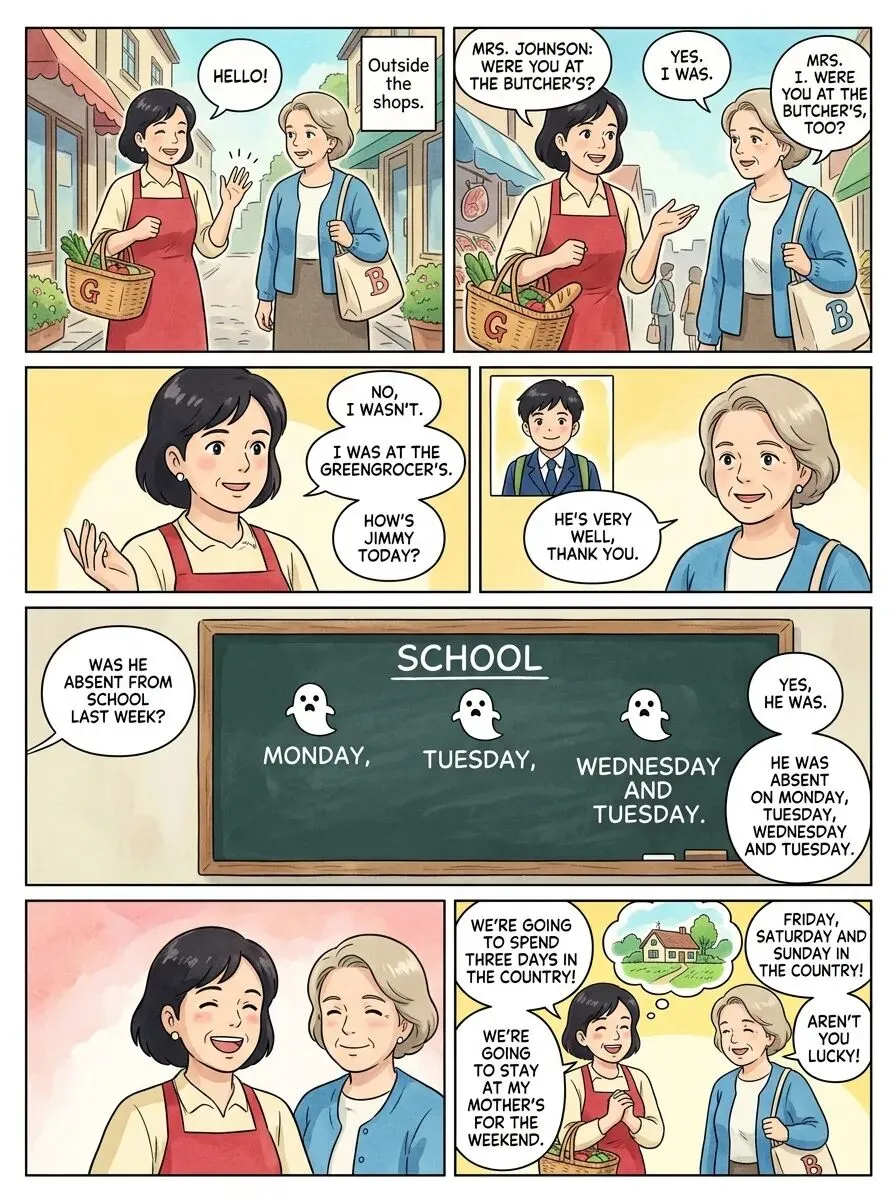
THE WEEKEND
Mrs. Williams: Hello. Were you at the butcher's?
Mrs. Smith: Yes, I was. Were you at the butcher's, too?
Mrs. Williams: No, I wasn't. I was at the greengrocer's. How's Jimmy today?
Mrs. Smith: He's very well, thank you.
Mrs. Williams: Was he absent from school last week?
Mrs. Smith: Yes, he was. He was absent on Monday, Tuesday, Wednesday and Thursday. How are you all keeping?
Mrs. Williams: We're all very well, thank you.
Mrs. Smith: Wasn't it a terrible day!
Mrs. Williams: Yes, wasn't it!
Mrs. Smith: Aren't you lucky! I was at the greengrocer's. Did you enjoy the weekend?
Mrs. Smith: Yes, thank you. We had roast beef and potatoes.
Mrs. Williams: Oh!
Mrs. Smith: What did you do?
Mrs. Williams: We stayed at home! The weather was terrible.
Mrs. Smith: What a pity!
📜 语音标注要点
- Were you at the butcher's?:Were you 常连读为 /wɜːr juː/ 或快速口语中近似 /wɜːrjə/。butcher's 尾音 /z/ 轻读。
- Yes, I was.:was 在肯定短句中通常重读,音调平稳或略降。
- No, I wasn't.:wasn't 发音为 /ˈwɒznt/,注意 /t/ 在快速口语中可能失去爆破。
- How's Jimmy today?:How's 是 How is 的缩写,连读为 /haʊz/。
- He was absent on Monday...:on 与 Monday 连读为 /ɒn ˈmʌndeɪ/。列举星期时,语调在最后一个(Thursday)前为升调,最后为降调。
- Wasn't it a terrible day!:这是一个否定疑问句形式的感叹句,Wasn't it 语调上扬,terrible day 重读并降调,表达强烈情绪。
- Yes, wasn't it!:附和对方,wasn't it 语调同样上扬,表示赞同。
- Did you enjoy the weekend?:Did you 常连读为 /dɪd juː/ 或 /ˈdɪdʒə/。enjoy 重读。
- We had roast beef and potatoes.:had 弱读为 /həd/,roast beef 和 potatoes 为重读词。
- We stayed at home!:stayed at 可以连读为 /steɪd æt/。
情景说明:本课对话发生在某个工作日(很可能是周一上午),地点可能在社区街道或商店附近。威廉姆斯夫人(Mrs. Williams)和史密斯夫人(Mrs. Smith)两位邻居或熟人相遇。她们从询问对方刚才是否在肉店(butcher's)开始寒暄,自然地过渡到关心彼此家人的健康状况(询问Jimmy和全家)。接着,她们对刚刚过去的周末天气发出一致感叹,并由此引出周末活动的核心话题:史密斯一家享受了丰盛的周日烤肉大餐,而威廉姆斯一家因为天气糟糕只能呆在家里。对话充满了日常闲聊的典型元素:问候、关心、抱怨天气、分享生活琐事,展现了英国家庭主妇之间亲切、琐碎而又充满人情味的交流方式。
参考译文:第67课 周末威廉姆斯夫人:您好。刚才您在肉店里吗?史密斯夫人:是的,我在。您也在肉店里吗?威廉姆斯夫人:不,我不在。我在蔬菜水果店里。吉米今天好吗?史密斯夫人:他很好,谢谢您。威廉姆斯夫人:上星期他没去上学吧?史密斯夫人:是的,他没去。他星期一、星期二、星期三和星期四没去上学。你们身体都好吗?威廉姆斯夫人:我们都很好,谢谢您。史密斯夫人:那天天气真糟啊!威廉姆斯夫人:是的,可不是嘛!史密斯夫人:你们真幸运!我那时在蔬菜水果店里。你们周末过得愉快吗?史密斯夫人:是的,谢谢。我们吃了烤牛肉和土豆。威廉姆斯夫人:噢!史密斯夫人:你们做什么了?威廉姆斯夫人:我们呆在家里了!天气太坏了。史密斯夫人:真可惜!
🔍 第二部分:逐句精讲与词块总结
句子1
原文: Hello. Were you at the butcher's?
翻译: 您好。刚才您在肉店里吗?
句子结构: 这是一个由简单问候语和一般疑问句组成的复合句。- Hello.:感叹词,独立成分,用于打招呼。- Were you at the butcher's?:主系表结构的一般疑问句。- Were:系动词 be 的过去式复数/第二人称单数形式,位于句首构成疑问。- you:主语,人称代词。- at the butcher's:介词短语作表语,表示地点。
重点词汇:
butcher 蓝思值 700L
英音 /ˈbʊtʃə(r)/ 美音 /ˈbʊtʃər/ 词性:n.
释义:屠夫;肉贩;肉店老板
常用语块:at the butcher's (在肉店)
例句一:My father bought some lamb chops from the butcher. 我父亲从肉贩那里买了一些羊排。
例句二:The butcher is very skilled at cutting meat. 这位屠夫切肉的技艺非常高超。
拓展:butcher's 是所有格形式表示店铺,类似用法有 the baker's (面包店), the grocer's (食品杂货店)。记忆窍门:可与 butchery (屠宰场;屠杀) 联想,但后者含义更负面。
语法点睛: 本句的核心语法点是 一般过去时的一般疑问句,具体为动词 be 的过去式 (was/were) 构成的疑问句。规则是将 was 或 were 提至句首。[NCE知识点笔记]- 表意功能:询问在过去某个特定时间(此处是对话发生前一刻)主语的状态或位置。- 结构:Was/Were + 主语 + 其他成分(表语/状语等)?- 例句:Were they at home last night? (他们昨晚在家吗?) Was she happy yesterday? (她昨天开心吗?)
语音要点: Were you 是常见的连读组合,发音时 /r/ 音与 /j/ 音平滑连接。butcher's 中的 's 发清辅音 /s/,因为 butcher 以清辅音 /tʃ/ 结尾。整个疑问句语调应为升调 ↗。
句子2
原文: Yes, I was. Were you at the butcher's, too?
翻译: 是的,我在。您也在肉店里吗?
句子结构: 两个简单句。- Yes, I was.:主系表结构的肯定简短回答。I 为主语,was 为系动词。- Were you at the butcher's, too?:主系表结构的一般疑问句,结构与句子1完全相同,末尾添加副词 too 表示“也”。
重点词汇:
too 蓝思值 BR10L
英音 /tuː/ 美音 /tuː/ 词性:adv.
释义:也;还;而且;过于
常用语块:me too (我也是);too... to... (太...而不能...)
例句一:I like apples, and I like oranges too. 我喜欢苹果,也喜欢橘子。
例句二:The coffee is too hot to drink. 咖啡太烫了,没法喝。
拓展:注意与 also (通常用于句中) 和 either (用于否定句句末) 的区别。too 通常用于肯定句句末,前面常有逗号隔开。
语法点睛: 本句展示了 一般过去时一般疑问句的肯定简短回答:Yes, 主语 + was/were. 以及 用 too 表示“也” 在疑问句中的位置,通常置于句末,用逗号隔开显得更正式。[NCE知识点笔记]- 否定简短回答为:No, 主语 + wasn't/weren't.- too 表示“也”时,不能直接跟在名词或代词后,不能说 “I too was there.” (除非是非常正式的文体),而应说 “I was there too.” 或 “I, too, was there.”
语音要点: Yes, I was. 中 was 重读,语调下降。too 在句末通常轻读,音调不高。
句子3
原文: No, I wasn't. I was at the greengrocer's.
翻译: 不,我不在。我在蔬菜水果店里。
句子结构: 两个简单句。- No, I wasn't.:主系表结构的否定简短回答。- I was at the greengrocer's.:主系表结构的肯定陈述句。I 为主语,was 为系动词,at the greengrocer's 为介词短语作表语。
重点词汇:
greengrocer 蓝思值 900L
英音 /ˈɡriːnɡrəʊsə(r)/ 美音 /ˈɡriːnɡroʊsər/ 词性:n.
释义:蔬菜水果零售商;果蔬店
常用语块:at the greengrocer's (在蔬菜水果店)
例句一:We buy fresh vegetables from the local greengrocer. 我们从本地果蔬店买新鲜蔬菜。
例句二:The greengrocer sells a variety of fruits and vegetables. 这个果蔬商出售各种各样的水果和蔬菜。
拓展:这是一个合成词:green (绿色的,指蔬菜) + grocer (食品杂货商)。类似的店铺表达:the greengrocer's。
语法点睛: 本句巩固了 一般过去时一般疑问句的否定简短回答 (wasn't = was not) 以及 肯定陈述句 (主语 + was/were + 其他) 的结构。同时再次呈现了 名词所有格 ('s) 表示店铺 的用法。[NCE知识点笔记]
语音要点: wasn't 发音为 /ˈwɒznt/,注意 /t/ 在快速口语中可能不明显。greengrocer's 发音较长,注意重音在第一个音节 /ˈɡriːn-/。
句子4
原文: How's Jimmy today?
翻译: 吉米今天好吗?
句子结构: 主系表结构的特殊疑问句。- How's:How is 的缩写,How 为疑问副词,is 为系动词。- Jimmy:主语,专有名词。- today:时间状语。
重点词汇:
today 蓝思值 BR10L
英音 /təˈdeɪ/ 美音 /təˈdeɪ/ 词性:n. & adv.
释义:今天;现今
常用语块:today's news (今日新闻);up to today (直到今天)
例句一:Today is Monday. 今天是星期一。(n.)
例句二:What are you going to do today? 你今天打算做什么?(adv.)
拓展:注意与 yesterday (昨天) 和 tomorrow (明天) 对应。today 作副词时,常置于句首或句末。
语法点睛: 本句是 用 How 询问某人近况或健康状态 的常见句型。How + be动词 + 主语 (+ 时间状语)?这是一个固定交际用语,用于日常寒暄。[NCE知识点笔记]- 回答通常是:主语 + be动词 + fine/well/all right, thank you.
语音要点: How's 连读为 /haʊz/。Jimmy 名字重读。整个句子语调为降调,因为是询问具体信息的问句。
句子5
原文: He's very well, thank you.
翻译: 他很好,谢谢您。
句子结构: 主系表结构的陈述句 + 礼貌用语。- He's:He is 的缩写,He 为主语,is 为系动词。- very well:very 为程度副词修饰形容词 well,well 作表语,表示“身体健康”。- thank you:固定短语,表示感谢。
重点词汇:
well 蓝思值 BR10L
英音 /wel/ 美音 /wel/ 词性:adj. (通常作表语) & adv. & interj.
释义:健康的;良好的;好地;嗯(叹词)
常用语块:feel well (感觉身体好);do well in (在...方面做得好)
例句一:I don't feel very well today. 我今天感觉不太舒服。(adj.)
例句二:She speaks English very well. 她英语说得非常好。(adv.)
拓展:作形容词表示“健康”时,通常只作表语,不作定语。作定语的“健康的”用 healthy。well 的比较级和最高级是 better, best。
语法点睛: 本句是 对健康状况询问的标准礼貌回应。well 作为形容词(表语)表示“身体好”,前面可以用 very, quite, pretty 等副词修饰。thank you 是必不可少的礼貌结语。[NCE知识点笔记]
语音要点: He's 轻读。very well 重读,尤其是 well。thank you 可以连读为 /θæŋk juː/。
句子6
原文: Was he absent from school last week?
翻译: 上星期他没去上学吧?
句子结构: 主系表结构的一般疑问句。- Was:系动词 be 的过去式单数形式,位于句首构成疑问。- he:主语。- absent from school:形容词短语作表语。absent 是形容词,from school 是其补足语,说明缺席的场所。- last week:时间状语。
重点词汇:
absent 蓝思值 800L
英音 /ˈæbsənt/ 美音 /ˈæbsənt/ 词性:adj.
释义:缺席的;不在场的;心不在焉的
常用语块:be absent from (缺席...);absent-minded (心不在焉的)
例句一:Three students were absent from class today. 今天有三名学生缺课。
例句二:He had an absent look on his face. 他脸上带着心不在焉的神情。
拓展:反义词是 present (出席的)。注意介词搭配 from。absence 是其名词形式。
school 蓝思值 BR10L
英音 /skuːl/ 美音 /skuːl/ 词性:n.
释义:学校;上学;学业;学派
常用语块:go to school (去上学);after school (放学后);primary school (小学)
例句一:Children go to school to learn. 孩子们去学校学习。
例句二:There are many different schools of thought in philosophy. 哲学中有许多不同的思想流派。
拓展:表示“上学”这个抽象活动时,前面不加冠词,如 at school, go to school。表示具体的建筑物时,可加冠词,如 in front of the school。
语法点睛: 本句继续练习 一般过去时 be 动词的一般疑问句。引入了 形容词 absent 与介词 from 的固定搭配,用于描述缺席某场合。时间状语 last week 明确了动作发生的时间范围。[NCE知识点笔记]
语音要点: Was he 可以连读为 /wɒz iː/ 或 /wɒzi/。absent from 中,absent 重音在第一音节,from 轻读并与 school 连接。last week 两个词都重读。
句子7
原文: Yes, he was. He was absent on Monday, Tuesday, Wednesday and Thursday.
翻译: 是的,他没去。他星期一、星期二、星期三和星期四没去上学。
句子结构: 两个简单句。- Yes, he was.:肯定简短回答。- He was absent on Monday, Tuesday, Wednesday and Thursday.:主系表结构的陈述句。on Monday... 是介词短语作时间状语,并列了四个具体日期。
重点词汇:
Monday 蓝思值 BR10L, Tuesday (蓝思值 BR10L), Wednesday (蓝思值 BR10L), Thursday (蓝思值 BR10L)
英音 /ˈmʌndeɪ/, /ˈtjuːzdeɪ/, /ˈwenzdeɪ/, /ˈθɜːzdeɪ/ 美音 /ˈmʌndeɪ/, /ˈtuːzdeɪ/, /ˈwenzdeɪ/, /ˈθɜːrzdeɪ/ 词性:n.
释义:星期一,星期二,星期三,星期四
常用语块:on Monday (在星期一);next Tuesday (下周二)
例句一:We have a meeting every Monday morning. 我们每周一早上开会。
例句二:The deadline is next Thursday. 截止日期是下周四。
拓展:星期名称要大写。介词用 on。文化背景:源自盎格鲁-撒克逊神话神祇(如 Wednesday 源于 Woden's day)。
语法点睛: 本句展示了 用介词 on 加星期几来表示在具体某一天。并列多个星期时,通常在最后一个前用 and 连接,前面用逗号分隔。同时,句子隐含了 from school 的省略,因为上文已提及,这是英语中常见的避免重复的方式。[NCE知识点笔记]
语音要点: 列举星期时,语调在前几个(Monday, Tuesday, Wednesday)上为升调 ↗,在最后一个(Thursday)上为降调 ↘。and 通常轻读为 /ənd/ 或 /ən/。
句子8
原文: How are you all keeping?
翻译: 你们身体都好吗?
句子结构: 主系表结构的特殊疑问句,现在时。- How:疑问副词。- are:系动词。- you all:主语,you 指代复数“你们”,all 是代词,强调“全部”。- keeping:现在分词,与 are 构成现在进行时,但在此处是固定短语,表示“身体状况如何”。
重点词汇:
keep 蓝思值 500L
英音 /kiːp/ 美音 /kiːp/ 词性:v.
释义:保持;保留;遵守;经营;饲养
常用语块:keep quiet (保持安静);keep a diary (记日记);keep fit (保持健康)
例句一:Please keep this secret. 请保守这个秘密。
例句二:How are you keeping? (= How are you?) 你身体好吗?(固定问候)
拓展:keep 含义极广,是本课重点多义词。How are you keeping? 是一种比 How are you? 更亲切、略显陈旧的问候方式,尤见于英国英语。
语法点睛: 本句引入了一个 固定的问候用语 How are you keeping?。虽然形式上像是现在进行时 (be + V-ing),但 keep 在这里不是表示动作,而是表示“维持(某种状态)”,整个短语等同于 How are you? 或 How are you getting along?,用于询问对方(们)的整体近况,特别是健康和生活状况。[NCE知识点笔记]
语音要点: you all 可以连读为 /juː ɔːl/。keeping 重读。句子语调为降调。
句子9
原文: We're all very well, thank you.
翻译: 我们都很好,谢谢您。
句子结构: 主系表结构的陈述句。- We're:We are 的缩写。- all:副词,修饰 very well,意为“全都”。- very well:表语。- thank you:礼貌用语。
重点词汇: (本句词汇已在前文覆盖,重点是 all 作为副词修饰整体的用法。)
语法点睛: 这是对 How are you all keeping? 的标准回答。all 作为副词,放在系动词 be 之后,表语形容词之前,用于强调主语中每一个成员的状态。结构:主语 + be + all + 表语。[NCE知识点笔记]
语音要点: We're all 连读,all 和 very well 重读。
句子10
原文: Wasn't it a terrible day!
翻译: 那天天气真糟啊!
句子结构: 这是一个 否定疑问句形式表示的感叹句。- Wasn't:Was not 的缩写,系动词否定式置于句首。- it:主语,指代天气或刚过去的那个(周末)日子。- a terrible day:名词短语作表语。
重点词汇:
terrible 蓝思值 600L
英音 /ˈterəbl/ 美音 /ˈterəbl/ 词性:adj.
释义:可怕的;很糟的;剧烈的
常用语块:terrible weather (糟糕的天气);a terrible accident (一场可怕的事故)
例句一:I have a terrible headache. 我头疼得厉害。
例句二:The food at that restaurant was terrible. 那家餐馆的食物糟透了。
拓展:口语中常用表示“很糟的”,程度较强。近义词有 awful, horrible。反义词可以是 wonderful, great。
语法点睛: 本句是 用否定疑问句 (Wasn't it...?) 来表达强烈的肯定感叹。这是一种常见的口语修辞手法,并非真正提问,而是期待对方认同。说话人坚信“那天很糟”,用反问形式加强语气。回答时也用同样结构 Yes, wasn't it! 表示完全同意。[NCE知识点笔记]
语音要点: 作为感叹句,Wasn't it 语调上扬 ↗,a terrible day 重读且语调下降 ↘,表达强烈的感慨。
句子11
原文: Yes, wasn't it!
翻译: 是的,可不是嘛!
句子结构: 附和性的感叹句,省略了表语 a terrible day。- Yes:表示同意。- wasn't it:重复对方的否定疑问结构,表示强烈赞同。
语法点睛: 这是对上述否定疑问式感叹的标准附和。完整形式是 Yes, wasn't it a terrible day! 口语中常省略相同的部分。这种附和表明双方共享同一种感受或经历。[NCE知识点笔记]
语音要点: Yes 短促,wasn't it 语调上扬 ↗,带有赞同和感慨的语气。
句子12
原文: Aren't you lucky!
翻译: 你们真幸运!
句子结构: 否定疑问句形式表示的感叹句。- Aren't:Are not 的缩写,系动词否定式现在时置于句首。- you:主语。- lucky:形容词作表语。
重点词汇:
lucky 蓝思值 500L
英音 /ˈlʌki/ 美音 /ˈlʌki/ 词性:adj.
释义:幸运的;吉祥的
常用语块:lucky dog (幸运儿);lucky charm (幸运符)
例句一:You're so lucky to have such a good friend. 你有这么好的朋友真幸运。
例句二:Seven is considered a lucky number in many cultures. 在许多文化中,7被视为吉祥数字。
拓展:名词形式是 luck。反义词是 unlucky。lucky 描述人,fortunate 更正式。
语法点睛: 与句子10同理,用 Aren't you + adj. 的结构表达强烈的感叹,意思是“你们多么...啊!”。这里史密斯夫人可能认为威廉姆斯夫人一家(可能因为没像她一样在糟糕天气出门?)是幸运的。这也是一种加强语气的修辞问句。[NCE知识点笔记]
语音要点: Aren't you 语调上扬 ↗,lucky 重读且降调 ↘。
句子13
原文: Did you enjoy the weekend?
翻译: 你们周末过得愉快吗?
句子结构: 一般过去时的一般疑问句,谓语是实义动词 enjoy。- Did:助动词 do 的过去式,置于句首构成疑问,本身无实义。- you:主语。- enjoy:实义动词原形。- the weekend:名词短语作宾语。
重点词汇:
enjoy 蓝思值 400L
英音 /ɪnˈdʒɔɪ/ 美音 /ɪnˈdʒɔɪ/ 词性:v.
释义:享受...的乐趣;喜爱;拥有
常用语块:enjoy oneself (玩得高兴);enjoy doing sth. (喜欢做某事)
例句一:I really enjoyed the concert last night. 我非常喜欢昨晚的音乐会。
例句二:Did you enjoy yourself at the party? 你在派对上玩得开心吗?
拓展:后面接名词或动名词 (enjoy doing),不能接不定式 (enjoy to do 是错误的)。enjoyable 是形容词。
weekend 蓝思值 BR10L
英音 /ˌwiːkˈend/ 美音 /ˈwiːkend/ 词性:n.
释义:周末(通常指星期六和星期日)
常用语块:at the weekend (在周末);weekend trip (周末旅行)
例句一:What are your plans for the weekend? 你周末有什么计划?
例句二:We often go hiking on weekends. 我们周末常去徒步。
拓展:介词可以用 at (英式常见) 或 on (美式常见)。复数 weekends 表示“在周末”这个泛指概念。
语法点睛: 本课核心语法点——实义动词一般过去时的一般疑问句。当谓语是实义动词(非 be 动词)时,构成过去时疑问句需要在句首添加助动词 Did,并将句中的主要动词恢复为原形。结构:Did + 主语 + 动词原形 + 其他?[NCE知识点笔记]- 表意功能:询问过去发生的动作或事件。- 本句中 enjoy 是主要动词,在疑问句中用了原形,而其过去时意义由 Did 体现。
语音要点: Did you 常连读为 /dɪd juː/ 或 /ˈdɪdʒə/。enjoy 和 weekend 重读。句子语调为升调 ↗。
句子14
原文: Yes, thank you. We had roast beef and potatoes.
翻译: 是的,谢谢。我们吃了烤牛肉和土豆。
句子结构: 两个简单句。- Yes, thank you.:肯定回答加礼貌用语。- We had roast beef and potatoes.:主谓宾结构的陈述句。We 为主语,had 为谓语动词过去式,roast beef and potatoes 为并列宾语。
重点词汇:
had 蓝思值 BR10L
英音 /hæd/ 美音 /hæd/ 词性:v. (have 的过去式和过去分词)
释义:有;吃;喝;进行;经历(过去式)
常用语块:had breakfast (吃了早餐);had a good time (过得愉快)
例句一:I had a sandwich for lunch. 我午餐吃了个三明治。
例句二:We had a meeting yesterday afternoon. 我们昨天下午开了个会。
拓展:have 是多功能动词,既可作实义动词(如本句“吃”),也可作助动词(构成完成时)。过去式 had 用于所有人称。
roast 蓝思值 700L
英音 /rəʊst/ 美音 /roʊst/ 词性:v., adj., n.
释义:烤;烘烤的;烤肉
常用语块:roast beef (烤牛肉);roast chicken (烤鸡);roast potatoes (烤土豆)
例句一:We roasted chestnuts over the fire. 我们在火上烤栗子。(v.)
例句二:I love Sunday roast dinner. 我喜欢周日烤肉大餐。(n.)
拓展:作形容词时常置于名词前,如 roast duck (烤鸭)。这是英式家庭周日午餐的传统主菜。
potato 蓝思值 BR10L
英音 /pəˈteɪtəʊ/ 美音 /pəˈteɪtoʊ/ 词性:n.
释义:马铃薯,土豆
常用语块:mashed potato (土豆泥);sweet potato (红薯)
例句一:Would you like some more potatoes? 你想再来点土豆吗?
例句二:Potatoes are a staple food in many countries. 土豆是许多国家的主食。
拓展:复数形式为 potatoes。注意拼写,不是 potatos。
语法点睛: 本句展示了 实义动词一般过去时肯定陈述句 的结构:主语 + 动词过去式 + 其他。动词 have 的过去式 had 用于所有人称。同时,句子介绍了 英式餐饮文化中经典的“周日烤肉” (Sunday roast),通常包括烤肉类(牛肉、鸡肉、羊肉等)和烤土豆、约克郡布丁等配菜。[NCE知识点笔记]
语音要点: We had 中 had 常弱读为 /həd/。roast beef 和 potatoes 为重读词。and 轻读。
句子15
原文: Oh!
翻译: 噢!
句子结构: 感叹词,独立成分。
语法点睛: 感叹词 Oh 在此表达多种可能的情绪:惊讶、羡慕、同情或仅仅是表示听到了对方的话。其具体含义需根据上下文和语调判断。这里是威廉姆斯夫人听到对方享受了大餐后的反应。[NCE知识点笔记]
语音要点: 可以根据情绪发成升调 Oh? (表示疑问或惊讶),或降调 Oh. (表示明白了或失望)。此处结合下文,可能带有轻微的羡慕或对自己遭遇的感慨。
句子16
原文: What did you do?
翻译: 你们做什么了?
句子结构: 一般过去时的特殊疑问句。- What:疑问代词作宾语。- did:助动词 do 的过去式。- you:主语。- do:实义动词原形,与助动词 did 一起构成疑问。
重点词汇:
do 蓝思值 BR10L
英音 /duː/ 美音 /duː/ 词性:v. & aux.v.
释义:做;干;助动词(构成疑问、否定等)
常用语块:do homework (做作业);do business (做生意)
例句一:What did you do last night? 你昨晚做了什么?(v.)
例句二:Do you like coffee? 你喜欢咖啡吗?(aux.v.)
拓展:do 作为实义动词含义广泛,需根据宾语确定具体意思。过去式是 did。
语法点睛: 本句是 实义动词一般过去时的特殊疑问句,询问过去发生的动作。结构:疑问词 + did + 主语 + 动词原形 + 其他? 当疑问词作主语时,结构不同(如 Who came?)。do 在这里是实义动词,意为“做”。[NCE知识点笔记]
语音要点: What did you 可以快速连读为 /ˈwɒt dɪd juː/ 或 /ˈwɒdɪdʒə/。do 重读。语调一般为降调。
句子17
原文: We stayed at home! The weather was terrible.
翻译: 我们呆在家里了!天气太坏了。
句子结构: 两个简单句。- We stayed at home!:主谓结构的陈述句。We 为主语,stayed 为不及物动词过去式作谓语,at home 为地点状语。- The weather was terrible.:主系表结构的陈述句。
重点词汇:
stay 蓝思值 400L
英音 /steɪ/ 美音 /steɪ/ 词性:v.
释义:停留;逗留;保持
常用语块:stay at home (呆在家里);stay healthy (保持健康);stay up late (熬夜)
例句一:I'm going to stay in London for a week. 我将在伦敦呆一周。
例句二:Please stay calm. 请保持冷静。
拓展:stay 通常作不及物动词,后接介词短语(如 at home, in a hotel)或形容词(如 calm, quiet)。
home 蓝思值 BR10L
英音 /həʊm/ 美音 /hoʊm/ 词性:n. & adv.
释义:家;家乡;在家;回家
常用语块:at home (在家);go home (回家);homeland (祖国)
例句一:There's no place like home. 没有任何地方像家一样。(n.)
例句二:I'm going home now. 我现在要回家了。(adv.)
拓展:at home 是固定短语,home 前不加冠词。作副词时,前面也不加介词,如 arrive home。
weather 蓝思值 500L
英音 /ˈweðə(r)/ 美音 /ˈweðər/ 词性:n.
释义:天气;气象
常用语块:weather forecast (天气预报);fine weather (好天气)
例句一:What's the weather like today? 今天天气怎么样?
例句二:The weather is getting warmer. 天气渐渐变暖了。
拓展:不可数名词,不能说 a weather 或 weathers。注意与 climate (气候) 区分,climate 指长期的天气模式。
语法点睛: 本句继续练习 实义动词一般过去时的肯定陈述句 (stayed 是 stay 的规则过去式)。同时,stay at home 是一个常用动词短语。第二句再次使用 be 动词过去式 (was) 描述过去的状态(天气)。两句结合,解释了前一句 (What did you do?) 的原因。[NCE知识点笔记]
语音要点: stayed at home 可以连读,stayed at /steɪd æt/。home 重读。The weather was terrible. 中 weather 和 terrible 重读,表达无奈或抱怨。
句子18
原文: What a pity!
翻译: 真可惜!
句子结构: 省略的感叹句。完整形式可为 What a pity it is!- What a pity:名词短语,What 是感叹形容词,a pity 是中心词。- 省略了主语 it 和系动词 is。
重点词汇:
pity 蓝思值 600L
英音 /ˈpɪti/ 美音 /ˈpɪti/ 词性:n.
释义:怜悯;遗憾;可惜的事
常用语块:What a pity! (真可惜!);It's a pity that... (遗憾的是...)
例句一:It's a great pity that you can't come to the party. 你不能来参加聚会真是太遗憾了。
例句二:I feel pity for those who lost their homes. 我为那些失去家园的人感到难过。
拓展:What a pity! 是固定表达,用于对不幸或令人失望的事情表示同情或遗憾。
语法点睛: 本句是 由 What 引导的名词性感叹句 的省略形式。结构:What (+ a/an) + (形容词) + 名词 + (主语 + 谓语)!常用于口语中省略主语和谓语。这是表达同情或遗憾的常见社交用语。[NCE知识点笔记]
语音要点: What a 连读为 /ˈwɒt ə/。pity 重读且降调,表达真诚的惋惜。
📌 核心词块总结
1. at the butcher's/greengrocer's -- at the shop of the butcher/greengrocer. (在肉店/果蔬店)- Example: I need to stop at the butcher's to buy some mince.
2. be absent from school -- not be present at school. (缺课,没上学)- Example: You must bring a note if you are absent from school.
3. How are you keeping? -- How are you? (A slightly old-fashioned, friendly greeting about one's health and general state.) (您身体好吗?)- Example: Hello, Mrs. Brown! How are you keeping these days?
4. roast beef and potatoes -- a traditional British Sunday lunch dish. (烤牛肉和土豆)- Example: For Sunday dinner, we often have roast beef and potatoes with gravy.
5. stay at home -- remain in one's house, not go out. (呆在家里)- Example: On rainy days, I prefer to stay at home and read a book.
6. What a pity! -- That's unfortunate/sad. (真遗憾!)- Example: You can't make it to the concert? What a pity!
💬 第三部分:基础会话技巧
1. 分析课文中的日常用语、礼貌表达、问答模式本课对话是邻里间偶遇闲聊的典范,包含多个层次的社交互动:- 开启对话:从具体观察/猜测入手 (Were you at the butcher's?),而非直接问 How are you?,更自然。- 问候与关心:在寒暄后立即转入对家人 (How's Jimmy today?) 和对方全家 (How are you all keeping?) 的关怀,体现了亲密和礼貌。- 共享经历与情绪:通过对糟糕天气的共同抱怨 (Wasn't it a terrible day! -- Yes, wasn't it!) 建立共鸣,这是拉近关系的有效方式。- 话题深入与信息交换:由天气自然过渡到询问周末活动 (Did you enjoy the weekend?),并展开具体细节 (We had..., We stayed...)。- 表达同情:在得知对方因天气未能外出时,及时回应 What a pity!,展现同理心。- 全程礼貌:多次使用 thank you,问句多使用 you 而非 your (如 How's Jimmy? 而非 How's your son?),显得更得体。
2. 提供类似场景的扩展对话示例(场景:两位同事周一早晨在办公室茶水间相遇)A: Morning, Sarah. Were you at the gym before work? I thought I saw you near there.B: Oh, no, I wasn't. I was just at the café next door grabbing a coffee. How's your daughter? Is her cold better?A: Yes, much better, thanks. She was back at school today. How was your weekend?B: It was lovely, thanks. We visited my parents in the countryside. The weather was perfect.A: Sounds wonderful! We just relaxed at home. The garden needed a lot of work.B: Well, at least you got something productive done!
3. 设计简单的角色扮演活动建议- 活动1:周末回顾:学生两人一组。学生A根据卡片提示(如:had a picnic, watched a film, visited grandparents, was ill in bed)描述自己的“上周未”。学生B进行询问 (Did you enjoy...?, What did you do?, Where did you go?) 并做出相应反应 (That sounds nice! / What a pity! / Oh dear!)。- 活动2:商店猜猜看:一位学生模仿在某个商店(如 baker's, chemist's, newsagent's)购物的动作。另一位学生用 Were you at the...?'s? 来猜测。猜对后,可以简单对话,如 What did you buy? -- I bought some bread/a magazine.。- 活动3:天气与活动:老师展示不同的天气图标(艳阳、大雨、大风、雪)。学生结对,一人抽天气卡,一人抽活动卡(如 go to the park, have a barbecue, go shopping, stay at home)。根据抽到的组合,进行对话。例如:(大雨 + go to the park)A: Did you go to the park at the weekend? B: No, I didn't. The weather was terrible. I stayed at home. A: What a pity!
4. 融入基础思考:设计1-2个简单的代入式问题- 问题1: 如果你是Mrs. Williams,在听到Mrs. Smith一家吃了丰盛的roast beef后,除了说“Oh!”,你心里可能会有什么感觉?为什么?- 问题2: 为什么Mrs. Smith在听说Mrs. Williams一家因为天气不好呆在家里后,会说“What a pity!”?这显示了她们之间什么样的关系?
📐 第四部分:本课语法精析(加强版)
本课语法重点是一般过去时 (Simple Past Tense) 的深化学习,特别是实义动词过去式的疑问句和否定句构成,并与 be 动词过去式进行对比整合。以下分析综合自知识库核心语法资料。
1. 一般过去时的核心意义与时间状语 [NCE知识点笔记],[语法新思维]一般过去时表示在过去某个特定时间发生并已完成的动作或状态。它常与表示过去的时间状语连用,这是判断时态的关键信号。- 本课出现的时间状语:- last week (上星期)- on Monday, Tuesday... (在星期一、二...——指刚过去的那些天)- the weekend (指刚过去的周末)- 上下文暗示:Were you at the butcher's? (对话发生前的一刻);Wasn't it a terrible day! (刚过去的那天,指周末)。- 其他常见过去时间状语:yesterday, ... ago (如 two days ago), in 1990, just now, this morning (如果说话时已是下午或晚上)。
2. 动词 be 的过去式 (was/were) 的用法总结 [名师精讲],[NCE知识点笔记]be 动词的过去式有两种形式:was (用于第一、三人称单数) 和 were (用于第二人称单、复数及各人称复数)。-肯定句:主语 + was/were + 其他。- I/He/She/Itwasat home. 我/他/她/它当时在家。- You/We/Theywereat home. 你(们)/我们/他们当时在家。-否定句:主语 + was/were + not + 其他。(was not = wasn't; were not = weren't)- Iwas not(wasn't) busy yesterday. 我昨天不忙。- Theywere not(weren't) happy with the result. 他们对结果不满意。-一般疑问句:Was/Were + 主语 + 其他? 回答:Yes, 主语 + was/were. / No, 主语 + wasn't/weren't.-Were youlate? 你迟到了吗? --- Yes, Iwas. / No, Iwasn't.-Was shea teacher? 她以前是老师吗? --- Yes, shewas. / No, shewasn't.-特殊疑问句:疑问词 + was/were + 主语 + 其他?-Where wereyou last night? 你昨晚在哪?-How was the film? 那部电影怎么样?
3. 实义动词一般过去时的构成(重点:规则动词)[语法新思维],[NCE知识点笔记]绝大多数动词的过去式是通过在原形后加 -ed 构成,称为规则动词。其疑问句和否定句需要借助助动词 did。- 规则动词过去式构成规则:1. 一般情况下直接加 -ed:work → worked; stay → stayed; enjoy → enjoyed.2. 以不发音的 e 结尾,加 -d:live → lived; like → liked.3. 以“辅音字母+y”结尾,变 y 为 i 再加 -ed:study → studied; carry → carried. (注意:enjoy 以元音字母+y结尾,直接加 -ed)4. 以重读闭音节结尾,且末尾只有一个辅音字母,双写该辅音字母再加 -ed:stop → stopped; plan → planned.- 读音规则:- 在清辅音后读 /t/:worked /wɜːkt/, helped /helpt/。- 在浊辅音或元音后读 /d/:lived /lɪvd/, stayed /steɪd/, enjoyed /ɪnˈdʒɔɪd/。- 在 /t/, /d/ 音后读 /ɪd/:wanted /ˈwɒntɪd/, needed /ˈniːdɪd/。
4. 实义动词一般过去时的句式结构(与 be 动词对比)[名师精讲],[语法一学就会]这是本课最关键的语法升级点。必须明确区分 be 动词句和实义动词句在过去时中的不同构成方式。核心区别记忆口诀:“Be” 自带变身技 (was/were),直问直答真容易;“实义” 需要 “Did” 帮,动词必须回原形。
5. 本课涉及的动词过去式分析- be → was/were: 不规则变化。- have → had: 不规则变化。- stay → stayed: 规则变化,直接加 -ed。- do → did: 不规则变化(在疑问句中作助动词 did,在特殊疑问句 What did you do? 中,第一个 did 是助动词,第二个 do 是实义动词原形)。- enjoy → enjoyed: 规则变化,直接加 -ed。
6. 否定疑问句用作感叹句的语法现象 [NCE知识点笔记]如 Wasn't it a terrible day! 和 Aren't you lucky!。这不是真正的疑问,而是修辞性问句 (Rhetorical Question),用来表达强烈的感情(惊讶、赞叹、责备等),并期望听者同意。回答时也用同样的结构表示附和,如 Yes, wasn't it!。这种用法在口语中非常普遍,能使语言更生动有力。
7. 介词 on 与星期的连用 [同步语法强化]表示在具体的某一天(包括星期几和日期),用介词 on。- on Monday (在星期一)- on Tuesday morning (在星期二早上)- on 5th May (在五月五日)- on a sunny day (在一个晴朗的日子)对比:in the morning (在早上),但 on Monday morning (在星期一早上)。
8. 练习题(不少于10道)①用 was, were, did 填空。1. Where ______ you yesterday evening? You ______ not at home.2. ______ they enjoy the concert last night?3. What ______ your brother ______ after school? (do)4. ______ it cold last winter? Yes, it ______.5. I ______ not see him because I ______ at the library.6. ______ you at the supermarket? No, I ______. I ______ at the post office.7. How ______ your holiday? It ______ great!8. They ______ not go out because the weather ______ awful.9. ______ she buy anything at the shops?10. Why ______ you late for the meeting?②将下列句子改为一般过去时。1. He is at the baker's. (yesterday) → He ______ at the baker's yesterday.2. Do they play tennis? (last Sunday) → ______ they ______ tennis last Sunday?3. We are not hungry. (after the big lunch) → We ______ not hungry after the big lunch.4. She enjoys the film. → She ______ the film.5. I don't stay at home. (last weekend) → I ______ ______ at home last weekend.③根据答句写出合适的问句。1. Q: ______________________________________?A: Yes, I was. I was at the cinema last night.2. Q: ______________________________________?A: We had pizza for dinner.3. Q: ______________________________________?A: No, she wasn't. She was absent on Wednesday.4. Q: ______________________________________ (they/enjoy)?A: Yes, they did. They enjoyed the party very much.5. Q: ______________________________________?A: Because the weather was terrible.
【练习题参考答案】① 1. were, were; 2. Did; 3. did, do; 4. Was, was; 5. did, was; 6. Were, wasn't, was; 7. was, was; 8. did, was; 9. Did; 10. were② 1. was; 2. Did, play; 3. were; 4. enjoyed; 5. did not (didn't) stay③ 1. Were you at the cinema last night? / Where were you last night?2. What did you have for dinner?3. Was she at school on Wednesday? / Was she absent on Wednesday?4. Did they enjoy the party?5. Why did you stay at home? / Why didn't you go out?
✏️ 第五部分:基础练习与活动
1. 跟读与模仿练习-活动:播放课文录音。第一遍,学生只听,注意语音语调。第二遍,学生跟读,模仿录音中的连读 (Were you, Did you)、弱读 (at, was) 和感叹句的语调。重点练习:- Wasn't it a terrible day! (↗ Wasn't it ↘ a terrible day)- Yes, wasn't it! (↗)- What a pity! (↘ pity)-替换练习:用不同地点和活动替换划线部分进行对话练习。A: Were you at thelibrary?B: No, I wasn't. I was at thesports centre.A: Did you enjoy thefilm?B: Yes, we did. Wewent to a restaurantafterwards.A: What did you do?B: Wevisited a museum. The weather wasfantastic.
2. 听力理解题目(假设有一段类似课文的新对话录音)对话内容(供教师朗读或播放):Tom: Hi, Anna. Were you at the park this morning? I thought I saw you.Anna: No, I wasn't. I was at the dentist's. Ugh.Tom: Oh dear. How's your tooth?Anna: It's better now, thanks. How was your weekend?Tom: Not bad. We went to the beach on Saturday. The weather was lovely.Anna: Lucky you! On Sunday, I just stayed at home and cleaned the house.Tom: What a boring way to spend a Sunday!问题:1. Where was Anna this morning?2. Was Tom at the park?3. What was wrong with Anna?4. What did Tom do on Saturday?5. How was the weather on Saturday?6. What did Anna do on Sunday?参考答案:1. She was at the dentist's.2. We don't know. He thought he saw Anna there, but the dialogue doesn't say if he was there.3. She had a tooth problem. / She went to the dentist.4. He went to the beach.5. It was lovely.6. She stayed at home and cleaned the house.
3. 课文简化改写版本(词汇更简单)Woman A: Hi. Were you at the meat shop?Woman B: Yes. Were you there too?Woman A: No. I was at the fruit and vegetable shop. How is your son Jimmy today?Woman B: He is fine, thank you.Woman A: Was he away from school last week?Woman B: Yes. He was away on Monday, Tuesday, Wednesday and Thursday. How are your family?Woman A: We are all fine, thank you.Woman B: The weather last Sunday was very bad!Woman A: Yes, it was!Woman B: You are very lucky! I was at the fruit shop then. Did you have a good weekend?Woman B: Yes, thank you. We ate cooked beef and potatoes.Woman A: Oh!Woman B: What did you do?Woman A: We did not go out. We were at home. The weather was very bad.Woman B: That is too bad!
🤔 第六部分:英文深度思考与拓展(强化版)
A. 层次化英文问题与答案① Level 1 (Factual):1. Q: Where does the conversation in Lesson 67 mainly take place?A: It is not explicitly stated, but it likely takes place on a neighborhood street or near some shops, as they discuss the butcher's and greengrocer's.2. Q: Why was Jimmy absent from school?A: The text does not give a specific reason. It only states that he was absent. It could be because he was ill, as earlier lessons mentioned him having a cold, but this lesson doesn't confirm the reason.3. Q: What did Mrs. Smith's family have for their weekend meal?A: They had roast beef and potatoes.4. Q: What expression does Mrs. Smith use to express her disappointment about the weather?A: She says, “Wasn't it a terrible day!”② Level 2 (Inferential):5. Q: Why does Mrs. Smith say “Aren't you lucky!” to Mrs. Williams? What can you infer about Mrs. Williams's situation at that specific moment?A: Mrs. Smith likely says this because she (Mrs. Smith) was at the greengrocer's when the terrible weather hit, while Mrs. Williams was probably safely indoors. She infers that Mrs. Williams managed to avoid the worst of the bad weather, making her “lucky” by comparison.6. Q: Based on the detailed days of Jimmy's absence, what can we infer about his illness or the reason for his absence?A: The fact that he was absent on Monday, Tuesday, Wednesday, and Thursday, but not Friday, suggests he was probably recovering towards the end of the week. It implies a standard sick leave of nearly a full week, possibly from a bad cold that was mentioned in previous lessons, fitting the timeline of a typical childhood illness.7. Q: What is the effect of the exchange “Wasn't it a terrible day!” — “Yes, wasn't it!”? How does it strengthen the conversation?A: This exchange creates a strong bond between the speakers through shared complaint. It's not a question seeking information, but a rhetorical statement looking for agreement. The immediate positive echo (“Yes, wasn't it!”) confirms they share the same feeling, which is a classic way to build social rapport in British conversation.8. Q: The dialogue shifts from being in a shop to weekend activities. How does Mrs. Smith naturally transition the topic?A: Mrs. Smith transitions by using the bad weather as a bridge. She mentions being at the greengrocer's during the terrible weather and then directly asks, “Did you enjoy the weekend?” The weather serves as the perfect springboard to discuss how each family spent the weekend.③ Level 3 (Evaluative):9. Q: In your opinion, what does the phrase “How are you all keeping?” suggest about the relationship between the two women compared to a simple “How are you?”A: “How are you all keeping?” is a warmer, more personal, and slightly more old-fashioned greeting. It inquires about the family's general health and well-being over a period, not just their state at that exact moment. It suggests a deeper, more caring, and established neighborly relationship compared to a casual “How are you?”.10. Q: If you were to rewrite this dialogue for a modern context (e.g., two friends texting), what elements would stay the same and what would dramatically change?A: The core elements of checking locations, asking about family, and discussing weekend plans would stay. However, the language would change dramatically. “Were you at the butcher's?” might become a check of location sharing. “How's Jimmy?” might be a text query. The weather complaints would include emojis or weather app screenshots. The entire exchange would be fragmented into shorter messages with abbreviations, GIFs, and without formal closings like “What a pity!” which might be replaced by a sad face emoji. The famous roast beef might be a shared photo.
B. 多类型拓展阅读1. 现代场景故事 (Modern Scene Story)Lily was scrolling through her phone on a Monday morning train when a message from her neighbor, Sue, popped up on the community group chat. “@Lily, were you at the farmer's market on Saturday? I thought I saw your blue coat!” Lily quickly typed back. “No, wasn't me lol. I was at the big supermarket getting stuff for a BBQ. How's your cat? Is he better? 🐱” Sue replied with a photo of her tabby cat sleeping. “All good! He was at the vet last week. Were you okay with that crazy storm yesterday? Wasn't it insane?! ⛈️” “Totally! We just stayed in and watched movies. You?” Lily asked. “My parents came over. We had a massive roast dinner. Pure comfort food!” Sue texted. “Sounds amazing! My weekend was so lazy.” “Well, sometimes that's perfect, right? ☺️” Sue replied with a smiley. Their digital chat, full of abbreviations and emojis, still echoed the timeless rhythm of neighborly catch-ups: checking in, sharing news, and bonding over the weather.引导性问题:What two classic topics from Lesson 67 does this modern chat scene still revolve around?2. 文化背景小知识 (Cultural Background Knowledge)The Great British Sunday RoastWhen Mrs. Smith says “We had roast beef and potatoes,” she's talking about a deep-rooted British tradition: the Sunday roast. This isn't just a meal; it's an institution. Historically, on Sundays, people would put a joint of meat in the oven before going to church, and it would be ready when they returned. The roast is typically served with roast potatoes, Yorkshire pudding (a baked batter), seasonal vegetables, and thick gravy. It's a time for families to gather around the table and share a quality meal together. Choosing beef was a sign of a good, prosperous weekend. Even today, while not every family does it every week, a Sunday roast remains a beloved comfort food across the UK, served in homes and countless “gastropubs.” So, Mrs. Smith’s statement instantly gives us a warm, classic image of British domestic life.引导性问题:Why was the Sunday roast a practical meal historically, according to this passage?3. 今昔对比 (Then and Now Contrast)The High Street Grocer vs. The SupermarketIn the era of Mrs. Williams and Mrs. Smith, a trip to the butcher's, the greengrocer's, or the baker's was a regular, almost daily, social event on the local High Street. You knew the shopkeeper by name, and the quality of your roast depended on your relationship with your butcher. These conversations were face-to-face and personal. Today, the landscape has changed drastically. The majority of food shopping happens at large, impersonal supermarkets where you can buy everything at once—from meat to vegetables to cleaning products. The weekly “big shop” is highly efficient but lacks the social interaction. However, there is a modern revival of this tradition in the form of farmers' markets and local artisan shops, where people seek out high-quality products and a sense of community once more.引导性问题:What is a major social difference between shopping at a traditional “High Street” butcher's and a modern supermarket?4. 新潮英语改写 (Trendy English Rewrite)Neighbourhood Catch-Up, Modern StyleWILLIAMS: Hey! You were at the butcher's, right? 👀SMITH: Yep! Were u there too? 😮WILLIAMS: Nah. Hit the greengrocer's instead. How's J? 🤒SMITH: He's good now, ta. Total absentee last week tho. Mon-Thurs. 😷WILLIAMS: Oof! How's the fam holding up?SMITH: We're all grand, thanks!SMITH: That weather tho... 💀WILLIAMS: IKR! The actual worst. 💯SMITH: U guys are lucky. I got caught in it at the greengrocer's. Did you have a good weekend? 👌SMITH: Yeah, was nice. We smashed a roast beef and spuds. 🍖🥔WILLIAMS: Jealous! We just vegged at home. Weather was grim. 🌧️SMITH: Aww, what a shame! Sending good vibes for next weekend! ✨引导性问题:What modern abbreviation in this rewrite means “I know, right?” and echoes the original feeling of “Yes, wasn't it!”?5. 难度略高的拓展阅读 (Slightly Higher Difficulty Extension)The Social Role of 'Small Talk' in British CultureThe dialogue in Lesson 67 is a textbook example of British “small talk,” a form of social communication whose function is not to exchange vital information but to manage social relationships and establish a friendly atmosphere. It operates on a set of unwritten rules. Notice how direct questions about personal matters are avoided early on; the conversation begins with a safe, neutral topic—being at a shop. The weather is then a universally accepted, “safe” topic for expressing shared feeling (“Wasn't it a terrible day!”). This shared complaint, common in British culture, acts as a social glue, creating an immediate in-group understanding. Only after these preliminaries does the conversation safely move to personal plans (the weekend). This framework maintains politeness, avoids potential offense, and navigates privacy boundaries. Mastering small talk, as exemplified by Mrs. Williams and Mrs. Smith, is a crucial social skill that transforms mere acquaintances into neighbors.引导性问题:According to the text, what is the primary function of “small talk” in the conversation between the two women?
🌍 第七部分:日常应用延伸
1. 本课语言点在日常生活中的应用场景- 寒暄与开场白: 当你不知道如何开启对话时,可以模仿课文,以观察到的细节来询问,如“Were you at the gym earlier? I thought I spotted you.” 如果你自己刚从某处回来,可以主动说“Oh, I was just at the grocery store.” 这比简单的“Hello. How are you?”更具体,更容易引出话题。- 询问近况与家人: 除了“How are you?”,可以用“How's your family?” 或更地道的“How are you all keeping?”,显得更亲切友好。当听说朋友孩子康复后,可以用“He's better. I'm so glad to hear that.” 来回应,并结合过去时态询问:“So, was he absent from school last week?”- 规划周末与社交安排: 周初上班时,用“Did you enjoy the weekend?” 是极佳的社交开场。被问到时,可以运用过去时描述:“I went to a new restaurant in town.” 或 “It was a quiet one. We stayed at home and cooked.” 周末前互相问“What are you doing this weekend?”时,也可以呼应今天学到的“roast beef”:“I'm thinking of making a traditional roast beef on Sunday。”- 回应与表达情绪: 当别人分享愉快的经历时,可以说“That sounds amazing!” 或 “Lucky you!”。当听到糟糕的经历时,“What a pity!” 和 “Oh dear!” 都是非常地道的反应。在对天气等共同感受表达强烈认同时,用反问句“Wasn't it awful today?” 绝对能得到“Yes, wasn't it!” 的共鸣回应。
2. 建议简单拓展学习材料- 写作应用: 模仿《新概念英语写作全攻略 (王惠宁编著).pdf》中的方法,用本课的核心句型写一篇关于自己上周末的微型日记,至少使用5个过去式动词,融入至少一句“What a pity!” 或 “Wasn't it...!” 的感叹。- 听力与口语: 使用《会说话的新概念英语单词.pdf》的配套MP3,跟读本课所有核心词汇在不同句型中的发音。利用《新概念英语口语宝典 第1册.pdf》中的“购物”和“周末活动”场景对话进行角色扮演练习。- 语法巩固: 完成《新概念英语同步语法强化 第1册.pdf》中关于一般过去时和be动词过去式的所有练习,甚至可以超前做一部分过去进行时的初级练习,为后续学习铺垫。- 文化扩展: 阅读《新概念英语美文欣赏 第1册.pdf》中描写英国家庭生活和传统文化的短文,寻找与课文相关的文化点(如周日烤肉、英式下午茶)来扩大背景知识。
3. 可附加英美生活小常识- “butcher's” & “greengrocer's”: 这种用所有格's表示店铺的说法很常见,但现代英语中,尤其是大型连锁店,更多直接说“the butcher” 或 “the grocery store”。但在英国,尤其是在谈论本地独立小店时,用the butcher's依然非常地道。- 英式“周末”vs. 美式“周末”: 提到“at the weekend”更偏英式,美式更常用“on the weekend”。课本中的“at the butcher's”和“at the greengrocer's”也是比较典型的英式日常路线。- “How are you keeping?”: 这是一个带点年代感的温馨问候,如果用在对长辈或相识多年的邻居身上,会显得特别真诚和体贴。对年轻人用可能显得有点老派,这时可用“How's it going?” 或 “How are you doing?”。- “What a pity!”: 这句话今天依然很常用,尤其是在英国。它与“What a shame!” 几乎是同义的,都表达真诚的惋惜,不是高高在上的怜悯。
🗂️ 第八部分:本课知识图谱(结构化逻辑图)
本课核心围绕 “在邻里闲谈中回顾过去事件、表达共情与维持关系” 展开。所有语法和词汇均服务于这一真实社交场景。
- 核心对话主题:周末生活与邻里寒暄 (The Weekend & Neighborly Chat)-主要情境1:确认过去某刻的行踪 (Confirming Past Whereabouts)-关键句型1:be动词过去时疑问句- Were you at + [地点]'s? / Was he/she at + [地点]?-功能词汇:were, was, at the butcher's, at the greengrocer's-关键句型2:be动词过去时简短回答- Yes, I was. / No, I wasn't. / Yes, he was. / No, he wasn't.-功能词汇:wasn't, were-主要情境2:关心对方及家人近况 (Inquiring about Well-being)-关键句型3:用How询问当前健康- How's + [人名] + today? / How are you all keeping?-功能词汇:how, keep, well, very well, today-关键句型4:用be absent描述过去缺席- [人名] + was/were + absent from + [地点] + on + [星期].-功能词汇:absent, from, on Monday/Tuesday..., last week-主要情境3:表达强烈共同感受 (Expressing Strong Shared Feelings)-关键句型5:否定疑问句表达感叹- Wasn't it + a/an + [形容词/名词]! / Aren't you + [形容词]!-功能词汇:wasn't, weren't, terrible, lucky-关键句型6:附和性感叹- Yes, wasn't it!-功能词汇:yes, wasn't it-主要情境4:回顾和评价过去经历 (Reviewing Past Experiences)-关键句型7:实义动词过去时一般疑问句- Did + 主语 + 动词原形 + [宾语]?-功能词汇:did, enjoy, do, go, see-关键句型8:实义动词过去时特殊疑问句- What did + 主语 + do? / Where did + 主语 + go?-功能词汇:what, did, do-关键句型9:描述过去的行动与状态- 主语 + 动词过去式 + [状语]. / 主语 + was/were + [形容词/介词短语].-功能词汇:stayed, had, went; was, were, terrible, at home-主要情境5:对他人经历做出共情回应 (Responding Empathetically)-关键句型10:表达遗憾- What a pity!-功能词汇:what, a pity-其他感叹: Oh! / Lucky you! / Sounds nice!
© 本文为狂暴英语教案 · 新概念英语第一册第67-68课
排版设计 · 仅供学习交流使用

贝琪酱英语无痛逆袭站
微信扫描二维码,关注我的账号
 10个月宝宝每天需要喝多少奶粉?

