【狂暴英语教案】新概念英语第一册第79-80课:卡罗尔的购物清单 / 我必须去...
读外刊,接触原汁原味的英文表达,
欢迎关注以下公众号+设为星标+推荐给朋友。▼
📚 狂暴英语教案 · 新概念英语第一册
第79-80课 Carol's Shopping List & I Must Go to the...
卡罗尔的购物清单 / 我必须去...
📘 本课信息教材:新概念英语第一册 · 第79-80课核心功能:家庭购物规划 · 存量描述 · 商店表达语法焦点:have got句型 · some与any · much与many · must · be going to
🎯 本课学习目标
词汇维度:
掌握与购物、日常用品相关的核心词汇,包括食品名称(meat, chicken, eggs, butter等)、购物清单相关表达以及商店名称(grocer's, greengrocer's, butcher's, stationer's, chemist's等)。重点词汇需掌握蓝思值、音标、词性、核心释义及常用搭配。
语法维度:
重点掌握have got句型(表示"有/拥有")在肯定句、否定句和疑问句中的用法,理解have got与have/has作为普通动词在英式与美式英语中的差异。同时掌握some和any在可数名词复数与不可数名词前的用法,以及must表示"必须"的用法。
技能维度(日常对话):
能够运用have got句型谈论自己拥有或需要购买的物品;能够运用"I must go to the + 商店名称"结构表达自己需要去某个地方;能够在实际购物场景中进行简单的对话交流。
文化维度:
了解英美国家的购物习惯和商店类型差异;了解英式英语和美式英语在have got用法上的区别;了解"购物清单"在西方日常生活中的使用习惯。
📖 第一部分:课文完整内容
课文原文(含语音标注)
Lesson 79 Carol's Shopping List
📜 课文原文
Listen to the tape then answer this question: What is Carol not going to buy?
(注:/ˈkærəlz ˈʃɒpɪŋ lɪst/ 卡罗尔的购物清单)
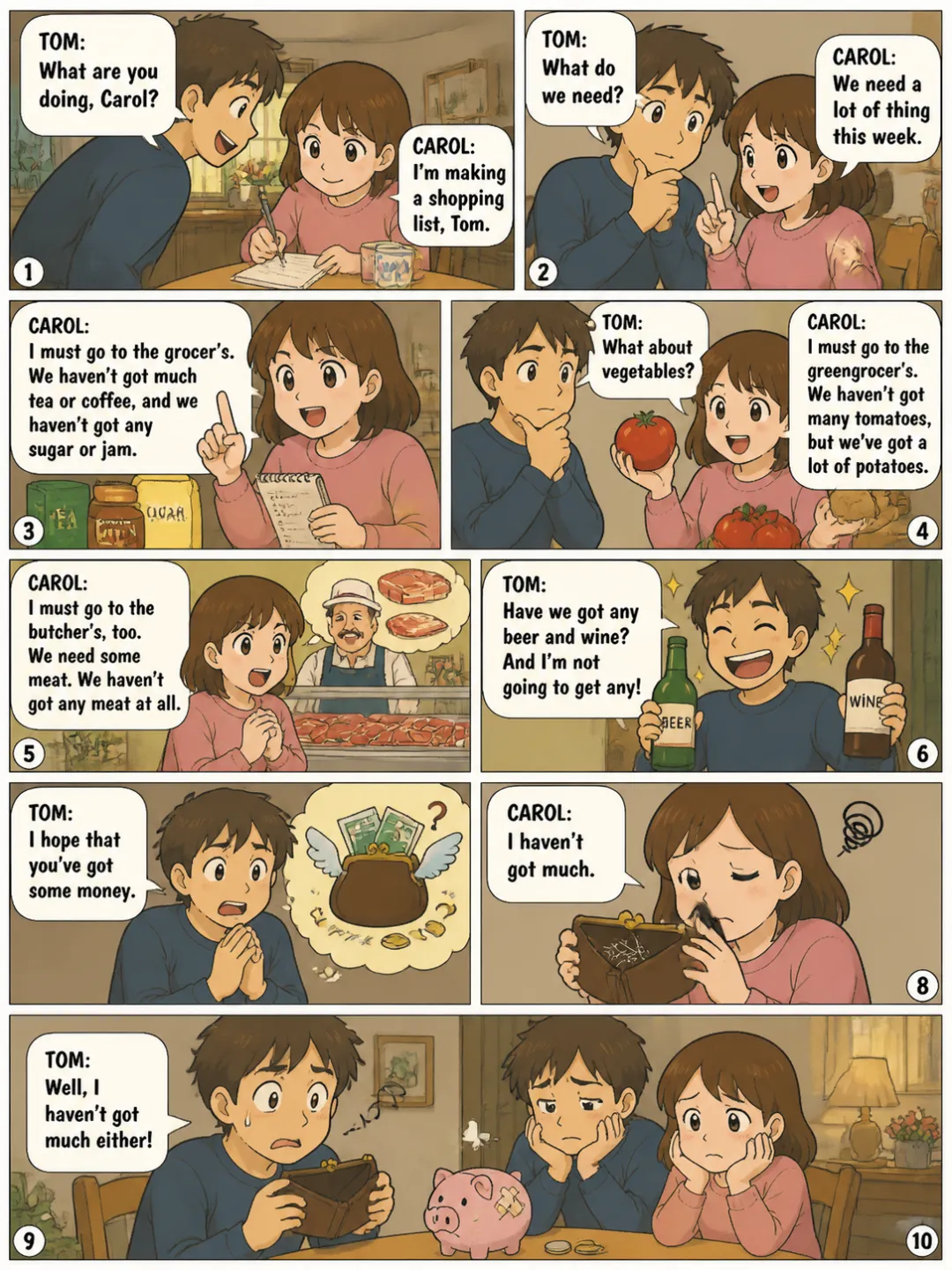
TOM: What are you doing, Carol?
(重音在"doing",语调上扬,表询问)
CAROL: I'm [aɪm] making a shopping list, Tom.
(making中/m/与前句doing连读流畅;"shopping list"重读,强调动作)
TOM: What do we need?
(重点在need,语调上扬)
CAROL: We need a lot of things this week.
("a lot of"连读为/əˈlɒtəv/;"this week"末语调先升后降)
CAROL: I must go to the grocer's. We haven't got much tea or coffee, and we haven't got any sugar or jam.
("I must"重读表必须;"haven't got"连读为/ˈhævənt ɡɒt/;"much tea or coffee"中much强调数量少;"any sugar or jam"中any强调完全没有任何)
TOM: What about vegetables?
("What about"连读,语调上扬)
CAROL: I must go to the greengrocer's. We haven't got many tomatoes, but we've got a lot of potatoes.
("greengrocer's"重读;haven't got many 与 have got a lot of 形成对比)
CAROL: I must go to the butcher's, too. We need some meat. We haven't got any meat at all.
("butcher's"重读;"at all"连读,强调完全没有)
TOM: Have we got any beer and wine?
("Have we got"倒装表疑问;beer and wine 语调先升后降)
CAROL: No, we haven't. And I'm not going to get any!
("No, we haven't"语调降调表否定;"not going to get any"语调加重表拒绝)
CAROL: I must go to the stationer's. We haven't got any envelopes.
("stationer's"重读音节;envelopes重音在第一个音节)
CAROL: I must go to the chemist's, too. We haven't got any aspirin.
("chemist's"重读;aspirin重音在第一个音节)
TOM: What about fruit?
("What about"连读,语调上扬)
CAROL: I must go to the greengrocer's. We haven't got many apples, but we've got a lot of pears.
("many apples"和"a lot of pears"形成对比,语调先升后降)
Lesson 80 I Must Go to the...
📜 课文原文
(本课为句型操练课,围绕"I must go to the + 商店名称"和"I've got some / I haven't got any"进行替换练习)
Example:
I must go to the grocer's. I haven't got any tea.
替换练习项:
1. grocer's / tea (蓝思值 [估算值] 420L)
2. chemist's / aspirin (蓝思值 [估算值] 640L)
3. grocep's / coffee (蓝思值 [估算值] 400L)
4. greengrocer's / apples (蓝思值 [估算值] 380L)
5. stationer's / envelopes (蓝思值 [估算值] 620L)
6. butcher's / meat (蓝思值 [估算值] 390L)
7. stationer's / writing paper (蓝思值 [估算值] 520L)
8. greengrocer's / pears (蓝思值 [估算值] 380L)
9. chemist's / medicine (蓝思值 [估算值] 590L)
10. grocer's / sugar (蓝思值 [估算值] 310L)
11. grocer's / jam (蓝思值 [估算值] 370L)
12. stationer's / glue (蓝思值 [估算值] 350L)
情景说明本课的场景设定在一个普通家庭中。第一课(Lesson 79)中,汤姆看到卡罗尔正在做购物清单(shopping list),于是询问她在做什么以及家里需要什么。卡罗尔逐一列出本周需要购买的物品,包括食品(茶叶、咖啡、糖、果酱)、蔬菜(西红柿、土豆)、肉类(肉)、文具(信封)和药品(阿司匹林)。她根据物品类别,分别说明自己必须去不同的商店:杂货店(grocer's)、蔬菜水果店(greengrocer's)、肉店(butcher's)、文具店(stationer's)和药店(chemist's)。在对话中,卡罗尔通过使用"haven't got much / many / any"和"have got a lot of / some"结构,生动展示了如何描述家中物品的存量情况。第二课(Lesson 80)是句型操练部分,通过替换练习帮助学生巩固"I must go to the + 商店名称"和"I've got some / I haven't got any"这两个核心句型。这一课没有完整的故事情节,而是以结构化练习为主,旨在让学生在实际语境中反复使用目标句型和词汇。从语法角度看,本课的核心是have got句型(表示"有/拥有"),这是英式英语中的常用表达,尤其在日常口语中极为常见。同时,much和many的使用规则(much+不可数名词,many+可数名词复数)、some和any在肯定句和否定句中的区别,以及must表示"必须"的用法,都是本课的重点语法内容。
参考译文第79课 卡罗尔的购物清单汤姆:你在做什么,卡罗尔?卡罗尔:我在列购物清单,汤姆。汤姆:我们需要什么?卡罗尔:这周我们需要很多东西。卡罗尔:我必须去杂货店。我们没有多少茶叶和咖啡了,而且我们也没有糖和果酱了。汤姆:蔬菜呢?卡罗尔:我必须去蔬菜水果店。我们没有多少西红柿了,但我们有很多土豆。卡罗尔:我还必须去肉店。我们需要一些肉。我们什么肉都没有了。汤姆:我们有啤酒和葡萄酒吗?卡罗尔:没有。而且我不打算买!卡罗尔:我必须去文具店。我们没有信封了。卡罗尔:我还必须去药店。我们没有阿司匹林了。汤姆:水果呢?卡罗尔:我必须去蔬菜水果店。我们没有多少苹果了,但我们有很多梨。第80课 我必须去......例如:我必须去杂货店。我没有茶叶了。(以下为替换练习,内容略)
🔍 第二部分:逐句精讲与词块总结
句子1
1. 原文: What are you doing, Carol?
2. 翻译: 你在做什么,卡罗尔?
3. 句子结构: 特殊疑问句。结构为"疑问词(What)+ be动词(are)+ 主语(you)+ 谓语(doing)"。属于主谓宾结构(S+V+O),其中what是宾语。
4. 重点词汇:
what 蓝思值 270L
英音[wɒt] 美音[wʌt] 词性:疑问代词
释义:什么
常用语块:What is...? What are...?
例句一:What is your name? 你叫什么名字?
例句二:What do you want? 你想要什么?
拓展:what是英语中最常用的疑问词之一,可与不同时态和结构搭配。在本句中,what作为宾语使用,询问正在进行的动作。
doing 蓝思值 330L
英音[ˈduːɪŋ] 美音[ˈduːɪŋ] 词性:动词(do的现在分词)
释义:做,正在做
常用语块:doing something(做某事);What are you doing?(你在做什么?)
例句一:She is doing her homework. 她正在做作业。
例句二:What are they doing? 他们在做什么?
拓展:现在分词doing是现在进行时的重要组成部分,由"be动词 + doing"构成。本课中,卡罗尔正在做购物清单,所以汤姆问"What are you doing?"表示"你正在做什么?"
5. 语法点睛: 本句使用了现在进行时(Present Continuous Tense)。现在进行时的结构为"主语 + be动词(am/is/are)+ 动词现在分词(-ing形式)",表示此刻正在进行的动作。在本句中,汤姆看到卡罗尔在写东西,于是用现在进行时询问她正在进行的动作。这是本课的开篇句,自然引出卡罗尔正在做购物清单的场景。[NCE知识点笔记]
6. 语音要点: "What are you"在快速口语中常连读为"Wha-cha doin'",其中"What are"连读为/wɒtə/,"you"弱读为/jə/。在标准朗读中,应保持清晰的发音,但连读是自然口语的特征。"doing"的结尾/ɪŋ/要发得清晰,不要吞音。
句子2
1. 原文: I'm making a shopping list, Tom.
2. 翻译: 我在列购物清单,汤姆。
3. 句子结构: 主谓宾结构(S+V+O)。主语"I",谓语"am making"(现在进行时),宾语"a shopping list"。
4. 重点词汇:
making 蓝思值 350L
英音[ˈmeɪkɪŋ] 美音[ˈmeɪkɪŋ] 词性:动词(make的现在分词)
释义:做,制作,制定
常用语块:make a list(列清单);make a cake(做蛋糕);make a decision(做决定)
例句一:He is making a model plane. 他正在制作一架模型飞机。
例句二:She makes breakfast every morning. 她每天早上做早餐。
拓展:make是一个非常灵活的动词,可与不同名词搭配构成短语。在购物场景中,"make a shopping list"是一个固定搭配,表示"列购物清单"。make强调"制作"的过程,与do强调"执行"有所区别。
shopping 蓝思值 370L
英音[ˈʃɒpɪŋ] 美音[ˈʃɑːpɪŋ] 词性:名词
释义:购物
常用语块:go shopping(去购物);shopping list(购物清单);shopping bag(购物袋)
例句一:I go shopping every weekend. 我每个周末去购物。
例句二:She has a long shopping list. 她有一张很长的购物清单。
拓展:shopping作为名词,常用于日常生活中。在英美国家,"shopping list"是一个非常常见的概念,家庭通常会在购物前列出需要购买的物品,以避免遗漏。
list 蓝思值 340L
英音[lɪst] 美音[lɪst] 词性:名词
释义:清单,列表
常用语块:shopping list(购物清单);to-do list(待办事项清单);name list(名单)
例句一:Please make a list of what we need. 请列一份我们需要什么物品的清单。
例句二:I have a long list of things to do today. 我今天有一长串待办事项。
拓展:list是一个基础词汇,在日常生活和工作中极为常用。在商业英语中,list也可以表示"价目表"或"目录"。
5. 语法点睛: 现在进行时(Present Continuous Tense)的使用。卡罗尔用"I'm making"回答汤姆的提问,表明她正在进行的动作。现在进行时强调动作的"进行性",即此刻正在发生。在对话中,这是对直接问题的自然回应。[NCE知识点笔记]
6. 语音要点: "I'm"是"I am"的缩略形式,在口语中常用。"shopping"中的双写p表示重读音节在前,发音为/ˈʃɒpɪŋ/,注意不要与"hoping"(/ˈhəʊpɪŋ/)混淆。"shopping list"中的两个/ɪ/要保持清晰发音。
句子3
1. 原文: What do we need?
2. 翻译: 我们需要什么?
3. 句子结构: 特殊疑问句。结构为"疑问词(What)+ 助动词(do)+ 主语(we)+ 谓语(need)"。属于主谓宾结构(S+V+O),what是宾语。
4. 重点词汇:
need 蓝思值 250L
英音[niːd] 美音[niːd] 词性:动词/名词
释义:需要
常用语块:need something(需要某物);need to do something(需要做某事);in need(需要帮助)
例句一:I need some water. 我需要一些水。
例句二:We need to go now. 我们现在需要走了。
拓展:need既可以作实义动词,也可以作情态动词。作实义动词时,与普通动词一样使用;作情态动词时,主要用于否定句和疑问句。在本课中,need作为实义动词使用,后面直接跟名词或to do不定式。
5. 语法点睛: 一般现在时(Simple Present Tense)在询问需求和状态中的使用。汤姆用"What do we need?"询问当前的需要情况。一般现在时用于表达当前的状态或习惯性动作。在购物场景中,询问"我们需要什么"是很自然的表达。[NCE知识点笔记]
6. 语音要点: "What do we"在快速口语中常连读为"Whad-uh-we",其中"do we"弱读为/də wi/。在标准朗读中,question的升调要明显,体现询问的语气。
句子4
1. 原文: We need a lot of things this week.
2. 翻译: 这周我们需要很多东西。
3. 句子结构: 主谓宾结构(S+V+O)。主语"We",谓语"need",宾语"a lot of things",时间状语"this week"。
4. 重点词汇:
lot 蓝思值 320L
英音[lɒt] 美音[lɑːt] 词性:名词
释义:大量,许多
常用语块:a lot of(许多);a lot(很多,非常)
例句一:There are a lot of books on the desk. 桌子上有很多书。
例句二:I like her a lot. 我非常喜欢她。
拓展:"a lot of"相当于"lots of",可以修饰可数名词复数和不可数名词。在口语中非常常用,表示"大量的"。注意与"a lot"(程度副词)的区别。
things 蓝思值 280L
英音[θɪŋz] 美音[θɪŋz] 词性:名词(thing的复数形式)
释义:东西,物品
常用语块:many things(很多东西);all things(所有东西);the important thing(重要的事)
例句一:I have many things to do today. 我今天有很多事情要做。
例句二:Put your things away. 把你的东西收拾好。
拓展:thing是英语中最基础的名词之一,可以指具体物品(如本句中的"things"指需要购买的东西),也可以指抽象事物(如"the important thing")。
week 蓝思值 200L
英音[wiːk] 美音[wiːk] 词性:名词
释义:星期,周
常用语块:this week(这周);last week(上周);next week(下周);weekend(周末)
例句一:I will see you next week. 我下周见你。
例句二:She works five days a week. 她每周工作五天。
拓展:表示时间的名词在英语中非常重要。week的复数形式是weeks。"this week"表示本周,类似的还有this month(这个月)、this year(今年)等。
5. 语法点睛: 一般现在时表示当前状态。卡罗尔用"We need a lot of things"表达当前的需求状态。虽然这句话没有明确的时间状语,但"this week"指明了时间范围。"a lot of"在肯定句中使用,相当于"many"或"much",但更口语化。
6. 语音要点: "a lot of"需要连读为/əˈlɒtəv/,中间的/t/与后面的/ə/连读。"this week"中的/ðɪs/和/wiːk/要清晰发音。整个句子语调先升后降,在"things"处达到语调高峰。
句子5
1. 原文: I must go to the grocer's. We haven't got much tea or coffee, and we haven't got any sugar or jam.
2. 翻译: 我必须去杂货店。我们没有多少茶叶和咖啡了,而且我们也没有糖和果酱了。
3. 句子结构: 第一句:主谓状结构(S+V+O)。主语"I",谓语"must go",状语"to the grocer's"。第二句:主谓宾结构(S+V+O)。主语"We",谓语"haven't got",宾语"much tea or coffee"。第三句:并列句,由"and"连接。主语"We",谓语"haven't got",宾语"any sugar or jam"。
4. 重点词汇:
must 蓝思值 250L
英音[mʌst] 美音[mʌst] 词性:情态动词
释义:必须
常用语块:must do something(必须做某事);must not / mustn't(不允许,禁止)
例句一:You must finish your homework. 你必须完成作业。
例句二:I must go now. 我现在必须走了。
拓展:must表示主观上的必要性,语气很强。在本课中,must用来表达"必须去"某个商店,因为家里没有某些物品了。与have to相比,must更强调个人认为的绝对必要性。
grocer 蓝思值 430L
英音[ˈɡrəʊsə] 美音[ˈɡroʊsər] 词性:名词
释义:杂货店老板,杂货店
常用语块:the grocer's(杂货店);at the grocer's(在杂货店)
例句一:I bought some bread at the grocer's. 我在杂货店买了些面包。
例句二:The grocer sells fresh vegetables. 杂货店卖新鲜蔬菜。
拓展:在英式英语中,"the grocer's"指杂货店,类似"the butcher's"(肉店)、"the baker's"(面包店)、"the greengrocer's"(蔬菜水果店)等。这种表示商店的方式非常常见,省略了"shop"一词,直接用名词所有格形式。
much 蓝思值 270L
英音[mʌtʃ] 美音[mʌtʃ] 词性:形容词/副词
释义:许多,大量的
常用语块:much + 不可数名词(许多......);too much(太多);how much(多少)
例句一:How much milk do you want? 你想要多少牛奶?
例句二:There isn't much time left. 剩下的时间不多了。
拓展:much用于修饰不可数名词,在肯定句中通常与"so"、"too"、"as"等搭配(如"so much water"),在否定句和疑问句中可单独使用(如"I don't have much money")。在本句中,"much tea or coffee"用于否定句,表示"没有多少茶叶或咖啡"。
any 蓝思值 250L
英音[ˈeni] 美音[ˈeni] 词性:形容词/代词
释义:任何,一些(用于否定句和疑问句)
常用语块:any + 名词(任何......);not any(没有任何)
例句一:I don't have any money. 我没有任何钱。
例句二:Do you have any questions? 你还有其他问题吗?
拓展:any在否定句中表示"完全没有"或"没有任何";在疑问句中表示"一些"的疑问形式。在本句中,"any sugar or jam"表示"没有任何糖或果酱"。
sugar 蓝思值 310L
英音[ˈʃʊɡə] 美音[ˈʃʊɡər] 词性:名词
释义:糖
常用语块:sugar and milk(糖和牛奶);a spoonful of sugar(一勺糖)
例句一:Do you take sugar in your coffee? 你的咖啡里加糖吗?
例句二:Please pass me the sugar. 请把糖递给我。
拓展:sugar是不可数名词,表示"糖"这种物质。在购物清单中,sugar是常见的食品之一。
jam 蓝思值 370L
英音[dʒæm] 美音[dʒæm] 词性:名词
释义:果酱
常用语块:strawberry jam(草莓酱);bread and jam(面包和果酱);traffic jam(交通堵塞)
例句一:I like strawberry jam on my toast. 我喜欢在吐司上涂草莓酱。
例句二:She made some jam from the apples. 她用苹果做了些果酱。
拓展:jam有两个含义:一为"果酱"(本课义项),二为"堵塞"(如traffic jam)。在购物场景中,jam是常见的食物。注意英式英语中常用jam,而美式英语中也常用jelly。
5. 语法点睛: 本句涉及多个重要语法点:① must表示"必须":must是情态动词,后面跟动词原形(go)。must没有人称和数的变化。② have got表示"有/拥有":haven't got是have got的否定形式,相当于don't have。这是英式英语的典型表达。③ much vs. very:much用于修饰不可数名词(tea, coffee),表示"大量"。④ some vs. any:在否定句中使用any(any sugar or jam),在肯定句中通常使用some。⑤ or连接两个并列宾语:在否定句中,用or连接两个并列项,相当于肯定句中的and。[NCE知识点笔记][名师精讲]
6. 语音要点: "I must go"中的/mʌst/要轻读,但/m/音要保持。"haven't got"连读为/ˈhævənt ɡɒt/,其中的/t/要轻读。"much tea"中的/tʃ/和/t/要区分清楚。"or"在快速口语中发音为/ɔː/或/ər/。"sugar"的/ʃ/发音要注意,不要与/s/混淆。
句子6
1. 原文: What about vegetables?
2. 翻译: 蔬菜呢?
3. 句子结构: 省略句。完整形式为"What about vegetables?"这是一个固定句型,用于提出建议或询问某事物的情况。
4. 重点词汇:
about 蓝思值 230L
英音[əˈbaʊt] 美音[əˈbaʊt] 词性:介词/副词
释义:关于,大约
常用语块:What/How about...?(......怎么样?);talk about(谈论);about 5 o'clock(大约五点)
例句一:What about going for a walk? 出去散步怎么样?
例句二:Tell me about your trip. 告诉我你的旅行情况。
拓展:"What about...?"是口语中非常常见的句型,用于引出新的话题或询问某事物的情况。在本句中,汤姆用这个句型询问蔬菜的情况。
vegetable 蓝思值 350L
英音[ˈvedʒtəbl] 美音[ˈvedʒtəbl] 词性:名词
释义:蔬菜
常用语块:fresh vegetables(新鲜蔬菜);green vegetables(绿色蔬菜);fruit and vegetables(水果和蔬菜)
例句一:You should eat more vegetables. 你应该多吃蔬菜。
例句二:I bought some vegetables from the market. 我从市场买了些蔬菜。
拓展:vegetable是可数名词,复数形式为vegetables。在西方饮食习惯中,蔬菜是日常饮食的重要组成部分。
5. 语法点睛: "What about...?"是口语中的固定句型,用于引出新的询问内容。汤姆用这个句型询问蔬菜的情况,相当于问"What about vegetables? Do we need any vegetables?"这种省略性的提问在日常对话中非常常见。
6. 语音要点: "What about"连读为/wɒt əˈbaʊt/。整个句子语调先升后降,在"vegetables"处语调上扬。
句子7
1. 原文: I must go to the greengrocer's. We haven't got many tomatoes, but we've got a lot of potatoes.
2. 翻译: 我必须去蔬菜水果店。我们没有多少西红柿了,但我们有很多土豆。
3. 句子结构: 第一句:主谓状结构。主语"I",谓语"must go",状语"to the greengrocer's"。第二句:主谓宾结构。主语"We",谓语"haven't got",宾语"many tomatoes"。第三句:转折句,由"but"连接。主语"we",谓语"'ve got",宾语"a lot of potatoes"。
4. 重点词汇:
greengrocer 蓝思值 520L
英音[ˈɡriːnˌɡrəʊsə] 美音[ˈɡriːnˌɡroʊsər] 词性:名词
释义:蔬菜水果店老板,蔬菜水果店
常用语块:the greengrocer's(蔬菜水果店);at the greengrocer's(在蔬菜水果店)
例句一:I bought some apples at the greengrocer's. 我在蔬菜水果店买了些苹果。
例句二:The greengrocer sells fresh fruit and vegetables. 蔬菜水果店卖新鲜的水果和蔬菜。
拓展:greengrocer由green(绿色)和grocer(杂货商)组合而成,专门指销售蔬菜水果的店铺。在英美国家,greengrocer's是常见的店铺类型,主要销售新鲜的水果和蔬菜。
many 蓝思值 270L
英音[ˈmeni] 美音[ˈmeni] 词性:形容词/代词
释义:许多,大量的
常用语块:many + 可数名词(许多......);how many(多少)
例句一:How many students are there in your class? 你班上有多少学生?
例句二:There are many books on the shelf. 书架上有很多书。
拓展:many用于修饰可数名词复数,在肯定句中通常与"so"、"too"、"as"等搭配,在否定句和疑问句中可单独使用。在本句中,"many tomatoes"用于否定句,表示"没有多少西红柿"。
tomato 蓝思值 380L
英音[təˈmɑːtəʊ] 美音[təˈmeɪtoʊ] 词性:名词
释义:西红柿
常用语块:tomato juice(番茄汁);tomato sauce(番茄酱);cherry tomatoes(樱桃番茄)
例句一:I like to put tomatoes in my salad. 我喜欢在我的沙拉里放西红柿。
例句二:Tomatoes are red when they are ripe. 西红柿成熟时是红色的。
拓展:tomato是可数名词,复数形式为tomatoes。在英式英语中发音为/təˈmɑːtəʊ/,在美式英语中发音为/təˈmeɪtoʊ/,这是英式英语和美式英语的一个典型差异。
potato 蓝思值 380L
英音[pəˈteɪtəʊ] 美音[pəˈteɪtoʊ] 词性:名词
释义:土豆
常用语块:potato chips(薯片);mashed potatoes(土豆泥);baked potatoes(烤土豆)
例句一:I like to eat mashed potatoes with chicken. 我喜欢配着鸡肉吃土豆泥。
例句二:Potatoes are a very common food. 土豆是一种非常常见的食物。
拓展:potato是可数名词,复数形式为potatoes。在购物清单中,土豆是常见的蔬菜。注意potato的复数变化与tomato相同,都是加-es。
5. 语法点睛: 本句展现了多个重要语法点:① many(修饰可数名词复数tomatoes)与a lot of(可修饰可数和不可数名词)的对比使用。② but表示转折:but连接两个具有对比意义的分句(没有很多西红柿vs.有很多土豆),形成鲜明的对比。③ have got的肯定形式('ve got)与否定形式(haven't got)的交替使用。④ 商店名词的所有格形式:the greengrocer's = the greengrocer's shop。[NCE知识点笔记][语法新思维]
6. 语音要点: "greengrocer's"的重音在第一个音节/ˈɡriːn/。"many tomatoes"中的/meni təˈmɑːtəʊz/要清晰,特别是tomatoes的复数发音/-əʊz/。"potatoes"的复数发音是/ˈpəʊz/,注意不要漏掉/z/音。"a lot of"连读为/əˈlɒtəv/。
句子8
1. 原文: I must go to the butcher's, too. We need some meat. We haven't got any meat at all.
2. 翻译: 我还必须去肉店。我们需要一些肉。我们什么肉都没有了。
3. 句子结构: 第一句:主谓状结构。主语"I",谓语"must go",状语"to the butcher's",副词"too"表示"也"。第二句:主谓宾结构。主语"We",谓语"need",宾语"some meat"。第三句:主谓宾结构。主语"We",谓语"haven't got",宾语"any meat",状语"at all"(用于强调否定)。
4. 重点词汇:
butcher 蓝思值 430L
英音[ˈbʊtʃə] 美音[ˈbʊtʃər] 词性:名词
释义:屠夫,肉店老板,肉店
常用语块:the butcher's(肉店);at the butcher's(在肉店)
例句一:I bought some pork at the butcher's. 我在肉店买了些猪肉。
例句二:The butcher sells fresh meat. 肉店卖新鲜的肉。
拓展:在英美国家,butcher's是专门销售肉类的店铺。与超市不同,butcher's通常提供更多种类的肉类产品,且服务更加个性化。
meat 蓝思值 390L
英音[miːt] 美音[miːt] 词性:名词
释义:肉
常用语块:red meat(红肉);white meat(白肉);fresh meat(鲜肉)
例句一:I don't eat meat. 我不吃肉。
例句二:The meat is very fresh. 这肉很新鲜。
拓展:meat是不可数名词,表示"肉"这种物质。不同类型的肉有专门的名称,如beef(牛肉)、pork(猪肉)、chicken(鸡肉)、lamb(羊肉)等。但在泛指"肉"时,用meat即可。
at all 蓝思值 280L
英音[æt ɔːl] 美音[æt ɔːl] 词性:短语副词
释义:根本,完全(用于否定句加强语气)
常用语块:not at all(一点也不);not...at all(根本不......)
例句一:I don't like it at all. 我根本不喜欢它。
例句二:She didn't understand at all. 她完全不明白。
拓展:at all是一个固定短语,用于否定句中加强否定的语气。在本句中,"haven't got any meat at all"表示"完全没有肉",语气比"haven't got any meat"更强。
5. 语法点睛: ① too表示"也":在肯定句末尾使用,表示"也"。在本句中,"too"表示"我也必须去肉店"。② some用于肯定句:在肯定句"We need some meat"中,使用some表示"一些"。③ any用于否定句:在否定句"haven't got any meat"中,使用any表示"没有任何"。④ at all加强否定语气:at all用于否定句末尾,强调"完全、根本"。⑤ must表示必须:must go to the butcher's表示必须去肉店,强调必要性。[NCE知识点笔记]
6. 语音要点: "butcher's"的发音/ˈbʊtʃəz/,其中/tʃ/与/əz/连接。"some meat"中的/miːt/要发清楚,不要混淆为/meɪt/。"at all"连读为/æt ɔːl/,注意/t/与/ɔː/的连读。
句子9
1. 原文: Have we got any beer and wine?
2. 翻译: 我们有啤酒和葡萄酒吗?
3. 句子结构: 一般疑问句。结构为"疑问助动词(Have)+ 主语(we)+ 谓语(got)+ 宾语(any beer and wine)"。这是have got句型的疑问句形式。
4. 重点词汇:
beer 蓝思值 320L
英音[bɪə] 美音[bɪr] 词性:名词
释义:啤酒
常用语块:a glass of beer(一杯啤酒);bottled beer(瓶装啤酒)
例句一:Would you like a glass of beer? 你想要一杯啤酒吗?
例句二:Beer is a popular drink in many countries. 啤酒在许多国家都是受欢迎的饮品。
拓展:beer是不可数名词,表示"啤酒"这种饮料。在英美文化中,beer是一种常见的酒精饮料。
wine 蓝思值 380L
英音[waɪn] 美音[waɪn] 词性:名词
释义:葡萄酒,果酒
常用语块:red wine(红葡萄酒);white wine(白葡萄酒);a glass of wine(一杯葡萄酒)
例句一:I prefer red wine to white wine. 比起白葡萄酒,我更喜欢红葡萄酒。
例句二:French wine is famous all over the world. 法国葡萄酒世界闻名。
拓展:wine是不可数名词,表示"葡萄酒"这种饮料。wine在西方饮食文化中具有重要地位,常用于配餐或社交场合。
5. 语法点睛: 本句展示了have got句型的疑问句形式。have got的疑问句结构为"Have/Has + 主语 + got + 宾语?"注意,在这种结构中,have/has是助动词,got是过去分词(在这里相当于动词的过去分词,表示"拥有")。在否定回答中,使用"No, we haven't." [NCE知识点笔记]
6. 语音要点: 疑问句语调上扬。Have we got中的"Have we"连读为/hæv wi/。"any beer and wine"中的"and"弱读为/ən/或/n/。整个句子在wine处语调上升。
句子10
1. 原文: No, we haven't. And I'm not going to get any!
2. 翻译: 不,我们没有。而且我不打算买!
3. 句子结构: 第一句:省略句。完整形式为"No, we haven't got any beer and wine."。第二句:主谓结构。主语"I",谓语"am not going to get",宾语"any"。这是一个一般将来时(be going to结构)的否定句。
4. 重点词汇:
going to 蓝思值 310L
英音[ˈɡəʊɪŋ tə] 美音[ˈɡoʊɪŋ tə] 词性:短语
释义:将要,打算
常用语块:be going to do something(打算做某事)
例句一:I am going to visit my grandmother. 我打算去看望我的祖母。
例句二:It is going to rain. 天要下雨了。
拓展:be going to是表示"将来"的一种常见结构,强调"计划、打算"或"有迹象表明会发生"。
5. 语法点睛: ① No, we haven't:这是对之前疑问句"Have we got...?"的否定回答。这是典型的省略表达,完整形式是"No, we haven't got any beer and wine." ② be going to表示"打算":卡罗尔说"I'm not going to get any",表示她不打算买啤酒和葡萄酒。be going to强调主观意图。③ any在否定句中:在"not going to get any"中,any表示"任何",用于否定句。[NCE知识点笔记]
6. 语音要点: "No, we haven't"中的语调下降,表示否定。"not going to"在快速口语中常发音为/ˈnɒt ɡənə/或/ˈnɒt ɡɒnə/。"get any"连读为/ˈɡet eni/,其中/t/与/e/连读。
句子11
1. 原文: I must go to the stationer's. We haven't got any envelopes.
2. 翻译: 我必须去文具店。我们没有信封了。
3. 句子结构: 第一句:主谓状结构。主语"I",谓语"must go",状语"to the stationer's"。第二句:主谓宾结构。主语"We",谓语"haven't got",宾语"any envelopes"。
4. 重点词汇:
stationer 蓝思值 620L
英音[ˈsteɪʃənə] 美音[ˈsteɪʃənər] 词性:名词
释义:文具店老板,文具店
常用语块:the stationer's(文具店);stationery(文具总称)
例句一:I need to go to the stationer's to buy some pens. 我需要去文具店买些笔。
例句二:The stationer's sells paper, pens, and envelopes. 文具店卖纸张、钢笔和信封。
拓展:注意stationer(文具商/文具店)与stationery(文具,不可数名词)的拼写和含义差异。stationer's指文具店,stationery指文具这个品类。
envelope 蓝思值 620L
英音[ˈenvələʊp] 美音[ˈenvəloʊp] 词性:名词
释义:信封
常用语块:an envelope(一个信封);the envelope on the desk(桌上的信封)
例句一:I need some envelopes to send letters. 我需要一些信封来寄信。
例句二:Please put the letter in an envelope. 请把信装进信封里。
拓展:envelope是可数名词。在书信写作中,envelope是必不可少的物品。在现代社会,虽然电子邮件普及,但传统信封仍然在某些场合使用。
5. 语法点睛: must再次出现,强调必须去文具店的必要性。any envelopes在否定句中使用,表示"没有任何信封"。[NCE知识点笔记]
6. 语音要点: "stationer's"的重音在第一个音节/ˈsteɪʃ/。"envelopes"的重音在第一个音节/ˈenv/,注意复数发音/-əʊps/。
句子12
1. 原文: I must go to the chemist's, too. We haven't got any aspirin.
2. 翻译: 我还必须去药店。我们没有阿司匹林了。
3. 句子结构: 第一句:主谓状结构。主语"I",谓语"must go",状语"to the chemist's",副词"too"。第二句:主谓宾结构。主语"We",谓语"haven't got",宾语"any aspirin"。
4. 重点词汇:
chemist 蓝思值 580L
英音[ˈkemɪst] 美音[ˈkemɪst] 词性:名词
释义:化学家,药剂师,药店
常用语块:the chemist's(药店);at the chemist's(在药店)
例句一:I bought some medicine at the chemist's. 我在药店买了些药。
例句二:The chemist can give you advice about minor health problems. 药剂师可以就轻微的健康问题给你建议。
拓展:在英式英语中,chemist's指药店(类似美式英语的drugstore或pharmacy)。在英美国家,药店通常也销售非处方药和健康产品。
aspirin 蓝思值 640L
英音[ˈæsprɪn] 美音[ˈæsprɪn] 词性:名词
释义:阿司匹林(一种解热镇痛药)
常用语块:take some aspirin(吃些阿司匹林);an aspirin(一片阿司匹林)
例句一:I need some aspirin for my headache. 我需要一些阿司匹林来治头疼。
例句二:Aspirin can help reduce fever. 阿司匹林可以帮助退烧。
拓展:aspirin是不可数名词(表示阿司匹林这种药),但也可以当可数名词使用(表示"一片阿司匹林")。在购物清单中,aspirin是常见的非处方药。
5. 语法点睛: too表示"也",在本句中表示"也必须去药店"。any aspirin在否定句中使用。[NCE知识点笔记]
6. 语音要点: "chemist's"的发音/ˈkemɪsts/,注意/s/与/t/的组合发音。"aspirin"的重音在第一个音节/ˈæs/。
句子13
1. 原文: What about fruit?
2. 翻译: 水果呢?
3. 句子结构: 省略句。与句子6类似,汤姆用这个句型询问水果的情况。
4. 重点词汇:
fruit 蓝思值 240L
英音[fruːt] 美音[fruːt] 词性:名词
释义:水果
常用语块:fresh fruit(新鲜水果);fruit and vegetables(水果和蔬菜)
例句一:I like to eat fruit for breakfast. 我喜欢早餐吃水果。
例句二:Apples and oranges are common fruits. 苹果和橙子是常见的水果。
拓展:fruit通常作为集合名词使用(不可数),指"水果"这一类。当指具体种类时,可以用复数fruits(如"tropical fruits"热带水果)。
5. 语法点睛: "What about...?"再次出现,用于询问新的话题。这是口语中非常实用的句型,相当于"关于......怎么样?"
6. 语音要点: "What about"连读为/wɒt əˈbaʊt/。"fruit"的发音/fruːt/,注意/r/的发音。
句子14
1. 原文: I must go to the greengrocer's. We haven't got many apples, but we've got a lot of pears.
2. 翻译: 我必须去蔬菜水果店。我们没有多少苹果了,但我们有很多梨。
3. 句子结构: 与句子7类似,由两个分句通过but连接,形成一个对比句。
4. 重点词汇:
apple 蓝思值 240L
英音[ˈæpl] 美音[ˈæpl] 词性:名词
释义:苹果
常用语块:an apple(一个苹果);apple pie(苹果派)
例句一:An apple a day keeps the doctor away. 一天一个苹果,医生远离我。
例句二:I bought a bag of apples. 我买了一袋苹果。
拓展:apple是最基础的水果名词之一。谚语"An apple a day keeps the doctor away"反映了苹果在西方文化中的健康象征意义。
pear 蓝思值 380L
英音[peə] 美音[per] 词性:名词
释义:梨
常用语块:a pear(一个梨);pear juice(梨汁)
例句一:Pears are sweet and juicy. 梨又甜又多汁。
例句二:I prefer pears to apples. 比起苹果,我更喜欢梨。
拓展:pear是可数名词。在购物清单中,pear是常见的水果之一。
5. 语法点睛: 再次使用but表示对比,强调"没有多少苹果"与"有很多梨"之间的对比。many用于可数名词(apples),a lot of用于肯定句。[NCE知识点笔记]
6. 语音要点: "many apples"连读为/ˈmeni ˈæplz/。"a lot of"连读为/əˈlɒtəv/。"pears"的复数发音/peəz/,注意/z/音。
📌 核心词块总结 (Key Lexical Chunks)
1. make a shopping list 含义:列购物清单(to write down the items you need to buy) 例句:"I'm making a shopping list for this week." 我在为这周列购物清单。
2. go to the + 商店名称's 含义:去某类商店(to visit a specific type of shop) 例句:"I must go to the butcher's." 我必须去肉店。 说明:'s结构是商店名称的常见表达,如grocer's, greengrocer's, butcher's, stationer's, chemist's等。
3. haven't got any... 含义:没有任何......(to not have any of something) 例句:"We haven't got any sugar." 我们没有任何糖了。 说明:这是have got句型的否定形式,any用于否定句。
4. have got a lot of... 含义:有很多......(to have a large quantity of something) 例句:"We've got a lot of potatoes." 我们有很多土豆。 说明:a lot of可以修饰可数名词复数和不可数名词,在肯定句中使用。
5. What about...? 含义:......怎么样?(used to ask for information or make a suggestion) 例句:"What about vegetables?" 蔬菜呢? 说明:这个句型用于引出新的话题或询问某事物的情况,非常口语化。
6. at all(用于否定句加强语气) 含义:根本,完全(used for emphasis in negative sentences) 例句:"We haven't got any meat at all." 我们完全没有肉了。 说明:at all强调否定,使语气更强。
💬 第三部分:基础会话技巧
1. 分析课文中的日常用语、礼貌表达、问答模式
本课的日常用语主要集中在购物场景和家庭对话中,具有以下几个特点:
1. 礼貌询问与回应:汤姆询问卡罗尔在做什么,使用的是"What are you doing, Carol?"这种直接但友好的询问方式。在家庭对话中,这种直接询问是很自然的。
2. 表达必要性:卡罗尔多次使用"I must go to..."表达自己的计划。在英语中,must表示强烈的必要性,适用于表达必须做的事情。
3. 描述存量:卡罗尔使用"haven't got much / many / any"和"have got a lot of / some"来描述家中物品的存量。这些表达在日常购物对话中非常实用。
4. 对比表达:通过使用"but"连接两个分句,形成对比(如"We haven't got many tomatoes, but we've got a lot of potatoes")。
5. 省略回答:在问答中,使用了"No, we haven't"这样的省略回答,这是口语中的常见现象。
2. 类似场景的扩展对话示例
场景:家庭购物对话(妈妈和儿子)
Mum: What are you doing, Tom?Tom:I'm making a list for the weekend.Mum:What do we need?Tom:We need a lot of things. I must go to the grocer's. We haven't got any bread or milk.Mum:What about eggs?Tom:We've got a lot of eggs. But we haven't got any cheese.Mum:I must go to the greengrocer's. We haven't got many carrots.Tom:Have we got any fruit?Mum:Yes, we've got some apples. But we haven't got any bananas.Tom:I must go to the stationer's, too. I need some paper.Mum: OK. Let's make a complete list.
3. 设计简单的角色扮演活动建议
活动名称:"家庭购物日"
准备:准备一些简单的卡片,上面写上物品名称(如tea, coffee, sugar, jam, apples, potatoes, meat, envelopes, aspirin等)和商店名称(grocer's, greengrocer's, butcher's, stationer's, chemist's)。
步骤:
1. 将学生分成两组:一组扮演家庭成员(如Tom和Carol),一组扮演商店老板(可选)。
2. 家庭组成员使用"What do we need?"开始对话。
3. 另一人使用"We need..."或"We haven't got..."表达需求。
4. 对话中必须包含"I must go to the..."结构。
5. 可选:商店老板使用"Can I help you?"等表达提供帮助。
扩展:可以增加"价格"和"数量"元素,如"How much does the sugar cost?"或"I need two kilos of apples"。
4. 融入基础思考:设计1-2个简单的代入式问题
问题1:如果今天是星期五,你需要在周末之前去购物。请使用本课学到的句型,说出你必须在哪些商店购买哪些物品。引导:学生需使用"I must go to the... We haven't got any..."或"I need..."结构。
问题2:你和你的朋友正在讨论这周需要购买的东西。你的朋友说"We need a lot of things."请使用"What about...?"句型询问两种不同的物品。引导:学生需使用"What about vegetables? / fruit? / milk? / bread?"进行提问。
📐 第四部分:本课语法精析(加强版)
本部分字数:约1800字
本课的核心语法包括:① have got句型(表示"有/拥有")在肯定句、否定句和疑问句中的用法;② some和any的区别;③ much和many的区别;④ must表示"必须"的用法;⑤ be going to表示"将来"的用法。以下将逐一详细分析。
一、have got句型(表示"拥有")
来源:[NCE知识点笔记]、[名师精讲]、[语法新思维]
have got句型是英式英语中表达"拥有"的常用结构。它由"have/has + got"构成,其中have是助动词,got是get的过去分词,但在这里不表示"得到",而是与have一起构成固定短语,表示"拥有"。在英式英语的口语中,have got比have更常用。
1. 肯定句结构:主语 + have/has + got + 宾语例句:
- I have got a new book. 我有一本新书。
- She has got a beautiful dress. 她有一条漂亮的裙子。
- We have got a lot of potatoes. 我们有很多土豆。(来自课文)
- He has got a car. 他有一辆车。
- They have got two children. 他们有两个孩子。
2. 否定句结构:主语 + have/has + not + got + 宾语缩略形式:haven't / hasn't + got例句:
- I haven't got any money. 我没有任何钱。
- She hasn't got a car. 她没有车。
- We haven't got much tea. 我们没有多少茶叶了。(来自课文)
- They haven't got any sugar. 他们没有任何糖了。(来自课文)
- He hasn't got a job. 他没有工作。
3. 疑问句结构:Have/Has + 主语 + got + 宾语?例句:
- Have you got any brothers or sisters? 你有兄弟姐妹吗?
- Has she got a car? 她有一辆车吗?
- Have we got any beer and wine? 我们有啤酒和葡萄酒吗?(来自课文)
- Have they got any children? 他们有孩子吗?
- Has he got a mobile phone? 他有一部手机吗?
4. 简短回答肯定回答:Yes, 主语 + have/has.否定回答:No, 主语 + haven't / hasn't.例句:
- Have you got a pen? Yes, I have. / No, I haven't.
- Has she got a car? Yes, she has. / No, she hasn't.
- Have we got any beer and wine? No, we haven't. (来自课文)
5. have got与have的区别
have got是英式英语的特点,have(作为普通动词)是美式英语的常见用法。两者在口语中可以互相替换,但have got更常用于口语中,表示"拥有"的含义。注意:在英式英语的非正式口语中,have got是首选;在正式书面语中,常常使用have。
-----------------------------------------------------------------------结构英式英语(口语)美式英语(口语/书面语)---------- ------------------------- -----------------------------------肯定句 I've got a pen. I have a pen.否定句 I haven't got a pen. I don't have a pen.疑问句 Have you got a pen? Do you have a pen?-----------------------------------------------------------------------
二、some和any的区别
来源:[NCE知识点笔记]、[名师精讲]
some和any都是表示"一些"的限定词,可以修饰可数名词复数和不可数名词。它们的主要区别在于:some通常用于肯定句中,any通常用于否定句和疑问句中。
1. some的用法(用于肯定句)例句:
- I need some meat. 我需要一些肉。(来自课文)
- I want some envelopes. 我想要一些信封。(来自课文)
- She has some money. 她有一些钱。
- There are some books on the desk. 桌子上有一些书。
2. any的用法(用于否定句)例句:
- We haven't got any sugar. 我们没有任何糖了。(来自课文)
- I don't have any money. 我没有任何钱。
- She hasn't got any apples. 她没有任何苹果。
- There aren't any chairs in the room. 房间里没有任何椅子。
3. any的用法(用于疑问句)例句:
- Have we got any beer and wine? 我们有啤酒和葡萄酒吗?(来自课文)
- Do you have any questions? 你们还有其他问题吗?
- Are there any apples in the basket? 篮子里还有苹果吗?
- Has he got any brothers? 他有兄弟吗?
三、much和many的区别
来源:[NCE知识点笔记]、[语法新思维]
much和many都表示"许多",但它们的用法不同:much修饰不可数名词,many修饰可数名词复数。
1. much + 不可数名词例句:
- We haven't got much tea. 我们没有多少茶叶了。(来自课文)
- I don't have much money. 我没有多少钱。
- How much coffee do you want? 你想要多少咖啡?
- There isn't much water in the bottle. 瓶子里没有多少水了。
2. many + 可数名词复数例句:
- We haven't got many tomatoes. 我们没有多少西红柿了。(来自课文)
- I don't have many books. 我没有很多书。
- How many apples do you want? 你想要多少个苹果?
- There aren't many students in the classroom. 教室里没有多少学生了。
3. much和many在肯定句中在肯定句中,much和many通常与"so"、"too"、"as"等搭配使用。单独使用在肯定句中虽然语法正确,但不自然(常见于正式英语)。口语中常用"a lot of"代替"much"或"many"。例如:
- There is a lot of water in the bottle.(自然)与 There is much water in the bottle.(不自然)
- I have a lot of books.(自然)与 I have many books.(较正式)
四、must表示"必须"
来源:[NCE知识点笔记]
must是情态动词,表示"必须",强调主观上的必要性和强制性。
1. 肯定句结构:主语 + must + 动词原形例句:
- I must go to the grocer's. 我必须去杂货店。(来自课文)
- You must finish your homework. 你必须完成作业。
- She must see a doctor. 她必须去看医生。
- We must buy some food. 我们必须买些食物。
2. 否定句结构:主语 + must not / mustn't + 动词原形例句:
- You must not smoke here. 你不可在这里吸烟。
- She mustn't be late. 她不可迟到。
- We mustn't forget the list. 我们不可忘记清单。
3. must与have to的区别must强调主观上的义务或必要性(个人认为必须),而have to强调客观上的必要性(由外部因素决定)。例如:
- I must go to the grocer's.(我主观认为有必要去)
- I have to go to the grocer's.(由于家庭需要,客观上必须去)
五、be going to表示"将来"
来源:[NCE知识点笔记]、[语法新思维]
be going to结构用于表示"将来"的计划或意图。
结构:主语 + be动词(am/is/are)+ going to + 动词原形
例句:
- I am going to buy some vegetables. 我打算买些蔬菜。
- She is going to visit her grandmother. 她打算去看望她的祖母。
- We are going to have a party. 我们打算举办一个聚会。
- I am not going to get any beer and wine. 我不打算买啤酒和葡萄酒。(来自课文)
- Are you going to go shopping? 你打算去购物吗?
练习题(不少于10道)
综合练习:根据本课语法要点,完成以下练习。
一、用have got的适当形式填空(每空1分,共10分)
1. I ________ ________ a new bicycle.
2. She ________ ________ a beautiful dress.
3. We ________ ________ (否定) any sugar.
4. ________ you ________ any brothers?
5. They ________ ________ (否定) any envelopes.
6. He ________ ________ a car.
7. I ________ ________ (否定) any money.
8. ________ she ________ a red pen?
9. We ________ ________ a lot of potatoes(来自课文提示).
10. Tom ________ ________ (否定) any homework.
答案:
1. have got / 've got
2. has got / 's got
3. haven't got
4. Have; got
5. haven't got
6. has got / 's got
7. haven't got
8. Has; got
9. have got / 've got
10. hasn't got
二、用some或any填空(每空1分,共10分)
1. I need ________ water.
2. We haven't got ________ sugar.
3. Do you have ________ apples?
4. She wants ________ tomatoes.
5. There isn't ________ milk in the bottle.
6. I have ________ money.
7. Are there ________ books on the desk?
8. We need ________ meat.
9. He hasn't got ________ friends.
10. I'd like ________ coffee, please.
答案:
1. some(肯定句)
2. any(否定句)
3. any(疑问句)
4. some(肯定句)
5. any(否定句)
6. some(肯定句)
7. any(疑问句)
8. some(肯定句)
9. any(否定句)
10. some(肯定句)
三、用much或many填空(每空1分,共5分)
1. We haven't got ________ tea.
2. I don't have ________ books.
3. How ________ apples do you want?
4. There isn't ________ water in the bottle.
5. I have ________ friends at school.
答案:
1. much(不可数名词tea)
2. many(可数名词books)
3. many(可数名词apples)
4. much(不可数名词water)
5. many(可数名词friends)
四、用must或mustn't填空(每空1分,共5分)
1. I ________ go to the grocer's because we need some food.
2. You ________ be late for school.
3. She ________ take this medicine every day.
4. We ________ forget the shopping list.
5. They ________ help their mother.
答案:
1. must(必要性)
2. mustn't(禁止)
3. must(必要性)
4. mustn't(禁止)
5. must(必要性)
五、句型转换:将下列句子改为否定句和疑问句(每题2分,共10分)
1. She has got a car.否定句:___________________________疑问句:___________________________
2. We need some sugar.否定句:___________________________疑问句:___________________________
3. He has got a lot of money.否定句:___________________________疑问句:___________________________
4. They have got some apples.否定句:___________________________疑问句:___________________________
5. I must go to the stationer's.否定句:___________________________疑问句:___________________________
答案:
1. 否定句:She hasn't got a car.疑问句:Has she got a car?
2. 否定句:We don't need any sugar.疑问句:Do you need any sugar?
3. 否定句:He hasn't got much money.疑问句:Has he got much money?
4. 否定句:They haven't got any apples.疑问句:Have they got any apples?
5. 否定句:I mustn't go to the stationer's.疑问句:Must I go to the stationer's?
✏️ 第五部分:基础练习与活动
1. 跟读练习
目标:模仿第79课对话的语音语调,掌握购物场景中的自然表达方式。
方法:
- 播放第79课课文录音。第一遍静听,注意对话中语调变化的模式。
- 第二遍逐句跟读,特别关注以下连读和语调:
- "What are you doing" -- 疑问语调上升
- "I'm making a shopping list" -- 陈述语调,在"list"处下降
- "I must go to the grocer's" -- "must"重读强调必要性
- "We haven't got much tea or coffee" -- "haven't"重读强调否定
- "but we've got a lot of potatoes" -- "but"轻微停顿,形成对比
- "at all" -- 用于句子末尾,语调下降,加强否定语气
- "No, we haven't" -- 下降语调表示否定
- "I'm not going to get any" -- 加重语气,表拒绝
- 第三遍尝试与录音同步朗读,模仿角色的情绪变化。
2. 角色扮演
活动名称:"购物清单接力"
准备:学生两人一组,准备一张购物清单的模板。
步骤:
1. 学生A说"I must go to the + 商店名称"并说出需要购买的物品。
2. 学生B使用"What about...?"询问另一种物品。
3. 学生A使用"We haven't got any... but we've got a lot of..."结构来描述存量。
4. 角色互换。
3. 句式替换练习
句型:
- 肯定句:I must go to the + 商店名称。I've got some + 物品。
- 否定句:I must go to the + 商店名称。I haven't got any + 物品。
练习方式:
1. 教师/学生A说"grocer's / tea"。
2. 学生B快速说出完整的句子"I must go to the grocer's. I haven't got any tea."
3. 根据第80课练习,轮换不同商店和物品组合。
4. 扩展到更多物品和商店。
4. 听力理解题目
材料:根据课文情境改编的对话。
录音脚本(教师朗读):"Woman: What are you doing, Tom?Man: I'm making a shopping list. We need a lot of things this week.Woman: What do we need?Man: I must go to the grocer's. We haven't got much tea or coffee, and we haven't got any sugar or jam.Woman: What about vegetables?Man: I must go to the greengrocer's. We haven't got many tomatoes, but we've got a lot of potatoes."问题:
1. What is Tom doing? (He is making a shopping list.)
2. Why must Tom go to the grocer's? (Because they haven't got much tea or coffee, and they haven't got any sugar or jam.)
3. What about vegetables? (Tom must go to the greengrocer's. They haven't got many tomatoes, but they've got a lot of potatoes.)
4. Does Tom need to buy potatoes? (No, because they've got a lot of potatoes.)
5. 课文改写版本(词汇更简单)
改写文:Tom: What are you doing, Carol?Carol: I'm making a list of things we need.Tom: What do we need?Carol: I must go to the food shop. We don't have much tea or coffee, and we don't have any sugar or jam.Tom: Do we need vegetables?Carol: I must go to the fruit and vegetable shop. We don't have many tomatoes, but we have a lot of potatoes.Carol: I must go to the meat shop, too. We need some meat. We don't have any meat.Tom: Do we have any beer and wine?Carol: No, we don't. And I'm not going to buy any!Carol: I must go to the paper shop. We don't have any envelopes.Carol: I must go to the medicine shop, too. We don't have any aspirin.Tom: What about fruit?Carol: I must go to the fruit and vegetable shop. We don't have many apples, but we have a lot of pears.
目的:降低词汇难度,使用更简单的词汇(如food shop代替grocer's,don't have代替haven't got),帮助学生更专注于核心句型和语法结构。
🤔 第六部分:英文深度思考与拓展(强化版)
本部分总字数:约2900字
A. 层次化英文问题与答案
Level 1 (Factual): 事实性问题
1. Q: What is Carol doing in Lesson 79?A: Carol is making a shopping list.
2. Q: Why must Carol go to the grocer's?A: They haven't got much tea or coffee, and they haven't got any sugar or jam.
3. Q: How many apples have they got according to the dialogue?A: They haven't got many apples, but they've got a lot of pears.
4. Q: What does Carol say about beer and wine?A: She says they haven't got any beer and wine, and she is not going to get any.
5. Q: Which shop does Carol need to visit to buy envelopes?A: She needs to go to the stationer's to buy envelopes.
6. Q: What does Tom ask after Carol mentions the butcher's?A: He asks, "What about fruit?"
Level 2 (Inferential): 推理性问题
1. Q: Why does Carol need to visit so many different shops instead of just one supermarket?A: In the time when this textbook was written, people often went to specialized shops for different goods. A grocer's sold dry goods, a greengrocer's sold fruit and vegetables, a butcher's sold meat, a stationer's sold paper goods, and a chemist's sold medicine. This reflects a time before large supermarkets became common.
2. Q: Why does Carol say "And I'm not going to get any!" about beer and wine?A: Her tone suggests she might be annoyed or disapproving. Perhaps Tom often asks for alcohol, or perhaps she thinks it's not necessary this week. The exclamation mark shows she feels strongly about not buying any.
3. Q: Why does Tom ask "What about fruit?" at the end of the conversation?A: Tom is checking if they have enough fruit. He noticed that Carol talked about vegetables but not fruit, so he wants to make sure they haven't forgotten an important food category.
4. Q: Based on the dialogue, which items does the family have enough of?A: They have a lot of potatoes and a lot of pears. They don't need to buy these items.
Level 3 (Evaluative/Creative): 评价/创造性问题
1. Q: If you were Carol, would you make a shopping list before going to the store, or would you just go and see what you need? Which way is better and why?A: (Sample answer) I would make a list. A shopping list helps me remember everything I need and prevents me from buying things I don't need. It saves time and money. Without a list, I might forget something important like sugar or envelopes.
2. Q: In today's world, many people shop online instead of going to different shops. Do you think this is better or worse than the way Carol shops? Give two reasons.A: (Sample answer) Online shopping is more convenient because you don't have to travel to different shops. You can buy everything from one website. However, it's worse because you can't see the quality of fresh food like fruit and vegetables before buying them. Also, you miss the social experience of talking to shopkeepers.
3. Q: Imagine you are Tom. After Carol says she won't buy any beer and wine, what could you say to persuade her to buy some?A: (Sample answer) I could say, "But we're having guests this weekend, and they might want some wine with dinner." Or I could say, "I've had a hard week at work. A little beer would help me relax."
4. Q: If you had to visit five different shops to buy everything for a week, would you prefer to do it in one day or spread it out? Explain your choice.A: (Sample answer) I would prefer to do it in one day. Although it might be tiring, it's more efficient. I can plan a route and visit all the shops in one trip. Spreading it out means I would waste time traveling back and forth every day.
B. 多类型拓展阅读
1. 现代场景故事 (Modern Scenario)
Title: Weekly Online Grocery Order
Sarah sat down at her computer on Sunday morning. "I must make a shopping list," she thought. She opened her phone and started typing. "We need milk, eggs, bread, and some fruit. We haven't got any apples or bananas." She opened her favorite online grocery app. She added items to her cart: tea, coffee, sugar, and a jar of jam. "What about vegetables?" she asked her husband. "We haven't got many carrots," he said. Sarah added carrots, tomatoes, and potatoes. Then she remembered the meat. "We haven't got any chicken," she said. She added chicken and beef to her cart. Finally, she checked the household items: paper towels and envelopes. She didn't need to visit the butcher's or the greengrocer's separately. Everything came from one website. The delivery arrived two hours later.
引导性问题:How is Sarah's shopping experience different from Carol's in the textbook? What are the advantages of Sarah's method?
2. 文化背景小知识 (Cultural Background)
Title: British Specialty Shops
In Britain, there is a long tradition of specialty shops. A "grocer's" sells dry goods like tea, coffee, sugar, and canned food. A "greengrocer's" sells fresh fruit and vegetables. A "butcher's" sells fresh meat, and a "fishmonger's" sells fish. A "stationer's" sells paper, pens, envelopes, and office supplies. A "chemist's" sells medicine, soap, and health products. In the past, people visited all these different shops to buy everything they needed. Today, most people do their weekly shopping at a large supermarket, which has all these sections under one roof. However, many British people still visit their local butcher or greengrocer for fresh, high-quality food. These small shops are often called "independent shops" and are valued for their personal service and fresh products. The phrase "I must go to the...'s" is still commonly used, even if the shop is now part of a big chain.
引导性问题:Why do some British people still prefer to visit independent shops like the butcher's or greengrocer's instead of going to a supermarket?
3. 今昔对比 (Then and Now)
Title: Shopping Then and Now
Fifty years ago, shopping was a daily or twice-weekly activity. Housewives like Carol would walk to the local shops every morning to buy fresh food. They would visit the grocer's, the greengrocer's, the butcher's, and the baker's. Everything was fresh and bought in small quantities. People didn't have large refrigerators, so they couldn't store much food. Today, most families have a large fridge and freezer. They go to a big supermarket once a week and buy everything at once. They buy in bulk to save time and money. Online shopping has made it even easier. You can order your weekly shopping on your phone and have it delivered to your door. The shopping list is still important, but it's now a digital list on a phone app instead of a piece of paper. The language has changed too. Instead of "I must go to the grocer's," people now say, "I need to order groceries online."
引导性问题:What are the main differences between shopping fifty years ago and shopping today? Which system do you prefer and why?
4. 新潮英语改写 (Trendy Rewrite)
Title: The Grocery Run
Tom: Yo, whatcha doin'?Carol: Makin' a grocery list. We're out of stuff.Tom: Like what?Carol: I gotta hit the grocery store. We're low on tea and coffee. No sugar or jam at all.Tom: What about veggies?Carol: Gotta swing by the greengrocer's. Almost out of tomatoes, but we're good on potatoes.Carol: Also gotta hit the butcher's. We're completely out of meat.Tom: Do we have any beer or wine?Carol: Nope. And I'm not buyin' any!Carol: Need to hit the stationer's too. No envelopes left.Carol: And the pharmacy. We're out of aspirin.Tom: What about fruit?Carol: Gotta go to the greengrocer's again. Not many apples left, but we've got tons of pears.
引导性问题:How does this modern version change the tone and formality of the original conversation? What phrases show it's very casual?
5. 难度略高的拓展阅读 (Higher Difficulty)
Title: The Psychology of Shopping Lists
A shopping list is more than just a piece of paper; it is a cognitive tool that helps us organize our thoughts and manage our resources. Psychologists have found that making a list reduces the mental load of remembering what we need. It also acts as a self-control mechanism. When we see "sugar" on our list, we are less likely to buy an extra bag of sweets. In Carol's dialogue, her list represents a systematic approach to household management. She categorizes items by store (grocer's, greengrocer's, butcher's), which shows an efficient understanding of the local shopping geography. Interestingly, the act of crossing items off a list provides a sense of accomplishment and progress. For people with busy lives, making and following a shopping list is a small but effective strategy to reduce stress and save money. In a world of endless consumer choices, a list can be a powerful tool for staying focused and avoiding impulse purchases.
引导性问题:According to the text, how does a shopping list help with self-control and money management?
6. 简单科普或趣闻 (Simple Science or Fun Fact)
Title: Why Do We Say "Grocer's" Instead of "Grocery Store"?
Did you know that British English often uses the possessive form ('s) to name shops? We say "the grocer's," "the butcher's," "the baker's," and "the chemist's." This is a shortened form of "the grocer's shop." It means "the shop of the grocer." This is a very old tradition. In the past, shops were named after the person who owned them. For example, if Mr. Smith was a butcher, his shop was called "Smith the Butcher's" or just "the butcher's." Today, we still use this form even when the shop is owned by a big company. It's a charming feature of British English that makes it sound more personal. In American English, people usually say "the grocery store" or "the drugstore" instead of "the grocer's" or "the chemist's." So, the next time you hear "I'm going to the baker's," remember you are using a linguistic tradition that is hundreds of years old!
引导性问题:What is the difference between British and American English when naming shops? Which tradition do you find more interesting?
🌍 第七部分:日常应用延伸
1. 本课语言点在日常生活中的应用场景
- 家庭购物规划:在每周开始前,和家人一起列出购物清单是常见的家庭活动。可以使用本课的句型:"I must go to the supermarket. We haven't got any milk or eggs"或"What about bread? We've got a lot of butter."
- 描述库存不足:在厨房或家里发现某样东西快用完了,可以使用:"We haven't got much sugar left"或"We haven't got any coffee at all." 这些句子在日常生活对话中非常实用。
- 询问他人需求:当准备去购物时,可以问家人或室友:"What do we need?"或"What about vegetables / fruit / meat?" 这是一种高效的方式,确保不会遗漏任何物品。
- 表达强烈意愿:当决定不买某样东西时,可以使用"I'm not going to get any!"这种带有强调语气的表达,在家庭对话中常见,表明坚定的立场。
- 讨论购物计划:和朋友或家人讨论即将进行的购物行程时,可以使用:"I must go to the stationer's to buy some envelopes"或"Do we need any medicine? I can go to the chemist's."
2. 建议简单拓展学习材料
- 视频:在YouTube或Bilibili搜索"British English: Shopping at the Grocer's"或"English Conversation: Making a Shopping List"。观看真实的购物场景对话,特别留意英式英语和美式英语中商店名称表达的差异。可以暂停视频,模仿其中的句子。
- 电影/电视剧片段:观看英国电视剧或电影片段,如《The Vicar of Dibley》或《EastEnders》,留意角色如何谈论购物和商店。特别注意"the grocer's"、"the butcher's"等表达的使用。
- App:使用"AnyList"或"Bring!"等购物清单App的英文版,练习用英文编写购物清单。将手机语言设置为英语,使用笔记App用英文记录每周需要购买的物品。
- 歌曲:听一些歌词中包含购物或列举物品的英文歌曲,如"The Grocery Song"等。注意歌词中如何描述需要购买的物品。
- 阅读材料:阅读简单的英文食谱或家庭管理文章,留意其中描述所需食材的表达方式。
3. 英美生活小常识
- 英国的传统商店命名习惯:在英式英语中,人们经常用所有格形式来指代商店,如"the grocer's"、"the butcher's"、"the baker's"。这是"the grocer's shop"的简写形式。即使在现代超市盛行的年代,英国人仍然保留这种表达习惯。例如,即使你去大型超市买肉,你仍然可以说"I'm going to the butcher's section."
- 购物小票与零钱:在英国和美国,收银员通常会问:"Would you like a receipt?"(您需要收据吗?)和"Here is your change."(这是您的找零。)如果金额正好,可以说"Keep the change."(不用找了。)但这通常只在小额消费时使用。
- 购物袋文化:在英国,许多超市现在对塑料袋收费,鼓励顾客自带购物袋。在美国,有些州禁止使用一次性塑料袋,有些州则收费。所以,带着自己的购物袋(reusable bag)去购物是一种环保且省钱的做法。
- 开门时间:传统的英国小商店(如药剂师、文具店)通常有较早的关门时间(下午5点或6点),而大型超市通常营业到很晚,甚至24小时营业。所以,如果需要紧急购买阿司匹林(aspirin),最好确认药店的营业时间。
- "At all"的用法:在英式英语中,"at all"是一个非常有用的强调词,在否定句中加强语气。例如,"We haven't got any meat at all."比"We haven't got any meat."语气更强,强调"完全没有"。这种用法在日常对话中非常常见。
🗂️ 第八部分:本课知识图谱(结构化逻辑图)
本课围绕 "家庭购物规划与物品存量管理" 这一核心主题展开,通过制作购物清单(making a shopping list)的场景,自然地学习"拥有/没有"的表达以及不同商店的名称。
核心对话主题:家庭购物规划与存量检查 (Family Shopping Planning and Stock Check)
├─ 主要句型1:询问当前行为 (Asking about Current Action)
│ ├─ 语法支撑:现在进行时 (Present Continuous Tense)
│ │ ├─ What are you doing?
│ │ └─ I'm making a shopping list.
│ └─ 关键词汇支撑:
│ ├─ 动词:making, doing
│ └─ 名词:shopping list
│ └─ 功能:引出对话的开头,设定场景
├─ 主要句型2:表达必要性 (Expressing Necessity)
│ ├─ 语法支撑:情态动词 must + 动词原形
│ │ ├─ I must go to the grocer's.
│ │ ├─ I must go to the greengrocer's.
│ │ ├─ I must go to the butcher's.
│ │ ├─ I must go to the stationer's.
│ │ └─ I must go to the chemist's.
│ └─ 关键词汇支撑:
│ ├─ 情态动词:must
│ ├─ 商店名词:grocer's, greengrocer's, butcher's, stationer's, chemist's
│ └─ 动词:go
│ └─ 功能:表达根据家庭需求必须采取的行动
├─ 主要句型3:描述存量情况 (Describing Stock Status)
│ ├─ 子句型A:没有/很少 (Negative / Insufficient)
│ │ ├─ 语法支撑:haven't got + much (不可数) / many (可数) / any (否定句)
│ │ │ ├─ We haven't got much tea or coffee.
│ │ │ ├─ We haven't got many tomatoes.
│ │ │ ├─ We haven't got any sugar or jam.
│ │ │ ├─ We haven't got any meat at all.
│ │ │ ├─ We haven't got any envelopes.
│ │ │ └─ We haven't got any aspirin.
│ │ └─ 关键词汇支撑:
│ │ ├─ 量词:much, many, any
│ │ ├─ 食品名词:tea, coffee, sugar, jam, meat, tomatoes, apples
│ │ └─ 文具/药品名词:envelopes, aspirin
│ │ └─ 功能:描述需要购买的物品
│ └─ 子句型B:有足够/很多 (Sufficient / Plentiful)
│ ├─ 语法支撑:have got + a lot of (可数/不可数) / some (肯定句)
│ │ ├─ We've got a lot of potatoes.
│ │ └─ We've got a lot of pears.
│ └─ 关键词汇支撑:
│ ├─ 量词:a lot of, some
│ └─ 食品名词:potatoes, pears
│ └─ 功能:描述不需要购买的物品
├─ 主要句型4:询问特定类别 (Asking about Specific Categories)
│ ├─ 语法支撑:What about + 名词?
│ │ ├─ What about vegetables?
│ │ └─ What about fruit?
│ └─ 关键词汇支撑:
│ └─ 名词:vegetables, fruit
│ └─ 功能:引出新话题,检查是否遗漏
└─ 主要句型5:表达将来意图 (Expressing Future Intention)
├─ 语法支撑:be going to + 动词原形 (否定句)
│ └─ I'm not going to get any!
└─ 关键词汇支撑:
└─ 动词:get
└─ 功能:表达强烈的决定,拒绝购买
核心语法主题:have got 句型的完整体系 (Complete System of have got)
├─ 肯定句 (Affirmative):主语 + have/has + got + 宾语
│ ├─ We've got a lot of potatoes.
│ └─ She's got a new dress.
├─ 否定句 (Negative):主语 + haven't / hasn't + got + 宾语
│ ├─ We haven't got any sugar.
│ └─ She hasn't got a car.
│ └─ 强调否定:We haven't got any meat at all.
├─ 疑问句 (Interrogative):Have / Has + 主语 + got + 宾语?
│ ├─ Have we got any beer and wine?
│ └─ Has she got a car?
└─ 简短回答 (Short Answers):
├─ 肯定:Yes, I / we / you / they have. Yes, he / she / it has.
└─ 否定:No, I / we / you / they haven't. No, he / she / it hasn't.
关联语法背景 (与其他已学知识的连接)
├─ have got (本课英式口语) vs. have 作为普通动词 (第75-76课美式用法) -- 语体差异
│ ├─ 英式口语:I've got a car. -> Have you got a car?
│ └─ 美式用法:I have a car. -> Do you have a car?
├─ must (第77-78课已学) vs. have got to (第77-78课已学) -- 语气强弱
│ ├─ I must go to the grocer's. -- 主观认为必须
│ └─ I've got to go to the grocer's. -- 客观情况迫使
├─ some vs. any (复习巩固):
│ ├─ 肯定句:We need some meat.
│ ├─ 否定句:We haven't got any meat.
│ └─ 疑问句:Have we got any beer?
├─ much vs. many (复习巩固):
│ ├─ much + 不可数名词:We haven't got much tea.
│ └─ many + 可数名词复数:We haven't got many tomatoes.
├─ a lot of (复习巩固):可修饰可数和不可数名词,用于肯定句:We've got a lot of potatoes.
└─ What about...? (复习巩固第77课):用于提出建议或询问情况:What about vegetables?
© 本文为狂暴英语教案 · 新概念英语第一册第79-80课
排版设计 · 仅供学习交流使用
贝琪酱英语无痛逆袭站
微信扫描二维码,关注我的账号