读外刊,接触原汁原味的英文表达,
欢迎关注以下公众号+设为星标+推荐给朋友。▼
📚 狂暴英语教案 · 新概念英语第二册
第49课 The end of a dream
梦的终结
📘 本课信息教材:新概念英语第二册 · 第49课核心功能:叙述意外事件 · 幽默叙事 · 复合句运用语法焦点:复合句(并列句与状语从句) · 分词作状语 · 过去完成时 · send + 宾语 + doing
🎯 本课学习目标
1. 词汇目标:
掌握本课重点词汇如 tire, realize, mattress, sweep, blow, draught, smash, miraculously, unhurt, promptly, glance,并能灵活运用它们的搭配和短语。
2. 语法目标:
深入理解和掌握复合句的构成,特别是由 and, but, so, or, for, yet, not only...but also... 等连词连接的并列句,并能区分其细微语义差别;复习并巩固动词+sb. to do结构和动词+ing形式的用法。
3. 技能目标:
能够分析叙事类文章的宏观结构(起因-经过-结果);掌握通过使用副词和连接词使故事连贯、生动的写作技巧;能够进行简单的故事续写或仿写。
4. 文化目标:
了解日常生活中突发奇想的趣事,以及从这些"小事故"中引出的思考。
📖 第一部分:课文完整内容
课文原文
📜 课文原文
The end of a dream
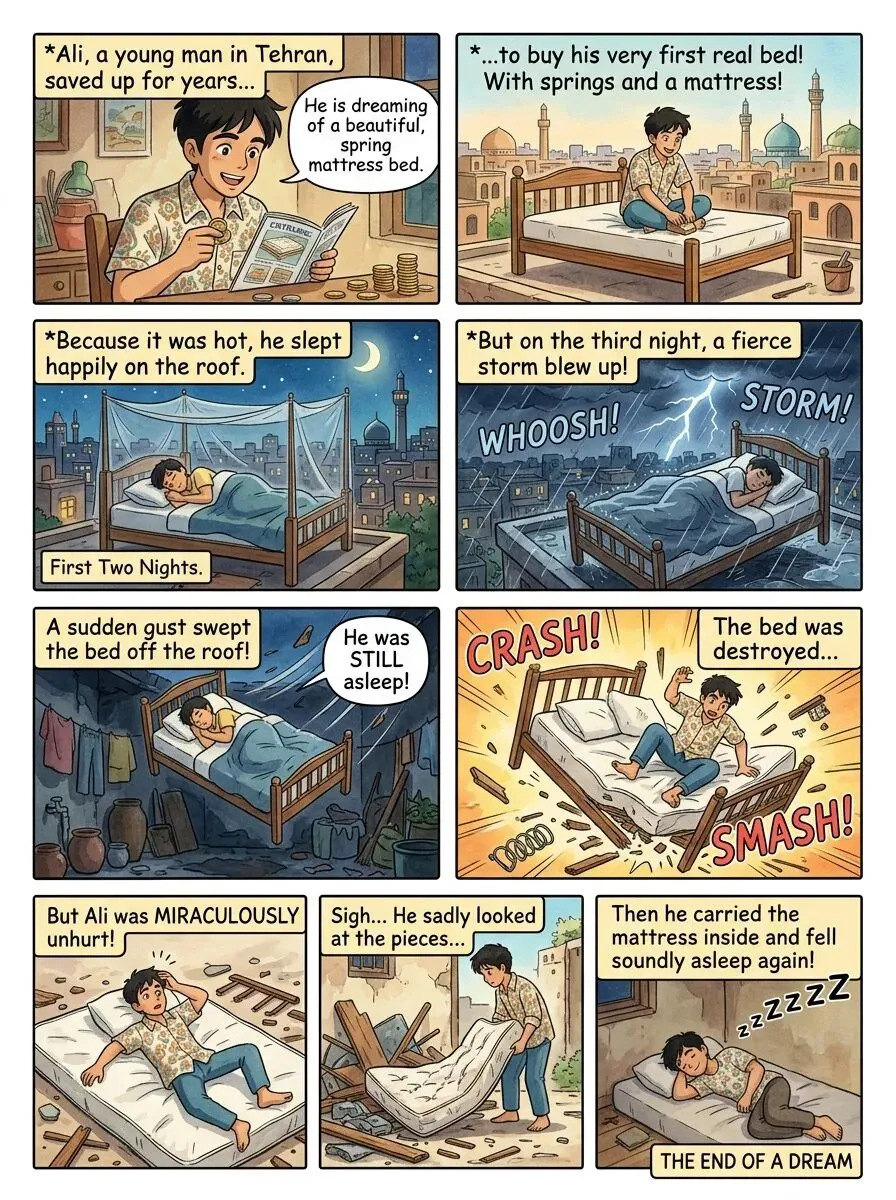
Tired of sleeping on the floor, a young man in Teheran bought a real bed for the first time in his life.
It was a dusty, windy night. A gust of wind swept the bed off the roof and sent it crashing into the courtyard below. The young man did not wake up until the bed had struck the ground. Although the bed was smashed to pieces, the man was miraculously unhurt. When he woke up, he was still on the mattress. Glancing at the bits of wood and metal that lay around him, the man sadly picked up the mattress and carried it into his house. After he had put it on the floor, he promptly went to sleep again.
背景简介本篇课文选自《新概念英语》第二册第49课,是一篇典型的叙事性短文。作者 L.G. Alexander 以其一贯的幽默笔触,讲述了一个发生在伊朗首都德黑兰的趣事。故事的主角是一个厌倦了睡地铺的年轻人,他买了一张真正的床,却因一场突如其来的大风而经历了一场"空中飞床"的奇遇。故事结构完整,细节生动,语言精练,非常适合用于分析叙事文的写作技巧和复合句的语法应用。
参考译文梦的终结德黑兰的一个年轻人,由于厌倦了睡在地板上,于是平生第一次买了一张真正的床。那是个有风的、尘土飞扬的夜晚。一阵狂风把床从屋顶刮了下来,把它摔到了下面的院子里。年轻人直到床摔到地上才醒过来。虽然床被摔成了碎片,但这个年轻人却奇迹般地没有受伤。他醒来时,仍然躺在床垫上。他看了看四周的碎木头和金属片,伤心地捡起床垫,把它搬进了屋子。他把床垫放在地板上后,又立刻睡着了。
🔍 第二部分:逐句精讲与词块总结
句子1
1. 原文: Tired of sleeping on the floor, a young man in Teheran bought a real bed for the first time in his life.
2. 翻译: 德黑兰的一个年轻人,由于厌倦了睡在地板上,于是平生第一次买了一张真正的床。
3. 句子结构: 简单句+分词短语作状语。主干部分是 a young man...bought a real bed。Tired of sleeping on the floor 是过去分词短语作原因状语,相当于 Because he was tired of sleeping...。in Teheran 是介词短语作定语修饰 a young man。for the first time in his life 是介词短语作时间状语。
4. 重点词汇:
tire 蓝思值 720L
英音 [ˈtaɪə(r)] 美音 [ˈtaɪər] 词性:vt. & vi. (使)疲劳,(使)厌倦
释义:to become or cause to become in need of rest or sleep; to lose interest or patience
常用语块:be tired of (doing) sth.
短语搭配:tire sb. out 使某人筋疲力尽;tire of 对......感到厌倦
例句一:He never tires of talking about his travels. 他从不厌倦谈论他的旅行。
例句二:The long walk tired the children. 长距离的步行让孩子们累了。
拓展:tired (adj.) 疲劳的,厌倦的;tiresome (adj.) 令人厌倦的,讨厌的;tiring (adj.) 令人疲劳的。注意区分 tired of (厌倦) 和 tired from/with (因......而疲劳)。
real 蓝思值 320L
英音 [riːl] 美音 [riːl] 词性:adj.
释义:真正存在的,真实的;非假装的
常用语块:a real bed
短语搭配:real life 现实生活;for real 真的,严肃的;the real thing 真品
例句一:Is that a real diamond? 那是真钻石吗?
例句二:This is a story about real people. 这是一个关于真人的故事。
拓展:反义词为 unreal (不真实的) 或 fake (假的)。副词形式为 really。
5. 语法点睛: [名师精讲]本句包含一个重要的语法点:分词短语作状语。Tired of sleeping on the floor 是一个过去分词短语,在句中作原因状语。这种结构可以使句子更加简洁紧凑。过去分词短语作状语时,其逻辑主语通常就是主句的主语,即 a young man,且与主语之间构成被动关系。这里 tired 表示"被弄得厌倦的",是常见的系表结构作状语。这个结构可以转化为一个完整的原因状语从句:Because he was tired of sleeping on the floor, a young man...。在写作中,使用分词短语可以让行文更精练,是提升作文水平的重要技巧。
句子2
1. 原文: It was a dusty, windy night.
2. 翻译: 那是个有风的、尘土飞扬的夜晚。
3. 句子结构: 简单句,主+系+表 结构。主语 It 指代天气/环境,was 是系动词,a dusty, windy night 是名词短语作表语。多个并列形容词作定语时,顺序一般为"观点+大小+形状+新旧+颜色+国籍+材料",此处 dusty 和 windy 属于描述性形容词,顺序相对自由。
4. 重点词汇:
dusty 蓝思值 780L
英音 [ˈdʌsti] 美音 [ˈdʌsti] 词性:adj.
释义:布满灰尘的;灰尘弥漫的
常用语块:a dusty room
短语搭配:dusty road 尘土飞扬的路
例句一:The old books were very dusty. 这些旧书上满是灰尘。
例句二:It was a dusty journey across the desert. 穿越沙漠的旅途尘土飞扬。
拓展:由名词 dust (灰尘) + -y 后缀构成形容词。类似的词还有 cloudy, rainy, windy 等。
windy 蓝思值 370L
英音 [ˈwɪndi] 美音 [ˈwɪndi] 词性:adj.
释义:有风的;多风的
常用语块:a windy day
短语搭配:windy weather 刮风的天气
例句一:It's too windy to go for a walk. 风太大了,不能去散步。
例句二:Spring is often windy in this area. 这个地区春天常刮风。
拓展:名词 wind。注意与 windy (有风的) 和 wind-blown (被风吹的) 的区分。
5. 语法点睛: [新概念英语pro 第2册]本句是典型的环境描写句式。在叙事文中,作者常常在讲述故事的开端时,先描写环境背景,为后续事件的发生做铺垫。It is/was + a/an + adj. + n. 这个句型非常适用于描述时间、天气、季节等,可以使读者迅速进入故事设定的氛围。此处 dusty 和 windy 两个形容词的运用,为下文"一阵大风把床刮下屋顶"埋下了伏笔,体现了作者的精心构思。
句子3
1. 原文: A gust of wind swept the bed off the roof and sent it crashing into the courtyard below.
2. 翻译: 一阵狂风把床从屋顶刮了下来,把它摔到了下面的院子里。
3. 句子结构: 简单句,谓语动词是 swept...off 和 sent...crashing... 两个并列的动作。主语 A gust of wind 是"一阵风"的意思。swept the bed off the roof 是"把床从屋顶刮走/刮落",sent it crashing into the courtyard 是"使床摔到院子里"。below 是副词,修饰 the courtyard,作后置定语。
4. 重点词汇:
gust 蓝思值 1010L
英音 [ɡʌst] 美音 [ɡʌst] 词性:n.
释义:一阵强风,一阵狂风;突发的、短暂的一阵
常用语块:a gust of wind
短语搭配:gusts of rain 几阵雨;a gust of laughter 一阵笑声
例句一:A sudden gust of wind blew his hat off. 突然一阵风把他的帽子吹掉了。
例句二:The wind was blowing in gusts. 狂风阵阵吹着。
拓展:常用来形容风、雨、烟、笑声等短暂而强烈的爆发。作为动词时表示"一阵阵地吹动"。
sweep 蓝思值 800L
英音 [swiːp] 美音 [swiːp] 词性:v. (swept, swept)
释义:扫,刮走;扫除;席卷
常用语块:sweep sth. off/away
短语搭配:sweep the floor 扫地;sweep through 横扫;sweep aside 不予理会
例句一:The tsunami swept away the houses along the shore. 海啸席卷了沿岸的房屋。
例句二:Strong winds swept the clouds from the sky. 大风把云彩从天空中吹散了。
拓展:sweep 作名词时意为"扫除"、"挥动"、"范围"等,如 make a clean sweep (大获全胜/彻底清理)。
send 蓝思值 420L
英音 [send] 美音 [send] 词性:v. (sent, sent)
释义:送;派遣;迫使 (某人/某物) 朝某个方向运动/处于某种状态
常用语块:send sb./sth. doing
短语搭配:send for 派人去叫;send off 寄出,送行;send out 发出
例句一:The explosion sent glass flying everywhere. 爆炸使玻璃四处飞溅。
例句二:They sent their children to school. 他们送孩子去上学。
拓展:此处 send 的用法是 send + 宾语 + 现在分词 (doing),表示"使得......做起......",强调动作的发生。
crash 蓝思值 780L
英音 [kræʃ] 美音 [kræʃ] 词性:v.
释义:撞击,坠毁;发出巨响地碰撞
常用语块:crash into sth.
短语搭配:crash a party 擅自闯入聚会;crash course 速成班;computer crash 电脑死机
例句一:The car crashed into a tree. 汽车撞到了一棵树上。
例句二:The plates crashed to the floor. 盘子哗啦一声掉在地上。
拓展:作名词时意为"撞击声"、"撞车事故",如 a plane crash (飞机失事)。
courtyard 蓝思值 1070L
英音 [ˈkɔːtjɑːd] 美音 [ˈkɔːrtjɑːrd] 词性:n.
释义:庭院,院子
常用语块:courtyard below
短语搭配:inner courtyard 内院;courtyard house 四合院
例句一:The students gathered in the school courtyard. 学生们聚集在学校院子里。
例句二:The hotel has a beautiful courtyard with a fountain. 这家酒店有一个带喷泉的漂亮庭院。
below 蓝思值 430L
英音 [bɪˈləʊ] 美音 [bɪˈloʊ] 词性:adv. & prep.
释义:在(......)下面,向(......)下方
常用语块:the courtyard below
短语搭配:see below 见下文;below zero 零度以下;below the average 低于平均水平
例句一:From the top of the hill we could see the valley below. 从山顶上我们能看到下面的山谷。
例句二:The temperature is ten degrees below zero. 温度是零下十度。
拓展:below 用作副词时表示"在下方",无宾语;用作介词时表示"在......之下",需接宾语。它的反义词是 above。
5. 语法点睛: [新概念英语名师精讲笔记 第2册.pdf]本句是一个动作描写非常生动的并列句。核心结构是 主语 + 谓语1 + 宾语1 + 状语1 + and + 谓语2 + 宾语2 + 宾补。第一个动作 swept the bed off the roof 是一个 动词 + 宾语 + 副词 构成的动词短语。sweep 是及物动词,off 是副词,表示"脱离、离开"。这种结构的宾语如果是代词,必须放在动词和副词之间 (如 sweep it off),如果是名词,可以放在后面 (如 sweep the bed off)。第二个动作 sent it crashing into the courtyard 使用了 send + 宾语 + doing 结构。这里的 crashing 是现在分词,作宾语 it 的宾语补足语(Objective Complement),补充说明 it (即 the bed) 被"发送"出去时的伴随动作。这个结构比 sent it into the courtyard 更加生动具体,让读者仿佛亲耳听到了床"哗啦"一声砸下去的巨响。
句子4
1. 原文: The young man did not wake up until the bed had struck the ground.
2. 翻译: 年轻人直到床摔到地上才醒过来。
3. 句子结构: 复合句,主句是 The young man did not wake up,从句是 until the bed had struck the ground。主句使用了否定结构 did not...until...,表示"直到......才......"。从句使用了过去完成时 (had struck),强调"床撞击地面"这个动作发生在"年轻人醒来"这个动作之前,是"过去的过去"。
4. 重点词汇:
wake up 蓝思值 400L
英音 [weɪk] [ʌp] 美音 [wek] [ʌp] 词性:phrasal v. (woke, woken)
释义:醒来;叫醒
短语搭配:wake sb. up 叫醒某人
例句一:I usually wake up at seven o'clock. 我通常七点醒来。
例句二:Please wake me up at six tomorrow. 请明天六点叫醒我。
拓展:wake 和 awake 都可作动词,awake 更正式。wake up 是常用短语。
strike 蓝思值 960L
英音 [straɪk] 美音 [straɪk] 词性:v. (struck, struck)
释义:撞击,打;罢工;突然想到;给......以深刻印象
常用语块:strike the ground
短语搭配:strike a match 划火柴;strike a bargain 达成协议;strike sb. as 给某人......的印象
例句一:The clock struck twelve. 时钟敲响了十二点。
例句二:An idea suddenly struck me. 我突然想到了一个主意。
拓展:作名词时意为"罢工"、"袭击",如 go on strike (罢工)。striking 是形容词,意为"引人注目的,显著的"。
5. 语法点睛: [新概念英语名师精讲笔记 第2册.pdf]本句包含两个关键语法点:1. not...until...结构:这是英语中一个非常核心的时间状语句型,表示"直到......才......"。until 是连词或介词,引导时间状语。在这个结构中,主句的谓语动词通常是终止性动词 (如 wake up, start, leave, finish),表示动作在 until 所指的时间点才开始发生。例如:I won't leave until you come back. (直到你回来我才会离开。) 2. 过去完成时:从句 until the bed had struck the ground 中使用了过去完成时 had struck。过去完成时表示在过去某个时间点之前已经完成的动作,即"过去的过去"。这里,年轻人醒来的时间是过去,而床撞击地面的时间更早,所以用 had struck。这个时态的使用,准确地体现了两个动作发生的时间先后顺序。
句子5
1. 原文: Although the bed was smashed to pieces, the man was miraculously unhurt.
2. 翻译: 虽然床被摔成了碎片,但这个年轻人却奇迹般地没有受伤。
3. 句子结构: 复合句,Although 引导一个让步状语从句,主句是 the man was miraculously unhurt。Although 意为"尽管,虽然",表达一种转折对比关系。
4. 重点词汇:
smash 蓝思值 950L
英音 [smæʃ] 美音 [smæʃ] 词性:v.
释义:(使)打碎,粉碎;猛撞,猛击
常用语块:smash sth. to pieces
短语搭配:smash a record 打破纪录;smash into 撞上;smash up 撞毁,捣毁
例句一:The thief smashed the window and got in. 小偷打碎窗户,爬了进去。
例句二:He smashed his fist down on the table. 他用力一拳砸在桌子上。
拓展:作名词时意为"破碎(声)"、"猛击"、"大获成功的电影/歌曲"等,如 a box-office smash (票房大片)。
miraculously 蓝思值 1120L
英音 [mɪˈrækjələsli] 美音 [mɪˈrækjələsli] 词性:adv.
释义:奇迹般地
常用语块:miraculously unhurt
短语搭配:miraculously survive 奇迹般地幸存
例句一:He miraculously recovered from the serious illness. 他奇迹般地从重病中康复了。
例句二:The pilot landed the plane miraculously. 飞行员奇迹般地让飞机降落了。
拓展:形容词为 miraculous,名词为 miracle (奇迹)。
unhurt 蓝思值 930L
英音 [ʌnˈhɜːt] 美音 [ʌnˈhɜːrt] 词性:adj.
释义:没有受伤的,未受伤害的
常用语块:miraculously unhurt
短语搭配:escape unhurt 毫发无伤地逃脱
例句一:The driver was unhurt in the accident. 司机在事故中没有受伤。
例句二:He survived the crash unhurt. 他在坠机中幸存下来,没有受伤。
拓展:由否定前缀 un- + hurt 构成。类似结构的词有 unharmed, unscathed 等。
5. 语法点睛: [新概念英语语法新思维 第2册.pdf]本句通过 Although 引导的让步状语从句,巧妙地运用了对比的修辞手法。Although 引导的从句 the bed was smashed to pieces (床被摔得粉碎) 和主句 the man was miraculously unhurt (人却奇迹般没受伤) 构成了强烈的反差,突出了故事喜剧性的结果。这种"意料之外,情理之中"的写法,极大地增强了故事的趣味性和可读性。使用 Although/Though/Even though 时,主句不能再用 but。这是英语语法中的一个基本原则,即"Although... (yet/still)..."是正确用法,而"Although... but..."是错误用法。
句子6
1. 原文: When he woke up, he was still on the mattress.
2. 翻译: 他醒来时,仍然躺在床垫上。
3. 句子结构: 复合句。When he woke up 是一个时间状语从句,主句是 he was still on the mattress。
4. 重点词汇:
mattress 蓝思值 920L
英音 [ˈmætrəs] 美音 [ˈmætrɪs] 词性:n.
释义:床垫,褥子
短语搭配:a spring mattress 弹簧床垫;air mattress 充气床垫;mattress cover 床垫罩
例句一:I need to buy a new mattress for my bed. 我需要为我的床买个新床垫。
例句二:He fell asleep as soon as he hit the mattress. 他一倒在床垫上就睡着了。
5. 语法点睛: 这个句子结构非常清晰,用于描述一个事件发生后紧接着发生的状态。在叙事中,使用 when 引导的从句可以连接两个顺承的动作或状态。这里 When he woke up 提供了时间参照点,而主句描述了在这个时间点上的状态 (was still on the mattress)。when 从句用一般过去时,主句也用一般过去时,表示两个动作几乎同时发生。这与句子4中的 not...until... 结构不同,后者强调动作的时间差。
句子7
1. 原文: Glancing at the bits of wood and metal that lay around him, the man sadly picked up the mattress and carried it into his house.
2. 翻译: 他看了看四周的碎木头和金属片,伤心地捡起床垫,把它搬进了屋子。
3. 句子结构: 复合句。主句是一个并列结构:the man...picked up the mattress and carried it into his house。句首 Glancing at... 是现在分词短语作伴随状语/时间状语,它的逻辑主语是 the man。that lay around him 是一个定语从句,修饰 the bits of wood and metal。
4. 重点词汇:
glance 蓝思值 880L
英音 [ɡlɑːns] 美音 [ɡlæns] 词性:v. & n.
释义:(v.) 匆匆一看,扫视;(n.) 一瞥
常用语块:glance at
短语搭配:glance over/through 浏览;at a glance 看一眼就;exchange glances 交换眼色
例句一:She glanced at her watch and hurried away. 她看了一眼手表,匆匆离开了。
例句二:He took a glance at the newspaper headlines. 他浏览了一下报纸的大标题。
拓展:[名师精讲] glance at 强调"快速看一眼"的动作,而 stare at 强调"盯着看",gaze at 强调"凝视/深情地看"。
bits 蓝思值 520L
英音 [bɪts] 美音 [bɪts] 词性:n. (pl.)
释义:小块,碎片
常用语块:bits of wood
短语搭配:a bit of 一点;bit by bit 一点一点地;do one's bit 尽一份力
例句一:She broke the biscuit into bits. 她把饼干掰成了小块。
例句二:He found bits of glass everywhere. 他发现到处都是玻璃碎片。
拓展:a bit 可以修饰形容词,相当于 a little,如 a bit sad (有点伤心)。
sadly 蓝思值 630L
英音 [ˈsædli] 美音 [ˈsædli] 词性:adv.
释义:悲伤地,伤心地;可惜,不幸地
常用语块:sadly picked up
短语搭配:sadly enough 说来也伤心/不幸
例句一:She shook her head sadly. 她伤心地摇了摇头。
例句二:Sadly, the plan didn't work out. 很可惜,计划没有成功。
拓展:形容词为 sad。在句首时,Sadly 用作评注性副词,表示说话人对整个句子的态度。
pick up 蓝思值 370L
英音 [pɪk ʌp] 美音 [pɪk ʌp] 词性:phrasal v.
释义:捡起,拾起;接送某人;学习(技能);好转
短语搭配:pick up the pieces 收拾残局;pick up speed 加速;pick up the bill 付账
例句一:Can you pick up the book for me? 你能帮我把书捡起来吗?
例句二:I'll pick you up at the airport. 我会去机场接你。
拓展:这个动词短语含义丰富,是高考、四六级热点词汇。
carry 蓝思值 320L
英音 [ˈkæri] 美音 [ˈkæri] 词性:v.
释义:拿,提,搬,携带
短语搭配:carry out 执行,实施;carry on 继续;carry away 冲走,使失去自制力
例句一:He was carrying a big bag on his back. 他背着一个大包。
例句二:We must carry out the plan carefully. 我们必须仔细地执行这个计划。
5. 语法点睛: [新概念英语名师精讲笔记 第2册.pdf]本句是三个语法点的综合应用:1. 现在分词作伴随状语:Glancing at... 是现在分词短语,其作用和前文提到的 Tired of... 类似,但不是原因而是伴随。它表示与主句谓语动词 picked up 和 carried 同时发生的次要动作,使人物动作更加连续、清晰。2. 定语从句:that lay around him 是关系代词 that 引导的限制性定语从句,修饰先行词 the bits of wood and metal。that 在从句中作主语,不能省略。这个定语从句具体描述了"木头和金属片"所处的状态——散落在四周,使场景描写更加细致。3. 并列谓语:picked up the mattress and carried it into his house 是由 and 连接的并列谓语,描述了主人公在遭受损失后连续做出的两个动作,简洁明了。
句子8
1. 原文: After he had put it on the floor, he promptly went to sleep again.
2. 翻译: 他把床垫放在地板上后,又立刻睡着了。
3. 句子结构: 复合句。After he had put it on the floor 是 After 引导的时间状语从句,从句使用了过去完成时 (had put)。主句是 he promptly went to sleep again,使用了一般过去时。
4. 重点词汇:
promptly 蓝思值 990L
英音 [ˈprɒmptli] 美音 [ˈprɑːmptli] 词性:adv.
释义:迅速地,立即;准时地
常用语块:promptly went to sleep
短语搭配:act promptly 迅速行动;respond promptly 立即回应
例句一:He answered the letter promptly. 他立即回了信。
例句二:She paid her bills promptly. 她准时付清了账单。
拓展:形容词为 prompt (迅速的),动词为 prompt (促使,激起)。
5. 语法点睛: [名师精讲]本句与句子4相互呼应,再次强调了过去完成时的用法。从句 After he had put it on the floor 中,put 这个动作发生在另一个过去动作 went to sleep 之前。After 这个连词本身已经表明了时间先后关系,因此从句使用过去完成时 had put 可以进一步加强这种"过去的过去"的时间感,使得动作的先后顺序非常清晰。与句子4不同的是,这里用 After 引导,主从句的时态关系变得更加明确。
📌 核心词块总结
1. Tired of doing sth.:厌倦了做某事 Explanation: Feeling frustrated, bored, or no longer interested in doing something because it has happened too often. Example: Tired of waiting for the bus, he decided to walk home.
2. For the first time in one's life:平生第一次 Explanation: An event or experience that has never happened to a person before. Example: She went to a concert for the first time in her life.
3. A gust of wind:一阵狂风 Explanation: A sudden, strong rush of wind. Example: A gust of wind blew the papers off my desk.
4. Send sth. doing:使......猛地/朝着某个方向运动 Explanation: To cause something to move in a particular direction or into a particular state, often violently or suddenly. Example: The explosion sent people running in all directions.
5. Be smashed to pieces:被摔成碎片 Explanation: To be broken violently into many small pieces. Example: The vase fell off the shelf and was smashed to pieces.
6. Glance at:看一眼,扫视 Explanation: To look at something or someone quickly, then look away. Example: He glanced at his phone to check the time.
7. Pick up:捡起,拾起 Explanation: To lift something up from a surface. Example: She picked up the book she had dropped on the floor.
8. Go to sleep:入睡,睡着 Explanation: To begin to sleep. Example: As soon as his head hit the pillow, he went to sleep.
✍️ 第三部分:语篇分析与段落写作技巧
1. 语篇分析 (关键术语标注英文)
① 识别宏观结构 (Identify the macrostructure)本课的叙事文本遵循经典的"五步叙事"结构:
- 开头/铺垫 (Exposition): 第一句介绍了主角(a young man)、地点(Teheran)、起因(tired of sleeping on the floor)和初始情况(bought a real bed)。这为整个故事提供了必要的背景信息。
- 冲突/上升动作 (Complication/Rising Action): 第二句和第三句制造了冲突。环境描写 (dusty, windy night) 为灾难埋下伏笔,紧接着 A gust of wind swept the bed off the roof 将故事推向一个小高潮。
- 高潮 (Climax): 第四、五句是故事的高潮和转折点。床摔到地上 (the bed had struck the ground),被摔成碎片 (smashed to pieces),但人却奇迹般地没受伤 (miraculously unhurt)。这是整个事件最紧张、最关键的时刻。
- 下降动作 (Falling Action): 第六、七句描述了主角醒来后的反应。他发现自己还在床垫上 (still on the mattress),看了看周围的碎片 (Glancing at the bits...),然后伤心地捡起床垫并搬回屋内 (sadly picked up the mattress and carried it into his house)。
- 结局 (Resolution): 最后一句点明了故事的结局——他 promptly went to sleep again。这个结局出乎意料又在情理之中,体现了作者黑色幽默的风格,也与标题 The end of a dream 形成巧妙呼应:他的"睡在床上"的梦想虽然以床的破碎而告终,但他"睡觉"的梦却还在继续。
② 列举衔接手段 (List cohesive devices)作者使用了丰富的衔接手段使故事连贯流畅:
- 照应 (Reference): 使用代词 (it 指代 bed, he 指代 the young man) 来指代前文出现的人或物,避免重复。
- 替代与省略 (Substitution / Ellipsis): He was still on the mattress 中的 the mattress 与前文 bought a real bed 中的 bed 形成替代关系。
- 连接词 (Conjunction): 使用多种连接词表示时间 (until, when, after)、让步 (although)、并列 (and) 等逻辑关系。
- 词汇衔接 (Lexical Cohesion): 使用一系列与床具相关的词汇链 (floor, bed, mattress, bits of wood and metal),以及与动作相关的词汇链 (bought, swept, sent crashing, woke up, picked up, carried, went to sleep),构建完整的语义场。
③ 分析作者态度 (Analyze the author's attitude)作者的整体态度是幽默、讽刺且略带同情的。
- 幽默: 整个故事的设定就充满了戏剧性:一个想睡个好觉的人,床被风刮跑了,摔碎了,结果自己还在床垫上,最后又倒头睡了。这种极端巧合和主角淡定的反应让人忍俊不禁。
- 讽刺: 文章的标题 The End of a Dream 和结尾 he promptly went to sleep again 形成了强烈的讽刺。梦想(拥有一张真正的床)破灭了,但"睡觉"这个生理行为却未受影响,暗示了梦想与现实的巨大落差。
- 略带同情: 作者使用 sadly 一词,以及 Glancing at the bits... 这个描写,含蓄地传达了对主角的同情。虽然语气幽默,但作者并未完全置身事外,而是通过细节描写让读者感受到了主角的无奈和悲伤。
2. 写作技巧
① 提炼写作逻辑本文的写作逻辑非常清晰:引出话题(铺垫)→ 设置冲突(事件的起因)→ 描写高潮(事件的经过)→ 描述反应(事件的结果)→ 结尾点睛(揭示主题)。这种"起承转合"的结构是典型的英文叙事文框架。此外,运用副词修饰动作(如 promptly went to sleep)和形容词营造氛围(如 dusty, windy night)是使描写生动的重要技巧。
② 提供段落写作范例假设要写一篇关于"一次不寻常的冒险"的短文,可以模仿本课的逻辑结构。
题目: A Surprising Rescue
段落范例:Tired of practicing his solo performance for days, a musician named Jack found himself lost in a small forest during a hike. It was a sudden, thick fog. The dense clouds of white completely obscured the narrow path and sent him wandering deeper into the unknown. Although he was worried and calling for help, there was no response. When he finally sat down, exhausted by a large rock, he could hear nothing but the rustling of leaves. Glancing at the strange shapes of trees that surrounded him, he sadly realized he might have to spend the night there. Just then, the fog began to lift. Following the faint sound of a river that he could now hear, he promptly found an exit and returned to his starting point.
分析其结构特点:
- 开头 (Exposition): 介绍人物、起因(Tired of... a musician named Jack lost himself...)。
- 冲突/上升动作 (Complication): 环境描写(a sudden, thick fog),导致迷路(sent him wandering...)。
- 高潮 (Climax): 求助无果(Although... no response...),陷入绝境。
- 下降动作 (Falling Action): 感到绝望(sadly realized...),但出现转机(Just then, the fog began to lift)。
- 结局 (Resolution): 成功脱险(promptly found an exit...)。
标注语言点映射:
- Tired of doing...: 过去分词短语作原因状语(映射本课句子1)。
- sent him wandering: send + 宾语 + doing 结构(映射本课句子3)。
- Although...: 让步状语从句(映射本课句子5)。
- Glancing at...: 现在分词作伴随状语(映射本课句子7)。
- that surrounded him: 定语从句(映射本课句子7)。
- promptly: 副词(映射本课句子8)。
③ 布置小练笔并提供例文
题目: 请模仿本课结构,写一个100词左右的英文故事。故事的开头是:Tired of eating the same food every day, a cat named Whiskers decided to explore the kitchen...
例文:Tired of eating the same dry cat food every day, a cat named Whiskers decided to explore the kitchen. It was a quiet, moonlit night. A sudden noise from the countertop startled him and sent him jumping into a half-open cupboard. Although he was scared, he found a bag of delicious-smelling treats inside. When he emerged, his whiskers were covered in crumbs. Looking proudly at the mess he had made, he happily jumped down and went to sleep in his favorite sunny spot, dreaming of his next adventure.
📐 第四部分:本课语法精析(加强版)
本部分字数不少于1500-2000字。
本课的语法核心在于对复合句 (Compound and Complex Sentences) 的综合运用和理解,尤其是对并列句和状语从句的复习与深化。我们将结合知识库中的《NCE知识点笔记》《名师精讲笔记》《语法新思维》进行系统讲解。
一、复合句的总览 (Review of Complex Sentences)
[NCE知识点笔记]一个句子中包含一个或多个从句的句子称为复合句。本课中几乎每个句子都是复合句,主要分为:
1. 并列句 (Compound Sentence):由 and, but, or, so, for, yet 等并列连词连接两个或两个以上意义相关、层次相同的简单句。
- 例如:The man sadly picked up the mattress and carried it into his house. (由 and 连接两个并列谓语)
2. 复合句 (Complex Sentence):由从属连词引导,使一个句子作为另一个句子的一个成分。
- 状语从句 (Adverbial Clause):本课最突出。Although, when, until, after 等引导。
- 定语从句 (Attributive Clause):that 引导。
二、并列句的深度解析 (In-depth Analysis of Compound Sentences)
[新概念英语语法新思维 第2册.pdf] 本课句子3(A gust of wind swept the bed off the roof and sent it crashing...)和句子7(...the man sadly picked up the mattress and carried it into his house.)都包含并列结构。然而,不同的并列连词表达的逻辑关系截然不同。我们重点复习 and, but, so, for, or, yet 的用法,并结合第一册内容进行对比。
1. and:表示并列、顺承、递进、因果关系。
- 例句1 (本课):...the man sadly picked up the mattress and carried it into his house. (顺承关系)
- 例句2:He opened the window and looked out. (顺承关系)
- 例句3:She studied hard, and she passed the exam. (因果关系,相当于 so)
- 例句4:And 还可以连接两个句子表示"那么"。例如:Get up early, and you will catch the first bus. (条件 → 结果,相当于 If you get up early, you will...)
2. but:表示转折或对比关系。与第一册所学一致。
- 例句1:He was poor, but he was happy.
- 例句2:I want to go, but I am too tired.
3. so:表示因果关系,意为"因此,所以"。第一册中已学习。
- 例句1:It was raining hard, so we stayed at home.
- 例句2:The bed was smashed to pieces, so the young man had to buy a new one. (根据课文推理)
4. for:表示原因,但语气比 so 弱,常是对前一句的补充说明或推测性原因。for 引导的分句不能放在句首。这是一个重要考点,也是较 because 更难掌握的点。
- [名师精讲] for 是并列连词,because 是从属连词。Because 引导原因状语从句,直接说明主句的原因;for 引导的是并列分句,它提供的理由通常是一种补充说明,有时是推测性的。
- 例句1 (对比):The ground is wet. It must have rained, for the ground is wet. (用 for 表示推测的依据) v.s. The ground is wet because it rained. (用 because 说明直接原因)
- 例句2 (与第一册对比):第一册曾学 I am tired because I worked hard. 而本课我们可以造句:He must be tired, for he went to sleep promptly. 用 for 是一种主观的、间接的推断。
5. or:表示选择或否定条件。
- 例句1 (选择):Do you like tea or coffee?
- 例句2 (否定条件):Hurry up, or you will be late. (= If you don't hurry up, you will be late.) 这个用法是重点,与 and 表肯定条件形成对比。
6. yet:表示转折,意为"然而,但是"。比 but 语气更强,有时可与 but 互换。
- 例句1:He is a rich man, yet he is not happy.
- 例句2:Although 引导的从句之后,主句不能用 but,但可以用 yet。例如:Although it was raining, yet he walked to work. (正确) Although it was raining, but he walked to work. (错误)
练习题1 (并列连词填空)
1. The bed was smashed to pieces, ______ the man was unhurt.
2. He was tired of sleeping on the floor, ______ he bought a real bed.
3. He may be sleeping, ______ he may be reading in his room.
4. He bought a mattress, ______ he put it on the floor.
5. He didn't wake up ______ the bed struck the ground.
6. He was poor ______ honest.
7. It was a warm night ______ there was no wind.
8. Finish your homework, ______ I won't let you watch TV.
9. It must have rained last night, ______ the ground is still wet.
10. He went to sleep again, ______ he had had a terrible experience.
答案解析:
1. but (转折,床碎了但人没受伤)
2. so (因果,厌倦所以买了床)
3. or (选择,他在睡觉或者读书)
4. and (顺承,买了然后放地上)
5. until (这是一个从属连词,引导时间状语从句,不是并列连词。not...until 是固定结构)
6. but/yet (转折,穷但诚实)
7. but/yet / for (转折,暖和但没风 / 推测, 推测没风所以天暖和)
8. or (否定条件,否则)
9. for (补充说明原因的并列分句)
10. but / yet (转折,经历了可怕的事但继续睡了)
三、状语从句复习 (Review of Adverbial Clauses)
[新概念英语语法手册.pdf] 本课集中体现了三种状语从句:
1. 时间状语从句 (Adverbial Clause of Time):由 When, until, after 等引导。从句中的时态是关键。
- When he woke up... (when 引导,主从句时态可以相同或不同,表示"当......时")
- ...not...until the bed had struck the ground... (until 引导,主句用否定,表示"直到......才")
- After he had put it on the floor... (after 引导,从句动作先于主句,所以用过去完成时)
2. 让步状语从句 (Adverbial Clause of Concession):由 Although / Though 引导。
- Although the bed was smashed to pieces... (Although 不能和 but 连用,但可以和 yet/still 连用)
3. 原因状语从句 (Adverbial Clause of Reason):由 because, since, as, for 引导。虽然本课课文中没有直接出现 because 引导的从句,但句子1中 Tired of sleeping... 的过去分词短语可以看作是隐含的原因状语从句。As/Since/Because 都是非常高频的考点。
- As:表示"因为,由于",语气较弱,常放在句首。如:As he was tired, he wanted to go to sleep.
- Since:表示"既然",强调已知的事实或理由,引导的从句常放在句首。如:Since you are sorry, I will forgive you.
- Because:语气最强,表示直接的原因,是回答问题 why 时用的连词。如:Why did he buy a bed? Because he was tired of sleeping on the floor. (这个句子可以完美解释课文第一句)
练习题2 (状语从句连接词填空与解析)
1. ______ the bed was smashed to pieces, the man was miraculously unhurt. → Although/Though (表示转折).
2. He didn't wake up ______ the bed had struck the ground. → until (固定结构 not...until).
3. ______ he had put the mattress on the floor, he immediately went back to sleep. → After (表示在......之后).
4. ______ he was tired of the floor, he bought a real bed. → Because/As/Since (均可表示原因).
5. The man was sad ______ he looked at the broken pieces. → when/while/as (当......的时候).
6. ______ his bed was gone, he still felt sleepy. → Although (表示让步,他的床没了,他依然困).
7. He decided to go to sleep, ______ his dream was over. → because/as (解释他睡觉的原因,梦结束了).
8. He slept on the floor for years ______ he finally bought a real bed. → before (在......之前).
四、分词作状语 (Participle Phrases as Adverbials)
[新概念英语名师精讲笔记 第2册.pdf] 这是将简单句和从句有效结合的标志性语法结构,也是写作高级化的关键。
1. 过去分词短语作状语 (Past Participle Phrase as Adverbial):Tired of sleeping on the floor...
- 逻辑主语是主句的主语 a young man,与 tire 构成被动关系(被弄得疲倦)。
- 功能:相当于原因状语从句 Because he was tired of sleeping on the floor...
- 对比第一册:第一册主要学习被动语态(The bed was smashed.),而本课开始学习非谓语动词作状语,这是语法难度的显著提升。
2. 现在分词短语作状语 (Present Participle Phrase as Adverbial):Glancing at the bits...
- 逻辑主语是主句的主语 the man,与 glance 构成主动关系(男人主动看了一眼)。
- 功能:相当于时间状语从句 When he glanced at the bits... 或伴随状语从句 He glanced at the bits and then...。
五、与第一册语法点的对比分析
----------------------------------------------------------------------------------------------------------------------------------------------------------------------------------------------语法点第一册 (基础)第二册本课 (深化)提升点分析-------------- ------------------------------------------ ------------------------------------------------------------- ----------------------------------------------------------------------并列句 简单并列连词 and, but, or。 引入 for, yet,并强化 and 从记忆基本用法到理解微妙语义区别,并能准确使用。表示条件的功能(祈使句,and/or...)状语从句 学习 when, because, if 深化 not...until,although;强调从句时态可以不一致(如 从简单时间、原因、条件关系扩展到时间先后、让步、推断等复杂逻辑关系。等基础连词引导的状语从句,时态基本一致。 had done 和 did)分词结构 未系统学习,仅有部分形容词化的分词(如 系统学习现在/过去分词短语作状语,使句子结构简化、凝练。 从词汇层面的识别跨越到句法层面的运用,这是写作能力质的飞跃。interesting, tired)。----------------------------------------------------------------------------------------------------------------------------------------------------------------------------------------------
练习题3 (综合语法巩固题)
1. ______ (tire) of his daily routine, John decided to take a trip.
2. ______ (glance) at the clock, she realized she was late for the meeting.
3. Not only ______ he lose his money, but he also lost his temper.
4. He was very rich, ______ he was not satisfied.
5. The thief ran out of the bank, ______ (send) people everywhere.
6. Why did the young man buy a real bed? (用 because 回答)
7. The man was unhurt ______ the bed was smashed.
8. He had been lying on the floor for years ______ he bought the bed. (before/when/after)
9. It was a windy night, ______ his bed was blown off the roof.
10. I have never been to Teheran, ______ my friend has.
练习题3 答案解析:
1. Tired (过去分词表示"感到厌倦的",作原因状语)。
2. Glancing (现在分词表示主动,作时间/伴随状语)。
3. did (Not only 放在句首时,主谓要部分倒装,"did he lose")。
4. but/yet (转折关系)。
5. sending (send sb. doing 结构,此处是现在分词作宾补)。
6. Because he was tired of sleeping on the floor. (必须用 because 回答 why 提问)。
7. although/though (让步关系)。
8. before (表示在买床之前睡了多年地板)。
9. so (因果,有风所以床被吹走)。
10. but (转折,我没去过,但我的朋友去过)。
🎧 第五部分:听力与阅读策略训练
1. 听力技巧:结合课文录音设计听力理解题
听力技巧点拨:① 预测关键词:在听录音前,先看课文标题《The end of a dream》和文本中反复出现的有关"床、风、睡眠"的关键词,能大致预测故事方向。这些词包括:bed, floor, wind, wake up, mattress, asleep 等。② 抓主旨大意:第一遍听录音时,不要被不认识的单词(如 miraculously, draught)打断,而是抓住5W1H(Who? Where? What? When? Why? How?)来把握故事梗概。③ 笔记方法:第四遍听录音时,采用"缩略词"记录关键信息点,如:
- Who: Young man / YM
- What happened: bought a bed; wind blew bed off roof
- Action 1: bed smashed
- Result: YM unhurt
- Action 2: YM carried mattress inside
- Final action: YM went to sleep
听力理解题:听录音两遍后,判断以下句子正误 (True/False):
1. ( ) The young man bought a bed because he wanted to sell it.
2. ( ) The wind swept the bed off the roof during a quiet, peaceful night.
3. ( ) The young man woke up when the bed started to blow.
4. ( ) The bed was completely destroyed, but the man was unhurt.
5. ( ) After the accident, the young man was too scared to sleep again.
答案解析:1. F (他厌倦了睡地板); 2. F (那是个有风、尘土飞扬的夜晚); 3. F (他直到床摔到地上才醒); 4. T; 5. F (他立刻又睡着了)。
2. 阅读理解策略:设计扫读、略读、推断词义等题目
题目1:扫读 (Scanning) --- 快速找出故事发生的地点和事件结果。
- Q: Where did this incident take place? → S: Teheran (根据原文第一句直接定位)
- Q: How did the young man's first night on the real bed end? → S: He was asleep on the mattress in his house at the end. (根据最后两句推断)
题目2:略读 (Skimming) --- 概括文章的主旨大意。
- Q: What is the whole story mainly about? → S: It is about a funny and unlucky experience of a young man who tried to have a good sleep on a real bed for the first time. (快速浏览首尾段和每段第一句得出)
题目3:推断词义 (Using Context Clues) --- 根据上下文线索猜测生词意思。
- Context: "A gust of wind swept the bed off the roof... Although the bed was smashed to pieces..."
- Q: From the context, what does "smashed" most likely mean?
- A. built quickly
- B. broken violently
- C. moved carefully
- D. cleaned thoroughly
- 解析: 前文提到床被风"swept off the roof (刮下屋顶)",后文提到"to pieces (成碎片)",所以 smashed 应意为"打碎/摔碎",选择 B。这个单词的含义在《新概念英语词汇大全》等资料中可查到为"打碎,粉碎"。
📝 第六部分:习题讲解
1. 针对教材中的书面练习进行详细讲解
关键句型练习 A (改写句子,使用 not...until)
- 原句: He didn't wake up before the bed struck the ground.
- 改写: He didn't wake up until the bed had struck the ground.
- 解析: before 引导的从句表示"在......之前",主句为否定形式,可以用 not...until 进行改写,强调"直到......才"。注意 until 后面接的是时间状语从句,主从句时态保持一致。
关键句型练习 B (用 until 连接句子)
- \(1\) He arrived. We had dinner.
- 答案: We didn't have dinner until he arrived.
- 解析: until 前面的主句要用否定形式(didn't have),表示"直到他到了我们才吃饭"。
关键句型练习 C (用 after 连接句子)
- \(1\) He finished his homework. Then he went to bed.
- 答案: He went to bed after he had finished his homework. 或 After he had finished his homework, he went to bed.
- 解析: after 表示"在......之后",从句动作(完成作业)发生在主句动作(睡觉)之前,因此从句用过去完成时 had finished。
难点练习 A (辨析 off 和 away)
- \(1\) The thief jumped ______ the wall and ran away.
- 答案: off (从墙上跳下来,表示"脱离")
- \(2\) He walked ______ from the burning house.
- 答案: away (从他家走开,表示"远离")
难点练习 B (辨析 crash 和 smash 的不同用法)
- \(1\) The car ______ into a tree.
- 答案: crashed (撞击,通常指交通工具的碰撞)
- \(2\) He ______ the plate on the floor in a fit of rage.
- 答案: smashed (打碎,通常指用力砸碎某物)
- 解析: crash 强调猛烈的碰撞,常涉及交通工具;smash 强调打碎/粉碎,常指破碎东西。两者都可表示破坏,但侧重点不同。
难点练习 C (辨析 pick up, carry, take 的区别)
- \(1\) He ______ the book and put it in his bag.
- 答案: picked up (捡起,指拿起或拾起一个物体)
- \(2\) He ______ the heavy box to the third floor.
- 答案: carried (搬运,常指搬动较重的物体,强调"负重移动")
- \(3\) Please ______ your umbrella with you when you go out.
- 答案: take (带走,指随身携带某物到别处去)
多项选择题讲解
- 1. The young man bought a real bed because ______ .
- A. he was tired of sleeping on the floor.
- B. he wanted to have a dream.
- C. the wind was too strong.
- D. he lived in Teheran.
- 解析: 根据课文第一句 Tired of sleeping on the floor... 可知原因是他厌倦了睡地板。答案选 A。
- 2. The young man didn't wake up until the bed ______ the ground.
- A. struck
- B. had struck
- C. strikes
- D. was struck
- 解析: until 引导的时间状语从句,主句用过去时 didn't wake up,从句的动作发生在主句之前,所以用过去完成时 had struck。答案选 B。
- 3. The young man was ______ during the accident.
- A. hurt
- B. injured
- C. unhurt
- D. killed
- 解析: 根据课文 ...the man was miraculously unhurt. 可知他奇迹般地没有受伤。答案选 C。
- 4. What did the man pick up after he woke up?
- A. The bed.
- B. The bits of wood.
- C. The mattress.
- D. The metal.
- 解析: 根据课文 ...the man sadly picked up the mattress... 可知他捡起了床垫。答案选 C。
- 5. After he put the mattress on the floor, he ______ .
- A. went out
- B. cried
- C. went to sleep again
- D. fixed the bed
- 解析: 根据课文最后一句 ...he promptly went to sleep again. 可知他立刻又睡着了。答案选 C。
🤔 第七部分:英文深度思考与拓展(强化版)
A. 层次化英文问题与答案
Level 1 (Factual): 事实性问题
1. Q: Where did the young man live?A: The young man lived in Teheran, the capital city of Iran. (原文:a young man in Teheran)
2. Q: What did the young man buy for the first time in his life?A: He bought a real bed for the first time in his life. (原文:bought a real bed for the first time in his life)
3. Q: What happened to the bed during the night?A: The bed was swept off the roof by a gust of wind and crashed into the courtyard below. (原文:A gust of wind swept the bed off the roof and sent it crashing into the courtyard below.)
Level 2 (Inferential): 推理性问题
4. Q: Why didn't the young man wake up when the wind first started blowing?A: It can be inferred that the wind was not strong enough to wake him directly, or he was a very deep sleeper. 课文提到 He didn't wake up until the bed had struck the ground.,这暗示了他要么睡得太沉,要么是床撞击地面的巨大声响才让他惊醒。
5. Q: How did the young man feel when he saw the broken bed?A: He felt sad and disappointed because the text says he sadly picked up the mattress. 从他的动作 sadly 以及他环顾四周碎片的细节,我们可以推断出他的心情是沮丧和失落的。
6. Q: Why did the young man go back to sleep again so promptly?A: He was probably still very tired either from sleeping on the floor for years or from the unexpected excitement of the accident. Also, he might have accepted his fate with stoic resignation and decided that sleeping on the mattress on the floor was still better than nothing. (推断:他很疲惫,也可能是一种顺应命运、退而求其次的选择。)
Level 3 (Evaluative): 评价性问题
7. Q: Do you think the title "The end of a dream" is a good title for this story? Why or why not?A: Yes, I think it is a very effective and ironic title. It has a double meaning. On one hand, it literally means the young man's dream of sleeping on a real bed was violently destroyed. On the other hand, it humorously shows that his "dream" of sleeping itself was not ended at all, as he went right back to sleep immediately. The title is both descriptive and deeply humorous, encapsulating the story's irony.
8. Q: The story ends with the man going to sleep again. What do you imagine happened next?A: I imagine he slept very soundly on his mattress, completely exhausted from the night's drama. The next morning, he might have felt a bit foolish, but he would probably start saving money to buy another real bed. Or, more humorously, he might just accept that the floor is safer and more practical for him, thus turning the "dream" into a cautionary tale he tells his friends.
9. Q: How does the author use humor in this story? Give a specific example.A: The humor comes from the stark contrast between the dramatic, destructive event (bed falling off the roof) and the man's utterly calm and nonchalant reaction (going back to sleep). The perfect example is the last sentence. The reader expects panic, grief, or frustration, but instead, we get he promptly went to sleep again. This anticlimax creates a powerful comic effect. [名师精讲] 中常常强调这种"反差式幽默"是高级写作手法。
10. Q: Compare the beginning and the end of the story. What change or lack of change do you notice in the man's life?A: At the beginning, he was tired of sleeping on the floor, so he bought a bed. At the end, his bed is broken, and he is sleeping on the floor again, this time on a mattress. In a fundamental way, his life has not changed; he is back to sleeping on a low surface. The biggest change is not his physical sleeping arrangement, but the experience he had. He now has a dramatic story to tell, and the memory of his brief "dream" is over. This circular narrative structure emphasizes the theme of the "dream's end".
11. Q: If you were the young man, what would you do differently to prevent such an accident?A: If I were him, I would have placed the bed inside the house or in a more sheltered part of the roof. A roof is an unsafe sleeping place, especially in a windy climate like Teheran's dusty, windy nights. I might also have checked the weather forecast or secured the bed with ropes. The story teaches us, in a humorous way, to prioritize safety and practicality over impulsive desires.
B. 多类型拓展阅读
1. 时事新闻拓展 (Current Events): The Real Problem with Sleeping Outdoors
Recently, a new trend known as "sleeping outdoors" or "camping out" has become popular, especially among young people seeking adventure. However, as our story shows, this can be dangerous. In 2023, a news report from China told of a college student who set up a tent on his apartment balcony to sleep under the stars. A sudden, strong thunderstorm with powerful gusty winds swept his tent, along with him inside it, off the balcony. Luckily, he fell onto some bushes and was shaken but unhurt. His "dream" of a romantic night was shattered, much like our young man in Teheran. This real-life incident perfectly mirrors the lesson's core event: a simple wish for a better sleep can go terribly wrong due to nature's unpredictability. The report urged people to prioritize safety and think twice before sleeping in exposed areas, especially during storm seasons.
- Language Point Mapping:
- gusty winds → 映射 gust of wind
- swept his tent off the balcony → 映射 swept the bed off the roof
- unhurt → 直接映射课文词汇 unhurt
- His "dream"... was shattered → 映射标题 The end of a dream
2. 文化背景解析 (Cultural Background): The Art of "Sleeping Anywhere"
In many Western cultures, the ability to "sleep anywhere" is often seen as a mark of a resilient, easy-going, and adaptable personality. It is a practical skill valued by travelers, soldiers, and busy professionals who can fall asleep on a plane, a train, or even a park bench without complaint. This contrasts with the idea of needing a "perfect" sleeping environment. The young man in our story initially fits this "adaptable" mold; he slept on the floor for years without a problem. However, his purchase of a bed signifies a desire for comfort and a "dream" of a more luxurious life. The story's humor, therefore, partially stems from his failed attempt to move from the stoic, practical "sleep anywhere" philosophy to the luxurious, yet fragile, "dream" of a real bed. The fact that he goes back to sleep on the floor suggests a return to his resilient roots, making the cultural concept of adaptability the story's underlying theme.
- 引导性问题: How does the cultural value of "sleeping anywhere" help us understand the young man's final action in the story?
- Language Point Mapping:
- Tired of sleeping on the floor → 映射从"适应"到"寻求舒适"的转变。
- promptly went to sleep again → 映射回归"适应力强"的本性。
3. 今昔对比分析 (Then vs. Now): Sleeping Habits
Fifty years ago, when this story was written, the idea of a real bed was a significant luxury for many people around the world. Sleeping on a floor on a simple mattress was common in many cultures. The image of a wealthy man sleeping on a rooftop to escape the heat was also not unusual in the Middle East. Today, in many modern cities, the concept of comfort has evolved dramatically. We have temperature-controlled mattresses, adjustable bases, and pillows designed by scientists. A rooftop is often seen as a space for a pool or a garden, not for sleeping. The young man's real bed might have been a simple wooden-framed bed, now considered basic. The story from the past highlights how our expectations for "comfort" have changed, while the basic human need for sleep and the occasional ridiculous accident remain timeless.
- 引导性问题: What does the "real bed" represent in the context of the 1960s compared to today?
- Language Point Mapping:
- bought a real bed for the first time in his life → 映射过去的奢侈,如今的标配。
- mattress (垫子) → 映射过去简单的床上用品,与现在复杂的床具形成对比。
4. 新潮英语改写 (New-age English Rewrite): Night of the Flying Bed
Sick of crashing on the hard floor every night, a dude in Teheran finally dropped some cash on his first-ever legit bed. The setup was on his rooftop. That night, the weather was crazy dusty and super windy. A massive gust of wind suddenly yoinked the bed right off the roof, sending it smashing down into the courtyard with a huge crash. This guy didn't even stir from his sleep until the bed hit the ground! Despite the bed being totally wrecked, he was, like, totally fine. When he finally opened his eyes, he was just chilling on the mattress. Taking a look at the splintered wood and metal scattered around him, the guy sadly picked up his mattress and hauled it back inside. As soon as he put it back on the floor, he just zonked out again.
- 语言点映射:
- Sick of / crashed on / legit bed → 映射 Tired of / sleeping on / real bed
- yoinked / super windy → 映射 gust of wind / windy
- totally wrecked / totally fine → 映射 smashed to pieces / miraculously unhurt
- zonked out → 映射 went to sleep
5. 难度略高的拓展阅读 (Slightly Harder Reading): The Psychology of a "Narrow Escape"
The story of the young man is a classic example of a "near-miss" or a "narrow escape." Psychologists describe the reaction to such events as a mix of anxiety and relief. The man experienced a serious threat (a bed falling off a roof) but survived unharmed. The brain often responds to this by releasing a flood of "feel-good" neurotransmitters like dopamine once the danger is realized to be over, which can paradoxically lead to a state of profound calm or even euphoria. This biological reaction could explain why the man, after seeing the destruction, did not panic but instead calmly picked up his mattress and went to sleep. His body was essentially "shutting down" from the stress and rewarding itself with rest. The story, therefore, is not just about a physical "dream" ending, but also about a psychological episode involving stress, survival, and the brain's remarkable ability to reset itself through sleep.
- 引导性问题: How does the psychological concept of a "near-miss" explain the young man's calm and immediate return to sleep?
- Language Point Mapping:
- miraculously unhurt → 映射"死里逃生"的心理状态。
- promptly went to sleep again → 映射身体在应激后的"恢复性休息"本能。
🌍 第八部分:日常应用与文化拓展
1. 介绍相关文化背景知识
- 中东地区的屋顶睡眠文化:在德黑兰等许多中东和南亚地区,由于夏季炎热,室内没有空调,人们常常会睡在屋顶(rooftop)上,因为那里有风,相对凉爽。这是一个普遍的生活习惯。文章中的"屋顶"正是这一文化背景的体现,使得故事的发生地点和情节非常合理。如果对这个背景不了解,可能会觉得"为什么要把床放在屋顶上"很奇怪。
- "梦"的象征:文章的标题《The end of a dream》具有双重隐喻。表层含义是"睡在真正床上的梦想"破碎了;深层含义是,这个年轻人为了改变现状、追求更舒适生活而做出的努力(梦境)以滑稽的方式结束了。他最终又回到了原点。这种"梦境与现实"的碰撞是文学中常见的主题。
2. 推荐拓展学习资源
- 经典文学:欧·亨利(O. Henry)的短篇小说。他的小说以"意料之外,情理之中"的结局而闻名,与本课的故事结构非常相似。例如《麦琪的礼物》(The Gift of the Magi)。
- 电影片段:著名默片演员巴斯特·基顿(Buster Keaton)的电影,他的喜剧风格与本文有异曲同工之妙——面对巨大的灾难或破坏,表情冷静、不动声色,通过反差制造笑料。
- 歌曲:美国乐队"The Mamas & the Papas"的经典歌曲《California Dreamin'》,歌曲中表达了在寒冷冬日里对加州温暖阳光的"梦",与本课标题中的"梦"有精神上的共鸣。
💡 第九部分:引导性思考
1. English: The young man's attempt to achieve a more comfortable life (buying a bed) ended in disaster. In your opinion, is it better to accept current conditions and be satisfied, or to always strive for improvement, even if it might lead to setbacks? Explain your reasoning.
中文:这个年轻人追求更舒适生活的尝试(买床)以灾难告终。在你看来,是接受现状、满足于当前更好,还是即使可能遭遇挫折也要始终努力改进?请解释你的理由。
2. English: The story is told in a very matter-of-fact tone. How does this objective, report-like style contribute to the humor of the story, compared to a more dramatic or emotional telling?
中文:这个故事是以一种非常平淡、就事论事的语气讲述的。与一种更戏剧化或情绪化的讲述相比,这种客观的、报告式的风格如何增强了故事的幽默感?
3. English: Imagine you are the young man. The next day, your friend visits and sees the broken pieces of the bed in the courtyard. Write a short dialogue (in English) between the two of you, explaining what happened.
中文:想象你是这个年轻人。第二天,你的朋友来访,看到了院子里床的碎片。写一段简短的(英文)对话,来解释发生了什么事。
🗂️ 第十部分:本课知识图谱(结构化逻辑图)
核心事件:一个年轻人追求"舒适睡眠"的梦想,因一场意外而破灭,但又迅速回归平静。
├─ 主要支撑点一:梦想的起点 (The Dream Begins)
│ ├─ 关键细节 1: 年轻人厌倦了睡地板(Tired of sleeping on the floor)
│ ├─ 关键细节 2: 他做出了改变现状的行动:平生第一次买了一张真正的床(bought a real bed for the first time in his life)
│ └─ 关键细节 3: 这张床被放置在了屋顶(on the roof)
│ └─ 逻辑关系:这是故事的起因,为后续悲剧的发生设定了背景。
├─ 主要支撑点二:梦想的破灭 (The Dream is Broken)
│ ├─ 关键细节 1: 冲突的导火索:一个有风多尘的夜晚(a dusty, windy night)
│ ├─ 关键细节 2: 冲突的发生:一阵狂风把床从屋顶刮下,摔进院子(A gust of wind swept the bed off the roof and sent it crashing into the courtyard)
│ ├─ 关键细节 3: 冲突的高潮:床被摔得粉碎(the bed was smashed to pieces)
│ └─ 关键细节 4: 冲突的意外结果:人却奇迹般毫发无伤(the man was miraculously unhurt)
│ └─ 逻辑关系:环境描写为冲突爆发提供条件,事件本身构成故事的高潮,而"人没事"这个结果则为后续的行动埋下伏笔。
└─ 主要支撑点三:梦想的"复活"与重生 (The Dream is Resurrected)
├─ 关键细节 1: 主角醒来后的反应:发现自己还在床垫上,看着周围的碎片,伤心地捡起床垫(Glancing at the bits... sadly picked up the mattress)
├─ 关键细节 2: 主角的行动:将床垫搬进屋里(carried it into his house)
└─ 关键细节 3: 最终结局:主角将床垫放在地板上后,立刻又去睡觉了(promptly went to sleep again)
└─ 逻辑关系:从"伤心"到"搬回屋内"再到"立刻睡着",构成了一个从认识到接受再到回归平静的完整心理过程,与标题形成呼应。
总结:整个故事遵循 "现状不满 → 尝试改变 → 遭遇变故 → 改变失败 → 回归原点" 的叙事循环。虽然外在的"梦想"(床)碎了,但内在的"核心需求"(睡眠)得到了满足,这种矛盾产生了强烈的幽默和讽刺效果。
© 本文为狂暴英语教案 · 新概念英语第二册第49课
排版设计 · 仅供学习交流使用

贝琪酱英语无痛逆袭站
微信扫描二维码,关注我的账号