【狂暴英语教案】新概念英语第二册第54课:粘糊的手指
- 2026-09-25 01:34:24
📚 狂暴英语教案 · 新概念英语第二册
第54课 Sticky fingers
粘糊的手指
📘 本课信息教材:新概念英语第二册 · 第54课核心功能:叙述家庭烘焙中的意外中断 · 幽默叙事语法焦点:过去完成时 (The Past Perfect Tense) · no sooner...than... / hardly...when... 句型
🏷️ 热门标签
🎯 本课学习目标
词汇:
掌握本课核心词汇如 sticky, finger, pie, mix, pastry, annoying, receiver, dismay, recognize, persuade, mess, doorknob, postman, sign, registered 等及其相关搭配和用法。重点理解 sticky fingers, pick up, ring back, hang up, no sooner...than..., sign for 等短语的用法。
语法:
系统掌握过去完成时 (The Past Perfect Tense) 的用法,特别是其与一般过去时 (The Simple Past Tense) 在叙述中的配合使用,以明确动作发生的先后顺序。同时,重点讲解 no sooner...than... 和 hardly...when... 这两个表示 “一……就……” 的固定句型结构及其倒装用法。
技能(段落写作):
学习如何基于时间顺序 (Chronological Order) 叙述一连串事件,并运用因果逻辑 (Cause and Effect) 和心理描写来增强故事的生动性和幽默感。掌握通过直接引语和感叹句来丰富叙述的手法。
文化:
了解英国家庭日常生活中的烘焙文化,特别是肉馅饼 (meat pies) 的传统。了解挂号信 (registered letter) 的含义及其递送流程。了解西方家庭中电话沟通的基本礼仪,如 ring back later(稍后再打)的用法。
📖 第一部分:课文完整内容
Lesson 54 Sticky fingers
📜 课文原文(含难词标注)
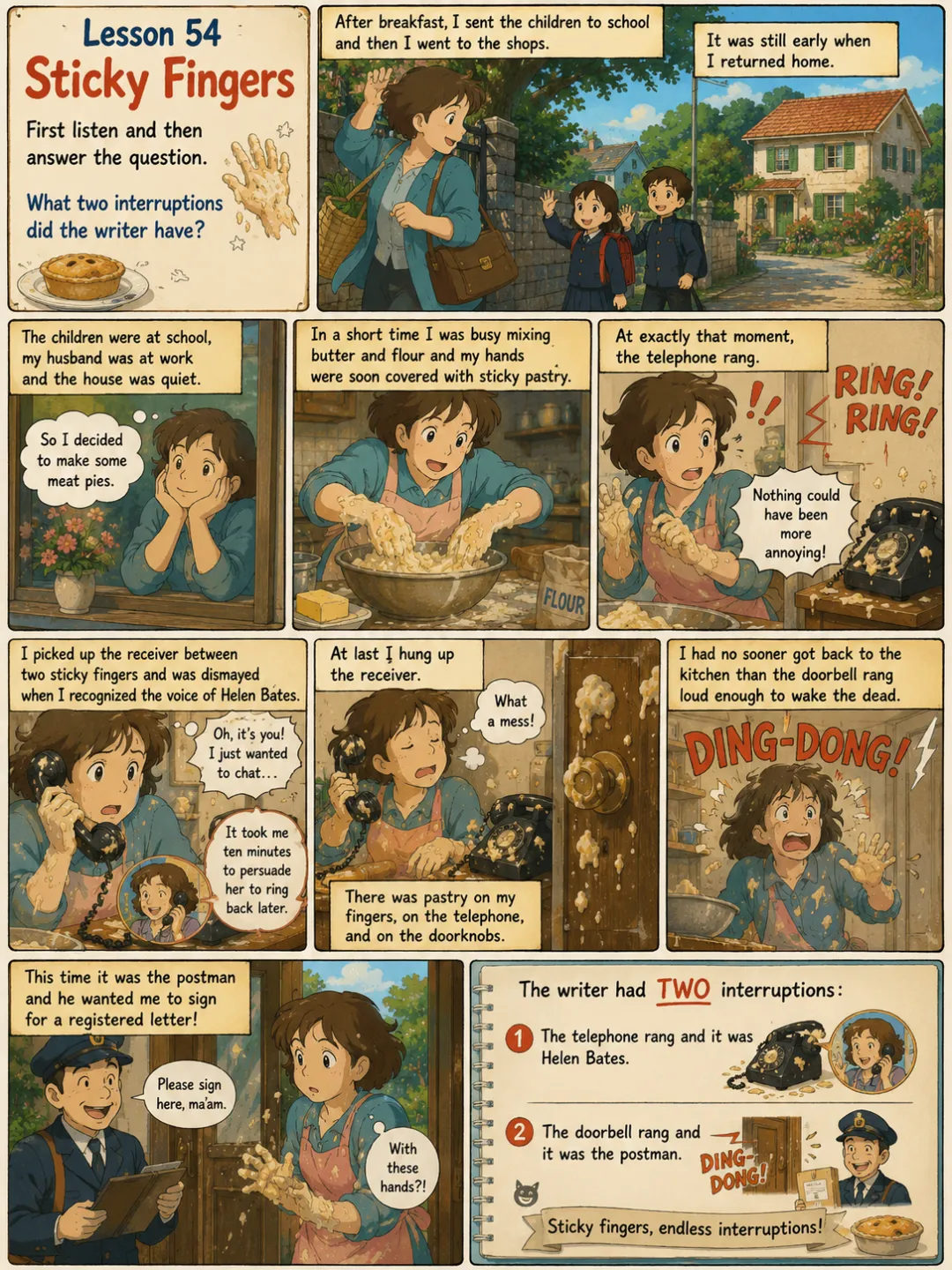
After breakfast, I sent the children to school and then I went to the shops. It was still early when I returned home. The children were at school, my husband was at work and the house was quiet. So I decided to make some meat pies. In a short time I was busy mixing butter and flour and my hands were soon covered with sticky pastry. At exactly that moment, the telephone rang. Nothing could have been more annoying. I picked up the receiver between two sticky fingers and was dismayed when I recognized the voice of Helen Bates. It took me ten minutes to persuade her to ring back later. At last I hung up the receiver. What a mess! There was pastry on my fingers, on the telephone, and on the doorknobs. I had no sooner got back to the kitchen than the doorbell rang loud enough to wake the dead. This time it was the postman and he wanted me to sign for a registered letter!
语音标注: After breakfast 连读;sent the children 中 sent 与 the 连读;It was still early 中 It was 弱读;decided to 中 to 弱读 /tə/;was busy mixing 中 was 弱读;At exactly that moment 中 that 弱读 /ðət/;Nothing could have been 中 could have been 连读 /kʊd əv biːn/;picked up 连读 /pɪkt ʌp/;between two sticky fingers 中 between 与 two 连读;It took me ten minutes 中 It 弱读;At last 连读 /ət lɑːst/;What a mess 连读 /wɒt ə mes/;had no sooner 连读 /hæd nəʊ ˈsuːnə/;loud enough 连读 /laʊd ɪˈnʌf/;sign for 连读 /saɪn fɔː/。
背景简介:本课选自《新概念英语》第二册第54课,课文标题为“Sticky fingers”(粘糊的手指)。这是一个充满生活气息和英式幽默的日常生活故事。作者L.G.Alexander通过第一人称叙述,生动地描绘了家庭主妇在准备烘焙时接连遭遇两次打扰的窘境。课文标题“Sticky fingers”一语双关,既指字面上沾满面糊的、粘糊糊的手指,也暗示了“被麻烦事缠住”、“手忙脚乱”的困境。故事以时间顺序展开,通过细腻的心理描写、动作描写和夸张的感叹,将一个平凡的生活场景演绎得妙趣横生,让读者在会心一笑中体会到家庭生活的琐碎与乐趣。课文最后一句“This time it was the postman and he wanted me to sign for a registered letter!”更是将这种“屋漏偏逢连夜雨”的窘境推向了高潮。
参考译文:早餐后,我送孩子们上学,然后就去了商店。我回到家时,时间还早。孩子们在上学,我丈夫在上班,家里很安静。所以我决定做些肉馅饼。不一会儿,我就忙着搅拌黄油和面粉,我的双手很快就沾满了粘糊糊的面糊。恰在此时,电话铃响了。没有什么比这更烦人的了。我用两根粘糊糊的手指拿起了听筒,当我听出是海伦·贝茨的声音时,感到非常沮丧。我花了十分钟才说服她过会儿再打来。最后,我挂断了电话。真是一团糟!我的手指上、电话机上、门的把手上,全都是面糊。我刚刚回到厨房,门铃就响了起来,响得足以把死人吵醒。这次是邮递员,他要我签收一封挂号信!
🔍 第二部分:逐句精讲与词块总结
句子1
原文: After breakfast, I sent the children to school and then I went to the shops.
翻译: 早餐后,我送孩子们上学,然后就去了商店。
句子结构: 并列句。由 and then 连接两个并列分句。第一个分句是 I sent the children to school,第二个分句是 I went to the shops。After breakfast 是时间状语。
重点词汇:
breakfast 蓝思值 230L
英音/ˈbrekfəst/ 美音/ˈbrekfəst/ 词性:n.
释义:早餐,早饭
常用语块:after breakfast(早餐后);have breakfast(吃早餐);at breakfast(早餐时)
短语搭配:a working breakfast(工作早餐)
例句一:I usually have breakfast at seven o'clock. 我通常七点吃早餐。
例句二:After breakfast, I read the newspaper. 早餐后,我看报纸。
拓展:breakfast由break(打破)+fast(禁食)构成,字面意思是“打破禁食”,即一天中的第一餐。
send 蓝思值 200L
英音/send/ 美音/send/ 词性:v.
释义:送;派遣;发送
常用语块:send sb. to school(送某人上学);send a letter(寄信);send for(派人去请)
短语搭配:send a message(发信息)
例句一:Every morning, I send my children to school. 每天早上,我送孩子们上学。
例句二:Please send me an email when you arrive. 你到了请给我发封邮件。
拓展:send是不规则动词,过去式和过去分词均为sent。send sb. to somewhere表示“送某人去某地”。
shop 蓝思值 180L
英音/ʃɒp/ 美音/ʃɑːp/ 词性:n./v.
释义:n.商店;店铺 v.购物
常用语块:go to the shops(去商店);shop assistant(店员);do the shopping(购物)
短语搭配:coffee shop(咖啡店)
例句一:I went to the shops to buy some groceries. 我去商店买了一些食品杂货。
例句二:She likes to shop for clothes online. 她喜欢在网上买衣服。
拓展:shop作名词时,在英式英语中常指小商店,美式英语中更常用store。
语法点睛:本句是并列句,使用一般过去时sent和went叙述过去连续发生的动作,清晰地交代了故事开始的时间线和背景。After breakfast明确了第一个时间段。这种开篇方式简洁明了,直接进入叙事。[NCE知识点笔记]
语音要点: After breakfast 连读;sent the children 中 sent 与 the 连读。
句子2
原文: It was still early when I returned home.
翻译: 我回到家时,时间还早。
句子结构: 主从复合句。主句是It was still early,when I returned home是一个由when引导的时间状语从句。
重点词汇:
early 蓝思值 160L
英音/ˈɜːli/ 美音/ˈɜːrli/ 词性:adj./adv.
释义:adj.早的;初期的 adv.早地;提前地
常用语块:still early(还早);early morning(清晨);early or late(迟早)
短语搭配:early bird(早起的人)
例句一:It's still early, we don't need to hurry. 时间还早,我们不必着急。
例句二:She gets up early every day. 她每天早起。
拓展:early的反义词是late(晚的/地)。still early强调“仍然很早”。
return 蓝思值 240L
英音/rɪˈtɜːn/ 美音/rɪˈtɜːrn/ 词性:v./n.
释义:v.返回;归还 n.返回;回报
常用语块:return home(回家);return to(回到);in return(作为回报)
短语搭配:return ticket(往返票)
例句一:He returned home late last night. 他昨晚很晚才回家。
例句二:Please return the book to the library on time. 请按时把书还给图书馆。
拓展:return home是固定搭配,home在此作副词,不加介词to。
语法点睛:本句使用 when 引导的时间状语从句,描述了“我回到家”这一时间点。主句 It was still early 是过去的时间状态描述。这种“it + be + 形容词 + when 从句”的结构常用于强调在某个时间点或事件发生时的状态。[新概念英语同步语法强化 第 2 册.pdf]
语音要点: It was still early 中 It was 弱读;when I returned home 中 when 与 I 连读。
句子3
原文: The children were at school, my husband was at work and the house was quiet.
翻译: 孩子们在上学,我丈夫在上班,家里很安静。
句子结构: 并列句。由三个并列的分句组成,描述了当时家里的情况。分别是:The children were at school, my husband was at work, the house was quiet.
重点词汇:
quiet 蓝思值 200L
英音/ˈkwaɪət/ 美音/ˈkwaɪət/ 词性:adj.
释义:安静的;寂静的;平静的
常用语块:quiet house(安静的房子);keep quiet(保持安静);a quiet life(平静的生活)
短语搭配:quiet as a mouse(非常安静)
例句一:The house was quiet when everyone was out. 大家都出去时,房子里很安静。
例句二:Please be quiet in the library. 在图书馆里请安静。
拓展:quiet作形容词,其副词形式为quietly。quiet的近义词是silent,但quiet强调没有噪音,silent强调不出声。
语法点睛:本句是一系列并列句,通过三个短句并列,营造出一种“难得清静”的氛围,为后文“被连续打扰”形成强烈的对比和铺垫。这种排比式的陈述增强了故事的节奏感,让读者感受到主人公难得的闲暇时光。[官方教材之新概念英语学生用书第2册.pdf]
语音要点: were at school 中 were 弱读;and the house was quiet 中 and 弱读 /ən/。
句子4
原文: So I decided to make some meat pies.
翻译: 所以我决定做些肉馅饼。
句子结构: 简单句。主语I,谓语decided,宾语to make some meat pies(不定式短语作宾语)。So是连词,表示结果。
重点词汇:
decide 蓝思值 230L
英音/dɪˈsaɪd/ 美音/dɪˈsaɪd/ 词性:v.
释义:决定;下决心
常用语块:decide to do sth.(决定做某事);decide on(选定);decide that(决定……)
短语搭配:decide against(决定不做)
例句一:I decided to stay at home and read a book. 我决定待在家里看书。
例句二:Have you decided on a date for the party? 你定好派对的日期了吗?
拓展:decide后常接不定式to do或that从句。
meat pie 蓝思值短语,整体约470L
英音/miːt paɪ/ 美音/miːt paɪ/ 词性:n.
释义:肉馅饼
常用语块:make meat pies(做肉馅饼);a slice of meat pie(一片肉馅饼)
短语搭配:chicken pie(鸡肉派)
例句一:She baked a delicious meat pie for dinner. 她为晚餐烤了一个美味的肉馅饼。
例句二:Meat pies are a traditional dish in many countries. 肉馅饼是许多国家的传统菜肴。
拓展:meat pie是一种英式传统食物,通常由肉馅和酥皮制成。pie也可以指其他各类馅饼。
语法点睛:本句承接上一句,用So这个连词引出结果。“Having a quiet house, I decided to make some meat pies.”说明主人公想要利用这段时间做些事情,这成为后续故事冲突的起因。[NCE知识点笔记]
语音要点: decided to 中 to 弱读 /tə/。
句子5
原文: In a short time I was busy mixing butter and flour and my hands were soon covered with sticky pastry.
翻译: 不一会儿,我就忙着搅拌黄油和面粉,我的双手很快就沾满了粘糊糊的面糊。
句子结构: 并列句。由 and 连接两个并列分句。第一个分句是 I was busy mixing butter and flour,第二个分句是 my hands were soon covered with sticky pastry。
重点词汇:
mix 蓝思值 170L
英音/mɪks/ 美音/mɪks/ 词性:v.
释义:混合;搅拌
常用语块:mix butter and flour(搅拌黄油和面粉);mix up(混合/混淆);mix with(与……混合)
短语搭配:mix a cake(拌和做蛋糕)
例句一:Mix the flour and sugar together. 把面粉和糖混合在一起。
例句二:Oil and water don't mix. 油和水不相溶。
拓展:mix 是动词,其名词形式为 mixture (混合物)。
sticky 蓝思值 360L
英音/ˈstɪki/ 美音/ˈstɪki/ 词性:adj.
释义:粘的;粘性的;棘手的
常用语块:sticky pastry(粘糊的面糊);sticky fingers(粘糊的手指);sticky situation(棘手的局面)
短语搭配:sticky tape(胶带)
例句一:My hands were sticky with jam. 我的手上沾满了果酱,粘糊糊的。
例句二:This is a sticky problem. 这是一个棘手的问题。
拓展:sticky 由动词 stick (粘贴) + 形容词后缀 - y 构成。
pastry 蓝思值 490L
英音/ˈpeɪstri/ 美音/ˈpeɪstri/ 词性:n.
释义:油酥面团;面糊;糕点
常用语块:sticky pastry(粘糊的面糊);pastry chef(糕点师);puff pastry(千层酥皮)
短语搭配:pastry shop(糕点店)
例句一:She rolled out the pastry to make a pie. 她擀开油酥面团来做馅饼。
例句二:I love French pastry. 我喜欢法式糕点。
拓展:pastry 是制作各类馅饼和糕点的基本面团,通常由面粉、黄油和水混合而成。
cover 蓝思值 190L
英音/ˈkʌvə(r)/ 美音/ˈkʌvər/ 词性:v./n.
释义:v. 覆盖;遮盖 n. 封面;盖子
常用语块:be covered with(被……覆盖);cover up(掩盖);cover the table(铺桌子)
短语搭配:cover story(封面故事)
例句一:The ground was covered with snow. 大地被积雪覆盖。
例句二:She covered the baby with a blanket. 她用毯子把婴儿盖好。
拓展:be covered with 是固定短语,表示“被……覆盖着”,强调状态。with 后接覆盖物。
语法点睛:本句的第一个分句使用了 was busy mixing 这一结构。be busy doing sth. 是一个常见句型,意为“忙于做某事”。第二个分句使用了 一般过去时的被动语态 were covered with,描述“手被面糊覆盖”这一结果状态。这两个分句共同描绘出主人公已经“深陷”烘焙工作中的场景。[手绘版新概念语法笔记]
语音要点: was busy mixing 中 was 弱读;and my hands 中 and 弱读 /ən/。
句子6
原文: At exactly that moment, the telephone rang.
翻译: 恰在此时,电话铃响了。
句子结构: 简单句。主语 the telephone,谓语 rang,时间状语 At exactly that moment。
重点词汇:
exactly 蓝思值 320L
英音/ɪɡˈzæktli/ 美音/ɪɡˈzæktli/ 词性:adv.
释义:恰好;正好;精确地
常用语块:at exactly that moment(恰在此时);exactly right(完全正确)
短语搭配:exactly the same(完全相同)
例句一:The train arrived exactly at nine o'clock. 火车正好九点钟到达。
例句二:That is exactly what I mean. 那正是我的意思。
拓展:exactly 在此处起强调作用,突出了时间点的巧合性,增强了戏剧效果。
ring 蓝思值 200L
英音/rɪŋ/ 美音/rɪŋ/ 词性:v./n.
释义:v.(使)发出铃声;打电话 n.戒指;环;铃声
常用语块:the telephone rings(电话铃响);ring back(回电话);ring up(打电话)
短语搭配:ring a bell(按铃/听起来耳熟)
例句一:The phone rang three times before he answered it. 电话响了三次他才接。
例句二:I'll ring you tomorrow. 我明天给你打电话。
拓展:ring 是不规则动词,过去式为 rang,过去分词为 rung。
语法点睛:这是一个强调时间巧合的简单句。At exactly that moment 是一个关键的时间状语,将电话铃声与主人公的“忙碌状态”紧密地联系在一起,制造了冲突。rang 是一般过去时,描述了一个突然发生的动作。这个句子短小精悍,却如同一个信号,瞬间打破了之前的宁静。[新概念英语名师精讲笔记第2册.pdf]
语音要点: At exactly that moment 中 that 弱读 /ðət/。
句子7
原文: Nothing could have been more annoying.
翻译: 没有什么比这更烦人的了。
句子结构: 简单句。主语 Nothing,谓语 could have been,表语 more annoying。
重点词汇:
annoying 蓝思值 400L
英音/əˈnɔɪɪŋ/ 美音/əˈnɔɪɪŋ/ 词性:adj.
释义:令人烦恼的;讨厌的
常用语块:be annoying(令人烦恼);annoying habit(令人讨厌的习惯)
短语搭配:very annoying(非常烦人)
例句一:The noise is very annoying. 噪音非常烦人。
例句二:It is annoying to be interrupted when you are busy. 忙碌时被打断很烦人。
拓展:annoying 是形容词,其动词原形为annoy(使烦恼),近义词为irritating。
语法点睛:本句使用“Nothing could have been + 比较级”这一虚拟语气结构,表达了“这种烦人程度无以复加”的含义。这是一种夸张的修辞手法,用来强调主人公当时有多么恼火。could have been 是对过去情况的推测,表示“当时本可能……”但实际并未发生。这个句式非常经典,用于表达极端的情绪。[NCE 知识点笔记][语法新思维]
语音要点: Nothing could have been 中 could have been 连读 /kʊd əv biːn/。
句子8
原文: I picked up the receiver between two sticky fingers and was dismayed when I recognized the voice of Helen Bates.
翻译: 我用两根粘糊糊的手指拿起了听筒,当我听出是海伦·贝茨的声音时,感到非常沮丧。
句子结构: 主从复合句。主句是 I picked up the receiver... and was dismayed。when I recognized the voice of Helen Bates 是一个由 when 引导的时间状语从句。between two sticky fingers 是方式状语。
重点词汇:
receiver 蓝思值 430L
英音/rɪˈsiːvə(r)/ 美音/rɪˈsiːvər/ 词性:n.
释义:电话听筒;接收器;收款人
常用语块:pick up the receiver(拿起听筒);put down the receiver(放下听筒);telephone receiver(电话听筒)
短语搭配:receiver of a letter(收信人)
例句一:He picked up the receiver and dialed the number. 他拿起听筒,拨了号码。
例句二:The sound came through the receiver very clearly. 声音从听筒里清晰地传过来。
拓展:receiver 由动词 receive (接收) + 名词后缀 - er (……的物品/人) 构成。
dismay 蓝思值 600L
英音/dɪsˈmeɪ/ 美音/dɪsˈmeɪ/ 词性:v./n.
释义:v. 使沮丧;使惊慌 n. 沮丧;惊慌
常用语块:be dismayed(感到沮丧);to one's dismay(令某人沮丧的是);in dismay(惊慌地)
短语搭配:dismay at sth.(对……感到沮丧)
例句一:I was dismayed to hear that he was ill. 听到他生病的消息我感到很沮丧。
例句二:She looked at him in dismay. 她沮丧地看着他。
拓展:dismay 语气较强,常指因意外的不利情况而感到的强烈沮丧。
recognize 蓝思值 330L
英音/ˈrekəgnaɪz/ 美音/ˈrekəgnaɪz/ 词性:v.
释义:认出;识别;承认
常用语块:recognize sb. by/from(通过……认出某人);recognize one's voice(辨认出某人的声音);recognize a problem(认识到问题)
短语搭配:be recognized as(被公认为)
例句一:I recognized her by her red hair. 我通过她的红头发认出了她。
例句二:He is recognized as one of the leading experts in the field. 他被公认为该领域的顶尖专家之一。
拓展:recognize 强调“认出”之前认识的人或物。
语法点睛:本句的when从句描述了一个瞬间的心理变化。主句中的两个谓语picked up和was dismayed由and连接,描述了两个连续的动作和状态变化。between two sticky fingers这个细节描写非常生动,形象地刻画了主人公当时手忙脚乱的窘态。[新概念英语课堂笔记第2册.pdf]
语音要点: picked up 连读 /pɪkt ʌp/;between two sticky fingers 中 between 与 two 连读。
句子9
原文: It took me ten minutes to persuade her to ring back later.
翻译: 我花了十分钟才说服她过会儿再打来。
句子结构: 简单句。使用It takes sb. + time + to do sth. 句型。It 是形式主语,to persuade her to ring back later 是真正的主语。me 是间接宾语,ten minutes 是时间名词。
重点词汇:
persuade 蓝思值 390L
英音/pəˈsweɪd/ 美音/pərˈsweɪd/ 词性:v.
释义:说服;劝说
常用语块:persuade sb. to do sth.(说服某人做某事);persuade sb. into doing sth.(说服某人做某事);persuade sb. out of doing sth.(说服某人不做某事)
短语搭配:try to persuade(试图说服)
例句一:I persuaded him to go to the doctor. 我说服了他去看医生。
例句二:She persuaded her friend into buying the dress. 她说服了她的朋友买那条裙子。
拓展:persuade 强调成功说服,而 try to persuade 则强调试图说服但未必成功。近义词为 convince。
ring back 蓝思值短语,整体约440L
英音/rɪŋ bæk/ 美音/rɪŋ bæk/ 词性:动词短语
释义:回电话
常用语块:ring sb. back(给某人回电话);ring back later(过会儿再打)
短语搭配:call back(回电话,美式英语)
例句一:I'll ask her to ring you back. 我会叫她给你回电话。
例句二:He said he would ring back in an hour. 他说他一小时后再打来。
拓展:ring back 在英式英语中很常用,美式英语中通常用 call back。
语法点睛:本句是 It takes sb. some time to do sth. 句型的典型应用,意为“做某事花了某人多少时间”。这里用 took 过去式,表示过去发生的事。to ring back later 是不定式短语作宾语补足语,later 表示“以后、过会儿”。[新概念英语句型步步高 第 2 册.pdf]
语音要点: It took me ten minutes 中 It 弱读;to persuade her 中 to 弱读 /tə/。
句子10
原文: At last I hung up the receiver.
翻译: 最后,我挂断了电话。
句子结构: 简单句。主语I,谓语hung up,宾语the receiver,时间状语At last。
重点词汇:
hang up 蓝思值短语,整体约460L
英音/hæŋ ʌp/ 美音/hæŋ ʌp/ 词性:动词短语
释义:挂断电话;挂起来
常用语块:hang up the phone(挂断电话);hang up the coat(挂起外套)
短语搭配:hang up on sb.(挂断某人的电话)
例句一:She said goodbye and hung up. 她说了再见,然后挂断了电话。
例句二:Don't hang up! I haven't finished talking. 别挂断!我还没说完。
拓展:hang up 在电话用语中意为“挂断”,是及物动词短语,代词作宾语需放在 up 前(hang it up),名词可放在中间或后面。hang 的过去式和过去分词是 hung。
语法点睛:本句是简单句,At last 强调了经过一番努力(花了十分钟说服)之后,终于完成了挂电话这一动作,为第一段“电话打扰”画上了句号。[新概念英语口语宝典 第 2 册.pdf]
语音要点: At last 连读 /ət lɑːst/。
句子11
原文: What a mess!
翻译: 真是一团糟!
句子结构: 感叹句。省略了主语和谓语“it is”的感叹句。
重点词汇:
mess 蓝思值 260L
英音/mes/ 美音/mes/ 词性:n.
释义:混乱;脏乱;一团糟
常用语块:What a mess!(真是一团糟!);in a mess(一片混乱);make a mess(搞得一团糟)
短语搭配:clear up the mess(清理烂摊子)
例句一:After the party, the house was a complete mess. 派对之后,房子一片狼藉。
例句二:My hair is a mess! 我的头发乱极了!
拓展:mess 是不可数名词,但可以用 a mess 表示“一团糟”的状态。
语法点睛:这是一个典型的What + a/an + 名词(+ 主语 + 谓语)! 结构的感叹句,用于表达强烈的情绪。在这里,作者用这个感叹句来总结她挂完电话后看到的场景,表达了她对当前混乱状况的无奈和惊讶。[手绘版新概念语法笔记]
语音要点: What a mess 连读 /wɒt ə mes/。
句子12
原文: There was pastry on my fingers, on the telephone, and on the doorknobs.
翻译: 我的手指上、电话机上、门的把手上,全都是面糊。
句子结构: There be 句型。主语是 pastry,谓语是 was,后面跟了一串并列的地点状语 on my fingers, on the telephone, and on the doorknobs.
重点词汇:
doorknob 蓝思值 680L
英音/ˈdɔːnɒb/ 美音/ˈdɔːrnɑːb/ 词性:n.
释义:门把手
常用语块:on the doorknobs(在门把手上);turn the doorknob(转动门把手)
短语搭配:doorknob hanger(门把手挂钩)
例句一:The doorknob was sticky with jam. 门把手被果酱弄得粘糊糊的。
例句二:He turned the doorknob and opened the door. 他转动门把手,打开了门。
拓展:doorknob 由 door (门) + knob (圆形把手) 合成。
语法点睛:本句承接前一句,解释了何为 "mess"。作者用排比的手法,列举了三个地点 on my fingers, on the telephone, and on the doorknobs,生动地展现了混乱的范围之广,形象地说明了她刚才接电话时是如何手忙脚乱的。[官方教材之新概念英语自学导读 第 2 册.pdf]
语音要点: There was pastry 中 There was 弱读 /ðə wəz/。
句子13
原文: I had no sooner got back to the kitchen than the doorbell rang loud enough to wake the dead.
翻译: 我刚刚回到厨房,门铃就响了起来,响得足以把死人吵醒。
句子结构: 主从复合句。主句是 I had no sooner got back to the kitchen, 从句是 than the doorbell rang... no sooner...than... 是固定句型,表示 "一……就……",主句通常使用过去完成时,从句使用一般过去时。loud enough to wake the dead 是形容词短语作结果状语,修饰 rang。
重点词汇:
loud 蓝思值 190L
英音/laʊd/ 美音/laʊd/ 词性:adj./adv.
释义:adj. 大声的;响亮的 adv. 大声地
常用语块:loud enough(足够响亮);loud noise(噪音);loud voice(响亮的声音)
短语搭配:laugh out loud(放声大笑)
例句一:The music is too loud. 音乐声太大了。
例句二:Speak louder, please. I can't hear you. 请大声点,我听不见你说话。
拓展:loud 可作形容词或副词,本课中作副词修饰 rang。
enough 蓝思值 160L
英音/ɪˈnʌf/ 美音/ɪˈnʌf/ 词性:adj./adv.
释义:adj.足够的 adv.足够地
常用语块:loud enough(足够响亮);good enough(足够好);enough time(足够的时间)
短语搭配:enough to do sth.(足够做某事)
例句一:The room is big enough for a party. 这个房间足够大,可以开派对。
例句二:I don't have enough money to buy that car. 我没有足够的钱买那辆车。
拓展:enough作副词时,放在被修饰的形容词或副词后面;作形容词时,放在名词前。
wake 蓝思值 190L
英音/weɪk/ 美音/weɪk/ 词性:v.
释义:醒;唤醒;醒来
常用语块:wake the dead(把死人吵醒,夸张用法);wake up(醒来/唤醒);wake sb. up(叫醒某人)
短语搭配:wake from sleep(从睡梦中醒来)
例句一:Please wake me up at seven o'clock. 请在七点钟叫醒我。
例句二:The noise woke me up in the middle of the night. 半夜的噪音把我吵醒了。
拓展:wake the dead 是一种夸张的说法,形容声音特别大。wake 的过去式是 woke,过去分词是 woken。
语法点睛:本句是本课的核心语法句,使用了 no sooner...than... 句型。这是一个倒装句的潜在形式,但在课文中没有倒装,是正常语序。no sooner 所在的主句使用过去完成时 had got back,强调这个动作发生在从句动作之前(门铃响之前)。从句使用一般过去时 rang。loud enough to wake the dead 这个短语使用了 enough to do 结构,表示“足够……以……”,且使用了夸张的修辞手法,增强了故事的幽默效果。[语法新思维][名师精讲]
语音要点: had no sooner 连读 /hæd nəʊ ˈsuːnə/;loud enough 连读 /laʊd ɪˈnʌf/。
句子14
原文: This time it was the postman and he wanted me to sign for a registered letter!
翻译: 这次是邮递员,他要我签收一封挂号信!
句子结构: 并列句。由 and 连接两个并列分句 it was the postman 和 he wanted me to sign for a registered letter。
重点词汇:
postman 蓝思值 410L
英音/ˈpəʊstmən/ 美音/ˈpəʊstmən/ 词性:n.
释义:邮递员,邮差
常用语块:the postman(邮递员);postman's bag(邮递员的包)
短语搭配:postwoman(女邮递员)
例句一:Has the postman been yet? 邮递员来过了吗?
例句二:The postman delivers letters every morning. 邮递员每天早上送信。
拓展:postman 是英式英语,美式英语中用 mailman 或 mail carrier。
sign for 蓝思值短语,整体约480L
英音/saɪn fɔː(r)/ 美音/saɪn fɔːr/ 词性:动词短语
释义:签收(某物)
常用语块:sign for a letter(签收一封信);sign for a package(签收一个包裹)
短语搭配:sign for receipt(签收)
例句一:You must sign for this parcel. 你必须签收这个包裹。
例句二:I signed for the registered letter at the door. 我在门口签收了那封挂号信。
拓展:sign for 强调在收到某物时签名确认。
registered 蓝思值 580L
英音/ˈredʒɪstəd/ 美音/ˈredʒɪstərd/ 词性:adj.
释义:挂号的;注册的;登记的
常用语块:registered letter(挂号信);registered mail(挂号邮件);registered user(注册用户)
短语搭配:registered trademark(注册商标)
例句一:I sent the document by registered post. 我通过挂号信寄了那份文件。
例句二:You need to send it as a registered letter to be safe. 为了安全起见,你需要用挂号信寄出。
拓展:registered 是动词 register (登记/注册) 的形容词形式。registered letter 是一种需要收件人签名确认的服务,比平信更安全可靠。
语法点睛:文章最后以一个并列短句结尾,点明了第二次打扰的来源。wanted me to sign for 是 want sb. to do sth. 结构,意为 "想要某人做某事"。以感叹号结尾,将主人公的震惊和无奈表现得淋漓尽致,也给读者留下了深刻的印象。[新概念英语之全新全绎 第 2 册.pdf]
语音要点: sign for 连读 /saɪn fɔː/。
📌 核心词块总结
1. sticky fingers (粘糊糊的手指/手忙脚乱): Literally, fingers covered with something sticky. Figuratively, it means being in a difficult or messy situation, or being prone to causing trouble (指手画脚/企图偷窃).例句: After baking, I had sticky fingers covered in pastry.
2. pick up the receiver (拿起听筒): To lift the telephone receiver to answer a call.例句: She picked up the receiver on the third ring.
3. ring back (回电话): To return a phone call to someone who called earlier.例句: I am busy now, can I ring you back later?
4. hang up (挂断电话): To end a phone call by placing the receiver back on the phone.例句: He said goodbye and hung up the phone.
5. What a mess! (真是一团糟!): An exclamation used to describe a situation or place that is very untidy or chaotic.例句: After the children played, the room was a mess. What a mess!
6. sign for (签收): To sign a document to confirm that you have received a package or letter.例句: You need to sign for this registered parcel yourself.
7. loud enough to wake the dead (响得足以把死人吵醒): An exaggerated expression meaning extremely loud.例句: The music at the party was loud enough to wake the dead.
✍️ 第三部分:语篇分析与段落写作技巧
1. 语篇分析(关键术语标注英文):① 识别宏观结构:本课是一篇第一人称记叙文(First-person Narrative),按照时间顺序(Chronological Order)叙述了一个发生在家庭中的小故事。结构清晰,可分为以下段落:背景设定: 第1-4句。交代时间、地点、人物状态(安静的家),并引出主人公的决定(做肉馅饼)。冲突一: 第5-10句。描述第一次打扰——电话铃响,以及主人公粘糊糊地接电话、沮丧地认出对方、花时间说服对方、最终挂断电话的全过程。转折/情绪高潮: 第11-12句。描述挂断电话后看到的混乱景象,感叹“真是一团糟”。冲突二: 第13-14句。描述第二次打扰——门铃巨响(夸张修辞),邮递员要求签收挂号信,故事在高潮中戛然而止。
② 列举衔接手段:时间连接: After breakfast, then, when I returned home, In a short time, At exactly that moment, At last, I had no sooner got back... than..., This time. 这些时间短语和连词清晰地串联了整个事件的顺序。逻辑连接: So(因此,表结果);and(和,并列表顺承);but(隐含于前后文对比中)。指代: I(主人公);the children, my husband(家人);the telephone, it(电话);Helen Bates(打电话的人);the postman(邮递员);a registered letter(挂号信)。词汇衔接: sticky pastry, fingers, telephone, receiver, doorknobs, kitchen, doorbell 等构成一个完整的家庭生活场景词汇链。
③ 分析作者态度:作者以幽默、自嘲、略带夸张的笔调叙述了这一段不愉快的经历。通过使用 annoying, dismayed, What a mess!, loud enough to wake the dead 等情感强烈的词汇和夸张手法,作者成功地将生活中的一个小烦恼转化为一个引人发笑的故事。读者能感受到作者的无奈,但更多的是对其窘境的幽默共鸣。整篇课文是一种“苦中作乐”的叙事风格。[新概念英语美文欣赏 第 2 册.pdf]
2. 写作技巧:① 提炼写作逻辑:本课的写作逻辑是“铺垫 → 冲突爆发 → 升级 → 再次爆发”的递进式叙事手法。铺垫:营造宁静、有序的氛围(The house was quiet.),为后文的“被打扰”做铺垫。冲突爆发:以时间点 At exactly that moment 引入第一个冲突(电话铃响)。升级:详细描述冲突过程(粘糊的手接电话、听出讨厌的声音、漫长地劝说),并交代冲突后的混乱结果(What a mess!)。再次爆发:利用 no sooner...than... 的紧凑结构,立即引入第二个冲突(门铃响),且程度更强(loud enough to wake the dead),并在高潮处点明来人(the postman with a registered letter),给予故事一个有力的结尾。
② 提供段落写作范例:题目:Write a short story about a person who is having a quiet, relaxing time at home, but then gets interrupted by two unexpected events. Use the structure and key expressions from Lesson 54.例文:A Relaxing Evening RuinedAfter a long day at work, I finally sat down on the sofa with a cup of tea and a good book. The cat was sleeping, and the flat was perfectly quiet. I was just getting to the most exciting part of the story when the phone rang. Nothing could have been more annoying. I picked up the phone and was dismayed to hear a recorded sales message. It took me two minutes to find the right button to hang up. I sighed and went back to my book. I had no sooner turned the page than the doorbell rang loud enough to startle the cat. This time it was my neighbor, and she wanted to borrow a cup of sugar!
③ 分析其结构特点:结构特点:完全模仿课文结构:宁静的背景 → “恰在此时”的第一次打扰 → 处理打扰的烦人过程 → 感叹(此处省略了What a mess!,但用了sighed表达情绪) → “……就”的第二次打扰 → 点明来访者的身份和目的。与课文手法完全一致。语言点映射:The flat was perfectly quiet. → 映射The house was quiet.I was just getting to the most exciting part... when the phone rang. → 映射At exactly that moment, the telephone rang.Nothing could have been more annoying. → 映射原文原句。It took me two minutes to find the right button to hang up. → 映射It took me ten minutes to persuade her to ring back later.I had no sooner turned the page than the doorbell rang... → 映射I had no sooner got back to the kitchen than the doorbell rang...This time it was my neighbor... → 映射This time it was the postman...
④ 布置小练笔并提供例文:小练笔:Write a short story (about 120 words) about someone who is doing a messy household chore (e.g., painting, gardening, cleaning the oven) and gets interrupted by two things. Use the sentence structures At exactly that moment... and I had no sooner... than...例文:The Messy GardenerI decided to repot my plants in the garden. Soon I was busy mixing soil and compost, and my hands were soon covered with sticky mud. At exactly that moment, my mobile phone rang. Nothing could have been more annoying. I picked it up with my dirty fingers and was dismayed when I realized it was my boss calling about a project. It took me five minutes to explain I couldn't talk right now and to persuade him to call back later. I hung up and sighed. What a mess! There was mud on my phone, on my clothes, and on the garden path. I had no sooner picked up my trowel than the doorbell rang. This time it was the delivery man with a heavy parcel, and he needed my signature!
📐 第四部分:本课语法精析(加强版)
本部分字数不少于1500-2000字。
本课的核心语法是过去完成时(The Past Perfect Tense)以及no sooner...than...和hardly...when...这两个表示“一……就……”的句型。
1. 过去完成时(The Past Perfect Tense)深度解析
结构:had + 过去分词
核心意义:表示动作发生在“过去的过去”。也就是说,它描述的是一个在另一个过去动作之前就已经完成的动作。它必须有一个过去的参照时间点才能体现出其意义。强调动作的先后顺序。
本课应用:唯一的过去完成时示例是I had no sooner got back to the kitchen than the doorbell rang。这里,had no sooner got back(刚刚回到厨房)这个动作发生在rang(门铃响了)这个过去动作之前。rang是“过去”的时间点,had got back是“过去的过去”。
与一般过去时的对比:- 一般过去时:仅仅陈述过去发生的事情,不强调其与另一件过去事情的先后关系。例如:The telephone rang.- 过去完成时:强调该动作发生在另一个过去动作之前,或对另一个过去时间点的状态产生了影响。例如:I had finished my work before he came.(说明“完成工作”发生在“他来”之前。)本课比较:课文中大部分动作都用一般过去时,因为它们是按时间顺序依次发生的(sent, went, returned, decided, was, rang, picked up, was dismayed, recognized, took, persuaded, hung up)。只有 had got back 使用了过去完成时,因为它需要明确表示这个动作发生在 rang 之前,以构成“一……就……”的逻辑关系。
与现在完成时的对比:现在完成时:强调过去动作与现在的联系(结果、影响、持续到现在)。时间坐标是现在。She has just left the room.(强调现在不在房间了)过去完成时:强调一个过去动作与另一个过去时间或动作的联系。时间坐标是过去的某个点。She had just left the room when I arrived.(强调我到达时,她已经离开房间了,与“我到达”这个过去时间点相关)
2. no sooner...than...句型
结构:Someone had no sooner done A than B happened. 意为“某人刚一做完 A,B 就发生了”。
用法:no sooner 所在的主句通常使用过去完成时 (had done),than 引导的从句使用一般过去时 (did)。这个句型强调两个动作衔接得非常紧密,中间几乎没有间隔。
本课应用:I had no sooner got back to the kitchen than the doorbell rang. 我刚刚回到厨房,门铃就响了。
类似结构:hardly...when...(刚……就……)。其结构与 no sooner...than... 基本相同:Someone had hardly done A when B happened.- 例句对比:I had hardly got back to the kitchen when the doorbell rang.(意思和上面一样)
倒装用法(Inversion):当 no sooner 或 hardly 位于句首时,主句必须使用部分倒装。这是一个高级语法点,在本课中没有出现,但第二册学生应有所了解,为以后学习打基础。- 正常语序:I had no sooner got back than the doorbell rang.- 倒装语序:No sooner had I got back than the doorbell rang.(将 had 提到主语 I 之前)- 练习:I had hardly opened the door when the dog ran out.- Hardly had I opened the door when the dog ran out.
3. 与第一册相关语法点进行对比分析
第一册引入了一般过去时 (The Simple Past Tense) 和现在完成时 (The Present Perfect Tense)。学生已经能够用一般过去时描述过去发生的事件,用现在完成时谈论经历或持续性的事件。
第二册第 54 课在此基础上引入了过去完成时 (The Past Perfect Tense)。这是一个质的飞跃,因为学生需要建立“过去的过去”这一时间概念。这是一个叙事中至关重要的时态,可以帮助作者清晰地表达动作发生的先后顺序。
对比示例 (第一册水平 vs 第二册水平):第一册: I went home. Then I ate dinner. (两个动作都用一般过去时,用 then 表明顺序)第二册: I had eaten dinner before I went home. (使用过去完成时,明确强调 "吃饭" 发生在 "回家" 之前,这是第一册没有的时态概念)第二册本课: I had no sooner got back to the kitchen than the doorbell rang. (虽然课文中没有使用倒装,但 no sooner...than... 这个句型本身以及过去完成时的运用,都是第二册的重要标志,深化了时间的表达方式。)
4. 练习题 (不少于 12 道,附详细解析)
一、用括号内动词的适当形式填空 (注意时态)1. When I got home yesterday, my mother (already, cook) dinner.2. He (finish) his homework before he went to bed.3. She (no sooner, arrive) than it started to rain.4. The train (already, leave) when we reached the station.5. I (never, see) such a beautiful sight before that day.6. He (hardly, sit down) when the phone rang again.
二、用 no sooner...than 或 hardly...when 完成句子7. I had started to eat the doorbell rang.8. He had put on his coat he realized he had forgotten his keys.
三、选择最佳答案9. I the film before, so I knew the ending.A. have seen B. had seen C. saw10. The old man for ten years already when another war broke out.A. had been dead B. was dead C. died11. No sooner had she the room than she noticed the strange smell.A. entered B. enter C. entering12. I was very disappointed because I for the exam for months.A. studied B. have studied C. had studied
四、将下列句子改为倒装句13. I had no sooner finished my work than he arrived.14. She had hardly entered the room when the alarm went off.
详细解析:1.答案:had already cooked解析:“我昨天到家”是过去的时间点,“妈妈做饭”发生在这之前,是“过去的过去”,用过去完成时。[NCE知识点笔记]2.答案:had finished解析:“睡觉”went to bed是过去动作,“完成作业”发生在这之前,用过去完成时。[名师精讲]3.答案:had no sooner arrived解析:no sooner...than 句型,主句 arrive 发生在 started to rain 之前,用过去完成时。[语法新思维]4.答案:had already left解析:“到达车站”reached the station 是过去动作,“火车离开”发生在这之前,用过去完成时。[手绘版新概念语法笔记]5.答案:had never seen解析:before that day(那一天之前)是过去的时间点,“从未见过”是发生在那个时间点之前的经历,用过去完成时。[新概念英语同步语法强化第2册.pdf]6.答案:had hardly sat down解析:hardly...when 句型,主句 sit down 发生在 rang 之前,用过去完成时。[语法新思维]7.答案:hardly...when解析:hardly...when 是固定搭配。[名师精讲]8.答案:no sooner...than解析:no sooner...than 是固定搭配。[NCE 知识点笔记]9.答案:B. had seen解析:knew the ending(知道结局)是过去,“看电影”发生在知道结局之前,所以是“过去的过去”,用过去完成时。[手绘版新概念语法笔记]10.答案:A. had been dead解析:war broke out(战争爆发)是过去时间点,“老人已去世十年”发生在战争爆发之前,表示持续的状态,用过去完成时。注意 dead 是形容词,die 是瞬间动词,不能延续十年。[新概念英语语法一学就会全 4 册.pdf]11.答案:A. entered解析:这是倒装句 No sooner had she entered... than...,倒装结构中 had 后的动词必须用过去分词形式。entered 是 enter 的过去分词。[语法新思维]12.答案:C. had studied解析:was disappointed(失望)是过去的心情,原因是“备考了几个月”,这个动作发生在心情失望之前,是“过去的过去”,用过去完成时。[新概念英语之全新全绎第 2 册.pdf]
四、改写句子答案:13. 答案:No sooner had I finished my work than he arrived.解析:倒装时,将had提到主语I之前。[手绘版新概念语法笔记]14. 答案:Hardly had she entered the room when the alarm went off.解析:倒装时,将had提到主语she之前。[语法新思维]
🎧 第五部分:听力与阅读策略训练
1. 听力技巧结合课文录音:本课录音语速适中,故事性强,充满生活气息,非常适合训练听力理解。建议按照[新概念英语讲师用书新版2一实践与进步.pdf]的步骤进行。
① 预测关键词:看课文问题“What two interruptions did the writer have?”(作者遇到了哪两次打扰?)根据问题和课文标题Sticky fingers,我们可以预测录音中会出现与厨房烘焙(pie, pastry, butter, flour)、电话(telephone, ring, receiver, phone)、门铃(doorbell, sign for)相关的关键词。还可以预测主人公会遇到两次打扰,分别是电话和门铃。
② 抓主旨大意:第一遍听录音,集中精力抓住故事的大致脉络。听出两个核心事件:第一次是电话打扰,第二次是邮递员按门铃。听完后尝试用一句话回答听力问题:The two interruptions were a phone call from Helen Bates and a visit from the postman with a registered letter.
③ 笔记方法:第二遍听,简记两次打扰的具体细节。Interruption 1: telephone rang -> helper picking up receiver with sticky fingers -> heard voice of Helen Bates -> persuaded her to ring back later -> hung up.Result 1: What a mess! -> pastry on fingers, phone, doorknobs.Interruption 2: got back to kitchen -> doorbell rang very loud -> postman -> sign for registered letter.
听力理解题示例:1. What was the writer doing when the telephone rang?A. Washing the dishes. B. Making meat pies.2. How did the writer answer the phone?A. With perfectly clean hands. B. With a towel. C. Between two sticky fingers. D. Using speakerphone.3. Who was calling?A. The writer's husband. B. The children's teacher. C. Helen Bates. D. The postman.4. Why was the writer dismayed when she heard the voice?A. Because the caller was a stranger. B. Because she had to talk for a long time. C. Because it was a wrong number. D. Because the timing was terrible and she was busy.5. What did the writer have to do for the second interruption?A. Make a cup of tea. B. Sign for a registered letter. C. Open the door for the children. D. Pay for the delivery.
答案解析:1. B (原文:I was busy mixing butter and flour... making some meat pies.)2. C (原文:I picked up the receiver between two sticky fingers)3. C (原文:I recognized the voice of Helen Bates)4. D (她处于非常忙乱的状态,不想被打扰,故而是因为时间点不好而感到沮丧)5. B (原文:he wanted me to sign for a registered letter)
2. 阅读理解策略
① 扫读:快速扫读,找出作者花了多长时间说服海伦·贝茨稍后再打。定位:在文章中快速扫读关键词minutes和persuade。答案:It took me ten minutes to persuade her to ring back later.
② 略读:快速略读,理解文章的结构层次。方法:先读第一句After breakfast...和最后一句This time it was the postman...快速浏览每段的开头句(重点看转折词So, At exactly that moment, At last, I had no sooner...than),可以迅速把握故事发展的几个关键转折点。略读有助于我们把握从“安静”到“打扰”再到“更糟的打扰”的层层递进关系。
③ 推断词义:题目:理解sticky fingers的双关含义。上下文线索:标题是Sticky fingers,文中提到my hands were soon covered with sticky pastry, I picked up the receiver between two sticky fingers.推理:字面意思是“粘糊糊的手指”,但考虑到她正在做一件“棘手”的事(烘焙),并且“粘糊”的手导致她接电话很不方便,sticky也隐含了“麻烦的、棘手的”意味。所以标题一语双关,既指她“手粘”,也指她“身陷麻烦”。
题目:推断wake the dead的实际意思。上下文线索:the doorbell rang loud enough to wake the dead.推理:dead是指“死人”。说门铃响得“能吵醒死人”是一种极其夸张的说法,旨在强调门铃的声音非常大。
📝 第六部分:习题讲解
1. 针对教材中的书面练习进行详细讲解本课的课后书面练习通常涵盖关键句型(Key Structures)和难点(Special Difficulties)。
关键句型练习:过去完成时练习示例1:将两个简单句合并成一个含有no sooner...than或hardly...when的句子。1. I got to the classroom. The teacher came in.答案:I had no sooner got to the classroom than the teacher came in. / I had hardly got to the classroom when the teacher came in.2. He turned off the light. The telephone rang.答案:He had no sooner turned off the light than the telephone rang. / He had hardly turned off the light when the telephone rang.
练习示例2:用括号内动词的过去完成时填空。1. When I arrived at the party, John (already/go) home.答案:had already gone2. She (never/be) to Paris before she went there last year.答案:had never been
难点练习:易混淆词和短语
3. make(制作/做) vs. do(做/干)- make通常指“创造、制作”某个先前不存在的东西。make some meat pies(制作肉馅饼); make a cake.- do通常指“做、进行”一项活动或工作。do the shopping(购物); do homework.- 练习题:I need to ______ the dishes. (do / make)- 答案:do (do the dishes 是固定搭配,意为“洗碗”)。make 通常不与 dishes 搭配。
4. receiver(听筒) vs. reception(接待/招待会)- receiver 在本课指电话听筒,也可指“接收器”、“收款人”。- reception 指“接待”、“招待会”或“接收(信号)”。- 练习题:He picked up the ______ and dialed the number. (receiver / reception)- 答案:receiver
5. maybe(也许) vs. may be(可能是)- maybe 是一个副词,意为“也许、大概”,常置于句首。Maybe it is true.- may be 是“情态动词 + be动词”,意为“可能是”。She may be at home.- 练习题:______ the postman will come later. (Maybe / May be)- 答案:Maybe
多项选择题题目1:Why did the writer decide to make some meat pies?A. She was hungry. B. The house was quiet and she had time. C. The children asked for them. D. She had nothing else to do.答案:B(对应原文上下文:家人都不在,家里很安静,所以才有时间做馅饼)
题目2:What made the writer annoyed when the telephone rang?A. The caller was Helen Bates. B. Her hands were covered with sticky pastry. C. It took ten minutes to persuade the caller. D. All of the above.答案:D(她被烦的原因是:手上粘糊/偏偏是讨厌的人打来/话很多,所有这些都是她恼火的原因)
题目3:How long did it take the writer to convince the caller to ring back?A. Five minutes. B. A few seconds. C. Ten minutes. D. An hour.答案:C(对应原文It took me ten minutes to persuade her to ring back later.)
题目4:What was the second interruption?A. The doorbell rang very loudly and it was the postman. B. The telephone rang again. C. The children came home. D. The husband returned from work.答案:A(对应原文the doorbell rang... it was the postman)
🤔 第七部分:英文深度思考与拓展(强化版)
本部分总篇幅不少于2500-3000字。
A. 层次化英文问题与答案
Level 1 (Factual): 事实性问题1. Q: What was the writer doing when the telephone rang?A: The writer was mixing butter and flour to make meat pies, and her hands were covered with sticky pastry.2. Q: Who called the writer on the phone?A: Helen Bates called the writer on the phone.3. Q: What was the second interruption that the writer had to deal with?A: The second interruption was that the postman arrived and wanted her to sign for a registered letter.
Level 2 (Inferential): 推理性问题4. Q: Why did the writer feel "dismayed" when she recognized Helen Bates's voice?A: She felt dismayed because she was in the middle of a messy task (making pies) and didn't want to be disturbed. Also, she probably found Helen Bates a difficult person to talk to, as it took her ten minutes to persuade her to hang up.5. Q: The writer says, "Nothing could have been more annoying." What does this sentence tell us about her mood at that specific moment?A: This sentence tells us that she felt extremely annoyed and frustrated. It's an exaggeration (hyperbole) to emphasize how perfectly the phone call ruined the peaceful moment she was having.6. Q: Why do you think the writer lists the places where pastry was found (on my fingers, on the telephone, and on the doorknobs)?A: The writer lists these specific places to show how chaotic the situation became. It proves that her "sticky fingers" touched everything, spreading the mess everywhere and intensifying the feeling of disaster.
Level 3 (Evaluative): 评价性问题7. Q: The title of the lesson is "Sticky fingers." This is a phrase with both a literal and a figurative meaning. What are both meanings, and how do they fit the story?A: Literally, "sticky fingers" refers to the writer's fingers being covered with sticky pastry. Figuratively, it means being in a difficult or "sticky" situation, or being involved in something messy and problematic. Both meanings perfectly fit the story, as the writer is literally cleaning sticky pastry while figuratively dealing with the "sticky" problem of being interrupted twice.8. Q: The first interruption (the phone call) is described in detail. The second interruption (the postman) is described very briefly. Why do you think the author chose to tell the story this way?A: The author likely used this structure for a comedic effect. The detailed first interruption builds up the reader's sympathy and tension. The very brief, rapid second interruption at the end is like a punchline—it delivers a final, unexpected blow that is even more absurd, leaving the reader laughing at the writer's terrible luck.9. Q: What might have been going through the writer's mind during the ten minutes she spent persuading Helen Bates to ring back later? Use your imagination.A: The writer was probably thinking about the mess in the kitchen, worrying about the pastry drying out, feeling frustrated and impatient, and trying to think of polite ways to end the conversation quickly. She might have been thinking, "Why did she have to call now? Just hang up! I need to get back to my pies!"10. Q: If you were the writer, would you have been more annoyed by the telephone call or the postman's visit? Why?A: This is a personal opinion question, but a likely answer is the phone call. The phone call was longer (ten minutes of persuasion) and forced her into an unavoidable interaction while her hands were messy. The postman's visit was quick, but the loudness of the doorbell and the need to sign for a letter on the spot would be equally frustrating. The phone call was a "slow burn" annoyance, while the doorbell was a sudden, shocking one.11. Q: The phrase "loud enough to wake the dead" is a hyperbole (夸张). Can you think of other situations in life where you might use this kind of exaggerated language to describe something? Give an example.A: You can use such hyperbole when describing a loud alarm clock, a baby screaming, a rock concert, or someone snoring very loudly. For example: "My alarm clock this morning was loud enough to wake the dead!"
B. 多类型拓展阅读
类型1:现代场景故事Title: The Rise of "Do Not Disturb" ModeIn our modern, hyper-connected world, the struggle described in Lesson 54 is more common than ever. The writer was interrupted by a phone call and a doorbell. Today, we are constantly interrupted by smartphone notifications, emails, and social media alerts. Many people now use "Do Not Disturb" mode on their phones to create the same kind of quiet environment the writer had. A recent survey found that the average person checks their phone 96 times a day! This means that, unlike the writer, who only had two interruptions, we face dozens, if not hundreds, of "phone calls" in the form of notifications. Our challenge is no longer about sticky fingers, but about keeping our attention from being scattered.引导性问题:How does the problem of interruptions in our modern life compare to the writer's problem in the lesson? What is the modern equivalent of the "telephone ring"?语言点映射:annoying (烦恼的), interruption (打扰), phone (电话)。
类型2:文化背景小知识Title: The English Tradition of Meat PiesThe writer in Lesson 54 was making "meat pies," a dish with a long and rich history in British cuisine. Meat pies have been a staple food in England since the Middle Ages. They were a practical way to preserve meat, as the pastry crust acted as a seal. Different regions of Britain have their own famous pies, like the Cornish pastry (filled with meat and vegetables) and the Scotch pie (a small, double-crust mutton pie). Even today, pies are a comfort food and a pub favorite. The writer choosing to make meat pies is a very authentic and culturally specific detail that grounds the story in everyday British domestic life.引导性问题:What does the writer's choice to make meat pies tell us about the cultural setting of the story?语言点映射:meat pie (肉馅饼), pastry (面糊/油酥面团), mix (搅拌)。
类型3:今昔对比分析Title: Telephones Then and NowThe writer used a telephone with a receiver that you had to hold to your ear. The interruption came from a fixed landline phone. Today, most phone calls are made on mobile phones. This changes the nature of interruptions. A landline would ring until someone picked it up. A mobile phone can be silenced, set to vibrate, or ignored. The writer had to physically walk to the phone and pick up the heavy receiver with her sticky fingers. Today, she could have just declined the call or sent a quick text message saying "Busy, call later." The basic annoyance of being interrupted remains the same, but the technology has given us more ways to manage (or avoid) those interruptions.引导性问题:How would the story be different if the writer had a modern smartphone instead of a landline telephone?语言点映射:telephone, receiver (听筒), ring back (回电话,现在仍常用,形式变了), hang up (挂断)。
类型4:新潮英语改写Title: Sticky Fingers: The Modern VersionSo I had just finished school drop-off and a quick grocery run. The house was totally quiet - kids at school, hubby at work. I decided to get my bake on and start some pies. I was knee-deep in mixing butter and flour, my hands super sticky. And, like, right then, my phone buzzed. So annoying! I managed to tap the answer button with a gunk-covered finger. Ugh, I was so bummed when I saw it was Helen Bates on FaceTime. It took me, like, forever to convince her to call back later. Finally, I hung up. What a disaster! I had pie goop on my fingers, my phone screen, and the doorknob. I had literally just gotten back to the kitchen when the doorbell went crazy loud. And guess what? It was the delivery guy with a package I had to sign for!语言点映射:got my bake on / start some pies → make some meat piesknee-deep in mixing → busy mixingsuper sticky / gunk-covered finger → sticky pastry / sticky fingersmy phone buzzed → the telephone rangSo annoying! → Nothing could have been more annoying.Ugh, I was so bummed → was dismayedlike, forever → took me ten minutespie goop → pastrywent crazy loud → rang loud enough to wake the deaddelivery guy → postman
类型5:难度略高的拓展阅读Title: The Psychology of InterruptionsThe writer's frustration is a classic example of how interruptions affect our psychology. Psychologists have found that interruptions have a significant cost. When we are in a state of "flow," or deep concentration on a task (like making pastry), being interrupted breaks our concentration. It takes time to get back to that level of focus. The feeling of "annoyance" is the brain's reaction to this forced break. The no sooner...than... structure in the story is a perfect linguistic representation of this feeling: just as you are re-establishing focus (getting back to the kitchen), a new interruption occurs. The second interruption is often more frustrating than the first because of this cumulative effect.引导性问题:According to the article, why is the second interruption often more frustrating than the first?语言点映射:annoying (烦恼的), interruption (打扰), mess (混乱的处境/状态)。
类型6:真实故事或人物传记Title: The Baker's Bad Day - A True StoryA famous real-life baker named Mary Berry once told a story about baking a cake for a royal visit. Just as she was finishing the delicate icing, her cat jumped onto the counter, knocked over a bowl of flour, and sent it flying everywhere. The flour covered the cake, the counter, and her. At that exact moment, the kitchen phone rang. It was a journalist asking for a comment. She, like the writer in our lesson, had to deal with a "sticky" situation while being interrupted. She famously said that she learned to always have a "Do Not Disturb" policy when she's working with pastry. This shows that the scenario in our lesson is not just a funny fiction, but a real-life challenge for many people who work with their hands, especially in baking!引导性问题:How is the real-life story of Mary Baker similar to the story in our lesson? What was her "sticky" situation?语言点映射:sticky (粘的/棘手的), pastry (面糊,引申为烘焙材料), mess (混乱)。
🌍 第八部分:日常应用与文化拓展
1. 介绍相关文化背景知识
烘焙文化:英式家庭烘焙是一种非常普遍的文化现象,尤其是在周末,很多家庭会亲自烘焙蛋糕、饼干、面包和馅饼。课文中的 meat pies 是一种经典的英式家常菜。这种文化背景让故事显得非常真实、接地气。如果需要用英语描述烘焙步骤,本课出现的 mix, butter, flour, pastry 等词都是基础词汇。
电话礼仪:课文中 ring back later (回电话) 是英式电话交流中的礼貌用语。了解 hang up (挂断)、pick up (接起)、hold on (别挂断) 等基本电话用语,对于日常英语沟通非常有帮助。
挂号信:这是一种需要收件人签名的邮政服务,常用于寄送重要文件,如合同、法律文件、护照等。邮递员(postman) 需要收件人本人在回执上签名,确认收到。这解释了为什么故事结尾邮递员一定要等主人公签字,即使她手很脏。
2. 推荐拓展学习资源
书籍:阅读《新概念英语写作全攻略(王惠宁编著).pdf》中的“Unit 3 记叙文写作”,学习如何用英语生动地记叙日常生活小事。
歌曲:听 John Lennon 的歌曲“Watching the Wheels”,歌词描述了他退出乐坛后享受平静家庭生活,与课文中“难得的安静”有异曲同工之妙。
电影:《美味情缘》(No Reservations)——讲述一个主厨的生活故事,其中厨房的忙碌与混乱与课文主题相关。
日常对话:学习如何用 It took me some time to do... 来描述做某事花费的时间,或者用 Nothing could have been more + adj. 来表达极致的情绪。
名言:引用《新概念英语名人名言诵典.pdf》中关于耐心或应对烦恼的名言:“Patience is bitter, but its fruit is sweet.” — Jean-Jacques Rousseau (耐心是苦涩的,但它的果实是甜的。)虽然主人公在课文中很不耐烦,但最后故事是以一种幽默的方式收尾,也是一种“甜”的果实。
💡 第九部分:引导性思考
English:The writer had two very different interruptions: one was a phone call that took a long time to handle, and the other was a doorbell that demanded immediate attention. Which type of interruption do you find more annoying, and why? What 'interruptions' do you face in your daily life?
中文:作者遇到了两种不同的打扰:一个是很费时的电话,另一个是要求立即回应的门铃。你觉得哪种打扰更烦人?为什么?你在日常生活中会面临哪些“打扰”?
English:The humor in this story comes from a series of unfortunate events happening to the same person. Do you think it is easier to laugh at our own misfortunes or at the misfortunes of others? Why does this kind of humor work well in stories?
中文:这个故事的幽默来自于一系列不幸事件发生在同一个人身上。你觉得是嘲笑自己的不幸更容易,还是嘲笑别人的不幸?为什么这种幽默在故事中效果很好?
English:The writer's day started peacefully but ended in chaos (at least temporarily). Do you think a little bit of chaos can make life more interesting? Why or why not?
中文:作者的一天以平静开始,以混乱(至少是暂时的)告终。你认为一点点混乱会不会让生活变得更有趣?为什么?
🗂️ 第十部分:本课知识图谱(结构化逻辑图)
核心事件:一位家庭主妇在烘焙时接连遭遇两次打扰,经历了一段“屋漏偏逢连夜雨”的混乱时光。
├─ 主要支撑点一:难得清静,主动作活(铺垫)│ ├─ 关键细节1:时间背景:早餐后,送走家人,安静的房子。After breakfast, the house was quiet.│ ├─ 关键细节2:行动决定:决定利用空闲时间做肉馅饼。decided to make some meat pies.│ ├─ 关键细节3:工作状态:正在忙碌地搅拌,双手沾满面糊。busy mixing, covered with sticky pastry.│ └─ 逻辑关系:宁静与被忙碌的状态是故事的起点,为后文的“打扰”提供了强烈的对比和冲突的基础。
├─ 主要支撑点二:第一次打扰——恼人的电话(冲突一)│ ├─ 关键细节1:时机:恰在此时。At exactly that moment.│ ├─ 关键细节2:接听与反应:粘糊的手指接听,听出是某人后感到沮丧。picked up between two sticky fingers, dismayed when I recognized Helen Bates.│ ├─ 关键细节3:后果:花了很长时间说服对方挂电话。It took ten minutes to persuade her to ring back later.│ ├─ 关键细节4:混乱状态:挂断后看到一片狼藉。What a mess!, pastry on...│ └─ 逻辑关系:第一次打扰是故事冲突的引爆点,作者通过细致描写,烘托出主人公的烦躁和无奈,并为第二次打扰蓄势。
└─ 主要支撑点三:第二次打扰——夺命门铃(冲突二)├─ 关键细节1:时机:刚刚回到厨房。had no sooner got back to the kitchen than...├─ 关键细节2:强度:门铃巨响(夸张)。rang loud enough to wake the dead.├─ 关键细节3:来访者:邮递员,要求签收挂号信。the postman, sign for a registered letter!└─ 逻辑关系:第二次打扰承接第一次,利用no sooner...than...的紧凑结构,将故事推向高潮,并在最高潮处戛然而止,给读者留下丰富的想象空间和幽默回味。
© 本文为狂暴英语教案 · 新概念英语第二册第54课
排版设计 · 仅供学习交流使用
相关热门标签:
贝琪酱英语无痛逆袭站
微信扫描二维码,关注我的账号

