【狂暴英语教案】新概念英语第一册第89-90课:出售 / 你已经……了吗?
- 2026-09-29 00:51:36
📚 狂暴英语教案 · 新概念英语第一册
第89-90课 For Sale / Have you... yet?
出售 / 你已经……了吗?
📘 本课信息
教材:新概念英语第一册 · 第89-90课
核心功能:房屋买卖询价与决策 · 礼貌请求与确认
语法焦点:现在完成时 (Present Perfect Tense) · for/since 的用法 · 情态动词 may/must · yet 的用法
🏷️ 热门标签
🎯 本课学习目标
词汇维度:
掌握本课核心词汇:believe, sale, sell, since, retire, cost, worth, penny, decide, word, may, yet,以及相关扩展词汇。学生能够正确拼写、发音,并在实际语境中运用这些词汇进行简单描述和表达。重点掌握“for sale”与“on sale”的区别,以及“have the last word”等习惯用语的含义和使用场景。
语法维度:
① 深入掌握现在完成时(Present Perfect Tense)的基本结构、用法,特别是与“for + 时间段”和“since + 时间点”的搭配使用。理解现在完成时所表达的“持续到现在的状态”这一核心概念。
② 区分现在完成时与一般过去时的用法差异,明确何时使用现在完成时,何时使用一般过去时。
③ 掌握情态动词“may”表示“请求许可”的用法,理解其与“can”在语气上的差异。
④ 初步理解“believe + that从句”的宾语从句结构。
技能维度(日常对话):
① 能够运用现在完成时进行关于居住时间、拥有物品、个人经历的问答对话。
② 能够在房屋购买/租赁、商品售卖等场景中进行简单的协商与表达立场。
③ 能够礼貌地使用“May I...?”提出请求并给予恰当回应。
④ 能够运用“I can’t decide yet.”、“Women always have the last word.”等表达进行简单的决策和评论。
文化维度:
① 了解英美国家房屋买卖的基本流程和文化惯用语,如“For Sale”标识的常见性,以及“have the last word”在英国文化中体现的家庭决策习惯。
② 了解英美国家谈房屋价格时的礼貌用语与表达方式。
③ 了解英镑(£)货币单位在实际购房语境中的使用。
📖 第一部分:课文完整内容
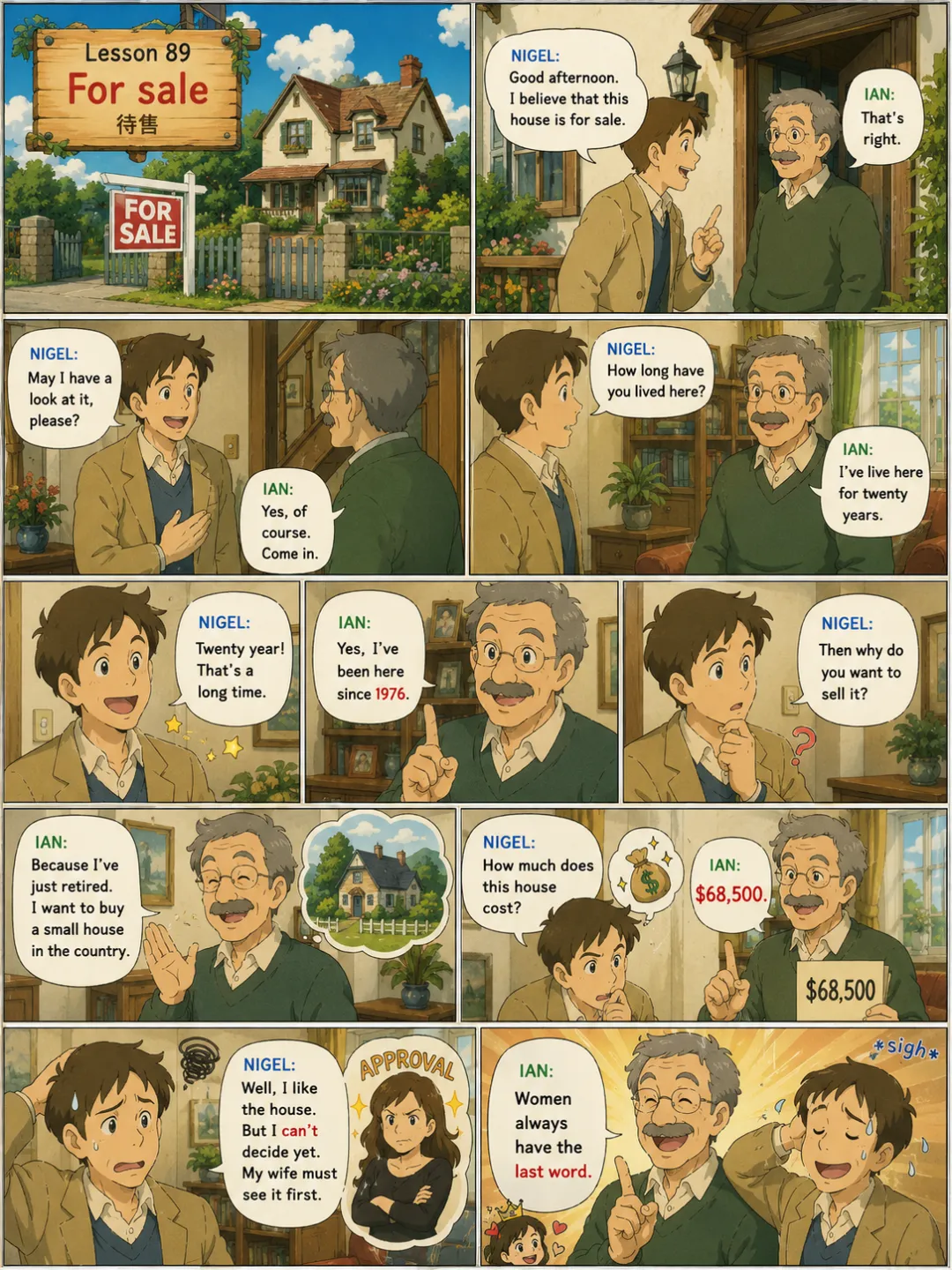
Lesson 89 For Sale
📜 课文原文(含语音标注)
Nigel: Good afternoon. I believe that this house is for sale.
奈杰尔:下午好。我相信这所房子是要出售的。
Ian: That's right.
伊恩:是的。
Nigel: May I have a look at it, please?
奈杰尔:我可以看一看它吗?
Ian: Yes, of course. Come in.
伊恩:当然可以。进来吧。
Nigel: How long have you lived here?
奈杰尔:你在这里住了多久了?
Ian: I've lived here for twenty years.
伊恩:我在这里住了二十年了。
Nigel: Twenty years! That's a long time.
奈杰尔:二十年!那是一段很长的时间。
Ian: Yes, I've been here since 1976.
伊恩:是的,我从一九七六年起就一直住在这里。
Nigel: Then why do you want to sell it?
奈杰尔:那么你为什么要把它卖掉呢?
Ian: Because I've just retired. I want to buy a small house in the country.
伊恩:因为我刚退休了。我想在乡下买一幢小房子。
Nigel: How much does this house cost?
奈杰尔:这房子要多少钱?
Ian: $68,500.
伊恩:六万八千五百英镑。
Nigel: Well, I like the house. But I can't decide yet. My wife must see it first.
奈杰尔:嗯,我喜欢这房子,但我还不能决定。我的妻子必须先来看一看。
Ian: Women always have the last word.
伊恩:女人总是有最后的决定权。
情景说明:本课对话发生在一个安静的住宅区街道上。Nigel是一位潜在的购房者,他看到Ian家的门前挂着“For Sale”的牌子,于是上前敲门询问。Ian是现房主,一位刚刚退休的老人,准备卖掉现在的房子搬到乡下去住。整个对话氛围礼貌、诚恳。Nigel对房子表现出兴趣,但作为一位成熟的购房者,他非常谨慎,深知这样重大的决定需要家人的意见。Ian则展现了典型的英式幽默,用一句“Women always have the last word”来结束关于决定权的讨论,既认可了妻子的权威,也缓和了可能因“无法立刻决定”而产生的微妙气氛。这不仅是关于房屋买卖的对话,也体现了英式沟通中尊重家庭成员意见和幽默化解问题的文化特点。
参考译文:
奈杰尔:下午好。我想这房子是要出售的吧?
伊恩:没错。
奈杰尔:我可以看一看吗?
伊恩:当然可以。请进。
奈杰尔:您在这里住了多久了?
伊恩:我在这里住了20年了。
奈杰尔:20年!那可真是很长时间了。
伊恩:是的,我从1976年起就住在这儿。
奈杰尔:那么,您为什么要卖掉它呢?
伊恩:因为我刚退休了。我想在乡下买一幢小房子。
奈杰尔:这房子要多少钱?
伊恩:68,500英镑。
奈杰尔:嗯,我喜欢这房子。但我还不能决定。我的妻子必须先来看看。
伊恩: 女人总是有最终决定权。
🔍 第二部分:逐句精讲与词块总结
句子1
原文: Good afternoon. I believe that this house is for sale.
翻译: 下午好。我相信这所房子是要出售的。
句子结构: “Good afternoon.” 是一个问候语,属于固定表达。“I believe that this house is for sale.” 是一个复合句。“I” 是主语。“believe” 是谓语动词。“that this house is for sale” 是宾语从句,作 “believe” 的宾语。在这个宾语从句中,“this house” 是主语,“is” 是系动词,“for sale” 是表语(介词短语作表语)。
重点词汇:
believe 蓝思值 340 L
英音 /bɪˈliːv/ 美音 /bɪˈliːv/ 词性:动词
释义:相信,认为有可能。本课义项为“认为,想”(表达一种较确信的看法,但非绝对事实)。
常用语块:believe in sb./sth. 信任某人/某事;believe it or not 信不信由你;make believe 假装;It is believed that... 人们认为...
例句一:I believe he is telling the truth. 我相信他在说实话。
例句二:Do you believe in ghosts? 你相信有鬼吗?
拓展:词根记忆法:源自拉丁语“credere”(信任)。英文中相关词汇有 “belief” (n. 信念), “believable” (adj. 可信的), “unbelievable” (adj. 难以置信的)。常用搭配 “believe it or not” 用于引出令人惊讶但真实的事情。
house 蓝思值 220 L
英音 /haʊs/ 美音 /haʊs/ 词性:名词
释义:房子,住宅。在本课中指具体的房屋建筑。
常用语块:move house 搬家;keep house 管理家务;from house to house 挨家挨户
例句一:They are building a new house. 他们正在建一栋新房子。
例句二:I spent the weekend cleaning the house. 我周末都在打扫房子。
拓展:区分 “house” 和 “home”:house 侧重指建筑物本身;home 更强调“家”的感觉和归属感。例如:“I’m going home.”(我要回家了。)“This is a beautiful house.”(这是一栋漂亮的房子。)注意 music 的复数是 houses,读音特殊:/ˈhaʊzɪz/。
sale 蓝思值 250 L
英音 /seɪl/ 美音 /seɪl/ 词性:名词
释义:出售,卖。本课的核心词义。
常用语块:for sale 待售;on sale 降价出售;not for sale 非卖品;a clearance sale 清仓大甩卖
例句一:Is this painting for sale? 这幅画卖吗?
例句二:The new model will go on sale next month. 新款下个月开始发售。
拓展:易混词:sale (n. 卖) vs. sell (v. 卖)。“for sale” 表示“待售”,物品本身出售;“on sale” 表示“打折出售”。相关习语:a sale of work(义卖)。
语法点睛:本句是典型的“主语 + 谓语 + 宾语从句”结构。在英语中,当表达想法、观点或信念时,常用 “I think/ believe/ hope/ guess + that从句” 的句型。这里的 “that” 引导宾语从句,在口语中常可省略,如 “I believe this house is for sale.”。这种结构在对话中非常实用,能委婉地表达自己的看法,而不是直接下结论。[NCE知识点笔记]中提到,“believe”后的宾语从句若表达否定意义,否定词通常前移至主句谓语,如 “I don’t believe it is true.”(我认为这不是真的。)这种“否定转移”是英语中的常见现象,理解这一点有助于更地道地表达。
语音要点: “Good afternoon” 中,“Good” 的 /d/ 音要与 “afternoon” 的 /ɑ:/ 音连读,听起来像 “Gud-afternoon”。“I believe that this house is for sale.” 中,“that” 常因弱读而变成 /ðət/;“is” 与 “for sale” 之间要注意 /ɪz/ 的发音清晰,不要吞音。“house” 中的 /s/ 音与 “is” 的 /ɪz/ 形成/s/和/z/的对比,需区分清晰。
句子2
原文: That's right.
翻译: 对的。
句子结构: 这是一个主系表结构的简单句。“That” 是主语,指代对方说的话。“’s” 是 is 的缩写,作系动词。“right” 是形容词作表语。
重点词汇:
right 蓝思值 220 L
英音 /raɪt/ 美音 /raɪt/ 词性:形容词
释义:正确的,对的。在本课义项中表示“没错”、“对的”,用来肯定对方的陈述。
常用语块:That’s right. 对的。/ 没错。/ 正是这样。all right 好的;没问题。right now 立刻,现在。in the right 有道理,没错
例句一:Your answer is right. 你的答案是正确的。
例句二:Are you all right? 你还好吗?
拓展:这是英美人日常对话中使用频率极高的表达,除了表示“正确”,还可以表示“明白”、“赞成”或“确认”。字面上只表达两个核心意思,但通过语气变化可以传递不同的情绪,如肯定、无奈、随声附和等。
语法点睛:本句是上句的肯定回应,属于非常简短的主系表结构。在日常交流中,“That’s right.” 是最常用的肯定确认表达之一。它简洁有力,直接表明说话人同意对方所说的内容。若想表示更强烈的肯定,可以用 “Exactly!” 或 “You’re right.”。[名师精讲]中建议,要区分 “all right” 和 “That’s right”:前者可用于征求同意、询问健康或表示“可以接受”;后者专门用在对事实或观点的确认上。
语音要点: “That’s” 发音为 /ðæts/,“s” 是清辅音,发音时要干脆,气流从牙齿缝隙中冲出,不要拖长。“right” 的 /raɪt/,结尾的 /t/ 在英音中常常不完全爆破(即只做口型但不发出强烈的/t/音),让句子听起来更自然流畅。整体语调为降调,表示陈述。
句子3
原文: May I have a look at it, please?
翻译: 我可以看一看它吗?
句子结构: 这是一个含有情态动词的疑问句。“May” 是情态动词,表示请求许可,口气比 “can” 更正式和礼貌。“I” 是主语。“have” 是实义动词。“a look” 是宾语(名词短语作宾语)。“at it” 是介词短语作状语,表示动作的目标。“please” 是礼貌副词,放在句末。
重点词汇:
may 蓝思值 320 L
英音 /meɪ/ 美音 /meɪ/ 词性:情态动词
释义:可以,可能。本课义项为“可以”(用于请求许可)。
常用语块:May I...? 我可以...吗?May I come in? 我可以进来吗?May I help you? 我可以帮你吗?It may be true. 那可能是真的。
例句一:May I borrow your pen? 我可以借你的笔吗?
例句二:May I speak to Mr. Jones, please? 请问我可以和琼斯先生通话吗?
拓展:情态动词 “may” 有两个主要用法:①表示请求许可(本课用法),语气比 “can” 更礼貌正式;②表示可能性推测,如 “He may come or he may not.”(他可能来也可能不来)。否定形式为 “may not”,不能缩写。学习时注意与 “might” 的区分,“might” 语气更不确定,可能性更小。
look 蓝思值 180 L
英音 /lʊk/ 美音 /lʊk/ 词性:名词(本课);动词
释义:看,瞧。本课用作名词,在 “have a look” 中表示“看一看”。
常用语块:have a look at... 看一看...;take a look 看一眼;look at 看...;look for 寻找
例句一:Let me have a look at your new bike. 让我看看你的新自行车。
例句二:She took one look at the mess and left. 她看了一眼那乱糟糟的样子就走了。
拓展:英语中常使用 “have/take a + 动词派生名词” 结构来表示短暂的行动,如 “have a look”(看一看)、“have a walk”(走一走)、“have a drink”(喝一杯)。这种结构比单个动词更口语化、更自然。
语法点睛:本句精讲了情态动词 “May” 引导的一般疑问句。“May I...?” 是请求许可的经典句型。现代英语中,虽然 “Can I...?” 更为普遍,但在正式场合或对陌生人说话时,“May I...?” 被认为是更礼貌、更绅士/淑女的表达。[名师精讲]特别指出,asked with "May I...?" expresses more politeness and is often used when unsure about the propriety of the request. 其肯定回答可以是 “Yes, you may.”(正式)或 “Certainly.” / “Yes, of course.”(更常用)。否定回答则通常委婉地说 “I’m sorry, but...” 或 “I’m afraid not.”,很少直接说 “No, you may not.”,因那样显得过于生硬。
语音要点: “May I” 连读为 /meɪ aɪ/。“have a look” 中,“have” 和 “a” 连读为 /hæv ə/,在实际口语中常因语速快而读得较轻。“look at” 连读为 /lʊk æt/。“it” 的 /ɪt/ 与 “please” 之间略作停顿,因为 “please” 作为一个礼貌修饰语,可以单独考虑语调。整句语调为升调,表达请求的语气。
句子4
原文: Yes, of course. Come in.
翻译: 是的,当然可以。请进。
句子结构: “Yes, of course.” 是礼貌的肯定回答,其中 “of course” 是一个插入性的副词短语。“Come in.” 是一个祈使句。动词原形 “Come” 作谓语。“in” 是副词,作状语。
重点词汇:
course 蓝思值 350 L
英音 /kɔːs/ 美音 /kɔːrs/ 词性:名词;在 “of course” 中为固定搭配。
释义:过程;课程;道路;当然。本课义项用于固定搭配 “of course” 表示“当然”。
常用语块:of course 当然;in the course of... 在...过程中;a course of action 行动方针;a training course 培训课程
例句一:Of course I will help you. 我当然会帮助你。
例句二:He took a course in French literature. 他修了一门法国文学课程。
拓展:注意 “course” 发音不要与 “coarse” (粗糙的) 混淆。在口语中,“of course” 是非常高频的词汇,但若过度使用会显得有些傲慢或不耐烦,有时用 “sure” 或 “certainly” 会更温和。
come 蓝思值 200 L
英音 /kʌm/ 美音 /kʌm/ 词性:动词
释义:来,来到。本课是实义动词原形,用于祈使句。
常用语块:come in 进来;come here 过来;come back 回来;come from 来自
例句一:Come here and see this! 过来看看这个!
例句二:Please come to my party. 请来参加我的派对。
拓展:“come” 是英语中最常用的动词之一,与不同介词或副词搭配可形成数十个短语动词,表达“来”的不同方式。本课中的 “come in” 就是其中之一,表示从外面进入房间。
语法点睛:本句是对请求的回应,体现了英语对话的礼貌性原则。首先用 “Yes, of course” 明确而礼貌地表示同意,然后用祈使句 “Come in” 发出邀请。在语法上,祈使句省略主语 “you”,用动词原形开头。在教授这一对话时,可以结合老师书中的建议:“Try to conduct the lesson in English.” 老师可以用最直观的肢体动作配合 “Come in.” 的指令,让学生理解这是在邀请进入。对于刚刚学会动词原形用法的学生来说,祈使句是容易理解且非常实用的语法点。
语音要点: “Yes, of course” 中,“of” 弱读为 /əv/;“course” 的重音在 /kɔːs/ 上。“Come in” 连读为 /kʌm ɪn/,/m/ 和 /ɪ/ 之间自然滑动。
句子5
原文: How long have you lived here?
翻译: 你在这里住了多久了?
句子结构: 这是一个含有现在完成时的特殊疑问句。“How long” 是疑问词短语,用于询问持续时间。“have” 是助动词,构成现在完成时。“you” 是主语。“lived” 是过去分词,表示动作或状态。“here” 是地点副词。
重点词汇:
live 蓝思值 230 L
英音 /lɪv/ 美音 /lɪv/ 词性:动词
释义:居住;生活。本课义项为“居住”。
常用语块:live in/at/on 居住在...;live with 与...一起住;live on 靠...生活
例句一:I live in a small town. 我住在一个小镇上。
例句二:Fish live in water. 鱼生活在水中。
拓展:注意 “live” 作动词时读 /lɪv/,作形容词(活的)时读 /laɪv/。区分 “live” (v. 居住) 与 “stay” (v. 短暂停留):“I live in Beijing.”(我住在北京→长居)与 “I am staying in a hotel.”(我住在酒店→暂住)。[NCE知识点笔记]特别指出,“How long have you lived here?” 是经典的现在完成时用于询问持续时间的句型。
how long 蓝思值 搭配短语
释义:多久(询问时间长度)
例句一:How long is the film? 这部电影多长时间?
例句二:I don’t know how long he will stay. 我不知道他会待多久。
拓展:注意区分 “how long”(多久,用于时间段)、“how far”(多远,用于距离)和 “how soon”(多久以后,用于将来时间)。
语法点睛:本句是现在完成时的核心用法之一:表示一个从过去某时开始,一直持续到现在的动作或状态。对于第二语言学习者而言,理解“持续性”概念至关重要。本课并非第一次接触现在完成时(在 L83-L88 已初步接触),但本课是第一次系统性地将现在完成时与表示一段时间的状语 “for...” 和表示起点的状语 “since...” 结合使用。现在完成时的重要组成部分在于它强调了“过去与现在的联系”,这种联系在本课中表现为“持续居住至今的状态”。对比一般过去时:如果问 “When did you move here?” 问的是过去的动作发生时间;而 “How long have you lived here?” 询问的是该动作从过去持续到现在的总时长。[名师精讲]强调,此处的 “live” 是一个“状态性动词”,因此可以用于现在完成时表示持续,而瞬间动词(如 arrive, leave, die)则不能直接这样使用,需要进行转换。
语音要点: “How long” 中的 “long” 发音为 /lɒŋ/(英音)或 /lɔːŋ/(美音),鼻音 /ŋ/ 要到位。“have you” 在语速较快时,常连读并弱化为 /həv juː/ 或更口语化的 /hæv jə/。“lived” 中的 /d/ 在英音中常不完全爆破,尤其在 “lived here” 连读时。句末单词 “here” 读 /hɪə/(英音)或 /hɪr/(美音),句子语调下降,因为这是 WH- 开头的特殊疑问句。
句子6
原文: I've lived here for twenty years.
翻译: 我在这里住了二十年了。
句子结构: 这是一个主谓结构的现在完成时陈述句。“I” 是主语。“’ve” 是 “have” 的缩写,作助动词。“lived” 是过去分词。“here for twenty years” 是状语,其中 “for twenty years” 是介词短语作时间状语。
重点词汇:
for 蓝思值 100 L
英音 /fɔː/ 美音 /fɔːr/ 词性:介词
释义:计,达。在表达时间段时,表示“(时间上)持续了...”。本课义项为“(表示时间)达,计”。
常用语块:for a long time 很久;for two hours 两小时;for years 多年;for a moment 一会儿
例句一:I have been waiting for an hour. 我已经等了一个小时了。
例句二:They stayed there for three days. 他们在那里待了三天。
拓展:现在完成时中 “for + 时间段” 是标志性用法,与一般过去时的 “... ago” 形成对比。准确理解和使用 “for” 是掌握现在完成时持续性用法的基础。注意:在否定句中,有时可以省略 “for”,如 “I haven’t seen him (for) two years.”,但建议初学者保留 “for” 以确保语法的完整性。
year 蓝思值 180 L
英音 /jɪə/ 美音 /jɪr/ 词性:名词
释义:年。本课中为复数形式 “years”。
常用语块:last year 去年;this year 今年;next year 明年;New Year 新年
例句一:We have lived here for ten years. 我们住在这里十年了。
例句二:The baby is one year old. 这个婴儿一岁了。
拓展:发音注意,“year” 以辅音 /j/ 开头,复数 “years” 词尾加 -s,读作 /jɪəz/ 或 /jɪrz/。区分 “year” 和 “ear”(耳朵),前者有 /j/ 音,后者没有。
语法点睛:本句精确展示了 “for + 时间段” 用于现在完成时的标准形态,回答上一句关于 “how long” 的提问。这是在初级英语句法阶段非常重要的一组问答对。需要注意的是,在现在完成时的陈述句中,“have/has + 过去分词” 构成谓语。对于规则动词如 “live”,过去分词与其过去式形式相同,都是 “lived”。但必须区分句型的表意功能:一般过去时 “I lived here for ten years.”(我在这里住了十年→现在可能不在了);而现在完成时 “I have lived here for ten years.”(我在这里住了十年→现在依然住在这里)。[语法新思维]将此概括为“动作发生在过去,但状态延续至今”。
语音要点: “I’ve lived” 连读,/aɪv/ + /lɪvd/。“for twenty years” 中,“for” 弱读为 /fə/(英音)或 /fər/(美音,带卷舌);“twenty” 常读成 /ˈtweni/(省略 /t/ 音,非常普遍);“years” 读作 /jɪəz/ 或 /jɪrz/。整句为降调。
句子7
原文: Twenty years! That's a long time.
翻译: 二十年!那是一段很长的时间。
句子结构: “Twenty years!” 是一个感叹词或者说是一个反馈性插入语,独立成句,不属于主谓结构。“That’s a long time.” 是一个主系表结构。“That” 是主语,指代 “twenty years”。“’s” 是 “is” 的缩写,系动词。“a long time” 是名词短语作表语。
重点词汇:
long 蓝思值 200 L
英音 /lɒŋ/ 美音 /lɔːŋ/ 词性:形容词
释义:长的;长久的。本课表示时间上的“长久”。
常用语块:a long time 很长时间;how long 多久;in the long run 从长远来看;long ago 很久以前
例句一:It was a long journey. 那是一次长途旅行。
例句二:This is a very long queue. 这条队排了好长。
拓展:“long” 作形容词可修饰时间或空间;作动词时表示“渴望”(如:I long for you.)。
语法点睛:这是一个反馈性的感叹句。口语中,可以通过重复对方的某个关键信息(如 “Twenty years!”)并加上带有情绪化的评价(如 “That’s a long time!”)来推动对话。在语法上,该句本身是基础的主系表结构,但起到了重要的对话功能和情感表达作用。从语用的角度看,这种反馈表示认真倾听、表示惊讶或同情,是维持良好交流的重要技巧。
语音要点: “Twenty years!” 语调应上扬,表现出惊讶。“That’s a long time.” 语调整体下降,其中 “long” 稍微重读以示强调。“a long time” 中,冠词 “a” 弱读为 /ə/。
句子8
原文: Yes, I've been here since 1976.
翻译: 是的,我从1976年起就一直在这里了。
句子结构: “Yes” 是肯定副词。“I” 是主语。“’ve been” 是 “have been” 的缩写,构成现在完成时,此处 “been” 是 “be” 的过去分词,表示状态。“here” 是副词作表语。“since 1976” 是介词短语作时间状语。
重点词汇:
since 蓝思值 440 L
英音 /sɪns/ 美音 /sɪns/ 词性:介词(本课);连词(也可引导从句)
释义:自...以来。用于表示从过去某时间点开始,持续到现在。
常用语块:since 1976 自从1976年;since last year 自从去年;since morning 自从早上;ever since 从那以后(一直)
例句一:I have known her since 2010. 我从2010年就认识她了。
例句二:He has been ill since Monday. 他从星期一就生病了。
拓展:区分 “since” 和 “for”:for + 时间段(如 two hours, ten years);since + 时间点(如 1976, last week, 10 o’clock)。这是现在完成时中最基础也最重要的区别。[语法新思维]指出,since除了作介词,还可作连词引导时间状语从句,如 “I have lived here since I was born.”(我从出生起就住在这里)。
语法点睛: “have been here” 是系动词 “be” 的现在完成形式,表示“一直在这里的状态”。本句完美演示了 “since + 时间点” 与现在完成时连用的规则,与上一句的 “for + 时间段” 相呼应,共同构建了询问和回答持续时间的基本框架。精确理解 for 和 since 的区别是掌握现在完成时的重要一步。讲义提出,在用 how long 提问时,回答既可用 “for + 时间段”,也可用 “since + 时间点”,两者是等价的转换。2026年至今1976年正好是50年,因此 also 可以用 “I’ve been here for 50 years.” 来表达。教师可以引导学生进行这种 for 和 since 的转换练习。
语音要点: “Yes” 单独,语调下降后上升。“I’ve been” 连读,注意 /v/ 音要清晰。“since” 读 /sɪns/;数字年份 “1976” 通常读作 “nineteen seventy-six”,重音落在 seventy 和 six 上。
句子9
原文: Then why do you want to sell it?
翻译: 那么你为什么想要卖掉它呢?
句子结构: 这是一个特殊疑问句,由疑问词开头,后接一般疑问句语序。“Then” 是副词,表示承接关系,引出新的问题。“Why” 是疑问副词,询问原因。“do” 是助动词,用于构成一般现在时的疑问句。“you” 是主语。“want to sell” 是谓语动词短语。“it” 是宾语。
重点词汇:
want 蓝思值 220 L
英音 /wɒnt/ 美音 /wɑːnt/ 词性:动词
释义:要,想要。本课表示“想要”做某事。
常用语块:want to do sth. 想要做某事;want sth. 想要某物;want sb. to do sth. 想要某人做某事
例句一:I want to go home now. 我现在想回家。
例句二:Do you want some coffee? 你想喝点咖啡吗?
拓展:want 后跟动词时必须使用不定式 “to do”,不能直接跟动词原形。这是一个非常基础且重要的语法规则。[名师精讲]提醒,否定形式可以是 “don’t want to” 或 “want not to”,但前者更自然。口语中常使用省略形式,如 “Want to come?” 代替 “Do you want to come?”。
sell 蓝思值 260 L
英音 /sel/ 美音 /sel/ 词性:动词
释义:卖,出售。
常用语块:sell sth. to sb. 把某物卖给某人;sell out 卖光 / 售罄;sell off 廉价出售
例句一:I want to sell my old car. 我想卖掉我的旧车。
例句二:The book sells well. 这本书卖得很好。
拓展:区分 “sell” (v. 卖) 和 “sale” (n. 卖),如课文中的 “for sale”。常见误用:*“I want sale my car.”(错误)→ 应改为 “I want to sell my car.”
语法点睛:本句展示了几个语法要点:①特殊疑问句的结构(WH-word + 一般疑问句);②“want to do sth.” 的搭配;③“then” 作为承接副词的句首用法,表示逻辑上的延续(“那么”、“这么说来”)。这种使用 “then” 引出新问题的结构在对话中非常自然实用。同时,本课对比了现在完成时的问句(How long have you lived here?)和一般现在时的问句(Why do you want to sell it?),让学生理解两种时态表达不同时间概念的能力:前者关心过去持续到现在的状态,后者关心当前的一般事实或意愿。
语音要点: “Then” 发音 /ðen/,咬舌音/ð/要清晰,与 /n/ 音结合。“Why do you” 快速朗读时,常变为 “Why d’you” /waɪ djuː/ 或 /waɪ dʒə/(美式口语)。“want to” 常略读为 /ˈwɒnə/(英音)或 /ˈwɑːnə/(美音)。疑问词 “why” 需要重读,整句为降调。
句子10
原文: Because I've just retired. I want to buy a small house in the country.
翻译: 因为我刚退休了。我想在乡下买一幢小房子。
句子结构: “Because” 引导原因状语从句。“I’ve just retired.” 是主谓结构的现在完成时陈述句。“I want to buy a small house in the country.” 是一个主谓宾结构的简单句。“I” 是主语。“want to buy” 是谓语动词短语。“a small house” 是宾语。“in the country” 是介词短语作定语,修饰 “house”。
重点词汇:
because 蓝思值 320 L
英音 /bɪˈkɒz/, /bɪˈkəz/(弱读) 美音 /bɪˈkɔːz/, /bɪˈkəz/(弱读)
释义:因为。用于引导原因状语从句。
常用语块:because of 因为(后跟名词短语)
例句一:I was late because I missed the bus. 我迟到了因为我错过了公交车。
例句二:He passed the exam because he worked hard. 他通过了考试因为他很努力。
拓展:口语回答 “Why?” 时,可以简单回答 “Because + 句子”,在非正式场合,甚至可以单独使用 “Because...” 作为一个完整的答语。注意区分 “because” 和 “because of”:前者后跟完整的句子,后者后跟名词或名词性短语。
retire 蓝思值 380 L
英音 /rɪˈtaɪə/ 美音 /rɪˈtaɪər/ 词性:动词
释义:退休。本课表示从工作岗位上退下来。
常用语块:retire from 从...退休;retire early 提前退休;retire to 退居到;(就寝)去...
例句一:My father retired at the age of 60. 我父亲60岁时退休了。
例句二:She plans to retire to the countryside. 她计划退休后去乡下生活。
拓展:retire 是一个不及物动词(vi.),后不直接跟宾语。可以与 “from + 工作/职位” 连用,表示从某处退休。名词形式为 “retirement”。
country 蓝思值 280 L
英音 /ˈkʌntri/ 美音 /ˈkʌntri/ 词性:名词
释义:国家;乡村。本课义项为“乡村,乡间”(常与 “the” 连用,且与 “city” 或 “town” 对应)。
常用语块:in the country 在乡下,在乡村;home country 祖国;developing country 发展中国家
例句一:He enjoys living in the country. 他喜欢住在乡下。
例句二:France is a beautiful country. 法国是一个美丽的国家。
拓展:当 “country” 作“乡村”讲时,一般前面加定冠词 “the”,且通常为单数,暗示离开城市、亲近自然的居住环境。这是一个非常典型的文化联想词,在英式英语中尤其带有 “田园牧歌” 的美好色彩。根据新概念教材解析中的文化背景介绍,英国人对乡村生活常有特殊的感情,退休后搬到乡下是很多人的理想选择。
语法点睛:本句包含两个重要的语法结构:①“Because” 引导的原因状语从句,这是回答 “why” 问句的标准结构。②“I’ve just retired.” 展示了现在完成时与 “just” 连用,表示“刚刚发生的动作”。这种用法直接连接过去和现在:“just retired” 意味着退休是最近的、刚刚发生的事件,与现在有直接关联。教材在新概念英语第89课的语境中,用 “because” 引出退休这个人生转折点,非常真实地呈现了一个生活决策链:因为退休了,所以考虑换房子。
语音要点: “Because” 的元音要发饱满,英音常弱读为 /bɪˈkəz/。“I’ve just retired” 中,“just” 注意 /dʒ/ 的发音,“retired” 发 /rɪˈtaɪəd/(英音)或 /rɪˈtaɪərd/(美音),词尾的 /d/ 可以不完全爆破。“in the country” 注意 “the” 在元音音素前发 /ði/ 的规则,“country” 中的 /ʌ/ 音要发准确。
句子11
原文: How much does this house cost?
翻译: 这房子要多少钱?
句子结构: 这是一个询问价格的常用特殊疑问句。“How much” 是疑问词短语,用于询问价格或不可数名词的量。“does” 是助动词,用于构成一般现在时的疑问句(主语为第三人称单数时)。“this house” 是主语。“cost” 是实义动词原形。
重点词汇:
cost 蓝思值 320 L
英音 /kɒst/ 美音 /kɔːst/ 词性:动词;名词
释义:花费,价钱为。本课用作动词。
常用语块:cost money 花钱;at all costs 不惜一切代价;the cost of living 生活费用
例句一:This book costs 5 dollars. 这本书花费5美元。
例句二:How much does the ticket cost? 这张票多少钱?
拓展:注意句法结构:“sth. costs (sb.) + 钱”,主语必须是物品或服务(物作主语)。例如:This dress cost me 100 dollars.(这条裙子花了我100美元。)所以,当询问价格时,正确的问句是 “How much does sth. cost?” 而不是 *“How much does it cost for sth.?”(错误)。cost 作动词时,过去式和过去分词都是 cost(不规则动词),且不用于被动语态。
much 蓝思值 180 L
英音 /mʌtʃ/ 美音 /mʌtʃ/ 词性:形容词 / 副词 / 代词
释义:许多的,大量的。本课用于固定短语 “how much” 询问价格。
常用语块:How much...? ...多少钱/多少量?;too much 太多;as much as 像...一样多
例句一:How much sugar do you need? 你需要多少糖?
例句二:I don’t have much time. 我没有多少时间了。
拓展:注意区分 “how much” 和 “how many”:much 用于不可数名词,many 用于可数名词复数。
语法点睛:本句是询问价格的经典句型。其结构可解读为:疑问词短语(How much)+ 一般疑问句(does this house cost),构成特殊疑问句。其核心要注意 “does” 作为助动词帮助构成问句并根据主语为第三人称单数进行变化,而后面的实义动词 “cost” 必须使用原形。这一句型在购物、买房等生活场景中使用频率极高,让学生掌握这一固定问句的语法结构,能有效提升日常口语交际能力。尽管询问价格的句型可能之前已经出现,但在“买房”这一特殊语境中再次强化,更加深了学生对 “cost” 这一动词搭配的印象。
语音要点: “How much” 中的 “much” 重读,“How” 相对较轻。“does this house” 连续读作 /dʌz ðɪs haʊs/,注意 /z/ 与 /ð/ 的咬舌音连读。“cost” 以 /st/ 结尾,发音时舌尖抵住上齿龈, /s/ 漏气, /t/ 可以不完全爆破(吞音)。
句子12
原文: $68,500.
翻译: 六万八千五百英镑。
句子结构: 这是一个单独的表示价格的名词短语,作为对上一句的回答。完整的句子可以看作是 “This house costs $68,500.”。
重点词汇:
pound 蓝思值 260 L
英音 /paʊnd/ 美音 /paʊnd/ 词性:名词
释义:英镑(英国货币单位)。本课用于表示房屋价格。
常用语块:one pound 1英镑;ten pounds 10英镑;thirty pounds 30英镑;one hundred pounds 100英镑
例句一:Can you lend me 5 pounds? 你能借我5英镑吗?
例句二:It costs about 10 pounds. 它大约要10英镑。
拓展:pound 是英国货币基本单位,符号是 £。1 pound = 100 pence(便士)。英镑纸币常见面额为 £5、£10、£20、£50;硬币常见为 1p、2p、5p、10p、20p、50p、£1、£2。注意在口语中,$68,500 读作 “sixty-eight thousand five hundred pounds”。在英式英语里,“pound” 常直接说 “quid” 作为俚语(例如:It costs fifty quid.)。通过掌握货币单位,学生不仅能计算,更能了解英美社会的经济语言。
语法点睛:此句不涉及到新的复杂语法,但在英语阅读与对话中,如何朗读大额数字是一个实用技能。英语数字读法规则:从高位到低位逐级读出,三或四位为一组。686,500:从高到低分别为 68,500,读作 “sixty-eight thousand five hundred”。注意英语中没有“万”级单位,中文的“万”需要转换成 “ten thousand”,例如 “一万” 为 ten thousand。68,500 即中文的“六万八千五百”。这是一个很好的跨文化数字学习点。
语音要点: “68,500” 的读法,注意 “sixty-eight” 中的连读,/ˈsɪksti eɪt/ 中 /i/ 音与 /eɪ/ 音连接。“thousand” 读作 /ˈθaʊzənd/,注意咬舌音 /θ/。“five hundred” 连读。
句子13
原文: Well, I like the house. But I can't decide yet. My wife must see it first.
翻译: 嗯,我喜欢这房子。但我还不能决定。我的妻子必须先来看看。
句子结构: “Well” 是语气词,用于组织话语或表示犹豫。“I like the house.” 是主谓宾结构的简单句。“But” 是并列连词,表示转折关系。“I can’t decide yet.” 是主谓结构的简单句。“My wife must see it first.” 是主谓宾结构,含有情态动词 “must”。
重点词汇:
decide 蓝思值 360 L
英音 /dɪˈsaɪd/ 美音 /dɪˈsaɪd/ 词性:动词
释义:决定。本课表示作出判断或选择。
常用语块:decide to do sth. 决定做某事;decide on sth. 就...作出决定;I can’t decide. 我无法决定。
例句一:I decide to learn English hard. 我决定努力学习英语。
例句二:She decided on the red dress. 她决定买红色的裙子。
拓展:[NCE知识点笔记] 提到,课文中的 “I can’t decide yet.” 是非常实用的句型,其中 “yet” 用于否定句表示“仍然”,这暗示了未来可能改变,即:现在还无法决定,也许以后可以。名词形式为 decision(决定,抉择)。
yet 蓝思值 340 L
英音 /jet/ 美音 /jet/ 词性:副词
释义:还,仍然(用于否定句和疑问句)。本课用于否定句,表示“仍然没有”。
常用语块:not yet 还没有;haven’t done sth. yet 还没有做某事
例句一:Have you finished your homework yet? 你做完作业了吗?
例句二:He hasn’t arrived yet. 他还没到。
拓展:区分 “yet” 和 “still”:在否定句中,两者有时可以互换,但含义略有差异。yet 强调预期的事情尚未发生;still 强调某事仍在进行。例如:“I still don’t understand.”(我仍然不明白),暗示持续的困惑;“I don’t understand yet.”(我还没明白),暗示预期是最终会明白,只是现在还没。
must 蓝思值 300 L
英音 /mʌst/ 美音 /mʌst/ 词性:情态动词
释义:必须。本课表示强烈的必要性或义务。
常用语块:must do sth. 必须做某事;must not (mustn’t) 禁止 / 绝不能
例句一:You must see this movie! It’s amazing. 你必须看这部电影!太棒了。
例句二:I must finish my work today. 我今天必须完成工作。
拓展:情态动词 “must” 用于一般现在时,没有人称和数的变化。其后直接跟动词原形。如表示过去的规定,需要用 “had to”。must 的否定形式为 “mustn’t”,表示“禁止”、“一定不要”。
first 蓝思值 180 L
英音 /fɜːst/ 美音 /fɜːrst/ 词性:形容词 / 副词
释义:第一的;首先。本课用作副词,表示“首先”、“先”。
常用语块:at first 起初;first of all 首先;first name 名字
例句一:Let’s have dinner first. 我们先吃饭吧。
例句二:He arrived first. 他最先到了。
拓展:在本句中,“see it first” 表示“先看”。这种用副词修饰动词的语序在英语中很常见,而中文则常说“先看看”,语序不同。王力先生曾提出,英文的逻辑是“动作+状态”,即先描述动作“see it”,然后再用副词 “first” 来补充说明时间顺序。
语法点睛:本句的语法重点是:① “I can’t decide yet.” 展示了情态动词 “can” 的否定式与 “yet” 的搭配,表示“目前还不能做某事,但可能以后能”。② “My wife must see it first.” 展示了情态动词 “must” 表示“必须”的用法。与之前学过的 “must” 相比,这里是正面地表达必要性,形式直接肯定。“must” 的语气很强,在这个语境中,Nigel 使用 “must” 表示妻子的意见对他来说是不可或缺的。③ 本句中的转折连词 “but” 也很重要。前一句 “I like the house.” 是好感,紧接的 “But I can’t decide yet.” 是现实的限制,这种表达结构在英语中非常常见,用于委婉地拒绝或迟疑。
语音要点: “Well” 的语调常先降后升,表示犹豫或引出新话题。“But” 发 /bʌt/,在语速快时,结尾的 /t/ 常不完全爆破或省略。“can’t” 在英音中读 /kɑːnt/,美音中读 /kænt/,发音与 “can” /kæn/ 有明显区别。“must see it first” 中,“must” 结尾的 /t/ 与 “see” 的 /s/ 相遇,可以吞音;“it” 的 /t/ 与 “first” 的 /f/ 之间也可不完全爆破。
句子14
原文: Women always have the last word.
翻译: 女人总是有最后的决定权。
句子结构: 这是一个主谓宾结构的一般现在时陈述句。“Women” 是主语。“always” 是频度副词。“have” 是谓语动词。“the last word” 是宾语。
重点词汇:
last 蓝思值 200 L
英音 /lɑːst/ 美音 /læst/ 词性:形容词
释义:最后的;上一个的。本课义项为“最后的”。
常用语块:the last time 最后一次;last week 上周;at last 最后,终于
例句一:This is my last chance. 这是我最后一次机会。
例句二:He came last in the race. 他在比赛中得了最后一名。
拓展:作“最后”解时,常与定冠词 “the” 连用,因为表示特指的“最后一个”。区别 “last” 和 “final”,有时可互换,但 “last” 强调顺序的末尾,而 “final” 强调状态的结束、不可改变。
word 蓝思值 190 L
英音 /wɜːd/ 美音 /wɜːrd/ 词性:名词
释义:词;话语;信息。本课在固定短语 “have the last word” 中表示“(争论中的)最后决定权”。
常用语块:have the last word 有最后决定权/说了算;in other words 换句话说;word by word 逐字地;keep one’s word 守信
例句一:I always let her have the last word. 我总是让她最后拿主意。
例句二:Actions speak louder than words. 事实胜于雄辩。
拓展:作为新概念教材解析中的一个文化知识点,这句 “Women always have the last word.” 不是一个严肃的论断,而是一句带有幽默色彩、半开玩笑半认同的英语习语式表达,它体现了英式对话中承认权威(通常是妻子)但又通过幽默来缓解话题严肃性的特点。这一表达在家庭、夫妻相关的对话中很常见。[NCE知识点笔记]指出,本课中的 “have the last word” 也可以写成 “have a say”、“make the final decision”。在英式幽默中,这是一种承认婚姻中妻子权威的调侃式说法。教师可以引导学生讨论在家庭决策中,谁拥有“最终决定权”等文化开放性问题。
语法点睛:本句的语法核心是:① 一般现在时表示一般事实或普遍真理。“Women always have the last word.” 表达的并不是一件在发生的事,而是一种说话者关于两性关系的观点或公认的“玩笑”。② 频度副词 “always” 放在实义动词 “have” 之前(主语之后)。在一般现在时的陈述句中,频度副词(always, usually, often, sometimes, never)通常位于 be 动词之后、实义动词之前。这是英语语法中重要的“中位副词”规则。③ “the last word” 作固定短语,一针见血地点题,以幽默的方式完成了整个对话的结尾。
语音要点: “Women” 发音为 /ˈwɪmɪn/,/ɪ/ 音比较短促。“always” 发音为 /ˈɔːlweɪz/,/weɪz/。“have the” 连读为 /hæv ðə/,注意咬舌音。“last word” 中,“last” 发音 /lɑːst/,结尾 /st/ 音要清晰,“word” 发音 /wɜːd/。整句为降调,语调呈下降趋势,表达陈述和调侃的语气。
📌 核心词块总结
1. be for sale
Meaning: to be available to buy.
Example: This house is for sale. I saw a sign outside.
2. have a look at
Meaning: to examine something visually.
Example: May I have a look at your new shoes?
3. live in...for / since
Meaning: to reside in a place from a certain time (for + period, since + point).
Example: I have lived in this city for five years. / I have lived here since 2019.
4. have the last word
Meaning: to make the final decision in an argument or discussion.
Example: In our family, my mother always has the last word.
5. can’t decide yet
Meaning: unable to make a decision at this moment, with the possibility of deciding later.
Example: I want to buy a gift for her, but I can't decide yet.
💬 第三部分:基础会话技巧
1. 课文中的关键表达分析
本课对话展示了几个重要的日常会话技巧,这些技巧不仅是语言形式,更是文化沟通的桥梁。
① 礼貌地开启话题
Nigel 的开场白 “Good afternoon. I believe this house is for sale.” 展现了一个非常成功的陌生人对陌生人、服务场面的开启策略。他没有直接问 “Is this house for sale?”(这会显得太直接),而是先以问候建立好感,再用 “I believe...” 开头,表明他观察到的信息并希望确认。这种间接的询问方式在英式英语中非常普遍,体现出对对方的尊重,也避免了自己因信息不准而造成尴尬。
② 委婉而坚定地表达立场
Nigel 对房子的评价和使用 “But” 来表达自己的延迟决策,是非常地道且有策略的表达。他首先说 “I like the house”,建立积极的印象,这相当于在心理上为房主提供了一种“放心”——我的犹豫不是房子不好。然后才用 “But” 带出真实原因 “I can’t decide yet.”,这是一个重要的面子保全策略(face-saving strategy)。在跨文化沟通中,这种先说好话再说限制的“汉堡包结构”是必须要掌握的高级沟通技能。
③ 使用幽默来缓和气氛
Ian 的最后一句话 “Women always have the last word.” 是典型的英式幽默结尾。这句话并没有消极地抱怨妻子,而是用一种略带自嘲的、公认的事实来总结,既没有让对方难堪,也展现了一种豁达幽默的人生态度。当一个理由可能涉及家庭决策权这样有点敏感的话题时,用幽默的方式表达出来是人情练达的表现。
④ 询问与回答的“配对结构”
从 “How long have you lived here?” 到 “I’ve lived here for twenty years.”,从 “Why do you want to sell it?” 到 “Because...”,从 “How much does this house cost?” 到 价格回答,本课的问答结构非常完整,展示了一组典型的“配对回应”模式。在学习时,要注意对疑问词的准确把握,并进行反复的问答替换练习。
2. 扩展对话示例
场景:租房
A: Good morning. I believe there's a flat for rent in this building.
B: That's right. One-bedroom flat on the third floor.
A: May I have a look at it?
B: Yes, of course. This way, please.
A: How long has it been empty?
B: For about three weeks.
A: I see. Why did the last tenant leave?
B: She moved to another city for work.
A: How much is the rent?
B: $800 a month.
A: Well, I like the flat. But I can't decide yet. My roommate must see it first.
B: Sure. Just let me know.
场景:买车
A: Hello. I'm interested in the red car. It's for sale, isn't it?
B: That's right. It's a very nice car.
A: Can I have a look at the engine?
B: Certainly. Open the hood.
A: How long have you had this car?
B: I've had it for five years.
A: Why do you want to sell it?
B: I need a bigger family car.
A: How much does it cost?
B: $12,000.
A: I like it, but I can't decide yet. My wife must drive it first.
B: No problem. Women always have the last word!
3. 角色扮演活动建议
活动一:房屋开放日
将学生分成两组:一组扮演房屋中介/房主,另一组扮演潜在购房者。
- 要求购房者必须使用课本中的目标句型:“How long have you lived here?”,“Why do you want to sell it?”,“How much does this house cost?”,“I can’t decide yet…”等。
- 房主必须使用目标词汇回答问题。
- 鼓励购房者在看房时多加一句对房子的评价,如 “I like the garden.”、“The kitchen is very nice.”等。
- 最后,购房者需要向全班汇报是否“购买”了这房子,并说出理由。
活动二:旧物交换
让每位学生带一件旧物品(或画图代替)到课堂,双方尝试进行“买卖”对话。学生需要练习:
A: How long have you had this? (You bought it last year.)
B: I’ve had it for one year.
A: Why do you want to sell it?
B: Because I need a new one.
A: How much does it cost?
B: Only 5 dollars!
A: Hmm, I like it, but I can’t decide yet… (perhaps a peer has to see it first).
4. 基础思考问题
Q1: Why does Nigel want his wife to see the house first? Do you think this is a good idea? Why or why not?
Q2: In your country, do women usually “have the last word” on big decisions like buying a house? What about in your own family?
📐 第四部分:本课语法精析(加强版)
本部分字数约2200字。
本课的核心语法是目前中文英语教学的核心语法点之一:现在完成时(Present Perfect Tense)与 “for” 和 “since” 的搭配使用。同时,结合对话内容,也需要叠加讲解 情态动词 “may” 表请求、“believe + that 从句” 以及 “must” 表“必须”的用法。本部分将对本课的核心语法点进行详尽的多维度分析。
一、现在完成时——持续性用法
1. 定义与基本结构
现在完成时是连接过去和现在的桥梁。它的基本结构是:主语 + have/has + 动词的过去分词
在肯定句中,主语 I/You/We/They 用 “have”,He/She/It 用 “has”。口语中常缩写为 I’ve, You’ve, He’s, She’s, It’s, We’ve, They’ve。
在否定句中,在 have/has 后加 not,缩写为 haven’t 或 hasn’t。
在疑问句中,将 have/has 提到主语之前。
2. 本课核心用法:动作或状态从过去持续到现在
本课中 Nigel 提问和 Ian 回答的句子完美诠释了这个用法。
- “How long have you lived here?”——询问的是从过去某个时间搬进来到现在这段时间的总长度。
- “I’ve lived here for twenty years.”——回答出这段时间长度为20年。
- “I’ve been here since 1976.”——回答出这段时间的起点是1976年。
从英语语法的层次来看,这种用法对应的是 “状态性动词/持续性动词” 在现在完成时中的运用。状态性动词(如 live, work, know, have, be)描述的是一个可以持续的状态,而不是一个短暂的、瞬间完成的动作。正因为如此,它们可以和 “for + 时间段” 或 “since + 时间点” 连用。
[语法新思维] 强调,现在完成时的持续性用法的核心含义是:过去的某一时刻发生的事情或形成的状态,一直持续到说话的时刻,并有可能继续下去。
对比:
- 一般过去时:I lived here for ten years. 我在这里住过10年。(暗示:我现在可能没住在这里了。)
- 现在完成时持续性用法:I have lived here for ten years. 我在这里已经住了10年了。(暗示:我现在还住在这里。)
3. “for + 时间段” vs. “since + 时间点”
这部分是掌握本课语法的重中之重,也是学生最容易混淆的地方之一。
| 概念 | “for + 时间段” | “since + 时间点” |
| :--- | :--- | :--- |
| 侧重点 | 强调动作持续的总时长 | 强调动作开始的具体起点 |
| 形式 | for + a period of time | since + a specific point in time |
| 例句 | for two days, for a week, for many years, for a long time | since Monday, since 2000, since I came here, since last year |
| 本课例句 | I’ve lived here for twenty years. | I’ve been here since 1976. |
| 互换 | 两者可以互换,但需调整表达方式。例如: I’ve lived here for 50 years. = I’ve lived here since 1976. |
[名师精讲] 中建议,从初学阶段就要帮助学生建立“for + 时间段”和“since + 时间点”的清晰对比,并且可以使用 “How long...?” 来提问,将两者的关系串联起来。教师可以引导学生进行大量的句式转换训练:
1. 原句:He has worked in this company since 2010.
转换:He has worked in this company for 14 years. (以2024年为基准)
2. 原句:She has been a doctor for eight years.
转换:She has been a doctor since 2016.
4. “have + just + 过去分词” 表示“刚刚”完成
本课中出现了 “I’ve just retired.” 这个句子。它表示了一个非常微妙的现在完成时用法:表示“刚刚完成的动作或刚刚发生的事件”,与现在有直接联系。
- 结构:主语 + have/has + just + 过去分词
- 含义:just 在此处表示过去分词所表达的动作是在“刚才”发生的,强调这个事件对当前的新鲜影响。Ian 说 “I’ve just retired.” 暗示退休是他人生中的一个刚刚发生的转折点,直接导致了他想搬到乡下去居住的现状。
二、本课其他重要语法点
1. 情态动词 “may” 表示请求许可
“May I have a look at it, please?” 中,“May” 比之前学过的 “Can” 更正式和礼貌。在请求许可时,两者差异不大,但 “May I...?” 通常被认为更标准、更客气,特别在是向陌生人或长辈提出请求时。
- Can I...?:更自然、更口语化、更常见。适用于朋友、家人和熟悉的人。
- May I...?:更礼貌、更正式、更标准。适用于陌生人、年长的人、正式场合或服务场合。
用法上,may 没有人称和数的变化,其后直接跟动词原形。
否定回答:拒绝 “May I...?” 的请求,通常不会直接说 “No, you may not.”,因为这样显得过于生硬和冒失。得体的回答方式是:
1. “I’m sorry, but...”
2. “I’m afraid not.”
3. “Not right now, please.”
肯定回答除了课文中的 “Yes, of course.” 之外,常见的还有 “Certainly.”, “Sure.”, “Please do.”, “Go ahead.”。
[NCE知识点笔记] 中也有提及:“May I...?” 是向他人提出请求的标准结构,要求使用升调,且通常搭配 “please” 以体现礼貌。
2. “believe + that 从句”
“I believe that this house is for sale.” 中的 “that” 从句充当 believe 的宾语,形成“主语 + 谓语 + 宾语从句”的结构。在口语中,引导词 “that” 通常被省略,表达成 “I believe this house is for sale”。在写作和正式口语中,保留 “that” 使句子结构更清晰。
这种 “I think / I believe / I know / I hope + (that) + 从句” 的句型在英语中使用极其广泛,是表达主观看法、假设、知识和期望的标准句型。
3. 情态动词 “must” 表“必须”
“My wife must see it first.” 一句中,“must” 表达很强的必要性或义务,语气强烈。相当于汉语的“必须”、“得……”。在英语教学语境中,需要注意情态动词的共同特征:
- 无人称和数的变化:主语是 I/You/He/She/It… 一律用 must。
- 后跟动词原形:must see, must go, must come。
- 否定式 mustn’t 表示“不许”、“禁止”。
4. “yet” 用于否定句
“I can’t decide yet.” 中的 “yet” 是一个非常特殊的时间副词。它主要用于否定句和疑问句中,表示“仍然不”、“还尚未”。
- 在否定句中:He hasn’t arrived yet. / I don’t know yet.
- 在疑问句中:Have you finished yet? / Did you eat yet? (美式口语)
学习时需要注意 “yet” 在否定句中的基本位置:通常置于句末(如本课),也可置于助动词之后(但较少用于否定句),例如:He doesn’t yet know.(不太常见)。最常见的还是句末位置:He hasn’t finished yet.
三、现在完成时 vs. 一般过去时:高维度对比分析
许多学生在学习了现在完成时之后,最大的难点是如何与一般过去时区分开来。本课提供了非常好的对比素材,因为对话中同时出现了现在完成时(讨论居住时长)和一般过去时/一般现在时(讨论退休的动机)。
| 对比维度 | 一般过去时 | 现在完成时(持续性用法) |
| :--- | :--- | :--- |
| 时间焦点 | 过去一个特定的、已结束的时间点或时间段。 | 从过去持续到现在的“延续”。 |
| 与现在的关联 | 与现在无关,动作或状态已经结束。 | 直接相关,动作可能延续,状态现在依然成立。 |
| 标志性时间词 | yesterday, last year, three days ago, in 1990, when... | for... / since... / already / just / ever / never / yet |
| 核心例句 | I lived in Beijing for 10 years. (暗示:我现在不在北京了。) | I have lived in Beijing for 10 years. (暗示:我现在还在北京。) |
| 提问方式 | When did it happen? | How long has it been? |
为了帮助学生更好理解,可以通过时间轴的方式在脑海中绘制:
- 一般过去时的时间轴:起点————终点(过去)|断裂|(现在)
- 现在完成时(持续性)的时间轴:起点(过去)————————(现在)--------(未来)
[NCE知识点笔记] 也提醒:询问“你在这里住了多久了?”必须用现在完成时的 “How long have you lived here?”,而不能用一般过去时的 *“How long did you live here?”,因为后者的前提预设是“问话人认为对方现在已经不在这里住了”,这是一个重要而微妙的话用区别。
四、本课语法练习题(不少于10道)
Part A:选择填空 (Choose the best answer)
1. How long ______ you lived in this city?
A. have B. do C. are D. is
2. I have lived in Shanghai ______ 2015.
A. for B. since C. in D. from
3. She has worked here ______ three months.
A. for B. since C. in D. during
4. “May I come in?” “______.”
A. Yes, I may B. Yes, of course C. No, you mustn’t D. Yes, you can
5. He has just ______ from his job.
A. retire B. retired C. retires D. retiring
6. I called the doctor, but he hasn’t arrived ______.
A. yet B. already C. just D. still
7. My father has worked in the same company ______ 25 years.
A. for B. since C. in D. during
8. This is a beautiful house. How much does it ______?
A. spend B. pay C. cost D. take
9. You ______ tell your mother. She has a right to know.
A. must B. can C. may D. do
10. “I’m sorry I can’t decide ______. I need more time.” “That’s OK.”
A. yet B. already C. just D. for
Part B:用 “for” 或 “since” 填空
1. I have known her ______ five years.
2. He has been ill ______ last Monday.
3. They haven’t met each other ______ 2020.
4. She has lived in this city ______ a decade.
Part C:按要求改写句子
1. I have lived here for four years. (对划线部分提问)
→ _________________________________?
2. He has been in London since 2021. (对划线部分提问)
→ _________________________________?
3. She has already finished her work. (改为否定句)
→ _________________________________?
参考答案
Part A:
1. A (How long...have you)
2. B (since + 时间点)
3. A (for + 时间段)
4. B (更礼貌的应答方式)
5. B (has just + 过去分词,retire 变为 retired)
6. A (否定句中用 yet)
7. A (for + 时间段)
8. C (sth. costs some money)
9. A (must 表示必要)
10. A (否定句中 yet 置于句末)
Part B:
11. for
12. since
13. since
14. for
Part C:
15. How long have you lived here?
16. How long has he been in London?
17. She hasn’t finished her work yet.
✏️ 第五部分:基础练习与活动
1. 跟读练习
① 选择课文录音中的一句(如:“How long have you lived here?”),教师先播放一遍,让学生仔细听语音语调;然后教师逐词带领学生跟读,注意连读“how long have you”→ 提醒学生注意 /hævjʊ/ 的连读效果。可以两到三遍让全班齐读、分组读、个别读。
② 在此基础上,让学生按住课本只看课文,逐句模仿老师的语调与重音进行跟读,特别注意 where 和 you 的连读、since 后面年份的读法。最后进行填空式的逐句复诵。
例:
T: I’ve lived here ...
Ss: ... for twenty years.
T: I’ve been here ...
Ss: ... since 1976.
2. 替换练习
教师给出一组句子结构,让学生进行词语替换,牢固掌握 now 句式。
结构1:How long have you + ______(动词过去分词)+ 地点?
- 替换词:worked (in this company), studied (at this school), known (this person).
- 答案例:How long have you worked in this company? // I have worked here for one year.
结构2:I have + ________(过去分词)+ for/since...
- 替换词:lived (in Beijing / 2019), been (at this school / last year), worked (here / 2022)
- 让学生自己组织句子并说出来,教师给予即时反馈。
3. 听力理解题目
听课文录音(可重复两遍),判断下列陈述的正误(T/F)。
1. Nigel wants to buy Ian’s house. (T)
2. Ian has lived in the house for thirty years. (F)
3. Ian retired last year. (F)
4. The house is in the country. (F) (It’s the current house, Ian wants to move TO the country)
5. Nigel’s wife has already seen the house. (F)
4. 课文改写版本(词汇更简单)
New Version (Simple English)
Nigel: Good afternoon. I think this house is for sale.
Ian: That is correct.
Nigel: Can I see it, please?
Ian: Yes, sure. Come in.
Nigel: How long do you live here?
Ian: I live here for 20 years.
Nigel: 20 years! That is a long time.
Ian: Yes, I am here from 1976.
Nigel: So, why do you want to sell it?
Ian: Because I just stop working. I want to buy a small house in the countryside.
Nigel: How much is this house?
Ian: It is 68,500 pounds.
Nigel: Hmm, I like the house. But I cannot make a decision now. My wife must see it first.
Ian: Women always say the final thing.
🤔 第六部分:英文深度思考与拓展(强化版)
本部分总篇幅约2800字。
A. 层次化英文问题与答案
① Level 1 (Factual) 事实性问题
1. Why did Ian want to sell his house?
Answer: Ian wanted to sell his house because he had just retired and he wanted to buy a small house in the country.
2. How long had Ian lived in the house?
Answer: Ian had lived in the house for 20 years. He had been there since 1976.
3. What was the price of the house?
Answer: The house cost 68,500 pounds.
② Level 2 (Inferential) 推理性问题
1. Why didn’t Nigel make a decision immediately?
Answer: Nigel didn’t make a decision immediately because he knew it was a big purchase. He was being careful and he respected that his wife, as a partner in life, needed to see the house first. The decision was too important for just one person to make.
2. What does Ian’s final remark, “Women always have the last word,” tell us about his personality?
Answer: Ian’s final remark is humorously self-deprecating and suggests he is an experienced, wise, and slightly humorous man. He acknowledges that in a marriage, both partners often need to agree, especially on a big purchase. This shows he’s open, laughs at life, and probably has a happy family life.
3. Is Ian sad to sell the house? How can you infer this?
Answer: The text does not explicitly say Ian is sad, but he mentions he has lived there for 20 years. That is a very long time, full of memories. However, he is retiring and wants a fresh start in the country. We can infer that he feels a mixture of nostalgia (looking back) and excitement (looking forward).
③ Level 3 (Evaluative/Creative) 评价/创造性问题
1. Do you think it is wise to buy a house without your partner seeing it? Justify your answer.
Answer: No, I think Nigel is very wise to wait for his wife. Buying a house is a huge financial decision. Both partners should like the house because they will both live in it. It’s not just an investment; it’s a home. If one person doesn’t like it, family problems can arise.
2. Imagine you are Nigel’s wife. You visit the house. What questions might you ask Ian?
Answer: I might ask questions like: “How much is the property tax?” “Are the neighbors friendly?” “Is the roof in good condition?” “How old is the heating system?” “Has there been any flooding in the area?” Nigel might have liked the look of the house, but a wife would need these practical details to make an informed decision.
3. In a modern family, is it still true that women “always have the last word”? How have roles changed?
Answer: In many modern families, decisions are shared equally. Ian’s statement is a cliché and a humorous stereotype. While in some families one person might be the main decision-maker on certain topics (like financial investments), in a healthy relationship, both partners talk and agree on major decisions. So, in this case, “having the last word” really means “having equal influence.”
4. What does the phrase “a small house in the country” suggest about Ian’s dream in retirement?
Answer: It suggests that Ian dreams of a quiet, slower, and more peaceful life away from the noise and bustle of the city (or town he currently lives in). It connects to classic British and American ideal of the “good life” in the countryside: having a garden, breathing fresh air, and enjoying nature. It’s a common retirement dream.
B. 多类型拓展阅读
1. 现代场景故事:A House Hunt
Today, buying a house is often done with a real estate agent. Tom and his wife, Mary, are looking for their first house. They have saved money for a long time. Tom wants a big house with a garden. Mary wants a house near the train station. “How long has this house been on the market?” Tom asks the agent. “For about three weeks,” the agent says. “How much does it cost?” Mary asks. “It costs 250,000 dollars,” the agent says. Tom likes the house, but Mary is not sure. “I need to think about it,” Mary says. “I need to check the train schedule.” Tom laughs and says, “Women have the last word.”
Question: What is the main difference between Tom and Mary’s needs for a new house?
2. 文化背景小知识:Why Do the British Love the Countryside?
The British have a long tradition of admiring the countryside. In books and movies, a quiet life away from the city is seen as very romantic. Many people dream of retiring to a village. This is not just an old idea. Modern British people still love “the country.” They enjoy going for walks in nature, having a big garden, and living in a quiet village. Big city life, like in London, is seen as stressful, busy, and expensive. So, Ian’s dream in the English textbook is very typical! His desire to buy a small house in the country is a very common British dream. Many Brits even take second holidays in the countryside.
Question: According to this passage, what are two reasons why British people love the countryside?
3. 今昔对比:Home Buying Then and Now
In the 1970s, when Ian bought his house, prices were much lower. A house could be bought with the money from a normal job. People often stayed in one house for 30 or 40 years, like Ian. They knew their neighbors very well. Today, things are very different. House prices are very high. Many young people cannot afford to buy a house. They have to rent an apartment. People change jobs more often, so they move cities much more frequently. Buying a house today is often seen as a huge financial struggle, not just a retirement dream. The average time people live in a house has become shorter.
Question: Name two ways in which buying a house in the 1970s was easier than buying a house today.
4. 新潮英语改写:A Cool Version
A guy walks up to a house. “Hey, so this place is for sale?” he asks the owner. “Yeah, that’s right,” the owner says. “Can I check it out?” the first guy asks. “Totally, come on in,” the owner says. “Dude, how long have you been living here?” “I’ve been here for 20 years, straight,” the owner says. “Wow, 20 years! That’s ages!” the guy says. “Why do you want to get rid of it?” “Well, I just retired. I wanna buy a little house in the countryside instead,” the owner explains. “So, how much are you asking for it?” “68,500 pounds.” “Alright, I dig the place. But the deal is not completely sealed yet. My better half has to check it out first.” “Yeah, the ladies always get the final say.”
Question: In this modern version, what does the phrase “My better half” mean?
5. 难度略高的拓展阅读:The Housing Market
The process of buying a house is more complex than it seems. It involves a “chain,” meaning that the buyer often has to sell their own house first. This creates a chain of buyers and sellers. If one sale falls through, the whole chain collapses. This makes moving stressful. In 2023, interest rates rose rapidly in many countries, including the UK. This made mortgage payments much more expensive. Because of this, many people could not afford to borrow money to buy a house. The housing market slowed down significantly. Prices stopped going up very quickly. More houses were “for sale” but fewer people were viewing them. Nigel’s visit to Ian’s house would be a welcome event in such a market.
Question: What is a “chain” in the house-buying process, and why does it make things stressful?
6. 简单科普或趣闻:Why Do Houses Have Numbers?
In British towns and cities, almost every house has a number and a street name. This seems obvious, but it’s a relatively modern invention. Before the 18th century, houses didn’t have numbers. They were known by their location, e.g., “the house next to the big church” or “the baker’s house.” As cities grew, this system became too confusing for delivering mail and finding people. Benjamin Franklin is often credited with introducing the modern street numbering system to Philadelphia. In the UK, the system became compulsory in London in the 1760s. Today, a number makes a house identifiable. It’s the most basic form of address. Later, as suburbs grew, addresses also needed a street name. So, the address “68,500” is not an address but a price! The address would be something like “12, Station Road.”
Question: What was the main problem with locating houses before street numbers were invented?
🌍 第七部分:日常应用延伸
1. 本课语言点在日常生活中的应用场景
本课的语言点可以广泛应用于以下生活场景:
- 看房/租房:与中介或房东沟通房屋售价、居住时长、决策理由等。
- 购物(大件商品):本课的核心句型同样适用于购买汽车、家具、电子产品等。例如:How long have you had this car? / How much does it cost? / I can’t decide yet, my partner must see it first.
- 搬家/换城市:How long have you lived in this area? / Why do you want to move?
- 人生规划与决策:本课中涉及到退休、换房、家庭协商等“人生大事”的表达,非常真实、成熟。在各位学习者的生活中,同样的句型可以用于:我刚刚毕业 → I’ve just graduated. / 我刚刚找到新工作 → I’ve just got a new job. / 我需要问我的家人 → I need to ask my family first.
- 工作面试中的“完成时”:I have worked in this company for five years. / I have had this job since 2018. 这种句型在求职时非常实用。
2. 简单拓展学习材料
- 学习词汇:建议学生关注以下扩展词汇:mortgage(房贷), property tax(房产税), estate agent(房产中介), offer sheet(购房意向书), renovation(翻新), in escrow(托管/过户流程中)。这些词汇在真实买房场景中高频出现。
- 语法深化:完成《同步语法强化》中关于现在完成时与“for/since”用法的专题练习。
- 句型作文练习:以 “A House I Like” 为题写一个小段落,模仿本课的对话,描述你看过的一所房子,包括它的价格、位置、你喜不喜欢等。
- 英语听力资源:推荐学生在bilibili或YouTube搜索英文看房视频(walkthrough tour),观察英文的介绍用语,比如:This house is for sale, open plan kitchen, three-bedroom house, central heating, double glazing等。
3. 英美生活小常识
- For Sale vs. Sold:在英美国家,当房子被出售时,门前的“For Sale”牌子会被翻过来变成“Sold”(已售)或者由中介替换一个“Sold”的牌子。所以,在路上看到“Sold”就知道交易成功了。这是英美社区生活的一道风景线。
- I believe that... vs I think that...:在英式英语中,“I believe that...” 代表说话者相当确信;而“I think that...” 相对更不确定。例如,在正式场合,英式英语倾向于用“I believe”来暗示推理而非直觉。
- Have the last word:这个习语在英式幽默中的使用,往往都带着轻松或自嘲的意味。如果你想在和朋友调侃时说“我老婆总是说了算”,可以用这句——Marriage secrets always involve “the last word.”
🗂️ 第八部分:本课知识图谱(结构化逻辑图)
核心对话主题:房屋买卖询价与决策
├── 1. 开场与确认(Opening & Confirmation)
│ ├── 主要句型:
│ │ ├── Good afternoon. I believe (that) ... is for sale.
│ │ └── That’s right.
│ └── 关键词汇:
│ ├── believe (蓝思值 340 L)
│ ├── house (蓝思值 220 L)
│ ├── sale (蓝思值 250 L)
│ └── for sale (固定短语)
├── 2. 请求许可(Asking for Permission)
│ ├── 主要句型:
│ │ ├── May I ... (have a look at it), please?
│ │ └── Yes, of course.
│ └── 关键词汇:
│ ├── may (蓝思值 320 L)
│ └── look (蓝思值 180 L)
├── 3. 询问居住时长(Asking about Duration of Residence)
│ ├── 主要句型:
│ │ ├── How long have you lived here?
│ │ ├── I’ve lived here for ... (twenty years)
│ │ └── I’ve been here since ... (1976)
│ ├── 关键词汇:
│ │ ├── live (蓝思值 230 L)
│ │ ├── for (蓝思值 100 L)
│ │ ├── since (蓝思值 440 L)
│ │ └── year (蓝思值 180 L)
│ ├── 核心语法点:
│ │ ├── 现在完成时的持续性用法 (have + lived/been)
│ │ ├── for + 时间段 (for twenty years)
│ │ └── since + 时间点 (since 1976)
│ └── 特别提醒:
│ └── since 是介词,后跟时间点;for 是介词,后跟时间段。
├── 4. 询问原因与说明(Asking for Reasons & Giving Reasons)
│ ├── 主要句型:
│ │ ├── Then why do you want to sell it?
│ │ ├── Because ... (I’ve just retired.)
│ │ └── I want to ... (buy a small house in the country)
│ ├── 关键词汇:
│ │ ├── want (蓝思值 220 L)
│ │ ├── sell (蓝思值 260 L)
│ │ ├── because (蓝思值 320 L)
│ │ ├── just (蓝思值 280 L)
│ │ └── retire (蓝思值 380 L)
│ └── 语法点:
│ ├── “just + 现在完成时”表示刚刚完成
│ └── “because”引导原因状语从句
├── 5. 询问价格(Asking about the Price)
│ ├── 主要句型:
│ │ ├── How much does this house cost?
│ │ └── (It costs) $68,500.
│ ├── 关键词汇:
│ │ ├── much (蓝思值 180 L)
│ │ ├── cost (蓝思值 320 L)
│ │ ├── penny (蓝思值 280 L)
│ │ └── pound (蓝思值 260 L)
│ └── 核心语法点:
│ └── “How much...?” 问价格;物作主语,跟cost。
└── 6. 表达兴趣与顾虑(Expressing Interest & Decision-Making)
├── 主要句型:
│ ├── I like the house. / But I can’t decide yet.
│ ├── My wife must see it first.
│ └── Women always have the last word.
├── 关键词汇:
│ ├── decide (蓝思值 360 L)
│ ├── yet (蓝思值 340 L)
│ ├── must (蓝思值 300 L)
│ ├── first (蓝思值 180 L)
│ ├── last (蓝思值 200 L)
│ └── word (蓝思值 190 L)
└── 语法与语用点:
├── “But”表转折,引出犹豫
├── “yet”用于否定句表示“还尚未”
├── “must”表示“必须”(情态动词)
└── “have the last word”固定习语,表示“说了算”
© 本文为狂暴英语教案 · 新概念英语第一册第89-90课
排版设计 · 仅供学习交流使用
相关热门标签:

贝琪酱英语无痛逆袭站
微信扫描二维码,关注我的账号

