读外刊,接触原汁原味的英文表达,
欢迎关注以下公众号+设为星标+推荐给朋友。▼
📚 狂暴英语教案 · 新概念英语第二册
第45课 A Clear Conscience
问心无愧
📘 本课信息
教材:新概念英语第二册 · 第45课
核心功能:道德叙事 · 归还款项 · 内心挣扎
语法焦点:间接引语时态不变 · 情态动词+have done推测 · 过去完成时 · 现在分词作状语 · 被动语态
🎯 本课学习目标
词汇:
1. 掌握核心词汇如 conscience, savings, villager, wallet, per cent 等的音、形、义及用法。2. 理解并运用与金钱、道德、社区相关的词汇链。3. 学习重点动词如 wrap, contain, discover 的用法及搭配。
语法:
1. 熟练掌握间接引语(Indirect Speech)中时态不变的特殊情况(当主句为过去时,但引述内容为客观事实或普遍真理时)。2. 巩固情态动词 must, could, should 在表示推测、可能性、建议时的用法。3. 复习一般过去时与过去完成时的区别与连用。
技能(段落写作):
1. 学习如何清晰、有条理地叙述一个包含起因、经过、结果和个人反思的完整事件。2. 掌握使用时间顺序连接词(如 soon, then, three months later)来推进叙事。3. 练习在叙事中融入人物的心理活动和道德抉择描写。
文化:
1. 理解“conscience”(良心/良知)在西方文化中的道德内涵及其对个人行为的影响。2. 探讨社区(village)在小规模社会关系中扮演的角色,以及“名声”对他人的影响。3. 思考诚实、内疚与自我救赎这一普遍人性主题。
📖 第一部分:课文完整内容
课文原文
📜 课文原文
A Clear Conscience
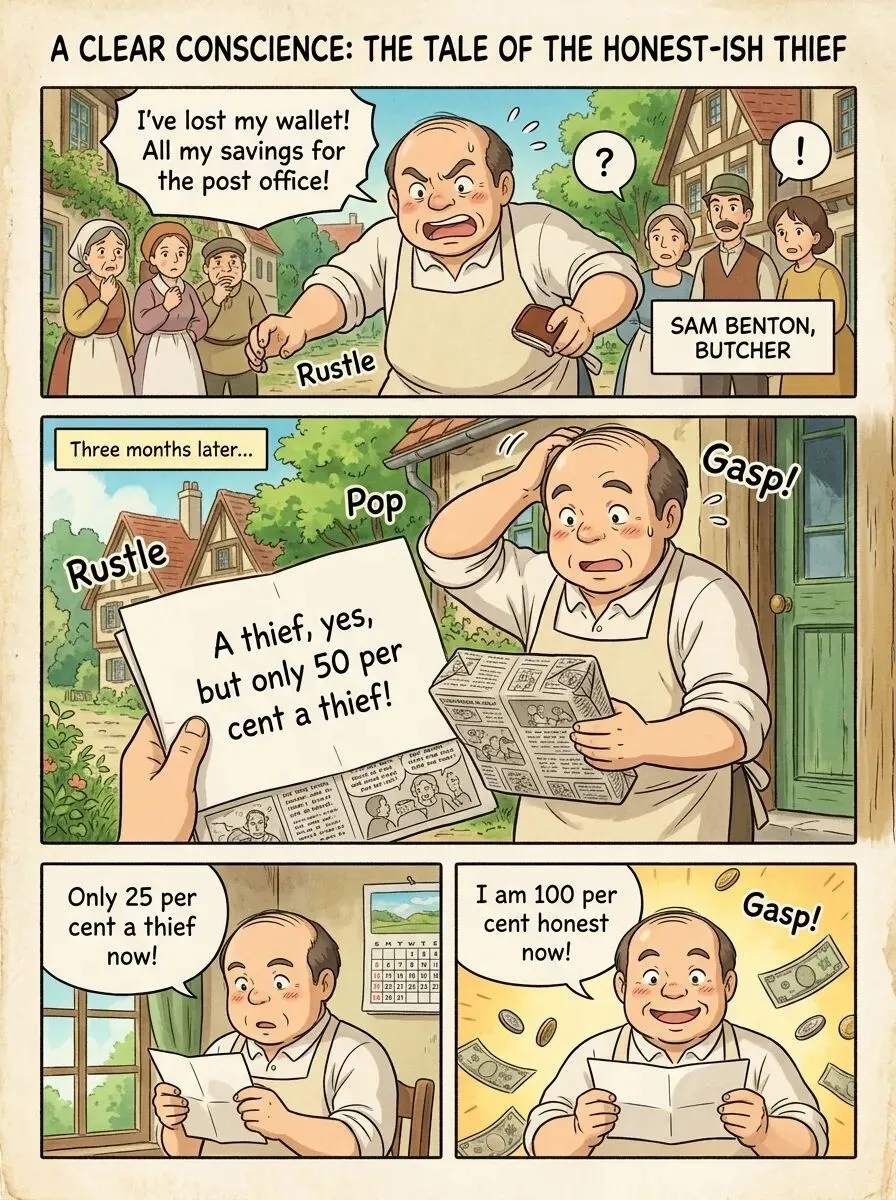
The whole village soon learnt that a large sum of money had been lost. Sam Benton, the local butcher, had lost his wallet while taking his savings to the post office. Sam was sure that the wallet must have been found by one of the villagers, but it was not returned to him. Three months passed, and then one morning, Sam found his wallet outside his front door. It had been wrapped up in newspaper and it contained half the money he had lost, together with a note which said: 'A thief, yes, but only 50 per cent a thief!' Two months later, some more money was sent to Sam. Another note came with it. It said: 'Only 25 per cent a thief now!' In time, all Sam's money was paid back in this way. The last note said: 'I am 100 per cent honest now!'
背景简介:本篇课文是一篇短小精悍的记叙文,讲述了一个关于道德觉醒与自我救赎的故事。故事发生在一个小村庄(village)的背景下,这种封闭的熟人社会环境放大了个人行为与社区舆论之间的关系。核心概念是“a clear conscience”(问心无愧),它驱动了故事中匿名人物的一系列行为。文章通过一个窃贼主动分批归还赃款并附上忏悔纸条的独特情节,探讨了内疚感、诚实以及改过自新的可能性,语言简洁但寓意深刻。
参考译文:
问心无愧
整个村子很快都知道,有一大笔钱丢失了。当地的肉店老板萨姆·本顿在带着存款去邮局的路上把钱包丢了。萨姆确信那钱包一定是被某个村民捡到了,可是却不见有人送还给他。三个月过去了,后来一天早晨,萨姆在自己大门外发现了他的钱包。钱包是用报纸包着的,里面有他丢失的钱的一半,还附着一张纸条,上面写着:“一个小偷,是的,但只是一个50%的小偷!”两个月后,又有些钱送还给了萨姆。又附了一张字条,写道:“现在只是一个25%的小偷了!”最终,萨姆所有的钱都以这种方式被还了回来。最后一张字条上写道:“我现在是一个100%的诚实人了!”
🔍 第二部分:逐句精讲与词块总结
句子1
原文: The whole village soon learnt that a large sum of money had been lost.
翻译: 整个村子很快都知道,有一大笔钱丢失了。
句子结构: 这是一个主从复合句。主句是“The whole village soon learnt”,后面接一个由“that”引导的宾语从句“that a large sum of money had been lost”。宾语从句本身使用了过去完成时的被动语态。
重点词汇:
village 蓝思值 600L
英音[ˈvɪlɪdʒ] 美音[ˈvɪlɪdʒ] 词性:n.
释义:村庄,乡村;村民(总称)
常用语块:the whole village (全村人),a small village (小村庄)
短语搭配:in a village, leave the village, village life
例句一:The news spread quickly through the village. 消息在村里传得很快。
例句二:He comes from a fishing village on the coast. 他来自海边的一个渔村。
拓展:词根“vill”来源于拉丁语,与“农庄、别墅”有关。派生词:villager (n. 村民)。注意:当指“全体村民”时,常用“the village”作单数主语,如本句。
sum 蓝思值 700L
英音[sʌm] 美音[sʌm] 词性:n.
释义:金额,款项;总数,总和
常用语块:a large sum of money (一大笔钱),a small sum (一小笔钱)
短语搭配:the sum total (总数),in sum (总而言之)
例句一:They paid an enormous sum for the house. 他们花了一大笔钱买这房子。
例句二:The sum of five and seven is twelve. 五加七的和是十二。
拓展:常与“money”连用,表示具体的钱数。区别于“amount”,后者更泛指数量。短语“a sum of”后接不可数名词。
learnt 蓝思值 400L
英音[lɜːnt] 美音[lɝːnt] 词性:v. (learn的过去式和过去分词)
释义:得知,获悉;学会
常用语块:learnt that... (得知......),learnt about (了解到关于......)
短语搭配:learn from, learn by heart
例句一:I learnt from the newspaper that he had resigned. 我从报纸上得知他已辞职。
例句二:Have you learnt your lines for the play? 你背熟剧本台词了吗?
拓展:英式英语中常用“learnt”,美式英语中“learned”更常见,两者都是正确的过去式和过去分词形式。本句中“learnt”表示“获知消息”这一瞬间动作。
语法点睛: 本句的宾语从句使用了过去完成时(had been lost)。这是因为“丢钱”的动作发生在“全村人知道”这一过去动作之前,属于“过去的过去”。[NCE知识点笔记] 指出,过去完成时常用于宾语从句中,以明确动作的先后顺序。同时,这里也复习了被动语态(be lost)的用法。
句子2
原文: Sam Benton, the local butcher, had lost his wallet while taking his savings to the post office.
翻译: 当地的肉店老板萨姆·本顿在带着存款去邮局的路上把钱包丢了。
句子结构: 这是一个简单句,主干为“Sam Benton had lost his wallet”。“the local butcher”是主语的同位语,起补充说明作用。“while taking his savings to the post office”是现在分词短语作时间状语,相当于“while he was taking...”。
重点词汇:
local 蓝思值 500L
英音[ˈləʊkl] 美音[ˈloʊkl] 词性:adj.
释义:地方的,当地的;局部的
常用语块:local butcher/shop/newspaper (当地的肉店/商店/报纸),local government (地方政府)
短语搭配:local community, local time
例句一:We get our vegetables from the local market. 我们从当地市场买菜。
例句二:The pain was local, not spreading. 疼痛是局部的,没有扩散。
拓展:反义词是“national”(全国的)或“global”(全球的)。派生词:locally (adv.), locality (n. 所在地)。
butcher 蓝思值 650L
英音[ˈbʊtʃə(r)] 美音[ˈbʊtʃər] 词性:n.
释义:屠夫,肉贩;刽子手(比喻)
常用语块:the local butcher (当地的肉店老板)
短语搭配:butcher's shop (肉铺)
例句一:My grandfather was a butcher. 我祖父是个屠夫。
例句二:The dictator was described as a butcher. 那个独裁者被形容为刽子手。
拓展:注意发音,字母“t”不发音。动词意为“屠宰;弄糟”。
wallet 蓝思值 550L
英音[ˈwɒlɪt] 美音[ˈwɑːlɪt] 词性:n.
释义:(男用)皮夹,钱包
常用语块:lost his wallet (丢了钱包),leather wallet (皮夹)
短语搭配:wallet-sized photo
例句一:He took out a ten-pound note from his wallet. 他从钱包里拿出一张十英镑的钞票。
例句二:I keep my credit cards in a separate wallet. 我把信用卡放在另一个钱包里。
拓展:通常指男士用的对折式皮夹。女士用的常称为“purse”(英式)或“handbag”(手提包)。
savings 蓝思值 650L
英音[ˈseɪvɪŋz] 美音[ˈseɪvɪŋz] 词性:n. (pl.)
释义:储蓄,存款
常用语块:his savings (他的存款),savings account (储蓄账户)
短语搭配:life savings (毕生积蓄),dip into one's savings (动用存款)
例句一:She used her savings to buy a car. 她用积蓄买了辆车。
例句二:It's wise to have some savings for emergencies. 存些钱以备急用是明智的。
拓展:总是以复数形式出现。动词原形是“save”(节省,拯救)。
post office 蓝思值 450L
英音[pəʊst ˈɒfɪs] 美音[poʊst ˈɔːfɪs] 词性:n.
释义:邮局
常用语块:to the post office (去邮局),at the post office (在邮局)
短语搭配:main post office, post office box (邮政信箱)
例句一:I need to go to the post office to send this parcel. 我需要去邮局寄这个包裹。
例句二:Is there a post office near here? 这附近有邮局吗?
拓展:合成名词。相关词汇:mail/post a letter (寄信), stamp (邮票), postcode (邮政编码)。
语法点睛: 本句再次使用了过去完成时“had lost”,与第一句的“had been lost”呼应,具体说明了丢钱的事件。语法重点是“while taking...”这个现在分词短语作时间状语。[名师精讲] 指出,当分词短语的主语与主句主语一致(都是Sam Benton)时,可以省略主语和be动词,直接用“while/ when/ before/ after + doing”结构,使句子更简洁。例如:He sang while walking. (他边走边唱。)
句子3
原文: Sam was sure that the wallet must have been found by one of the villagers, but it was not returned to him.
翻译: 萨姆确信那钱包一定是被某个村民捡到了,可是却不见有人送还给他。
句子结构: 这是一个并列复合句,由连词“but”连接两个分句。第一个分句“Sam was sure that...”中包含一个由“that”引导的宾语从句。第二个分句是简单句“it was not returned to him”。
重点词汇:
sure 蓝思值 300L
英音[ʃʊə(r)] 美音[ʃʊr] 词性:adj.
释义:确信的,有把握的;一定的
常用语块:was sure that... (确信......),make sure (确保)
短语搭配:sure of oneself (自信),for sure (肯定地)
例句一:Are you sure you locked the door? 你确定锁门了吗?
例句二:It's sure to rain tomorrow. 明天肯定会下雨。
拓展:常用结构:be sure of/about sth.; be sure to do sth.; be sure that...。同义词:certain。
must have been found (情态动词+完成被动式)
释义:表示对过去已发生事件的肯定推测(一定已经被......)。
常用语块:must have done (一定做过),must have been done (一定被做过)
例句一:The ground is wet. It must have rained last night. 地面是湿的,昨晚一定下雨了。
例句二:His phone is switched off. He must have gone to bed. 他手机关机了,一定睡了。
拓展:[语法新思维] 讲解:情态动词(must, may, might, could, can't) + have + 过去分词,用于表示对过去情况的推测。must have done 表示非常肯定的推测。
return 蓝思值 450L
英音[rɪˈtɜːn] 美音[rɪˈtɝːn] 词性:v.
释义:归还;返回;回复
常用语块:return to him (归还给他),return home (回家)
短语搭配:return a book to the library, in return (作为回报)
例句一:Please return the keys when you leave. 离开时请归还钥匙。
例句二:She returned to her hometown after many years. 多年后她回到了故乡。
拓展:名词也有“归还;回报;往返票”的意思。注意:“return back”是冗余表达,因为“return”已包含“back”之意。
语法点睛: 本句的核心语法点是“must have been found”,这是“情态动词+完成式的被动语态”,表示萨姆对“钱包被找到”这一过去事件的强烈推测。[NCE知识点笔记] 强调,这是第二册重要的语法项目,用于表达逻辑推断。同时,句子也包含了“be sure that...”这一表达个人信念的句型。
句子4
原文: Three months passed, and then one morning, Sam found his wallet outside his front door.
翻译: 三个月过去了,后来一天早晨,萨姆在自己大门外发现了他的钱包。
句子结构: 这是一个由“and”连接的并列句。第一个分句“Three months passed”是简单句。第二个分句“Sam found his wallet outside his front door”也是简单句,“outside his front door”是地点状语。
重点词汇:
passed 蓝思值 400L
英音[pɑːst] 美音[pæst] 词性:v. (pass的过去式)
释义:(时间)过去,流逝;经过;通过
常用语块:time passed (时间过去),passed the exam (通过考试)
短语搭配:pass by, pass away (去世)
例句一:Two hours passed before the doctor arrived. 两个小时过去了医生才到。
例句二:She passed me in the corridor without speaking. 她在走廊里从我身边走过,没有说话。
拓展:注意与同音词“past”区分。“past”可作名词(过去)、形容词(过去的)或介词(经过)。本句中是动词。
found 蓝思值 350L
英音[faʊnd] 美音[faʊnd] 词性:v. (find的过去式)
释义:发现,找到;发觉
常用语块:found his wallet (发现他的钱包),found that... (发觉......)
短语搭配:find out (查明),find fault with (挑剔)
例句一:I found a coin on the pavement. 我在人行道上发现一枚硬币。
例句二:He found the work very boring. 他觉得这工作很无聊。
拓展:不规则动词:find-found-found。名词形式是“finding”(发现物;调查结果)。
outside 蓝思值 400L
英音[ˌaʊtˈsaɪd] 美音[ˌaʊtˈsaɪd] 词性:prep./adv./n./adj.
释义:在......外面;外部;外部的
常用语块:outside his front door (在他前门外),wait outside (在外面等)
短语搭配:outside world, from the outside
例句一:It's cold outside. Put on your coat. 外面冷,穿上外套。
例句二:The house has a beautiful garden outside. 房子外面有个漂亮的花园。
拓展:反义词是“inside”。可以作多种词性,本句中作介词。
语法点睛: 本句通过“Three months passed, and then...”清晰地交代了时间推移和事件的转折,是叙事文中常见的时间序列表达方式。句子使用了一般过去时(passed, found)来描述相继发生的具体动作。
句子5
原文: It had been wrapped up in newspaper and it contained half the money he had lost, together with a note which said: 'A thief, yes, but only 50 per cent a thief!'
翻译: 钱包是用报纸包着的,里面有他丢失的钱的一半,还附着一张纸条,上面写着:“一个小偷,是的,但只是一个50%的小偷!”
句子结构: 这是一个结构较复杂的并列复合句。由“and”连接两个并列分句。第一个分句“It had been wrapped up in newspaper”是被动语态的简单句。第二个分句“it contained... a note which said...”是主从复合句,其中“half the money he had lost”里包含一个省略了关系代词的定语从句“he had lost”修饰“money”;“together with a note”是伴随状语;“which said...”是定语从句修饰“note”;引号内是直接引语作“said”的宾语。
重点词汇:
wrapped up 蓝思值 600L
英音[ræpt ʌp] 美音[ræpt ʌp] 词性:v. (wrap up的过去分词)
释义:包起来,裹住
常用语块:wrapped up in newspaper (用报纸包着),wrap up a parcel (包裹包裹)
短语搭配:wrap up warm/warmly (穿暖和),be wrapped up in (专心于,沉浸于)
例句一:The presents were beautifully wrapped up. 礼物包装得很漂亮。
例句二:She was completely wrapped up in her work. 她全身心扑在工作上。
拓展:“wrap”是不规则动词吗?不,是规则动词:wrap-wrapped-wrapped。注意拼写:双写p再加-ed。
contained 蓝思值 650L
英音[kənˈteɪnd] 美音[kənˈteɪnd] 词性:v. (contain的过去式)
释义:包含,容纳;控制
常用语块:contained half the money (包含一半的钱),containing (内含)
短语搭配:container (容器),contain oneself (克制自己)
例句一:This box contains all his letters. 这个盒子里装着他所有的信。
例句二:The report contains several errors. 报告中有几处错误。
拓展:区别于“include”(包括,强调部分是整体的一部分)。“contain”强调“内有,装有”。
per cent 蓝思值 500L
英音[pə ˈsent] 美音[pər ˈsent] 词性:n. (也可写作percent)
释义:百分之......
常用语块:50 per cent (50%),a large per cent of (很大比例的)
短语搭配:percentage (百分比),per cent increase (增长百分比)
例句一:I agree with you one hundred per cent. 我百分之百同意你。
例句二:Over sixty per cent of families own a car. 超过60%的家庭拥有汽车。
拓展:常与数字连用,符号为“%”。注意:“per cent”作主语时,谓语动词的单复数取决于of后面的名词。
thief 蓝思值 550L
英音[θiːf] 美音[θiːf] 词性:n.
释义:小偷,贼
常用语块:a thief (一个小偷),car thief (偷车贼)
短语搭配:stop thief (捉贼),like a thief in the night (偷偷摸摸地)
例句一:The thief was caught by the police. 小偷被警察抓住了。
例句二:Set a thief to catch a thief. (谚语) 以贼捉贼。/ 以毒攻毒。
拓展:复数形式为“thieves”。动词是“steal”(偷窃)。相关词汇:burglar (入室盗贼),robber (抢劫犯)。
语法点睛: 本句语法点密集。1) “had been wrapped”是过去完成时的被动语态,强调钱包在被发现时已被包裹好的状态(先于“found”发生)。2) “he had lost”是省略了关系代词“that/which”的定语从句,修饰“money”。[课堂笔记] 指出,当关系代词在定语从句中作宾语时,常可省略。3) “together with”是介词短语,表示伴随,其后的名词不影响主语的单复数。4) “which said”是非限定性定语从句的常见形式,对“note”进行补充说明。
句子6
原文: Two months later, some more money was sent to Sam.
翻译: 两个月后,又有些钱送还给了萨姆。
句子结构: 这是一个简单句,使用了被动语态(was sent)。“Two months later”是时间状语。
重点词汇:
was sent (send的过去式被动语态)
英音[wəz sent] 美音[wəz sent] 词性:v.
释义:被寄送,被发送
常用语块:was sent to Sam (被送给萨姆),sent by post (邮寄)
短语搭配:send for (派人去请),send out (发出)
例句一:The letter was sent last week. 信是上周寄出的。
例句二:He was sent to prison for five years. 他被判入狱五年。
拓展:不规则动词:send-sent-sent。本句使用被动语态,因为动作执行者(那个小偷)未知或不重要。
语法点睛: 本句继续使用被动语态(was sent),延续了上文对钱包和钱的描述视角,即焦点在萨姆和钱上,而非行动者。时间状语“Two months later”清晰地推进了故事的时间线。
句子7
原文: Another note came with it.
翻译: 又附了一张字条。
句子结构: 这是一个简单的“主谓状”结构句子。“Another note”是主语,“came”是谓语,“with it”是状语。
重点词汇:
came with 蓝思值 350L
释义:随......一起来,附带
常用语块:came with it (随之而来/附带着),come with the job (是工作的一部分)
例句一:The computer comes with a free mouse. 这台电脑附带一个免费的鼠标。
例句二:Success often comes with hard work. 成功常伴随着努力工作而来。
拓展:非常地道的表达,比“was attached to”更口语化和常用。
语法点睛: 极其简洁的句子,用“came with”生动地表达了纸条是“伴随”钱而来的,比“there was another note”更动态。
句子8
原文: It said: 'Only 25 per cent a thief now!'
翻译: 上面写着:“现在只是一个25%的小偷了!”
句子结构: 简单句,包含直接引语作宾语。
语法点睛: 继续使用直接引语来呈现纸条内容,让读者直接感受到小偷语气和心态的变化,从“50%”到“25%”,增强了故事的生动性和幽默感。
句子9
原文: In time, all Sam's money was paid back in this way.
翻译: 最终,萨姆所有的钱都以这种方式被还了回来。
句子结构: 这是一个简单句的被动语态。“In time”是时间状语,“in this way”是方式状语。
重点词汇:
In time 蓝思值 450L
英音[ɪn taɪm] 美音[ɪn taɪm] 词性:短语
释义:最终,迟早;及时
常用语块:in time (最终),in time for (及时赶上)
短语搭配:just in time (刚好来得及),on time (准时)
例句一:In time, he forgot all about the accident. 最终,他完全忘记了那次事故。
例句二:We arrived just in time for the start of the film. 我们刚好在电影开场时赶到。
拓展:注意与“on time”(准时)的区别。“in time”强调经过一段时间后最终达到某种结果,或在不迟于某个时间点前。
paid back 蓝思值 600L
英音[peɪd bæk] 美音[peɪd bæk] 词性:v. (pay back的过去分词)
释义:偿还,归还;报复
常用语块:was paid back (被偿还),pay back a loan (偿还贷款)
短语搭配:pay sb back for sth (为某事向某人报复)
例句一:Have you paid back the money you borrowed? 你借的钱还了吗?
例句二:I'll pay you back for your kindness. 我会报答你的好意。(或:我会报复你的。)
拓展:“pay back”侧重归还所欠的钱。名词形式是“repayment”。
语法点睛: “In time”作为时间状语,总结了整个还款过程的结局。“was paid back”是被动语态的一般过去时,表示一个完成的动作。句子概括了事件的结果。
句子10
原文: The last note said: 'I am 100 per cent honest now!'
翻译: 最后一张字条上写道:“我现在是一个100%的诚实人了!”
句子结构: 简单句,包含直接引语。
重点词汇:
honest 蓝思值 500L
英音[ˈɒnɪst] 美音[ˈɑːnɪst] 词性:adj.
释义:诚实的,正直的;坦率的
常用语块:100 per cent honest (100%诚实),an honest man (诚实的人)
短语搭配:to be honest (老实说),honest mistake (无心之失)
例句一:He is an honest businessman. 他是个诚实的商人。
例句二:Give me your honest opinion. 把你的真实想法告诉我。
拓展:名词是“honesty”(诚实)。反义词是“dishonest”。注意发音,字母“h”发音。
语法点睛: 故事以直接引语收尾,达到了道德升华的点睛效果。小偷自称从“50% thief”到“100% honest”,完成了一个完整的道德转变弧光。这句话也点明了课文标题“A Clear Conscience”的含义——只有彻底诚实,才能问心无愧。
📌 核心词块总结
1. learnt that... 得知...... (The whole village soon learnt that a large sum of money had been lost.)
2. a large sum of money 一大笔钱 (He lost a large sum of money.)
3. had lost... while taking... 在(做某事)时丢了...... (He had lost his wallet while taking his savings to the post office.)
4. must have been found 一定被找到了 (Sam was sure it must have been found by a villager.)
5. wrapped up in 用......包裹着 (It was wrapped up in newspaper.)
6. contained... together with a note which said... 包含......以及一张写着......的纸条 (It contained half the money, together with a note which said...)
7. per cent a thief ......百分比的小偷 (only 50 per cent a thief)
8. in time 最终,迟早 (In time, all the money was paid back.)
9. paid back in this way 以这种方式偿还 (The debt was paid back in this gradual way.)
10. a clear conscience 问心无愧 (After returning everything, he had a clear conscience.)
✍️ 第三部分:语篇分析与段落写作技巧
1. 语篇分析
①识别宏观结构 (Identify the macrostructure):本文是一篇典型的线性叙事结构。按照时间顺序展开:事件发生(丢钱)→ 等待与悬念(三个月无人归还)→ 转折点(钱包意外出现,但钱少了一半并有纸条)→ 发展(分期还款并附忏悔纸条)→ 结局(钱全部还清,小偷宣称自己重归诚实)。这种“问题-解决”型叙事清晰易懂。
②列举衔接手段 (List cohesive devices):
*时间连接词:soon, while, three months passed, then, one morning, two months later, in time 这些词清晰地标记了事件的发展阶段。
*代词照应:it (指代wallet), him (指代Sam), this way (指代分期还款附纸条的方式),确保了语篇的连贯。
*词汇复现:wallet, money, note, thief, per cent 等关键词的重复出现,强化了主题。
*平行结构:“A thief, yes, but only 50 per cent a thief!” / “Only 25 per cent a thief now!” / “I am 100 per cent honest now!” 这三句构成了语义和结构上的平行递进,生动展示了人物的内心变化。
③分析作者态度 (Analyze the author's attitude): 作者以一种略带幽默和宽容的笔调讲述了这个故事。通过小偷自嘲式的纸条(“50% thief”)和最终的自我宣告(“100% honest”),作者并未严厉谴责偷窃行为,而是侧重于描绘良心发现和自我救赎的过程。标题“A Clear Conscience”本身就带有积极的道德评判色彩,暗示了诚实与内心安宁的终极价值。
2. 写作技巧
①提炼写作逻辑:本文展示了如何讲述一个关于“错误与改正”的个人经历。逻辑链条为:背景设定(谁,在哪,发生了什么)→ 初始反应与困惑 → 出现转机与发现线索 → 事情出现意想不到的发展 → 最终结果与个人感悟。这种逻辑非常适合用于写“一次难忘的经历”、“一个道德抉择”或“一个让我改变的人/事”这类题目。
②提供段落写作范例:
题目:An Act of Honesty (一次诚实的行为)
Last winter, I found a smartphone lying on a bench in the park. It was an expensive model. My first thought was to keep it, as no one was around. I even switched it off and put it in my bag. However, on my way home, I started feeling uneasy. I imagined how worried the owner must be. That evening, I turned it on, and after a while, a call came through from “Mom”. I answered and explained the situation. The owner, a grateful teenager, came to collect it. He offered me some money as a reward, but I refused. Simply handing back the phone made me feel surprisingly happy and light. It taught me that honesty isn't about being praised; it's about the peace of mind you give yourself.
分析其结构特点:遵循了“发现物品→内心挣扎→做出决定→采取行动→结果与感受”的经典叙事结构。使用了心理描写(feeling uneasy, imagined)来增强真实感。
标注语言点映射:“must be”表示推测;“on my way home”模仿“while taking... to”;“came through”类似“came with”;“peace of mind”对应“a clear conscience”。
③布置小练笔并提供例文:
练笔题目:Write about a time when you faced a temptation but chose to do the right thing. Describe what happened, what you thought, and how you felt afterwards. (约120词)
例文:
During a group project in school, my friend suggested we copy some paragraphs from the internet to save time. The deadline was tight, and everyone else seemed okay with the idea. I felt pressured to agree. That night, while trying to paste the copied text, I couldn't do it. I remembered my teacher saying that real learning comes from effort. I told my group we had to write in our own words, even if it meant working longer. We stayed up late, but we finished it ourselves. When we got a good grade, the satisfaction was immense. It wasn't just a grade; it was a victory for our own integrity. The temptation was strong, but resisting it made our success truly ours.
📐 第四部分:本课语法精析(加强版)
本课语法重点围绕间接引语中的时态特殊规则和情态动词对过去的推测展开,同时综合运用了多种时态和语态。
1. 间接引语(Indirect Speech)中时态不变的特殊情况
[NCE知识点笔记] 明确指出,当主句动词是过去时(如 said, told, thought, was sure),引述从句的时态通常要后退一步(一般现在时→一般过去时,现在完成时→过去完成时等)。但是,有一个重要例外:当引述的内容是客观事实、普遍真理、或习惯性动作时,从句时态保持不变。
-课文例句:Sam was sure that the wallet must have been found by one of the villagers. (萨姆确信钱包一定被村民捡到了。) 这里“was sure”是过去时,但后面从句的内容是萨姆当时的主观确信(接近于一个他认为的“事实”),但语法上我们关注的是“must have been found”这个结构本身,它已经是过去推测,不涉及时态后退问题。为了更好地说明规则,我们看另一个例子:
-[名师精讲] 例句:
- He said that the earthmovesaround the sun. (他说地球绕着太阳转。)(客观真理,时态不变)
- She told me that shegets upat 6 a.m. every day. (她告诉我她每天六点起床。)(习惯动作,时态不变)
- I knew that waterboilsat 100 degrees Celsius. (我知道水在100摄氏度沸腾。)(科学事实,时态不变)
-对比(需要时态后退的情况):
- Sam said: “Ilostmy wallet.” → Sam said that hehad losthis wallet. (一般过去时→过去完成时)
- The note said: “Iam50% a thief.” → The note said that hewas50% a thief. (一般现在时→一般过去时)
- Sam thought: “Someonehas foundit.” → Sam thought that someonehad foundit. (现在完成时→过去完成时)
-练习题 (判断是否需要改变时态):
1. He said that Paris ______ (be) the capital of France.
2. She told me she ______ (buy) a new car the day before.
3. We knew the sun ______ (rise) in the east.
4. He announced that he ______ (resign) immediately.
5. My teacher said that practice ______ (make) perfect.
解析:
1.is(客观事实)
2.had bought(“the day before”表明是过去的过去,需用过去完成时)
3.rises(自然规律)
4.would resign(或 was resigning,表示将来,需后退为过去将来时)
5.makes (谚语,视为普遍真理)
2. 情态动词对过去事件的推测:Must/Can't/Could/May/Might + Have + Past Participle
[语法新思维] 对此有系统讲解。这是第二册的核心语法之一,用于表示说话人对过去已发生事情的猜测。
-must have done:表示非常肯定的推测,“一定做了某事”。
- 课文例句: ...the walletmust have been foundby one of the villagers. (钱包一定被某个村民捡到了。)
- [课堂笔记] 补充例句: The ground is wet. Itmust have rainedlast night. 地上是湿的,昨晚一定下雨了。
-can't/couldn't have done:表示否定的推测,“不可能做了某事”。
- 例句: Hecan't have stolenthe money; he was with me all day. 他不可能偷钱,他一整天都和我在一起。
-may/might/could have done:表示不太确定的推测,“可能/或许做了某事”。三者可能性依次略有降低,但常可互换。
- 例句: Shemight have forgottenour appointment. 她可能忘了我们的约会。
- 例句: Why isn't he here? Hecould have missedthe train. 他怎么没来?他可能没赶上火车。
-需要注意:这些结构只表示推测,不表示事实。其否定形式不是在情态动词后加not,而是用“can't have done”或“may not have done”(后者表示“可能没有”)。
-练习题 (用合适的情态动词+have done填空):
1. The lights are off. They ______ (go) to bed.
2. He knows everything about the accident. He ______ (see) it happen.
3. She passed the exam easily. She ______ (study) very hard.
4. I can't find my keys. I ______ (leave) them in the office.
5. He was very familiar with the road. He ______ (drive) there many times before.
解析:
1.must have gone(非常肯定)
2.must have seen(非常肯定)
3.must have studied(非常肯定)
4.may/might/could have left(不确定)
5.must have driven (非常肯定)
3. 过去完成时(Past Perfect)的复习与运用
本课多处使用过去完成时(had lost, had been lost, had been wrapped, he had lost),用于表示“过去的过去”。
-[NCE知识点笔记] 总结用法:过去完成时表示在过去某一时间或动作之前已经发生或完成了的动作。它必须有一个明确的“过去时间点”作为参照。
-课文中的应用:
- ...a large sum of moneyhad been lost. (参照点:全村人“learnt”的时候。)
- Sam Benton...had losthis wallet... (参照点:同上,也是全村人知道的时候。)
- ...half the money hehad lost... (参照点:他发现钱包的时候。)
- Ithad been wrappedup... (参照点:他发现钱包的时候。)
-与一般过去时的对比:[名师精讲] 强调,当句子中有两个或多个过去动作,且需要明确先后顺序时,先发生的用过去完成时。
- 例句: When Iarrived(动作2) at the party, Tomhad already left(动作1). 当我到达派对时,汤姆已经离开了。
-练习题 (用动词的正确时态填空):
1. After they ______ (finish) dinner, they ______ (watch) a movie.
2. I ______ (realize) I ______ (leave) my umbrella on the bus.
3. She ______ (be) upset because she ______ (fail) her driving test.
4. The house was quiet because everyone ______ (go) to sleep.
5. He ______ (tell) me that he ______ (visit) Japan twice before.
解析:
1.had finished, watched(吃完饭后才看电影)
2.realized, had left(意识到时,伞已经落在车上了)
3.was, had failed(难过是因为考试没过,考试在先)
4.had gone(安静的原因是大家都已睡着)
5.told, had visited (告诉我的时候,访问已是过去经历)
4. 现在分词短语作状语
本课出现了“while taking his savings...”这一典型结构。
-[语法新思维] 讲解:当状语从句的主语与主句主语一致时,可以省略从句的主语和be动词,将动词变为现在分词(-ing形式)。连接词(while, when, before, after, since等)可以保留。
-课文例句:...had lost his walletwhile takinghis savings to the post office. = ...while he was taking...
-更多例句:
-Before leavinghome, she checked all the windows. = Before she left home...
- He hurt his kneewhile playingfootball. = ...while he was playing...
-After finishinghis work, he went home. = After he finished...
-注意:如果分词表示的动作与主句动作是主动关系,用现在分词;如果是被动关系,则用过去分词。例如:Seen from the hill, the city looks beautiful. (城市被看)
-练习题 (将划线部分改为分词短语):
1. When she opened the door, she saw a stranger.
2. After he had dinner, he went for a walk.
3. Because he didn't know the way, he asked a policeman.
4. While I was walking in the park, I met an old friend.
解析:
1.Opening the door,she saw a stranger. (When opening... 也可)
2.Having had dinner,he went for a walk. (After having... 也可,强调完成)
3.Not knowing the way,he asked a policeman. (原因状语)
4.While walking in the park, I met an old friend.
5. 被动语态的综合运用
本课被动语态出现频繁(had been lost, must have been found, was not returned, had been wrapped, was sent, was paid back),主要用于强调动作的承受者(钱包、钱),而隐去或未知动作的执行者(小偷、捡到的人)。
-[课堂笔记] 复习:被动语态的基本结构:be + 过去分词。时态通过be动词体现。
-本课被动语态类型总结:
- 过去完成时被动: had been lost, had been wrapped
- 情态动词+完成被动: must have been found
- 一般过去时被动: was not returned, was sent, was paid back
-何时使用被动语态:1) 不知道或不必说明动作执行者;2) 强调动作承受者;3) 出于礼貌或修辞需要。
-练习题 (将主动句改为被动句,必要时省略施动者):
1. Someone found the wallet in the street.
2. The villagers did not return the wallet to Sam.
3. The thief sent the money back to Sam gradually.
4. People have paid back all the money.
解析:
1. The wallet was found in the street.
2. The wallet was not returned to Sam (by the villagers).
3. The money was sent back to Sam gradually (by the thief).
4. All the money has been paid back.
🎧 第五部分:听力与阅读策略训练
1. 听力技巧
结合课文录音,设计以下听力理解训练:
① 预测关键词 (Predict Key Words): 在听录音前,根据标题“A Clear Conscience”,预测故事可能涉及哪些词汇?(如:money, lost, thief, honest, return, conscience, wallet, note)
② 抓主旨大意 (Grasp the Main Idea): 第一遍听,回答:What is the story mainly about? (A. A robbery in a village. B. A thief who returns money and becomes honest. C. A butcher who loses his savings.)
③ 笔记方法 (Note-taking Method): 第二遍听,尝试用时间线做笔记:
* Event 1: Sam Benton lost his ______ while taking ______ to the __.
* Time passed: ______ months.
* Event 2: Sam found wallet __. It contained ______ the money + a note: “__ thief.”
* Later: More money sent. Note: “__ thief now.”
* End: All money __. Final note: “__ honest now.”
2. 阅读理解策略
设计以下阅读任务,训练不同阅读微技能:
①扫读 (Scanning):快速阅读课文,找出以下具体信息,不超过30秒:
* What was Sam Benton's job?
* How much money was in the wallet when it was first returned?
* What did the last note say?
②略读 (Skimming):在1分钟内读完课文,总结故事的三个阶段:Beginning (What happened?), Middle (What was surprising?), End (How did it conclude?).
③推断词义 (Inferring Meaning):根据上下文推断划线词的意思:
* “The wallet had beenwrapped upin newspaper.” (Para. 1) “Wrapped up” likely means ______.
* “In time, all Sam's money waspaid back.” (Para. 1) “Paid back” here means ______.
* The title “A ClearConscience” suggests the story is about feeling ______ after doing something wrong. (a. guilty b. proud c. peaceful and right)
④理解指代 (Understanding Reference):“It had been wrapped up in newspaper andit contained half the money...” 第二个“it”指代什么?
📝 第六部分:习题讲解
(以下讲解基于《官方教材之新概念英语练习详解 第2册.pdf》及学生用书中的练习)
关键句型 (Key Structures) 练习
练习通常围绕本课核心语法点。以“间接引语”和“情态动词推测”为例:
- 例题: Change the direct speech into indirect speech.
- Sam said, “I have lost my wallet.”
- → Sam said that he had lost his wallet.
- 讲解思路: 1) 主句动词“said”是过去时。2) 引述内容“I have lost”是现在完成时。3) 根据时态后退原则,现在完成时应改为过去完成时(had lost)。4) 人称从“I”改为“he”。
- 常见错误: 忘记改变时态或人称。
难点练习 (Special Difficulties)
可能涉及词汇辨析或特殊表达。
-可能练习点1: “steal” vs. “rob”
-Steal:偷(某物)。结构:steal sth. (from sb.)
-Rob:抢(某人或某地)。结构:rob sb./a place (of sth.)
- 例句:The thiefstolehis wallet. / Theyrobbedthe bank.
-可能练习点2: “between” vs. “among”
-Between:两者之间。
-Among:三者或以上之间。
- 课文应用:...found by one of the villagers... (among many villagers).
多项选择题 (Multiple Choice Questions)
- 解题策略: 1) 通读题干和选项。2) 回到原文定位相关信息。3) 排除明显错误的选项。4) 选择最贴合文意的答案。
- 示例题干: Why did Sam think the wallet was found by a villager?
- A. Because he saw someone pick it up.
- B. Because it was lost in the village.
- C. Because villagers are usually honest.
- D. The story doesn't say.
- 解析: 文中只说“Sam was sure that...”,并未给出具体理由。这是一种基于常理的推测。最准确的答案是D,因为文章确实没有说明原因。B看似有理,但文中并未明确说“lost in the village”,也可能是去邮局的路上。
作文练习 (Composition)
教材可能要求根据关键词写摘要或短文。
- 指导: 1) 按时间顺序组织所给关键词。2) 使用正确的时态(一般过去时为主,可能需要过去完成时)。3) 适当添加连接词使行文流畅。4) 结尾可以呼应标题,点明“a clear conscience”的主题。
- 关键词可能包括: Sam Benton, butcher, lose wallet, savings, post office, village, three months, find, newspaper, half money, note, 50 per cent thief, later, more money, 25 per cent, in time, all money, paid back, 100 per cent honest.
🤔 第七部分:英文深度思考与拓展(强化版)
A. 层次化英文问题与答案
Level 1 (Factual): Retrieve information directly from the text.
1. Q: What was Sam Benton's profession?
A: He was the local butcher.
2. Q: Where was he going when he lost his wallet?
A: He was taking his savings to the post office.
3. Q: How much of his money was in the wallet when it was first returned?
A: Only half of the money he had lost was in the wallet.
4. Q: What was the final percentage the note writer claimed to be?
A: He claimed to be “100 per cent honest” in the final note.
Level 2 (Inferential): Read between the lines to understand implications.
5. Q: Why might the person who found the wallet not return it immediately?
A: He was probably tempted by the money and initially decided to keep it, struggling with his conscience.
6. Q: What does the gradual return of the money suggest about the finder's character?
A: It suggests that he felt guilty and was trying to redeem himself step by step. He was conflicted but ultimately wanted to do the right thing.
7. Q: Why did the finder choose to communicate through notes instead of returning the wallet anonymously in one go?
A: The notes served as a confession and a personal journey log. They added a psychological dimension, showing his internal struggle and his desire to declare his moral progress, perhaps seeking symbolic forgiveness.
8. Q: How did the villagers' knowledge of the loss (the whole village learnt) possibly influence the finder?
A: Living in a small village where everyone knows each other, the social pressure and fear of being discovered might have intensified his guilt and prompted him to act.
Level 3 (Evaluative & Creative): Make judgments, connect to broader themes, or propose alternatives.
9. Q: Do you think the finder truly became “100 per cent honest”? Justify your view.
A: This is debatable. Yes, because he fully rectified his wrong by returning all the money and publicly (through notes to Sam) acknowledged his transformation. No, because true honesty might have required revealing his identity and facing the consequences. His anonymity protects him from full accountability.
10. Q: Can a single act of returning stolen property completely erase a dishonest act? Discuss the concept of redemption.
A: Returning the property is a crucial step towards redemption, as it repairs the material harm. However, complete redemption often involves more: sincere remorse, changed behavior over time, and sometimes, seeking forgiveness from the wronged person. The story presents a simplified but powerful version of redemption through action.
11. Q: Imagine you are Sam Benton. How would you feel when you received the last note? What, if anything, would you want to say or do in response?
A: As Sam, I would feel a mix of relief, amusement, and respect. I would be relieved to have my money back, amused by the unique manner of its return, and respectful of the person's moral struggle. I might want to place a note in the local newspaper saying, “To the person who returned my savings: Thank you. Your conscience is indeed clear. All is forgiven.” This would close the loop without demanding identification.
12. Q: Compare the finder's internal conflict with a modern-day dilemma, such as finding a lost phone with payment apps unlocked. Are the moral stakes similar or different?
A: The core moral conflict—temptation versus honesty—is identical. However, modern stakes can be higher (access to banking, personal data) and lower (easier to track via technology). The anonymous, gradual redemption in the story is harder in the digital age, but the fundamental choice between easy gain and a clear conscience remains timeless.
B. 多类型拓展阅读
1. 时事新闻拓展 (News Extension)
Headline: “Honesty Box” Farm Stand Thrives on Community Trust
In a small countryside town reminiscent of Sam Benton's village, a farmer named Mrs. Ellis runs an unusual vegetable stall. There's no cashier. Instead, an “honesty box” sits next to piles of fresh tomatoes, carrots, and eggs. Prices are clearly marked. Customers take what they need and drop the correct money into the box. “It started during the pandemic for contactless sales,” Mrs. Ellis explains, “but I kept it. In over two years, I've never lost money. Sometimes, I even find a little extra.” This system, she says, strengthens community bonds. “It's a daily reminder that most people are good. It gives everyone a chance to have a clear conscience.” Psychologists note that such environments use positive social expectations to encourage ethical behavior, much like the village atmosphere in our lesson.
-Language Focus:“reminiscent of”, “thrives on”, “contactless”, “strengthens bonds”, “ethical behavior”.
2. 文化背景解析 (Cultural Background)
The Concept of “Conscience” in Western Thought
The word “conscience” is central to the story. It comes from Latin ‘conscientia', meaning ‘knowledge within oneself'. In Western, particularly Judeo-Christian, tradition, conscience is seen as an inner voice that distinguishes right from wrong. It's not just about fear of punishment, but a personal moral compass. Stories about troubled consciences are common in literature, from Shakespeare's guilt-ridden Macbeth to Dickens' repentant Scrooge. The anonymous thief's actions follow a classic arc: sin → guilt → restitution → peace. This reflects a cultural belief that true happiness (“a clear conscience”) is linked to moral integrity, not just material possession. In societies with strong communal ties (like a village), the pressure to maintain social harmony often amplifies the voice of conscience.
-Language Focus:“moral compass”, “guilt-ridden”, “repentant”, “restitution”, “moral integrity”.
3. 今昔对比分析 (Then-and-Now Analysis)
Lost and Found: From Village Gossip to Digital Traces
In Sam Benton's time, losing a wallet in a village meant news traveled by word of mouth (“the whole village soon learnt”). Finding it relied on the finder's conscience. Today, the scenario is different. If you lose a wallet in a city, you might post on local social media groups or use lost-and-found apps. Many wallets contain IDs or credit cards linkable to owners. Security cameras might have recorded the drop. The physical “note” might be replaced by an email or a direct message. However, the core human moment remains unchanged: the finder holding the wallet, facing the same age-old temptation. Technology makes restitution easier but also makes evasion harder. The moral choice, however, is just as personal and significant as it was in Sam's village. The desire for “a clear conscience” transcends technological change.
-Language Focus:“word of mouth”, “linkable to”, “restitution”, “evasion”, “transcends”.
4. 新潮英语改写 (Modern Retelling)
The Crypto Confession
Dude, so I'm this crypto trader, right? Sam_B.eth. One crazy day, I'm transfering my life savings—like, 50 ETH—to a new cold wallet, and I totally blank on my seed phrase after a... let's say, intense NFT launch party. Poof. Wallet inaccessible. I'm devastated. Tweet about it. Whole crypto Twitter knows. Months go by. Then, one morning, I check an old wallet address. Whoa. 25 ETH appears out of nowhere. Attached memo: “A degen, yes. But only 50% a degen. Sorry, bro.” Two months later, another 12.5 ETH. Memo: “Down to 25% degen now.” Eventually, all 50 ETH is back. Final transaction memo: “Back to 100% honest anon. Keep your seeds safe.” Never found out who it was. Some anonymous whale with a conscience. True story (kind of). Faith in humanity... restored.
-Language Focus:Internet slang (“Dude”, “right?”, “totally blank”, “Poof”, “Whoa”, “bro”, “anon”), crypto terms (“ETH”, “cold wallet”, “seed phrase”, “NFT”, “wallet address”, “memo”, “whale”).
5. 难度略高的拓展阅读 (Higher-Difficulty Extension)
The Psychological Weight of Unconfessed Guilt
The anonymous thief's tale is a neat narrative, but real-life guilt is often messier. Psychologists describe unconfessed guilt as a cognitive and emotional burden. It can manifest as anxiety, avoidance of related places or people (like the thief avoiding Sam?), or even physical symptoms. The act of returning the money, especially in stages with confessional notes, can be seen as a form of “expiatory behavior”—actions meant to alleviate guilt without full confession. This is effective to a degree. However, studies suggest that full disclosure and apology often lead to greater psychological relief for the wrongdoer and better reconciliation, if possible. The story's charm lies in its simplicity: action alone leads to a clear conscience. Reality sometimes demands more nuanced forms of closure, but the power of corrective action remains the essential first step.
-Language Focus: “cognitive and emotional burden”, “manifest as”, “expiatory behavior”, “alleviate guilt”, “full disclosure”, “nuanced forms of closure”.
🌍 第八部分:日常应用与文化拓展
1. 相关文化背景知识
- “Conscience” in Idioms: 英语中有许多关于“良心”的习语,如“a guilty conscience needs no accuser”(做贼心虚)、“in all conscience”(凭良心说)、“on one's conscience”(令某人良心不安)。
- Village Life: 传统的英国村庄(village)通常规模小,社区联系紧密,常有 pub(酒吧)、church(教堂)、post office(邮局)和 village green(公共草地)。在这种环境下,个人声誉(reputation)至关重要,gossip(闲话)传播迅速,这解释了为什么“the whole village soon learnt”。
- Butcher: 肉店(butcher's shop)曾是英国城镇和村庄的核心商铺之一。店主(butcher)通常是社区里的知名人物。
2. 推荐拓展学习资源
- 书籍: 《新概念英语美文欣赏 第2册.pdf》中可能有关于诚实、道德的短文,可作为平行阅读。
- 影片: 短片或电影片段关于“honesty”,如迪士尼动画中相关情节,或电影《The Truman Show》中对真实与良心的探讨(适合较高水平)。
- 歌曲: 歌曲“Honesty” by Billy Joel,歌词简单,主题契合。
- 词汇工具: 利用《会说话的新概念英语单词.pdf》和《新概念英语全单词表(带音标)完整版.doc》巩固本课词汇。
- 语法深化: 使用《新概念英语语法一学就会 全4册.pdf》和《手绘版新概念语法笔记.pdf》复习相关语法点。
💡 第九部分:引导性思考
1. Is it more difficult to be honest when no one is watching? Why or why not? (无人注视时,保持诚实是否更难?为什么?)
2. 如果故事中的萨姆最终知道了小偷的身份,你认为他应该原谅对方并为其保密,还是要求对方公开道歉?哪种做法更能带来真正的“问心无愧”?(If Sam eventually discovered the thief's identity, do you think he should forgive and keep the secret, or demand a public apology? Which approach leads to a truer “clear conscience”?)
3. Can technology (like surveillance cameras or digital tracking) replace the role of personal conscience in ensuring honest behavior? Discuss the pros and cons. (科技(如监控或数字追踪)能否取代个人良知在确保诚实行为方面的作用?讨论利弊。)
🗂️ 第十部分:本课知识图谱(结构化逻辑图)
核心事件: 一个匿名的钱包发现者通过分期归还赃款并附上忏悔纸条,完成自我道德救赎。
- 主要支撑点 1: 事件发生与初始状态
-关键细节 1.1:萨姆·本顿(肉店老板)在去邮局存钱的路上丢失钱包。
-关键细节 1.2:全村皆知此事,但钱包无人归还。(悬念建立)
-关键细节 1.3:萨姆确信钱包已被村民捡到。(人物心理)
-主要支撑点 2: 转折与发展
-关键细节 2.1:三个月后,钱包被送回萨姆门前,但钱只剩一半。
-关键细节 2.2:附有第一张纸条,自称“50%的小偷”。(核心象征:部分认罪)
-关键细节 2.3:两个月后,又归还部分钱,纸条称“25%的小偷”。(进程:道德改善)
-主要支撑点 3: 结局与升华
-关键细节 3.1:最终,所有钱被还清。
-关键细节 3.2:最后一张纸条宣布“100%的诚实人”。(目标达成:完全救赎)
-关键细节 3.3: 标题“问心无愧”得以实现:人物通过行动获得了内心的平静。
© 本文为狂暴英语教案 · 新概念英语第二册第45课
排版设计 · 仅供学习交流使用

贝琪酱英语无痛逆袭站
微信扫描二维码,关注我的账号
 10个月宝宝每天需要喝多少奶粉?

