【狂暴英语教案】新概念英语第一册第69-70课:汽车比赛
- 2026-07-04 20:11:55
读外刊,接触原汁原味的英文表达,
欢迎关注以下公众号+设为星标+推荐给朋友。▼
📚 狂暴英语教案 · 新概念英语第一册
第69-70课 The Car Race
汽车比赛
📘 本课信息
教材:新概念英语第一册 · 第69-70课
核心功能:描述过去场景 · 回忆赛事经历 · 幽默警告
语法焦点:过去进行时 · there be句型过去时 · 介词短语 · 祈使句否定式
🏷️ 热门标签
🎯 本课学习目标
(从教材及知识库提取,维度:词汇、语法、技能(日常对话)、文化)
词汇:
掌握与赛车、道路、位置描述相关的核心名词(如 race, town, crowd, way, winner)和动词(如 stand, finish, win, overtake)。精确理解介词短语“on the way home”的用法。
语法:
系统掌握过去进行时 (Past Continuous Tense)的构成(was/were + V-ing)、核心意义(表示过去某一时刻或时段正在进行的动作)及其与一般过去时的初步区分。巩固there be句型在过去时态中的应用。
技能:
能够用英语描述过去某个场景中人们正在进行的活动,尤其是大型公共活动(如体育赛事、街头庆典)的现场描述。提升叙事能力和场景再现的口语表达能力。
文化:
初步了解汽车运动(如拉力赛)在西方社会作为大众娱乐和体育项目的文化背景,感知公共场所聚集(crowd)的文化现象。
📖 第一部分:课文完整内容
课文原文(含语音标注)
Lesson 69
📜 课文原文
(The car race)
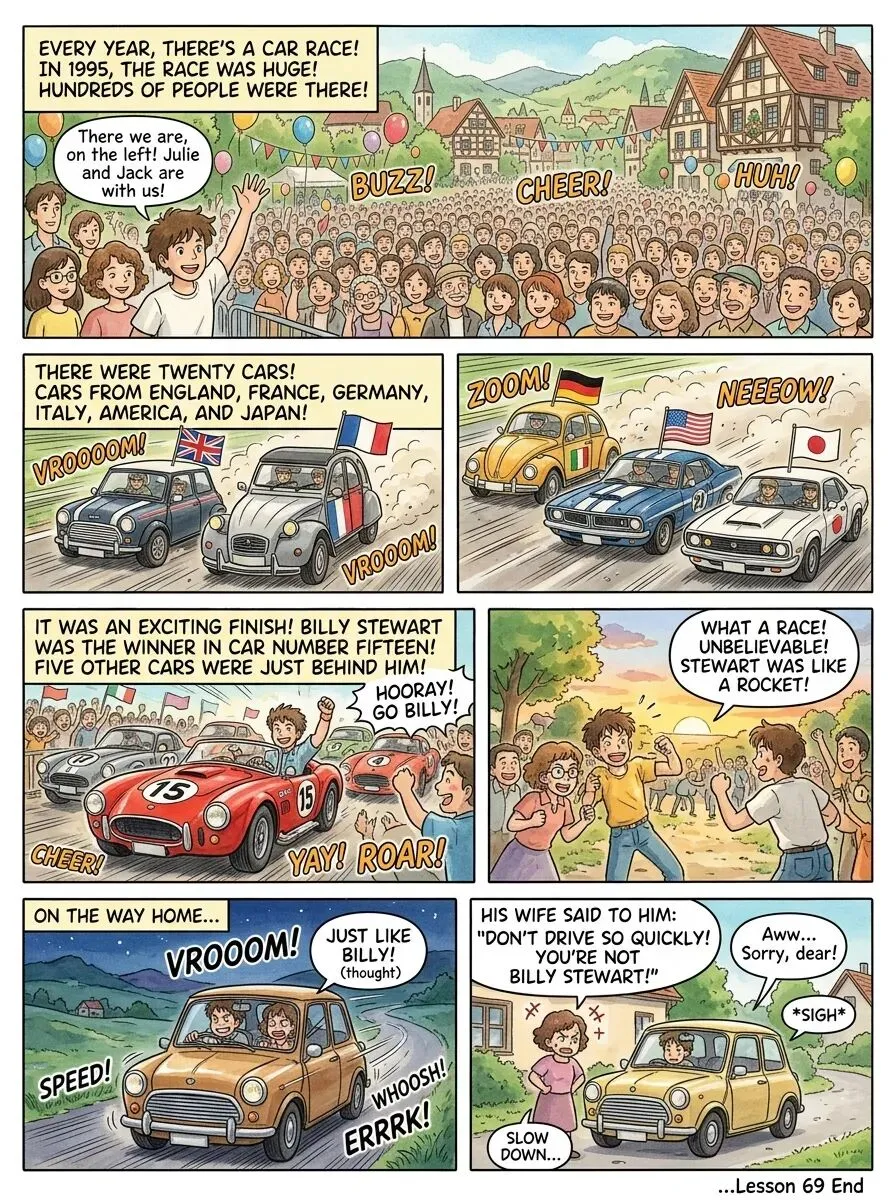
There is a car race near our town every year. In 1995, there was a very big race.
There were hundreds of people there. My wife and I were at the race. Our friends, Julie and Jack were there, too. You can see us in the crowd. We are standing on the left.
There were twenty cars in the race. There were English cars, French cars, German cars, Italian cars, American cars and Japanese cars.
It was an exciting finish. The winner was Billy Stewart. He was in car number fifteen. Five other cars were just behind him.
On the way home, my wife said to me, 'Don't drive so quickly! You're not Billy Stewart!'
Lesson 70
📜 课文原文
(Lesson 69 的问答练习,核心句型为:Where were you and your friends on + 日期? We were at/in... What were you doing? We were...)
例如:Where were you and Susan on January 1st? We were in Australia. What were you doing? We were travelling by plane.
📜 语音标注
- car race /ˈkɑː ˈreɪs/:注意car中的长元音/ɑː/与race中的双元音/eɪ/,两词间有轻微连读。
- hundreds of /ˈhʌndrədz əv/:hundreds词尾的/dz/与of的弱读形式/əv/自然连读。
- were at the /wər ət ðə/:were常弱读为/wər/,at与the均弱读,整体语流轻快。
- exciting finish /ɪkˈsaɪtɪŋ ˈfɪnɪʃ/:exciting词尾的/ŋ/与finish的开头/f/形成鼻音后接摩擦音的过渡。
- On the way home /ɒn ðə ˈweɪ ˈhəʊm/:on the连读为/ɒn ðə/,way home两个重读单词清晰。
- Don't drive so quickly! /dəʊnt ˈdraɪv səʊ ˈkwɪkli/:Don't的爆破音/t/在drive的/d/前失去爆破,so quickly中副词重读,表达强烈情绪。
情景说明:本课描述了一个回忆中的场景:叙述者(第一人称“我”)和他的妻子以及朋友茱莉、杰克,在1995年前往靠近他们城镇的年度汽车比赛现场观赛。课文前半部分(Lesson 69)以叙述形式重现了当时的盛大场面:人山人海(crowd),各国赛车云集,以及激动人心的冲刺结局——比利·斯图尔特获胜。课文最后巧妙地转向了赛后回家的路上,妻子对沉浸在比赛兴奋中、开车过快的“我”发出幽默的警告,将赛场激情与现实安全连接起来,充满了生活趣味。Lesson 70则通过问答形式,对这一语法结构(过去进行时)在不同日期、地点和活动上进行大量操练。
参考译文:
第69课 (汽车比赛)
在我们镇附近每年都有一场汽车比赛。1995年举行了一次盛大的比赛。
那里有成千上万的人。我和我的妻子也去了比赛。我们的朋友朱莉和杰克也去了。你可以在人群中看到我们。我们站在左边。
有二十辆汽车参赛。有英国车、法国车、德国车、意大利车、美国车和日本车。
比赛的结尾是激动人心的。获胜者是比利·斯图尔特。他在第15号车里。另外五辆车紧跟在他后面。
在回家的路上,我妻子对我说:“别开得这么快!你又不是比利·斯图尔特!”
第70课 (略,为第69课的问答练习)
🔍 第二部分:逐句精讲与词块总结
句子1
原文: There is a car race near our town every year.
翻译: 在我们镇附近每年都有一场汽车比赛。
句子结构: “There be”句型(存在句)。There是形式主语,is是系动词,a car race是真正的主语,near our town和every year分别是地点状语和时间状语。
重点词汇:
race 蓝思值 600L
英音[reɪs] 美音[reɪs] 词性:n. 比赛;竞赛;种族 v. 参赛;疾走;快速运转
释义:n. (速度)比赛,竞赛。
常用语块:a car/boat/horse race 汽车/划船/赛马比赛;win/lose a race 赢得/输掉比赛
例句一:The Formula One race attracts millions of fans worldwide. 一级方程式赛车吸引了全世界数百万车迷。
例句二:They are training hard for the swimming race next month. 他们正在为下个月的游泳比赛刻苦训练。
拓展:词根词缀:可能与古北欧语“rás”(跑步)有关。记忆窍门:把“race car”(赛车)倒过来就是“car race”。文化小知识:“Grand Prix”(大奖赛)常指顶级汽车赛事。
near 蓝思值 400L
英音[nɪə(r)] 美音[nɪr] 词性:prep. 在...附近 adj. 近的;亲近的 adv. 几乎;临近
释义:prep. 在...附近。
常用语块:near the window/school 在窗户/学校附近;live near me 住在我附近
例句一:Is there a supermarket near here? 这附近有超市吗?
例句二:My birthday is near, and I'm very excited. 我的生日快到了,我很兴奋。
拓展:常见搭配:near future 不久的将来;near and dear 亲近的。易错点:near作介词时直接接地点,nearly是副词,意为“几乎”。
语法点睛: 本句使用“There is...”的一般现在时结构,表述一个客观、规律性存在的事实(每年都有)。这与课文中后续“In 1995, there was...”的一般过去时形成鲜明对比,后者描述一次具体的、已发生的事件。这种时态对比清晰地划定了普遍规律与特定事件的界限。[来源 NCE知识点笔记:关于there be句型的一般现在时与一般过去时对比]
语音要点: There is a 常连读为 /ðeər ɪz ə/,语速快时甚至像 /ðeər ə/。car race 两个词都重读,强调核心事件。
句子2
原文: In 1995, there was a very big race.
翻译: 1995年举行了一次盛大的比赛。
句子结构: “There be”句型(存在句)的一般过去时。In 1995是时间状语,there是形式主语,was是系动词的过去式,a very big race是真正的主语。
重点词汇:
was 蓝思值 BR L
英音[wɒz] 美音[wʌz] 词性:v. be动词的过去式(第一、三人称单数)
释义:是(过去式)。
常用语块:I was, he was, she was, it was
例句一:I was at home yesterday evening. 昨晚我在家。
例句二:It was sunny last weekend. 上个周末天气晴朗。
拓展:was是am和is的过去式。其否定式为was not或wasn't。疑问句需将其提前:Was he happy?
语法点睛: 这是“There be”句型从一般现在时(There is)切换到一般过去时(There was)的关键句。In 1995这个明确的时间状语提示我们必须使用过去时态来描述那个特定年份发生的事件。这是英语叙事中建立时间背景的基础手法。[来源 NCE知识点笔记:there be句型在过去时的应用]
语音要点: In 1995中,In弱读为/ɪn/,1995读作/nainˈti:n ˈnaɪnti faɪv/,重音在ninety和five上。there was a连读为/ðeə wɒz ə/。
句子3
原文: There were hundreds of people there.
翻译: 那里有成千上万的人。
句子结构: “There be”句型(存在句)的一般过去时,主语为复数。There是形式主语,were是系动词的过去式(复数),hundreds of people是真正的主语,第二个there是地点副词,作状语。
重点词汇:
hundreds of 蓝思值 500L
英音[ˈhʌndrədz əv] 美音[ˈhʌndrədz əv] 词性:短语
释义:数以百计的,成百上千的。
常用语块:hundreds of students/books/cars 数百名学生/书/汽车
例句一:Hundreds of birds flew across the sky at sunset. 日落时分,数百只鸟儿飞过天空。
例句二:The charity received hundreds of letters of support. 该慈善机构收到了数百封支持信。
拓展:类似结构:thousands of (数千),millions of (数百万)。注意:具体数字时不加s和of,如two hundred people。
people 蓝思值 BR L
英音[ˈpiːpl] 美音[ˈpiːpl] 词性:n. 人,人们;人民;民族
释义:n. 人,人们(集体名词,本身为复数)。
常用语块:many/some/a few people 许多/一些/几个人;young people 年轻人
例句一:Most people enjoy listening to music. 大多数人喜欢听音乐。
例句二:The Chinese people are hard-working and friendly. 中国人民勤劳友好。
拓展:易错点:people是复数名词,谓语动词用复数。一个“人”用a person。peoples指多个民族。
语法点睛: 主语hundreds of people是复数概念,因此there be句型中的be动词必须使用复数过去式were。这巩固了主谓一致的原则在存在句中的应用。hundreds of是模糊数量词,用于渲染规模宏大、人数众多的场景,是描述大型活动的常用表达。[来源 名师精讲:there be句型的主谓一致]
语音要点: There were 连读为 /ðeə wə/,people there 中 people 词尾的/l/与there的开头/ð/形成舌侧音向齿擦音的过渡。
句子4
原文: My wife and I were at the race.
翻译: 我和我的妻子也去了比赛。
句子结构: 主系表结构。My wife and I是并列主语,were是系动词的过去式(复数),at the race是介词短语作表语。
重点词汇:
wife 蓝思值 BR L
英音[waɪf] 美音[waɪf] 词性:n. 妻子
释义:n. 妻子。
常用语块:his/her wife 他的/她的妻子;husband and wife 夫妻
例句一:He introduced his wife to us at the party. 他在聚会上向我们介绍了他的妻子。
例句二:They have been husband and wife for thirty years. 他们做夫妻三十年了。
拓展:复数形式为wives。对应词:husband(丈夫)。
at 蓝思值 BR L
英音[æt] 美音[æt] 词性:prep. 在(某处、某时间点、某种状态)
释义:prep. 在(某事件或活动场所)。
常用语块:at the party/school/concert 在派对/学校/音乐会;at 5 o'clock 在五点
例句一:We met at the airport. 我们在机场见面。
例句二:She is good at singing. 她擅长唱歌。
拓展:at用于较小的地点或具体活动点,in用于较大的范围或空间内部。如at the cinema(在电影院这个地方),in the cinema(在电影院建筑里面)。
语法点睛: 本句明确了叙述者及其妻子的位置——“在比赛现场”。My wife and I作为复合主语,英语习惯将I放在最后以示礼貌,谓语动词用复数were。at the race中的at精准地表达了“身处某项活动或事件发生地”的概念。[来源 NCE知识点笔记:介词at表示“在...场合”]
语音要点: My wife and I 中 wife 和 and 连读为 /waɪf ən/,and I 连读为 /ənd aɪ/ 或 /ən aɪ/。at the 弱读为 /ət ðə/。
句子5
原文: Our friends, Julie and Jack were there, too.
翻译: 我们的朋友朱莉和杰克也去了。
句子结构: 主系表结构。Our friends是主语,Julie and Jack是主语的同位语,were是系动词,there是地点副词作表语,too是副词作状语。
重点词汇:
friends 蓝思值 BR L
英音[frendz] 美音[frɛndz] 词性:n. 朋友们(friend的复数)
释义:n. 朋友们。
常用语块:good/close/best friends 好朋友/亲密朋友/最好的朋友;make friends with 与...交朋友
例句一:We've been friends since childhood. 我们从童年起就是朋友。
例句二:It's important to have friends to share happiness and sorrow. 有朋友分享快乐和忧愁很重要。
拓展:friend的形容词是friendly(友好的)。谚语:A friend in need is a friend indeed.(患难见真情。)
语法点睛: 句子通过同位语Julie and Jack对主语Our friends进行了具体说明,使人物更加清晰。too放在句末,表示“也”,用于肯定句,增添了信息的叠加感,进一步烘托出“熟人齐聚”的热闹氛围。[来源 语法新思维:同位语及too的用法]
语音要点: Our friends 中 our 有时弱读为 /ɑː/ 或 /ər/。were there 连读为 /wə ðeə/。too 发音清晰,语调可略微上扬。
句子6
原文: You can see us in the crowd.
翻译: 你可以在人群中看到我们。
句子结构: 主谓宾结构。You是主语,can see是情态动词+谓语动词,us是宾语,in the crowd是介词短语作地点状语。
重点词汇:
crowd 蓝思值 700L
英音[kraʊd] 美音[kraʊd] 词性:n. 人群;群众;一伙人 v. 拥挤;聚集
释义:n. 人群。
常用语块:a big/large crowd 一大群人;in the crowd 在人群中;crowds of people 成群的人
例句一:A crowd gathered around the street performer. 一群人围住了街头表演者。
例句二:We got separated in the crowd at the concert. 我们在音乐会上的人群中走散了。
拓展:动词用法:People crowded into the stadium. 人们涌入体育场。形容词:crowded(拥挤的)。
us 蓝思值 BR L
英音[ʌs] 美音[ʌs] 词性:pron. 我们(we的宾格)
释义:pron. 我们(宾语)。
常用语块:see/tell/help us 看见/告诉/帮助我们;with us 和我们一起
例句一:They invited us to their wedding. 他们邀请我们参加婚礼。
例句二:Could you pass the salt to us, please? 你能把盐递给我们吗?
拓展:主格we,宾格us,形容词性物主代词our,名词性物主代词ours。
语法点睛: 本句突然从纯粹的过去叙事转向与读者的直接互动(“You can see...”),使用了一般现在时,仿佛在指着一张当时的照片向读者讲解。这种时态切换创造了生动的临场感。in the crowd准确地描述了在密集人群中的状态。[来源 名师精讲:现在时在叙事中创造临场感]
语音要点: can see 中 can 常弱读为 /kən/。us in the 可以连读为 /ʌs ɪn ðə/,in the弱读。
句子7
原文: We are standing on the left.
翻译: 我们站在左边。
句子结构: 主谓结构(现在进行时)。We是主语,are standing是现在进行时的谓语,on the left是介词短语作地点状语。
重点词汇:
standing 蓝思值 400L
英音[ˈstændɪŋ] 美音[ˈstændɪŋ] 词性:v. stand的现在分词/动名词 n. 地位;立场
释义:v. 站立(stand的-ing形式)。
常用语块:be standing 正站着;standing room 站位
例句一:They were standing in line for tickets. 他们当时正排队买票。
例句二:I'm tired of standing all day. 我厌倦了整天站着。
拓展:动词原形stand。过去式stood。短语:stand up(起立),stand for(代表)。
left 蓝思值 BR L
英音[left] 美音[lɛft] 词性:n. 左边 adj. 左边的 adv. 向左 v. leave的过去式
释义:n. 左边,左侧。
常用语块:on/to the left 在/向左边;turn left 向左转
例句一:In Britain, people drive on the left. 在英国,人们靠左行驶。
例句二:My house is the second one on the left. 我的房子是左边第二栋。
拓展:反义词:right(右边)。政治术语:the Left(左翼)。
语法点睛: 这句继续使用现在时(现在是进行时are standing),进一步加强了“看图说话”的即时感。它描述了在照片定格的那一瞬间,“我们”所处的具体方位。on the left是描述相对位置的常用短语。[来源 NCE知识点笔记:方位介词on表示“在...一侧”]
语音要点: We are 常缩写并连读为 /wiːə/ 或 /wɪə/。standing on 连读为 /ˈstændɪŋ ɒn/,注意standing的/ŋ/音。
句子8
原文: There were twenty cars in the race.
翻译: 有二十辆汽车参赛。
句子结构: “There be”句型(存在句)的一般过去时。There是形式主语,were是系动词(复数),twenty cars是真正的主语,in the race是介词短语作状语。
语法点睛: 再次使用There were来列举比赛中的具体元素——赛车的数量。数字twenty明确了比赛的规模。in the race意为“在比赛中”,指作为参与者置身于赛事之内。[来源 NCE知识点笔记:介词in表示“在...活动中”]
语音要点: twenty cars 中 twenty 重音在第一音节/ˈtwenti/,cars 发音清晰。
句子9
原文: There were English cars, French cars, German cars, Italian cars, American cars and Japanese cars.
翻译: 有英国车、法国车、德国车、意大利车、美国车和日本车。
句子结构: “There be”句型(存在句)的一般过去时,主语为一系列并列的名词短语。There是形式主语,were是系动词,后面是所有并列的真正主语。
重点词汇:
English/French/German/Italian/American/Japanese 蓝思值 300-500L
这些均为表示国籍或产地的形容词,首字母大写。它们在句中修饰cars,意为“...国的汽车”。
拓展:这些形容词对应的国家名分别为:England/ Britain, France, Germany, Italy, America/the USA, Japan。注意German的复数是Germans,而Japanese单复数同形。
语法点睛: 这是一个经典的There were句型用于罗列多项事物的例子。通过并列连词and连接最后一个项目,清晰地展现了比赛的国际化程度。这些国别形容词作定语,直接放在名词cars前,是形容词最基本的用法。[来源 语法新思维:形容词作定语及国家形容词]
语音要点: 朗读这一长串列举时,注意节奏感,每个国别形容词都需清晰读出,and前的语调稍升,Japanese cars语调下降,表示列举结束。English cars等词组内部有连读。
句子10
原文: It was an exciting finish.
翻译: 比赛的结尾是激动人心的。
句子结构: 主系表结构。It是主语(指代比赛的最后阶段),was是系动词的过去式,an exciting finish是名词短语作表语。
重点词汇:
exciting 蓝思值 600L
英音[ɪkˈsaɪtɪŋ] 美音[ɪkˈsaɪtɪŋ] 词性:adj. 令人兴奋的,使人激动的
释义:adj. 令人兴奋的。
常用语块:an exciting game/movie/journey 一场激动人心的比赛/电影/旅程
例句一:The football match had an exciting finish. 这场足球赛有一个激动人心的结尾。
例句二:Reading an exciting book makes time fly. 读一本引人入胜的书会让时间飞逝。
拓展:动词形式:excite(使兴奋)。形容人感到兴奋用excited(I am excited.)。-ing形容词描述事物特性,-ed形容词描述人的感受。
finish 蓝思值 700L
英音[ˈfɪnɪʃ] 美音[ˈfɪnɪʃ] 词性:n. 结束;终点;最后阶段 v. 完成
释义:n. 结尾,最后阶段(尤指比赛)。
常用语块:a close/exciting finish 势均力敌/激动人心的结局;from start to finish 从头到尾
例句一:The marathon runners were exhausted at the finish. 马拉松选手们在终点筋疲力尽。
例句二:Let's stay until the finish of the concert. 我们待到音乐会结束吧。
拓展:动词用法:Have you finished your homework? 你做完作业了吗?反义词:start(开始)。
语法点睛: It在这里是代词,指代上文提到的“比赛的最后时刻或冲刺阶段”。使用an exciting finish这样的“形容词+名词”结构,是对事件高潮部分进行定性描述,是叙事中表达评价的常用方式。[来源 名师精讲:代词it指代前文及形容词修饰名词]
语音要点: It was an 连读为 /ɪt wɒz ən/。exciting finish 两个单词都重读,传达兴奋感。
句子11
原文: The winner was Billy Stewart.
翻译: 获胜者是比利·斯图尔特。
句子结构: 主系表结构。The winner是主语,was是系动词的过去式,Billy Stewart是专有名词作表语。
重点词汇:
winner 蓝思值 500L
英音[ˈwɪnə(r)] 美音[ˈwɪnɚ] 词性:n. 获胜者,赢家
释义:n. 胜利者,第一名。
常用语块:the winner of the competition 比赛的获胜者;a born winner 天生的赢家
例句一:The winner of the singing contest will get a recording contract. 歌唱比赛的获胜者将获得一份唱片合约。
例句二:In life, we are not always winners, but we should never give up. 在生活中,我们并非总是赢家,但我们绝不应放弃。
拓展:动词形式:win(赢得)。反义词:loser(失败者)。
语法点睛: 这是一个典型的“A is B”识别句型在过去时的应用,用于揭晓比赛结果。定冠词The特指“这场比赛”的获胜者。[来源 NCE知识点笔记:系表结构表示身份]
语音要点: The winner 中 the 在元音前读 /ðiː/。Billy Stewart 作为人名,需清晰读出。
句子12
原文: He was in car number fifteen.
翻译: 他在第15号车里。
句子结构: 主系表结构。He是主语,was是系动词,in car number fifteen是介词短语作表语。
重点词汇:
number 蓝思值 400L
英音[ˈnʌmbə(r)] 美音[ˈnʌmbɚ] 词性:n. 数字;号码;数量 v. 编号;总计
释义:n. 号码,编号。
常用语块:room number 房间号;phone number 电话号码;car number 车号
例句一:What's your seat number on the plane? 你飞机上的座位号是多少?
例句二:Please dial the number carefully. 请仔细拨号。
拓展:缩写:No. 或 no.。a number of 表示“一些”,后接复数名词和动词。
语法点睛: in car number fifteen 是一个固定的表达方式,表示“在编号为十五的车里”。介词in在这里表示“在...容器/交通工具内部”。注意英语中编号的表达:Number + 数字 或 No. + 数字。[来源 NCE知识点笔记:介词in表示“在...内部”及编号表达]
语音要点: car number 连读为 /ˈkɑː ˈnʌmbə/。fifteen 读作 /ˌfɪfˈtiːn/。
句子13
原文: Five other cars were just behind him.
翻译: 另外五辆车紧跟在他后面。
句子结构: 主系表结构。Five other cars是主语,were是系动词,just behind him是介词短语作表语。
重点词汇:
other 蓝思值 400L
英音[ˈʌðə(r)] 美音[ˈʌðɚ] 词性:adj. 其他的,另外的 pron. 另一个(人/物)
释义:adj. 其他的,另外的。
常用语块:other people/things/days 其他人/事/日子;the other side 另一面
例句一:Some students like music, and other students prefer sports. 一些学生喜欢音乐,另一些学生更喜欢运动。
例句二:Do you have any other questions? 你还有其他问题吗?
拓展:the other 指两者中的另一个;others 是代词,指“其他人/物”;another 指三者或以上中的“另一个”。
behind 蓝思值 400L
英音[bɪˈhaɪnd] 美音[bɪˈhaɪnd] 词性:prep. 在...后面;落后于 adv. 在后面 n. 屁股
释义:prep. 在...后面(位置)。
常用语块:behind the house 在房子后面;fall behind 落后
例句一:The sun disappeared behind the clouds. 太阳消失在云层后面。
例句二:In the race, Tom was soon behind the others. 比赛中,汤姆很快就落在别人后面了。
拓展:反义词:in front of(在...前面)。既可表空间,也可表时间(behind schedule 晚点)或进度(落后)。
him 蓝思值 BR L
英音[hɪm] 美音[hɪm] 词性:pron. 他(he的宾格)
释义:pron. 他(宾语)。
常用语块:see/tell/help him 看见/告诉/帮助他;with him 和他一起
例句一:I gave the book to him yesterday. 我昨天把书给了他。
例句二:Everybody likes him because he is kind. 每个人都喜欢他,因为他很善良。
拓展:主格he,宾格him,形容词性物主代词his,名词性物主代词his。
语法点睛: 本句描述了激烈的竞争场面——获胜者并非遥遥领先。other用在数字后,表示“除此之外的...”,five other cars即“另外五辆车”。just这个副词修饰behind,强调了“紧随其后、差距微小”的状态,生动刻画了冲刺时刻的紧张感。[来源 语法新思维:other的用法及副词修饰介词短语]
语音要点: Five other 连读为 /ˈfaɪv ˈʌðə/。behind him 连读为 /bɪˈhaɪnd hɪm/,注意/h/音。
句子14
原文: On the way home, my wife said to me, 'Don't drive so quickly! You're not Billy Stewart!'
翻译: 在回家的路上,我妻子对我说:“别开得这么快!你又不是比利·斯图尔特!”
句子结构: 主句是my wife said to me,后接直接引语。On the way home是时间状语。直接引语包含两个句子:第一个是祈使句否定式Don't drive so quickly!,第二个是主系表结构的否定句You're not Billy Stewart!。
重点词汇:
way 蓝思值 400L
英音[weɪ] 美音[we] 词性:n. 路;方式;方向 adv. (美式俚语)非常
释义:n. 路,路途。
常用语块:on the/one's way to 在去...的路上;ask the way 问路;in this way 用这种方法
例句一:I met an old friend on my way to work. 我在上班路上遇到了一位老朋友。
例句二:Could you tell me the way to the nearest post office? 你能告诉我去最近的邮局的路吗?
拓展:on the way home是一个固定搭配,home在这里是副词,前面不加to。类似的还有on the way here/there。
home 蓝思值 BR L
英音[həʊm] 美音[hoʊm] 词性:n. 家;故乡 adv. 到家;在家 adj. 家庭的;主场的
释义:adv. 到家,回家。
常用语块:go/come/walk home 回家;on the way home 在回家路上
例句一:What time do you usually get home? 你通常几点到家?
例句二:I stayed home and watched TV last night. 我昨晚呆在家里看电视。
拓展:at home 表示“在家(的状态)”。home作名词:I love my home.(我爱我家。)
said 蓝思值 BR L
英音[sed] 美音[sɛd] 词性:v. say的过去式和过去分词
释义:v. 说(过去式)。
常用语块:said to sb. 对某人说;it is said that 据说
例句一:He said hello to me when we met. 我们见面时他向我问好。
例句二:What did you say just now? 你刚才说什么?
拓展:动词原形say,过去式said,过去分词said。注意搭配:say something to somebody。
drive 蓝思值 500L
英音[draɪv] 美音[draɪv] 词性:v. 驾驶;驱动;迫使 n. 驾车旅行;驱动器
释义:v. 驾驶(车辆)。
常用语块:drive a car/bus/truck 开小汽车/公交车/卡车;drive carefully/slowly 小心/慢点开
例句一:My father drives to work every day. 我爸爸每天开车上班。
例句二:Can you teach me how to drive? 你能教我开车吗?
拓展:名词:driver(司机)。过去式drove,过去分词driven。
quickly 蓝思值 500L
英音[ˈkwɪkli] 美音[ˈkwɪkli] 词性:adv. 迅速地,很快地
释义:adv. 快速地。
常用语块:walk/eat/answer quickly 走得/吃得/回答得快
例句一:Time passes quickly when you are having fun. 当你玩得开心时,时间过得飞快。
例句二:Please come here quickly! 请快点过来!
拓展:形容词形式:quick(快的)。同义词:fast, rapidly。注意fast既可作形容词也可作副词。
语法点睛: 这是本课的画龙点睛之笔。On the way home是极其地道的表达。直接引语部分:Don't drive so quickly! 是祈使句的否定形式,用于发出强烈的命令或警告。You're not Billy Stewart! 是用一般现在时表达的永恒真理(事实否定),带有幽默和调侃的语气,将赛场的激情与现实的安全驾驶准则巧妙对比,体现了典型的英式幽默。[来源 NCE知识点笔记:祈使句否定式及on the way home搭配;名师精讲:直接引语与现在时表事实]
语音要点: On the way home 作为一个意群,需流畅读出。直接引语部分,Don't drive so quickly! 语调急促下降,表现警告;You're not Billy Stewart! 中not重读,语调可带调侃。
📌 核心词块总结
1. car race -- a competition between cars to see which is the fastest.
Example: The annual car race through the city streets is a major event.
2. hundreds of -- a very large but indefinite number (between 200 and 999).
Example: Hundreds of fans waited outside the stadium to see the star.
3. in the crowd -- among a large group of people gathered together.
Example: I spotted a familiar face in the crowd at the concert.
4. on the left -- located at the left side.
Example: In the photo, the library is on the left and the museum is on the right.
5. exciting finish -- the final part of a competition that causes great excitement.
Example: The basketball game had an exciting finish, with the winning shot at the last second.
6. on the way home -- during the journey back to one's house.
Example: Let's stop at the supermarket on the way home.
💬 第三部分:基础会话技巧
1. 分析课文中的日常用语、礼貌表达、问答模式
-描述过去事件模式:课文主体采用“There was/were...”、“...were at/in...”等存在句和主系表结构,客观陈述过去事件的背景、地点和参与者。这是一种清晰、直接的叙事模式。
-现场指认模式:“You can see us... We are standing...” 这种从过去叙事中跳脱出来,用现在时与听众/读者互动,指向具体视觉证据(如照片)的模式,极具现场感和说服力,常用于分享回忆、讲解图片。
-幽默警告模式:课文结尾的“‘Don't drive so quickly! You're not Billy Stewart!’” 是日常生活中典型的、带有亲密关系的劝阻用语。它用事实对比(你不是专业赛车手)来强化劝诫的理由,语气直接但不失风趣。
-问答模式(L70):Lesson 70 固化了一种询问过去经历的双问题模式:1)Where were you...?(询问地点) → 2)What were you doing? (询问当时的具体活动)。这是深入了解他人过去某时刻经历的完整对话链条。
2. 提供类似场景的扩展对话示例
(Scene: Two friends looking at an old photo album)
A: Wow, this photo is from the school sports day in 2010!
B: Yeah, I remember! There were so many people on the playground.
A: Look! You can see us in this picture. We are sitting near the finish line.
B: Oh right! And there was a very exciting race. The winner was Tom from Class 3.
A: Ha! On the way home that day, my mum said to me, “Don't run everywhere! You're not Tom!”
B: Haha, parents always say things like that!
3. 设计简单的角色扮演活动建议
- 活动1:照片解说员
- 学生A手持一张包含多人活动的图片(可以是真实的照片或杂志剪报)。
- 学生A扮演解说员,用“There were...”, “You can see...”, “He/She is V-ing...”等句型向学生B描述图片中的场景和人物活动。
- 学生B可以提问,如“Where were they?”, “What was he doing?”
- 活动2:赛后采访
- 学生A扮演刚刚看完一场精彩比赛(足球、篮球、赛车等)的观众。
- 学生B扮演电视台记者,在“现场”进行采访。
- 记者B用“Where were you just now?”, “What was exciting?”, “Who was the winner?”提问。
- 观众A用课文中的句式描述现场情况。
- 最后,观众A可以模仿课文,说一句同伴或家人对他/她说过的幽默警告,如“My friend said, 'Don't shout so loudly! You're not the coach!'”
4. 融入基础思考:设计1-2个简单的代入式问题
- 问题1: 如果你在现场观看了1995年的那场比赛,除了课文描述的,你觉得还可能听到或闻到什么?(引导学生调动多感官想象场景,如引擎的轰鸣声、人群的欢呼声、汽油味、爆米花香等。)
- 问题2: 为什么妻子要说“You're not Billy Stewart!”而不是直接说“Drive slowly!”?你觉得哪种说法在提醒家人时可能更有效?(引导学生思考幽默、对比在沟通中的作用,以及亲密关系间的表达方式。)
📐 第四部分:本课语法精析(加强版)
本部分聚焦于核心语法点——过去进行时 (Past Continuous Tense),并结合相关知识库资料进行深度解析。
1. 过去进行时的构成与核心意义
构成:主语 +was/were+ 动词的现在分词 (V-ing)。
- was 用于第一人称单数 (I) 和第三人称单数 (he, she, it)。
- were 用于第二人称单数/复数 (you)、第一人称复数 (we) 和第三人称复数 (they)。
核心意义:表示在过去某一特定时刻或某一段较短时间内正在发生或持续进行的动作。这个“过去时刻”通常由时间状语(如then, at that time, at 5 o'clock yesterday)或另一个发生在过去的短暂动作(用一般过去时表示)来指明。[来源 语法新思维 第1册,P78-82;NCE知识点笔记 L69 N15]
例句(不少于10个):
① Iwas watchingTV at 8 o'clock last night. (昨晚八点我正在看电视。)
② Theywere havingdinner when I called. (我打电话时,他们正在吃晚饭。)
③ Itwas rainingheavily when we left home. (我们离开家时,正下着大雨。)
④ Whatwereyoudoingwhen the teacher came in? (老师进来时,你正在干什么?)
⑤ Shewasn't listeningto the radio; shewas readinga book. (她没在听收音机,她在看书。)
⑥Wereyousleepingat noon yesterday? (昨天中午你在睡觉吗?)
⑦ While my motherwas cooking, Iwas settingthe table. (妈妈做饭时,我正在摆餐具。)
⑧ The studentswere writingtheir compositions from 2 pm to 3 pm. (学生们从下午两点到三点一直在写作文。)
⑨ Hewas drivingto work at that time. (那时他正在开车去上班。)
⑩ Wewere standing on the left in the photo. (照片里我们正站在左边。)
2. 过去进行时与一般过去时的初步区分
这是本课的难点,也是未来学习的重点。两者的根本区别在于看待动作的角度不同。
-一般过去时:表示动作发生在过去,且已经完成。它侧重于陈述一个单纯的过去事实。
-例句:Iwatcheda movie last night. (我昨晚看了一场电影。) —— 电影看完了。
-课文例句:Therewasa big race. (有过一场大赛。) —— 比赛已发生并结束。
-过去进行时:表示在过去某个时间点,动作正在进行、尚未完成。它侧重于描绘过去某个时刻的动态画面或背景。
-例句:Iwas watchinga movie at 8 last night. (昨晚八点我正在看电影。) —— 八点时,电影正在看,还没看完。
-课文例句:Weare standingon the left. (我们正站在左边。) —— 在照片定格的那一刻,“站”这个动作正在进行。
对比分析:
- “My wifesaidto me...” (一般过去时) —— “说”这个动作在当时发生了,是一个完成的引语行为。
- “‘Don't drive so quickly!’” (直接引语内的内容) —— 如果改为间接引语并强调背景,可能会用:“My wife told me not to drive so quicklywhile we were drivinghome.” (过去进行时were driving描述“告诫”发生时正在进行的背景动作)。
当两个过去动作同时发生,且其中一个(较长或作为背景)正在持续,另一个(较短)突然介入时,通常长的动作用过去进行时,短的动作用一般过去时。[来源 名师精讲笔记 第1册,P145-147;NCE知识点笔记 L69 N16-N18]
例句:
① Iwas readinga book when the phonerang. (电话响时,我正在看书。)
② While theywere playingfootball, itstartedto rain. (他们正在踢足球时,天下起雨来。)
③ Shewas walkingin the park when shemet an old friend. (她在公园散步时,遇到了一位老朋友。)
3. 动词现在分词(-ing形式)的构成规则复习与巩固
过去进行时的构成离不开动词的现在分词。其规则与现在进行时完全相同,需熟练掌握:
1. 一般情况,直接加-ing: do → doing, stand → standing, watch → watching, play → playing.
2. 以不发音的e结尾,去e加-ing: make → making, write → writing, drive → driving (课文词), have → having.
3. 以重读闭音节结尾,且末尾只有一个辅音字母,双写该辅音字母再加-ing: run → running (课文词), sit → sitting, swim → swimming, get → getting.
4. 少数以-ie结尾的动词,变ie为y再加-ing: lie → lying, die → dying, tie → tying.[来源 手绘版新概念语法笔记.pdf,P23;语法一学就会,P15]
4. There be 句型的一般过去时
本课大量使用了There was/were...结构来描述过去存在的场景,这是对第41-42课所学There is/are...的自然时态延伸。
- 单数主语用There was: There was a big race. / There was an exciting finish.
- 复数主语用There were: There were hundreds of people. / There were twenty cars.
注意事项: 主谓一致原则在過去時依然嚴格遵守。hundreds of, a number of 等短语后接复数名词,动词用were。[来源 NCE知识点笔记 L41-L44;同步语法强化 第1册,P33]
5. 练习题(不少于10道,附答案)
1.用所给动词的过去进行时形式填空。
① Yesterday afternoon, I __________ (study) in the library.
② At 10 o'clock last night, he __________ (not sleep). He __________ (play) computer games.
③ What __________ you __________ (do) when the earthquake happened?
④ They __________ (have) a picnic in the park when it began to rain.
⑤ While my dad __________ (fix) the car, my mum __________ (cook) lunch.
答案:① was studying ② wasn't sleeping; was playing ③ were; doing ④ were having ⑤ was fixing; was cooking
2.将下列句子改为一般过去时或过去进行时,使句意符合逻辑。
① I (watch) TV at 9 pm last Sunday. (强调那一刻在做的事)
② She (write) a letter to her pen pal yesterday evening. (强调完成了)
③ They (build) this bridge in 1998. (强调建造完成于1998年)
④ We (walk) along the river when we saw a beautiful bird. (walk是背景动作)
答案:① was watching ② wrote ③ built ④ were walking
3.根据中文提示,用There was/were完成句子。
① 去年我们镇上__________(有一场大火)。
② 昨天的派对上__________(有很多食物和饮料)。
③ 书架顶上__________(有一层厚厚的灰尘)。
④ 1995年__________(有二十辆车在比赛中)。
答案:① There was a big fire in our town last year. ② There was a lot of food and drink at the party yesterday. ③ There was a thick layer of dust on top of the bookshelf. ④ There were twenty cars in the race in 1995.
4.综合选择题。
( ) --- What ______ at that time?
--- I ______ a shower.
A. did you do; was having B. were you doing; was having C. did you do; had D. were you doing; had
( ) There ______ hundreds of people ______ in the square when we arrived.
A. was; dancing B. were; danced C. were; dancing D. was; to dance
( ) On ______ way ______, she told me an interesting story.
A. the; to home B. /; home C. the; home D. /; to home
答案: B; C; C
✏️ 第五部分:基础练习与活动
1. 跟读练习:
- 目标: 模仿课文录音的语音、语调、连读和节奏。
- 方法: 播放Lesson 69课文录音,学生逐句跟读。重点关注标注的语音要点部分。可先慢速跟读,再逐渐提速至正常语速。
- 扩展: 跟读Lesson 70的问答句,注意疑问句的升调和答句的降调。
2. 角色扮演与简单替换练习:
- 活动: “时光记者”
- 准备: 准备几张展现过去不同场景的图片(如:1980年代的街头、一场旧音乐会、一次家庭聚会)。
- 流程:
① 学生A(记者)拿起一张图片,向学生B(目击者/参与者)提问:“Where were you in this picture?” 学生B根据图片猜测一个地点回答:“I was at a concert/in my old house/on a street in Beijing.”
② 记者A继续问:“What were you (and other people) doing?” 学生B用过去进行时描述图片中人物的活动:“I was listening to music. Some people were dancing. Others were taking photos.”
③ 互换角色,用另一张图片练习。
- 替换核心: 替换时间(In 1990, Last summer...)、地点(at the beach, in the mountains...)、活动(were surfing, were hiking...)。
3. 听力理解题目:
(假设基于课文录音或类似对话)
听一段关于“上周日公园活动”的简短描述,回答下列问题。
听力文本(示例): Last Sunday, there were many people in Central Park. It was a sunny day. Some families were having picnics on the grass. Children were running and playing games. A group of old men were playing chess under a big tree. Near the lake, a woman was painting a picture. Everyone was enjoying themselves.
问题:
① Where were many people last Sunday?
② What were some families doing?
③ Who were playing chess?
④ What was the woman near the lake doing?
参考答案:
① They were in Central Park.
② They were having picnics on the grass.
③ A group of old men were playing chess.
④ She was painting a picture.
4. 课文改写版本(词汇更简单):
原句:There were hundreds of people there.
改写:Very many people were there. / A lot of people were there.
原句:It was an exciting finish.
改写:The end of the race was very exciting.
原句:Five other cars were just behind him.
改写:Five more cars were right after him.
原句:On the way home, my wife said to me...
改写:When we were going home, my wife told me...
(此练习旨在帮助学生用已掌握的更简单词汇理解句意,并看到同一意思的不同表达方式。)
🤔 第六部分:英文深度思考与拓展(强化版)
A. 层次化英文问题与答案
【层次一:事实性问题 (Factual Questions)】
1.Q:How often is there a car race near the narrator's town?
A:There is a car race near their town every year.
(来源: 《新概念英语第1册 (亚历山大 何其莘).docx》 Lesson 69 第一句)
2.Q:In which year does the story about the “very big race” take place?
A:The story takes place in 1995.
(来源: 同上,第二句)
3.Q:What number was on Billy Stewart's winning car?
A:Billy Stewart was in car number fifteen.
(来源: 同上,倒数第三段)
4.Q:According to Lesson 70, where were “you and Susan” on January 1st, and what were they doing?
A:They were in Australia, and they were travelling by plane.
(来源: 《官方教材之新概念英语学生用书 第1册.pdf》 Lesson 70 示例问答)
【层次二:推理性问题 (Inferential Questions)】
5.Q:Why does the narrator specifically mention the nationalities of the cars (English, French, German, etc.)?
A:By listing the nationalities, the narrator emphasizes the international scale and prestige of the race, suggesting it attracted participants and perhaps attention from around the world, which contributed to making it a “very big” event.
(来源: 结合《新概念英语教材解析 第1册.pdf》对课文细节作用的分析进行推理)
6.Q:What can we infer about the narrator's driving style on the way home from the wife's warning?
A:We can infer that the narrator was probably driving faster than usual, likely because he was still excited or influenced by the high-speed race he just watched, prompting his wife to remind him of safety.
(来源: 结合《新概念英语美文欣赏 第1册.pdf》中对人物行为和言语关联的分析进行推理)
7.Q:Looking at the structure of Lesson 70, what is the primary grammatical purpose of repeatedly asking “Where were you...?” and “What were you doing?”?
A:The primary purpose is to provide intensive, patterned drills for students to master the formation and usage of the Past Continuous Tense within a clear context of past time and location, automating the response pattern.
(来源: 《如何学习新概念.pdf》中指出利用高频问答模式培养语感;《官方教材之新概念英语练习详解 第1册.pdf》显示练习的设计意图)
8.Q:If “hundreds of people” were there, and the narrator says “You can see us in the crowd,” what does this imply about how the memory is being shared?
A:It strongly implies that the narrator is referring to a photograph or a video from that day. The shift to present tense (“can see”, “are standing”) acts as a verbal pointer, making the listener imagine looking at visual evidence, which is a powerful way to share and authenticate a personal memory.
(来源: 《钻研《新概念英语》啃课文第1册.pdf》提倡通过画面感理解课文;《新概念英语之全新全绎 第1册.pdf》分析时态切换的修辞效果)
【层次三:评价性/创造性问题 (Evaluative/Creative Questions)】
9.Q:Imagine you are a news reporter at the 1995 race. Write two short sentences you might say for a live broadcast: one describing the scene using “There were...”, and one describing the winner's moment using the Past Continuous Tense.
A:(示例答案) “There were crowds cheering wildly along the track! And as he crossed the finish line, Billy Stewart was raising his arm in victory!”
(来源: 应用《新概念英语口语宝典 第1册.pdf》中“现场报道”场景的要素及本课核心句型)
10.Q:The wife's comment is humorous. Can you think of a similar humorous warning someone might give in a different situation? (e.g., after watching a cooking show, a football match, a dance competition)
A:(示例答案) After watching a MasterChef finale, a parent might say to a child making a sandwich: “Don't use so many ingredients! You're not a celebrity chef!” Or after a football match: “Don't kick the ball in the house! You're not the team captain!”
(来源: 融合《新概念英语写作全攻略》中关于模仿和创新句型的理念,以及《新概念英语名人名言诵典》中体现的幽默智慧)
11.Q:Compare describing an event with the Past Continuous Tense (“I was attending a concert”) versus the Simple Past (“I attended a concert”). Which description feels more vivid or immersive to you, and why?
A:The Past Continuous description feels more vivid and immersive to me. “I was attending a concert” paints a picture of me being in the middle of the experience—hearing the music, seeing the lights, feeling the crowd's energy at that specific past moment. “I attended a concert” simply states a completed fact; it's a diary entry, not a snapshot.
(来源: 《新概念英语语法新思维 第1册.pdf》对比时态的表意功能;《新概念英语pro 第1册.pdf》强调语言的形象化运用)
12.Q:“On the way home” is a very common and useful phrase. How would completing this phrase differently change the meaning? Think about: “on the way to school”, “on the way to the interview”, “on the way to recovery”.
A:Completing the phrase changes the focus to the destination and the purpose of the journey. “On the way to school” implies a routine, possibly with thoughts about classes. “On the way to the interview” carries tension and preparation. “On the way to recovery” is metaphorical, describing a process of getting better. The core idea remains: it's about the journey and what happensduringit toward a specific endpoint.
(来源: 《新概念英语句型步步高 第1册.pdf》系统归纳“on the way to”句型;《会说话的新概念英语单词.pdf》展示短语在不同语境下的应用)
B. 多类型拓展阅读
【类型1:现代场景故事 —— 直播时代的“过去进行时”】
Title: The Stream That Froze a Moment
Last year, during the city marathon, my friend Lisa wasn't just watching; she was live-streaming from the sidelines. In her video, you could hear her voice saying, “There are thousands of runners here! The lead runner is passing by right now!” Later, when we re-watched the stream, it was like traveling back in time. We weren't just remembering the event; we were re-experiencing it through her past continuous commentary. “Look, here I am waving at the camera!” she said, pointing at herself on screen. The stream captured what shewas doingandwas seeingat every precise moment. It made me realize that our modern habit of recording life constantly is like creating endless examples of the Past Continuous Tense—each clip answers the question “What was happening then?”
***引导性问题:How does live-streaming or constant video recording relate to the grammatical concept of the Past Continuous Tense?
【类型2:文化背景小知识 —— 汽车拉力赛】
Title: More Than Just Speed: The World of Rally Racing
The “car race” in our lesson could be a rally, a popular form of motorsport. Unlike circuit races, rallies often take place on public or private roads closed for the event, sometimes near towns, just like the text says. In a rally, drivers and co-drivers race against the clock on varied terrain—dirt, gravel, snow—not just against each other on a track. The finish is often especially “exciting” because times are calculated precisely, and seconds can decide the winner. Famous rallies like the World Rally Championship (WRC) attract “hundreds of people” and feature cars from many manufacturers (Japanese, French, etc.). Understanding this adds depth to the课文: it wasn't just any race, but likely a challenging, community-attracting rally event.
***引导性问题:What are some differences between a rally race (as suggested in the text) and a Formula One circuit race?
【类型3:今昔对比 —— 观赛方式的变化】
Title: From Crowds to Screens: Watching Sports
In 1995, if you wanted to experience the “exciting finish” of a race, you had to be there “in the crowd,” like the narrator, or wait for highlights on TV news. The memory was personal and physical: where youwere standing, what youwere hearing. Today, while crowds still exist, many people watch sports digitally. They might be on their way home (on a train) while streaming a race live on their phone. They can comment in real-time: “He is overtaking now!” This shift means the Past Continuous Tense now describes not just physical presence (“I was watching at the track”) but also digital engagement (“I was watching the stream on my device”). The essence of describing an ongoing past action remains, but the context has vastly expanded.
***引导性问题:How has technology changed the typical “scene” that we might describe using the Past Continuous Tense about watching an event?
【类型4:新潮英语改写 —— 社交媒体帖子版】
Title: Throwback Thursday (#TBT) to 1995!
Crafting a social media post about the课文 event using modern lingo:
“#TBT to 1995! Remember that HUGE annual car race near our town? This was the year. 🇬🇧🇫🇷🇩🇪🇮🇹🇺🇸🇯🇵 cars all competing! (Swipe for pics!)
Pic 1: The CROWD. Hundreds of people! 👥
Pic 2: Found us! 👋 Wewere standingon the left. (Tagging friends!)
Pic 3: The EXCITING FINISH! Billy Stewart in car 15 FTW! 🏆 Just barely ahead!
The best part? After all that adrenaline, my wife's classic line on the drive back: ‘Babe, you're NOT Billy Stewart! 🚗💨 Slow down!' #Memories #CarRace #PastContinuous #GrammarInAction”
***引导性问题:How does converting the textbook story into a social media post change the tone and what details are highlighted?
【类型5:难度略高的拓展阅读 —— 引入时间状语从句】
Title: The Symphony of a Street Festival
As I was walking down Elm Street last Saturday, I became an observer of a vibrant past continuous scene. While a band was playing lively jazz music on the makeshift stage, children were dancing freely in the open space in front of it. Their parents, who were chatting in small groups, were occasionally glancing at them with smiles. At the same time, vendors were selling handmade crafts and delicious snacks from their colorful stalls. The air was filled with the smell of popcorn and the sound of laughter. I noticed an elderly couple sitting on a bench; they weren't talking much, but they were holding hands, seemingly enjoying the atmosphere as much as anyone. For those few hours, the entire street was a living painting where everyone was engaged in some pleasant activity, all happening simultaneously, creating a perfect symphony of community life.
***引导性问题:Identify three different pairs of actions in this passage that are happening at the same time, using ‘while', ‘as', or ‘at the same time'.
🌍 第七部分:日常应用延伸
1. 提供本课语言点在日常生活中的应用场景
-分享回忆与照片:这是最直接的应用。当你看老照片或视频时,可以向朋友描述:“Here, wewere havinga picnic. My brotherwas flyinga kite. Iwas tryingto eat a huge sandwich!” 这比只说“We had a picnic.”生动得多。
-解释过去的误会或状况:当需要说明过去某个时刻你为什么没接电话或回复信息时,可以用过去进行时提供背景:“Sorry, Iwas drivingwhen you called.” “Iwas attendinga meeting all morning, so I couldn't reply.”
-讲述故事或经历:在讲述一个有趣或惊险的经历时,用过去进行时描绘背景,用一般过去时叙述关键事件,能使故事更有层次感。“Iwas walkingalone in the park. Itwas gettingdark. Suddenly, Ihearda strange noise...”
-描述梦境:描述梦境时,因为梦中的场景往往是正在进行的画面,过去进行时非常适用:“Last night, I dreamed Iwas flyingover the ocean. Birdswere singingaround me.”
-来源依据: 《新概念英语口语宝典 第1册.pdf》中“讲述经历(Telling Experiences)”和“打电话解释(Explaining on the Phone)”等场景;《新概念英语写作全攻略》中关于叙事技巧的章节。
2. 建议简单拓展学习材料
- 音频: 反复精听《新概念英语》Lesson 69-70的官方录音,注意叙述部分和对话部分不同的语速、语调。可尝试“听写”关键句子。
- 视频: 在视频平台搜索短小的、无旁白的纪实片段(如“A Day in Tokyo 1990s”,“Street Market in the 80s”),自己尝试用过去进行时为画面配音,描述其中人物的活动。
- 阅读: 尝试阅读非常简短的英文儿童故事或漫画,关注其中用于描述场景的句子。例如,《新概念英语美文欣赏 第1册.pdf》中的小故事,体会其中时态的运用。
- 书写: 写一篇5-7句的英文日记,记录昨天某个时间段(如晚上7点到8点)你和家人在做什么。刻意使用过去进行时。
- 来源依据: 《如何学习新概念.pdf》推荐的“听写”与“模仿”方法;《新概念英语主题写作 第1册.pdf》提供的循序渐进的写作练习。
3. 可附加英美生活小常识
- 关于“Car Culture”: 汽车比赛(特别是纳斯卡、印第500、F1、拉力赛)在英美等国是重要的体育产业和文化现象,拥有庞大的粉丝群体。像课文中的地方性赛事也很常见,是社区活动的一部分。谈论赛车是许多人的共同爱好。
- “On the way home”的灵活性: 这个短语在使用中非常灵活。你可以说“I'll buy some milk on the way home.”(我会在回家路上买点牛奶。)这里的“回家”可能指从公司、学校或任何地方回住所。它已经成为表示“在返回常住地的途中”的固定说法。
- 幽默与讽刺: 课文结尾妻子的话体现了英式幽默中常见的“温和讽刺”或“事实陈述式幽默”。通过指出一个显而易见但被对方忽略的事实(你不是专业赛车手)来表达关切或批评,这种方式在日常生活中很普遍,既传达了信息,又不至于让气氛太严肃。
- 来源依据: 《新概念英语口语宝典 第1册.pdf》中渗透的文化点滴;《新概念英语名人名言诵典.pdf》中反映的思维方式;《新概念英语pro 第1册.pdf》中关于语言与文化关联的论述。
🗂️ 第八部分:本课知识图谱(结构化逻辑图)
第一层:核心叙事主题 (Core Narrative Theme)
└── 回忆并描述一次过去的重大公众活动经历 (Recalling and Describing a Past Experience at a Major Public Event)
│
├── 核心交际功能:生动再现过去某个热闹场景的画面和氛围,并分享其中的个人趣事。
└── 典型场景:向他人讲述参观体育赛事、节日庆典、大型集会等活动的经历。
第二层:核心语法架构与句型 (Core Grammatical Framework & Sentence Patterns)
│
├── 【语法支柱一】:存在句的一般过去时 (There was/were...)
│ │
│ ├── 功能:交代过去事件的背景、规模、构成要素。
│ │
│ ├── 句型骨架:There + was/were + 主语 + (地点/时间状语).
🔖 相关热门标签
© 本文为狂暴英语教案 · 新概念英语第一册第69-70课
排版设计 · 仅供学习交流使用

贝琪酱英语无痛逆袭站
微信扫描二维码,关注我的账号


