2026初二寒假
 英语
英语

Contents
☛ Review
八上重点回顾练习
☛ New Knowledge Learning
Unit 1 Time to Relax
Unit 2Stay Healthy
Unit 3Growing Up
Unit 4 The Wonders of Nature
☛ Grammar
Lesson 1 过去进行时
Lesson 2 现在完成时
☛ Review
八上重点回顾(课前小测)
Test One — 8上U1
Score:___________/50'
1.Did you find___________________________(interesting something)in that__________________(古代的)museum?
2.Did that__________________(strange)visit____________________________(special somewhere)during his trip?
3.During her trip to the small town, she enjoyed__________________(she)so much that the beautiful views almost____________________________________(breath短语:令她惊叹).
4.I like those__________________(taste)homemade cookies,________________(special)the ones with chocolate.
5.My mom spends lots of time_____________(介词) the meals every day, and she feels relaxed__________________(see)us enjoy the food.
6.In the school sports meeting, the 800-meter race was so__________________. We shouted for our classmates in__________________, and they tried their best__________________(run) to the finish line.(excite)
7.Our family spends money__________________(travel)to see some beautiful scenery every year—those wonderful __________________make me more__________________in learning about different local cultures.(experience)
8.I picked a warm red scarf as my__________________(choose)and got ready__________________(perform)a dance at the school art show.
9.I__________________________(bore短语:对...感到厌倦) staying at home doing homework, so I chose__________________(walk)in the park though it was raining__________________(heavy).
10.I had nothing but__________________(read)my favorite storybook__________________(comfortable)on my sofa after homework.
11.She heard someone__________________(come)into the room./Can you hear someone__________________(sing)in the next room?
12.__________________(What/What a/How)surprised we are at our team’s victory!
13.As grandma walked towards the square to dance, I reminded her__________________(be)careful when coming back home.
14.辨析:against的含义
(1)I had to walk slowly against the wind when I went to school this morning.__________________
(2)We’ll play against another team in the table tennis match this afternoon.__________________
(3)I put my schoolbag against the wall and sat down to do homework.__________________
(4)The bike hit against a tree because the little boy rode too fast.__________________
15.辨析:through,over,across,past
(1)The sunlight shone through the window.__________________
(2)The old man slowly walked across the bridge.__________________
(3)The car drove past us quickly.__________________
(4)A plane flew over the mountain.__________________
16.With the guide__________________(introduce) the history of the old building, we listened carefully.
17.__________________(短语:成千上万的)maple leaves__________________(短语:掉落)gently in the autumn wind, which reminds me_____________(介词)the beautiful memories with my family.
18.In the__________________park, I sat in__________________and forgot about my schoolwork for a while.(peace)
19. Though my mom is a little__________________, she gave me an__________________birthday gift last week.(forget)
20. 句子改写:The task is very difficult.I can’t work out the task.
(1)so...that...:______________________________________________________
(2)such...that...:______________________________________________________
(3)too...to...:______________________________________________________
(4)not...enough to...:______________________________________________________
21.My dad and I__________________(v.做预算)for the faraway beach trip carefully, which made my mom__________________(feel)relaxed about the journey.
22.One of the most important parts of learning English is__________________(read)English __________________(regular)every morning, and it seems__________________(help)me a lot.
23.When our teacher told us the__________________good news, I felt__________________and looked at my deskmate in __________________.(surprise)
Test Two — 8上U2
Score:___________/50'
1.After__________________(help)my mom clean the living room, I packed up the toys, __________________(hang)up the wet clothes,and__________________(feed)my pet dog.
2.Could you help me sort(词性和含义:____________) the different sorts of(词性和含义:____________) snacks? I’ll share them with my classmates at the picnic.
3.My best friend called just now to send me a birthday__________________(invite), but I had to hang up(含义:____________) and keep__________________(finish)my math exercises.
4.I would like__________________(add)my favorite game to the party plan and remind everyone of the__________________(arrive)time tomorrow.
5.I can't wait__________________(invite)my friends to my home this weekend—I'll buy their favorite snacks__________________(make)them feel at home.
6.We made a plan_____________(介词)our class trip, borrowed a map_____________(介词)the teacher, and found that all the expenses(花费) add up to(含义:_____________) 200 yuan per person.
7.Last weekend, my friends and I were busy__________________(hunt)for beautiful stones in the mountain—we treasure (词性和含义:____________) every special treasure(词性和含义:____________) we found there.
8.I didn’t understand my mom’s love__________________(if/until/because)we had a long talk.
9.It rained heavily this morning, so it was difficult__________________(get)to school on time—Luckily, my neighbor_____________________________(lift短语:开车送我).
10.The teacher asked her__________________(sort) these books,and it was really nice__________________(介词)her to clean up the messy area in the classroom as well.
11.The teacher told us__________________(不要触摸)the unknown things in the lab—wrong use of them could cause serious accidents even __________________(die).
12.______________________(end短语:在...的末尾)our class trip, I'm glad__________________(share)some interesting photos with my friends.
13.I saw my classmate__________________(ride)a__________________(share)bike near the school gate and reminded him to be careful with it.
14.My aunt came to visit. I set the table first, and_____________________(while短语:过了一会), we got ready_________________(eat).
15.I_____________________(短语:对...熟悉)Tom.He likes to tell several funny jokes after class,and his_________________(describe)always make us laugh.
16._________________(where)I meet Emma, she always nods at me,sometimes even bringing some_________________(fresh)picked flowers to me.
17._____________________(joy短语:令他开心的是), the old man thanked him for carrying the heavy things—he learned that even small acts of kindness m_________________ a lot to others.
18.When I walked through the next block(词性和含义:____________) , an apartment block(含义:____________) blocked(词性和含义:____________) my way.
19.Could you give a hand_________________(cover)the blackboard with colorful paper? What do you think about adding some small_________________(decorate)like balloons?
20.The book corner in our community has some new books—this one with a colorful cover_________________(write)by my favorite writer is interesting.
Test Three — 8上U3
Score:___________/50'
1._________________with city life, country life is quiet and slow,and it also brings us closer to nature by _________________.(compare)
2.The teacher told the_________________to speak louder so that their_________________ could be heard clearly by everyone.(perform)
3.The teacher said_________________(congratulate) on his wonderful work after he performed(含义:____________) the plan perfectly.
4.If we get better at doing research as_________________(careful)as those scientists, we may have the chance_________________(get)the first prize one day.
5.Besides_________________(finish)our schoolwork, we should also spare some time_________________(do)sports, because it is the way_________________(balance)our life and study.
6.-Could you pass me the salt?
-_________________.(Withpleasure/My pleasure)
7.I’m so_________________that this_________________talk helps our friendship become stronger.(please)
8.My best friend and I don’t look similar in_________________(appear),but we ___________________________(短语:有许多的共同点)in personality.For example,we_______________________________our study(翻译:我们都认真对待serious我们的学习).
9.If you take teamwork _________________(serious), it will not only show your_________________but also_________________the bond(纽带) of the team.(strong)
10.Because of the cold weather, the winter holiday in Heilongjiang is longer than_________________(it/one/that/those)in Guangdong.
11.This_________________book about different countries_________________me a lot, and it helps me know more about the cultural_________________(different)in the world.(interest)
12.Speaking in front of others_________________(make)some students nervous(紧张的), and they often sense(词性何含义:_____________) their heart beating fast because they_______________________(afraid短语:害怕于...)making mistakes.
13._________________(honest)will make us get less trust(信任) from others, so we must say sorry at once if we do something wrong_________________(mistake短语:错误地).
14.Although this Chinese character(含义:____________) has a difficult structure(结构), I can write it clearly; besides, I admire(钦佩) the character(含义:____________) in the novel for her strong character(含义:____________) , which makes her stand out among all the roles.
15.I didn’t notice the _________________(similar) between the two words at first, but the teacher pointed it out_________________(direct).
16.My parents expect me_________________(get)good grades in the exam,and_________________(accident短语:意外地),I got full marks,which was beyond(超出) their_________________(expect).
17.If he_________________(care)about you, he_________________(be)there to help you in any situation.
Test Four — 8上U4
Score:___________/50'
1.This_________________bike is easy to use,and it is one of_________________(popular)choices among students.(fold)
2.We use a dictionary_________________(look)up new words, and it is one of the most helpful_________________(tool)for English learning.
3._________________(actual),you can feel free_________________(ask)any questions about English.
4.The rocket(火箭)_________________(shoot)into the sky and landed safely in an_________________(Africa)country.
5.He hopes to cut down his_________________(weigh)_________________(with)giving up his favorite snacks,because he said eating snacks can make him happy. So he plans to take action_________________(jog)for one hour every morning.
6.In order_________________(make)the story more interesting,we should connect it with our_________________(imagine).
7.The_________________of the rainbow made us excited,but it_________________quickly.(appear)
8.The number of students who learn English_________________(grow)every year, and English plays an important role in daily _________________(communicate).
9.The_________________(important)of _________________(happy)is that it can store warm memories in our hearts.
10.Fifty percent of the milk_________________(seem)to taste a little sour.
11.I imagine_________________(spend)this vacation traveling around the country with my family,_________________(besides/except)when there is bad weather that may stop our plan.
12.Many teenagers don’t realize that_________________(popular)is meaningless_________________(with)real ability at school.
13.Don’t be_________________with the boring task, because your_________________(imagine)ideas can turn it into something fun and avoid the_________________of wasting time.(disappoint)
14.We should protect the ecosystem_________________(介词)danger, because we have a close_________________(connect)with it.
15.My sister titled(词性和含义:______________) her painting "The Little Garden" and it ___________________________(翻译:在...起着一个特别的作用role) in our family art show.
Test Five — 8上U5
Score:___________/50'
1.First, ________________(cut them up/cut up them)into small pieces, then stir the________________(mix)well, and finally the delicious bread will be made by the ________________(bake).
2.________________(短语:多亏)my home economics teacher, she taught me________________(make)tasty pancakes, and now I feel like________________(cook)it every weekend.
3.________________(短语:根据)the ________________(instruct), we need to heat the water to 100℃, and after that, we have a ________________(heat)talk about what to do next.
4.Though my desk looked________________(mess)with all the old books, but it reminded me of warm________________(memory)with my best friends.
5.My mom, along with my little brothers, ________________(help)me warm up the milk, and then we fill the cups________________(for/with) it.
6.Grandma has a special skill to bring out the rich________________(sweet)of the cake(粗体字部分成分为:___________), and she likes to place some fresh berries on top of it.
7.I drink ________________(短语:至少)a cup of milk at school every day, and I share my favorite snacks with my deskmate in s________________(秘密地) ________________(when) the teacher isn’t looking at.
8.We should________________(simple)keep the clean clothes and the dirty ones________________(separate).
9.There is an old man________________(visible)tired, ________________(sit) on the roadside and resting for a while.
10.We need to learn________________(finish)our group project tasks________________(separate) first, then put our ideas together.
11.My mom made me________________(read)the cooking instructions carefully before________________(cook) spaghetti for the family.
12.The secret to________________(learn)English well has to do with using every chance________________(do)more listening and speaking practice.
Test Six — 8上U6
Score:___________/50'
1.The________________not only pointed out the right ________________for the project but also asked the engineer to deal with the problems________________ instead of waiting for help. (direct)
2.The young ________________(photograph) loves reading l________________(文学,文献)very much, and his favorite books are those famous classic novels about friendship and growth.
3.Our trainer keeps us________________(run)on the playground for 40 minutes every morning, and we all try our best ________________(keep) up because we are sure about________________(win)the coming sports meeting.
4.Students________________(tired短语:厌倦于)too much homework.Because of that,they are________________(able)to spare time for their hobbies.
5.Though the________________(able)girl had difficulty in walking, she still stuck to________________(practice)dancing every weekend and never gave up.
6.When Tom gets________________(stick)in his study tasks, he always remembers that success has to do with hard work and careful thinking, so he never gives up until he makes great ________________(achieve).
7.Because of these________________problems,dad promises________________(take) a walk after dinner every day, and we believe this resolution can help dad be in good________________(healthy)again.
8.Hobbies like drawing and reading don’t take up(含义:___________) too much of our time; instead, they can build our________________and help us speak and act ________________in public.(confident)
9.Although our class meeting was a little busy, Lily, an________________girl and also the________________of this meeting, made this ________________run well.(organize)
10.The________________(introduce)of the new museum is too long________________(catch)all the points at once, but if we think ________________(wise) and take notes carefully, we will know it better soon.
11.Our teacher advises us________________(take)her useful________________(advise), or our hard work will become________________and we’ll never find the real ________________of learning.(mean)
12.If we fail________________(do)our work carefully, we may face________________(fail) sometimes, but we should still keep________________(go)and believe that there is hope ahead.
13.When the school art show _____________________(draw短语:即将结束), the young _____________(design)told us that we should spare some time _____________(create)beautiful forms(词性和含义:___________) of art in our daily life.
14._________________________(最后但同样重要的是), if you eat________________(more two apples/two more apples/two apples more)every week, you will become more________________(energy)and do better in your schoolwork.
Test Seven — 8上U7
Score:___________/50'
1.Although some movies say aliens from outer space will________________(短语:接管)our earth,which is the________________(bad) idea we’ve ever heard, I believe humans will always find ways________________(protect) our home.
2.I ________________(positive)think that the new book I________________(book) last week will be interesting and meaningful.
3.-How soon will the new________________(educate)book come out?
-It will come out________________(in/after) two weeks.
4.We really hope that the________________(long)of transportation will take less time, so we can get the things we need much________________(fast).
5.________________(few)students in our class dislike English________________(educate) now than those in the past, because we all know it will have an influence on our future.
6.As long as we________________(take)the medicine on time, we ________________(have) less pain, and we truly believe there will be a cure________________(介词)this illness soon.
7.The________________(research)said that enough cash would help them ___________________________(翻译:满足...的需求)the important science project in the small town.
8.It is a pleasure________________(say)that the chief of the local police station has helped avoid serious traffic accidents this year.It makes our life even________________(please).
9.________________(depend) on our teachers’ advice, we happen________________(find)that facing ________________(challenge)problems bravely is the best way to grow up.
10.The expert told us that we could replace boring tasks________________(介词)interesting activities, which needs both________________(create)and ________________(emotion) support from our partners.
11.Teachers mention that only________________(intelligent) can’t solve problems; instead, they tell us that many things need________________(do)with hard work and patience.
12.The Awakening of Insects(惊蛰)________________(serve短语:充当) a symbol of the arrival of spring, telling people to make________________(prepare) for the coming year.
13.People can see the food industry________________(develop) fast everywhere now, and there are many rules to make sure that the food in different places is________________(accept) to us all.
14.Good quality products never________________(appear)from the market, and they always influence more and more people________________(choose)and trust the local brands.
15.Focusing on high-quality products__________________________(influence短语:对...有影响)the________________(develop)of its related(相关的) industries.
16.________________public books is important, because some of them are________________gifts from kind people.(value)
17.As long as you________________(prepare)________________(efficient)for the competition, your teacher________________(let) you drop in to see the amazing art________________(work)in the school hall.
18.Doctors say it is ________________to lower the ________________of cancer if we eat more vegetables and exercise more often.(possible)
Test Eight — 8上U8
Score:___________/50'
1.I pretended________________(agree) his idea, then I picked up a pen and signed my name as________________(clear)as I can.
2.It’s really helpful________________(improve)our________________(communicate)skills by having face-to-face talks with local students who share the same hobbies as us.
3.One of the most boring________________(argue) between my brother and me was about who made up the silly story, which made mom________________(speech)every time.
4.We find it wise________________(calm)down before talking to the neighbor________________(短语:亲自)about the noisy party.
5.Many teenagers prefer________________(chat)with friends online to________________(talk)with their parents face to face, so most parents are________________(worry)about their kids’ communication skills.
6.Most students prefer________________(use)simple________________(express)in their English reports rather than________________(write)long and difficult sentences.
7.I’m thankful to have the chance________________(talk)with a ________________(profession)coach, because I have problems________________(介词)my table tennis skills.
8.I have difficulty________________(understand) the________________(serious)difficult math problem, so I ask my deskmate for help right away.
9.It’s time________________(share)our interesting stories from the training, and we hope to____________________________(翻译:给每位朋友写信) to invite them to the big reunion.
10.She didn’t shout angrily at the stranger who stood________________(nervous)by the door. I________________(首字母填空), he smiled and________________(polite) talked to him.
11.We ________________(sure)need to talk about our________________(person)ideas before we reach an________________(agree).
12.We should pay attention to________________(be)honest with our friends, and we will________________(sincere)trust each other if we always keep our promises.
13.My friend promised to________________(cost/pay)for the book, but I told her that it________________(cost/pay)only ten yuan and I could afford it myself.
14.Lots of young people show________________(interesting)in the outdoor music event, and they all look forward to________________(enjoy)the wonderful performances every year.
15.The best way________________(improve)your ability is to take part in more social activities, because you can________________________(短语:从...中受益)them a lot.
16.If you________________(reply) to the email in time, you________________(get)a good opportunity, and remember to____________________________(短语:远离) careless mistakes.
17.The expert________________(careful)explained that the old tradition________________(date)back to the Ming Dynasty, and his words sounded very________________(reason).
Test Nine — 八上语法点集锦练习(一)
◎“动词不定式” 易错点合集:
单项选择。
()1.It is necessary ________ wildlife.
A. of us to protectB. for us to protect
C. of us protectingD. for us protecting
()2. One aim in middle school education is to let students ________ abilities of independent learning.
A. developB. to developC. developingD. to developing
()3.She is looking for a nice room ________ in during her stay in this city.
A.livedB. livingC. to liveD. Lives
()4.I usually forget ________ the door, but I remembered ________ it when I left yesterday.
A. to close; closingB. to close; to close
C. closing; closingD. closing; to close
()5.Mr.Brown asked us to stop ________ and we stopped ________ to him at once.
A. talking; to listenB. to talk; to listen
C. talking; listeningD. to talk; listening
()6. —What should I do ________ stupid mistakes in the Chinese exam?
—Read the instructions carefully before answering the questions.
A. avoid makeB. to avoid make
C. avoid makingD. to avoid making
()9.______ a shared future, we should learn from each other and help each other.
A. CreateB. To createC. Creating
()8. He ran as fast as he could ________ the bus but he failed.
A. catchB. to catchC. catchesD. caught
()9. The duty of the hero in fairy tales(童话故事)is ________ the poor.
A. protectB. protectsC. protectedD. to protect
()10.Jane used to ______ to school. But now she is used to ______ a bike to school.
A. walk; rideB. walking; ride
C. walking; ridingD. walk; riding
◎“比较级和最高级”易错点合集:
单项选择。
()1.Ann’s drawing is _________ better than Jim’s.
A.littleB.evenC.fewD.a few
()2.We wear too many clothes. The weather is ________ we thought.
A.as cold asB.as hot asC.not so cold asD.not so hot as
()3.Don’t make such stupid mistakes again. You should be ________ from now on than ever.
A.carefullyB.more carefullyC.carefulD.more careful
()4.—What do you think of the football match?
—Wonderful. They have never played ________.
A.bestB.betterC.worseD.worst
()5.Venice, a city sits on a large group of islands, is going down. The land under it is getting ________.
A.smaller and smallerB.the smallest
C.bigger and biggerD.the biggest
()6.—Quan Hongchan did a really good job in the Olympics. I think she will be better in the future.
—I think so. ________ you work, ________ you will be.
A.The harder; the more luckierB.The hardest; the luckier
C.The harder; the luckierD.The hardest; the more luckier
()7.My sister Amy is ________ person I know.
A.funB.funnyC.funnierD.the funniest
()8.The U.S. is the second _________ country in area in North America.
A.largeB.largerC.largestD.larges
()9.Peter is ________ outgoing than any other ________ in our class.
A.much more; studentB.more much; student
C.much more; studentsD.more much; students
()10.Miss Wang is one of _________ writers in China and she writes many novels.
A.famousB.more famousC.most famousD.the most famous
◎ “情态动词”易错点合集:
单项选择。
()1.—We’ve ordered too much food. I ________ eat any more.
—Never mind. Let’s take it home.
A.can’tB.mustn’tC.needn’tD.shouldn’t
()2.The girl is really clever. She ________ speak two foreign languages.
A.canB.mustn’tC.can’tD.need
()3.—Is the girl over there Lucy?
—No. It ________ be her. She is cleaning the classroom.
A.mustB.couldC.can’tD.mustn’t
()4.— Is the girl over there Amy?
— It ________ be her,but I’m not sure.
A.mustn’tB.can’tC.canD.might
()5.—________ I return the book to the library today?
—No, you ________. You can register your name and then you can keep it for 7 days.
A.May; may notB.Must; you mustn’tC.Must; needn’t
()6.This warning sign tells us that we ________ leave rubbish.
A.needn’tB.may notC.won’tD.mustn’t
()7.—Look at the sign. “________ swimming!”
—So it ________ be dangerous to swim here.
A.Don’t; mustB.Not; mayC.Not be; canD.No; must
()8.—Miss Li. I don’t want to say sorry to Daniel.
—I’m afraid you ________. After all, you broke his glasses.
A.mayB.have toC.mustn’tD.needn’t
()9.You __________ return the book now.You can keep it till next week.
A.can’t B.mustn’t C.needn’t D.may not
()—Could I use your dictionary for a minute?
—Of course you ______. I’m not using it now.
A. CouldB. canC. mustD. should
Test Ten — 八上语法点集锦练习(二)
◎“状语从句” 易错点合集:
单项选择。
()1.Tom didn’t go to bed ______ his mother came back last night.
A. untilB. ifC. becauseD. unless
()2.Everything is possible ______ you work hard.
A. as much asB. as soon asC. as long asD. as far as
()3.Jeff still works hard ______ he has achieved great success.
A. ifB. beforeC. thoughD. because
()4.Our teacher asks us to read newspapers every day ______ we can find out what’s going on around the world.
A. so thatB. even thoughC. in order toD. as soon as
()5.—What were you doing ______ the rainstorm came?
—I was reading a book ______ my brother was playing chess with my dad.
A.while; whileB. while; whenC. when; whenD. when; while
()6.—Please give the Chinese book to Linda.
—OK. ______ I see her, I will give it to her.
A. As soon asB. UnlessC. Before
()7.It’s hard for us to say goodbye ______ we have so many happy days to remember.
A. soB. becauseC. althoughD. until
()— Do you know when we ______ the field trip?
— We ______ it when the weather ______ fine.
A.will have; will have; is B. will have; will have; will be
C. will have; have; isD. will have; have; will be
()9.—I wonder if Li Hua ______ to the hospital to receive the vaccination (疫苗接种).
—I am sure he will if he ______ time.
A.goes; will haveB. will go; has
C. will go; will haveD.goes;has
()10.—Lucy, the Dragon Boat Festival is coming. I want to learn how to make zongzi.
—OK. If my grandma ______ free tomorrow, she will teach us.
A. isB. areC. amD. will be
◎“感叹句” 易错点合集:
单项选择。
()1.The C919, China’s self - made large plane, is now in use. ______ exciting the news is!
A. HowB. What anC. How anD.What
()2.______ meaningful classes we had! We have learned a lot about paper cutting.
A. WhatB. What aC. How aD. How
()3.______ fine day it is! Many people would like to go hiking on such day.
A. WhatB. What aC. HowD. What an
()4.______ useful knowledge the teacher has given us!
A. HowB. WhatC. How aD. What a
()5.There are many kinds of flowers in the park. ______ beautiful they are!
A. WhatB. What aC. What anD. How
()6.- I'm going to Hainan for vacation this winter.
- Great! ______ happy it will be to stay there in such a cold winter!
A. WhatB. HowC. How aD.What a
()7.—Did you watch the sports meeting yesterday?
—Yes! ______ fast Su Bingtian ran in the 100-meter race! He broke the Asian record again.
A. What aB. How aC. HowD. What
()8.- It was reported that a heavy storm hit Hainan and caused a terrible result.
- Yeah. _____ terrible weather it is!
A. HowB. WhatC. What aD.What an
()9.______ hard - working girl Zheng Qinwen is! She practices tennis as hard as she can.
A. WhatB. How aC. HowD. What a
()10.______ great progress Linda made! She got full marks in the listening test.
A. WhatB. What aC. HowD. What an
◎按要求翻译句子:
1.我发现在课堂上做笔记很重要。(it作形式宾语)
__________________________________________________________________
2.在公交车上给老年人让座是很礼貌的。(it作形式是主语)
__________________________________________________________________
3.当他沿着湖边跑步的时候,遇到了他的朋友。(while引导的省略句)
__________________________________________________________________
4.我决定要去乡下度假。(不定式作宾语)
__________________________________________________________________
5.我今晚有很多要完成的作业。(不定式作定语)
__________________________________________________________________
6.我的梦想是成为一名医生去帮助生命的人。(不定式作表语)
__________________________________________________________________
7.她认真做笔记,为了记住重点。(不定式作目的状语)
__________________________________________________________________
8.按要求扩充句子:
Tom ate the apple.
添加地点状语:__________________________________________________________________
再添加时间状语:__________________________________________________________________
再添加Tom的同位语:__________________________________________________________________
再添加apple的定语:__________________________________________________________________
☛ New Knowledge Learning
Unit 1Time to Relax
Part 1Vocabulary
1. calligraphy /kəˈlɪɡrəfi/ n. 书法
2. ski /skiː/ v. 滑雪
3. program /ˈprəʊɡræm/ v. 编写程序;n. 程序;(=programme) 节目;项目
4. express /ɪkˈspres/ v. 表达;表示
5. instructor /ɪnˈstrʌktə(r)/ n. 教练;指导者
6. scared /skeəd/ adj. 害怕的;对……感到惊慌的
7. scared of 害怕;恐惧
8. fear /fɪə(r)/ n. & v. 害怕;担忧
9. get over 克服(困难);解决(问题)
10. up to 正在做;由某人决定
11. poem /ˈpəʊɪm/ n. 诗
12. single /ˈsɪŋɡl/ adj. 单个的;单身的
13. stroke /strəʊk/ n. 笔画;击球
14. give up 放弃
15. ink /ɪŋk/ n. 墨水
16. return /rɪˈtɜːn/ n. & v. 回来;归还
17. in return 作为回报
18. deal /diːl/ n. 交易;协议;v. (dealt, dealt) 对付
19. manage /ˈmænɪdʒ/ v. 完成(困难的事);管理
20. get into 开始做某事;进入
21. give it a go 试一试某事
22. kung fu /ˌkʌŋ ˈfuː/ n. 功夫
23. push /pʊʃ/ v. 督促;推
24. myself /maɪˈself/ pron. 我自己
25. once in a while 偶尔地;间或
26. chat /tʃæt/ v. & n. 闲聊
27. outing /ˈaʊtɪŋ/ n. 外出游玩;远足
28. go on an outing 外出游玩
29. reduce /rɪˈdjuːs/ v. 减少
30. stress /stres/ n. 精神压力;紧张
31. yoga /ˈjəʊɡə/ n. 瑜伽
32. object /ˈɒbdʒɪkt/ n. 物品;宾语
33. Italian /ɪˈtæliən/ adj. 意大利的;意大利人的;意大利语的;n. 意大利人;意大利语
34. programmer /ˈprəʊɡræmə(r)/ n. 程序设计员
35. allow /əˈlaʊ/ v. 使……成为可能;允许
36. sense /sens/ n. 感觉;感官
37. achievement /əˈtʃiːvmənt/ n. 成就
38. coin /kɔɪn/ n. 硬币
39. stamp /stæmp/ n. 邮票
40. teenage /ˈtiːneɪdʒ/ adj. 青少年的
41. postcard /ˈpəʊstkɑːd/ n. 明信片
42. rather /ˈrɑːðə(r)/ adv. 相当;更准确地说
43. old-fashioned /ˌəʊld ˈfæʃənd/ adj. 过时的;守旧的
44. foreign /ˈfɒrən/ adj. 外国的;国外的
45. dream of 梦想;希望
46. suggestion /səˈdʒestʃn/ n. 建议;提议
47. failure /ˈfeɪljə(r)/ n. 失败
48. inspire /ɪnˈspaɪə(r)/ v. 激励;鼓舞
49. strict /strɪkt/ adj. 严厉的;严格的
50. surprisingly /səˈpraɪzɪŋli/ adv.出人意料地;惊人地
51. so far 到目前为止
52. stage /steɪdʒ/ n. 舞台;阶段
53. importantly /ɪmˈpɔːtntli/ adv. 重要地
54. India /ˈɪndiə/ 印度
55. Mogao Caves /keɪvz/莫高

语法填空:
(一)A Relaxing Weekend with New Hobbies
Last weekend, I decided to take time 1.________________(relax)and try new things instead of just being a programmer writing programs all day. First, I joined a calligraphy class—my instructor taught me how 2.________________(hold)the brush and make each stroke carefully, and I even spilled(泼洒) some ink on the paper at first! I wanted to give up, 3.________________the instructor told me to get over the difficulty and not be scared of making mistakes.“Fear of failure shouldn’t stop us from trying new hobbies, right?”I expressed my thanks to the instructor’s hard work, and in return, I promised to practice more every single day.
When I returned home, I wrote 4.________________short poem , and my mom often chatted with me about my progress. She even pushed me to give it a go at kung fu, so I joined a kung fu club too! I had to deal with tired muscles at first, but I learned to manage my time well between calligraphy and kung fu.
How did I get into these hobbies? It was up to my friend Lily—she invited me to go skiingonce in a while, and that trip made me want to try new 5.________________(activity). So far, these hobbies have brought me so much joy.
(二)An Unforgettable Outing
Last Saturday, our class planned an outing to a quiet hill. Before we left, our teacher said, “Don’t bring too many objects!” But I am rather crazy about 6.________________(collect)coins and stamps,so I secretly packed a lot into my bag.
We met a friendly Italian guy on the way—he’s a young programmer traveling in China. When he saw us group of teenage students, he felt very 7.________________(please). He told us he kept practicing yoga, and he said it was a great way to reduce his stress levels.He even showed us a postcard of the Mogao Caves—it looked amazing! “I dream of visiting there someday,” he said. “I also collect old things, though some people think it’s old-fashioned.” His words made me 8.________________(feel)a sense of achievement about my own collections.
Later, we sat together to share ideas. A classmate gave a suggestion: “Why don’t we 9.________________ (exchange) small gifts?” The Italian guy gave me a foreign coin, and I gave him a stamp. “This trip inspires me to try new things,” he said.
On the way back, someone joked, “Our strict teacher allowed us 10.________________(have)so much fun today!” Surprisingly, she laughed and said, “So far, this is the best stage of this term!”
More importantly, this outing taught us that small moments can make great memories.
Part 2Text Preview
Read the conversation. Choose the right sentence for each blank(one is extra).
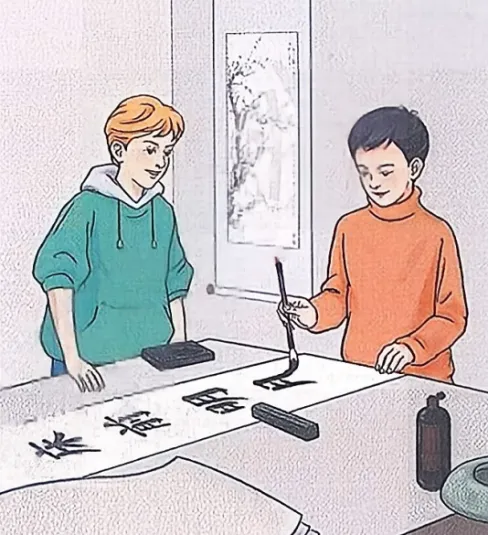 Peter: Hey Yaming! 1._____________
Yaming: Hi Peter. I’m doing calligraphy.
Peter: It’s beautiful! What are you writing?
Yaming: It’s a poem by Li Bai. 2._____________
Peter: What’s this character?
Yaming: It’s yue. It means “moon”.
Peter: It’s nice! 3._____________
Yaming: Well, the first step is always the hardest. When I started to do calligraphy, I spent hours practising single strokes.
Peter: I know how that feels! 4._____________ It’s difficult, but he always encourages me not to give up.
Yaming: Exactly. Now I do calligraphy to relax. I even like how the ink smells! Why did you choose to play the guitar?
Peter: I think playing the guitar is cool. 5._____________ I can teach you to play a song in return.
Yaming: It’s a deal!
A. I like watching you write like that. But it looks difficult.
B.What are you up to?
C.Will you teach me to write a poem?
D.My grandmother taught me how to write it.
E.My dad’s teaching me to play the guitar.
F.I often post my calligraphy works on social media to get more likes.
Read the text.Fill in the blanks with the correct forms of the words in the brackets.
Hobbies That Are Good for You
When work or school is over, what do you do 1.__________________(pass)the time? Do you spend time on hobbies you love? Reading or listening to music can help us to calm down after a busy day. Physical 2.__________________(hobby), such as playing tennis or doing yoga, can help us to keep fit. And some hobbies are 3.__________________(create). For example, people sometimes paint pictures 4.__________________(remember)a beautiful landscape or object, or reduce stress.
Luca Bruno likes to be creative in his free time. But he doesn’t make art 5.__________________(and)write stories. Instead, this Italian teenager finds it fun 6.__________________(make)mobile phone apps. He thinks that apps can be a great way 7.__________________(help)people. He started programming when he 8.__________________(be)ten, after he read about famous businessmen who started out as programmers. His latest app allows people around the world to find study partners for 9.__________________(learn)Italian. They can learn Italian and make friends at the same time!
“It gives me such a sense of 10.__________________(achieve)to see people using the app,” says Luca. “I believe I’m helping people around the world to learn Italian!”
Some people prefer not to make 11.__________________(thing). They prefer 12.__________________(collect)them! In India, Maya Badal doesn’t collect coins or stamps. Instead, this teenage girl collects postcards!
“I know some people think postcards are rather old-fashioned, but I think they’re a good way to learn about different places,” Maya says. “I think it’s 13.__________________(interest)to see the beautiful buildings and landscapes in foreign countries.”
Maya’s first postcard shows the Mogao Caves in Dunhuang. Her dad sent it to her when she was five, and she liked it so much that she put it up on her bedroom wall! Now there are over one hundred postcards from thirty-two countries on Maya’s walls. She dreams of 14.__________________(travel) to these places in the future!
Complete the passage with the infinitive forms of the verbs in the box.
chat(not) comedolistenplayspendstaywatch
 My twin brother and I look alike, but we are so different. I love sport, and I often meet my friends 1.__________________ football and tennis. My brother joined us to play football once or twice, but he decided 2.__________________ after that. He doesn’t like sport very much! Instead, he likes 3.__________________ at home and 4.__________________ movies, 5.__________________ to music, and 6.__________________ with friends online. Our parents were worried about him staying home too much. They also wanted us 7.__________________ more time together as a family. So, now they let us 8.__________________ our favourite activities on Saturdays, but on Sundays, we go on a family outing together!
Read the posts and translate.
What is your favourite free-time activity? |

Jason(UK) | Hi, everyone! 1.__________________________________________________(我想要培养take up一项新的空闲时间的活动[业余爱好]), and I’m hoping to get some ideas. What do you do? Why do you like it? 2.______________________________(请再多告诉我一些)! |
 Shuyin(China) Shuyin(China)
| I have many free-time activities, 3._________________________________________(像like绘画,写诗和阅读). But my favourite free-time activity is horse riding. When I was six, I visited my grandfather’s farm, and 4.__________________________________(他带我去骑马). 5.________________________________________(那是如此的一次超棒的amazing经历)! Now I do it at his farm every weekend with my favourite horse, Nini. I love horse riding 6.___________________________________(因为我享受在大自然里). 7.________________________________________(骑马也帮助我保持健康). But most importantly, it lets me spend time with Nini! She’s my best friend. 8._____________________________________________________(每次whenever我去看她,她都很开心), especially when I bring her some carrots for a snack! 9._______________________________________________.(生命中有她我很幸运) |
Part 3Grammar
✿ give up(“give”/“动词+up”相关短语):

Exercises:
()1.Douyin has become more and more popular nowadays. Not only the students but also the old often ______ late to watch different kinds of short videos.
A. feel freeB. stay upC. part with
()2.—I didn't pass the exam again. What should I do?
—Don't ______. You'll succeed sooner or later.
A. give upB. give inC. give away
()3.— How was your camping in the countryside last weekend?
— It was great. We ______ a tent by the lake and had much fun.
A. put upB. put offC. put onD. put away
()4.Trust yourself! Never ______ when you are facing difficulties.
A. give upB. give outC. get up
()5.—Coco, I can't understand the meaning of this word.
—You'd better ______ the word in your dictionary.
A. look forB. look upC. look after
()6.—Larry looks so different these days.
—Yeah.Last month he ______ yoga as a new hobby,and now he spends much time on it.
A.put upB.took upC.gave upD.looked up
()7.—I hear the Drawing Club was ______ in our school last week. Shall we join it?
—Good idea. Let's go.
A.put upB.picked upC.taken upD.set up
()8.______! It's not a big deal. Just believe yourself and everything will be OK.
A.Give upB. Stay upC. Cheer up
()9.Well, Carl. We're supposed to ______ smart phones and take more exercise.
A.hold onB. give outC. put awayD. use up
()10.Many Chinese people usually ______ some paper cuttings on windows, doors and walls as symbols of wishes
for good luck.
A.put upB. take upC. cut upD. give up
 ✿ 回顾辨析:四个“花”

Exercises:
()1. How long will it ______ you to fly to Beijing from your hometown?
A. spendB. takeC. payD. cost
()2. Why do more and more kids prefer to spend time ______ screens?
A. inB. forC. atD. on
()3. Do you know how much Anna ______ all these books? They ______ only 100 yuan.
A. spent; costB. paid for; spentC. paid for; costD. cost; spent
()4. Jack is always so busy that he can hardly ______ a few minutes to talk to his family.
A. spendB. spareC. shareD. take
() 5. Parents hope their children can spend as much time as they can ______ .
A.studyingB.to studyC.studyD.studied
()6. Mrs. Smith spends more time than she used to ______ with her parents when they become older.
A. stayB. stayingC. staysD. stayed
 ✿ 辨析:such as/for example


Exercises:
汉译英。
1.他喜欢户外运动,例如(such as)徒步和骑行。
______________________________________________________________________
2.你可以在家用很多方式放松,比如(for example)读小说或者听轻音乐。
______________________________________________________________________
3.许多漂亮的国家,比如(for example)中国以其秀美的(nice)景色而闻名。
______________________________________________________________________
 ✿ 辨析:suggestion/suggest/advice/advise

Exercises:
1.The tour guide suggested________________(visit)the ancient town in the morning when there are fewer tourists, and she also gave us some good________________(suggest)about trying the local snacks at the old street.
2.The doctor advises her________________(drink) more warm water and get enough sleep, and he also offers some _______________________(在...方面的建议)how to prevent catching a cold in winter.
3.I suggest that he________________(join)the sports club to improve his basketball skills.
 ✿ 形式主语&形式宾语 “it”:

Exercises:
翻译练习:
1.听一些轻音乐来放松是很有必要的。
_______________________________________________________________
2.每天花半小时做运动对你来说是有益的。
_______________________________________________________________
3.熬夜玩手机是不明智的。
_______________________________________________________________
4.我们都觉得在周末看一场喜剧电影(comedy)很有趣。
_______________________________________________________________
5.她发现每天坚持阅读英语故事很难。
_______________________________________________________________
6.我认为和朋友们一起分享快乐是一件很棒的事。
_______________________________________________________________
Part 4基础过关
一、请根据所给的首字母或音标写出单词,使句子意思完整正确。
1. She has a very sweet v______________ and we all like listening to her sing songs.
2. My grandmother likes to read books with ______________ /ˈɡlɑːsɪz/ when she is free.
3. The little girl was ______________ /həʊpˈfəl/ that her parents would come back home early.
4. [2025 山西太原期末·节选] The two brothers dress a______________, wearing the same style of T-shirts and jeans.
5. Don’t w______________. They’re able to pass the coming exam.
6. You’d better go to bed early ______________ /ɪnˈsted/ of staying up late to play video games.
7. [2025 湖南长沙期末·节选] We should work ______________ /təˈɡeðə(r)/ to solve this difficult maths problem.
8. Whenever I see the progress of our country, I have a s______________ of pride.
9. [2025 河南郑州期末·节选] It’s necessary for us to learn how to deal with so much s______________ in our daily life.
10. The headmaster’s announcement at the beginning of the new term made the students stand in the playground r______________ excited.
11. ______________ /ˈtiːneɪdʒ/ years are a special period in our lives. We are growing up and beginning to have our own ideas.
12. [2025 河北唐山期末·节选] Tina sent ______________ /ˈpəʊstkɑːdz/ to her friend when she was on a trip to Beijing.
二、请根据句子意思,用括号中所给单词或短语的适当形式填空。
1. The old man ______________ (lie) on the road and couldn’t move. We called 120 at once.
2. After taking the medicine, his ______________ (ill) got much better.
3. He ______________ (death) in a car accident when he was only 25 years old.
4. Peter worked extra hours ______________ (make) enough money for the concert ticket.
5. [2025 广西南宁期末] Remember ______________ (not touch) the paintings when you are in the museum.
6. The coach expected the players ______________ (push) themselves harder during training.
7. [2025 吉林长春期末] It’s important for us ______________ (develop) the ability to ask questions.
8. ______________ (chat) with foreign friends on the internet can help us improve our English speaking skills.
9. [2025 云南玉溪期末] Our English teacher often tells us if we have any difficulty learning English, we can ask her for ______________ (suggest).
10. Don’t be afraid ______________ (fail)—it’s a part of the process of learning something new.
11. ______________ (surprise), even the youngest student in our class solved the difficult maths problem.
12. [2025 湖北武汉期末] In the past, the scientist’s story ______________ (inspire) our parents to work harder for their dreams.
13. More ______________ (important), we should always be kind to others and respect different opinions.
14. [2025 浙江杭州期末] I feel lucky ______________ (have) such caring friends who always support me.
15. I saved up ______________ (coin) in a piggy bank to buy a gift for my mother’s birthday.
Part 5能力提升
一、任务型阅读。
A museum vlogger named Shui Xing has become a big hit on the internet these days. In her videos, she shows people around the museums across China.
The vlogger’s real name is Wang Yini. She is a post-95 girl from Jilin Province. She was interested in archaeology(考古学)from an early age. When she was little, her parents often took her to museums. The experiences of visiting museums gave her the idea of studying archaeology when she grew up.
Wang started making videos about archaeology in 2020. She did this because she found that many people had misunderstandings(误解)about archaeology. Besides, she wanted to share her knowledge in the field. However, her videos didn’t get much attention at first. Wang thought about it carefully and realized that she didn’t choose subjects that would interest people. She worked hard and finally found a way to tell stories in an interesting way. “The key is to interest the online users with interesting story lines. This makes it easier for them to understand what I say,” she said.
Now Wang is a teacher in Liaoning University. She wants to train more talents on archaeology. At the same time, she tries to make more interesting videos for people. She hopes to let more people know where our culture comes from so that we can know where to go in the future.
1. Who is Shui Xing?
_______________________________________________________________________
2. What gave her the idea of studying archaeology when she grew up?
_______________________________________________________________________
3. Did her videos get much attention at first?
_______________________________________________________________________
4. How did Wang interest the online users?
_______________________________________________________________________
5. What do you think of Wang?
_______________________________________________________________________
二、完成图表。
Farming is a thing for farmers in the countryside. But now farms are coming to the balconies (阳台) of city buildings.
It’s reported that vegetable seeds sold online are more and more popular. The report also shows Shanghai, Dongguan and Beijing are the top three cities for vegetable growers. Of these growers, most are in their 20s.
More and more people in the cities like growing vegetables in the balcony. Having fun and seeing the results are important for them. As their life becomes better, people like to grow different vegetables. Some like growing fresh-looking vegetables because they want to make their balconies colourful. The growers also like showing their colourful vegetables or telling what they learnt in vegetables growing to each other on the internet.
It’s easy to grow vegetables in the balcony, so many children are also interested in it. For children, it is a great way to stay away from watching TV or using smartphones for a long time. It also helps them know about farm work and brings lots of happiness to their lives.
Zhang Chao, 17, is one of them. “My love for growing vegetables started when I was in primary school. At that time, I lived with my grandpa in the countryside. I learnt to grow vegetables from him. I know farming is never easy but I feel happy. I know farming is never easy but I feel happy when I see seeds turn into vegetables,” he said.
A new 1. ____________ in the city—growing vegetables in the balcony: • Growing vegetables in the balcony is more and more popular now. • The cities have many growers and most of them are 2. ____________ people. |
The adult growers Through growing vegetables, they can: • have fun and see the results; • make their balconies colourful; • share their experience of growing vegetables with others 3. ____________. | The children growers Through growing vegetables, they can: • spend 4. ____________ watching TV or using smart phones; • learn something about farming; • get happiness from farming. Example: • Zhang Chao learnt to grow vegetables from his grandpa when he was in primary school. 5. ____________ farming is difficult, he thinks it's happy to see the results. |
Part 6时文阅读
话题:中国留学生每周打飞的去澳洲上学
Guangli Xu, an international student from China, chose an unusual way to complete his final term of study in Australia.
Instead of living in Australia, Xu traveled weekly from his hometown in Shandong to attend a single class at the Royal Melbourne Institute of Technology.
 Xu had been studying in Australia for eight years. But he chose to finish his studies as an "international commute (通勤) student" so he could spend more time with his wife, who completed her studies in Australia and returned to China over the summer.
Between August and October, Xu made the 8,800-kilometer trip 11 times, reports Australian news company SBS.
Each trip cost around $1,000, and took about 10 hours to 13 hours each way. Xu would leave for Melbourne on Monday mornings and return to China by Wednesday evenings, staying on a friend's sofa during his short visits to Australia.
The trips cost a little more than the monthly rent for an apartment in Melbourne, but Xu told the South China Morning Post that he believed the time and money were well spent for "love" and for "good food at home".
He filmed his super long trip to school and posted it on Douyin, China's TikTok. The video, titled Challenging the World's Longest Commute to Classes, went viral.
Xu told SBS that, after so many years away, he wanted to spend more time with his family.
Quan Gong from Perth's Curtin University told SBS that this kind of short-term international commuting might become more common in the near future—especially for students from countries closer to Australia, such as South Korea, Japan, Malaysia and Singapore.
()1. How does the writer start the passage according to Paragraph 1?
A. By showing a fact.B. By telling a story.
C. By asking a question.D. By introducing a place.
()2. Which question can help us know the main idea of Paragraph 3?
A. How much did each trip cost?
B. What did Xu think of his trips?
C. Why did Xu choose to commute weekly?
D. Where did Xu stay during his short visits?
()3. How much did a round trip from China to Melbourne cost Xu?
A. About $1,000.B. About $2,000.
C. About $3,000.D. About $4,000.
()4. What does the passage mainly talk about?
A. The challenges of studying abroad for Chinese students.
B. A student’s extreme (极端的) commute for family and love.
C. The rising costs of international education in Australia.
D. How social media makes student stories popular.
Unit 2Stay Healthy
Part 1Vocabulary
1. ourselves /ˌaʊəˈselvz; ɑːˈselvz/ pron.我们自己
2. sore /sɔː(r)/ adj.疼痛的;酸痛的
3. throat /θrəʊt/ n.喉咙
4. stomachache /ˈstʌməkeɪk/ n.胃痛;肚子疼
5. headache /ˈhedeɪk/ n.头痛
6. toothache /ˈtuːθeɪk/ n.牙痛
7. backache /ˈbækeɪk/ n.背痛;腰痛
8. press /pres/ v.压;按;挤;推
9. nosebleed /ˈnəʊzbliːd/ n.鼻出血
10. dentist /ˈdentɪst/ n.牙科医生
11. fever /ˈfiːvə(r)/ n.发烧
12. stomach /ˈstʌmək/ n.胃;腹部
13. avoid /əˈvɔɪd/ v.避免;防止
14. gas /ɡæs/ n.气体;燃气
15. ache /eɪk/ n. & v.疼痛
16. X-ray /ˈeks reɪ/ n.X光照片;X射线
17. careless /ˈkeələs/ adj.不小心的;粗心的
18. runny /ˈrʌni/ adj.流鼻涕的;流眼泪的
19. cough /kɒf/ n. & v.咳嗽
20. bruised /bruːzd/ adj.受了瘀伤的
21. suffer /ˈsʌfə(r)/ v.受苦;遭受
22. suffer from 受苦;受折磨
23. take a seat 坐下
24. take one's temperature 给某人量体温
25. test /test/ n. & v.检查;测验
26. flu /fluː/ n.流行性感冒
27. medicine /ˈmedsn/ n.药;医学
28. mask /mɑːsk/ n.口罩
29. virus /ˈvaɪrəs/ n.病毒
30. stop ... from doing 防止……;阻止……
31. description /dɪˈskrɪpʃn/ n.描写;形容
32. patient /ˈpeɪʃnt/ n.病人 adj.有耐心的
33. injury /ˈɪndʒəri/ n.伤害;损伤
34. illness /ˈɪlnəs/ n.疾病
35. knife /naɪf/ n. (pl. knives /naɪvz/)刀
36. clear /klɪə(r)/ adj.清晰的;清楚的 v.清理
37. pain /peɪn/ n.疼痛;痛苦
38. what's more 更有甚者;更为重要的是
39. brightness /ˈbraɪtnəs/ n.亮度
40. environment /ɪnˈvaɪrənmənt/ n.环境
41. cross /krɒs/ v.穿越;横过;交叉
42. catch fire 着火
43. themselves /ðəmˈselvz/ pron.他(或她、它)们自己
44. fry /fraɪ/ v.油炸;油煎;油炒
45. turn on 接通(电流、煤气、水等);打开
46. stove /stəʊv/ n.厨房灶具;炉子
47. happily /ˈhæpɪli/ adv.快乐地;高兴地
48. no way 不可能;没门
49. burn /bɜːn/ v. (burnt /bɜːnt/, burnt)燃烧;着火
50. on fire 着火;起火
51. flame /fleɪm/ n.火焰
52. panic /ˈpænɪk/ n.惊恐;恐慌
53. onto /ˈɒntu; ˈɒntə/ prep.向;朝
54. throw /θrəʊ/ v. (threw /θruː/, thrown /θrəʊn/)摇动身体(部位);扔;抛
55. roll /rəʊl/ v.(使)翻滚;滚动
56. quick /kwɪk/ adj.快的;迅速的 adv.迅速地;快速地
57. be about to 即将;正要(做某事)
58. stop short 突然停住
59. aid /eɪd/ n. & v.帮助;援助
60. first aid 急救
61. safety /ˈseɪfti/ n.安全;安全处所
62. extinguisher /ɪkˈstɪŋɡwɪʃə(r)/ n.灭火器
63. eat out 上馆子吃饭;在外用餐
64. tonight /təˈnaɪt/ adv.在今晚 n.今夜;今晚
65. sadly /ˈsædli/ adv.伤心地;令人遗憾地
66. smoke /sməʊk/ n.烟 v.吸烟;冒烟
67. unfortunately /ʌnˈfɔːtʃənətli/ adv.不幸地;可惜地
68. luckily /ˈlʌkɪli/ adv.幸运地
69. badly /ˈbædli/ adv. (worse /wɜːs/, worst /wɜːst/)严重地
70. harm /hɑːm/ n. & v.伤害;损害
71. pill /pɪl/ n.药丸;药片
72. painful /ˈpeɪnfl/ adj.(身体部位)疼痛的;令人痛苦的
73. lie /laɪ/ v. (lay /leɪ/, lain /leɪn/)平躺;平放
74. lie down 平躺;平卧
75. harmful /ˈhɑːmfl/ adj.有害的
76. hit /hɪt/ v. (hit, hit)碰撞;击;打 n.打;击;击中
77. shock /ʃɒk/ n.震惊;令人震惊的事 v.使震惊;使惊愕
78. bleed /bliːd/ v. (bled /bled/, bled)流血;出血
79. check /tʃek/ v.检查;查明
80. tight /taɪt/ adj.疼痛的;憋气的;紧的;牢固的
81. peanut /ˈpiːnʌt/ n.花生
82. nervously /ˈnɜːvəsli/ adv.紧张不安地
83. allergic /əˈlɜːdʒɪk/ adj.过敏的
84. from now on 从现在起

语法填空:
(一)A Terrible Camping Trip
Last weekend, my friends and I went 1.______________(camp)—we wanted to take care of ourselves, but we were too careless.
We set up tents first.The environment was nice, but the brightness disappeared fast. After hiking, my leg was painful, and I had a backache. 2.______________(sudden), Lily tripped(绊倒) over a stone: her knee turned bruised, and she said her old toothache came back.Tom didn’t wear enough clothes so he got a sorethroat.Then he started coughing with a runny nose. He seemed 3.______________(have) a fever, maybe by the flu.Mia held her stomach and cried that she had stomachache from eating cold snacks. What’s 4.______________(bad), Jack’s nose started a nosebleed! He tried to press it,but it didn’t work.
We called the camp guide, who used to be a dentist. She came to do the first aid.She let us take a seat, took our temperature, and 5.______________(say): “You’re all suffering from illness—maybe a kind of virus.” She gave us medicine and told us to wear masks 6.______________(stop) the virus from spreading.
Later,she took us to the hospital.There were lots of patients.Some were injury, and some were doing X-ray or some tests. The doctor checked us and gave us a description of our conditions : “Your illness could have been avoided—you must have eaten something you shouldn’t.”he gave us some pills, and told us to lie down.What's more, she warned(警告): “Don’t touch sharp things like knife-shaped stones, 7.______________(keep) your camping area clear, don’t cross the river alone, and never play with fire,which might catch fire. Learn 8.______________(take)care of yourselves next time!”
We really learned a big lesson about safety!
(二)What Terrible Experiences
Tonight, instead of eating out,mom was ready tofry eggs at home. She went to turn on the stove, and I really wanted 9.______________(have) a try. But she replied, “no way. It’s dangerous!”
Just then, mom was about to get the pan when she stopped short: the oil burned suddenly— the pan was on fire, with flame 10.______________(jump)up! We 11.______________(fall)into panic; Ifell onto the floor to roll away, and mom threw a wet cloth over the fire quickly.One of our 12.______________(neighbor)saw the smoke,and he came with 13.______________extinguisher . Luckily,we were both saved with no one bleeding. What a bad day!
The other day, I brought some peanut cakes to my friend Bob, not 14.______________(know) that he’s allergic to peanuts. Unfortunately, he felt bad and his face turned badlytight. I was shocked 15.______________nervous.From now on,I’ll always check food allergies first and I’ll never offer harmful food to him again.
These experiences hit me a lot,but I learned a huge lesson about 16______________(safe)!
Part 2Text Preview
Listen to the conversation and fill in the blanks.
 Doctor: 1.______________________, Helen. How are you feeling?
Helen: Not good ... I have a runny nose and a fever.
Doctor: Let me 2.__________________________ ... Oh, it’s quite high.
Helen: Yes, it started yesterday. I felt so cold, and I didn’t have much energy. When I tried to 3.__________________________, I almost 4.___________________________________. My throat hurts too.
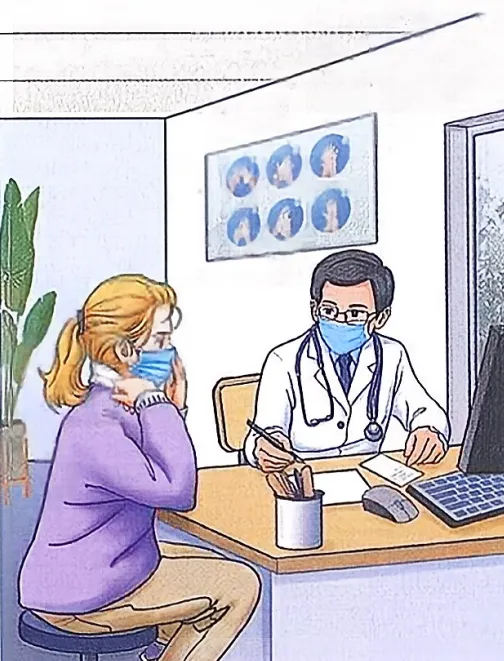 Doctor: Let’s see. Yes,5.__________________________ looks very red. We’ll need to do a test, but I believe you have the flu. It’s flu season.
Helen: What should I do, Doctor?
Doctor: You should take some medicine and 6.____________________________.
Helen: OK, thank you. Can I go to school tomorrow?
Doctor: No, you should rest at home. When you’re outside, please 7._______________________. It stops us from passing the flu virus to others easily.
Helen: I will!
Doctor: And remember, your health is in your hands. If you 8.___________________________, you’ll get better soon.
Read the story and find out how the fire started.
A Cooking Accident
James lived in the city with his friend Allen. It was their first time living away from their families, and they enjoyed learning how to do many things themselves.
One Saturday, James decided to make fried chicken. First, he poured oil into a pan. Then he turned on the stove and left the oil to heat while he prepared the chicken. Just then, he heard the front door open, followed by the sound of Allen singing.
“Guess what,” Allen called out happily. “We won!”
“No way!” James followed him into the living room. He wanted to hear all about the football game! Suddenly, Allen stopped talking and looked up.
“Hey, do you smell something burning?”
“Oh no!”
They both rushed back into the kitchen. The pan was on fire! Large flames were jumping into the air. In a panic, James turned off the stove at once. But he was so close to the pan that a flame jumped onto his shirt. James cried out and threw himself to the floor. He put out the fire by rolling on the ground, but the pan was still burning!
“Get water, quick!” he shouted.

“Are you OK?” Allen asked his friend.
“I think so,” James said. It was lucky that his shirt wasn’t too thin! His arm was red, but it didn’t hurt very much.
“Maybe we should eat out tonight,” James said as he ran cool water over his arm.
“Sure, we could do that. What do you want?”
“Anything but fried chicken,” he said sadly.
✎ Read the story again. Number the events in the correct order.
________ Allen put out the fire with the fire extinguisher.
________ James followed Allen into the living room.
1James heated oil on the stove.
________ James rolled on the ground.
________ James turned off the stove.
________ Allen ran to the living room to get the fire extinguisher.
________ James’s shirt caught fire.
________ The pan caught fire.
✎ Read again. Complete the summary of the story using the details in the sentences above.
James lived with his friend Allen in the city. One day, he decided to make a meal. He 1.________________________ and prepared some chicken. When Allen returned home, James 2.________________________ to talk about a football game. Suddenly, they smelt smoke and found 3.________________________. James rushed to 4.________________________. Unfortunately, his shirt 5.________________________, so he dropped to the ground and 6.________________________ until the fire was out. Allen quickly 7.________________________ and put out the fire. Luckily, James wasn’t badly hurt.
Complete the passage with the correct forms of the words in the box.
injurysufferX-rayavoidaidthrowcolour
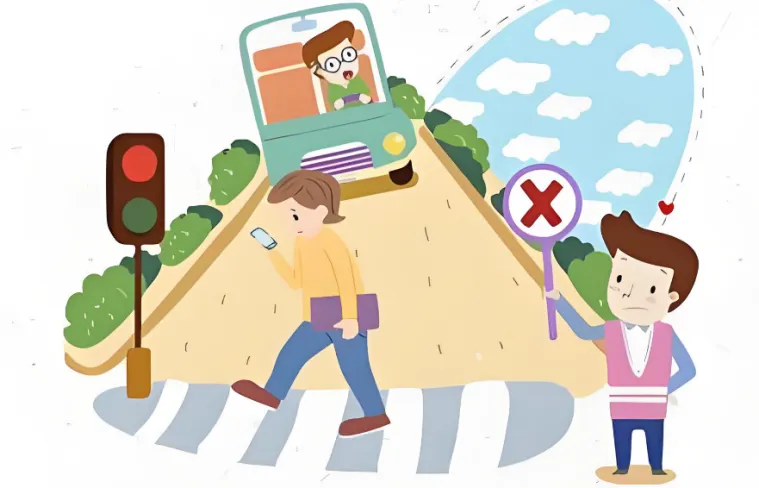 Kelly looked at her phone. She was late, and her exam was starting in 10 minutes! Suddenly, something hit her hard and 1. ____________ her to the ground.
"Are you all right?" the driver cried out.
His face was 2. ____________ with fear. But Kelly didn't say anything. She was 3. ____________ from shock and her arm was bleeding.
"Don't worry. I know first 4. ____________! I'll call for help too!" the driver said.
At the hospital, the doctor checked Kelly's arm carefully. An 5. ____________ showed that her right arm was broken. "You're lucky that your 6. ____________ wasn't worse," said the doctor.
"You're right," Kelly said. "I'll 7. ____________ looking at my phone while crossing the road next time."
Read the short story and complete the grammar blank filling.
One Saturday, Julie1.________________(invite)Mark and Lucy to her house for lunch. Her parents weren’t home, so they had it all to themselves. They ordered pizza, salad, and juice. But in the middle of the meal, Mark started 2.________________(feel)strange. His face felt warm, and his throat felt tight.
“Were there any 3.________________(peanut)in our food?” he asked 4.________________(nervous).
“I think I tasted peanuts in the salad,” said Julie. “What’s the matter?”
“Oh no, I’m allergic to peanuts!” Mark cried. His friends jumped into action and 5.________________(take)him to the hospital at once.
At the hospital, Mark’s friends told Dr Cooper 6.________________happened, and she gave Mark some medicine right away. When Mark felt 7.________________(good), the doctor asked him some questions and gave him some 8.________________(advise).
“I’ll take better care of 9.________________(I)from now on,” Mark promised. It was 10.________________day he would never forget.
Part 3Grammar
✿ 表示“患病”或“...痛”的表达:

Exercises:
Listen to four conversations. Write the health problems next to the students,and find the cause of each student’s health problem.
Name | Health Problem | Cause |
David | | __________________ at a friend's birthday party |
Ben | | fell during a __________________ |
Nancy | | ate too many __________________ |
Judy | | talked too much and didn't __________________ |


Listen to three conversations. Complete the school nurse’s advice for each student.
Name | Advice |
David | • You shouldn’t ____________ next time.  • Avoid ____________ for now as the gas could make the ache worse. • Avoid ____________ for now as the gas could make the ache worse.
|
Nancy |  • You might need an X-ray. • You might need an X-ray.
• You could eat some ____________, but no more ____________. • Remember to ____________ carefully. |
Jeff | • ____________ on your nose. ____________ for a few minutes. • You should be ____________ next time. Accidents can happen when we’re careless. |
✿ turn相关短语:

Exercises:
单项选择。
()1.The Monkey King can ________ himself ________ different animals and objects.
A. turn...offB. turn...upC. turn...into
()2.Remember to ________ the lights when you leave the room.
A. turn onB. turn offC. turn upD. turn down
()3.—Would you please ________ your MP3 a little? Your baby sister is sleeping.
A. turn upB. turn downC. turn onD. turn in
()4.Maybe it will be ________ a real product one day!
A. turned onB. turned downC. turned offD. turned into
()5.Tom had to ________ the invitation to the party because he was too busy.
A. turn inB. turn downC. turn overD. turn to
()6.The plan ________ to be a perfect one after we tried it.
A. turned onB. turned outC. turned offD. turned up
✿stop/keep/prevent sb. from doing sth.:

Exercises:
汉译英。
1.我们应该阻止孩子们长时间玩手机。
___________________________________________________________
2.大雨使我们没能按时到达车站。
___________________________________________________________
3.没有什么能阻止她实现自己的梦想。
___________________________________________________________
4.我们戴口罩是为了保护自己免受病毒侵害。
___________________________________________________________
5.这件外套能保护你免受寒冷侵袭。
___________________________________________________________
✿ 反身代词:


Exercises:
一、用括号中所给单词的适当形式填空。
1.Some tourists fall in love with Yangzhou ____________ rather than just its tourist attractions. (it)
2. It was really a wonderful day! Cathy and I really enjoyed ____________ (we) very much.
3. Every time I meet difficulties, I always say to ____________ (I), “Yes, I can!”
4. Daniel likes keeping art diaries. In this way, he can express ____________ (he) through drawing or painting.
5. The old lady is not feeling ____________ (she) today.
二、用适当的反身代词填空。
6.. The work is too hard. I can’t do it ____________.
7. Little Mary was proud of ____________ because she taught Uncle Li how to borrow books online.
8. My best friend Jim always helps me. As a famous writer once said, “A friend is a gift that you give ____________.”
9. If you want more bread, just help ____________, boys and girls.
10. The dress ____________ is beautiful, but I don’t think it’s suitable for you.
✿ 情态动词should和could的用法:


Exercises:
一、单项选择。
()1. Shh…! This is a library. You ______ keep your voice down.
A. canB. can’tC. shouldD. shouldn’t
()2. —It’s boring to walk alone here.
—You ______ go for walks with your friend in the park.
A. are able toB. have toC. CouldD. need
()3. —I’ve got a toothache, Mom.
—Oh, you ______ eat too much candy.
A. shouldn’tB. needn’tC. shouldD. need
()4. —______ you please help me fix my bike?
—Sure. Let me have a look at it.
A. MustB. NeedC. CouldD. Should
二、按要求完成句子,每空一词。
5. You should drink hot water when you have a sore throat.(对画线部分提问)
____________ ____________ I do when I have a sore throat?
6. 我哥哥五岁的时候就会弹钢琴了。(翻译句子)
My brother ____________ ____________ ____________ ____________ when he was five years old.
7. 我认为你应该躺下休息。(翻译句子)
I think you ____________ ____________ ____________ and have a rest.
8. 如果你想做志愿工作,你可以帮忙分发食物。(翻译句子)
You ____________ ____________ hand out food if you want to do volunteer work.
9. 作为学生,我们上学不应该迟到。(翻译句子)
As students, we ____________ ____________ late for school.
Part 4基础过关
一、请根据所给的首字母或音标写出单词,使句子意思完整正确。
1. [2025 四川眉山期中] Lucy had a sore throat and kept c______________ all night, so her mother was worried about her.
2. Most of us use natural g______________ for cooking at home.
3. If you have a ______________ /ˈnəʊzbliːd/, pinch your nose.
4. Lisa ______________ /ˈpresɪz/ the first button to turn the machine on.
5. [2025 河南郑州期末·节选] They suffered serious i______________ in the accident and had to go to the hospital.
6. The nurse takes good care of the p______________ in the hospital, making sure they take their medicine on time.
7. [2025 黑龙江哈尔滨期末·节选] Scientists are working hard to find a way to fight against the ______________ /ˈvaɪrəs/ and save more people’s lives.
8. After singing at the concert for a long time, her ______________ /θrəʊt/ was so sore that she could hardly speak.
9. He always looks both directions carefully before he c______________ the road.
10. [2025 甘肃兰州期末·节选] I had to stop running because of a p______________ on my knee.
11.We should all take action to protect the e______________, such as reducing waste and planting more trees.
12.The heavy s______________ from the burning house could be seen from miles (1 mile ≈ 1,609 metres) away.
13.[2025 河南郑州期末·节选] The ball r______________ down the hill and that scared the sheep.
14.[2025 湖南株洲期末·节选] He wanted to join the football team, but u______________, he injured his knee.
二、请根据句子意思,用括号中所给单词的适当形式填空。
1. [2025 江苏淮安期中] —Could you tell me how many _______ (stomach) a cow has?
—Maybe four, but I am not sure.
2. [2025 四川达州二模] As students, we should learn from mistakes and avoid ______________ (make) the same mistakes again.
3. Staying in the cold wind for too long, he got a ______________ (run) nose and started to sneeze.
4. Staying up late to play video games always gives me a terrible ______________ (head) the next day.
5. Chefs usually keep several sharp ______________ (knife) in their kitchen to cut different ingredients.
6. [2025 湖北荆州期末] The ______________ (bright) of the sun on a summer day makes everything look colourful.
7. Jane's school life is more interesting now because she can enjoy ______________ (she) in different clubs.
8. [2025 浙江杭州期中·节选] I cut ______________ (I). And my mother helped me put medicine on the cut.
9. The ______________ (care) driver didn’t notice the red light and caused an accident.
10. [2025 黑龙江哈尔滨调研] She ______________ (hit) him on the head with her umbrella after she found him.
11. [2025 辽宁盘锦期末] Abing’s Erquan Yingyue makes people recall their deepest wounds from their ______________ (pain) experiences.
12. Ignoring a ______________ (tooth) for too long may lead to more serious dental problems.
13. [2025 山东济南期末] The doctor told him to take these ______________ (pill) three times a day after meals.
14. She waited for the exam results ______________ (nervous), biting her nails all the time.
15. We were all ______________ (shock) by the news of the sudden earthquake in that small town.
16. The boy cut his finger with a knife and it ______________ (bleed) a lot.
Part 5能力提升
一、从方框内选择合适的单词,用其适当形式完成短文。
carespendcontrolgivegoodheimportantliepeoplequicklyshesituation
One day, Lisa's neighbour Amy came to her and shouted, “Lisa! Please help my sister Ella! She cut 1. ______________!”
Lisa ran to Amy's house as 2. ______________ as possible. So terrible it is! Ella 3. ______________ on the floor and blood poured out of the cut on her right foot. “Ella was so 4. ______________ that she broke the glass as she was playing. Our mum wasn’t at home, and I didn’t know what to do,” Amy told Lisa. “I must 5. ______________ her first aid at once!” Lisa replied. Luckily, Lisa knew how to do it and acted quickly. She pressed the cut to 6. ______________ the bleeding. Then she told Amy to call 911. As they waited, she let Ella rest on the sofa and kept pressing the cut, so Ella would not lose too much blood before going to the hospital.
A few days later, Ella’s right foot got much 7. ______________. Lisa felt happy as she heard the good news. “Everyone should know the 8. ______________ of first aid. In some dangerous 9. ______________, first aid means a lot before doctors come. Sometimes, it can save 10. ______________ lives,” Lisa said. “I advise everyone to learn how to give first aid.”
二、根据短文内容,从A、B、C、D四个选项中选出最佳答案。
The flu can easily spread from one person to another. This is especially true for people who are weak. When you’re weak, you’re more likely to catch the flu. Do you know how to avoid it? 1.__________
Wash your hands.
2.__________ You should wash your hands when coming home, before eating, after using the toilet, etc. You should use running water to wash your hands. It’s better to wash them for several minutes.
Eat healthy food.
Another good way to avoid the flu is to eat healthy food, because healthy food can provide you with rich nutrition (营养). For example, milk, eggs, vegetables and fruit are good choices for you. They’ll be good for your health. 3.__________
Do exercise.
Doing exercise will make you stronger. 4.__________ You can play ping-pong, go swimming, go for a walk and so on. No matter what kind of exercise you do, you should do it often.
5.__________
Keeping away from people with the flu is an effective (有效的) way. If your classmates or friends have the flu, keep away from them until they are well. You may catch it easily by staying close to them. Besides, you’d better wear a mask in crowded places.
 A. Talk with friends happily.
B. Here is some advice for you.
C. Keep away from people with the flu.
D. If you often do exercise, you may keep fit.
E. Washing your hands is an easy way to avoid the flu.
F. So it’s good for you to eat some healthy food every day.
Part 6时文阅读
话题:科学认证 -“晨型人”欢乐多
 Have you ever had a bad day and been told, “You’ll feel better in the morning”? Well, science says that might actually be true!
A study from University College London (UCL) found that people generally feel better in the morning and worse at night.
The study looked at nearly 1 million survey responses from 50,000 adults over two years. Researchers asked people questions like, “In the past week, how happy did you feel?” and “How satisfied have you been with your life?”
They found that happiness, life satisfaction and general well-being were highest for people who answered the survey in the morning. But these feelings decreased as the day went on, reaching their lowest point around midnight.
Scientists believe our body’s biological clock plays a big role in this. It controls when we wake up and when we feel sleepy, and it also affects our moods. Cortisol (皮质醇), a hormone that regulates moods and emotions, peaks (达到最高值) in the morning and drops at night. This could explain why people feel better at the start of the day and worse later on.
Other factors (因素) can also affect our moods. For example, our daily routines, work and social activities change between weekdays and weekends, and that can change how we feel. This is also supported by the study’s findings, because happiness and life satisfaction were higher on Mondays and Fridays than on Sundays. And Tuesdays were the happiest day of the week. Seasons affect our moods as well—people feel happier and less anxious in spring, summer and autumn compared to winter. However, the time of day still affects our moods, no matter the season.
These findings could help mental health services, says UCL’s Feifei Bu. If people feel worse at night, she said, more support should be offered during those hours.
()1. How does the writer start the passage?
A. By telling a story.B. By giving the results.
C. By raising a question.D. By giving suggestions.
()2. What’s the meaning of the underlined word “decreased”?
A. Dropped.B. Failed.C. Passed.D. Disappeared.
()3. Which question helps us understand the main idea of Paragraph 5?
A. How do social activities improve well-being?
B. Why does cortisol, a hormone, control emotions?
C. How do daily lives and social activities change moods?
D. What controls the change of people’s moods during the day?
()4. Why does the writer give the examples in Paragraph 6?
A. To suggest we should try to become happy.
B. To show how important our moods are.
C. To tell us many other factors can affect our moods.
D. To prove that our moods are different at different times.
()5. What is the main idea of the passage?
A. People feel happiest on Tuesdays and least happy on Sundays.
B. Time of day and other factors influence human moods.
C. Mental health services should offer nighttime support to improve well-being.
D. Winter causes lower happiness than other seasons because of the cold weather.
Unit 3Growing Up
Part 1Vocabulary
1. deal with处理;对付
2. emotion /ɪˈməʊʃn/ n. 情感;情绪
3. upset /ʌpˈset/ adj. 难过的;沮丧的
4. lonely /ˈləʊnli/ adj. 孤独的;寂寞的
5. shocked /ʃɒkt/ adj. 震惊的
6. alone /əˈləʊn/ adv. 独自;单独
7. control /kənˈtrəʊl/ v. & n. 控制
8. anger /ˈæŋɡə(r)/ n. 怒火
9. advise /ədˈvaɪz/ v. 建议;劝告
10. hurtful /ˈhɜːtfl/ adj. 伤感情的
11. in future今后;从今以后
12. forgive /fəˈɡɪv/ (forgave /fəˈɡeɪv/, forgiven /fəˈɡɪvn/) v. 原谅;宽恕
13. fault /fɔːlt/ n. 过错;责任
14. clear the air尽释前嫌
15. present /ˈpreznt/ n. 礼物
16. standard /ˈstændəd/ n. 标准;水平;adj. 标准的
17. award /əˈwɔːd/ n. 奖;奖品
18. get across解释清楚;传达
19. clearly /ˈklɪəli/ adv. 清楚地
20. pressure /ˈpreʃə(r)/ n. 压力
21. purpose /ˈpɜːpəs/ n. 目的;意图
22. on purpose故意;有意地
23. reduce by half减少一半
24. apologize /əˈpɒlədʒaɪz/ (=apologise) v. 道歉
25. put oneself in sb's shoes设身处地;处于某人的境地
26. shut /ʃʌt/ (shut, shut) v. 关闭;合上;住嘴
27. shut sb/sth away把……关(藏)起来;隔离
28. lastly /ˈlɑːstli/ adv. 最后
29. plenty /ˈplenti/ pron. 充足;丰富;大量
30. plenty of充足;大量
31. feel blue感到忧郁的
32. on top of the world欢天喜地
33. all smiles笑容满面
34. low /ləʊ/ adj. 沮丧的;低的
35. in low spirits情绪低落;精神不振
36. ring /rɪŋ/ (rang /ræŋ/, rung /rʌŋ/) v. 发出铃声
37. enter /ˈentə(r)/ v. 进入
38. dare /deə(r)/ v. & modal v. 敢于
39. everybody /ˈevribɒdi/ pron. 每人;所有人
40. let down使失望
41. be hard on对……苛刻或过分严厉
42. player /ˈpleɪə(r)/ n. 运动员;选手
43. referee /ˌrefəˈriː/ n. 裁判
44. take back撤回;收回
45. decision /dɪˈsɪʒn/ n. 决定
46. kick oneself(因干了蠢事等)自责或懊恼
47. look on the bright side:从好的方面想;抱乐观态度
48. score /skɔː(r)/ n. 得分;比分
49. proud /praʊd/ adj. 骄傲的;自豪的
50. proud of为……感到骄傲
51. coach /kəʊtʃ/ n. 教练
52. as well也;又
53. bit /bɪt/ n. 有点儿;稍微
54. a bit有点儿;稍微
55. repeat /rɪˈpiːt/ v. 重复
56. pull together齐心协力;通力合作
57. though /ðəʊ/ conj. 虽然;尽管
58. even though即使;虽然
59. solution /səˈluːʃn/ n. 解决办法;解决
60. joyful /ˈdʒɔɪfl/ adj. 高兴的;令人愉快的
61. thankful /ˈθæŋkfl/ adj. 感谢的;感激的
62. negative /ˈneɡətɪv/ adj. 否定的;消极的
63. bully /ˈbʊli/ v. 霸凌;恐吓;n. 恶霸
64. shout at sb冲某人喊
65. from time to time不时;偶尔
66. behave /bɪˈheɪv/ v. 表现;举止得体
67. differently /ˈdɪfrəntli/ adv. 不同地
68. physics /ˈfɪzɪks/ n. 物理;物理学
69. awake /əˈweɪk/ adj. 醒着的
70. normal /ˈnɔːml/ adj. 正常的;普通的
71. mad /mæd/ adj. 发狂的;疯的
72. mean /miːn/ adj. 刻薄的;吝啬的
73. deep /diːp/ adj. 深的;有……深的
74. take a deep breath深呼吸
75. pass away去世(委婉说法)
76. anybody /ˈenibɒdi/ pron. 任何人
77. remain /rɪˈmeɪn/ v. 继续存在;保持不变
78. not only ... but also ...:不但……而且……

语法填空:
(一)Linda’s Apology
It was Monday morning, and Lina felt blue—she argued 1._______________her deskmate Mia at school yesterday. “I didn’t do it on purpose.My purpose wasn’t 2._______________(hurt)her, but I lost my control and let my anger out,” she thought. She walked alone to school, feeling lonely and upset.
When the school bell rang, Lina didn’t dare to enter the classroom. She was afraid that she’d hurt Mia with such hurtful 3._______________(word). “This is all my fault,” she sighed in low spirits. Even the teacher awarding her for great her painting was meaningless now.After returning home, shocked at the whole thing,Lina’s mom advised her to clear the air.
So the next day, Lina took a deep breath and 4._______________(walk) to Mia. “I want to apologize,” Lina said, trying to get across her regret clearly. “Can you forgive me?”Mia looked up, then said, “I was under pressure too—my math test didn’t reach the class standard.” Lina tried to put herself in Mia’s shoes and nodded. And they decided to deal with their emotions 5._______________(good) in future.
Lastly, Lina gave Mia a small present—a nice pen, hoping their sadness could reduce by half! Mia was all smiles, and Lina felt on top of the world. There was plenty of joy in the classroom, and everybody could see their friendship again. Maybe next time, they won’t shut each other away when 6._______________(other) argument happens!
(二)Carry On With Hope
I’m 7._______________soccer player in our school team. Last week, we lost the game. I messed up a key pass and the referee said he couldn’t take back his decision .I felt I’d let everyone down,and I kept kicking myself as well,but my coach wasn’t hard on me.My teammate told me 8. _______________(look)on the bright side—our score was so close!
My class teacher said she was proud of how I tried, and that made me thankful. Though I felt a bit sad, our team decided to pull together next time.But there’s a boy in our team 9._______________ bullies others and shouts at people from time to time. He acts meanly and madly, and he even laughed at me about my mistakes. But I learned to behave differently. I told him, “We should not only respect each other but also help one another.”
Last night, I stayed awake 10._______________(think) about my grandpa—he passed away last year.11._______________(memory) of him still remain . When I feel negative , I take a deep breath and remember his words: “Even though things go wrong, find the joyful parts.”
Today, we had physics class. The teacher said, “Does anybody know the solution?” I raised my hand—I want to do well, and I know I can! Life isn’t always normal, but we can choose 12._______________(see) it deep with hope.
Part 2Text Preview
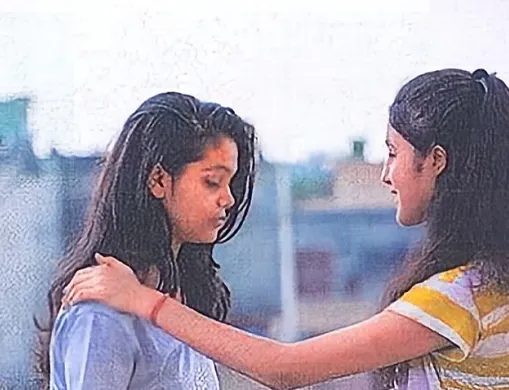 Read the conversation and complete the mind map. Do you think Judy and her parents communicate well?
Lily: What’s wrong, Judy?
Judy: Well, my parents aren’t happy with my grades.
Lily: Really? Weren’t they pretty good this term?
Judy: Yeah, but my parents have very high standards. They often compare me with my cousin, Kate. She gets better grades, plays the piano well, often wins awards ...
Lily: I’m sorry to hear that. But I’m sure your parents just want you to do well, although they may not show it. Why don’t you talk to them? Until you talk to them, they might not know how you feel.
Judy: I guess ... I know my parents love me, but sometimes I think they love Kate more. I’m afraid I’ll cry if we talk.
Lily: How about writing them a letter so that you can get your message across clearly?
Judy: Oh, that’s a good idea.
Lily: Writing things down can also make you feel better.
Judy: Thanks! Just talking to you makes me feel better already!
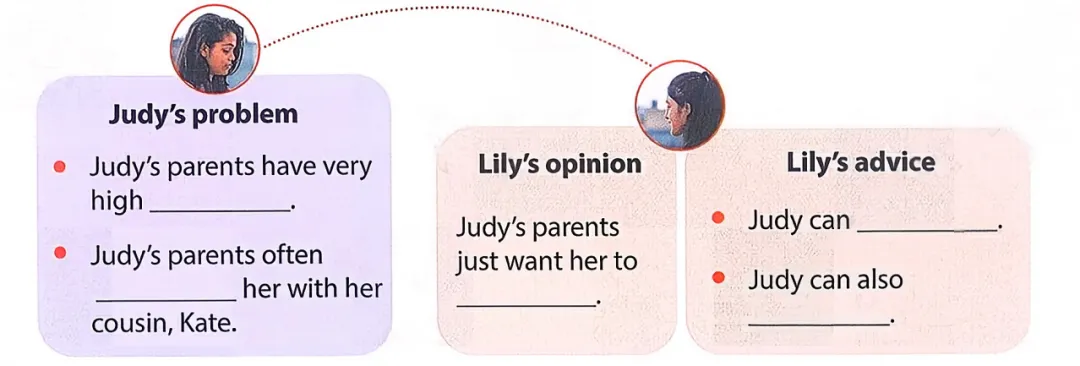
Read the story. Fill in the blanks with the proper forms of the words given in the box(two are extra).
 otherquietrepeatyouaccidentshockgoodenterluckwinforscore

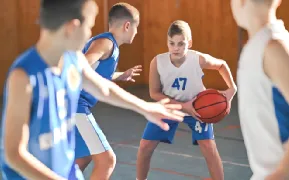
✎ Read again. Complete the problems and solutions.
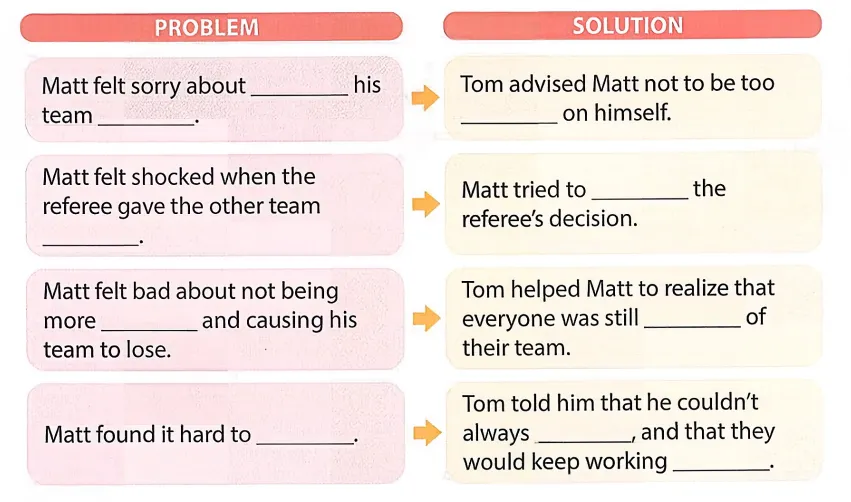
✎ Replace the underlined words with the idioms from the story.
1. Edward noticed that his friend had a sad expression. ______________________
2. The musician apologized for disappointing everyone when he fell sick and couldn’t attend the show.
______________________
3. When something goes wrong, it’s easy to get angry. But if you think about the good things in that bad situation, you’ll feel better. ______________________
4. Even if you try your best, you can’t always succeed or win. ______________________
5. When you work together as a group, you can achieve great things.______________________
 Read Kelly’s thank-you letter to her teacher and doing the translation.

Read the passage about managing stress. Then complete the sentences.
There are many things you can do when you feel stressed. First, you can take a break from what you are doing. This will help you clear your mind. You can listen to music or go for a walk. Next, share your problems with someone you trust instead of shutting yourself away. The person might not have any advice for you, but talking about your problems can help you feel better. Lastly, remember to take care of yourself. Eat healthy food, exercise, and get enough sleep. These three things alone are great for reducing stress!
1. If______________________________, you should take a break from what you are doing.
 2. You can talk to a person you trust, although______________________________.
3. You might not feel better until____________________.
4. You should eat healthy food, get plenty of sleep, and exercise so that____________________!
Part 3Grammar
✿ 辨析:lonely/alone

Exercises:
单项选择。
()1. — Do you feel ______ when you stay at home by yourself on weekends?
—Not really. I can read books and watch movies I like.
A.aloneB. lonelyC. happyD. excited
()2. The old man lives ______ in the big house, but he doesn’t feel ______ at all.
A.alone; lonelyB. lonely; alone
C.alone; aloneD. lonely; lonely
()3. My little sister is afraid of staying ______ in the dark room, because she is easy to feel ______.
A.lonely; aloneB. alone; alone
C.lonely; lonelyD. alone; lonely
()4. — Why did you cry just now?
— Because I was left ______ in the bus station, and I felt so ______ that全 I cried.
A.alone; lonelyB. lonely; alone
C.alone; aloneD. lonely; lonely
()5. She walked ______ on the path in the forest, but she wasn’t afraid of being ______.
A.lonely; aloneB. alone; lonely
C.alone; aloneD. lonely; lonely
✿ present的多种含义:
Exercises:
写出下列句中present的词性和含义。
1.My uncle sent me a special present on my fourteenth birthday.
2.We should live in the present instead of worrying about the past or future.
3.The artist will present his new paintings at the city museum next month.
4.A number of experts were present when the important decision was made.
5.The little boy tried his best to present a beautiful flower to his mother on Mother’s Day.
✿ plenty of(修饰名词的数量短语):

 ✿ 5个“也”:

Exercises:
单项选择。
()1. My mother ______ enjoys listening to classical music after work.
A.alsoB. as wellC. tooD. either
()2. — I don’t want to go shopping this weekend.
—______ do I.
A.SoB. EitherC. NeitherD. Also
()3. Lily can speak English very well, and she can speak French ______.
A.neitherB. as wellC. eitherD. nor
()4. — Tom doesn’t like spicy food at all.
—Me ______. I can’t stand the taste of chili.
A.tooB. alsoC. neitherD. as well
()5. Mr. Wang is a good teacher. He is kind to his students, and he ______ cares about their daily life.
A.tooB. as wellC. alsoD. either
()6. She can’t play the piano, and I can’t play it ______.
A.tooB. eitherC. alsoD. as well
()7. Lucy ______ her sister likes reading storybooks in the evening.
A.as well asB. alsoC. tooD. either
✿not only...but (also)...:
Exercises:
汉译英(请使用not only...but also...)。
1.不仅我,而且我的同桌也担心即将到来的数学考试。
____________________________________________________________________
2. 我的父母不仅希望我成绩好,而且希望我能学会做家务。
____________________________________________________________________
3.不仅我的朋友,而且我也觉得和陌生人交流很困难。
____________________________________________________________________
4.他不仅忘记了朋友的生日,而且还弄丢了要送给对方的礼物。
____________________________________________________________________
5.她不仅害怕在同学面前演讲,而且害怕回答老师提出的问题。
____________________________________________________________________
✿ although/until/so that引导的状语从句:




Exercises:
单项选择。
()1. Nowadays more and more people take exercise every day ______ they can have healthier bodies.
A.such thatB. in order toC. so that
()2. ______ over 400 million adults are too heavy, China has made a plan to help its people with weight control.
A. SinceB. UnlessC. ThoughD. Until
()3. Take it easy. ______ you keep working hard and ask teachers for help, you’ll surely make progress.
A.As long asB. Even thoughC. As soon asD. Ever since
()4. Jack, have you done the survey? —Not yet. I am in New York now. I’ll start it ______ I come back.
A.wheneverB. as soon asC. beforeD. after
()5. The saying “Seeing is believing” means we can’t believe it ______ we see it with our eyes.
A.afterB. whenC. until
()6. A friend is never known ______ a man has need.
A.asB. tillC. sinceD. though
()7. You will never truly understand your parents’ great love ______ you grow up.
A.ifB. untilC. whenD. while
()8. Love your parents ______ they are alive. Don’t wait until it is too late.
A.unlessB. althoughC. untilD. while
()9. Jack will send you an e-mail as soon as he ______ in London.
A.arrivesB. arrivedC. is arrivingD. will arrive
()10. Tony will begin to do his homework as soon as he ______ home.
A.gotB. getsC. is gettingD. has got
()11. —Can you tell me when you are arriving there?
—I’mnot sure. I’ll ring you up as soon as I ______ there tomorrow.
A. arriveB. arrivedC. will arriveD. am arriving
()12. My father will tell us something funny after he ______ home tomorrow.
A.arrivesB. arrivedC. is arrivingD. will arrive
Part 4基础过关
一、请根据所给的首字母或音标写出单词,使句子意思完整正确。
1. [2025安徽滁州期末·节选] The young man is new here and he has few friends, so he feels l____________.
2. We should learn to c____________ our temper when we are angry.
3. [2025湖北武汉期末] Tina was ____________/ə'pset/ because she failed the maths test.
4. On Mother's Day, I prepared handmade ____________/'preznts/ for my mum.
5. Emma won two a____________ for her excellent dance at the art festival.
6. Facing the p____________ of the senior high school entrance exam, we can relax by doing sport.
7. [2025河北石家庄期末·节选] It was sunny, and we played p____________ happily in the park.
8. I sent ____________/'mesɪdʒɪz/ to the teacher to ask about the school project time.
9. [2025四川成都期末] When I saw the report card, I ____________/'riːəlaɪzd/ I needed to work harder.
10. The p____________ of our environmental activity is to promote low-carbon living.
11. [2025安徽合肥期末·节选] He a____________ to me immediately after he stepped on my foot.
12. Using fewer plastic bags every day can r____________ the garbage by half.
13. [2025广西南宁期末·节选] There are ____________/'plenti/ of books for us to choose from in the library.
14. It’s a b____________ cold today. Remember to put on a coat before going out.
二、请根据句子意思,用括号中所给单词或短语的适当形式填空。
1. [2025江苏南京期中] Mr Wu advised us ____________ (not be) dishonest because that would make us lose friends.
2. When watching the moving movie, we all shared many ____________ (emotion).
3. [2025辽宁抚顺期末] Although Tom broke the vase, the teacher ____________ (forgive) him.
4. Lucy realized her words were ____________ (hurt) when she saw Lily's tears.
5. Jack's ____________ (angry) faded when he heard his sister's words.
6. [2025 重庆调研] Remember to be ____________ (thank) for the difficulty you have met. It helps you grow up.
7. He ____________ (remain) optimistic even though he met difficulties.
8. [2025 辽宁盘锦期末] After treatment, she can now walk ____________ (normal) as usual.
9. Everyone thought it was a ____________ (joy) day because the whole family spent the Spring Festival together.
10. Parents should pay attention to their children's online ____________ (behave) and correct it in time to ensure they use the internet safely and politely.
11. [2025 河北廊坊期末] We can try to solve the same problem ____________ (different) with different methods.
12. The thunder was too loud last night, and I stayed ____________ (wake) until early morning.
Part 5能力提升
一、完形填空。
I was walking in the park near my neighbourhood. There were black 1.__________ in the sky and I knew it was about to rain. Even so, I didn't want to go home. I 2.__________ with my mum and ran out of the house just 10 minutes ago. I sat down near a lake. There were many children playing with their parents. I felt a little lonely.
"Shall we play together?" A little girl came towards me with a 3.__________ in her hands. I agreed and she 4.__________ me the football. When it began to rain, all the children went home with their parents. "Why don't you go home? Where are your parents?" I asked the girl. "My mum is selling fruit outside the park," the girl 5.__________. "I usually play alone here. It will be OK 6.__________ you need to go home now. My mum is coming soon."
At this moment, I thought 7.__________ my mother and felt a little sorry to argue with her.
In the end, I took the little girl to her mum's vending cart (售货摊) and then ran home quickly. When I opened the door, my mum looked 8.__________, "Where did you go? I 9.__________ for you everywhere!" But I knew she wasn't angry 10.__________. After taking a shower, I heard her shouting, "Dinner time! Come out if you feel like eating some fish balls."
()1. A. birdsB. planesC. kitesD. clouds
()2. A. sharedB. arguedC. communicatedD. compared
()3. A. footballB. basketballC. baseballD. volleyball
()4. A. lentB. passedC. boughtD. returned
()5. A. guessedB. askedC. explainedD. cried
()6. A. becauseB. ifC. untilD. though
()7. A. toB. withC. forD. of
()8. A. boredB. shyC. nervousD. pretty
()9. A. lookedB. askedC. preparedD. ordered
()10. A. anymoreB. neitherC. nervousD. pretty
二、完成图表。
We all have unhappy time. That's OK. You need time like this, or how can you make yourself happy? You will enjoy your good time even in your bad days. Although sadness is part of life, don't take it too seriously. Let's make the part small. Here are some good ways to help you feel better when you are sad.
Smile! It's easy to do and have good results. This way can not only make you happy but also bring your friends happiness.
Listen to music. Listening to music you like best can be very useful. Some kinds of music are better than others, so try to find out what kind of music is the best for you.
Take some "me" time. You can be happy in reading a book, seeing a movie, taking a hot shower or something like those.
Exercise. It is a great way to make you happy. When you are exercising, you usually feel excited and it is easy to forget unhappy things.
These ways will help you feel better when you are unhappy, but don't just use them when you are sad. Try to practise them every day to make them a habit. But if you are in deep depression (沮丧), please see a doctor.
What to do with sadness |
Opinions | •It's OK to feel unhappy. •It is necessary to make sadness 1.____________ part of life. |
2.____________ | • Smile at others because it can make you happy. • Listen to your 3.____________ music because it is the best for you. • Find 4.____________ in everyday life, such as reading a book. • Exercise can make you feel better and forget unhappy things. |
Advice | Try to make the good ways a habit. 5.____________ when you are very depressed. |
Part 6时文阅读
话题:心理健康热线12356上线
语法填空:
On December 25, 2024, the National Health Commission (NHC) 1.(announce) that a nationwide mental health(心理健康)support hotline would soon be available(可使用的) in China. This is 2.(deal)with the rising psychological problems(心理问题).
The hotline number is 12356. It started working around January 1, 2025 and will be available across the country from May 1. Each city has at least one hotline, with at least two operators(接线员) 3.(work)for 18 hours a day.
Through the hotline, operators will give mental health education, psychological counseling(咨询) and support as well as respond(回应)to some mental health needs. The government is also trying to connect this hotline with police, fire, and medical emergency hotlines.
This is part of a national plan to solve mental-health 4.(problem)by giving useful services. Xing Ruoqi, an official of NHC, said more and more Chinese people are facing mental pressures because of economic(经济上的) 5.(grow), urbanization(城市化), industrialization(工业化), and an aging population.
6.(meet) the growing need for mental health services, the country has taken a lot of action, like training more doctors, and 7.(make) treatment guidelines.
 In 2018, a pilot program was started to build 8.mental health service network. It also asked experts to teach the public about mental health.
Now, people can call 12356 for mental health information or support when they don’t feel well. Local governments need to grow services to handle more calls. It also wants to improve mental health services,
9.(strong)the training of medical professionals, and carry out 10.(many)programs to teach people about mental health.
Unit 4The Wonders of Nature
Part 1Vocabulary
1. wonder /ˈwʌndə(r)/ n. 奇观;惊叹 v. 琢磨;想知道;感到诧异
2. measurement /ˈmeʒəmənt/ n. 数量;测量
3. square kilometre 平方千米
4. below /bɪˈləʊ/ prep. 在(或到)……下面;少于;低于 adv. 在(或到)下面
5. level /ˈlevl/ n. 高度;水平;程度
6. surface /ˈsɜːfɪs/ n. 表面;表层
7. depth /depθ/ n. 深(度);纵深
8. dive /daɪv/ v. & n. 潜水;跳水;俯冲
9. research /rɪˈsɜːtʃ/ v. & n. 研究;调查
10. vessel /ˈvesl/ n. 大船;轮船
11. unusual /ʌnˈjuːʒuəl/ adj. 特别的;不寻常的
12. bottom /ˈbɒtəm/ n. 底部;最下部
13. waterfall /ˈwɔːtəfɔːl/ n. 瀑布
14. civilization /ˌsɪvəlaɪˈzeɪʃn/ (= civilisation) n. 文明
15. means /miːnz/ n. (pl. means) 方式;途径
16. development /dɪˈveləpmənt/ n. 发展;壮大
17. desert /ˈdezət/ n. 沙漠;荒原
18. cubic /ˈkjuːbɪk/ adj. 立方的
19. mile /maɪl/ n. 英里
20. pool /puːl/ n. 池塘;水坑
21. climber /ˈklaɪmə(r)/ n. 攀登者;登山者
22. northern /ˈnɔːðən/ adj. 北部的;向北的
23. distance /ˈdɪstəns/ n. 距离;遥远
24. survive /səˈvaɪv/ v. 生存;存活;艰难度过
25. condition /kənˈdɪʃn/ n. 状态;境况
26. degree /dɪˈɡriː/ n. 度;度数;程度
27. cliff /klɪf/ n. 悬崖;峭壁
28. changeable /ˈtʃeɪndʒəbl/ adj. 可能变化的;易变的;常变的
29. death /deθ/ n. 死亡;毁灭;破灭
30. determined /dɪˈtɜːmɪnd/ adj. 有决心的;坚决的
31. above /əˈbʌv/ prep. 在(或向)……上面;超过 adv. 在(或向)上面;在(或向)高处;超过
32. teammate /ˈtiːmmeɪt/ n. 同队队员;队友
33. shoulder /ˈʃəʊldə(r)/ n. 肩膀;肩部
34. bit by bit 一点一点地;逐渐地
35. ladder /ˈlædə(r)/ n. 梯子;阶梯;途径
36. measure /ˈmeʒə(r)/ v. 测量;量度 n. 措施;度量单位
37. successfully /səkˈsesfəli/ adv. 成功地;顺利地
38. risk /rɪsk/ v. 使……冒风险(或面临危险) n. 危险;风险
39. curiosity /ˌkjʊəriˈɒsəti/ n. 好奇心;求知欲
40. ambition /æmˈbɪʃn/ n. 追求的目标;野心;雄心
41. explorer /ɪkˈsplɔːrə(r)/ n. 探险者;勘探者
42. simply /ˈsɪmpli/ adv. 仅仅;只;简单地
43. risky /ˈrɪski/ adj. 有危险(或风险)的
44. southern /ˈsʌðən/ adj. 南部的;向南的
45. located /ləʊˈkeɪtɪd/ adj. 位于;坐落在
46. freshwater /ˈfreʃwɔːtə(r)/ adj. 淡水的;淡水中生长的
47. type /taɪp/ n. 类型;种类
48. attract /əˈtrækt/ v. 吸引;招引;引起(反应)
49. curious /ˈkjʊəriəs/ adj. 好奇的;求知欲强的
50. traveller /ˈtrævələ(r)/ (= traveler) n. 旅行者;游客
51. natural /ˈnætʃrəl/ adj. 自然的;天然的;天生的
52. underwater /ˌʌndəˈwɔːtə(r)/ adj. 水下的;用于水下的 adv. 在水下
53. northeastern /ˌnɔːθˈiːstən/ adj. 东北的;东北方向的
54. coast /kəʊst/ n. 海岸;海滨
55. coral /ˈkɒrəl/ n. 珊瑚;珊瑚虫
56. reef /riːf/ n. 礁;礁脉
57. include /ɪnˈkluːd/ v. 包含;包括
58. sand /sænd/ n. 沙子
59. alive /əˈlaɪv/ adj. 活着;在世;有活力
60. structure /ˈstrʌktʃə(r)/ n. 结构(体);构造;体系
61. snorkel /ˈsnɔːkl/ v. 使用呼吸管潜泳 n.(浮潜用的)呼吸管
62. school /skuːl/ n.(鱼、鲸、海豚等的)群
63. turtle /ˈtɜːtl/ n. 海龟;龟
64. lifetime /ˈlaɪftaɪm/ n. 一生;终身
65. Mount Qomolangma /ˈtʃəʊməʊˌlæŋmə/ 珠穆朗玛峰
66. Dead Sea 死海
67. Titanic /taɪˈtænɪk/ 泰坦尼克号
68. Yangtze /jæŋtsi/ River 长江
69. Egypt /ˈiːdʒɪpt/ 埃及

语法填空:
(一) A Desert Adventure to Remember
This summer, my teammates and I set off on a desert adventure.I was so looking forward to 1._______________(see) all kinds of wonders.
Our guide took out something for measurement and said, “This area 2._______________(cover) over 20 square kilometres (about the size of 3,000 football fields). At night, the temperature dropped below zero degrees!” We stood on the sand surface and wondered about its depth—but the guide warned, “Don’t try to dive into the sand; you’ll get 3._______________(stick)!”
One of us was a climber who’d done a research in this desert before. He pointed to a faraway cliff and said, “There’s a pool at its foot!” We headed toward the northern direction. The distance was long, 4._______________we were determined and moved bit by bit forward.
The weather was changeable—a strong wind blew suddenly, and we stood together, leaning on(倚着)each other’s shoulders to stay still. When we reached the cliff, we were all 5._______________(surprise)at such an unusual sight in the desert!
The guide explained that an ancient civilization once used these pools as a means to survive in hard conditions. Today, desert development has made such pools rare(稀有的). We found a ladder by the cliff. We used it 6._______________(climb) down to the bottom of the small hole near the pool and filled our water bottles.
On the way back, we looked above at the clear sky and felt how 7._______________(luck)we were to see this hidden treasure.
(二) Our Cool Trip with New Discoveries
We, a group of explorers , went to a southern desert with great curiosity and ambition . First, we simply used tools 8._______________(measure) the sand —it’s a risky task , but we finished it successfully .
Then we found a freshwater pool (a special type of desert water) located near a cliff. It attracts many travellers —we even saw 9._______________ladder, a small structure , and a turtle by it. We used the ladder to climb to the bottom of a hole there, then looked above at the natural clear sky.
Later, we talked about other places, 10._______________(include) the northeastern coast with coralreefs ,where people snorkel to see schools of fish stay aliveunderwater , Mount Qomolangma, Dead Sea, Yangtze River, Egypt and the story of Titanic . We felt this trip was the best part of our lifetime !
 Part 2Text Preview
 Listen to the conversation and fill in the blanks with what you hear.
Yaming: Welcome back, Ella! 1._____________________________?
Ella: It was great! We saw the Hukou Waterfall on the Yellow River. Is that the longest river in China?
Yaming: No, the Yangtze River is 2._______________________in China. 3._____________________________and is about 6,300 kilometres long. The Yellow River is 5,464 kilometres long and is the second longest. 4.______________________, do you know why it’s called the Yellow River?
Ella: Because it’s yellow?
 Yaming: Right. 5._____________________________ carry brown and yellow earth.
Ella: That’s interesting! I like learning about rivers. My favourite is the Nile. Did you know it’s the longest river in Africa?
Yaming: Yes, it’s 6.__________________________. It’s very important in Egypt’s history.
Ella: That’s right. Both the Nile and the Yellow River helped ancient civilizations to develop. And they’re still very important today.
Yaming: In China, we even call the Yellow River our “7._______________________”!
Ella: 8._____________________________ by all means.
Choose the right expressions and circle T for true or F for false.
Reaching New Heights
To most people, Mount Qomolangma is one of the greatest 1.wonder/wonders of the world. On the highest place on earth, you will feel like you are able to touch the sky. But only the best climbers reach the top, and that is only if they survive the terrible conditions first. On the mountain, temperatures can fall to -30 degrees. Climbers must also deal with thin air, high cliffs, and2. changeable/changing weather.
Before 1960, no one 3.was/is able to reach the top of Qomolangma from the northern side. Mountain climbers even called that way the “Death Road”, but a Chinese climbing team was determined 4.making/to make the climb.
5.On/In 24 May 1960, climbers Liu Lianman, Wang Fuzhou, Qu Yinhua, and Gong Bu arrived at the Second Step. It was 8,600 metres above sea level. People said it was 6.such/so high that even birds could not reach it. Liu allowed his teammates 7.step/to step on his shoulders. Bit by bit, the climbers pulled 8.themselves/them up, and they made it past the Second Step. 9.At/On 4:20 a.m. on 25 May, the Chinese national flag flew above the world’s 10.the highest/highest mountain for the first time.
In 1975, another Chinese team climbed to the top of Qomolangma 11.do/to do research. This time, they brought a ladder to the Second Step. Until 2007, almost all climbers from the northern side used this “Chinese Ladder” to reach the top much 12.fast/faster.
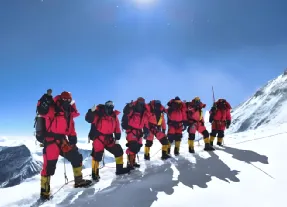 In 2020, a third team returned to Qomolangma to measure13. its/it height—8,848.86 metres.
Climbing Qomolangma is dangerous. Some climbers reach the top 14.successful/successfully, but many fail. Why do people still risk their 15.lives/life to climb the highest mountain in the world? It is because human curiosity and ambition cannot be stopped. Or, as the English explorer George Mallory put it, it is 16.simple/simply “because it’s there”!
1. To reach the top of Qomolangma, one needs both a strong body and a strong mind.TF
2. The climber Gong Bu helped his teammates go past the Second Step.TF
3. More than one Chinese team used the “Death Road” to reach the top of Qomolangma.TF
4. Two Chinese teams reached the top of Qomolangma in 1975.TF
5. Climbers first started to use the “Chinese Ladder” in 2007.TF
Read the advertisement,and find the mistakes(5 in total)in it.

The Great Barrier Reef:
An Amazing Underwater World
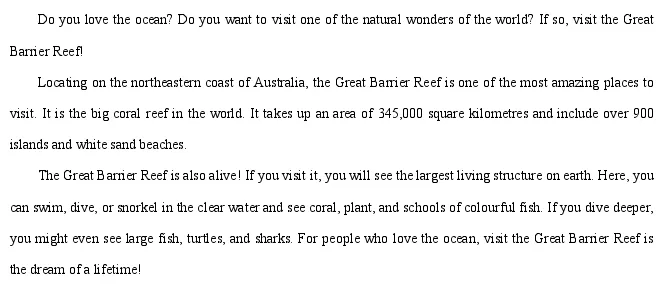
1._______________2._______________3._______________4._______________5._______________
Complete the passage with the correct forms of the words in the box.
deepenvironmentsurvivewonderfulsurfacedive
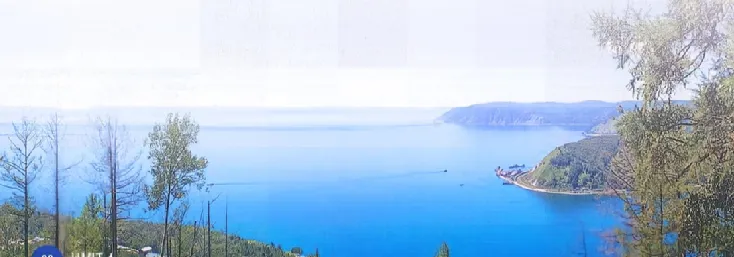 Located in Siberia, Russia, Lake Baikal is one of the world’s most famous lakes. It is the ____________ freshwater lake in the world. To reach the bottom, you must ____________ 1,620 metres! It is also larger than most other lakes. Its ____________ covers 31,500 square kilometres. That is bigger than the country of Belgium! Lake Baikal is very cold for most of the year. But over 1,200 different types of animals can still ____________ in this ____________. Today, the lake still attracts many curious travellers. After all, it is a great natural ____________!
Part 3Grammar
✿ wonder的常见用法:

Exercises:
1. The Great Wall is one of the greatest ____________ (wonder)in the world.
2. It’s a ____________ (wonder)that he got full marks in the exam.
3. I wonder if he ____________ (arrive) here on time tomorrow.
4. She wondered what _____________ (happen) to the little boy just now.
5. It's a wonder that he _____________ (finish) such hard work in two days.
6. We all wonder ______________(how/what) we can get to the station before the train leaves.
7. How _____________ (wonder)the music is! I want to listen to it again.
8. The little girl wondered who ____________ (take) her toy car away when she cried.
 ✿ “东南西北”的表达:

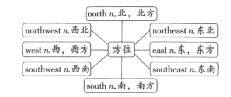
 ✿ 介词above/over/on; below/under:

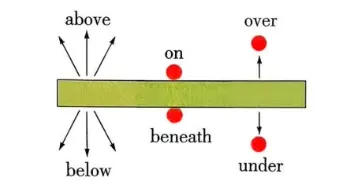 Exercises:
判断句中的介词用法是否正确,若不对,请改正。
1.The temperature in Harbin is often fifteen degrees under zero in January.__________
2.A huge eagle flew above the forest and disappeared in the distance a few minutes later.__________
3.There is a modern bridge on the Yangtze River in Wuhan, which is very famous.__________
4.The plane flew under the clouds and headed to the south quickly.__________
5.The little boy likes to keep some snacks under the pillow so that he can eat them at night.__________
 ✿ 大数的表达和读法:

 ✿ 4组超重点单词:

Exercises:
单词正确形式填空。
1. The little boy has a strong __________________ about how the birds can fly freely in the sky. (curious)
2. Luckily, all the local people __________________ the heavy storm with the timely help of the government. (survive)
3. You will risk__________________ the important competition if you refuse to practice hard now. (lose)
4. Our city museum is__________________ in the center of the street, and it __________________ many ancient artworks that attract lots of visitors. (locate; include)
5. It’s very __________________ to drive fast on the wet road after rain, so please slow down. (risk)
6. The __________________ of the small village is hard to find, but its quiet scenery attracts quite a few travelers. (locate)
7. This big factory, __________________ three small workshops, is located near the river at the bottom of the hill. (include)
8. The doctors tried their best to help the __________________ of the accident live through the difficult time. (survive)
9. She __________________ her own safety to save the little cat from the tall tree yesterday afternoon. (risk)
10. Don’t take unnecessary __________________ when you go hiking in the mountain alone. (risk)
Part 4基础过关
一、请根据所给的首字母或音标写出单词,使句子意思完整正确。
1. The diver went b________________ the boat to check the ropes under the water.
2. The tables’ s________________ were very clean.
3. The water l________________ in the pool rose after the heavy rain.
4. Sally ______________ /rɪ'sɜːtʃ/ many books before she wrote her report.
5. They found a strange stone at the _______________ /'bɒtəm/ of the lake.
6. The school is planning a new sports field for the d_______________ of students.
7. Many animals in hot d_______________ need to travel far to find water.
8. These special glasses can help p_______________ your eyes from strong sunlight.
9. The workers _______________ /'kærid/ heavy stones to build the new bridge.
10. We saw some _______________ /'eɪnʃənt/ paintings on the walls of the cave.
11. The temperature dropped to five d_______________ last night.
12. The car is in a very good c_______________ even though it is ten years old.
13. She carried two bags on her left _______________ /'ʃəʊldə(r)/ as she walked home.
14. People in the _______________ /'nɔːðən/ part of the country often see snow in winter.
二、请根据句子意思,用括号中所给单词的适当形式填空。
1. The _______________ (deep) of the lake is hard to measure.
2. It is _______________ (usual) to see snow in China in the summer.
3. This hill is the _______________ (low) one in our neighbourhood. It is only 1 metre high.
4. Children have many different _______________ (ability) to learn new things.
5. The coach _______________ (dive) into the pool to show us how to do it correctly yesterday.
6. The restaurant is as _______________ (close) as the post office, just next door.
7. [2025 青海西宁期末]The lake is much _______________ (deep) after the heavy rain.
8. That was the _______________ (amazing) painting in the whole museum.
9. It is one of the biggest _______________ (pool) in this city.
10. [2025 甘肃白银期末]The school is _______________ (locate) near the city park.
11. The Great Wall is a famous _______________ (attract) and many people visit it every year.
12. There are many old _______________ (structure) in this city, and they tell us past stories.
13. [2025 河北邯郸期末]The book _______________ (include) many interesting stories and beautiful pictures and sells well.
14. Lucy is very curious _______________ (watch) the stars and planets.
15. Climbing without safety gear(设备)is very _______________ (risk).
16. [2025 黑龙江绥化期末]The _______________ (south) coast of the country has many beautiful beaches.
17. Lots of _______________ (travel) visit the city during the holiday season.
Part 5能力提升
一、12选10。
itabovesafecomechangeriskytakenaturetemperatureeggbuildacross
Lake Natron is a lake in Tanzania, East Africa. Its water is red, and the lake is one of the saltiest lakes in the world. The red colour 1._______________ from salt-loving organisms (生物) called halophiles. This is a (n) 2._______________ wonder, but also dangerous to many living things.
Lake Natron is very hot. And 3._______________water can reach 60℃. The lake’s high salt levels can burn skin and even damage (损害) eyes. That’s why many animals cannot live here. But one special bird, the flamingo, loves this lake. It 4._______________ nests on the salt islands. Every year, thousands of flamingos come here to lay 5._______________ eggs and raise their chicks. The lake gives them a (n) 6._______________ home, because few animals can reach their nests.
The lake’s beauty is 7._______________ . Sometimes it looks red, sometimes pink, and sometimes silver or orange. This depends on the sunlight, 8._______________ , and algae (藻类) in the water. Its colours change throughout the day and 9._______________seasons. Strong winds can also change the shape of the salt crusts.
People must be careful here. Walking near the lake is 10._______________ . The salt crust can break, and people can fall into the hot, salty water. The air around the lake sometimes smells terrible because of chemicals in the water. Still, it is a magical place to visit and study, especially for scientists and photographers.
二、六选五。
People are familiar with the ancient Silk Road,but not everyone knows about the Hexi Corridor and the Qilian Mountains. __1__
Northwest China’s climate is mostly dry and desert-like. __2__ The Hexi Corridor was an important part of those people’s journey and made their journey less difficult because it connected oases (绿洲) along the way. Until now, it is still an important place.
Since ancient times, the Qilian Mountains have been the most important water provider in the Hexi Corridor. There are over 1,000 km² of glaciers (冰川). The glaciers provide water for people in the Hexi Corridor. __3__ The glaciers’ change has a big influence on the development of the area.
__4__ But due to human activities, the environment there was once in a bad situation, and the number of plants and animals dropped dramatically (显著地).
In order to protect the Qilian Mountains, the government made a plan to build a national park. __5__ Now there are more wild animals living there again.
 A. The Qilian Mountains are also home to many plants and animals.
B. With the help of local people and scientists, the environment became much better.
C. However, these glaciers are getting smaller rapidly because of climate change nowadays.
D. Such an environment made it very difficult for the ancient Chinese to travel to the West.
E. Many ancient traders travelled through the Hexi Corridor and left behind amazing stories.
F.They are two of the important parts of the ancient Silk Road.
Part 6时文阅读
话题:唐太宗种下的银杏树至今生机勃勃
 In China’s ancient capital Xi’an, there is a millennium-old ginkgo tree 1.________ in the Old Guanyin Temple.
Every late autumn, its leaves turn bright yellow, which makes the tree look like 2.________ a "golden coat". When watched from a distance, the old ginkgo tree shines brilliantly and looks like being adorned with countless strings of golden firecrackers. As a result, it attracts a lot of tourists from home and 3.________ every year.
What’s more mysterious about this ginkgo tree is that it is said to be personally planted by Emperor Taizong of the Tang Dynasty, and it remains lush and full of 4.________ after 1,400 years.
The ginkgo tree is one of China’s famous ancient trees and one of the oldest tree 5.________ in the world. The earliest discovered fossils of this type of tree 6.________ back to around 300 million years ago, which is why this tree is also known as a "living 7.________ ".
Though there are many ginkgo trees, ancient ginkgo trees are quite 8.________ . The fruits they bear, known as "white nuts", have much higher nutritional value compared 9.________ ordinary ginkgo nuts, making them very precious. Like giant pandas, 10.________ are considered "national treasure" of China as well.
()1. A. livedB. locatedC. grownD. watered
()2. A. wearingB. makingC. buyingD. designing
()3. A. schoolB. parkC. abroadD. city
()4. A. vitalityB. waterC. fruitD. leaves
()5. A. namesB. speciesC. agesD. colors
()6. A. goB. keepC. dateD. turn
()7. A. animalB. fossilC. plantD. tree
()8. A. commonB. rareC. tallD. small
()9. A. toB. withC. forD. on
()10. A. weB. youC. itD. they
☛ Grammar
Lesson 1过去进行时
定义:表示过去某一时刻或某一段时间内正在进行的动作,强调动作在过去的某个时间点处于“进行中”的状态。
时间标志词/短语 |
1. 具体时间点:at 8 o’clock yesterday morning(昨天早上8点)、at this time last night(昨晚这个时候) 2. 时间段:from 7 to 9 yesterday evening(昨天晚上7点到9点)、all morning yesterday(昨天整个上午) 3. 时间状语从句:when + 一般过去时句子(当……的时候)、while + 过去进行时句子(在……期间) 4. 其他:just then(就在那时)、at that moment(在那一刻) |
动词形式(结构) |
句式 | 结构 | 例句 |
肯定句 | 主语+was/were+动词-ing形式+其他 | I was reading a book at 8 last night.(昨晚 8 点我正在看书。) They were playing football on the playground yesterday afternoon.(昨天下午他们正在操场上踢足球。) |
否定句 | 主语+was/were+not+动词-ing形式+其他 | She wasn’t watching TV when I called her.(我给她打电话时,她没在看电视。) |
一般疑问句 | Was/Were+主语+动词-ing形式+其他? 回答:Yes, 主语 + was/were./ No, 主语 + wasn’t/weren’t. | —Were you cooking dinner at 6 p.m yesterday.?(昨天下午 6 点你在做晚饭吗?) —Yes, I was. / No, I wasn’t. |
特殊疑问句 | 特殊疑问词+was/were+主语+动词-ing形式+其他? | What was he doingwhen the rainstorm came?(暴风雨来的时候他在做什么?) |
主要用法 |
用法和说明 | 例句 |
表示过去某一时刻正在进行的动作 | He was writing an email at 10 o’clock yesterday.(昨天10点他正在写邮件。) |
表示过去某一段时间内持续进行的动作 | They were traveling in Europe last month.(上个月他们一直在欧洲旅行。) |
表示两个过去同时进行的动作(常用 while 连接,两个动作都用过去进行时;也可用 when 连接,一个用一般过去时,一个用过去进行时。) | While I was listening to music, my sister was drawing a picture.(我听音乐时,妹妹在画画。) I was walking in the street when I met an old friend.(我在街上走的时候遇到了一位老朋友。) |
表示过去即将发生的动作(少数移动性动词,如go, come, leave等) | She was leaving for Shanghai the next day.(她第二天就要动身去上海了。) |
用于故事开头,描述背景或营造氛围 | The wind was blowing hard and the rain was falling heavily. A little girl was walking in the street alone.(风刮得很大,雨下得很猛,一个小女孩独自走在街上。) |
| | |
Exercises:
单项选择。
()1. —Tim, why didn’t your brother come to watch your show?
—Because he ______ an important test at that time.
A. takeB. will takeC. is takingD. was taking
()2. —Why didn’t you answer my phone last night?
—Sorry. I ______ an old friend and we ______ all the time.
A. have met; are talkingB. met; talk
C. met; are talkingD. met; were talking
()3. —Why are you so worried, Xiao Lei?
—Because I ______ extra(额外的) lessons the whole holiday and I haven’t finished my homework.
A.was attendingB. attended
C. have attendedD. attend
()4. When she arrived at the airport, it was early morning and it ______.
A.has snowedB. was snowing
C. is snowingD. snowed
()5. Tim Cook called his mother every week even while he ______ around the world.
A. travelsB. traveledC. is travelingD. was traveling
()6. —Hi, Ethan. I called you at 8:00 last night, but you didn’t answer.
—Sorry, I ______ the dishes.
A. washB. washedC. am washingD. was washing
()7. When I saw Xiao Wang yesterday, he ______ an old man cross the road.
A. helpsB. was helpingC. will help
()8. —How did the accident happen yesterday?
—A boy ______ games on the phone while walking across the street.
A. playsB. playingC. was playing
()9. We ______ on the countryside road when a sudden storm hit, so we made our way back.
A.joggedB. were joggingC. have joggedD. will jog
()10. I didn’t sleep well. My sister ______ TV all night. That was too noisy.
A. watchesB. has watchedC. was watchingD. will watch
()11. The students ______ the floor when the teacher came into the classroom.
A. cleanB. cleanedC. were cleaningD. will clean
()12. —I sent you a message on WeChat just now, but you didn’t reply.
—Oh, Sorry. I ______ my homework.
A. doB. am doingC. was doing
()13. My sister ______ a kite in the park happily this time yesterday.
A.was flyingB. flew
C. had flownD. would fly
()14. Sorry, I missed your phone. I ______ and I didn’t hear it.
A.was cookingB. am cooking
C. cookD. have cooked
()15. —I watched the basketball match between China and America on TV last night. It was so exciting.
—What a pity! I ______ for my report at that time.
A.will prepareB. am preparing
C. preparedD. was preparing
Lesson 2现在完成时
定义 |
已完成用法 | 表示过去发生的动作对现在造成的影响或结果 |
未完成用法 | 表示过去开始的动作或状态持续到现在,可能还会继续 |
动词形式(动词过去分词不规则变化见附页) |
句式 | 结构 | 例句 |
肯定句 | 主语 + have/has + 动词过去分词(done)+ 其他 | I have finished my homework. (我已经做完作业了。) She has lived here for 5 years. (她在这里住了5年了。) |
否定句 | 主语 + have/has + not + 动词过去分词 + 其他(have not缩写为haven’t;has not缩写为hasn’t) | They haven’t seen this movie. (他们没看过这部电影。) |
一般疑问句 | Have/Has + 主语 + 动词过去分词 + 其他? 回答:Yes, 主语 + have/has. / No, 主语 + haven’t/hasn’t. | —Has he arrived at school? (他到学校了吗?) —Yes, he has.(是的,他已经到了) |
特殊疑问句 | 特殊疑问词 + Have/Has + 主语 + 动词过去分词 + 其他? | What have you donesince morning? (从早上到现在你做了什么?) |
“已完成”用法 |
核心用法 | 动作发生在过去,已结束,但动作产生的影响或结果延续到现在。 |
时间标志词/短语 | already(肯定句)、yet(否定 / 疑问句)、just、ever、never、before、once、twice、several times |
例句 | I have justfinished my homework.(动作已完成,结果是现在可以休息了) She has never been to Beijing.(动作未发生,结果是现在仍没去过北京) Haveyouseen this film yet?(询问动作是否完成,影响是是否了解剧情) |
“未完成”用法 |
核心用法 | 动作发生在过去,已结束,但动作产生的影响或结果延续到现在。 谓语动词需为延续性动词(非延续性动词需转换后才能用);常搭配for/since等表持续的标志词。 |
时间标志词/短语 | for + 时间段(for 3 years)、since + 时间点/一般过去时句子(since 2019;since she came here)、so far、up to now、till now、recently、in the past few years |
例句 | We have lived in this city for 10 years.(住的动作从10年前开始,持续到现在) He has studied English since he was 6.(学英语从6岁开始,持续至今) My mother has worked in the hospital since 2018.(工作动作2018年起步,延续到现在) |
延续性动词与非延续性动词的转换 |
说明 | 非延续性动词(die/buy/borrow/join等)不能接for/since,需转换为对应延续性形式 |
举例 | buy → have;borrow → keep;die → be dead;join → be in/be a member of等。(转化清单见附页) 错误:He has bought the book for 2 years.正确:He has had the book for 2 years. |
现在完成时与一般过去时的辨析 |
说明 | 现在完成时:侧重现在的影响/持续的状态,不接具体过去时间点; 一般过去时:侧重过去的动作本身,接具体过去时间(yesterday/last week等); |
举例 | He has eaten breakfast.(结果:现在不饿); He ate breakfast at 7 a.m.(仅陈述过去7点吃早餐的动作) |
固定句型搭配 |
搭配 | 举例 |
have/has been to (去过某地,已返回;可接次数,可与ever/never连用) | I have been to Beijing twice.(我去过北京两次。) She has never been to this park.(她从没去过这个公园。) |
have/has gone to (去了某地,未返回;后不接时间段) | My father has gone to Shanghai.(我爸爸去上海了。) The students have gone to the library.(学生们去图书馆了。) |
have/has been in (在某地待了多久,现在仍在该地;后接时间段) | He has been in London for 3 years.(他在伦敦待了 3 年了。) They have been in this school since 2022.(他们从 2022 年就在这所学校了。) |
| | | |
Exercises:
一、按要求变换词形。
1.watch(现在分词) | 2.study(现在分词) |
3.fall(过去式) | 4.drive(现在分词) |
5.become(过去分词) | 6.write(过去分词) |
7.hear(过去式) | 8.broken(原形) |
9.read(过去分词) | 10.play(第三人称单数) |
二、改错。
1.What have you done yesterday?
2.I have been to the island two years ago.
3.I have studied English since six years.
4.He has lived in the city ten years ago.
5.The manager has arrived here for two days.
三、单项选择。
()1. Alex ______ tea culture since he came to China in 2010.
A. StudiesB. studiedC. has studiedD. was studying
()2. The astronauts of the Shenzhou-18 ______ in the Tiangong space station for about two months since they were sent into space in April this year.
A. will workB. have workedC. is working
()3. —Wow! There are thousands of old coins in your house.
—My grandpa is a big fan of them. He ______ over 4,000 old coins and he is still doing it.
A. will collectB. was collectingC. is collectingD. has collected
()4. —I miss Bill very much as we haven’t seen each other ______ two years.
—Me, too. Whenever I see the photo, it reminds me ______ the happy days we spent together.
A. in; withB. for; ofC. on; inD. from; for
()5. —Would you like something to eat, Mr. Song?
—No, thanks. I’m not hungry. I ______ some zongzi already.
A. EatB. ateC. have eaten
()6. —Would you like a piece of beef, Alice?
—No, Thank you. I ______ two pancakes. I’m full up.
A. HaveB. have hadC. will haveD. am having
()7. —Oh hi, I’m looking for a pair of shoes.
—Well, you ______ to the right place. We have a lot of shoes in our shop.
A. cameB. were comingC. will comeD. have come
()8. —This old book brings so many sweet memories.
—Yes! I ______ it since my first time to school.
A. have boughtB. hadC. have hadD. bought
()9. —The book is worth reading. How long may I ______ it?
—______ a week.
A. keep, ForB. borrow,ForC. lend,In
()10. Li Dong and Zhang Ming ______ friends since they met in 2000.
A. MadeB. have beenC. have madeD. have become
()11. —I’m sorry for being late.
—Never mind. The movie ______ for only 5 minutes.
A. has begunB. has been onC. have begunD. began
()12. —When did your uncle leave his hometown?
—He ______ for nearly twenty years.
A. has leftB. has been awayC. leftD. had been away
()13. —Lucy, where is Mr. Wang?
—He ______ Beijing to attend a meeting.
A. has gone toB. has been toC. has been in
()14. Hurry up! The movie ______ for ten minutes.
A. has begunB. beganC. has been on
()15. —Cathy, the film Nezha 2 is very hot this year. I have watched it three times.
—Me too. This is the best film I ______ this year.
A. WatchB. have watchedC. watchedD. will watch
()16. Mr. Green ______ China for five years.
A. has been toB. has gone toC. has been inD. has come to
()17. —Have you ever ______ the Great Wall?
—Yes, I have. I went there on our last school trip.
A. been toB. gone toC. been in
()18. —May I speak to Wang Hong?
—Sorry, she is not at home. She ______ to Beijing.
A. has beenB. has to goC. has gone
附页:
动词过去式及过去分词不规则变形清单(共90个)
A—A—A 型(共9个) |
cost—cost—cost花费 | cut—cut—cut切 | hit—hit—hit打 |
hurt—hurt—hurt受伤 | let—let— let让 | read—read—read阅读 |
put—put—put放 | set—set—set设置 | shut—shut—shut关闭 |
A—B—B 型(共38个) |
过去式和过去分词都含有-ought(3个) |
bring—brought—brought带来 | buy— bought—bought买 | think—thought—thought认为 |
词尾有-ild ,-end 时,只需把 d 变为 t(4个) |
build—built—built修建 | lend—lent— lent借出 | send—sent—sent寄,派遣 |
spend—spent— spent花 | | |
过去式、过去分词都含有-aught(2个) |
catch—caught—caught抓 | teach—taught—taught教 | |
-eep 变为-ept(3个) |
keep—kept—kept保持 | sleep—slept—slept睡觉 | sweep— swept—swept打扫 |
把-ell 变为-old(2个) |
tell—told—told告诉 | sell—sold—sold卖 | |
过去式、过去分词都含有-elt 或-ilt(3个) |
smell—smelt—smelt闻 | spell—spelt—spelt拼写 | feel—felt— felt感觉 |
过去式、过去分词都在原形词尾加 t(2个) |
learn—learnt—learnt学习 | mean—meant—meant意思是 | |
过去式、过去分词词尾是 d(4 个) |
say—said—said说(+内容) | pay—paid—paid付钱 | lay—laid—laid放置 |
hear—heard—heard听 | | |
改变元音字母(10个) |
meet—met—met遇见 | get—got—got得到,到达 | sit—sat—sat坐 |
find— found—found发现 | hold—held—held举办 | shine— shone—shone发光 |
win—won—won赢 | hang—hung—hung悬挂 | dig— dug—dug挖 |
lose—lost—lost丢失 | | |
改变辅音字母(1个) |
make—made—made制作,让 | | |
改变元、辅音字母(4 个) |
leave—left—left离开,遗留 | stand—stood—stood站 | have(has)— had—had有 |
understand—understood—understood理解 | | |
A—B—C 型,即原形、过去式、过去分词都不相同(共35个) |
i—a—u 变化(6 个) |
begin—began—begun开始 | drink—drank—drunk喝 | sing— sang—sung唱歌 |
ring—rang—rung打电话,嗡嗡作响 | swim—swam—swum游泳 | sink— sank—sunk下沉 |
词尾为-ow ,-aw 时,过去式将其变为-ew,过去分词在其原形后加 n(5 个) (show 除外) |
blow—blew—blown吹 | draw—drew—drawn画画 | grow— grew—grown生长 |
know—knew—known知道 | throw—threw—thrown扔 | |
词尾为“i+辅(1个) +e”,过去式将 i 变为o,过去分词多在原形后加 n,若那个辅音字母为 d 或 t,须双写 d 或 t 后加 n(4 个)(give ,hide 除外) |
drive—drove—driven驾驶 | write—wrote—written写 | ride— rode—ridden乘骑 |
rise—rose—risen上升 | | |
过去分词在过去式后加(e)n(5 个) |
break—broke—broken破坏 | choose—chose—chosen选择 | freeze—froze—frozen结冰 |
speak—spoke—spoken说 | wake—woke— woken醒来 | |
过去分词由过去式加-ten 构成(1个) |
forget—forgot—forgotten忘记 | | |
过去分词由原形加(e)n 构成(6 个) |
be—was(were)—been是 | eat—ate—eaten吃 | fall—fell—fallen落下 |
give—gave—given给 | see—saw—seen看见 | hide—hid—hidden(hid)躲 |
词尾为-ake 时,过去式将其变为-ook,过去分词在原形词后加-n(2 个) |
take—took—taken带去 | mistake—mistook—mistaken犯错 | |
原形、过去式和过去分词都不相同(6 个) |
do—did—done做 | fly—flew—flown飞 | go—went—gone走,去 |
lie—lay—lain躺 | show—showed—shown展示 | wear—wore—worn穿 |
A—A—B 型,即过去式和原形相同(共1个) |
beat—beat—beaten敲击,击败 | | |
A—B—A 型,即过去分词和原形相同(共3 个) |
come—came—come来 | become—became—become成为 | run— ran—run跑 |
情态动词型,只有原形和过去式,没有过去分词(共4 个) |
can—could | will—would | shall—should |
may—might | | |
附页2:
非延续性动词→延续性动词对应转化清单
表开始 / 终止类(瞬间启动或停下动作,转持续状态 / 动作) |
begin/start(开始)→ be on(进行中)/be doing(持续做) | finish/end(结束)→ be over(完结状态) |
open(打开)→ be open(保持打开) | close(关闭)→ be closed(保持关闭) |
stop(停止动作)→ be over(动作终止状态) | |
表到达 / 位移类(瞬间完成位置变动,转持续所处位置状态) |
arrive (at/in)/reach/get to(到达)→ be in/at(身处某地) | leave(离开)→ be away(离开状态)/be away from(离开某地) |
go to(去某地)→ be in/at(待在某地) | come to(来某地)→ be here/there(待在对应地点) |
move to(搬去)→ be in(居于该地)/live in(定居该地) | set off(出发)→ be on the way(处于途中状态) |
表拥有 / 得失类(瞬间获得、丧失或变动所属,转持续保有 / 缺失状态) |
buy(买)/sell(卖)→ have(持有) | get/receive(得到 / 收到)→ have/keep(持有 / 留存) |
lose(丢失)→ be lost(丢失状态)/not have(持续无) | borrow(借入)/lend(借出)→ keep(持续借有) |
die(死亡)→ be dead(死亡状态) | become(成为)→ be(持续维持该身份 / 状态) |
表状态转变类(瞬间切换身心 / 事物状态,转持续维持该状态) |
join(加入组织 / 团队)→ be in(隶属于)/be a member of(作为成员) | marry(结婚)→ be married(已婚状态) |
fall asleep(入睡)→ be asleep(睡眠状态) | wake up(醒来)→ be awake(清醒状态) |
turn off(关电器)→ be off(电器关闭) | turn on(开电器)→ be on(电器开启) |
catch a cold(感冒)→ have a cold(感冒状态) | |
表接触 / 破损类(瞬间发生接触、碰撞或破损,转持续关联 / 受损状态) |
meet(遇见)→ know(持续认识) | break(打碎)→ be broken(处于破碎状态) |
hurt(受伤)→ be hurt(处于受伤状态) | |
后台回复:八年级下册