读外刊,接触原汁原味的英文表达,
欢迎关注以下公众号+设为星标+推荐给朋友。▼
📚 狂暴英语教案 · 新概念英语第一册
第29-30课 Come in, Amy & What must I do?
进来,艾米 / 我必须做什么?
📘 本课信息教材:新概念英语第一册 · 第29-30课核心功能:家务指令 · 询问职责 · 必要性表达语法焦点:祈使句 · 情态动词must · 肯定与否定指令
🎯 本课学习目标
词汇:
掌握与家务、指令相关的核心动词(如 shut, air, put, take, dust, sweep, empty, read, sharpen, make, open)及形容词(如 untidy)。理解并运用"must"表达必要性。
语法:
系统掌握祈使句(肯定与否定形式)的构成与用法;深入理解情态动词"must"表示"必须"的用法及其与"can"的区别。
技能(日常对话):
能够听懂并发出清晰的日常指令;能够描述并询问在特定情境下"必须"做的事情;提升在家庭或简单工作场景中的基础交流能力。
文化:
初步了解英国家庭中关于整洁、责任的基本规范,以及使用祈使句和"must"时所体现的礼貌层级(从直接命令到必要性的陈述)。
📖 第一部分:课文完整内容
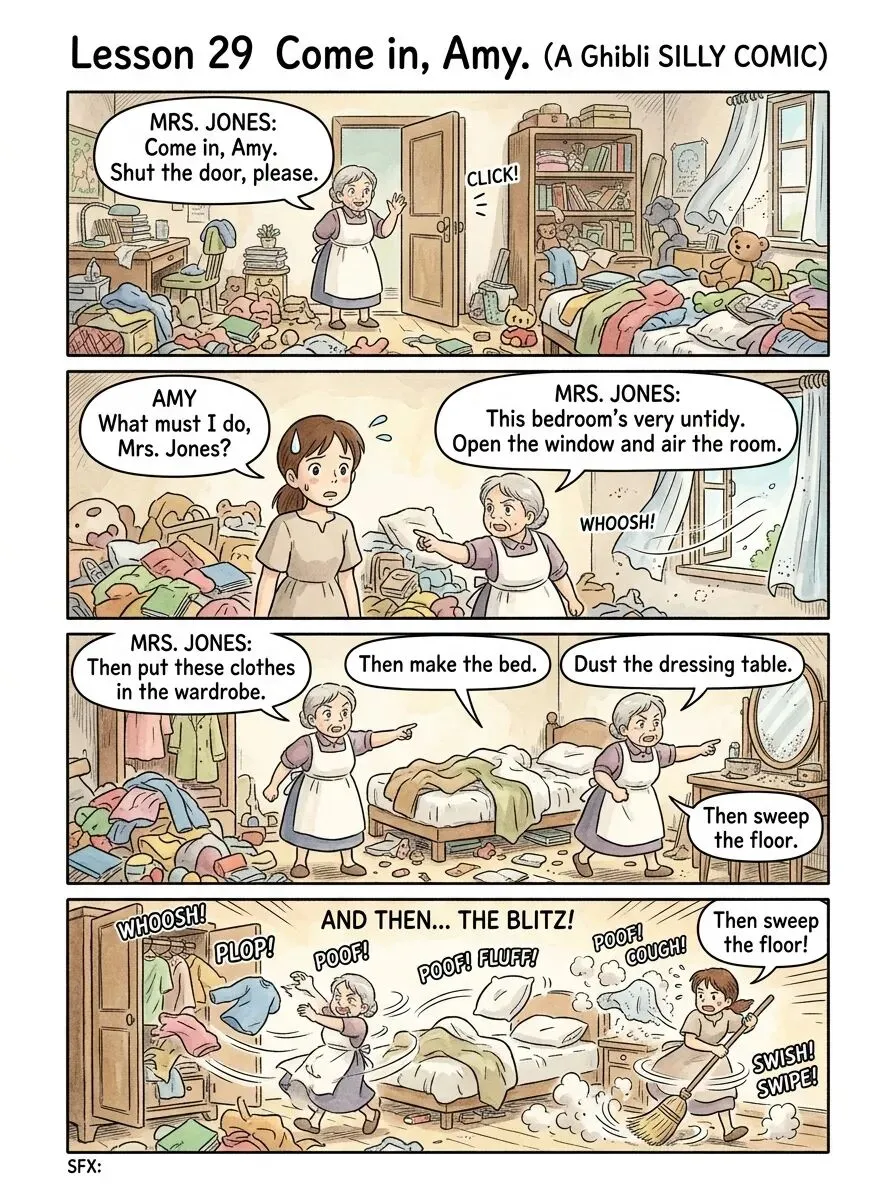
情景说明:本课场景发生在琼斯夫人(Mrs. Jones)的家中,很可能是Amy(可能是她的孩子、房客或帮忙的人)的房间。琼斯夫人进入一个非常凌乱(untidy)的卧室,随即给出一系列清晰、连贯的指令,指导Amy如何整理房间。对话体现了英国家庭中长辈对晚辈或雇主对帮手在布置任务时的典型方式:直接、有序、使用祈使句和"must"来表达必要性和权威性。
Lesson 29 Come in, Amy.
📜 课文原文(含语音标注)
MRS. JONES: Come in, /kʌm ɪn/ Amy.
琼斯夫人:进来,艾米。
MRS. JONES: Shut the door, /ʃʌt ðə dɔː(r)/ please.
琼斯夫人:请把门关上。
MRS. JONES: This bedroom's very untidy. /ðɪs ˈbedruːmz ˈveri ʌnˈtaɪdi/
琼斯夫人:这卧室太不整洁了。
AMY: What must I do, /wɒt mʌst aɪ duː/ Mrs. Jones?
艾米:我该做些什么呢,琼斯夫人?
MRS. JONES: Open the window /ˈəʊpən ðə ˈwɪndəʊ/ and air the room. /ənd eə(r) ðə ruːm/
琼斯夫人:打开窗户,给房间通通风。
MRS. JONES: Then put these clothes /ðen pʊt ðiːz kləʊðz/ in the wardrobe. /ɪn ðə ˈwɔːdrəʊb/
琼斯夫人:然后把这些衣服放到衣柜里去。
MRS. JONES: Then make the bed. /ðen meɪk ðə bed/
琼斯夫人:再把床铺好。
MRS. JONES: Dust the dressing table. /dʌst ðə ˈdresɪŋ ˈteɪbl/
琼斯夫人:掸掉梳妆台上的灰尘。
MRS. JONES: Then sweep the floor. /ðen swiːp ðə flɔː(r)/
琼斯夫人:然后扫扫地。
语音要点: Come in 可轻微连读,语调降调;Shut the 中 shut 的 /t/ 与 the 连接;bedroom's 为缩读;Open the 连读;and air 连读;put these 中 /t/ 与 /ð/ 过渡;in the 连读;make the 连读;dust the 连读;sweep the 连读。
Lesson 30 What must I do?
📜 课文原文(含语音标注)
What must I do? /wɒt mʌst aɪ duː/
我必须做什么?
You must ... /juː mʌst/
你必须......
Shut the door! /ʃʌt ðə dɔː(r)/
关上门!
Open the window! /ˈəʊpən ðə ˈwɪndəʊ/
打开窗户!
Put on your shirt! /pʊt ɒn jɔː(r) ʃɜːt/
穿上你的衬衫!
Take off your shoes! /teɪk ɒf jɔː(r) ʃuːz/
脱掉你的鞋子!
Turn on the light! /tɜːn ɒn ðə laɪt/
打开灯!
Turn off the tap! /tɜːn ɒf ðə tæp/
关掉水龙头!
Sweep the floor! /swiːp ðə flɔː(r)/
扫地!
Clean the blackboard! /kliːn ðə ˈblækbɔːd/
擦黑板!
Dust the cupboard! /dʌst ðə ˈkʌbəd/
掸掉碗柜上的灰尘!
Empty the basket! /ˈempti ðə ˈbɑːskɪt/
清空篮子!
Read this magazine! /riːd ðɪs ˌmæɡəˈziːn/
读这本杂志!
Sharpen these pencils! /ˈʃɑːpən ðiːz ˈpenslz/
削这些铅笔!
情景说明:第30课通过图片和句型替换练习,巩固第29课所学的"must"和祈使句。它模拟了多种需要发出指令的日常场景,如穿衣、使用电器、打扫卫生、学习等。练习旨在训练学习者快速理解"必须做什么"的指令,并能用"You must..."或直接祈使句进行回应或转述,将语言从理解转化为主动输出。
📑 参考译文
第29课:进来,艾米。琼斯夫人:进来,艾米。琼斯夫人:请把门关上。琼斯夫人:这卧室太不整洁了。艾米:我该做些什么呢,琼斯夫人?琼斯夫人:打开窗户,给房间通通风。琼斯夫人:然后把这些衣服放到衣柜里去。琼斯夫人:再把床铺好。琼斯夫人:掸掉梳妆台上的灰尘。琼斯夫人:然后扫扫地。
第30课:我必须做什么?我必须做什么?你必须......关上门!打开窗户!穿上你的衬衫!脱掉你的鞋子!打开灯!关掉水龙头!扫地!擦黑板!掸掉碗柜上的灰尘!清空篮子!读这本杂志!削这些铅笔!
🔍 第二部分:逐句精讲
句子1 (L29)
原文: Come in, Amy.
翻译: 进来,艾米。
句子结构: 祈使句。省略主语you,动词原形Come + 状语in + 呼语Amy。
重点词汇:
come 蓝思值 10L以下
英音 /kʌm/ 美音 /kʌm/ 词性:vi.
释义:来;来到;到达。
常用语块:come in (进来);come on (加油;得了吧);come from (来自);come back (回来)
例句一:Please come here. 请到这儿来。
例句二:Spring comes after winter. 冬去春来。
拓展:come是一个非常基础且多义的核心动词。其过去式是came,过去分词是come。在祈使句中直接使用原形,表示命令、邀请或建议。
语法点睛: **祈使句 (Imperative Sentences)** 用于发出命令、请求、建议或邀请。其基本结构是省略主语you,直接以动词原形开头。本句是典型的表示"邀请/允许进入"的祈使句。在礼貌场合,常与please连用。来源 [NCE知识点笔记]
语音要点: Come in 可以产生轻微的连读,/kʌm/ 和 /ɪn/ 之间自然过渡。语调通常为降调,表示肯定的指令。呼语Amy用平调或轻微升调,以引起对方注意。
句子2 (L29)
原文: Shut the door, please.
翻译: 请把门关上。
句子结构: 祈使句。动词原形Shut + 宾语the door + 礼貌语please。
重点词汇:
shut 蓝思值 50L
英音 /ʃʌt/ 美音 /ʃʌt/ 词性:vt./vi.
释义:关上,关闭;合拢。
常用语块:shut the door/window (关门/窗);shut up (闭嘴;关闭);shut down (关闭,停工)
例句一:Shut your eyes and go to sleep. 闭上眼睛睡觉吧。
例句二:The shops shut at 5:30 p.m. 商店下午五点半关门。
拓展:shut与close在表示"关闭"时常常互换,但shut语气更强烈、更直接,且通常不用于抽象意义的"关闭"(如关闭银行账户用close an account)。其过去式和过去分词均为shut。
语法点睛: 本句展示了祈使句与礼貌用语please的结合使用,使命令变得委婉客气。please可置于句首(Please shut the door.)或句末(Shut the door, please.),句末时常用逗号隔开。来源 [名师精讲]
语音要点: Shut the 中,shut的尾音/t/与the的/ðə/连接。please读作/pliːz/,语调轻柔,以示礼貌。
句子3 (L29)
原文: This bedroom's very untidy.
翻译: 这卧室太不整洁了。
句子结构: 主系表结构。This bedroom是主语,'s是is的缩写,系动词,very untidy是表语(very修饰untidy)。
重点词汇:
untidy 蓝思值 200L
英音 /ʌnˈtaɪdi/ 美音 /ʌnˈtaɪdi/ 词性:adj.
释义:不整洁的,凌乱的。
常用语块:an untidy room (凌乱的房间);untidy handwriting (潦草的字迹)
例句一:His desk is always untidy. 他的书桌总是乱七八糟。
例句二:Don't be so untidy with your clothes. 别把衣服弄得这么乱。
拓展:该词由前缀un-(表示否定)+ tidy(整洁的)构成。反义词是tidy。同义词有messy, disorderly。
语法点睛: 复习be动词(is)与形容词构成的主系表结构,用于描述事物的状态。very作为程度副词,修饰形容词untidy,加强语气。来源 [语法新思维]
语音要点: bedroom's 是bedroom is的缩读,/ˈbedruːmz/。very untidy中,very的/ˈveri/与untidy的/ʌnˈtaɪdi/之间略有停顿,强调程度。
句子4 (L29)
原文: What must I do, Mrs. Jones?
翻译: 我该做些什么呢,琼斯夫人?
句子结构: 特殊疑问句。What是疑问代词作宾语,must是情态动词,I是主语,do是实义动词,Mrs. Jones是呼语。
重点词汇:
must 蓝思值 10L以下
英音 /mʌst/ 美音 /mʌst/ 词性:modal v.
释义:必须;应当;一定(表示推测)。
常用语块:must do (必须做);must be (一定是)
例句一:You must finish your homework before dinner. 你必须在晚饭前完成作业。
例句二:She must be very tired after the long journey. 长途旅行后她一定很累了。
拓展:must没有时态和人称变化,后接动词原形。其否定形式是must not(缩写mustn't),表示"禁止、不准"。询问"必须做某事吗?"用Must I/you...?。来源 [NCE知识点笔记]
语法点睛: 本句引入了情态动词must表示"必要性"或"义务"的核心用法。What must I do? 是询问在特定情况下"我有什么责任或必须要做的事",语气正式且带有寻求指导的意味。来源 [名师精讲]
语音要点: What must I 可以连读为/wɒt mʌst aɪ/,must和I之间略有连接。整个句子用升调,表示疑问。呼语Mrs. Jones用平调。
句子5 (L29)
原文: Open the window and air the room.
翻译: 打开窗户,给房间通通风。
句子结构: 由and连接的并列祈使句,两个祈使分句。
重点词汇:
air 蓝思值 200L
英音 /eə(r)/ 美音 /er/ 词性:vt.
释义:使通风;晾干。
常用语块:air the room (给房间通风);air clothes/bedding (晾晒衣服/被褥)
例句一:I air the bedroom every morning. 我每天早上都给卧室通风。
例句二:She aired the quilt in the sun. 她把被子晒在太阳下。
拓展:air作动词是"通风"的意思,由名词"空气"转化而来。这是一种使动用法。同义词有ventilate。
open 蓝思值 10L以下
英音 /ˈəʊpən/ 美音 /ˈoʊpən/ 词性:vt./vi.
释义:打开;开启;开业。
常用语块:open the door/window/book (开门/窗/书);open a shop (开店)
例句一:Can you open the bottle for me? 你能帮我打开这个瓶子吗?
例句二:The museum opens at 9 a.m. 博物馆上午9点开门。
拓展:反义词是shut或close。open也可作形容词,意为"开着的;开放的"。
语法点睛: 祈使句可以用并列连词and连接,表示一系列连续或相关的动作指令。这种结构使指令听起来更有条理和计划性。来源 [语法新思维]
语音要点: Open the 连读为/ˈəʊpən ðə/。and air 连读为/ənd eə(r)/,and常弱读为/ən/。语调在window处用升调或平调,表示动作未结束,在room处用降调,表示指令完毕。
句子6 (L29)
原文: Then put these clothes in the wardrobe.
翻译: 然后把这些衣服放到衣柜里去。
句子结构: 祈使句,Then时间副词,put动词原形,these clothes宾语,in the wardrobe地点状语。
重点词汇:
put 蓝思值 10L以下
英音 /pʊt/ 美音 /pʊt/ 词性:vt.
释义:放,安置;表达。
常用语块:put sth. in/on/under... (把某物放在......里面/上面/下面);put on (穿上);put away (收起来)
例句一:Put the books on the shelf, please. 请把书放在架子上。
例句二:How can I put it in English? 这个用英语怎么说?
拓展:put是一个非常活跃的动词,与介词或副词搭配形成大量短语动词(phrasal verbs),如put up with(忍受),put off(推迟)。过去式和过去分词均为put。
wardrobe 蓝思值 400L
英音 /ˈwɔːdrəʊb/ 美音 /ˈwɔːrdroʊb/ 词性:n.
释义:衣柜,衣橱;(个人的)全部衣物。
常用语块:a built-in wardrobe (嵌入式衣柜);a summer wardrobe (夏季衣物)
例句一:She hung her dress in the wardrobe. 她把连衣裙挂在衣柜里。
例句二:He has a limited wardrobe. 他的衣服不多。
拓展:英式英语常用wardrobe,美式英语也常用closet表示衣柜。
语法点睛: Then用于连接顺序动作,使一系列指令在时间上具有连贯性。put... in...结构是"动词+宾语+介词短语"的典型,介词短语说明动作的方向或目的地。来源 [NCE知识点笔记]
语音要点: put these 中,put的尾音/t/与these的/ðiːz/有轻微爆破。in the 连读为/ɪn ðə/。
句子7-9 (L29)
原文: Then make the bed. / Dust the dressing table. / Then sweep the floor.
翻译: 再把床铺好。/ 掸掉梳妆台上的灰尘。/ 然后扫扫地。
句子结构: 三个连续祈使句,结构相同:(Then) + 动词原形 + the + 名词。
重点词汇:
make 蓝思值 10L以下
英音 /meɪk/ 美音 /meɪk/ 词性:vt.
释义:做,制造;整理(床铺);使得。
常用语块:make the bed (铺床);make a cake (做蛋糕);make sb. happy (让某人开心)
例句一:I make my bed every morning. 我每天早上都铺床。
例句二:This factory makes cars. 这家工厂制造汽车。
拓展:make是英语中最核心的动词之一,含义极其丰富。make the bed是固定搭配,指把床铺整理平整,并非"制造一张床"。
dust 蓝思值 300L
英音 /dʌst/ 美音 /dʌst/ 词性:v.
释义:掸去......的灰尘;撒粉末。
常用语块:dust the furniture (给家具除尘);dust with sugar (撒上糖)
例句一:She dusts the living room every weekend. 她每周末都给客厅除尘。
例句二:Dust the cake with cocoa powder. 在蛋糕上撒点可可粉。
拓展:dust作动词是由名词"灰尘"转化而来。相关工具有duster(掸子,抹布)。
sweep 蓝思值 250L
英音 /swiːp/ 美音 /swiːp/ 词性:v.
释义:扫,打扫;掠过。
常用语块:sweep the floor (扫地);sweep away (扫走);sweep over (席卷)
例句一:He is sweeping the leaves in the yard. 他正在院子里扫树叶。
例句二:A wave of sadness swept over her. 一阵悲伤掠过她的心头。
拓展:过去式和过去分词是swept。相关工具有broom(扫帚)。
dressing table 蓝思值 500L
英音 /ˈdresɪŋ ˈteɪbl/ 美音 /ˈdresɪŋ ˈteɪbl/ 词性:n.
释义:梳妆台。
例句:There is a mirror on the dressing table. 梳妆台上有一面镜子。
拓展:也可称为vanity table。是卧室家具的一种。
语法点睛: 这三句巩固了"Then + 祈使句"的序列指令模式,并引入了更多与家务劳动相关的及物动词(make, dust, sweep)。这些动词后直接接宾语,构成"动词+宾语"的简单祈使结构。来源 [名师精讲]
语音要点: make the 连读/meɪk ðə/;dust the 连读/dʌst ðə/;sweep the 连读/swiːp ðə/。每个句子都是降调,表示一个完整的指令单元。
📌 核心词块总结
1. Come in. – Used to invite or permit someone to enter a room or building. (用于邀请或允许某人进入房间或建筑物。) *例句:The door is open, so just come in.*
2. Shut/Open the window/door. – Basic instructions for closing or opening an entryway or ventilation point. (关闭或打开入口或通风点的基本指令。) *例句:It's cold outside, please shut the window.*
3. What must I do? – A polite way to ask for instructions or clarification about one's duties. (一种询问指令或澄清自身职责的礼貌方式。) *例句:The boss gave me this file. What must I do with it?*
4. Make the bed. – The specific action of arranging the sheets, blankets, and pillows neatly on a bed. (将床单、毯子和枕头在床上整理整齐的特定动作。) *例句:My mother always tells me to make my bed before leaving for school.*
5. Dust/Sweep the... – Instructions for cleaning surfaces (dusting) or floors (sweeping). (清洁表面(除尘)或地板(扫地)的指令。) *例句:Can you dust the bookshelves while I sweep the kitchen floor?*
6. Put on/Take off... – Instructions for wearing or removing clothing or accessories. (穿上或脱下衣物或配饰的指令。) *例句:Put on your coat, it's snowing outside. / Take off your wet shoes at the door.*
💬 第三部分:基础会话技巧
1. 日常用语与礼貌表达分析:- 指令发起:课文以观察陈述(This bedroom's very untidy.)作为指令的**理由**,比直接命令更易接受。接着用What must I do?引导出具体任务清单,这是一种**问答式**的任务布置模式。- 礼貌层级:Shut the door, please. 中的please软化了命令。What must I do? 本身也体现了服从和寻求指导的礼貌态度。一系列以Then连接的祈使句,结构清晰,避免了重复的"你必须......",显得干练而不冗杂。- 应答模式:Amy的应答What must I do?是典型的**确认和接受任务**的回应。在实际对话中,接受指令后还可以说"OK.", "All right.", "I will."等。
2. 扩展对话示例:场景: 妈妈和孩子在厨房。Mum: Tom, the kitchen is a bit messy after your snack.Tom: Sorry, Mum. What must I do?Mum: First, put the empty milk carton in the bin. Then, wash your plate and cup. Finally, wipe the table.Tom: OK. Put in bin, wash plate and cup, wipe table. Got it!Mum: Good boy.
3. 角色扮演活动建议:- 活动一:清洁指挥官。一人扮演房间主人(Owner),另一人扮演清洁助手(Helper)。Owner描述一个凌乱的场景(如:The living room is untidy. There are books on the floor and cups on the table.),然后Helper问"What must I do?",Owner给出系列指令。- 活动二:早晨例行公事。模拟家长叫孩子起床准备上学。使用Put on your uniform/shoes., Brush your teeth., Eat your breakfast., Take your schoolbag.等指令,孩子用"OK, I must..."回应。
4. 基础思考问题:① If you are Amy, after hearing "This bedroom's very untidy," how would you feel? (如果你是Amy,听到"这卧室太不整洁了"后,你会有什么感觉?) *(可能感到不好意思、有责任去整理)*② Why does Mrs. Jones say "Open the window and air the room" first? (为什么琼斯夫人先说"打开窗户,给房间通通风"?) *(这可能是因为通风是改善房间环境的第一步,或者有气味需要散掉。)*③ In your home, who usually gives instructions like these? And how do they say it? (在你家里,通常谁发出这样的指令?他们是怎么说的?) *(引导学生联系自身生活,比较中英文指令表达的异同。)*
📐 第四部分:本课语法精析(加强版)
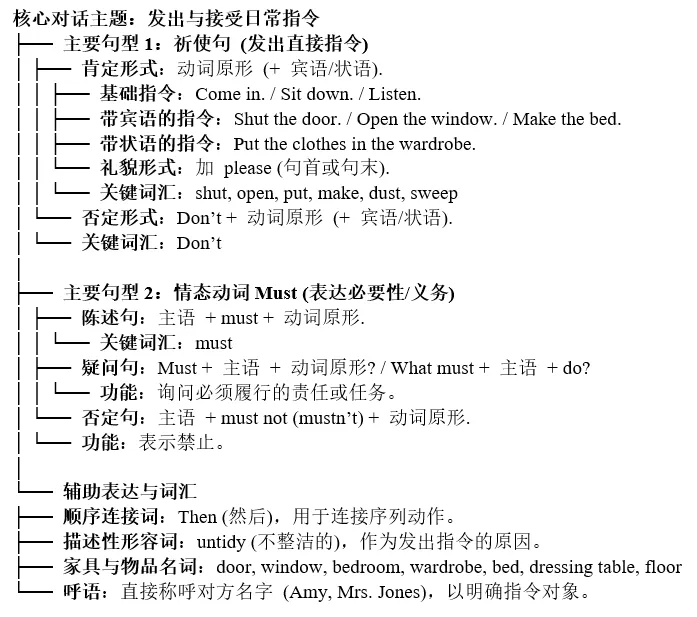
一、祈使句 (Imperative Sentences)来源 [NCE知识点笔记], [名师精讲], [语法新思维]祈使句用来表达命令、请求、建议、警告、邀请等。其最大特点是通常省略主语you(听话人),直接以动词原形开头。1. 肯定祈使句的结构:动词原形 (+ 宾语) + (其他成分). Come here. Listen to me carefully. Be quiet, please. Have a nice day!2. 否定祈使句的结构:Don't (Do not) + 动词原形 (+ 宾语) + (其他成分). Don't be late. Don't open the window. Do not run in the hallway.3. 祈使句的语调:通常用降调,听起来坚定、肯定。如果带有呼语或表示列举,呼语前或前半句末尾可用平调或轻微升调。4. 祈使句的功能扩展:表示邀请、建议、警告、指示等。5. 与情态动词must的对比:祈使句直接对you发出动作指令,焦点在动作本身;You must open the window.陈述一个客观或主观的必要性,焦点在义务或规则。
二、情态动词 Must来源 [NCE知识点笔记], [名师精讲], [语法新思维]Must是一个情态动词,无人称和时态变化,后接动词原形。1. 表示"必须"、"应当" (Necessity or Obligation):本课的核心用法,表示说话人认为有必要或有义务做某事。I must go now, or I'll miss the bus. You must finish your vegetables. We must protect the environment.2. Must 的疑问句与否定句:疑问句将must提到主语前:Must I do all the exercises? What must I do? (本课句型)。否定句用must not (mustn't),表示"禁止"、"不准":You mustn't play with fire. Cars mustn't park here. 注意:mustn't不表示"不必","不必"要用need not (needn't) 或don't have to。3. 表示很有把握的推测:用于肯定句,表示"一定"、"肯定"。You've been traveling all day. You must be tired. The lights are on. Someone must be at home. 表示推测时,否定用can't:He can't be in the library; I just saw him in the canteen.4. Must 与 Have to 的对比:must强调主观认为的"必须"或权威性的命令、规定;have to强调客观环境、情况或外部规则所要求的"必须"。5. Must 与 Can 的对比(能力与许可):can表示"能力"(能)或"许可"(可以);must表示"必须"(义务)。
例句(不少于20个):1. Come in and sit down. (祈使句)2. Don't be afraid. (否定祈使句)3. Please pass me the salt. (带please的祈使句)4. Be careful when you cross the road. (以Be开头的祈使句)5. Let's go to the cinema. (以Let's开头的建议祈使句)6. You must obey the school rules. (must表义务)7. Must we hand in the report today? (must疑问句)8. Students mustn't use mobile phones in class. (mustn't表禁止)9. You needn't (don't have to) come so early tomorrow. (不必)10. She isn't here. She must be in the garden. (must表推测)11. That can't be true! (否定推测)12. I have to work late tonight. (have to表客观必须)13. Do I have to wear a tie? (have to疑问句)14. You can leave your bag here. (can表许可)15. Can you speak French? (can表能力)16. Open your books to page 29. (教师课堂指令)17. Then turn off the lights and lock the door. (序列指令)18. What must I do to improve my English? (询问必要措施)19. You must see a doctor if you feel unwell. (强烈建议)20. There's no milk. We must go to the supermarket. (必要性)
练习题(不少于10道,附答案):1. 将下列句子改为祈使句。a) You should close the window. → Close the window. / Please close the window.b) You are not allowed to smoke here. → Don't smoke here.c) Will you please help me with this box? → Help me with this box, please.d) It is necessary for you to be on time. → Be on time.2. 用 must, mustn't, needn't (don't have to) 填空。a) It's a secret. You ______ tell anyone. → mustn'tb) The exam is tomorrow. I ______ study tonight. → mustc) We've got plenty of time. We ______ hurry. → needn't / don't have tod) This is a library. You ______ talk loudly. → mustn'te) ______ I answer all the questions on the form? → Must3. 翻译句子。a) 请把电视关掉。 → Please turn off the TV. / Turn off the TV, please.b) 你必须在周五前完成阅读。 → You must finish the reading by Friday.c) 你不必等我吃晚饭。 → You needn't wait for me for dinner. / You don't have to wait for me for dinner.d) 地上湿的。一定下过雨了。 → The ground is wet. It must have rained.e) 我可以开窗吗? → Can I open the window?4. 根据情景写出合适的句子。a) 你想请朋友把门打开。 → (Could you) open the door, please?b) 告诉弟弟不要在沙发上跳。 → Don't jump on the sofa.c) 询问老师你下一步必须做什么。 → What must I do next, teacher?
✏️ 第五部分:基础练习与活动
1. 跟读与模仿练习- 重点句跟读:反复听录音并跟读以下句子,注意祈使句的降调和must的强读。Come in, Amy. (降调,Amy平调)Shut the door, please. (please语调轻柔)What must I do? (must重读,句尾升调)Open the window and air the room. (and前平调或轻微升调,room降调)Then make the bed. (Then可轻读,bed降调)- 指令串跟读:模仿Mrs. Jones的语速和节奏,将第29课从"Open the window..."到"...sweep the floor."的指令作为一个连贯的段落进行跟读,注意Then的衔接作用。
2. 听力理解题目(基于课文)听第29课对话录音,回答下列问题。① Who is in the bedroom with Mrs. Jones? → Amy.② What does Mrs. Jones ask Amy to do first after shutting the door? → She asks her to open the window and air the room.③ What is wrong with the bedroom? → It is very untidy.④ What is the second thing Amy must do? (After opening the window) → She must put the clothes in the wardrobe.⑤ Where must Amy put the clothes? → In the wardrobe.⑥ What are the three pieces of furniture mentioned that need cleaning? → The bed, the dressing table, and the floor.⑦ Does Mrs. Jones use "please" for every instruction? → No, only for the first one ("Shut the door, please.").
3. 简单替换练习用括号内单词的正确形式或短语替换划线部分,保持句意通顺。1. *Shut the door.* - (open/window) → Open the window.2. *Put these clothes in the wardrobe.* - (books/on the shelf) → Put these books on the shelf.3. *Dust the dressing table.* - (sweep/floor) → Sweep the floor.4. *What must I do?* - (we) → What must we do?5. *You must air the room.* - (clean/kitchen) (改为否定祈使句) → Don't clean the kitchen. / You mustn't clean the kitchen.
4. 课文改写(词汇简化版)Mrs. Jones: Amy, come in.Mrs. Jones: Please close the door.Mrs. Jones: This room is very messy.Amy: What should I do, Mrs. Jones?Mrs. Jones: Open the window to let fresh air in.Mrs. Jones: Then, put these clothes in the closet.Mrs. Jones: Then, tidy up the bed.Mrs. Jones: Clean the table (where you put makeup).Mrs. Jones: Then, clean the floor with a broom.
🤔 第六部分:英文深度思考与拓展
A. 层次化英文问题与答案Level 1 (Factual):1. Q: What is the first thing Mrs. Jones tells Amy to do after she comes in? A: She tells Amy to shut the door.2. Q: Why does Mrs. Jones give Amy instructions? A: Because the bedroom is very untidy.3. Q: Name three specific cleaning tasks Mrs. Jones mentions. A: She mentions making the bed, dusting the dressing table, and sweeping the floor.Level 2 (Inferential):4. Q: How do you think Amy feels when she hears "This bedroom's very untidy"? Why? A: She probably feels a little embarrassed or responsible because the state of the room prompts immediate instructions for cleaning, suggesting it's her duty.5. Q: Why might Mrs. Jones say "air the room" as the first cleaning step? A: Perhaps the room smells stale or needs fresh air for a healthier environment before other cleaning, or it's a logical first step to make dusting and sweeping more pleasant.6. Q: The instructions are given in a specific order (air, put away, make bed, dust, sweep). Does this order make sense? Why or why not? A: Yes, it makes sense. It follows a logical workflow: start by improving air quality, then clear clutter (clothes), then deal with surfaces (bed, dressing table), and finally clean the floor, which might collect dust from the other activities.Level 3 (Evaluative/Creative):7. Q: If you were Amy, would you prefer Mrs. Jones to say "You must make the bed" or "Make the bed"? Why? A: I might prefer "Make the bed" because it sounds more like a direct, simple instruction. "You must" can sound a bit more formal or emphasize obligation, which might feel stricter.8. Q: Imagine you are teaching a robot to clean a room. Using only imperative sentences (like "Shut the door"), write a sequence of 4 instructions for a different chore, like cleaning a kitchen counter. A: First, clear all items from the counter. Next, wipe the surface with a damp cloth. Then, spray cleaner and scrub any stains. Finally, dry the counter with a clean towel.9. Q: In your culture, how do people usually ask others to do chores? Is it direct ("Do this") or more indirect ("Could you maybe...")? Compare it with the style in the lesson. A: In my culture, we often use more indirect or polite requests, especially with family or peers, like "Could you help me clean up?" or "Would you mind taking out the trash?" The style in the lesson is more direct, which might be common in clear instructional settings like a boss-employee or parent-child dynamic where roles are defined.
B. 多类型拓展阅读1. 现代场景故事 (Modern Scene Story)My smart home assistant, Alexa, gives me instructions every morning, but they sound nothing like Mrs. Jones! At 7:00 a.m., a gentle chime plays. Then a calm voice says, "Good morning. It's time to start your day. The weather is sunny. You might want to open the blinds." I say, "Alexa, what's my schedule?" She replies, "Your first online meeting is at 9:30. You must prepare the presentation slides before then. Also, don't forget to water the plants; the sensor indicates low soil moisture." It's funny—the instructions are about work and plants, not dusting or sweeping. Technology has changed the "must-dos" in our lives, but the need for reminders and lists remains the same.引导性问题:How are the instructions from the smart assistant different from Mrs. Jones's instructions in terms of content and delivery style?2. 文化背景小知识 (Cultural Background)The concept of a "tidy" bedroom and specific chores like "making the bed" hold particular importance in British and American household culture, often linked to discipline and self-reliance. For children, daily chores are a common way to earn pocket money or learn responsibility. The phrase "make the bed" specifically means to straighten the sheets, blankets, and pillows neatly after sleeping. It's seen as a basic skill. Interestingly, the order of chores in the lesson reflects a traditional approach: airing out a room was considered essential for health before modern central heating and air conditioning. While today's chores might include "charge your devices" or "update the family calendar," the underlying idea that shared living spaces require shared upkeep is a enduring value.引导性问题:According to the text, what is one traditional reason for "airing the room" that might be less common today?3. 今昔对比 (Then and Now Contrast)Contrasting Mrs. Jones's 20th-century cleaning list with a modern "room reset" routine reveals how domestic life has changed. Then: "Air the room" meant manually opening windows. Now: We tap a thermostat for "air circulation mode." Then: "Put clothes in the wardrobe." Now: We might say, "Sort laundry into smart hampers for wash cycles." Then: "Dust the dressing table." Now: We use a cordless vacuum with a dusting attachment. Then: "Sweep the floor." Now: A robot vacuum maps the room and sweeps on a schedule. The core tasks—organizing, cleaning surfaces, cleaning floors—are timeless. But the tools, speed, and even the phrasing ("Run Roomba" vs. "Sweep the floor") show how technology has reshaped the execution of these "must-do" activities.引导性问题:What is a key difference in how the task of cleaning the floor might be accomplished "then" versus "now"?4. 新潮英语改写 (Trendy English Rewrite)Okay, Amy, come on in. Hey, can you push the door shut? Thanks. Whoa, this room is a total mess! Seriously, what's the game plan? What do you need me to do? First up, crack that window wide open—let's get some fresh air in here, stat. Then, all these clothes? Just chuck them in the closet for now. Next, fix up the bed—you know, pull the sheets tight. After that, quick wipe-down of the vanity table. And finally, just give the floor a quick sweep. Easy peasy! We'll have this place looking fresh in no time.引导性问题:How does the use of words like "total mess," "game plan," and "stat" change the tone of the instructions compared to the original?5. 难度略高的拓展阅读 (Slightly Higher Difficulty)The linguistic exchange in Lesson 29 is a microcosm of directive speech acts. Mrs. Jones employs a mixture of imperative sentences ("Shut the door," "Open the window") and a statement of necessity framed by the modal verb "must" within a question ("What must I do?"). This combination effectively establishes a power dynamic: the imperatives assert immediate authority over actions, while the "must" question forces the listener (Amy) to verbally acknowledge her subordinate role and request specification of her duties. The sequence of imperatives linked by "then" not only provides clarity but also constructs a mini-narrative of the chore, reducing ambiguity and potential resistance. This efficient, transactional use of language is characteristic of instructional settings where social hierarchies are clear and the primary goal is task completion rather than negotiation.引导性问题:What does the author suggest is the effect of using "What must I do?" instead of just giving a list of commands?6. 简单科普或趣闻 (Simple Science or Trivia)Have you ever wondered why we say "make the bed" even though we don't actually "make" or build it from scratch? This is an example of an **idiomatic expression**—a phrase whose meaning isn't obvious from the individual words. The word "make" here has an older meaning of "to prepare" or "to put in order." So, "make the bed" means to prepare or arrange it for use (either for sleeping or for a tidy appearance). Similarly, we "make dinner" (prepare it) and "make a decision" (form it). Languages are full of these interesting fossils of older meanings! Knowing them helps you sound more natural.引导性问题:According to the text, what is the older meaning of "make" that explains the phrase "make the bed"?
🌍 第七部分:日常应用延伸
1. 提供本课语言点在日常生活中的应用场景- 家庭生活:家长给孩子布置家务(Make your bed. Put your toys away. Don't leave the lights on.)。室友之间协商清洁任务(What must I do this week? You must take out the rubbish.)。- 课堂与学习:老师给出课堂指令(Open your books. Read the first paragraph. Don't talk during the test.)。学生询问作业要求(What must we do for homework?)。- 工作场合:上司布置简单任务(Send this email by 5 p.m. File these documents. You must attend the meeting.)。新员工询问职责(What must I do first?)。- 公共场所:遵守规则或指示(Please queue here. You must wear a mask. Don't touch the exhibits.)。
2. 建议简单拓展学习材料- 家务清单/图表:查找或制作英文版的家务清单(Chore Chart),上面列有Make bed, Set table, Feed pet, Vacuum等,用于实践词汇。- 儿童指令类绘本:如《The Listening Walk》或《We're Going on a Bear Hunt》中有大量动作指令,适合跟读模仿。- 生活技能视频:在视频平台搜索英文的"how to clean your room"、"morning routine"等视频,听母语者如何描述步骤。- 应用程序:使用一些语言学习APP,在"日常活动"或"指令"主题下进行专项词汇和句型练习。
3. 可附加英美生活小常识- Chore Charts and Allowance:在英美家庭,给孩子分配固定家务并给予少量零花钱(allowance/pocket money)是一种常见的教育方式,旨在培养责任感和金钱管理能力。- "Please" and "Thank You":即使在发出指令时,please也频繁使用以保持礼貌。完成指令后,说Thank you表示认可和感谢,这很重要。- Directness vs. Indirectness:英美人通常比一些文化更直接,但礼貌仍然关键。对陌生人或不熟悉的人,会用Could you...?或Would you mind...?代替直接的祈使句。但在明确的上司对下属、父母对孩子或紧急情况下,直接祈使句很常见且不被视为粗鲁。
© 本文为狂暴英语教案 · 新概念英语第一册第29-30课
排版设计 · 仅供学习交流使用

贝琪酱英语无痛逆袭站
微信扫描二维码,关注我的账号
 10个月宝宝每天需要喝多少奶粉?

