读外刊,接触原汁原味的英文表达,
欢迎关注以下公众号+设为星标+推荐给朋友。▼
📚 狂暴英语教案 · 新概念英语第一册
第51-52课 A pleasant climate & What nationality are they?
宜人的气候 & 他们是哪国人?
📘 本课信息
教材:新概念英语第一册 · 第51-52课
核心功能:询问与描述国家、国籍及气候 · 日常寒暄
语法焦点:一般现在时 · 频率副词 · 国家/国籍/语言表达 · 选择疑问句
🎯 本课学习目标
词汇:
掌握与气候、天气、国家、国籍、方位相关的基础词汇,如气候类型(pleasant, mild, cold, hot)、国家名称(Greece, England, Brazil等)、方位词(north, south, east, west)以及频率副词(always, often, sometimes)。
语法:
深入理解并运用一般现在时(Simple Present Tense)描述客观事实、习惯和普遍真理;掌握频率副词在句中的位置;学会用"What...like?"询问状况;巩固国家、国籍与语言的对应表达。
技能(日常对话):
能够就气候、天气、籍贯、国籍等话题进行简单的问答交流;掌握初次见面或日常寒暄中询问对方来自哪里及当地气候的对话模式。
文化:
初步了解不同国家的地理位置、气候特点及文化关联,培养跨文化交际的初步意识。
📖 第一部分:课文完整内容
Lesson 51 A pleasant climate
📜 课文原文(含语音标注)
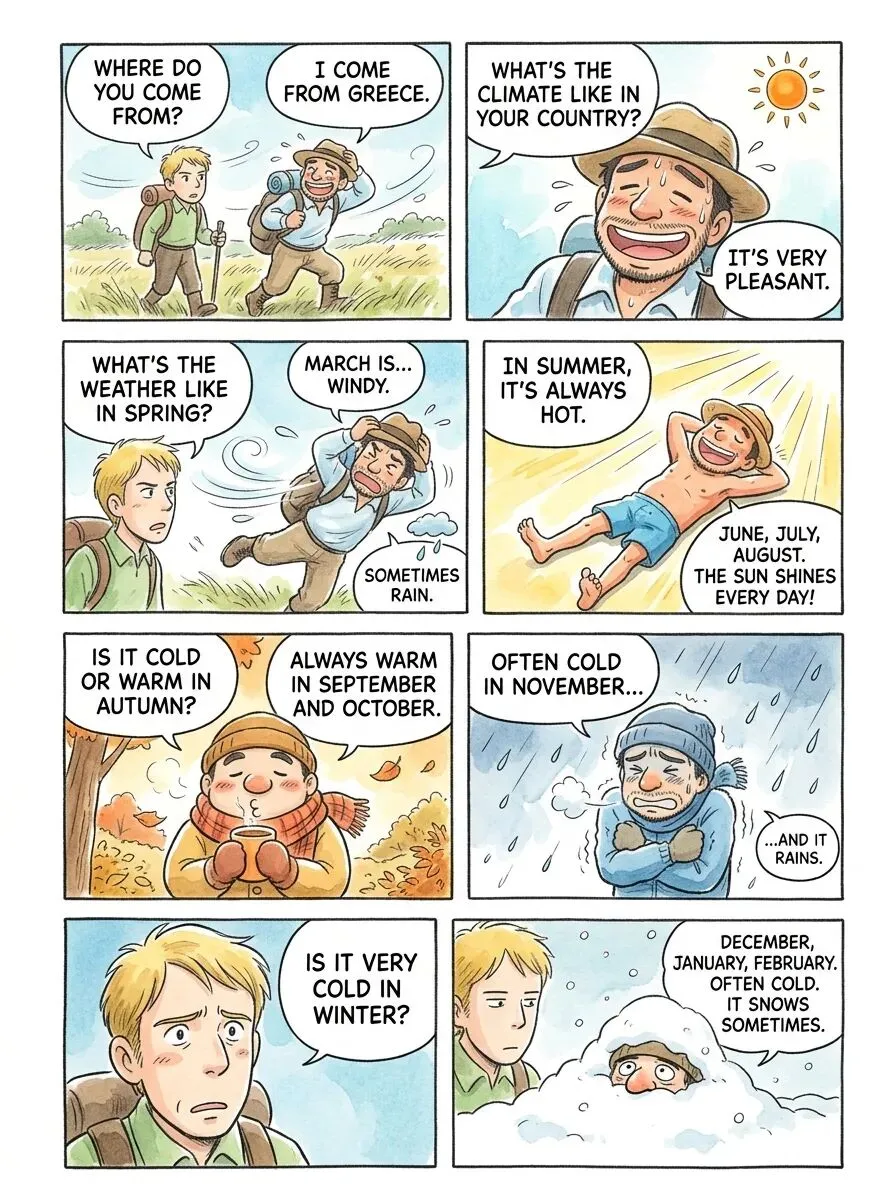
HANS: Where do you come from? /weə də jə ˈkʌm frəm/
汉斯:你是哪国人?
DIMITRI: I come from Greece. /aɪ ˈkʌm frəm ˈɡriːs/
迪米特里:我是希腊人。
HANS: What's the climate like in your country? /wɒts ðə ˈklaɪmət laɪk ɪn jɔː ˈkʌntri/
汉斯:你们国家的气候怎么样?
DIMITRI: It's very pleasant. /ɪts ˈveri ˈpleznt/
迪米特里:气候非常宜人。
HANS: What's the weather like in spring? /wɒts ðə ˈweðə laɪk ɪn sprɪŋ/
汉斯:春天的天气怎么样?
DIMITRI: It's often windy in March. /ɪts ˈɒfən ˈwɪndi ɪn mɑːtʃ/
It's always warm in April and May, /ɪts ˈɔːlweɪz wɔːm ɪn ˈeɪprəl ənd meɪ/
but it rains sometimes. /bət ɪt reɪnz ˈsʌmtaɪmz/
迪米特里:三月里常常刮风。四月和五月总是很暖和,但有时会下雨。
HANS: What's it like in summer? /wɒts ɪt laɪk ɪn ˈsʌmə/
汉斯:夏天的天气怎么样呢?
DIMITRI: It's always hot in June, July and August. /ɪts ˈɔːlweɪz hɒt ɪn dʒuːn, dʒʊˈlaɪ ənd ˈɔːɡəst/
The sun shines every day. /ðə sʌn ʃaɪnz ˈevri deɪ/
迪米特里:六月、七月和八月总是很热。每天都有太阳。
HANS: Is it cold or warm in autumn? /ɪz ɪt kəʊld ɔː wɔːm ɪn ˈɔːtəm/
汉斯:秋天的天气是冷还是暖呢?
DIMITRI: It's always warm in September and October. /ɪts ˈɔːlweɪz wɔːm ɪn sepˈtembə ənd ɒkˈtəʊbə/
It's often cold in November and it rains sometimes. /ɪts ˈɒfən kəʊld ɪn nəʊˈvembə ənd ɪt reɪnz ˈsʌmtaɪmz/
迪米特里:九月和十月总是很暖和。十一月常常很冷,而且有时下雨。
HANS: Is it very cold in winter? /ɪz ɪt ˈveri kəʊld ɪn ˈwɪntə/
汉斯:冬天很冷吗?
DIMITRI: It's often cold in December, January and February. /ɪts ˈɒfən kəʊld ɪn dɪˈsembə, ˈdʒænjuəri ənd ˈfebruəri/
It snows sometimes. /ɪt snəʊz ˈsʌmtaɪmz/
迪米特里:十二月、一月和二月常常很冷。有时会下雪。
语音标注: Where do you 弱读连读 /weə də jə/;What's the 连读 /wɒts ðə/;It's often 中 often 可读作 /ˈɒfən/;April and May 中 and 弱读 /ənd/;but it 连读 /bət ɪt/;The sun 中 the 读 /ði/。
Lesson 52 What nationality are they?
📜 课文原文(本课为练习课,核心句型如下)
What nationality are you? /wɒt ˌnæʃəˈnæləti ə juː/
I'm Greek. /aɪm ˈɡriːk/
Where do you come from? /weə də jə ˈkʌm frəm/
I come from Greece. /aɪ ˈkʌm frəm ˈɡriːs/
What's the climate like in your country? /wɒts ðə ˈklaɪmət laɪk ɪn jɔː ˈkʌntri/
It's very pleasant. /ɪts ˈveri ˈpleznt/
(后续替换不同国家:the U.S., Brazil, England, France, Germany, Italy, Norway, Russia, Spain, Sweden等)
情景说明:第51课对话发生在两个可能初次见面或正在闲聊的人之间。汉斯(Hans)询问迪米特里(Dimitri)来自哪个国家以及该国的气候情况。迪米特里来自希腊,他系统地描述了希腊四季(春、夏、秋、冬)的典型天气特征,使用了"always"(总是)、"often"(经常)、"sometimes"(有时)等频率副词来精确表达天气现象的规律性。这是一个典型的跨文化日常寒暄场景,话题围绕地理和气候展开。第52课通过系统性的替换练习,巩固第51课引入的关于国家、国籍和气候的问答句型。它模拟了与来自不同国家的人进行对话的场景,要求学习者能够灵活切换国家名称、对应的国籍形容词,并可能根据常识或提示描述该国的典型气候。
参考译文:
第51课
汉斯:你是哪国人?
迪米特里:我是希腊人。
汉斯:你们国家的气候怎么样?
迪米特里:气候非常宜人。
汉斯:春天的天气怎么样?
迪米特里:三月里常常刮风。四月和五月总是很暖和,但有时会下雨。
汉斯:夏天的天气怎么样呢?
迪米特里:六月、七月和八月总是很热。每天都有太阳。
汉斯:秋天的天气是冷还是暖呢?
迪米特里:九月和十月总是很暖和。十一月常常很冷,而且有时下雨。
汉斯:冬天很冷吗?
迪米特里:十二月、一月和二月常常很冷。有时会下雪。
第52课
你是哪国人?我是希腊人。你来自哪里?我来自希腊。你们国家的气候怎么样?气候非常宜人。(替换为:美国/巴西/英国等)
🔍 第二部分:逐句精讲与词块总结
句子1
原文: Where do you come from?
翻译: 你来自哪里?(你是哪国人?)
句子结构: 特殊疑问句。Where(疑问副词,作地点状语) + do(助动词,构成疑问) + you(主语) + come from(谓语动词短语)。
重点词汇:
where 蓝思值 BR L
英音[weə(r)] 美音[wer] 词性:adv.
释义:在哪里;到哪里;从哪里
常用语块:Where are you from? / Where do you live? / Where is it?
例句一:Where is my book? 我的书在哪里?
例句二:Where are you going this weekend? 你这周末要去哪里?
拓展:与here(这里)、there(那里)对应。在询问籍贯或出生地时,Where are you from? 和 Where do you come from? 常可互换,后者稍显正式。
come from 蓝思值 10L-200L
英音[ˈkʌm frəm] 美音[ˈkʌm frəm] 词性:v. phr.
释义:来自;出生于
常用语块:I come from... / Where do you come from?
例句一:She comes from a small town in Canada. 她来自加拿大的一个小镇。
例句二:This idea comes from an ancient tradition. 这个想法源于一个古老的传统。
拓展:come from 强调来源或出身。其同义表达 be from 更口语化,如:I'm from China.
语法点睛: 本句是使用助动词do构成的一般现在时特殊疑问句。当主语是you(你/你们)时,用do帮助提问。其结构为:疑问词 + do/does + 主语 + 动词原形 + 其他?用于询问习惯性动作或客观事实。
语音要点: Where do you 在快速口语中常弱读连读为 /weə də jə/ 或 /weə dʒə/。come from 两个词可平稳连接,无明显连读。
句子2
原文: I come from Greece.
翻译: 我来自希腊。
句子结构: 主语+谓语+状语。I(主语) + come from(谓语动词短语) + Greece(宾语,同时也是地点状语)。
重点词汇:
Greece 蓝思值 600L-800L
英音[ɡriːs] 美音[ɡriːs] 词性:n.
释义:希腊(欧洲国家)
常用语块:in Greece / from Greece / travel to Greece
例句一:Athens is the capital of Greece. 雅典是希腊的首都。
例句二:Ancient Greece had a profound influence on Western civilization. 古希腊对西方文明产生了深远影响。
拓展:其国籍形容词为 Greek(希腊的;希腊人;希腊语)。注意区分地理名词和国家名词的拼写与发音。
语法点睛: 这是一般现在时的肯定陈述句,结构为:主语 + 动词原形/动词第三人称单数形式 + 其他。此处主语为I,动词用原形come。用于陈述一个客观事实(籍贯)。
语音要点: I come from 中 I 发音清晰,come from 连读。Greece 发音为 /ɡriːs/,注意长元音 /iː/。
句子3
原文: What's the climate like in your country?
翻译: 你们国家的气候怎么样?
句子结构: 特殊疑问句。What(疑问代词,作表语) + 's(is的缩写,系动词) + the climate(主语) + like(介词,与what构成固定搭配) + in your country(地点状语)。
重点词汇:
climate 蓝思值 800L-1000L
英音[ˈklaɪmət] 美音[ˈklaɪmət] 词性:n.
释义:气候(指一个地区长期的天气特征)
常用语块:pleasant climate / tropical climate / climate change
例句一:The island has a tropical climate with high humidity. 这个岛屿属于高温高湿的热带气候。
例句二:We need to take action against global climate change. 我们需要采取行动应对全球气候变化。
拓展:区别于 weather(天气,指短期的气象状况)。Climate 是宏观、长期的;weather 是微观、瞬时的。
like 蓝思值 BR L(此处作介词)
英音[laɪk] 美音[laɪk] 词性:prep.
释义:像......一样;......怎么样(用于询问描述)
常用语块:What's ... like? / look like / feel like
例句一:What's your new teacher like? 你的新老师怎么样?
例句二:The sky looks like it's going to rain. 天空看起来要下雨了。
拓展:What's ... like? 是询问某人或某事物性质、特征的万能句型。Like 作动词意为“喜欢”。
country 蓝思值 200L-400L
英音[ˈkʌntri] 美音[ˈkʌntri] 词性:n.
释义:国家;乡村
常用语块:my country / all over the country / country music
例句一:I love my country. 我爱我的国家。
例句二:They live in the country, far from the city. 他们住在远离城市的乡村。
拓展:一词多义。在“国家”义项下,与 nation(侧重民族国家)、state(侧重政权国家)有细微区别。
语法点睛: 本句核心是 What's ... like? 句型。What 在句中作表语,like 是介词,be like 合起来表示“是......样子的”。这是一个询问事物性质或特征的常用句型。
语音要点: What's the 强烈连读为 /wɒts ðə/。climate like in 中,like in 可以轻微连读 /laɪk ɪn/。your country 中 your 可弱读为 /jə/。
句子4
原文: It's very pleasant.
翻译: (气候)非常宜人。
句子结构: 主语+系动词+表语。It(主语,指代气候) + 's(is的缩写,系动词) + very pleasant(表语,very为程度副词修饰形容词pleasant)。
重点词汇:
pleasant 蓝思值 600L-800L
英音[ˈpleznt] 美音[ˈpleznt] 词性:adj.
释义:令人愉快的;舒适的;宜人的
常用语块:pleasant weather / a pleasant surprise / have a pleasant trip
例句一:We had a pleasant conversation over tea. 我们一边喝茶一边进行了愉快的交谈。
例句二:The hotel room was clean and pleasant. 酒店房间干净舒适。
拓展:其名词形式为 pleasure(愉快)。反义词可以是 unpleasant(令人不快的)或 nasty(恶劣的)。
语法点睛: 这是典型的“主系表”结构,用于描述主语的状态或特征。It作为代词,指代上文中提到的 the climate,避免重复。Very 是副词,修饰形容词,表示程度。
语音要点: It's very 中 It's 发音清晰,very 重读。pleasant 注意 /ˈpleznt/ 的发音,重音在第一音节。
句子5
原文: It's often windy in March.
翻译: 三月里常常刮风。
句子结构: 主语+系动词+表语+状语。It(主语,指天气) + 's(is,系动词) + often windy(表语,often为频率副词修饰表语整体) + in March(时间状语)。
重点词汇:
often 蓝思值 200L-400L
英音[ˈɒfn] 美音[ˈɔːfn] 词性:adv.
释义:经常;常常
常用语块:very often / how often / often enough
例句一:I often go for a walk after dinner. 我经常晚饭后散步。
例句二:How often do you visit your grandparents? 你多久去看一次你的祖父母?
拓展:频率副词,表示动作发生的频度。在句中的位置通常在 be 动词之后,行为动词之前。英式发音中 t 可不发音。
windy 蓝思值 400L-600L
英音[ˈwɪndi] 美音[ˈwɪndi] 词性:adj.
释义:多风的;风大的
常用语块:a windy day / windy weather / it's windy
例句一:It's too windy to fly a kite today. 今天风太大,不能放风筝。
例句二:Chicago is known as the "Windy City". 芝加哥被称为“风城”。
拓展:由名词 wind(风)加后缀 -y 构成,表示“充满......的;有......特性的”。类似结构:sunny(晴朗的),rainy(多雨的),cloudy(多云的)。
March 蓝思值 400L-600L
英音[mɑːtʃ] 美音[mɑːrtʃ] 词性:n.
释义:三月
常用语块:in March / early March / March wind
例句一:Spring begins in March in the Northern Hemisphere. 在北半球,春天始于三月。
例句二:The project will start next March. 这个项目将于明年三月启动。
拓展:月份名称首字母大写。介词用 in。源自罗马神话战神玛尔斯(Mars)。
语法点睛: 本句展示了频率副词 often 在“主系表”结构中的位置:放在系动词 be 之后,形容词表语之前。用于描述有规律发生的状态。in + 月份 是表示在某个月份的标准介词搭配。
语音要点: It's often 连读为 /ɪts ˈɒfən/。windy in 可以连读为 /ˈwɪndi ɪn/。March 注意英音 /ɑː/ 和美音 /ɑːr/ 的区别。
句子6
原文: It's always warm in April and May, but it rains sometimes.
翻译: 四月和五月总是很暖和,但有时会下雨。
句子结构: 并列复合句。第一部分:It's always warm in April and May(主系表+时间状语);第二部分:but it rains sometimes(连词but连接,主谓结构+频率状语)。but表示转折。
重点词汇:
always 蓝思值 BR L
英音[ˈɔːlweɪz] 美音[ˈɔːlweɪz] 词性:adv.
释义:总是;一直
常用语块:almost always / not always / always on time
例句一:The sun always rises in the east. 太阳总是从东方升起。
例句二:She is always ready to help others. 她总是乐于助人。
拓展:频率最高的副词(100%)。位置规则同 often。注意其否定形式 not always 表示“并非总是”,是部分否定。
rain 蓝思值 BR L(此处作动词)
英音[reɪn] 美音[reɪn] 词性:v./n.
释义:v. 下雨;n. 雨
常用语块:it rains / heavy rain / rain cats and dogs
例句一:It rained heavily all night. 下了一整夜的大雨。
例句二:Don't forget to take an umbrella in case of rain. 别忘了带伞以防下雨。
拓展:作动词时,主语常用 it(非人称主语)。名词形式相同。形容词为 rainy。
sometimes 蓝思值 200L-400L
英音[ˈsʌmtaɪmz] 美音[ˈsʌmtaɪmz] 词性:adv.
释义:有时;间或
常用语块:sometimes... sometimes... / at sometimes
例句一:I sometimes have coffee in the afternoon. 我有时下午喝咖啡。
例句二:Sometimes I walk to work, and sometimes I take the bus. 有时我走路去上班,有时我坐公交车。
拓展:频率副词,频度低于 often。在句中的位置比较灵活,可置于句首、句中或句末。
语法点睛: 本句包含两个重要语法点:1) 频率副词 always 和 sometimes 的位置。always 在系动词后,sometimes 在行为动词 rains 后(也可放句末)。2) 连词 but 连接两个具有转折关系的分句。此外,it作为非人称主语表示自然现象(下雨),是英语中的独特用法。
语音要点: April and May 中 and 弱读为 /ənd/。but it 连读为 /bət ɪt/。rains sometimes 可以连读为 /reɪnz ˈsʌmtaɪmz/。
句子7
原文: The sun shines every day.
翻译: 每天都有太阳。(阳光普照。)
句子结构: 主语+谓语+状语。The sun(主语) + shines(谓语动词,第三人称单数) + every day(时间状语)。
重点词汇:
shine 蓝思值 400L-600L
英音[ʃaɪn] 美音[ʃaɪn] 词性:v.
释义:照耀;发光;擦亮(皮鞋等)
常用语块:the sun shines / shine brightly / shine through
例句一:The moon is shining brightly tonight. 今晚月光皎洁。
例句二:He shined his shoes before the interview. 面试前他擦亮了皮鞋。
拓展:不规则动词,过去式和过去分词为 shone /ʃɒn/。名词形式为 shine 或 shininess。
语法点睛: 这是一般现在时的肯定句,主语 The sun 是第三人称单数,因此谓语动词 shine 要加 -s,变成 shines。用于描述一个客观规律或经常发生的自然现象。Every day 是表示每天的时间状语。
语音要点: The sun 中 the 在元音前读 /ði/。shines every 可以连读为 /ʃaɪnz ˈevri/。day 发音清晰。
句子8
原文: Is it cold or warm in autumn?
翻译: 秋天的天气是冷还是暖呢?
句子结构: 选择疑问句。Is(系动词) + it(主语) + cold or warm(并列的表语选项) + in autumn(时间状语)?or 连接两个供选择的项目。
重点词汇:
autumn 蓝思值 400L-600L(英式)
英音[ˈɔːtəm] 美音[ˈɔːtəm] 词性:n.
释义:秋天;秋季
常用语块:in autumn / autumn leaves / early autumn
例句一:The leaves turn yellow and red in autumn. 秋天树叶变成黄色和红色。
例句二:Autumn is my favourite season. 秋天是我最喜欢的季节。
拓展:美式英语更常用 fall 表示秋天。两者可互换,但 autumn 更显正式或文雅。介词用 in。
语法点睛: 这是一个选择疑问句。结构是:一般疑问句 + or + 供选择的另一部分? 朗读时,or 前面的部分用升调,后面的部分用降调。回答时不能用 Yes/No,而要从选项中选择一个,或给出其他答案。
语音要点: Is it 连读为 /ɪz ɪt/。cold or 连读为 /kəʊld ɔːr/。warm in 连读为 /wɔːrm ɪn/。autumn 注意 /ˈɔːtəm/ 的发音。
句子9
原文: It snows sometimes.
翻译: 有时会下雪。
句子结构: 主语+谓语+状语。It(非人称主语) + snows(谓语动词,第三人称单数) + sometimes(频率状语)。
重点词汇:
snow 蓝思值 BR L(此处作动词)
英音[snəʊ] 美音[snoʊ] 词性:v./n.
释义:v. 下雪;n. 雪
常用语块:it snows / heavy snow / snow white
例句一:Look! It's snowing outside! 看!外面下雪了!
例句二:Children love to play in the snow. 孩子们喜欢在雪地里玩耍。
拓展:作动词时,主语常用 it。名词形式相同。形容词为 snowy(下雪的;多雪的)。
语法点睛: 与 It rains sometimes. 结构完全相同,都是“It + 表示自然现象的动词(第三人称单数) + 频率状语”。这是一般现在时描述周期性自然现象的典型句式。
语音要点: It snows 连读为 /ɪt snəʊz/。snows sometimes 可以连读为 /snəʊz ˈsʌmtaɪmz/。
句子10
原文: What nationality are you?
翻译: 你是哪国人?
句子结构: 特殊疑问句。What nationality(疑问词组,作表语) + are(系动词) + you(主语)?
重点词汇:
nationality 蓝思值 800L-1000L
英音[ˌnæʃəˈnæləti] 美音[ˌnæʃəˈnæləti] 词性:n.
释义:国籍;民族
常用语块:Chinese nationality / dual nationality / what nationality
例句一:He has British nationality. 他拥有英国国籍。
例句二:The university has students of over 50 different nationalities. 这所大学有来自50多个不同国家的学生。
拓展:来自 nation(国家;民族)。询问国籍还可以用 Where are you from?,但 What nationality are you? 更直接指向法律或文化身份。
语法点睛: What nationality 作为一个整体充当疑问词,询问人的国籍属性。回答时用“I'm + 国籍形容词”,如 I'm Greek. 注意国籍形容词首字母大写。这是“主系表”结构的疑问形式。
语音要点: What nationality are 可以连读为 /wɒt ˌnæʃəˈnæləti ə/。are you 常连读为 /ə juː/ 或 /ɑː juː/。
📌 核心词块总结
1. come from / be from:表示来源或籍贯。 解释:To originate from a particular place or country.例句:She comes from Italy, but she lives in London now.
2. What's ... like?:询问事物或人的性质、特征。 解释:Used to ask for a description of someone or something.例句:What's the food like in that new restaurant?
3. It's always/often/sometimes + adj.:描述有规律出现的状态(尤指天气)。 解释:Describes a state or condition that occurs with a certain frequency.例句:It's often cloudy in the morning, but it clears up by noon.
4. in + (月份/季节):表示在某个特定的月份或季节。 解释:Used to indicate a point or period within a specific month or season.例句:The flowers bloom in spring. My birthday is in July.
5. What nationality?:直接询问国籍。 解释:A direct question about a person's legal or cultural affiliation to a country.例句:--- What nationality is the famous scientist? --- He's German.
💬 第三部分:基础会话技巧
1. 分析课文中的日常用语、礼貌表达、问答模式
- 寒暄与开启话题:对话始于 Where do you come from?,这是一个常见且中性的社交开场白,用于了解对方背景。接着用 What's the climate like...? 自然地将话题引向一个安全、可分享的领域(天气/气候)。
- 问答模式:本课展示了清晰的“提问-回答-追问”模式。汉斯先问国家,再问气候,接着针对每个季节追问细节(What's the weather like in spring/summer? Is it cold or warm in autumn? Is it very cold in winter?)。这种层层递进的提问方式在深入交谈中很实用。
- 描述模式:迪米特里的回答结构清晰:It's + 频率副词 + 形容词 + in + 时间。并且使用 but 进行转折补充,使描述更全面(...warm..., but it rains sometimes.)。
2. 提供类似场景的扩展对话示例
A:Hi, I'm Alex. Nice to meet you.
B:Nice to meet you too, Alex. I'm Maria.
A:Where are you from, Maria?
B:I'm from Brazil.
A:Really? What's the climate like there? Is it hot all year round?
B:Not exactly. It's often hot and humid in the north, but the south can be quite mild and sometimes even cool in winter.
A:What about the rainy season?
B:It rains a lot from December to March, especially in the Amazon region.
A: Sounds interesting! I'd love to visit someday.
3. 设计简单的角色扮演活动建议
活动名称:“环球气候记者”
准备:准备一些写有国家名称(如 Canada, Australia, Japan, Egypt, South Africa)和简单气候关键词卡(如 snowy winter, dry summer, monsoon, mild)的卡片。
步骤:1. 学生A抽一张国家卡,扮演来自该国的居民。2. 学生B扮演记者,进行采访。必须使用以下句型:Where are you from? What's the climate like in your country? What's the weather like in [季节]? Is it ... or ...? 3. 学生A根据自己对国家的了解(或参考关键词卡)回答。4. 互换角色。
目标:熟练运用本课句型,并激发对世界地理文化的兴趣。
4. 融入基础思考:设计1-2个简单的代入式问题
- 问题1:如果你要向一位来自热带国家的朋友描述你家乡的冬天,你会重点描述哪些方面?(提示:温度、常见的天气现象、人们的穿着和活动。)
- 问题2:课文中迪米特里说希腊的气候“very pleasant”。你认为一个“pleasant climate”应该具备哪些特点?你居住的地方气候“pleasant”吗?为什么?
📐 第四部分:本课语法精析(加强版)
1. 一般现在时(Simple Present Tense)的巩固与拓展
一般现在时用于表示:
-客观事实与普遍真理:如 The sun shines every day.(太阳每天照耀。)
-习惯性动作或经常发生的状态:如 I come from Greece.(我来自希腊。)It often rains in November.(十一月经常下雨。)
-现在的状态或特征:如 It's very pleasant.(气候很宜人。)
在本课中,一般现在时主要用于描述气候和天气的客观规律和常见状态。需要注意主语为第三人称单数(he, she, it, 单数名词)时,谓语动词的变化规则:
- 大多数动词直接加 -s: come → comes, rain → rains, snow → snows.
- 以 -ch, -sh, -s, -x, -o 结尾的动词加 -es: watch → watches, wash → washes, go → goes.
- 以辅音字母加 -y 结尾的动词,变 y 为 i 再加 -es: study → studies, fly → flies. (但本课未涉及)
例句:1. She comes from Spain. (她来自西班牙。) 2. He speaks English very well. (他英语说得很好。) 3. My father works in a hospital. (我父亲在医院工作。) 4. Water boils at 100 degrees Celsius. (水在100摄氏度沸腾。) 5. The Earth revolves around the Sun. (地球围绕太阳转。) 6. This shop closes at 8 p.m. every day. (这家商店每天晚上8点关门。) 7. It snows heavily in the mountains during winter. (冬天山里下大雪。) 8. He always washes his hands before meals. (他饭前总是洗手。) 9. The bus goes to the city center every 10 minutes. (这趟公交车每10分钟一班开往市中心。) 10. Spring follows winter. (冬去春来。)
2. 频率副词(Adverbs of Frequency)
频率副词表示动作或状态发生的频率。本课重点学习了三个:always (总是,100%), often (经常,~70%), sometimes (有时,~30%)。它们在句中的位置有基本规则:
- 放在 be 动词(am, is, are)之后:It is always hot in summer. / He is often late for school. / They are sometimes busy on weekends.
- 放在行为动词之前:She always drinks coffee in the morning. / It often rains here in April. / I sometimes go swimming after work.
- Sometimes 可以放在句首或句末,表示强调:Sometimes I cook dinner at home. / We travel abroad sometimes.
其他常见频率副词还有:usually (通常), frequently (频繁地), occasionally (偶尔), seldom (很少), rarely (罕有地), never (从不)。Never 表示否定。
例句:11. I usually get up at 7 o'clock. (我通常7点起床。) 12. They never eat fast food. (他们从不吃快餐。) 13. Sometimes my brother helps me with my homework. (有时我哥哥帮我做作业。) 14. She seldom watches television. (她很少看电视。) 15. Do you often go to the cinema? (你经常去看电影吗?)
3. 国家、国籍和语言表达
这是本课另一语法重点,涉及专有名词的大小写和不同词性的转换。
- 国家(Country):名词,如 China(中国), the United States(美国), France(法国)。
- 国籍(Nationality):形容词:描述人或事物的来源,如 Chinese(中国的;中国人的), American(美国的;美国人的), French(法国的;法国人的)。在 I'm Chinese. 中作表语。可数名词:指人,如 a Chinese(一个中国人), an American(一个美国人), a Frenchman/Frenchwoman(一个法国男人/女人)。注意有些词形不变(如 Chinese),有些词形变化(如 American → Americans)。
- 语言(Language):名词,如 Chinese(中文), English(英语), French(法语)。很多语言名称与国籍形容词同形。
常见搭配:
- Q: Where are you from? / Where do you come from? A: I'm from [国家]. / I come from [国家].
- Q: What's your nationality? A: I'm [国籍形容词].
- Q: What language do you speak? A: I speak [语言].
例句:16. Country: Brazil is in South America. (巴西在南美洲。) 17. Nationality (Adj.): She is Italian. (她是意大利人。) 18. Nationality (n.): He is a German. (他是一个德国人。) They are friendly Japanese. (他们是友好的日本人。) 19. Language: Can you speak Russian? (你会说俄语吗?) 20. 综合: Maria is from Mexico. She is Mexican, and her native language is Spanish. (玛丽亚来自墨西哥。她是墨西哥人,她的母语是西班牙语。)
4. 选择疑问句(Alternative Questions)
复习第51课中 Is it cold or warm in autumn? 的句型。其结构为:一般疑问句 + or + 另一个选择? 回答时直接选择其一,或说 Neither, it's... 或 Both. 等。
练习题(附答案)
1. 将下列句子改为一般疑问句:She comes from Germany. → Does she come from Germany?
2. 用动词的正确形式填空:It often ______ (snow) in January here. → snows
3. 将频率副词 often 放入句中正确位置:He is late for meetings. → He is often late for meetings.
4. 将频率副词 sometimes 放入句中正确位置(两种可能):We have dinner at a restaurant. → We sometimes have dinner at a restaurant. / Sometimes we have dinner at a restaurant.
5. 根据括号内国家,写出对应的国籍形容词和人:(England) → English;an Englishman/Englishwoman
6. 连线:将国家与正确的国籍形容词连线。Japan - Japanese, Australia - Australian, Sweden - Swedish, Egypt - Egyptian.
7. 将下列句子改为选择疑问句:Spring is warm. (用 cold 作为另一选项) → Is spring warm or cold?
8. 翻译:希腊的夏天总是很热,阳光充足。 → It's always hot in summer in Greece. The sun shines every day.
9. 用 What's ... like? 句型提问:你想知道新学校的老师怎么样。 → What's the teacher like in your new school?
10. 改正句中的错误:He come from the France. He speak French. → He comes from France. He speaks French.
✏️ 第五部分:基础练习与活动
1. 跟读练习
目标:模仿课文录音的语音、语调、连读和弱读。
方法:播放第51课对话录音。第一遍静听,注意标注出的连读弱读点。第二遍跟读,一句一暂停,尽力模仿。第三遍尝试同步跟读。
重点句:Where do you come from? /weə də jə ˈkʌm frəm/;What's the climate like...? /wɒts ðə ˈklaɪmət laɪk.../;It's often windy... /ɪts ˈɒfən ˈwɪndi.../
2. 角色扮演
活动:两人一组。一人扮演旅行者,一人扮演本地居民。旅行者询问本地居民关于当地气候的问题。必须使用至少5个本课学到的句型。
句型库:Where are you from? What's the climate like here? What's the weather like in [季节]? Is it ... or ...? Does it often [rain/snow]? It's always/often/sometimes...
3. 简单替换练习
模板:A: Where does he come from? B: He comes from ______. A: What's the climate like there? B: It's ______.
替换词:国家:Brazil, Norway, Canada, Italy;气候形容词:hot and humid, cold and snowy, mild and pleasant, dry and sunny
示例:A: Where does she come from? B: She comes from Canada. A: What's the climate like there? B: It's cold and snowy in winter.
4. 听力理解题目
录音内容(模拟):Tom: Hi, Anna. I heard you're new here. Where are you from? Anna: I'm from Sweden. Tom: Sweden? Is it very cold there? Anna: Well, it's often cold in winter, and it snows sometimes. But summer is usually mild and pleasant. Tom: What about spring? Anna: Spring is windy sometimes, but always beautiful.
问题:① Where is Anna from? ② What's the weather like in Sweden in winter? ③ Does it snow in Sweden? ④ How is the summer in Sweden? ⑤ What is spring like according to Anna?
参考答案:① She is from Sweden. ② It's often cold. ③ Yes, it snows sometimes. ④ It's usually mild and pleasant. ⑤ It's windy sometimes, but always beautiful.
5. 课文改写版本(词汇更简单)
Hans:Where are you from?
Dimitri:I'm from Greece.
Hans:How is the weather in your country?
Dimitri:It's very nice.
Hans:How is the weather in spring?
Dimitri:It's windy in March. It's warm in April and May. But it rains at times.
Hans:How is it in summer?
Dimitri:It's hot in June, July and August. The sun is out every day.
Hans:Is it cold or not cold in autumn?
Dimitri:It's warm in September and October. It's cold in November and it rains at times.
Hans:Is it very cold in winter?
Dimitri: It's cold in December, January and February. It snows at times.
🤔 第六部分:英文深度思考与拓展(强化版)
A. 层次化英文问题与答案
① Level 1 (Factual):
1. Q: Where does Dimitri come from? A: He comes from Greece.
2. Q: What is the climate like in Greece according to Dimitri? A: It is very pleasant.
3. Q: Which months are always warm in Greece during spring? A: April and May are always warm.
4. Q: Does it ever snow in Greece? A: Yes, it snows sometimes in winter.
② Level 2 (Inferential):
5. Q: Why do you think Hans asks about the climate after knowing Dimitri is from Greece? A: Probably because climate is a common and safe topic to continue the conversation and learn more about Dimitri's country. It shows interest without being too personal.
6. Q: Based on the dialogue, which season in Greece seems to have the most stable and predictable weather? How do you know? A: Summer seems the most stable. Dimitri says it is "always hot" and "The sun shines every day," with no "but" or "sometimes" mentioned for negative conditions.
7. Q: What can you infer about the frequency of rain in Greece during the transition months between seasons? A: It rains occasionally during these times. It rains "sometimes" in late spring (implied in April/May) and in late autumn (November). This suggests rainfall is not constant but occurs intermittently.
8. Q: If someone says "It's often cold in December, January and February," what does that imply about the other days in those months? A: It implies that while cold weather is frequent, there are also days in those months that are not cold. "Often" means it happens many times but not always.
③ Level 3 (Evaluative/Creative):
9. Q: Dimitri describes Greece's climate as "very pleasant." Do you think this is an objective description or a subjective opinion influenced by his being from there? Explain. A: It is likely a subjective opinion influenced by being native. While Greece does have a Mediterranean climate considered pleasant by many, someone from a tropical country might find its winter "cold," and someone from a Nordic country might find its summer "too hot." "Pleasant" is often a personal feeling about one's home environment.
10. Q: Imagine you are from a country with a very different climate (e.g., a tropical rainforest or a desert). How would you answer the question "What's the climate like in your country?" Try to use "always," "often," and "sometimes." A: (Example for a desert country) It's often very hot and dry during the day. The sun almost always shines. It sometimes gets cool at night, especially in winter. Rain is very rare; it sometimes rains lightly in a short season, but not often.
11. Q: Besides climate, what other safe and interesting topics can you ask about when you first meet someone from a different country? List at least three and form a question for each. A: 1. Food: "What's a traditional dish from your country that you would recommend?" 2. A famous place: "What is the most famous tourist attraction in your country?" 3. A festival: "What is an important holiday or festival in your country?"
12. Q: How does understanding a country's climate help you better understand its culture, lifestyle, or even economy? Give one example. A: Understanding climate helps explain many cultural aspects. For example, in Greece, the pleasant, sunny climate supports an outdoor lifestyle (cafés, open markets), influences architecture (white houses to reflect heat), and is crucial for its economy (tourism, olive and grape cultivation).
B. 多类型拓展阅读
1. 现代场景故事 (Modern Scenario)
The Digital Pen Pal
Lena stared at her screen, a notification blinking: "New message from Kai." Excited, she clicked. "Hi Lena! Thanks for connecting. My profile says I'm from 'Oslo, Norway,' but I'm actually half-Japanese and grew up in both places. Crazy mix, right?" Lena smiled and typed back, "That's amazing! So, you must have experienced very different climates." Kai's reply came fast. "Totally! In Norway, winters are long, dark, and cold. We always have snow for months, and sometimes it's so cold you can't stay outside for long. But summer is magical---mild, with almost 24 hours of daylight in the north! In Japan, where my mom is from, it's more humid. Summers are hot and rainy, and winters in Tokyo are much milder but still chilly." Lena imagined switching between snowy fjords and humid city summers. "Which climate do you prefer?" she asked, curious about this digital friend's life between two worlds.
引导性问题:How does Kai's experience show that a person's "climate identity" can be complex?
2. 文化背景小知识 (Cultural Background)
Why Do We Talk About the Weather?
In many English-speaking cultures, especially in Britain and the United States, talking about the weather is a fundamental social ritual. It's considered the perfect "small talk" topic. But why? Firstly, it's a safe, neutral subject that avoids personal, political, or controversial issues. Everyone experiences the weather, so it creates instant common ground. Secondly, it's a flexible opener. A simple "Nice day, isn't it?" can start a conversation that may lead to other topics. Thirdly, commenting on the weather can express shared experience and empathy, like complaining about the heat together or expressing hope for sunshine. This habit is so ingrained that people often discuss the weather even when it's perfectly ordinary. So, the next time you hear "Lovely weather we're having," remember it's less about meteorology and more about building a friendly, comfortable connection.
引导性问题:According to the passage, what are the two main social purposes of talking about the weather in English-speaking cultures?
3. 今昔对比 (Then and Now)
My Grandfather's Greece vs. My Greece
My grandfather grew up in a small village in Greece in the 1950s. When he describes the climate, he talks about predictability. "Spring was always for planting," he says. "Summer was hot and dry, perfect for the harvest. We knew exactly when the rains would come in autumn to help the new seeds." His life was in sync with the stable Mediterranean rhythm. My Greece feels different. I live in Athens. Summers are still hot, but heatwaves are more intense and last longer---the news often calls them "record-breaking." Winters seem less predictable; some years are very mild with almost no snow, while others bring unexpected cold snaps. The "sometimes" rains in spring and autumn feel more like "occasional heavy storms" that cause flooding. Scientists talk about climate change. My grandfather's climate was a reliable calendar. My climate feels like a news alert---often surprising and sometimes worrying.
引导性问题:What is the key difference between how the grandfather and the narrator perceive the climate of Greece, and what possible reason is suggested for this change?
4. 新潮英语改写 (Trendy Rewrite)
Climate Chat: Greece Edition
Alex: Hey, so your profile says Greece? No way! What's the vibe with the weather there?
Dimi: Oh, the vibe is totally chill! Like, super pleasant overall.
Alex: Sweet. Spill the tea on spring.
Dimi: March can be a bit windy, kinda moody. But April and May? Absolute gems. Always warm and cozy. Just the occasional rain shower, no biggie.
Alex: And summer? Bet it's fire.
Dimi: Literally! June through August is just constant heat. Sun's out, non-stop good vibes. Perfect beach weather.
Alex: What about fall? Is it a sweater season or still T-shirts?
Dimi: September and October are still T-shirt warm, for sure. November gets a bit of a reality check---often chilly and with some rainy days.
Alex: Winter must be a hard pass then?
Dimi: Not exactly! Dec to Feb is often cold, yeah. You'll need a jacket. And we get those picture-perfect snowy moments sometimes, which is pretty awesome.
引导性问题:How does the use of informal language like "vibe," "spill the tea," and "no biggie" change the tone of the conversation compared to the original textbook dialogue?
5. 难度略高的拓展阅读 (Slightly Higher Difficulty)
The Science Behind "Pleasant" Climates
What makes a climate "pleasant"? Scientifically, it often refers to a temperate climate without extremes. The Mediterranean climate, like in Greece, California, or parts of Australia, is frequently described this way. It's characterized by warm, dry summers and mild, wet winters. The average temperatures typically range between 10°C (50°F) in the coolest month and 25°C (77°F) in the warmest month. This range is comfortable for most human activities without requiring excessive heating or cooling. Sunshine is abundant, especially in summer, promoting outdoor life and agriculture like vineyards and olive groves. Rainfall is moderate and seasonal, usually enough to support vegetation without causing floods. However, "pleasant" is subjective. This climate type can also bring challenges: summer droughts, wildfire risks, and winter storms. Furthermore, with global warming, these "pleasant" zones are experiencing more frequent heatwaves and changing rainfall patterns, reminding us that climate stability is delicate.
引导性问题:Based on the scientific description, list three key characteristics of a Mediterranean climate that contribute to it being considered "pleasant."
🌍 第七部分:日常应用延伸
1. 提供本课语言点在日常生活中的应用场景
- 旅行与社交:当遇到外国朋友、同事或游客时,可以用 Where are you from? 和 What's the climate like there? 开启对话,展现友好和兴趣。
- 计划活动:讨论周末或假期计划时,可以用 What's the weather going to be like on Saturday? (将来时,但句型类似)或根据常识说 It's often sunny in May, let's plan a picnic.
- 描述家乡:向别人介绍自己的家乡时,可以套用 I'm from [城市]. It's always/often/sometimes [形容词] in [季节]. 的句式。
- 看天气预报:理解简单的英文天气预报,其中会大量使用 sunny, cloudy, rainy, windy, snowy 等形容词,以及 always, often, sometimes 等词描述趋势。
2. 建议简单拓展学习材料
- 歌曲:歌曲《What's the Weather Like Today?》系列儿童英文歌,旋律简单,重复天气词汇。
- 视频:在视频平台搜索"National Geographic Kids Climate"或"BBC Weather for Kids",有简短生动的气候科普视频。
- 绘本/读物:儿童分级读物如《Oxford Read and Discover》系列中 Level 3 的《Wonderful Weather》或《All About Islands》。
- 网站/App:使用简单的英文天气应用(如苹果自带天气切换英文),或浏览 weather.com 等网站,尝试阅读城市气候概况。
3. 可附加英美生活小常识
- 天气是万能开场白:在英美,与陌生人(如排队时、电梯里)进行极简社交(small talk),评论天气是最安全、最常用的方式。例如:"Bit chilly today, isn't it?" 或 "Lovely sunshine!"
- 温度单位:英国和美国通常使用华氏度(°F),而中国和大多数国家使用摄氏度(°C)。简单换算:°C = (°F - 32) / 1.8。例如,70°F 约等于 21°C,是一个舒适的室温。
- 谈论气候 vs. 天气:日常聊天中,人们更常谈论具体的“天气”(weather),比如“今天下雨了”。而“气候”(climate)更多用于讨论一个地区的整体模式、长期变化或比较不同地区时。
- 季节感知差异:由于中国大部分地区属季风气候,四季分明,而英国属温带海洋性气候,四季温差较小,冬季潮湿多雾,夏季凉爽。因此,中国人觉得“温暖”的温度,英国人可能觉得“相当热”。
🗂️ 第八部分:本课知识图谱(结构化逻辑图)
核心对话主题:询问与描述国家、国籍及气候
├─ 主要句型分支一:询问与回答来源/国籍
│ ├─ 句型1:询问来源 Where do you come from? / Where are you from?
│ │ └─ 关键词汇:where, come from, be from
│ │ └─ 回答模式:I come from [国家名]. / I'm from [国家名].
│ └─ 句型2:询问国籍 What nationality are you?
│ └─ 关键词汇:nationality, what
│ └─ 回答模式:I'm [国籍形容词].
│ └─ 关联知识:国家名 (Greece, England...)、国籍形容词 (Greek, English...)、语言名 (常与国籍形容词同形)
├─主要句型分支二:询问与描述气候/天气
│ ├─ 句型3:询问总体气候 What's the climate like in [地方]?
│ │ └─ 关键词汇:climate, what's...like?, like (prep.)
│ │ └─ 回答模式:It's [形容词]. (如 very pleasant)
│ ├─ 句型4:询问特定时间天气 What's the weather like in [季节/月份]? / Is it [adj.1] or [adj.2] in [季节]?
│ │ └─ 关键词汇:weather, spring/summer/autumn/winter, month names, or (选择疑问)
│ │ └─ 核心描述框架:It's [频率副词] [形容词] in [时间].
│ │ ├─ 频率副词子分支:always > often > sometimes
│ │ │ └─ 语法规则:位于 be 动词后,行为动词前。
│ │ ├─ 天气形容词子分支:pleasant, warm, hot, cold, windy, sunny (由 shine 衍生)
│ │ └─ 自然现象动词子分支:rain, snow
│ │ └─ 语法规则:主语用 it,第三人称单数加 -s。
│ └─ 句型5:转折补充描述 ..., but it [动词] sometimes.
│ └─ 关键词汇:but (连词)
│ └─ 功能:使描述更全面、客观。
© 本文为狂暴英语教案 · 新概念英语第一册第51-52课
仅供学习交流使用

贝琪酱英语无痛逆袭站
微信扫描二维码,关注我的账号
 10个月宝宝每天需要喝多少奶粉?

