【狂暴英语教案】新概念英语第二册第36课:横渡海峡
- 2026-07-13 17:48:38
读外刊,接触原汁原味的英文表达,
欢迎关注以下公众号+设为星标+推荐给朋友。▼
📚 狂暴英语教案 · 新概念英语第二册
第36课 Across the Channel
横渡海峡
📘 本课信息
教材:新概念英语第二册 · 第36课
核心功能:讲述挑战与计划 · 表达决心与支持
语法焦点:将来完成时 · 将来进行时 · 主将从现
🏷️ 热门标签
🎯 本课学习目标
词汇目标:
1. 掌握与体育运动、决心、成就相关的核心词汇,如 record, intend, train, succeed, anxiously, solid 等。
2. 理解并运用由 set up, strong (current), sure (that) 等构成的常用词块。
3. 估算并了解重点词汇的阅读难度(蓝思值),辅助分级阅读。
语法目标:
1. 深入理解并准确运用将来完成时 (Future Perfect Tense),掌握其构成(will have + 过去分词)、核心用法(表示在将来某一时间点之前已经完成的动作)及典型时间状语。
2. 辨析将来完成时与一般将来时、现在完成时的区别。
3. 巩固由 if 引导的条件状语从句的用法。
技能目标(段落写作):
1. 学习按时间顺序(chronological order)叙述事件经过的叙事结构。
2. 掌握在叙事中穿插人物直接引语(direct speech)以增强真实性和生动性的技巧。
3. 能够模仿课文结构,撰写一篇关于个人目标设定与努力过程的简短记叙文。
文化目标:
1. 了解横渡英吉利海峡(English Channel swimming)这项具有历史意义的体育挑战及其文化象征意义(毅力、耐力)。
2. 初步接触体育新闻报道的文体特点。
📖 第一部分:课文完整内容
Lesson 36 Across the Channel
📜 课文原文
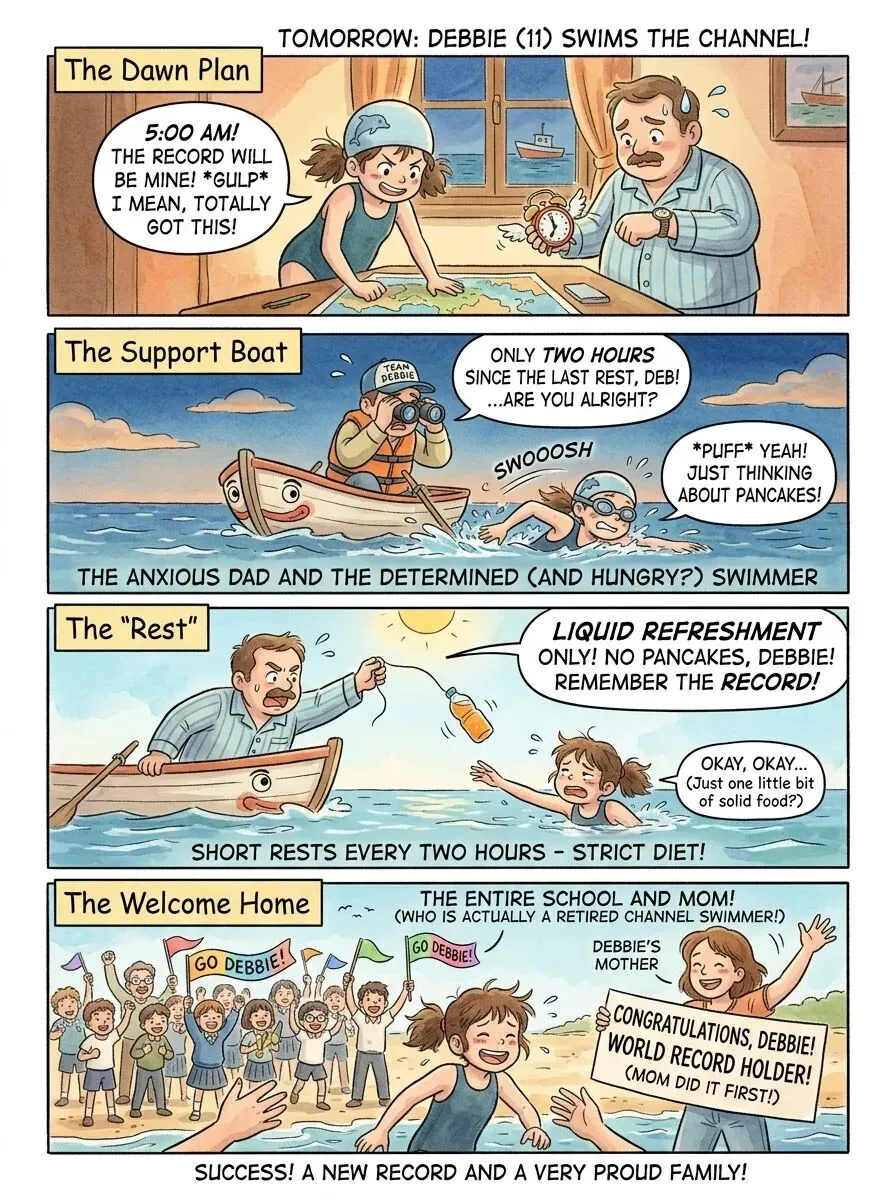
Debbie Hart is going to swim across the English Channel tomorrow. She is going to set out from the French coast at five o'clock in the morning. Debbie is only eleven years old and she hopes to set up a new world record. She is a strong swimmer and many people feel that she is sure to succeed. Debbie's father will set out with her in a small boat. Mr. Hart has trained his daughter for years. Tomorrow he will be watching her anxiously as she swims the long distance to England. Debbie intends to take short rests every two hours. She will have something to drink but she will not eat any solid food. Most of Debbie's school friends will be waiting for her on the English coast. Among them will be Debbie's mother, who swam the Channel herself when she was a girl.
语音标注: going to 连读 /ɡəʊɪŋ tə/;set out 连读 /set aʊt/;hopes to 连读 /həʊps tə/;sure to 连读 /ʃʊə tə/;trained his daughter 连读 /treɪnd hɪz/;will be watching 连读 /wɪl bi ˈwɒtʃɪŋ/;intends to 连读 /ɪnˈtendz tə/。
背景简介:本课是一篇简短的新闻报道式记叙文,讲述了11岁女孩黛比·哈特计划横渡英吉利海峡的故事。英吉利海峡是分隔英国与欧洲大陆的海域,最窄处约34公里,水温低、洋流复杂,横渡它是游泳耐力挑战的象征。自1875年首次有人成功横渡以来,它一直是公开水域游泳的终极测试之一。课文通过描写黛比的准备、家人的支持以及她母亲的过往经历,塑造了一个勇敢追梦的年轻运动员形象。
参考译文:
黛比·哈特明天将横渡英吉利海峡。她将在早上五点钟从法国海岸出发。黛比只有11岁,她希望创造一项新的世界纪录。她是一名游泳健将,许多人认为她一定能成功。黛比的父亲将乘坐一艘小船同她一道出发。哈特先生训练他的女儿已经多年。明天,当黛比长距离游向英国时,他将焦急地注视着她。黛比打算每两小时休息一下。她将喝些饮料,但不吃任何固体食物。黛比的大部分同学将在英国海岸等候她。他们当中还会有黛比的母亲,她本人还是个姑娘时,也曾横渡过英吉利海峡。
🔍 第二部分:逐句精讲与词块总结
句子1
原文: Debbie Hart is going to swim across the English Channel tomorrow.
翻译: 黛比·哈特明天将横渡英吉利海峡。
句子结构: 简单句。主语(Debbie Hart) + 谓语(is going to swim) + 宾语(across the English Channel) + 时间状语(tomorrow)。
重点词汇:
swim 蓝思值 400L
英音[swɪm] 美音[swɪm] 词性:v. & n.
释义:v. 游泳;n. 游泳
常用语块:go swimming(去游泳), swim across(横渡)
短语搭配:swim a race(参加游泳比赛), swim with the tide(随波逐流)
例句一:The children love to swim in the lake during summer. 孩子们喜欢夏天在湖里游泳。
例句二:He managed to swim across the river despite the strong current. 尽管水流湍急,他还是成功游过了河。
拓展:过去式 swam,过去分词 swum。Swimmer(游泳者)是派生词。
across 蓝思值 500L
英音[əˈkrɒs] 美音[əˈkrɔːs] 词性:prep. & adv.
释义:prep. 横过,穿过;在...对面。adv. 从一边到另一边;在对面。
常用语块:across from(在...对面), come across(偶然遇见)
短语搭配:walk across the street(穿过街道), a bridge across the river(横跨河流的桥)
例句一:There is a bank just across the street from the post office. 邮局正对面就有一家银行。
例句二:The idea suddenly came across my mind. 这个想法突然浮现在我脑海。
拓展:辨析 across 与 through:across 强调从表面“横穿”(如马路、河流),through 强调从内部“穿过”(如森林、隧道)。
语法点睛: 本句使用 be going to 结构表示按计划、打算在将来要做的事情。这与单纯表示将来时间的 will 有所不同,be going to 更强调事先已有意图或计划。
语音要点: going to 连读 /ɡəʊɪŋ tə/;across the 连读 /əˈkrɒs ðə/。
句子2
原文: She is going to set out from the French coast at five o'clock in the morning.
翻译: 她将在早上五点钟从法国海岸出发。
句子结构: 简单句。主语(She) + 谓语(is going to set out) + 地点状语(from the French coast) + 时间状语(at five o'clock in the morning)。
重点词汇:
set out 蓝思值 600L
英音[set aʊt] 美音[set aʊt] 词性:动词短语
释义:出发,动身;开始(做某事);陈列,摆放。
常用语块:set out on a journey(开始旅程), set out to do sth.(着手做某事)
短语搭配:set out from...(从...出发), set out for...(动身前往...)
例句一:We set out at dawn to avoid the traffic. 我们在黎明时分出发以避开交通拥堵。
例句二:She set out to learn German last year and now she can hold a basic conversation. 她去年开始学德语,现在能进行基本对话了。
拓展:Set off 是近义短语,也常表示“出发”。Set up(建立,设立)是另一个重要短语,在本课下文出现。
coast 蓝思值 700L
英音[kəʊst] 美音[koʊst] 词性:n.
释义:海岸,海滨。
常用语块:on the coast(在海岸线上), off the coast(在沿海海域)
短语搭配:the west coast(西海岸), a rocky coast(多岩石的海岸)
例句一:They spent their holiday in a small village on the coast of Cornwall. 他们在康沃尔海岸的一个小村庄度假。
例句二:There are many islands off the coast of Scotland. 苏格兰沿海有许多岛屿。
拓展:派生词 coastal(adj. 沿海的),如 coastal city(沿海城市)。注意与 beach(海滩,沙滩)的区别,coast 范围更广。
语法点睛: 本句再次使用 be going to 结构,与第一句形成并列,详细说明计划的具体细节(出发时间和地点)。时间状语 at five o'clock in the morning 使用了精确的时间点介词 at。在表示一天中的某个时刻时,必须用 at,如 at noon, at midnight。
语音要点: set out 连读 /set aʊt/;from the 连读 /frəm ðə/。
句子3
原文: Debbie is only eleven years old and she hopes to set up a new world record.
翻译: 黛比只有11岁,她希望创造一项新的世界纪录。
句子结构: 并列句。由连词 and 连接两个分句:1) Debbie is only eleven years old; 2) she hopes to set up a new world record。
重点词汇:
hope 蓝思值 300L
英音[həʊp] 美音[hoʊp] 词性:v. & n.
释义:v. 希望,盼望;n. 希望。
常用语块:hope to do sth.(希望做某事), hope for sth.(盼望某事)
短语搭配:lose hope(失去希望), in the hope of(怀着...的希望)
例句一:I hope to see you again soon. 我希望不久能再见到你。
例句二:We're hoping for good weather for the picnic. 我们盼望着野餐那天有好天气。
拓展:Hope 后接不定式(to do)或从句(that...),但不能接“宾语+不定式”结构(不能说 hope sb to do)。其反义词是 despair(绝望)。
set up 蓝思值 650L
英音[set ʌp] 美音[set ʌp] 词性:动词短语
释义:建立,设立;创立;创下(纪录);摆放好。
常用语块:set up a company(创立公司), set up a record(创纪录)
短语搭配:set up a tent(搭帐篷), set up a meeting(安排会议)
例句一:They set up the committee to investigate the accident. 他们成立了委员会来调查事故。
例句二:The athlete set up a new national record in the 100-meter dash. 这位运动员在百米短跑中创下了新的全国纪录。
拓展:名词形式为 setup。注意与 set out(出发)区分。Set up 强调“使立起来”或“使成立”的结果。
record 蓝思值 550L
英音[ˈrekɔːd] (n.) / [rɪˈkɔːd] (v.) 美音[ˈrekərd] (n.) / [rɪˈkɔːrd] (v.)
释义:n. 记录,记载;唱片;最好成绩。v. 记录,录制。
常用语块:break a record(打破纪录), keep a record(保存记录)
短语搭配:world record(世界纪录), criminal record(犯罪记录), record a song(录歌)
例句一:She holds the world record for the women's marathon. 她保持着女子马拉松的世界纪录。
例句二:Make sure you record all your expenses during the business trip. 务必记录下你出差期间的所有花费。
拓展:作名词时重音在第一音节,作动词时在第二音节。派生词 recorder(录音机,记录员)。
语法点睛: 这是一个由并列连词 and 连接的并列句,表示递进或补充关系。第二个分句中,hopes to set up 是“动词 + 不定式”结构,表示“希望做某事”。类似的动词还有 want, plan, decide, intend 等。Only 在这里是副词,修饰 eleven,强调年龄之小,与后面雄心勃勃的目标形成对比。
语音要点: hopes to 连读 /həʊps tə/;set up 连读 /set ʌp/。
句子4
原文: She is a strong swimmer and many people feel that she is sure to succeed.
翻译: 她是一名游泳健将,许多人认为她一定能成功。
句子结构: 并列复合句。整体是 and 连接的并列句。第二个分句包含一个由 that 引导的宾语从句(that she is sure to succeed),作 feel 的宾语。
重点词汇:
strong 蓝思值 350L
英音[strɒŋ] 美音[strɔːŋ] 词性:adj.
释义:强壮的;坚固的;强烈的;擅长的。
常用语块:strong wind(大风), strong feeling(强烈的感情)
短语搭配:strong coffee(浓咖啡), strong point(长处,强项), a strong swimmer(游泳健将)
例句一:You need to be strong to lift this box. 你需要力气大才能抬起这个箱子。
例句二:He has a strong desire to travel around the world. 他有一个环游世界的强烈愿望。
拓展:反义词是 weak(弱的)。名词形式为 strength(力量)。A strong swimmer 不是指“强壮的游泳者”,而是指“游泳技术好、耐力强的人”。
feel 蓝思值 400L
英音[fiːl] 美音[fiːl] 词性:v. & n.
释义:v. 感觉;认为;触摸。n. 感觉,触觉。
常用语块:feel like (doing) sth.(想要做某事), feel sorry for(为...感到抱歉)
短语搭配:feel happy/sad(感到高兴/悲伤), feel the texture(触摸质感)
例句一:I feel that we should leave now. 我认为我们现在应该走了。
例句二:The material feels soft and smooth. 这布料摸起来柔软光滑。
拓展:过去式和过去分词均为 felt。Feel 作“认为”讲时,常接 that 从句,与 think, believe 类似,但更侧重基于感觉的判断。
sure 蓝思值 300L
英音[ʃʊə(r)] 美音[ʃʊr] 词性:adj. & adv.
释义:adj. 确信的,有把握的;一定的,必定的。adv. (口语)当然。
常用语块:be sure of/about(对...有把握), be sure to do(一定会做)
短语搭配:make sure(确保), for sure(肯定地)
例句一:Are you sure of the answer? 你对这个答案有把握吗?
例句二:It's sure to rain later, so take an umbrella. 待会儿肯定会下雨,带上伞吧。
拓展:Be sure to do 表示说话人确信某事会发生。Be sure of 表示主语自己对某事有信心。副词 surely(无疑地,一定)。
succeed 蓝思值 600L
英音[səkˈsiːd] 美音[səkˈsiːd] 词性:v.
释义:成功;继任,接替。
常用语块:succeed in (doing) sth.(在...方面成功)
短语搭配:succeed sb. as...(接替某人担任...)
例句一:She finally succeeded in passing the driving test after three attempts. 经过三次尝试,她终于成功通过了驾照考试。
例句二:Who will succeed the current president? 谁将接替现任总统?
拓展:名词为 success(成功),形容词为 successful(成功的),副词为 successfully(成功地)。反义词是 fail(失败)。注意介词搭配:succeed in, 不是 succeed to do。
语法点睛: 本句结构稍复杂。Many people feel that... 中,that 引导宾语从句。That 在口语中常可省略。从句 she is sure to succeed 中,be sure to do 是一个固定搭配,表示“一定会...”,表达一种强烈的预期或判断。这个结构使人们对黛比成功的信心表达得非常肯定。
语音要点: sure to 连读 /ʃʊə tə/。
句子5
原文: Debbie's father will set out with her in a small boat.
翻译: 黛比的父亲将乘坐一艘小船同她一道出发。
句子结构: 简单句。主语(Debbie's father) + 谓语(will set out) + 伴随状语(with her) + 方式状语(in a small boat)。
语法点睛: 本句使用了一般将来时 will set out,表示单纯的将来动作。这里用 will 而不用 be going to,可能更侧重于对将来事实的客观陈述,而非强调父亲的个人计划(虽然这显然也是计划的一部分)。With her 是介词短语作伴随状语,说明父亲是和黛比一起。In a small boat 是介词短语作方式状语,说明乘坐的工具。
语音要点: will set out 连读 /wɪl set aʊt/。
句子6
原文: Mr. Hart has trained his daughter for years.
翻译: 哈特先生训练他的女儿已经多年。
句子结构: 简单句。主语(Mr. Hart) + 谓语(has trained) + 宾语(his daughter) + 时间状语(for years)。
重点词汇:
train 蓝思值 500L
英音[treɪn] 美音[treɪn] 词性:v. & n.
释义:v. 训练,培训;锻炼。n. 火车;行列。
常用语块:train for(为...而训练), train sb. to do sth.(训练某人做某事)
短语搭配:catch a train(赶火车), a train of thought(思路)
例句一:He is training hard for the upcoming marathon. 他正在为即将到来的马拉松刻苦训练。
例句二:The company trains all new employees in safety procedures. 公司对所有新员工进行安全规程培训。
拓展:名词 trainer(培训师,教练员;运动鞋), trainee(受训者)。Training(n. 训练)。
语法点睛: 本句使用现在完成时 has trained,强调动作从过去开始,持续到现在,并且可能持续下去,重点是训练这一过程所花费的时间(for years)。For years 表示“多年”,是完成时典型的持续时间状语。这表明黛比的成功并非偶然,而是长期艰苦训练的结果,为她的挑战增添了可信度。
语音要点: trained his 连读 /treɪnd hɪz/。
句子7
原文: Tomorrow he will be watching her anxiously as she swims the long distance to England.
翻译: 明天,当黛比长距离游向英国时,他将焦急地注视着她。
句子结构: 复合句。主句(he will be watching her anxiously) + 时间状语从句(as she swims the long distance to England),由 as 引导。
重点词汇:
anxiously 蓝思值 650L
英音[ˈæŋkʃəsli] 美音[ˈæŋkʃəsli] 词性:adv.
释义:焦急地,忧虑地。
常用语块:wait anxiously(焦急地等待)
短语搭配:look anxiously at sb.(焦虑地看着某人)
例句一:The parents waited anxiously outside the operating room. 父母在手术室外焦急地等待着。
例句二:She glanced anxiously at her watch, worried about being late. 她焦虑地瞥了一眼手表,担心会迟到。
拓展:形容词形式为 anxious(焦虑的,渴望的),名词为 anxiety(焦虑)。Be anxious about(为...担心), be anxious to do(渴望做)。
distance 蓝思值 600L
英音[ˈdɪstəns] 美音[ˈdɪstəns] 词性:n.
释义:距离,间距;远方;疏远。
常用语块:long distance(长距离), in the distance(在远处)
短语搭配:keep a distance(保持距离), distance learning(远程学习)
例句一:What's the distance between London and Paris? 伦敦和巴黎之间的距离是多少?
例句二:We could see a light in the distance. 我们能看到远处有灯光。
拓展:形容词 distant(遥远的)。动词 distance oneself from(与...疏远)。
语法点睛: 这是本课语法重点之一。主句使用将来进行时 will be watching,表示在将来某个特定时间(明天黛比游泳期间)正在进行的动作。这比单纯用 will watch 更生动地描绘出父亲在那一时间段持续关注的状态。从句 as she swims 使用一般现在时,但在时间状语从句中,常用一般现在时表示将来(主句是将来时),这是英语中“主将从现”规则的一种体现。As 引导时间状语从句,意为“当...时”,强调主从句动作同时发生。
语音要点: will be watching 连读 /wɪl bi ˈwɒtʃɪŋ/;as she 连读 /æz ʃi/。
句子8
原文: Debbie intends to take short rests every two hours.
翻译: 黛比打算每两小时休息一下。
句子结构: 简单句。主语(Debbie) + 谓语(intends) + 宾语(to take short rests) + 时间状语(every two hours)。
重点词汇:
intend 蓝思值 700L
英音[ɪnˈtend] 美音[ɪnˈtend] 词性:v.
释义:打算,计划;意思是。
常用语块:intend to do sth.(打算做某事)
短语搭配:be intended for(为...而设计/准备)
例句一:I intend to finish this report by Friday. 我打算在周五前完成这份报告。
例句二:This gift is intended for your birthday. 这份礼物是为你的生日准备的。
拓展:名词 intention(意图)。Intend 比 plan 或 want 更正式,决心更强。
rest 蓝思值 400L
英音[rest] 美音[rest] 词性:n. & v.
释义:n. 休息;剩余部分;支架。v. 休息;倚靠。
常用语块:have/take a rest(休息一下), the rest of(其余的)
短语搭配:rest your eyes(让眼睛休息), rest on(依靠,基于)
例句一:Let's stop and have a ten-minute rest. 我们停下来休息十分钟吧。
例句二:You can rest assured that everything will be fine. 你可以放心,一切都会好的。
拓展:Rest 作“剩余部分”讲时,常与 the 连用,后接 of。形容词 restful(宁静的,悠闲的)。
语法点睛: Intends to take 是“动词 + 不定式”结构,表示意图,与前面的 hopes to set up 类似。Every two hours 表示频率,意为“每两小时”,类似结构有 every day, every week, every other day(每隔一天)。Short rests 中的 short 修饰 rests,说明休息是短暂的,符合长距离耐力挑战的策略。
语音要点: intends to 连读 /ɪnˈtendz tə/。
句子9
原文: She will have something to drink but she will not eat any solid food.
翻译: 她将喝些饮料,但不吃任何固体食物。
句子结构: 并列句。由连词 but 连接两个对比的分句:1) She will have something to drink; 2) she will not eat any solid food。
重点词汇:
solid 蓝思值 650L
英音[ˈsɒlɪd] 美音[ˈsɑːlɪd] 词性:adj. & n.
释义:adj. 固体的;坚固的;实心的;可靠的。n. 固体。
常用语块:solid food(固体食物), solid ground(坚实的地面)
短语搭配:solid evidence(确凿的证据), a solid line(实线)
例句一:Water becomes solid when it freezes. 水结冰时变成固体。
例句二:He gave me some solid advice on career planning. 他在职业规划方面给了我一些可靠的忠告。
拓展:反义词是 liquid(液体)或 hollow(空心的)。副词 solidly(坚固地)。Solid food 指非流质的食物。
语法点睛: 这是一个由 but 连接的并列句,表示转折对比。两个分句都使用一般将来时 will have 和 will not eat。Something to drink 是不定式 to drink 作后置定语,修饰 something,意为“喝的东西”。Any 用于否定句中,修饰 solid food。这说明了黛比在挑战过程中的补给策略。
语音要点: something to 连读 /ˈsʌmθɪŋ tə/。
句子10
原文: Most of Debbie's school friends will be waiting for her on the English coast.
翻译: 黛比的大部分同学将在英国海岸等候她。
句子结构: 简单句。主语(Most of Debbie's school friends) + 谓语(will be waiting for) + 宾语(her) + 地点状语(on the English coast)。
语法点睛: 本句再次使用将来进行时 will be waiting for,表示在将来某个时间(黛比抵达时)正在进行的动作。这生动地描绘出朋友们在海岸边翘首以盼的场景。Most of... 表示“...中的大多数”,后接名词复数(friends)或不可数名词。Wait for 是固定短语动词。
语音要点: will be waiting 连读 /wɪl bi ˈweɪtɪŋ/。
句子11
原文: Among them will be Debbie's mother, who swam the Channel herself when she was a girl.
翻译: 他们当中还会有黛比的母亲,她本人还是个姑娘时,也曾横渡过英吉利海峡。
句子结构: 复合句。主句是倒装句(Among them will be Debbie's mother),后接一个由 who 引导的非限制性定语从句(who swam the Channel herself when she was a girl),修饰 Debbie's mother。定语从句中又包含一个由 when 引导的时间状语从句。
语法点睛: 这是本课最复杂的句子,包含倒装和非限制性定语从句。主句 Among them will be Debbie's mother 是表语(Among them)提前的完全倒装句,正常语序是 Debbie's mother will be among them。倒装使句子与上文衔接更紧密(them 指代 school friends),并强调地点。Who 引导的非限制性定语从句对母亲进行补充说明,提供重要背景信息——她也有横渡经历,这解释了父亲为何能训练女儿,也增强了故事传承的意味。定语从句中的 when she was a girl 是时间状语从句。Herself 是反身代词,起强调作用,意为“她本人”。
语音要点: Among them 连读 /əˈmʌŋ ðəm/;who swam 连读 /huː swæm/。
📌 核心词块总结
1. set out (from...) — to begin a journey from a particular place. (从某地)出发。 例句:The expedition will set out from base camp at dawn. (探险队将于黎明从大本营出发。)
2. set up a record — to establish a new best performance that is officially recognized. 创造一项纪录。 例句:The young gymnast hopes to set up a new national record in the competition. (这位年轻的体操运动员希望在比赛中创造新的全国纪录。)
3. be sure to do sth. — to be certain or very likely to do something. 一定会做某事。 例句:With all this practice, you are sure to pass the driving test. (经过所有这些练习,你一定能通过驾照考试。)
4. train sb. for years — to teach or prepare someone over a long period of time (for a specific purpose). 训练某人多年。 例句:The coach has trained the athlete for years, preparing him for the Olympics. (教练训练这名运动员多年,为他备战奥运会。)
5. watch sb. anxiously — to observe someone with a feeling of worry or nervousness. 焦急地注视着某人。 例句:The mother watched her child anxiously as he climbed the tree. (母亲焦急地看着她的孩子爬树。)
6. intend to do sth. — to have a plan or purpose in mind to do something. 打算做某事。 例句:I intend to visit my grandparents during the summer holiday. (我打算暑假去看望我的祖父母。)
7. take short rests — to pause for brief periods to relax or recover. 进行短暂的休息。 例句:During the long hike, it's important to take short rests and drink water regularly. (在长途徒步中,定期短暂休息和喝水很重要。)
8. will be waiting for — (Future Continuous) used to describe an action that will be in progress at a specific time in the future. 将在等候(将来进行时,描述将来某时正在进行的动作)。 例句:This time tomorrow, I will be waiting for my flight at the airport. (明天这个时候,我将在机场等候我的航班。)
✍️ 第三部分:语篇分析与段落写作技巧
1. 语篇分析(关键术语标注英文):
①识别宏观结构 (Identify the macrostructure): 本文采用经典的叙事结构 (narrative structure)。开头(第1-2句)交代核心事件(Debbie将横渡海峡)及具体计划。主体部分(第3-10句)展开叙述,包括:Debbie的个人情况与目标(3-4句)、父亲的支持与训练(5-7句)、Debbie的挑战策略(8-9句)、朋友的等待(10句)。结尾(第11句)通过补充母亲的信息,深化主题,形成一种家庭传统与精神传承的意味。全文按时间顺序 (chronological order)和逻辑顺序 (logical order)交织推进。
②列举衔接手段 (List cohesive devices):
-指代 (Reference): 大量使用代词(she, her, he, his, them)指代上文出现的人物(Debbie, Mr. Hart, friends),使行文简洁连贯。
-连接词 (Conjunctions): 使用 and(并列、递进)、but(转折)等并列连词连接句子。使用 as(当...时)引导时间状语从句。
-词汇衔接 (Lexical Cohesion): 重复关键词 swim/swimmer、Channel、coast、record。使用同义或相关词汇,如 set out(出发)与 swim across(横渡)关联,strong swimmer(游泳健将)与 succeed(成功)关联。
-时间状语 (Temporal Adjuncts): tomorrow, at five o'clock, for years, every two hours 等清晰勾勒出时间线。
③分析作者态度 (Analyze the author's attitude): 作者的态度是客观中带着钦佩与期待 (objective with a tone of admiration and anticipation)。通过使用 only eleven years old(只有11岁)与 set up a new world record(创世界纪录)的对比,突出黛比的非凡。strong swimmer, sure to succeed, has trained... for years 等表述传递出对其实力和准备的肯定。Will be watching her anxiously 体现了对挑战艰辛的理解和人性化的关切。最后提及母亲的经历,则暗示了这是一种值得尊敬的家族传统或体育精神。全文没有直接的情感抒发,但通过事实选择和措辞,营造出积极、鼓舞的氛围。
2. 写作技巧:
①提炼写作逻辑: 本文是“预告-背景-细节-呼应”的经典模式。首先点明即将发生的核心事件,然后介绍主角的资质和目标,接着提供支持系统(家人、训练)和具体计划,最后以朋友的等候和家庭背景收尾,使故事丰满且有深度。这种逻辑适用于写个人成就、项目计划、活动预告等。
②提供段落写作范例:
主题:写一段话,介绍一位朋友为参加马拉松所做的准备。
范例:
My friend, Leo, is going to run his first marathon next month. He is only sixteen, but he has been training seriously for over a year. Leo is a determined runner, and we all feel he is sure to finish the race. His older brother, who is an experienced marathoner, has been coaching him every weekend. During his long training runs, Leo plans to take short breaks every five kilometers. He will drink sports beverages but avoid heavy snacks. On the race day, our whole class will be waiting for him at the finish line. Among us will be our P.E. teacher, who ran the same marathon a decade ago.
分析其结构特点:首句点明事件;第二句介绍年龄与训练时长,形成对比;第三句描述特质与信心;第四句介绍支持系统;第五、六句说明具体策略;第七句讲朋友的等待;末句补充相关人物经历,模仿课文结尾。
标注语言点映射:is going to run (将来计划), has been training (现在完成进行时,强调持续训练), is sure to finish (固定搭配,表示确信), will be waiting (将来进行时), Among... will be (倒装结构)。
③布置小练笔并提供例文
任务:假设你或你认识的人正在为一个重要目标努力(如备考、学乐器、准备演讲比赛等)。请模仿课文结构,写一个约100词的英文段落进行介绍。
要求:包含1) 目标是什么;2) 主角的简要情况;3) 为此做的准备/训练;4) 支持者是谁/会怎么做;5) 一个相关的背景细节(如家人朋友有过类似经历)。
例文:
My cousin, Mia, is going to take the Grade 8 piano exam next week. She is thirteen and hopes to achieve a distinction. Mia is a talented musician and practices for two hours daily. Our aunt, a piano teacher, has guided her for the past three years. During the exam, Mia intends to take a deep breath before each piece. She will have some water with her but will not eat until afterwards. Our family will be listening nervously outside the exam room. Among them will be my grandfather, who used to play the piano in an orchestra when he was young.
分析: 该段落完整模仿了课文结构,涵盖了所有要求要点,并使用了 is going to take, hopes to achieve, has guided, intends to take, will be listening, Among them will be 等本课核心或相关句式,实现了有效的模仿写作。
📐 第四部分:本课语法精析(加强版)
本部分聚焦核心语法:将来完成时 (Future Perfect Tense),并对比相关时态。
1. 将来完成时的构成与核心概念
- 构成:will have + 过去分词 (past participle)。
- 例句:By this time tomorrow, I will have finished my homework.
- 例句:They will have built three new schools by the end of the year.
- 核心概念:表示到将来某个时间点为止,某个动作已经完成或某个状态已经存在。它强调的是“将来之先”——在未来的某一刻回头看,某事已经完成了。
- 例句:When you arrive tonight, we will have already eaten dinner. (你今晚到时,我们将已经吃过晚饭了。)
- 关键:总是与一个表示“将来时间点”的状语连用,如 by tomorrow, by the end of next month, by the time you come back, when she arrives 等。
2. 将来完成时的典型时间状语
这是识别和使用该时态的关键。常见状语有:
- by + 将来时间点:by tomorrow, by next Friday, by 2025, by the age of 30
- 例句:By 2030, scientists will have discovered new treatments for many diseases.
- by the time + (一般现在时从句):by the time you get home, by the time the movie starts
- 例句:By the time you get this letter, I will have left for Japan.
- by the end of + 将来时间段:by the end of this week, by the end of the year
- 例句:By the end of this course, you will have learned all the basic grammar rules.
- when + (一般现在时从句)(主句用将来完成时):when we meet again
- 例句:When we meet again next year, a lot will have changed.
3. 将来完成时与一般将来时的对比
- 一般将来时 (will do / be going to do):表示单纯的将来动作或状态,不涉及该动作在另一将来时间点前的完成情况。
- 将来完成时 (will have done):强调在将来某时间点前,动作的完成或结果的达成。
- 对比例句:
- I will write the report. (我将写报告。)——只说明要写。
- I will have written the report by Friday. (到周五时,我将已经写完报告。)——强调周五前完成。
- She will visit Paris. (她将访问巴黎。)
- She will have visited Paris by the time she graduates. (到她毕业时,她将已经访问过巴黎了。)
4. 将来完成时与现在完成时的对比
- 现在完成时 (have/has done):表示动作发生在过去,但与现在有关联(结果影响现在,或持续到现在)。参照点是“现在”。
- 将来完成时 (will have done):表示动作将在将来某个时间点之前完成。参照点是“将来的某个时间点”。
- 对比例句:
- I have lived here for ten years. (我在这里住了十年了。)——从过去住到现在。
- Next year, I will have lived here for eleven years. (到明年,我在这里就将住满十一年了。)——到明年那个将来时间点,居住这个状态将已持续十一年。
- He has finished his work. (他已经完成了他的工作。)——现在完成了。
- He will have finished his work by 6 p.m. (到下午六点,他将已经完成他的工作。)——将来六点前完成。
5. 与本课相关的其他语法点:将来进行时
本课出现了将来进行时 (will be watching, will be waiting)。
- 构成:will be + 现在分词 (present participle)
- 用法:表示在将来某个特定时间点或时间段正在进行的动作。它描绘一幅将来的“场景”。
- 与将来完成时对比:
- This time tomorrow, I will be flying to London. (明天这个时候,我将在飞往伦敦的途中。)——强调明天此时正在进行的动作。
- By this time tomorrow, I will have arrived in London. (到明天这个时候,我将已经抵达伦敦。)——强调明天此时动作已完成。
- 课文例句分析:Tomorrow he will be watching her anxiously... 描绘父亲在黛比游泳的整个过程中持续关注的状态。Most of Debbie's friends will be waiting for her... 描绘朋友们在她抵达时正在等候的场景。
6. “主将从现”在时间/条件状语从句中的应用
在时间状语从句 (when, as, before, after, as soon as, until) 和条件状语从句 (if, unless) 中,如果主句是将来时,从句通常用一般现在时表示将来。
- 课文例句:...as she swims the long distance... (从句一般现在时) / ...he will be watching... (主句将来进行时)
- 更多例句:
- If it rains tomorrow, we will cancel the picnic.
- I will call you as soon as I arrive at the airport.
- She won't go to bed until she finishes her homework.
7. 练习题(不少于12道)
1. By the end of this month, we __________ (complete) the project. (答案:will have completed)
2. When you come back from your trip, I __________ (move) to a new apartment. (答案:will have moved)
3. I'm sure they __________ (finish) building the bridge by next year. (答案:will have finished)
4. By the time she is twenty-five, she __________ (visit) over fifteen countries. (答案:will have visited)
5. Look at the sky! It __________ (rain) soon. (用一般将来时) (答案:is going to rain / will rain)
6. This time next week, I __________ (lie) on a beach in Hawaii. (用将来进行时) (答案:will be lying)
7. If he __________ (work) hard, he will pass the exam. (用正确时态) (答案:works)
8. I __________ (read) this book for two hours by 10 o'clock tonight. (答案:will have been reading) (注:此处可用将来完成进行时,稍作拓展)
9. They __________ (not start) dinner until everyone __________ (arrive). (答案:will not start; arrives)
10. By 2050, scientists __________ (find) a cure for many cancers, I hope. (答案:will have found)
11. When I see you tomorrow, I __________ (finish) my report, so we can discuss it. (答案:will have finished)
12. 改错:By this time tomorrow, I will finish all my chores. (答案:will finish -> will have finished)
解析:
- 第1-4,10-12题:考查将来完成时的基本构成和与 by... 时间状语的搭配。
- 第5题:考查一般将来时(根据迹象 Look at the sky 用 be going to 更佳)。
- 第6题:考查将来进行时,与特定将来时间点 (this time next week) 连用,描述正在进行的动作。
- 第7、9题:考查“主将从现”规则,在 if 和 until 引导的从句中用一般现在时表示将来。
- 第8题:稍难,引入将来完成进行时 (will have been doing),表示到将来某时,动作已持续一段时间并可能继续。此处接受 will have read (将来完成时) 也为合理答案,但 will have been reading 更强调“阅读”这个动作的持续性。
8. 与第一册相关语法点的对比分析
在第一册,学生主要掌握了一般现在时、现在进行时、一般过去时、一般将来时 (will/be going to) 以及现在完成时的基本用法。第二册第36课引入的将来完成时是时态体系的进一步深化和拓展。
- 复杂度提升:第一册的时态多描述现在、过去或单纯的将来。将来完成时需要学生建立“在将来某个时间点之前”的思维框架,将时间参照点从“现在”转移到“未来”,并理解“完成”的视角也相应转移。
- 逻辑关联:将来完成时与现在完成时在“完成”概念上相通,只是时间轴不同。现在完成时联系“过去”与“现在”,将来完成时联系“现在(或将来某动作)”与“更远的将来某点”。教学时可以引导学生进行这种时空平移的类比。
- 状语标志:第一册学习了 for, since 等与现在完成时连用的状语。第二册第36课重点学习 by..., by the time... 等将来完成时的标志性状语,这是区分和运用该时态的关键。
🎧 第五部分:听力与阅读策略训练
1. 听力技巧:结合课文录音设计听力理解题
在听课文录音前、中、后,可以设计以下活动:
①预测关键词 (Predicting Key Words):
- 出示标题 “Across the Channel”。提问:What do you think the passage will be about? (Swimming, sea, challenge, England, France...)
- 出示第一句 “Debbie Hart is going to swim across the English Channel tomorrow.” 听后,让学生预测接下来可能会听到哪些信息?(How old is she? Why is she doing it? Who is with her? How will she do it?)
②抓主旨大意 (Gist Listening):
- 播放全文录音1-2遍。提问:
- What is the main event? (Debbie Hart plans to swim the English Channel.)
- Who is the main person? (Debbie Hart.)
- What are two key supporting facts? (She is young and wants to set a record; her father trained her; her mother also did it.)
③笔记方法 (Note-taking):
- 播放录音,要求学生以关键词形式记下要点。提供框架:
- Who: Debbie Hart (11 years old)
- What: Swim across English Channel tomorrow
- Goal: Set up a new world record
- Support: Father (by boat, trained her), Friends & Mother (waiting on English coast)
- Plan: Start at 5 a.m. from France; rest every 2 hours; drink, no solid food.
- 根据笔记,尝试复述故事。
2. 阅读理解策略:设计扫读、略读、推断词义等题目
①扫读 (Scanning):针对具体信息快速定位。
- How old is Debbie Hart? (Scan for numbers: “eleven years old”)
- What time will she set out? (“at five o'clock in the morning”)
- How often will she take rests? (“every two hours”)
②略读 (Skimming):快速获取段落大意。
- 读第一段(通常为前几句),回答:What is the passage mainly about? (A girl's plan to swim the Channel.)
③推断词义 (Inferring Meaning):
- “She is a strong swimmer.” From the context (she wants to set a world record, her father trained her for years), what does “strong” mean here? (It likely means “skilled, capable, having great endurance” rather than just physically powerful.)
- “...who swam the Channel herself when she was a girl.” What does this information suggest about Debbie's family? (It suggests swimming the Channel might be a family tradition or that Debbie was inspired by her mother. It also explains why the father knows how to train her.)
④理解指代 (Understanding Reference):
- In “Tomorrow he will be watching her anxiously”, who does “he” refer to? (Debbie's father, Mr. Hart.)
- In “Among them will be Debbie's mother”, who does “them” refer to? (Debbie's school friends waiting on the coast.)
📝 第六部分:习题讲解
1. 针对教材中的书面练习进行详细讲解
-关键句型练习 (Key Structures):通常会聚焦本课核心语法——将来完成时和将来进行时。例如,完成句子:By the time you arrive, I __________ (finish) my work. 讲解重点是识别时间状语 By the time you arrive,这提示使用将来完成时 will have finished。
-难点练习 (Special Difficulties):可能涉及词汇辨析,例如 watch, look at, see 的区别;或者 set 短语动词的辨析 (set out, set up, set off)。需要结合课文例句和补充例句进行讲解。
-多项选择题 (Multiple Choice Questions):通常综合考查词汇、语法和课文理解。
- 例题:Debbie Hart hopes to __________ a new world record.
A. put up B. set up C. build up D. make up
-解题思路:首先回顾课文原句是 set up a new world record。其次,辨析选项:put up 常指“张贴,搭建”;set up 有“创立,建立,创纪录”的意思;build up 指“逐步建立,增强”;make up 指“编造,弥补,化妆”。与“纪录”搭配的固定短语是 set up 或 break(打破)。因此选B。
-答案解析:B 是正确答案,因为 set up a record 是固定搭配。
2. 提供解题思路和答案解析
-思路:做练习前,务必回顾课文内容和本课讲解的重点语法、词汇。对于语法题,先找时间状语或上下文逻辑,判断时态。对于词汇题,回忆课文中的用法,并考虑搭配和词义。
-示例(作文练习摘要写作):
-题目:根据课文要点,写一篇不超过50词的摘要。
-要点提示:1. Debbie Hart - swim - English Channel - tomorrow. 2. Eleven years old - hopes - new world record. 3. Father - trained her - years. 4. He - accompany her - boat. 5. She - take rests - two hours - drink - no solid food. 6. School friends - wait - English coast. 7. Mother - among them - swam Channel - girl.
-解题思路:将这些要点用完整的句子连接起来,注意使用正确的时态(将来时为主,部分用现在完成时和一般过去时),并确保字数符合要求。
-参考范文: Debbie Hart, an eleven-year-old girl, will swim the English Channel tomorrow to set up a new world record. Her father, who has trained her for years, will accompany her in a boat. She plans to take short rests every two hours, having only drinks. Her school friends and her mother, who swam the Channel as a girl, will be waiting on the English coast. (约55词,可微调至50词内)
🤔 第七部分:英文深度思考与拓展(强化版)
A. 层次化英文问题与答案
①Level 1 (Factual): 事实性问题,至少3个。
1. Q: How old is Debbie Hart? A: Debbie Hart is eleven years old.
2. Q: What time is Debbie going to start her swim? A: She is going to set out at five o'clock in the morning.
3. Q: What will Debbie have during her swim, and what won't she have? A: She will have something to drink, but she will not eat any solid food.
4. Q: Who trained Debbie for years? A: Her father, Mr. Hart, trained her for years.
②Level 2 (Inferential): 推理性问题,至少3个。
1. Q: Why do many people feel that Debbie is sure to succeed? A: They feel she is sure to succeed because she is described as a “strong swimmer” and, more importantly, her father has trained her rigorously for years, which suggests she is well-prepared.
2. Q: What does the fact that Debbie's mother also swam the Channel tell us about Debbie's challenge? A: It tells us that swimming the Channel might be a family tradition or a shared dream. It also suggests that Debbie has grown up in an environment that understands and supports such a difficult endeavor, and her father's training methods might be based on personal experience.
3. Q: Why do you think Debbie's father will be watching her “anxiously”? A: He will be watching anxiously because, despite the training, swimming the English Channel is a dangerous and exhausting challenge. As a father, he is naturally worried about her safety, health, and whether she can endure the harsh conditions like cold water, strong currents, and fatigue.
4. Q: What is the purpose of taking short rests every two hours instead of swimming non-stop? A: The purpose is to manage her energy and endurance over the long distance. Short rests allow her muscles to recover slightly, take in fluids to prevent dehydration, and mentally regroup without letting her body cool down too much, which would make restarting very difficult.
③Level 3 (Evaluative): 评价性问题,至少4个。
1. Q: Do you think it is appropriate for an eleven-year-old to attempt such a dangerous world record? Why or why not? A: This is a complex issue. On one hand, with proper training, supervision, and medical support, it could be a testament to human potential and discipline at a young age. On the other hand, the physical and mental strain might be excessive for a child's developing body and mind. The decision should involve experts, and her well-being must be the top priority.
2. Q: What qualities do you think a person needs to achieve a goal like swimming the English Channel? A: To achieve such a goal, a person needs exceptional physical endurance and strength, immense mental toughness and determination, meticulous planning and preparation, the ability to tolerate discomfort and pain, and a strong support system for training and during the attempt itself.
3. Q: How does the author make the story more interesting and believable by including details about Debbie's family? A: The author makes the story more interesting and believable by including her family. The father's years of training add credibility to her ability. The mother's past feat adds depth, creating a narrative of inspiration or legacy. The father's anxious watch and the friends' waiting add human emotion and stakes, making it more than just a sports report.
4. Q: If you were a news reporter covering this event, what additional information would you want to include in your article? A: As a reporter, I would want to include: the exact distance and expected time of her swim, the water temperature and weather forecast, details of her training regimen, quotes from Debbie and her parents about their feelings, the history of the Channel swim and the current world record for her age group, and opinions from sports doctors or coaches on the challenges.
B. 多类型拓展阅读
1. 时事新闻拓展 (Current News Extension)
Title: Modern Channel Swimmers Embrace Technology
Swimming the English Channel remains a pinnacle of endurance sports, but today's attempts look different from Debbie Hart's fictional one. Swimmers now wear GPS trackers, allowing fans worldwide to follow their progress in real-time online. Specialized swimsuits provide minimal warmth without breaking the “no artificial aid” rules. Support boats are equipped with advanced navigation and communication systems. Nutrition science has also evolved; swimmers consume precisely formulated liquid gels at regular intervals instead of just “something to drink.” Despite these advances, the core challenge remains: battling cold, currents, fatigue, and one's own mind for over 10 hours. The spirit of adventure that drove the first swimmer in 1875 still inspires every person who steps into the waters at Dover.
引导性问题:How has technology changed the way people attempt the Channel swim compared to the story? What aspects of the challenge remain unchanged?
2. 文化背景解析 (Cultural Background Analysis)
Title: The English Channel: More Than Just Water
The English Channel, separating England from France, is about 560 km long and 34 km wide at its narrowest (the Strait of Dover). Historically, it served as a natural defensive barrier for Britain. In the world of sports, it became the ultimate test for long-distance swimmers after Matthew Webb's first successful crossing in 1875. The swim is governed by strict rules: no touching the support boat, only a standard swimsuit, cap, and goggles. The “Channel Swimming Association” officially observes and verifies crossings. Success depends heavily on tides and weather, requiring meticulous planning. Completing the swim grants entry into an elite global community and is a badge of honor that symbolizes extreme perseverance, much like climbing Mount Everest for mountaineers.
语言点映射:separating... from... (现在分词作定语), served as (充当), the ultimate test (终极测试), governed by (被...管理), depends heavily on (严重依赖于), symbolizes (象征)。
3. 今昔对比分析 (Then-and-Now Comparison)
Title: Training Then and Now: The Evolution of Preparation
In stories like Debbie's, training often involves a dedicated parent coaching for years, likely based on experience and traditional methods. Today, aspiring Channel swimmers often have access to much more. They might train in open water year-round, using temperature acclimatization techniques. Their training plans are designed by professional coaches using data from heart rate monitors and swim trackers. They undergo psychological conditioning to prepare for the mental strain of hours in cold, featureless water. Diet is carefully managed by nutritionists. While the core elements—long hours, discipline, and family support—remain vital, the approach has become more scientific and specialized. This reflects a broader trend in sports where technology and expert knowledge play increasingly larger roles alongside raw talent and determination.
引导性问题:What are the main differences between traditional training (implied in the text) and modern training methods? What core elements of training seem to be timeless?
4. 新潮英语改写 (Trendy English Rewrite)
Title: GOAL: Channel Swim @ 11! #Determination #DadCoach
Okay, so get this. Debbie Hart, just 11, is literally going to swim the ENTIRE English Channel TOMORROW. She's starting at 5 AM from France. Her goal? To smash a world record! Everyone says she's got this — she's a total beast in the water. Her dad's been her coach for, like, forever, and he'll be in a boat beside her, probably freaking out (in a supportive dad-way). Debbie's plan: quick breaks every couple of hours, hydrate with sports drinks, but no snacks. All her squad from school will be on the UK shore, cheering her on. The coolest part? Her MOM did the same swim when she was young! How's that for family goals? We're all rooting for you, Debbie! #ChannelSwim #FutureChampion #GirlPower
语言点映射:将 set up a record 改写为口语化的 smash a record;将 strong swimmer 改写为网络用语 a total beast;将 watch anxiously 改写为 freaking out (in a supportive dad-way);将 school friends 改写为 her squad;体现了社交媒体文案的特点(用词夸张、使用标签、直接对话语气)。
5. 难度略高的拓展阅读 (Slightly Higher Difficulty Extension)
Title: The Psychology of Solitary Endurance
Attempts like swimming the English Channel are as much a mental battle as a physical one. For hours, the swimmer is alone with their thoughts in a vast, often cold and monotonous environment. Psychologists note that successful endurance athletes employ specific cognitive strategies. They might break the huge task into smaller, manageable segments (“just get to the next rest point”). They use positive self-talk and visualization, picturing the successful finish. They learn to acknowledge pain and discomfort without letting them dictate the decision to stop. The presence of a support boat, as in Debbie's case, is crucial not just for safety and nutrition, but also for providing occasional verbal encouragement—a vital psychological lifeline that breaks the solitude and reinforces purpose. This mental fortitude, developed through training and experience, is what often separates those who complete the journey from those who don't.
引导性问题: What are some mental challenges a Channel swimmer faces? What strategies can help them overcome these challenges? Why is the support boat important beyond just physical help?
🌍 第八部分:日常应用与文化拓展
1. 介绍相关文化背景知识
-英吉利海峡地理与历史:重申其作为重要航道和 historical barrier 的角色。提及著名的“白崖”(White Cliffs of Dover)是英国海岸的象征。
-海峡横渡历史:简要介绍首位成功者 Matthew Webb (1875),以及后来著名的横渡者如Gertrude Ederle(第一位女性,1926)。提及这项活动如何从男性主导的冒险演变为男女老少皆可挑战的体育项目。
-体育精神象征:横渡英吉利海峡与马拉松、攀登珠峰等一样,在现代文化中已成为“挑战极限”、“perseverance”(坚持不懈)和“human will”(人类意志)的象征。它经常被引用在励志演讲和文章中。
-相关组织:提到“Channel Swimming Association”(海峡游泳协会)和“Channel Swimming & Piloting Federation”(海峡游泳与领航联合会)等官方认证机构。
2. 推荐拓展学习资源
-纪录片:《The Channel》(BBC等可能制作的纪录片),或搜索“English Channel swim documentary”在线观看。
-书籍:《Swimming to Antarctica: Tales of a Long-Distance Swimmer》 by Lynne Cox(著名长距离游泳运动员自传,包含挑战极冷水域的故事)。
-电影:《Youngblood》(1986年电影,关于一位年轻游泳运动员,虽非直接讲英吉利海峡,但涉及竞技游泳与个人奋斗)。
-网站:Channel Swimming Association 官网 (channelswimmingassociation.com):查看规则、成功者名单、最新动态。 Marathon Swimmers Federation 网站:了解全球公开水域长距离游泳信息。
-词汇学习: 利用《会说话的新概念英语单词.pdf》和《新概念英语习语惯用语大全.pdf》,查找与本课主题(sports, determination, adventure)相关的扩展词汇和地道表达。
💡 第九部分:引导性思考
1. 中文: 除了艰苦的训练,你认为家庭的支持在黛比追求目标的过程中扮演了怎样的角色?如果你的家人非常支持你的一个梦想,你会有什么不同的感受?
英文: Besides hard training, what role do you think family support plays in Debbie's pursuit of her goal? How would you feel differently if your family strongly supported one of your dreams?
2. 中文: 课文最后提到黛比的母亲也曾横渡海峡。这个信息如果放在文章开头,效果会有何不同?作者这样安排结尾有什么好处?
英文: The text mentions Debbie's mother also swam the Channel at the end. How would the effect be different if this information were placed at the beginning? What is the advantage of the author's arrangement?
3. 中文: “设定一个几乎不可能的目标并为之全力以赴”和“设定一个切实可行的目标并稳步实现”,你更欣赏哪一种人生态度?为什么?
英文: “Setting an almost impossible goal and going all out for it” versus “setting a practical goal and achieving it steadily”—which life attitude do you admire more? Why?
🗂️ 第十部分:本课知识图谱(结构化逻辑图)
核心事件: 11岁女孩黛比·哈特计划明日横渡英吉利海峡。
├─ 主要支撑点一:黛比的资质与目标
│ ├─ 关键细节1:年龄仅11岁,与宏大目标形成对比。
│ ├─ 关键细节2:目标是创造新的世界纪录。
│ └─ 关键细节3:她被描述为“游泳健将”,公众相信她能成功。
├─ 主要支撑点二:准备与支持系统
│ ├─ 关键细节1:父亲用小船陪同,并提供多年训练(现在完成时体现长期性)。
│ ├─ 关键细节2:父亲在过程中将焦急注视(将来进行时描绘场景)。
│ └─ 关键细节3:她制定了具体策略:每两小时短暂休息,只喝流质。
└─ 主要支撑点三:等待与传承
├─ 关键细节1:大多数同学将在英国海岸等候(将来进行时)。
└─ 关键细节2:母亲也在等待者中,并揭示她年轻时也曾完成同样壮举(非限制性定语从句提供背景,倒装句突出)。
逻辑关系: 核心事件通过“个人能力”、“家庭支持与准备”、“社会联系与历史传承”三个维度得到充分支撑和深化,使一个简单的体育新闻变得丰满、可信且富有感染力。
© 本文为狂暴英语教案 · 新概念英语第二册第36课
仅供学习交流使用
贝琪酱英语无痛逆袭站
微信扫描二维码,关注我的账号
随机文章
-
 10个月宝宝每天需要喝多少奶粉?
- 守护花开,安全伴随,中小学防性侵教育课件
- 【��说课一等奖】《藤野先生》高分课件PPT(免费分享)
- 科学四下电路前两课绘本生动课件,可自取用于ppt设计!【吴老师交互】
- 服装搭配美术课件PPT!新人教八下美术课件
- 【2026年春】教师常用《班会课件大礼包》,班会,家长会课件,安全教育,防溺水,火灾消防安全,节假日,PPT,小学初中高中
- 是谁还在到处找医院药房月度培训ppt课件
- 26新人教八下物理课件——物体的浮沉条件
- 新视野大学英语读写教程4习题答案+课件PPT+课文翻译(第四版)
- 精品课件!!猪群用药基础知识
- 大班社会精品教案《五一国际劳动节》|含参观+手工+劳动,可直接照搬上课

