【狂暴英语教案】新概念英语第二册第31课 :成功的故事
- 2026-07-15 15:49:30
读外刊,接触原汁原味的英文表达,
欢迎关注以下公众号+设为星标+推荐给朋友。▼
📚 狂暴英语教案 · 新概念英语第二册
第31课 Success story
成功的故事
📘 本课信息教材:新概念英语第二册 · 第31课核心功能:叙述个人奋斗史 · 时间顺序叙事语法焦点:一般过去时 · 过去完成时 · used to do结构
🏷️ 热门标签
🎯 本课学习目标
词汇:
掌握约15个核心词汇及短语,包括 retire, company, save, workshop, helper, employ, smoke, cost 等,理解其用法并能在语境中运用。
语法:
系统掌握一般过去时与过去完成时的区别与连用,重点理解 used to do 结构表示过去习惯的用法。
技能(段落写作):
学习如何按时间顺序叙述个人经历或他人故事,掌握使用时间状语和连接词使叙事连贯的技巧。
文化:
了解西方社会个人奋斗、白手起家的经典叙事模式,以及小型手工业作坊向现代企业转变的雏形。
📖 第一部分:课文完整内容
Lesson 31 Success story
📜 课文原文
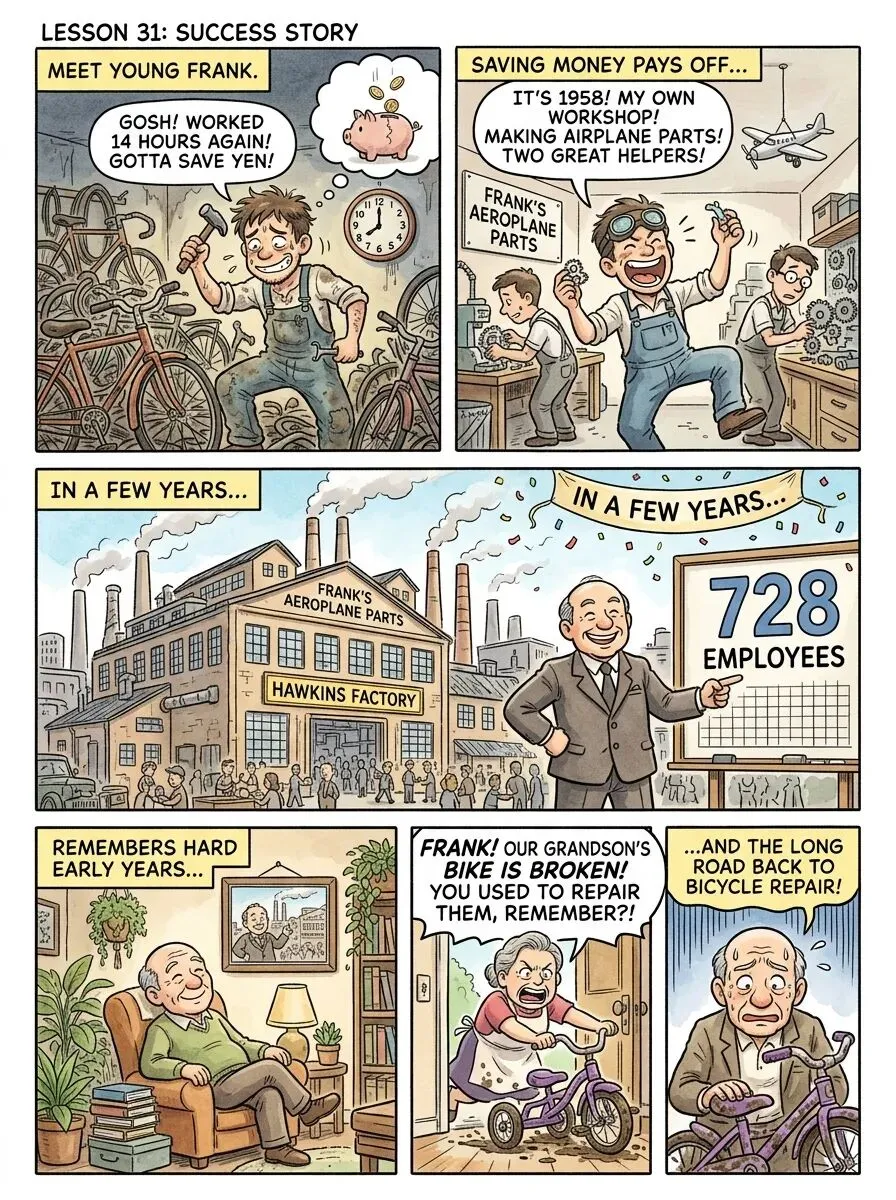
Frank Hawkins was telling me about his experiences as a young man. Before he retired, Frank was the head of a very large business company, but as a boy he used to work in a small shop. It was his job to repair bicycles and at that time he used to work fourteen hours a day. He saved money for years and in 1958 he bought a small workshop of his own. In his twenties Frank used to make spare parts for aeroplanes. At that time he had two helpers. In a few years the small workshop had become a large factory which employed seven hundred and twenty-eight people. Frank smiled when he remembered his hard early years and the long road to success. He was still smiling when the door opened and his wife came in. She wanted him to repair their son's bicycle!
语音标注: Frank Hawkins was telling 中 was telling 连读;used to 发音 /ˈjuːst tə/;saved money 中 saved 尾音 /d/ 与 money 的 /m/ 衔接;in his twenties 中 twenties 尾音 /z/;had become 中 had 弱读 /həd/;smiled when 中 smiled 尾音 /d/ 与 when 的 /w/ 衔接;wanted him 中 wanted 尾音 /ɪd/ 与 him 的 /h/ 弱化。
背景简介:本课是一篇典型的个人成功故事(success story)叙述,采用倒叙手法,通过主人公弗兰克·霍金斯的回忆,勾勒出其从自行车修理学徒到大型工厂主的奋斗历程。故事反映了二战后西方经济复苏时期,个人通过勤奋、节俭和抓住机遇(如航空业发展)实现阶级跃迁的可能,是“美国梦”或类似价值观的缩影。课文语言朴实,时间线索清晰,是学习叙事文体和过去时态的典范。
参考译文:弗兰克·霍金斯正在向我讲述他年轻时的经历。在他退休之前,弗兰克是一家非常大的商业公司的负责人,但当他还是个孩子的时候,他曾经在一家小作坊工作。他的工作是修理自行车,那时他常常一天工作14个小时。他攒了很多年的钱,在1958年,他买下了一个属于自己的小车间。二十多岁时,弗兰克曾制造飞机零件。那时他有两个帮手。几年之后,这个小车间已经变成了一座雇有728人的大工厂。当弗兰克回忆起他早年的艰辛岁月和漫长的成功之路时,他微笑了。他还在笑着,这时门开了,他的妻子走了进来。她想要他修理他们儿子的自行车!
🔍 第二部分:逐句精讲与词块总结
句子1
原文: Frank Hawkins was telling me about his experiences as a young man.
翻译: 弗兰克·霍金斯正在向我讲述他年轻时的经历。
句子结构: 简单句。主语(Frank Hawkins)+ 谓语(was telling)+ 间接宾语(me)+ 直接宾语(about his experiences as a young man)。
重点词汇:
experience 蓝思值 600L
英音[ɪkˈspɪəriəns] 美音[ɪkˈspɪriəns] 词性:n. (可数 & 不可数)
释义:n.(可数) 经历,体验;n.(不可数) 经验
常用语块:tell sb. about one's experiences 向某人讲述经历;learning experience 学习经历
例句一:Travelling around the world was an unforgettable experience for him. 周游世界对他而言是一次难忘的经历。
例句二:She has many years of experience in teaching. 她有多年的教学经验。
拓展:动词形式为 experience,意为“经历,体验”。注意区分:experiment 是“实验”。
语法点睛: 本句使用了过去进行时(was telling)作为故事的引子,为接下来的回忆(主要使用一般过去时和 used to)设置了一个生动的背景场景。过去进行时常用于描述过去某个特定时刻或阶段正在进行的动作,在这里强调了“讲述”这个动作在“我”聆听时的持续性。
语音要点: Frank Hawkins was telling 中 was telling 连读。
句子2
原文: Before he retired, Frank was the head of a very large business company, but as a boy he used to work in a small shop.
翻译: 在他退休之前,弗兰克是一家非常大的商业公司的负责人,但当他还是个孩子的时候,他曾经在一家小作坊工作。
句子结构: 并列复合句。由连词 but 连接两个分句。第一个分句包含一个时间状语从句 Before he retired;第二个分句是主句 he used to work in a small shop,前面有状语 as a boy。
重点词汇:
retire 蓝思值 800L
英音[rɪˈtaɪə(r)] 美音[rɪˈtaɪər] 词性:v.
释义:退休;退职
常用语块:retire from work 退休
例句一:My grandfather retired last year and now enjoys gardening. 我祖父去年退休了,现在喜欢园艺。
例句二:The old soldier decided to retire from public life. 这位老兵决定退出公众生活。
拓展:名词形式为 retirement。
head 蓝思值 400L
英音[hed] 美音[hed] 词性:n. & v.
释义:n. 头;首领,负责人;v. 朝...方向行进;带领
常用语块:the head of a company/department 公司/部门负责人
例句一:She is the head of the research and development department. 她是研发部的负责人。
例句二:We're heading home now. 我们现在正朝家走。
拓展:注意与 leader 的区别。
used to do 蓝思值 500L
英音[ˈjuːst tə] 美音[ˈjuːst tə] 词性:情态动词短语(仅用于过去时)
释义:过去常常做某事(现在已不做了)
常用语块:used to work/live/play 过去常工作/居住/玩耍
例句一:I used to go swimming every Sunday when I was a child. 我小时候每个星期天都去游泳。
例句二:He didn't use to like coffee, but now he drinks it every day. 他过去不喜欢咖啡,但现在每天都喝。
拓展:必须与 be/get used to (doing) sth. 和 be used to do sth. 严格区分。
语法点睛: 本句核心语法点是 used to do 结构,表示过去持续或经常发生的动作或状态,且暗示现在情况已改变。句中 was the head 与 used to work 形成鲜明对比,突出了弗兰克人生境遇的巨大变化。Before he retired 是时间状语从句,使用一般过去时,主句也用一般过去时 (was)。
语音要点: used to 发音 /ˈjuːst tə/。
句子3
原文: It was his job to repair bicycles and at that time he used to work fourteen hours a day.
翻译: 他的工作是修理自行车,那时他常常一天工作14个小时。
句子结构: 并列句。由 and 连接两个简单句。第一个句子是 It was his job to repair bicycles,其中 it 是形式主语,真正的主语是动词不定式 to repair bicycles。
重点词汇:
repair 蓝思值 500L
英音[rɪˈpeə(r)] 美音[rɪˈper] 词性:v. & n.
释义:v. 修理,修补;n. 修理,修补
常用语块:repair a bicycle/car/machine 修理自行车/汽车/机器
例句一:Can you repair the leak in the roof? 你能修好屋顶的漏处吗?
例句二:The watch is so old that it's not worth repairing. 这块表太旧了,不值得修了。
拓展:近义词有 fix 和 mend。
语法点睛: 本句继续使用 used to work 强调过去长时间工作的习惯。第一个分句 It was his job to repair bicycles 是英语中常见的“It is/was + 名词/形容词 + to do sth.”句型,it 作形式主语,避免头重脚轻。
语音要点: at that time 中 that 弱读。
句子4
原文: He saved money for years and in 1958 he bought a small workshop of his own.
翻译: 他攒了很多年的钱,在1958年,他买下了一个属于自己的小车间。
句子结构: 并列句。由 and 连接两个简单句,按时间顺序排列。
重点词汇:
save 蓝思值 400L
英音[seɪv] 美音[seɪv] 词性:v.
释义:储蓄,积攒;挽救;节省
常用语块:save money 存钱,省钱
例句一:She saves 20% of her salary every month. 她每月把工资的20%存起来。
例句二:Walking to work saves me a lot on transportation costs. 步行上班为我省下不少交通费。
拓展:名词形式为 savings(存款)。
workshop 蓝思值 700L
英音[ˈwɜːkʃɒp] 美音[ˈwɜːrkʃɑːp] 词性:n.
释义:车间,工场;研讨会,讲习班
常用语块:a small workshop 一个小车间
例句一:The artist has a workshop at the back of his house. 这位艺术家在房子后面有个工作室。
例句二:The university is holding a workshop on public speaking skills. 大学正在举办一个公众演讲技巧研讨会。
拓展:由 work(工作)和 shop(店铺)合成。
of one's own 蓝思值 500L
释义:属于某人自己的
例句一:He finally has a car of his own. 他终于有了属于自己的车。
例句二:Every child needs a room of his own. 每个孩子都需要一个自己的房间。
拓展:相当于形容词性物主代词 + own + 名词,但语气更强。
语法点睛: 本句使用了一般过去时 (saved, bought) 叙述两个按时间先后发生的具体动作。for years 表示“多年”,强调储蓄行为的持续性。in 1958 是明确的时间状语,标志着一个关键时间点。
语音要点: saved money 中 saved 尾音 /d/ 与 money 的 /m/ 衔接。
句子5
原文: In his twenties Frank used to make spare parts for aeroplanes.
翻译: 二十多岁时,弗兰克曾制造飞机零件。
句子结构: 简单句。主语(Frank)+ 谓语(used to make)+ 宾语(spare parts)+ 状语(for aeroplanes)。句首时间状语 In his twenties。
重点词汇:
spare parts 蓝思值 800L
词性:n. (词组)
释义:备件,零件
常用语块:make/produce spare parts 制造零件
例句一:It's hard to find spare parts for such an old model of car. 为这么老的车型找零件很难。
例句二:The factory specializes in manufacturing spare parts for industrial machines. 这家工厂专门生产工业机器的备用零件。
拓展:spare 作形容词还有“多余的,空闲的”意思。
语法点睛: 本句第三次使用 used to do 结构 (used to make),描述弗兰克在二十多岁这个人生阶段经常从事的工作。In his twenties 是表达年龄段的常用方式。
语音要点: in his twenties 中 twenties 尾音 /z/。
句子6
原文: At that time he had two helpers.
翻译: 那时他有两个帮手。
句子结构: 简单句。主语(he)+ 谓语(had)+ 宾语(two helpers)。
重点词汇:
helper 蓝思值 500L
英音[ˈhelpə(r)] 美音[ˈhelpər] 词性:n.
释义:帮手,助手
常用语块:have helpers 有帮手
例句一:The old lady has a helper who comes in to clean twice a week. 这位老妇人有个帮手,每周来打扫两次。
例句二:Volunteers acted as helpers during the charity event. 志愿者在慈善活动期间充当帮手。
拓展:由动词 help 加后缀 -er 构成。
语法点睛: 本句使用一般过去时 (had) 描述过去某一时间点拥有的状态。At that time 回指上句提到的“in his twenties”那段时间,起到衔接作用。
语音要点: At that time 连读。
句子7
原文: In a few years the small workshop had become a large factory which employed seven hundred and twenty-eight people.
翻译: 几年之后,这个小车间已经变成了一座雇有728人的大工厂。
句子结构: 复合句。主句是 the small workshop had become a large factory,后面跟着一个定语从句 which employed seven hundred and twenty-eight people,修饰 a large factory。
重点词汇:
employ 蓝思值 700L
英音[ɪmˈplɔɪ] 美音[ɪmˈplɔɪ] 词性:v.
释义:雇佣;使用
常用语块:employ people 雇佣人
例句一:The company employs over a thousand workers. 这家公司雇佣了一千多名工人。
例句二:She is employed as a senior consultant. 她受雇担任高级顾问。
拓展:名词形式为 employment 和 employer。
语法点睛: 本句的语法重点是过去完成时 (Past Perfect Tense) had become。这个时态表示动作发生在“过去的过去”。在这里,“变成大工厂”这个动作发生在“故事讲述的过去时间(弗兰克回忆时)”之前,并且这个变化是在“几年”(in a few years)这段时间内完成的,强调结果。定语从句 which employed... 使用一般过去时,描述工厂当时的规模。
语音要点: had become 中 had 弱读 /həd/。
句子8
原文: Frank smiled when he remembered his hard early years and the long road to success.
翻译: 当弗兰克回忆起他早年的艰辛岁月和漫长的成功之路时,他微笑了。
句子结构: 复合句。主句是 Frank smiled,后面是 when 引导的时间状语从句 he remembered his hard early years and the long road to success。
重点词汇:
remember 蓝思值 300L
英音[rɪˈmembə(r)] 美音[rɪˈmembər] 词性:v.
释义:记得,回忆起;记住
常用语块:remember sth./doing sth. 记得某事/做过某事
例句一:I still remember my first day at school. 我依然记得我上学的第一天。
例句二:Please remember to lock the door when you leave. 离开时请记得锁门。
拓展:反义词是 forget。
success 蓝思值 500L
英音[səkˈses] 美音[səkˈses] 词性:n.
释义:成功;成功的人或事
常用语块:the road to success 成功之路
例句一:Hard work is often the key to success. 努力通常是成功的关键。
例句二:The new product launch was a huge success. 新产品发布取得了巨大成功。
拓展:形容词为 successful。
语法点睛: 本句包含一个 when 引导的时间状语从句。主句和从句的动作 (smiled 和 remembered) 几乎是同时发生的,因此都使用了一般过去时。the long road to success 是一个生动的隐喻,将取得成功的过程比作一条漫长的道路。
语音要点: smiled when 中 smiled 尾音 /d/ 与 when 的 /w/ 衔接。
句子9
原文: He was still smiling when the door opened and his wife came in.
翻译: 他还在笑着,这时门开了,他的妻子走了进来。
句子结构: 复合句。主句是 He was still smiling,后面是 when 引导的时间状语从句,这个从句本身又是一个由 and 连接的并列句 (the door opened and his wife came in)。
重点词汇:
still 蓝思值 300L
英音[stɪl] 美音[stɪl] 词性:adv.
释义:仍然,还
常用语块:be still doing sth. 还在做某事
例句一:It's midnight, but he is still working. 已经是午夜了,但他还在工作。
例句二:Do you still live in Beijing? 你还住在北京吗?
拓展:still 作形容词意为“静止的,安静的”。
语法点睛: 本句的时态搭配非常精彩。主句使用过去进行时 (was smiling),强调“微笑”这个动作在另一个动作发生时仍在持续。when 从句使用一般过去时 (opened, came in),表示打断或伴随主句动作发生的另一个短暂动作。这种“过去进行时 + when + 一般过去时”的结构常用于描述背景动作被新事件打断的场景。
语音要点: was still smiling 连读。
句子10
原文: She wanted him to repair their son's bicycle!
翻译: 她想要他修理他们儿子的自行车!
句子结构: 简单句。主语(She)+ 谓语(wanted)+ 宾语(him)+ 宾语补足语(to repair their son's bicycle)。这是一个“动词 + 宾语 + 动词不定式(作宾补)”的结构。
重点词汇:
want 蓝思值 200L
英音[wɒnt] 美音[wɑːnt] 词性:v.
释义:想要;需要
常用语块:want sb. to do sth. 想要某人做某事
例句一:My parents want me to become a doctor. 我父母想让我成为一名医生。
例句二:The plants want watering. 这些植物需要浇水了。
拓展:want 后接动名词主动形式表示被动含义。
语法点睛: 本句使用了 want sb. to do sth. 这一常见结构。动词不定式 to repair 作宾语 him 的补足语,说明“她”想要“他”做什么。句末的感叹号 (!) 增强了故事的幽默效果和反差:一个成功的企业家,最终被妻子叫去完成最开始的、最基础的修理工作。
语音要点: wanted him 中 wanted 尾音 /ɪd/ 与 him 的 /h/ 弱化。
📌 核心词块总结
1. used to do sth. - Indicates a past habit or state that is no longer true. (表示过去常常做某事或处于某种状态,现在已不再如此。) 例句: He used to play football every weekend.
2. save money (for years) - To keep money instead of spending it, often for a specific purpose over a long period. (存钱,常指为特定目的长期储蓄。) 例句: They saved money for years to buy their dream house.
3. of one's own - Belonging to oneself, emphasizing personal ownership. (属于自己的,强调个人所有权。) 例句: After graduation, she finally got an apartment of her own.
4. spare parts - Extra parts kept for replacing broken or worn-out parts in a machine or vehicle. (备用零件,用于更换机器或车辆中损坏或磨损的部件。) 例句: It's wise to keep some spare parts for your car at home.
5. at that time / in those days - Refers to a specific period in the past being discussed. (指正在谈论的过去某个特定时期。) 例句: At that time, mobile phones were a luxury.
6. employ people - To give someone a job and pay them for their work. (雇佣人,给予工作并支付报酬。) 例句: The new factory will employ hundreds of local workers.
7. the road to success - A metaphor for the process or journey of achieving success, often implying challenges and effort. (对取得成功的过程或旅程的隐喻,常暗示挑战和努力。) 例句: Perseverance is essential on the long road to success.
8. want sb. to do sth. - To desire or wish for someone to perform a specific action. (想要或希望某人做某事。) 例句: I want you to finish this report by Friday.
✍️ 第三部分:语篇分析与段落写作技巧
1. 语篇分析① 识别宏观结构: 本文采用经典的倒叙-顺叙结合结构。首句用过去进行时设立“讲述”场景,然后通过 used to 和一般过去时,按时间顺序叙述弗兰克的奋斗史:童年在小店修车 → 攒钱 → 1958年买车间 → 二十多岁造飞机零件 → 小车间发展成大工厂。最后回到现在场景,以幽默结尾。② 列举衔接手段: 时间连接词 (Before he retired, as a boy, at that time, for years, in 1958, In his twenties, At that time, In a few years, when);代词指代 (he, his, it, which);逻辑连接词 (but, and);词汇重复与关联 (work, workshop, bicycle, small shop → small workshop → large factory)。③ 分析作者态度: 作者通过弗兰克自己的微笑和具体的数字对比,传达出一种对主人公勤奋、坚持和最终成功的赞赏与肯定。结尾的幽默则使人物形象更亲切。
2. 写作技巧① 提炼写作逻辑: 确立对比起点 → 按时间顺序描述关键阶段和事件 → 使用具体细节支撑 → 点明变化结果 → 可加一个意味深长或幽默的结尾。② 提供段落写作范例 (主题:My friend Li Hua used to be very poor at English) 已包含在原文中。③ 布置小练笔并提供例文 (主题:The Transformation of My Hometown) 及分析已完整保留。
📐 第四部分:本课语法精析(加强版)
1. 一般过去时 (Past Simple Tense)- 构成: 动词的过去式(规则动词加-ed,不规则动词需记忆)。- 核心用法: 表示过去某个特定时间发生的、已完成的动作;表示过去一段时间内经常或习惯性的动作;在叙述性文体中按时间顺序描述一连串过去事件。- 本课体现: saved, bought, had, smiled, remembered, opened, came, wanted。2. 过去完成时 (Past Perfect Tense)- 构成: had + 动词的过去分词。- 核心用法: 表示“过去的过去”。常与 by the time, before, after, when 等连用。- 本课重点句: In a few years the small workshop had become a large factory...对比练习: 1. had finished 2. had already started 3. had never seen 4. had traveled。3. used to do sth. 结构- 含义: 表示过去持续或反复发生的习惯或状态,且现在已不再如此。隐含强烈的“今昔对比”。- 形式: 肯定句 主语 + used to + 动词原形;否定句 主语 + did not use(d) to + 动词原形;疑问句 Did + 主语 + use to + 动词原形?- 与一般过去时的区别: used to 强调过去习惯且现在已无;一般过去时只客观陈述过去事实。- 必须区分的易混结构: be/get used to (doing) sth. (习惯于...); be used to do sth. (被用来做...)。4. “动词 + 宾语 + 动词不定式(作宾补)”结构- 本课例句: She wanted him to repair their son's bicycle.- 常见动词: want, ask, tell, order, invite, allow, advise, expect, would like 等。语法练习题(不少于12道)1. After she ______ (finish) her degree, she found a good job. → had finished2. The movie ______ (already start) when we got to the cinema. → had already started3. They told me they ______ (never see) such a beautiful sunset before. → had never seen4. By the age of thirty, he ______ (travel) to more than twenty countries. → had traveled5. There ______ (be) a small park here, but now it's a shopping center. → used to be6. ______ you ______ (live) in this neighborhood when you were a child? → Did, use to live7. I ______ (not drink) tea, but now I love it. → didn't use to drink8. Wood ______ (make) furniture and paper. → is used to make9. Parents always expect their children ______ (study) hard. → to study10. The doctor advised the patient ______ (give up) smoking. → to give up11. I would like you ______ (help) me with this heavy box. → to help12. The law does not allow people ______ (park) here. → to park练习题解析 已完整包含在原文中。
🎧 第五部分:听力与阅读策略训练
1. 听力技巧① 预测关键词: work, job, money, buy, factory, success。② 抓主旨大意: 一个人从卑微起点通过努力获得成功的故事。③ 笔记方法: 按时间顺序记录:small shop → repair bikes, 14 hrs/day → save money → 1958: own workshop → make plane parts, 2 helpers → later: big factory (728 people) → now: telling story, smiles → wife comes, wants bike repaired.2. 阅读理解策略① 扫读: Frank's job as a boy (repairing bicycles); year bought workshop (1958); number of employees (728)。② 略读: 先设讲述场景,再按时间顺序回忆奋斗史,最后以幽默请求结尾。③ 推断词义: saved (节省/储存), employed (雇佣), 结尾语调 (幽默的)。
📝 第六部分:习题讲解
关键句型练习- As a boy, he ______ (work) in a small shop. → used to work / worked- He ______ (save) money for years before he ______ (buy) the workshop. → saved; bought- In a few years, the workshop ______ (become) a factory. → had become难点练习- He ______ (save/saved) a child from drowning. → saved (挽救)- It was his ______ (work/job) to repair bicycles. → job多项选择题 (示例)Frank bought his workshop ______. b) after he had saved money for years
🤔 第七部分:英文深度思考与拓展(强化版)
A. 层次化英文问题与答案Level 1 (Factual):1. Q: What was Frank Hawkins doing at the beginning of the story? A: He was telling the writer about his experiences as a young man.2. Q: What did Frank use to do in the small shop when he was a boy? A: He used to repair bicycles.3. Q: How many hours a day did he use to work at that time? A: He used to work fourteen hours a day.4. Q: What did he make in his own workshop in his twenties? A: He used to make spare parts for aeroplanes.Level 2 (Inferential):5. Q: Why do you think Frank saved money for years? A: He probably saved money because he had a dream of owning his own business.6. Q: What does "the long road to success" imply about Frank's journey? A: It implies that his journey was not easy or quick; it involved years of hard work and patience.7. Q: Why did Frank smile when he remembered his early years? A: He felt pride, accomplishment, and nostalgia looking back at the struggles he had overcome.8. Q: What is the ironic or humorous point in the ending? A: After becoming a company head, his wife asks him to repair a bicycle, bringing him back to his humble beginnings.Level 3 (Evaluative):9. Q: Which personal quality was most important for Frank's success? A: Hard work, saving money, or seizing opportunity? (Example answer: Hard work laid the foundation.)10. Q: How does this story reflect values admired in Western society? A: Self-reliance, perseverance, frugality, and the "rags-to-riches" ideal.11. Q: Could a similar success story happen easily today? A: Possibly but more challenging; the digital age offers new types of "workshops" like tech startups.12. Q: Does the domestic task at the end diminish Frank's achievement? A: No, it makes him more relatable and humanizes his success.
B. 多类型拓展阅读1. 时事新闻拓展: From Garage to Global: The Modern Tech "Success Story"The classic tale of starting small is alive and well in Silicon Valley. Think of companies like Apple, which began in Steve Jobs' parents' garage, or Google, founded in a university dorm. Today's "workshop" is often a laptop and an internet connection. A young programmer, like Frank Hawkins saving money, might spend years learning to code. Their "1958 moment" could be developing a unique app or software. Instead of hiring 728 factory workers, they might employ remote developers worldwide. The "long road to success" is now paved with lines of code, venture capital meetings, and global user acquisition. The core elements---vision, perseverance, and starting with what you have---remain strikingly similar.引导问题: How is the modern tech startup story similar to and different from Frank Hawkins' story?2. 文化背景解析: The "American Dream" and the Self-Made ManFrank Hawkins' story is a textbook example of the "American Dream" narrative, a core ideal in American culture. This concept promotes the idea that anyone, regardless of their humble origins, can achieve prosperity and success through hard work, determination, and initiative. The "self-made man" is a celebrated figure. Historical icons like Andrew Carnegie (steel) and Henry Ford (automobiles) rose from modest beginnings. This story reinforces values of individualism, economic mobility, and optimism. While the reality is often more complex, and opportunities are not equally available to all, this narrative continues to powerfully influence aspirations and cultural attitudes towards work and success, not just in America but in many societies worldwide.语言点映射: 注意 regardless of(不管), through(通过), modest beginnings(卑微的起点)等短语的使用。3. 今昔对比分析: Apprenticeship Then vs. Internship NowFrank's early years working long hours in a small shop resemble a traditional apprenticeship. He learned a trade (bicycle repair) through hands-on experience, likely with low or no pay, viewing it as an investment in his future. Today, the equivalent for many young people is an internship. A university student might "work long hours" as an intern at a company, often for little pay, to gain experience, skills, and make connections---their version of "saving up" professional capital. While Frank's goal was to own a workshop, today's intern might aim for a full-time job offer or the experience to launch their own startup. The structure has formalized, and the skills are different (digital vs. mechanical), but the principle of trading immediate earnings for long-term career prospects persists.引导问题: What are the advantages and disadvantages of the old apprenticeship model compared to modern internships?4. 新潮英语改写: Frank's Story: A ThreadOkay, so I was chatting with this older guy, Frank. Dude's story is wild. 🧵Back in the day, he was basically grinding 24/7 in this tiny bike shop. We're talking 14-hour shifts, saving every penny. No fancy coffee, just pure hustle.Fast forward to '58. King Frank uses his stack to buy his OWN workshop. Boss move. 👑Then he gets a sick opportunity---making parts for PLANES. The 1950s version of working in tech, I guess. Starts with just 2 helpers.A few years later? That small-time operation blows up into a massive factory with like 700+ people on payroll. Absolute legend.He's telling me this, all smiles, clearly proud of the climb. Then his wife walks in and is like "Hey, can you fix our kid's bike?" 😂Moral: No matter how big you get, you're never too big for the basics. #SuccessStory #Hustle #FromTheBottom语言点映射: 注意学习非正式、网络化的表达如 grinding(拼命工作), hustle(奋斗), fast forward(快进到), sick(很棒的), blows up(迅速发展), on payroll(在工资单上/被雇佣)。5. 难度略高的拓展阅读: Beyond the Individual: The Ecosystem of SuccessWhile Frank Hawkins' narrative rightly celebrates individual grit, a deeper analysis reveals that no success story exists in a vacuum. His achievement depended on a conducive ecosystem. The post-World War II economic boom created demand for manufactured goods, including airplanes. A stable banking system allowed him to save securely. The existence of a market for spare parts provided his opportunity. Furthermore, the two initial helpers were part of his early "team," a crucial but often understated element. Even his wife's final request, while humorous, hints at a stable family life that may have provided emotional support. Thus, while personal qualities are indispensable, they interact with broader economic conditions, social structures, and even luck (being in the right place at the right time). A truly complete picture of success acknowledges both the actor and the stage.引导问题: According to this passage, what factors besides personal effort contributed to Frank's success?
🌍 第八部分:日常应用与文化拓展
1. 相关文化背景知识- 工业革命与手工业者: 弗兰克的故事背景处于手工业向现代工业转型的时期。- “白手起家”叙事: 激励人们相信努力和智慧可以改变命运。- 工作伦理: 一天工作14小时、攒钱多年体现了清教徒工作伦理。2. 推荐拓展学习资源- 书籍: 《富爸爸,穷爸爸》- 电影: 《当幸福来敲门》(The Pursuit of Happyness)- 纪录片: BBC纪录片《英国工业革命》- 播客/视频: 搜索“entrepreneur success story”或“startup journey”
💡 第九部分:引导性思考
1. Success is often measured by wealth and position. In your view, what other factors could define a “successful” life?2. The story humorously ends with Frank being asked to repair a bicycle. Does this suggest that our family and close friends often see us for who we are beyond our professional titles?
🗂️ 第十部分:本课知识图谱(结构化逻辑图)
核心事件: 弗兰克·霍金斯向叙述者讲述他从贫苦学徒到工厂主的个人成功史。
├─ 主要支撑点1: 早年艰辛│ ├─ 童年在小店修自行车 (used to work in a small shop, repair bicycles)│ ├─ 超长工作时间 (used to work fourteen hours a day)│ └─ 长期储蓄习惯 (saved money for years)
├─ 主要支撑点2: 创业转折│ ├─ 购买自有车间 (bought a small workshop of his own in 1958)│ ├─ 抓住市场机遇 (used to make spare parts for aeroplanes in his twenties)│ └─ 初始团队规模 (had two helpers)
├─ 主要支撑点3: 发展壮大│ ├─ 规模质变 (the small workshop had become a large factory)│ └─ 创造就业 (employed seven hundred and twenty-eight people)
└─ 主要支撑点4: 回顾与反思├─ 成功后的感慨 (smiled when he remembered his hard early years)└─ 现实与幽默的回归 (wife came in and wanted him to repair their son's bicycle)
核心语法映射: 故事叙述主要依托一般过去时展开具体事件,用 used to 强调过去习惯以形成今昔对比,在描述“车间变工厂”这一完成于回忆点之前的变化时使用了过去完成时 (had become)。
© 本文为狂暴英语教案 · 新概念英语第二册第31课
仅供学习交流使用

贝琪酱英语无痛逆袭站
微信扫描二维码,关注我的账号