读外刊,接触原汁原味的英文表达,
欢迎关注以下公众号+设为星标+推荐给朋友。▼
📚 狂暴英语教案 · 新概念英语第一册
第59-60课 Is that all? & What's the time?
就这些吗? / 几点钟?
📘 本课信息教材:新概念英语第一册 · 第59-60课核心功能:购物对话 · 询问与告知时间 · 形容词比较级语法焦点:动词have用法 · 形容词比较级与最高级 · 时间表达法(past/to)
🎯 本课学习目标
词汇维度:
1. 掌握与购物、尺寸、颜色、价格相关的核心名词,如 size, colour, price, assistant, change 等。2. 掌握描述商品特征的形容词,如 small, large, blue, green, cheap, expensive 等。3. 巩固数字、时间及货币单位的表达。
语法维度:
1. 熟练掌握动词 have 在购物场景中的用法,特别是 I want... / I'd like... 表达需求,以及 Have you got...? 询问是否有货。2. 深入理解并运用形容词的比较级(-er)和最高级(-est)的基本形式,用于比较尺寸、价格等。3. 巩固 What's the time? 及其多种回答方式。
技能维度(日常对话):
1. 能够模拟在商店(如服装店、食品店)购物的完整对话流程,包括询问商品、试穿/试用、询问价格尺寸、讨价还价(基础)及付款。2. 能够就时间进行准确问答,并将其应用于日程安排等场景。
文化维度:
1. 了解英美国家商店购物时的基本礼仪和常用表达。2. 熟悉英式与美式在时间表达、货币单位称呼上的细微差异。
📖 第一部分:课文完整内容
课文原文(Lesson 59: Is that all?)
📜 课文原文
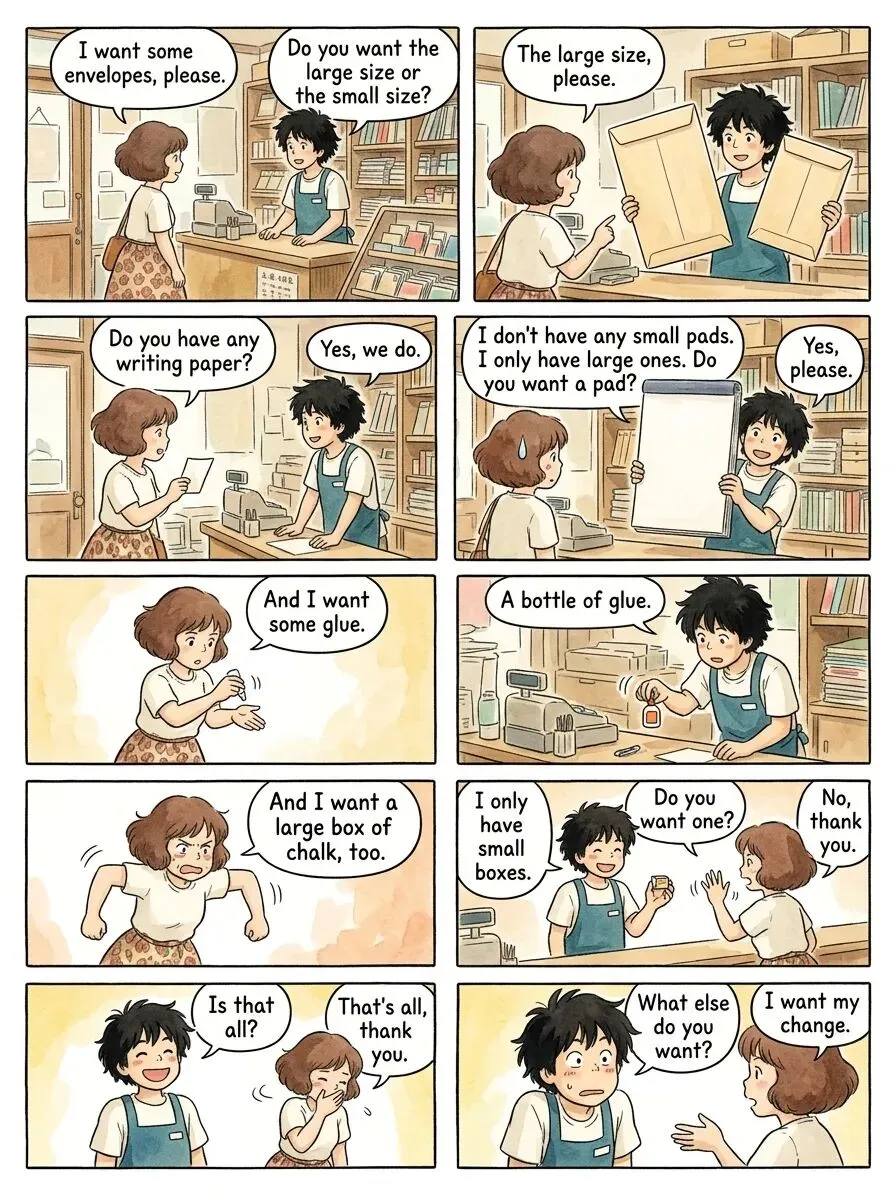
Lady: I want some envelopes, please. ( want some 中 t 轻微失爆;envelopes 注意 /ˈenvələʊps/ 的发音,重音在第一音节)
Shop Assistant: Do you want the large size or the small size? (large size 连读 /lɑːdʒ saɪz/;or the 连读 /ɔː ðə/)
Lady: The large size, please. (large size 同上连读)
Shop Assistant: Do you have any writing paper? (Do you 可弱读为 /djuː/;writing paper 注意 /ˈraɪtɪŋ ˌpeɪpə/ 的发音)
Lady: Yes, I do. (I do 连读 /aɪ duː/)
Shop Assistant: I want a large box of chalk, too. (box of 连读 /bɒks əv/;chalk 注意 /tʃɔːk/ 的发音,l 不发音)
Lady: I only have small boxes. Do you want one? (only have 连读 /ˈəʊnli hæv/;Do you want one? 中 want one 连读 /wɒnt wʌn/,t 与 w 之间过渡平滑)
Lady: No, thank you. (No, thank you 语调下降,表示礼貌拒绝)
Shop Assistant: Is that all? (Is that all? 升调,表示询问)
Lady: That's all, thank you. (That's all 降调,表示确认结束)
Shop Assistant: What else do you want? (What else 连读 /wɒt els/;do you 弱读)
Lady: I want my change. (my change 连读 /maɪ tʃeɪndʒ/)
课文原文(Lesson 60: What's the time?)
📜 课文原文(本课为关键句型与练习课,核心句型如下)
- What's the time?
- It's one o'clock.
- It's five past one. (1:05)
- It's ten past one. (1:10)
- It's a quarter past one. (1:15)
- It's twenty past one. (1:20)
- It's twenty-five past one. (1:25)
- It's half past one. (1:30)
- It's twenty-five to two. (1:35)
- It's twenty to two. (1:40)
- It's a quarter to two. (1:45)
- It's ten to two. (1:50)
- It's five to two. (1:55)
情景说明:本课对话发生在一个文具店或综合商店的柜台。一位女士(Lady)正在购买文具用品。她先后询问了信封、信纸和粉笔。店员(Shop Assistant)积极回应,询问具体规格(大小),并告知库存情况。女士在确认购买粉笔时,店员只有小盒装,女士因此放弃购买。最后,女士完成购物清单,并提醒店员找零。对话展现了从提出需求、确认商品细节到完成交易(包括找零)的完整、基础的购物流程,用语正式且礼貌。第60课聚焦于时间表达这一核心生活技能。通过一个系统的时间表达表格,展示了从整点 (o'clock)、过 (past) 到差 (to) 的完整表达体系。学习者需要掌握用 past 表示“过几分”,用 to 表示“差几分”,以及 a quarter (15分钟) 和 half (30分钟) 这两个特殊表达。此课为后续学习日程安排、约会等话题打下坚实基础。
参考译文:女士: 请给我拿些信封。店员: 您要大号的还是小号的?女士: 请拿大号的。店员: 您有信纸吗?女士: 是的,我有。店员: 我还要一大盒粉笔。女士: 我只有小盒的。您要一盒吗?女士: 不了,谢谢。店员: 就这些吗?女士: 就这些,谢谢。店员: 您还要什么吗?女士: 我要我的零钱。(第60课译文略)
🔍 第二部分:逐句精讲与词块总结
句子1 (L59)
原文: I want some envelopes, please.
翻译: 请给我拿些信封。
句子结构: 主语 (I) + 谓语动词 (want) + 宾语 (some envelopes) + 礼貌用语 (please)。属于“主语+谓语+宾语”(SVO) 的基本句型。
重点词汇:
envelope 蓝思值 600L
英音[ˈenvələʊp] 美音[ˈenvəloʊp] 词性:n. (可数名词)
释义:信封
常用语块:a sealed envelope (一个密封的信封);put a letter in an envelope (把信装进信封)
例句一:She addressed the envelope carefully. 她仔细地在信封上写上地址。
例句二:Don't forget to stick a stamp on the envelope. 别忘了在信封上贴邮票。
拓展:记忆窍门:可以联想 en- (使进入) + velope (包裹,来自词根“卷”),意为“用来把信卷进去的东西”,即信封。常见搭配:business envelope (公务信封),return envelope (回邮信封)。
语法点睛: 本句展示了表达“想要某物”的最直接句型 I want...。want 是及物动词,后面直接接名词作宾语。some 用于肯定句中,修饰不可数名词或可数名词复数,表示“一些”。在购物等提出请求的场合,句末加 please 使语气更礼貌。[NCE知识点笔记]
语音要点: I want some 中,want 的尾音 /t/ 与 some 的开头辅音 /s/ 相邻,/t/ 发生轻微失爆,即发音器官做好发 /t/ 的准备但不完全爆破,随即转向 /s/。envelopes 作为复数,词尾 /s/ 发音为清辅音 /s/。
句子2 (L59)
原文: Do you want the large size or the small size?
翻译: 您要大号的还是小号的?
句子结构: 助动词 (Do) + 主语 (you) + 谓语动词原形 (want) + 宾语 (the large size) + 连词 (or) + 宾语 (the small size)?这是一个包含选择疑问项 (or) 的一般疑问句。
重点词汇:
size 蓝思值 400L
英音[saɪz] 美音[saɪz] 词性:n.
释义:尺寸,大小;尺码
常用语块:What size do you take/wear? (你穿什么尺码?);medium size (中号)
例句一:The size of the room is perfect for us. 这个房间的大小对我们来说正合适。
例句二:These shoes are not my size. 这双鞋不是我的尺码。
拓展:常见搭配:life-size (实物大小的),full-size (全尺寸的),pocket-size (袖珍的)。在服装鞋帽购物中是必问词汇。
large 蓝思值 300L
英音[lɑːdʒ] 美音[lɑːrdʒ] 词性:adj.
释义:大的,巨大的
常用语块:a large amount of (大量的);at large (逍遥法外;总体上)
例句一:We need a larger car for the family. 我们家需要一辆更大的车。
例句二:The company operates on a large scale. 这家公司大规模运营。
拓展:反义词是 small。large 通常指体积、面积、数量、规模等方面的“大”,比较级和最高级为 larger, largest。
small 蓝思值 200L
英音[smɔːl] 美音[smɔːl] 词性:adj.
释义:小的,少的
常用语块:small talk (闲聊);small change (零钱)
例句一:She lives in a small town. 她住在一个小镇上。
例句二:There's only a small chance of success. 成功的机会很小。
拓展:反义词是 large 或 big。small 侧重尺寸、数量、价值、重要性等方面的“小”,比较级和最高级为 smaller, smallest。
语法点睛: 这是一个选择疑问句。结构为:一般疑问句 + or + 供选择的另一选项?回答时不用 Yes/No,而是直接选择其中一个选项,如 The large size, please.。or 连接两个并列的宾语 the large size 和 the small size。[NCE知识点笔记]
语音要点: large size 发生连读,large 的尾音 /dʒ/ 与 size 的开头辅音 /s/ 平滑连接。or the 连读为 /ɔː ðə/,the 在元音前读 /ðiː/,但在快速口语中常弱读为 /ðə/。
句子3 (L59)
原文: Do you have any writing paper?
翻译: 您有信纸吗?
句子结构: 助动词 (Do) + 主语 (you) + 谓语动词原形 (have) + 宾语 (any writing paper)?这是一个用 Do 构成的一般疑问句,询问“是否有”。
重点词汇:
writing paper 蓝思值 500L
英音[ˈraɪtɪŋ ˌpeɪpə] 美音[ˈraɪtɪŋ ˌpeɪpər] 词性:n. (不可数名词短语)
释义:信纸,书写纸
常用语块:a sheet of writing paper (一张信纸);headed writing paper (带抬头的信纸)
例句一:I need to buy some writing paper to write to my friend abroad. 我需要买些信纸给我国外的朋友写信。
例句二:This writing paper is of high quality. 这种信纸质量很好。
拓展:writing 是动名词,修饰 paper,表示用途。类似的还有 wrapping paper (包装纸),toilet paper (卫生纸)。作为不可数名词,用量词 some, a piece/sheet of 修饰。
语法点睛: 本句是 have 表示“拥有”时构成一般疑问句的标准句型:Do + 主语 + have + 宾语?。any 用于疑问句和否定句中,修饰不可数名词或可数名词复数,此处修饰不可数名词 writing paper。肯定回答为 Yes, I do. 或 Yes, I have some.;否定回答为 No, I don't. 或 No, I don't have any.。[NCE知识点笔记]
语音要点: Do you 在口语中常弱读为 /djuː/ 或 /də jə/。writing paper 中,writing 的尾音 /ŋ/ 与 paper 的开头辅音 /p/ 自然过渡,注意 /ŋ/ 是鼻音。
句子4 (L59)
原文: I want a large box of chalk, too.
翻译: 我还要一大盒粉笔。
句子结构: 主语 (I) + 谓语动词 (want) + 宾语 (a large box of chalk) + 副词 (too)。属于“主语+谓语+宾语”(SVO) 的基本句型。too 作为副词,修饰整个句子,表示“也”。
重点词汇:
chalk 蓝思值 500L
英音[tʃɔːk] 美音[tʃɔːk] 词性:n. (通常作不可数名词)
释义:粉笔
常用语块:a piece/stick of chalk (一支粉笔);chalk and talk (传统教学方式,指板书和讲授)
例句一:The teacher wrote on the blackboard with chalk. 老师用粉笔在黑板上写字。
例句二:The cliffs are made of white chalk. 这些悬崖是由白垩构成的。
拓展:注意 l 不发音。文化小知识:在英国多佛有著名的白崖 (White Cliffs of Dover),其主要成分就是白垩 (chalk)。
box 蓝思值 300L
英音[bɒks] 美音[bɑːks] 词性:n. (可数名词)
释义:盒,箱;方框
常用语块:a box of matches (一盒火柴);think outside the box (跳出框框思考,创新思维)
例句一:She keeps her jewelry in a small wooden box. 她把珠宝放在一个小木盒里。
例句二:Tick the box if you agree. 如果同意,请在方框里打勾。
拓展:复数形式为 boxes。动词意为“拳击”。a box of 是常见的量词搭配,后接不可数名词或可数名词复数,表示“一盒...的量”。
语法点睛: a large box of chalk 是一个名词短语作宾语。of 表示“...的”,连接容器 (box) 和内容物 (chalk)。too 表示“也”,通常用于肯定句句末,前面常有逗号隔开。它与 also (用于句中) 和 as well (用于句末,更口语化) 同义。[NCE知识点笔记]
语音要点: box of 连读为 /bɒks əv/,of 弱读为 /əv/。chalk 发音时注意 /tʃ/ 和 /ɔːk/,l 不发音。too 发音为 /tuː/,语调平或略升。
句子5 (L59)
原文: I only have small boxes. Do you want one?
翻译: 我只有小盒的。您要一盒吗?
句子结构: 第一句:主语 (I) + 副词 (only) + 谓语动词 (have) + 宾语 (small boxes)。第二句:助动词 (Do) + 主语 (you) + 谓语动词原形 (want) + 宾语 (one)?这是两个独立的句子,第二句是基于第一句情况的询问。
重点词汇:
only 蓝思值 400L
英音[ˈəʊnli] 美音[ˈoʊnli] 词性:adv.
释义:只,仅仅;才
常用语块:only if (只有...才);not only... but also... (不仅...而且...)
例句一:I only wanted to help. 我只是想帮忙。
例句二:He is only five years old. 他才五岁。
拓展:only 在句中的位置灵活,通常放在它所修饰的词之前。例如:Only I have the key. (只有我有钥匙。) I have only the key. (我只有钥匙。) 含义略有不同。
语法点睛: only 作为副词,修饰动词 have,强调“仅有”。small boxes 是复数名词,表示“小盒装(的粉笔)”。第二句中,one 是代词,指代前文提到的 a small box (of chalk),避免了名词重复。用 Do you want one? 提供替代选项,是服务中常见的询问方式。[NCE知识点笔记]
语音要点: only have 可以连读为 /ˈəʊnli hæv/。Do you want one? 中,want one 连读 /wɒnt wʌn/,两个 /w/ 音之间过渡平滑,t 音轻微。
句子6 (L59)
原文: Is that all?
翻译: 就这些吗?/ 还要别的吗?
句子结构: 系动词 (Is) + 主语 (that) + 表语 (all)?这是一个主系表结构的一般疑问句。
重点词汇:
all 蓝思值 200L
英音[ɔːl] 美音[ɔːl] 词性:pron./adj./adv.
释义:(pron.) 全部,所有一切;(adj.) 所有的,全部的;(adv.) 完全,都
常用语块:all right (好的;没事);all over (到处;结束);all in all (总的来说)
例句一:All is well. 一切都好。(pron.)
例句二:All children need love. 所有的孩子都需要爱。(adj.)
例句三:She was dressed all in white. 她全身穿着白色。(adv.)
拓展:That's all. 是常用口语,意为“就这些/完了”。Is that all? 是店员在顾客似乎结束挑选时的礼貌性询问,以确认是否还需要其他服务。
语法点睛: that 是指示代词,指代顾客之前提出的所有购物需求。all 在这里是不定代词,作表语。Is that all? 是一个固定句型,用于确认当前事项是否完结。[NCE知识点笔记]
语音要点: 句子用升调,表示询问。that all 可以连读为 /ðæt ɔːl/,t 与 ɔː 平滑连接。
句子7 (L59)
原文: What else do you want?
翻译: 您还要什么吗?
句子结构: 疑问词 (What else) + 助动词 (do) + 主语 (you) + 谓语动词原形 (want)?这是一个特殊疑问句。else 修饰疑问词 What。
重点词汇:
else 蓝思值 400L
英音[els] 美音[els] 词性:adv.
释义:其他,另外
常用语块:or else (否则);nothing else (没有别的了);somebody else (别人)
例句一:What else can I do for you? 我还能为您做些什么?
例句二:Is there anything else you'd like to know? 您还有什么想知道的吗?
拓展:else 常接在疑问词 (what, who, where 等) 或不定代词 (something, anything, nothing, somebody 等) 之后。注意所有格形式:someone else's book (别人的书)。
语法点睛: What else 是“还有什么”的意思,比单用 What 更具体,询问除已提及事物外的其他需求。句子结构是特殊疑问句的标准语序:疑问词 + 一般疑问句。[NCE知识点笔记]
语音要点: What else 连读为 /wɒt els/,t 与 e 之间过渡。do you 弱读。
句子8 (L59)
原文: I want my change.
翻译: 我要我的零钱。
句子结构: 主语 (I) + 谓语动词 (want) + 宾语 (my change)。属于“主语+谓语+宾语”(SVO) 的基本句型。
重点词汇:
change 蓝思值 400L
英音[tʃeɪndʒ] 美音[tʃeɪndʒ] 词性:n. (不可数名词);v.
释义:(n.) 零钱;找头;变化;(v.) 改变;更换
常用语块:small change (零钱,小额硬币);change one's mind (改变主意)
例句一:Can you give me change for a ten-pound note? 你能帮我换开一张十英镑的钞票吗?(n.)
例句二:The town has changed a lot since I was a child. 自从我小时候以来,这个城镇变化很大。(v.)
拓展:购物场景中,change 特指付款后找回的零钱。动词 change 含义广泛,是核心高频词。
语法点睛: 这是一个简单的陈述句。my change 中,my 是形容词性物主代词,修饰名词 change,强调“属于我的”找零。在购物结束时,顾客有时需要主动提醒或索要找零,此句体现了这一点。[NCE知识点笔记]
语音要点: my change 连读为 /maɪ tʃeɪndʒ/。句子用降调,表示陈述。
句子9 (L60 核心句型)
原文: What's the time?
翻译: 几点了?
句子结构: 疑问词 (What) + 系动词 (is) 的缩写 ('s) + 主语 (the time)?这是一个主系表结构的特殊疑问句。
重点词汇:
time 蓝思值 200L
英音[taɪm] 美音[taɪm] 词性:n.
释义:时间;时刻;次数;时代
常用语块:on time (准时);in time (及时);from time to time (有时);have a good time (玩得开心)
例句一:Time flies! 时光飞逝!
例句二:What time does the movie start? 电影什么时候开始?
拓展:What's the time? 是询问钟点时刻最常用的句型之一,与 What time is it? 同义。time 作“次数”讲时为可数名词。
语法点睛: 这是询问具体钟点时刻的标准句型。What's 是 What is 的缩写。回答用 It's + 时间。It 是无人称代词,指代时间。[NCE知识点笔记]
语音要点: What's the 连读为 /wɒts ðə/。time 发音为 /taɪm/,双元音饱满。句子用升调。
句子10 (L60 回答示例)
原文: It's a quarter past one.
翻译: 现在是一点一刻。
句子结构: 主语 (It) + 系动词 (is) 的缩写 ('s) + 表语 (a quarter past one)。这是一个主系表结构的陈述句。表语是一个表示时间的介词短语。
重点词汇:
quarter 蓝思值 500L
英音[ˈkwɔːtə] 美音[ˈkwɔːrtər] 词性:n.
释义:四分之一;一刻钟(15分钟);季度
常用语块:a quarter of an hour (一刻钟);first quarter (第一季度)
例句一:Cut the apple into quarters. 把苹果切成四瓣。
例句二:The bus comes every quarter of an hour. 公交车每十五分钟来一班。
拓展:在时间表达中,a quarter 特指15分钟。past 表示“过”,to 表示“差”。a quarter past/to... 是固定搭配。
past 蓝思值 400L
英音[pɑːst] 美音[pæst] 词性:prep./adj./n.
释义:(prep.) 过,经过;晚于;(adj.) 过去的;(n.) 过去
常用语块:half past two (两点半);in the past (在过去);past experience (过去的经验)
例句一:It's ten past nine. 现在是九点十分。(prep.)
例句二:The past year has been difficult. 过去的一年很艰难。(adj.)
拓展:作为介词表示时间时,past 接在分钟数后,表示“分钟数过了整点”。反义词是 to。
语法点睛: 这是表达“过几分”的句型:It's + 分钟数 + past + 钟点数。当分钟数小于等于30时,通常用 past。a quarter 是15分钟的特殊表达。one 此处指代 one o'clock。[NCE知识点笔记]
语音要点: It's a 连读为 /ɪts ə/。quarter past one 中,quarter 和 past 之间,past 和 one 之间均有停顿,但需流畅。past 的 /t/ 在 one 的 /w/ 前轻微失爆。
📌 核心词块总结
1. I want... / I'd like... - Used to express a desire or request for something. 例句: I want a cup of coffee. / I'd like to try on this dress.
2. Do you have any...? - A polite way to inquire about the availability of something. 例句: Do you have any tickets for the concert tonight?
3. What size/colour? - Questions to specify the attributes of an item when shopping. 例句: What size shoes do you wear? What colour is your new car?
4. Is that all? / That's all. - Fixed expressions used to confirm the completion of a list or transaction. 例句: (Cashier) Is that all for today? (Customer) Yes, that's all, thank you.
5. What's the time? / It's... (past/to)... - The fundamental Q&A pattern for telling time. 例句: What's the time? --- It's twenty to five.
6. a box/bottle/piece of... - Measure word phrases for uncountable nouns or collective items. 例句: a bottle of water, a piece of advice, a crowd of people.
💬 第三部分:基础会话技巧
1. 分析课文中的日常用语、礼貌表达、问答模式- 提出需求: I want... 直接,I'd like... 更委婉。句末加 please 是基本礼貌。- 店员询问: 使用一般疑问句 (Do you want...?, Do you have...?) 和选择疑问句 (...or...?) 来明确顾客需求。Is that all? 和 What else? 是确认服务结束的礼貌用语。- 顾客回应: 对选择疑问句直接回答选项 (The large size.)。对是否有货的询问,肯定回答 Yes, I do.,否定则可能引出后续 (I only have...)。- 结束交易: 顾客说 That's all.,并可能提醒 I want my change. 体现了完整的交易闭环意识。- 时间问答: What's the time? 是通用问法。回答遵循 It's + 数字 + past/to + 钟点 的结构,注意 a quarter 和 half 的特殊性。
2. 提供类似场景的扩展对话示例 (At a Clothing Store)Customer:Excuse me, I'd like to see that blue shirt in the window.Assistant:Certainly. What size are you?Customer:I usually wear a medium.Assistant:Here you are. The fitting room is over there.(Customer tries it on)Customer:It's a bit tight. Do you have a large size?Assistant:Yes, we do. Here's the large one.Customer:This fits perfectly. How much is it?Assistant:It's forty-five pounds.Customer:OK, I'll take it.Assistant:Is that all?Customer:Yes, that's all. Can I pay by card?Assistant: Of course.
3. 设计简单的角色扮演活动建议活动: “Mini-Market” 角色扮演准备: 准备一些实物或图片卡片(水果、文具、饮料等),标上价格。准备一些道具货币。角色: 售货员 (Shopkeeper) 1-2名,顾客 (Customers) 若干。任务:① 顾客用 I want/I'd like... 提出购买需求。② 售货员用 Do you want... (or...)? / What size/colour? 等进行询问。③ 顾客可能询问价格 (How much?) 或是否有货 (Do you have any...?)。④ 完成购买,使用 That's all. 和 Here's your change. 结束交易。⑤ 融入时间问答:售货员可以问 What's the time? We close at...,顾客需看钟表道具回答。
4. 融入基础思考:设计1-2个简单的代入式问题① 如果你是课文中的女士,在店员问“Is that all?”之后,除了要零钱,还可以怎么礼貌地结束对话?(例如:That's all for now, thank you for your help.)② 如果你和朋友约好“三点一刻”见面,用英语有哪几种方式表达这个时间?(a quarter past three 或 three fifteen)
📐 第四部分:本课语法精析(加强版)
本课语法重点围绕 动词have的用法 和 形容词的比较级与最高级 展开,并融合了 时间表达法。以下分析综合自知识库相关文档。
一、 动词 have 的用法精讲have 是英语中最核心的动词之一,含义丰富。在本课购物场景中,主要体现其“拥有”和“使役”的语义,以及其疑问句和否定句的构成。1.表示“拥有”、“持有” (Possession)-肯定句:主语 + have/has + 宾语。例句: I have a new bike. She has a beautiful voice. We have enough time.[名师精讲]-一般疑问句:Do/Does + 主语 + have + 宾语?例句: Do you have any brothers? Does the hotel have a swimming pool?[NCE知识点笔记]回答: Yes, I/we/they do. / No, I/we/they don't. Yes, he/she/it does. / No, he/she/it doesn't.-否定句:主语 + do/does + not (don't/doesn't) + have + 宾语。例句: I don't have his phone number. He doesn't have a car.-特殊疑问句:疑问词 + do/does + 主语 + have?例句: What do you have in your bag? How many books does she have?本课应用:Do you have any writing paper? (询问拥有) --- Yes, I do. (肯定回答) --- I only have small boxes. (陈述拥有状态,并用 only 修饰)。对比 have 与 there be:have 强调“所属关系”,主语通常是人或机构。there be 强调“存在”,表示某地有某物。例句(对比): Our school has a big library. (学校拥有一个图书馆。) There is a big library in our school. (学校里存在一个大图书馆。)[名师精讲]2.have 构成“使役动词”结构:have + 宾语 + 动词原形/过去分词虽然本课未直接出现,但它是 have 的重要用法,常在第一册后期及第二册出现。-have sb. do sth.让/叫某人做某事 (强调主动执行)。例句: The boss had his assistant type the report. (老板让他的助理打报告。)[语法新思维]-have sth. done让某事被做 (强调动作由他人完成,或遭遇某事)。例句: I had my hair cut yesterday. (我昨天理了发。) She had her wallet stolen. (她的钱包被偷了。)[语法新思维]3.have 作为实义动词的其他常见搭配- have breakfast/lunch/dinner 吃早/午/晚餐- have a lesson/meeting 上课/开会- have a good time 玩得开心- have a look 看一看- have a try 试一试这些搭配中的 have 已失去“拥有”的本意,与后面的名词构成固定短语,表示一个动作。
二、 形容词的比较级与最高级 (Comparative and Superlative Degrees)本课出现了 large 和 small,并隐含了比较的场景 (large size or small size)。这是系统学习形容词比较变化的基础。1.基本概念:-原级 (Positive Degree):形容词的基本形式,如 large, small, cheap。-比较级 (Comparative Degree):用于两者之间的比较,表示“更...”,形式为 形容词+-er 或 more + 形容词。-最高级 (Superlative Degree):用于三者或三者以上的比较,表示“最...”,形式为 形容词+-est 或 most + 形容词,前面通常加定冠词 the。2.规则变化:①单音节和部分双音节词:加 -er / -est。原级 --- 比较级 --- 最高级large --- larger --- largestsmall --- smaller --- smallestcheap --- cheaper --- cheapesttall --- taller --- tallest注意:以-e结尾,只加 -r/-st:nice --- nicer --- nicest。以辅音+y结尾,变y为i再加:happy --- happier --- happiest。重读闭音节且末尾只有一个辅音字母,双写该辅音字母再加:big --- bigger --- biggest。[NCE知识点笔记] [语法新思维]②多音节和部分双音节词:前加 more / most。expensive --- more expensive --- most expensivebeautiful --- more beautiful --- most beautifulinteresting --- more interesting --- most interesting3.常用句型:-比较级句型:A + be + 比较级 + than + B.例句: This box is larger than that one. My car is more expensive than yours.-最高级句型:A + be + the + 最高级 + (名词) + in/of...例句: He is the tallest boy in our class. This is the most interesting book of all.-选择疑问句中的比较:本课 Do you want the large size or the small size? 隐含了在 large 和 small 两个属性间选择,为后续明确的比较级 (larger, smaller) 学习做铺垫。4.不规则变化:(需特别记忆)good/well --- better --- bestbad/ill --- worse --- worstmany/much --- more --- mostlittle --- less --- leastfar --- farther/further --- farthest/furthest
三、 时间表达法 (Telling the Time)第60课系统呈现了英式时间表达法。1.整点:It's + 数字 + o'clock.例句: It's three o'clock. It's eleven o'clock.2.非整点:-分钟 ≤ 30:用 past (过)。结构:It's + 分钟 + past + 钟点。例句: It's five past one. (1:05) It's twenty past ten. (10:20)-分钟 > 30:用 to (差)。结构:It's + (60-分钟) + to + (下一个钟点)。例句: It's twenty to two. (1:40) It's five to twelve. (11:55)-特殊表达:15分钟 = a quarter30分钟 = half例句: It's a quarter past two. (2:15) It's half past six. (6:30) It's a quarter to nine. (8:45)[NCE知识点笔记]3.美式表达:直接读数字,先说小时,再说分钟。例句: 1:05 --- one o-five / one five- 2:15 --- two fifteen- 6:30 --- six thirty- 8:45 --- eight forty-five美式也用 after 代替 past,of 或 till 代替 to,但不如数字直读法普遍。4.介词使用:- 在具体钟点前用 at:at three o'clock, at half past five.- 在上午/下午/晚上用 in:in the morning, in the afternoon, in the evening.- 在中午/午夜用 at:at noon, at midnight.
练习题 (不少于10道):1.用 have 的正确形式填空。① I ______ a new dictionary.② ______ she ______ any sisters? (疑问句)③ They ______ (not) a big garden.④ We ______ lunch at school every day.⑤ He wants to ______ a look at your photos.2.写出下列形容词的比较级和最高级。① big ______ ______② expensive ______ ______③ good ______ ______④ happy ______ ______⑤ little ______ ______3.根据中文意思,用比较级完成句子。① 这本书比那本书有趣。 This book is ______ ______ that one.② 我的房间比你的房间大。 My room is ______ ______ yours.③ 今天比昨天冷。 It is ______ today ______ yesterday.4.将下列时间改为 past/to 表达法。① 4:05 → It's ______ ______ four.② 7:50 → It's ______ ______ eight.③ 11:15 → It's ______ ______ eleven.④ 3:30 → It's ______ ______ three.⑤ 9:40 → It's ______ ______ ten.5.选择正确的选项完成对话。A: Do you ______ any black coffee?B: No, I'm sorry. We only ______ milk.a) have / have b) has / have c) have / has d) has / has6.将下列句子改为一般疑问句并作否定回答。She has a lovely cat.→ ______ she ______ a lovely cat? → No, ______ ______.7.用最高级填空。The Nile is ______ (long) river in the world.This is ______ (good) cake I've ever tasted.8.翻译下列时间表达。a quarter to tentwenty-five past three9.根据 have 的不同含义,判断句子类型(A. 拥有 B. 动作)。( ) I have two tickets for the concert.( ) Let's have a break.( ) They have a meeting every Monday.10.连词成句。size / want / you / do / large / the / small / or / the / ?time / is / it / what / ?
【练习题参考答案】1. ① have ② Does, have ③ don't have ④ have ⑤ have2. ① bigger, biggest ② more expensive, most expensive ③ better, best ④ happier, happiest ⑤ less, least3. ① more interesting than ② larger/bigger than ③ colder, than4. ① five past ② ten to ③ a quarter past ④ half past ⑤ twenty to5. a) have / have6. Does, have; she, doesn't.7. the longest; the best8. 差一刻十点 / 九点四十五;三点二十五9. A; B; B10. Do you want the large size or the small size? What time is it? / What's the time?
✏️ 第五部分:基础练习与活动
1. 跟读练习:- 目标: 模仿课文录音的语音、语调、连读和节奏。- 方法: 播放第59课对话录音。第一遍静听。第二遍逐句跟读,特别注意标注的语音要点(如 want some, large size, box of 的连读)。第三遍尝试同步跟读。最后独立朗读全文并录音,与原音对比。- 拓展: 跟读第60课的时间表达表,确保每个时间点发音准确,特别是 quarter, past, to。
2. 角色扮演 (Role-play):- 活动: “The Stationery Shop”- 场景: 学生A扮演顾客,需要购买:一些大号信封 (some large envelopes)、信纸 (writing paper)、一瓶胶水 (a bottle of glue)。学生B扮演店员。- 任务: 根据课文模式展开对话。顾客提出需求,店员询问规格,确认库存,最后询问 Is that all? 并完成交易。鼓励使用 I'd like..., Do you have any...?, What else? 等句型。- 升级: 加入询问价格 (How much is it/are they?)、讨价还价 (That's a bit expensive.) 或付款方式 (Can I pay by...?) 的环节。
3. 简单替换练习:-练习1 (购物需求):A:I want some envelopes, please.替换词:stamps (邮票), notebooks (笔记本), pencils (铅笔), batteries (电池)B:Do you want the large size or the small size?替换词:blue colour or black colour? (颜色), new ones or old ones? (新旧)-练习2 (时间表达):A:What's the time?B:It's a quarter past one.替换时间: (根据第60课表格,随机替换成其他时间,如 ten to two, five past three, half past four 等)
4. 听力理解题目:(假设有一段关于购物的简短对话)听力材料脚本 (教师朗读或播放):Shop Assistant: Good morning. Can I help you?Customer: Yes, I'd like some apples, please.Shop Assistant: We have red apples and green apples.Customer: I'll take the red ones.Shop Assistant: How many would you like?Customer: A kilo, please.Shop Assistant: Anything else?Customer: Do you have any bananas?Shop Assistant: Yes, we do. They're over there.Customer: Thank you. That's all for now.问题:① What does the customer want first?② What colour apples does the customer choose?③ How many apples does the customer want?④ Does the shop have bananas?⑤ What does the customer say at the end?参考答案:① Some apples. ② Red (ones). ③ A kilo. ④ Yes, they do. ⑤ That's all for now.
5. 课文改写版本(词汇更简单):原句:I want some envelopes, please.改写:Can I have some envelopes, please? (Can I have...? 是更口语化、更礼貌的请求方式)原句:Do you have any writing paper?改写:Have you got any paper for writing letters? (Have you got...? 是 Do you have...? 的口语变体,在英国更常用。)原句:I only have small boxes.改写:We've only got the small ones. (We've got = We have got)原句:Is that all?改写:Will that be all? (另一种礼貌说法)原句:I want my change.改写: Can I have my change, please? (更礼貌)
🤔 第六部分:英文深度思考与拓展(强化版)
A. 层次化英文问题与答案① Level 1 (Factual): 事实性问题1.Q:What does the lady want to buy at the beginning of the conversation in Lesson 59?A:She wants to buy some envelopes.2.Q:What two sizes does the shop assistant offer for the envelopes?A:The shop assistant offers the large size and the small size.3.Q:How does the lady answer the question “Do you have any writing paper?”?A:She answers, “Yes, I do.”4.Q:What does the shop assistant say when he thinks the lady might have finished her shopping?A:He says, “Is that all?” and later, “What else do you want?”5.Q:According to Lesson 60, how do you say “1:15” and “1:45” in English?A:“1:15” is “a quarter past one” and “1:45” is “a quarter to two”.② Level 2 (Inferential): 推理性问题1.Q:Why does the lady say “No, thank you” when offered a small box of chalk?A:She probably needs a large box of chalk, not a small one. Since the shop only has small boxes, she decides not to buy any chalk at all.2.Q:What can we infer about the shop assistant's attitude from the dialogue?A:We can infer that the shop assistant is polite and helpful. He asks clarifying questions (“large or small?”), checks inventory (“I only have small boxes.”), and ensures the customer's needs are fully met (“Is that all?” “What else?”).3.Q:Why is the phrase “I want my change” an important part of a shopping conversation?A:It is important because it reminds the seller to return the correct amount of money to the customer after payment. It finalizes the transaction and ensures fairness.4.Q:In the context of telling time, why do we switch from using “past” to “to” after 30 minutes?A:We switch to “to” because it's more efficient to say how many minutes are left until the next hour, rather than how many minutes have passed after the current hour, when the number is large (over 30).5.Q:Based on the items asked for (envelopes, writing paper, chalk), where might this conversation be taking place?A:It is most likely taking place in a stationery shop, a bookstore that sells stationery, or a general store that has a stationery section.③ Level 3 (Evaluative/Creative): 评价/创造性问题1.Q:If you were the shop assistant and you didn't have large envelopes, what else could you say or do besides stating “I only have small boxes”?A:I could apologize first: “I'm sorry, we're out of the large size at the moment.” Then, I could offer alternatives: “But we do have the small size, which are very popular for postcards. Would you like to see them?” or suggest a solution: “We are expecting a new delivery tomorrow. Could I take your order?”2.Q:Imagine you are planning a picnic with friends. Create a short shopping list in English using “I want/need...” for the picnic, and explain why you chose those items.A:Shopping list: I need a loaf of bread, some cheese, a bottle of lemonade, a large packet of crisps, and some fruits like apples and bananas. I chose bread and cheese for sandwiches, lemonade to drink, crisps as a snack, and fruits for a healthy dessert.3.Q:“Time is money.” How can understanding how to ask for and tell time (from Lesson 60) be useful in real-life situations that relate to this saying?A:Understanding time is crucial for punctuality, which shows respect for others' time (and money in business). It helps you manage your schedule, meet deadlines, catch transportation on time, and be efficient—all of which can save or make money. For example, being on time for a job interview or a business meeting is essential.4.Q:Design a simple dialogue where someone is not happy with the “change” they received. What polite phrases could they use to address the issue?A:Customer: Excuse me, I think there might be a mistake with the change.Shop Assistant: Oh, I'm sorry. Let me check. How much did you give me?Customer: I gave you twenty pounds for this fifteen-pound book.Shop Assistant: You're right. I only gave you four pounds. Here's the extra pound. Sorry about that.Customer: That's okay. Thank you for fixing it.5.Q:Compare shopping in a physical store (like in the lesson) with shopping online. What are one advantage and one disadvantage of each, using vocabulary from or related to the lesson?A:An advantage of shopping in a physical store is that you can see the actualsizeandcolourof an item, like thelargeorsmallenvelopes, before buying. A disadvantage is that you have to go to the store during its openingtime. An advantage of online shopping is that you can shop at anytime of day. A disadvantage is that you sometimes have to wait for delivery and can't check the item immediately.
B. 多类型拓展阅读1. 现代场景故事 (Modern Scenario)Title: The Last-Minute GiftEmma looked at her watch. It wasa quarter to six. The party started at seven! She needed a gift for her friend Sarah. She rushed into a small gift shop. “I need something nice, quickly!” she said to the assistant. The assistant smiled. “Do you like candles or bath products?” she asked. “We havelargescented candles orsmallgift sets.” Emma saw a beautiful blue candle. “What's theprice?” “It's twenty pounds,” said the assistant. “Perfect! I'll take it,” said Emma. She paid and got herchange. “Is that all?” asked the assistant. “Yes,that's all! Thank you!” Emma ran out, happy she made it ontime.引导性问题:Why was Emma in a hurry?2. 文化背景小知识 (Cultural Background)Title: Shopping Etiquette in the UK and USWhen shopping in English-speaking countries, a few polite phrases go a long way. Starting with “Hello” or “Excuse me” is common. Instead of just saying “I want this,” using “Could I have...?” or “I'd like..., please” sounds more polite. In Britain, “Have you got...?” is as common as “Do you have...?” In the US, you might hear “Do you carry...?” for specific brands. When paying, it's fine to ask “Can I pay by card?” or “Do you take credit cards?” Remembering to say “Thank you” when you receive your items andchangeis always appreciated. Unlike in some cultures, bargaining is not common in most shops, except maybe at markets or flea markets.引导性问题:What is a more polite way to say “I want this” according to the text?3. 今昔对比 (Then and Now)Title: From Chalk to Chat: Stationery Through TimeThe conversation in Lesson 59 mentionschalk,envelopes, andwriting paper. These were everyday items in the 20th century. Students usedchalkon blackboards, people wrote letters onwriting paperand sent them inenvelopes. Today, things are different. Many classrooms use whiteboards and markers or digital screens. We send emails and instant messages instead of letters. We take notes on tablets or laptops. However, some things haven't changed. We still needenvelopesfor official documents or greeting cards.Writing paperis now often called “notepads” or “cards,” andchalkis still used by artists or on some traditional blackboards. Thesizeandcolourchoices are now much wider online!引导性问题:What are two modern replacements for “writing paper” mentioned?4. 新潮英语改写 (Trendy English Rewrite)Title: DMs & Digital Cart(Based on Lesson 59)Scene:A customer DMs (direct messages) a store's Instagram page.Customer:Hey, do you guys have those cute patterned envelopes in stock?Shop (via DM):Yup! We've got them in thelargepack (10 pieces) or thesmallpack (5 pieces). Which one?Customer:Thelargeone, pls. Also, any matching writing paper?Shop:Sure thing! It's right here on the link. Adding to cart?Customer:Yes, add it. Oh, and the pastelchalkset too.Shop:Sorry, the chalk sets are sold out RN (right now). We're restocking next week.Customer:K, no worries. Just the envelopes and paper then.Shop:Cool. Checkout when you're ready. Anythingelse?Customer:That's all. Thx!引导性问题:How does the shop tell the customer they don't have chalk?5. 难度略高的拓展阅读 (Slightly Higher Difficulty)Title: The Psychology of “Large” vs. “Small”The simple question “Do you want thelarge sizeor thesmall size?” is more powerful than it seems. Shops often use this to guide customer choice. Most people tend to avoid extremes, so if there are three sizes (small, medium, large), many will choose the middle one. Presenting only two, like in our lesson, forces a direct comparison. Calling it “large” instead of “big” or “standard” makes it sound more valuable. Studies show that when given a choice between two, people feel more in control and satisfied with their decision, even if it was simple. Furthermore, the word “size” itself focuses the customer on a measurable attribute, which can be more persuasive than just talking aboutprice. Next time you shop, listen for these choice questions!引导性问题:According to the text, why do shops sometimes offer three sizes instead of two?
🌍 第七部分:日常应用延伸
1. 提供本课语言点在日常生活中的应用场景- 购物场景: 适用于任何零售店——超市 (Do you have any organic milk?)、服装店 (What size are you?)、咖啡馆 (I'd like a large coffee, please.)、书店 (Have you got the latest novel by...?)。核心是 I want/I'd like..., Do you have...?, What size/colour...?, Is that all?。- 时间管理: 用于约会 (Let's meet at a quarter past three.)、赶交通 (What time is the next bus?)、安排日程 (My class starts at half past eight.)、烹饪 (Bake for twenty-five minutes.)。- 物品描述与比较: 描述房间 (My room is larger than yours.)、谈论天气 (Today is colder than yesterday.)、选择商品 (This is the cheapest model.)。
2. 建议简单拓展学习材料- 视频资源: 搜索 YouTube 上的 “ESL Shopping Dialogues” 或 “Real English Conversation at a Store”,观看真实场景下的购物交流。观看 “How to Tell Time in English” 动画或教学视频。- 歌曲与影视: 歌曲《9 to 5》涉及时间。影视剧中任何商店场景(如《老友记》Central Perk咖啡馆点餐)都是绝佳听力材料。动画《Peppa Pig》中有许多简单购物和日常对话。- 实践工具: 使用手机语言学习APP(如Duolingo, BBC Learning English)中购物和时间的相关模块。在线进行虚拟购物游戏(一些儿童英语学习网站提供)。
3. 可附加英美生活小常识- 购物找零: 在美国和英国,店员通常会自动找零,并说 “Here's your change” 或将零钱连同收据一起递给你。不需要像课文中特别索要,但核对找零金额是明智的。- 时间表达偏好: 在英国,past/to 结构非常常用。在美国,直接读数字 (seven forty-five) 更为普遍,尤其是在正式场合或年轻人群中。但两者都通用。- 尺寸系统: 服装鞋帽尺寸,英国和欧洲使用不同的数字系统(如UK 8, EU 42)。购物时需注意。large/medium/small 用于一般衣物,但具体尺码更精确。- “Paper” 的含义: 在英国,a paper 常指“一份报纸” (newspaper)。Writing paper 或 notepaper 才明确指信纸。避免混淆。
🗂️ 第八部分:本课知识图谱(结构化逻辑图)
核心对话主题: Stationery Shopping & Inquiring about Time-主要句型分支 1: 提出与确认购物需求-句型1: 表达需求- I want/I'd like + [物品]. (提出想要)- Do you have any + [物品]? (询问是否有货)-句型2: 明确商品细节- Do you want the + [形容词A] + [名词] or the + [形容词B] + [名词]? (提供选择)- What size/colour? (询问具体属性)-句型3: 回应与提供选项- Yes, I do. / No, I don't. (回答是否有货)- I only have + [选项]. (说明有限库存)- Do you want one? (提供替代建议)-句型4: 结束交易- Is that all? / What else? (确认需求完结)- That's all. (确认完结)- I want my change. (索要找零)-主要句型分支 2: 询问与表达时间-核心问句:What's the time? / What time is it?-核心答句结构:It's + [时间表达].-子结构A (整点):[数字] + o'clock.-子结构B (非整点,分钟≤30):[分钟] + past + [钟点].-特殊点1:a quarter past... (15分)-特殊点2:half past... (30分)-子结构C (非整点,分钟>30):[60-分钟] + to + [下一个钟点].-特殊点:a quarter to... (45分)-关键词汇网络:-购物名词:envelope, writing paper, chalk, size, colour, price, change, box, shop assistant.-描述性形容词 (引出比较级):large, small, cheap, expensive. (其比较级:larger, smaller, cheaper, more expensive)-功能词:any, some, only, else, all, past, to, quarter, half.-动词核心: want, like, have.
© 本文为狂暴英语教案 · 新概念英语第一册第59-60课
仅供学习交流使用
贝琪酱英语无痛逆袭站
微信扫描二维码,关注我的账号