读外刊,接触原汁原味的英文表达,
欢迎关注以下公众号+设为星标+推荐给朋友。▼
📚 狂暴英语教案 · 新概念英语第二册
第43课 Over the South Pole
飞越南极
📘 本课信息教材:新概念英语第二册 · 第43课核心功能:极地探险·叙事写作·问题解决语法焦点:过去完成时·间接引语·条件状语·介词by表示差额
🎯 本课学习目标
词汇层面:掌握本课核心词汇,如pole, flight, explorer, lie, serious, point, seem, crash, sack, clear, aircraft, endless, plain等,理解其在航空探险语境下的具体含义与用法,并能估算其阅读难度(蓝思值)。语法层面:深入理解并熟练运用过去完成时 (Past Perfect Tense)在叙述过去事件先后顺序中的作用,掌握间接引语 (Indirect Speech)中时态回溯(尤其是过去完成时)的规则,复习介词(如over, at, in, by)的精确使用。技能层面(段落写作):学习如何按时间顺序清晰叙述一个包含多个阶段的事件(如飞行探险),掌握使用时间状语(如At first, then, in the end)和连接词来增强叙事的连贯性。能够撰写一段约120字的叙事性段落。文化层面:了解人类极地探险史,特别是飞越南极的里程碑事件,认识探险家们(如伯德、阿蒙森等)的勇气与科学精神,理解技术进步(如飞机)对人类探索未知疆域的巨大推动作用。
📖 第一部分:课文完整内容
课文原文
📜 课文原文
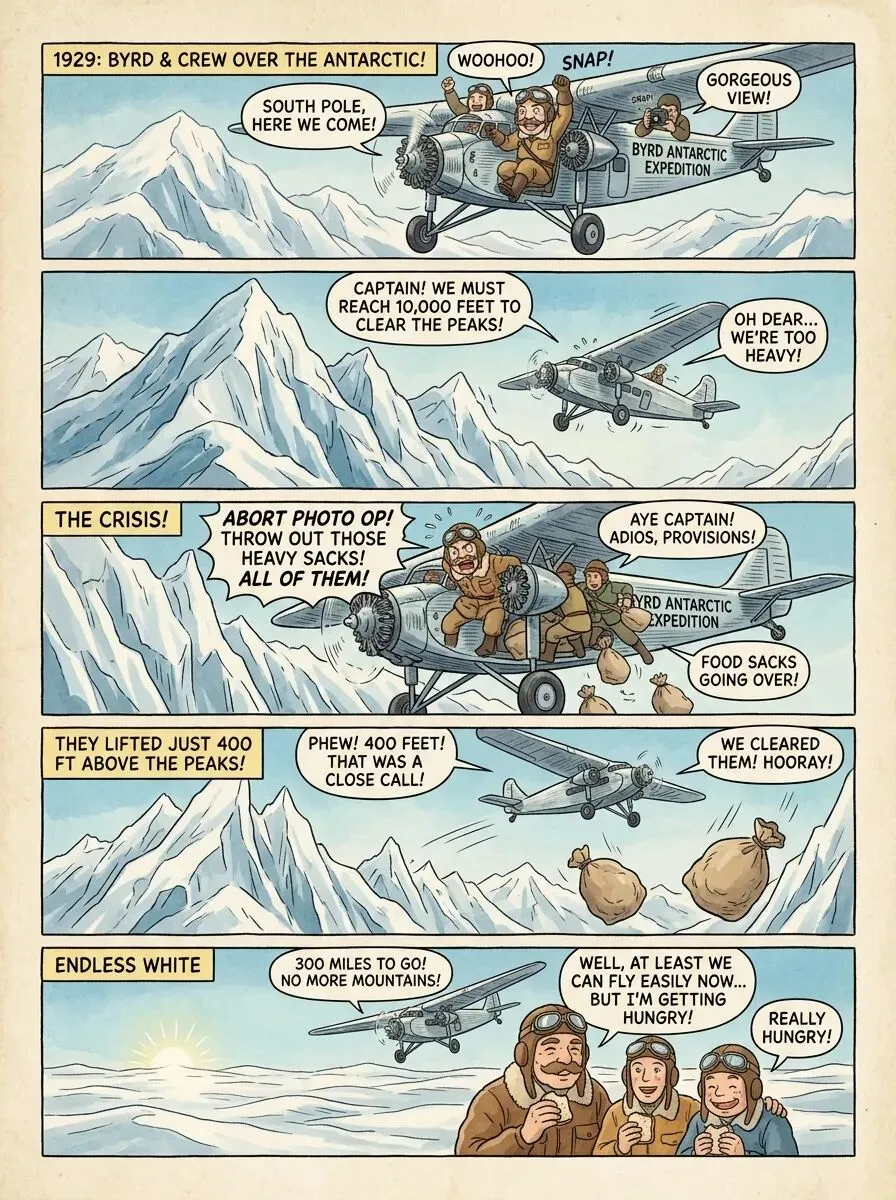
In 1929, three years after his flight over the North Pole, the American explorer, R.E. Byrd, successfully flew over the South Pole for the first time. Though, at first, Byrd and his men were able to take a great many photographs of the mountains that lay below, they soon ran into serious trouble. At one point, it seemed certain that their plane would crash. It could only get over the mountains if it rose to 10,000 feet. Byrd at once ordered his men to throw out two heavy food sacks. The plane was then able to rise and it cleared the mountains by 400 feet. Byrd now knew that he would be able to reach the South Pole which was 300 miles away, for there were no more mountains in sight. The aircraft was able to fly over the endless white plains without difficulty.
背景简介:本课讲述了美国著名极地探险家理查德·E·伯德(Richard E. Byrd)爵士在1929年首次成功飞越南极点的惊险历程。伯德是美国海军少将,也是20世纪最具影响力的极地探险家之一。他于1926年声称驾驶飞机飞越了北极点(尽管后世对此存疑),随后于1929年11月29日,指挥一次探险队,驾驶一架福特三引擎飞机“弗洛伊德·贝内特”号,首次飞越南极点,并安全返回。这次飞行标志着航空技术在极地探险中的应用取得了重大突破,极大地提升了人类对南极内陆的了解。课文描述的正是此次飞行中遭遇险情并化险为夷的关键片段。
参考译文:1929年,在飞越北极3年之后,美国探险家R.E.伯德首次成功地飞越了南极。虽然开始时伯德和他的助手们拍下了飞机下面连绵群山的大量照片,但他们很快就陷入了困境。在某个时刻,他们的飞机似乎注定要坠毁。只有在飞至10,000英尺的高度时,它才能飞过这些山头。伯德马上命令他的助手们扔掉两个沉重的食物袋。于是飞机得以升高,并在离山头400英尺的高度飞越了过去。伯德这时知道他能够顺利飞抵300英里以外的南极了,因为前面再没有山了。飞机可以毫无困难地飞过这片茫茫无际的白色原野。
🔍 第二部分:逐句精讲与词块总结
句子1
原文: In 1929, three years after his flight over the North Pole, the American explorer, R.E. Byrd, successfully flew over the South Pole for the first time.
翻译: 1929年,在飞越北极3年之后,美国探险家R.E.伯德首次成功地飞越了南极。
句子结构: 这是一个简单句。主干为the American explorer flew over the South Pole。In 1929和three years after his flight over the North Pole均为时间状语,后者是插入语,对前者进行补充说明。R.E. Byrd是the American explorer的同位语。successfully和for the first time是状语,修饰谓语动词flew。
重点词汇:
flight 蓝思值 600L
英音[flaɪt] 美音[flaɪt] 词性:n.
释义:飞行;航班;楼梯的一段;逃跑
常用语块:take a flight (乘坐航班);a flight of stairs (一段楼梯)
短语搭配:flight over... (飞越......的飞行);in flight (在飞行中);book a flight (预订机票)
例句一:The bird's graceful flight captivated the children. 鸟儿优雅的飞行迷住了孩子们。
例句二:We missed our connecting flight due to the delay. 由于延误,我们错过了转机航班。
拓展:动词形式为fly (flew, flown)。注意区分flight(飞行/航班)和fright(惊吓)。
explorer 蓝思值 800L
英音[ɪkˈsplɔːrə(r)] 美音[ɪkˈsplɔːrər] 词性:n.
释义:探险家;勘探者
常用语块:a famous explorer (著名的探险家)
短语搭配:space explorer (太空探索者)
例句一:Modern explorers use advanced technology to map the ocean floor. 现代探险家使用先进技术绘制海底地图。
例句二:He dreams of becoming an explorer and discovering lost cities. 他梦想成为一名探险家,发现失落的城市。
拓展:动词为explore (探索),名词exploration (探索活动)。
pole 蓝思值 700L
英音[pəʊl] 美音[poʊl] 词性:n.
释义:(地球的)极;极点;杆;柱
常用语块:the North/South Pole (北/南极);a tent pole (帐篷杆)
短语搭配:magnetic pole (磁极);pole position (杆位,引申为有利位置)
例句一:Penguins live in the regions close to the South Pole. 企鹅生活在靠近南极的地区。
例句二:He fixed the flag to the top of the pole. 他把旗子固定在杆子顶端。
拓展:注意与poll(投票)的发音和拼写区别。地理上的“极地”是polar regions,形容词polar(极地的,对立的)。
fly over 蓝思值 650L - 短语
释义:飞越;在......上空飞行
例句一:The helicopter will fly over the city to survey the damage. 直升机将飞越城市上空评估损失。
例句二:We watched the geese fly over the lake in a perfect V formation. 我们看着雁群以完美的V字形飞越湖面。
拓展:over在这里表示“在......上方(但不一定垂直正上方)并越过”。对比fly across(飞越一片区域,强调横跨)。
语法点睛: 本句通过时间状语In 1929和three years after his flight over the North Pole清晰地交代了事件发生的具体时间背景。after引导的介词短语作后置定语修饰three years,这种结构使时间表达非常精确。句子使用了一般过去时(flew),这是叙述过去确定发生事件的典型时态。[NCE知识点笔记]
句子2
原文: Though, at first, Byrd and his men were able to take a great many photographs of the mountains that lay below, they soon ran into serious trouble.
翻译: 虽然开始时伯德和他的助手们拍下了飞机下面连绵群山的大量照片,但他们很快就陷入了困境。
句子结构: 这是一个复合句。主句是they soon ran into serious trouble。Though引导让步状语从句,其中嵌套了一个由that引导的定语从句that lay below,修饰the mountains。at first是插入在让步状语从句中的时间状语。
重点词汇:
though 蓝思值 500L
英音[ðəʊ] 美音[ðoʊ] 词性:conj. & adv.
释义:conj. 虽然,尽管;adv. 可是,不过(常用于句末)
常用语块:even though (即使)
短语搭配:用作副词时,如It's hard work. I enjoy it, though. (这工作很辛苦,不过我喜欢。)
例句一:Though it was raining heavily, they decided to go ahead with the picnic. 虽然雨下得很大,他们还是决定继续野餐。
例句二:He's a bit shy. I like him, though. 他有点害羞,不过我喜欢他。
拓展:though和although作连词时通常可以互换,但although更正式,且不能像though那样用作副词放在句末。
a great many 蓝思值 550L - 短语
释义:非常多,许多(后接可数名词复数)
例句一:A great many students participated in the science fair. 许多学生参加了科学展览会。
例句二:She has read a great many books on ancient history. 她读了许多关于古代历史的书。
拓展:同义表达有a large number of, many, numerous。a great deal of后接不可数名词。
lie 蓝思值 600L此处为不及物动词
英音[laɪ] 美音[laɪ] 词性:v. (lay, lain, lying)
释义:位于;躺;平放;存在
常用语块:lie in bed (躺在床上);lie ahead (摆在前面)
短语搭配:lie in (在于);lie down (躺下)
例句一:The valley lies between two majestic mountains. 山谷位于两座雄伟的山脉之间。
例句二:The answer lies in careful planning and execution. 答案在于细致的规划和执行。
拓展:必须与及物动词lay (放置, laid, laid, laying) 严格区分,这是常见的易错点。lie (说谎, lied, lied, lying) 是另一个同形异义词。
run into 蓝思值 650L - 短语动词
释义:偶然遇见;遭遇(困难、问题);撞上
常用语块:run into trouble/difficulty/problems (遇到麻烦/困难/问题)
短语搭配:run into an old friend (偶遇老朋友);run into a tree (撞到树上)
例句一:If you run into any problems with the software, call tech support. 如果你在使用软件时遇到任何问题,打电话给技术支持。
例句二:I ran into my former teacher at the supermarket yesterday. 我昨天在超市偶然遇到了我以前的老师。
拓展:run into还有“共计达到”的意思,如Costs could run into millions. (成本可能高达数百万。)
语法点睛:本句包含了though引导的让步状语从句,体现了英语中“先承认事实,后转折”的逻辑表达方式。that lay below是一个限定性定语从句,对mountains进行限定说明,that在从句中作主语,不可省略。were able to表示过去“有能力并成功做到了”某事,比could更强调成功的结果。[名师精讲]
句子3
原文: At one point, it seemed certain that their plane would crash.
翻译: 在某个时刻,他们的飞机似乎注定要坠毁。
句子结构: 这是一个复合句。it seemed certain是主句,其中it是形式主语。真正的主语是that引导的主语从句that their plane would crash。At one point是时间状语。
重点词汇:
point 蓝思值 450L
英音[pɔɪnt] 美音[pɔɪnt] 词性:n. & v.
释义:n. 时刻;地点;观点;分数;要点;v. 指向;指明
常用语块:at this point (在这个时候);make a point (提出论点)
短语搭配:point of view (观点);to the point (切中要害);point at/to (指向)
例句一:At that point, I realized I had made a terrible mistake. 在那一刻,我意识到我犯了一个可怕的错误。
例句二:Could you point out the main attractions on the map? 你能在地图上指出主要景点吗?
拓展:at one point意思是“一度,在某一时刻”,常用于叙述中引入一个关键的发展节点。
seem 蓝思值 500L
英音[siːm] 美音[siːm] 词性:v. (linking verb)
释义:好像,似乎,看来
常用语块:it seems that... (似乎......);seem to be (好像是)
短语搭配:seem like (看起来像);can't seem to do (好像不能做)
例句一:She seems very happy with her new job. 她似乎对新工作很满意。
例句二:It seems that we have taken the wrong turn. 看来我们拐错弯了。
拓展:seem是系动词,后接形容词、名词或to be结构。It seems that...是非常常用的句型。
certain 蓝思值 550L
英音[ˈsɜːtn] 美音[ˈsɜːrtn] 词性:adj.
释义:确定的,肯定的;某个,某些
常用语块:be certain of/about (对......确信);make certain (弄清楚)
短语搭配:a certain amount of (一定数量的);for certain (肯定地)
例句一:I'm absolutely certain I locked the door before leaving. 我绝对肯定离开前锁了门。
例句二:A certain Mr. Smith called for you this morning. 一位姓史密斯的先生今天早上打电话找你。
拓展:名词形式为certainty (确定性)。反义词为uncertain。
crash 蓝思值 650L
英音[kræʃ] 美音[kræʃ] 词性:v. & n.
释义:v. (飞机)坠毁;(汽车)撞车;发出巨响;崩溃;n. 撞击声;事故;崩溃
常用语块:car/plane crash (汽车/飞机事故)
短语搭配:crash into (撞上);crash course (速成课程)
例句一:The stock market crashed in 1929, leading to the Great Depression. 1929年股市崩盘,导致了大萧条。
例句二:We heard a loud crash from the kitchen and rushed in. 我们听到厨房传来一声巨响,冲了进去。
拓展:注意与clash(冲突,抵触)和crush(压碎)的区别。
语法点睛: 本句使用了It seemed certain that...的句型。It作为形式主语,代替后面冗长的that从句,使句子结构平衡,避免头重脚轻。这是英语中处理较长主语时的常用手段。would crash是过去将来时,表示从过去的视角(seemed)来看将要发生的动作,体现了时态的一致性。[语法新思维]
句子4
原文: It could only get over the mountains if it rose to 10,000 feet.
翻译: 只有在飞至10,000英尺的高度时,它才能飞过这些山头。
句子结构: 这是一个复合句。主句是It could only get over the mountains,if引导条件状语从句if it rose to 10,000 feet。
重点词汇:
get over 蓝思值 600L - 短语动词
释义:克服(困难);从(疾病、失望)中恢复过来;越过
常用语块:get over an illness (病愈);get over a problem (解决问题)
短语搭配:get over someone (忘记某人);get over something (越过某物,如课文中的山)
例句一:It took him months to get over the shock of losing his job. 他花了几个月才从失业的打击中恢复过来。
例句二:How did you manage to get over that high wall? 你是怎么越过那堵高墙的?
拓展:本课中是字面意思“飞越”。更多时候用作比喻义“克服、恢复”。
rise 蓝思值 550L
英音[raɪz] 美音[raɪz] 词性:v. (rose, risen) & n.
释义:v. 上升;升起;起床;上涨;n. 上升;增加;加薪
常用语块:sun rise (日出);give rise to (引起)
短语搭配:rise to the occasion (成功应对困难局面);rise against (反抗)
例句一:Hot air rises. 热空气上升。
例句二:There has been a sharp rise in the cost of living. 生活成本急剧上涨。
拓展:不及物动词,强调自身向上移动。及物动词是raise (举起,提高)。rise的过去式和过去分词不规则。
语法点睛:本句包含一个if引导的真实条件句,表示在当时情况下唯一的可能性。主句中的could表示“能力”或“可能性”,only强调了条件的唯一性和必要性。这种“only... if...”结构突出了解决问题的苛刻前提。[NCE知识点笔记]
句子5
原文: Byrd at once ordered his men to throw out two heavy food sacks.
翻译: 伯德马上命令他的助手们扔掉两个沉重的食物袋。
句子结构: 这是一个简单句。主干为Byrd ordered his men。to throw out two heavy food sacks是动词不定式短语作宾语his men的补足语。
重点词汇:
at once 蓝思值 450L - 短语
释义:立刻,马上;同时
例句一:Stop what you're doing and come here at once! 停下你正在做的事,马上过来!
例句二:I can't do two things at once. 我不能同时做两件事。
拓展:同义表达有immediately, right away, instantly。all at once意为“突然”。
order 蓝思值 550L
英音[ˈɔːdə(r)] 美音[ˈɔːrdər] 词性:v. & n.
释义:v. 命令;订购;点菜;n. 命令;顺序;订单;秩序
常用语块:in order (整齐;按顺序);place an order (下单)
短语搭配:order sb. to do sth. (命令某人做某事);keep order (维持秩序)
例句一:The general ordered his troops to advance. 将军命令部队前进。
例句二:The names are listed in alphabetical order. 名字按字母顺序列出。
拓展:order作“命令”讲时,后接宾语+不定式补足语,或接that从句(从句中用should+动词原形或直接用动词原形)。
throw out 蓝思值 600L - 短语动词
释义:扔掉;撵走;否决(提议)
常用语块:throw out the trash (扔垃圾)
短语搭配:throw out a suggestion (提出建议);get thrown out (被赶出去)
例句一:We need to throw out these old magazines to make space. 我们需要扔掉这些旧杂志来腾出空间。
例句二:The committee threw out the proposal as impractical. 委员会以不切实际为由否决了该提案。
拓展:本课中是字面意思“抛出机舱”。同义词discard更正式。
sack 蓝思值 700L
英音[sæk] 美音[sæk] 词性:n. & v.
释义:n. 大袋;麻袋;解雇;v. 解雇;洗劫
常用语块:a sack of potatoes (一袋土豆);get the sack (被解雇)
短语搭配:hit the sack (上床睡觉,俚语)
例句一:The farmer filled the sack with grain. 农民把粮食装进袋子里。
例句二:He was sacked for repeatedly being late. 他因屡次迟到被解雇了。
拓展:作“解雇”讲是非正式用语,同义词有fire, dismiss。
语法点睛: 本句的语法重点是动词order后接复合宾语的结构:order sb. to do sth.。类似的动词还有tell, ask, want, allow, force等。这个结构将“命令”的对象和“命令”的内容清晰地结合起来。[名师精讲]
句子6
原文: The plane was then able to rise and it cleared the mountains by 400 feet.
翻译: 于是飞机得以升高,并在离山头400英尺的高度飞越了过去。
句子结构: 这是一个并列句,由and连接两个分句:The plane was then able to rise 和 it cleared the mountains by 400 feet。
重点词汇:
clear 蓝思值 550L此处为及物动词
英音[klɪə(r)] 美音[klɪr] 词性:v. & adj.
释义:v. 越过;清除;澄清;adj. 清楚的;晴朗的;无障碍的
常用语块:clear the table (收拾桌子);clear one's throat (清嗓子)
短语搭配:clear up (放晴;整理);clear away (收拾走);make clear (阐明)
例句一:The horse easily cleared the fence. 马轻易地跃过了栅栏。
例句二:The sky is clear and blue today. 今天天空晴朗湛蓝。
拓展:本课中clear作及物动词,意为“越过(障碍)而不触及”。by 400 feet表示“以400英尺的差距/余地”。
语法点睛: was able to再次出现,强调在采取行动(扔掉负重)后,飞机“得以”或“成功”爬升。by 400 feet中的介词by表示“相差......的程度或数量”,常用于说明距离、时间、金额等的差额。[NCE知识点笔记]
句子7
原文: Byrd now knew that he would be able to reach the South Pole which was 300 miles away, for there were no more mountains in sight.
翻译: 伯德这时知道他能够顺利飞抵300英里以外的南极了,因为前面再没有山了。
句子结构: 这是一个多重复合句。主句是Byrd now knew。that引导宾语从句that he would be able to reach the South Pole。which was 300 miles away是定语从句,修饰the South Pole。for引导原因状语从句for there were no more mountains in sight,对整个主句进行解释。
重点词汇:
reach 蓝思值 450L
英音[riːtʃ] 美音[riːtʃ] 词性:v. & n.
释义:v. 到达;达到;伸手够到;取得联系;n. 范围;河段
常用语块:reach an agreement (达成协议);out of reach (够不着)
短语搭配:reach for (伸手去拿);reach out to (联系,帮助)
例句一:We hope to reach the summit before noon. 我们希望中午前到达山顶。
例句二:Make sure medicines are kept out of the reach of children. 确保药品放在儿童够不到的地方。
拓展:reach是及物动词,后面直接接地点,而arrive是不及物动词,需接at/in。
in sight 蓝思值 550L - 短语
释义:看得见;在望
例句一:Land was finally in sight after weeks at sea. 在海上航行数周后,陆地终于出现在眼前。
例句二:With the exams in sight, students are studying harder. 考试在即,学生们学习更努力了。
拓展:反义词是out of sight (看不见)。at sight意为“一见就”,如play music at sight (视奏)。
语法点睛:本句结构复杂,包含了宾语从句、定语从句和原因状语从句,是典型的英语长句。which引导的非限定性定语从句(课本中虽无逗号,但语义上是补充说明)提供额外信息。for作为并列连词引导原因分句,语气比because稍弱,更侧重于推理和解释。would be able to是过去将来时,表示伯德在过去那个时间点对未来成功的判断。[语法新思维]
句子8
原文: The aircraft was able to fly over the endless white plains without difficulty.
翻译: 飞机可以毫无困难地飞过这片茫茫无际的白色原野。
句子结构: 这是一个简单句。主干为The aircraft was able to fly over the endless white plains。without difficulty是介词短语作状语,表示方式。
重点词汇:
aircraft 蓝思值 750L
英音[ˈeəkrɑːft] 美音[ˈerkræft] 词性:n. (单复数同形)
释义:飞机,航空器
常用语块:military/civil aircraft (军用/民用航空器)
短语搭配:aircraft carrier (航空母舰)
例句一:All aircraft must be inspected before take-off. 所有航空器在起飞前都必须接受检查。
例句二:The new aircraft is more fuel-efficient. 新飞机更省油。
拓展:是airplane/plane的更正式和技术性的说法,涵盖所有飞行器(如直升机、滑翔机)。
endless 蓝思值 650L
英音[ˈendləs] 美音[ˈendləs] 词性:adj.
释义:无止境的,无穷的;环状的
常用语块:endless possibilities (无限的可能性)
短语搭配:endless belt/chain (环形带/链)
例句一:The meeting seemed endless. 会议似乎没完没了。
例句二:Children often ask endless questions. 孩子们经常会问没完没了的问题。
拓展:由end (尽头) + -less (无......的) 构成。反义词是finite或limited。
plain 蓝思值 700L
英音[pleɪn] 美音[pleɪn] 词性:n. & adj.
释义:n. 平原;adj. 简单的;朴素的;清楚的;普通的
常用语块:the Great Plains (北美大平原);plain clothes (便衣)
短语搭配:make plain (阐明);plain sailing (一帆风顺)
例句一:Vast plains stretch across the central part of the continent. 广阔的平原横亘在大陆的中部。
例句二:Please give me a plain answer -- yes or no. 请给我一个明确的答复——是或否。
拓展:注意与plane(飞机;平面)同音异义。作形容词时,plain强调简单无装饰,simple强调不复杂。
语法点睛: 本句以was able to结尾,与开头的were able to呼应,完成了从陷入困境(ran into trouble)到克服困难(was able to fly... without difficulty)的叙事闭环。without difficulty这个介词短语简洁有力地表达了行动的顺利,是easily或with ease的同义表达。[名师精讲]
📌 核心词块总结
1. fly over (something): To pass above something in an aircraft. (飞越某物)Example: The geese fly over our house every autumn.
2. run into trouble: To encounter difficulties or problems. (遇到麻烦)Example: Their expedition ran into trouble when their supplies were lost.
3. at one point: At a particular moment in time during a series of events. (在某一时刻)Example: At one point during the storm, we thought the roof would blow off.
4. It seemed certain that...: Used to express that something appeared very likely or inevitable from a past perspective. (似乎可以肯定......)Example: It seemed certain that the home team would win, but they lost in the final minutes.
5. get over (an obstacle): To successfully pass across or above an obstacle. (越过障碍)Example: The truck couldn't get over the fallen tree on the road.
6. order somebody to do something: To give someone a command to perform an action. (命令某人做某事)Example: The captain ordered the crew to prepare for departure.
7. clear (something) by (a distance): To pass over something with a specified amount of space to spare. (以......的差距越过某物)Example: The jumper cleared the bar by ten centimeters.
8. in sight: Able to be seen; visible. (在视线内,看得见)Example: After hiking for hours, the village was finally in sight.
✍️ 第三部分:语篇分析与段落写作技巧
1. 语篇分析①识别宏观结构 (Identify the macrostructure):本文是一篇典型的叙事文 (narrative),按照时间顺序 (chronological order)展开。结构清晰:背景引入 (Introduction)→发展/冲突 (Development/Conflict)→高潮/解决 (Climax/Resolution)→结局 (Conclusion)。首句交代人物、时间和核心事件(成功飞越南极)。中间部分详细描述了飞行过程中遇到的险情(拍照→遇险→决策→脱险)。最后两句描述了脱险后的顺利飞行和前景,形成圆满结局。②列举衔接手段 (List cohesive devices):*时间连接词 (Temporal connectors):In 1929, three years after, at first, soon, At one point, then, now。这些词语清晰地勾勒出事件的时间线。*逻辑连接词 (Logical connectors):Though (让步), if (条件), for (原因)。这些词表明了句子间的逻辑关系(转折、条件、因果)。*指代 (Reference):使用代词he (Byrd), his (Byrd's), their (Byrd and his men's), it (the plane) 来指代前文提到的人和物,避免重复,使行文连贯。*词汇复现 (Lexical repetition):关键词mountains, plane, fly/flew, over, South Pole的重复出现,紧扣主题。③分析作者态度 (Analyze the author's attitude):作者的叙述是客观、纪实性 (objective and factual)的,但通过词汇选择隐含了对探险家勇气和决断的钦佩。例如,使用successfully, at once ordered, was able to等正面或果断的词汇。描述险情时用serious trouble, seemed certain... would crash制造紧张感,随后用cleared... by 400 feet, without difficulty营造解脱和成功的氛围。
2. 写作技巧①提炼写作逻辑:本文展示了如何讲述一个“问题-解决”型故事。基本逻辑框架是:设定场景 (Situation)→出现问题 (Problem)→做出反应 (Reaction)→采取行动 (Action)→取得结果 (Result)。写作时,可以遵循这个框架来组织内容,使故事有条理、有张力。②提供段落写作范例:主题:一次难忘的户外经历(登山遇险)Last summer, my friends and I decided to climb Mount Skyline, a popular peak near our city. Initially, the hike was enjoyable, and we took many photos of the stunning scenery. However, the weather changed abruptly as we approached the summit. Thick fog rolled in, and we soon lost sight of the trail. At one point, it seemed certain that we would have to spend the night on the mountain, unprepared and cold. We could only find our way back if the fog lifted. Our leader, Sarah, immediately suggested we use a compass and map we had packed. Following her directions carefully, we slowly descended and eventually cleared the dangerous ridge area. Now we knew we would be able to reach the base camp, for the path downward became clear. The rest of the journey was completed without further difficulty, though it taught us a vital lesson about preparation.结构特点分析:这个段落模仿了课文的叙事结构。开头设定场景(时间、人物、活动),接着用However转折引入问题(天气突变迷路),然后用At one point描述危机时刻,紧接着是条件和反应(使用指南针),行动(跟随指引下山),结果(脱离险境,顺利下山),最后以感悟结尾。语言点映射:Initially对应at first;took many photos对应take a great many photographs;soon lost sight of对应soon ran into trouble;it seemed certain that直接借用;could only... if句型相同;immediately suggested对应at once ordered;cleared the dangerous ridge area对应cleared the mountains;would be able to reach对应would be able to reach;without further difficulty对应without difficulty。③布置小练笔并提供例文小练笔:请模仿课文的结构和语言,写一段约120字的英文段落,描述一次你或他人通过冷静决策和行动克服困难(如考试、比赛、日常问题)的经历。例文 (Example Composition):Two years ago, I participated in the regional English speech contest. I had prepared thoroughly and felt confident at first. However, when I stepped onto the stage, I saw the large audience and my mind went blank. At that moment, it seemed certain that I would fail embarrassingly. I could only deliver my speech successfully if I calmed down and focused on my notes. Taking a deep breath, I decided to ignore the crowd and look at my teacher in the front row. I then began speaking slowly and clearly. Once I got through the introduction, I knew I would be able to finish the speech, for my memory gradually returned. The rest of the presentation went smoothly, and I even managed to answer questions without difficulty. In the end, I won third prize, which was a huge relief and encouragement.
📐 第四部分:本课语法精析(加强版)
本课的核心语法点是过去完成时 (Past Perfect Tense)和间接引语 (Indirect Speech)中的时态回溯,同时也涉及了条件句、定语从句等多种复合句结构。以下将结合知识库资料进行详细解析。
1. 过去完成时 (Past Perfect Tense) -- “过去的过去”过去完成时表示在过去某一时间或动作之前已经发生或完成的动作。它由“had + 过去分词”构成。[NCE知识点笔记]-基本用法:a)表示在过去某个时间之前完成的动作:常与by, before, until, when, after等引导的时间状语连用。*Byrd successfully flew over the South Pole in 1929. He had flown over the North Pole three years earlier.(本课背景的完整表达)*By the time we arrived at the cinema, the film had already started.*She had finished her homework before her friends came over.b)用于间接引语中,将直接引语中的现在完成时或一般过去时转为过去完成时:(详见下文间接引语部分)c)与when, before, after等连词引导的时间状语从句连用,明确两个过去动作的先后顺序:*When I got to the station, the train had left.(火车离开发生在“我到达”之前)*After he had checked the engine, he started the car.注意:在after和before引导的从句中,由于连词本身已表明先后关系,有时也可用一般过去时代替过去完成时。After he checked the engine, he started the car.也是正确的,但用过去完成时更强调完成性。-与一般过去时的对比(第一册回顾):第一册主要学习一般过去时,表示过去某个特定时间发生的动作或存在的状态。过去完成时则需一个明确的“过去时间点”作为参照,动作发生在这个参照点之前。- 一般过去时:I saw that movie last week.(只说出了动作发生在过去)- 过去完成时:I had already seen that movie twice before I saw it with you last week.(“看过两次”发生在“上周和你一起看”之前)-练习题 (Exercises):1. By 2010, she ___________ (live) in London for five years.2. They ___________ (already/eat) dinner when I invited them out.3. The roads were wet because it ___________ (rain) all night.4. He told me he ___________ (lose) his passport.5. After I ___________ (finish) my report, I handed it to the manager.6. I couldn't get into my apartment because I ___________ (leave) my keys inside.答案解析:1.had lived(到2010年这个过去时间点为止,已居住五年)2.had already eaten(“吃晚饭”发生在“我邀请”之前)3.had rained(“下雨”是“路湿”的原因,且发生在过去)4.had lost(间接引语,丢护照发生在“告诉”之前)5.had finished或finished(after已表明顺序,两者皆可)6.had left (“忘带钥匙”发生在“进不去”之前)
2. 间接引语 (Indirect Speech / Reported Speech) 中的时态回溯当我们转述别人的话时,如果主句动词是过去时(如said, told, asked, knew等),从句的时态通常要向后推移一层,这叫“时态回溯”。[名师精讲], [语法新思维]-回溯规则:- 一般现在时 → 一般过去时- 现在进行时 → 过去进行时- 一般过去时 →过去完成时(这是本课关联的重点)- 现在完成时 → 过去完成时- 过去完成时 → 过去完成时 (不变)- will → would- can → could- may → might-本课例句分析:课文并未出现直接的直接引语,但隐含了这种时态关系。我们可以设想一个直接引语场景:- 直接引语 (飞行前): Byrd said, “Wewill be able toreach the South Pole.”- 间接引语 (课文中的转述,在脱险后): Byrd nowknewthat hewould be able toreach the South Pole...这里,主句动词knew是过去时,所以直接引语中的will在间接引语中变成了would。-重点:一般过去时在间接引语中变为过去完成时这是学习者容易出错的地方。当直接引语中使用一般过去时来描述一个在转述时已完成的动作时,在间接引语中需改为过去完成时。- 直接引语: She said, “Isawthat film yesterday.”- 间接引语: She said that shehad seenthat film the day before.- 直接引语: He said, “My carbrokedown on the way.”- 间接引语: He said that his carhad brokendown on the way.-练习题 (Exercises):将下列直接引语改为间接引语(主句动词为过去时)。7. Tom said, “Ineeda new computer.”8. Mary said, “Iam readingan interesting book.”9. John said, “Ifinishedmy project last night.” (关键题)10. Sue said, “Ihave visitedParis three times.”11. Dad said, “Iwill repairthe bike tomorrow.”12. The teacher said, “Youcanleave early today.”答案解析:7. Tom said that heneededa new computer. (现在时→过去时)8. Mary said that shewas readingan interesting book. (进行时→过去进行时)9. John said that hehad finishedhis project the night before.(一般过去时→过去完成时)10. Sue said that shehad visitedParis three times. (现在完成时→过去完成时)11. Dad said that hewould repairthe bike the next day. (will→would)12. The teacher said that wecould leave early that day. (can→could)
3. 条件状语从句 (Adverbial Clause of Condition)本课第4句包含一个if引导的真实条件句,表示在过去的特定情况下可能发生的事。[NCE知识点笔记]-结构:It could only get over the mountains if it rose to 10,000 feet.-分析:主句用could表示“可能性”,从句用一般过去时(rose)。在叙述过去事件的条件句时,时态通常用一般过去时。-对比第一册:第一册学习了if引导的一般现在时条件句(主将从现),如:If it rains tomorrow, we will cancel the picnic.本课是这种结构在过去语境中的应用。-更多例句:-He said he would help us if he had time.(他说如果他有时间就会帮我们。)-The patient would recover faster if he followed the doctor's advice.-注意: 这不是虚拟语气。虚拟语气用于表示与事实相反或可能性很小的假设,结构不同(如:If I were you, I would...)。
4. 定语从句 (Attributive Clause)本课出现了两个定语从句:[名师精讲]a) ... the mountainsthat lay below... (限定性定语从句,that作主语)b) ... the South Polewhich was 300 miles away... (非限定性定语从句,which作主语,提供附加信息。课文书写中虽未用逗号隔开,但从语义上判断应为非限定性,补充说明南极点的距离。)-that vs which:在限定性定语从句中,指物时两者常可互换。但在非限定性定语从句中(用逗号隔开),只能用which,不能用that。-练习题:用that或which填空。13. The book ___________ I borrowed from you is very interesting.14. Mount Everest, ___________ is the highest mountain in the world, attracts many climbers.15. Everything ___________ he said turned out to be true.答案解析:13.that/which(限定性从句,可互换)14.which(非限定性从句,前后有逗号,只能用which)15.that (先行词是everything, anything, nothing等不定代词时,通常用that)
5. 原因状语从句 (Adverbial Clause of Reason)本课用for引导原因状语从句。for是并列连词,连接两个分句,表示原因,语气比because弱,更偏重解释和推断。[语法新思维]- Byrd now knew... for there were no more mountains in sight.- 对比because: because是从属连词,引导的从句通常表示直接原因,语气更强。- He stayed at home because he was ill. (直接原因)- It must have rained last night, for the ground is wet. (根据结果推断原因)- 注意: for引导的分句不能放在句首。不能说:For there were no more mountains, Byrd knew...
6. 介词by表示差额... cleared the mountains by 400 feet. 这里的by表示“以......之差”、“相差”。[NCE知识点笔记]- He is older than me by two years.- We missed the train by only three minutes.- The bullet missed him by inches.
总结与综合练习将本课语法点融入以下综合改错和翻译练习:16. 改正错误:She said she has finished her work an hour ago.17. 改正错误:I knew that he will come to the party.18. 改正错误:The house where we lived in it last year was sold.19. 汉译英:飞机似乎肯定要坠毁了,除非它能立即爬升。20. 汉译英:到上个月底,他已经写了五篇小说。21. 汉译英:他告诉我他前一天把车修好了。答案解析:16.had finished(间接引语,ago表明“完成”发生在“说”之前,需用过去完成时)17.would come(主句knew是过去时,从句will需回溯为would)18.where we lived last year或that/which we lived in last year(定语从句中where相当于in which,不能再加it;用that/which则需作宾语)19.It seemed certain that the plane would crash unless it could rise at once.20.By the end of last month, he had written five short stories.21. He told me that he had repaired his car the day before.
🎧 第五部分:听力与阅读策略训练
1. 听力技巧结合课文录音(可从《官方教材之新概念英语学生用书 第2册.pdf》或《新概念英语pro 第2册.pdf》等相关资源获取音频),设计以下听力理解训练:①预测关键词 (Predicting Key Words):在听录音前,根据课文标题“Over the South Pole”和已知背景,预测可能会听到哪些关键词。列出至少8个,如:explorer, Byrd, flight, mountains, trouble, crash, height/feet, sacks, plain, South Pole。②抓主旨大意 (Gist Listening):*任务:听第一遍录音,回答:Who did what? When? Was it completely smooth?*答案要点:American explorer R.E. Byrd successfully flew over the South Pole for the first time in 1929. The flight encountered serious trouble but managed to overcome it.③笔记方法 (Note-taking):*任务:听第二遍录音,尝试用关键词或符号按顺序记录事件发展过程。*示例笔记:* 1929 -- Byrd -- fly S. Pole (1st)* At first: OK, photos* Soon: trouble* Problem: mountains low* Solution: rise to 10,000 ft* Action: throw out food sacks* Result: cleared mtns by 400 ft* Reason for confidence: no more mtns* Final: fly over plains easily*技巧: 使用缩写(S. Pole), 箭头(→表示结果), 符号(+表示增加,-表示减少)。
2. 阅读理解策略①扫读 (Scanning):快速浏览课文,找出以下具体信息,不超过30秒。a) The year of the flight over the South Pole:1929b) The height needed to clear the mountains:10,000 feetc) What they threw out:two heavy food sacksd) The distance from the mountains to the Pole:300 miles②略读 (Skimming):在1分钟内读完课文,总结段落大意:The passage describes the perilous yet successful first flight over the South Pole by R.E. Byrd, focusing on a critical moment when lightening the plane saved it from crashing into mountains.③推断词义 (Inferring Meaning):根据上下文推断划线词的含义。* “...they soonran intoserious trouble.” 猜ran into意为:encountered/met with* “...theendlesswhite plains...” 猜endless意为:seemingly without end, vast* “...clearedthe mountains by 400 feet.” 猜cleared在此意为:passed over without touching
📝 第六部分:习题讲解
(以下习题主要参考《官方教材之新概念英语练习详解 第2册.pdf》、《新概念英语教材全解 第2册全新版.pdf》及《新概念英语教材解析 第2册.pdf》中针对第43课的练习。)
1. 摘要写作 (Summary Writing)- 教材原题(要点法): 根据所给要点,写出课文摘要。Points: 1. 1929, Byrd flew over South Pole. 2. Photos --- mountains. 3. Ran into trouble --- plane crash. 4. Ordered --- throw out food sacks. 5. Plane rose --- cleared mountains. 6. Knew --- reach Pole --- no more mountains. 7. Flew over plains.- 解题思路: 将7个要点用连接词和恰当的语法串联成一个连贯的段落。注意使用过去时态,将要点2和3用but或however连接以体现转折,要点4和5用so或and then连接以体现因果/顺序。- 参考答案:In 1929, Byrd flew over the South Pole. At first, he took many photographs of the mountains, but he soon ran into trouble and his plane nearly crashed. He at once ordered his men to throw out two food sacks, so the plane rose and cleared the mountains. Then he knew he could reach the Pole because there were no more mountains, and the aircraft flew over the endless plains without difficulty.(Word count: 70)
2. 作文 (Composition)- 教材原题(情景法): 用以下句子开头,续写一段短文:“The plane not only flew over the South Pole, but it also flew over a part of the Antarctic which had never been seen before...”- 写作指导: 这是一个拓展性写作。需要基于课文事实进行合理想象。可以从以下角度展开:描述新看到的景象(冰川、裂缝、野生动物?),机组人员的反应(兴奋、继续拍照?),这次新发现的意义(绘制了新地图?),最后安全返航。- 范文片段:...This previously uncharted territory revealed breathtaking vistas of jagged ice formations and deep blue crevasses. Byrd and his crew, filled with awe, continued to take photographs diligently, knowing these images were invaluable for science. This aerial survey provided the first detailed evidence of the vast, rugged interior of Antarctica, contributing significantly to geographical knowledge. After completing their historic flight, they turned back and eventually landed safely at their base, having conquered both the Pole and the unknown.
3. 关键句型与难点练习 (Key Structures & Special Difficulties)-A. 关键句型(过去完成时练习):用括号中动词的正确形式(一般过去时或过去完成时)填空。1. After he ___________ (finish) breakfast, he ___________ (go) out.2. The train ___________ (leave) just before I ___________ (reach) the station.3. He ___________ (tell) me that he ___________ (see) the film before.-答案解析:1.had finished, went(after表明完成在先)2.had left, reached(火车离开发生在“我到”之前)3.told, had seen(间接引语,“看”发生在“告诉”之前)-B. 难点练习(词汇辨析):用lie或lay的正确形式填空。1. I'm going to ___________ down for a while. I feel tired.2. He ___________ the book on the table and left.3. The papers have ___________ on his desk for weeks.-答案解析:1.lie(不及物,“躺下”)2.laid(及物,“放置”,过去式)3.lain (不及物,“位于”,过去分词)
4. 多项选择题 (Multiple Choice)(来自《新概念英语教材全解 第2册全新版.pdf》等辅导书模拟题)1. Byrd flew over the South Pole in ___________.a) 1926 b) 1927 c) 1928 d) 19292. At first, they were able to take photographs ___________.a) with difficulty b) easily c) quickly d) slowly3. They soon ran into ___________ trouble.a) safe b) serious c) slight d) small4. It seemed certain that their plane would ___________.a) land b) crash c) return d) disappear5. The plane could only get over the mountains if it rose to ___________ feet.a) 1,000 b) 10,000 c) 100,000 d) 1,000,0006. Byrd ordered his men to throw out two ___________.a) boxes b) bags c) sacks d) parcels-答案:1.d 2.b 3.b 4.b 5.b 6.c-解题思路: 均为细节理解题,需准确回忆课文内容。
🤔 第七部分:英文深度思考与拓展(强化版)
A. 层次化英文问题与答案Level 1 (Factual): Retrieving explicit information from the text.1. Q: Who was the first person to fly over the South Pole according to the text?A: The American explorer, R.E. Byrd, was the first person to fly over the South Pole.2. Q: What did Byrd and his men do at the beginning of the flight over the mountains?A: At first, they were able to take a great many photographs of the mountains below.3. Q: What specific action did Byrd take to save the plane from crashing?A: Byrd at once ordered his men to throw out two heavy food sacks to lighten the plane.4. Q: How much distance was between the South Pole and the mountains they cleared?A: The South Pole was 300 miles away from the mountains they had just cleared.Level 2 (Inferential): Drawing conclusions based on implicit information.5. Q: Why was throwing out the food sacks an effective solution to their problem?A: Throwing out the heavy food sacks reduced the weight of the aircraft, allowing it to climb to the necessary height (10,000 feet) to clear the mountains.6. Q: What can we infer about Byrd's character from his actions during the crisis?A: We can infer that Byrd was a decisive, quick-thinking, and calm leader under pressure, as he immediately identified the solution and issued clear orders.7. Q: Why did Byrd feel confident about reaching the South Pole after clearing the mountains?A: He felt confident because there were no more mountains in sight, meaning the terrain ahead was the endless flat plain, which posed no further altitude-related obstacles for the flight.8. Q: What does the phrase “ran into serious trouble” suggest about the severity of the situation?A: It suggests that the situation was not a minor issue but a potentially life-threatening emergency that required immediate and drastic action to avoid a crash.Level 3 (Evaluative & Analytical): Making judgments, connections, and analyses.9. Q: Evaluate the significance of Byrd's flight in the context of human exploration.A: Byrd's flight was highly significant as it marked the first aerial conquest of the South Pole, demonstrating the potential of aircraft for polar exploration. It opened up new methods for surveying vast, inaccessible territories like Antarctica, speeding up mapping and scientific discovery compared to traditional ground expeditions.10. Q: Compare and contrast the challenges faced by early polar aviators like Byrd with those faced by modern pilots flying over polar regions.A: Early aviators faced immense challenges: primitive aircraft with limited power, range, and navigation equipment; unreliable engines; lack of accurate weather forecasts; and the constant risk of mechanical failure in extreme cold. Modern pilots benefit from jet engines, advanced GPS and inertial navigation systems, satellite communications, real-time weather data, pressurized and heated cabins, and established polar flight routes with support infrastructure, making such journeys routine and far safer.11. Q: The text mentions they threw out “food sacks.” Discuss the ethical dilemma between saving the mission (and lives) versus abandoning essential supplies in a remote, hostile environment.A: This presents a classic survival dilemma. The immediate priority was to avoid crashing, which would mean almost certain death for all onboard. Sacrificing food, while risky for a prolonged ground survival scenario, was the rational choice to ensure the continuation of the flight. It highlights the calculated risks explorers take, prioritizing immediate existential threats over potential future ones. They likely carried some reserve or calculated the remaining distance to safety.12. Q: Analyze the author's use of language to build suspense and resolution in this short narrative.A: The author builds suspense by shifting from the successful start (“successfully flew,” “able to take photographs”) to a sudden problem (“soon ran into serious trouble”). The climax is heightened with strong language: “it seemed certain that their plane would crash.” The resolution is delivered through swift, decisive verbs: “ordered,” “throw out,” “was then able to rise,” “cleared.” Finally, calm is restored with words like “knew,” “able to reach,” and “without difficulty,” creating a satisfying narrative arc from tension to relief.
B. 多类型拓展阅读1. 时事新闻拓展 (Current News Extension)Title: Modern Antarctic Aviation: The Ice RunwayAntarctica today is a hub for scientific research, supported by a network of flights from New Zealand, Chile, and South Africa. Unlike Byrd's daring single-engine venture, modern operations use large cargo planes like the C-17 Globemaster and specialized ski-equipped LC-130 Hercules. The most fascinating feature is the “ice runway.” At McMurdo Station, the main U.S. base, crews groom a several-mile-long strip directly on the sea ice or glacial ice. This runway, capable of supporting massive aircraft, melts and reforms annually. Pilots undergo rigorous training for white-out conditions and extreme cold. These flights transport scientists, equipment, and supplies, proving that the spirit of Antarctic aviation, pioneered by heroes like Byrd, continues to evolve with technology, now in the service of international science and cooperation.引导性问题:What are the key differences between Byrd's flight and modern Antarctic supply flights? What unique challenge does an “ice runway” present?2. 文化背景解析 (Cultural Background Analysis)Title: The Heroic Age of Antarctic ExplorationThe early 20th century is known as the “Heroic Age of Antarctic Exploration.” It was dominated by figures like Roald Amundsen (first to the South Pole by land, 1911), Robert Falcon Scott (who tragically died returning from the Pole), Ernest Shackleton, and Richard E. Byrd. This era was characterized by national rivalry, personal ambition, and immense hardship. Explorers used sled dogs, ponies, and man-hauling. Byrd represented the transition into the “Mechanical Age.” His use of aircraft, radio, and motorized vehicles marked a technological shift. While still heroic and dangerous, these tools allowed for broader exploration and mapping from the air. Byrd's 1929 flight symbolized that the continent's secrets could now be unlocked from above, changing the paradigm of polar exploration forever.语言点映射:注意“characterized by”, “transition into”, “marked a shift”, “symbolized” 等用于描述时代特征和变化的短语。3. 今昔对比分析 (Then-and-Now Comparison)Title: Navigation: From Sextant to SatelliteImagine Byrd in his cockpit in 1929. To navigate over the featureless white expanse, he likely relied on a magnetic compass (unreliable near the poles), a sextant for celestial navigation (difficult in constant daylight or cloud), dead reckoning (calculating position based on speed and direction), and rudimentary maps with huge blanks. One error could mean missing the Pole or running out of fuel. Contrast this with today. A pilot flying over Antarctica uses GPS satellites providing pinpoint accuracy, inertial navigation systems as backup, digital moving maps showing real-time position over detailed terrain, and constant satellite communication with ground control. Byrd's achievement is magnified when we understand he essentially ventured into the white unknown with the equivalent of a paper map and a guess. His success was a triumph of skill, courage, and luck over technological limitation.引导性问题:Why was navigating over Antarctica particularly challenging in Byrd's time? How have modern technologies solved these challenges?4. 新潮英语改写 (Trendy English Rewrite)Title: Polar Peril: Byrd's Epic SaveOkay, picture this: 1929. Explorer boss R.E. Byrd is on the ultimate mission -- first flight over the South Pole. Starts out chill, snapping insane pics of epic mountain ranges below. But then... major plot twist. The plane hits a wall -- literally, the mountains are too high! Vibe check: panic. For a sec, it looks like game over, total crash mode. Byrd doesn't freeze. He's got one move: lighten the load. “Yo, dump the food!” he commands. Crew chucks two mega-heavy grub sacks. Instant result: the plane lifts, barely skims over the peaks -- we're talking a nail-biting 400-foot gap. Heart rates drop. Ahead? Nothing but flat, white infinity. Byrd knows it's in the bag. Smooth sailing all the way to the Pole. Mission: accomplished. Mic drop.语言点映射:这是用现代网络口语、俚语(“boss”, “epic”, “vibe check”, “game over”, “in the bag”)和短句节奏对原文进行的趣味性改写,展示了语言的时代变化。5. 难度略高的拓展阅读 (Higher-Difficulty Extension)Title: The Physiological and Psychological Toll of Polar FlightBeyond the mechanical risks, early polar aviators endured severe physiological and psychological strains. In unpressurized, uninsulated cabins, temperatures plummeted far below freezing, risking frostbite and hypothermia. Engine noise was deafening, and vibration constant, leading to fatigue. The visual monotony of the “white desert” could induce spatial disorientation and a phenomenon akin to “highway hypnosis,” where focus wavers dangerously. Navigational anxiety was relentless—a single calculation error meant death in the trackless waste. Sleep deprivation on long flights impaired judgment. Byrd and his men faced not just the mountain, but their own minds and bodies pushed to the limit. Their success required not just technical skill, but extraordinary mental fortitude and physical endurance to withstand an environment utterly hostile to human existence.引导性问题:What non-mechanical challenges did Byrd's team face? Why is mental fortitude as important as flying skill in such environments?
🌍 第八部分:日常应用与文化拓展
1. 文化背景知识- 理查德·E·伯德 (Richard E. Byrd, 1888-1957): 美国海军少将,被誉为20世纪最伟大的极地探险家之一。他组织了多次大型南极探险,使用了飞机、雪地摩托等先进工具,发现了大片新区域,并建立了长期考察站(如“小美洲”基地)。他的探险极大促进了南极科学研究。他也因其北极飞行争议和后来的“高跳行动”等而成为历史讨论的话题人物。- 南极探险史: 从詹姆斯·库克船长环南极洲航行,到1911年阿蒙森与斯科特的“极点竞赛”,再到伯德的航空时代,以及1959年的《南极条约》确立南极用于和平与科研。这是一部充满勇气、悲剧、科学和国家竞争的历史。- 极地飞行技术: 了解为何在极地飞行导航困难(磁罗盘失效,地磁极与地理极不重合),以及惯性导航系统和GPS的出现如何革命化了极地航空。
2. 推荐拓展学习资源- 书籍: 《Alone》 by Richard E. Byrd (伯德本人撰写的关于他在南极独自越冬的经历,经典求生文学)。《The Last Place on Earth》 by Roland Huntford (关于阿蒙森和斯科特竞赛的精彩历史)。- 纪录片: BBC的《Frozen Planet》,国家地理的《Antarctica: A Year on Ice》,以及关于伯德探险的历史纪录片。- 网站/机构: 美国国家航空航天局(NASA)关于极地研究的网页;英国南极调查局(BAS)官网;斯科特极地研究所(Scott Polar Research Institute)网站。这些提供了最新的极地科学资讯。- 词汇学习: 利用《会说话的新概念英语单词.pdf》和《新概念英语全单词表(带音标)完整版.doc》巩固本课词汇,并通过《新概念英语习语惯用语大全.pdf》学习相关主题的惯用语。
💡 第九部分:引导性思考
1. If you were a member of Byrd's crew and had to choose between throwing out food or fuel during the emergency, which would you choose and why? What factors would influence this life-or-death decision? / 如果你是伯德机组的一员,必须在紧急情况下选择扔掉食物或燃料,你会选择哪个?为什么?哪些因素会影响这个生死攸关的决定?2. Byrd's achievement was built upon earlier, often tragic, expeditions by foot and sled. Does the use of advanced technology (like aircraft) make an explorer's accomplishment less “heroic” or worthy of admiration? Why or why not? / 伯德的成就是建立在早期往往悲剧收场的徒步和雪橇远征之上的。使用先进技术(如飞机)是否会使探险家的成就显得不那么“英雄”或值得钦佩?为什么?3. The text ends with the plane flying over the “endless white plains.” Imagine you are Byrd looking down at that untouched landscape. What thoughts and emotions might be going through your mind at that moment of triumph and solitude? / 课文以飞机飞越“无边无际的白色平原”结束。假设你是伯德,俯瞰那片未被触及的景观。在那胜利与孤独的时刻,你的脑海中可能会闪过怎样的思绪和情感?
🗂️ 第十部分:本课知识图谱(结构化逻辑图)
核心事件: R.E.伯德于1929年首次成功飞越南极点。
- 主要支撑点1: 飞行初始阶段顺利。- 关键细节1.1: 时间:1929年。- 关键细节1.2: 人物:美国探险家伯德及其队员。- 关键细节1.3: 行动:拍摄了大量下方山脉的照片。
- 主要支撑点2: 飞行中途遭遇重大险情。- 关键细节2.1: 问题:飞机面临撞山风险。- 关键细节2.2: 原因:山脉海拔高,飞机当前高度不足。- 关键细节2.3: 必要条件:需爬升至10,000英尺方能越过。
- 主要支撑点3: 采取紧急措施化解危机。- 关键细节3.1: 决策:伯德立即命令扔掉重物。- 关键细节3.2: 行动:助手扔掉两个沉重的食物袋。- 关键细节3.3: 结果:飞机成功爬升,以400英尺差距飞越山脉。
- 主要支撑点4: 危机过后顺利达成目标。- 关键细节4.1: 信心来源:前方再无山脉阻挡,距离南极仅300英里。- 关键细节4.2: 最后阶段:飞机毫无困难地飞越无尽白色平原。
© 本文为狂暴英语教案 · 新概念英语第二册第43课
排版设计 · 仅供学习交流使用

贝琪酱英语无痛逆袭站
微信扫描二维码,关注我的账号